
Louisville City Zoning Code
APPENDIX B
SIGN CODE1
Printed herein is the Sign Code of the city, Ordinance No. 1779-2019, as adopted October 15, 2019. Amendments to the ordinance are indicated by parenthetical history notes following amended provisions. The absence of a history note indicates that the provision remains unchanged from the original ordinance. Obvious misspellings and punctuation errors have been corrected without notation. Additions made for clarity are indicated by brackets.
1.1 - PURPOSE.
These sign regulations safeguard the health, safety, convenience, order and welfare of all residents and visitors of Louisville. The City of Louisville recognizes that signs may act as a visual means of communication between the public and businesses and those businesses have an expectation of using signs to identify and advertise themselves.
Specifically, the purpose of these regulations is to provide a balanced and fair legal framework for the design, construction, and placement of signs that:
1.
Enhance the City's economy and its businesses by promoting reasonable, orderly, and effective signs which assist in wayfinding and achieve better communication with the public;
2.
Promote the efficient communication of messages, ensure that persons exposed to signs are not overwhelmed by the number of messages presented, and enhance the appearance and economic value of the landscape by reducing and preventing sign clutter;
3.
Encourage creativity and innovation consistent within the established principles of the City's Design Guidelines;
4.
Ensure that signs are compatible with their surroundings, and prevent the construction of signs that are a nuisance to occupants of adjacent and contiguous property due to brightness, reflectivity, bulk, or height;
5.
Ensure commercial signs are designed for the purpose of identifying a business in an attractive and functional manner;
6.
Ensure signs on the façade of buildings reinforce the City's existing character and are complimentary to the architectural design of Louisville's commercial districts;
7.
In Downtown Louisville, promote commerce, enable creativity, ensure visibility for all users, and requires compatibility with the historic architectural character and pedestrian scale, to accomplish the following:
a.
Establish reasonable and improved standards for business identification;
b.
Encourage creative and innovative approaches to regulating signs consistent with the established principles of the Design Handbook for Downtown Louisville;
c.
Promote economic vitality in Downtown Louisville;
d.
Enhance overall visual environment in Downtown Louisville by discouraging signs which contribute to the visual clutter of the streetscape;
e.
Ensure commercial signs are designed for the purpose of identifying a business in an attractive functional manner;
f.
Ensure signs on the facade of buildings reinforce the existing character and are complimentary to the architectural design of Downtown Louisville;
8.
Provide fair and consistent permitting and enforcement; and
9.
Promote the safety of persons and property by ensuring that signs do not create a hazard by:
a.
Confusing or distracting motorists; or
b.
Impairing drivers' ability to see pedestrians, obstacles or other vehicles, or to read traffic signs.
1.2 - INTENT.
It is the intent of these regulations to provide for the proper control of signs in a manner consistent with state and federal constitutional guarantees of free speech. It is not the intent of these regulations to regulate signs based on the content of their messages. Rather, these regulations advance important, substantial, and compelling governmental interests.
1.
The incidental restriction on the freedom of speech that may result from the regulation of signs hereunder is no greater than is essential to the furtherance of the important, substantial, and compelling interests that are advanced by these regulations.
2.
The City has an important and substantial interest in preventing sign clutter (which is the proliferation of signs of increasing size and dimensions as a result of competition among property owners for the attention of passing motorists and pedestrians), because sign clutter:
a.
Creates visual distraction and obstructs views, potentially creating a public safety hazard for motorists, bicyclists, and pedestrians;
b.
May involve physical obstructions of streets or sidewalks, creating public safety hazards;
c.
Degrades the aesthetic and essential historic character of Louisville, making the City a less attractive place for tourism, commerce, and private investment; and
d.
Dilutes or obscures messages displayed along City streets through the proliferation of distracting structures and competing messages.
3.
The City has a substantial and compelling interest in preventing traffic accidents.
4.
The City has a substantial and compelling interest in preventing negative impacts associated with temporary signs. Temporary signs may be degraded, damaged, moved, or destroyed by wind, rain, snow, ice, and sun, and after such degradation, damage, movement, or destruction, such signs harm the safety and aesthetics of the City's streets if they are not removed.
1.3 - APPLICABILITY.
These regulations shall apply to the display, construction, erection, alteration, use, maintenance, and location of all signs within the City.
1.
Signs may be erected, altered, and maintained only for, and be a permitted use in, the district in which the signs are located; shall be located on the same lot as the permitted uses to which they relate, except for sandwich board signs as permitted in Section 5 and shall be clearly incidental, customary and commonly associated with the operation of the permitted use.
2.
If any provision of these regulations conflicts with any other adopted City ordinance or regulation that regulates signs, the more restrictive standards shall apply, provided, however, to the extent an approved, unexpired and currently effective Planned Unit Development (PUD) under Louisville Municipal Code Chapter 17.28 includes specific sign allowances and/or restrictions that directly conflict with these regulations, the approved PUD regulations shall apply to the extent of the conflict. In lieu thereof, the property owner may elect to fully comply with these regulations in the area of the conflict.
3.
Design guidelines identified within this manual replace the design standards for signs contained in the Design Handbook for Downtown Louisville, the Downtown Louisville Sign Manual, the City of Louisville Commercial Development Design Standards and Guidelines, the City of Louisville Industrial Development Design Standards and Guidelines, the City of Louisville Mixed Use Development Design Standards and Guidelines, and Chapter 17.24 of the Louisville Municipal Code (LMC).
4.
The City recognizes other regulations pertaining to signage, specifically the State of Colorado, Department of Highways, "Rules and Regulations Pertaining to Outdoor Advertising," effective January 1, 1984, as may be amended. Where any provision of these regulations address the same subject matter as other regulations, the more restrictive regulation shall apply.
5.
All signs displayed, constructed, erected, or altered after the effective date of these regulations, as adopted on October 15, 2019, by Ordinance 1779, Series 2019, shall be in conformance with the provisions of these regulations. All signs that are existing at the time of the adoption of these regulations shall not be altered or enlarged without being brought into conformance with these regulations.
1.4 - NONCONFORMING SIGNS.
Existing signs which do not conform to the specific provisions of these regulations or to an approved and unexpired PUD, variance, or waiver are designated as nonconforming signs. Nonconforming signs must be brought into compliance with these regulations or must be removed when any of the following conditions exist:
1.
Any change which requires a permit per Section 2.1, except copy changes, are permitted with an approved permit.
2.
The owner wishes to relocate, alter the size, height, or supporting structure for the sign.
3.
If any such sign or nonconforming portion thereof is destroyed by any means to an extent of more than fifty (50) percent of its replacement value at the time of the destruction, it shall not be reconstructed except in conformity with the applicable provisions of these regulations.
4.
The location of the sign is moved or relocated.
1.5 - ENFORCEMENT.
1.
The provisions herein shall be enforced by the City Manager. It shall be unlawful to erect, construct, reconstruct, alter, or change any sign without first obtaining a sign permit from the City, and no permit shall be issued unless plans of and for the proposed erection, construction, reconstruction, alteration, or use fully conform to this Section.
2.
It shall be unlawful to erect, construct, move, or change the use of any sign in the City or cause the same to be done contrary to or in violation of the provisions of these regulations or amendments thereto.
1.6 - PROHIBITED SIGNS.
The following types of signs are prohibited except as noted:
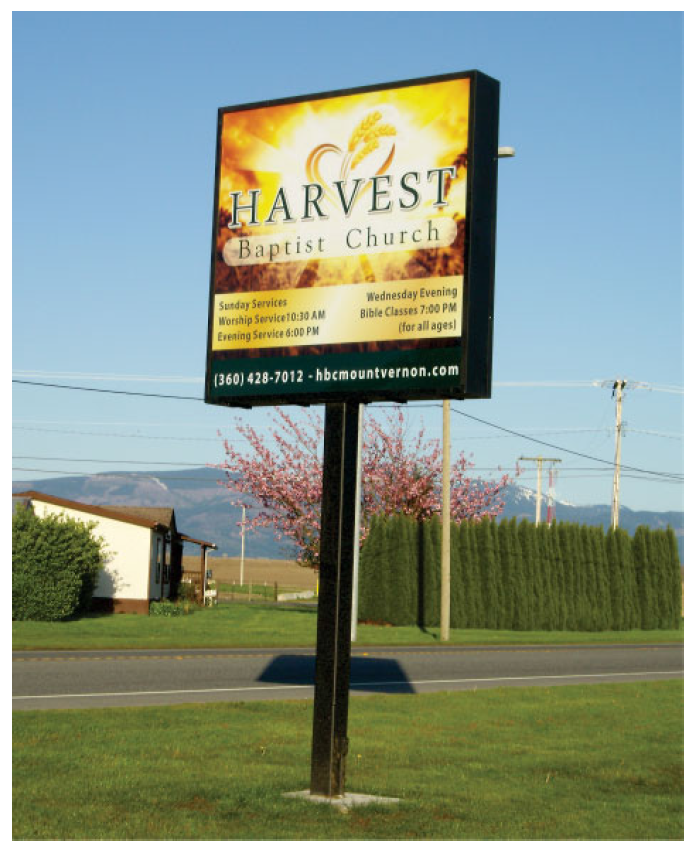
Freestanding pole signs are not permitted
1.
All signs not expressly permitted under these regulations or exempt from a permit in accordance with Section 2.2 of these regulations.
2.
Any sign other than traffic control signs, that is erected, constructed, or maintained within, over or upon a public right-of-way or city property, except projecting signs, signs on awnings, or canopies, flags, and sandwich board signs in conformance with these regulations, or civic event signs otherwise granted permission for such location by the City or the Colorado Department of Transportation.
3.
Any sign, other than traffic control signs, located in a vision clearance area.
4.
Any sign at any location where by reason of its position, size, shape, or color, it may obstruct, impair, obscure, interfere with the view of, or be confused with, any traffic control sign, signal or device, or may it interfere with, mislead, or confuse traffic.

Inflatable signs are not
permitted
5.
Handheld signs. No person shall place, maintain, or otherwise utilize a handheld sign in a manner which obstructs or makes hazardous the free passage of pedestrians and motor vehicles on any street, sidewalk, or public-right-of way.
6.
Vehicle signs. No person shall park any vehicle or trailer on a public right-of-way or public property, or on private property, so as to be visible from a public right-of-way which has attached thereto or located thereon any sign. This provision applies when the vehicle is placed in a location for the primary purpose of displaying signage and is not intended to prohibit any form of vehicular sign, such as a sign attached to a motor vehicle primarily used for business purposes other than advertising.
7.
Teardrop banner signs, as defined in Section 6.1.
8.
Any sign attached to a tree or utility pole whether on public or private property.
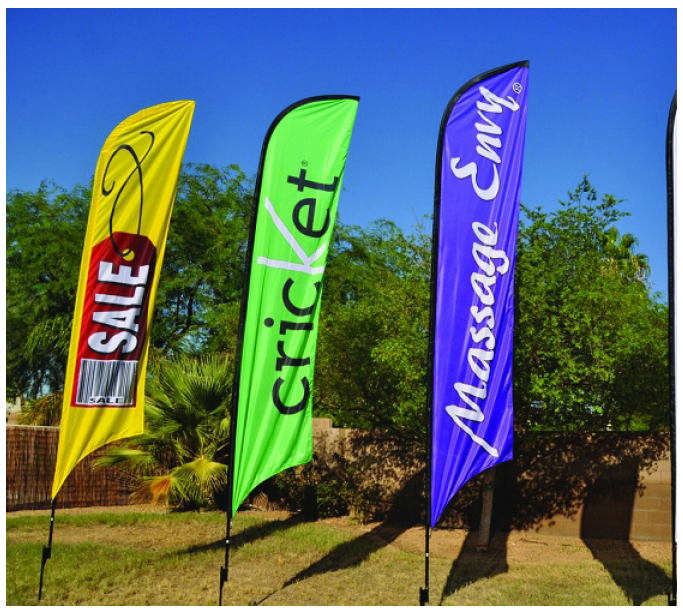
Teardrop banners are not permitted
9.
Any flashing, rotating or moving signs, animated signs, signs with moving lights, or signs which create the illusion of movement, except for:
a.
The City shall not deem a sign whereon the current time and/or temperature is indicated by intermittent lighting to be a flashing sign.
b.
Traditional barber poles.
c.
Electronic message signs, subject to the standards in Section 3.4.
10.
Inflatable signs or displays placed on the ground or on buildings or tethered to other objects or structures.
11.
Any freestanding pole sign, unless designated as an Iconic or Landmark Sign.
12.
Any sign painted, erected, and/or constructed upon, above or over the roof or parapet of any building.
13.
Any off-premise sign, including billboards. Off-premise sandwich board signs are permitted subject to the standards in these regulations.
14.
Any sign that obstructs access to or impedes operation of any fire escape, downspout, window, door, stairway, ladder, or opening intended to provide light, air, ingress, or egress for any building or structure as may be required by law.
15.
Any sign or sign structure which is structurally unsafe, constitutes a hazard to safety or health by reason of inadequate maintenance, abandonment, dilapidation, or obsolescence and/or is not kept in good repair.
2.1 - PERMIT REQUIRED.
A permit shall be required in order to change copy, erect, move, alter, reconstruct, or repair any permanent or temporary sign, except signs that are exempt from permits in compliance with Section 2.2.
1.
An application for a permit for a sign shall be submitted on a form provided by the Department of Building and Safety.
2.
Submittal requirements. Each application for a permit shall include:
a.
A to-scale drawing showing the proposed location of the sign(s) along with the property boundaries, locations, types, and square footage areas of all existing signs on the same site.
b.
Specifications and full color scale drawings shall be included showing the sign type, materials, design, and dimensions.
c.
Structural supports and/or attachments.
d.
To-scale landscaping plan, if required.
e.
Lighting and/or electrical components of the proposed sign(s).
f.
Additional submittal requirements, as requested at the discretion of the Department of Planning and Building Safety, which information is reasonably necessary to assist in the review of the sign permit application.
g.
The number of copies of application submittal items shall be determined by the Department of Planning and Building Safety.
h.
The appropriate fee as adopted and required by the City.
3.
Upon receipt of a complete application the Department of Planning and Building Safety shall review the same for compliance with these regulations, all applicable building code requirements, and any other applicable City codes and regulations, and approve, approve with conditions, or deny the application.
4.
The Department of Planning and Building Safety shall have the right to inspect the proposed sign location prior to acting on the application, and shall also have the right to inspect the sign after construction to insure compliance with these regulations and any conditions of approval.
5.
A permit for a sign shall lapse and have no further effect unless the applicant has erected a sign in compliance with the terms and conditions of the permit within one (1) year after the date of the permit approval, or as provided in the adopted City building codes.
2.2 - EXEMPTIONS FROM REQUIRED PERMIT.
The following signs are exempt from the permit requirements of Section 2.1 above; however, exempt signs remain subject to the remaining provisions of these regulations. Exempt signs shall otherwise be in conformance with all applicable requirements of these regulations, and the construction and safety standards of the City. All signs not listed in this Section and that are not prohibited by Section 1.6 require a permit pursuant to Section 2.1 above. Unless otherwise specifically provided, exempt signs may not incorporate illumination. Exempt signs include:
1.
Signs erected by the City or by any government agency, including, but not limited to, traffic control signs and civic event signs on city property or right-of-way. These signs may utilize illumination for safety purposes.
2.
Any public purpose/safety sign and any other notice or warning required by a valid and applicable federal, State or local law, regulation or resolution. These signs may utilize illumination for safety purposes.
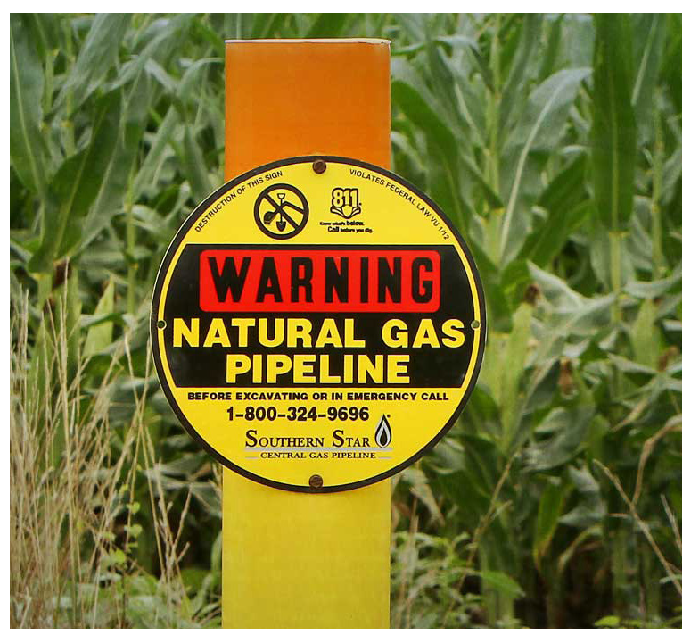
Public safety and warning sign
3.
Signs displayed on motor vehicles which are being operated or stored in the normal course of a business, provided that the primary purpose of such vehicles is not for the display of signs and provided that they are parked or stored in areas appropriate to their use as vehicles.
a.
Signs on vehicles shall not project beyond the surface of the vehicle in a manner which creates a hazard to pedestrians, cyclists, or other vehicles.
b.
It shall be unlawful to place or store a vehicle with a sign on it in such manner as to increase the permitted sign area or number of signs either on-site or off-site for a non-residential use, as provided in Section 1.6.
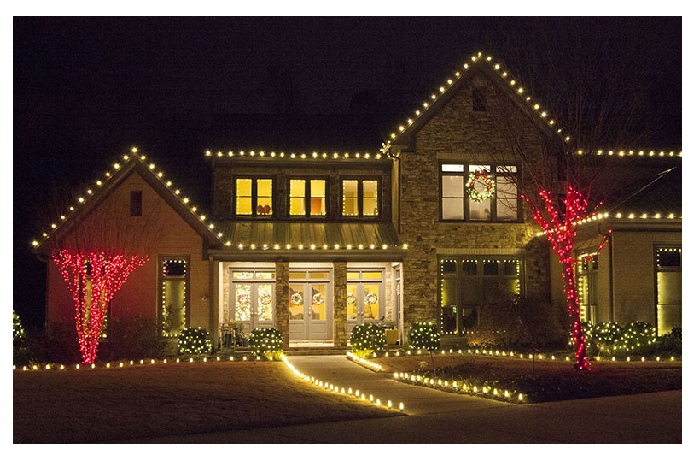
Temporary decorations
4.
Temporary decorations or displays, for a period of not more than forty five (45) consecutive days nor more than sixty (60) days in any one year. Such decorations or displays may be of any type, number, area, height, location, illumination or animation, provided that such decorations or displays:
a.
Are maintained and do not constitute a fire hazard; and
b.
Are located so as not to conflict with, interfere with or visually distract from traffic regulatory devices.
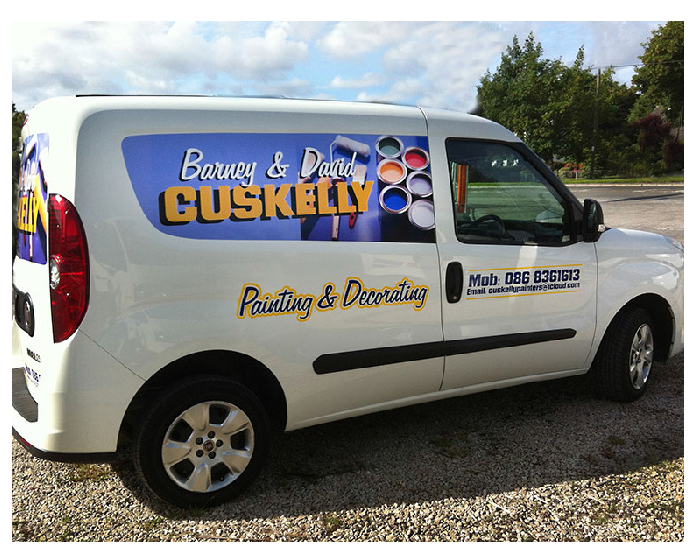
Sign Displayed on a Vehicle
5.
Flags that are affixed to not more than two (2) permanent flagpoles or flagpoles that are mounted to buildings (either temporary or permanent) provided that such flag maintains a minimum clearance of eight (8) feet from any travel surface and does not exceed twenty-four (24) square feet in Downtown, and forty (40) square feet in all other areas.
6.
Incidental and directional signs, as defined in Section 6.1, provided that such signs do not exceed five (5) square feet in sign area.
7.
Non-illuminated wall mounted display signs, as defined in Section 6.1, subject to the standards in Section 4.4.
8.
Window signs, as defined in Section 6.1, subject to the standards in Section 4.5 and 5.6.
9.
Sandwich board signs, as defined in Section 6.1, subject to the standards in Section 5.3.
10.
Site signs, as defined in Section 6.1, subject to the standards in Section 5.4.
11.
Yard signs, as defined in Section 6.1, subject to the standards in Section 5.5.
2.3 - WAIVERS AND MODIFICATIONS FROM SIGN REQUIREMENTS.
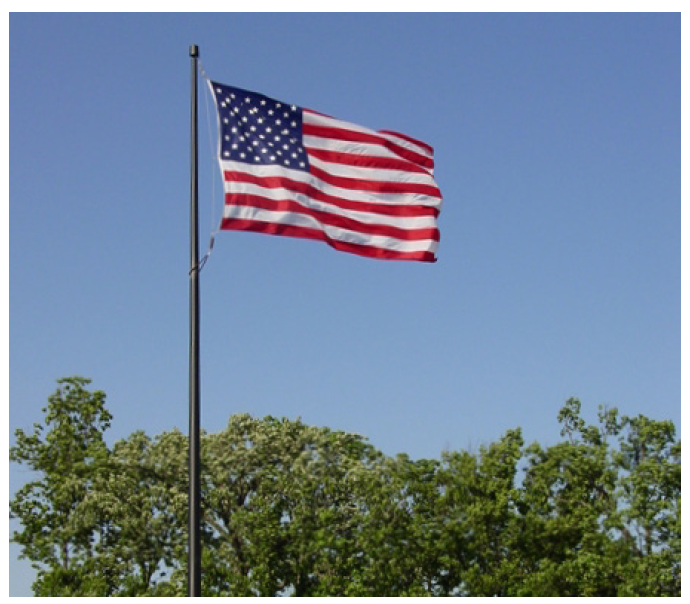
Flag affixed to a pole
1.
Unless eligible for a minor modification in Section 2.3.2, any request for an increase in the maximum allowable height, area, or number of signs permitted by these regulations shall follow the procedures set forth in Title 17 of the Louisville Municipal Code for approval of a Final Planned Unit Development (PUD). The City shall utilize the following review criteria as the basis of the evaluation of such request:
a.
The proposed sign(s) shall encourage excellence in design, exhibit improved creativity, promote community aesthetics, and be appropriate with the character of the area.
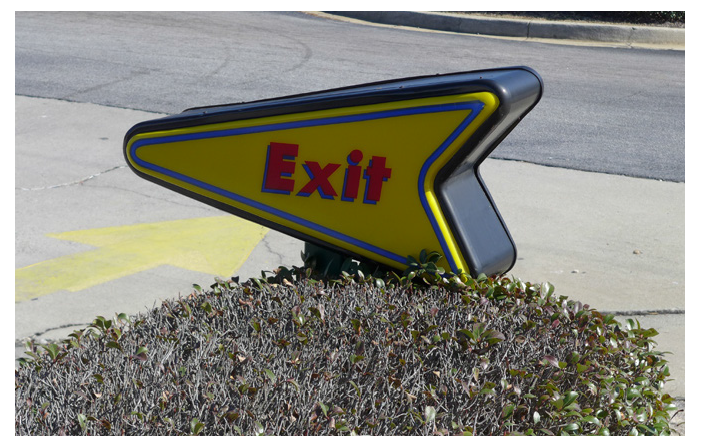
Directional sign
b.
The proposed sign(s) shall be compatible with the color, materials, and design of the on-site building(s).
c.
The proposed signs(s) shall be scaled and located in a manner that is compatible with the scale of the lot and the massing of the building(s), with consideration of legibility of copy area.
d.
The proposed sign(s) are otherwise in conformance with the regulations of this chapter and applicable design guidelines respecting the size, height, location, design, and appearance of the sign(s) involved.
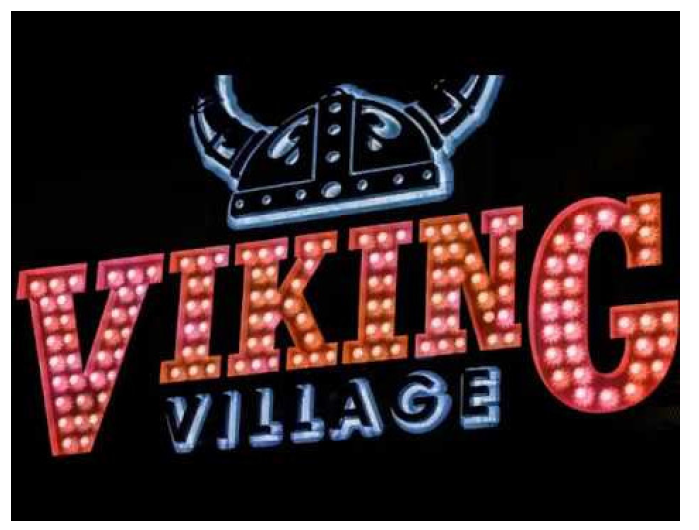
Creative sign design that could be considered through approval of a waiver for exposed
illumination
2.
The Department of Planning and Building Safety may grant minor modifications of any sign standard, including, but not limited to, sign area and/or height modifications of ten (10) percent or less, pursuant to the procedure for a Minor Impact Variance set forth in Sec. 17.52.050, and upon a finding that:
a.
The minor modification is of a technical nature and is required to compensate for some practical difficulty or unusual aspect of the site or the proposed sign.
b.
The proposed sign(s) shall encourage excellence in design, exhibit improved creativity, promote community aesthetics, and be compatible with the character of the area.
c.
The proposed sign(s) shall be compatible with the color, materials, and design of the on-site building(s).
d.
The proposed signs(s) shall be at a scale and location that is compatible with the scale of the lot and the massing of the building(s), with consideration of legibility of copy area.
2.4 - ICONIC SIGN DESIGNATION.
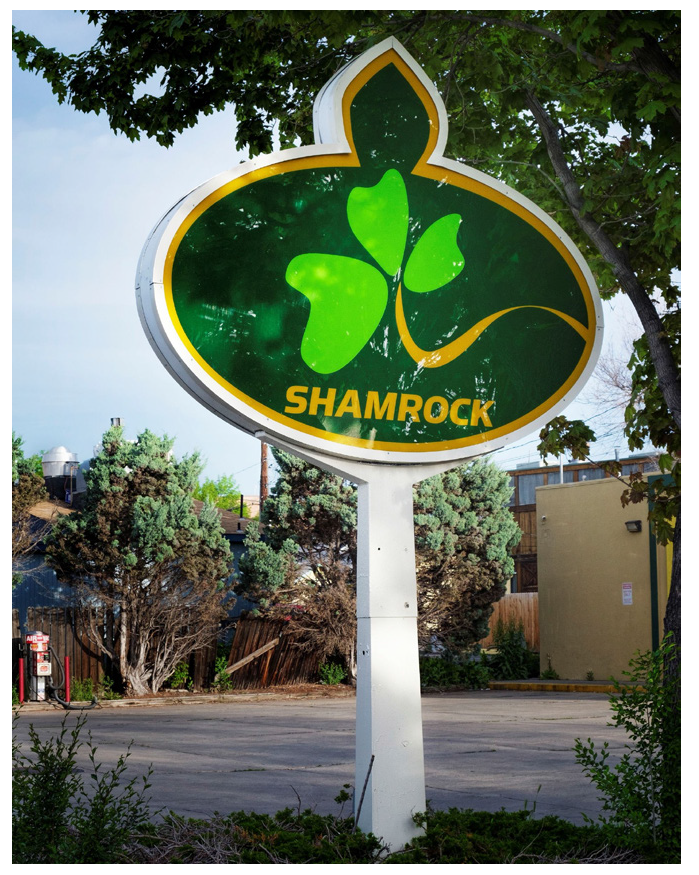
Designated Iconic Sign
1.
Iconic Signs. A sign designated as an Iconic Sign by the Historic Preservation Commission and City Council, and which retains those dimensional, locational, and lighting standards that the sign possessed when it received such a designation, shall benefit from the following privileges:
a.
May remain on roofs, or exceed height limits found elsewhere in these regulations.
b.
May exceed dimensional limits found elsewhere in these regulations.
c.
May change the sign copy and logo so long as the architectural quality of the original sign is maintained, subject to Section 2.4.6.
d.
Shall not have the sign area deducted from the square footage of sign area granted by other standards in these regulations.
e.
May remain in a right-of-way unless it becomes a hazard.
f.
May retain its original lighting patterns and materials.
g.
May be removed by the owner if they so choose.
2.
Review Criteria. The Department of Planning and Building Safety shall review all applications at the request of the property owner for the Iconic Sign designation for consistency with the review criteria described below. The review shall include consideration of size, color, materials, illumination, and location, as well as all other elements of creative sign design and construction. The Department of Planning and Building Safety will then forward the application and staff report to the Historic Preservation Commission for recommendation and City Council for official designation. An Iconic Sign shall meet the following criteria:
a.
The sign, by its design, construction, and location, will not have a substantial adverse effect on abutting property or the permitted use thereof, and will contribute to the City's unique character and quality of life.
b.
The sign exhibits unique or rare characteristics that enhance the streetscape or identity of Downtown Louisville, or the area it is located, and it clearly provides a unique architectural style and appearance.
c.
The sign contributes to the historical or cultural character of the streetscape or the community at large.
3.
Designation. The granting of the Iconic Sign designation is based upon a sign's distinct qualities. The City of Louisville Historic Preservation Commission and City Council shall have the authority to approve or disapprove the designation of an Iconic Sign based upon the criteria in Subsection (2) above.
4.
At the time of submittal, the applicant must file all information as required by the Department of Planning and Building Safety to determine if the sign meets the above criteria.
5.
A sign which the City has designated as an Iconic Sign will not be required to comply with the requirements for nonconforming signs.
6.
Any change to a sign which the City designates as an Iconic Sign that requires a permit under these regulations shall also require review and approval by the Historic Preservation Commission if the change is inconsistent with the findings for the initial Iconic Sign Designation.
2.5 - LANDMARK SIGN DESIGNATION.
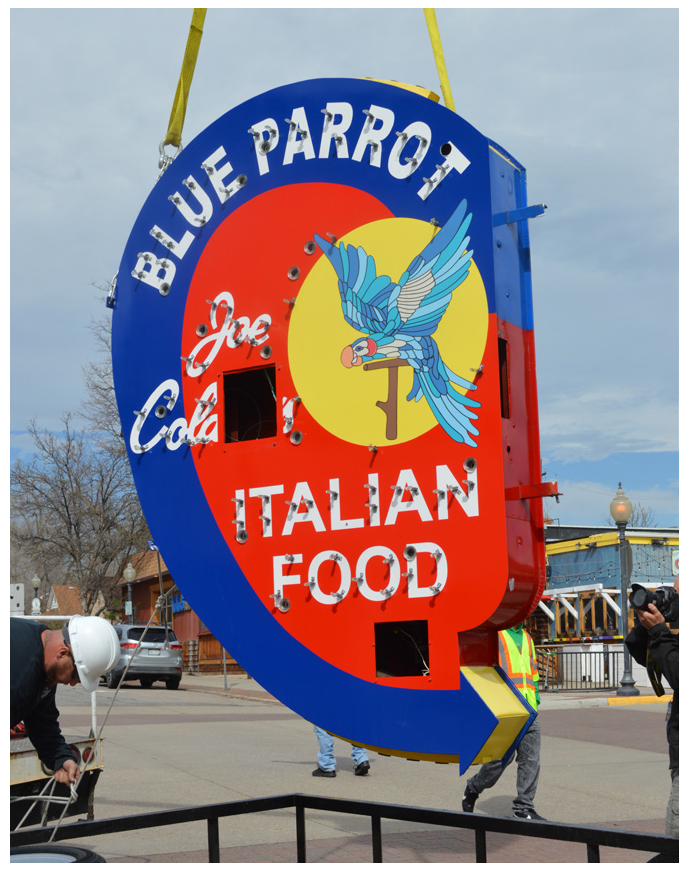
Designated Landmark Sign
1.
Landmark Signs. A sign which the Historic Preservation Commission and City Council officially designate as a Landmark Sign shall benefit from the following privileges:
a.
May be eligible for historic preservation funds for restoration, repair, or maintenance, with approval from the Historic Preservation Commission and City Council.
b.
May remain on roofs, or exceed height limits found elsewhere in these regulations.
c.
May exceed dimensional limits found elsewhere in these regulations.
d.
May change the sign copy only with an alteration certificate from the Historic Preservation Commission.
e.
Shall not have the sign area deducted from the square footage of sign area granted by other standards of these regulations.
f.
May remain in a right-of-way unless it becomes a hazard.
g.
May retain its original lighting patterns and materials.
2.
Review Criteria. A Landmark Sign shall meet the criteria established for a landmark structure as outlined in Section 15.36.050 of the Louisville Municipal Code.
3.
Designation. The City of Louisville Historic Preservation Commission and City Council shall have the authority to approve or disapprove the designation of a Landmark Sign based upon the criteria in Section 15.36.050 of the Louisville Municipal Code.
4.
At the time of submittal, the applicant must file all information as required by the Department of Planning and Building Safety to determine if the sign meets the criteria.
5.
A sign which the City designates as a Landmark Sign will not be required to comply with the requirements for nonconforming signs.
6.
Any change to a sign which the City designates as a Landmark Sign that requires a permit under these regulations shall also require an Alteration Certificate, pursuant to Section 15.36.110 of the Louisville Municipal Code. An Alteration Certificate must be issued prior to any work that requires a permit under these regulations.
3.1 - SIGN MEASUREMENT.
1.
Height.
a.
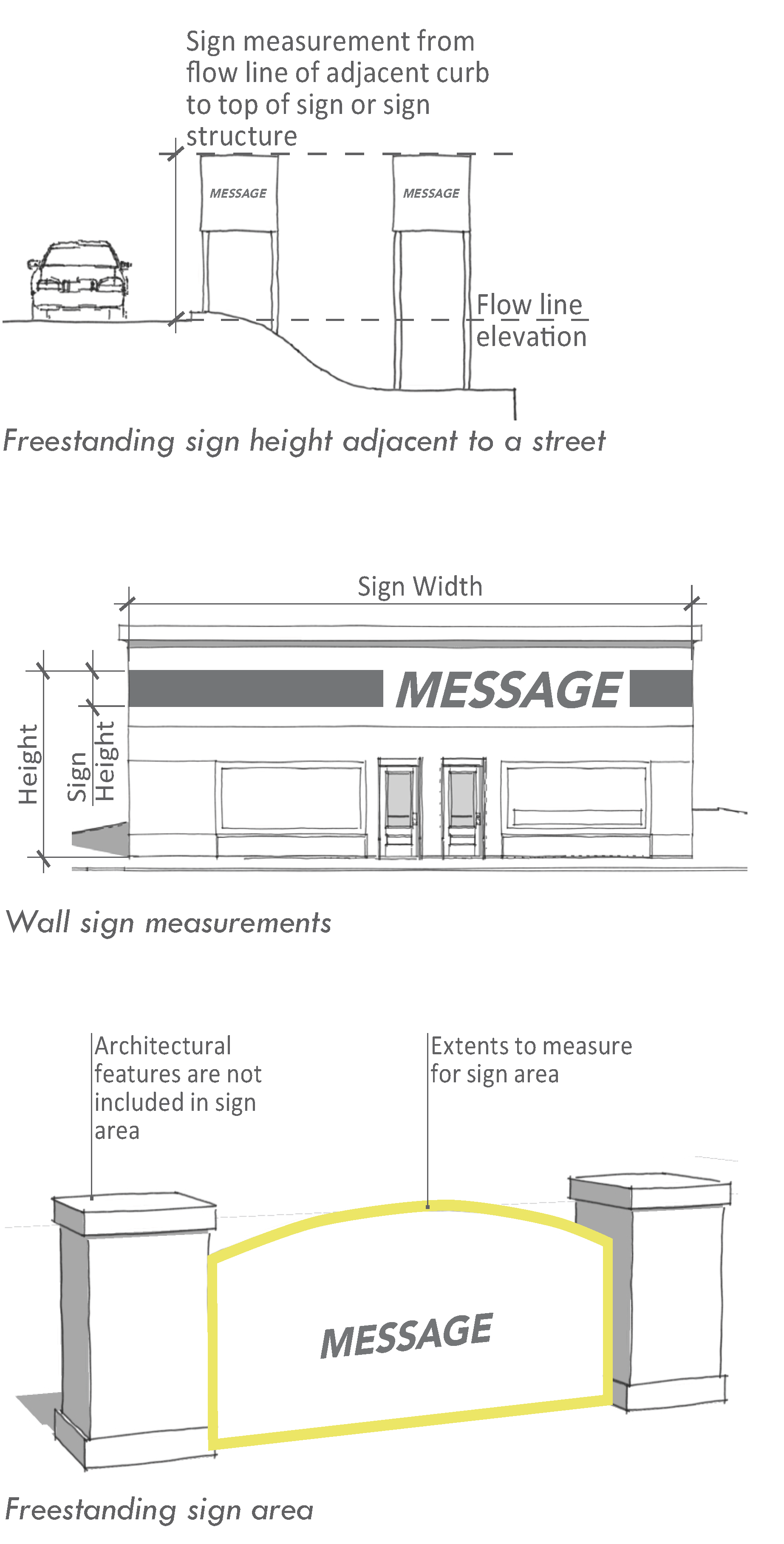
The height of a freestanding sign is the vertical distance to the top of the structure or sign face, whichever is higher, measured from the elevation of average grade in the area within the required landscape area around the base of the sign.
b.
For freestanding signs adjacent to a street, if average grade is more than two (2) feet lower than the average grade of the nearest abutting street, then the height of the sign shall be measured from the flow line elevation of said street to the top of the sign face or sign structure, whichever is higher.
c.
For signs mounted on a building, the height is measured from the average grade of the building frontage.
2.
Sign height. Sign height is the vertical distance of the sign area.
3.
Area of single-faced signs.
a.
Sign area is the entire surface area of a sign, including non-structural trim, frame, or other material or color forming an integral part of the display or used to differentiate the sign's contents from the background against which they are placed. The supports, uprights, or structures on which any sign is mounted shall not be included in measuring sign area.
b.
A building's architectural features, structural supports, and landscape elements shall not be included within the sign area.
c.
An awning, canopy, or non-cabinet wall sign's area shall be measured by including within a single continuous rectilinear perimeter of not more than eight straight lines that enclose the extreme limits of writing, representation, lines, emblems, or figures contained within all modules together with any air space, materials, or colors forming an integral part or background of the display or materials used to differentiate such sign from the structure against which the sign is placed.
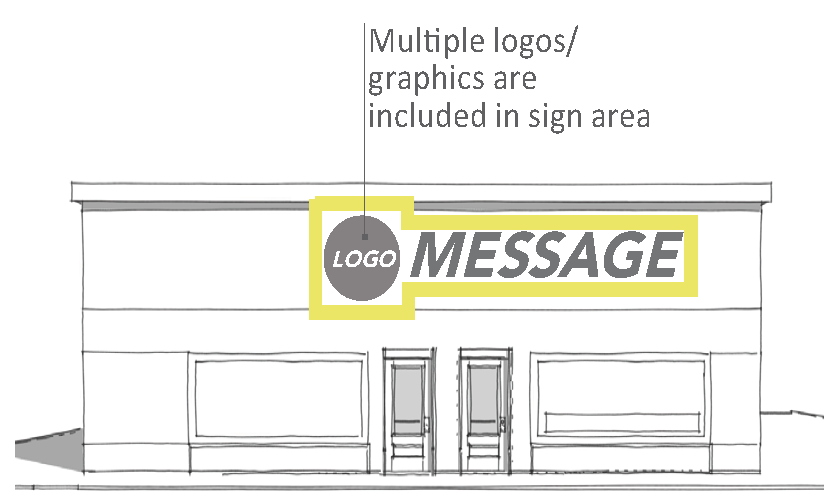
Multiple elements included in sign area
4.
Area of multi-faced signs. All sign faces visible from one point shall be counted and considered part of the maximum total sign area allowance for a sign.
a.
When two (2) identical sign faces are placed back to back so that both faces cannot be viewed from any point at the same time, and are part of the same sign structure, the sign area shall be computed as the measurement of one (1) of the two (2) faces.
b.
When a sign has more than two (2) display surfaces that are visible from the same viewpoint, or the sign is a three-dimensional object, the area of such sign is the largest display surface visible from any single direction.
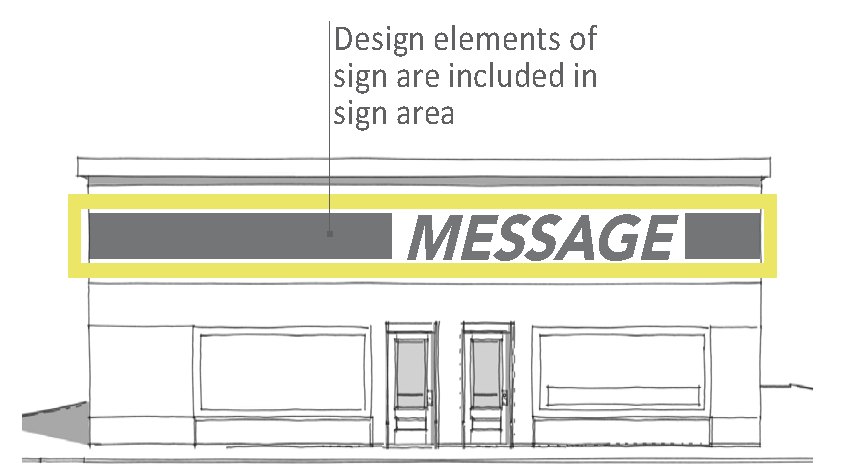
Elements included in sign area
5.
Area of multiple Signs.
a.
Whenever more than one (1) sign is placed on a freestanding structure, or on a projecting structure, the combination of signs shall be considered as one sign for the purpose of computing sign area and determining the number of signs on a site.
b.
Total sign area shall be computed by adding the areas of the individual signs.
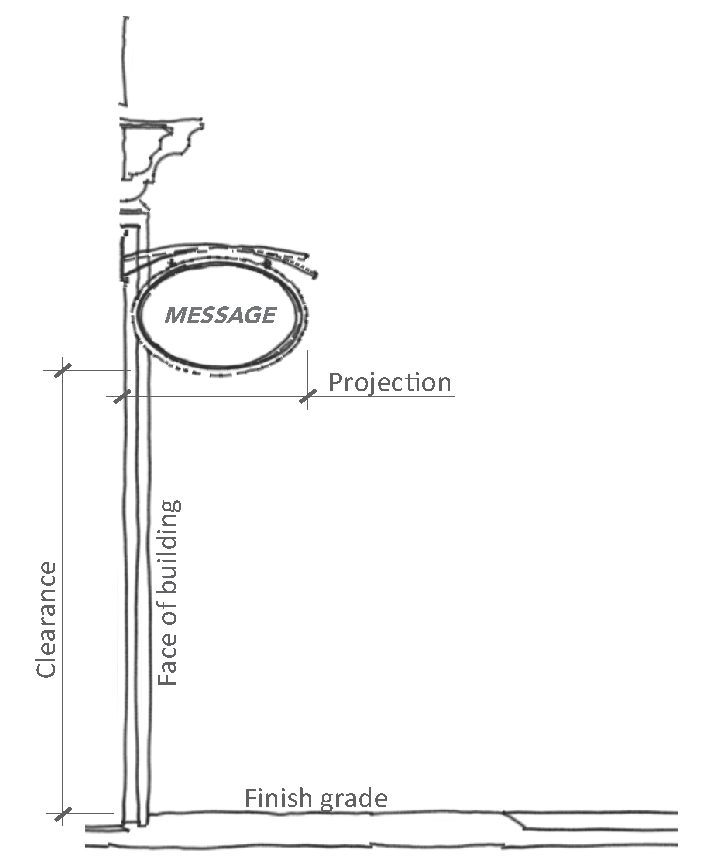
Projection and clearance
6.
Projection. Projection is measured as the distance from the face of the building to which a sign is mounted to the furthest point on the sign away from the wall.
7.
Clearance. Clearance is measured as the shortest distance between the bottom of a sign and the grade below.
3.2 - SIGN DESIGN.
In general, signs shall have mutually unifying elements which may include uniformity in materials, color, size, height, letter style, sign type, shape, lighting, location on buildings, and design motif.
1.
All signs shall be constructed of high quality durable materials.
2.
Exposed raceways and conduit.
a.
Raceways shall only be permitted when other means of attachment are not feasible, except as noted in d. below.
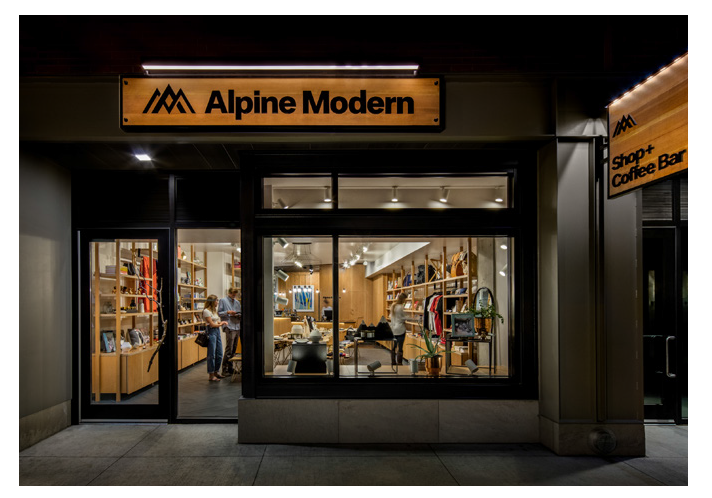
High quality, unified signage
b.
Exposed raceways shall be as thin and narrow as possible, shall be finished to match the background wall, and shall not extend in width or height beyond the area of the sign's lettering or graphics.
c.
Conduit shall be concealed from public view.
d.
Raceways and exposed conduit are not permitted in Downtown Louisville.
3.
Materials and textures of signs shall be compatible with the architectural character of the site and building. Supporting sign structures of freestanding signs shall match the primary finish and colors of the associated building(s).
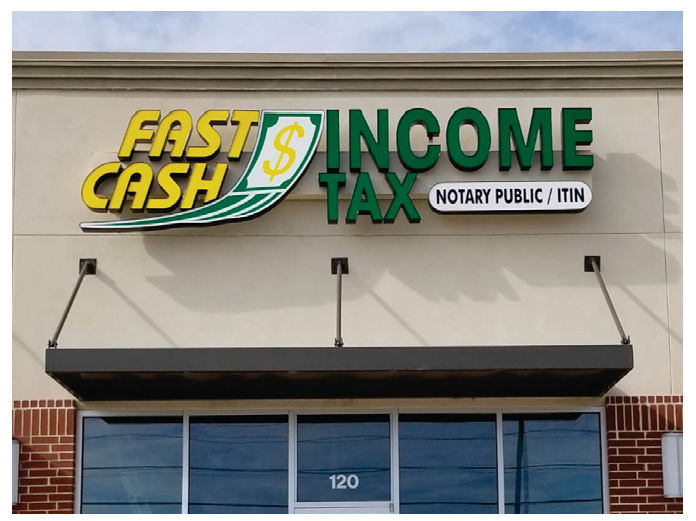
Exposed raceway
4.
Where possible, freestanding signs shall integrate tenant signs into a single sign structure.
5.
Wayfinding and directional signage systems shall be of a unified graphical system. Such signage shall be placed in consistent locations near site entries, key points on the internal automobile and pedestrian circulation system, building entries, seating areas, and sidewalk intersections.
6.
The supporting members of a sign shall appear to be free of any extra bracing angle iron, guy wires, cables, etc. The supports shall appear to be an architectural and integral part of the building and/or sign.
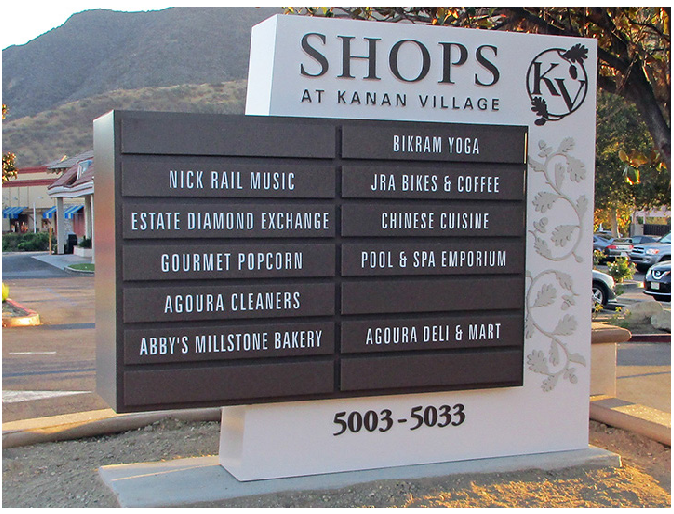
Multi-tenant freestanding sign
3.3 - SIGN ILLUMINATION.
Illumination of signs shall be in accordance with the following requirements, in addition to the standards provided in Section 4 for each sign type:
1.
Internally illuminated signs.
a.
No internally illuminated sign shall include any exposed light source, except that neon or aesthetically equivalent tube lighting is permitted where neon is allowed.
b.
When an internally illuminated sign cabinet is permitted, only that portion of the sign face dedicated to the trademark or characters may be translucent. The balance of the sign face shall be opaque.
2.
Externally illuminated signs.
a.
All signs that use external illumination shall have their lighting directed in such a manner as to illuminate only the face of the sign without causing glare.
b.
The light source must be downcast and fully shielded.
c.
Projecting light fixtures shall be simple and unobtrusive in appearance, and shall not obscure the graphics of the sign.
3.
No illuminated sign visible from and located within three hundred (300) feet of any property in a residential zoning district may be illuminated between the hours of 11:00 p.m. or one-half hour after the use to which it is appurtenant is closed, whichever is later, and 7:00 a.m.
4.
Light sources which flash, rotate, move, or create the illusion of movement are prohibited anywhere in Louisville, except as provided for in Section 1.6 and Section 3.4.
5.
All illuminated signs in AO-T zone districts shall comply with Section 17.13.110 of the Louisville Municipal Code regarding glare, and the following additional standards:
a.
Signs shall be illuminated only from a concealed light source internal to the sign structure or shielded from public view and from surrounding properties used to illuminate only the sign face, and not any area beyond the face; and
b.
Signs shall not remain illuminated between the hours of 9:00 p.m. and 6:00 a.m.
3.4 - ELECTRONIC MESSAGE CENTERS.
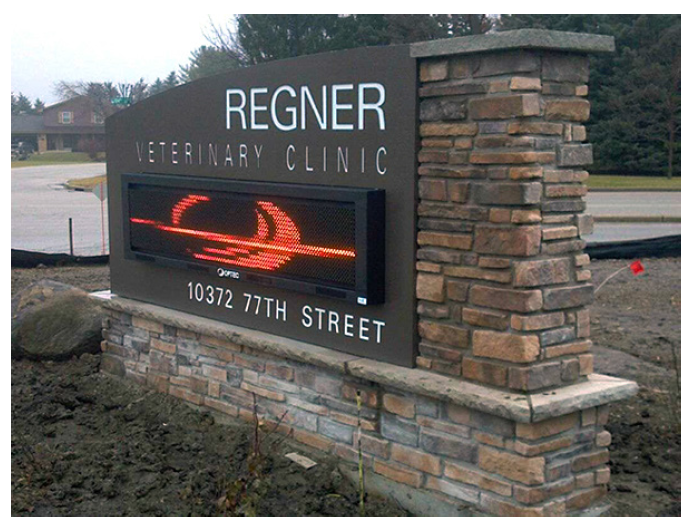
Electronic message center
1.
Electronic message centers are permitted for the display of variable pricing on freestanding signs for gasoline stations and display signs in Commercial and Mixed-Use Areas.
2.
Any other electronic message center may be permitted only if expressly authorized in an approved Final PUD plan. The electronic message center in the Final PUD plan shall meet the specific standards in Section 3. below and shall include standards and requirements concerning the design and location of the electronic message center, and shall demonstrate exceptional and unique circumstances warranting the use of the electronic message center.
3.
All electronic message centers shall meet the following requirements:
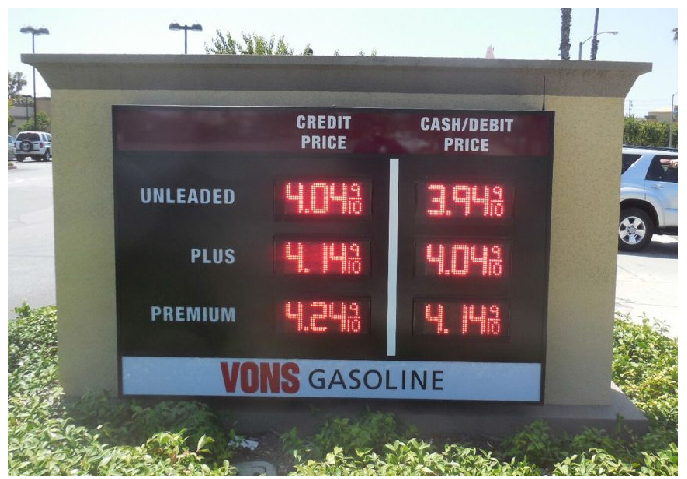
Electronic message center at a gas station
a.
The electronic message area of a freestanding sign shall be integrated into the design of the freestanding sign. Such electronic message portions of freestanding signs shall not be an add-on feature, but rather must be fully integrated into the sign design.
b.
All electronic message centers shall include a malfunction display and the ability to automatically shut off if a malfunction occurs.
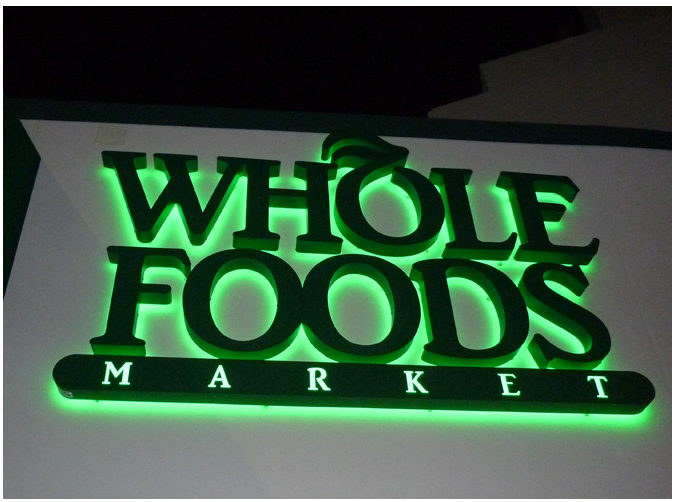
Halo lit wall sign
c.
Transition method. The electronic message center shall be limited to static messages, changed only through either dissolve or fade transitions, which may otherwise not have movement, or the appearance or optical illusion of movement, of any part of the sign or structure, design, or pictorial segment of the sign, including the movement of any illumination or the flashing, scintillating or varying of light intensity.
d.
Transition duration. The transition duration between messages shall not exceed one (1) second.
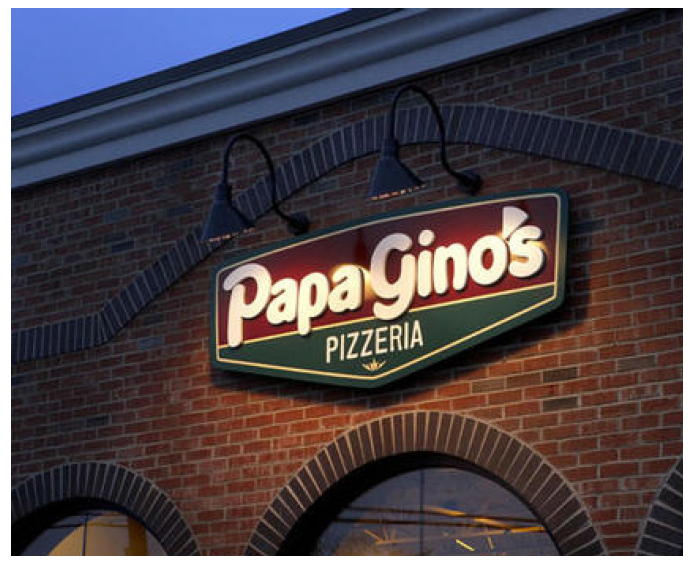
Externally illuminated wall sign
e.
Message hold time. Messages shall not transition on a frequent basis. The message hold time shall be appropriate for the site, surrounding neighborhood, uses, and roadway.
f.
Lighting from an electronic message center shall not exceed 0.3 footcandles between dusk to dawn as measured from the sign's face. The City may require lower light levels if it determines less light is appropriate for the surrounding area. The electronic message center shall have automatic dimmer software or solar sensors to control brightness for nighttime viewing. The intensity of the light source shall not produce glare, the effect of which constitutes a traffic hazard.
g.
Existing signage proposed for conversion to the use of an electronic message center shall conform to the sign standards in these regulations prior to issuance of a sign permit. Nonconforming signs shall not be eligible for conversion to an electronic message center.
3.5 - SIGN INSTALLATION.
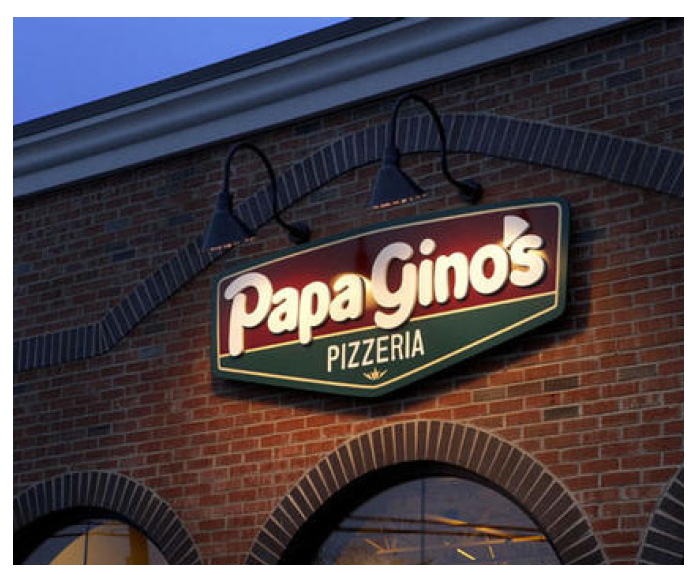
Externally illuminated wall sign
1.
In addition to the permit requirements in Section 2.1, all permanent signs and all components thereof, including sign structures and sign faces, shall be installed in compliance with the adopted building and electrical codes of the City.
a.
At final inspection by the City, every electric sign shall have affixed thereon an approved Underwriters' Laboratories label, or all wiring of such sign as approved by the State electrical inspector, and all wiring connected to such sign shall comply with all provisions of the applicable regulations of the City relating to electrical installations. This label may be removed following the passage of final inspection.
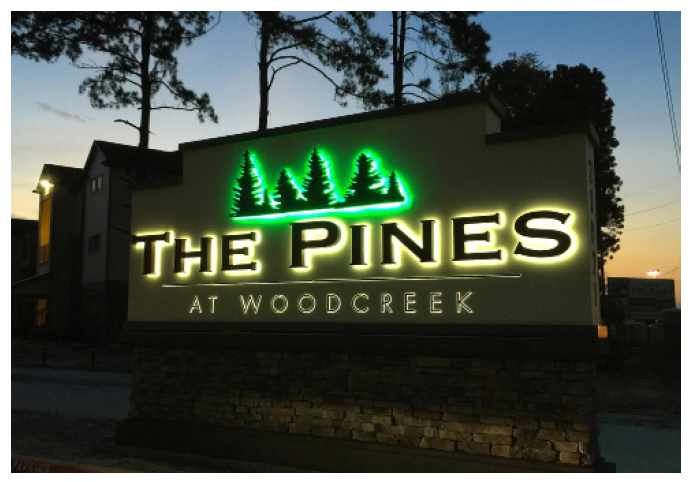
Halo lit freestanding sign
b.
Signs shall be located in such a way as to maintain horizontal and vertical clearance of all overhead electrical conductors in accordance with adopted electrical code specifications, depending on voltages concerned. However, in no case shall a sign be installed closer than forty eight inches (48") horizontally or vertically from any conductor or public utility guy wire, or as recommended by the local public utility company.
c.
No sign or sign structure shall be installed that impedes pedestrian or vehicular movement, or be erected in such a location as to cause visual obstruction or interference with motor vehicle traffic or traffic-control devices, or obstruct clear vision in any direction from any street intersection or driveway.
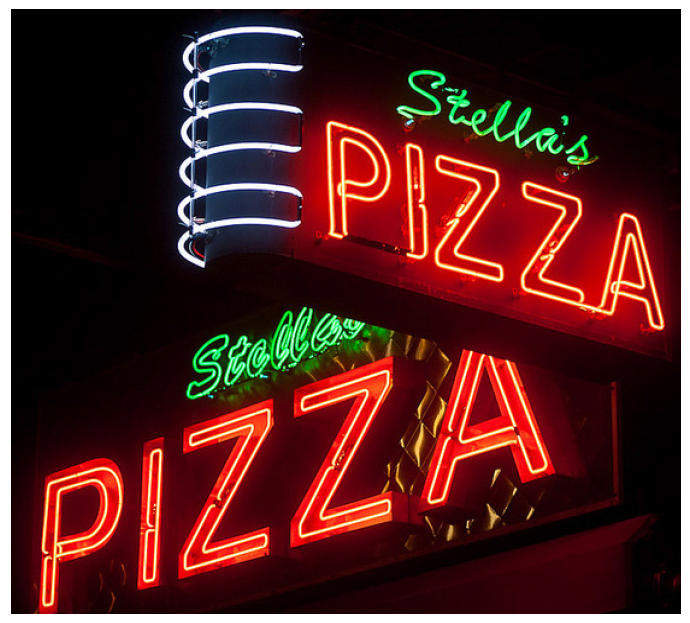
Neon illuminated signs
d.
No sign or sign structure shall be installed that obstructs access to or impedes operation of any fire escape, downspout, window, door, stairway, ladder or opening intended to provide light, air, ingress or egress for any building or structure as may be required by law. If possible, signs should not be placed in locations that obscure architectural features such as pilasters, arches, windows, cornices, etc.
e.
No sign or sign structure shall be installed which is structurally unsafe.
2.
Except for flags, window signs and temporary signs conforming to the requirements of these regulations, all signs shall be permanently attached to the ground, a building, or another structure by direct attachment to a rigid wall, frame, or structure.
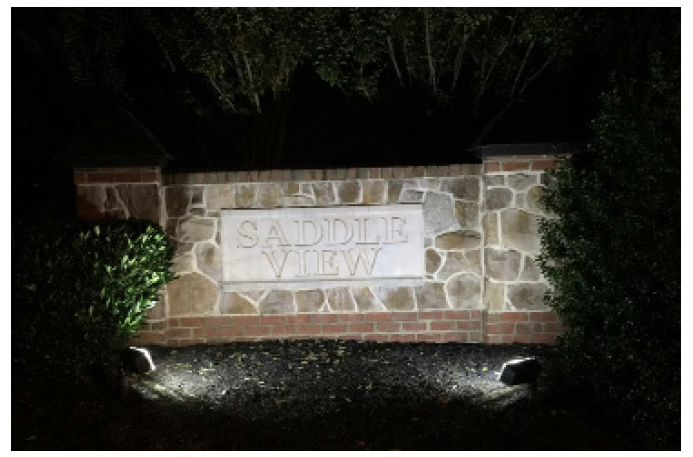
Up-lit signs are not allowed
3.6 - SIGN MAINTENANCE.
The owner or lessee of any sign shall take all reasonable actions so that the sign will be maintained.
1.
All signs, and all parts and components thereof, shall be maintained in a safe condition in compliance with the approved permit and in conformance with these regulations.
a.
All signs, including sign structures and sign faces, shall be maintained in good repair at all times and shall not constitute a hazard to safety, health, or public welfare by reason of inadequate maintenance or deterioration. For the purposes of this Section, good repair shall mean that there are no loose, broken, torn, or severely weathered portions of the sign structure or sign face.
b.
The owner of a sign is required to keep signs and supporting hardware structurally safe, clean, free of visible defects, including graffiti, and functioning properly at all times. Exposed surfaces shall be kept clean and neatly painted, and free from rust and corrosion. Defective parts shall be replaced. Repairs to signs shall be equal to or better in quality of materials and design than the original sign.
2.
All signs or any part of a sign which is broken or damaged or which is not reasonably maintained such as to present a nuisance, hazard or potential hazard, including any required landscaping, shall be repaired or removed by the sign owner such that the sign no longer is a nuisance or endangers public health and/or safety. If the sign owner fails or refuses to repair or remove the unsafe sign as herein required, the sign shall be deemed a nuisance and the City may abate the same as provided in Section 8.01.050 of the Louisville Municipal Code, as the same may be amended.
3.7 - SIGN ALTERATION AND REMOVAL.
1.
Any alteration to an existing sign, including a copy change, shall require a new sign permit pursuant to Section 2.1, unless exempt pursuant to Section 2.2. Alterations shall include, without limitation:
a.
Changing the size of the sign;
b.
Changing the shape of the sign;
c.
Changing the material of which the sign is constructed;
d.
Changing or adding lighting to the sign;
e.
Changing the location of the sign; or
f.
Changing the height of the sign.
2.
Existing nonconforming signs may be altered in any way that does not change the materials, light source, size height, background, shape or location of the sign without bringing the entire sign into conformance, provided that the cost of the alteration is less than fifty (50) percent of the sign's replacement cost.
3.
Any abandoned or illegal sign, which is not removed from the premises by the owner, user, or property owner within the time frames prescribed shall be subject to removal in accordance with the provisions and procedures detailed in this Section. The City shall consider any such sign a violation of the provisions of these regulations.
a.
An abandoned permanent sign shall be removed within thirty (30) days from time the purpose has passed or no longer applies.
b.
An abandoned temporary sign shall be removed within three (3) days from time the purpose has passed or no longer applies.
c.
When a building-mounted or painted wall sign is removed, the face of the structure shall be treated to conform to surrounding building conditions. Such removal shall not leave any evidence of the sign's existence.
d.
Any illegal sign shall be removed from the premises upon which it is located within thirty (30) days from the notice of violation, and shall not remain on the premises until and unless a sign permit is issued.
4.
Upon failure of the owner, user, or property owner to comply within the specified time requirements set out in this Section, the City Manager is hereby authorized to cause such abandoned or illegal sign to be removed and any expense attendant thereto shall be paid by the owner, agent, or person having the beneficial use of the building, structure, or premises upon which the sign is located.
a.
If such removal expense remains unpaid for more than thirty (30) days after such removal is performed with expense incurred by the City, and a bill for same was mailed to the permittee or property owner by first class, certified or registered mail, such unpaid charge shall constitute a lien upon the real estate.
b.
The City Attorney is hereby authorized, in accordance with the law, to file a notice of lien in the office of the County Clerk to foreclose this lien and to sue the owner of the property of sign permittee, or their agents, in a civil action to recover the money due for the foregoing service, plus all its costs as hereinafter more fully described, together with reasonable attorney's fees to be fixed by the court.
c.
Any such judgement shall be enforced in accordance with law. Included in the expenses recoverable by the City shall be the costs of filing the notice of lien, foreclosing such lien, and all litigation costs, together with all office and legal expenses incurred in connection with collection of the amount due hereunder.
d.
In lieu of filing and enforcing a lien, the City may certify its costs of removal and enforcement with the County Treasurer under C.R.S. 31-20-105 & 106 for collection in the same manner as real property taxes.
e.
A failure to remove any abandoned or illegal sign and subsequent failure by the Department of Planning and Building Safety to duly notice the owner, user, or property owner of the provisions of this Section shall not be deemed to constitute a waiver of any violations of these regulations, nor to be given any special status.
f.
If, through administrative neglect or inaction, an owner, user, or property owner is not notified of the requirements of this Section within the time frames specified, but is later so notified, such owner, user, or property owner shall take action to either correct the abandonment or illegality or shall cause the sign to be removed within twenty (20) days of such notification.
g.
Any sign removed by the City, in accordance with this Section, shall become the property of the City and may be disposed of in any manner deemed appropriate by the City.
3.8 - DISTRICT AREAS.
The regulations in Section 4 and 5 set forth standards applicable by districts. Contact the Department of Planning & Building Safety to confirm which district is applicable.
Residential: Generally, this area is comprised of the residentially zoned properties, or properties developed with residential uses. This area includes properties zoned A, RR, RE, RL, RM, RH, R-RR, SF-LD, SF-MD, SF-HD, SF-R, SF-E, and PCZD-R. This also may include commercially zoned properties with residential uses approved through a Special Review Use. Institutional uses include those defined by Use Groups 9, 11 through 23, and 30 of Section 17.12.030 the Louisville Municipal Code that are located in the above zone districts.
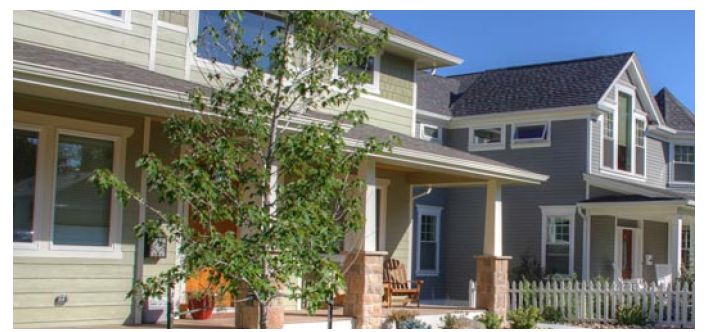
Residential Area
Commercial: Generally, this area includes properties with commercial zoning, and that are subject to the Commercial Development Design Standards and Guidelines. This area includes properties that are zoned CN, CC (not Downtown), CB, AO, BO, AO-T (with additional regulations) and PCZD-C.
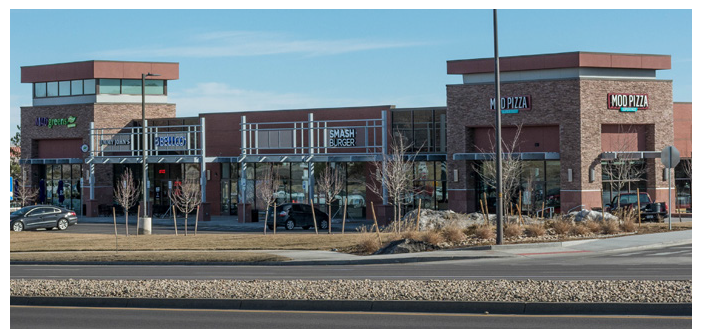
McCaslin Marketplace—Commercial Area
Industrial: Generally, this area includes properties with industrial zoning, and that are subject to the Industrial Development Design Standards and Guidelines. This area includes properties that are zoned I and PCZD-I.
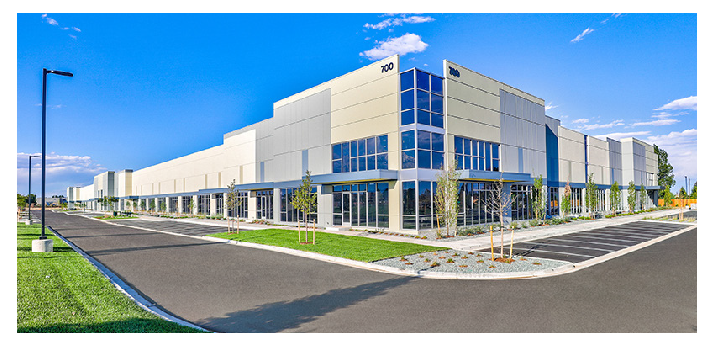
Louisville Corp. Campus—Industrial Area
Mixed-Use: This area includes properties with mixed-use zoning, and that are subject to the Mixed Use Development Design Standards and Guidelines. This area includes properties that are zoned MU-R and CC-MU. This area also includes properties located on the east side of the railroad tracks within the downtown, as defined in Sec. 17.08.113 of the Louisville Municipal Code.
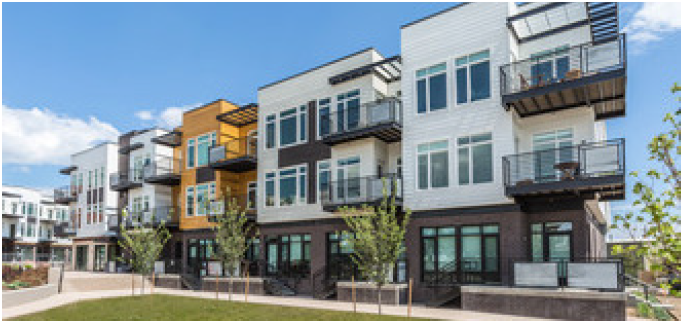
DELO—Mixed-Use Area
Downtown: This area includes properties with Commercial Community zoning that are located on the west side of the railroad tracks within the Downtown, as defined in Sec. 17.08.113 of the Louisville Municipal Code. Properties located on the east side of the railroad tracks in Downtown are subject to the standards in the Mixed-Use Area.
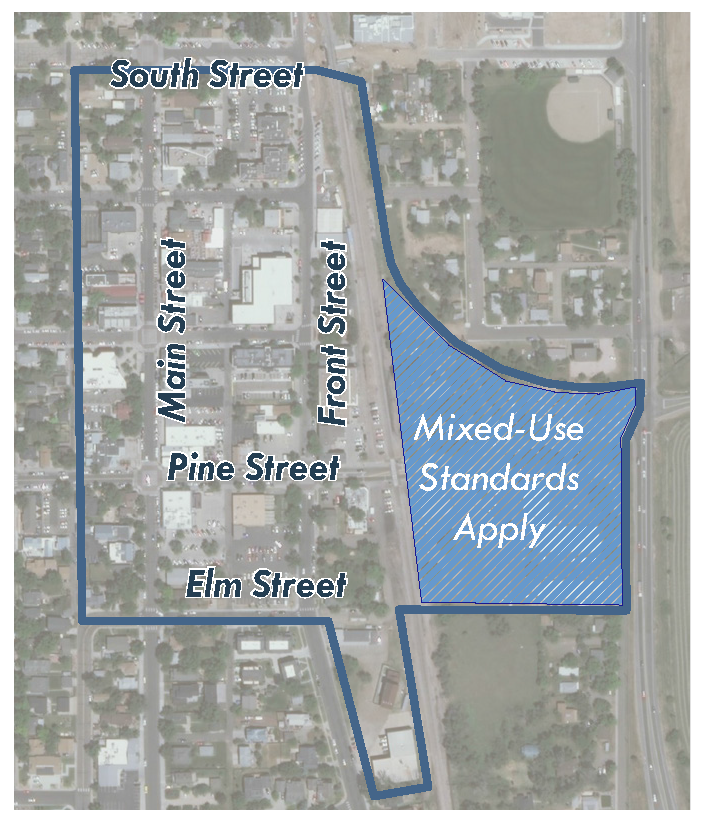
Downtown Louisville
4.1 - PERMANENT SIGNS.
The standards of this Section apply to all permanent signs. Permanent signs may be subject to additional standards set out elsewhere in these regulations.
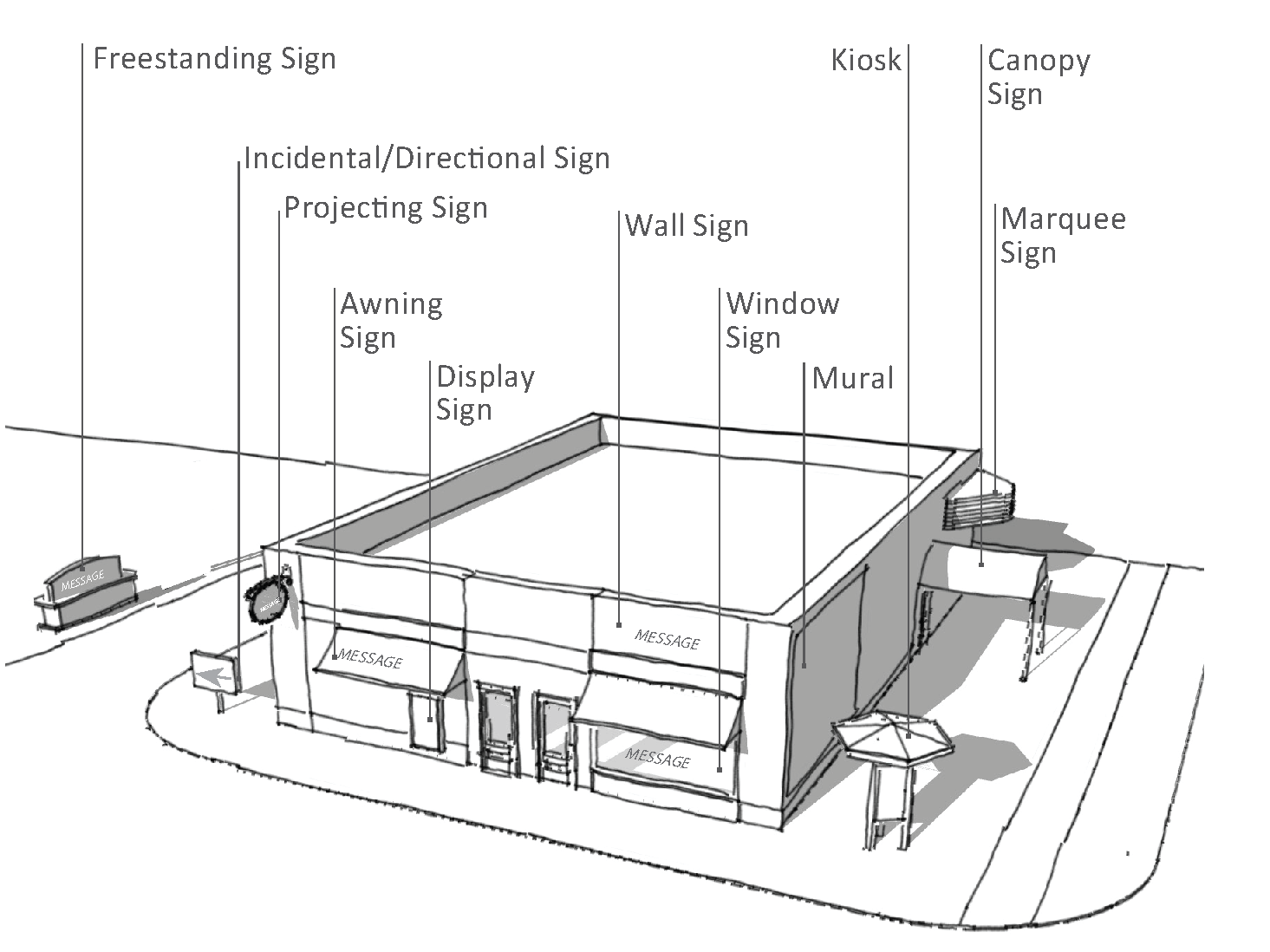
Sign Types. Permanent signs include the following types:
4.2 Awning Signs
4.3 Canopy Signs
4.4 Display Signs
4.5 Window Signs
4.6 Kiosks
4.7 Marquee Signs
4.8 Murals
4.9 Projecting Signs
4.10 Freestanding Signs
4.11 Wall Signs
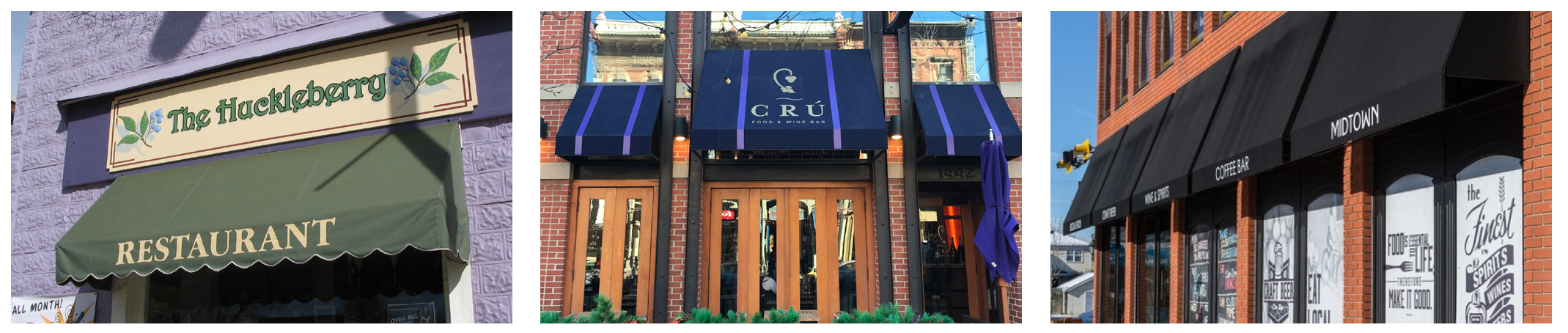
4.2 - AWNING SIGNS.
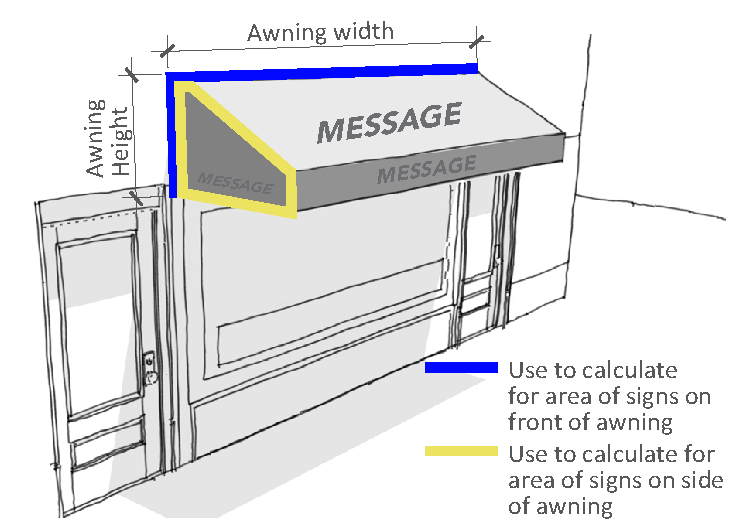
Awning sign measurement
Signs on awnings are subject to the standards below. These regulations do not authorize the installation of awnings, with or without signs, without obtaining any necessary building permits in compliance with the City's applicable building and zoning codes.
1.
Awnings that contain signs shall be designed to be compatible with the storefront in scale, proportion, material, and color.
2.
No awnings with signs shall extend above the roof line of any building, or the first story, whichever is less.
3.
No sign mounted to an awning shall project beyond, above, or below the face of the awning.
4.
The principal function of any awning with a sign must be to provide shelter for a window, a door, or an outdoor seating area.
5.
An awning in Downtown shall project not more than six (6) ft from the face of the building to which it is mounted, or two-thirds (2/3) the width of the walkway above which it is mounted, whichever is less. Awnings in all other areas shall comply with the design regulations in effect in that area.
4.3.a - CANOPY SIGNS IN VEHICULAR AREAS.
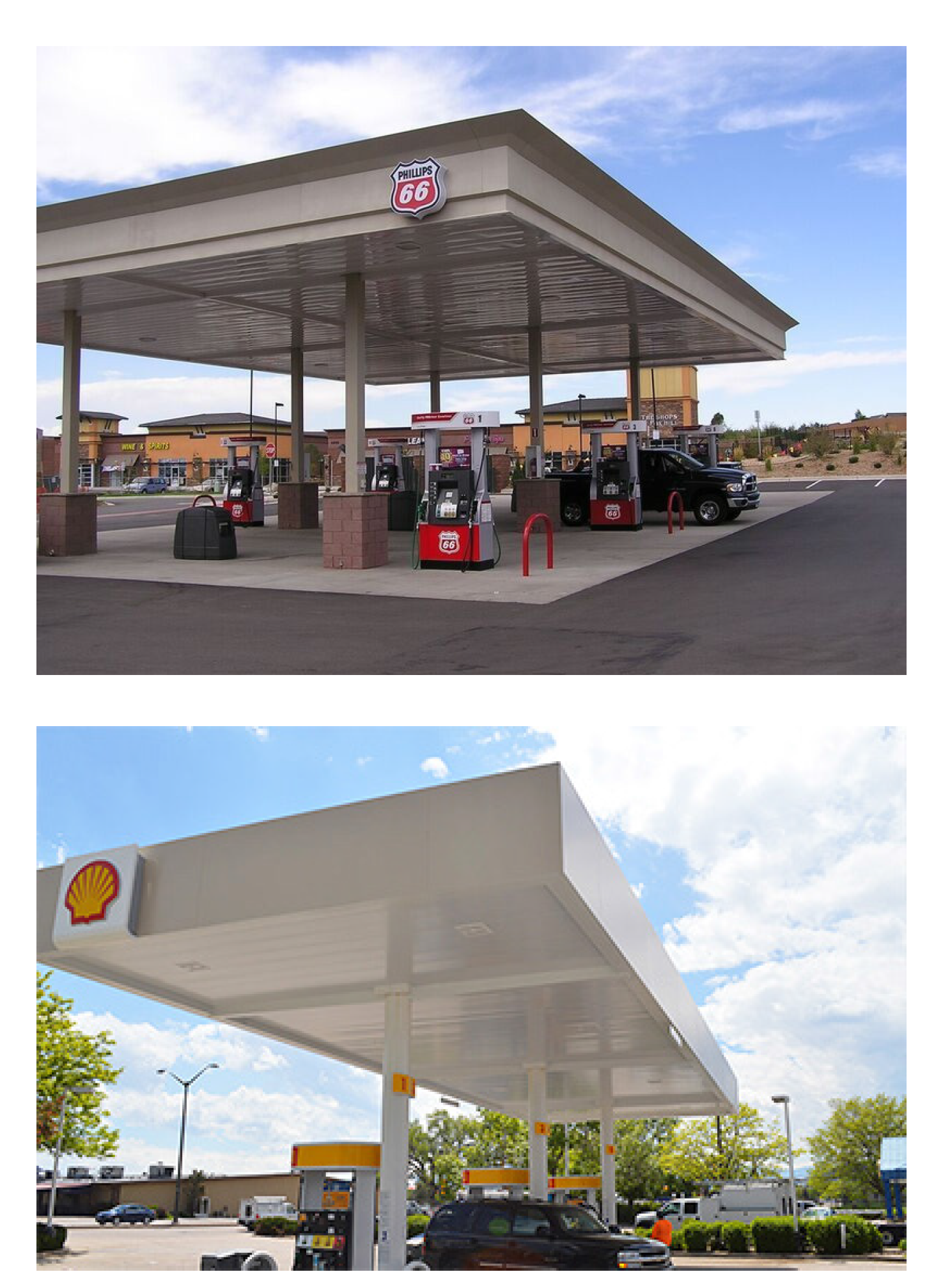
Signs on canopies in vehicular areas may be permitted only in commercial and mixed-use areas, and only if a canopy in a vehicular area is expressly authorized in an approved Final PUD plan. The PUD plan shall contain standards and requirements concerning the design of any canopy in vehicular areas.
1.
Canopies with signs shall be designed to be compatible with the storefront in scale, proportion, and color.
2.
Signs on a canopy in a vehicular area shall not be permitted to wrap the canopy.
4.3.b - CANOPY SIGNS IN PEDESTRIAN AREAS.
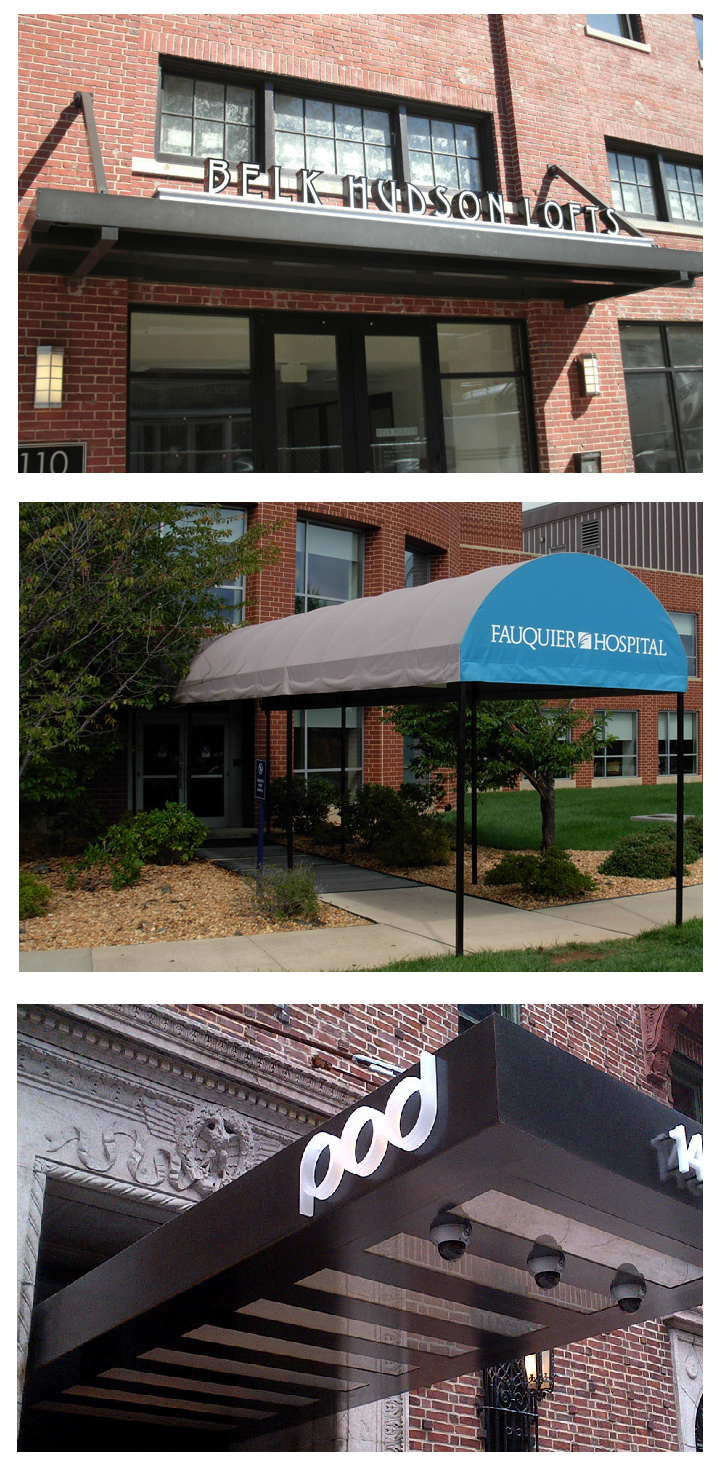
Signs on canopies are subject to the standards below. These regulations do not authorize the installation of canopies, with or without signs, without obtaining any necessary building permits in compliance with the city's applicable building and zoning codes.
1.
No sign mounted to a canopy shall project below the face of a canopy. Signs mounted to the top of a canopy shall be designed such that:
a.
They are comprised of channel letters or other three dimensional forms;
b.
The mounting hardware and supporting structures of the sign are concealed from view;
c.
The sign does not extend more than two (2) feet above the top of the canopy, or extend above the nearest roofline, whichever is less.
4.
Canopies with signs shall be designed to be compatible with the storefront in scale, proportion, material, and color.
5.
Canopies in Downtown shall project not more than six (6) ft from the face of the building to which it is mounted, or two-thirds (2/3) the width of the walkway above which it is mounted, and shall maintain a two (2) ft minimum distance from the back of the curb, whichever is less. Canopies in all other areas shall comply with the design regulations in effect in that area.
4.4 - DISPLAY SIGNS.
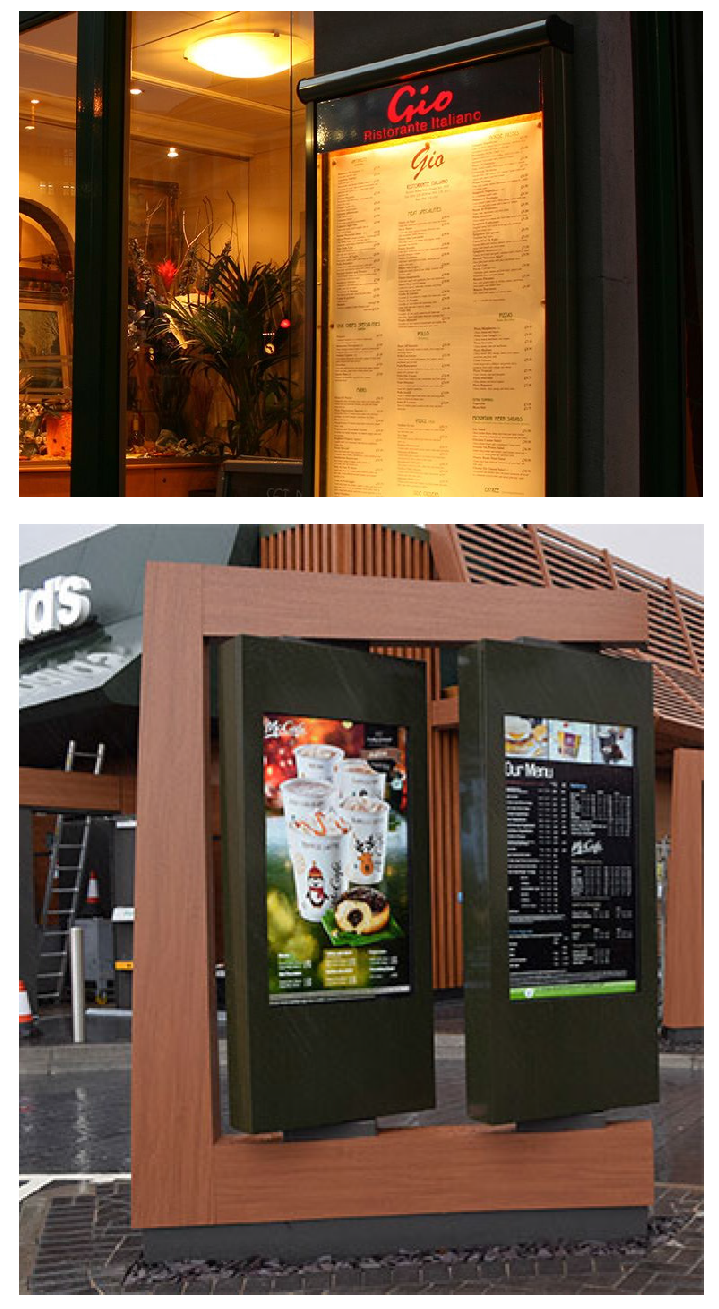
Display signs are subject to the standards below. Display signs may be wall mounted or may orient to occupants in a vehicle. Display signs oriented to occupants in a vehicle may be permitted only in commercial and mixed-use areas, and only if a drive through is expressly authorized in an approved Final PUD plan.
1.
High quality materials shall be used in the construction of display signs.
2.
Display signs shall be appropriate in material, size, location, and design to the character and architectural detail of the building and site.
3.
Display signs may include electronic message centers in commercial and mixed-use areas, subject to Section 3.4.
4.
A display sign oriented to a drive through in a Commercial or Mixed-Use area may be an electronic message center that contains up to 100% of the sign area, only if the display changes no more than three (3) times in a 24-hour period.
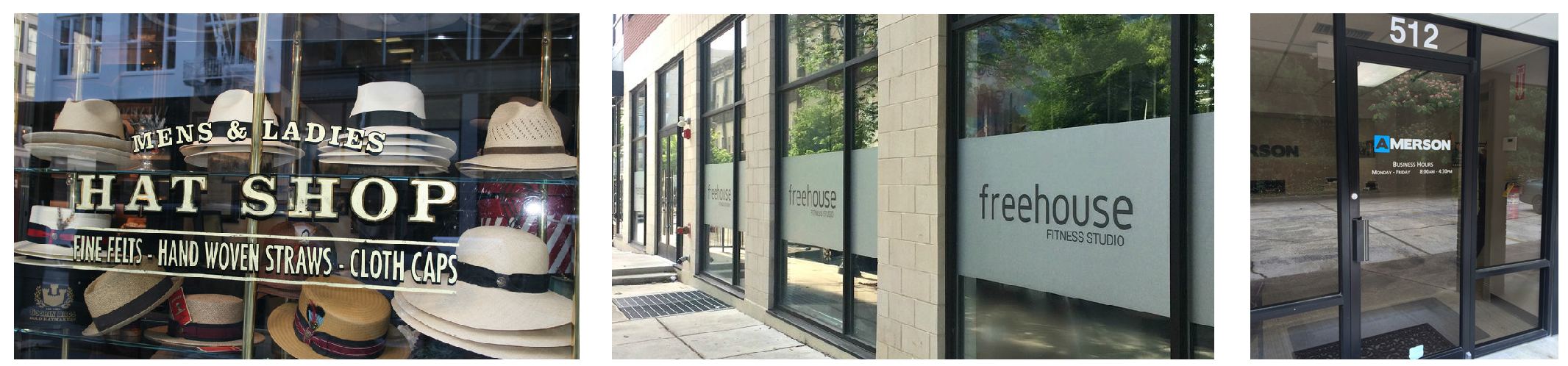
4.5 - WINDOW SIGNS.
Permanent window signs are subject to the following standards:
1.
A window sign may be painted on, attached to, or placed within four feet of the inside of a window.
2.
If illumination is permitted, only that portion of the sign dedicated to the trademark or characters may be translucent. The balance of the sign face shall be opaque.
4.6 - KIOSKS.
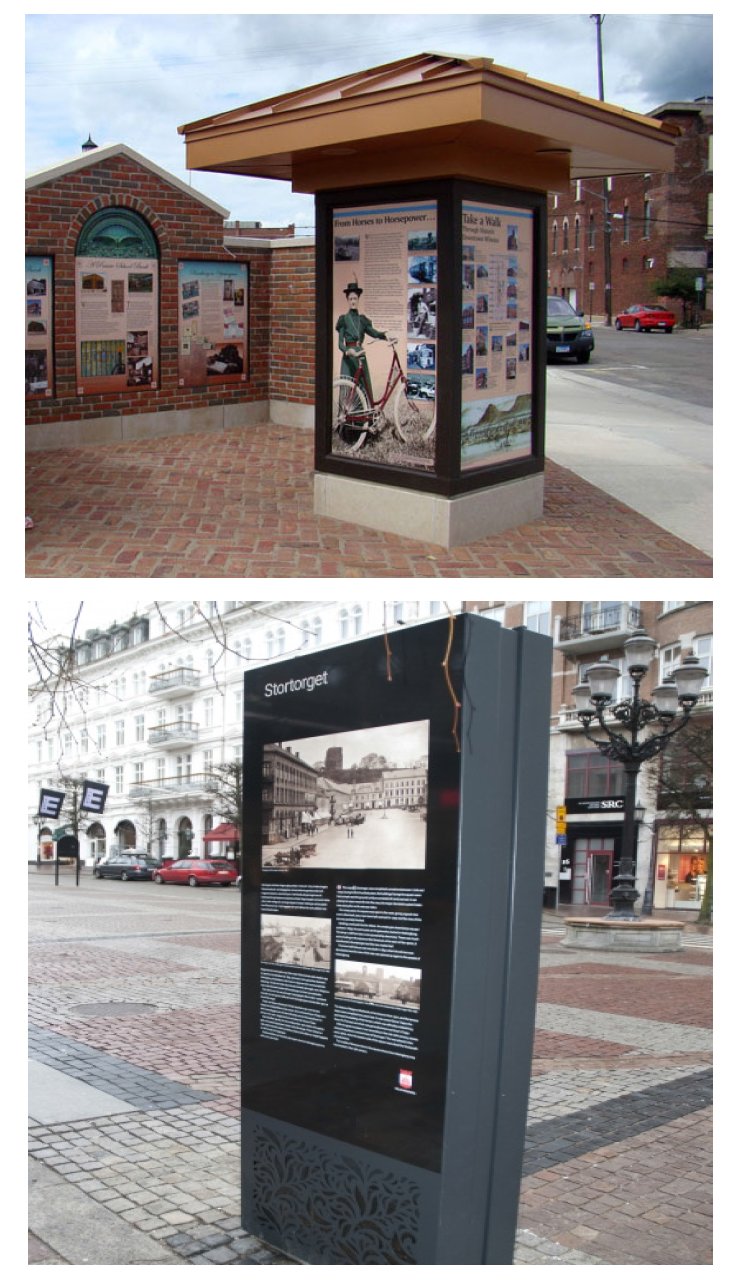
Kiosks may be permitted only if expressly authorized in an approved Final PUD plan. The Final PUD plan shall contain specific standards and requirements concerning the design, construction, maintenance, and operation of any kiosk.
1.
The size and placement of the kiosk is dependent on the proposed activity. Specific design considerations, including illumination, may only be approved through the Final PUD or Special Review Use (SRU) process.
2.
A kiosk may contain an electronic message center display.
4.7 - Marquee signs.
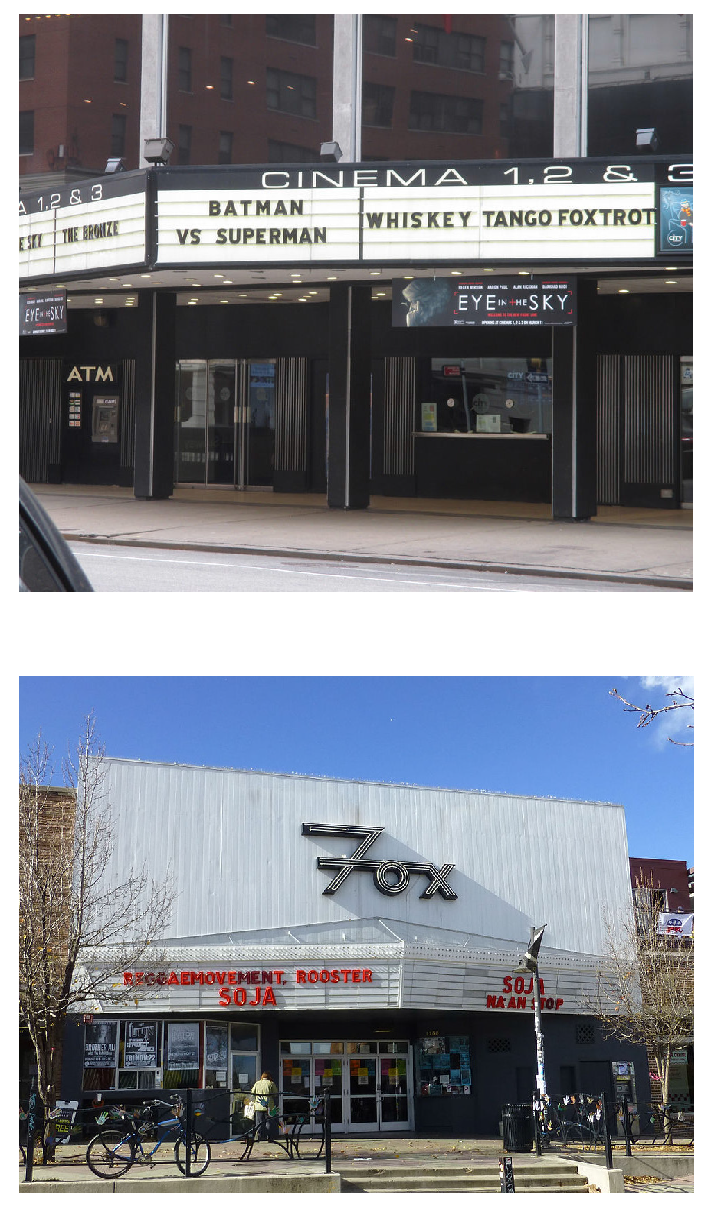
Marquee signs are subject to the following standards.
1.
A marquee sign shall be designed to be compatible with the storefront in scale, proportions, and color.
2.
A marquee sign shall be located on the upper portion of the storefront. A marquee shall not obscure the building's windows, doors, or ornamental features.
3.
A marquee sign is not permitted along an alley frontage.
4.8 - MURALS.
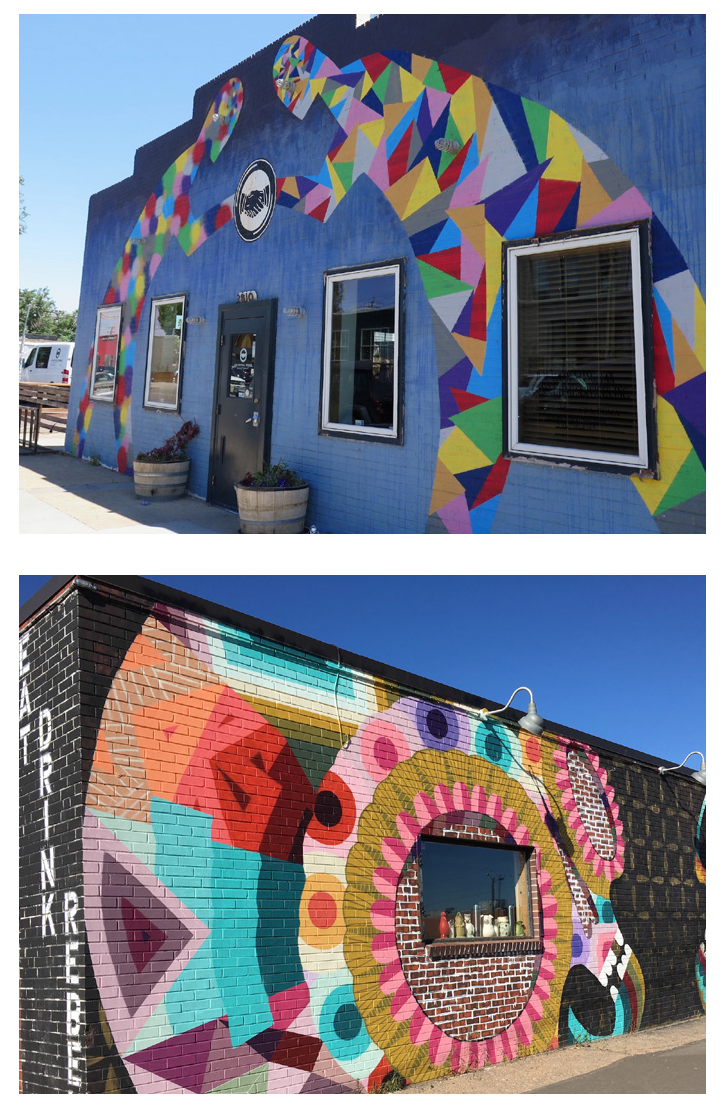
Murals are subject to the following standards.
1.
This section applies to murals on non-residential sites.
2.
Murals may be located on a principal or accessory structure facade, or other structure within a site.
3.
Murals may be placed on all building facades other than facades oriented to the primary street frontage.
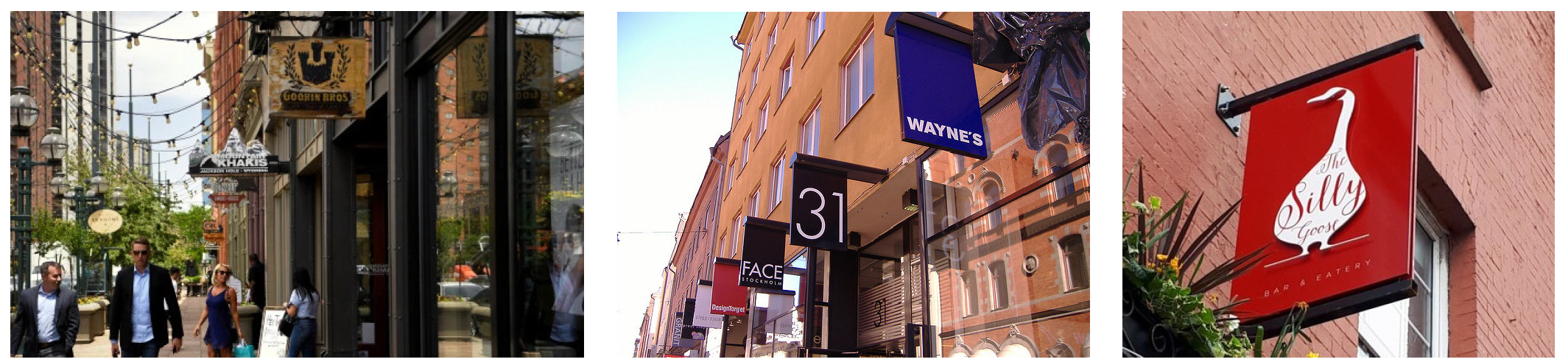
4.9 - PROJECTING SIGNS.
Projecting signs are subject to the following standards.
1.
Projecting signs shall be placed near a building entrance or an access point to a walkway.
2.
Projecting signs shall be spaced a minimum of ten (10) feet apart on multi-tenant buildings, unless there is less than ten (10) feet separating tenant entrances.
4.10 - FREESTANDING SIGNS.
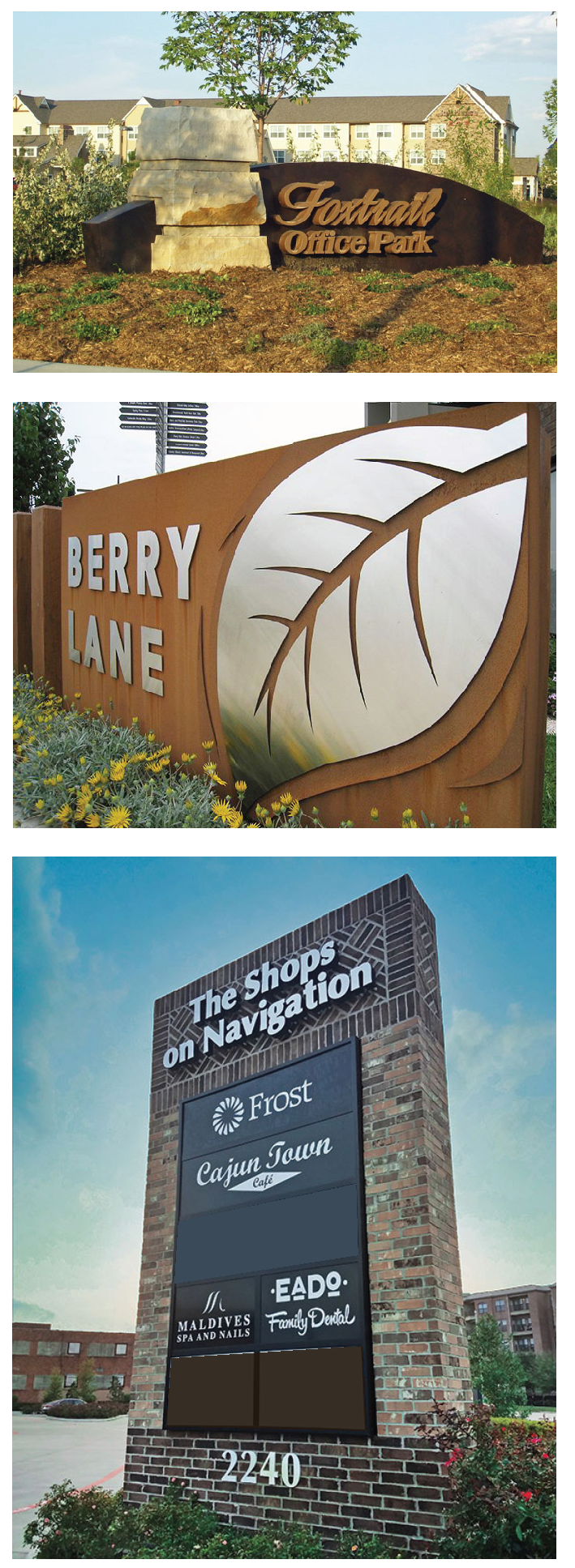
The standards below apply to all freestanding signs.
1.
All freestanding signs shall be located outside of the vision clearance area.
2.
Freestanding signs may be located in a privately owned and maintained median. Such signs shall be setback at least ten (10) feet from nose of the median, and are subject to review and approval from the Department of Public Works.
3.
Where more than one primary or secondary freestanding sign is permitted, each permitted sign shall be allowed to have the maximum square footage allowed as noted in this section.
4.
A freestanding sign may be affixed to an existing retaining wall, provided the retaining wall is expressly authorized by a Final PUD plan and is not located in right-of-way. The minimum setback does not apply to a sign affixed to such a retaining wall.
5.
When required, landscaping shall include shrubs, ornamental grasses, perennials, ground covers and other enhancements. Landscaping areas shall not consist of more than twenty-five (25) percent turf or native grasses.
4.10.a - FREESTANDING SIGNS IN RESIDENTIAL AREAS.
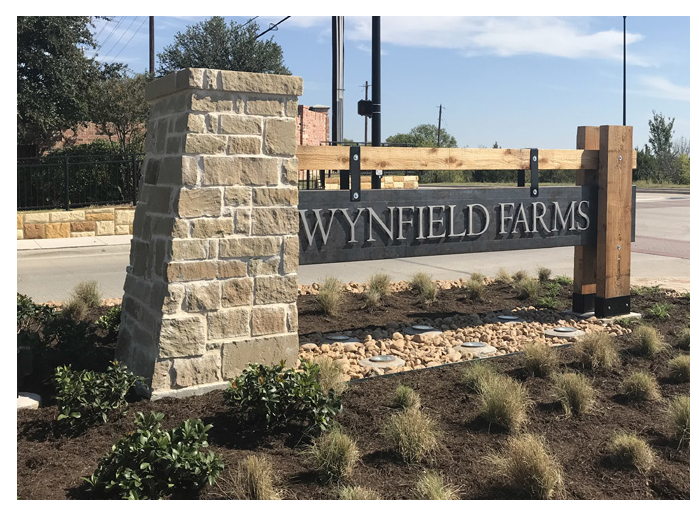
Primary Entrance Sign
In addition to the standards in Sec. 4.10, freestanding signs in residential areas are subject to the standards below.
1.
A freestanding sign shall be located at a primary or secondary neighborhood entrance or entry drive, on privately owned common area, or a privately owned and maintained median. There must be at least six hundred (600) feet of separation between any freestanding sign on the same street.
2.
All freestanding signs must be constructed of an opaque background of uniform color, and shall be of high quality materials that are compatible with the character of the neighborhood. Freestanding sign bases or supports shall be constructed of stone, brick, wood, decorative concrete, high quality metal, or other similar materials.
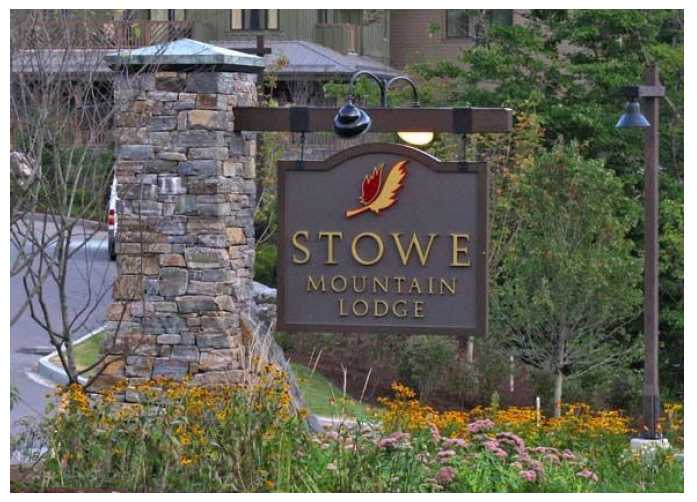
Secondary Entrance Sign
3.
Internally lit cabinet signs are not permitted.
4.
All freestanding signs shall be in a landscaped area on privately owned common area. A minimum of three (3) square feet of landscaping shall be provided for every one (1) square feet of sign area. Only one face of the sign shall be counted for sign area. Landscape plans shall demonstrate that after three years of growth, seventy-five (75) percent of the landscaping area shall be covered with living plants.
5.
Freestanding signs for single-family residential areas shall only be permitted for neighborhoods with a Home Owners' Associations (HOA) to ensure the signs are properly maintained over time. If a HOA dissolves, the HOA shall be responsible for removal of the sign prior to dissolving.
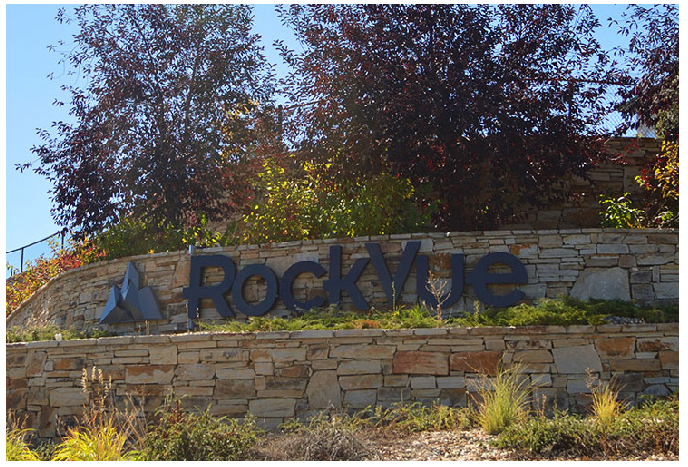
Entry Sign on a retaining wall
6.
In place of one sign at a neighborhood entrance, one sign may be placed on each side of the street at the neighborhood entrance, provided the maximum area of both signs combined does not exceed the permitted maximum area for one sign, and the maximum height is reduced to four (4) feet.
4.10.b - FREESTANDING SIGNS IN COMMERCIAL AREAS.

High quality compatible freestanding sign
In addition to the standards in Sec. 4.10, freestanding signs in commercial areas are subject to the following standards.
1.
All freestanding signs shall be located along a primary or secondary public street frontage. Only one primary frontage shall be allowed. Sites may have more than one secondary frontage. Sites with more than five hundred (500) feet of primary or secondary frontage shall be allowed to place an additional sign meeting the secondary frontage standards on the that frontage.
2.
Primary and secondary freestanding signs shall be located a minimum of seventy-five (75) feet apart.
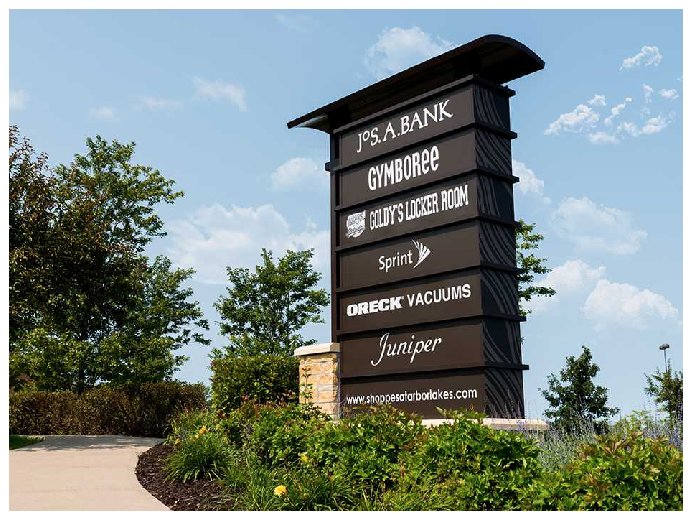
Multi-tenant freestanding sign with only characters illuminated
3.
All freestanding signs must be constructed of an opaque background of uniform color, and shall be of high quality materials that are compatible with the building. Freestanding sign bases and support shall be constructed of brick, stone, wood, decorative concrete, high quality metal, or other similar materials.
4.
All freestanding signs using an internally lit sign cabinet design shall have an architectural base and border on all sides that is consistent with and/or complements the building materials.
5.
All freestanding signs shall be in a landscaped area. A minimum of three (3) square feet of landscaping shall be provided for every one (1) square feet of sign area. Only one face of the sign shall be counted for sign area. Landscape plans shall demonstrate that after three years of growth, seventy-five (75) percent of the landscaping area shall be covered with living plants.
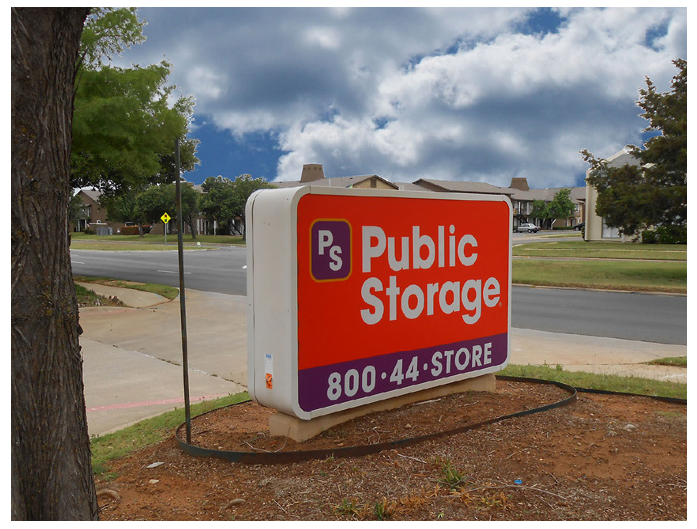
Cabinet signs without base and border are not permitted
6.
The minimum setback is not required if the sign is adjacent to right-of-way with more than ten (10) feet between the curb and the property line, provided there is a minimum of five (5) feet between the sign and any adjacent sidewalk.
7.
Properties adjacent to US 36 may have an additional freestanding sign oriented to US 36. Freestanding signs oriented toward US 36 may have an additional fifty (50) percent increase in the maximum area and an additional one-hundred (100) percent increase in the maximum height.
4.10.c - FREESTANDING SIGNS IN INDUSTRIAL AREAS.
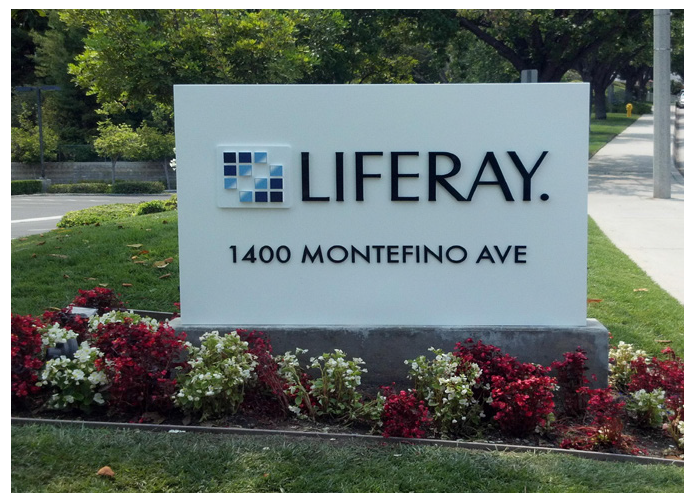
Primary Entrance Sign
In addition to the standards in Sec. 4.10, freestanding signs in industrial areas are subject to the following standards:
1.
All freestanding signs shall be located along a primary or secondary public street frontage. Only one primary frontage shall be allowed. Sites may have more than one secondary frontage. Sites with more than five hundred (500) feet of primary or secondary frontage shall be allowed to place an additional sign meeting the secondary frontage standards on that frontage.

Secondary Entrance Sign
2.
Primary and secondary freestanding signs shall be located a minimum of seventy-five (75) feet apart.
3.
All freestanding signs must be constructed of an opaque background of uniform color, and shall be of high quality materials that are compatible with the building.
4.
Internally lit cabinet signs are not permitted.
5.
All freestanding signs shall be in a landscaped area. A minimum of three (3) square feet of landscaping shall be provided for every one (1) square feet of sign area. Only one face of the sign shall be counted for sign area. Landscape plans shall demonstrate that after three years of growth, seventy-five (75) percent of the landscaping area shall be covered with living plants.
4.10.d - FREESTANDING SIGNS IN MIXED-USE AREAS.
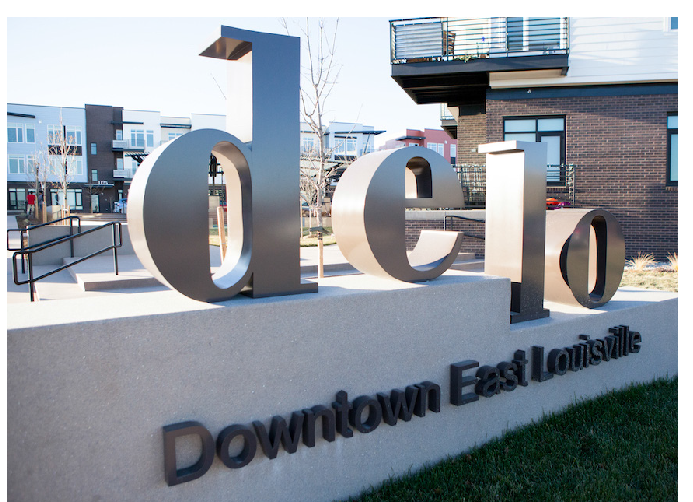
Primary Entrance Sign
In addition to the standards in Sec. 4.10, freestanding signs in mixed-use areas are subject to the following standards:
1.
For lots or sites with only residential uses, the standards for Residential Areas apply. For all other sites, the standards in this Section apply.
2.
All freestanding signs shall be located along a primary or secondary public street frontage. Only one primary frontage shall be allowed. Sites may have more than one secondary frontage. Sites with more than five hundred (500) feet of primary or secondary frontage shall be allowed to place an additional sign meeting the secondary frontage standards on the that frontage. If a site has arterial frontage, the arterial frontage shall be the primary frontage for the purpose of these regulations.
3.
Primary and secondary freestanding signs shall be located a minimum of seventy-five (75) feet apart.
4.
All freestanding signs must be constructed of an opaque background of uniform color, and shall be of high quality materials that are compatible with the building. Freestanding sign bases or supports shall be constructed of stone, brick, wood, decorative concrete, high quality metal, or other similar materials.
5.
Internally lit cabinet signs are only permitted on an arterial frontage.
6.
All freestanding signs shall be in a landscaped area, or in an appropriate location within a hardscaped area or plaza.
4.10.e - FREESTANDING SIGNS IN DOWNTOWN.
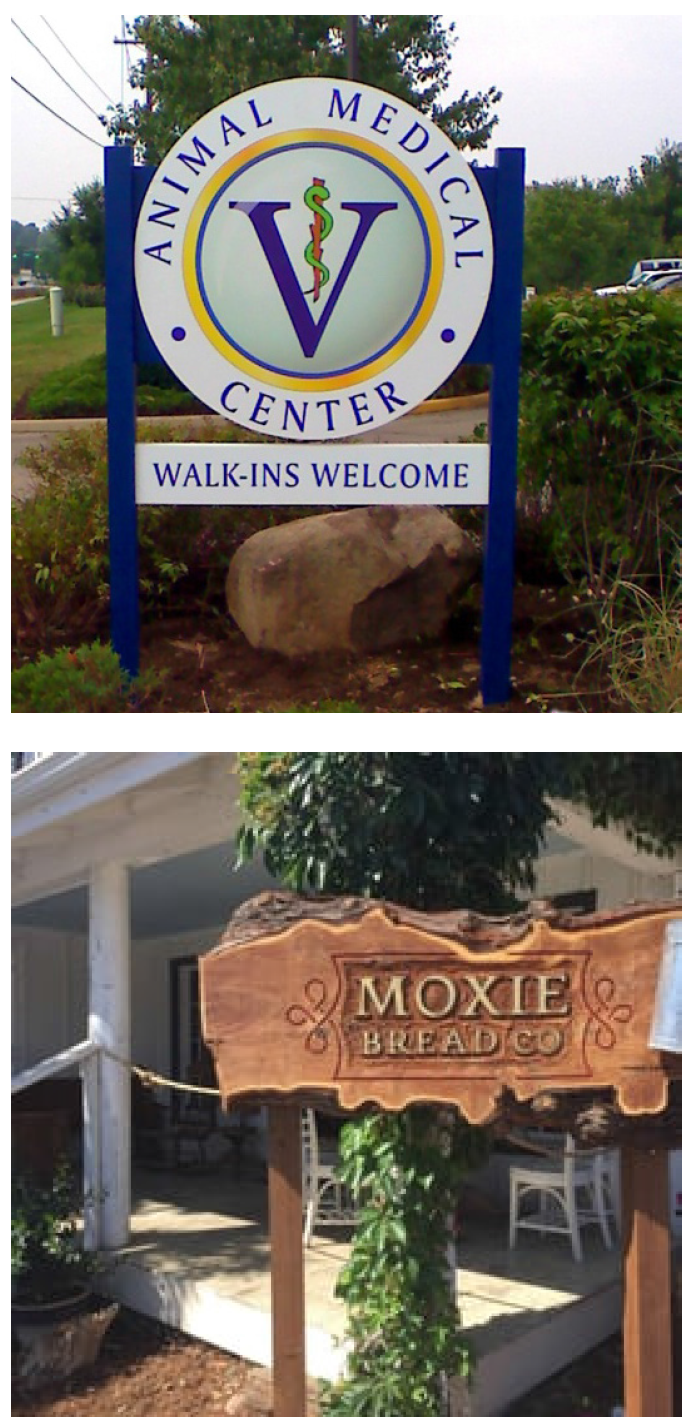
In addition to the standards in Sec. 4.10, freestanding signs in downtown are subject to the standards below.
1.
A freestanding sign shall be located only on a site frontage adjoining a public street.
2.
Freestanding signs shall be designed to be compatible with the principal building in material, scale, proportions, and color. Opaque backgrounds are required and shall be a non-reflective material
3.
Freestanding signs shall only be used when other allowed types of signage cannot provide adequate messaging.
4.
Freestanding signs shall not include a cabinet sign or utilize a monolithic base anchored to the ground.
4.11 - WALL SIGNS.
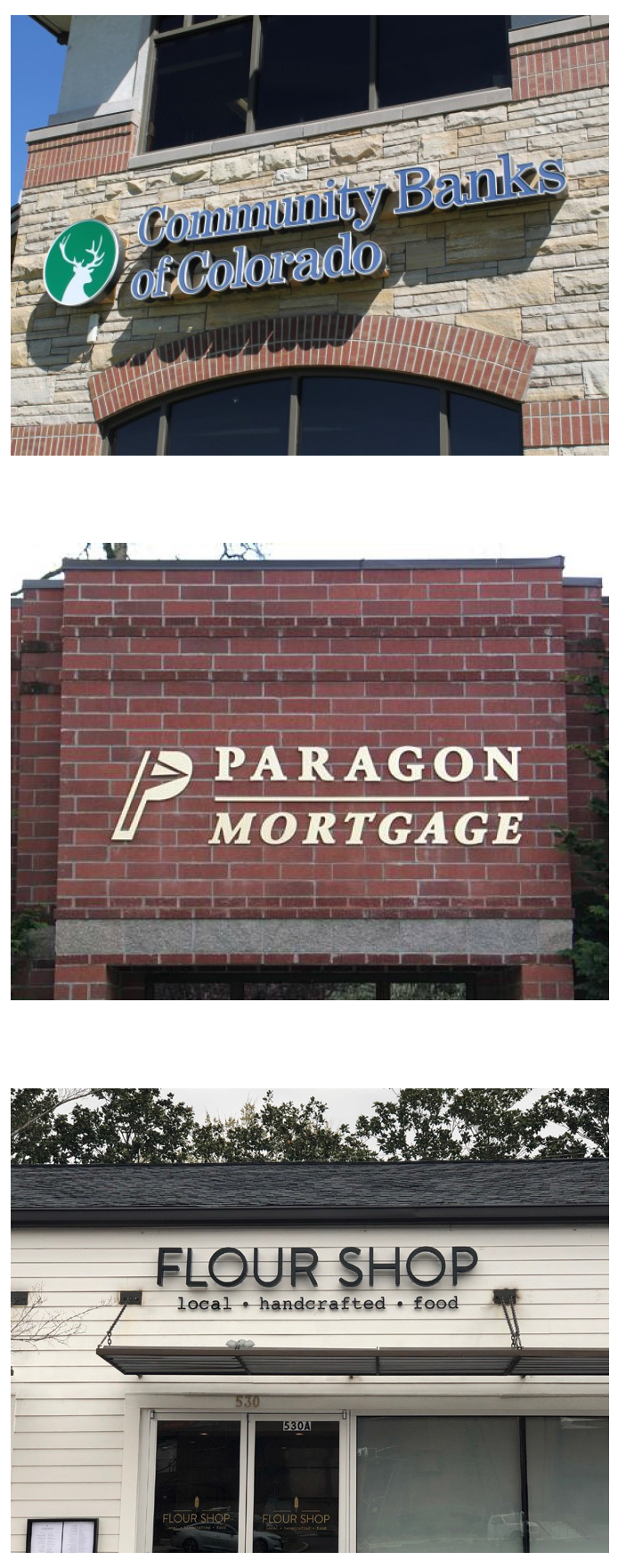
The standards below apply to all wall signs.
1.
Wall signs shall be designed to be compatible with the building in scale, proportions, and color.
2.
A wall sign shall not obstruct any portion of a window, doorway or other architectural detail.
3.
No sign part, including cut-out letters, may project from the building more than required for construction purposes, and in no case may project more than twelve (12) inches.
4.
No wall sign shall extend above the roof or parapet line of any building.
4.11.a - WALL SIGNS IN RESIDENTIAL AREAS.

Primary Halo Lit Wall Sign
In addition to the standards in Sec. 4.11, wall signs in residential areas are subject to the standards below.
1.
Wall signs may be located on primary and secondary frontages. Only one primary frontage shall be designated per site.
2.
Internally lit cabinet signs are not permitted.
3.
In place of a wall sign located on primary or secondary frontages, a wall sign may be permitted on an alternative location on the structure, oriented towards a parking lot, plaza, alley, or other area with a public entrance.
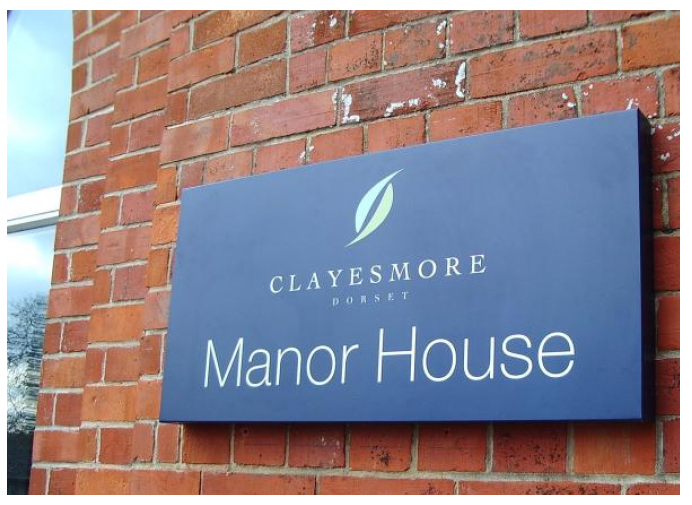
Secondary Wall Sign
4.
The area allowance for wall signs shall include any sign area utilized on a canopy sign.
4.11.b - WALL SIGNS IN COMMERCIAL AREAS.
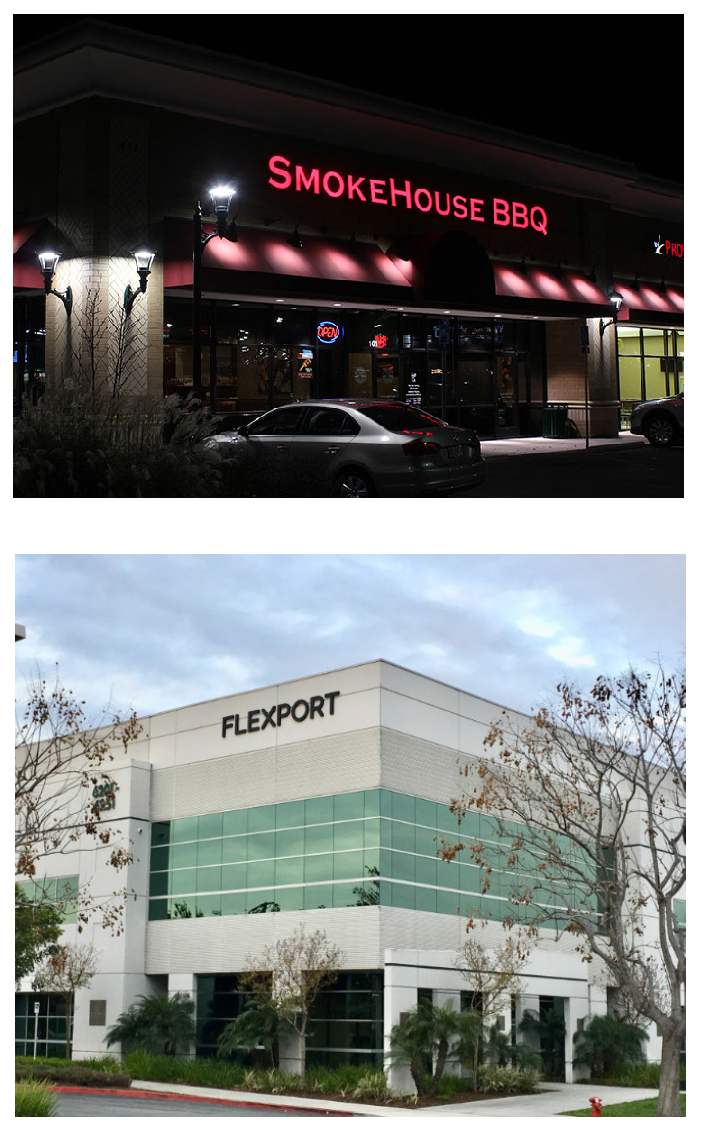
In addition to the standards in Sec. 4.11, wall signs in commercial areas are subject to the standards below.
1.
Wall signs may be located on primary and secondary public street frontages. Only one primary frontage shall be designated per site. Sites may have more than one secondary frontage.
2.
In place of a wall sign located on primary or secondary frontages, a wall sign may be permitted on an alternative location on the structure, oriented towards a parking lot, plaza, alley, or other area with a public entrance.
3.
The area allowance for wall signs shall include any sign area utilized on a canopy sign, awning sign, marquee sign, illuminated window sign, or a projecting sign.
4.
In addition to the signs in this section, buildings with public rear entrances may have a six (6) sf unlit sign above each entrance, one (1) per tenant.
5.
Properties adjacent to US 36 may have an additional wall sign(s). Wall signs oriented toward US 36 may have an additional fifty (50) percent increase in the maximum area and an additional one-hundred (100) percent increase in the maximum sign height.
6.
The use of individually cut, internally lit or halo lit characters are encouraged.
4.11.c - WALL SIGNS IN INDUSTRIAL AREAS.
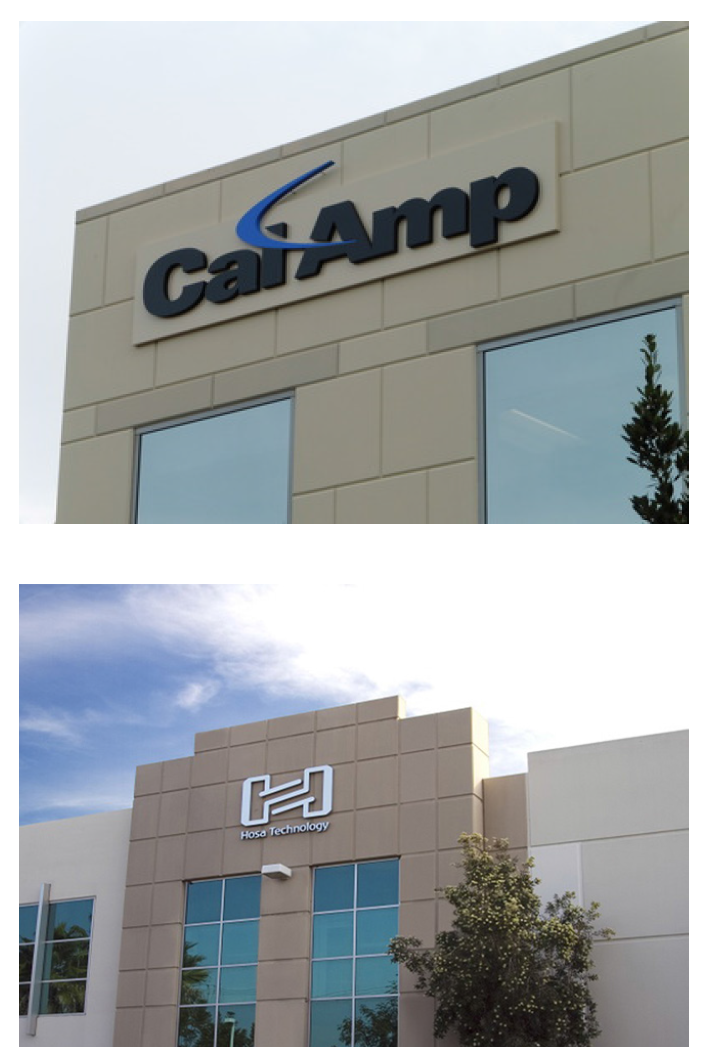
In addition to the standards in Sec. 4.11, wall signs in industrial areas are subject to the following standards:
1.
Wall signs may be located on primary and secondary public street frontages. Only one primary frontage shall be designated per site. Sites may have more than one secondary frontage.
2.
In addition to the signs in this section, buildings with public rear entrances may have a six (6) sf unlit sign above each entrance, one (1) per tenant.
3.
Cabinet signs are not permitted.
4.11.d - WALL SIGNS IN MIXED USE AREAS.
In addition to the standards in Sec. 4.11, wall signs in mixed use areas are subject to the standards below.
1.
For lots or sites with only residential uses, the standards in Residential Areas apply.
2.
For all other sites, the standards in Commercial Areas apply.
4.11.e - WALL SIGNS IN DOWNTOWN.
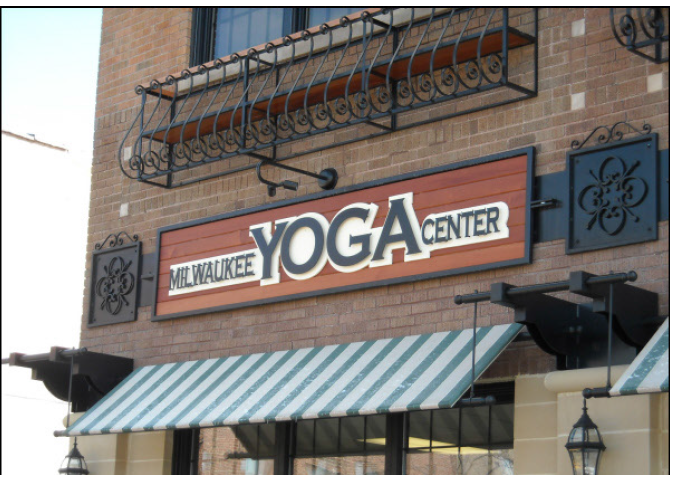
Externally lit wall sign
In addition to the standards in Sec. 4.11, wall signs in downtown are subject to the following standards:
1.
Wall signs may be located on primary and secondary public street frontages. Only one primary frontage shall be designated per site. Sites may have more than one secondary frontage.
2.
In addition to wall signs on primary or secondary frontages, wall signs may be permitted on an alternative location on the structure, such as a parking lot, plaza, alley or other area, provided there is an operable public entrance to the building orienting to that area.
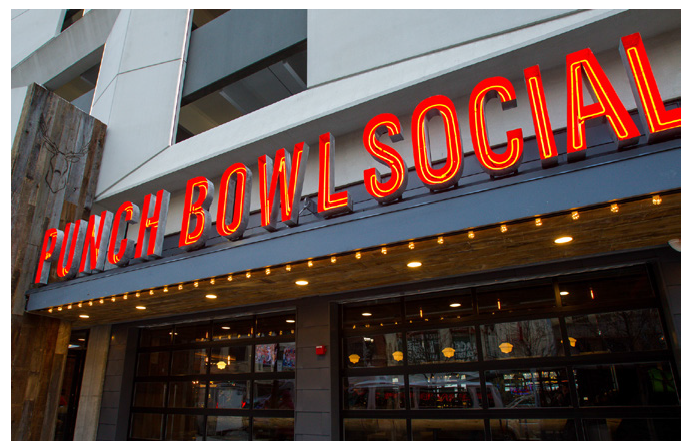
Neon lit wall sign
3.
The area allowance for wall signs shall include any sign area utilized on a canopy sign, awning sign, marquee sign, or projecting sign.

Halo lit wall sign
4.
Visible raceways and transformers are not permitted.
5.1 - TEMPORARY SIGNS.
The standards of this Section apply to all temporary signs. Temporary signs may be subject to additional standards set out elsewhere within these regulations.
Sign Types. Temporary signs include the following types:
5.2 Fabric Signs
5.3 Sandwich Board Signs
5.4 Site Signs
5.5 Yard Signs
5.6 Window Signs
1.
The purpose of temporary signs is to display messages for a temporary duration. Temporary signs shall not be used to circumvent the regulations that apply to permanent signs or to add permanent signage to a property in addition to that which is allowed by these regulations.
2.
In general, a temporary sign shall be removed as of the date:
a.
That it becomes an abandoned sign;
b.
That it falls into disrepair; or
c.
Of expiration of the number of days in the tables below.
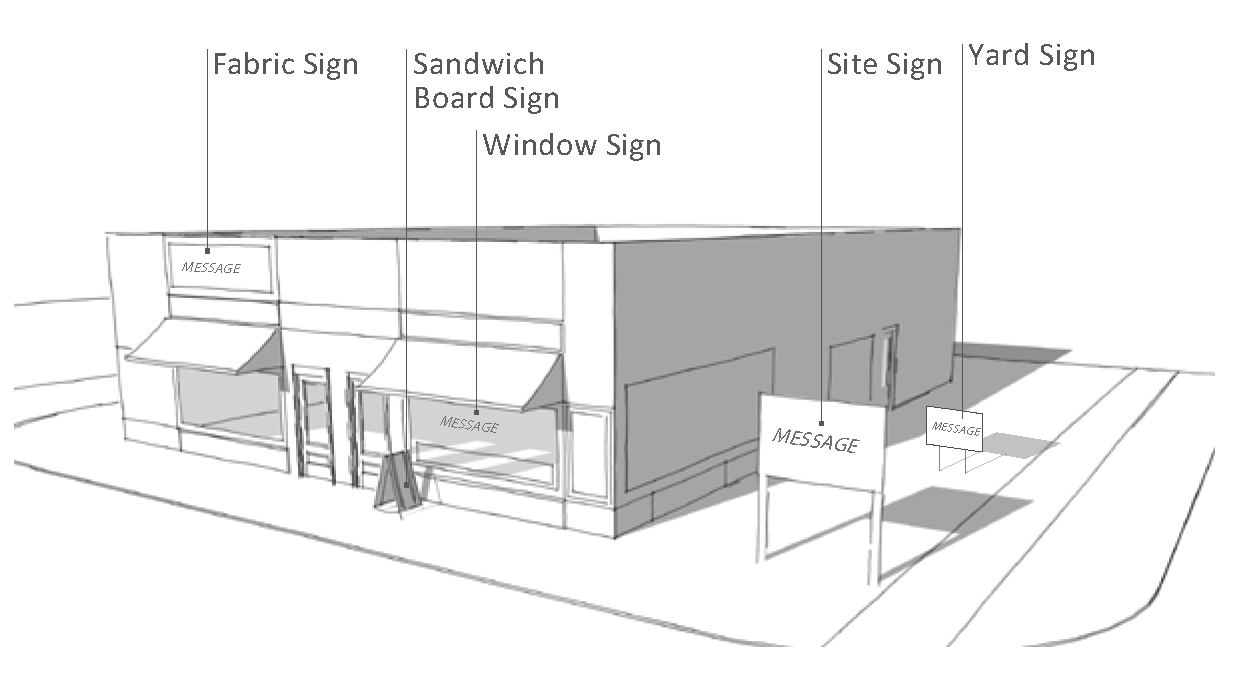
5.2 - FABRIC SIGNS.
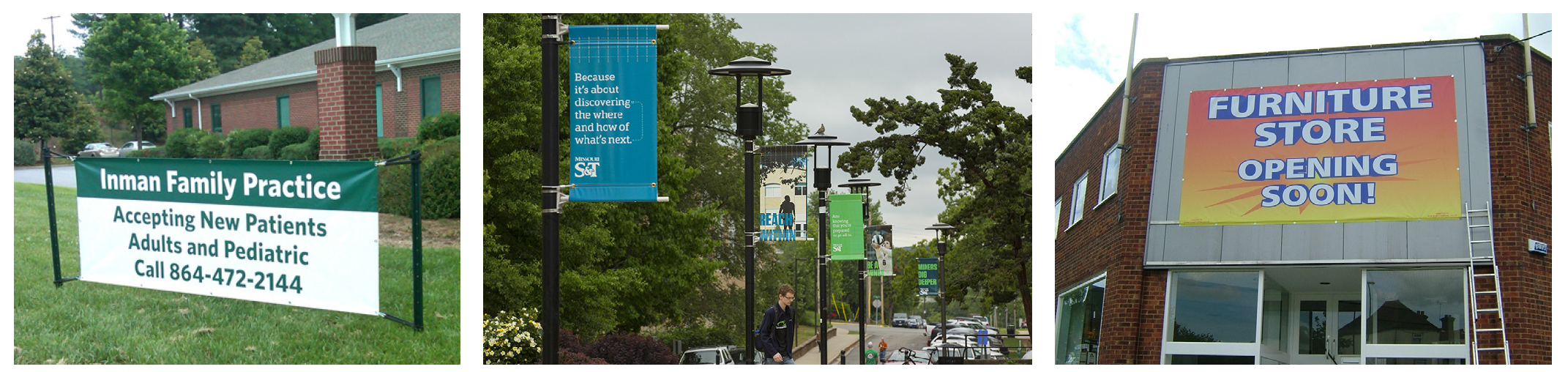
Fabric signs, also referred to as banners, are subject to the following standards:
1.
Fabric signs placed on a wall shall not obstruct any portion of a window, doorway, or other architectural detail.
2.
Fabric signs mounted on the ground may not be located within the vision clearance area.
3.
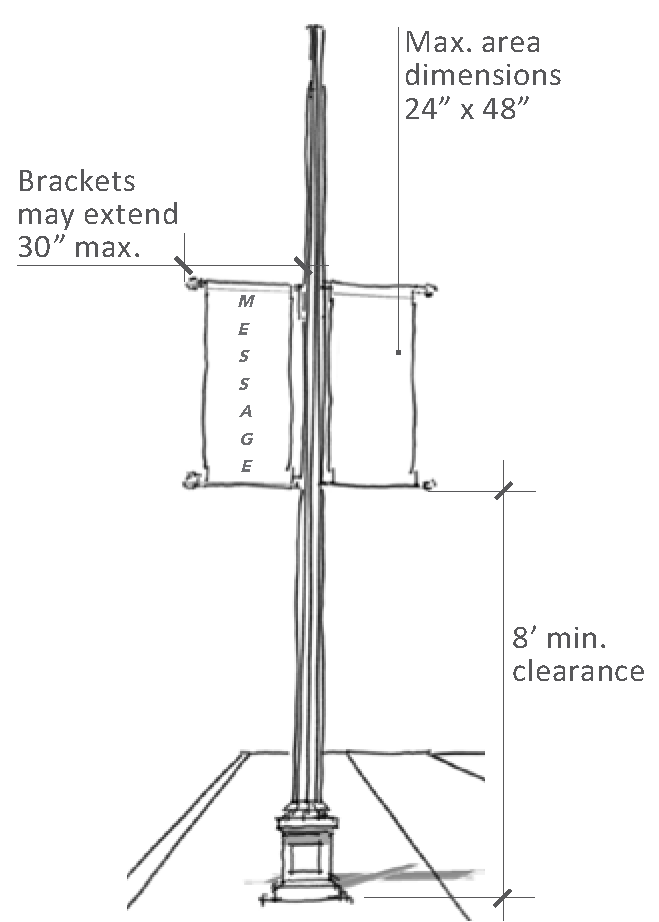
Fabric signs may be installed for civic events on a utility pole with the consent of both the utility provider and the Department of Planning and Building Safety. A fabric sign shall be attached at the top and bottom of utility pole brackets that project no more than thirty (30) inches from the utility pole. Fabric signs installed on utility poles shall not exceed twenty-four (24) inches in width and forty-eight (48) inches in height, with a minimum clearance of eight (8) feet maintained from any travel or walking surface.
5.3 - SANDWICH BOARD SIGNS.
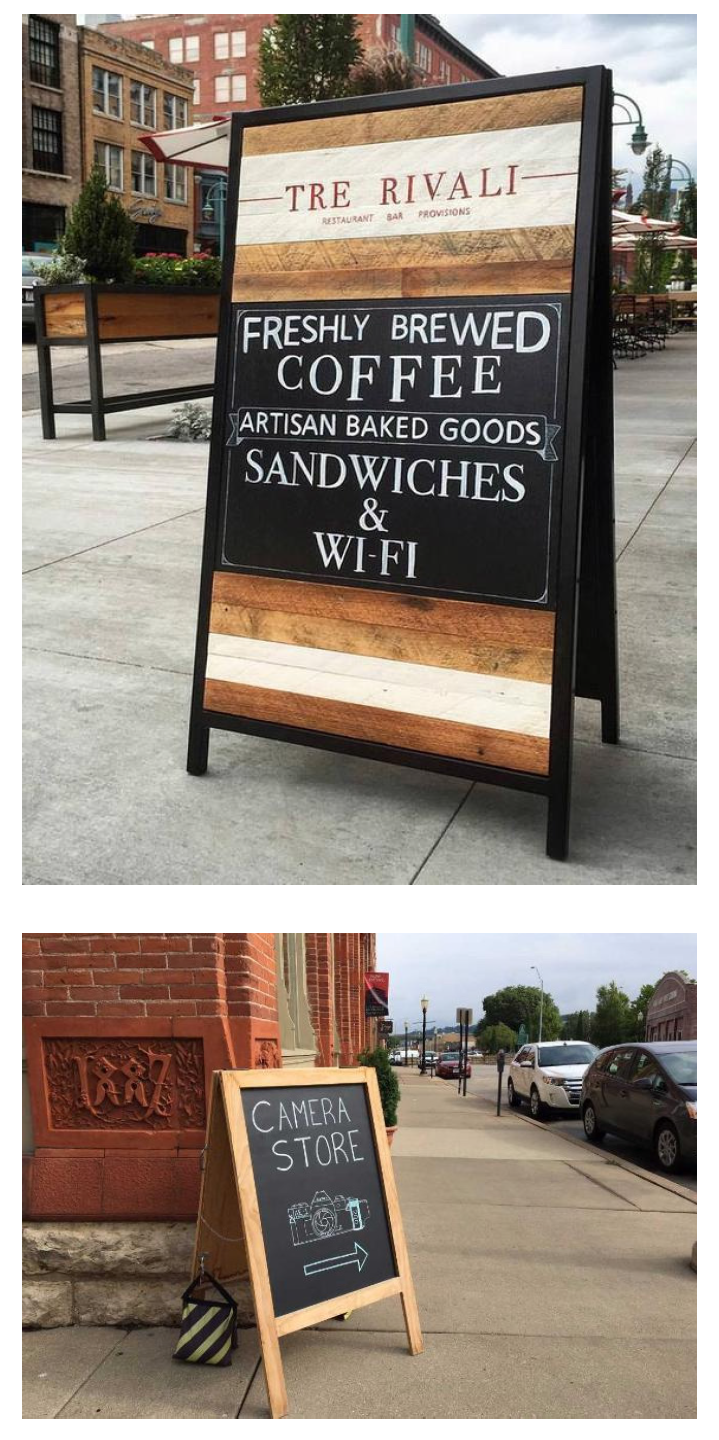
Sandwich board signs are subject to the standards below.
1.
High quality materials and artistic designs shall be used in the construction of sandwich board signs. No plastic board or plastic letters shall be permitted.
2.
A sandwich board sign shall not obstruct pedestrian circulation. A minimum of four (4) feet of sidewalk clearance shall be maintained at all times.
3.
Sandwich board signs must be removed each day at close of business.
4.
Sandwich board signs must be anchored to the ground or weighted sufficiently to prevent movement by wind.
5.
In Downtown, sandwich board signs may be placed in right-of-way on a sidewalk or on a private walkway immediately adjacent to the building frontage with the primary entry of a tenant or site.
6.
In Commercial and Mixed-Use areas, sandwich boards are permitted only on walkways not in right-of-way and shall be located adjacent to the business and on the same frontage as the primary entry.
5.4 - SITE SIGNS.
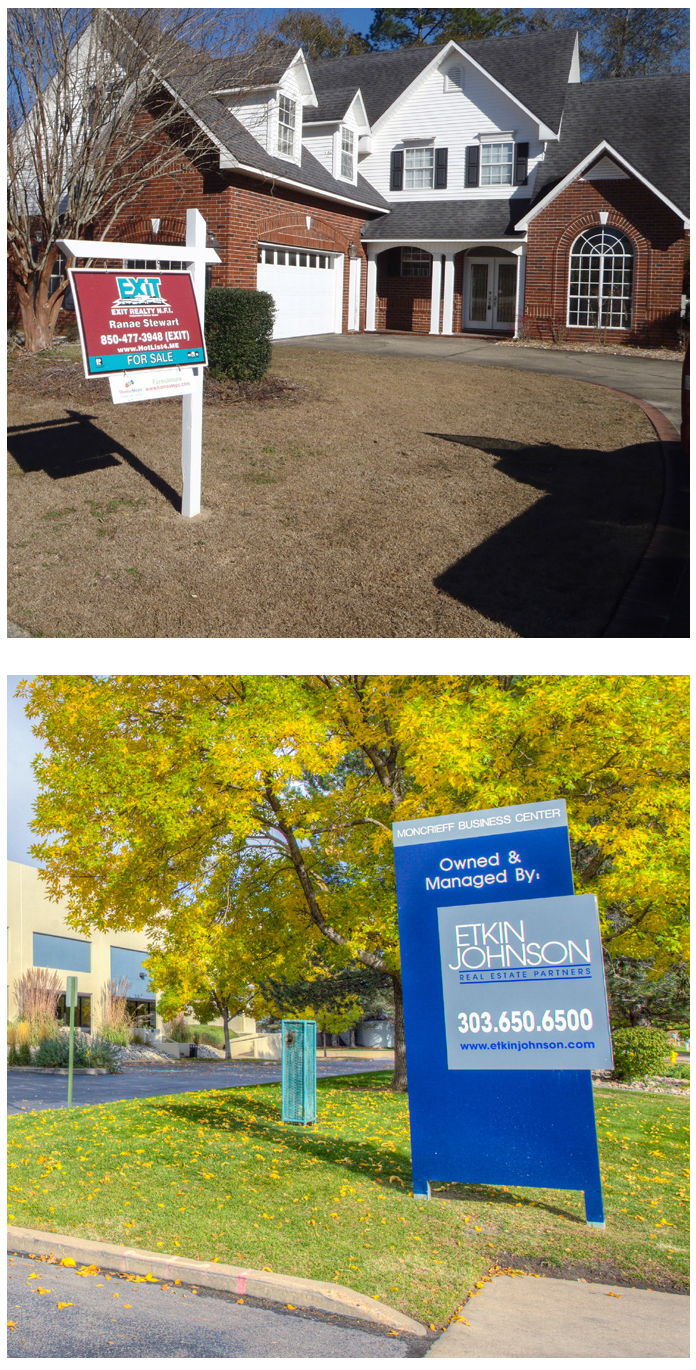
Site signs are subject to the following standards:
1.
Site signs are not intended to be installed in place of a permanent sign.
2.
Site signs are only allowed on properties with active listings for sale or for rent, or on properties with active building permits.
3.
Site signs may not be located within a vision clearance area.
5.5 - YARD SIGNS.
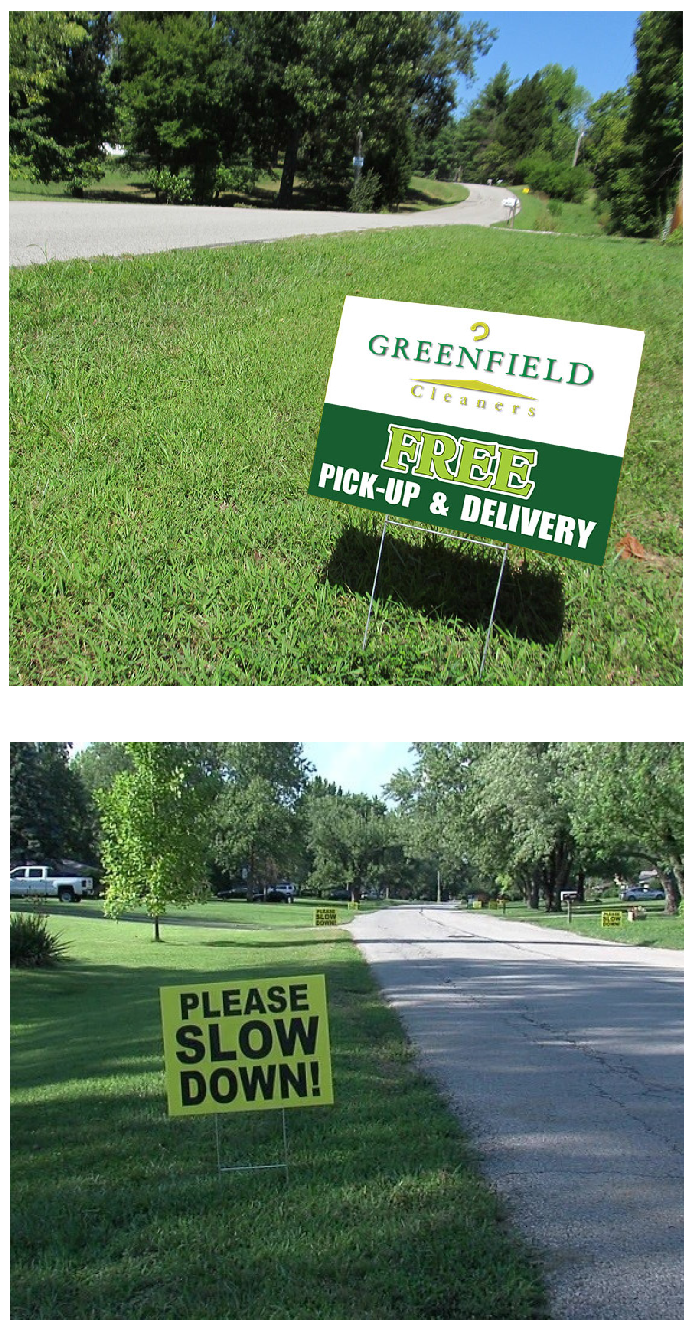
Yard signs are subject to the standards below.
1.
Yard signs may not be placed in a vision clearance area.
5.6 - WINDOW SIGNS.

Temporary window signs are subject to the standards below.
1.
Temporary window signs are allowed in all locations where permanent window signs are allowed.
2.
The temporary sign area allowance is in addition to the area allowance for permanent window signage, pursuant to Section 4.5. If a site does not utilize all of the permanent allowance, that area may be used for temporary window signage, in addition to the area listed below.
3.
Temporary window signs shall be affixed to the window such that the fastener (e.g. tape) is not highly visible, or signs shall be mounted inside of the building for viewing through the window.
6.1 - DEFINITIONS.
The following words, terms and phrases when used in these regulations shall have the meanings ascribed to them in this Section, except where the context clearly indicates a different meaning:
Abandoned sign means a sign, including sign face and supporting structure, which is unsafe, constitutes a hazard to safety or health by reason of inadequate maintenance, dilapidation, or obsolescence, and/or is not kept in good repair; or which contains no sign copy on all sign faces for a continuous period of three (3) months.
Alteration means change in the size or shape of an existing sign.
Animated means the use of movement or change of lighting to depict action or to create a special effect or scene.
Animated sign means any sign flashing or simulating motion with an electronic or manufactured source of supply or contains wind-actuated motion.
Architectural features means finished elements of a building that define a structure's architectural style and physical uniqueness, including, but not limited by, windows, doors, trim, and ornamental features.
Awning sign means a sign permanently affixed to a sheet of canvas or other material stretched on a frame and used to keep the sun or rain off a storefront, window, doorway, or deck.
Banner see definition for Fabric sign.
Billboard means any sign in excess of fifty (50) square feet in size oriented to a public street utilized to advertise a product or service that is not produced or conducted on the same property as the sign.
Building means any structure built for the shelter or enclosure of persons, animals, chattels or property, or substances of any kind, excluding fences.
Building frontage means the horizontal, linear dimension of that side of a building which abuts a street, a parking area, plaza, alley, or other circulation area open to the general public; and having either a main window display of the enterprise or a public entrance to the building.
a.
Where more than one use or tenant occupies a building, each such use or tenant having a public entrance or main window display for its exclusive use shall be considered to have its own building frontage, which shall be the frontage width of the portion of the building occupied by that use.
b.
On corner and double-frontage lots, each building frontage that abuts a street, highway, private drives, or alley shall be considered to have both a primary and secondary frontage.
Cabinet sign means a sign structure consisting of the frame and face(s), not including the internal components, embellishments or support structure.
Canopy sign means a sign permanently affixed to a roofed shelter covering a sidewalk, walkway, driveway, or other similar area which shelter may be wholly supported by a building or may be wholly or partially supported by columns, poles, or braces extended from the ground.
Channel letter means a three-dimensional character that may include an internal or external light source.
Character means any graphic symbol used for sign text, included, but not limited to, letters, numbers, and logos.
City Manager means the City Manager of Louisville, Colorado or his or her designee.
Civic event means any event held or advertised on property or right-of-way owned, or controlled by the City of Louisville, either financially or with in-kind services, and having a valid special event permit.
Clearance means the distance from the bottom of a sign face elevated above grade and the grade below.
Copy means the words, message, logo, symbols, figures, or images on a sign.
Copy area means the area that encloses the words, message, logo, symbols, figures, or images on a sign.
Copy change means replacement or alteration to any portion of a sign that includes copy. This includes any change that alters the script, size, color, or arrangement of copy on a sign face, or replacement of a sign face. This does not include any change to manual changeable copy, such as readerboards.
Electric sign means any sign containing electrical wiring, but not including signs illuminated by exterior light sources, such as floodlights.
Directional sign means any sign that is designed and erected for the purpose of providing direction and/or orientation for pedestrian or vehicular traffic with or without reference to, or inclusion of, the name of a product sold or service performed on the lot or in a building, structure or business enterprise occupying the same.
Display sign means a sign either 1) mounted on a building wall oriented to pedestrians, or 2) a freestanding sign oriented to occupants of a vehicle in a drive aisle.
Electronic message center sign means a sign capable of displaying words, symbols, figures, or images that can be electronically or mechanically changed by remote or automatic means.
Externally illuminated means lighting by means of a light source which is directed at a reflecting surface in such a way as to illuminate the sign from the front, or a light source which is primarily designed to illuminate the entire building facade upon which a sign is displayed. External illumination does not include lighting which is primarily used for purposes other than sign illumination; e.g., parking lot lights, or lights inside a building which may silhouette a window sign but which are primarily installed to serve as inside illumination.
Fabric sign includes any temporary sign, banner, pennant, valance, or advertising display constructed of cloth, canvas, fabric, or other light material, with or without frames, which is not permanently fixed to a supporting structure.
Flag A fabric device similar to and including national and state flags, designed to be attached to a flagpole.
Flagpole means a pole, either building-mounted or freestanding, that is used for displaying a flag.
Flashing means a pattern of changing light illumination where the sign illumination alternates suddenly between fully illuminated and fully non-illuminated for the purpose of drawing attention to the sign.
Freestanding sign means a sign which is not attached to a building.
Frontage means the linear frontage - Primary or Secondary - of a lot, parcel, or site abutting on a public street, park, plaza, walkway, or alley.
Grade (ground level) means the average of the finished grade surface elevation as measured in Section 3.1.1.
Halo lit means an illuminated reverse channel letter (open or translucent back) so light from the letter is directed against the surface behind the letter producing a halo lighting effect around the letter. Also referred to as silhouette lit or back lit.
Handheld sign means a temporary sign held, suspended, or supported by an individual. Handheld signs do not include handheld signs utilized for traffic control or safety purposes. Also known as a human directional, sign spinner, or sign twirler sign.
Hazard means whenever any portion, support structure, or appurtenance of a sign is likely to fail or to become detached or dislodged or collapse.
Iconic sign means an existing non-conforming sign with a distinctive architectural style and specifically designated as an Iconic Sign as provided herein.
Incidental sign means a small sign affixed to a building or structure, machine, equipment, fence, gate, wall, gasoline pump, public telephone, or utility cabinet.
Inflatable sign means a balloon, blimp, or other inflated object used for attracting attention.
Internal illumination means lighting by means of a light source which is within a sign having a translucent back-ground, silhouetting opaque letters or designs, or which is within letters or designs which are themselves made of a translucent material.
Kiosk means a small structure, typically located within a pedestrian walkway or similar circulation area, and intended for use as a key, magazine or similar type of small shop, or for use as display space for posters, notices, exhibits, etc.
Landmark Sign means an existing sign with a distinctive architectural style and historic significance which has been officially designated as a Landmark Sign as provided herein.
Light source includes neon, fluorescent, or similar tube lighting, the incandescent bulb (including the light-producing elements therein) light-emitting diode (LED) and any reflecting surface which, by reason of its construction and/or placement, becomes in effect the light source.
Logo means an emblem, letter, character, picture, trademark, or symbol used to represent any firm, organization, entity, or product.
Lot means a portion or parcel of land, whether part of a platted subdivision or otherwise, occupied or intended to be occupied by a building or use and its accessories, together with such yards as are required under the provisions of the Louisville Municipal Code. A lot must be an integral unit of land held under unified ownership in fee or in co-tenancy, or under legal control tantamount to such ownership.
Maintenance means the repairing or repainting of a portion of a sign structure; periodic changing of bulletin board panels; or renewing of copy which has been made unusable by ordinary wear and tear, weather, or accident.
Marquee means a permanently-roofed structure with changeable messages attached to and supported by a building above an entrance.
Marquee sign means any sign made a part of a marquee and designed to have changeable copy.
Message hold time means the time interval a static message must remain on the display before transitioning to another message.
Multi-tenant building means a structure housing more than one retail business, office, or commercial venture but not including residential apartment buildings, which share the same lot, access, and/or parking facilities.
Mural means a sign in a non-residential area which consists of a picture or graphic illustration applied directly to a wall of a building or structure that does not advertise or promote a particular business, service, or product.
Nonconforming sign means a sign which was validly installed under laws or ordinances in effect at the time of its installation, but which is in conflict with the current provisions of these regulations.
Off-premise sign means a sign which advertises or directs attention to products or activities not provided on the parcel or site upon which the sign is located.
Owner means a person, firm, corporation, or other legal entity recorded as such on the records of the County Assessor including a duly authorized agent or attorney, a purchaser, devisee, fiduciary, or a person having a vested or contingent interest in the property in question.
Pennant means a triangular, square, or rectangular shaped flag attached in a string-type manner. Pennants do not contain any words, logos, or emblems.
Permanent sign means any sign constructed of durable materials and affixed, lettered, attached to, or placed upon a fixed, non-movable, non-portable supporting structure.
Pole sign means a permanent sign supported by one or more poles or pylons.
Projecting sign means a double-faced sign attached perpendicular to the wall of a building or structure which projects over private or public property.
Raceway means an enclosed box that functions as a mounting mechanism, and electronic component enclosure for wall mounted signage.
Roof means the cover of any building, including the eaves and similar projections.
Roofline means the highest point on any building where an exterior wall encloses usable floor space, including floor area for housing mechanical equipment. The term "roofline" also includes the highest point on any parapet wall, providing such parapet wall extends around the entire perimeter of the building.
Roof sign means a sign erected upon or above a roof or parapet wall of a building and which is wholly or partially supported by such building.
Sandwich board means a type of portable sign that is intended to be placed on a hard surface, most commonly a sidewalk. These signs include A-frame signs, signs that are suspended from the top member of an A-frame, signs with weighted bases, and comparable signs.
Setback means the distance from the property line to the nearest part of the applicable building, structure, or sign, measured perpendicularly to the property line.
Sign means any written copy, display, illustration, insignia, or illumination used to communicate a message or idea which is displayed or placed in view of the general public, and shall include every detached sign and every sign attached to or forming a component part of any marquee, canopy, awning, pole, vehicle, or other object, whether stationary or movable.
Sign face means the exterior display surface of a sign (including nonstructural trim, yet exclusive of the supporting sign structure) upon, against, or through which a message is displayed or illustrated.
Sign height shall be the vertical distance from established grade at the base of the sign to the highest element or the uppermost point on the sign or sign structure.
Sign program means a design package that identifies a coordinated project theme of uniform design elements for all sign associated with a building, including color, lettering style, material, and placement.
Site means a lot, lots, parcel, or tract of land under common ownership, or developed together as a single development site, regardless of how many uses occupy the site.
Site sign means a temporary freestanding sign constructed of vinyl, plastic, wood, or metal and designed or intended to be displayed for a limited period of time on a site with an active listing for sale or for rent, or on properties with active building permits.
Street frontage means the linear frontage (or frontages) of a lot or parcel abutting on a private or public street which provides principal access to, or visibility of, the premises.
Teardrop banner sign means a type of temporary sign consisting of cloth, bunting, canvas, or similar fabric, attached to a single vertical support structure with distinctive color, words, patterns, or symbolic logos for display. Also known as a feather banner, flying banner, or a wave banner sign.
Temporary sign means any sign based upon its materials, location, and/or means of construction, e.g., light fabric, cardboard, wallboard, plywood, paper, or other light materials, with or without a frame, intended or designed to be displayed for a limited period of time.
Traffic control sign means a sign erected in a public right-of-way by an authorized governmental agency for the purposes of traffic regulation and safety.
Transition duration means the time interval it takes the display to change from one complete static message to another complete static message.
Transition method means a visual effect applied to a message to transition from one message to the next. Transition methods include:
a.
Dissolve a frame effect accomplished by varying the light intensity or pattern, where the first frame gradually appears to dissipate and lose legibility simultaneously with the gradual appearance and legibility of the second frame.
b.
Fade a frame effect accomplished by varying the light intensity, where the first frame gradually reduces intensity to the point of not being legible (i.e. fading to black) and the subsequent frame gradually increases intensity to the point of legibility.
Vehicle sign means a sign that is printed, painted upon, or attached to motor vehicles, including semi-truck trailers, used primarily for the delivery of products, passengers or services or for business purposes other than as a sign.
Vision clearance area means a triangular area on a lot at the intersection of two streets, a street and a railroad, a street and an alley, or a street and a recreational trail, two sides of which are curb lines measured from the corner intersection of the curb lines to a distance specified in the Sec. 17.08.590 of the Louisville Municipal Code.
Wall sign means any sign painted on or affixed to the wall of a building or structure, or any sign consisting of cut-out letters or devices affixed to a wall with no background defined on the wall in such a manner that the wall forms the background surface of the sign.
Window means an opening for letting in light or air or for looking through, usually having a pane or panes of glass, etc. Spandrel glass that appears to be a window shall not be considered as such.
Window sign means any sign which is applied or attached to either the interior or exterior of a window and intended to be viewed from outside the building or structure.
Yard sign means a temporary freestanding sign constructed of paper, vinyl, plastic, wood, metal, or other comparable material, and designed or intended to be displayed for a limited period of time on a lot with one or more existing permanent structures.

