
Louisville City Zoning Code
CHAPTER 17
14 - MIXED USE ZONE DISTRICTS
Sec. 17.14.010.- Purpose and intent.
Major improvements to State Highway 42 and the potential development of a commuter rail station in Louisville are creating the conditions for significant development and change in the Highway 42 Revitalization Area. In anticipation of such change, the City of Louisville hereby declares that it is the purpose and intent of this chapter to:
A.
Implement the Highway 42 Revitalization Area Comprehensive Plan;
B.
Strengthen and enhance adjacent residential neighborhoods while protecting them from potential adverse impacts associated with new development;
C.
Complement and integrate the area with historic downtown Louisville through the establishment of strong pedestrian, and multimodal connections;
D.
Capture the potential for high-quality, mixed use development that will serve adjacent neighborhoods and the citizens of Louisville and enhance the city's long-term tax base;
E.
Avoid incompatible industrial and large-scale or heavy commercial growth;
F.
Adopt a regulatory framework which promotes and encourages redevelopment to integrate principles of sustainable architecture and energy conservation;
G.
Provide for design standards for the development of a commuter rail station which shall promote the public health and safety, adequate ingress and egress, parking, and surface parking which shall be decentralized. Surface parking shall be decentralized in a manner which does not overwhelm the redevelopment area; and
H.
Capture the potential for highway commercial development adjacent to State Highway 42 while providing a restricted range of retail sales and services.
(Ord. No. 1524-2007, § 1, 9-18-2007)
Sec. 17.14.020. - Applicability.
A.
The regulations and requirements of this chapter shall apply to all new development, changes in use, or a substantial alteration or expansion of an existing use within the boundaries of the Highway 42 Revitalization Area Plan, as adopted on September 13, 2003, and as shown on the land use plan exhibit. Except for certain industrial uses that are not eligible for a substantial alteration or expansion as provided in section 17.12.070, any person proposing new development, a change in use, or a substantial alteration or expansion, of an existing use, shall first apply to the city for a rezoning to either the mixed-use residential (MU-R) zone district or the commercial community (CC) zone district according to the procedures stated in section 17.14.090.
B.
Rezonings shall be consistent with Exhibit A, Land Use Plan Exhibit, which exhibit is hereby adopted by reference and incorporated into this title.
C.
For purposes of this section, "substantial alteration or expansion of an existing use" shall mean work to alter, expand, or enlarge an existing use (including alterations to a structure housing an existing use) where the cost of work equals or exceeds 25 percent of the replacement value of the use or structure at the time of the proposed work. The extension of an existing use to a portion of a structure that was arranged or designed for the use as of November 6, 2007, shall not be interpreted as an "expansion."
(Ord. No. 1524-2007, § 1, 9-18-2007; Ord. No. 1634-2013, § 2, 7-16-2013; Ord. No. 1637-2013, § 1, 8-2-2013)
Sec. 17.14.030. - Establishment of MU-R mixed use zone district.
To implement the Highway 42 Revitalization Area Plan, the MU-R mixed use zone district is hereby created and subject to specific regulations as set forth in this chapter 17.14. The boundaries of the mixed use zone districts are as depicted in Exhibit A, Land Use Plan Exhibit.
A.
Residential mixed use zone district (MU-R). The residential mixed use (MU-R) district is intended to implement the residential mixed use land use and planning goals depicted and discussed in the Highway 42 Revitalization Area Plan. Areas zoned MU-R should be used predominantly for higher density multi-family residential, with subsidiary commercial uses and civic uses that cater to the needs of residents and transit commuters.
B.
Commercial community zone district (CC). The commercial community (CC) zone district is intended to provide zoning which would encourage the development of a limited range of highway oriented commercial uses adjacent to Highway 42. The commercial community zoning is intended to address the market demand for highway-oriented commercial development in a form that would protect the existing residential neighborhoods as well as interface effectively with the future mixed use development of the neighborhood.
(Ord. No. 1524-2007, § 1, 9-18-2007)
Sec. 17.14.040. - Adoption of design standards and guidelines, and relationship to existing regulations.
A.
Louisville Mixed Use Design Standards and Guidelines to apply. All development zoned mixed use residential (MU-R) subject to this chapter 17.14, and zoned commercial community (CC) within the Highway 42 Revitalization Area shall comply with the Mixed Use Design Standards and Guidelines, except as expressly waived or modified by the city in a planned unit development plan approved according to chapter 17.28 and subject to the limitations stated in section 17.14.090.
The City of Louisville Commercial Development Design Standards and Guidelines (CDDSG) shall not apply in the MU-R district except as expressly cross-referenced or provided in the City of Louisville Mixed Use Design Standards and Guidelines. The standards and guidelines set forth in the Downtown Design Handbook for Louisville and the yard, bulk, and other requirements applicable to Downtown Louisville (including but not limited to section 17.12.050 and section 17.20.025 of this Zoning Ordinance) shall not apply in the MU-R zone district except as specifically cross-referenced or provided in this chapter or in the City of Louisville Mixed Use Design Standards and Guidelines.
B.
Relationship to general regulations. When this chapter or the City of Louisville Mixed Use Design Standards and Guidelines state a development or design standard specific to the MU-R zone district, such standards shall apply in lieu of any general regulation stated in chapter 17.16 or in other parts of Title 17 that address the same subject. When the general development or design regulations in chapter 17.16 or in other provisions of Title 17 regulate a subject that this chapter or the Mixed Use Design Standards and Guidelines do not address, the general regulation shall apply to development in the mixed use zone districts.
(Ord. No. 1524-2007, § 1, 9-18-2007)
Cross reference— Mixed Use Development Design Standards and Guidelines, ch. 17.16, app. A.
Sec. 17.14.050. - Permitted uses and district specific regulations.
This section sets forth the uses that are permitted within the MU-R and the CC zone dist-ricts. The uses allowed in the MU-R and the CC zone districts are subject to the standards in section 17.14.060 (dimensional and bulk standards) and section 17.14.070 (development and design standards), as well as any generally applicable standards in Title 17.
A.
Permitted principal uses in the commercial community (CC), and the MU-R mixed use zone districts. The following Table 1 shows the principal land uses allowed in the MU-R and CC zone districts. Any use not expressly permitted shall be deemed excluded. If there is a question pertaining to interpretation of any specific use as to whether it does or does not come within the following express use groups, an applicant may apply to the board of adjustment for the determination of whether a specific use is expressly permitted. In the following table, uses expressly permitted are designated "Yes," uses prohibited are designated "No," and uses permitted by special review are designated "R."
All uses are subject to compliance with the dimensional and bulk standards stated in section 17.14.060, including but not limited to maximum ground floor building footprint requirements.
Note: Table 1 below reflects both uses set forth in the use table in section 17.12.030 of this Code and additional uses. A number of uses have been broken out into subcategories. Uses have been categorized as residential, commercial, office, or civic for purposes of determining the proper mix of uses required below.
Note to Table 1:
1.
Duplexes are only allowed north of Griffith Street.
B.
Accessory uses allowed. In the MU-R district and the CC district, accessory uses shall comply with all requirements for principal uses except where specifically modified in this chapter. The general accessory use standards in section 17.16.030 of this title shall not apply in the MU-R or CC zone districts. The following accessory uses shall be allowed subject to operational compatibility standards in Section 8.4 of the Mixed Use Development Design Standards and Guidelines as well as the following conditions stated:
1.
Outdoor eating and serving areas. Outdoor eating and serving areas are allowed as an accessory to a principal eating and drinking establishment, subject to compliance with the following conditions:
a.
The outdoor seating or food service area shall not obstruct the movement of pedestrians through plazas, along adjoining public sidewalks, or through other areas intended for public usage.
b.
If food service is provided outdoors, only employees of the principal eating and drinking establishment shall provide the food service.
c.
In approving outdoor seating or food service areas, the city may impose conditions relating to the location, configuration, and operational aspects (such as lighting, noise and hours of operation) of such outdoor areas to ensure that such outdoor areas will be compatible with surrounding uses, will be maintained in an attractive manner, and will comply with applicable building, fire, and liquor licensing codes.
2.
Outdoor retail display and sales. Permanent outdoor retail display and sales is allowed as accessory to a principal retail sales establishment, subject to compliance with the following conditions:
a.
Procedural requirements.
i.
Permanent outdoor display and/or sales areas shall require PUD site plan approval. The site plan shall show the location of such areas in accordance with this subsection. Existing commercial uses that wish to establish new outdoor display and/or sales area shall submit a site plan showing the location of the outdoor display or sales areas and how the requirements of this subsection are to be met. Approval may be subject to appropriate conditions by the director consistent with the intent of this subsection.
b.
Prohibited outdoor displays/sales.
i.
Outdoor display or sale of hazardous and flammable materials, such as gasoline, propane, LP Gas, oil, antifreeze, kerosene, poisons, pesticides, fertilizers are prohibited.
ii.
Outdoor displays of goods or merchandise shall not be allowed within the public right-of-way, on the roof or on top of any building.
c.
Accessory use only. Unless otherwise allowed in the terms of the approved site plan, the accessory outdoor display/sale and the principal retail sales use shall be under the same ownership.
d.
Design and operational standards.
i.
Outdoor display or sales shall be limited to items, goods, or seasonal merchandise directly related to the principal use on the site, or similar in scope and type to the items, goods, or merchandise offered by the principal use on the site. All items, goods, or merchandise shall be displayed solely for the purpose of sale to the general public at retail.
ii.
Outdoor display shall occur within 15 feet of the exterior walls of the principal building and shall not comprise more than three percent of the building footprint of the principal building, as shown on the approved site plan.
iii.
Outdoor display areas shall be conducted so as to ensure that the sidewalk or entrance into the principal building is not obstructed, and that a minimum width of eight feet shall be continuously maintained on the sidewalk or entrance into the principal building to allow for pedestrian access.
iv.
The use of semi-trailers, storage or shipping pods, or temporary buildings shall not be permitted.
v.
In no event shall outdoor display be permitted within the off-street parking area, drive aisles, loading zones, or fire lanes as shown on the approved site plan.
vi.
No goods shall be attached to a building's wall surface, or to the surface of doors or windows.
vii.
The height of the outdoor display shall not exceed six feet, unless the planning director grants an exception to this provision.
viii.
The outdoor display area shall take place on a hard surface such as the sidewalk or pavement.
ix.
Vending machines and similar dispensing machines used for the purpose of accessory outdoor sales shall not be internally lit. The number of accessory outdoor vending machines allowed per principal retail sales use shall be no more than one machine per 30,000 square feet (gross floor area) of the principal use.
x.
If installed, exterior lighting shall meet the functional needs of the facility without adversely affecting adjacent properties or neighborhoods.
C.
Temporary uses allowed. The temporary uses specified in section 17.16.180 as allowed in a nonresidential or residential zone district shall be allowed in the MU-R, and CC zone districts, subject to the requirements for a temporary use permit stated in section 17.16.180. In addition, the following temporary use is allowed in the MU-R district, subject to compliance with the following conditions:
1.
Temporary vendor carts. Vendor carts intended for temporary sales may be allowed by temporary use permit when they meet the following criteria:
a.
They provide no service other than the sale of food or beverages in a form suited for immediate consumption.
b.
They are located entirely on private property.
c.
Vendors and carts on private property are limited to one vendor or cart.
d.
The cart shall not exceed six feet in length.
e.
They provide a positive impact upon the community, as determined by an evaluation of the application against all relevant provisions of this title. These will include, but not be limited to, aesthetics, site design, architectural compatibility, and impacts on pedestrian and vehicle traffic.
D.
MU-R district specific regulations. The following standards and regulations shall apply to all uses and structures within the MU-R district.
1.
Mix of uses encouraged in district. To ensure a balance of commercial, office, residential, and civic uses as set forth in section 17.14.030, the city strongly encourages all new developments in the MU-R district to include a mix of two or more distinct types of permitted principal uses.
2.
Required mix of uses. To ensure a balance of residential, commercial, office and civic uses as set forth in section 17.14.030, the following use mix requirements shall apply to all parcels of land and development sites within the MU-R district that are five acres or larger.
Note to Table 2:
1 To meet this standard, there must be a minimum of one use from two different principal use groups included in the plan for development. The use groups are shown in Table 1 in section 17.14.050.A. The use groups that qualify towards meeting the minimum number of uses in the MU-R district shall be the residential, office, commercial, and civic groups.
3.
Nonconforming uses and structures. The nonconforming use and structure provisions set forth in chapter 17.36 shall be strictly applied to all existing nonconforming uses and structures in the MU-R and CC districts.
4.
Location of uses.
a.
Residential uses denoted as subject to special review in Table 1 shall be allowed on the ground floor of any building within the MU-R zone district if authorized through the PUD and SRU process.
b.
Ground floor nonresidential uses are strongly encouraged to locate around public squares, plazas, and spaces.
(Ord. No. 1524-2007, § 1, 9-18-2007; Ord. No. 1604-2011, §§ 1, 2, 10-18-2011; Ord. No. 1615-2012, § 3, 6-19-2012; Ord. No. 1634-2013, § 1, 7-16-2013; Ord. No. 1650-2013, § 3, 12-17-2013; Ord. No. 1665-2014, § 5, 5-20-2014; Ord. No. 1691-2015, § 3, 6-2-2015; Ord. No. 1716-2016, § 3, 3-8-2016; Ord. No. 1754-2018, § 4, 2-6-2018; Ord. No. 1763-2018, § 3, 10-2-2018; Ord. No. 1769-2019, § 35, 2-5-2019; Ord. No. 1802-2020, § 3, 11-17-2020; Ord. No. 1829-2022, § 3, 5-3-2022; Ord. No. 1887-2024, § 4, 12-3-2024)
Sec. 17.14.060. - Dimensional and bulk standards.
This section's dimensional and bulk standards shall apply to all new development in the MU-R and CC zone districts.
A.
General intent—MU-R. The dimensional and bulk standards in this section are intended to encourage and allow more "urban scale" development within the Highway 42 Revitalization Area consistent with planning goals for that area. Compared to other commercial and residential development allowed in Louisville, "urban scale" generally means taller buildings similar to those found in downtown Louisville, greater lot coverage, and buildings pushed close to the front property line. The dimensional and bulk standards are also intended to support a pedestrian friendly environment along the district's streets. Buildings pushed closer to the street edge provide a sense of enclosure for the pedestrian, making the district a more inviting place to walk.
Building length is regulated so that principal buildings are scaled to allow pedestrians and vehicles access from a perimeter public street to the interior of the district at relatively frequent intervals. In addition, a maximum building length standard is intended to prevent adverse visual impacts on neighboring properties that a long, uninterrupted solid building wall might create, particularly where block length within the district exceeds 400 feet.
B.
Table of dimensional and bulk standards. All new development in the MU-R and CC zone districts shall comply with the dimensional and bulk standards stated in Table 3 below. See section 17.14.060(C) for additional dimensional and bulk regulations, including rules of measurement and exceptions.
Notes to Table 3:
1.
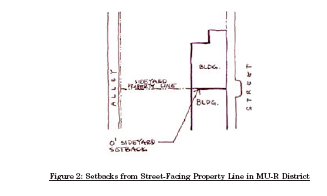
For purposes of this regulation, "side" property line shall mean only those property lines perpendicular to a street-facing property line ("street-facing property line" does not include property lines abutting only an alley).
2.
When a property in a mixed-use zone district either abuts or is across a street or alley from a property zoned R-L or R-M, the minimum building height and setback standards stated in Section 8 (Residential Protection and Transitional Standards) of the Mixed Use Design Standards and Guidelines shall apply instead of the bulk/dimensional standards stated in this Table 3.
3.
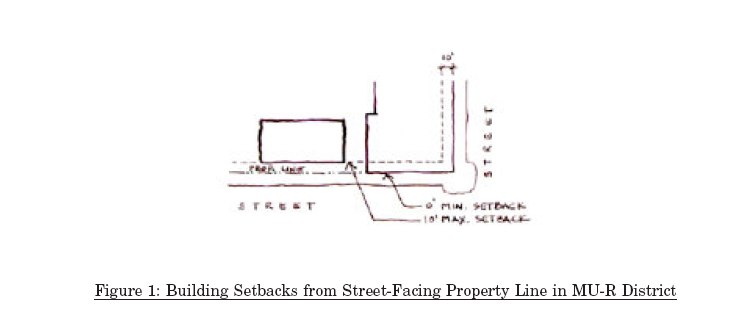
These standards shall not apply to property lines abutting an alley. This standard is met if the building wall is placed anywhere between the minimum and maximum allowed setback from street-facing property lines. The minimum 70 percent is a cumulative total of one or more buildings or building walls sited on the same property line or, as applicable, on two or more street-facing property lines.
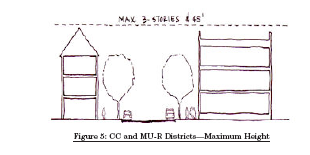
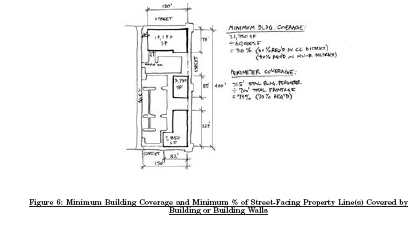
C.
Additional bulk and dimensional standards and exceptions.
1.
Additional residential density standards.
a.
Calculated as gross density. Residential density in Table 3 above is calculated as gross density, and shall be measured as an average including over the gross land area of only the residential portion of the site (as determined by the city), plus one-half the area of any adjacent street or alley right-of-way. For developments with mixed-use buildings containing both residential and nonresidential uses, residential density is measured including the gross land occupied by the entire mixed-use building.
2.
Setbacks—Rules of measurement.
a.
The Highway 42 setback shall be measured from the back edge of the Highway 42 right-of-way.
b.
The maximum street-facing front setback requirements shall apply only to the lower 35 feet or first two stories, whichever is less, of a building, and higher portions of the building may be stepped back further from the front property line.
c.
The maximum front minimum and maximum street-facing setback standards shall not apply to surface parking lots, which are subject instead to the minimum buffer standards in Section 7.1 of the Mixed Use Design Standards and Guidelines.
d.
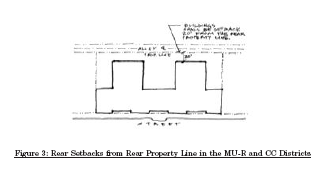
Setbacks from a rear property line shall be measured from the property line.
e.
See also Section 8 (Residential Protection and Transitional Standards) of the Mixed Use Design Standards and Guidelines for additional setback standards when new development in a MU-R or CC zone district is adjacent to existing residential uses in a R-L or R-M zone district.
3.
Zero building setbacks encouraged in MU-R district. To encourage pedestrian-friendly streets by bringing buildings close to pedestrian sidewalks and ways, the city encourages principal buildings in the MU-R district to be built to the back edge of the public sidewalk (zero feet setback), except as necessary to allow room for outdoor seating and service areas, outdoor sales and displays, landscaping, emphasized entryways integral to the building design, and similar pedestrian and customer amenities.
4.
Maximum height standards.
a.
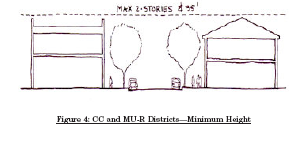
The maximum height of a two story building is 35.0′, which is inclusive of any parapet or rooftop mechanical equipment or other architectural or mechanical elements. The maximum height of a three story building is 45.0′, which is inclusive of any parapet or rooftop mechanical equipment or other architectural or mechanical elements. All rooftop mechanical equipment shall be screened according to the Mixed Use Design Standards and Guidelines.
(Ord. No. 1524-2007, § 1, 9-18-2007)
Sec. 17.14.070. - Development and design standards.
All new development in the MU-R zone district shall comply with the development and design standards stated in the Louisville Mixed Use Design Standards and Guidelines, except as expressly waived or modified by the city in a planned unit development plan approved according to chapter 17.28 and subject to the limitations stated in section 17.14.090.
(Ord. No. 1524-2007, § 1, 9-18-2007)
Sec. 17.14.080. - Incentives.
A.
References to incentives. Following is a summary of the mixed use development incentives provided and cross-references to the applicable sections of this chapter 17.14:
1.
A greater number and variety of uses allowed in the mixed use zone districts compared to other zone districts in Louisville. See section 17.14.050 (permitted uses and district specific regulations).
2.
Modifications of certain standards that reflect less demand and greater efficiencies in mixed-use projects, such as off-street parking. See Mixed Use Design Standards and Guidelines, Section 4.1 (Off-Street Parking).
3.
Additional flexibility for developers of mixed-use developments to propose a waiver or modification of some of the otherwise generally applicable development or design standards outlined in this chapter and the Mixed Use Design Standards and Guidelines. See section 17.14.090.A.2.b.i. (general rule allowing waiver or modification of standards).
(Ord. No. 1524-2007, § 1, 9-18-2007)
Sec. 17.14.090. - Review procedures for development in the mixed-use residential or the commercial community districts.
A.
General requirements. Rezonings within the Highway 42 Revitalization Area shall be consistent with the preferred land uses as reflected in Exhibit A, Land Use Plan Exhibit.
1.
Rezoning with PUD site plan approval required. Development on all sites in a mixed-use residential or commercial community zone district shall require subdivision approval, as applicable, and approval of a PUD site plan according to the planned unit development procedures and criteria stated in chapter 17.28 of this title, except as expressly modified by this section prior to construction.
2.
Planned unit development (PUD) option. Preliminary planned unit development plan shall be submitted and reviewed according to the requirements stated in chapter 17.28.
a.
Final PUD plan required. An approved final planned unit development plan is required prior to establishment of any use included in an approved preliminary PUD development plan. The final PUD plan shall be subject to public hearings before planning commission and city council as required under section 17.28.190.
b.
Applicable regulations.
i.
General rule allowing waiver or modification of standards. Unless otherwise limited by this section, the city may waive or modify all applicable stated Mixed Use Development Design Standards and Guidelines stated in this chapter, or other generally applicable design standards and provision of this Title 17, if the decision-making body finds that the proposed development represents an improvement in site and building design over that which could be accomplished through strict compliance with otherwise applicable district standards. Unless specifically waived or modified during the review and approval process, the zoning, use, bulk, dimensional, development, and design standards stated in this chapter and the Mixed Use Design Standards and Guidelines shall apply.
ii.
Specific standards that cannot be waived or modified. The following zoning, use, and development/design standards shall not be waived or modified as part of the PUD review procedure:
(a)
The principal uses allowed in the MU-R district stated in section 17.14.050.A.;
(b)
The requirements for a mix of principal uses for the MU-R district stated in section 17.14.050.D.;
(c)
The street design standards and guidelines stated in Section 1 of the Mixed Use Development Design Standards and Guidelines (the block design and dimension standards found in the same Section 1 may be modified through the PUD review process); and
(d)
The residential protection and transitional standards stated in Section 8 of the Mixed Use Development Design Standards and Guidelines.
3.
Effect of a PUD development plan approval.
a.
Binding nature of PUD site plan. The final PUD site plan shall limit and control the issuance and validity of all building permits and occupancy permits and shall restrict and limit the construction, location, use, and operation of all land and structures included within the site plan to all limitations and conditions set forth in the approved plan. Failure to maintain a property in compliance with its approved site plan shall be a basis for enforcement action under this title, subject to section 17.28.200, construction procedures and building permits.
(Ord. No. 1524-2007, § 1, 9-18-2007)
Sec. 17.14.100. - Definitions.
As used in this chapter, the following terms have the following meanings:
Assisted living/senior independent living facilities. Establishments that provide housing service for the elderly, as further defined as follows:
Assisted living facilities provide a range of residential and personal care services, often with on-site nursing care facilities for the elderly who are unable to fully care for themselves, and/or the elderly who do not desire to live independently. Individuals live in a variety of residential settings with meals, housekeeping, social, leisure, and other services available to assist residents in daily living. Assisted living facilities do not include adult foster care homes and adult care group homes, which are often established in single-family homes and where elderly residents share the house with the care provider's family.
Independent living facilities include any residential development that is age-restricted to persons 55 years of age and older, and that is not a group home (as defined by C.R.S. 31-23-303), and which may be in any housing form, including single-family detached or attached dwellings or multi-family structures. Independent living facilities may offer private or semi-private rooms/units, shared community dining facilities, and other social, recreational, or transportation amenities for the entire community, but does not provide for individualized personal or medical care for residents.
Research and development. A facility that is designed or equipped for basic or applied research or experimental study, testing, or analysis in the natural sciences or engineering, including any educational activities associated with and accessory to such research. Research and development offices do not include the mass manufacture, fabrication, processing, or sale of products, except limited facilities for the sale of products as incidental and accessory to the research purposes of the facility are allowed.
Person. An individual, firm, partnership, joint venture, association, corporation, limited liability company, estate, trust, business trust, receiver, syndicate, or other legal entity of any type, or any group or combination acting as a unit.
(Ord. No. 1524-2007, § 1, 9-18-2007)

