
Lynn Haven City Zoning Code
CHAPTER 1
GENERAL PROVISIONS
1.01.00 - TITLE
This code shall be known as and entitled the "Lynn Haven Unified Land Development Code" and may be referred to herein as the "ULDC."
1.02.00 - AUTHORITY
This ULDC is enacted pursuant to the requirements and authority of Chapter 163, Part II, F.S., and Chapter 166, F.S.
1.04.00 - CITY MANAGER
The City Manager is the chief administrative official of Lynn Haven. For the purposes of this ULDC, the City Manager is assigned to administer, interpret, and implement the standards, criteria, and procedures of this ULDC. The City Manager may delegate such responsibilities in writing to City staff. Throughout this ULDC, the term "City Manager" is used to indicate the responsibility for specified actions, except where specified actions are reserved or specifically delegated to the building official. In all instances, "City Manager" means the "City Manager or designee."
1.06.00 - DOCUMENTS REFERENCED
A.
The Technical Standards Manual, previously referred to as the Concurrency Management System User's Handbook, referred to herein as TSM.
B.
The Future Land Use Map (FLUM) as adopted within the Lynn Haven Comprehensive Plan and designated the "Official Land Use Map" in Section 2.00.02.
1.07.00 - ACRONYMS AND DEFINITIONS
A.
List of acronyms
CRA - Community Redevelopment Agency or Community Redevelopment Area (when referring to the CRA Plan)
DBH - diameter at breast height
EPA - Environmental Protection Agency
ERP - Environmental Resource Permit
FAA - Federal Aviation Administration
FAC - Florida Administrative Code
FCC - Federal Communications Commission
FDEP - Florida Department of Environmental Protection
FDOT - Florida Department of Transportation
FLUM - Future Land Use Map
FS - Florida Statutes
NGVD - National Geodetic Vertical Datum
OFW - Outstanding Florida Water
PUD - Planned Unit Development
TRC - Technical Review Committee
TSM - Technical Standards Manual
ULDC - Unified Land Development Code
USACOE - United States Army Corps of Engineers
B.
List of defined terms. Words and phrases shall be construed according to the common and approved usage of the language. Words with specific meaning in this ULDC are defined below.
Abutting property means any property that is immediately adjacent or contiguous to, or immediately across any road or public right-of-way from the subdivision.
Accessory use means a use of land or structure or portion thereof customarily incidental and subordinate to the principal use of the land or structure and located on the same parcel with the principal use.
Accessory structure (Appurtenant structure) means a structure that is located on the same parcel of property as the principal structure and the use of which is incidental to the use of the principal structure. Accessory structures should constitute a minimal investment, may not be used for human habitation, and be designed to have minimal flood damage potential. Examples of accessory structures are detached garages, carports, storage sheds, pole barns, and hay sheds.
Addition (to an existing building) means any walled and roofed expansion to the perimeter of a building in which the addition is connected by a common load bearing wall other than a firewall. Any walled and roofed addition which is connected by a firewall or is separated by independent perimeter load bearing walls is new construction.
Adverse effects means any modifications, alterations, or effects on waters, associated wetlands, or shore lands, including their quality, quantity, hydrology, surface area, species composition, or usefulness for human or natural uses which are or may potentially be harmful or injurious to human health, welfare, safety or property, to biological productivity, diversity, or stability or which unreasonably interfere with the reasonable use of property, including outdoor recreation. The term includes secondary and cumulative as well as direct impacts.
Advertising means sign copy intended directly or indirectly to promote the sale or use of a product, service, commodity, entertainment, or real or personal property.
Agricultural lands mean those lands in any agricultural use including forestry.
Apartment means one (1) or more rooms with private bath and kitchen facilities comprising an independent self-contained dwelling unit not owned in fee simple.
Apartment house means any building or part thereof providing more than two (2) separate apartments.
Appeal means a request for a review of the City Manager's interpretation of any provision of this ULDC.
Applicant means any person applying for or who has been granted a permit to proceed with a project.
Aquifer means an underground formation, group of formations, or part of a formation that is permeable enough to transmit, store or yield usable quantities of water.
Architect means a person registered and currently licensed to practice architecture in the State.
Artificial drainage system means any canal, ditch, culvert, dike, storm sewer or other manmade facility which tends to control the surface flow of water.
As-built means the construction document with exact location of utilities, rights-of-way and property lines.
As-built plans means the amended site plans specifying the locations, dimensions, elevations, capacities and capabilities of structures or facilities as they have been constructed.
Associated wetland means any wetland that is adjacent or contiguous to waters, or which has a direct hydrologic connection to waters.
Beneficial functions of a protected environmentally sensitive area means those functions, described in the conservation element of the City Comprehensive Plan, that justify designating an area as environmentally sensitive.
Block means and includes tier or group and means a group of lots existing within well-defined and fixed boundaries, usually being an area surrounded by streets or other physical barriers and having an assigned number, letter, or other name through which it may be identified.
Board means the Board of Adjustment.
Building means any enclosed or roofed structure for any occupancy or storage.
Accessory building means any building, the use of which is incidental to the main building, and which is placed upon the same lot as the main building.
Building setback means a line parallel to and equidistant from the relevant lot line (front, back, and side) between which no buildings or structures may be erected as prescribed in these regulations.
Certificate of concurrency means the certificate issued by the City upon finding that an application for a development permit will not result in the reduction of the level of service standards set forth in the City Plan for public facilities and services.
City engineer means an engineer employed by the City and designated as City engineer.
Clearing means the removal of trees and brush from the land, not including the ordinary mowing of grass.
Commercially developed parcel means a parcel of property used for wholesale or retail purposes on which the property user or employees are engaged in work for which it is intended that compensation be received for goods or services.
Concurrency management system means the procedures and processes utilized by the City to determine that development permits, when issued, will not result in the reduction of the level of service standards set forth in the City Comprehensive Plan.
Curb level means the elevation of the top of the street curb, as officially established by the City.
Datum means a reference surface used to ensure that all elevation records are properly related. The current national datum is the National Geodetic Vertical Datum (NGVD) of 1929, which is expressed in relation to mean sea level, or the North American Vertical Datum (NAVD) of 1988.
Deed restriction means the developers' right to impose restrictive covenants or other such limitations on the sale and use of the property within a subdivision. All restrictions are to be recorded in the records of the Clerk of the Circuit Court and shall be either shown or referenced on the final plat of record. The City shall have no responsibility for ensuring compliance with, or enforcement of, any such privately imposed restrictions unless they are included as part of an enforceable development agreement.
Detention means the collection and storage of surface water for subsequent controlled discharge at a rate which is less than the rate of inflow.
Developer means an individual, partnership, corporation, or other legal entity, or agent thereof, who undertakes the activities covered by this ULDC.
Development or development activities means construction, clearing, filling, excavating, grading, paving, dredging, mining, or otherwise significantly disturbing the soil of a site.
Permit (or, Development Permit) means a document issued by the City authorizing the applicant to undertake certain activities, including, but not limited to:
1.
Building.
2.
Tree removal.
3.
Temporary use.
4.
Demolition.
Local Development Order is a permit that gives the developer the right to commence land clearing and site work, including installation of infrastructure. A local development order will be issued for the following:
1.
Development plan approval for planned unit developments (PUD).
2.
Preliminary and final plat approval.
3.
Minor Subdivision Replat.
4.
Site plans.
5.
Development orders for developments of regional impact as defined in Section 380.06, F.S.
6.
Traditional Neighborhood Development (TND) plans.
Direct hydrologic connection means a surface water connection which, under normal hydrological conditions, occurs on an average of thirty (30) or more consecutive days per year. In the absence of reliable hydrologic records, a continuum of wetlands may be used to establish a direct hydrologic connection.
Discharge or Discharge Point means the point of outflow of water from a project, site, aquifer, drainage basin or facility.
Drainage facility means the whole or any part of the drainage system.
Drainage plan means the detailed analysis required by Sections 6.04.03 and 6.04.04 for each activity described in Section 6.04.02.
Drainage system means the system through which water flows; it includes all watercourses, waterbodies, and wetlands.
Dwelling unit means a room or rooms connected together, constituting a separate, independent housekeeping establishment containing sleeping, kitchen, and sanitary facilities.
Accessory A separate, complete housekeeping unit with a separate entrance, kitchen, sleeping, and complete sanitary facilities, which is an attached or detached extension to an existing single-family structure.
Duplex A structure containing two (2) separate dwelling units, each of which has independent access.
Multiple-family dwelling A dwelling on one (1) lot, containing three (3) or more separate dwelling units, having separate or joint entrances, and including the terms apartments, group homes, row houses, condominiums and multiple dwellings.
Single-family residence means a detached dwelling unit with a room or rooms connected together, constituting a separate, independent housekeeping establishment containing sleeping, kitchen, and sanitary facilities.
Easement means an interest in land owned by another which entitles its holder to a specific use or enjoyment.
Engineer means a person registered and currently licensed to practice professional engineering in the State.
Erosion means the wearing or washing away of soil by the action of wind or water.
Existing means the average physical condition of the land and buildings on a site immediately before development or redevelopment commences.
Facade means that portion of any exterior elevation on the building extending from grade to top of the parapet, wall, or eaves and the entire width of the building elevation.
Facade, street means the facing wall of a building fronting a street, other than courtyard walls.
First story means that part of a building or structure resting on or anchored to piers, foundation, or basement enclosure supporting the first floor joist sills and forming the lower floor level to its ceiling height.
Flood or flooding means a temporary rise in the level of any waterbody, watercourse, or wetland which results in the inundation of areas not ordinarily covered by water. For the purpose of floodplain management, Flood or flooding means:
(a)
A general and temporary condition of partial or complete inundation of normally dry land areas from:
(1)
The overflow of inland or tidal waters.
(2)
The unusual and rapid accumulation or runoff of surface waters from any source.
Flood insurance study (FIS) is the official hydrology and hydraulics report provided by FEMA. The study contains an examination, evaluation, and determination of flood hazards. The study may also contain flood profiles, as well as the FIRM, FHBM (where applicable), and other related data and information.
Floodplain means any land area susceptible to being inundated by water from any source.
Floor means the top surface of an enclosed area in a building (including basement), i.e., top of slab in concrete slab construction or top of wood flooring in wood frame construction. The term does not include the floor of a garage used solely for parking vehicles.
Floor area ratio (F.A.R.) means a measurement of the intensity of development on a site. The floor area ratio is the relationship between the total floor area on a site and the gross site area. The F.A.R. is calculated by adding together all floor areas of all floors and dividing this total by the gross site area. F.A.R. = Total Building Floor Area/Total Lot Area.
Frontage means the length of the front property line of the lot, lots, or tract of land abutting a public street, road, highway, or rural right-of-way.
Groundwater means water beneath the surface of the ground whether or not flowing through known and definite channels.
Group home facility Homes of six (6) or fewer residents which otherwise meet the definition of a community residential home shall be deemed a single-family unit and a noncommercial, residential use for the purpose of local laws and ordinances. Homes of six (6) or fewer residents which otherwise meet the definition of a community residential home shall be allowed in single-family or multifamily zoning without approval by the local government, provided that such homes shall not be located within a radius of one thousand (1,000) feet of another existing such home with six (6) or fewer residents. Such homes with six (6) or fewer residents shall not be required to comply with the notification provisions of this section; provided, however, that the sponsoring agency or the department notifies the local government at the time of home occupancy that the home is licensed by the department.
Hardship means the exceptional difficulty associated with the land that would result from a failure to grant the requested variance. The City of Lynn Haven requires that the variance is exceptional, unusual, and peculiar to the property involved. Mere economic or financial hardship alone is not exceptional. Inconvenience, aesthetic considerations, physical handicaps, personal preferences, or the disapproval of one's neighbors likewise cannot, as a rule, qualify as an exceptional hardship. All of these problems can be resolved through other means without granting a variance, even if the alternative is more expensive, or requires the property owner to build elsewhere or put the parcel to a different use than originally intended.
Height of building means the vertical distance to the top plate of the building measured from the curb level, or above the flood elevation if no curb level has been established.
Hotel is an establishment providing, for a fee, transient sleeping accommodations, resort residential rentals (see F.S. § 509.242) and customary lodging services, including maid service, the furnishing and upkeep of furniture and bed linens, and telephone and desk service. Related ancillary uses may include but shall not be limited to conference and meeting rooms, restaurants, bars, and recreational facilities.
Impervious surface means a surface which has been compacted or covered with a layer of material so that it is highly resistant to infiltration by water. The term includes most conventionally surfaced streets, roofs, sidewalks, parking lots, and similar structures.
Improvements means the physical changes made to raw land and structures placed on or under the land surface.
Land means the earth, water, air, above, below or on the surface, and includes any vegetation, improvements, or structures.
Land surveyor means a land surveyor duly registered and currently licensed in the State.
Light-duty truck, as defined in 40 C.F.R. 86.082-2, means any motor vehicle rated at eight thousand five hundred (8,500) pounds Gross Vehicular Weight Rating or less which has a vehicular curb weight of six thousand (6,000) pounds or less and which has a basic vehicle frontal area of forty-five (45) square feet or less, which is:
(1)
Designed primarily for purposes of transportation of property or is a derivation of such a vehicle, or
(2)
Designed primarily for transportation of persons and has a capacity of more than twelve (12) persons; or
(3)
Available with special features enabling off-street or off-highway operation and use.
Limited industrial means the manufacture, predominantly from previously prepared materials, of finished products or parts, including processing, fabrication, assembly, treatment, and packaging of such products, and incidental storage, sales and distribution. This excludes basic industrial processing and custom manufacturing.
Lot means the latest fractional part of subdivided lands having limited fixed boundaries, and an assigned number, letter, or other name through which it may be identified. The word "lot" shall include the words "plot," "parcel," or "tract."
Corner lot means a lot abutting upon two (2) or more streets at a street intersection, or abutting upon two (2) adjoining and deflected lines of the same street and thereby forming an interior angle of less than one hundred thirty-five (135) degrees.
Depth of lot means the average distance from a street line to the rear of the lot, measured in the mean general direction of the side lot lines.
Double frontage lot means a lot having two (2) non-adjoining property lines abutting upon a street.
Lot frontage means the horizontal distance between the side lot lines measured at the point where the side lot lines intersect the street right-of-way. All sides of a lot that abuts a street shall be considered frontage. On curvilinear streets, the arc between the side lot lines shall be considered the lot frontage.
Lot reconfiguration is the reconfiguration of lot lines within an existing plat to create an equal or lesser number of lots.
Rear lot line means the dividing line between two (2) tiers of lots in a block; the line separating a lot from an alley or the less important of two (2) streets.
Width of lot means the distance between the side lot lines.
Lowest adjacent grade means the lowest elevation, after the completion of construction, of the ground, sidewalk, patio, deck support, or basement entryway immediately next to the structure.
Lynn Haven City Plan means the Comprehensive Plan adopted by the City Commission pursuant to Ch. 163, Part II, F.S., as such plan may be amended from time to time.
Maintenance means that action taken to restore or preserve the functional intent of any facility or system.
Mangrove stand means an assemblage of mangrove trees which is mostly low trees noted for a copious development of interlacing adventitious roots above the ground and which contains one (1) or more of the following species: black mangrove (Avicennia nitida); red mangrove (Rhizophora mangle); white mangrove (Longuncularia racemosa); and buttonwood (Conocarpus erecta).
Manufactured home means a structure, transportable in one (1) or more sections, which eight (8) feet or more in width and greater than four hundred (400) square feet, and which is built on a permanent chassis and designed to be used with or without a permanent foundation when connected to the required utilities. The term also includes park trailers, travel trailers, and similar transportable structures placed on a site for one hundred eighty (180) consecutive days or longer and intended to be improved property.
Manufactured home park or subdivision means a parcel (or contiguous parcels) of land divided into two (2) or more manufactured home lots for rent or sale.
Massing is the overall bulk or size of a building or project, its physical volume or magnitude.
Mean high water is the average height of the high water over a nineteen-year period. For shorter periods of observation, it means the average height of water after corrections are applied to eliminate known variations and to reduce the result to the equivalent of a mean nineteen-year value. The mean high water line along the shores of land immediately bordering on navigable waters is recognized and declared to be the boundary between the foreshore owned by the State in its sovereign capacity and upland subject to private ownership.
Mean high water line means the intersection of the tidal plane of mean high water with the shore.
Medical marijuana dispensary means a location owned by a medical marijuana treatment center that sells, distributes, dispenses, or administers marijuana, products containing marijuana, related supplies, or educational materials to qualifying patients or their caregivers and is registered with the State of Florida Department of Health.
Minimum distance means the shortest permissible distance between two (2) points.
Mini-warehouse or self-service storage facility means one (1) or more structures containing individual, compartmentalized stalls, lockers or storage spaces with direct, private access for dead storage of personal property.
Multiple occupancy complex means a commercial use, i.e., any use other than residential or agricultural, consisting of a parcel of property, or parcel of contiguous properties, existing as a unified or coordinated project, with a building housing more than one (1) occupant.
National Geodetic Vertical Datum (NGVD) means, as corrected in 1929, a vertical control used as a reference for establishing varying elevations within the floodplain.
Natural system means a system which predominantly consists of or uses those communities of plants, animals, bacteria, and other life systems which naturally occur on the land, in the soil or in the water.
Neighborhood mean a parcel or parcel of land, at least forty (40) acres in size, planned as a whole and containing a mixture of all uses within a Traditional Neighborhood Development (TND).
North American vertical datum (NAVD) means a vertical control used as a reference for establishing varying elevations within the floodplain.
Occupant (occupancy) means a commercial use, i.e., any use other than residential or agricultural.
Occupied means "arranged," "designed or intended to be used," and "designed or intended to be occupied."
Owner means the person in whom is vested the fee ownership, dominion, or title of property that is the lawful proprietor. This term may also include a tenant, if, under his lease, he is responsible for the maintenance of the property; provided that the tenant shall always obtain the consent of the person(s) or entity who possesses vested fees in the property.
Parcel means a unit of land within legally established property lines.
Park shall mean a public open space, useable for passive or active recreation.
Pedestrian access easement means walkways, usually unpaved, that provide pedestrian passage through or along a block, running from street to street, or street to alley.
Permanent means designed, constructed and intended for more than temporary use as regulated in this ULDC.
Pharmacy means a location that sells, distributes, dispenses, administers, or compounds, medical drugs or medicines to qualifying patients or their caregivers and is registered with the State of Florida Department of Health.
Planting strip is an easement or right-of-way between a sidewalk and parking or driving lane.
Plat means a map or drawing depicting the division of lands and lots, blocks, parcels, tracts, or sites being a complete exact representation of the subdivision and other information in compliance with all applicable sections of the State plat act, F.S. § 177.031 et seq., and this chapter.
Pollutant means any substance, contaminant, noise, or manmade or man-induced alteration of the chemical, physical, biological, or radiological integrity of air or water in quantities or at levels which are or may be potentially harmful or injurious to human health or welfare, animal or plant life, or property, or which unreasonably interfere with the enjoyment of life or property, including outdoor recreation.
Protected environmentally sensitive area means an environmentally sensitive area designated for protection in the Conservation Element of the City Comprehensive Plan.
Protected wellhead means those wellheads which supply potable water for public consumption in the City.
Public facilities and services means the following public facilities and services for which level of service standards have been established in the City Plan:
1.
Potable water.
2.
Wastewater.
3.
Solid waste.
4.
Recreation/open space.
5.
Stormwater management.
6.
Transportation.
Public safety and nuisance means anything which is injurious to safety or health of the entire community or a neighborhood, or any considerable number of persons, or unlawfully obstructs the free passage or use, in the customary manner, of any navigable lake, or river, bay, stream, canal, or basin.
Receiving bodies of water means any waterbodies, watercourses, and wetlands into which surface waters flow.
Recharge means the inflow of water into a project, site, aquifer, drainage basin or facility.
Recreational vehicle means a vehicle which is:
1.
Built on a single chassis;
2.
Four hundred (400) square feet or less when measured at the largest horizontal projection;
3.
Designed to be self-propelled or permanently towable; and
4.
Designed primarily not for use as a permanent dwelling but as temporary living quarters for recreational, camping, travel or seasonal use.
Restaurant, take-out: Establishment for the sale of prepared food, most of which is consumed off the premises.
Restrictive covenants means private regulations recorded with the final plat which limit or otherwise govern the use, intensity, and development patterns of land within a subdivision or parcel of land for a specified time and transfers with the property.
Retention means the collection and storage of runoff without subsequent surface discharge to surface waters.
Reuse means water which has been treated to allow for irrigation.
Roofline means a horizontal line intersecting the highest point or points of a roof.
Sediment means solid material, whether mineral or organic, that is in suspension, is being transported, or has been moved from its site or origin by air, water or gravity.
Sedimentation facility means any structure or area which is designed to hold runoff water until suspended sediments have settled.
Sign means any writing, pictorial presentation, number, illustration, or decoration, flag, banner or pennant, or other device which is used to announce, direct attention to, identify, advertise or otherwise make anything known. The term "sign" shall not be deemed to include the terms "building" or "landscaping," or any architectural embellishment of a building not intended to communicate information.
Accessory sign means a permanent ground or building sign that is permitted under this chapter as incidental to an existing or proposed use of land.
Building sign means a sign displayed upon or attached to any part of the exterior of a building, including walls, windows, doors, parapets, marquees and roof slopes of forty-five (45) degrees or steeper.
Copy means the linguistic or graphic content of a sign.
Electric sign means any sign containing electric wiring.
Erect a sign means to construct, reconstruct, build, relocate, raise, assemble, place, affix, attach, create, paint, draw, or in any other way bring into being or establish a sign. It shall not include any such activities when performed as an incident to the change of message, routine maintenance activities when performed as an incident to the change of message, or routine maintenance.
Ground sign means a sign that is supported by one (1) or more columns, upright poles, or braces extended from the ground or from an object on the ground, or that is erected on the ground, where no part of the sign is attached to any part of a building.
Harmful to minors means, with regard to sign content, any description or representation, in whatever form, of nudity, sexual conduct, or sexual excitement, when it:
1.
Predominately appeals to the prurient, shameful, or morbid interest of minors in sex;
2.
Is patently offensive to contemporary standards in the adult community as a whole with respect to what is suitable sexual material for minors; and
3.
Taken as a whole, lacks serious literary, artistic, political, or scientific value.
4.
The term "harmful to minors" shall also include any non-erotic word or picture when it is patently offensive to contemporary standards in the adult community as a whole with respect to what is suitable for viewing by minors, and, taken as whole, lacks serious literary, artistic, political, or scientific value.
Illuminated sign means a sign which contains a source of light or which is designed or arranged to reflect light from an artificial source including indirect lighting, neon, incandescent lights, backlighting, and shall also include signs with reflectors that depend upon automobile headlights for an image.
Marquee means a structure projecting from and supported by a building which extends beyond the building line or property line and fully or partially covers a sidewalk, public entrance or other pedestrian way.
Outdoor advertising sign means a permanent ground sign supported by a single metallic pole attached to which is a sign face the bottom of which is at least twenty (20) feet above the ground and which is at least two hundred (200) square feet in size.
Portable sign means any sign which is manifestly designed to be transported by trailer or on its own wheels, including such signs even though the wheels may be removed and the remaining chassis or support structure converted to an A- or T-frame sign and attached temporarily or permanently to the ground.
Roof sign means a sign placed above the roofline of a building or on or against a roof slope of less than forty-five (45) degrees.
Sign face means the part of a sign that is or may be used for copy.
Sign face area means the area of any regular geometric shape which contains the entire surface area of a sign upon which copy may be placed.
Sign structure means any construction used or designed to support a sign.
Small announcement sign means a sign or nameplate not more than one (1) square foot in area.
Vehicle sign means any sign affixed to a vehicle.
Significant adverse effect means any modification, alteration, or effect upon a protected environmentally sensitive area which measurably reduces the area's beneficial functions as delineated in the conservation element of the City Comprehensive Plan.
Site means any tract, lot or parcel of land or combination of tracts, lots, or parcels of land which are in one (1) ownership, or are contiguous and in diverse ownership where development is to be performed as part of a unit, subdivision, or project.
Square means an outdoor public open space whose area is defined by streets or adjacent buildings on at least three (3) sides.
Street means a public thoroughfare, including road, highway, drive, lane, avenue, place, boulevard, and any other thoroughfare that affords the principal means of access to abutting property.
Alley means any street or lane not more than thirty (30) feet in width, whether or not designated as any alley on the official plat of the City.
Arterial means a street designed to carry large volumes of traffic and providing efficient vehicular movement between large areas of the City or Bay County.
Collector means a street carrying traffic from local streets to the major system of arterial streets and highways and including the principal access streets to residential developments.
Cul-de-sac means a local dead-end street having a permanent circular turnaround and only one (1) open end providing access to another street.
Marginal access street means a local street having two (2) ends, both of which connect with the same street, but having other streets intersecting between its ends.
Minor street means a local street, the primary function of which is to provide access and service to abutting properties. This includes access and service to residential, business, industrial, and public uses.
Private street means a street that has not been dedicated to public use but is platted and constructed in accordance with City standards.
Roundabout means a raised island that is usually landscaped and located at the intersection of two (2) streets used to reduce traffic speeds and accidents without diverting traffic onto adjacent residential streets.
Street line means the dividing line between a street and the lots abutting on it.
Street vista means a view through or along a street centerline created by a natural view, the placement of a public monument, use of a building facade or landscaping.
Structural alteration means any change in the foundations, walls, interior or exterior columns, beams, girders or other supporting members of a structure, roof or structural covering of the approved type.
Structure means anything constructed, installed, or portable, the use of which requires a location on a parcel of land.
Subdivider means and includes the term "developer," his duly authorized agent or representative, and shall include the word "person"; such person being engaged in the subdivision or development of land.
Subdivision means the division or re-division of a parcel of land into three (3) or more lots or parcels for the purpose of building development, or, if a new street is involved, any division of a parcel of land. The term "subdivision" includes a re-subdivision, and when appropriate to the context, shall relate to the process of subdividing or to the land subdivided. The term "subdivision" shall also include the replatting of all or any part of an existing plat.
Swale means a natural or manmade drainage pathway.
Temporary means designed, constructed, and intended to be used for a limited duration.
Trade service establishment means an establishment for sales, service or repair of articles, goods, and materials; these establishments include, but are not limited to, household appliances, auto and tire supply, , electrical store, plumber, radio and electronics, landscaping, sign painter, and tool sharpener.
Unit means that part of a multiple occupancy complex housing one (1) occupant.
Used means and shall include "arranged," "designed or intended to be used," and "designed or intended to be occupied."
Variance means cause to change, diversify, or modify an existing designation.
Vegetation means all plant growth, especially trees, shrubs, vines, ferns, mosses, and grasses.
Volume means occupied space, measured in cubic units.
Water or waters means and includes, but is not limited to, water on or beneath the surface of the ground or in the atmosphere, including natural or artificial watercourses, streams, rivers, lakes, ponds, or diffused surface water and water percolating, standing, or flowing beneath the surface of the ground.
Water and community water means any and all water on or beneath the surface of the ground or in the atmosphere. It includes the water in any watercourse, waterbody, or drainage system. It also includes diffused surface water and water percolating, standing or flowing beneath the surface of the ground, as well as coastal water.
Water body means any natural or artificial pond, lake, reservoir, or other area with a discernible shoreline which ordinarily or intermittently contains water.
Waterbody or surface waterbody means any natural or artificial pond, lake, reservoir, or other area which ordinarily or intermittently contains water and which has a discernible shoreline.
Water's edge and wetland's edge means the edge which shall be determined by whichever of the following indices yields the most landward extent of waters or wetlands:
1.
The boundary established by the average annual high water mark;
2.
The landward boundary of hydric soils; or
3.
The landward boundary of wetland vegetation, based on the wetland vegetation index.
Watercourse means any natural or artificial channel, ditch, canal, stream, river, creek, waterway or wetland through which water flows in a definite direction, either continuously or intermittently, and which has a definite channel, bed, banks, or other discernible boundary. Watercourse includes specifically designated areas in which substantial flood damage may occur.
Waters of the State means water including, but not limited to, rivers, lakes, streams, springs, impoundments, wetlands, and all other waters or bodies of water, including fresh, brackish, saline, tidal, surface, or underground waters.
Wetlands means those areas saturated by surface water or groundwater at a frequency and duration sufficient to support, and that under normal circumstances do support, a dominance of vegetation adapted for life in saturated soil conditions. Wetlands covered under this chapter shall include the following:
1.
Areas within the dredge and fill jurisdiction of the Florida Department of Environmental Protection (FDEP) as authorized by Chapter 403, F.S..
2.
Areas within the jurisdiction of the U.S. Army Corps of Engineers, as authorized by USC Section 404, Clean Water Act or USC Section 10, River and Harbor Act.
3.
Areas identified by the state natural areas inventory.
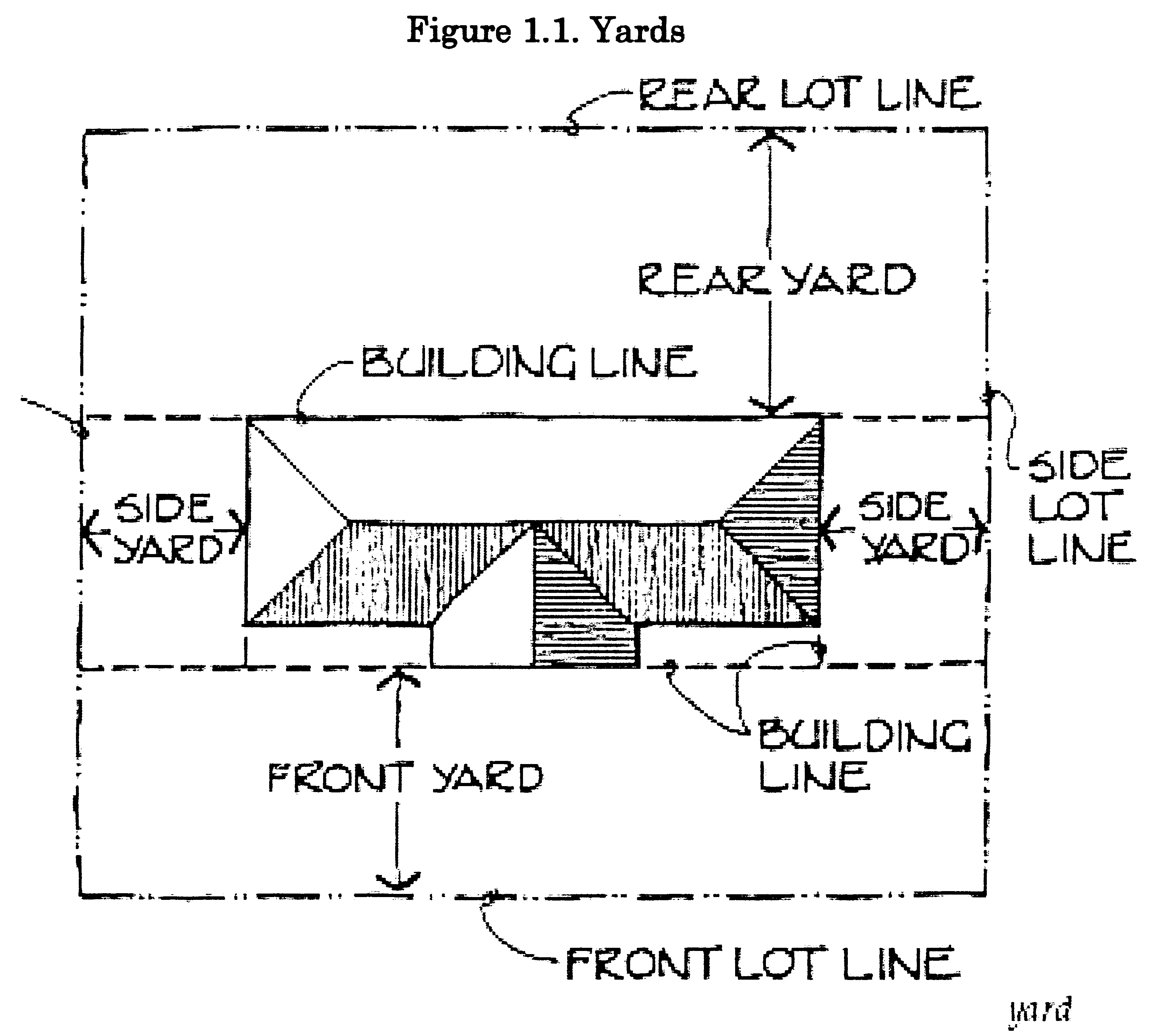
Yard means an open space that is unoccupied and unobstructed and that lies between a principal or accessory building or buildings and the nearest lot line. (See Figure 1.1)
Front yard means an open, unoccupied space on a lot facing a street, extending across the front of the lot between the side lot lines and from the outermost surface of the main building to the front lot line, with the minimum distance between the front lot line and the main building line as specified for the district in which the lot is located.
Rear yard means a yard extending across the full width of a lot and lying between the rear property line of the lot and the nearest wall of the main building.
Side yard means an open space between the side of a building and the adjacent lot line extending the full length of the building from front to back.
(Ord. No. 916, § 1, 5-26-09; Ord. No. 934, § 1, 5-25-10; Ord. No. 1033, § 1, 6-13-17; Ord. No. 1045, § 1, 10-10-17; Ord. No. 1075, § 2, 4-23-19; Ord. No. 1166, § 1(Exh. A), 8-27-24)
1.00.01 - Purpose and Intent
This Unified Land Development Code is hereby adopted and established as the City's official land development regulations in compliance with the City of Lynn Haven Comprehensive Plan in order to accomplish the following purposes:
A.
To promote the general health and welfare;
B.
Lessen danger from fire;
C.
Provide adequate light and air;
D.
Prevent the overcrowding of land;
E.
Conserve natural resources;
F.
Provide facilities concurrent with the needs of development for transportation, potable water, sanitary sewerage, parks and recreation, stormwater management, and solid waste disposal; and
G.
Conserve the value of real estate and encourage the most appropriate use of land within the City.
1.03.01 - Generally
A.
The use of any parcel of land, or any structure, or any combination thereof, within the corporate limits of the City shall be in conformance with the requirements of the ULDC.
B.
All development, which includes redevelopment, shall conform to the standards, criteria, requirements, and procedures of this ULDC.
C.
A change of use shall conform to the standards, criteria, requirements, and procedures of this ULDC.
D.
Where a development permit that was lawfully issued prior to the effective date of this ULDC expires, any further development on the site subject to the development permit shall conform to the standards, criteria, requirements, and procedures of this ULDC.
1.03.02 - Exceptions
Previously approved projects that are identified as exempt from the provisions of this ULDC are exempt only to the extent of the previous approval and are exempt from the provisions of this ULDC only to the extent that such provisions and requirements are inconsistent with prior, unexpired approval. The following general conditions or circumstances are exempt from the provisions and requirements of the ULDC:
A.
Projects for which a development permit has been lawfully issued, provided:
1.
The development permit has not expired prior to the effective date of the ULDC or amendment of the ULDC;
2.
The development activity authorized by the development permit commenced on or before the effective date of this ULDC and continues in good faith according to the applicable time limits; and
3.
The development activity authorized by the development permit is in accordance with all applicable development permits.
B.
Work required for public facilities and services and undertaken by an authorized governmental entity or agency within the public right-of-way, as further described below:
1.
Work required for the installation of facilities for the distribution or transmission of gas, water, sewer, or telecommunications services;
2.
Work required for the purpose of inspecting, repairing, or replacing any existing water or sewer lines, mains, or pipes; and
3.
Work required for the purpose of inspecting, repairing, or replacing cables, power lines, utility poles, utility tunnels, or the like.
1.05.01 - Generally
A.
Specific provisions of this ULDC shall be followed in lieu of general provisions that may be in conflict with the specific provision.
B.
In the interpretation and application of this ULDC, all standards, provisions, and requirements shall be liberally construed in favor of the objectives and purposes of the City and shall not be construed to limit nor repeal any other powers granted under State statutes.
C.
Where provisions of this ULDC conflict with other regulations, the more stringent restrictions shall be applied.
D.
Where written text and illustrations are in conflict, the written text shall govern.
1.05.02 - Responsibility for Interpretation
A.
In the event that any question arises concerning the application of regulations, standards, definitions, development criteria, or any other provision of this ULDC, the City Manager shall be responsible for interpretation. In the interpretation of this ULDC, the City Manager shall seek guidance from the comprehensive plan.
B.
Responsibility for interpretation by the City Manager shall be limited to standards, regulations, and requirements of this ULDC, and shall not be construed to include interpretation of any technical codes adopted by reference in this ULDC. Interpretation shall not be construed to override the responsibilities given to any commission, board, or official named in other sections or chapters of this ULDC.
1.05.03 - Rules for Interpretation of Boundaries
A.
The boundaries of the several land use districts as shown on the map entitled, Official Land Use Map, approved and adopted by the City Commission, which map, together with such additions or changes as may be found necessary or advisable from time to time, is hereby made a part of this ULDC.
B.
All areas within the City which are under water shall be subject to the same regulations as the land use districts which they adjoin.
C.
Boundary lines between districts adjoining water areas shall be extended in lines to the corporate limits or until they meet the extended lines of other districts.
1.05.04 - Rules of Construction
The following rules of construction shall be applied in the interpretation of the provisions of this ULDC:
A.
The word "shall" is mandatory and the word "may" is discretionary;
B.
Words used in the present tense shall include other tenses;
C.
Words in the singular shall include the plural, and words in the plural shall include the singular;
D.
Words denoting the masculine gender shall be construed to include the feminine and neuter;
E.
The word "person" includes a firm, association, organization, partnership, trust, company, or corporation, as well as an individual;
F.
The word "owner," applied to a building or land, shall include any part owner, joint owner, tenant in common, tenant in partnership, joint tenant, or tenant by the entirety, of the whole or of a part of such building or land;
G.
The word "and" indicates that all the connected items, conditions, provisions, or events shall apply;
H.
The word "or" indicates that the connected items, conditions, provisions, or events may apply singularly or in any combination; and
I.
The words "either ... or" indicate that the connected items, conditions, provisions, or events shall apply singularly, but not in combination.
1.05.05 - Computation of Time
A.
Whenever a notice is required to be given, an act to be done, or a certain length of time before any proceeding shall be provided, the day on which such notice is given, or such act is done, shall be counted in computing the time, but the day on which such proceeding is to be had shall not be counted.
B.
The term "day" means a calendar day.
C.
The term "month" means a calendar month.

