
Lyon Charter Township
City Zoning Code
City Zoning Code
ARTICLE 12
00 - GENERAL PROVISIONS
Section 12.01.- Administrative regulations.
A.
Scope of regulations. No structure or tract of land shall hereafter be used or occupied, and no structure, or part thereof, shall be erected, altered, or moved, except in conformity with the provisions of this Ordinance.
However, where a building permit for a building or structure has been issued in accordance with law prior to the effective date of this Ordinance and construction is begun within six months of the effective date, said building or structure may be completed in accordance with the approved plans. Furthermore, upon completion the building may be occupied under a certificate of occupancy for the use for which the building was originally designated, subject thereafter to the provisions of article 13.00 concerning nonconformities. Any subsequent text or map amendments shall not affect previously issued valid permits.
B.
Minimum requirements. The provisions of this Ordinance shall be held to be the minimum requirements for the promotion of public health, safety, convenience, comfort, morals, prosperity and general welfare.
C.
Relationship to other ordinances or agreements. This Ordinance is not intended to abrogate or annul any ordinance, rule, regulation, permit, easement, covenant, or other private agreement previously adopted, issued, or entered into and not in conflict with the provisions of this Ordinance.
However, where the regulations of this Ordinance are more restrictive or impose higher standards or requirements than other such ordinances, rules, regulations, permits, easements, covenants, or other private agreements, the requirements of this Ordinance shall govern.
D.
Vested right. Nothing in this Ordinance should be interpreted or construed to give rise to any permanent vested rights in the continuation of any particular use, district, zoning classification, or permissible activities therein. Furthermore, such rights as may exist through enforcement of this Ordinance are hereby declared to be subject to subsequent amendment, change or modification as may be necessary for the preservation or protection of public health, safety and welfare.
E.
Continued conformity with yard and bulk regulations.
1.
The maintenance of yards and other open space and minimum lot area legally required for a building shall be a continuing obligation of the owner of such building or of the property on which it is located, for as long as the building is in existence.
2.
No portion of a lot used in complying with the provisions of this Ordinance in connection with an existing or planned building, shall again be used to qualify or justify any other building or structure existing or intended to exist at the same time.
F.
Division and consolidation of land. The division and consolidation of land shall be in accordance with the Subdivision Ordinance of the Charter Township of Lyon, as amended. No zoning lot shall hereafter be divided into two or more zoning lots and no portion of any zoning lot shall be sold, unless all zoning lots resulting from each such division or sale conform with all regulations of the zoning district in which the property is located.
G.
Unlawful buildings, structures, site designs and uses. A building, structure, or use which was not lawfully existing at the time of adoption of this Ordinance shall not be made lawful solely by adoption of this Ordinance. In case any building, or part thereof, is used, erected, occupied or altered contrary to the provisions of this Ordinance, such building or use shall be deemed an unlawful nuisance and may be required to be vacated, torn down or abated by any legal means, and shall not be used or occupied until it has been made to conform to the provisions of this Ordinance. Public expenditures toward abating any such nuisance shall become a lien upon the land.
H.
Voting place. The provisions of this Ordinance shall not be construed to interfere with the temporary use of any property as a voting place in connection with a public election.
Section 12.02. - Allowable and prohibited uses.
A.
Allowable uses. Only the following uses of land, buildings and structures shall be allowed in the township:
1.
Uses lawfully established on the effective date of this Ordinance.
2.
Uses for which a building permit has been issued in accordance with section 10.01.
3.
Permitted uses in the applicable zoning districts, subject to the requirements specified.
4.
Special uses in the applicable zoning districts, subject to the conditions and requirements specified.
5.
Temporary uses, subject to the requirements in section 12.06.
B.
Prohibited uses. The following uses, as defined in section 3.02, shall not be allowed anywhere in the township:
1.
Medical marijuana growers and grow facilities.
2.
Medical marijuana processors.
3.
Medical marijuana provisioning centers and dispensaries.
4.
Medical marijuana safety compliance facilities.
5.
Medical marijuana secure transporters.
6.
Medical marijuana cooperatives.
7.
Medical marijuana compassion clubs.
8.
Establishments pursuant to Michigan Regulation and Taxation of Marihuana Act, MCL 333.27951 et seq., as may be amended.
9.
Uses and structures that are not expressly permitted in this Ordinance are prohibited.
(Ord. No. 03-10, pt. II, 7-6-2010; Ord. No. 03-16, pt. 3, 3-9-2016; Ord. No. 07-17, § 2, 12-4-2017; Ord. No. 02-19, § 2, 3-4-2019)
Section 12.03. - Lawful use of a structure as a dwelling unit.
A.
Incompletely constructed structures. Any incompletely constructed structure which does not meet the requirements of the building code or this Ordinance shall not be issued a certificate of occupancy and shall not be used as a dwelling. For the purposes of this section, a basement which does not have a residential structure constructed above it shall be considered an incompletely constructed structure. The restrictions shall not prevent temporary use of structure as a residence in accordance with section 12.06.
B.
Caretaker residence. No dwelling shall be erected in a commercial or industrial district, except for the living quarters of a watchman or caretaker. Any such living quarters shall consist of a structure which is permanently affixed to the ground, constructed in accordance with the adopted building code, and provided with plumbing, heating, bathroom, and kitchen facilities. In no case shall such living quarters be used as a permanent single-family residence by anyone other than a watchman or caretaker.
Section 12.04. - Residential design standards.
Any residential structure, including manufactured dwellings and mobile homes not located in mobile home parks, shall be erected or constructed only if in compliance with the following residential design standards:
A.
General requirements.
1.
Area and bulk regulations. Any residential structure, including any mobile home dwelling unit, shall comply with the minimum floor area requirements specified for the zoning district where such structure is located. Mobile homes shall comply with all regulations normally required for site-built housing in the zoning district in which it is located, unless specifically indicated otherwise herein.
2.
Foundation. Any principal or accessory residential building, including a mobile home, shall be placed on a permanent foundation in accordance with the adopted building code of the township. A foundation is not required for one-story detached residential accessory structures if the floor area does not exceed 200 square feet. A mobile home shall be securely anchored to its foundation to prevent displacement during windstorms. The wheel, tongue and hitch assembly, and other towing appurtenances shall be removed before attaching a mobile home to its permanent foundation.
3.
Other regulations. Residential structures shall be constructed in compliance with applicable state, federal or local laws or ordinances. Mobile homes shall comply with the most recent regulations specified by the United States Department of Housing and Urban Development, Mobile Home Construction and Safety Standards (24cFR3280), as amended.
4.
Floodplain. No dwelling unit, including mobile homes, shall be located within a 100-year floodplain.
5.
Use. Mobile homes and other structures shall be used only for the purposes permitted in the zoning district in which they are located.
6.
Attachments. Any exterior attachments or extensions onto a dwelling unit, such as entry steps and storage buildings, shall comply with the adopted building code of the township.
7.
Street address numbers. New residential structures shall be provided with street address numbers, which shall be at least four inches in height, visible from the street, and located where they will be illuminated.
B.
Requirements applicable to mobile homes. Mobile homes or manufactured dwelling units erected outside of mobile home parks after the effective date of this Ordinance shall comply with the general requirements set forth previously in subsection 12.04.A, and with the following regulations:
1.
Design features. The design and position of windows and other features of mobile homes and manufactured dwellings, including exterior wall colors and color combinations, shall be similar to site-built homes within 300 feet of the mobile home property boundaries. If no more than one site-built dwelling is presently located within 300 of the proposed location, then the mobile home or manufactured dwelling shall be compared to the nearest 50 site-built homes.
2.
Roof pitch. The pitch of the main roof shall have a minimum vertical rise of one foot for each four feet of horizontal run, and the minimum distance from the eaves to the ridge shall be ten feet, except where the specific housing design dictates otherwise (ie., French provincial, Italianate, etc.). The roof shall be finished with a type of shingle or other material that is commonly used in standard on-site residential construction.
3.
Exterior materials. The exterior siding of a mobile home or manufactured dwelling shall consist of materials that are generally acceptable for site-built housing, provided that the reflection from such exterior surface shall be no greater than from white semi-gloss exterior enamel; and provided further, that any such exterior is comparable in composition, appearance, and durability to the exterior siding commonly used in standard residential construction.
4.
Dimensions. The dimensions and placement of mobile homes or manufactured dwellings shall be comparable to typical dimensions and placement of site-built housing in the vicinity. Therefore, a mobile home or manufactured dwelling shall be located on the lot so that the minimum width of the front elevation is no less than 34 feet and the minimum dimension along any side or rear elevation is no less than 24 feet. If there are any extensions or additions off of the front of the mobile home or manufactured dwelling, the minimum width of any such secondary front elevation shall be 24 feet. Such dimensions shall be measured from the outer extremities and shall include additions to the main body of the mobile home or manufactured dwelling, such as living or recreation rooms, garages, carports, utility rooms, and the like, the front portions of which are within ten feet of the front of the main body of the mobile home or manufactured dwelling.
5.
Roof overhang. Mobile homes and manufactured dwellings shall be designed with either a roof overhang of not less than six inches on all sides or with window sills and roof drainage systems to concentrate roof drainage at collection points along the sides of the dwelling.
6.
Exterior doors. Mobile homes and manufactured dwellings shall have not less than two exterior doors which shall not be located on the same side of the building.
(Ord. No. 04-13, pt. 4, 11-4-2013; Ord. No. 03-17, pt. 2, 6-5-2017)
Section 12.05. - Home occupations.
A.
General requirements. Home occupations shall be subject to the requirements of the zoning district in which they are located, as well as the following standards, unless otherwise specified elsewhere in this Ordinance:
1.
Home occupations must be clearly incidental to the use of the dwelling as a residence.
2.
No outdoor display and/or storage of materials, goods, supplies, or equipment used in the home occupation shall be permitted on the premises.
3.
The appearance of the principal structure shall not be altered, nor shall the home occupation be conducted in a manner which would cause the premises to differ from its residential character either by the use of colors, materials, construction, lighting, signs, or the emission of sounds, noises or vibrations.
4.
Only the residents of the dwelling unit may be engaged in the home occupation.
5.
The home occupation may increase vehicular traffic flow and parking by no more than one additional vehicle at a time. No more than ten customers or clients shall come to the dwelling unit for services or products during any one day. Any need for parking generated by the conduct of such home occupation shall be met off the street and other than in the required front yard.
6.
No home occupation shall require internal or external alterations or involve construction features or the use of electrical or mechanical equipment that would change the fire rating of the structure.
7.
No home occupation shall cause an increase in the use of any one or more utilities (water, sewer, electricity, trash removal, etc.) such that the combined total use for the dwelling unit and home occupation exceeds by more than ten percent the average for the residence itself, measured over the previous 12-month period.
8.
One non-illuminated nameplate, not more than one square foot in area, shall be permitted. Said sign shall be attached flat to the building wall, and shall display only the name and occupation of the resident on the premises.
9.
A home occupation shall not create noise, dust, vibration, smell, smoke, glare, electrical interference, fire hazard, or any other hazard or nuisance to any greater extent or frequency than would normally be generated in a similarly zoned residential district.
10.
A single-family residence may be used by an occupant of that residence to give instruction in a craft or fine art as a home occupation within the residence, subject to regulations set forth in this section, in accordance with Public Act 110 of 2006, as amended, regardless of the zoning district in which the residence is located.
11.
The following uses, by the nature of their operation, have a pronounced tendency to increase in intensity beyond the limits permitted for home occupations, thereby impairing the reasonable use and value of surrounding residential properties. Therefore, the following uses shall not be permitted as home occupations (unless otherwise permitted subject to special approval):
-
Medical clinics and hospitals.
-
Offices maintained for the general practice of a veterinarian, doctor, lawyer, accountant, insurance agent, or real estate agent. The private offices of these professionals shall be permitted, provided that the residence is used only for consultation, emergency treatment, or business matters that can be carried on by the professional alone.
-
Millinery shops.
-
Animal hospitals or commercial kennels.
-
Vehicle and engine repair businesses.
-
Antique shops.
-
Barber shops and beauty parlors.
-
Private clubs.
-
Landscape installation and maintenance businesses, including lawn mowing businesses.
-
Snow plowing and/or removal businesses.
-
Concrete, excavation, or similar contractors.
-
Trailer rental.
-
Restaurants and tea rooms.
-
Repair shops and service establishments.
This list does not include every use that is prohibited as a home occupation.
Section 12.06. - Temporary structures and uses.
A.
General requirements. Temporary buildings and structures shall comply with the following requirements:
1.
Temporary structures used for residential purposes. A building or structure may be approved for temporary residential use only while damage to the principal dwelling due to fire, flood, ice, wind, or other natural disaster is being repaired. Any such temporary building shall not be used as a residence without prior review and approval by the police, fire and building officials.
Also, a mobile home or other approved living quarters may be occupied as a residence on a temporary basis on sites for which a building permit has been issued for construction, major repair, or remodeling of a new dwelling unit, subject to the following:
a.
Such permits may be issued by the building official for up to six months in duration and may be renewed for periods of up to six months, provided that work is proceeding in an expeditious manner.
b.
The total duration of a temporary permit shall not exceed 24 months.
c.
Temporary structures shall comply with the setback standards for the district in which they are located.
d.
The building official shall approve electrical and utility connections to any temporary structure.
e.
An approved temporary structure may be moved onto a site 14 days prior to commencement of construction and shall be removed within 14 days following issuance of a certificate of occupancy for the permanent dwelling.
f.
The applicant shall furnish the township with a performance guarantee in the amount of $500.00 to assure removal of the temporary structure.
2.
Temporary structures used for nonresidential purposes. Temporary buildings for nonresidential use, including semi-trucks/trailers and concrete batch plants, shall be permitted only when the intended use is by a contractor or builder in conjunction with a construction project, and only after review and approval by the building official. Such temporary structures shall be removed immediately upon completion of the construction project and prior to a request for a certificate of occupancy for the project.
3.
Permits. Permits for the utilization of temporary structures shall be issued by the building official. The permit shall specify a date for the removal of the temporary structure, and the building official may require posting of a bond to insure removal. A certificate of occupancy shall be required for such structures.
4.
Use as an accessory structure. A temporary building or structure shall not be used as an accessory building or structure, except as permitted herein.
Section 12.07. - Uses not otherwise included within a district.
A.
General requirements. A land use which is not cited by name as a permitted use in a zoning district may be permitted upon determination by the planning commission that such use is clearly similar in nature and compatible with the listed or existing uses in that district. In making such a determination, the planning commission shall consider the following:
1.
Determination of compatibility. In making the determination of compatibility, the planning commission shall consider specific characteristics of the use in question and compare such characteristics with those of the uses which are expressly permitted in the district. Such characteristics shall include, but are not limited to, traffic generation, types of service offered, types of goods produced, methods of operation, and building characteristics.
2.
Conditions by which use may be permitted.
a.
If the planning commission determines that the proposed use is compatible with permitted and existing uses in the district, the commission shall then decide whether the proposed use shall be permitted by right, as a special or conditional use, or as a permitted accessory use. The proposed use shall be subject to the review and approval requirements for the district in which it is located. The planning commission shall have the authority to establish additional standards and conditions under which a use may be permitted in a district.
b.
No use shall be permitted in a district under the terms of this section if the use is specifically listed as a use permitted by right or as a special or conditional use in any other district.
Section 12.08. - Yard and bulk regulations.
A.
General regulations. All lots, buildings, and structures shall comply with the following general yard and bulk regulations unless specifically stated otherwise in this Ordinance:
1.
Minimum lot size. Every building hereafter erected on a lot or parcel of land created subsequent to the effective date of this Ordinance shall comply with the lot size, lot coverage, and setback requirements for the district in which it is located.
No yards in existence on the effective date of this Ordinance, may subsequently be reduced below, or further reduced if already less than, the minimum yard requirements of this Ordinance.
2.
Number of principal uses per lot. Only one principal building shall be placed on a lot of record or parcel in single-family residential districts. In a single-family site condominium project, only one principal building shall be placed on each condominium lot, as defined in article 3.00.
3.
Projections into required yards. Fire escapes, fire towers, chimneys, platforms, balconies, boiler flues, and other projections shall be considered part of the building, subject to the setback requirements for the district in which the building is located. The following table identifies permitted projections in required yards:
PERMITTED PROJECTIONS INTO REQUIRED YARDS
Notes related to table:
1. Access drives and sidewalks. An access drive may be placed in a required front, or side, or rear yard so as to provide access to rear yards or accessory or attached structures on the property. Further, a sidewalk, or other pavement serving a like function, shall be permitted in any required yard, providing the pavement is not higher than six inches above grade. All such paved surfaces shall be set back a minimum of 12 inches from any property line.
2. Animal enclosures, dog runs, mechanical equipment. Animal enclosures for pets, dog runs, central air conditioning units, heat pumps, and other mechanical equipment that could produce noise, odors or other nuisances shall not be located adjacent to an adjoining property owner's living or sleeping area where window or doors would be exposed to the nuisance. Animal enclosures, dog runs, and mechanical equipment shall be set back a minimum distance of ten feet from property lines.
3. Architectural features. Bay windows, window sills, belt courses, cornices, eaves, overhanging eaves, and other architectural features may project into a required side yard not more than two inches for each one foot of width of such side yard, and may extend into any front or rear yard not more than 24 inches.
4. Open and covered decks. Open decks may project into a required rear yard, provided that the unoccupied portion of the rear yard has a depth of at least ten feet. Covered decks may project into a required rear yard, provided that the unoccupied portion of the rear yard has a depth of least 25 feet and the covered deck is not enclosed.
5. Fireplace chimneys. Fireplace chimneys, including cantilevers, may encroach up to two feet into a required rear yard and up to two feet into a required interior side yard, provided the chimney is at least six feet from the property line.
6. Window wells. Window wells may encroach into a required rear yard and into a required interior side yard provided that the window well is at least six feet from the property line.
7. Uncovered paved terraces, patios, and porches. Uncovered paved terraces, patios, and porches with a paved surface not exceeding six inches above grade may encroach into a required rear yard, provided that the unoccupied portion of the rear yard has a depth of at least ten feet. Uncovered paved terraces, patios, and porches with a paved surface greater than six inches above grade shall be regulated in accordance with footnote 4, above.
4.
Unobstructed sight distance.
a.
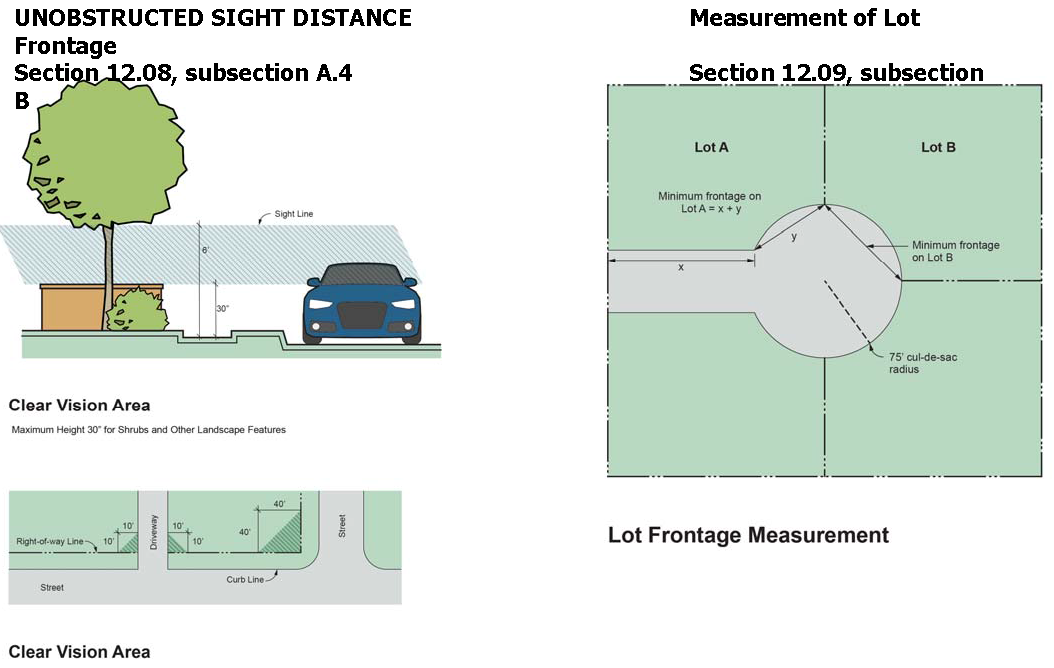
No fence, wall, structure, or planting shall be erected, established, or maintained on any lot which will obstruct the view of drivers in vehicles approaching an intersection of two roads or the intersection of a road and a driveway (see diagram). Fences, walls, structures, or plantings located in the triangular area described below shall not be permitted to obstruct cross-visibility between a height of 30 inches and six feet above the lowest point of the intersecting road(s).
b.
Trees shall be permitted in the triangular area provided that limbs and foliage are trimmed so that they do not extend into the cross-visibility area or otherwise create a traffic hazard. Landscaping, except required grass or ground cover, shall not be located closer than three feet from the edge of any driveway or road pavement within the triangular area.
c.
Unobstructed sight area. The unobstructed triangular area is described as follows:
-
The area formed at the corner intersection of two public right-of-way lines, the two sides of the triangular area being 40 feet in length measured along abutting public rights-of-way lines, and third side being a line connecting these two sides; or
-
The area formed at the corner intersection of a public right-of-way and a driveway, the two sides of the triangular area being ten feet in length measured along the right-of-way line and edge of the driveway, and the third side being a line connecting these two sides.
The unobstructed sight vision area in the New Hudson Zoning District shall include the area formed at the corner intersection of two public right-of-way lines, the two sides of the triangular area being 25 feet in length measured along abutting public rights-of-way lines, and third side being a line connecting these two sides; or
The area formed at the corner intersection of a public right-of-way and a driveway, the two sides of the triangular area being ten feet in length measured along the right-of-way line and edge of the driveway, and the third side being a line connecting these two sides.
5.
Lots adjoining alleys. In calculating the area of a lot that adjoins an alley for the purposes of applying lot area and setback requirements, one-half of the width of said alley shall be considered a part of the lot.
6.
Utilities, rights-of-way and easement. No portion of any newly created residential lot that is one acre or less in area which is located in a subdivision plat or a condominium plat shall be occupied by an easement or right-of-way for a high pressure gas line (60 psi or greater), a petroleum line, or a high voltage electric transmission line (100 kV or greater).
(Ord. No. 03-12, pt. 2.D., 8-6-2012; Ord. No. 03-17, pt. 3, 6-5-2017; Ord. No. 190-18, § 1, 5-7-2018; Ord. No. 197-18, § 1, 7-2-2018; Ord. No. 03-23, § 2, 7-5-2023; Ord. No. 02-25, § 1, 6-2-2025)
Section 12.09. - Streets, roads, and other means of access.
A.
Intent. Unimpeded, safe access to parcels of land throughout the township is necessary to provide adequate police and fire protection, ambulance services, and other public services, and to otherwise promote and protect the health, safety and welfare of the public. Minimum standards and specifications are required for private roads to assure safe to private property. The standards and specifications set forth herein are determined to be the minimum standards and specifications necessary to meet these intentions.
B.
Public access required. The front lot line of all lots shall abut onto a publicly dedicated road right-of-way or onto an approved private road which complies with the requirements set forth herein. The required frontage on an approved road right-of-way or easement shall be equal to or greater than the minimum lot width for the district in which the lot is located, as specified in article 36.00; except that the minimum frontage of lots that abut the turnaround at the end of a cul-de-sac shall be equal to or greater than 50 percent of the minimum lot width. On lots located on a curve, frontage shall be measured along a straight line between the two points where the side lot lines intersect the curved right-of-way line (see drawing). Frontage on a "T" turnaround shall not be counted toward the minimum road frontage requirements. No person shall construct, alter, or extend a private road unless in compliance with these requirements and the requirements of the private road ordinance.
C.
Road and driveway dimensions. Roads and driveways shall comply with the pavement width and curb and gutter requirements set forth in the following table. Roads and driveways shall comply with the applicable township engineering standards, the private road ordinance, and the current requirements of the Road Commission for Oakland County. All private roads serving non-residential parcels shall be designed to meet the requirements for public roads of the Road Commission for Oakland County.
Footnotes:
1
Road standards do not apply to roads serving a plat or site condominium, which are subject to the design requirements in the township's subdivision regulations.
2
A residential collector street is a street which collects and distributes traffic between other lower-order residential streets and higher-order streets or major activity centers. A residential collector street typically carries between 1,000 and 3,000 vehicles per day.
3
The entrance road extends from the edge of the public road to the edge of any parking lot, intersection, tee, or similar terminus within the development.
4
"T" turnarounds shall only be used at the end of the stub streets that have no dwelling units fronting on them. A cul-de-sac shall be constructed at the end of all dead-end private or public roads, regardless of whether the roads are expected to be extended in the future.
D.
Access across residential district land. No land which is located in a residential district shall be used for a driveway, walkway, or access purposes to any land which is located in a nonresidential district, unless such access is by way of a public road.
E.
Private roads or streets. Lots may be created with frontage on approved private roads provided that such lots conform to all requirements of the district in which the land is located, and provided further, that the lots shall not be created until an easement and easement maintenance agreement for the private road have been created and recorded in accordance with the standards set forth in the township private road ordinance. No construction shall be permitted on lots which have frontage only onto undeveloped private road easements. Construction may be permitted on such lots upon development of the private road in full compliance with the private road ordinance.
F.
Service roads. If the planning commission determines that proposed or anticipated development will result in an excessive number of entrance or exit drives onto a public road, thereby creating potentially hazardous traffic conditions and diminishing the carrying capacity of the road, the commission may permit or require construction of service roads across abutting parcels and generally parallel to the arterial street to allow traffic to circulate from one parcel to another without re-entering the public road. The front edge of any such secondary access drive shall be located no closer to the road than the future right-of-way line. Such secondary access drive shall conform to the minimum specifications for private roads as set forth previously.
Also, in anticipation of the need for such secondary access drives in the future, the planning commission may require, as a condition of site plan approval, granting of an easement to allow future vehicular access from adjoining properties.
G.
Performance guarantee. To assure completion of a private road or service road in conformance with the requirements set forth herein, the building official may require the applicant or owner to provide a performance guarantee, in accordance with article 17.00.
(Ord. No. 10-16, pt. 3, 11-9-2016; Ord. No. 07-20, § 1, 8-5-2020; Ord. No. 12-22, § 1, 11-1-2022)
Section 12.10. - Grading regulations.
All requirements for grading regulations, requirements, plans, standards, review inspection and approval procedures shall be governed by the Lyon Code of Ordinances, chapter 15, Design and Construction Standards, article VI, Grading.
(Ord. No. 12-15, pt. 2, 10-5-2015)
Section 12.11. - Lighting.
A.
Intent. The regulations in this section are intended to require sufficient lighting for parking areas, walkways, driveways, building entrances, loading areas, and common areas to ensure the security of property and safety of persons; prevent the adverse effects of inappropriate lighting, including glare, light trespass onto adjoining properties, light pollution and sky glow, and energy waste; and permit and encourage the use of lighting that complements and enhances the rural environment and natural features of the township.
B.
Definitions. Words and phrases used in this section shall have meaning set forth below. Words and phrases not defined herein but defined in article 1.00 shall be given the meanings set forth in article 1.00. All other words and phrases shall be given their common, ordinary meaning, unless context clearly requires otherwise.
Bulb (or lamp): The source of electric light (to be distinguished from the whole assembly, which is called the luminaire). Lamp is often used to denote the bulb and its housing.
Disability glare: An intense and blinding light that results in reduced visual performance and visibility, and is often accompanied by discomfort.
Filtered fixture: A light fixture that has a glass, acrylic, or translucent enclosure to filter the light.
Fixture: The assembly that holds the lamp in a lighting system. The fixture includes the elements designed to give light output control, such as a reflector (mirror), refractor (lens), ballast, housing, and the attachment parts.
Floodlight: A fixture or lamp designed to flood an area with light.
Footcandle: A measure of light intensity; the level of illuminance produced on a surface one foot from a uniform point source of one candela, or, when one lumen is distributed into an area of one square foot.
Fully shielded fixture: An outdoor lighting fixture that is shielded or constructed so that all light emitted is projected onto the site and away from adjoining properties. Light from a fully shielded fixture is not visible from adjoining properties, and does not cause glare or interfere with the vision of motorists.
High pressure sodium (HPS) lamp: High-intensity discharge lamp where radiation is produced from sodium vapor at relatively high partial pressures (100 torr).
Incandescent lamp: A lamp that produces light by a filament heated to a high temperature by electric current.
Laser source light: An intense beam of light, in which all photons share the same wavelength.
LED light: A light fixture that uses a light-emitting diode, which is a semi-conductor diode that emits light when conducting electrical current.
Light trespass: Light falling where it is not wanted or needed (also called spill light).
Low pressure sodium (LPS) lamp: A discharge lamp where the light is produced by radiation from sodium vapor at a relatively low partial pressure (about 0.001 torr). A LPS lamp produces monochromatic light.
Luminaire: The complete lighting unit, including the lamp, fixture, and other parts.
Lux: A measure of light intensity. One lux is one lumen per square meter. One footcandle is one lumen per square foot.
Mercury vapor lamp: A high-intensity discharge lamp where the light is produced by radiation from mercury vapor.
Metal halide lamp: A high-intensity discharge mercury lamp where the light is produced by radiation from metal-halide vapors.
Nonessential lighting: Outdoor lighting which is not required for safety or security purposes.
Recessed canopy fixture: An outdoor lighting fixture recessed into a canopy ceiling so that the bottom of the fixture is flush with the ceiling.
C.
General requirements.
1.
Minimum illumination. Sufficient lighting, as specified in the following table, shall be required for parking areas, walkways, driveways, building entrances, loading areas, and public common areas to ensure the security of property and safety of persons.
For locations other than those identified in the above table, sufficient lighting shall be based on recommendations in the most recent edition of the "Illuminating Engineering Society of North America (IESNA) Lighting Handbook."
2.
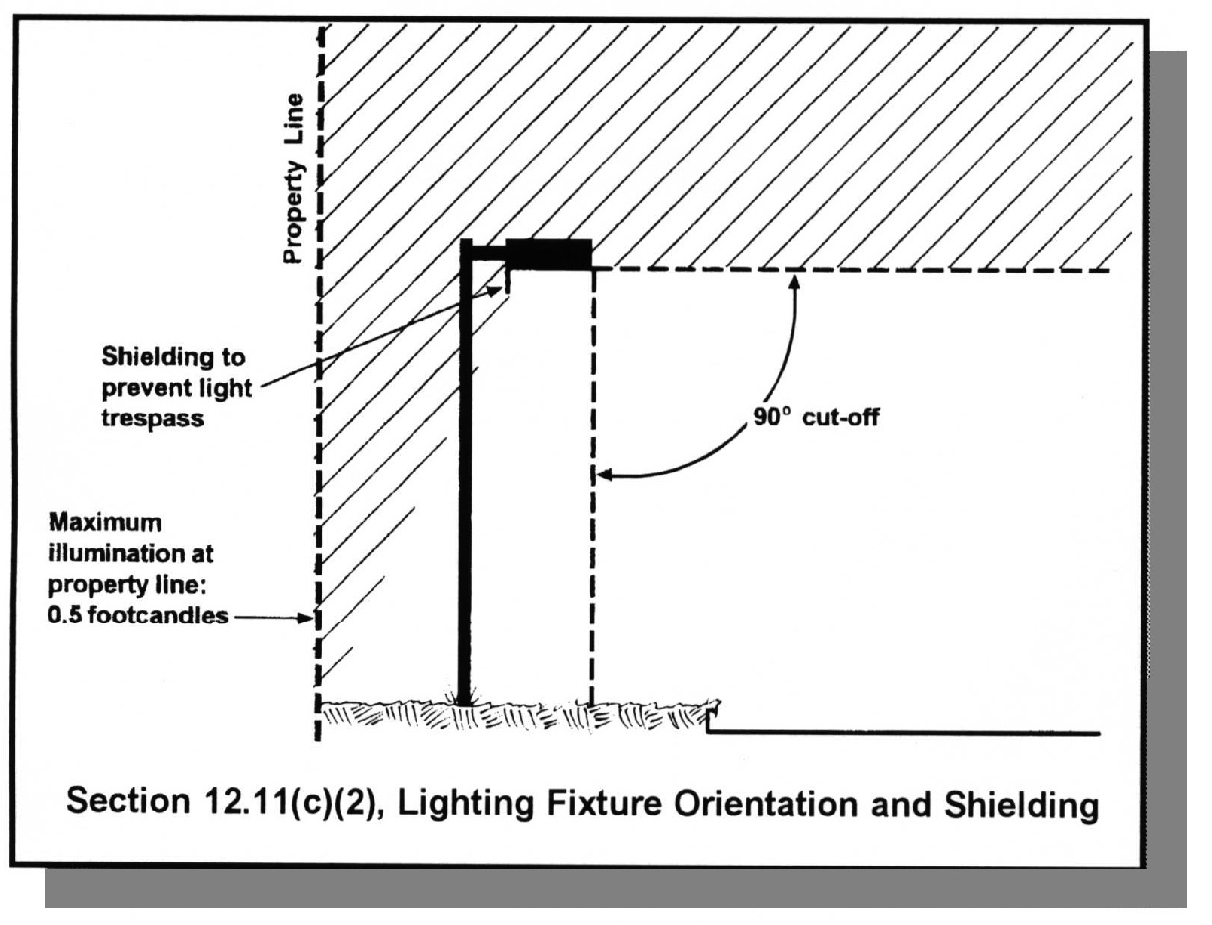
Fixture orientation and shielding. Lighting fixtures shall be focused downward and shall be fully shielded to prevent glare and sky glow and to minimize light trespass onto adjoining properties. Full cut-off fixtures shall be used to prevent light from projecting above a 90 degree horizontal plane (see illustration).
3.
Nonessential lighting. Nonessential lighting shall be turned off after business hours, leaving only that lighting that is necessary for site security. Proposed security lighting shall be identified on the site plan.
4.
Light trespass at property line. Light trespass from a property shall not to exceed 0.5 footcandles at the property line, measured five feet from the ground.
5.
Uplighting. Uplighting of buildings for aesthetic purposes shall be confined to the target surface as much as possible to prevent sky glow.
6.
Canopy lights. Light fixtures mounted on the underside of a canopy or similar structure shall be fully recessed into the canopy ceiling so that the bottom of the fixture and the lens are flush with the canopy ceiling. The total initial lamp output under a canopy shall not exceed 40 lumens per square foot of canopy.
D.
Permitted lighting sources and shielding requirements. Outdoor lighting shall comply with the following use and shielding requirements:
E.
Height.
1.
Lighting fixtures on parcels used for nonresidential purposes shall not exceed a height of 22 feet measured from the ground level to the centerline of the light source. Fixtures should provide an overlapping pattern of light at a height of approximately seven feet above ground level.
2.
The planning commission may modify these height standards in commercial and industrial districts, based on consideration of the following: The position and height of buildings, other structures, and trees on the site; the potential off-site impact of the lighting; the character of the proposed use; and, the character of surrounding land use. In no case shall the lighting exceed the maximum permitted building height in the district in which it is located.
F.
Sign lighting. Illuminated signs shall comply with the regulations set forth in article 16.00.
G.
Prohibited lighting.
1.
Recreational facility lighting. No outdoor recreational facility, public or private, shall be illuminated after 11:00 p.m., except to conclude a permitted recreational or sporting event or other activity in progress prior to 11:00 p.m.
2.
Outdoor building and landscaping lighting. Unshielded illumination of the exterior of a building or landscaping is prohibited except with incandescent fixtures having lamps of 100 watts or less.
3.
Mercury vapor and wall pack lighting. The installation of mercury vapor fixtures is prohibited. Wall pack fixtures are also prohibited, except where the lens is fully shielded.
4.
Laser source light. The use of laser source light or any similar high intensity light for outdoor advertising or entertainment, when projected above the horizontal, is prohibited.
5.
Searchlights. The operation of searchlights for advertising purposes is prohibited between 10:00 p.m. and sunrise the following morning.
H.
Exceptions. The following exterior lighting shall be exempt from the regulations in this section 12.11:
1.
Fossil fuel light. Fossil fuel light produced directly or indirectly from the combustion of natural gas or other utility-type fossil fuels (e.g., gas lamps).
2.
Temporary carnival and civic uses. Lighting for a permitted temporary circus, fair, carnival, or civic uses is exempt from the provisions of this section.
3.
Construction and emergency lighting. Lighting necessary for construction or emergencies is exempt from the provisions of this article; provided that, said lighting is temporary and is discontinued immediately upon completion of the construction work or abatement of the emergency.
4.
Special conditions. Additional exception may be permitted, subject to site plan review, and upon finding that unique or special conditions on the site warrant the exception.
5.
Low illuminance lights. The shielding requirements specified herein shall not apply to incandescent lights of 100 watts or less.
6.
Traditional or decorative fixtures. The cut-off, orientation, and shielding requirements may be waived or modified for traditional-style or decorative lighting fixtures, upon making the determination that the fixtures will comply with the illumination levels specified herein, will not cause glare or interfere with the vision of motorists, and will be consistent with the spirit and intent of this Ordinance.
I.
Application for a permit.
1.
Any person applying for site plan approval or for a building, electrical or sign permit to install outdoor lighting fixtures, whether for new or replacement lighting, shall submit evidence that the proposed work will comply with this section.
2.
The site plan or building, electrical, or sign permit application shall identify the location, type, height, method of mounting, and intensity of proposed lighting. If available, the manufacturer's catalog specifications and documents, drawings (including a photometric map showing proposed illumination levels on the site), and certified test reports shall be submitted. The information submitted shall be sufficiently complete to demonstrate compliance with ordinance requirements.
(Ord. No. 03-17, pts. 5, 6, 6-5-2017)
Section 12.12. - Trash removal and collection.
A.
Standards for siting and screening of trash dumpsters. Dumpsters may be permitted or required as accessory to any use other than single- and two-family residential uses, subject to the following conditions:
1.
Location.
a.
Dumpsters shall be located in a rear yard, provided any such dumpster shall not encroach on required parking area, is clearly accessible to servicing vehicles, and is located at least ten feet from any building. Dumpsters shall comply with the setback requirements for the district in which they are located.
b.
Dumpsters shall be located as far as practicable from any adjoining residential district.
2.
Concrete pad. Dumpsters shall be placed on a concrete pad. The concrete pad should extend a minimum of three feet in front of the dumpster enclosure.
3.
Screening. Dumpsters shall be screened from view from adjoining property and public streets and thoroughfares. Dumpsters shall be screened on three sides with a permanent building, decorative masonry wall, vinyl or composite fencing, or earth mound, not less than six feet in height or at least one foot above the height of the enclosed dumpster, whichever is taller. The fourth side of the dumpster screening shall be equipped with an opaque lockable gate that is the same height as the enclosure around the other three sides. The opaque lockable gate shall not be wood.
4.
Vinyl or composite screening standards. If vinyl or composite fencing is selected as the desired dumpster screening alternative, the following standards shall apply:
a.
Materials. The vinyl or composite fencing material must be durable and approved by the planning commission. Wood is a prohibited dumpster fencing material.
b.
Posts. Posts shall be set in concrete 42 inches below grade level. The posts must be three-inch diameter galvanized steel posts, concealed by the approved vinyl or composite material.
5.
Bollards. Bollards (concrete-filled metal posts) or similar protective devices shall be installed at the opening to prevent damage to the screening wall or fence.
6.
Site plan requirements. The location and method of screening of dumpsters shall be shown on all site plans and shall be subject to the approval of the planning commission.
(Ord. No. 199-18, § 1, 8-8-2018)
Section 12.13. - Safety provisions.
A.
Public service access. All structures shall be provided with adequate access for fire, police, sanitation, and public works vehicles.
B.
Fire protection. All structures shall be provided with adequate fire protection, including adequate water supply for firefighting purposes, adequate internal fire suppression system, use of fire walls and fire-proof materials, and other fire protection measures deemed necessary by the township fire chief or building official.
1.
Fire protection systems. The fire chief or building official shall have the authority to require fire protection systems installed in any zoning district.
2.
Site development standards. To facilitate fire protection during site preparation and construction of buildings, consideration shall be given to the following:
a.
If public water is available, water mains and fire hydrants shall be installed prior to construction above the foundation. Hydrants shall be spaced to provide adequate firefighting protection for all buildings and uses, subject to applicable codes and review by the township officials.
b.
Prior to construction of buildings and other large structures, a hard surfaced roadbed shall be provided to accommodate access of heavy firefighting equipment to the immediate job site at the start of construction. The roadbed shall be maintained until all construction is completed or until another means of access is constructed.
c.
Free access from the street to fire hydrants and to outside connections for standpipes, sprinklers, or other fire extinguishing equipment, whether permanent or temporary, shall be provided and maintained at all times.
d.
The building permit holder shall provide scheduled daily cleanup of scrap lumber, paper products, corrugated cardboard and other debris. Construction debris shall be disposed of in accordance with methods approved by the building official.
C.
Excavations and holes. Excavations and holes created in conjunction with a construction project shall be adequately barricaded and illuminated if not filled in at the end of the working day. Where such excavations or holes are located in a public right-of-way, it shall be the responsibility of the contractor to notify the Oakland County Sheriff of their existence.
D.
Building demolition. Before a building or structure is demolished, the owner, wrecking company, or person who requests the demolition permit shall notify all utilities providing service to the building. A demolition permit shall not be issued until all utilities have provided notification that service has been property terminated.
Section 12.14. - Exceptions.
A.
Essential services.
1.
Essential services, as defined in article 3.00, shall be permitted as authorized and regulated by franchise agreements and federal, state and local laws and ordinances, it being the intention of this Ordinance to permit modification to regulations governing lot area, building or structure height, building or structure placement, and use of land in the township when strict compliance with such regulations would not be practical or feasible.
2.
Although essential services may be exempt from certain regulations, proposals for construction of essential services shall still be subject to site plan review and special land use review, it being the intention of the township to achieve efficient use of the land and alleviate adverse impact on nearby uses or lands. Essential services shall comply with all applicable regulations that do not affect the basic design or essential operation of said services.
B.
Exceptions to height standards. The height limitations of this Ordinance shall not apply to chimneys, church spires, public monuments, wireless transmission towers, farm buildings, water towers, and flag poles; provided that the following requirements are complied with:
1.
Windmills. The maximum height of windmills used for pumping water for farm uses (but not including pumping of stormwater) or for decorative purposes shall be 35 feet; provided that, the windmill is setback from all property lines a distance equal to the height of the windmill or the setback required by the zoning district, whichever is greater. Windmills used for pumping water for farm uses or for decorative purposes shall be located only in the rear yard in the R-1.0, residential - agricultural district.
2.
Antennas in residential districts. Private television antennas, pole antennas, and other private communication antennas or towers shall be permitted in residential districts as follows:
a.
Antennas with a wind-resistance surface of seven square feet or less shall be located in the rear yard or on a rooftop; provided that the antenna tower is set back from all property lines a distance equal to the height of the tower. Such antennas shall comply with the height standards for the district in which they are located, except as hereinafter provided.
b.
Antennas with a wind-resistance surface of over seven square feet shall be located in the rear yard only, and shall be subject to the setback and height standards for the district in which they are located. Any such antenna shall be located to obscure its view from adjacent properties and roads, to the maximum extent possible.
c.
Notwithstanding the above requirements, open element and monopole antennas shall be permitted in residential districts as follows:
Satellite dish antennae shall be subject to the regulations in Section 12.17.
3.
Antennas in nonresidential districts. Antennas with a wind-resistance surface of seven square feet or less shall be permitted on the rooftop of any building or in the rear of a nonresidential district provided that the antenna complies with the height standard for the district in which it is located, and is obscured from view from adjacent properties and roads, to the maximum extent possible. A freestanding antenna may be located in the side yard if its visibility from adjacent properties is obscured.
4.
Variances. Variances from height standards may be sought from the zoning board of appeals. In considering such a request, the zoning board of appeals shall be considered the character of the surrounding uses, the height of surrounding structures, the potential to obscure light or view to or from existing buildings or surrounding properties, and potential detriment to the use or value of surrounding properties.
5.
Public right-of-ways. Utility poles, structures and wireless equipment in a public right-of-way are subject to the following regulations:
a.
Utility poles and structures in a public right-of-way shall not be more than 40 feet in height above ground level.
b.
Wireless equipment shall not extend more than five feet above the top of a utility pole or structure it is attached to in a public right-of-way.
(Ord. No. 03-13, pt. 3, 10-7-2013; Ord. No. 190-18, § 3, 5-7-2018; Ord. No. 200-18, § 2, 9-4-2018)
Section 12.15. - Sidewalks.
Sidewalks and bicycle paths shall be subject to the requirements in the adopted Township Bicycle Path and Sidewalk Ordinance, and the following regulations:
A.
General Requirements.
1.
[Sidewalks and bicycle paths required.] Sidewalks and bicycle paths shall be required in the locations specified in the Bicycle Path and Sidewalk Ordinance, chapter 40, article II of the Code of Ordinances, and section 22-245.
2.
Location and width. Required sidewalks shall be five feet in width and bicycle paths shall be ten feet in width. Sidewalks and bicycle paths shall generally be located one foot off the property line in the road right-of-way, except where the planned right-of-way is greater in width than the existing right-of-way, in which case the sidewalk shall be located one foot inside the planned right-of-way. The planning commission may modify this requirement in consideration of the location of utilities, existing or proposed landscaping, or other site improvements.
3.
Design standards. Sidewalks shall be constructed of concrete, and bicycle paths shall be constructed of asphalt, in accordance with established engineering standards for the township. Use of other materials shall be subject to township engineer approval.
4.
Alignment with adjacent sidewalks and bicycle paths. Sidewalks and bicycle paths shall be aligned horizontally and vertically with existing sidewalks and bicycle paths on adjacent properties. The planning commission may modify this requirement if existing adjacent sidewalks or bicycle paths are not constructed in conformance with the standards set forth herein.
5.
Signage. The planning commission may require the installation of signage for the purposes of safety where it necessary to separate vehicular traffic from pedestrian and bicycle traffic, or where it necessary to alert vehicular traffic of the presence of the sidewalks or bicycle paths.
6.
Maintenance. The owner of the property that fronts on a sidewalk shall be responsible for maintenance of the sidewalk, including patching deteriorated or cracked pavement, snow removal, and removal of glass and other debris. Where a sidewalk or bicycle path located along a collector or arterial road adjoins a subdivision or condominium, maintenance shall be the collective responsibility of the property owners in the subdivision or condominium.
7.
Permits. It shall be responsibility of the owner or developer to secure any required permits from the Road Commission for Oakland County or State of Michigan agencies to allow sidewalk or bicycle path construction in the right-of-way.
(Ord. No. 10-16, pt. 4, 11-9-2016; Ord. No. 05-24, § 1, 11-6-2024)
Section 12.16. - Fences.
A.
General requirements.
1.
Fence materials. Fences shall consist of materials commonly used in conventional fence construction, such as wood or metal. Razor wire shall not be permitted. Fences which carry electric current shall be permitted only in conjunction with an agricultural use. Barbed wire may be permitted in nonresidential districts, provided that the barbed wire is at least six feet above the ground.
2.
Finished appearance. If, because of the design or construction, one side of the fence has a more finished appearance than the other, the side of the fence with the more finished appearance shall face the exterior of the lot.
3.
Obstruction to use of adjoining property. No fence shall be erected where it would prevent or unreasonably obstruct the use of adjacent property, nor shall a fence be erected where it would obstruct or prevent the continued safe use of an existing driveway or other means of access to adjacent property. In enforcing this provision, the building official may require a fence to be set back a minimum distance from a driveway or property line.
4.
Fence maintenance. Fences shall be maintained in good condition. Rotten or broken components shall be replaced, repaired, or removed. As required, surfaces shall be painted, stained, or similarly treated.
5.
Measurement. The maximum height of fences shall be measured from ground level adjacent to the fence.
6.
Fences enclosing utility facilities. It is necessary to control entry into facilities, stations, and yards housing public utilities in the interest of public safety and to protect resources that are vital to well-being of the general public. Consequently, utilities are permitted to fence their facilities as necessary, regardless of the zoning district in which the facilities are located, subject to administrative review and approval.
7.
Deed restriction, subdivision regulations, condominium regulations. Property owners in a subdivision or condominium are advised to investigate whether there are deed restrictions, subdivision regulations, or condominium bylaws that regulate fences in the development, although the township does not enforce such regulations.
B.
Fence regulations in residential districts.
1.
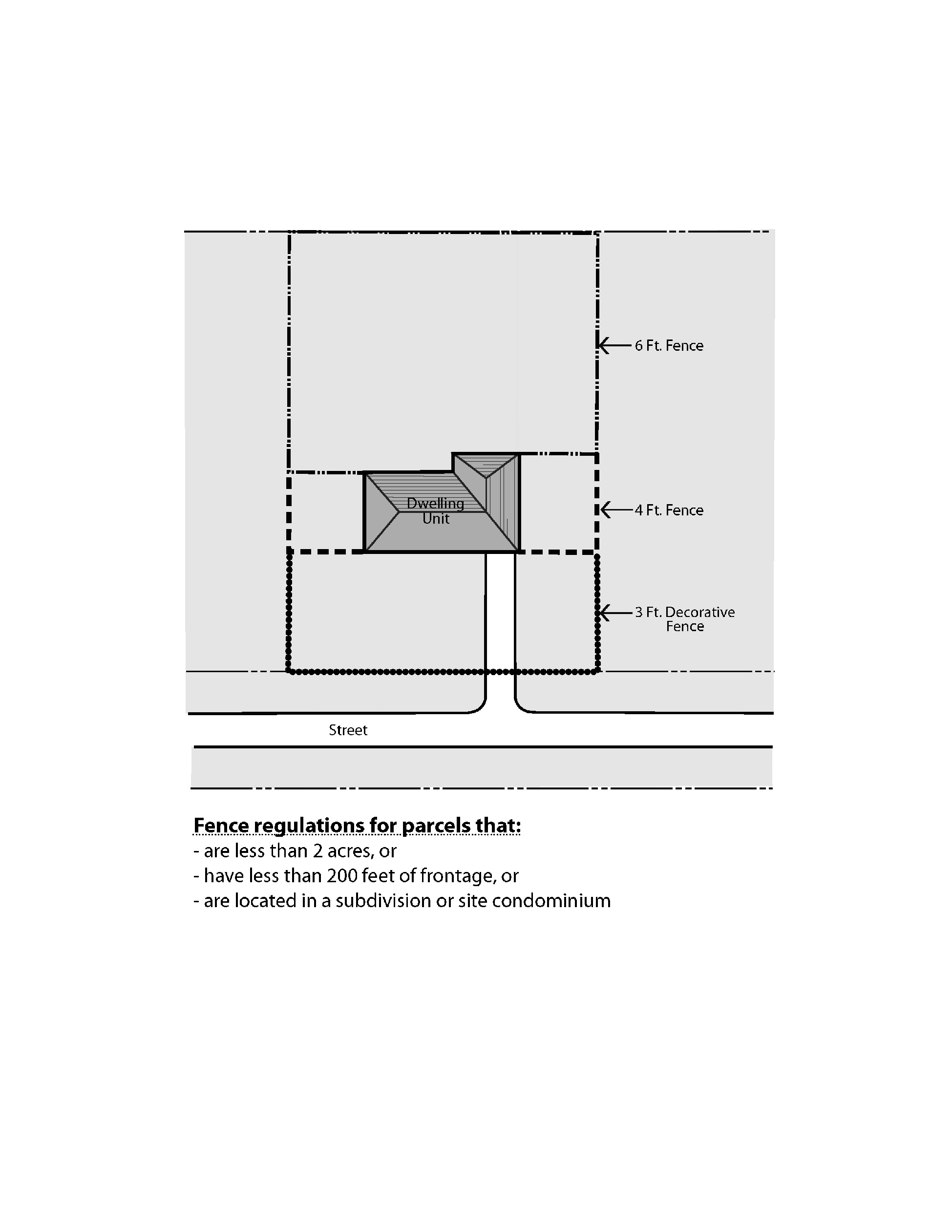
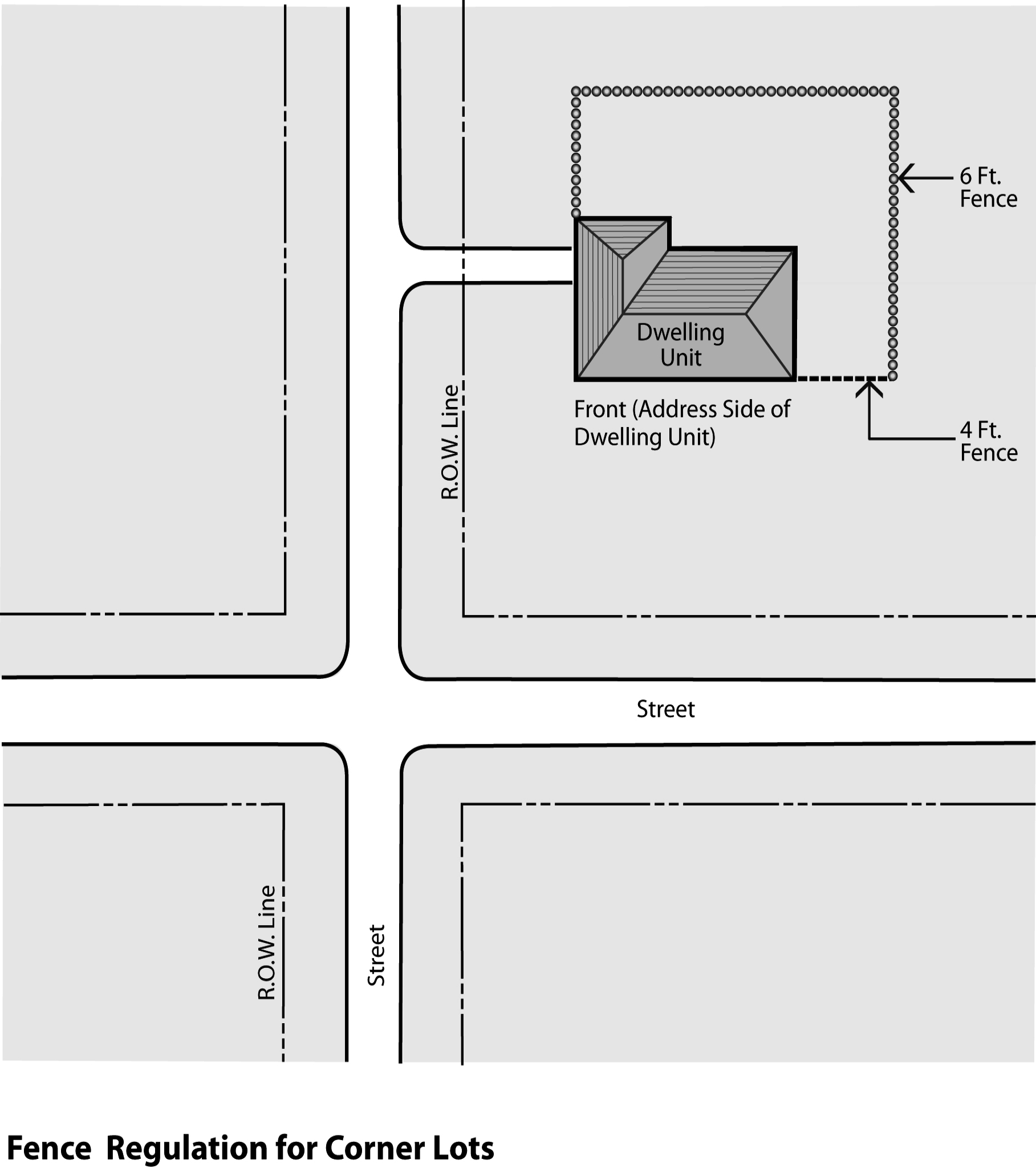
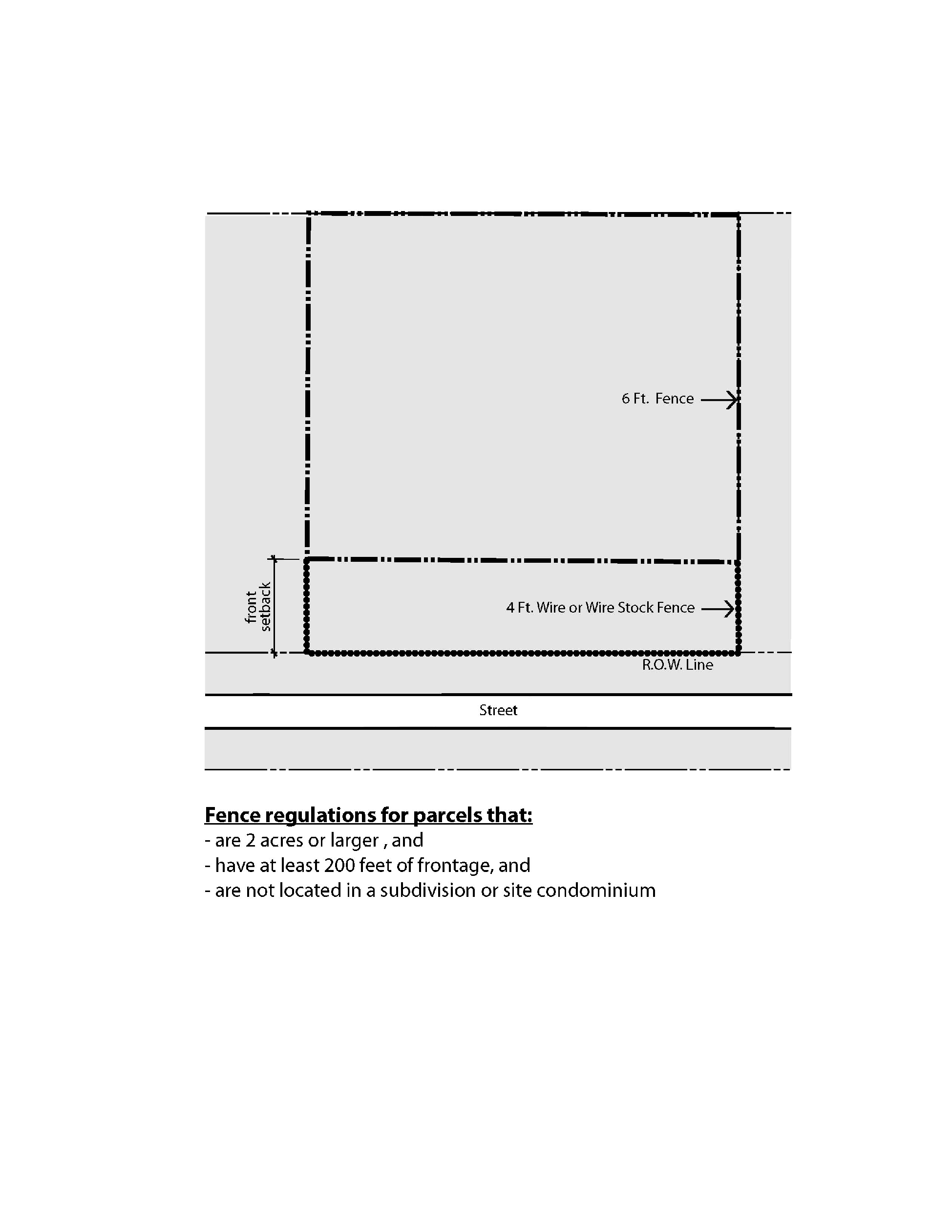
Location, height and other restrictions (see diagrams).
a.
For parcels of land or lots which are less than two acres, or which have less than 200 feet of frontage, or which are located in a subdivision plat or site condominium development:
•
The maximum height shall be six feet fences located to the rear of the dwelling unit, except that chain link fences shall not exceed four feet in height.
•
The maximum height shall be four feet for fences located in the side yard.
•
The maximum height shall be three feet for fences located in the front yard.
•
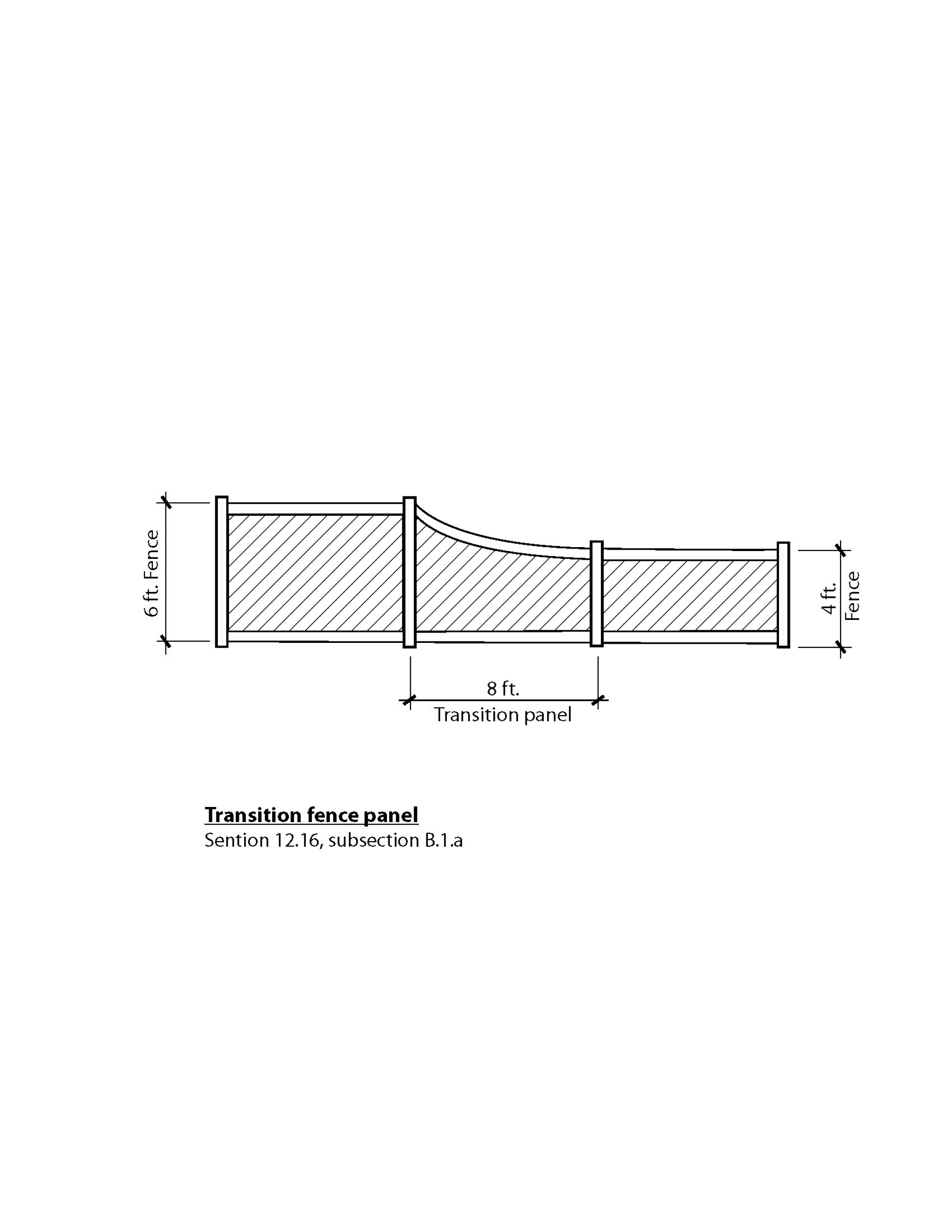
An eight-foot long transition fence panel is permitted to achieve a progression in height from a taller fence to a shorter fence.
•
Fences in the front yard shall be decorative and non-obscuring in design. Decorative fences include, by way of example, picket and split rail fences. Stockade, wire, and chain link fences are not considered decorative fences.
•
On corner lots the following regulations shall apply:
(1)
On the side yard facing a street (the non-address side), a six-foot high fence shall be permitted provided the fence does not extend closer to the street than any portion of the principal dwelling.
(2)
In the front yard facing a street (the address side), a four-foot high fence shall be permitted, provided the fence does not extend closer to the street than any portion of the principal dwelling.
(3)
A three-foot high fence may be erected in the setback area, provided that any such fence shall be decorative and non-obscuring in design, as described above.
b.
For parcels of land which are two acres or larger, and which have at least 200 feet of frontage, and which are not located in a subdivision plat or site condominium development:
•
The maximum height shall be six feet for fences located at or to the rear of the front setback line.
•
Fences between the road right-of-way line and the front setback line shall have a maximum height of four feet. Such fences shall be open and non-obscuring in design, such as wire or wire stock fences.
2.
Fences enclosing public areas. Fences which enclose public parks, playgrounds, or similar public areas located within a developed residential area shall not exceed eight feet in height, measured from the surface of the ground. No greater than 25 percent of the vertical surface of such fences shall be opaque so as to obstruct vision.
C.
Fence regulations in nonresidential districts. Fences shall be permitted in nonresidential districts, subject to the following conditions:
1.
Location. Fences shall be permitted in the rear or side yard of nonresidential districts, provided that no fence extend toward the front of the lot than any portion of the principal structure. These restrictions shall not apply to agricultural uses.
2.
Height. Fences in nonresidential districts shall not exceed eight feet in height, except that fences used to enclose agricultural lands shall not exceed four feet in height.
D.
Walls. This section shall in no way alter or affect the requirements for walls set forth in article 15.00.
Section 12.17. - Satellite dish antennae.
Satellite dish antennae may be permitted as an accessory use in any zoning district, subject to the following conditions:
A.
Roof-mounted antennae. Roof-mounted dish antennae up to ten feet in diameter shall be permitted in commercial and industrial districts only, provided that the antennae comply with the height standards for the district in which they are located.
B.
Ground-mounted antennae. Ground-mounted antennae up to ten feet in diameter shall be permitted in all districts subject to the following conditions:
1.
Maximum height permitted shall be 20 feet.
2.
The satellite dish structure shall be securely mounted and anchored to a pole and secured in accordance with the requirements of the manufacturer and the building code.
3.
If elevated off of the ground, all such antennas shall be located so that there is an eight-foot clearance between the lowest part of the dish and grade.
4.
Satellite dish antennae comply with setback requirements for the district in which they are located, and shall not be permitted in front yards.
5.
All electrical and antenna wiring shall be placed underground or otherwise obscured from view.
6.
The surface of the dish shall be painted or treated as not to reflect glare from sunlight, and shall not be used as any sign or message board. All installations shall employ (to the extent possible) materials and colors that blend the surroundings.
Section 12.18. - Impact assessment.
A.
Intent. The purpose of an impact assessment is to assess the developmental, ecological, social, economic, and physical impact from a proposed development on and surrounding the development site, and to determine if a proposed use will be in compliance with the site development and performance standards set forth in articles 19.00 and 20.00 where required, the impact assessment shall, at minimum, assess the following:
1.
Water, noise and air pollution associated with the proposed use.
2.
Effect of the proposed use on public utilities.
3.
Historic and archeological significance of the site and adjacent properties.
4.
Displacement of people and other land uses by the proposed use.
5.
Alteration of the character of the area by the proposed use.
6.
Effect of the proposed use on the township's tax base and adjacent property values.
7.
Compatibility of the proposed use with existing topography, and topographic alterations required.
8.
Impact of the proposed use on surface and groundwater.
9.
Operating characteristics and standards of the proposed use.
10.
Proposed screening and other visual controls.
11.
Impact of the proposed use on traffic.
12.
Impact of the proposed use on flora and fauna.
13.
Negative short-term and long-term impacts, including duration and frequency of such impacts, and measures proposed to mitigate such impacts.
B.
Information required. Where required, an impact assessment shall contain all applicable information that is required for conceptual review of planned development, as set forth in section 7.05, subsection A.
C.
Evaluation of the impact assessment. The planning commission and township board shall consider the criteria listed below in their evaluation of an impact assessment. Failure to comply with any of the criteria shall be sufficient justification to deny approval. The township board and planning commission shall determine that the proposed use:
1.
Will be harmonious with and in accordance with the general objectives of the master plan.
2.
Will be designed, constructed, operated, and maintained in harmony with the existing or future neighboring uses.
3.
Will not be hazardous or disturbing to existing or future neighboring uses.
4.
Will represent a substantial improvement to property in the immediate vicinity and to the community as a whole.
5.
Will be served adequately by essential public services and facilities, such as highways, streets, drainage structures, police and fire protection, and refuse disposal, or persons or agencies responsible for the establishment of the proposed use shall be able to provide adequately for such services.
6.
Will not create excessive additional requirements at public cost for public facilities and services, and will not be detrimental to the economic welfare of the community.
7.
Will not involve uses, activities, processes, materials, equipment, and conditions of operations that will be detrimental to any persons, property, or the general welfare by reason of excessive smoke, fumes, glare, noise, vibration or odors.
D.
Applicability of other standards and ordinances. Approval of the impact assessment shall not relieve the project's sponsor from complying with other land development standards of the Zoning Ordinance, or with any other township ordinance, or with any other applicable local, state or federal law or regulation.

