
Lyon Charter Township
City Zoning Code
City Zoning Code
ARTICLE 19
00 - SITE DEVELOPMENT STANDARDS APPLICABLE TO SPECIFIC USES
Section 19.01.- Intent and scope of application.
A.
Each use listed in this article, whether permitted by right or subject to approval as a special land use, shall be subject to the site development standards specified, in addition to applicable standards and requirements for the district in which the use is located. These standards are intended to alleviate the impact from a use which is of a size or type, or which possesses characteristics which are unique or atypical in the district in which the use is located. These standards are further intended to assure that such uses will be compatible with surrounding uses and the orderly development of the district. Conformance with these standards shall be subject to site plan review.
B.
Unless otherwise specified, each use listed in this article shall be subject to all applicable yard, bulk and other standards for the district in which the use is located.
Section 19.02. - Site development standards for nonresidential uses.
A.
Accessory apartment. Accessory apartments as defined in article 3.00, shall comply with the following regulations:
1.
Residence an incidental use. The accessory apartment shall be clearly incidental to the principal residence on the site. Accordingly, the following conditions shall be met:
a.
Accessory apartments shall be established in owner-occupied homes only.
b.
Only one such accessory residence shall be permitted on each parcel.
c.
The total floor area of the accessory residence shall not exceed 600 square feet.
2.
Setbacks and placement on the parcel. Accessory residences shall comply with all setback requirements for the district in which they are located.
3.
Compatibility with surrounding land use. The design of the accessory residence shall not detract from the single-family character and appearance of the principal residence or the surrounding neighborhood. The accessory residence shall not have front entrance visible from the front yard, other than the entrance that serves the principal residence. When viewed from the outside, it shall appear that only one household occupies the site.
4.
Parking and access. In addition to required parking for the principal residence, one additional parking space shall be provided for the accessory residence.
B.
Adult book or supply stores, adult motion picture theaters, adult live stage performing theaters, adult outdoor motion picture theaters, group "A" cabarets, and massage parlors or massage establishments. In the development and execution of this Ordinance and this section, it is recognized that there are certain uses which, because of their very nature, have serious objectionable characteristics, particularly when several of them are concentrated under certain circumstances, thereby having a deleterious effect upon the adjacent areas. The special regulations in this section are intended to prevent a concentration of these uses in any one area, so as to prevent the blighting, deterioration, or downgrading of an area. The following requirements are intended to accomplish these purposes:
1.
The establishment of the types of adult regulated uses listed below shall be prohibited if the establishment of such use will constitute the second such use within a 1,000-foot radius (i.e., not more than one such use within 1,000 feet of another). The distance between uses shall be measured horizontally between the nearest property lines.
a.
Adult book or supply stores.
b.
Adult motion picture theaters.
c.
Adult motion picture arcade.
d.
Adult motel.
e.
Adult model studio.
f.
Adult live stage performing theaters.
g.
Adult outdoor motion picture theaters.
h.
Group "A" cabarets.
i.
Massage parlors and massage establishments, but excluding establishments engaged in therapeutic massage where all of the practitioners have received training required to be licensed and are licensed by the State of Michigan.
2.
It shall be unlawful to hereafter establish any adult regulated use if the proposed regulated use will be within a 600-foot radius of the following:
a.
Any "class C" establishment licensed by the Michigan Liquor Control Commission.
b.
Pool or billiard halls.
c.
Coin-operated amusement centers.
d.
Disco or dance centers which typically cater to teens.
e.
Ice or roller skating rinks.
f.
Pawn shops.
g.
Indoor or drive-in movie theaters.
h.
Public parks, playgrounds, or other recreation uses.
i.
Churches, convents, monasteries, synagogue, or similar religious institutions.
j.
Day care centers or nurseries.
k.
Any public, private or parochial nursery, primary, or secondary school.
l.
Any residentially used or zoned land.
The distance between uses shall be measured horizontally between the nearest property lines.
3.
The building and premises shall be designed and constructed so that material depicting, describing, or relating to "specified sexual activities" or "specified anatomical areas" (as defined in this Ordinance) cannot be observed by pedestrians or from vehicles on any public right-of-way. This provision shall apply to any display, decoration, sign, show window, or other opening.
4.
Adult regulated uses shall be located within a freestanding building. Enclosed walls, strip shopping centers, common-wall structures, and structures which contain several uses do not constitute a freestanding building.
5.
Massage parlors and similar uses are also subject to the restrictions in the Massage Regulation Ordinance.
C.
Airports and related uses. Airports, landing fields and platforms, hangars, masts, and other facilities for the operation of aircraft may be permitted subject to the following conditions:
1.
Plan approval. The plans for such facilities shall be approved by the Federal Aviation Agency (FAA) and the Michigan Department of Aeronautics prior to submittal to the township for review and approval.
2.
Minimum standards. The standards established by the FAA and the Michigan Department of Aeronautics concerning obstruction to air navigation shall be complied with.
3.
Clear zones. All required "clear zones" (as defined by the FAA) shall be owned by the airport facility.
4.
Aircraft and vehicle parking. Sufficient parking shall be provided for aircraft storage. Additional vehicular parking shall be provided for airport users, and for offices, restaurants, sales rooms, and other uses associated with the airport, subject to the requirements in article 14.00.
5.
Airport layout. Airports shall be designed so that offices, restaurants, sales rooms, and similar uses are located closest to the road.
D.
Automobile or vehicle dealers. Automobile or vehicle dealers with repair facilities or outdoor sales space shall be subject to the following requirements. These requirements shall apply to operations involved in the sale, lease or rental of new or used vehicles, house trailers, recreational vehicles, trucks, and other vehicles, except those meeting the requirements of article 19 (HH).
1.
Grading, surfacing and drainage. Outdoor sales lots, parking areas, and other vehicle maneuvering areas shall be hard-surfaced with concrete or plant-mixed bituminous material, and shall be graded and drained so as to dispose of surface waters. Grading, surfacing, and drainage plans shall be subject to review and approval by the township engineer.
2.
Driveway location. The nearest edge of any driveway serving an outdoor vehicle sales area shall be located at least 60 feet from any street or road intersection (as measured from the nearest intersection right-of-way line).
3.
Servicing of vehicles. Any servicing of vehicles, including major motor repair and refinishing, shall be subject to the following requirements:
a.
Service activities shall be clearly incidental to the vehicle sales operation.
b.
Vehicle service activities shall occur within a completely enclosed building.
c.
Partially dismantled vehicles, damaged vehicles, new and used parts, and discarded parts shall be stored within a completely enclosed building.
d.
The building containing service operations shall be located a minimum of 50 feet from any property line.
e.
There shall be no external evidence of the service operations, in the form of dust, odors, or noise, beyond the service building.
4.
Broadcasting devices prohibited. Devices for the transmission or broadcasting of voice or music shall be prohibited outside of any building.
5.
Setbacks. Outdoor sales lots, parking areas, and other vehicle maneuvering areas shall comply with the locational requirements for parking lots, as specified in section 14.01, subsection B.1.
6.
Minimum lot area.The minimum lot area required for such uses shall be 43,560 square feet.
E.
Filling station, minor or major vehicle repair. The following regulations shall apply to filling station and minor or major vehicle repair facilities:
1.
Minimum lot area. The minimum lot area required for such uses shall be 21,780 square feet.
2.
Minimum lot width. The minimum lot width required for such uses shall be 120 feet.
3.
Minimum setbacks. Such uses shall comply with the setback requirements for thedistricts in which they are located, except that a minimum setback of 40 feet shallbe maintained on all sides which abut property that is zoned or used for residential purposes. Pump islands and canopies for filling stations shall comply with the following requirements:
4.
Ingress and egress.
a.
Ingress and egress drives shall be a minimum of 25 feet and a maximum of 30 feet in width. No more than one such drive or curb opening shall be permitted for every 75 feet of frontage or fraction thereof along any street. The nearest edge of any such drive shall be located at least 25 feet from the nearest point of any property zoned or used for residential purposes.
b.
A curb opening for a drive shall not be permitted where the drive would create a safety hazard or traffic nuisance because of its location in relation to other ingress/egress drives, traffic generated by other buildings or uses, or pedestrian entrances or crossings.
5.
Curbs. A curb of at least six inches in height shall be installed to prevent vehicles from being driven onto or parked with any part of the vehicle extending within two feet of abutting landscaped areas, sidewalks, streets, buildings, or adjoining property.
6.
Layout. All lubrication equipment, automobile wash equipment, hoists, and pits shall be enclosed entirely within a building. Gasoline pumps shall be located so the motor vehicles do not park on or extend over abutting landscaped areas, sidewalks, streets, buildings, or adjoining parking while being served.
7.
Outside storage. Inoperable, wrecked or partially dismantled vehicles may be stored outside for no more than two days, provided such vehicles are stored in the rear yard and are fully screened in accordance with subsection 15.02.E.
8.
Vehicles sales and storage. The storage, sale, or rental of new or used cars, trucks, trailers, and other vehicles on the premises is prohibited.
F.
Car or vehicle wash establishment.
1.
Minimum lot size. The minimum lot size required for automobile or car wash establishments shall be 21,780 square feet.
2.
Layout. All washing activities shall be carried on within a fully enclosed building. Vacuuming facilities shall be permitted in the rear or side yard only, provided such facilities are located at least 50 feet from adjacent residentially zoned or used property.
3.
Entrances and exits. All maneuvering areas, stacking lanes, and exit aprons shall be located on the car wash parcel itself. Sufficient space shall be provided so that vehicles do not enter or exit the wash building directly from an adjacent street. Streets shall not be used for maneuvering or parking by vehicles to be serviced by the car wash. Exit shall not face residentially zoned or used property.
4.
Orientation of open bays. Buildings should be oriented so that open bays, do not face onto adjacent thoroughfares unless landscaped to meet or exceed the requirements in subsection 15.02.B.
5.
Drainage. The site shall be graded so that storm and drain water is contained on the site in accordance with Township Engineering Requirements.
G.
Bed and breakfast facilities. Bed and breakfast facilities shall be subject to the following regulations:
1.
Bed and breakfast an accessory use. The bed and breakfast operations shall be clearly incidental to the principal residence on the site. Accordingly, the bed and breakfast operations shall be confined to the single-family dwelling unit which is the principal dwelling on the site. Not more than 25 percent of the total floor area of the dwelling unit shall be used for bed and breakfast sleeping rooms.
2.
Maximum number of units. No more than three bed and breakfast units shall be established in dwelling units located on lots up to 2.5 acres in size. Where lot size exceeds 2.5 acres, the number of bed and breakfast units permitted shall be based on good design principles, subject to planning commission review.
3.
Principal residence. The dwelling unit shall be the principal residence of the operator, and the operator shall live in the dwelling unit when the bed and breakfast facility is in operation.
4.
Kitchen facilities. There shall be no separate cooking facilities for the bed and breakfast operation, other than those which serve the principal residence. Food may be served only to those persons who rent a room in the bed and breakfast facility.
5.
Building requirements. A building used for bed and breakfast operations shall comply with the following minimum requirements:
a.
There shall be at least two exits to the outdoors.
b.
Rooms used for sleeping shall have a minimum size of 100 square feet for two occupants, plus and additional 30 square feet for each additional occupant. Rooms shall be designed to accommodate no more than four occupants.
c.
Each sleeping room shall be equipped with a smoke detector.
6.
Parking. Adequate off-street parking shall be provided for bed and breakfast patrons, in accordance with article 14.00. Off-street parking in the front yard is prohibited.
H.
Coal, coke and fuel yards. Prior to establishment of a coal, coke, or fuel yard, and environmental impact statement shall be prepared in accordance with section 12.18, and submitted to the planning commission for review.
I.
Cemeteries. The following regulations shall apply to the establishment of new cemeteries or expansion of existing cemeteries:
1.
Location. Not more than 50 percent of the land parcel occupied by a cemetery shall be a part of a recorded plat.
2.
Master plan. Any crematorium, mausoleum, columbarium, or other building shall be designed and located in accordance with a cemetery master plan, which shall be subject to planning commission approval.
3.
Setbacks. No building or structures containing bodies or remains, other than subterranean graves, shall be located closer than 200 feet to the boundary line of any residential or commercial district.
4.
Location of entrances. Entrances to cemeteries shall be off of a major or secondary thoroughfare, and shall be designed to minimize traffic congestion.
5.
Screening. Screening shall be provided along all property lines abutting a residential district or street in a residential district, in accordance with section 15.02, subsection E.
J.
Drive-in establishments.
1.
Drive-in requirements. The following provisions shall apply to all drive-in establishments:
a.
Setbacks. Buildings and other structures shall be set back a minimum of 60 feet from any street right-of-way line.
b.
Location of driveways. Driveways serving drive-in establishments shall be located off of a major or secondary thoroughfare. The nearest edge of any entrance or exit drive shall be located no closer than 60 feet from any street or road intersection (as measured from the nearest intersection right-of-way line).
c.
Screening. Screening shall be provided along all property lines abutting property that is zoned for residential, commercial, or office use. Screening may consist of landscaping that meets the requirements of section 15.02(E), or an obscuring wall or fence that meets the requirements of section 15.08.
2.
Drive-in theaters. The following regulations shall apply to drive-in theaters:
a.
Lot size. The minimum lot size for a drive-in theater shall be 20 acres.
b.
Setbacks. The face of the theater screen shall not be closer than 500 feet to any public road or highway right-of-way, and shall be constructed so it is not visible from any road, highway, or residentially-zoned district.
c.
Frontage and road access. Such uses shall front onto a paved major thoroughfare and the main means of access to the theater shall be via the thoroughfare. In no case shall access to a drive-in theater be off of a residential street. The nearest edge of any entrance or exit drive shall be located no closer than 250 feet from any street or road intersection (as measured from the nearest intersection right-of-way line).
d.
Access drive design. The access drive shall be designed with separate entrance and exit lanes which shall be separated by a landscaped median strip at least 20 feet in width. There shall be a minimum of four entrance and four exit lanes, and each lane shall be at least ten feet in width.
e.
Stacking space. A minimum of 50 stacking spaces shall be provided on the premises for vehicles waiting to enter the theater.
f.
Fencing. The entire drive-in theater site shall be screened with an eight-foot high fence, constructed according to the specifications in section 15.08.
K.
Drive-through businesses. The following regulations shall apply to drive-through businesses:
1.
Driveway location. Driveways shall be located a minimum of 60 feet from any street or road intersection (as measured from the nearest road right-of-way line). All maneuvering lanes, stacking lanes, and exit aprons shall be located on the drive-through parcel itself.
2.
Traffic and pedestrian safety. A curb opening for a driveway shall not be permitted where the driveway would create a safety or traffic hazard because of its location in relation to pedestrian entrances or crossings.
3.
Exit orientation. Exits from drive-through facilities shall not face residentially-used property.
4.
Setbacks. Maneuvering and stacking lanes shall be set back a minimum of 10 feet from any side or rear property line. The nearest edge of the delivery window shall be no closer than 60 feet to any existing or planned road right-of-way line.
5.
Menu board location. Drive-through businesses that have a menu board shall locate it to the rear of the principal building to minimize visibility from off the site.
6.
Sound attenuation. Devices for the transmission of sound shall be directed or controlled so as to prevent sound from being audible beyond the boundaries of the site.
L.
Farms and hobby farms. The following provisions shall apply to farms and hobby farms, as defined in section 3.02:
1.
Location. A farm operated as a commercial enterprise may be located in an R-1.0 or planned development district only, and shall not be located within the boundaries of a recorded subdivision plat or condominium unless approved as part of a planned development agreement.
2.
Prohibited uses. Farms shall not be used for the disposal of garbage, sewage or sewage sludge, rubbish, or offal. Farms may not be occupied by rendering plants. Farms shall not be used for the slaughtering of animals, except where the animals have been raised on the premises for consumption by residents on the premises.
3.
Sod production. The growing, stripping, and removal of sod is permitted, provided that all stripped land shall be reseeded by fall of the year in which it was stripped so as to prevent the erosion of soil by wind or water.
4.
Stables and riding arenas. Stables and riding arenas shall be subject to the provisions in subsection 19.02.DD.
5.
Hobby farm. Hobby farms, as defined in section 3.02, shall comply with the following requirements:
a.
Farm animals may be kept on lots of one acre or larger, subject to the following density standards:
b.
Hobby farm animals shall be kept within a building or fenced area. No farm animals are permitted to run at large.
c.
Structures used for keeping hobby farm animals shall not be located in any required front yard, shall be set back 30 feet from all other property lines, and shall be set back 100 feet from dwellings on neighboring properties.
d.
Hobby farms shall comply with noise and odor performance standards of this Ordinance.
e.
Indoor and outdoor areas where hobby farm animals are kept shall be cleaned and manure spread or disposed of at least weekly.
f.
Manure shall be stored at least 75 feet from all property lines.
g.
Hobby farms shall have a minimum lot size of one acre.
M.
Funeral homes or mortuaries. The following regulations shall apply to funeral homes and mortuaries:
1.
Assembly area. Adequate assembly area shall be provided off-street for vehicles to be used in funeral processions.
2.
Screening. The service and loading area shall be obscured from adjacent residential areas in accordance with section 15.02, subsection E.
3.
Caretaker's residence. A caretaker's residence may be provided within the main building of the funeral home, subject to the provisions in section 12.03.
N.
Golf courses and country clubs, par-3 golf courses. The following regulations shall apply to golf courses, country clubs, and par-3 golf courses:
1.
Lot size. Regulation length 18-hole golf courses shall have a minimum lot size of 160 acres, of which a minimum of 110 acres of usable land shall be allocated in fairways, roughs, and greens. Nine-hole courses with regulation length fairways shall have a minimum lot size of 90 acres. Eighteen-hole, par-3 courses shall have a minimum lot size of 50 acres.
2.
Setbacks and fairway width. The principal and accessory buildings shall be set back at least 75 feet from all property lines. Fairways and driving ranges shall have sufficient width and shall be oriented in such a manner and set back a sufficient distance to prevent golf balls from being hit outside the perimeter of the golf course. The minimum width for fairways shall be 100 yards subject to review by the planning commission. Fairways shall be designed so that existing or future dwelling units are located a minimum of 200 feet from the center of the fairway.
3.
Access. Golf courses and country clubs shall have direct access onto a major thoroughfare.
4.
Shelter buildings. At least one shelter building with toilet facilities shall be provided per nine holes. The shelter shall meet all requirements of the Oakland County Health Department and the township building code.
5.
Impact on water supply. A hydrological study shall be completed and submitted to document the impact of the golf course watering system on groundwater supply. This study shall inventory and analyze well logs from surrounding properties, giving consideration to the depth of the wells and quality of water. The study shall further estimate the quantity of water that will be used on a daily basis during the peak watering periods and shall evaluate the impact of watering operations on surrounding wells.
6.
The following regulations shall apply to driving ranges:
a.
Minimum dimensions and setbacks. Driving ranges shall have sufficient width and length and shall be designed in such a manner as to prevent golf balls from being hit outside the perimeter of the driving range. The minimum length of the driving range shall be 350 yards, measured from the tee to the end of the range. Tees shall be set back at least 50 yards from each side property line, unless the applicant can demonstrate that golfers will be oriented toward the center of the range so that golf balls will not be hit beyond the side property lines.
b.
Screening or slopes. The planning commission may require a landscaped buffer or fencing along the perimeter to screen the driving range from adjacent properties or to prevent balls from being hit outside of the driving range. Screening shall comply with the standards in section 15.02, subsection E. The planning commission may also require that the sides of the driving range slope upward and be rough mowed so as to intercept stray golf balls.
c.
Special use requirements for outdoor recreation facilities. Driving ranges shall comply with the requirements for outdoor recreation facilities in section 19.02, subsection Z.
O.
State licensed residential facility, child care center. The following regulations shall apply to state licensed residential facilities that are subject to special land use review, childcare centers, nursery schools, day nurseries, and pre-schools:
1.
Licensing. In accordance with applicable state laws, all child care facilities shall be registered with or licensed by the department of social services and shall comply with the minimum standards outlined for such facilities.
2.
Location. In accordance with Public Act 110 of 2006, as amended, all facilities must not be located closer than 1,500 feet to any of the following:
a.
Another licensed group day care home.
b.
Another adult foster care small group home or large group home as licensed under the Adult Foster Care Licensing Act, 1979 PA 281, as amended.
c.
Another facility offering substance abuse treatment and rehabilitation services to 7 or more people licensed under Article 6 of the Public Health Code, 1978 PA 218, as amended.
d.
A community correction center, resident home, halfway house, or other similar facility which houses an inmate population under the jurisdiction of the department of corrections.
3.
Character. In accordance with Public Act 110 of 2006, as amended, all facilities must maintain the property consistent with the visible characteristics of the neighborhood.
4.
Hours of operation. In accordance with Public Act 110 of 2006, as amended, a facility may not exceed 16 hours of operation during a 24-hour period.
5.
Signs. In accordance with Public Act 110 of 2006, as amended, a facility's sign to identify itself must meet the applicable sign regulations of this Ordinance.
6.
Off-street parking. In accordance with Public Act 110 of 2006, as amended, a facility must meet applicable off-street parking regulations of this Ordinance.
7.
Outdoor play area. A minimum of 150 square feet of outdoor play area shall be provided and maintained per child based on the number of children permitted outdoors at any one time; provided that the overall size of the outdoor play area shall not be less than 5,000 square feet. The outdoor play area shall be suitably fenced and screened from abutting residentially zoned or used land by a greenbelt, which shall be landscaped in accordance with section 15.02, subsection D.
8.
Frontage. Child care centers shall front onto a paved thoroughfare or collector road. Child care centers and family day care homes may be permitted on unpaved roads, subject to special land use approval.
9.
Setbacks. Child care centers shall have a minimum side yard setback of at least 25 feet.
P.
Hospitals. The following regulations shall apply to hospitals:
1.
Lot area. The minimum lot size for hospitals shall be ten acres.
2.
Frontage and access. Hospitals shall front onto a paved major thoroughfare and the main means of access to the hospital for patients, visitors, and employees shall be via the thoroughfare. In no case shall access to a hospital be off of a residential street.
3.
Setbacks. The principal building and all accessory buildings shall be set back a minimum distance of 100 feet from all property lines. The minimum setback shall be increased 20 feet for each story in excess of two stories.
4.
Screening. Ambulance and emergency entrance areas shall be screened from view from adjacent residences by the building design or by a masonry wall constructed in accordance with section 15.08.
5.
State and federal regulations. Hospitals shall be constructed, maintained, and operated in conformance with applicable state and federal laws, including provisions of the Michigan Hospital Survey and Construction Act, Public Act 299 of 1947, as amended.
Q.
Junk yards or salvage yards. The following regulations shall apply to junk yards and salvage yards:
1.
Lot size. The minimum lot size for junk yards and salvage yards shall be 40 acres.
2.
Location. The junk yard or salvage yard parcel shall have at least one property line abutting a railroad right-of-way line.
3.
Setbacks. A minimum setback of 250 feet shall be maintained between the front property line and the portion of the lot on which junk materials are placed or stored. All buildings, fencing, and junk materials shall be set back at least 250 feet from any road or highway right-of-way line, and at least 300 feet from any property line which abuts a residentially zoned or used district.
4.
Screening. The entire junk yard or salvage yard site shall be screened with an eight-foot obscuring masonry wall, constructed in accordance with the section 15.08. The wall shall be uniformly painted and maintained in neat appearance, and shall not have any signs or symbols painted on it.
5.
Surfacing. All roads, driveways, parking lots, and loading and unloading areas shall be paved or treated in a manner approved by the building official so as to confine any wind-borne dust within the boundaries of the site.
6.
Regulated activities. Open burning shall be prohibited. All fluids shall be drained from vehicles and disposed of in a proper manner prior to the vehicles being stored on the site.
7.
Permits. All required township, county, and state permits shall be obtained prior to establishing a junkyard.
R.
Kennels. The following regulations shall apply to kennels:
1.
Private kennels. Private kennels to house only the animals owned by the occupant of the dwelling unit shall be permitted subject to the following:
a.
Lot size. The lot on which any such kennel is located shall be a minimum of two acres in size.
b.
Number of animals. No more than six animals over the age of six months shall be housed in a private kennel.
c.
Breeding. Breeding of animals shall be restricted to no more than two litters per year.
d.
Setbacks. Buildings in which animals are kept, animal runs, and exercise areas shall not be located in any required front, side, or rear yard setback area, and shall be located at least 100 feet from any dwellings or buildings used by the public on adjacent property.
e.
Kennels prohibited in subdivisions. Regardless of lot size, private kennels shall not be permitted in platted subdivisions.
2.
Commercial kennels. Commercial kennels shall be permitted subject to the following:
a.
Operation. Any such kennel shall be subject to all permit and operational requirements established by county and state regulatory agencies.
b.
Lot size. The lot on which any such kennel is located shall be a minimum of two acres in size. If more than four animals are housed in the kennel, an additional one acre shall be required for every additional ten animals (or fraction thereof).
c.
Setbacks. Buildings in which animals are kept, animal runs, and exercise areas shall not be located in any required front, side, or rear yard setback area, and shall be located at least 200 feet from any property line.
d.
Sound control. All animals shall be contained in a building which is fully soundproofed, using insulation, soundboards, and acoustic tile.
e.
Odor control. Nonabsorbent surfaces (such as sealed concrete or ceramic tile) shall be used throughout the kennel. Dog waste shall be power flushed or otherwise removed on a regular schedule, but no less than four times daily.
f.
Kennels prohibited in subdivisions. Regardless of lot size, commercial kennels shall not be permitted in platted subdivisions.
S.
Landfills, dumping and sewage disposal facilities.
1.
General requirements.
a.
Design and operation standards. Any such use shall conform to current standards established by the U.S. Environmental Protection Agency, the U.S. Department of Agriculture, the Michigan Department of Natural Resources, and other regulatory agencies. Landfills shall also be subject to the regulations in the Lyon Township Ordinance Soil Excavation and Landfill Ordinance.
b.
Environmental impact statement. An environmental impact statement shall be prepared in accordance with section 12.18 and submitted to the township board for review.
2.
Landfills and dumping.
a.
Intent. These regulations are established to control the storage, piling, placing, or dumping of garbage, sewage, refuse, trash, debris, rubbish, or other waste in the township, including landfills.
b.
Scope of application. No person shall pile, place, store, dump, bury, dispose of, or keep in open containers of any land within the township any garbage, sewage, refuse, trash, debris, rubbish or other solid waste, including cans, bottles, waste paper, cartons, boxes, crates, or other offensive or obnoxious matter, except in strict conformity with the provisions of this Ordinance.
c.
Exceptions. These provisions shall not prevent the reasonable use of fertilizers, manure and similar materials for improvement of land being lawfully utilized for farming purposes, provided that such use is carried out in a healthy and sanitary manner without creating a nuisance for the surrounding area.
3.
Permit requirements for landfills and dumping.
a.
Issuance. A permit shall be required in all instances where landfill or dumping activity is proposed in the township.
b.
Review procedures. Applications for landfill or dumping permits shall be reviewed in accordance with the procedures for review of special land uses in article 6.00. Permits for such uses shall be issued by the township board for a one-year period. Permits may be renewed for one-year periods unless the owner or operator violates any conditions of approval.
c.
Performance guarantee.
(1)
To assure conformance with the requirements specified herein, the township may require the applicant or owner to provide a performance guarantee, in accordance with article 17.00. The performance guarantee shall be held in escrow, and may be released to the applicant in proportion to the work completed on the various restoration activities, provided an inspection report has been submitted to the township engineer and approved by the township board. No more than 90 percent of the performance guarantee shall be returned until all work has been completed and inspected.
(2)
The amount of the performance guarantee shall be reevaluated on an annual basis when the permit is renewed to insure that it is adequate to complete the project as proposed, based on current construction costs.
(3)
The township board may approve a performance guarantee that covers less than the total site; provided that no excavation or dumping may take place in an area until a performance guarantee has been submitted to assure proper completion of the activities proposed for the area.
d.
Application requirements. The following information shall be provided on an application for a landfill or dumping permit:
(1)
Aerial photography. Vertical aerial photographs of the site, enlarged to a scale of one inch equals 200 feet. The aerial photograph shall include all land included in the application, all contiguous land which is proposed to be used or has been used by the owner or operator, and all surrounding public roads.
(2)
Survey. A metes and bounds survey of the subject site, prepared by a registered land surveyor and drawn to a scale of one inch equals 200 feet. The survey shall include the boundary of the entire site and topography of the site at two-foot contour intervals.
(3)
Engineering report. Report by a qualified soil scientist, soils engineer, or geologist regarding the effect of the proposed operation on the watershed of the area. Particular attention should be focused on the potential pollution or contamination of groundwater.
(4)
Master plan. A detailed plan for the landfill, including a timetable for various stages of the operation. A specific timetable for dumping and restoration shall be included with each annual permit request.
(5)
Restoration plan. A restoration plan indicating how the area will be re-used in a manner compatible with the township master plan. The restoration plan shall include the proposed use of the restored area and the proposed topography drawn at two-foot contour intervals.
(6)
Operating specifications. A detailed description of operating procedures, so as to demonstrate conformance with the standards in subsection 4, following.
4.
Standards. All landfill and dumping activity shall be subject to the following standards:
a.
Limits of approval. All landfill and dumping activities shall be carried on within the boundary limits approved for such activities.
b.
Setbacks.
(1)
Land filling, dumping and stockpiling shall not be conducted closer than 100 feet to the approved outer boundary for the operation, and not closer than 300 feet to any dwelling. The required setback area may be used only for access roads and greenbelt plantings and landscaping.
(2)
The zoning board of appeals may grant a variance from the setback requirements where the outer boundary abuts a body of water.
(3)
All equipment for sorting, processing, storing, weighing, and other operations shall be located at least 300 feet from any public street right-of-way line or adjacent property line.
c.
Noise, dust, debris. All processing equipment and activities and all storage areas shall be treated, covered, muffled, or otherwise controlled to prevent excessive noise, dust, debris, or other impacts beyond the property line. Any trucks hauling material to or from the site shall be enclosed or covered to prevent materials from blowing or falling out of the trucks.
d.
Road treatment. All private access roads shall be treated to create a dust-free surface. The operator shall work with the township to minimize dust on public access roads serving the site.
e.
Frontage and access. The subject site shall have a minimum frontage of 250 feet on a major or secondary thoroughfare having an existing or proposed right-of-way of at least 86 feet. However, a proposed dumping operation may be approved without frontage on a thoroughfare if it is located adjacent to an approved dumping operation which has sufficient frontage; provided that the proposed operations is granted access across the existing operation.
f.
Fencing. Landfill and dumping operations shall comply with the following fencing requirements:
(1)
Where slopes steeper than 30 degrees exist for a period of one month or more, the proposed operation shall be enclosed with a six-foot high cyclone fence or similarly effective barrier located at least 50 feet outside the edge of the excavation area.
(2)
Where collection of water greater than one foot in depth occurs for a period of one month or more in an area occupying 200 square feet or more, fencing shall be required as previously noted.
g.
Slopes. Finished slopes shall not exceed a four to one grade (four feet horizontal per one foot vertical). These requirements shall be complied with as each phase of the excavation or dumping proceeds. The finished slopes shall be achieved within 12 months after work has begun on any section.
h.
Topsoil and seeding. Sufficient topsoil shall be stockpiled so that a minimum of three inches of topsoil will be placed on the top of the finished operation. The topsoil shall be planted immediately with grass or other groundcover, subject to approval by the township board.
i.
Berms. Ten-foot high berm with side slopes of no greater than four on one grade shall be required around any active cell which is adjacent to a public thoroughfare or exterior property line. This requirement may be waived when topographic or other screening exits that would accomplish the purpose of the berm.
5.
Violations. To insure compliance with these regulations, the building official shall conduct periodic inspections. In the event that a violation is found, the building official shall send a written notice to the permit holder. Failure to correct the violation within 30 days shall automatically void the permit. No new permits shall be issued until the violation has been corrected.
T.
Mini-warehouses. The following regulations shall apply to mini-warehouses:
1.
Lot area. The minimum lot size for mini-warehouses shall be three acres.
2.
Permitted use. Mini-warehouse establishments shall provide for storage only, which must be contained within enclosed buildings.
3.
Site enclosure. Fences or walls, if proposed, shall comply with the regulations in section 15.08, except as follows:
a.
A traditional ornamental iron design shall be required for any fence located on any side of site adjoining a road.
b.
A six-foot high masonry screening wall shall be required along any property line that abuts a residential district.
4.
Exterior appearance. The exterior of any mini-warehouse shall comply with the following minimum requirements:
a.
Storage buildings shall have pitched roofs with gables. The minimum roof pitch must be 4:12 (i.e., four inches vertical rise for every 12 inches of horizontal run.)
b.
Any side of a building facing a public street shall have a brick exterior.
c.
Buildings shall be oriented so that doors to storage units do not face toward the road, unless such doors will be completely screened from view from the road.
d.
If a manager's office is proposed, it shall be located in front to screen the storage units. Fences or walls shall project no closer to the font of the site than the front of any such office or residence.
5.
On-site circulation and loading. Driveways between buildings shall be designed with one, ten-foot wide loading/unloading lane and one, 15-foot travel lane. Other internal circulation routes shall be at least 24 feet in width.
U.
Motels. The following regulations shall apply to motels:
1.
Accessory facilities. A motel must include at least one of the following amenities:
a.
An attached dining room with seating capacity for at least 20 occupants at the same time, serviced by a full-service kitchen; or
b.
An unattached standard restaurant, as defined in this Ordinance, with seating capacity for not less than 50 occupants, located on the same site as the motel or on a site contiguous with the motel and developed simultaneously or in advance of the motel site.
2.
Design. Each unit shall contain at least a bedroom and bath and a minimum gross floor area of 250 square feet.
3.
Services. Motels shall provide customary motel services, such as maid service, linen service, telephone and/or desk service, and the use of furniture.
V.
Nursing homes and convalescent homes. The following regulations shall apply to nursing homes and convalescent homes:
1.
Lot area. The minimum lot area shall be three acres. However, the township board may consider a lot of less than three acres, based on a recommendation from the planning commission; provided that the lot abuts permitted nonresidential uses, such as a church, fire department, public library, or other nonresidential building or use.
2.
Frontage and access. Such uses shall front onto or have direct access to a paved major thoroughfare, except that the township board may consider access to the major thoroughfare via a driveway or other secondary road so as to minimize curb cuts in the interest of public safety, upon recommendation from the planning commission.
3.
Setbacks. The principal building and all accessory buildings shall be set back a minimum distance of 75 feet from all property lines and from the right-of-way line.
4.
Open space. Common outdoor open space shall be provided, subject to the following:
a.
Landscaped open space shall constitute a minimum of 15 percent of the total site. Enclosed courtyards may be counted as landscaped open space.
b.
Street rights-of-way, required setback areas, access drives, the submerged area of a pond, lake, or stream, and wetlands shall not be counted as required open space.
5.
Landscaped screening. Perimeter screening shall be provided, in accordance with the requirements of section 15.02, subsection E.1.
6.
State and federal regulations. Nursing homes and convalescent homes shall be constructed, maintained, and operated in conformance with applicable state and federal laws.
W.
Oil and gas processing plants. The following regulations shall apply to oil and gas processing or sweetening plants:
1.
Setbacks.
a.
Oil and gas processing plants shall be located a minimum of 1,300 feet from any existing residential, commercial, or industrial establishments, wetlands, or surface water.
b.
Oil and gas processing plants shall be located a minimum of 2,640 feet from population concentrations, such as subdivisions, apartment buildings, residential developments, or mobile home parks, and from uses whose occupants would be difficult to evacuate, such as hospitals or nursing homes.
2.
Density. There shall be not more than one oil and gas processing facility in operation per square mile section of land. Such facilities shall be designed to service all oil and gas wells that are expected to need such service within a two-mile radius.
3.
Screening. Oil and gas processing facilities shall be screened in accordance with section 15.02, subsection E.
4.
Air pollution control. Emissions from the plant shall meet or exceed all applicable state and federal pollution standards. Monitors/sensors shall be installed in at least four locations along the perimeter of the site. In addition, monitors shall be installed in all process buildings. These monitors shall be set to alarm and automatically cause the plant to be shut down upon detection of excessive concentrations of hydrogen sulfide, sulfur dioxide, methane, or other gases. The plant operator shall provide the township with the instrument shut down set points, which shall be subject to review and approval. All monitors shall be maintained in proper working order at all times.
5.
Fire detection. The fire detection and suppression system shall be constructed and maintained in accordance with state and local fire and building codes, and as approved by the fire chief. Fire eyes shall be installed in storage tank areas and in process buildings.
6.
Noise. Oil and gas processing plants shall comply with the noise standards set forth in article 20.00.
7.
Automatic alarm system.
a.
In the event that instruments, sensors, or monitors detect a malfunction of the system, including but not limited to, the detection of gas leaks, odors, fire, flare failure, or improper operation of the processing equipment, an alarm system shall be set to automatically operate.
b.
The alarm system shall be operated through a bonded alarm company approved by the township. The alarm company shall be instructed to contact the township fire department dispatcher and plant operating personnel.
8.
Site security. The following security measures shall be maintained on the site:
a.
Fencing. The site shall be fully enclosed with a six-foot high chain link fence with three strands of barbed wire along the top of the fence.
b.
Locking of the facility. All building doors and fence gates shall be kept closed and locked, except when personnel are at the site during the daytime hours.
c.
Signs. "Poisonous Gas" or other appropriate warning signs shall be placed at 50-foot intervals along the fence surrounding the facility. The warning signs shall have a reflective surface.
d.
Lighting. The site shall be adequately lighted, in accordance with section 12.11.
e.
Telephone monitoring system. In the event of a break-in or other lapse of security, the bonded alarm system shall automatically be put into operation, and operating personnel and local law enforcement officials shall be notified.
9.
Preventative maintenance. The facility shall be maintained in proper operating condition at all times. Manufacturer's recommendations concerning periodic maintenance shall be adhered to.
10.
Site closure. In the event that operation of the facility is terminated for a period exceeding six months, all equipment and surface piping shall be removed and foundations shall be destroyed to a depth of 36 inches below grade. The entire site shall be evenly graded and re-seed.
11.
Other approvals. The applicant shall submit proof of permits and approvals from all state or county agencies having jurisdiction, including but not limited to, the Michigan Department of Natural Resources (MDNR) Hazardous Waste Division, Michigan Pollution Control Commission, Oakland County Health Department, Oakland County Road Commission, Oakland County Drain Commission, MDNR Groundwater Division, MDNR Local Water Quality Division, and Michigan Department of State Police Fire Marshall Division.
12.
Performance guarantee. Prior to issuance of a building permit, the township may require submission of a performance guarantee, in accordance with article 17.00.
X.
Open-air business. The following regulations shall apply to permanent open-air businesses:
1.
Lot area. The minimum lot size for open-air businesses shall be 21,780 square feet.
2.
Driveway location. The nearest edge of any driveway serving an open-air business shall be located at least 60 feet from any street or road intersection (as measured from the nearest intersection right-of-way) and at least 20 feet from any side property line.
3.
Parking setback. Parking shall be setback a minimum of ten feet from any road right-of-way line.
4.
Lot width. The minimum lot width for open-air businesses shall be 100 feet.
5.
Loading and parking. All loading and parking areas for open-air businesses shall be confined within the boundaries of the site, and shall not be permitted to spill over onto adjacent roads.
6.
Outdoor display of vehicles. The outdoor display of new or used automobiles, boats, mobile homes, recreational vehicles, trailers, trucks, or tractors which are for sale, rent, or lease shall comply with the requirements in section 19.02, subsection D.
7.
Plant material nursery. Nurseries which deal with plant materials shall comply with the following:
a.
Plant storage and display areas shall comply with the minimum setback requirements for the district in which the nursery is located.
b.
The storage of soil, fertilizer, and similar loosely packaged materials shall be contained and covered to prevent it from blowing onto adjacent properties.
8.
Roadside stands. Roadside stands shall be subject to the requirements in section 19.02, subsection BB.
9.
Outdoor seating for restaurants. Outdoor seating for restaurants, standards restaurants that are part of a golf course clubhouse, and ancillary uses such as outdoor food preparation, shall be subject to the following requirements:
a.
The outdoor seating shall be accessory to a fully-operational restaurant located on the same site. The outdoor seating capacity shall be no greater than 50 percent of the indoor seating capacity.
b.
The capacity of the outdoor seating area shall be considered along with the indoor seating for the purposes of determining compliance with required parking.
c.
Entertainment, music, speakers, or similar devices shall be prohibited.
d.
A site plan shall be submitted for review. The site plan shall indicate the location of the outdoor seating, proposed lighting, access, fences, landscaping, trash removal, setbacks from property lines, and other proposed improvements associated with the outdoor seating.
e.
Outdoor food storage shall be prohibited. Outdoor food preparation may be permitted; provided that, the location and type of cooking equipment is shown on the site plan, and subject to any conditions that may be imposed by the township to minimize the off-site impact of such operations.
f.
The outdoor seating shall comply with the setback requirements for a principal building or structure.
g.
Outdoor seating shall not face directly on a lot or parcel that is zoned or used for residential purposes.
h.
Outdoor seating and outdoor food preparation shall be subject to applicable Oakland County Health Department requirements.
i.
The site plan shall specify the plans for storage of tables, chairs, and equipment during the months when the outdoor seating is not in uses.
j.
The outdoor seating shall in no way impair the use and enjoyment of adjacent or nearby properties.
k.
Outdoor seating shall be subject to review and approval by the fire chief.
l.
The hours of operation for the outdoor seating shall be specified on the site plan, which shall be subject to approval.
Y.
Wireless communication facilities.
1.
General requirements.
a.
Option A. Wireless communications equipment is a permitted use of property and is not subject to special land use approval or any other approval if all of the following requirements are met:
(1)
The wireless communications equipment will be colocated on an existing wireless communications support structure or in an existing equipment compound.
(2)
The existing wireless communications support structure or existing equipment compound is in compliance with the township Zoning Ordinance or was approved by the township planning commission.
(3)
The proposed colocation will not do any of the following:
i.
Increase the overall height of the wireless communications support structure by more than 20 feet or ten percent of its original height, whichever is greater.
ii.
Increase the width of wireless communications support structure by more than the minimum necessary to permit colocation.
iii.
Increase the area of the existing equipment compound to greater than 2,500 square feet.
(4)
The proposed colocation complies with the terms and conditions of any previous final approval by the planning commission.
(5)
Wireless equipment in a public right-of-way that meets the criteria of section 12.14.B.5.
b.
Option B. Wireless communications equipment is subject to special land use approval, in accordance with article 6.00 of the Zoning Ordinance, if the equipment does not meet requirements "(3)" and "(4)" under Option A, but the equipment meets all of the following requirements:
(1)
The wireless communications equipment will be colocated on an existing wireless communications support structure or in an existing equipment compound.
(2)
The existing wireless communications support structure or existing equipment compound is in compliance with the township Zoning Ordinance or was approved by the township planning commission.
c.
Option C. Wireless communication equipment is subject to special land use approval, in accordance with article 6.00 of the Zoning Ordinance if the proposal does not involve colocation (e.g., a new facility).
2.
Approval procedures. The following procedures have been established to achieve approval of a proposed wireless communications facility:
a.
Option A. Option A wireless communication equipment proposals require no zoning approval. However, plans for Option A improvements shall be submitted to the township.
b.
Option B. Option B wireless communication equipment proposals require special land use approval. Accordingly, such proposals are subject to the procedures in section 27.03 and the following special procedures:
c.
Option C. Option C wireless communication equipment proposals require special land use approval. Accordingly, such proposals are subject to the procedures outlined for Option B, except that in Step 4 the special land use review must be complete not more than 90 days after the application is considered complete.
3.
Standards and conditions. All applications for wireless communication facilities shall be reviewed in accordance with the standards in this Ordinance that apply generally to site plan review and special land use review, and subject to the following standards and conditions. If approved, such facilities shall be constructed and maintained in accordance with such standards and conditions and any additional conditions imposed by the planning commission and township board.
a.
Public health and safety. Facilities and/or support structures shall not be detrimental to the public health, safety and welfare.
b.
Compliance with federal, state and local standards. Wireless communication facilities shall comply with applicable federal and state standards, including requirements promulgated by the Federal Aviation Administration (FAA), Federal Communication Commission (FCC), and Michigan Aeronautics Commission. Wireless communication support structures shall comply with all applicable building codes.
c.
Maximum height. The maximum height of a new or modified support structure and antenna shall not exceed 120 feet. Higher towers may be permitted, however, if necessary to achieve colocation. The buildings, cabinets, and other accessory structures shall not exceed the maximum height for accessory structures in the zoning district in which the facility is located.
d.
Minimum setbacks.
(1)
The setback of a new or modified support structure from any residential-zoned district or existing or proposed right-of-way or other publicly traveled road shall be no less than the total height of the structure and attachments thereto.
(2)
Where the proposed new or modified support structure abuts a parcel of land zoned for a use other than residential, the support structure shall comply with the required setbacks for principal buildings specified in the schedule of regulations for the zoning district in which the facility is located.
(3)
Buildings and facilities accessory to the wireless communication facility (other than the support structure) shall comply with the required setbacks for principal buildings specified in the schedule of regulations for the zoning district in which the facility is located.
e.
Access. Unobstructed permanent access to the support structure shall be provided for operation, maintenance, repair and inspection purposes, which may be provided through or over an easement. The permitted type of surfacing, dimensions and location of such access route shall be subject to approval by the planning commission, based on evaluation of the location of adjacent roads, layout of buildings and equipment on the site, utilities needed to service the facility, proximity to residential districts, disturbance to the natural landscape, and the type of vehicles and equipment that will visit the site.
f.
Division of property. The division of property for the purpose of locating a wireless communication facility shall be permitted only if all zoning requirements, including lot size and lot width requirements, are met.
g.
Equipment enclosure. If an equipment enclosure is proposed as a building or ground-mounted structure, it shall comply the required setbacks and other requirements specified for principal buildings in the schedule of regulations for the zoning district in which the facility is located. If an equipment enclosure is proposed as a roof appliance on a building, it shall be designed, constructed and maintained to be architecturally compatible with the principal building.
h.
Design objectives. The support structure and all accessory buildings shall be designed to minimize distraction, reduce visibility, maximize aesthetic appearance, and ensure compatibility with surroundings. Support structures shall not have lights unless required otherwise by the Federal Aviation Administration (FAA). Equipment buildings shall have a masonry brick or brick-like exterior. No signs or logos visible from off-site shall be permitted on a support structure.
i.
Fencing. Wireless communication facilities shall be enclosed by an open weave, green vinyl-coated, chain link fence having a maximum height of six feet. Barbed wire is not permitted.
j.
Structural integrity. Wireless communication facilities and support structures shall be constructed and maintained in structurally sound condition, using the best available technology, to minimize any threat to public safety.
k.
Maintenance. A plan for the long-term, continuous maintenance of the facility shall be submitted. The plan shall identify who will be responsible for maintenance, and shall include a method of notifying the township if maintenance responsibilities change.
l.
Screening. Evergreens shall be planted to provide a complete screen around the facility. The evergreens shall be six feet in height at the time of planting. The planning commission has the authority to waive the screening requirement in consideration of the character of surrounding land use and/or the degree of screening provided by existing plant material.
4.
Removal. A condition of every approval of a wireless communication facility shall be adequate provision for removal of all or part of the facility by users and owners upon the occurrence of one or more of the following events:
a.
When the facility has not been used for 180 days or more. For purposes of this section, the removal of antennas or other equipment from the facility, or the cessation of operations (transmission and/or reception of radio signals) shall be considered as the beginning of a period of nonuse.
b.
Six months after new technology is available at reasonable cost, as determined by the township board, which permits the operation of the communication system without the requirement of the support structure.
(1)
The situations in which removal of a facility is required, as set forth in subsection 4. above, may be applied and limited to portions of a facility.
(2)
Upon the occurrence of one or more of the events requiring removal, the property owner or persons who had used the facility shall immediately apply for any required demolition or removal permits, and immediately proceed with and complete the demolition, removal, and site restoration.
(3)
If the required removal of a facility or a portion thereof has not been lawfully completed within 60 days of the applicable deadline, and after at least 30 days' written notice, the township may remove or secure the removal of the facility or required portions thereof, with its actual cost and reasonable administrative charge to be drawn or collected and/or enforced from or under the security posted at the time application was made for establishing the facility.
5.
Application requirements.
a.
Site plan and special land use review. If required, a site plan prepared in accordance with article 5.00 shall be submitted, showing the location, size, screening and design of all buildings, outdoor equipment, and structures. In addition, special land use review is required, approval procedures and standards in article 6.00 shall be followed.
b.
Landscape plan. If screening is required, a landscaping plan shall be submitted illustrating the number, species, location, and size at the time of planting of all proposed trees and shrubs. In addition to the plant schedule on the landscape plan, a digital, editable spreadsheet of the plant schedule shall also be provided. The purpose of landscaping is to provide screening and aesthetic enhancement for the structure base, accessory buildings and enclosure.
c.
Structural specifications. Structural specifications for the support structure and foundation shall be submitted for review. The structural specifications shall state the number of various types of antennae capable of being supported on the structure. A soils report prepared by a geotechnical engineer licensed in the State of Michigan shall also be submitted confirming that the soils on the site will support the structure. Structural plans shall be subject to review and approval by the township engineer.
d.
Security. The application shall include a description of security to be posted immediately upon issuance of a building permit for the facility to ensure removal of the facility when it has been abandoned or is no longer needed, as previously noted. The amount of security shall be determined by the township engineer. In this regard, the security shall, at the election of the applicant, be in the form of: (1) cash; (2) surety bond; (3) letter of credit; or (4) an agreement in a form approved by the township attorney and recordable at the office of the register of deeds, establishing a promise of the applicant and owner of the property to remove the facility in a timely manner as required herein, with the further provision that the applicant and owner shall be responsible for the payment of any costs and attorney's fees incurred by the township in securing removal.
e.
Service area documentation. The application shall include a map showing existing and known proposed wireless communication facilities in the township and in areas surrounding communities, which are relevant in terms of potential colocation or in demonstrating the need for the proposed facility. If such information is on file with the community, the applicant shall be required only to update as needed. Any such information which is a trade secret and/or other confidential commercial information which, if released would result in commercial disadvantage to the applicant, may be submitted with a request for confidentiality in connection with the development of governmental policy {MCL 15.243(l)(g)}. This Ordinance shall serve as the promise to maintain confidentiality to the extent permitted by law. The request for confidentiality must be prominently stated in order to bring it to the attention of the township.
f.
Contact person. The application shall include the name, address and phone number of the person to contact for engineering, maintenance and other notice purposes. This information shall be continuously updated during all times the facility is on the premises.
Z.
Recreation facilities.
1.
Outdoor recreation activities and facilities. Outdoor recreation activities and facilities, as would commonly be located in a park, shall comply with the following regulations:
a.
General requirements.
(1)
Setbacks. Principal and accessory buildings shall be set back at least 75 feet from all property lines.
(2)
Access. Outdoor recreation uses shall have direct access onto a principal arterial, minor arterial, or collector road, as defined in the Lyon Township Master Plan.
(3)
Impact on surrounding properties. The location, layout, design, and operation of outdoor recreation facilities shall not impair the continued enjoyment, use, and future orderly development of adjacent and nearby properties. The planning commission may recommend to the township board hours of operation in order to assure compatibility with adjacent uses.
(4)
Nuisance impacts. Outdoor recreation activities shall not generate excessive noise, odors, dust, or other impacts, such that the continued use and enjoyment of adjacent property would be impaired.
(5)
Parking. Off-street parking for outdoor recreation activities shall comply with the dimensional requirements in section 14.01.
(6)
Accessory retail facilities. Accessory retail or commercial facilities, such as food and beverage facilities and equipment shops, shall be designed to serve only the patrons of the outdoor recreation facilities, unless the retail or commercial facilities are listed as a permitted uses in the district in which they are located.
b.
Off-road vehicle and snowmobile trails, gun ranges. Courses or trails for off-road vehicles, snowmobiles, or similar use, and gun ranges, shall comply with the following regulations:
(1)
Minimum parcel size. A minimum of 80 acres shall be required for such uses.
(2)
Location. The site shall be located in a predominantly undeveloped area so as to minimize adverse impact on adjacent uses.
c.
Campgrounds. Campgrounds, shall comply with the following requirements:
(1)
Setbacks. Buildings, structures, and areas designated for camping shall be located a minimum of 100 feet from all property lines. The storage of vehicles not set up for occupancy, such as maintenance vehicles, shall be located a minimum of 200 feet from all property lines, and shall be screened in accordance with section 15.02, subsection E.
(2)
Minimum campsite size. Each campsite shall be at least 1,500 square feet in size.
(3)
Utilities. Each campsite shall be provided with individual water and sanitary sewer connections approved by the Oakland County Health Division or shall have access to an on-site restroom and shower facility within 400 feet.
(4)
Fencing. The entire campground shall be enclosed by a six-foot high fence, subject to applicable requirements in section 12.16. The fence may be located on the side and rear property lines, but shall be set back a minimum of 50 feet from any road right-of-way line. In lieu of a fence, along the front of the campground facing a road the planning commission may approve a landscaped berm, which shall be landscaped in accordance with section 15.02C.
(5)
Temporary residency. Campgrounds shall be for seasonal recreation use only. Temporary residency for seasonal recreation use may only occur from April 1 to November 1. This provision shall not apply to the manager or caretaker.
(6)
Internal roads. Internal roads may be paved or gravel and shall have a minimum width of 20 feet. There shall be no parking on the road surface. Parking on one side shall be permitted on roads having a minimum width of 27 feet.
(7)
Use of accessory facilities. Accessory facilities commonly associated with campgrounds such as swimming pools, athletic courts and fields, beaches, picnic pavilions, boat launches and docks, club houses, and game rooms, shall be for the use of campers only and their gratuitous guests, and shall not be open to the general public.
(8)
State and county permits. Permits received from state and county agencies regarding the campground shall be forwarded to the township.
(9)
Storage of unoccupied recreational vehicle prohibited. The storage of unoccupied recreational vehicles is prohibited.
d.
Swimming pools.
(1)
Enclosure. Outdoor swimming pools in single-family districts shall be enclosed within a four-foot high fence; a six-foot high fence shall be required in all other districts. All fences shall be subject to the requirements in section 12.16. Entry shall be by means of a self-closing, self-latching gate. The latch shall be on the inside so that it is not readily available for children to open. Gates shall be securely locked when the pool is not in use.
(2)
Setbacks. Swimming pools in single-family districts shall comply with the front and side setback requirements for the district in which they are located, and shall be located no closer than ten feet to the rear property line. In all other districts swimming pools shall be set back a minimum distance of 60 feet from all property lines. In no case shall a swimming pool be located in an easement or right-of-way.
(3)
Distance from buildings. Swimming pools shall be located a minimum of four feet from any building on the same parcel. Swimming pools in single-family districts shall be located a minimum of 35 feet from the nearest edge of an residence on an adjoining lot.
(4)
Swimming pool clubs. Swimming pool clubs in residential districts shall be incorporated as nonprofit organizations, and shall be maintained and operated for the exclusive use of members and their guests. Membership shall be limited by subdivision or another clearly-defined geographic area as specified in the club's articles of incorporation.
2.
Indoor recreation facilities. Indoor recreation facilities, such as, but not limited to, bowling establishments, billiard halls, indoor archery ranges, indoor tennis courts, indoor skating rinks, arcades, and similar indoor recreation uses shall comply with the following regulations:
a.
Setbacks. Indoor recreation uses shall be set back a minimum of 100 feet from any property line which abuts a residential district.
b.
Adverse impacts. The location, design, and operation of an indoor recreation use shall not adversely affect the continued use, enjoyment, and development of adjacent properties. In considering this requirement, particular attention shall be focused on the adverse impact resulting from loitering on the premises.
c.
Access. Indoor recreation uses shall have direct access onto a major thoroughfare.
d.
Arcades. Arcades shall be subject to the requirements of Lyon Township Ordinance No. 11.
e.
Arcades as accessory uses. Where permitted as an accessory use, arcades shall comply with the following requirements:
(1)
The arcade facilities shall be clearly incidental to the principal use on the site.
(2)
The arcade facilities shall be accessible only from within the building which contains the principal use. The arcade shall have no direct means of access to the exterior of the building.
(3)
The arcade shall operate only during the hours when the principal use is open for business.
(4)
Sufficient additional off-street parking shall be provided to serve the arcade facilities.
(5)
Where arcades are permitted as an accessory use to an eating or drinking establishment or private club or lodge, there shall be no more than one arcade for each 30 persons permitted at one time, based on the occupancy load established by local code.
AA.
Religious institutions. The following regulations shall apply to all religious institutions, including churches, synagogues, temples, and so forth:
1.
Lot width. The minimum lot width for religious institutions shall be 150 feet.
2.
Lot area. The minimum lot area for religious institutions shall be two acres.
3.
Parking setback. Off-street parking shall be prohibited in the front setback area and within 15 feet of the rear or side property line.
4.
Building setback. Religious institutions shall comply with the following building setback requirements:
Front yard: 75 feet.
Side yards: 25 feet.
Rear yard: 50 feet.
5.
Frontage and access. Religious institutions shall be located on a major thoroughfare.
6.
Landscaping. Religious institutions shall comply with the landscaping requirements set forth in section 15.03, subsection D.
BB.
Farm markets and roadside stands. The following provisions shall apply to farm markets and roadside stands, as defined in section 3.02:
1.
Farm markets.
a.
Structures. Farm markets may have permanent or temporary structures. Unless exempt, structures shall be subject to inspection under the Single State Construction Code Act and Property Maintenance Code.
b.
Trash containers. A sufficient number of trash containers shall be placed on the premises for public use.
c.
Building setbacks. All buildings and structures shall meet the setback requirements for a principal structure for the district in which they are located.
d.
Parking. Off-street parking shall be provided, which may be located in the front yard. Off-street parking may be located on a grass or gravel area for seasonal uses. Off-street parking shall be provided at the following rates: five spaces, plus one space per 200 square feet of interior retail floor area, plus one space per 1,000 square feet for outdoor activities. Parking shall comply with the dimensional and barrier-free parking requirements in article 14.00.
e.
Signs. A farm market shall comply with sign requirements for the district in which it is located.
f.
Exterior lighting. Parking lot and pedestrian route lighting shall be required for any roadside stand that operates after dusk or before dawn, subject to section 12.11. Adequate lighting shall be provided to assure the safety of pedestrians and drivers.
g.
Site plan review. Farm markets shall require administrative site plan review.
2.
Roadside stands.
a.
Temporary structures or buildings. One temporary structure or building shall be permitted, which shall not exceed 200 square feet in gross floor area.
b.
Trash containers. A sufficient number of trash containers shall be placed on the premises for public use.
c.
Building setbacks. Any building shall be located no closer than 45 feet to the nearest edge of the paved surface of any paved road and no closer than 45 feet to the improved gravel surface of any unpaved road.
d.
Parking. Off-street parking shall be provided, which may be located in the front yard. Off-street parking may be located on a grass or gravel area for seasonal uses. Off-street parking shall be provided at the following rates: five spaces, plus one space per 1,000 square feet for outdoor activities. Parking shall comply with the dimensional and barrier-free parking requirements in article 14.00.
e.
Signs. A roadside stand shall comply with sign requirements for the district in which it is located.
f.
Exterior lighting. Parking lot and pedestrian route lighting shall be required for any roadside stand that operates after dusk or before dawn, subject to section 12.11. Adequate lighting shall be provided to assure the safety of pedestrians and drivers.
g.
Site plan review. Roadside stands shall require administrative site plan review.
CC.
Sand and gravel extraction. Sand, gravel, and topsoil deposits are unrenewable natural resources which are necessary and beneficial to the economy of the township and the region. The standards in this section are intended to assure removal of such resources occurs in a manner that is compatible with existing and proposed development and to insure the proper restoration of the land. Extractive operations shall also be subject to the regulations in Lyon Township Ordinance No. 9, the Soil Excavation and Landfill Ordinance.
1.
Review and approval process.
a.
Permit required. Permits shall be required for sand, gravel, and other extractive operations. Permits may be approved for a one-year period by the township board after recommendation by the planning commission. Unless the owner or operator of the extractive operation ignores or violates any conditions of approval, the permit may be renewed for one-year periods. A permit shall not be required for normal land balancing related to building site development, or for excavation of a basement or building foundation.
b.
Special land use approval. Proposals for sand, gravel and other extractive operations shall be reviewed in accordance with the procedures for special land use review in article 6.00.
c.
Performance guarantee. Submittal of a performance guarantee, in accordance with article 17.00, may be required as a condition of approval of a sand, gravel, or other extractive operation.
d.
Inspections. To insure compliance with ordinance requirements, the building official shall conduct periodic inspections and shall file a written notice to the permit holder if a violation is found. Thirty days prior to the renewal date of permit, the building official shall file a written report with the township board on the status and compliance of the operation.
e.
Violations. In the event of deviation from an approved plan, the building official shall notify the permit holder of a violation. Failure to correct the violation within 30 days shall automatically void any permits issued, and shall prevent the issuance of new permits until such time as the violation has been corrected. Appeals from a decision of the building official regarding an alleged violation shall be directed to the township board.
2.
Application data requirements. Applications for a permit for a sand, gravel or other extractive operation shall include the following information, in addition all additional information required as a part of site plan review and special land use review:
a.
Aerial photograph. Vertical aerial photograph, enlarged to a scale equal to one inch equal to 200 feet, from an original photograph at a negative scale no smaller than one inch equals 1,000 feet. The area covered by the vertical aerial photograph shall include: All land included in the petition; all contiguous land which is proposed to be used or has been used by the owner or leasehold applicant for any extraction, treatment or storage; and all public roads which can provide first point of access. Each such area or feature shall be delineated on the aerial.
b.
Survey. Five copies of a land survey, prepared by an engineer or surveyor certified by the State of Michigan to prepare such survey, drawn to a scale of one inch equals 200 feet. This survey shall include the boundary of the entire tract by courses and distances, boundary of the area where the extraction is proposed, and the means of vehicular access to the proposed operation. An estimate of the quantity of excavation shall also be provided.
c.
Watershed report. Report by a qualified soil scientist, soils engineer or geologist regarding the effect the proposed operation will have upon the watershed. Particular attention shall be focused on the impact on the water table. The report shall indicate if water bodies are to be created and the anticipated permanence of such.
d.
Master plan and timetable. A master plan for the extraction of the natural resource deposits. The plan shall include a timetable for various stages of the operation and a restoration plan indicating how the parcel will be reused. A timetable for extraction and restoration shall be included for each yearly permit requested; subsequent requests shall include an evaluation of work completed in the preceding year. The restoration plan shall include the proposed use of the parcel, the proposed topography drawn at contour intervals of two feet, indication of waterbodies and other major physical features, and the delineation of areas intended to be partitioned or subdivided, including a preliminary layout.
e.
Access routes.
(1)
An explanation of the access routes that will be used, together with an estimate of the size, weight, and frequency of trips.
(2)
The proposed routing shall be submitted to the Oakland County Road Commission (OCRC) for review. The township shall report any circulation or routing problems to the applicant and OCRC. After consultation with the OCRC, the township may request use of alternate access routes or limited use of existing problem routes.
f.
Compliance with subsection 3. A detailed explanation of how the applicant intends to comply with the operating requirements contained in subsection 3, following.
3.
Operating requirements. A sand and gravel extraction permit shall not be issued unless the applicant demonstrates that the operation will comply with all of the following requirements:
a.
General requirements. The removal of sand, gravel, limestone or similar materials by excavation, stripping, mining or another method, and the on-site operations appurtenant to the extraction, including washing, grading, sorting, crushing and grinding operations, shall be carried on within the limits of an area approved for such activities. All extraction from new pits begun subsequent to the effective date of this Ordinance shall be washed, graded, and further processed and stored within the limits of the area approved. No natural resource extracted outside the limits of this area shall be brought in for washing, grading, or further processing, except in instances where the township board, following planning commission recommendation, finds that such activities will not conflict with the reasonable use and development of neighboring properties. Resource-related industries including, but not limited to, concrete batching plants and asphalt mixing plans, shall not be permitted as a part of the operation unless specifically approved and regulated as an accessory operation to the principal permitted use.
b.
Setbacks.
(1)
No topsoil, earth, gravel or sand shall be removed, and no excavation, washing and stockpiling of extracted material shall be conducted closer than 300 feet to the outer boundary of the area approved for extractive operation. This setback may be reduced upon making the determination that the operations can still be carried out in a manner that is compatible with surrounding land use.
(2)
Extractive operations shall not encroach upon required setback areas. Greenbelt plantings and landscaping shall be provided in the setback area as required.
c.
Control of off-site impacts.
(1)
In order to reduce the effects of airborne dust, dirt, and noise, all equipment for sorting, crushing, grinding, loading, weighing, and other operational structures shall not be built closer than 300 feet from any public street right-of-way line or adjacent property lines.
(2)
This setback may be reduced upon making the determination that the operations can still be carried out in a manner that is compatible with surrounding use. All such activities, equipment, roadways and material storage areas shall be treated, covered, muffled or otherwise controlled to minimize adverse impact beyond the property line. Trucks hauling extractive materials to or from the site shall be loaded and covered in accordance with all applicable state and county and local regulations.
(3)
Private access roads serving the operation shall be treated to create dust-free surfaces for a distance of 300 feet from any public access road. Arrangements shall also be made to minimize dust on public access routes traveled in the township.
d.
Frontage and access. Extractive operations shall be located on parcels having minimum frontage of 250 feet on a thoroughfare which has a minimum right-of-way of 86 feet. However, the township may approve an extractive operation on a parcel of land that has no such frontage; provided that it adjoins an active extractive operation, whose timetable for development is not in conflict with the proposed operation; and provided further that written permission for access across the existing extractive parcel is secured from the owner in fee or leaseholder.
e.
Fencing. Extractive operations shall be subject to the following safety requirements:
(1)
Where slopes steeper than 30 degrees exist for a period of one month or more, access to such slopes shall be barred by a fence or similarly effective barrier at least six feet high and at least 50 feet outside the edge of the excavation with suitable gates to control access.
(2)
Where collections of water one foot or more in depth exist for a period of one month or more in an area of 200 square feet or more, access to such collections shall be fenced as required in subsection (1) above.
(3)
Where the extractive area is situated in marginal land areas consisting of swamp land or is bounded by natural bodies of water, a fence shall be required on those sides accessible via public rights-of-way and as the township board may require to secure safety. The township board may require the posting of "KEEP OUT - DANGER" signs.
(4)
The installation of a six-foot high fence around the entire site with suitable gates shall be considered as compliance with the requirements of subsections (1) and (2) above.
f.
Slopes. Finished slopes shall be no steeper than three feet horizontal to one foot vertical. Where ponded water is created as a result of extraction, the 3:0 on 1:0 slope shall be extended into the water to a depth of five feet. The slope requirements shall be met as the work in any one section of the excavation proceeds.
g.
Fill material. No garbage or refuse of any nature shall be used for fill. Only the following materials may be used for fill: Sand, gravel, clay, broken concrete, topsoil and other clean earth materials which provide a suitable base for future building sites.
h.
Reclamation bond. The owner or operator shall post a performance bond in an amount to be determined by the township board to assure faithful completion of the reclamation plan.
i.
Liability. The owner or operator shall maintain liability insurance with the township named as an insured party, and the township shall be indemnified and held harmless in respect to any liability and claims which may arise in conjunction with the extractive operations.
j.
Gravel roads. Gravel roads which are within 300 feet of occupied residences shall not be used for ingress and egress to the excavation site. However, the owner or operator of the extractive operation may arrange at his expense to have such roads paved, subject to Oakland County Road Commission approval.
k.
Removal of structures and equipment. All buildings, structures and equipment shall be removed within six months after completion of the excavation, unless otherwise permitted by the planning commission.
l.
Hours of operation. Mining, processing and reclamation activities shall occur only during the following times:
(1)
Processing and stockpiling of aggregates shall occur only between the hours of 7:00 a.m. and 10:00 p.m.
(2)
Mining or extracting operations shall occur only between the hours of 7:00 a.m. and 6:00 p.m.
(3)
Equipment maintenance and repair shall occur only between the hours of 7:00 a.m. and 10:00 p.m.
m.
Top soil replacement. Sufficient top soil shall be stockpiled on the site so that the entire area may be recovered with a minimum of three inches of top soil when excavating operations are completed. The top soil replacement shall occur immediately following the termination of extraction operations. All replaced top soil shall immediately be planted with grass or other plant material acceptable to the township so as to prevent erosion. Lands under water or in approved beach areas are excluded from top soil replacement and planting requirements.
n.
Explosives. Explosives shall be used in accordance with the regulations established by the Michigan State Police, Fire Marshall Division.
DD.
Stable and riding arenas.
1.
Private stables. Private stables, as defined in article 3.00 of this Ordinance, are intended for the keeping of horses or other large animals for the noncommercial use of the residents of the principal residential use on the site. Private stables shall comply with the following requirements:
a.
Location. Private stables shall not be located on land that is a part of a recorded plat.
b.
Minimum size. Private stables shall have a minimum of one acre of open pasture per animal.
c.
Setbacks. All buildings in which animals are kept shall be located a minimum of 50 feet from any property line, any occupied dwelling or any other building used by the public. However, horses may be pastured to the side or rear property line, except that horses may be pastured no closer to the road than the front setback line or the front of the house, whichever is greater, unless otherwise permitted by the planning commission.
d.
Maintenance. All stables shall be constructed and maintained so that odor, dust, noise, and drainage shall not create a nuisance or hazard to adjoining properties. All manure shall be stored at least 70 feet from any property line and shall be removed from the premises or spread and cultivated at least once per week so as to control odors and flies.
2.
Public stables. Public stables, as defined in this Ordinance, shall comply with the following:
a.
Location. Public stables shall not be located on land that is a part of a recorded plat.
b.
Minimum size. Public stables shall have a minimum of one acre per animal, but in no event shall there be less than 100 acres.
c.
Setbacks. All buildings in which animals are kept shall be located a minimum of 100 feet from any property line and a minimum of 50 feet from any occupied dwelling and any other building used by the public. However, horses may be pastured to the property line, except that horses may be pastured no closer to the road than the front setback line or the front of the house, whichever is greater, unless otherwise permitted by the planning commission.
d.
Maintenance. All stables shall be constructed and maintained so that odor, dust, noise, and drainage shall not create a nuisance or hazard to adjoining properties. All manure shall be stored at least 70 feet from any property line and shall be removed from the premises or spread and cultivated at least once per week so as to control odors and flies.
e.
Supervision. Persons renting horses shall be properly supervised so as to avoid conflict with other nearby property owners.
3.
Riding arenas. Riding arenas may be permitted as an accessory building in residential districts, subject to the following requirements:
a.
Location. Riding arenas shall not be located on land that is a part of a recorded plat.
b.
Minimum size. Riding arenas shall have a minimum of one acre per animal, but in no event shall there be less than ten acres.
c.
Private use. Riding arenas shall not be open to the public. Accordingly, grandstands and other public facilities shall be prohibited. However, observation platforms or similar viewing facilities are permitted.
d.
Setbacks.
(1)
Riding arenas shall be located at least 500 feet from any subdivision, condominium development, or multiple-family residential development of record, as measured from the nearest edge of the riding arena to the nearest boundary line of the residential development.
(2)
The riding arena and any outdoor practice track shall be located at least 100 feet from any property line in an R-1.0 district, and at least 125 feet from any property line located in another residential district.
(3)
All buildings in which animals are kept shall be located a minimum of 100 feet from any property line and a minimum of 50 feet from any occupied dwelling and any other building used by the public. However, horses may be pastured to the property line, provided they are properly kept.
e.
Floor area. The gross floor area of any riding arena building shall not exceed 10,000 square feet unless the site exceeds ten acres in size, in which case an additional 1,500 square feet of floor area may be permitted for each additional full acre of land; provided that in no instance shall a riding arena exceed 15,000 square feet in gross floor area.
f.
Maximum height. Riding arenas shall comply with the height requirements for the district in which they are located.
g.
Maintenance. Riding arenas shall be constructed and maintained so that odor, dust, noise, and drainage shall not create a nuisance or hazard to adjoining properties. All manure shall be stored at least 70 feet from any property line and shall be removed from the premises or spread and cultivated at least once per week so as to control odors and flies.
h.
Permitted use. Riding arenas shall be used for no other purpose except for riding, exercising, and training of horses. Riding arenas may contain stables.
i.
Written agreement. All required conditions and limitations on the use of a riding arena shall be set forth in a written document, prepared in a recordable form. Upon approval the site plan and prior to issuance of a building permit, the agreement shall be recorded by the township in the Oakland County Office of the Register of Deeds, unless otherwise agreed to by the township board.
j.
Approval criteria. The planning commission shall determine that all of the following criteria will be met prior to approving the plans for a riding arena:
(1)
All requirements set forth in this subsection will be complied with.
(2)
The arena will be for private use only for riding horses that are permanently stabled on the same property.
(3)
No living quarters will be located in the arena building.
(4)
The arena will be compatible in terms of appearance and function with surrounding land uses.
(5)
The arena is not likely to negatively affect the value of other property in the area in which it is located.
4.
Stables for breeding and training horses. Stables which are used solely for breeding and training horses and which do not satisfy the definition of "private or public stable" or "riding arena" shall be considered bona fide farms, as defined in article 3.00, and shall be subject to the regulations applicable to farms.
EE.
Stamping plants, punch presses, press brakes and other machines. The following regulations shall apply to stamping machines, punch presses, press brakes, and other machines:
1.
General requirements. All such machines shall have shock absorbing mountings and be placed on a suitable reinforced concrete footing. No machine shall be loaded beyond the capacity prescribed by the manufacturer. All such machines shall comply with the noise and vibration standards in section 20.02.
2.
Automatic screw machines. Automatic screw machines shall be equipped with noise silencers, and shall not be located closer than 300 feet from any property zoned or used for residential purposes.
3.
Setbacks. Punch and stamp presses, other than hydraulic presses shall comply with the following capacity standards:
Hydraulic presses shall comply with the following capacity standards:
4.
Press brakes. Press brakes shall be set back at least 300 feet from any property line zoned for residential use.
FF.
Veterinary clinics. Veterinary clinics shall comply with the following requirements:
1.
Small animal clinics.
a.
Enclosure. All activities shall be conducted within a completely enclosed building.
b.
Setbacks. All buildings shall be set back at least 200 feet from abutting land that is zoned for residential use.
2.
Large animal clinics.
a.
Range of services. The veterinary clinic shall cater to horses, livestock and other farm animals. A small animal clinic may be an accessory use.
b.
Access. The veterinary clinic shall front on or have direct access to a hard-surfaced road.
c.
Accessory office uses. Any office area shall be an accessory use to the clinic and shall be attached to the treatment or surgical facilities.
d.
Setbacks. No building other than a stable shall be located closer than 100 feet to any dwelling on the premises, 75 feet to any adjacent property line, and 200 feet to any residential district. These setback standards shall not preclude the subsequent rezoning and development of adjacent properties for residential purposes, even though such zoning or development may result in noncompliance with the setback standards.
e.
Maintenance. All stables and treatment areas shall be constructed and maintained so that odor, dust, noise, and drainage shall not create a nuisance or hazard to adjoining properties. All manure shall be removed from the premises or spread and cultivated at least once per week so as to control odors and flies.
f.
Setback of stable or paddock. No stable or confined paddock area shall be located nearer than 50 feet to any property line. Horses and livestock may, however, be pastured to the property line, provided the pasture is properly fenced.
g.
Minimum lot size. Veterinary clinics shall have a minimum lot area of ten acres.
h.
Signs. The veterinary clinic shall be permitted one identification sign, in accordance with article 16.00.
i.
Parking. The veterinary clinic shall provide parking at the ratio of one space per 400 square feet of usable floor area in the clinic, plus one space per employee on the largest working shift. Parking shall comply with the requirements in article 14.00.
GG.
Concrete plants. Concrete plants shall comply with the following regulations:
1.
Minimum lot size. Concrete plants shall have a minimum lot area of three acres.
2.
Setbacks. In order to reduce the effects of airborne dust, dirt, and noise, plant equipment, stockpiles, truck staging areas, and similar operations shall be located no closer than 300 feet to any public or private road right-of-way line, no closer than 100 feet to any adjacent property lines, and no closer than 1,000 feet to any property that is not zoned or used for industrial or commercial purposes. Concrete plants shall be located only on property that is surrounded by other I-2 zoned property.
3.
Access. Concrete plants shall have direct access onto a paved major thoroughfare. All driveways, loading areas, staging areas, and truck maneuvering areas within the site shall be paved.
4.
Stacking spaces. A minimum of five stacking spaces shall be provided on the premises for trucks waiting to be loaded.
5.
Hours of operation. Mixing, loading, and related plant activities shall occur only between the hours of 7:00 a.m. and 6:00 p.m.
6.
Maximum size. Concrete plants shall be of a low profile design and production shall be restricted to no more than 250 cubic yards per day.
7.
Layout. Concrete batch plants and operations shall be entirely enclosed within a building.
8.
Outside storage. Outside storage of materials other than sand, gravel and other natural materials used in the concrete manufacturing process shall be prohibited. Sand and gravel storage shall be enclosed on three sides with a wall or landscaped berm. The location and size of sand and gravel storage areas shall be shown on the site plan. At no time shall stockpiles exceed 15 feet in height.
9.
Screening. Concrete plant facilities, including parking and loading areas, shall be screened in accordance with section 15.02, subsection E.
10.
Truck traffic. Truck traffic shall be limited to 25 trips leaving the site per day. Trucks hauling concrete mixing materials to the site shall be loaded and covered in accordance with all applicable state and county and local regulations.
11.
Back-up alarm. All trucks using the facility shall be fitted with an automatic back-up alarm. Such alarm shall have a listening device which automatically adjusts the volume so the alarm can be heard just above the ambient noise level.
12.
Truck washes. All truck washing activities shall be carried on within a designated hard surfaced area. Such area shall be designed so that wash water is captured and disposed of by an approved method as noted below. Truck washing shall be limited to only those trucks that are permanently housed on the concrete plant site.
13.
Pollution control. Concrete plants shall comply with the dust and noise standards set forth in article 20.00. The plan for fugitive dust shall address emissions from stockpiles, process sources, and traffic. Concrete plant building floor drains shall not be permitted to connect with a dry well or septic system. Unless a MDNR groundwater discharge permit has been obtained, all drains must be connected to a closed holding tank. A plan for off-site disposal of holding tank effluent must be noted on the site plan.
14.
Plan approval. The applicant shall obtain required approvals from all state or county agencies having jurisdiction, including but not limited to, the Michigan Department of Natural Resources (MDNR) Air Quality Control Division, Michigan Pollution Control Commission and MDNR Groundwater Division. Evidence of approvals from these agencies shall be submitted to the township prior to final approval.
15.
Excess concrete. The proposed recovery system for excess concrete must be noted on the site plan and approved by the township. Storage of excess concrete on the site shall not exceed the limits specified in the approved recovery plan. Excess concrete from other locations shall not be brought onto the site for recovery.
16.
Performance guarantee. Prior to issuance of a building permit, the township may require submission of a performance guarantee, in accordance with article 17.00.
HH.
Recreational vehicle dealers. Recreation vehicle dealers with repair facilities and outdoor sales space shall be subject to the following requirements. These requirements shall apply to operations involved in the sale, lease or rental of new or used recreational vehicles and trailers licensed for over-the-road use, commonly known as camping trailers or pop-ups, motorhomes, fifth wheels, travel trailers and truck campers and typically containing sleeping, sanitary and food preparation capabilities that are normally intended for temporary lodging or shelter while traveling away from home.
1.
Minimum lot area. The minimum lot area required for such uses shall be 20 acres.
2.
Minimum lot width. The minimum lot width required for such uses shall be 250 feet.
3.
Frontage and road access. The subject site shall front a major paved thoroughfare and the main means of access shall be via the thoroughfare.
4.
Grading surface and drainage. Outdoor sales lots, parking areas and other vehicle maneuvering areas shall be hard-surfaced with concrete or plant-mixed bituminous material, and shall be graded and drained so as to dispose of surface waters. Grading, surfacing and drainage plans shall be subject to review and approval by the township engineer.
5.
Driveway location. The nearest edge of any driveway servicing an outdoor recreational vehicle sales area shall be located at least 100 feet from any street or road intersection (as measured from the nearest intersection right-of-way line).
6.
Setbacks. Outdoor sales lots, parking areas and other vehicle maneuvering areas shall comply with the locational requirements for parking lots, as specified in section 14.01, subsection B.1.
7.
Public address system. No exterior public address or speaker system shall be utilized.
II.
Agricultural tourism. The following provisions shall apply to agricultural tourism operations, as defined in section 3.02:
1.
Buildings. More than one building may be permitted per parcel. Unless exempt, buildings shall be subject to inspection under the Single State Construction Code Act and Property Maintenance Code.
2.
Trash containers. A sufficient number of trash containers shall be placed on the premises for public use.
3.
Restrooms. A sufficient number of restrooms shall be available for public use.
4.
Building and amenity setbacks. Minimum front, side, and rear setbacks shall be 100 feet. In the interest of protecting the character of adjacent properties, all structures, parking areas, photo-taking locations, and other amenities shall comply with this standard, except for a reasonable driveway providing access from the road to the parking lot.
5.
Building height. Buildings related to agritourism shall not exceed 35 feet in height.
6.
Parking. Off-street parking shall be provided, which may be located on a grass or gravel area for seasonal uses. Off-street parking shall be provided at the following rates: One space per 200 square feet for buildings, plus one space per 1,000 square feet for outdoor activities. Parking shall be in compliance with the dimensional and accessible parking space requirements in article 14.00.
7.
Signs. Agricultural tourism uses shall comply with the requirements for wall signs and freestanding signs in section 16.08, subsections C and D; however, where such a use has more than 1,000 feet of frontage, it may have one freestanding sign per 500 feet of frontage or fraction thereof.
8.
Exterior lighting. Parking lot and pedestrian route lighting shall be required for any agricultural tourism use that operates after dusk or before dawn, subject to section 12.11. Adequate lighting shall be provided to assure the safety of pedestrians and drivers.
9.
Site plan review. Agricultural tourism uses shall require site plan review, unless the facility contains non-agriculturally related uses or event facility rental space, in which case special land use review shall also be required.
10.
Paved road. The site shall be accessed by a paved road.
11.
Food prep and disposal. The method of anticipated food and beverage preparation and disposal for events held in the facility shall be described and the appropriate approving authority, if any, shall be consulted prior to the plan approval.
12.
Alcohol. A liquor license is required for alcohol to be served on site.
13.
Noise. Amplified music is permitted only within the principal structure, and only where the structure is enclosed. No amplified music shall be allowed after 11:00 p.m. All events shall be required to meet the regulations of the Lyon Township Noise Ordinance.
14.
Traffic. A traffic impact analysis may be required by the planning commission for this use.
15.
Site and event security. A written plan for on-site security measures (fencing, gates, cameras, etc.) shall be submitted with an application. Sensitive elements of the plan, such as specific camera locations, may be omitted.
16.
Event regulations. The planning commission may place reasonable limitations on the maximum number of events and the hours of operation to minimize impacts on adjacent and nearby property owners.
17.
Minimum lot size and width. The minimum lot size for agritourism uses shall be 30 acres. Minimum lot width shall be 300 feet, measured along the paved road frontage.
JJ.
Solar energy systems.
1.
Purpose: It is the purpose of this subsection to promote the safe, effective, and efficient use of solar energy systems to generate electricity. Further, it is the purpose of this subsection to standardize and streamline the review and permitting process for solar energy systems.
2.
Findings: The township has found that solar energy is an abundant, renewable, and nonpolluting energy resource of which some residents, businesses, and utility companies would like to make use. Generation of electricity by these facilities will reduce dependence on non-renewable energy resources and decrease air and water pollution that results from the use of conventional fossil fuels. Solar energy systems will also enhance the reliability and power quality of the power grid, reduce peak power demands, and help diversify the township's energy supply.
3.
Solar energy systems (ten kW or less):
a.
Roof-mounted solar energy systems: Roof- and building-mounted solar energy systems are permitted accessory structures in all zoning districts, subject to the following regulations:
(1)
Height: Roof-mounted systems shall not extend more than one foot above the surface to which it is affixed. However, where roof-mounted systems are fully screened from public view by parapet walls, the systems may extend up to four feet above the surface to which it is affixed.
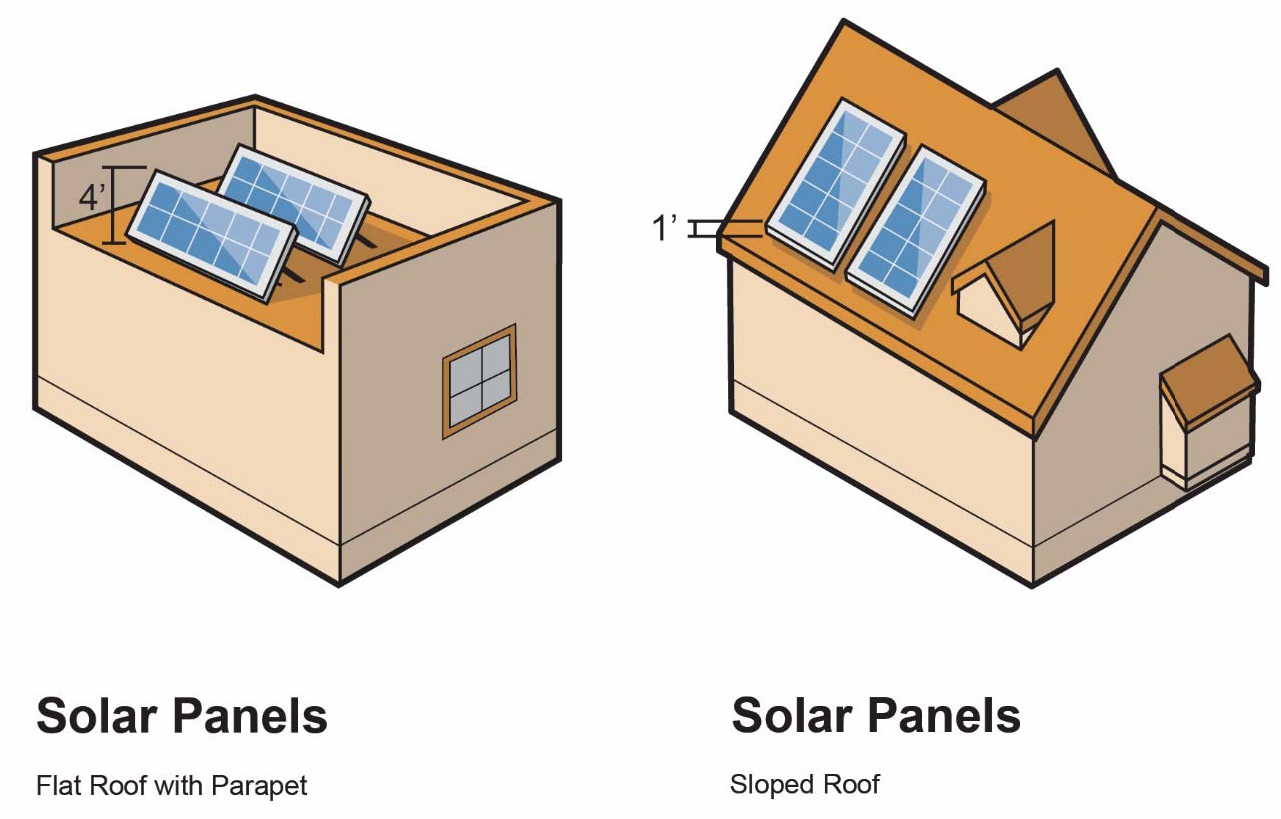
(2)
Building permit: A building permit shall be required for installation of roof- and building-mounted systems.
b.
Ground-mounted solar energy systems: Ground-mounted and freestanding solar energy systems for residential use are permitted accessory structures in all zoning districts, subject to the following regulations:
(1)
Location and setbacks: Where feasible, ground-mounted solar energy systems shall be located to the rear of the dwelling unit. In the event that proper solar orientation cannot be achieved to the rear, a solar energy system may be located on the side of the dwelling unit. Solar energy systems shall also meet the minimum setbacks of the zoning district.
(2)
Height: The height of the solar energy system and any mounts shall not exceed ten feet when oriented at maximum tilt.
(3)
Screening: Landscaping shall be provided to screen the racking from view on all sides.
(4)
Building permit: A building permit shall be required for any ground-mounted solar energy system.
(5)
Area: Ground-mounted solar energy systems shall be subject to the maximum lot coverage standards of the zoning district.
c.
Batteries: When solar storage batteries are included as part of the solar collector system, they must be placed in a secure container or enclosure when in use, and when no longer used shall be disposed of in accordance with applicable laws and regulations.
d.
Removal: If a solar energy system ceases to perform its intended function (generating electricity) for more than 12 consecutive months, the property owner shall remove the collectors, mounts, and associated equipment and facilities no later than 90 days after the end of the 12-month period. Where the removal has not been lawfully completed as required above, and after at least 30 days' written notice, the township may remove or secure the removal of the solar energy system or portion thereof, with the township's actual cost and reasonable administrative charges to be placed as a lien on the property. A lien on the property shall be superior to all other liens except taxes.
4.
Solar energy facilities—Utility grade (over ten kW, operated by a utility company or governmental entity):
a.
Ground-mounted solar energy systems: Ground-mounted and freestanding solar energy systems over ten kW capacity are permitted subject to special land use approval in the R-1.0, I-1 and I-2 zoning districts, and subject to the following regulations:
(1)
Location and setbacks: The solar energy system shall not be located closer to the street than any portion of the principal building, and shall meet the minimum front, side and rear yard setbacks of the zoning district.
(2)
Height: The height of the solar energy system and any mounts shall not exceed 15 feet when oriented at maximum tilt.
(3)
Screening: Landscaping shall be provided to screen the racking from view on all sides.
(4)
Building permit: A building permit shall be required for any ground-mounted solar energy system.
(5)
Area: Ground-mounted solar energy systems shall be subject to the maximum lot coverage standards of the zoning district.
b.
Batteries: When solar storage batteries are included as part of the solar collector system, they must be placed in a secure container or enclosure when in use, and when no longer used shall be disposed of in accordance with applicable laws and regulations.
c.
Removal: If a solar energy system ceases to perform its intended function (generating electricity) for more than 12 consecutive months, the operator shall remove the collectors, mounts, and associated equipment and facilities no later than 90 days after the end of the 12-month period. Where the removal has not been lawfully completed as required above, and after at least 30 days' written notice, the township may remove or secure the removal of the solar energy system or portion thereof, with the township's actual cost and reasonable administrative charges to be placed as a lien on the property. A lien on the property shall be superior to all other liens except taxes.
KK.
Wind energy systems.
1.
Purpose: It is the purpose of this subsection to promote the safe, effective, and efficient use of wind energy systems to generate electricity and thereby reduce or replace on-site consumption of utility-supplied electricity. Further, it is the purpose of this subsection to standardize and streamline the review and permitting process for wind energy systems.
2.
Findings: The township has found that wind energy is an abundant, renewable, and nonpolluting energy resource that some residents of the township would like to use. Generation of electricity by these facilities will reduce dependence on non-renewable energy resources and decrease air and water pollution that results from the use of conventional fossil fuels. Wind energy systems will also enhance the reliability and power quality of the power grid, reduce peak power demands, and help diversify the township's energy supply.
3.
Small wind energy systems:
a.
Where permitted:
(1)
Roof-mounted small wind energy systems are permitted by right in the R-1.0, residential - agricultural, and R-0.5, single-family residential districts, provided that all of the applicable requirements of this Ordinance are met.
(2)
Tower-mounted small wind energy systems may be permitted as a special land use in the R-1.0, residential - agricultural, and R-0.5, single-family residential districts, provided that all of the applicable requirements of this Ordinance are met.
b.
Minimum lot area:
(1)
Roof-mounted small wind energy systems shall have no minimum lot area.
(2)
Tower-mounted small wind energy systems shall be located on a lot with a minimum net area of one acre.
c.
Maximum wind turbine height:
(1)
Roof-mounted small wind energy systems shall have a maximum height of ten feet above the highest point of the roof.
(2)
Tower-mounted small wind energy systems shall have a maximum height of 20 meters (65.617 feet).
d.
Minimum setbacks:
(1)
Roof-mounted small wind energy systems shall adhere to the minimum setbacks of the zoning district.
(2)
Tower-mounted small wind energy systems shall be set back from all property lines, overhead utility rights-of-way and easements, and other towers a distance equal to or greater than the height of the windmill.
e.
General standards: The following requirements are applicable to all wind energy systems:
(1)
Noise: A wind energy system shall comply with the noise standards set forth in subsection 20.02(A).
(2)
Shadow flicker: The application for a wind energy system shall include a shadow flicker analysis demonstrating impact on adjacent and nearby residential properties. Wind energy systems shall be constructed in locations that minimize the impacts of shadow flicker on residences.
(3)
Lighting: No wind energy system shall be artificially lighted unless required by the Federal Aviation Administration (FAA).
(4)
Appearance, color and finish: The wind energy system shall be maintained in the color or finish that was originally applied by the manufacturer, unless otherwise approved in the building permit. All wind energy systems shall be a single non-reflective, non-obtrusive, matte finished color (e.g., white or gray).
(5)
Signs: The manufacturer or installer's identification sign, appropriate warning signs, and an owner identification sign, are permitted. All other signs are prohibited.
(6)
Electrical wires: All electrical wires associated with a wind energy system, other than wires necessary to connect the wind generator to the tower wiring, the tower wiring to the disconnect junction box, and grounding wires, shall be located underground.
(7)
Compliance with electrical code: Building permit applications for wind energy systems shall be accompanied by line drawings of the electrical components in sufficient detail to allow for a determination that the manner of installation conforms to the National Electrical Code.
(8)
Construction codes, towers, and interconnection standards: Wind energy systems, including towers, shall comply with all applicable state construction and electrical codes and local building permit requirements. Wind energy systems, including towers, shall comply with the FAA requirements, the Michigan Airport Zoning Act (Public Act 23 of 1950, as amended), and other applicable local and state regulations. A wind energy system connected to the public utility electrical grid shall comply with Michigan Public Service Commission and Federal Energy Regulatory Commission standards. Off-grid systems are exempt from this requirement.
(9)
System access: Small wind energy systems shall be designed and installed such that step bolts, ladders, or other means of access readily accessible to the public are located at least eight feet above grade level.
(10)
Safety: A wind energy system shall have an automatic braking, governing, or feathering system to prevent uncontrolled rotation or over speeding. All wind towers shall have lightning protection. If a tower is supported by guy wires, the wires shall be clearly visible to a height of at least six feet above the guy wire anchors.
(11)
Minimum ground clearance: The lowest extension of any blade or other exposed moving component of a wind energy system shall be at least 20 feet above the surrounding grade at its highest point within 20 feet of the base of the tower and at least 20 feet above any outdoor surface intended for human use, such as balconies or roof gardens, that are located below the wind energy system.
(12)
Roof-mounted small wind energy systems: Roof-mounted small wind energy systems shall be limited to roof mounting and shall not be mounted on any other building wall or surface.
(13)
Removal: If a small wind energy system ceases to perform its intended function (generating electricity) for more than 12 consecutive months or has been abandoned, the property owner shall remove the wind energy system, electrical components, and all other associated facilities no later than 90 days after the end of the 12-month period. Where the removal has not been lawfully completed as required above, and after at least 30 days' written notice, the township may remove or secure the removal of the facility or portion thereof, with the township's actual cost and reasonable administrative charges to be drawn from the performance guarantee posted, or the costs and charges may be placed as a lien on the property. A lien on the property shall be superior to all other liens except taxes.
(14)
Performance guarantee: All applications for a small wind energy system shall be accompanied by a performance guarantee in accordance with article 17.00, in an amount sufficient to ensure the decommissioning and removal of the system when it is abandoned or no longer needed.
(15)
Insurance: The applicant shall submit proof of sufficient property damage and liability insurance.
(16)
Utility connection: The applicant shall submit evidence that the utility company has been informed of the customer's intent to install an interconnected, customer-owned wind energy generator and that such connection has been approved. Off-grid systems shall be exempt from this requirement.
LL.
Commercial recreation facilities. Commercial recreation facilities shall comply with the following requirements:
1.
Compatibility with industrial development. The primary goal of the township is to retain I-1 and I-2 zoned land for industrial, warehousing and research uses. When considering the approval of a proposed commercial recreation facility the compatibility of such a use with existing and possible future development in the vicinity shall be evaluated.
2.
Parking. In determining the number of parking spaces required to accommodate a proposed commercial recreation facility, the township shall consider the proposed types of uses and hours of operation. The planning commission may require that a parking demand study be provided by the applicant.
3.
Broadcasting. Exterior broadcasting of voices or music shall be prohibited.
4.
Accessory uses. Facilities for the sale and consumption of food and beverages, and the sale of supplies and equipment, for the sole benefit of users of the facility are permitted. Such accessory uses may operate during the hours of operation of the principal building.
5.
Detrimental impacts on neighboring properties. Management of the facility is responsible for control of exterior noise, littering and trespassing. If necessary, traffic management shall be required to maintain continuous ingress and egress and access to neighboring properties.
MM.
Brewpubs and microbreweries.
1.
The following regulations shall apply to brewpubs, as defined in section 3.02:
a.
Brewpub production shall not exceed 5,000 barrels of beer per year.
b.
On-premises sale of alcoholic liquor by a brewpub is permitted, subject to the license obtained pursuant to the Michigan Liquor Control Act, as amended.
c.
A brewpub may not sell its beer to other retailers or wholesalers.
d.
Storage of hops, barley, wheat or other grain used in the brewing process may be stored in a detached structure, such as a silo, provided that any such accessory structure: 1) complies with the setback requirements for the district in which it is located; and 2) is compatible in color and materials with the principal building. No open storage of bottles, pallets, or other containers shall be permitted. Storage in tractor trailers shall be permitted for periods not exceeding 24 hours.
e.
Brewpubs shall comply with the performance standards specified in article 20.00.
f.
Brewpubs shall include a taproom or restaurant that provides full meal service for consumption by patrons while seated on the premises. Twenty-five percent of the gross sales of the restaurant shall be derived from the sale of food and nonalcoholic beverages. (The provision regarding "25 percent of the gross sales" is a State of Michigan requirement and would not be subject to local enforcement.)
g.
No more than 50 percent of the total gross floor space of the establishment shall be used for the brewery function, such as the brewhouse, fermentation tanks, conditioning tanks, bright beer tanks/filter, bottling and kegging lines, malt milling and storage, serving tanks and boiler and water treatment areas.
h.
No outside beer tent shall be permitted in any off-street parking lot or off-street loading/unloading area except as may be permitted as a temporary use pursuant to section 5.02, subsection B.14. Outside table service may be permitted in areas not designated for parking or loading/unloading, pursuant to section 19.02, subsection X.
i.
Off-street parking shall be provided at the rate of one space per 50 square feet of usable floor area (UFA) or 0.5 spaces per seat, whichever is greater. For the purposes of this requirement, areas dedicated to brewery production shall not be counted as UFA. In addition, brewpubs shall provide employee parking at the rate of one parking space per employee on the largest working shift. Off-street parking shall comply with the requirements in article 14.00.
j.
A brewpub's taproom or restaurant shall comply with State of Michigan regulations with respect to hours of operation.
k.
Brewpubs are subject to review and approval under the township's industrial pretreatment program.
2.
The following regulations shall apply to microbreweries, as defined in section 3.02:
a.
Microbrewery production shall not exceed 30,000 barrels of beer per year.
b.
A microbrewery may sell beer it manufactures to a licensed wholesaler who may resell the beer to licensed retailer.
c.
Storage of hops, barley, wheat or other grain used in the brewing process may be stored in a detached structure, such as a silo, provided that any such accessory structure: 1) complies with the setback requirements for the district in which it is located; and 2) is compatible in color and materials with the principal building. No open storage of bottles, pallets, or other containers shall be permitted. Storage in tractor trailers shall be permitted for periods not exceeding 24 hours.
d.
Microbreweries shall comply with the performance standards specified in article 20.00.
e.
Microbreweries shall provide food service for consumption by patrons while seated on the premises. The term "food service" does not imply the need for a full-scale restaurant with complete kitchen.
f.
No more than 65 percent of the total gross floor space of the establishment shall be used for the brewery function, such as the brewhouse, fermentation tanks, conditioning tanks, bright beer tanks/filter, bottling and kegging lines, malt milling and storage, serving tanks and boiler and water treatment areas.
g.
No outside beer tent shall be permitted in any off-street parking lot or off-street loading/unloading area except as may be permitted as a temporary use pursuant to section 5.07, subsection B.14. Outside table service may be permitted in areas not designated for parking or loading/unloading, pursuant to section 19.02, subsection X.
h.
Off-street parking shall be provided at the rate of one space per 50 square feet of usable floor area (UFA) or 0.5 spaces per seat, whichever is greater. For the purposes of this requirement, areas dedicated to brewery production shall not be counted as UFA. In addition, microbreweries shall provide employee parking at the rate of one parking space per employee on the largest working shift. Off-street parking shall comply with the requirements in article 14.00.
i.
Microbreweries are subject to review and approval under the township's industrial pretreatment programs.
NN.
Small wine makers and hard cider producers. It is the intent of the regulations in this sub-section to permit small wine makers and hard cider producers in the interest of providing jobs and promoting economic growth and agritourism. It is further the intent of these regulations to prevent development of small wine makers and hard cider producers that are out of scale or out of character with surrounding land use. Accordingly, small wine makers and hard cider producers, as defined in section 3.02 of the Zoning Ordinance, shall comply with the following regulations:
1.
Setbacks. Principal and accessory buildings shall comply with the setback requirements for the district in which they are located.
2.
Impact on surrounding properties. The location, layout, design, operation, and size of such a facility shall not impair the continued enjoyment, use, and future development of adjacent and nearby properties. The planning commission may impose conditions on the facility to assure compatibility with adjacent uses.
3.
Parking.
a.
New Hudson Zoning District. In the New Hudson Zoning District, parking shall comply with the requirements of section 41.401.
b.
Other Districts (R-1.0, B-2, and B-3). In the R-1.0, B-2, and B-3 districts, all parking shall be provided in off-street parking lots, designed in accordance with article 14.00, off-street parking and loading requirements, except as follows:
(1)
Off-street parking shall be set back a minimum of 20 feet from any property that is zoned or used for residential purposes.
(2)
The number of spaces required shall be determined on a case-by-case basis, based on consideration of the types and sizes of facilities proposed and the number of employees anticipated.
4.
Accessory commercial facilities. Accessory commercial facilities, such as a wine or cider tasting room, a gift shop limited to merchandise related to the wine or cider business, or retail sales of wine or cider, may be permitted, subject to the following:
a.
Accessory commercial facilities shall be clearly incidental to the principal small wine maker or hard cider producer use, and shall be designed to serve only the patrons of the small wine maker or hard cider producer use. In the R-1.0 district, accessory commercial facilities shall occupy no more than 25 percent of the gross floor space or 1,000 square feet, whichever is smaller.
b.
Accessory commercial facilities shall be fully contained within a building.
c.
All such accessory commercial facilities shall be clearly delineated on the site plan.
d.
Permanent restroom facilities shall be required; portable toilet facilities shall not be permitted.
e.
Accessory buildings shall comply with the dimensional requirements of the district in which they are located.
5.
Permits and licenses. Copies of all state and federal permits and licenses required to operate the facility shall be submitted to the township.
6.
Signs. In the New Hudson Zoning District, signs shall comply with the requirements in section 41.407. In the R-1.0 district, signs shall comply with the requirements for signs for approved non-residential principal uses in section 16.07.G. In the B-2 and B-3 districts, signs shall comply with the requirements for nonresidential district signs in section 16.08.
7.
Single-family dwelling. In the R-1.0 district, one single-family dwelling shall be permitted, to serve as the principal residence of the owner or operator of the facility.
8.
Special events. Special events, which may include music, food, wine tasting, and the like, shall require a special event permit issued by the township, pursuant to section 5.02.B.16.
9.
Production limits. Small wine makers and hard cider producers shall manufacture or bottle no more than 50,000 gallons in one calendar year.
10.
Performance standards. Small wine makers and hard cider producers shall comply with the performance standards in article 20.00.
11.
Sanitary and septic disposal. Small wine makers and hard cider producers that are connected to the township's sanitary sewer system are subject to the township's industrial pre-treatment requirements. Small wine makers and hard cider producers that are connected to a septic system must obtain approval from the Oakland County Health Division prior to establishment of the use.
12.
Hours of operation. In the R-1.0 district, the hours that a small wine maker and hard cider producer may be open to the public or for private events shall be 8:00 a.m. to 9:00 p.m. However, the planning commission may permit less restrictive hours of operation in the R-1.0 district, or may require more restrictive hours of operation in any zoning district, based the impact on adjacent and nearby properties, including the future development of adjacent and nearby properties.
OO.
Small distiller. The following regulations shall apply to small distillers, as defined in section 3.02:
1.
Setbacks. Principal and accessory buildings shall comply with the setback requirements for the district in which they are located.
2.
Impact on surrounding properties. The location, layout, design, operation, and size of such a facility shall not impair the continued enjoyment, use, and future development of adjacent and nearby properties. The planning commission may impose conditions on the facility to assure compatibility with adjacent uses.
3.
Storage. All operations of the small distillery shall be contained within a fully enclosed building. There shall be no open storage of bottles, pallets, containers, or other material.
4.
Performance Standards. Small distillers shall comply with the performance standards in article 20.00.
5.
Parking.
a.
New Hudson Zoning District. In the New Hudson Zoning District, parking shall comply with the requirements of section 41.401.
b.
Other districts {R-1.0, B-2, and B-3). In the R-1.0, B-2, and B-3 districts, all parking shall be provided in off-street parking lots, designed in accordance with article 14.00, off-street parking and loading requirements, except as follows:
(1)
Off-street parking shall be set back a minimum of 20 feet from any property that is zoned or used for residential purposes.
(2)
The number of spaces required shall be determined on a case-by-case basis, based on consideration of the types and sizes of facilities proposed and the number of employees anticipated.
6.
Accessory commercial facilities. Accessory commercial facilities, such as a sampling room or a place to sell spirits to consumers for on-premises or off-premises consumption, may be permitted, subject to the following:
a.
All such accessory facilities shall be clearly incidental to the principal small distillery, and shall be designed to serve only the patrons of the small distillery. In the R-1.0 district, accessory commercial facilities shall occupy no more than 25 percent of the gross floor space or 1,000 square feet, whichever is smaller.
b.
Accessory retail facilities shall be fully contained within a building.
c.
All such accessory retail facilities shall be clearly delineated on the site plan.
d.
Permanent restroom facilities shall be required; portable toilet facilities shall not be permitted.
e.
Accessory buildings shall comply with the dimensional requirements of the district in which they are located.
7.
Permits and licenses. Copies of all state and federal permits and licenses required to operate the facility shall be submitted to the township.
8.
Signs. In the New Hudson Zoning District, signs shall comply with the requirements in section 41.407. In the R-1.0 district, signs shall comply with the requirements for signs for approved non-residential principal uses in section 16.07G. In the B-2 and B-3 districts, signs shall comply with the requirements for nonresidential district signs in section 16.08.
9.
Single-family dwelling. In the R-1.0 district, one single-family dwelling shall be permitted to serve as the principal residence of the owner or operator of the facility.
10.
Special events. A special event, which may include music, food, tasting of spirits, and the like, shall require a special event permit issued by the township, pursuant to section 5.02.B.16.
11.
Production limits. Small distillers shall manufacture or bottle no more than 60,000 gallons annually.
12.
Industrial pre-treatment. Small distillers that are connected to the township's sanitary sewer system are subject to the township's industrial pre-treatment requirements. Small distillers that are connected to a septic system must obtain approval from the Oakland County Health Division prior to establishment of the use.
13.
Hours of operation. In the R-1.0 district, the hours that a small distiller may be open to the public or for private events shall be 8:00 a.m. to 9:00 p.m. However, the planning commission may permit less restrictive hours of operation in the R-1.0 district, or may require more restrictive hours of operation in any zoning district, based the impact on adjacent and nearby properties, including the future development of adjacent and nearby properties.
PP.
Outdoor Dining. Outdoor dining, such as sidewalk cafes and outdoor patios, shall be subject to the following requirements:
1.
Location. Outdoor dining is permitted in the front, on the side, or in the rear of the principal structure, immediately adjacent to the principal structure. A sidewalk having a minimum width of five feet shall be provided either adjacent to the building, or on the exterior of the outdoor dining area, as applicable, for pedestrian access.
2.
Accessory use. The outdoor dining shall be accessory to a fully operational restaurant located on the same site. The outdoor seating capacity shall not exceed 50 percent of the indoor seating capacity. Increasing the available seating and dining area may result in further improvements to the structure being required to meet applicable codes, including but not limited to, building and fire.
3.
Serving of alcohol. Alcoholic beverages to be served at an outdoor dining area shall be provided by the restaurant and shall only be served to patrons seated at tables. The consumption of alcoholic beverages brought in by patrons is specifically prohibited. The proprietor of the outdoor dining area shall procure the appropriate license or permit from the Michigan Liquor Control Commission to serve alcoholic beverages and shall comply with all other laws and regulations concerning the serving of alcoholic beverages and the use of the property.
4.
Site plan requirements. A site plan, drawn to scale, shall be submitted for review and approval. The site plan shall indicate the location of the outdoor dining, proposed lighting, access, fences, landscaping, trash removal, setbacks from property lines, signs, and other proposed improvements associated with the outdoor dining. If outdoor food storage and preparation is sought, the site plan shall also provide information showing the location and type of cooking equipment requested. Site plans for outdoor dining associated with an existing restaurant shall be subject to administrative review. Site plans for outdoor dining associated with a new restaurant, or a proposed expansion triggering the requirement for site plan approval under Section 5.02 A, shall be subject to planning commission review.
5.
Perimeter fence or barriers. A fence, bollards, planters, or other barriers shall be provided around the perimeter of the outdoor dining area where needed to protect patrons from the intrusion of vehicles.
6.
Property owner approval. Outdoor dining proprietors who are lessees shall submit proof of property owner approval.
7.
Setbacks. Outdoor dining shall comply with the setback requirements applicable to the zoning district.
8.
Hours of operation. The hours of operation for outdoor dining shall be specified on the site plan, which shall be subject to approval. The hours of operation shall not be greater than those of the restaurant to which the outdoor dining is accessory.
9.
Food storage and preparation. Outdoor food storage is prohibited. Outdoor food preparation may be permitted during review and approval of the site plan, subject to any conditions imposed by the township to minimize off-site impacts. Outdoor food preparation shall be subject to Oakland County Health Division requirements and approval.
10.
Off-season storage. The site plan shall specify plans for storage of tables, chairs, umbrellas, planters, posts, railings, and other equipment during the off-season. These items shall not be stored outside.
11.
Maintenance. The maintenance of the outdoor dining area shall be the responsibility of the proprietor, including but not limited to, surface treatment and cleaning, litter control, and sweeping. The sidewalk and public property shall be always kept neat and clean and free from any substance that may cause damage to the sidewalk or public property or cause pedestrian injury.
12.
Umbrella advertising. Advertising on table umbrellas is permitted and shall not be counted against the total allowed signage for the site.
13.
Sound management. Entertainment, music, speakers, and similar devices are permitted, subject to compliance with those noise regulations in section 20.02(A).
14.
Insurance. Outdoor dining operators with facilities located on public property shall procure and maintain a policy of comprehensive commercial general liability insurance in an amount acceptable to the township, including workers compensation, endorsing the township as an additional insured. Establishments serving alcohol shall also procure and maintain a liquor liability policy endorsing the township as an additional insured. A certificate of insurance or policy shall be provided to the township on an annual basis as proof of such insurance, and the certificate or policy shall contain a clause requiring the insuring company to give ten days' written notice to the township supervisor prior to cancelation. No establishment shall operate any other outdoor dining facility on public property without providing proof of proper insurance and maintaining such required insurance in effect at all times.
(Ord. No. 01-12, pt. 2, 2-6-2012; Ord. No. 09-12, pt. 2(exh. A), 11-5-2012; Ord. No. 03-13, § pt. 4, 10-7-2013; Ord. No. 05-13, pt. 3, 11-4-2013; Ord. No. 06-13, pt. 2, 11-4-2013; Ord. No. 07-13, pt. 3, 11-4-2013; Ord. No. 01-14, pt. 2, 1-7-2014; Ord. No. 10-14, pt. 3, 9-2-2014; Ord. No. 17-14, pts. 2, 3, 12-1-2014; Ord. No. 06-16, pts. 3,4, 10-3-2016; Ord. No. 03-17, pt. 10, 6-5-2017; Ord. No. 190-18, § 3, 5-7-2018; Ord. No. 191-18, § 1, 5-7-2018; Ord. No. 192-18, § 1, 5-7-2018; Ord. No. 193-18, § 3, 5-7-2018; Ord. No. 195-18, § 2, 6-4-2018; Ord. No. 198-18, § 1, 8-8-2018; Ord. No. 200-18, § 3, 9-4-2018; Ord. No. 05-20, § 1, 7-6-2020; Ord. No. 12-20, § 4, 1-4-2021; Ord. No. 01-21, § 1, 2-1-2021; Ord. No. 01-24, § 2, 3-4-2024; Ord. No. 03-24, § 1, 6-3-2024; Ord. No. 08-24, § 2, 11-6-2024)
Section 19.03. - Site development standards for residential uses.
A.
Multiple-family and single-family attached housing requirements. The following site development standards shall apply to attached housing developments, including development in the suburban townhouse and multiple-family residential, and New Hudson Zoning District:
1.
Permitted density.
a.
Basic formula. The permitted density of development in multiple-family districts shall be based on the total number of rooms (excluding kitchen, dining and bathrooms), in accordance with the following formulae:
RM-1 district: The maximum number of rooms permitted shall be equal to the area of the parcel in square feet divided by 3,600.
RM-2 district: The maximum number of rooms permitted shall be equal to the area of the parcel in square feet divided by 1,800.
TC district: The maximum number of rooms permitted shall be equal to the area of the parcel in square feet divided by 1,210.
b.
Minimum room requirements. All units in the RM-1 district shall have at least one living room and one bedroom, and no more than 25 percent of the units may be one bedroom units. All units in the RM-2 district shall have at least one living room and one bedroom, and no more than ten percent of the units may be efficiency apartments.
c.
Method of measuring land area. The computations of land area for the purposes of determining density shall not include areas occupied by road rights-of-way or easements, or subaqueous areas, wetlands or floodplains. The first 20,000 square feet of a site that is not served by an approved public sanitary sewer shall be excluded from density computations.
2.
Building length. Multiple-family buildings shall not exceed 150 feet in overall length, measured along the front line of connecting units, inclusive of any architectural features which are attached to or connect the parts of the building together (see illustration). Horizontal facades longer than 30 feet shall be articulated into smaller units of the residential scale. At least two of the following methods shall be included (see illustration):
•
Distinctive roof and wall forms or elements.
•
Changes in materials or patterns.
•
Windows (shape, pattern, trims and/or details)
•
Color differentiation.
•
Recesses, offsets, cantilevers.
•
Architectural features (bay or bow windows, chimneys, lower roofs and awnings).
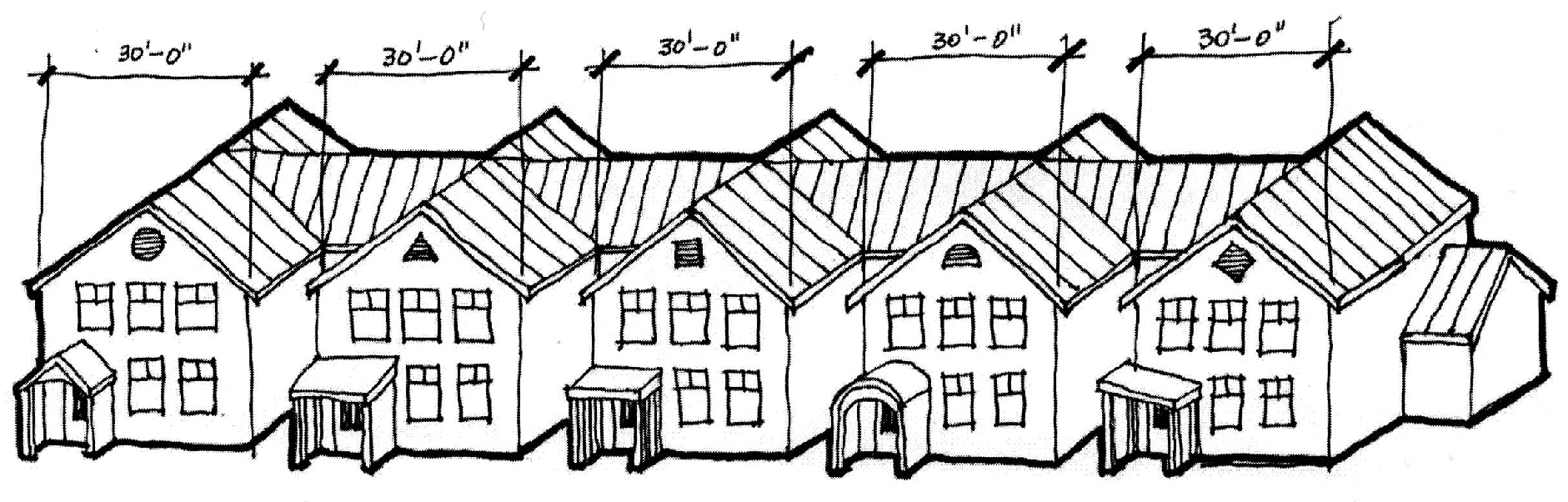
Buildings shall include modulation along the building facades. Special attention shall be given to building faces viewed from the street. Flat blank walls are discouraged.
3.
Building spacing. The minimum distance between any two buildings shall be based on the following tables:
4.
Street address. The address of each dwelling unit must be clearly posted so that the unit can be readily identified from the roadway or adjacent parking area.
5.
Access and circulation. Multiple-family developments shall comply with the following requirements for access and circulation (see illustration):
a.
Access to roads. RM-1 and RM-2, and TC developments shall have direct access to a collector road or major thoroughfare; however, alternate means of access may be permitted by the planning commission upon finding that, due to special circumstances, substantial improvements in traffic safety could be achieved by reducing the number of driveways. Furthermore, an alternate means of access shall be permitted only if one or more of the following conditions exists:
(1)
The property directly across the street from the development under consideration is zoned for multiple-family or non-residential use; or
(2)
The property directly across the street is developed with permanent uses other than single-family residences; or
(3)
The proposed development is in an area which, based on study by the planning commission, will eventually be used for purposes other than single-family use.
b.
Emergency access. All dwelling units, including those under construction, shall be readily accessible by fire and emergency vehicles from a paved public street, paved private access road, or other approved paved area. Private roads or driveways dedicated as fire lanes shall be posted with signs indicating "Fire Lane, No Parking." To facilitate emergency vehicle access, the following guidelines shall be complied with:
(1)
All roadways shall be paved and bi-directional, allowing for both ingress and egress. A boulevard may be utilized to provide bi-directional traffic movement; provided that, the median strip is a minimum of 25 feet in width, and the width of each paved moving lane in each direction is at least 15 feet.
(2)
Streets with no outlet shall be terminated with a cul-de-sac, designed in accordance with standards established and periodically updated by the township engineer and kept on file in the building department. Such streets with no outlet shall not exceed 300 feet in length.
(3)
Gatehouses and/or barricades at entrances to private roadways shall be designed so as not to impede fire and emergency vehicle access.
c.
Street dimensions. On-site streets and drives shall comply with the standards in section 12.09, subsection C.
6.
Sidewalks. Sidewalks shall be provided within the development, located no less than five feet from and parallel to access drives. Such sidewalks shall provide convenient access to community buildings and between parking areas and dwelling units. The sidewalks shall be designed and constructed in accordance with section 12.15. Bicycle paths shall be provided along the collector road or thoroughfare on which the development fronts, in accordance with section 12.15.
7.
Parking. In addition to the requirements set forth in article 14.00, multiple-family developments shall comply with the following requirements:
a.
Location. Required parking shall be located in parking lots or individual driveways, and not in streets or access drives. Parking may be permitted in required side and rear yard setback areas; provided that parking lots and access drives shall be located a minimum of ten feet from any property line or public right-of-way. Parking lots and access drives shall not be located closer than 25 feet to a wall of any residential structure which contains windows or doors, nor closer than ten feet to a wall of any residential structure which does not contain openings.
b.
Distance from dwelling units. Parking shall be located within 150 feet of the dwelling units the parking is intended to serve, measured along the sidewalk leading to the parking lot.
c.
Parking for community buildings. Parking shall be provided for community buildings as specified in article 14.00.
BUILDING LENGTH
section 19.03, subsection A.1
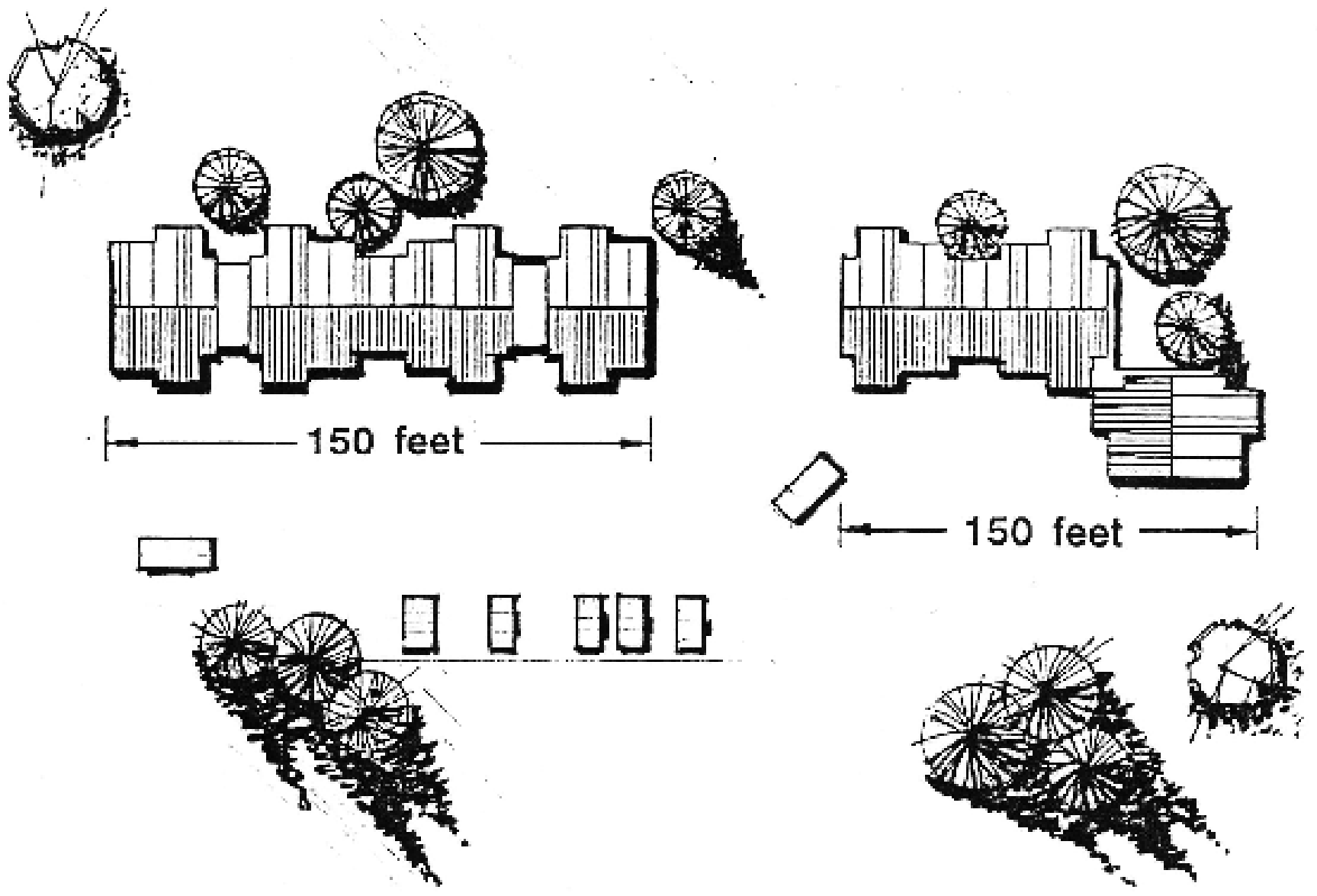
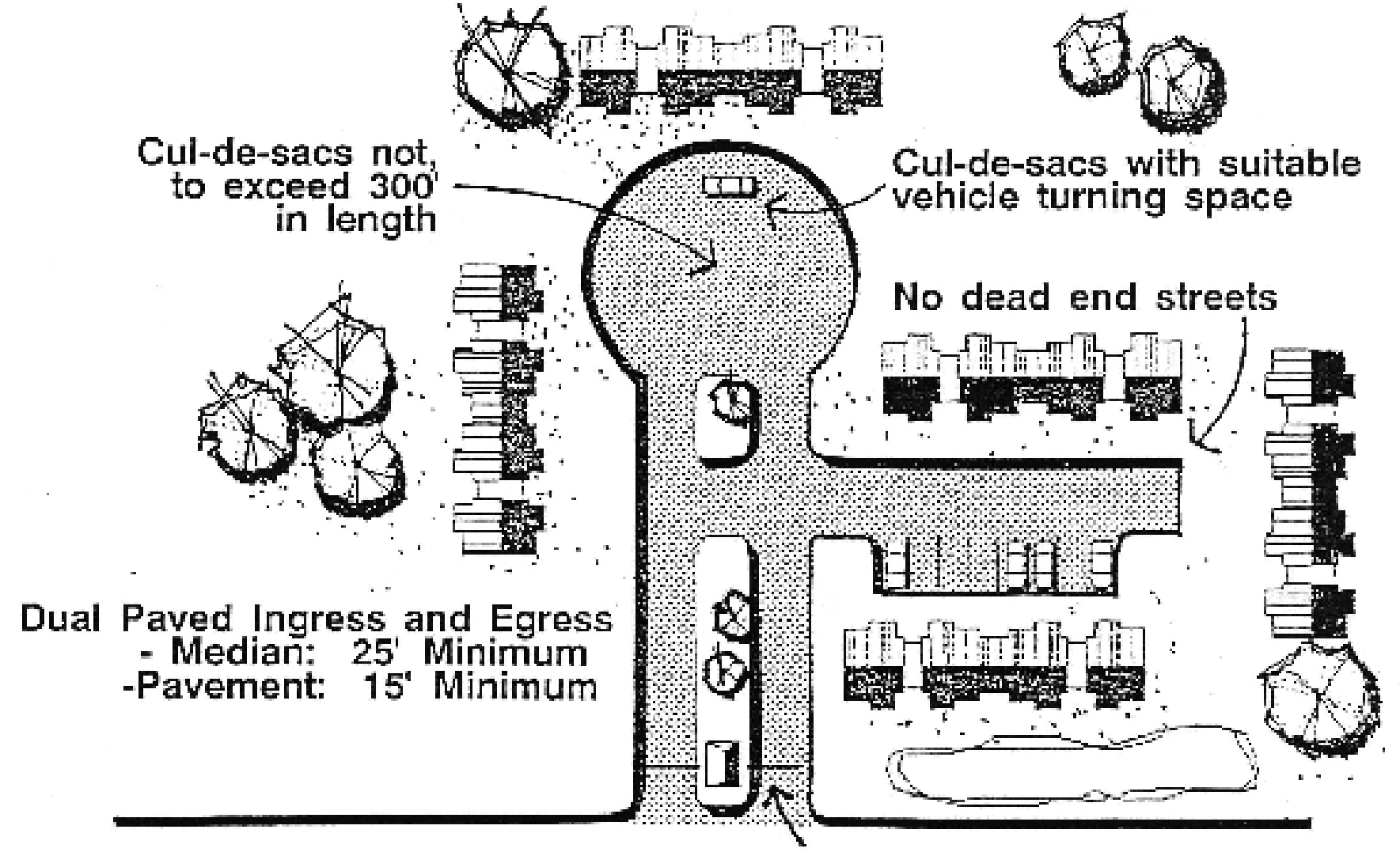
Gatehouses and/or barricades designed
so as not to impede emergency vehicles
ACCESS AND CIRCULATION
section 19.03, subsection A.5
8.
Lighting. All parking areas, building entrances, sidewalks, and ramps shall be illuminated to ensure the security of property and the safety of persons using such areas, in accordance with the requirements set forth in section 12.11.
9.
Landscaping. Multiple-family developments shall be landscaped in accordance with section 15.03, subsection C.
10.
Open space. Open space shall be provided in any multiple-family development containing eight or more units. The open space shall comply with the following requirements:
a.
Size. Total open space required shall be based on the number and size of units, as indicated in the following chart, provided that each development shall contain a minimum of 10,000 square feet of open space.
b.
Location. Open space shall be located conveniently in relation to the majority of dwelling units intended to be served. Swamp areas, marshy areas, and similar limited-use areas shall not be included in the required open space.
c.
Use of open space. Uses permitted within the required open space include picnic and sitting areas, playground and park space, play equipment, tennis courts, shuffleboard courts, and similar outdoor recreation facilities.
d.
Phasing. Open space improvements shall be completed in proportion to the number of units constructed in each phase.
11.
Garages. Garages shall be permitted for each unit, in accordance with the provisions for accessory uses in article 18.00.
12.
Antennae. Each multiple-family building shall be permitted to erect one antenna, subject to the requirements in sections 12.14 and 12.17.
B.
Single-family development options. The following site development standards shall apply to average lot size and single-family cluster developments:
1.
Intent. The intent of these provisions is to provide limited flexibility in the regulation of single-family developments for the purposes of:
a.
Providing improved living and working environments in the township;
b.
Preserving the natural beauty of the township;
c.
Promoting more economic residential designs;
d.
Encouraging ingenuity and originality in the total site design; and
e.
Providing adequate usable open space, tree cover, recreation areas; and scenic vistas.
These provisions shall not be used to achieve higher density development on parcels where portions cannot be developed because of wetlands.
2.
Scope of requirements. Average lot size and single-family cluster developments may be approved in the R-1.0, R-0.5, or R-0.3 districts, whether developed as conventional single-family subdivision plats or as single-family condominium projects, subject to review and approval as provided for herein.
3.
Eligibility criteria. In considering any proposal for average lot size or single-family cluster development, the township shall make their determinations on the basis of the following criteria:
a.
Compatibility with adopted plans and ordinances. The proposed development shall be consistent with the general principles and objectives of the adopted township master land use plan, the subdivision ordinance, and all applicable building codes.
b.
Compliance with applicable zoning standards. The proposed development shall comply with applicable standards of this Ordinance, except as modified in accordance with the procedures and standards in this section.
c.
Impact on the township. The proposed development shall not have a substantial or undue adverse impact upon adjacent property, the character of the neighborhood, traffic conditions, parking, utilities, and other matters affecting the public health, safety, and welfare.
d.
Impact on the neighboring property. The proposed development shall be constructed, arranged, and operated so as not to interfere with the development and use of neighboring property, in accordance with the applicable district regulations.
e.
Design diversity. Diversity and originality in layout and building design shall be encouraged to achieve the best possible relationship between the development and the land.
f.
Impact on residents. Individual lots (if applicable), buildings, units, and parking areas shall be situated to avoid any adverse effects from shadows, noise, and traffic on the residents of the development.
g.
Impact on natural features. Individual lots (if applicable), buildings, streets, and parking areas shall be designed and situated to minimize alteration of the natural features of the site which are intended to be preserved.
h.
Access to open space. Open space intended for recreation or public use shall be easily accessible to pedestrians and shall meet the needs of the handicapped and elderly.
i.
Usability of open space. The usability of open space which is intended for recreation or public use shall be determined by the size, shape, and topography of the site and the location requirements of the principal buildings or uses on the site.
j.
Access. The proposed development shall front on and have direct access to a major or secondary thoroughfare having a minimum existing or planned right-of-way width of 86 feet.
k.
Natural features. The parcel of land possesses natural features or resources which will be conserved, such as streams, watercourses, wetlands, tree stands, or unusual topographic features.
4.
Average lot size requirements.
a.
Permitted modifications.
(1)
Lot size and lot width may be reduced below the minimum standards for the zoning district in which the development is located, in accordance with the standards specified in this section. All such reductions shall be compensated for by an equivalent amount of open space, which shall be maintained and preserved in accordance with the standards specified in this section.
(2)
In no case shall the maximum dwelling unit density standards of the zoning district in which the development is located be exceeded. Except as specified in this section, other applicable standards for the district in which the development is located shall not be modified or changed.
b.
Lot standards.
(1)
Reduction in minimum lot size, lot width, and yard setback standards in average lot size developments shall be permitted as specified in the following table provided that each lot is capable of satisfying minimum county and township requirements with respect to septic system/sanitary waste treatment and potable water.
(2)
Minimum side yard setbacks pertain only to interior lots. Where a side yard abuts a street, such as on a corner lot, the minimum required side yard setback shall be the same as specified for the front yard.
c.
Open space requirements. The township may require that common open space be permanently reserved and maintained as landscaped park or recreation space for the benefit of residents of the average lot size development. The size, configuration and location of such open space shall be subject to review and approval by the planning commission. Manmade stormwater retention areas shall not be counted toward required open space.
The required open space shall be set aside by the developer through an irrevocable conveyance, such as deed restrictions or covenants that run with the land, or through a conservation easement, assuring that the open space will be developed according to the site plan and never changed to another use. Such conveyance shall:
(1)
Specify ownership of the open space;
(2)
Provide for maintenance of the open space by the private property owners having an interest in the open space;
(3)
Provide for maintenance standards and a maintenance schedule;
(4)
Provide for maintenance insurance; and
(5)
Include any other specifics deemed necessary by the planning commission.
d.
Review and approval process. Proposals for average lot size development shall be reviewed in accordance with applicable procedures for special land uses, article 6.00.
5.
Residential density. The overall density of units in a residential development may be based on the density that could be achieved with the underlying zoning (as defined in section 3.02). To approximate the density that could be achieved with the underlying zoning, the applicant shall submit a parallel plan, which is a conceptual subdivision layout based on the uses of land, dimensional requirements, and density allowed by right in the district in which the land is located. The parallel plan shall adhere to the following principles:
a.
It shall reflect a realistic assessment of regulated wetland use, considering the constraints imposed by the Michigan Department of Environment, Great Lakes and Energy (EGLE) and U.S. Environmental Protection Agency (EPA). Accordingly, the parallel plan shall minimize wetland fill and the need for mitigation. If wetland fill is proposed on the parallel plan, it shall not exceed the wetlands fill by more than the minimum lot area of the underlying zoning district (ex. R-1.0: 35,000 square feet; R-0.5: 17,000 square feet; and R-0.3: 12,000 square feet with public sewer).
b.
All lots on the parallel plan shall be able to accommodate the proposed housing product without encroaching into required setbacks.
c.
The parallel plan shall allocate land for stormwater management facilities in an amount necessary to accommodate the development's needs, pursuant to township engineering standards.
d.
If the development will be using public water and sanitary sewer utilities, then the parallel plan shall be designed to use public water and sanitary sewer utilities. If the development will be using wells and septic systems, then the parallel plan shall be designed to use wells and septic systems.
e.
The parallel plan shall comply with applicable requirements in the Zoning Ordinance and Township Code of Ordinances, including the Subdivision Ordinance. The parallel plan shall be used as an advisory tool to be used as a guide by the planning commission and township board to determine the appropriate density of a residential development. Thus, the design characteristics of a development may warrant an increase or decrease in the number of dwelling units above or below the number shown on the parallel plan.
f.
The computations of land area for the purposes of determining density shall not include areas occupied by road rights-of-way or easements, or subaqueous areas, wetlands or floodplains. The first 20,000 square feet of a site that is not served by an approved public sanitary sewer shall be excluded from density computations.
6.
Single-family cluster development.
a.
Permitted modifications.
(1)
Subject to review and approval procedures which follow, a mixture of two to four dwelling units may be attached, either through a common dwelling unit wall, a common garage wall, or an architectural feature, such as an archway; provided that, the common wall of adjoining dwelling units shall not overlap by more than 50 percent. However, common garage walls may overlap for their full distance on both sides.
(2)
All such modifications shall be compensated for by an equivalent amount of open space, which shall be maintained and preserved in accordance with the standards specifications in this section.
(3)
In no case shall the maximum dwelling unit density standards of the zoning district in which the development is located be exceeded. Except as specified in this section, other applicable standards for the district in which the development is located shall not be modified or changed.
b.
Setbacks.
(1)
The front yard setback requirements for the district in which the development is located shall be complied with on all sides of a cluster development which abuts a public road or street.
(2)
A 75-foot setback shall be provided along the entire perimeter of a cluster development, except on sides which abut a public road or street.
(3)
Dwelling units in a cluster development shall be set back a minimum of 30 feet from the easement of right-of-way line of any private road or drive serving the development.
(4)
The minimum distance between any two building clusters shall be based on the standards in section 19.03, subsection A.3.
c.
Minimum floor area and height standards. Dwelling units in a single-family cluster development shall comply with the floor area and height standards for the district in which the development is located.
d.
Landscaping. Single-family cluster developments shall comply with the landscaping requirements in section 15.03, subsection C.
e.
Open space requirements. The township may require that common open space be permanently reserved and maintained as landscaped park or recreation space for the benefit of residents of the single-family cluster development. The size, configuration, and location of such open space shall be subject to review and approval by the planning commission.
The required open space shall be set aside by the developer through an irrevocable conveyance, such as deed restrictions or covenants that run with the land, or through a conservation easement, assuring that the open space will be developed according to the site plan and never changed to another use. Such conveyance shall:
(1)
Specify ownership of the open space;
(2)
Provide for maintenance of the open space by the private property owners having an interest in the open space;
(3)
Provide for maintenance standards and a maintenance schedule;
(4)
Provide for maintenance insurance; and
(5)
Include any other specifications deemed necessary by the planning commission.
f.
Building design. Cluster housing units shall be designed in a manner that is compatible with surrounding development and the natural environment. Accordingly, when a cluster development faces or abuts a conventional single-family subdivision, the facades and orientation of the conventional units shall be used as a guide for the design and layout of the cluster units.
g.
Roads and utilities. Proposed roads and utilities in a cluster development shall comply with adopted township standards, and shall be subject to review and approval by the township engineer.
h.
Review and approval process. Proposals for single-family cluster development shall be reviewed in accordance with applicable procedures for special land uses, article 6.00.
C.
Mobile home park requirements. All mobile home parks shall comply with the requirements of Michigan Public Act 419 of 1976, as amended. Further, all mobile home parks shall comply with the provisions of this Ordinance, the Michigan Mobile Home Commission Rules, and any other lawfully adopted ordinance of Lyon Township. Should any conflict in legally approved regulatory provisions occur, whichever provision imposes the more restrictive standard or higher standard shall prevail.
1.
Location. Mobile homes shall be located only in those zoning districts in which mobile home land use is permitted by right or subject to special approval. All mobile homes in an MHP mobile home park district shall be located on an approved site in an approved mobile home park. Emergency or temporary parking of a mobile home on any street, alley, or highway may be permitted for a period not exceeding two hours, subject to any other limitations imposed by traffic or parking regulations or ordinances for that street, alley or highway.
2.
Mobile home standards. Each mobile home shall be of contemporary design and shall contain sanitary waste disposal facilities, sleeping accommodations, a tub or shower bath, kitchen facilities, and plumbing and electrical connections designed for attachment to appropriate external system as commonly found in modern mobile homes, and as specified in section 12.04. Each mobile home shall comply with the regulations for the district in which it is located, regulations of the U.S. Department of Housing and Urban Development as adopted on June 15, 1976, and all subsequent amendments to such standards and regulations. Mobile homes constructed prior to June 15, 1976 shall be in full compliance with MFPA 501B-1974/ANSI 119.1-1975 standards.
3.
Setbacks in the MHP district.
a.
Mobile homes shall comply with the minimum distances specified in R125.1945, Rule 941 of the Michigan Administrative Code.
b.
No mobile home unit shall be located within 50 feet of the right-of-way of a public thoroughfare, or within 35 feet of any other mobile home park property line.
c.
No mobile home unit exterior wall surface shall be located within 20 feet of any other mobile home unit's exterior wall surface.
4.
Permit. It shall be unlawful for any person to operate a mobile home park unless that individual obtains a license for such operation in compliance with the requirements of Michigan Public Act 419 of 1976, as amended. The building official shall communicate his recommendations regarding the issuance of such licenses to the Director of Mobile Home Division, Corporation and Securities Bureau, Michigan Department of Commerce.
5.
Violations. Whenever, upon inspection of any mobile home park, the building official finds that conditions or practices exist which violate provisions of this Ordinance or other regulations referenced herein, the building official shall give notice in writing by certified mail to the Director of Michigan Mobile Home Commission, including the specific nature of the alleged violations and a description of possible remedial action necessary to effect compliance with the ordinance or other regulations. The notification shall include such other information as is appropriate in order to fully describe the violations and potential hazards to the public health, safety and welfare resulting from the violation. A copy of such notification shall be sent by certified mail to the last known address of the park owner or agent.
6.
Inspections. The building official or other authorized township agent is granted the authority, as specified in Michigan Public Act 419 of 1976, as amended, to enter upon the premises of any mobile home park for the purpose of determining compliance with the provisions of this Ordinance or other regulations referenced herein or other applicable township ordinances.
7.
Park site development standards.
a.
Park size. Mobile home parks shall be at least 40 acres in size.
b.
Access. All mobile home parks shall have access to a major thoroughfare.
c.
Interior roadways.
(1)
All interior roadways and driveways shall be hard-surfaced and provided with curbs and gutters. Roadway drainage shall be appropriately designed such that stormwater from the roadway will not drain onto the mobile home lots.
(2)
Main access drives shall be no less than 22 feet in width. Parking shall not be permitted on 22-foot wide drives.
(3)
Secondary access drives shall be no less than 22 feet in width. Parking shall not be permitted on 22-foot wide drives.
d.
Sidewalks. Concrete sidewalks shall be constructed on the street side of each mobile home lot in accordance with established engineering standards for the township. Required sidewalks shall be no less than five feet in width. Sidewalks shall be placed not less than three feet from the edge of the curb of a main access drive, but may be placed contiguous to the curb of a secondary access drive. The areas between the sidewalk and curb shall be seeded or sodded with grass, and shade trees may be planted in the area.
e.
Water and sewer service. All mobile home parks shall be served by approved central water and sewage systems, which shall meet the requirements of the Oakland County Health Department and the Michigan Department of Health. Running water shall be piped to each mobile home lot with a minimum available pressure of 20 pounds per square inch for each lot. The plumbing connections to each mobile home site shall be constructed so that all lines are protected from freezing, accidental bumping, or from creating any nuisance or health hazard.
f.
Storm drainage. All developed portions of the mobile home park shall be served by adequate storm drainage facilities, designed and constructed in accordance with applicable local, county and state regulations and shall be subject to review and approval by the township engineer.
g.
Telephone and electric service. All electric, telephone, cable TV, and other lines within the park shall be underground.
h.
Fuel oil and gas. Any fuel oil and gas storage shall be centrally located in underground tanks, at a safe distance from all mobile home sites. All fuel lines leading to mobile home sites shall be underground and designed in conformance with the Michigan Administrative Code and other applicable local, county and state regulations.
i.
Television antennas. Individual exterior television antennas shall not be placed on any mobile home unit or lot. The mobile home park may provide: (a) master exterior television antenna(s) for connection to individual mobile home units; (b) or an underground cable television system may be installed.
8.
Skirting. Each mobile home must be skirted within 90 days after establishment in a mobile home park. In the event that skirting cannot be installed in a timely manner due to inclement weather, the building official may permit extension of the time period. All skirting shall conform to the installation and materials standards specified in the Michigan Administrative Code, R125.1604, Rule 604.
9.
Canopies and awnings.
a.
Canopies and awnings may be attached to any mobile home, provided they are in compliance with the Michigan Administrative Code, R125.1941, Rule 941 (1)(b)(ii); and provided further that they shall not exceed 12 feet in width or exceed the length or the height of the mobile home.
b.
A building permit shall be required for construction or erection of canopies or awnings, or for construction of any area enclosed by glass, screens, or other material, such that the enclosed area will be used for more than casual warm weather leisure.
10.
Landscaping. Mobile home parks shall be landscaped in accordance with section 15.03, subsection B.
11.
Open space. Each mobile home park shall provide a minimum of 25,000 square feet of open space area. The open space shall be increased by 250 square feet for each mobile home site in excess of 50 mobile home park sites.
12.
Accessory storage areas.
a.
A fenced and screened parking area shall be located within each mobile home park for the storage of residents' carrying trailers, boats, snowmobiles, motorized recreational vehicles, and other similar equipment. Such equipment shall not be stored elsewhere in the park.
b.
Each mobile home shall be provided with an accessory storage building having at least 80 square feet of floor area for the storage of household items, lawn equipment, and similar possessions.
13.
Garbage and refuse collection. Garbage and refuse collection areas shall be screened in accordance with section 2.12.
D.
Senior housing. Senior housing shall be subject to the following regulations:
1.
Intent. It is the intent of these regulations to permit the development of senior housing in the township upon determining that the location, size, design, and operating characteristics of the use will be compatible with the surrounding neighborhood. In making this determination, consideration shall be given to the scale, coverage, and density of development; to the availability of utilities and services; to the generation of traffic and capacity of surrounding roads; and to other relevant impacts.
2.
Minimum site size. The minimum site size for a senior housing development shall be five acres, except where the site abuts a nonresidential zoning district, in which case the planning commission may permit a site having a minimum area of three acres.
3.
Project density. The number of dwelling units within the facility shall not exceed the following density:
4.
Setbacks. The minimum setbacks for senior housing shall be as follows:
a.
Front: 40 feet from the right-of-way line.
b.
Each side: 30 feet.
c.
Rear: 30 feet.
5.
Spacing between buildings. The minimum spacing between buildings shall be in accordance with the following requirements:
6.
Minimum floor area per unit. The minimum floor area per dwelling unit shall be as follows:
7.
Building and site design.
a.
Building length. No building shall exceed 375 feet in overall length, measured along any continuous elevation.
b.
Building articulation. Building facades of greater than 100 feet in length shall incorporate recesses or projections to break up the expanse of the building elevation.
c.
Roof. Roofs shall be sloped with a pitch of no less than 5:12. There shall be variations in roof lines to reduce the scale of the building and to add interest.
d.
Sidewalks. Sidewalks shall be provided from the main building entrance(s) to sidewalks along adjacent public or private streets.
e.
Resident access. The pick-up/drop-off of residents shall be provided at the front entrance of the building with a covered canopy.
8.
Building height. The maximum building height shall be 35 feet in height and a maximum of three stories.
9.
Maximum coverage. The maximum coverage of the site by buildings shall be limited to 30 percent of the net site area (not including right-of-way).
10.
Parking. Senior housing shall comply with the following requirements:
11.
Loading. Loading areas shall be located to the side or rear of the building being served such that it is screened from view from adjoining roads and adjacent residential area.
12.
Vehicular access. All vehicular access to the site shall be from a paved collector or primary road. The planning commission may allow secondary access from local streets. Vehicles must be able to easily circulate within and through the site to designated pick-up/drop-off areas without impeding circulation on the site or traffic on adjacent roads.
13.
Open space. Common outdoor recreation space shall be provided for residents, subject to the following:
a.
Landscaped open space for residents shall constitute a minimum of 15 percent of the total site. Enclosed courtyards may be counted as landscaped open space.
b.
Recreation facilities including paved walkways and covered sitting areas shall be provided in a manner that meets the needs of the resident population.
c.
Street rights-of-way, required setback areas, access drives, submerged land areas of a pond, lake, or stream, and wetlands shall not be counted as recreation space.
14.
Lighting. All parking areas, building entrances, sidewalks, and ramps shall be illuminated to ensure the safety of persons using such areas and the security of property, in accordance with the requirements set forth in section 12.11.
15.
Landscaping and screening. Senior housing developments shall comply with the landscaping and screening requirements in section 15.03, subsection C.
16.
Public utilities. Senior housing facilities shall have access to a public sanitary sewer system and wastewater treatment system with adequate capacity.
17.
Resident services. Support services offered solely to residents may be permitted; provided that, such services are contained with the principal building and are accessory to the principal senior residential use. Such support services include, but are not necessarily limited to: Congregate dining, health care, personal services, private meeting rooms, and social, recreational and educational facilities and programs.
E.
Model homes. Model homes in subdivisions and condominiums shall comply with the following requirements:
1.
Permitted use. Each builder may have one model home for display or promotional purposes for the subdivision or condominium in which the home is located, provided that no more than two model homes shall be permitted at any one time in the subdivision or condominium. If there are more than two builders, the township may consider requests for additional model homes, approval of which may be granted administratively after evaluating the impact the model homes would have on the neighborhood in which they are proposed.
Each builder shall be allowed to use his or her model home as a temporary sales office. Model homes shall not be used to conduct business unrelated to sales of homes in the subdivision or condominium. Model homes shall not be used to market the sale of dwellings in developments other than the development for which the model home has been approved.
2.
Termination. Use of a model home as a sales office shall cease as soon as 90 percent of the lots in the subdivision or condominium have been issued certificates of occupancy, or in two years, whichever occurs sooner, whereupon the model home shall be offered for sale for use as a dwelling unit.
3.
Appearance. The model home and site shall be maintained to look like a typical single-family dwelling at all times. However, one identification sign shall be permitted, subject to the following requirements:
•
Maximum size: Six square feet.
•
Maximum height: Six feet.
•
Type: Ground or wall sign.
•
Location: Sign shall comply with the required setbacks.
4.
Parking. A minimum of two temporary paved off-street parking spaces shall be provided. Off-street parking shall comply with the requirements in article 14.00.
F.
Open space preservation option. Open space preservation developments may be approved in the R-0.5 and R-1.0 districts, subject to the standards and review procedures set forth herein.
1.
Purpose.
a.
The purpose of open space preservation option is to preserve undeveloped land, thereby maintaining rural character and agricultural lands. The regulations in this subsection F proposed to accomplish this purpose by providing for grouping of homes onto the most buildable portions of a site so that the remainder of the site can be preserved in an undeveloped state.
b.
As used in this subsection, the term "undeveloped state" shall have the meaning given to it in Section 102 of the Michigan Zoning Enabling Act, Public Act 110 of 2006, as amended, which states the following:
"Undeveloped state" means a natural state preserving natural resources, natural features, or scenic or wooded conditions; agricultural use; open space; or a similar use or condition. Land in an undeveloped state does not include a golf course but may include a recreational trail, picnic area, children's play area, greenway, or linear park. Land in an undeveloped state may be, but is not required to be, dedicated to the use of the public.
2.
Review and approval process. If the open space preservation option is selected, the property shall be developed under the conditions and requirements in this subsection, applicable requirements for the district in which the development is located, and other applicable zoning regulations and township ordinances. Proposals for open space preservation development shall be reviewed following the same procedures used for conventional subdivision or condominium proposals, except that the applicant shall complete a site features inventory prior to development. The inventory shall consist of maps and written analysis which shall identify, describe and quantify the following features, at minimum: Existing vegetation, topography at two-foot contour intervals, water courses, drainage patterns, wildlife habitats, roads and road rights-of-way, easements, soils (based on U.S. Soil Conservation Survey or soil borings), MDEQ-regulated wetlands, floodplains, woodlands and tree lines, rare and endangered species habitats, and any additional features uniquely affecting the site.
3.
Permitted density.
a.
The overall density of residential uses in an open space preservation development shall not exceed the density that would be permitted if the site was developed as a conventional single-family subdivision.
b.
The permitted density shall be based on the net buildable area of the site which consists of the portions of the site that are not encumbered by regulated wetlands (except that one-quarter of the total wetlands may be counted as buildable), steep slopes, existing and proposed road rights-of-way, easements, existing structures or lots, or other existing or proposed features that would prevent construction of a building or use of the site for residential purposes.
c.
To assist the planning commission in determining net buildable area, the applicant shall submit an alternative plan that shows how the site could be developed under conventional zoning.
d.
Modifications permitted under the rural open space preservation option that result in reduction in land area dedicated to individual dwelling units shall be compensated for by an equivalent amount of open space, which shall be maintained and preserved in accordance with the standards specified in this subsection.
4.
Dimensional standards.
a.
Setbacks. Open space preservation developments shall comply with the following minimum yard setback requirements:
Building setbacks
(1)
Docks, bulkheads, patios, terraces, decks, gazebos, and pathways may be permitted within the waterfront or wetland setback, subject to review and approval by the township, upon finding there will be no adverse impact on ground or surface waters or floodplains.
(2)
The minimum rear and side yard setback for detached single-family structures and accessory structures thereto shall be based on sound planning and design principles, taking into account the degree of compatibility between adjoining uses, sensitivity to the characteristics of the site, the need for free access for emergency vehicles, the need for adequate amounts of light and air between buildings, the desire for quality building architecture and for side entry garages, and the need for proper amounts of open space for the use of residents on the site.
Parking Lot Setbacks
b.
Minimum lot size. The minimum lot size in an open space preservation development shall be 8,500 square feet in the R-0.5 district and 17,000 square feet in the R-1.0 and R-2.5 district. Variation from these lot size standards may be required or permitted where the planning commission finds that either of the following circumstances exist:
(1)
A larger lot size is required to satisfy Oakland County Health Division septic system standards; or
(2)
A smaller lot size is required to achieve the density permitted under subsection F.3., above.
c.
Distances between buildings. Any detached single-family structure (or accessory structure thereto) shall be located at least 30 feet from any other detached single-family structure or accessory structure.
d.
Floor area and height standards. Buildings in an open space preservation development shall comply with the floor and height standards for the district in which the development is located.
5.
Open space requirements. Open space preservation developments shall provide and maintain open space in an undeveloped state, which shall comply with the following requirements:
a.
Open space preservation developments shall reserve at least 50 percent of the parcel in an undeveloped state.
b.
Open space shall be located on the parcel to meet the following objectives:
(1)
To preserve distinctive natural features, scenic or wooded conditions, and rural characteristics.
(2)
To preserve farmlands.
(3)
To minimize impact from development on wetlands, streams, and other sensitive environmental areas.
(4)
To maintain open, rural character along main roads.
In addition, the open space shall be developed with children's play facilities, picnic facilities, trails, and similar passive recreational facilities to satisfy the needs of future residents of the development, provided that all such facilities shall be compatible in design with other open space requirements and objectives.
c.
Required open space shall not include the area of any public or private road, the area of any easement providing access to the site, the area of any commercial recreation use (such as a golf course), or the area of any stormwater retention or detention pond.
d.
The required open space shall be set aside by the developer through an irrevocable conveyance, such as a deed restriction, conservation easement, plat dedication, restrictive covenant, or other means that runs with the land, whereby all rights to develop the land are conveyed to a land conservation organization or other public body, assuring that the open space will remain undeveloped. Such conveyance shall:
(1)
Indicate the proposed use(s) of the required open space.
(2)
Provide for the privately-owned open space to be maintained by private property owners having an interest in the open space.
(3)
Provide maintenance standards and a maintenance schedule.
(4)
Provide notice of possible assessment to the private property owners by the Charter Township of Lyon for the maintenance of the open space in the event that it is inadequately maintained and becomes a public nuisance.
(5)
After approval from the township, the developer shall record with the Oakland County Register of Deeds to provide record notice of the restrictions to all persons having or seeking an interest in the property contained in the open space preservation development. Evidence that the document has been recorded shall be provided to the township prior to issuance of any permits to commence construction.
6.
Building location. Where feasible, open space preservation developments shall comply with the following building location requirements. Modification to these locational requirements may be approved by the township as part of the review process, upon making the determination that other building locations would be more appropriate because of topography, existing trees or vegetation, proposed grading or landscaping, or other existing or proposed site features or conditions.
a.
Buildings shall be located on the edges of fields and in wooded areas to minimize the visual impact of development. Buildings should not be located in open fields.
b.
Buildings shall not be located on the tops of ridge lines or in areas with slopes that exceed 35 percent.
c.
Buildings shall not be located in wetlands or floodplains.
d.
Buildings shall be set back as far back from public roads as possible so as to maintain the rural appearance of the township from the road. This goal can also be achieved by placing buildings behind or within a woodlands or tree line that screens the buildings from the road.
7.
Roads and driveways. The amount of site disruption caused by road and driveway construction and associated grading required for construction shall be minimized in open space preservation developments. Accordingly, open space preservation developments shall comply with the following standards:
a.
Roads shall follow existing contours to minimize the amount of cut and fill.
b.
Where sites include linear features, such as existing access roads, tree lines, and stone rows, roads shall follow these features to minimize the visual impact of the roads.
c.
Roads shall not be located in open fields.
d.
Use of common driveways to serve up to four units is permitted to minimize the amount of paving and reduce the number of curb cuts onto public roads.
8.
Stormwater management.
a.
Existing natural drainage shall be maintained to the maximum extent feasible.
b.
Retention and detention basins, where proposed or required, shall resemble natural ponds with gradual slopes and shall be landscaped with plant material that enhances the wildlife habitat.
9.
Landscaping lawns.
a.
Existing trees and other plant growth shall be preserved in areas where disturbance is not necessary outside of the building envelope.
b.
Conversion of woods, meadows, and other natural features into lawns shall be avoided, except where lawn areas are a part of the open space design or serve as residential yard space.
c.
Where landscaping is proposed, native species shall be used.
10.
Existing structures.
a.
When a parcel contains existing structures deemed to be of historic, cultural or architectural significance (such as farm structures), and where these structures are suitable for rehabilitation, the structures shall be retained.
b.
Adaptive reuse of existing structures for residential use or permitted accessory residential uses shall be permitted.
F[G].
Accessory apartment. Accessory apartments as defined in article 3.00, shall comply with the following regulations:
1.
Residence an incidental use. The accessory apartment shall be clearly incidental to the principal residence on the site. Accordingly, the following conditions shall be met:
a.
Accessory apartments shall be established in owner-occupied homes only.
b.
Only one such accessory residence shall be permitted on each parcel.
c.
The total floor area of the accessory residence shall not exceed 600 square feet.
2.
Setbacks and placement on the parcel. Accessory residences shall comply with all setback requirements for the district in which they are located.
3.
Compatibility with surrounding land use. The design of the accessory residence shall not detract from the single-family character and appearance of the principal residence or the surrounding neighborhood. The accessory residence shall not have front entrance visible from the front yard, other than the entrance that serves the principal residence. When viewed from the outside, it shall appear that only one household occupies the site.
4.
Parking and access. In addition to required parking for the principal residence, one additional parking space shall be provided for the accessory residence.
(Ord. No. 17-15, pt. 2, 10-5-2015; Ord. No. 190-18, §§ 1, 3, 5-7-2018; Ord. No. 01-19, § 1, 3-4-2019; Ord. No. 01-20, § 4, 2-3-2020; Ord. No. 12-20, § 4, 1-4-2021; Ord. No. 13-20, § 1, 1-4-2021; Ord. No. 08-22, § 8, 9-6-2022; Ord. No. 01-24, § 3, 3-4-2024)
Section 19.04. - Site development standards for mixed uses.
A.
Commercial/industrial developments. In all commercial districts, a limited amount of storage is permitted where the storage is accessory to the principal retail use. Similarly, in industrial districts limited office and sales operations are permitted where such activities are clearly incidental to the principal industrial use.
In certain businesses, the accessory use is an integral part of the overall business operation, such that the business takes on the character of a "mixed use". In these cases, the specific guidelines provided in this section to determine if the accessory use is reasonable and should be permitted.
1.
Retail uses in industrial districts. Retail uses shall be deemed acceptable accessory uses in industrial districts if the following criteria are met:
a.
Character of the principal use. The principal use on the site must be industrial in character. The retail activity must be an integral part of the business such that separation of the manufacturing and retail activity would adversely affect operating and management procedures.
b.
Percent of floor area. The retail activity shall occupy no more than 20 percent of total floor area or 2,000 square feet, whichever is less.
c.
Percent of gross value. The gross value of the retail sales shall not exceed 20 percent of the gross value of the products produced on the premises.
d.
Products offered for sale. Retail sales shall be limited primarily to products produced on the premises. If it is determined that the sale of limited specialty products not produced on the premises is essential to installation or use of the principal product sold, then such sales may be permitted, provided they represent no more than 20 percent of the gross on-site retail sales.
e.
Compatibility of traffic. The type of and quantity of traffic generated by the retail sales operation shall be compatible with permitted industrial uses in the district.
f.
Parking. Adequate parking shall be provided for the retail sales, as specified in section 14.01. Off-street parking shall be subject to the locational and setback requirements for the district in which the use is located.poop
2.
Industrial uses in commercial districts. Industrial, processing and warehouse uses shall be deemed acceptable accessory uses in commercial districts if the following criteria are met:
a.
Character of the "industrial" use. Assembly, fabrication, manufacturing and warehouse activities shall be directly related to the specific products or services permitted as principal use on the site.
b.
Limits of industrial activity. Any products manufactured or produced shall not be for distribution to other retail stores or manufacturing facilities.
c.
Types of equipment. Heavy machinery typically found in manufacturing or industrial plants shall not be permitted. The machinery shall not create dust, noise, odor, vibration or fumes, that would cause an adverse impact on neighboring properties.
d.
Percent of floor area. The industrial activity shall occupy no more than 20 percent of total floor area.
e.
Compatibility of traffic. The type of and quantity of traffic generated by the industrial activity shall be compatible with permitted retail uses in the district.
f.
Outside activity prohibited. Industrial activity, if permitted, shall be located within a completely enclosed building. There shall be no outside storage, except as specifically permitted in the district in which the use is located.
(Ord. No. 10-16, pt. 8, 11-9-2016)

