
Lyon Charter Township
City Zoning Code
City Zoning Code
ARTICLE 41
00 - NEW HUDSON ZONING DISTRICT5
Editor's note— Ord. No. 03-14, pts. 3, 4, adopted Jan. 7, 2014, repealed the former Art. 41.00., §§ 41.01—41.07, and enacted a new Art. 41.00 as set out herein. The former Art. 41.00 was entitled "TC Town Center Overlay District".
CHAPTER 2. - PERMITTED USES
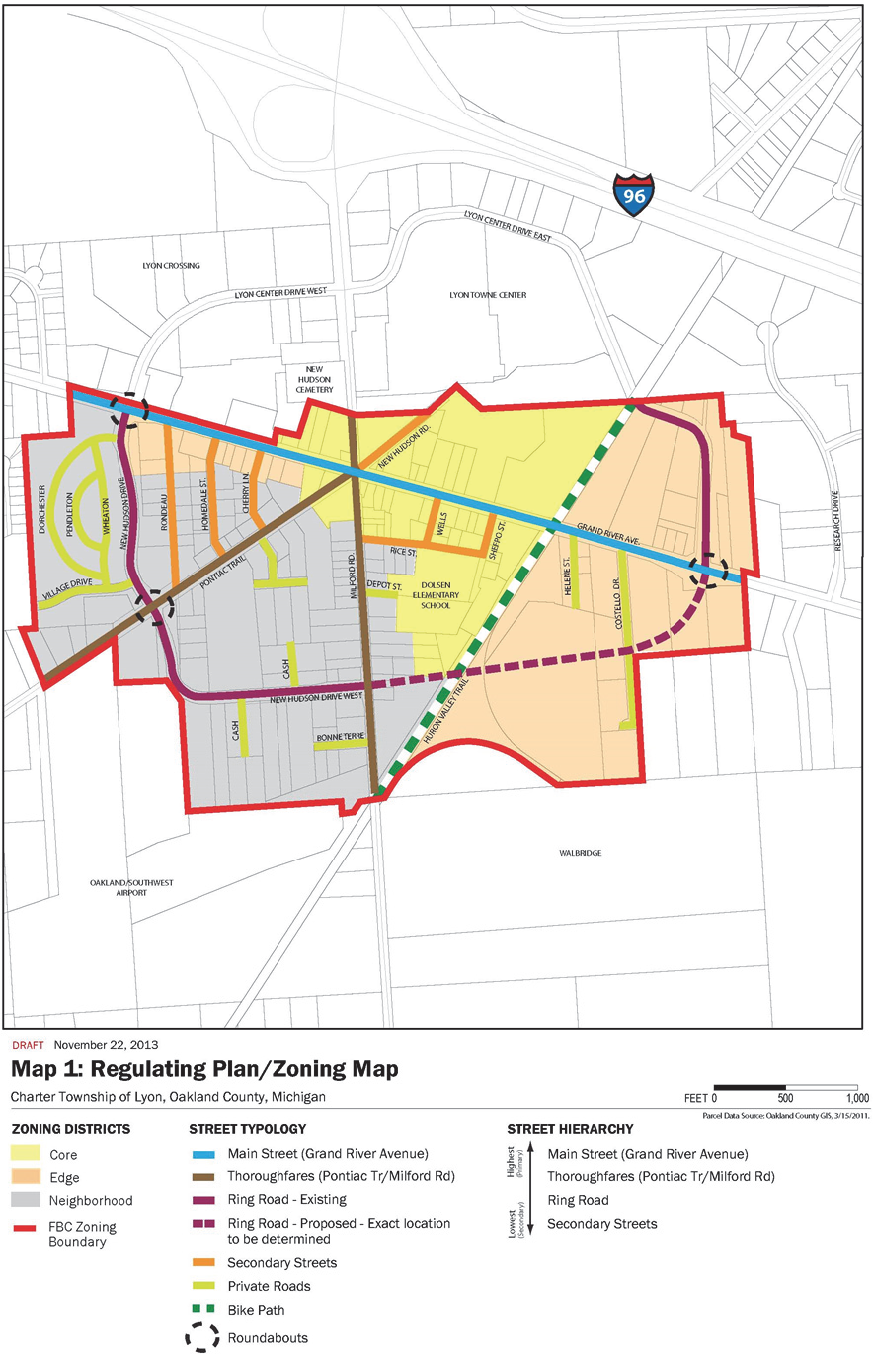
The following uses are or may be permitted in the New Hudson Zoning District. If a use is not listed in the following table, it is not permitted in the New Hudson Zoning District. The boundaries of the core, edge, and neighborhood sub-areas are shown on the Regulating Plan/Zoning Map (Map 1).
(Ord. No. 03-14, pt. 4, 1-7-2014; Ord. No. 10-14, pt. 6, 9-2-2014; Ord. No. 07-15, pt. 2, 6-1-2015; Ord. No. 06-16, pt. 2, 10-3-2016; Ord. No. 195-18, § 6, 6-4-2018; Ord. No. 13-22, § 6, 11-1-2022)
Section 41.101. - Statement of purpose.
The purpose of the New Hudson Zoning District is to create regulations for the design of new development or redevelopment in the area of Lyon Township known as New Hudson. The regulations in this article require development to have a physical form that complements the historic nature of existing development. Specifically, these regulations encourage a pedestrian-friendly and walkable character; permit a mixture of land uses; encourage streets that serve the needs of pedestrians, bicycles, and motorized vehicle traffic equitably; encourage places for informal social activity and recreation; and encourage building frontages that define the public space of streets. With proper physical form, a building can accommodate a wide range of uses without generating undue impact on neighboring properties or the area as a whole.
It is further the purpose of the New Hudson Zoning District to:
A.
Create a core area that maintains the traditional physical form of a historic hamlet.
B.
Create a unique, walkable mixed use district that includes residential, retail, entertainment, office, and other compatible uses.
C.
Encourage shared parking areas throughout core and edge sub-areas rather than requiring each commercial property owner to provide physical parking space on their property.
D.
Create quantitative and qualitative building design guidelines that ensure new development is compatible with the historic character of the hamlet.
E.
Ensure that permitted uses complement each other in terms of character and location, and to ensure that uses in the New Hudson Zoning District do not have an adverse impact on the overall economic and social vitality of the hamlet, street capacity, public utilities or services, or the overall image and function of the district.
F.
Prevent automobile-oriented development from achieving the goal of a walkable hamlet.
(Ord. No. 03-14, pt. 4, 1-7-2014)
Section 41.102. - Instructions.
A.
Application of requirements. The provisions of this article are activated by "shall" or "must" when required, "should" or "encouraged" when recommended, and "may" when optional.
B.
Applicability to sub-areas. The regulations herein shall apply to the core, edge, and neighborhood sub-areas of the New Hudson Zoning District unless specifically noted otherwise herein.
C.
Conflict. Wherever there is or appears to be a conflict between the regulations of this article and other sections of the Zoning Ordinance (as applied to a particular development), the requirements specifically set forth in this article shall prevail. For development standards not addressed in this article, the other applicable sections of this Zoning Ordinance shall be used as the requirement.
(Ord. No. 03-14, pt. 4, 1-7-2014)
Section 41.103. - New Hudson Zoning District sub-areas.
The location of the core, edge, and neighborhood sub-areas within the New Hudson Zoning District are shown on the Charter Township of Lyon Zoning Map. These sub-areas are characterized as follows:
A.
Core. The core sub-area is located in the heart of the New Hudson Zoning District, and is the focus of activity and attention in the hamlet. The core sub-area contains the most intensive development in the hamlet while using traditional design concepts that promote its historic character. The uses within the core sub-area consist primarily of retail and office, but may include upper story residential on top of commercial uses and live-work units.
B.
Edge. The edge sub-area, which is generally located east of the core sub-area, encourages a wide variety of land uses, such as residential, commercial, industrial, and civic uses. While mixing land uses has the potential to highlight incompatibilities, it is also an opportunity to incorporate superior design elements in a way that fosters the sustainability and success of mixed land uses. As the edge sub-area develops and redevelops, special attention must be paid to how mixed uses relate to one another as well as the New Hudson Zoning District as a whole.
C.
Neighborhood. A successful downtown requires sufficient population to partake of the services offered by the businesses. The New Hudson Zoning District accommodates this need by designating the neighborhood sub-area, which allows residential development of up to 14 units per acre. The neighborhood sub-area also encourages commercial uses that are compatible with residential uses.
(Ord. No. 03-14, pt. 4, 1-7-2014)
Section 41.104. - Approval process.
A.
Site plan approval. Site plan approval shall be required in accordance with the requirements of article 5.00, and shall follow the procedures established therein.
B.
Special land use approval. Any development that contains a use requiring special land use approval shall be reviewed following the procedures and review criteria of article 6.00. However, the planning commission shall be the sole approving authority, and review by the township board is not required.
(Ord. No. 03-14, pt. 4, 1-7-2014)
Section 41.105. - Modifications to existing development.
A.
Expansions of developed sites. The following regulations apply to proposals to expand an existing development:
1.
Twenty-five percent or less of existing condition. Any development activity on a developed site that would increase the floor area of the existing principal building or the total floor area of all accessory structures by 25 percent or less need not comply with the requirements of this article. However, any new building area shall result in the site being more compliant, and shall not result in the site being less compliant with the requirements of this article.
2.
More than 25 percent of existing condition. Whenever an expansion results in the principal building floor area or the total floor area of all accessory structures increasing by more than 25 percent, the structure shall comply with all of the dimensional requirements of this article.
3.
Expansions measured cumulatively. For the purposes of determining compliance with this section, expansions shall be measured cumulatively, with the baselines being the principal building floor area and total floor area of the accessory structures that existed at the date of adoption of this Ordinance.
B.
Redevelopment. The following regulations apply to proposals to demolish and replace all or a portion of an existing development:
1.
Whenever 50 percent or less of the gross square footage (measured at the exterior walls) of an existing building will be demolished or replaced, the development activity need not comply with the requirements of this article. However, any site layout or building design changes that occur as a result of the development activity shall result in the site being more compliant with the requirements of this article.
2.
Whenever more than 50 percent of an existing building will be demolished or replaced, the development activity shall comply with all of the requirements of this article.
(Ord. No. 03-14, pt. 4, 1-7-2014)
Section 41.301. - In general.
The following dimensional and design standards regulate the physical characteristics of development in the New Hudson Zoning District. The standards are broken into sections addressing a specific development characteristic: blocks and streets, lot requirements, and building requirements.
(Ord. No. 03-14, pt. 4, 1-7-2014)
Section 41.302. - Block and street design.
A.
Blocks and street network.
1.
The street network in and proximate to the New Hudson Zoning District should be designed to foster a walkable, pedestrian scale environment. Rice, Wells and Shefpo Streets exhibit a pedestrian scale, with length between 400—500 feet and block perimeters of about 1,600 feet.
2.
This block pattern should be maintained in the New Hudson Zoning District in order to retain a pedestrian scale. If new streets are proposed, or changes to the existing street network are proposed, the following requirements shall apply:
a.
Block length. The length for any block face between intersecting streets shall be 400—600 feet.
b.
Block perimeter. The block perimeter shall be 1,600—2,000 feet.
3.
The planning commission may allow deviations from these requirements upon making the determination that compliance would be impractical because of the configuration of existing streets or the inability to make cross connections.
B.
Street types.
1.
There are five street types illustrated on the Regulating Plan/Zoning Map (Map 1) for the New Hudson Zoning District: Main Street, thoroughfares, ring roads, secondary streets, and private roads. The specific dimensional requirements for a building will depend on the type of street upon which it has frontage or frontages.
2.
Main Street, thoroughfares, and ring roads carry higher volumes of traffic and are typically more prominent.
3.
Secondary streets and private roads intersect with the Main Street, thoroughfares, and ring roads, contain more residential uses, and provide local access to adjacent residential neighborhoods.
4.
The following table identifies the streets in the New Hudson Zoning District by street type. New streets shall be designated as a street type by the planning commission for the proposed development:
C.
Street design guidelines.
1.
On-street parking. On-street parking in the New Hudson Zoning District is encouraged where permitted by the Road Commission for Oakland County. All streets in the New Hudson Zoning District should include a parking lane on both sides of the street, except where the width of the road right-of-way is insufficient to accommodate parking on both sides.
2.
Two-way travel. Two-way streets are encouraged in the New Hudson Zoning District. One-way streets should not be used in the New Hudson Zoning District.
3.
Curb radius. The curb radius at the intersection of two streets should be the minimum necessary to permit vehicle circulation. A smaller curb radius shortens the distance that pedestrians must travel to cross the street, and leads to a safer pedestrian environment by reducing the speed at which cars can travel around corners. It is recommended that the centerline curb radius not exceed 30 feet at the intersection of any two streets, subject to review by the Road Commission for Oakland County.
4.
Sidewalks at driveway crossings. When a sidewalk crosses a vehicle driveway, the driveway shall retain the elevation of the sidewalk. The appearance of the sidewalk shall be maintained across the driveway to indicate that the sidewalk is a part of the pedestrian zone and that pedestrians have the right-of-way.
5.
Pedestrian zone.
a.
The pedestrian zone is the area between the curb (or edge of pavement if there is no curb) and the edge of the right-of-way, and includes area for sidewalks, landscape plantings, and other pedestrian-scale uses and amenities. The treatment of the pedestrian zone determines the character of the street, and the quality of the public realm within the right-of-way. Streets are the most common public space in the hamlet, and must be designed to be welcoming and accommodating for pedestrians as well as motorized traffic.
b.
The pedestrian zone in the New Hudson Zoning District contains three distinct areas, an edge area that allows car doors to open freely; a walkway area where pedestrians walk; and a frontage area adjacent to the building. Figure 1 illustrates the three areas of the pedestrian zone:
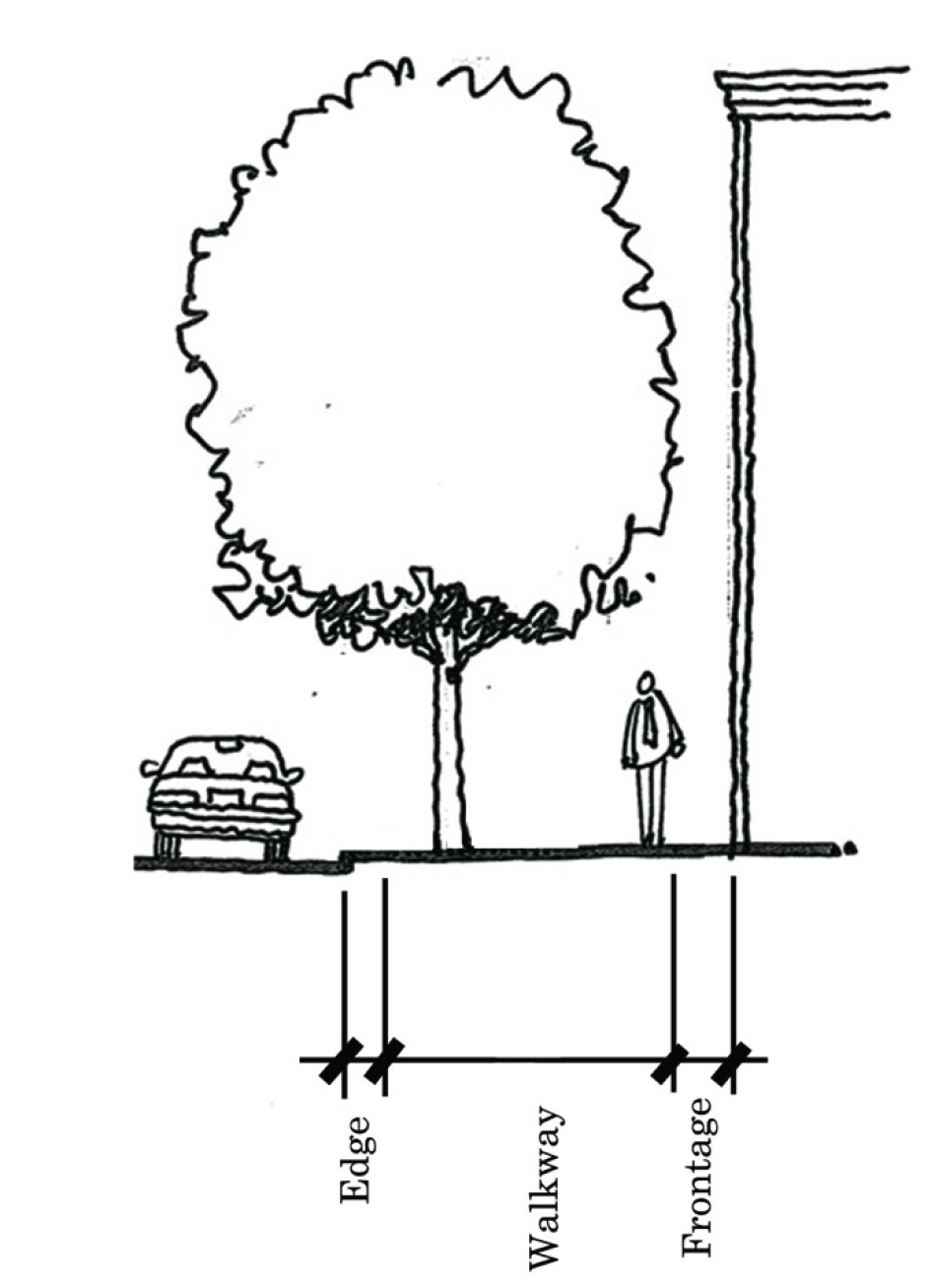
Figure 1. Pedestrian Zone
c.
The following sidewalk design requirements and recommendations are intended to create an inviting public space along streets:
(1)
Pedestrian zone width. The pedestrian zone portion of the public right-of-way shall have a minimum width of 7.5 feet (i.e., an edge area of at least 2.5 feet wide and a walkway area of at least five feet wide, as required in (2) and (3) below); however, a larger width is appropriate along the Main Street (Grand River Avenue) and the thoroughfares (Pontiac Trail and Milford Road).
(2)
Edge area. The edge area shall have a minimum width of 2.5 feet, and shall remain clear of obstructions to permit the doors of parked cars to open freely. Streetlights and traffic control signs may be located in the edge area. The edge area may be paved, or if a tree lawn is combined, it may be landscaped.
(3)
Walkway area. The walkway area is the basic sidewalk area where pedestrians walk. The walkway area must maintain a five-foot wide clear path free of obstructions at all times to permit free pedestrian travel. No permanent structures or uses may be located in the walkway area with exception to structures related to public utilities such as fire hydrants or streetlights. Trees and other landscaping is permitted in the walkway area, provided it does not obstruct the required five-foot wide clear path.
(4)
Frontage area. The frontage area is the portion of the pedestrian zone adjacent to the building. The frontage area is an optional area, and may be used for street furniture or other uses accessory to the use in the adjacent building.
D.
Alleys. Alleys and lanes that provide access to the rear of buildings or parking areas are permitted in the New Hudson Zoning District; provided that designated pedestrian access across the alleys is provided when necessary. The intersection between an alley and a street should be separated at least 150 feet from any street intersection (measured from the point of intersection between the centerlines of the streets).
(Ord. No. 03-14, pt. 4, 1-7-2014)
Section 41.303. - Lot requirements.
The following requirements apply to the development of lots in the New Hudson Zoning District. For the purposes of determining compliance with these regulations, lots that are assembled under one ownership may be considered a single lot.
A.
Setbacks. Buildings in the New Hudson Zoning District shall comply with the following minimum and maximum setback requirements:
1.
Primary vs. secondary front yards. Any lot line that borders on a street shall be considered a front yard. When a lot is located on a corner lot, the primary front yard setback shall be measured from the street right-of-way of the street designated as the front on the subdivision plat, condominium master deed, or building permit.
a.
The applicant shall identify primary and secondary front yards on the site plan submitted for approval by the planning commission. In reviewing an applicant's designation of primary and secondary front yards, the planning commission shall consider the following:
(1)
Every lot shall have at least one primary front yard.
(2)
Main Street, thoroughfares, or ring roads shall always be considered a primary front yard.
(3)
The yard facing a secondary street or private road may be considered a primary or a secondary front yard.
B.
Building frontage requirements. In order to maintain a pedestrian scale environment, buildings shall maintain a minimum frontage as specified in the following chart. Building frontage requirements prevent buildings from being spaced too far apart, which creates gaps in the street wall. Building frontage is defined as the width of the building divided by the lot width at the front property line. By way of example, a building that is 70 feet wide in the front setback area located on a lot that is 100 feet wide would have a building frontage of 70 percent (70/100 x 100 = 70%).
C.
Any existing lot created prior to the effective date of this Ordinance shall be considered a buildable lot in the New Hudson Zoning District provided the lot width is a minimum of 30 feet and lot area is greater than 3,000 square feet. Any new lot created in the New Hudson Zoning District must conform to the following minimum dimensions, or the predominant lot width and area of the lots on the same side of the street between the closest intersecting streets, whichever is less:
1.
Core subdistrict: 70-foot lot width; 10,000 square feet lot area.
2.
Edge and neighborhood subdistricts: 100 feet; 15,000 square feet lot area.
(Ord. No. 03-14, pt. 4, 1-7-2014; Ord. No. 04-20, § 1, 7-6-2020)
Section 41.304. - Building design.
Buildings in the New Hudson Zoning District shall comply with the following requirements.
A.
Private frontage. The private frontage is the area between the public right-of-way and the principal building facade. Buildings must contain architectural elements consistent with one of the following four private frontages. Each frontage is designed to be consistent with some or all of the uses permitted in the New Hudson Zoning District.
| Shopfront | |
|---|---|
|
A frontage where the building facade is located close to the front lot line with the
building entrance at sidewalk grade. This frontage type is suitable for nonresidential
uses on the first floor.
Where Permitted: • Core • Edge | 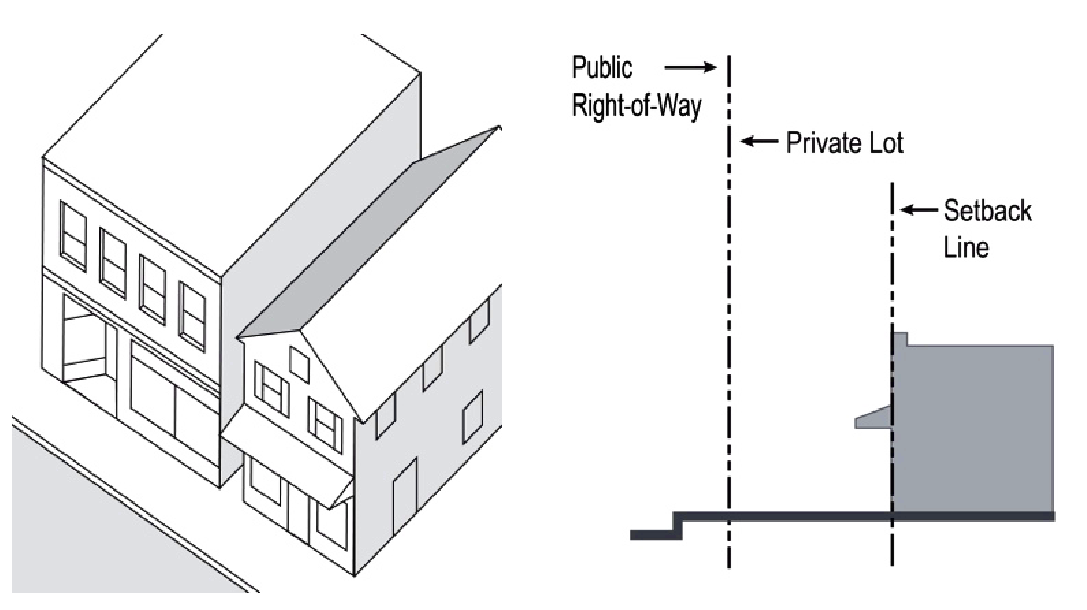 |
| Courtyard | |
|---|---|
|
A frontage where a portion of the building facade is close to the front lot line with
a portion set back. The courtyard may accommodate tree plantings or a vehicle drop-off
area. This frontage is suitable for any building use.
Where Permitted: • Core • Edge • Neighborhood Dimensional Considerations: The courtyard area shall be considered part of the front building facade. | 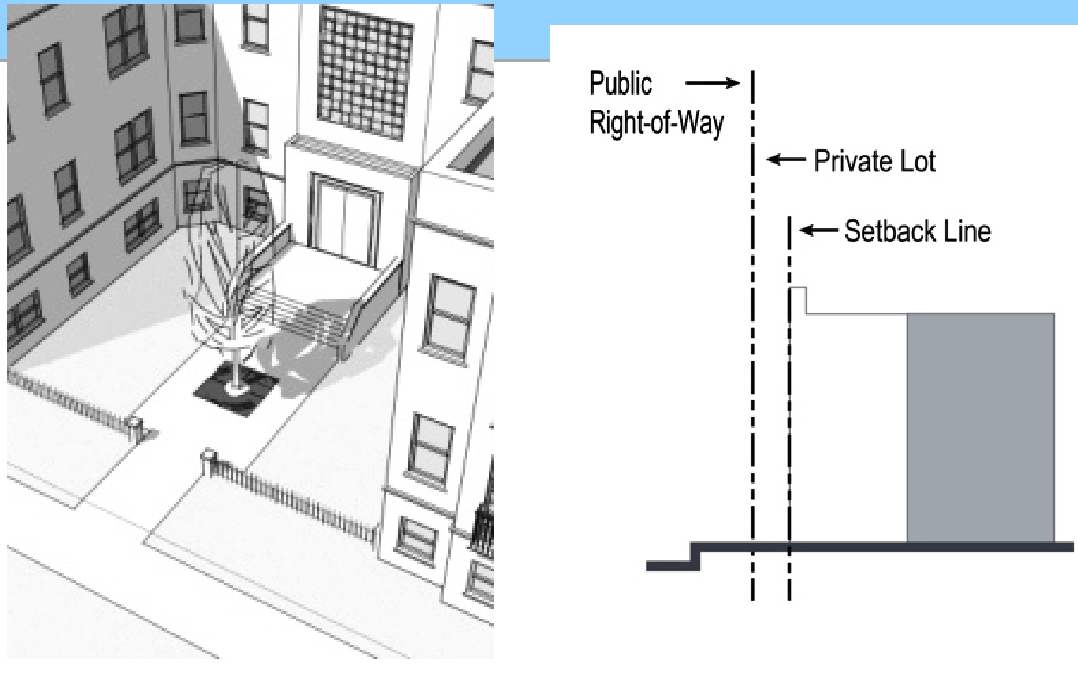 |
| Residential Stoop | |
|---|---|
|
A frontage where the first floor is elevated from the sidewalk to provide privacy
for first floor windows. The entrance is usually from an exterior stair and landing.
This frontage is suitable for ground-floor residential use.
Where Permitted: • Neighborhood Dimensional Requirements: The building shall be set back a minimum of 15 feet from the front lot line. The stoop or porch area shall be set back a minimum of 5 feet from the front lot line. | 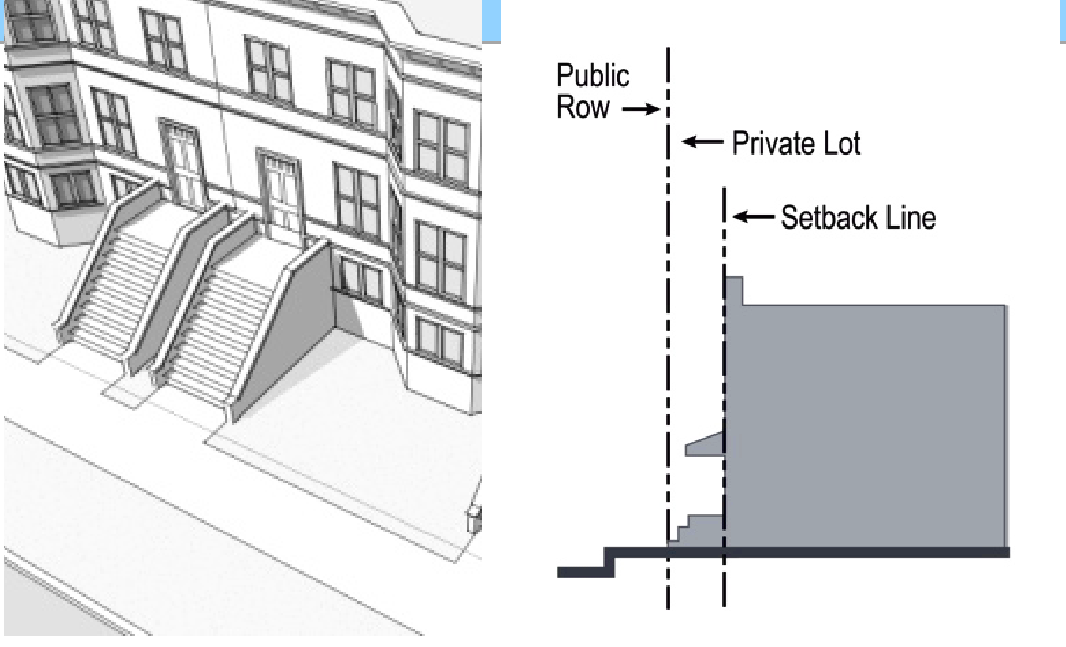 |
| Lawn | |
|---|---|
|
A frontage where the building is set back from the street with a landscaped front
yard area. This frontage is suitable for any building use.
Where Permitted: • Edge • Neighborhood Dimensional Requirements: The building shall be set back a minimum of 20 feet from the front lot line. Unenclosed front porches shall be set back a minimum of 5 feet from the front lot line. | 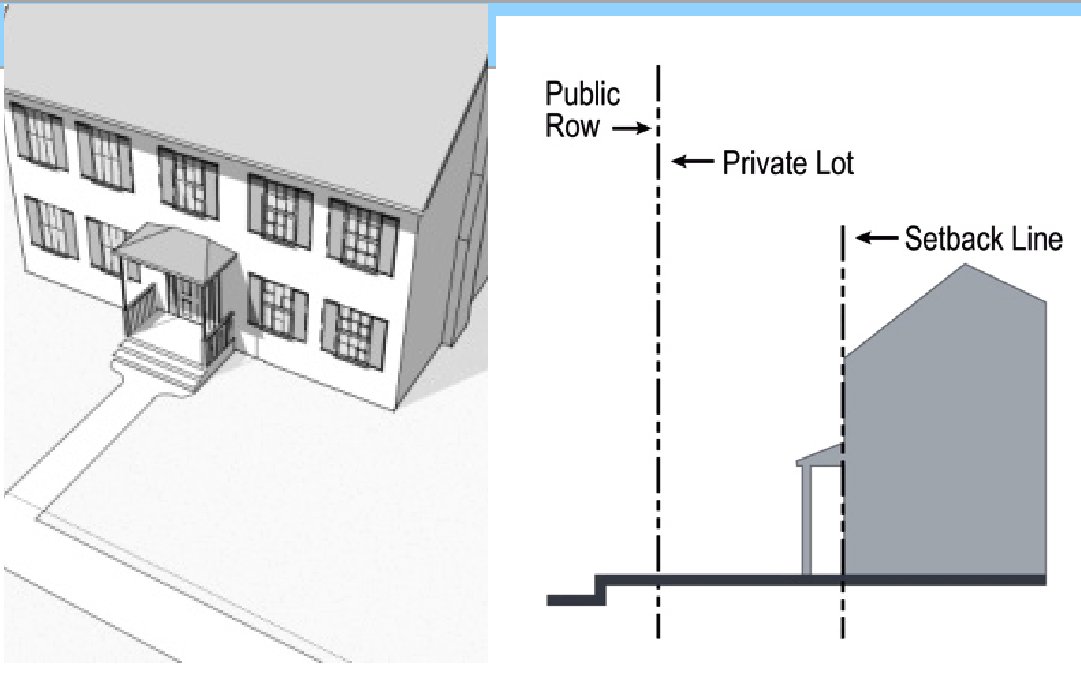 |
B.
Building height.
1.
Stories. Building height in the New Hudson Zoning District shall be measured in stories. Unfinished attics or similar spaces that are not part of the livable space of a building shall not be considered a building story.
2.
Maximum height. The maximum building height permitted in the New Hudson Zoning District is three stories.
3.
Minimum Height. The minimum building height for new buildings in the core sub-area is two stories. If it is infeasible to construct a two-story building on a lot (for example, if a lot is too small to accommodate a two-story building plus required site amenities), then a one-story is permissible. There is no minimum height requirement in the edge sub-area or neighborhood sub-area.
4.
Exceptions. Special architectural features such as towers, cupolas, chimneys, steeples, and similar elements are allowed to exceed the height limits.
C.
Base, middle and cap. Flat-roofed, two-story buildings, shall incorporate a base, middle, and cap, as is applicable (Figure 2).
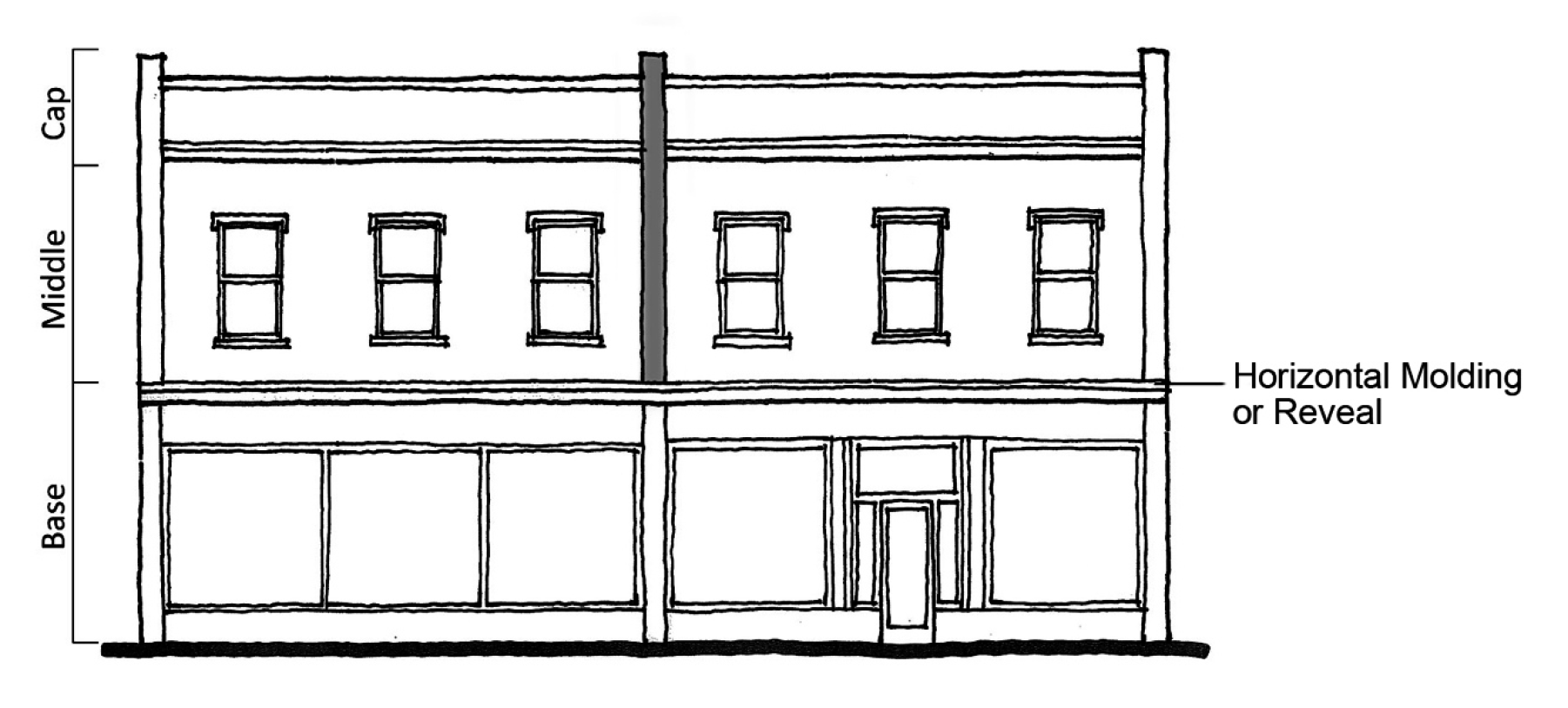
Figure 2: Base, middle, and cap of a two-story building
1.
Base. The base shall include an entryway with transparent windows and a horizontal molding or reveal (also known as an intermediate cornice line or beltline) placed between the first and second stories or over the second story. The molding or reveal shall have a depth of at least two inches and a height of at least four inches. If a one story building is proposed, the molding or reveal is not required.
2.
Middle. The middle may include bands, balconies, or windows that are located between the reveal and the cap area.
3.
Cap. The cap includes the area from the ceiling of the top floor to the roof of the building, and shall include a cornice or roof overhang.
D.
Alignment. Windowsills, moldings, and cornices shall align closely with those of adjacent buildings. The top line defining the edge of the windows (the "top windowsill alignment") shall not vary more than two feet from the alignment of surrounding buildings. If the adjoining buildings have top windowsill alignments that vary by more than two feet from one another, the top windowsill alignment of the proposed building shall align with one of the adjoining buildings.
E.
Building materials. Buildings in the New Hudson Zoning District shall comply with the following building material requirements:
1.
Primary building materials. Primary exterior building materials shall be brick, wood siding, or synthetic building materials that convincingly match the appearance of natural building materials. Vinyl siding is permitted as a primary building material for residential buildings provided that it is premium grade having a minimum thickness of 0.046 inches. Concrete block or similar masonry units (including CMU or split-faced block) are prohibited as a primary building material except on the sides or rear of industrial buildings. Exterior insulating finish systems (EIFS) and similar materials may not be used as a primary building material. Primary building materials shall be used on a minimum of 70 percent of the facade of the building (excluding doors and windows).
2.
Accent building materials. Accent materials may be used on up to 30 percent of the facade area of the building (excluding doors and windows). Acceptable accent materials include decorative precast concrete block, custom metal panels, and glass. Building materials such as EIFS may be used as accent building materials on up to ten percent of the total wall area of any facade, but may not be used below 11 feet in height.
3.
Prohibited building materials. The use of aluminum siding, mirrored glass, and plastic is prohibited. With exception to single-family residential structures, the use of vinyl siding is also prohibited.
4.
Awning materials. Awnings must be made of canvas fabric or similar material. Metal awnings shall be permitted if they are a permanent building architectural element. Plastic or rigid fiberglass awnings are not permitted. Awnings shall not be made of high gloss, shiny or translucent materials, and shall not be internally illuminated.
F.
Ground floor design.
1.
First story clear height. Any building that contains office, commercial, or retail uses on the first floor must have a minimum first story clear height of 12 feet, as measured from the interior floor to the ceiling on the first floor.
2.
Pedestrian elements. Awnings, trellises, arcades and similar features are encouraged to enhance the pedestrian experience.
3.
Building entrance(s). All buildings shall have their principal entrance or entrances open onto a street, sidewalk, or public space. The principal building entrance shall not open onto a parking lot, although a secondary entrance may be provided to a parking lot. Apartment buildings shall have one entrance facing the street to retain a residential character, with individual units being accessed via interior doorways or from the side or rear facades.
4.
Entryway alignment.
a.
Nonresidential uses. For all buildings in the core sub-area of the New Hudson Zoning District and buildings with nonresidential uses on the first floor in the edge sub-area, the ground floor of the principal entrance shall align with the elevation of the adjacent sidewalk. Sunken terraces or stairways to a basement shall not constitute principal entrances to a building for the purposes of this section. It is not the intent of this section to preclude the use of below or above grade entryways, provided that such entryways are secondary, not principal entrances.
b.
Residential and live/work uses. For first floor residential and live/work uses in the edge and neighborhood sub-areas of the New Hudson Zoning District, the ground floor of the building (and consequently the principal entrance as well) may be raised up to 36 inches above the elevation of the adjacent sidewalk. This is intended to create greater privacy for first floor residential uses by elevating windows above the view of passing pedestrians.
5.
Recessed entrances encouraged. Doors in the core and edge sub-areas are encouraged to be recessed into the face of the building to create a sense of entry and to add variety to the streetscape.
G.
Windows. The following requirements apply to facades of buildings facing a public street or public space such as a plaza or square:
1.
Window materials.
a.
Front facing windows must be clear non-reflective glass. The use of tinted glass or plexi-glass is prohibited. On side or rear facades that exceed 30 feet in length, the planning commission may approve the use of spandrel glass to create visual interest.
b.
Curtains or blinds are permissible for second story windows or where a first floor residential use exists. Curtains or shades are discouraged for first floor offices, because they eliminate the "eyes on the street" for purposes of first floor transparency. If window coverings must be used on the first floor to prevent glare, then adjustable solar shades are an acceptable alternative.
2.
Ground floor facade transparency.
a.
All buildings with first floor nonresidential uses shall provide the following minimum percentage of transparency between two and eight feet above grade level on the first floor facade. Door and window glass provides transparency, but must be see-through and not frosted, beveled, spandrel, covered with paper, or otherwise obscuring the inside view of the building from the street.
b.
Solid walls shall not be permitted along any primary or secondary front yard.
H.
Roofs. The following requirements apply to all roofs.
1.
Roof type. Pitched roofs or flat roofs are permitted. Pitch is the slope of the sides of a roof, expressed by the ratio of its height to its span.
2.
Flat roof requirements.
a.
Roof shall have a parapet horizontal in elevation above the roof facing any frontage; the parapet shall be appropriately elaborated, and shall be no less than 12 inches tall measured above the roof.
b.
Any equipment placed on a flat roof must be located on the rear half of the building; and/or screened by parapet walls or screens, rendering the equipment invisible from six feet above the street level and from adjacent properties.
c.
Eaves (when used) shall overhang vertical building walls a minimum of 16 inches, and shall be designed with the view from the street in mind.
3.
Pitched roof requirements.
a.
Pitched roofs shall be clad in either cement tile, slate, through-fastened steel roofing, standing-seam metal roofing, or dimensional shingles.
b.
Hip roofs shall have a pitch of 6:12 or greater.
c.
Gable roofs shall have a pitch between 6:12 and 12:12.
d.
Shed roofs are permitted only when they are attached to a principal building, and shall have a slope between 4:12 and 8:12.
e.
Porch roofs and roofs over other building elements such as bay windows and exterior utility closets or mechanical rooms that are attached to principal buildings, shall be hipped and shall have a pitch of 4:12.
f.
Dormers must be habitable, and set back no less than 36 inches from the exterior wall below. Hipped, and/or gabled dormers shall be sloped to match the principal roof, and shed roofs shall have a minimum slope of 3:12.
g.
Eaves shall be continuous, and overhang exterior vertical building walls a minimum of eight inches. Open eaves shall extend beyond exterior vertical building walls no less than 12 inches in height.
h.
Cornices shall be no less than 12 inches in height.
i.
Roof penetrations such as plumbing and heating vents shall be placed on the rear ridge of the roof and painted to match the color of the roof. Metal roof penetrations may be left unpainted.
I.
Encroachments. Architectural features, such as cornices, may extend up to 1.75 feet into the required setback. Awnings and canopies may encroach into the public right-of-way.
J.
Service areas. All service areas, including utility access, above ground HVAC equipment, and dumpsters shall be located in side or rear yards and shall be screened from view from any street.
K.
Mechanical and utility equipment. Mechanical equipment, electrical and gas meters and service components, and similar utility devices (whether ground level, wall-mounted, or roof-mounted) shall be screened from view from the front property line. Exterior screening materials shall be the same as the predominant exterior materials of the principal building.
(Ord. No. 03-14, pt. 4, 1-7-2014; Ord. No. 07-15, pt. 3, 6-1-2015)
Section 41.401. - Parking.
The following parking requirements are applicable in the New Hudson Zoning District, and replace any similar requirements set forth in article 14.00:
A.
Minimum parking required. All new development or expansion of existing development shall provide off-street parking spaces according to the following requirements. The parking spaces shall be provided within 800 feet of the building.
1.
Residential uses.
a.
Attached: A minimum average of 1.5 off-street parking spaces per residential dwelling unit.
b.
Detached: A minimum of 2.0 off-street parking spaces per residential unit. Required spaces may be in the garage.
2.
Nonresidential uses. One parking space per 250 square feet of gross nonresidential floor area, unless article 14.00 requires fewer spaces. The planning commission may enforce the minimum parking space standards of article 14.00 if there are not a sufficient number of public parking spaces in the area. Adjacent on-street parking may be included in calculations to determine compliance with parking requirements.
3.
Barrier-free parking.
a.
Barrier-free parking spaces shall be provided per state requirements, shall be accessible from and conveniently located near each primary building entrance, and shall be identified by above-grade signs and pavement striping.
b.
The following table is a summary of the barrier-free parking space requirements in effect at the effective date of this Ordinance:
Barrier Free Parking Requirements
4.
Bicycle parking. Bicycle parking may replace up to two percent of the vehicle parking requirements for new developments. In other words, if 60 parking spaces are required for a new development, 59 spaces could be for cars and one space could be provided for bicycles.
5.
Transit reduction. If public transit access is provided within a one-fourth mile of a property located within the New Hudson Zoning District, the planning commission may reduce the parking requirement for that property by ten percent.
6.
Shared parking reduction. Shared parking may be permitted where two or more land uses with different peak occupancy times agree to share a parking lot. The minimum number of parking spaces shall be determined by a study prepared by the applicant(s) following the procedures of the Urban Land Institute (ULI) Shared Parking Report, Institute of Transportation Engineers (ITE) Shared Parking Guidelines, or other approved procedures. A formal parking study may be waived for small developments where there is established experience with the land use mix and its impact is expected to be minimal. The actual number of parking spaces required shall be based on the most current edition of Parking Generation, an ITE publication. If standard rates are not available or limited, the applicant may collect data at similar sites to establish local parking demand rates on an hourly basis. If the shared parking plan assumes use of an existing parking facility, then field surveys shall be conducted to determine actual parking accumulation. These surveys should consider the seasonal peak period for the combination of land uses involved. A legal agreement guaranteeing access to, use of, and management of the shared parking lot must be executed by the parties agreeing to share the parking.
7.
Public parking reduction. If public parking is provided within 800 feet of a property located within the New Hudson Zoning District, the parking requirement for that property may be reduced by no more than 50 percent of the total minimum parking requirement calculated based on the property's land use. Such reduction may be approved administratively if the public parking is constructed subsequent to site plan approval for the subject property.
B.
On-street parking. Adjacent on-street parking may be included in the calculations to determine compliance with minimum parking requirements.
C.
Parking lot location. Parking lot location must comply with the following table:
D.
Parking lot layout. Side-by-side parking lots created on two separate properties shall have a landscaped buffer of at least ten feet wide that separates the parking lots. However, the buffer may be reduced or eliminated if an overall parking plan is submitted that illustrates how parking on adjacent sites will be coordinated. Such a plan shall be subject to planning commission approval. An interconnecting driveway is permitted between the lots as a means of sharing parking and reducing on-street traffic.
E.
Parking stall and maneuvering aisle dimensions. The dimensions of the parking stalls and maneuvering aisles shall be the same dimensions required in article 14.00.
F.
Loading space. There are no specific loading requirements in the New Hudson Zoning District; however, buildings and sites should be designed such that delivery vehicles can be accommodated on the site without encroaching into a public right-of-way, where possible. Further, loading facilities such as truck docks shall be located and screened such that they are not visible from a main street.
(Ord. No. 03-14, pt. 4, 1-7-2014; Ord. No. 07-15, pt. 4, 6-1-2015; Ord. No. 10-16, pts. 14, 15, 11-9-2016)
Section 41.402. - Outdoor amenity space.
Any development or redevelopment of a building (except an industrial building) with more than 10,000 square feet of floor area in the New Hudson Zoning District shall provide outdoor amenity space. The emphasis of the amenity space requirement is on the quality rather than the quantity of the space; therefore, there is no minimum area of amenity space required. Amenity space shall be adjacent to or visible and accessible from a public right-of-way. Outdoor amenity space may take the form of a pocket park or plaza and may include street furniture, public art, landscaping, a water feature, play equipment, or a combination of amenities. Rather than providing the amenity space on-site, a developer may propose to improve an existing outdoor public space, subject to planning commission approval.
(Ord. No. 03-14, pt. 4, 1-7-2014)
Section 41.403. - Outdoor retail sales.
Outdoor retail sales, such as sidewalk sales, are permitted in the New Hudson Zoning District, subject to the following requirements:
A.
No permit required. Temporary or moveable outdoor retail sales activity or displays accessory to a principal use in the New Hudson Zoning District are permitted, subject to the following requirements:
1.
Area. The total of all outdoor sales display areas on the site shall not exceed 1.5 square feet per linear foot of building frontage.
2.
Location. Outdoor sales areas may be located in the build-to zone, and/or in the right-of-way. Outdoor sales in the right-of-way shall be located in the frontage or furnishings area of the pedestrian zone directly adjacent to the building containing the use to which it is accessory.
3.
Time. The outdoor sales display shall only be set out during business hours, and shall be moved indoors for storage overnight or when the business is closed. A minimum five-foot wide clear pedestrian pathway on the sidewalk shall be maintained at all times.
B.
Permit required. Administrative approval is required for outdoor sales that exceed the area limitations in subsection A, above; for special outdoor sales events that will be located anywhere besides the frontage or furnishings area of the pedestrian zone; or for times outside of normal business hours. The permit will specify the permitted size and duration for the outdoor sales event.
(Ord. No. 03-14, pt. 4, 1-7-2014)
Section 41.404. - Outdoor storage.
No outside storage shall be permitted in the New Hudson Zoning District. For the purpose of this article, outdoor storage consists of items that are not brought indoors overnight or when the business is closed.
(Ord. No. 03-14, pt. 4, 1-7-2014)
Section 41.405. - Outdoor dining.
Outdoor dining is permitted in the New Hudson Zoning District, subject to the requirements in Section 19.02, subsection PP.
(Ord. No. 03-14, pt. 4, 1-7-2014; Ord. No. 06-17, § 1, 11-6-2017; Ord. No. 03-24, § 4, 6-3-2024)
Section 41.406. - Street design guidelines.
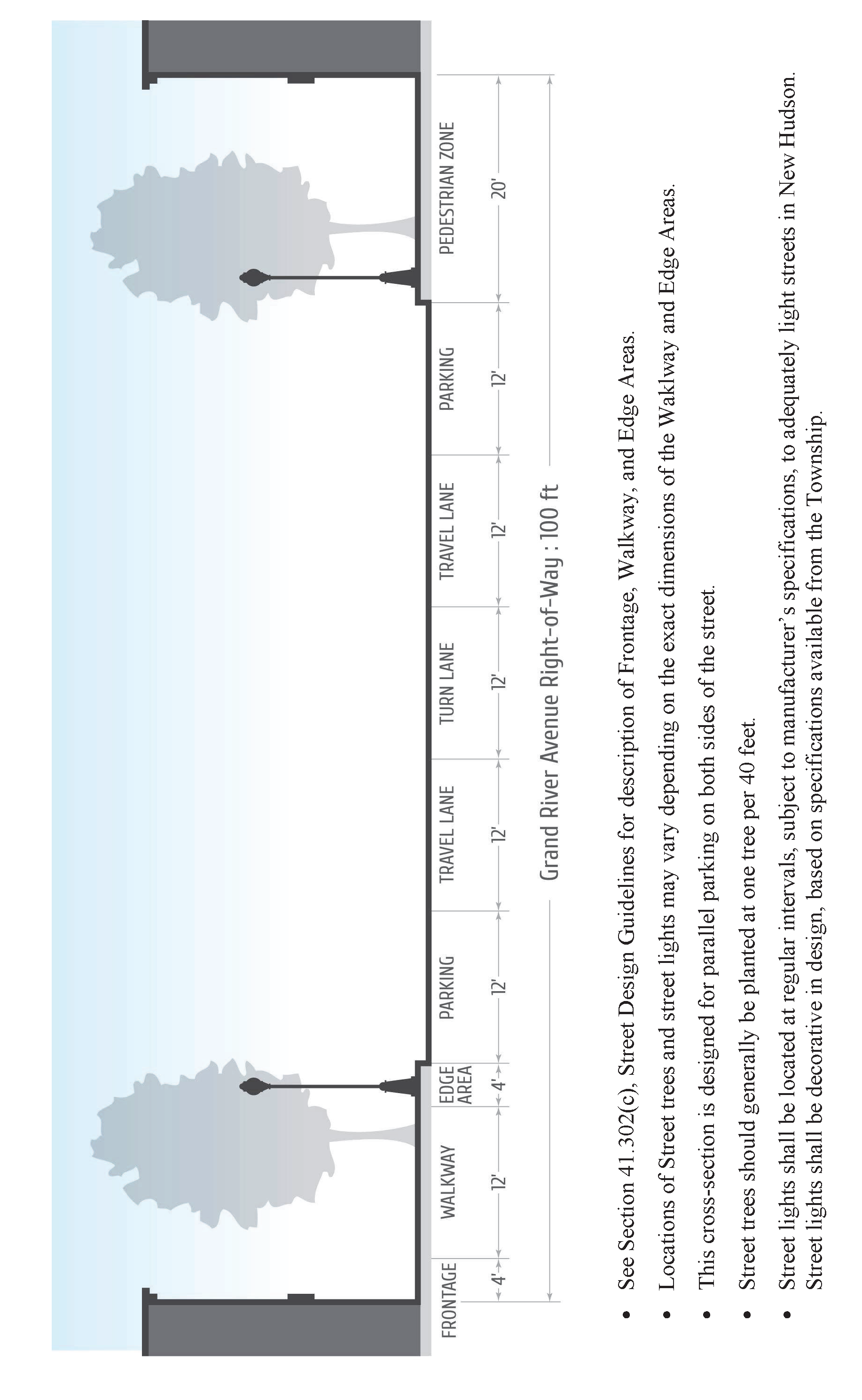
The following illustrations provide the regulations for development of Grand River Avenue and neighborhood streets, subject to approval of the Road Commission for Oakland County:
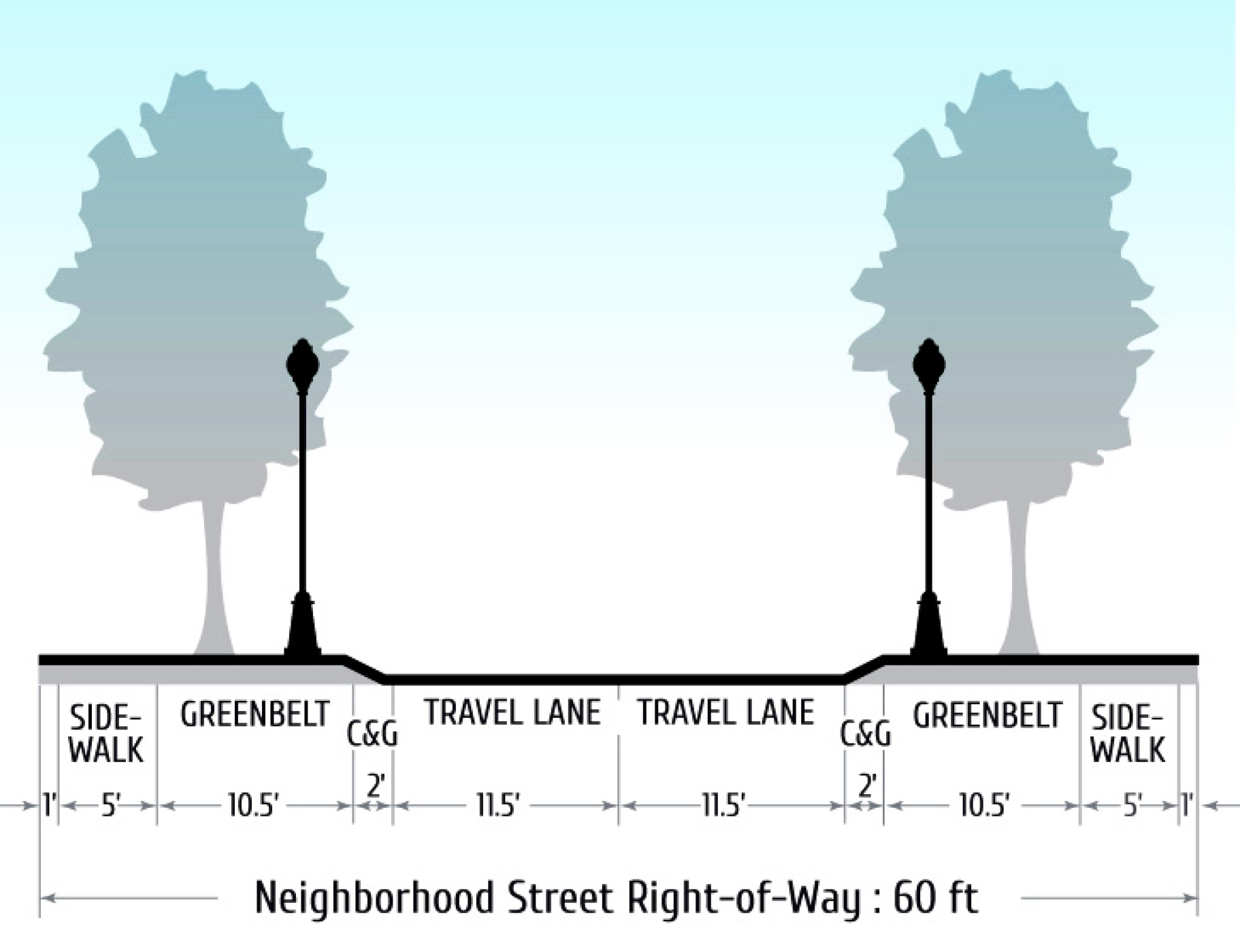
•
G & G - Curb and Gutter
•
Locations of street trees and street lights may vary depending on the design of the residential development.
•
This cross-section is designed for parallel parking on one side of the street.
•
Street trees should be planted at one tree per 40 feet.
•
Street lights shall be located at regular intervals, subject to manufacturer's specifications, to adequately light streets in New Hudson. Street lights shall be decorative in design, based on specifications available from the Township.
(Ord. No. 03-14, pt. 4, 1-7-2014)
Section 41.407. - Signs.
The following exterior sign regulations are applicable within the New Hudson Zoning District, and shall supersede any underlying sign requirements:
A.
Applicability.
1.
It shall be unlawful for any person to erect, alter, relocate, or structurally change a sign or other advertising structure without first obtaining a permit from the building department, in accordance with section 16.04.
2.
When new development is proposed, sign locations shall be shown on building elevations and site plans submitted for site plan approval and shall be subject to review and approval by the planning commission. Signs proposed for an existing site developed under the standards of this article shall require only a sign permit from the building department.

Gooseneck Lighting Fixtures
B.
Purpose. The intent of these sign regulations is to:
1.
Establish reasonable standards for business identification.
2.
Encourage creative and innovative approaches to signage within an established framework.
3.
Promote economic vitality.
4.
Promote traffic safety by reducing unnecessary visual distractions.
5.
Enhance overall property values and the visual environment by discouraging signs that visually clutter the streetscape.
6.
Ensure that commercial signs are designed for the purpose of identifying a business in an attractive and functional manner.
7.
Ensure signs on the facade of buildings reinforce the intended character of the New Hudson Zoning District and are integrated into the architectural scheme of the building.
8.
Promote a quality visual environment by allowing signs that are compatible with their surroundings and that effectively communicate their message.

Reverse Channel Illumination
C.
Design and materials.
1.
Exterior materials, finishes, and colors should be the same or similar to those used on the principal building.
2.
Signs should be professionally constructed using high-quality materials such as metal, stone, hardwood, or similar quality materials.
3.
Internally lit plastic letters and plastic box signs are prohibited.
4.
To minimize irreversible damage to masonry, all mounting and supports should be inserted into mortar joints and not into the face of the masonry.
D.
Sign lighting. Sign lighting greatly contributes to the overall character and perceived quality of a sign. Signs shall comply with the following lighting requirements:
1.
Internal sign illumination prohibited. Internally illuminated signs are prohibited.
2.
Externally illuminated signs. Projecting light fixtures used for externally illuminated signs, such as gooseneck fixtures for wall or projecting signs, should be simple and unobtrusive in appearance. Any external sign light source must be designed so that the light source is directed against the sign and away from pedestrian or vehicle travel ways, and the light source must not shine onto adjacent properties or cause glare for motorists or pedestrians.
3.
Back-lit, halo-lit, or reverse channel letter illumination. The use of back-lit, halo-lit, or channel-lit lighting is permitted. These types of sign lighting are appropriate for pedestrian and automobile scale sign lighting applications (see photo).
4.
Prohibited signs. Any sign incorporating flashing or blinking lights, animated display screens, or electronic changeable copy is prohibited.
E.
Multiple story buildings. The following regulations are applicable to multiple story buildings:
1.
Ground floor tenants shall place signs at the storefront level, below the expression line (see definitions, chapter 5) separating the ground floor from upper floors.
2.
Upper story tenants may only display window signs.
3.
A tenant wall directory sign shall be permitted at ground level entrances that provide address and access information for upper story tenants. Tenant wall directory signs shall have a maximum area of 12 square feet, and shall have a maximum height of eight feet.
F.
Permitted signs. The following types of signs are permitted:
| 1. WALL SIGNS | |
|---|---|
Definition: A sign that is mounted flush and fixed securely to or painted on a building wall,
projecting no more than 12 inches beyond the face of a building wall and not extending
sideways beyond the building face or above the highest line of the building to which
it is attached.
 | Regulations: a. Wall signs should be located on the upper portion of the storefront, and should not exceed the width of the storefront bay. b. Wall signs shall not exceed 1 ½ square feet per lineal foot of building frontage, provided that no such sign shall exceed 48 square feet. c. Wall signs shall be placed in a clear signable area, which is an architecturally continuous area uninterrupted by doors, windows, or architectural details such as grillwork, piers, pilasters, or other ornamental features. |
| 2. AWNING AND CANOPY SIGNS | |
|---|---|
Definition: A sign that is printed on, painted on, or attached to an awning or canopy above a
business door or window. Such signs are generally oriented toward pedestrians on the
opposite side of the street.
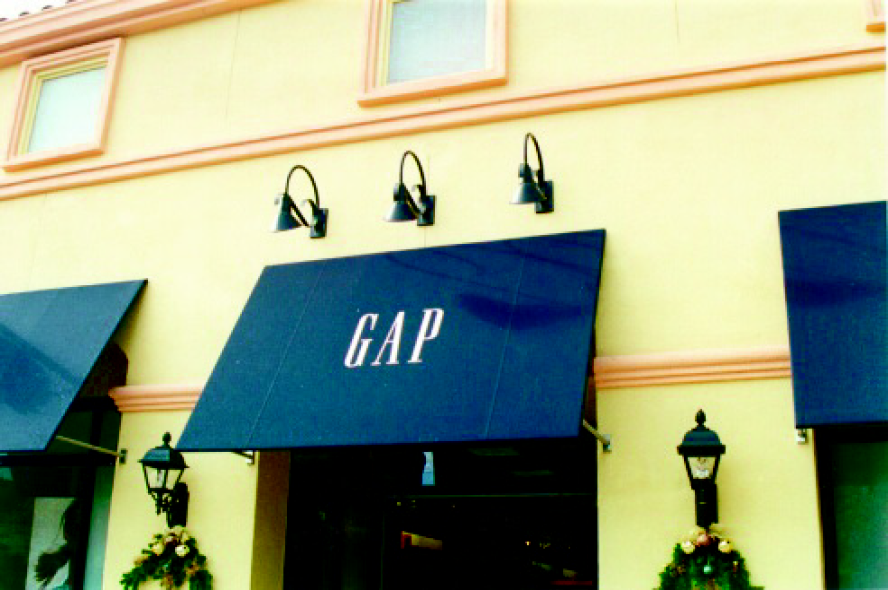 | Regulations: a. Sign lettering or logos shall comprise no more than 30% of the total exterior surface of an awning or canopy. b. Awnings or canopies with back-lit graphics or other kinds of interior illumination are prohibited. c. UV-resistant architectural fabric, in matte finish, suitable for outdoor use must be used and shall cover the front of the awning frame. d. The awning frame shall be constructed of steel or aluminum. e. Wind and snow load capacities shall be provided to the Township as part of the permit process. Applicants should be able to obtain wind and snow load capacities from the product manufacturer. f. Torn, frayed, ripped, faded, stained, soiled, or dirty awnings shall be replaced immediately. |
| 3. MARQUEE SIGNS | |
|---|---|
Definition: A marquee is a permanent roof like structure, supported by and extending from the
face of the building. A marquee sign is often constructed above a building entrance,
or over a street or sidewalk. Marquee signs generally contain changeable copy on the
face of the sign.
 | Regulations: a. A marquee sign is only permitted in conjunction with a theater, cinema, or performing arts facility. b. The permanent text of the sign may indicate the facility name and the changeable copy portion of the sign may highlight current and future attractions. c. One marquee sign shall be permitted per street frontage. d. A minimum vertical clearance of 10 feet shall be provided beneath any marquee. e. The total size of a marquee sign shall not exceed 1 ½ square feet per lineal foot of building frontage. The area of permanent lettering shall be counted in determining compliance with the standards for total area of wall signs permitted on a parcel. |
| 4. BLADE SIGNS | |
|---|---|
Definition: A blade sign is a sign that is affixed to the face of a building or structure that
projects in a perpendicular manner from the wall surface of a building.
 | Regulations: a. Blade signs shall be small in scale and provide a minimum vertical clearance of 10 feet between the lowest point of the sign and the sidewalk. b. A blade sign shall have a maximum area of 12 square feet. c. Mounting hardware shall be an integral part of the sign design. d. Businesses that have a blade sign may not have a hanging sign. |
| 5. HANGING SIGNS | |
|---|---|
Definition: A hanging sign is similar to a blade sign, except that it is suspended below a marquee,
awning or canopy.
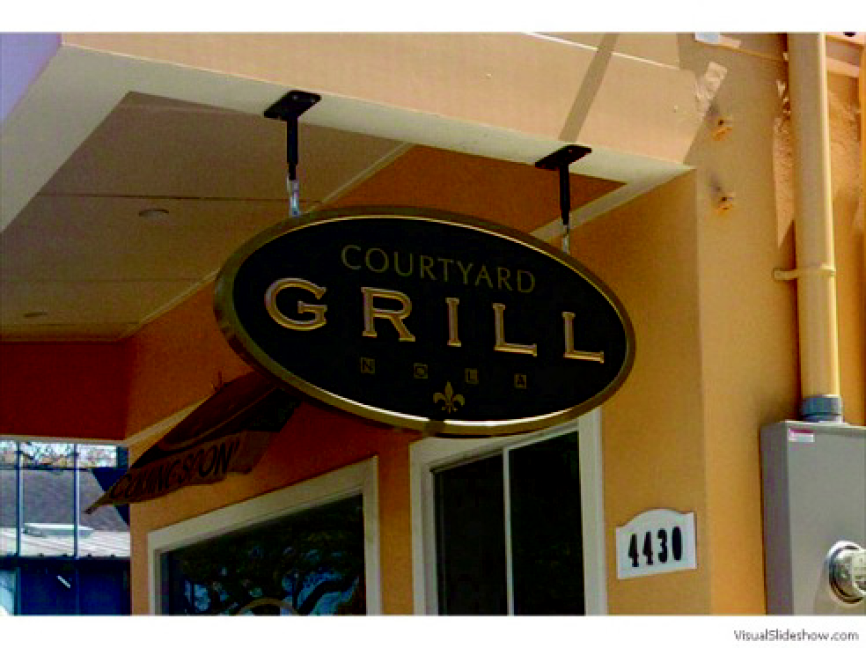 | Regulations: a. Hanging signs shall have a a maximum area of six square feet (excluding supporting rods, chains, or similar hangers). b. Hanging signs shall maintain a minimum vertical clearance of 10 feet between the lowest point of the sign and the sidewalk. c. Businesses that have a hanging sign may not have a blade sign. |
| 6. WINDOW SIGNS | |
|---|---|
Definition: A window sign is painted, posted, displayed, or etched on an interior translucent
or transparent surface, including windows or doors, which is intended to be viewed
from the outside.
 | Regulations: a. Window signs shall not exceed one third of the first floor window area so that visibility into and out of the window is not obscured. b. Sign copy shall not exceed eight inches in height. c. Window signs should be applied directly to the interior face of the glazing or hung inside the window to conceal all mounting hardware and equipment. d. Businesses on upper floors may also have window signs, provided that such signs do not exceed one third of the upper floor window area. |
| 7. PLAQUE SIGNS | |
|---|---|
Definition: A plaque sign is a small version of a wall sign that is attached to surfaces adjacent
to store entries or tenant entries.
 | Regulations: a. Plaque signs shall have a maximum area of 2 square feet. b. Plaque signs may project a maximum of three inches from wall surfaces. |
| 8. RESTAURANT MENU SIGNS | |
|---|---|
Definition: A restaurant menu sign is a sign that incorporates a menu for the restaurant. The
purpose of restaurant menu signs is to assist customers in finding a restaurant they
would like to patronize.
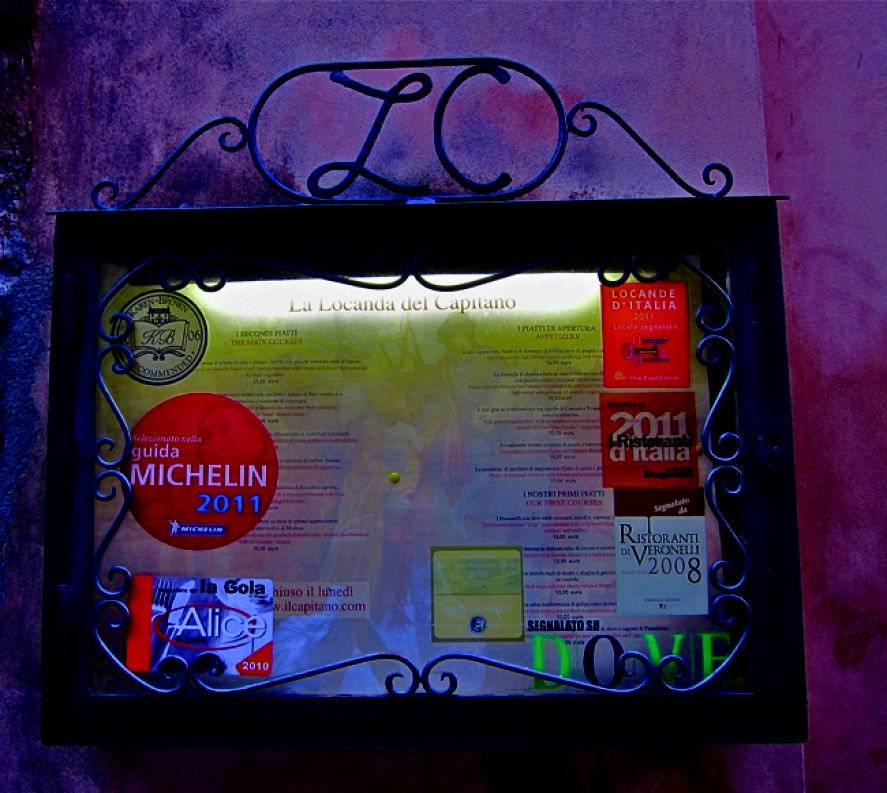 | Regulations: a. The maximum area for menu signs is 6 square feet. b. Menu signs shall be located in a permanently mounted display box on the surface of the building adjacent to the entry or on a stand. |
| 9. TENANT DIRECTORY SIGNS | |
|---|---|
Definition: A tenant directory sign is used to identify tenants and businesses in a multi-tenant
building, often for tenants that do not have direct frontage on a public street. Such
tenants can be located in second story space, or in portions of the building that
do not front on a street. Tenant directory signs are oriented toward the pedestrian.
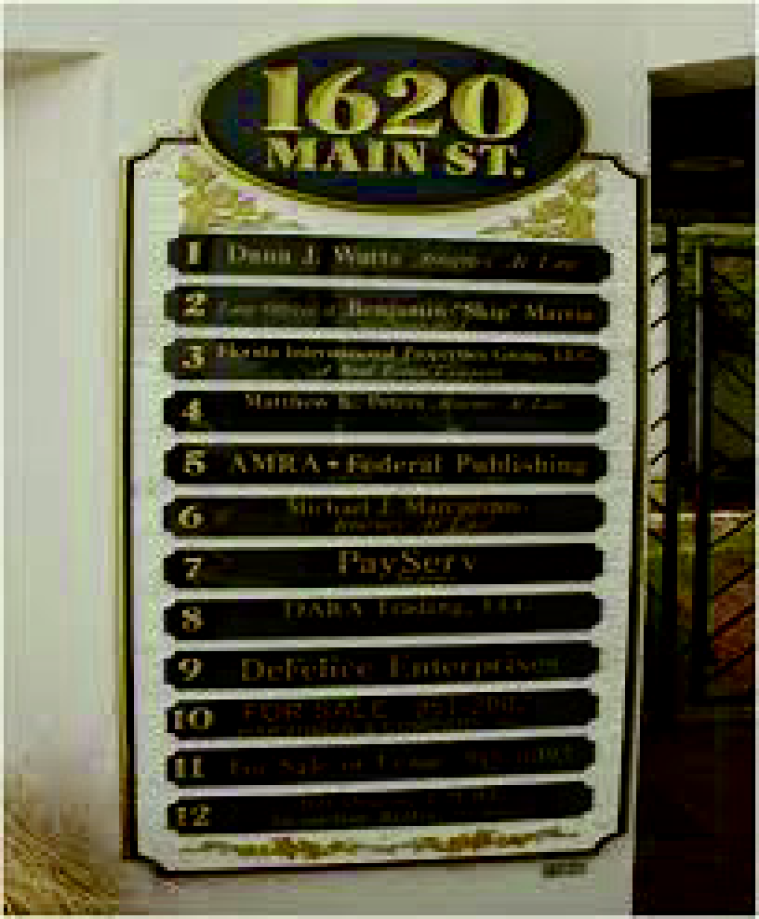 | Regulations: a. The maximum area for a tenant directory sign is 12 square feet. b. Tenant directory signs shall be mounted flat against a solid wall proximate to a common building entrance serving tenants listed on the directory sign, or on a freestanding sign located on the property on which the tenants are located. c. The maximum height for a freestanding tenant directory sign shall be 8 feet. d. Tenant directory signs may include the following: building or project name, project logo, address, business tenant names, and suite numbers or letters. |
| 10. POLE SIGNS | |
|---|---|
Definition: A pole sign is a type of freestanding sign that is elevated above the ground on one
or more poles or braces.
 | Regulations: One pole sign shall be permitted for businesses that occupy buildings in existence
at the time of adoption of this provision, subject to compliance with the following
criteria:
a. The maximum area of any such sign shall be 32 square feet. b. The maximum height of any such sign shall be 20 feet. c. Pole signs shall be permitted only in the following two situations: i. Because of the size of the site, configuration of the building relative to other site features, or design of the building, there is no possible way to place a conforming wall sign on the building; or ii. There is a desire to preserve an existing pole sign that has historic value. |
| 11. SANDWICH BOARD SIGNS | |
|---|---|
Definition: A sandwich board sign is an "A-frame" shaped sign that identifies or advertises a
place of business. A sandwich board sign typically consists of two sign boards that
are hinged together at the top on which the changeable message is imprinted.
 | Regulations: Sandwich board signs shall be subject to the regulations in subsection 16.05.G. |
| 12. VERTICAL PROJECTING SIGNS | |
|---|---|
Definition: A vertical projecting sign is a sign that is attached perpendicularly to the face
of a building and projects more than 12 inches from the wall surface.
 | Regulations: a. The sign's vertical dimension shall be greater than its horizontal dimension. b. Projecting signs shall maintain a minimum vertical clearance of 10-feet between the lowest point of the sign and the sidewalk. c. Mounting hardware shall be an integral part of the sign design. d. Businesses that have a projecting sign may not have a blade sign. e. A vertical projecting sign shall have a maximum area of 32 square feet. f. Vertical projecting signs shall project no more than 3 feet from the face of the building. g. On multistory buildings, vertical projecting signs are permitted on the first or second stories only. h. Projecting signs shall not extend above the top of the roof or parapet line. |
G.
Temporary signs. A temporary sign is one that has not been constructed and is not intended for long-term use. The following temporary signs shall be permitted in the New Hudson Zoning District, subject to the standards in subsection 16.05.C:
1.
Construction signs.
2.
Real estate signs (all types).
3.
Grand opening signs.
4.
Garage sale signs.
5.
"Coming soon" signs.
6.
Community special event signs (including yard signs).
7.
Political signs.
8.
Temporary window signs.
9.
Real estate bandit signs.
10.
Noncommercial message signs.
11.
Real estate open house signs.
12.
"Model Open" flag signs.
13.
Balloons.
14.
Searchlights.
15.
Banner signs.
16.
Feather banner signs.
17.
"Help Wanted" signs.
H.
Incidental signs. Incidental signs, as defined in section 16.03, are permitted exempt signs, provided that the total area of all such signs shall not exceed two square feet.
I.
Sight lines for motorists. All signs shall comply with the requirements for unobstructed motorist visibility in section 12.09.
(Ord. No. 03-14, pt. 4, 1-7-2014; Ord. No. 03-17, pt. 12, 6-5-2017; Ord. No. 05-17, § 2, 11-6-2017)
Section 41.501. - Defined terms.
This chapter provides definitions for terms that are used in article 41.00. Where a definition in this chapter conflicts with a definition in article 3.00, the definition in this chapter shall prevail for the purposes of administering the New Hudson Zoning District requirements.
Apartment: For the purposes of article 41.00, an apartment is a dwelling unit with party walls, contained in a building with other apartment units and/or commercial, office, or retail occupants. An apartment unit may be rented or owned (e.g., a condominium unit).
Balcony: An open portion of an upper floor that extends beyond or indents into a building's exterior wall.
Block: The aggregate of private lots, rear lanes and alleys, the perimeter of which abuts perimeter streets.
Block perimeter: The linear distance around a block measured along the road right-of-way line or road easement line.
Brewpub: An eating or drinking establishment that includes the brewing of beers as an accessory use for sale at the same premises of not more than 2,000 barrels per year. (A barrel is equivalent to 31 U.S. gallons.) Such an accessory use may occupy up to 50 percent of the gross floor area of the brewpub. The sale of alcoholic liquor by a brewpub other than produced by the brewpub is permitted, provided the appropriate license is obtained pursuant to the Michigan Liquor Control Act, as amended, MCL 436.1101 et seq.
Buffer: An area of land, which may include landscaping, walls, and fences, typically located between land uses of different characters and which is intended to mitigate negative impacts of the more intense land use on the less intense land use.
Build-to zone: A zone at the front of the lot where a front building facade must be located.
Expression line: A horizontal linear element extending across a facade of a building, which provides a noticeable difference of projection or recess, or change of color or material, or is a clear architectural feature of ornamentation such as a cornice. An expression line may vary significantly from building to building and in accordance with different architectural styles.
Frontage lot line: The lot line that coincides with the public right-of-way or edge of a space dedicated for public use. Building facades parallel to frontage lines define public space and are therefore subject to a higher level of regulation than the elevations that face other lot lines.
Habitable space: Building space that involves human presence with direct view of the fronting streets or public or private open space. Habitable space does not include parking garages, storage facilities, warehouses, and display windows separated from retail activity.
Live-work unit: A building space that combines a person's workspace with his/her living quarters, with the workspace on the ground level facing the street.
Microbrewery: A brewery that produces less than 20,000 barrels of ale or beer per year, and less than 10,000 barrels of alcoholic liquors per year, other than ale or beer, for on-site consumption and retail and wholesale distribution as allowed by state law. (A barrel is equivalent to 31 U.S. gallons). A microbrewery may sell only those alcoholic liquors it produces. A microbrewery is restricted to the above production limits, irrespective of less restrictive limits that may be imposed by state law.
Multiple-family residential housing: For the purposes of article 41.00, multiple-family residential housing consists of several attached residential units with party walls in a building.
Personal service establishment: A business that performs services or assistance on the premises for individuals residing in nearby residential areas, such as a beauty or barber shop, clothing or watch repair, or similar service.
Single-family attached housing: For the purposes of article 41.00, a single-family attached development consists of several attached residential units with party walls, where each occupant owns his or her own unit. A townhouse is a type of housing where each unit has its own front door that opens to the outdoors at ground level, and which typically has its own front and rear yards.
Single-family detached housing: Single-family detached units are independent, detached residential dwelling units designed for and used or held ready for use by one family only. A single-family detached dwelling shall be the only principal use on the lot on which it is located.
Spandrel glass: A durable glass building material that is used to cover construction materials. Spandrel glass has an opaque coating that prevents light transmission. The main purpose of spandrel glass is to enhance a building's aesthetics by creating an overall uniform appearance and giving the illusion of a window. Spandrel glass is commonly used between certain sections of a building including the area between floors, ceilings, columns, and other small or large spaces.
Street wall: The primary or secondary front facade of a building that is located between the minimum and maximum front yard setbacks. The streetwall defines the street by creating a sense of enclosure and a comfortable scale for pedestrians.
Tree lawn: A grassed or landscaped area located between the sidewalk and the curb of the street intended to accommodate street tree planting.
(Ord. No. 03-14, pt. 4, 1-7-2014; Ord. No. 12-20, § 9, 1-4-2021)

