
Mancos City Zoning Code
ARTICLE 2
Definitions and Measurements
Sec. 16-2-1.- Rules of construction.
All provisions, terms, phrases, and expressions contained in this LUC shall be construed to accomplish the purposes stated in Section 16-1-4, Purpose. In case of any difference of meaning or implication between the text of this LUC and any illustration or figure, the text shall control.
(1)
Computation of Time. In the computation of time for completing an act, the first day shall be excluded and the last day shall be included. If the last day is a Saturday, Sunday, or legal holiday declared by the Town, that day shall be excluded. In the computation of time for public hearing notice, both the first day (day of the advertisement) and the last day (day of the hearing) shall be excluded. The following time-related words are interpreted as follows:
a.
Day means one (1) calendar day, unless working day is specified.
b.
Month means one (1) calendar month.
c.
Week means seven (7) calendar days.
d.
Year means one (1) calendar year, unless a fiscal year is indicated.
(2)
Conjunctions. Conjunctions shall be interpreted as follows unless the context clearly indicates to the contrary:
a.
And indicates that all connected items, conditions, provisions or events shall apply; and
b.
Or indicates that one (1) or more of the connected items, conditions, provisions or events shall apply.
(3)
Delegation of authority. Whenever a provision appears requiring the head of a department or some other officer or employee to do some act or perform some duty, it is to be construed to authorize the head of the department or other officer to designate, delegate, and authorize appropriate subordinates to perform the required act or duty, unless the terms of the provision or section specify otherwise.
(d)
Nontechnical and technical words.
a.
Words and phrases shall be construed according to the common and approved usage of the language, but technical words and phrases that have acquired a particular and appropriate meaning in law shall be construed and understood according to such meaning.
b.
All public officials, bodies, and agencies to which reference is made are those of the Town, unless otherwise indicated.
c.
The word shall is mandatory. The word may is permissive.
d.
Words used in the past or present tense include the future as well as the past or present, unless the context clearly indicates the contrary. The singular number shall include the plural, and the plural shall include the singular, as the context and application of this LUC may reasonably suggest. Words of one gender shall apply to persons, natural or fictitious, regardless of gender, as the context and application of this LUC may reasonably suggest.
(e)
Cross references. Cross references are provided in this Code for the user's convenience only and are not intended to be exclusive of other applicable standards in this Code.
(f)
Fractions. Unless specifically stated otherwise and only where the Zoning Administrator finds the result is not contrary to the intent of the subject standard, where any requirement of this Code results in a fraction of a unit, a fraction of five-tenths (0.5) or more shall be considered a whole unit and a fraction of less than five-tenths (0.5) shall be disregarded.
(Ord. No. 751, § 1, 11-13-2019)
Sec. 16-2-2. - Floodplain management terms.
Unless specifically defined below, the following words or phrases shall be applicable to Article 17, Floodplain Management, and shall be interpreted so as to give them the meanings they have in common usage and to give this Land Use Code its most reasonable application:
100-year flood means a flood having a recurrence interval that has a one-percent chance of being equaled or exceeded during any given year (one-percent-annual-chance flood). The terms "one hundred-year flood" and "one-percent-chance flood" are synonymous with the term "100-year flood." The term does not imply that the flood will necessarily happen once every one hundred (100) years.
100-year floodplain means the area of land susceptible to being inundated as a result of the occurrence of a one hundred-year flood.
500-year flood means a flood having a recurrence interval that has a 0.2-percent chance of being equaled or exceeded during any given year (0.2-percent-chance annual flood). The term does not imply that the flood will necessarily happen once every five hundred (500) years.
500-year floodplain means the area of land susceptible to being inundated as a result of the occurrence of a five hundred-year flood.
Addition means any activity that expands the enclosed footprint or increases the square footage of an existing structure.
Alluvial fan flooding means a fan-shaped sediment deposit formed by a stream that flows from a steep mountain valley or gorge onto a plain or the junction of a tributary stream with the main stream. Alluvial fans contain active stream channels and boulder bars, and recently abandoned channels. Alluvial fans are predominantly formed by alluvial deposits and are modified by infrequent sheet flood, channel avulsions and other stream processes.
Appeal means a request for a review of the Town's interpretation of any provisions of this Land Use Code or of an administrative action taken under this Land Use Code.
Area of shallow flooding means a designated Zone AO or AH on a community's Flood Insurance Rate Map (FIRM) with a one-percent chance or greater annual chance of flooding to an average depth of one (1) to three (3) feet where a clearly defined channel does not exist, where the path of flooding is unpredictable and where velocity flow may be evident. Such flooding is characterized by ponding or sheet flow.
Base flood elevation means the elevation shown on a FEMA Flood Insurance Rate Map for Zones AE, AH, A1-A30, AR, AR/A, AR/AE, AR/A1-A30, AR/AH, AR/AO, V1-V30 and VE that indicates the water surface elevation resulting from a flood that has a one-percent chance of equaling or exceeding that level in any given year.
Basement means any area of a building having its floor sub-grade (below ground level) on all sides.
Channel means the physical confine of stream or waterway consisting of a bed and stream banks, existing in a variety of geometries.
Channelization means the artificial creation, enlargement or realignment of a stream channel.
Community means any political subdivision in the State that has authority to adopt and enforce floodplain management regulations through zoning, including but not limited to cities, towns, unincorporated areas in the counties, Indian tribes and drainage and flood control districts.
Conditional Letter of Map Revision (CLOMR) means FEMA's comment on a proposed project, which does not revise an effective floodplain map, that would, upon construction, affect the hydrologic or hydraulic characteristics of a flooding source and thus result in the modification of the existing regulatory floodplain.
Critical facility means a structure or related infrastructure, but not the land on which it is situated, as specified in Section 16-17-25, that, if flooded, may result in significant hazards to public health and safety or interrupt essential services and operations for the community at any time before, during and after a flood. See Section 16-17-25.
Development means any man-made change to improved or unimproved real estate, including but not limited to buildings or other structures, mining, dredging, filling, grading, paving, excavation or drilling operations or storage of equipment or materials.
DFIRM Database means a database (usually spreadsheets containing data and analyses that accompany DFIRMs). The FEMA Mapping Specifications and Guidelines outline requirements for the development and maintenance of DFIRM databases.
Digital Flood Insurance Rate Map (DFIRM) means the FEMA digital floodplain map. These digital maps serve as "regulatory floodplain maps" for insurance and floodplain management purposes.
Elevated building means a nonbasement building (i) built, in the case of a building in Zones Al-30, AE, A, A99, AO, AH, B, C, X and D, to have the top of the elevated floor above the ground level by means of pilings, columns (posts and piers) or shear walls parallel to the flow of the water, and (ii) adequately anchored so as not to impair the structural integrity of the building during a flood of up to the magnitude of the base flood. In the case of Zones A1-30, AE, A, A99, AO, AH, B, C, X and D, elevated building also includes a building elevated by means of fill or solid foundation perimeter walls with openings sufficient to facilitate the unimpeded movement of floodwaters.
Existing manufactured home park or subdivision means the preparation of additional sites by the construction of facilities for servicing the lots on which the manufactured homes are to be affixed (including, at a minimum, the installation of utilities, the construction of streets and either final site grading or the pouring of concrete pads) are completed before the floodplain management regulations are adopted by a community.
Expansion to existing manufactured home park or subdivision means the preparation of additional sites by the construction of facilities for servicing the lots on which the manufactured homes are to be affixed (including the installation of utilities, the construction of streets and either final site grading or the pouring of concrete pads).
FEMA means Federal Emergency Management Agency, the agency responsible for administering the National Flood Insurance Program.
Flood or flooding means a general and temporary condition of partial or complete inundation of normally dry land areas from:
(1)
The overflow of water from channels and reservoir spillways; and/or
(2)
The unusual and rapid accumulation or runoff of surface waters from any source.
(3)
Mudslides or mudflows that occur from excess surface water that is combined with mud or other debris that is sufficiently fluid so as to flow over the surface of normally dry land areas (such as earth carried by a current of water and deposited along the path of the current).
Flood control structure means a physical structure designed and built expressly or partially for the purpose of reducing, redirecting or guiding flood flows along a particular waterway. These specialized flood modifying works are those constructed in conformance with sound engineering standards.
Flood Insurance Rate Map (FIRM) means the official map on which the Federal Emergency Management Agency has delineated both the areas of special flood hazards and the risk-premium zones.
Flood Insurance Study (FIS) means the official report provided by the Federal Emergency Management Agency that includes the Flood Insurance Rate Map as well as flood profiles for studied flooding sources that can be used to determine base flood elevations for some areas.
Floodplain or flood-prone area means any land area susceptible to being inundated as the result of a flood, including the area of land over which floodwater would flow from the spillway of a reservoir.
Floodplain Administrator means the community official designated by title to administer and enforce the floodplain management regulations.
Floodplain Development Permit means a permit required before construction or development begins within any special flood hazard area (SFHA). If FEMA has not defined the SFHA within a community, the community shall require permits for all proposed construction or other development in the community, including the placement of manufactured homes, so that it may determine whether such construction or other development is proposed within flood-prone areas. Permits are required to ensure that proposed development projects meet the requirements of the NFIP and this Article.
Floodplain management means the operation of an overall program of corrective and preventive measures for reducing flood damage, including but not limited to emergency preparedness plans, flood control works and floodplain management regulations.
Floodplain Management Regulations means zoning ordinances, subdivision regulations, building codes, health regulations, special purpose ordinances (such as a floodplain ordinance, grading ordinance and erosion control ordinance) and other applications of police power. The term describes such state or local regulations, in any combination thereof, which provide standards for the purpose of flood damage prevention and reduction.
Floodproofing means any combination of structural and/or nonstructural additions, changes or adjustments to structures which reduce or eliminate flood damage to real estate or improved real property, water and sanitary facilities, structures and their contents.
Floodway (regulatory floodway) means the channel of a river or other watercourse and adjacent land areas that must be reserved in order to discharge the base flood without cumulatively increasing the water surface elevation more than a designated height. The Colorado statewide standard for the designated height to be used for all newly studied reaches shall be one-half (½) foot (six (6) inches). Letters of map revision to existing floodway delineations may continue to use the floodway criteria in place at the time of the existing floodway delineation.
Freeboard means the vertical distance in feet above a predicted water surface elevation intended to provide a margin of safety to compensate for unknown factors that could contribute to flood heights greater than the height calculated for a selected size flood, such as debris blockage of bridge openings and the increased runoff due to urbanization of the watershed.
Functionally dependent use means a use which cannot perform its intended purpose unless it is located or carried out in close proximity to water. The term includes only docking facilities, port facilities that are necessary for the loading and unloading of cargo or passengers, and ship building and ship repair facilities, but does not include long-term storage or related manufacturing facilities.
Highest adjacent grade means the highest natural elevation of the ground surface prior to construction next to the proposed walls of a structure.
Historic structure means any structure that is:
(1)
Listed individually in the National Register of Historic Places (a listing maintained by the Department of Interior) or preliminarily determined by the Secretary of the Interior as meeting the requirements for individual listing on the National Register;
(2)
Certified or preliminarily determined by the Secretary of the Interior as contributing to the historical significance of a registered historic district or a district preliminarily determined by the Secretary to qualify as a registered historic district;
(3)
Individually listed on a state inventory of historic places in states with historic preservation programs which have been approved by the Secretary of the Interior; or
(4)
Individually listed on a local inventory of historic places in communities with historic preservation programs that have been certified either:
a.
By an approved state program as determined by the Secretary of the Interior; or
b.
Directly by the Secretary of the Interior in states without approved programs.
Levee means a man-made embankment, usually earthen, designed and constructed in accordance with sound engineering practices to contain, control or divert the flow of water so as to provide protection from temporary flooding. For a levee structure to be reflected on the FEMA FIRMs as providing flood protection, the levee structure must meet the requirements set forth in 44 CFR § 65.10.
Levee system means a flood protection system which consists of a levee, or levees, and associated structures, such as closure and drainage devices, which are constructed and operated in accordance with sound engineering practices.
Letter of Map Revision (LOMR) means FEMA's official revision of an effective Flood Insurance Rate Map (FIRM) or Flood Boundary and Floodway Map (FBFM), or both. LOMRs are generally based on the implementation of physical measures that affect the hydrologic or hydraulic characteristics of a flooding source and thus result in the modification of the existing regulatory floodway, the effective base flood elevations (BFEs), or the Special Flood Hazard Area (SFHA).
Letter of Map Revision Based on Fill (LOMR-F) means FEMA's modification of the special flood hazard area (SFHA) shown on the Flood Insurance Rate Map (FIRM) based on the placement of fill outside the existing regulatory floodway.
Lowest floor means the lowest floor of the lowest enclosed area (including basement). Any floor used for living purposes which includes working, storage, sleeping, cooking and eating, or recreation or any combination thereof. This includes any floor that could be converted to such a use such as a basement or crawl space. The lowest floor is a determinate for the flood insurance premium for a building, home or business. An unfinished or flood-resistant enclosure, usable solely for parking of vehicles, building access or storage, in an area other than a basement area, is not considered a building's lowest floor, provided that such enclosure is not built so as to render the structure in violation of the applicable non-elevation design requirements of this Land Use Code and Section 60.3 of the National Flood Insurance Program regulations.
Mean sea level means for purposes of the National Flood Insurance Program, the North American Vertical Datum (NAVD) of 1988 or other datum, to which base flood elevations shown on a community's Flood Insurance Rate Map are referenced.
Material Safety Data Sheet (MSDS) means a form with data regarding the properties of a particular substance. An important component of product stewardship and workplace safety, it is intended to provide workers and emergency personnel with procedures for handling or working with that substance in a safe manner, and includes information, such as physical data (melting point, boiling point, flash point, etc.), toxicity, health effects, first aid, reactivity, storage, disposal, protective equipment and spill-handling procedures.
National Flood Insurance Program (NFIP) means FEMA's program of flood insurance coverage and floodplain management administered in conjunction with the Robert T. Stafford Relief and Emergency Assistance Act. The NFIP has applicable federal regulations promulgated in Title 44 of the Code of Federal Regulations. The U.S. Congress established the NFIP in 1968 with the passage of the National Flood Insurance Act of 1968.
New construction means structures for which the start of construction commenced on or after the effective date of the initial ordinance codified herein, and includes any subsequent improvements to such structures.
New manufactured home park or subdivision means a manufactured home park or subdivision for which the construction of facilities for servicing the lots on which the manufactured homes are to be affixed (including, at a minimum, the installation of utilities, the construction of streets and either final site grading or the pouring of concrete pads) is completed on or after the effective date of these floodplain management regulations.
No-rise certification means a record of the results of an engineering analysis conducted to determine whether a project will increase flood heights in a floodway. A no-rise certification must be supported by technical data and signed by a registered Colorado Professional Engineer. The supporting technical data should be based on the standard step-backwater computer model used to develop the 100-year floodway shown on the Flood Insurance Rate Map (FIRM) or Flood Boundary and Floodway Map (FBFM).
Physical map revision (PMR) means FEMA's action whereby one (1) or more map panels are physically revised and republished. A PMR is used to change flood risk zones, floodplain and/or floodway delineations, flood elevations and/or planimetric features.
Special flood hazard area means the land in the floodplain within a community subject to a one percent (1%) or greater chance of flooding in any given year, i.e., the one hundred-year floodplain.
Start of construction means and includes substantial improvement and means the date the building permit was issued, provided that the actual start of construction, repair, reconstruction, placement or other improvement was within one hundred eighty (180) days of the permit date. The actual start means the first placement of permanent construction of a structure on a site, such as the pouring of slab or footings, the installation of piles, the construction of columns or any work beyond the stage of excavation or the placement of a manufactured home on a foundation. Permanent construction does not include land preparation, such as clearing, grading and filling, nor does it include the installation of streets and/or walkways, excavation for a basement, footings, piers or foundations or the erection of temporary forms or the installation on the property of accessory buildings, such as garages or sheds not occupied as dwelling units or not part of the main structure. For a substantial improvement, the actual start of construction means the first alteration of any wall, ceiling, floor or other structural part of a building, whether or not that alteration affects the external dimensions of the building.
Structure means a walled and roofed building or manufactured home, including a gas or liquid storage tank, that is principally above ground.
Substantial damage means damage of any origin sustained by a structure whereby the cost of restoring the structure to its before-damaged condition would equal or exceed fifty percent (50%) of the market value of the structure before the damage occurred.
Substantial improvement means any reconstruction, rehabilitation, addition or improvement of a structure, the cost of which equals or exceeds fifty percent (50%) of the market value of the structure before the start of construction of the improvement. The value of the structure shall be determined by the local jurisdiction having land use authority in the area of interest. This term includes structures which have incurred substantial damage, regardless of the actual repair work performed. The term does not, however, include either:
(1)
Any project for improvement of a structure to correct existing violations of state or local health, sanitary or safety code specifications which have been identified by the local code enforcement official and which are the minimum necessary to assure safe living conditions; or
(2)
Any alteration of a historic structure, provided that the alteration will not preclude the structure's continued designation as a historic structure.
Threshold planning quantity (TPQ) means a quantity designated for each chemical on the list of extremely hazardous substances that triggers notification by facilities to the State that such facilities are subject to emergency planning requirements.
Variance means a grant of relief from the requirements of this Article when specific enforcement would result in unnecessary hardship. A variance, therefore, permits construction or development in a manner that would otherwise be prohibited by this Article.
Violation means the failure of a structure or other development to be fully compliant with the community's floodplain management regulations.
Water surface elevation means the height, in relation to the North American Vertical Datum (NAVD) of 1988 (or other datum, where specified), of floods of various magnitudes and frequencies in the floodplains of coastal or riverine areas.
(Ord. No. 751, § 1, 11-13-2019; Ord. No. 761, § 1, 10-28-2020)
Sec. 16-2-3. - General terms.
Unless specifically defined below, words or phrases used in this LUC shall be interpreted to give them the meaning they have in common usage and to give this Code its most reasonable application. In case of dispute over the meaning of a term not defined in the LUC or over the application of a definition, the Zoning Administrator shall provide an interpretation in accordance with Section 16-19-3, Interpretations.
A/B/C Terms
Accessory use or structure means a use or structure naturally and normally incidental to and subordinate to the permitted primary structure or use by right of the land or lot area.
Accessory dwelling unit (ADU) means a smaller, secondary residential dwelling unit with a separate entrance from the primary one-unit dwelling on the same lot as a primary one-unit dwelling. Accessory dwelling units are independently habitable and provide the basic requirements of living, sleeping, cooking, and sanitation.
Addition means any activity that expands the enclosed footprint or increases the square footage of an existing structure.
Affordable housing means a unit(s) priced for households earning no more than eighty percent (80%) of the Area Median Income. AMI information shall be determined by the U.S. Department of Housing and Urban Development (HUD), and affordable rental information shall be as determined by the Colorado Housing Finance Authority (CHFA). The affordability measurements in this definition may be adjusted pursuant to the Town of Mancos Affordable Housing Policy.
Agriculture means a use of land for production and/or marketing of crops, livestock or products produced on site.
Agricultural production activity means production of forage, grains, livestock, trees, and fruits, vegetables, nursery, floral, and ornamental stock with reasonable expectation of profit; commercial feed lots shall not be considered agriculture for purposes of this definition.
Animal pound or kennel (public or private) means any premises on which five (5) or more dogs over ten (10) weeks of age are kept or housed for any reason and for any length of time.
Appeal means a request for a review of the Town's interpretation of any provisions of this Land Use Code or of an administrative action taken under this Land Use Code.
Applicant means a person who submits an application for development to a local government.
Application for development means an application for a preliminary or final plat for a subdivision, a planned unit development, or any other similar land use designation that is used by a local government. Application for development includes applications for zoning, rezoning, general development plans, and special use permits where such applications are in anticipation of new surface development but does not include building permit applications.
Asphalt or concrete batching plant, temporary means a temporary facility for producing asphalt or concrete products used in construction activities on the same or nearby sites.
Awning means a roof-like cover that projects from the wall of a building for the purpose of shielding a doorway or window from the elements.
Basement means any area of a building having its floor sub-grade (below ground level) on all sides.
Bay window means a window that is made up of three (3) windows, typically two (2) operable windows at an angle with one (1) fixed window in the middle.
Bed and breakfast means a house, or portion thereof, used by the record owner of the property, who is also a resident of the property where the use is proposed, and where short-term lodging rooms and meals are provided.
Block means a group of lots within defined and fixed boundaries of a subdivision and usually being an area surrounded by streets or other features, such as parks, trails, pedestrian accessways, or municipal boundary lines, which together shall not be longer than six hundred (600) feet.
Block face means all lots on one (1) side of a block.
Boarding house means a building arranged or used for lodging for compensation, with or without meals, and not occupied as a single-family unit.
Building means any structure built for the support, shelter, and enclosure of persons, animals, chattels, or movable property of any kind. When subdivided in a manner sufficient to prevent the spread of fire, each portion so subdivided may be deemed a separate building. Building includes yurts, removable sheds, greenhouses, and similar uses, but does not include signs or fences.
Building footprint means the gross floor area of an individual structure on a lot measured to the farthest exterior wall face at the ground floor. See Section 16-2-3 for measurement instructions.
Building line means a line parallel or approximately parallel to the street line at a specified distance, establishing the minimum distance from the street line that a building may be erected.
Building materials, sales and yard means an establishment in which building, construction, and/or home improvement materials are offered or kept for retail sale, which may also include the fabrication of certain materials related to home improvement and/or the outdoor storage of such materials designated for retail sale.
Bus station or terminal means a lot and related building that is a designated location where bus or coach services start or end. A bus terminal shall not include a location where the bus stops to drop off or take on passengers where there are no operational facilities related to the bus or coach operation.
Campground means a parcel of land used or intended to be used, let or rented for transient, vacation and recreational occupancy by travel trailers, campers, tents, recreational vehicles, motor homes and the motor vehicles propelling or carrying the same, but excluding mobile homes or manufactured housing designed for year-round occupancy or as a place of residence.
Canopy means an attached or detached structure, open on at least one (1) side, which is designed to provide overhead shelter from the sun or weather. Canopies include, but are not limited to, service station canopies, carports, porte-cochères, arcades, and pergolas. A canopy is different from an awning in that a canopy is not covered with fabric or flexible material.
Car wash means a facility or area for the cleaning or steam cleaning, washing, polishing, or waxing of passenger vehicles by machine or hand-operated facilities.
Clear sight triangle means an area free of all obstructions that could interfere with the visibility of approaching drivers as defined in this Code.
An intersection clear sight triangle is located at an intersection between two (2) streets. The area is a triangular-shaped piece of land, measuring forty (40) feet in distance along the major street and twenty (20) feet in distance along the minor street, both distances being measured from and along the back of the curb. means A driveway clear sight triangle is located at an intersection between an entrance or drive and a street. The area is a triangular-shaped piece of land, measuring fifteen (15) feet in distance along the street and fifteen (15) feet in distance along the entrance or drive, both distances being measured from and along the back of the curb.
Commercial development means and includes, but is not limited to, the construction or expansion by the addition of square footage of office, retail, wholesale, warehouse, manufacture, commercial recreation, and restaurant/bar and/or service commercial operations.
Common interest community means real estate described in a declaration with respect to which a person, by virtue of such person's ownership of a unit, is obligated to pay for real estate taxes, insurance premiums, maintenance, or improvements of other real estate described in a declaration. Ownership does not include a leasehold interest of less than forty (40) years, including renewal options, as measured from the commencement date of the initial term.
Common open space means a parcel of usable land, area of water, or a combination of land and water within a site designated for a planned unit development, designated and intended primarily for the use or enjoyment of residents, occupants, and owners of the planned unit development. Common open space may include, but is not limited to, areas devoted to recreation, courts, gardens, parks, and walkways. The term shall not include space devoted to streets, parking, and loading areas.
Community, planned means a common interest community that is not a condominium or cooperative.
Condominium means a common interest community in which portions of the real estate are designated for separate ownership and the remainder of which is designated for common ownership solely by the owners of the separate ownership portions.
Condominium map means a printed instrument depicting all or a portion of a common interest community in three (3) dimensions. A condominium map or a condominium plat may be combined in one (1) instrument.
Condominium plat means a printed instrument that is a land survey depicting all or a portion of a common interest community in two (2) dimensions. A condominium plat and condominium map may be combined in one (1) instrument.
Cooperative means a common interest community in which the real property is owned by an association, each member of which is entitled, by virtue of such member's ownership interest in the association, to exclusive possession of a unit.
Cottage industry means limited commercial and industrial uses permitted in a residential dwelling or other on-premise, accessory structure that are more extensive than home occupations, but which, like home occupations, do not alter or disturb the residential nature of the premises or its surroundings. As used in this Code, cottage industry is a use definition and is not identical to the Colorado Cottage Food Act.
Cultivation operation (cannabis) means cultivation operation means a person licensed pursuant to Section 12-43.3-403, C.R.S.
Custom personal service means a barbershop, beauty shop, tailor, dressmaker, shoe shop, or similar shop offering custom service.
D/E/F Terms
Dark sky cutoff fixture means any light fixture that emits its light below forty-five (45) degrees when measured from zero to one hundred eighty (180) degrees vertical. Dark sky cutoff fixtures keep most of their light from reaching the night sky, minimize ground reflection, and reduce light scatter beyond the property line.
Dark sky fixture means any light fixture that emits its light below ninety (90) degrees when measured from zero to one hundred eighty (180) degrees vertical. Dark sky fixtures keep most of their light from reaching the night sky.
Dark sky shade means anything that is used to shade a light fixture so that it behaves as a dark sky fixture. These include, but are not limited to, fixtures outfitted with caps or housings or installed under canopies, building overhangs, roof eaves, or shaded by other structures, objects, or devices.
Dark sky shield means anything that is used to shield a light fixture so that it behaves as a dark sky cutoff fixture. These include, but are not limited to, fixtures outfitted with caps or housings, or installed under canopies, building overhangs, roof eaves, or shielded by other structures, objects, or devices.
Day care center means a building or place where care, supervision, custody or control is provided for a specified number of unrelated children pursuant to the requirements of state statute.
Density means the maximum number of dwelling units per gross acre of land permitted in a zone district.
Developer means any public or private person, partnership, association, or agency that prepares raw land for the construction of buildings or causes to be built physical building space for use primarily by others, during which preparation the land or the creation of the building space is in itself a business and is not incidental to another business or activity.
Development means the physical extension and/or construction of urban land uses. Development activities include: Subdivision of land; change in the intensity of use of land; construction, reconstruction, demolition, or partial demolition or alteration of buildings, roads, utilities, and other facilities; commencement of drilling (except for a well or to obtain soil samples), mining, or excavation; installation of septic systems; grading; deposit of refuse, debris, or fill materials; and clearing of natural vegetation cover.
Development, floodplain means any man-made change to improved or unimproved real estate, including but not limited to buildings or other structures, mining, dredging, filling, grading, paving, excavation or drilling operations, or storage of equipment or materials. See Article 17, Floodplain Regulations.
Development permit. See Zoning Development Permit.
District. A zoning district.
Duplex. See Dwelling Unit, Two-family.
Dusk means the time of evening thirty (30) minutes before sunset as determined by the sunrise/sunset reference location identified by the Board of Trustees.
Dwelling unit means a building arranged and designed as a dwelling unit and intended to be occupied by one (1) family, which has at least one bathroom and a minimum floor area of five hundred (500) square feet, unless otherwise specified within the appropriate zoning districts. Dwelling units shall include manufactured homes and factory-built homes.
Eave means the underpart of a sloping roof overhanging a wall.
Emergency refers to lighting as required by civil officers, agents, and officials to perform their duties to maintain the public health, safety, and welfare.
Erosion control blanket means an erosion control blanket is a preformed protective blanket of plastic fibers, straw or other plant residue designed to protect soil from the impact of precipitation and overland flow and retain moisture to facilitate establishment of vegetation. Erosion control blankets are sometimes referred to as Rolled Erosion Control Products (RECPs).
Essential services and facilities means the development or maintenance of public utilities or Town-approved underground, surface, or overhead gas, electrical, telephone, steam, fuel, or water transmission or distribution systems, including towers, poles, wires, mains, drains, sewers, pipes, conduits, cables, fire alarm and police call boxes, traffic signals, hydrants, and similar equipment and sewage pump stations. Telecommunications towers or facilities shall not be considered essential services and are defined separately.
Façade means the front exterior portion of a building.
Factory-built home means a dwelling unit designed for one (1) family that is partially or entirely manufactured in a factory and designed for long-term residential use when placed upon a permanent foundation. Factory-built homes must be constructed in compliance with the codes adopted in the Colorado Division of Housing, Factory-Built Housing Program (8 C.C.R. § 1302-12), the same as amended from time to time, and must bear a Colorado insignia indicating compliance with those standards.
False front means faced extending beyond and above the true dimensions of a building falsifying the size, finish, or importance of a building.
Family means two (2) or more persons between whom there is a legally recognized relationship or not more than five (5) unrelated persons occupying the same dwelling unit. This definition is not applicable to group homes.
Farmers' market means a common facility or area where producers gather on a recurring basis to sell a variety of fresh fruits and vegetables and other locally grown or made products.
Fenestration means the arrangement, proportioning and design of windows and doors in a building.
Field office, temporary means a structure or shelter used in connection with an approved development or building project for housing on the site of temporary administrative and supervisory functions and for sheltering employees and equipment.
Flag means a rectangular piece of fabric of distinctive design, not including streamers, banners or pennants.
Four-sided design means when the same attention to the detail exemplified in the front of the building shall be accorded to the remaining three (3) sides.
Frontage building means the wall of the building that faces the street abutting the property. If the building is located on a corner lot, the frontage shall be the wall of the building which faces the street with the highest average daily traffic count.
Frontage lot means the length of the property line of any one (1) property along a public right-of-way on which it borders.
Frontage street means the length of the property line of any one (1) property along a public right-of-way on which it borders, measured along the property line.
Front wall or façade means a building wall fronting the primary street or housing the primary entrance to the business.
G/H/I Terms
Garden center or nursery means a business where retail and wholesale products and produce are sold to the customer. These centers, which may include a nursery and/or greenhouses, import many of the items sold, and may include plants, nursery products and stock, potting soil, hardware, power equipment and machinery, hoes, rakes, and other garden and farm variety tools. Marijuana shall not be grown or sold at a garden center.
Gasoline service station means a building or place arranged, designed, used, or intended to be used for the primary purpose of dispensing gasoline, oil, diesel fuel, liquefied petroleum gases, greases, batteries, and other minor automobile accessories and services.
Greenhouse means a facility or area for the indoor growing, display, or sale of plant stock, seeds or other horticulture items.
Gross floor area (GFA) means total floor area designed for occupancy and use, including basements, mezzanines, and upper floors as measured from the centers of outside walls, excluding warehouse, storage, and utility rooms.
Group home means a structure in which housing is provided for a group of unrelated individuals or related and unrelated individuals pursuant to state statute.
Historic means having importance in the history, architecture, archaeology, or culture of Colorado, the Town of Mancos, Montezuma County, or the United States, as determined by the Historic Preservation Board.
Historic district means a district is a geographically definable area, urban or rural, possessing a significant concentration, linkage, or continuity of sites, buildings, structures, or objects united by past events or aesthetically by plan or physical development. A district may also comprise individual elements separated geographically but linked by association or history.
Historic preservation means the protection, enhancement, and maintenance of historic properties.
Historic properties means the resources, including buildings, structures, objects, sites, districts, or areas that are of historical significance.
Historic structure means any structure that is:
(1)
Listed individually in the National Register of Historic Places (a listing maintained by the Department of Interior) or preliminarily determined by the Secretary of the Interior as meeting the requirements for individual listing on the National Register;
(2)
Certified or preliminarily determined by the Secretary of the Interior as contributing to the historical significance of a registered historic district or a district preliminarily determined by the Secretary to qualify as a registered historic district;
(3)
Individually listed on a state inventory of historic places in states with historic preservation programs which have been approved by the Secretary of the Interior; or
(4)
Individually listed on a local inventory of historic places in communities with historic preservation programs that have been certified either:
a.
By an approved state program as determined by the Secretary of the Interior; or
b.
Directly by the Secretary of the Interior in states without approved programs.
Historical. See Historic.
Home occupation means an activity that is carried on for commercial or philanthropic purposes on the same lot as a dwelling unit where the operator of the home occupation resides and that is clearly secondary to that dwelling.
Hospital or clinic means an establishment that provides diagnosis and treatment, both surgical and nonsurgical, for patients who have any of a variety of medical conditions through an organized medical staff and permanent facilities that include inpatient beds, medical services, and continuous licensed professional nursing services.
Hotel or motel means a building or group of buildings with guest rooms in which lodging is provided and offered to transient guests for compensation.
Improvement means the addition of a street, curb and gutter, sidewalk, storm drainage, utilities facilities, street trees, or any other required items on a vacant parcel of land.
Industrial means industrial or manufacturing enterprises that tend to emit odor, noises, or other ecological pollutants that are least compatible with other uses.
J/K/L Terms
Junk vehicles means vehicles that lack a current state registration or are wrecked and/or dismantled.
Landscaping means trees, shrubs, grass, ground cover, vines, walkways, ponds, fountains, sculptures, and other organic and inorganic materials used for creating an attractive appearance. Smooth concrete or asphalt surfaces are not considered landscaping.
Light fixture means any device intended to produce illumination.
Lot means an undivided tract or parcel of land under one (1) ownership having frontage on a public street and either occupied or to be occupied by a building or building group together with accessory buildings, which parcel of land is designated as a separate and distinct tract. Lot types include:
(1)
Interior lot: Any lot that is not a corner lot.
(2)
Corner lot: A lot at the junction of two (2) or more intersecting or intercepting streets where the angle of intersection of the lot lines does not exceed one hundred thirty-five (135) degrees.
(3)
Double frontage (through) lot: A lot having a pair of opposite lot lines along two (2) relatively parallel public rights-of-way, and that is not a corner lot.
(4)
Flag lot: A lot not meeting the minimum lot width or public street frontage requirements, and where access to a public street is limited to a narrow strip of land or private access way.
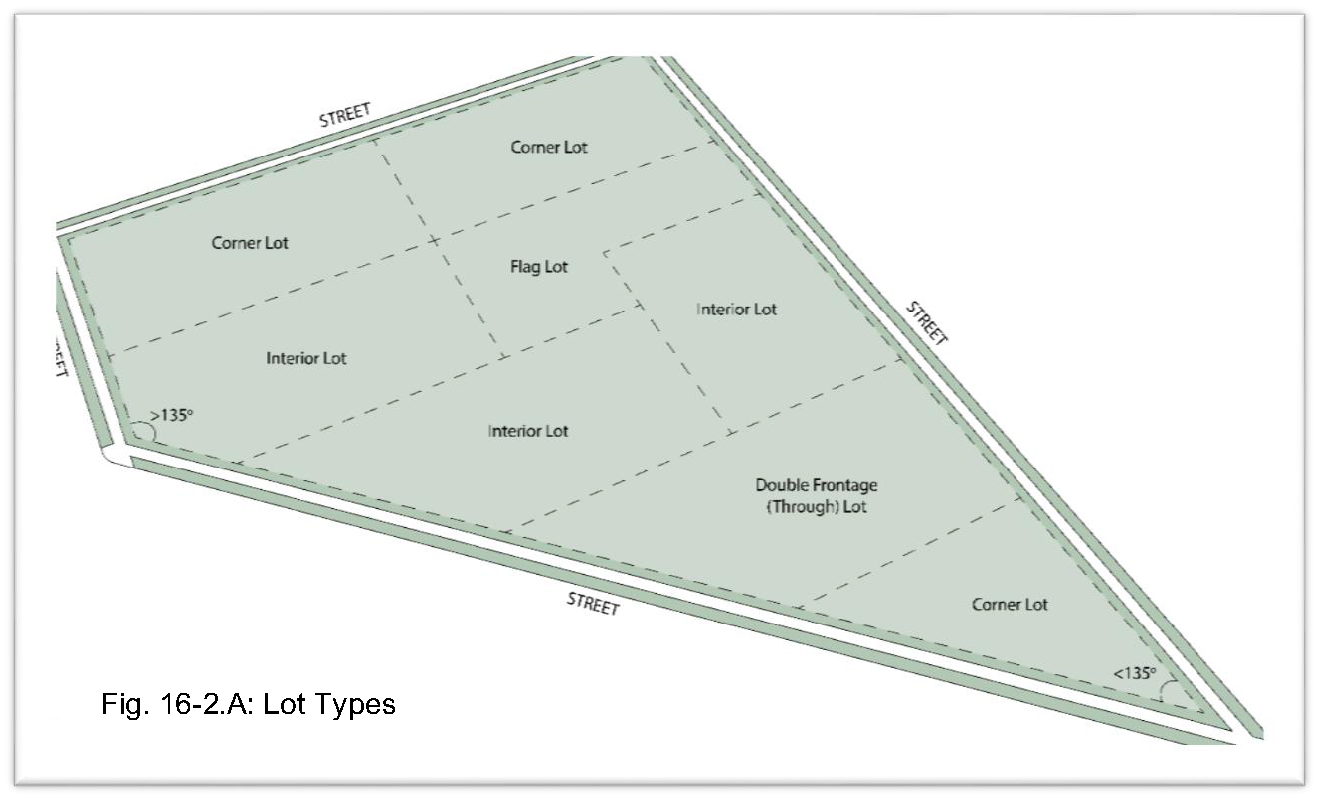
Lot of record means a lot that is part of a subdivision or the original Town site, the plat of which has been recorded in the office of the County Clerk or a parcel of land, the deed for which is recorded in the office of the County Clerk prior to the adoption of the Town's original Zoning Ordinance adopted with Ordinance No. 383, 1978.
Lot coverage means the percentage of a lot or tract covered by building footprints.
M/N/O Terms
Manufactured home means a structure transportable in one (1) or more sections that is built on a permanent chassis, is designed for use with or without a permanent foundation when connected to the required utilities and meets the construction safety standards of the federal Manufactured Housing Act of 1974. Similar structures that do not meet the construction safety standards of that Act are referred to as mobile homes. Manufactured home does not include recreational vehicle.
Manufactured home park or subdivision means a parcel (or contiguous parcels) of land divided into two (2) or more manufactured home lots for rent or sale.
Manufacturing, heavy means the storage of, or manufacturing processes utilizing, flammable or explosive materials, or storage or manufacturing processes that potentially involve hazardous or commonly recognized offensive conditions. Typical uses include chemical manufacturing and warehousing, dry ice manufacturing, fat rendering plants, fertilizer manufacturing, fireworks and explosives manufacturing or warehousing, petroleum refineries, pulp or wood processing, paper products manufacturing, radioactive materials manufacturing or use, steel works, slaughterhouses, and tanneries.
Manufacturing, light means an establishment or use engaged in the manufacture, predominantly from previously prepared materials, of finished products or parts, including processing, fabrication, assembly, treatment, and packaging of such products, and incidental storage, wholesale sales, and distribution of such products.
Marijuana means the "usable form of marijuana" as set forth in Article XVIII, Section 14(1)(i) of the Colorado Constitution, or as defined in any applicable state law or regulation.
Marijuana business, medical means any business that is licensed by the State, such as: Medical marijuana dispensary, medical marijuana center, medical marijuana cultivation facility, or medical marijuana-infused product manufacturer or production facility.
Marijuana dispensary means any business licensed by the State that sells or otherwise distributes medical or non-medical marijuana or marijuana-infused products.
Marijuana dispensary, medical means a business that sells or otherwise distributes marijuana through one (1) or more primary caregivers to patients for medical use.
Marijuana-infused product means a product infused with marijuana that is intended for use or consumption other than by smoking including edible products, ointments, and tinctures.
Marijuana-infused product, medical means a product infused with medical marijuana that is intended for use or consumption other than by smoking, including but not limited to edible products, ointments, and tinctures. These products, when manufactured or sold by a licensed medical marijuana center or a medical marijuana-infused product manufacturer, shall not be considered a food or drug for the purposes of the Colorado Food and Drug Act.
Marijuana, medical means marijuana or marijuana-infused products regulated and intended for medical use as defined by the State of Colorado in Article XVIII, Section 14(1)(b) of the Colorado Constitution, or as may be more fully defined in any applicable state law or regulation.
Marijuana production facility means a facility that cultivates marijuana, produces marijuana-infused products, or tests marijuana products; whether medical or non-medical.
Market garden means the commercial (for profit) production of vegetables, fruits, flowers, and other plants on an area of land not more than one (1) acre. This may be accomplished using one (1) or more greenhouses. Any greenhouse on properties zoned residential shall be considered an accessory use.
Marquee means a permanent structure, other than a roof or canopy, attached to, supported by, and projecting from a façade of a building.
Medical use shall have the same meaning as is set forth in Article XVIII, Section 14(1)(b) of the Colorado Constitution, or as may be more fully defined in any applicable state law or regulation.
Mineral estate means an interest in real property that is less than full fee title and that includes mineral rights as shown by the real estate records of the county in which the property is situated.
Mineral estate owner means the owner or lessee of a mineral estate underneath a surface estate that is subject to an application for development.
Mixed-use means a building that includes residential and some other use, typically commercial. In most cases, the commercial use is the primary use and is located on the ground floor. The secondary use shall be residential and shall be located above the commercial space or, in limited cases, to the rear of the primary use.
Mobile home means a dwelling unit built prior to June 13, 1976, to no state or nationally recognized building code. Mobile home does not include travel trailers, campers, camper buses, motor homes, or any closed vehicle designed to be towed by an automobile or truck.
Motel or hotel. See Hotel or motel.
Motion sensor means any device that turns a light fixture on when it detects motion and off when motion stops.
Multifamily means [a] dwelling type where multiple separate housing units for residential inhabitants are contained within one (1) building or several buildings within one (1) complex.
Municipal facilities means Town-owned and [Town]-operated institutions or facilities, including but not limited to museums, parks, playgrounds, trails, recreational centers, jails or correctional facilities, police facilities, fire protection facilities, airports, and water or sewer facilities.
New construction means structures for which the start of construction commenced on or after the effective date of the initial ordinance codified herein and includes any subsequent improvements to such structures.
Niche manufacturing means the production or manufacturing of specialty items in conjunction with the retail and/or wholesale, sales of the items at the same location.
Nursing home means a residential facility, licensed according to the requirements of Section 25-1.5-103, Colorado Revised Statutes, which is maintained primarily for the care and treatment of inpatients under the direction of a physician. The patients in such a facility require supportive, therapeutic, or compensating services and the availability of a licensed nurse for observation or treatment on a twenty-four-hour basis. Nursing care may include but is not limited to terminal care; extensive assistance or therapy in the activities of daily living; continual direction, supervision, or therapy; extensive assistance or therapy for loss of mobility; nursing assessment and services which involve assessment of the total needs of the patient, planning of patient care, and observing, monitoring, and recording the patient's response to treatment; and monitoring, observing, and evaluating the drug regimen. "Nursing home" includes intermediate nursing facilities for the mentally retarded or developmentally disabled.
Office, business or professional means a use where business, professional, or governmental services are made available to the public, including:
(1)
Business office: An office for use by persons such as realtors; travel, advertising, or insurance agents; and property managers providing both products and services, or the home office of a company that sells retail or wholesale products or provides professional services; and
(2)
Professional office: An office for use by persons such as physicians, dentists, lawyers, architects, engineers, accountants, and other professionals who primarily provide services rather than products.
Open space means natural areas as described in the Town's Parks, Recreation, and open space plan, and as follows: Either owned privately under a single common ownership or by a public entity with little or no structural enhancements, the primary purpose of which is to protect or house wildlife habitat, migration and breeding areas, scenic views, cultural values, sensitive plants or environments, wetlands, and water quality. The calculation of open space does not include areas under specific individual ownership, such as private yards and driveways.
Optional premises means the premises specified in an application for a medical marijuana center license with related growing facilities in the State for which the licensee is authorized to grow and cultivate for a purpose authorized under the Colorado Constitution.
Owner means any part owner, joint owner, tenant in common, tenant in partnership, joint tenant, or other person with sole or with concurrent legal and/or beneficial title to the whole or to part of a building or land.
P/Q/R Terms
Park means any dedicated and accepted public or private land available for recreational or scenic purposes.
Passive open space means open space that is owned, managed, and maintained in its natural state.
Pennant means a piece of fabric, plastic or other flexible medium that may be in the shape of a triangle, rectangle or other shape, is typically mounted to a flexible cord or rope that is stretched across two (2) points, is mounted in quantity and spaced along the cord or rope.
Permanent residency means occupancy of a recreational vehicle or site within an RV park for more than one hundred eighty (180) days in any twelve-month period at a site, after which they may then move to another site within the RV park for an additional one hundred eighty (180) days in any twelve-month period, after which a thirty-day cooling off period is required prior to occupying a site in the same RV park, or engaging in activities consistent with year-round residential use, regardless of whether the stay is continuous or intermittent.
Person means an individual, proprietorship, trust, partnership, corporation, association, or other legal entity.
Portable storage unit means enclosed storage containers that are left at a location for temporary storage on-site, or for filling and moving to another site (which may include an off-site storage facility).
Porte-cochere means a covered driveway entrance where vehicles stop to discharge passengers.
Portico means a porch leading to the entrance of a building.
Premises means any one (1) or more parcels directly abutting each other and all under the same ownership, upon which any building is located.
Primary building means the building in a multi-unit multifamily development located at the main access to the complex or where the office functions are provided for the complex.
Public land means land or interests in land owned by a governmental entity or held in trust for the benefit of the public by a not-for-profit organization.
Recreational use, indoor or outdoor commercial means a business that provides enclosed or outdoor recreation or entertainment. These uses may include, but are not limited to, miniature golf courses, skate park, adventure or fun center, rock climbing walls, bowling alleys, martial arts schools, dance schools, roller skating center, fitness clubs, water parks, sports stadiums, and the like.
Recreational vehicle (RV) means vehicle type unit primarily designed as temporary living quarters for recreational, camping, or travel, or seasonal use, which either has its own motive power or is mounted on or drawn by another vehicle. The basic types are:
(1)
Travel trailer. A vehicular portable unit, mounted on wheels, of such a size or weight as not to require special highway movement permits when drawn by a motorized vehicle, and of a body width of no more than eight (8) feet six (6) inches, excluding awnings, and a body length of no more than forty (40) feet when factory equipped for the road.
(2)
Tent camper. A portable unit mounted on wheels and constructed with collapsible partial side walls which fold for towing by another vehicle.
(3)
Truck camper. A portable unit, designed to be loaded onto, or affixed to, the bed or chassis of a truck. Truck campers are of two (2) basic types:
a.
Slide-in camper. A portable unit designed to be loaded onto and unloaded from the bed of a pickup truck.
b.
Chassis-mount camper. A portable unit designed to be affixed to a truck chassis.
(4)
Motorhome. A vehicular unit built on a self-propelled motor vehicle chassis.
(5)
Tiny house on wheels. A structured intended for temporary living quarters that is: a validly licensed vehicle, certified by the town building inspector, a portable unit designed to be affixed to a truck chassis, and has not less than one hundred fifteen (115) square feet nor more than five hundred (500) square feet of habitable space excluding lofts.
Recreational vehicle park (RV park) means a parcel of land designed and intended to accommodate two (2) or more recreational vehicles for temporary occupancy.
Repair services, general means an establishment engaged in the repair of trucks, buses, agricultural equipment, construction equipment, or other heavy equipment.
Repair services, limited means an establishment engaged in the repair of personal apparel and household appliances, furniture, and similar items, excluding repair of motor vehicles. Typical uses include apparel repair and alterations, small appliance repair, bicycle repair, lawn mower repair, clock and watch repair, and shoe repair shops.
Restaurant, fast food means an establishment where the principal business is the sale of food and beverages in a ready-to-consume state and where the design or method of operation includes any service to a customer in a motor vehicle.
Restaurant, general means an establishment where the principal business is the sale of food and beverages in a ready-to-consume state and where customers are normally provided with an individual menu and are generally served in non-disposable containers by a restaurant employee at the same table or counter at which said items are consumed. This use may include take-out service, but excludes any service to a customer in a motor vehicle.
Retail, general (indoors) means a retail establishment that does not fit the definition of any other land use classification and that does not entail any outdoors sales, service, display, storage, or other activity. Typical uses include, but are not limited to, apparel and accessory stores; clothing stores; rental stores; consumer electronics stores; gift, novelty, and souvenir shops; grocery stores; liquor stores; luggage and leather goods stores; jewelry stores; music stores; and book stores.
Retail, general (outdoors) means a retail establishment that does not fit the definition of any other land use classification and that entails some outdoors sales, service, display, storage, or other activity. Typical uses include, but are not limited to, boat dealers, hot tub dealers, recreational vehicle dealers, farmers' markets, and monument sales.
Roof overhang means eaves or the lower edge of the roof which overhangs the wall, including the eave or edge of the roof which overhangs a gabled end wall.
S/T/U Terms
Screen means a fence or wall that is at least four (4) feet in height designed and erected to obstruct and eliminate the public view of storage or other areas.
Seasonal decorations means decorations and temporary signs that are clearly incidental, customary, and commonly associated with a holiday, birthday, anniversary, graduation or similar occasion.
Setback means a setback is the minimum horizontal distance from a lot line to a building, structure, sign, or other improvement on a lot. See Section 16-2-6 for measurement instructions.
Short-term rental unit means a residential dwelling unit, or portion of such a unit, that is rented for compensation or consideration for less than thirty (30) days at a time; does not include dwelling units owned by the federal government, the state or the Town, or any of their agencies, or facilities licensed by the state as health care facilities.
Short-term rental means the renting, or offer to make available, (by way of a rental agreement, lease, license or any other means, whether oral or written) for compensation or consideration, of residential property, a dwelling unit, or a portion thereof, for a period of thirty (30) consecutive days or less to a transient.
Single-family attached dwelling means three (3) or more dwelling units on a single lot, each of which is occupied by only one (1) family and has an individual entrance, with common walls between the units.
Single-family detached dwelling means a single-family dwelling that is not attached to any other dwelling by any means.
Solar energy system, large means any device or combination of devices or elements which rely on direct sunlight as an energy source, including but not limited to any substance or device which collects energy from sunlight for primary use off-site. Large solar energy systems may deliver energy to the electrical grid.
Solar energy system, small means any device or combination of devices or elements which rely on direct sunlight as an energy source, including but not limited to any substance or device which collects energy from sunlight for use on-site. Small solar energy systems may deliver excess solar energy to the electrical grid to offset on-site energy use, but the annual excess energy delivered to the grid shall not exceed one hundred twenty percent (120%) of the total annual on-site energy use.
Start of construction means and includes substantial improvement and means the date the building permit was issued, provided that the actual start of construction, repair, reconstruction, placement, or other improvement was within one hundred eighty (180) days of the permit date.
The actual start means the first placement of permanent construction of a structure on a site, such as the pouring of slab or footings, the installation of piles, the construction of columns, or any work beyond the stage of excavation or the placement of a manufactured home on a foundation.
Permanent construction does not include land preparation, such as clearing, grading, and filling, nor does it include the installation of streets and/or walkways, excavation for a basement, footings, piers, or foundations or the erection of temporary forms or the installation on the property of accessory buildings, such as garages or sheds not occupied as dwelling units or not part of the main structure.
For a substantial improvement, the actual start of construction means the first alteration of any wall, ceiling, floor, or other structural part of a building, whether or not that alteration affects the external dimensions of the building.
Street means a public way, other than an alley or driveway, which affords the principal means of access to abutting property.
Street line means a dividing line between a lot, tract, or parcel of land and a contiguous street, the right-of-way line, or easement line.
Structural alterations means any change in the supporting member of a building, such as a bearing wall, column, beam, or girder.
Structure means an edifice or building which is built or constructed or any kind or any piece of work artificially built up or composed of parts joined together in some definitive manner.
Structure area (sign) means the total surface area of the structure of a monument sign that supports its copy area and contains dimensional or material differences from the plane of the sign face.
Subdivision means the division of any parcel of land into two (2) or more parcels, separate interests, or interests in common, except when such division:
(1)
Creates parcels of land each thirty-five (35) acres or more, none of which are intended for use by multiple owners;
(2)
Creates parcels of land, such that the land area of each parcel, when divided by the number of interests therein, results in thirty-five (35) acres or more per interest;
(3)
Is caused by the lawful order of any court in the State or by operation of law;
(4)
Is caused by a lien, mortgage, deed of trust, or any other security instrument;
(5)
Is caused by a security or unit of interest in any investment trust regulated under the laws of the State, or any other interest in an investment entity;
(6)
Creates cemetery lots; or
(7)
Creates an interest in oil, gas, minerals, or water that is severed from the surface ownership of real property.
Substantial damage means damage of any origin sustained by a structure whereby the cost of restoring the structure to its before-damaged condition would equal or exceed fifty percent (50%) of the market value of the structure before the damage occurred.
Surface estate means an interest in real property that is less than full fee title that does not include the mineral rights as shown by the real estate records of the county in which the property is situated.
Surface owner means the owner of the surface estate and any person with rights under a recorded contract to purchase all or part of the surface estate.
Switch means any device that can be manually controlled by a person to turn a light fixture on and off; switches include motion sensors but switches do not include light sensors or timers.
Temporary lighting means refers to lighting as required by citizens to carry out legally approved activities for durations as specified in the permits for those activities. These include, but are not limited to, activities such as nighttime agricultural operations, construction work lighting, and seasonal decorations, but in no case for more than a period of three (3) months without an exemption granted by the Town.
Temporary use means a use established for a fixed period of time with the intent to discontinue such use upon the expiration of the time period.
Theater and performing arts space means a venue that is used for the display of arts, music, and cultural events. These venues may include museums, concert halls, movie theaters, live theaters for performing arts, galleries, and studio arts. This shall not include adult entertainment venues or drive-in theaters.
Town Administrator means the Town of Mancos Town Administrator or the administrator's designee.
Town Register means the Town Register of Historic Properties.
Transient occupant/guest means the occupancy of a legal unit or sleeping accommodation for a period of thirty (30) consecutive calendar days or less.
Two-family dwelling (duplex) means the use of a lot for two (2) dwelling units within a single building and under a single roof.
Usable square footage means any portion of a structure or attachment to a structure (such as a patio or porch) that is livable, leasable, or otherwise used to generate income on a continuing basis.
V/W/X/Y/Z Terms
Vehicle repair garage means a building or place arranged, designed, used or intended to be used for the primary purpose of providing general repair and servicing of motor vehicles. Such repair or servicing may include reconditioning of engines, air conditioning systems and transmissions; wrecker service; collision services, including body, frame or fender straightening or repair; painting, undercoating and rust-proofing; replacement or repair of brakes, shock absorbers, tires, batteries, mufflers or upholstery; and other similar services.
Warehouse, commercial or self-storage means an enclosed building designed and used primarily for the storage of goods and materials.
Wall face means the area determined by multiplying the linear footage of the wall times the vertical height of the wall.
Yard, required means an open space on the lot between the lot line and minimum setback that is not obstructed from any point thirty (30) inches above the general ground level of the graded lot to the sky except for authorized encroachments and accessory structures. See Section 16-2-6 for measurement instructions.
(Ord. No. 751, § 1, 11-13-2019)
(Ord. No. 761, § 1, 10-28-2020; Ord. No. 777, § 2, 12-20-2023; Ord. No. 779, §§ 1, 2, 5-22-2024; Ord. No. 789, § 1, 11-11-2025)
Sec. 16-2-4. - Sign terms.
Commercial speech means expression by a speaker for the purposes of commerce, where the intended audience is actual or potential consumers, and where the content of the message is commercial in character. Commercial speech typically advertises a business or business activity or proposes a commercial transaction.
Copy means the wording on a sign surface either in permanent or removable form.
Copy area means the geometric area in square feet that encloses the copy of the sign.
Copy extension means that part of the sign area which extends beyond the edge or border of the sign.
Existing finish grade means the highest point of elevation within the area below the sign and the parcel line or, when the parcel line is more than five (5) feet from the sign, between the sign and a line five (5) feet from the sign, excluding all planter boxes, foundations, berms, or any other surface alteration that would increase the height of the sign.
Repair, renewal, refurbishment, and restoration of a sign means synonymous terms that may be used interchangeably to mean "to restore to a former, better state, and resembling the original design and construction as closely as possible" when describing a damaged sign or a sign in disrepair.
Sign means any writing (including letter, word or number), pictorial representation (including illustration or declaration), product, form (including shapes resembling any human, animal or product form), emblem (including any device, symbol, trademark, object or design which conveys a recognizable meaning, identity or distinction) or any other figure of similar character that is a structure or any part thereof, or is written, painted, projected upon, printed, designed into, constructed or otherwise placed on or near a building, board, plate, or upon any material object or device whatsoever, that by reason of its form, location, manner of display, color, working, stereotyped design or otherwise attracts or is designed to attract attention to the subject or to the property upon which it is situated, or is used as a means of identification, advertisement or announcement. The term sign shall not include the following:
(1)
Window displays of merchandise or products;
(2)
Art that does not include commercial speech;
(3)
Products, merchandise or other materials which are offered for sale or used in conducting a business, when such products, merchandise, or materials are kept or stored in a location which is designed and commonly used for the storage of such products, merchandise or materials; and
(4)
Any feature of display that would otherwise be considered a sign, but that has been found by the Planning Commission to be an integral part of a building that contributes to the character of the building and surrounding area.
Sign, abandoned means a sign for a business that is no longer in operation at the location or for which no legal owner can be found, for a period of six (6) months or more.
Sign, attached means a sign that is mounted on or attached to a structure, including a wall sign, window sign, roof sign, or projecting sign.
Sign, awning means a type of sign with one (1) face affixed to an awning. See Section 16-2-3, Awning.
Sign, banner means a type of temporary sign that is painted or printed on cloth, vinyl, or other flexible material, which is designed to be stretched between poles, fence posts or wire, mounted in a free-standing frame, or hung on walls with ties, clips, rails, brackets, hooks, or frames.
Sign, canopy means a type of sign with one (1) face affixed to a canopy. See Section 16-2-3, Canopy.
Sign, damaged means a sign that, for any reason, has received less than fifty percent (50%) damage to any combination of the copy area or sign structure.
Sign, destroyed means any sign that, for any reason, has received fifty percent (50%) or greater damage to any combination of the copy area or sign structure.
Sign, double-faced means a sign with two (2) faces that are parallel or within thirty (30) degrees of parallel.
Sign, electronic message center (EMC) means an electronic sign that utilizes video content, whether static or motion, to advertise products, services and businesses, and is digitally programmed and controlled, either directly or indirectly, by the use of a computer or software. The term electronic message center sign includes, but is not limited to, light-emitting diodes, liquid crystal displays and plasma screen displays.
Sign, flutter flags means a piece of cloth or other similar material, varying in size, color, and design, that is attached to a pole or staff, and may be in the shape of a vertically-oriented rectangle, teardrop, or similar, where typically the cloth or material is supported by wire to maintain the shape of the flag.
Sign, freestanding means a ground-mounted sign erected on a permanently set pole or poles, mast, or framework that is not mounted on or attached to a structure, including an access sign, monument sign, or pole sign.
Sign, inflatable means a sign that is constructed from an envelope flexible material that is given shape or movement by inflation.
Sign, light projection means any image, text, or other content that is projected onto an outdoor surface (e.g., a building wall, window, or sidewalk) by a laser projector, video projector, video mapping, or other comparable technology, in a location such that the image, text, or content is obviously visible from outside of the property.
Sign, marquee means a sign attached to a marquee. See Section 16-2-3, Marquee.
Sign, monument means a sign supported by the ground and not attached to a building or structure, and where the bottom edge of the sign structure is on or in the ground. A multi-tenant monument sign is a monument sign permitted for a property with three (3) or more tenants, as identified by individual tenant addresses.
Sign, off-premises means any sign advertising products, services, uses, or enterprises sold or offered at a location other than the property where the sign is physically located.
Sign, on-premises means a sign advertising any product, service, or enterprise physically located on the property where the sign is located.
Sign, on-vehicle means any magnetic sign(s), signs painted or wrapped on, adhesive vinyl film affixed to a window, or sign attached by other temporary or permanent means to a vehicle, where the vehicle is owned by the business, is operable and properly licensed, and the vehicle is regularly and consistently used in the normal daily conduct of the business, such as delivering or transporting goods or providing services related to the business.
Sign, pole means a sign which is supported by one (1) or more uprights, poles, or braces affixed to the ground, and not attached to a building or structure.
Sign, projecting or suspended means a vertical edge mounted sign that is attached directly to the wall of a building, and which extends at least one (1) foot from the face of the wall, and is typically mounted perpendicular to the wall surface.
Sign, required means a sign that is required by an applicable building code (e.g., address numbers) or health and safety regulations (e.g., the Occupational Safety and Health Act ("OSHA")) or other laws or regulations, whether such sign is temporary or permanent.
Sign, rider means a subordinate sign that is attached to a temporary sign, either above or below the sign face.
Sign, roof means a sign erected on a roof, including a mansard type roof, where any portion of the sign extends above the roofline of a building or structure, or that is mounted upon the horizontal plane of a flat roof structure, which may include the roof of a canopy or porte-cochère that is attached to a building.
Sign, subdivision means a monument sign located at the entrance of a legally platted subdivision of land.
Sign, temporary means a sign that is: (1) constructed of cloth, canvas, vinyl, paper, plywood, fabric or other lightweight material not well suited to provide a durable substrate; or (2) if made of some other material, is neither permanently installed in the ground, nor permanently affixed to a building or structure that is permanently installed. Temporary signs may include rider signs.
Sign, under canopy means a sign that is suspended beneath an awning, canopy, ceiling, soffit, or roof.
Sign, wall means any sign painted on, attached to, or erected against the wall of a building or structure, with the exposed face of the sign in a plane parallel to the plane of the wall, and extending not more than one (1) foot from the face of the wall, and not to extend above the highest point of the wall.
Sign, walker means a sign, including costumes, that is worn, held, or balanced by a person and is not installed or attached to real property.
Sign, wind means a display of pennants, streamers, balloons, flutter flags, whirligigs, wind blades, or similar devices, activated by wind.
Sign, window means a solid or transparent sign painted on or affixed to either side of a window, or facing the outside and intended to be seen from the outside.
Sign, yard means a type of temporary sign that is constructed of paper, vinyl, plastic, wood, metal or other comparable material, which is mounted on a stake or a frame structure (often made from wire) that includes one (1) or more stakes.
Signage means any graphics, symbols, or written copy designed specifically for the purposes of advertising or identifying an establishment, product, goods or services.
Sign structure means the base, footer, support poles, framing, and all other parts and components onto which the copy area is resting or attached.
(Ord. No. 751, § 1, 11-13-2019)
Sec. 16-2-5. - Telecommunication terms.
Accessory equipment means any equipment serving or being used in conjunction with a WCF, including, but not limited to, utility or transmission equipment, power supplies, generators, batteries, cables, equipment buildings, cabinets and storage sheds, shelters or other structures.
Alternative tower structure means man-made trees, clock towers, bell steeples, light poles, traffic signals, buildings, and similar alternative design mounting structures that are compatible with the natural setting and/or surrounding structures, and camouflage or conceal the presence of Antennas or towers so as to make them architecturally compatible with the surrounding area pursuant to this Division. This term also includes any Antenna or Antenna array attached to an Alternative Tower Structure. A stand-alone Monopole (including a Replacement Pole) in the Public Right-of-Way that accommodates Small Cell Wireless Facilities is considered an Alternative Tower Structure to the extent it meets the camouflage and concealment standards of Section 16-4-8, Wireless Communication Facilities.
Antenna means any device used to transmit and/or receive radio or electromagnetic waves such as, but not limited to panel antennas, reflecting discs, microwave dishes, whip antennas, directional and non-directional antennas consisting of one (1) or more elements, multiple antenna configurations, or other similar devices and configurations, and exterior apparatus designed for telephone, radio, or television communications through the sending and/or receiving of wireless communications signals.
Applicant means any person that submits an application to the Town to site, install, construct, collocate, modify and/or operate a wireless communications facility in the public right-of-way.
Base station means a structure or equipment at a fixed location that enables FCC-licensed or authorized wireless communications between user equipment and a communications network. The definition of base station does not include or encompass a tower as defined herein or any equipment associated with a tower. Base station does include, without limitation:
(1)
Equipment associated with wireless communications services such as private broadcast, and public safety services, as well as unlicensed wireless services and fixed wireless services such as microwave backhaul that, at the time the relevant application is filed with the Town under this Chapter and has been reviewed and approved under the applicable zoning or siting process, or under another State or local regulatory review process, even if the structure was not built for the sole or primary purpose of providing such support; and
(2)
Radio transceivers, antennas, coaxial or fiber-optic cable, regular and backup power supplied, and comparable equipment, regardless of technological configuration (including distributed antenna systems ("DAS") and small-cell networks) that, at the time the relevant application is filed with the Town, has been reviewed and approved under the applicable zoning or siting process, or under another State or local regulatory review process, even if the structure was not built for the sole or primary purpose of providing such support.
The definition of base station does not include any structure that, at the time the relevant application is filed with the Town, does not support or house equipment described in paragraphs (1) and (2) above.
Camouflage, concealment, or camouflage design techniques means the designing of a WCF to alter its appearance in such a manner as to substantially integrate it into surrounding building designs and/or natural settings to minimize the visual impacts of the facility on the surrounding uses and ensure the facility is compatible with the environment in which it is located. A wireless communication facility utilizes camouflage design techniques when it: (i) is integrated as an architectural feature of an existing structure such as a cupola, or (ii) is integrated in an outdoor fixture such as a utility tower, or (iii) uses a design which mimics and is consistent with the nearby natural or architectural features (such as a clock tower) or is incorporated into (including without limitation, being attached to the exterior of such facilities and painted to match it) or replaces existing permitted facilities (including without limitation, stop signs or other traffic signs or freestanding light standards) so that the presence of the WCF is not readily apparent.
Colocation means the mounting or installation of transmission equipment on an existing tower or base station; provided that for eligible facilities requests, "colocation" means the mounting or installation of transmission equipment on an eligible support structure for the purpose of transmitting and/or receiving radio frequency signals for communications purposes.
Director means the Public Works Director, or his or her designee.
Eligible facilities request means any request for modification of an existing tower or base station that it is not a substantial change.
Eligible support structure means any tower or base station as defined in this Section, provided that it is existing at the time the relevant application is filed with the Town under this Section.
Essential services and facilities means the development or maintenance of public utilities or Town-approved underground, surface or overhead gas, electrical, telephone, steam, fuel or water transmission or distribution systems, including towers, poles, wires, mains, drains, sewers, pipes, conduits, cables, fire alarm and police call boxes, traffic signals, hydrants and similar equipment and sewage pump stations. For the purpose of this Chapter, telecommunications towers or facilities shall not be considered essential services, and are defined separately.
Existing tower or base station means a constructed tower or base station that was reviewed, approved, and lawfully constructed in accordance with all requirements of applicable law as of the time it was built; for example, a Tower that exists as a legal, non-conforming use and was lawfully constructed is existing for purposes of this definition.
FCC means the Federal Communications Commission.
Micro cell facility means a small wireless facility that is no larger than twenty-four (24) inches in length, fifteen (15) inches in width, twelve (12) inches in height, and that has an exterior antenna, if any, that is no more than eleven (11) inches in length.
Monopole means a single, freestanding pole-type structure supporting one (1) or more antennas.
Over the air receiving device means an antenna used to receive video programming from direct broadcast satellites, broadband radio services and television broadcast stations, but shall not include antennas used for AM/FM radio, amateur ("ham") radio, CB radio, digital audio radio services or antennas used as part of a hub to relay signals among multiple locations.
Pole-mounted small cell wireless facility means a small cell facility with antenna that are mounted and supported on an alternative tower structure, which includes a replacement pole.
Public right-of-way (ROW) means any public street, way, alley, sidewalk, median, parkway, or boulevard that is dedicated to public use.
Radio frequency emissions letter means a letter from the applicant certifying all WCFs that are the subject of the application shall comply with federal standards for radio frequency emissions.
Replacement pole means an alternative tower structure that is a newly constructed and permitted traffic signal, utility pole, street light, flagpole, electric distribution, or street light poles or other similar structure of proportions and of equal height or such other height that would not constitute a substantial change to a pre-existing pole or structure in order to support a WCF or small cell facility or micro cell facility or to accommodate colocation and replaces a pre-existing pole or structure.
Signal non-interference letter means a letter from the applicant certifying all WCFs that are the subject of the application shall be designed, sited, and operated in accordance with applicable federal regulations addressing radio frequency interference.
Site for towers (other than towers in the right-of-way and eligible support structures) means the current boundaries of the leased or owned property surrounding the tower or eligible support structure and any access or utility easements currently related to the site. A site, for other alternative tower structures, base stations, micro cell facilities, and small cell facilities in the right-of-way, is further restricted to that area comprising the base of the structure and to other related accessory equipment already deployed on the ground.
Small cell facility means a wireless communication facility where each antenna is located inside an enclosure of no more than three (3) cubic feet in volume, or, in the case of an antenna that has exposed elements, the antenna and all of its exposed elements could fit within an imaginary enclosure of no more than three (3) cubic feet; and primary equipment enclosures are no larger than seventeen (17) cubic feet in volume. The following associated equipment may be located outside of the primary equipment enclosure and, if so located, is not included in the calculation of equipment volume: Electric meter, concealment, telecommunications demarcation box, ground-based enclosure, back-up power systems, grounding equipment, power transfer switch and cut-off switch. Small cells may be attached to alternate tower structures, replacement poles, and base stations. The definition of a small cell facility shall also include a micro cell or micro cell facility.
Substantial change means a modification that substantially changes the physical dimensions of an eligible support structure if, after the modification, the structure meets any of the following criteria:
(1)
For towers, other than alternative tower structures or towers in the right-of-way, it increases the height of the tower by more than ten percent (10%) or by the height of one (1) additional antenna array, with separation from the nearest existing antenna not to exceed twenty (20) feet, whichever is greater; for other eligible support structures, it increases the height of the structure by more than ten percent (10%) or more than ten percent (10%) feet, whichever is greater;
(2)
For towers, other than towers in the right-of-way, it involves adding an appurtenance to the body of the tower that would protrude from the tower more than twenty (20) feet, or more than the width of the tower structure at the level of the appurtenance to the body of the structure that would protrude from the side of the structure by more than six (6) feet;
(3)
For any eligible support structure, it involves installation of more than the standard number of new equipment cabinets for the technology involved, but not to exceed four (4) cabinets;
(4)
For towers in the right-of-way and base stations, it involves installation of any new equipment cabinets on the ground if there are no pre-existing ground cabinets associated with the structure, or else involves installation of ground cabinets that are more than ten percent (10%) larger in height or overall volume than any other existing, individual ground cabinet associated with the structure;
(5)
For any eligible support structure, it entails any excavation or deployment outside the current site;
(6)
For any eligible support structure, it would defeat the concealment elements of the eligible support structure. For the purposes of this Subsection, a change that would undermine the concealment elements of this structure will be considered to defeat the concealment elements of the structure; or
(7)
For any eligible support structure, it does not comply with conditions associated with the siting approval of the construction or modification of the eligible support structure equipment, unless the non-compliance is due to an increase in height, increase in width, addition of cabinets, or new excavation that would not exceed the thresholds identified in paragraphs (1), (2), (3) and (4) of this definition. For purposes of determining whether a substantial change exists, changes in height are measured from the original support structure in cases where deployments are or will be separated horizontally, such as on buildings' rooftops; in other circumstances, changes in height are measured from the dimensions of the tower or base station, inclusive of originally approved appurtenances and any modifications that were approved prior to February 22, 2012.
Support structure means a structure designed to support small cell wireless facilities including, but not limited to, monopoles, alternative tower structures, replacement poles, and other freestanding self-supporting pole structures.
Telecommunications facilities means any cables, wires, wave guides, antenna and any other equipment or facilities associated with the transmission or reception of communications services located or installed upon or near a tower or base station. Such communications services include, but are not limited to, cellular, personal communication services, specialized mobilized radio, enhanced specialized mobilized radio, paging and other similar services marketed to the commercial or residential consumers. Telecommunications facilities shall not include:
(1)
Any satellite earth station antenna two (2) meters in diameter or less which is located in an area zoned commercial or industrial; and
(2)
Any satellite earth station antenna one (1) meter or less in diameter, regardless of zoning category.
Toll and tolling means to delay, suspend, or hold off on the imposition of a deadline, statute of limitations, or time limit.
Tower means any structure built for the sole or primary purpose of supporting one (1) or more FCC-licensed or authorized antennas and their associated facilities, including structures that are constructed for wireless communications services including, but not limited to private, broadcast, and public safety services, as well as unlicensed wireless services and fixed wireless services such as microwave backhaul, and the associated site. The term includes self-supporting lattice towers, guy towers or monopole towers, radio and television transmission towers, microwave towers, common carrier towers, cellular telephone towers, alternative tower structures and the like.
Transmission equipment means equipment that facilitates transmission for any FCC licensed or authorized wireless communication service, including, but not limited to, radio transceivers, antennas, coaxial or fiber-optic cable, and regular and backup power supply. The term includes equipment associated with wireless communications services including, but not limited to, private, broadcast, and public safety services, as well as unlicensed wireless services and fixed wireless services such as microwave backhaul.
Unreasonable interference means any use of the right-of-way that disrupts or interferes with its use by the Town, the general public, or other person authorized to use or be present upon the right-of-way, when there exists an alternative that would result in less disruption or interference. Unreasonable interference includes any use of the right-of-way that disrupts vehicular or pedestrian traffic, any interference with public utilities, and any other activity that will present a hazard to public health, safety or welfare.
Wireless communications facility or WCF means a facility used to provide personal wireless services as defined at 47 U.S.C. Section 332 (c)(7)(C); or wireless information services provided to the public or to such classes of users as to be effectively available directly to the public via licensed or unlicensed frequencies; or wireless utility monitoring and control services. A WCF does not include a facility entirely enclosed within a permitted building where the installation does not require a modification of the exterior of the building; nor does it include a device attached to a building, used for serving that building only and that is otherwise permitted under other provisions of the Code. A WCF includes an antenna or antennas, base stations, support equipment, alternative tower structures, and towers. The term does not include mobile transmitting devices used by wireless service subscribers, such as vehicle or hand-held radios/telephones and their associated transmitting antennas, nor does it include other facilities specifically excluded from the coverage of Article 16-4.
(Ord. No. 751, § 1, 11-13-2019; Ord. No. 761, § 1, 10-28-2020)
Sec. 16-2-6. - Measurements.
(a)
Buildable area and setbacks. Buildable area means that portion of a building lot or site not within the required front, side, and rear setback areas. A setback is the minimum horizontal distance that must remain unobstructed from the ground to the sky, measured perpendicular from the lot line.
For the purposes of issuing building permits, buildable area also means those areas on a building lot or site, as shown on the required site plan, necessary for the construction of such other improvements as driveways, parking areas, pools, tennis courts, and accessory buildings, including sufficient adjacent area to allow the normal operation of construction equipment.
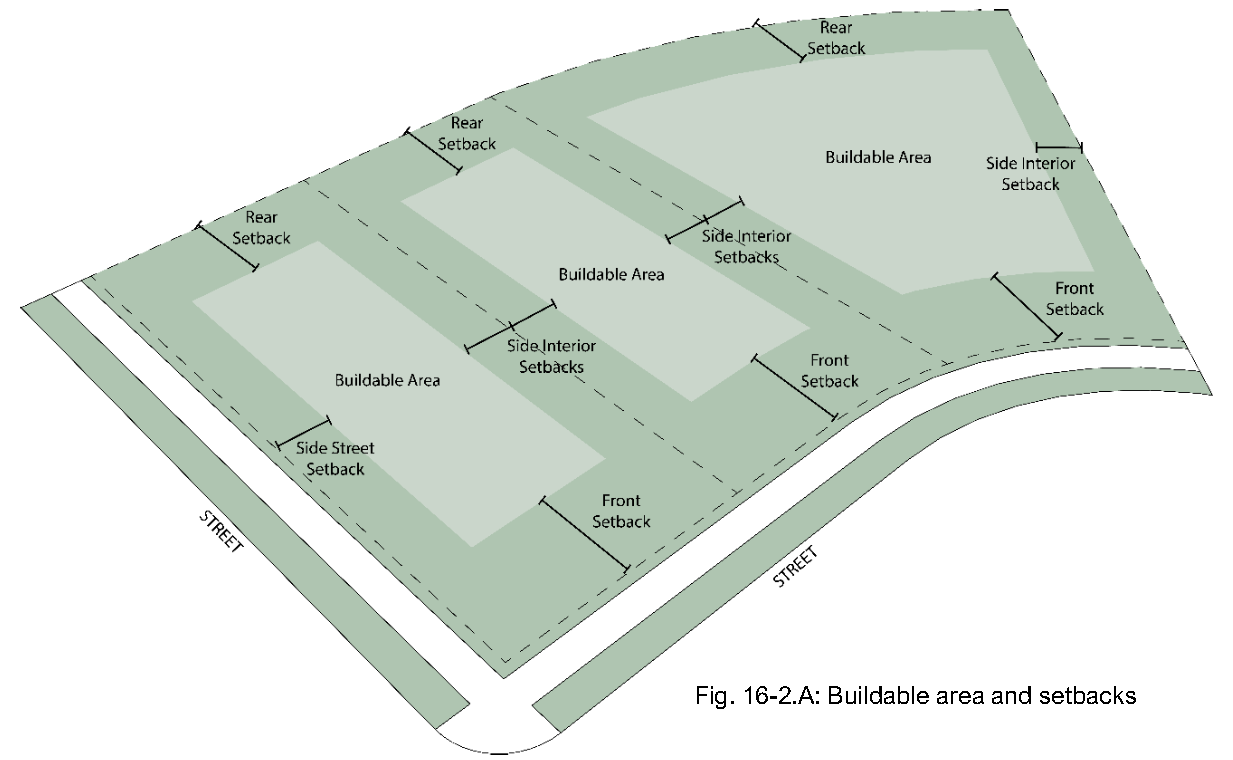
(b)
Building footprint. Building footprint for an individual structure on a lot measured to the farthest exterior wall face at the ground floor including above-grade enclosed projections. The following are counted as enclosed areas for the purposes of determining building footprint:
(1)
Areas covered by swimming pools and hot tubs;
(2)
Decks, stoops, patios, porches, and associated stairs that are thirty (30) inches or more above grade;
(3)
Structures covered by a roof;
(4)
An eave or roof overhang that extends over the external wall by more than three (3) feet, for which the entire area under the eave or roof overhang is counted; and
(5)
Structures that are more than six (6) feet tall and enclosed on three (3) or more sides with walls that are less than twenty-five percent (25%) open.
(c)
Building height. The vertical distance measured from the average undisturbed grade at the foundation to the highest finished roof surface in the case of a flat roof, or in the case of a pitched roof, to a point halfway between the highest peak and the highest eave.
(d)
Highest adjacent grade. The highest natural elevation of the ground surface prior to construction next to the proposed walls of a structure.
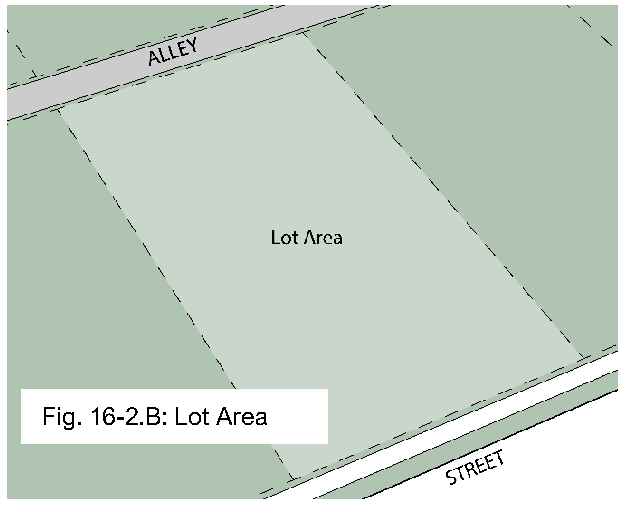
(e)
Lot measurements.
(1)
Lot area. The net area of the lot, excluding portions of streets and alleys.
(2)
Lot depth. The distance between the midpoints of straight lines connecting the foremost points of the side lot lines in front and the rearmost points of the side lot lines in the rear.
(3)
Lot frontage.
a.
For the purpose of determining yard requirements on corner lots and through lots, all sides of a lot adjacent to streets shall be considered frontage, and yards shall be provided as indicated under "yards" in this Section. Residentially-zoned and used through lots that back up to a street to which they do not have access or an alley shall not be required to maintain a front yard except along the principal street.
b.
No lot shall front on an alley.
(4)
Lot width. The distance between the side lot lines as measured at the rear of the required front yard, except for lots on the turning circle of cul-de-sacs which shall be at least eighty percent (80%) of the required lot width and maintain an average lot width between the front and rear property lines of at least the minimum lot width for the zoning district in which the lots are located.
(f)
Lowest floor. The lowest floor of the lowest enclosed area (including basement). Any floor used for living purposes which includes working, storage, sleeping, cooking and eating, recreation, or any combination. This includes any floor that could be converted to such a use, such as a basement or crawl space. The lowest floor is a determinate for the flood insurance premium for a building, home, or business. An unfinished or flood-resistant enclosure, usable solely for parking of vehicles, building access, or storage, in an area other than a basement area, is not considered a building's lowest floor, provided that such enclosure is not built so as to render the structure in violation of the applicable non-elevation design requirements of this LUC and Section 60.3 of the National Flood Insurance Program regulations.
(g)
Separation distance. Where a standard includes a separation or distance requirement, it shall be measured as follows:
(1)
Between buildings. The horizontal distance between the two (2) closest portions of each building's exterior walls.
(2)
Between uses. The horizontal distance shall be measured from the nearest of the lot line of the proposed use to the nearest point of the lot line of the lot on which the existing permitted use is located.
(3)
Between cell towers. The separation distance from cell towers shall be measured from tower to tower, pole to pole, or between the relevant support structures that are being measured.
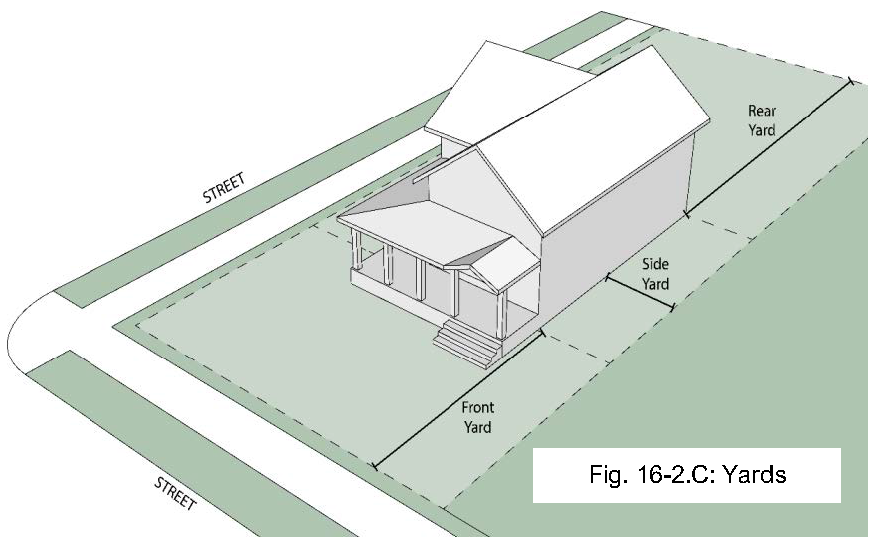
(h)
Yard measurement.
(1)
Front yard. A yard extending across the full width of the lot, the depth of which is the least distance between the street right-of-way and the front building setback line. Depth of a required front yard shall be measured at right angles to a straight line joining the foremost points of the side lot lines. The foremost point of the side lot line, in the case of rounded property corners at street intersections, shall be assumed to be the point at which the side and front lot lines would have met without such rounding. Front and rear yard lines shall be parallel.
a.
Through lots: Front yards shall be provided on both frontages.
b.
Corner lots: A front yard shall be provided in accordance with the district requirements for one (1) frontage designated by the property owner at the time of the building permit issuance and the second yard shall conform to the side yard requirements as defined herein. In the case of corner lots with more than two (2) frontages, the third or more yards shall conform to the side yard requirements as defined herein.
(2)
Rear yard.
a.
A yard extending across the full width of the lot, the depth of which is the least distance between the rear lot line and the rear setback line.
b.
Double frontage lots have no rear yard, only front and side yards. Where an alley runs behind a lot and such alley serves only as an access alley and no lots have primary frontage on the alley, the lot shall not be considered a double frontage lot.
(3)
Side yard. A yard extending between the front setback line and the rear setback line, the width of which is the least distance between the side lot line and the required side setback. In absence of a clearly defined rear yard, as in the case of a through lot, any portion of the lot not designated as a front yard shall be a side yard.
(Ord. No. 751, § 1, 11-13-2019)

