
Mancos City Zoning Code
ARTICLE 4
Use Standards
Sec. 16-4-1.- General
(a)
Uses in districts. Land and buildings in each zone district may be used for any of the principal or accessory land uses authorized in the regulations set forth for that zone district in this Article.
(b)
Compliance required. No building or structure shall be erected, converted, enlarged, reconstructed, or altered for use, nor shall any building, structure, or land be used or changed in such a way that it does not comply with all of the district regulations established by this LUC for the district in which the building or structure or land is located.
(Ord. No. 751, § 1, 11-13-2019)
Sec. 16-4-2. - Use table organization.
The uses allocated to each zone district are identified in Table 16-4.1, Primary Uses, Table 16-4.2, Accessory Uses, and Table 16-4.3, Temporary Uses. Uses are classified as follows to provide a systematic basis for assigning present and future land uses into appropriate zoning districts.
(1)
Use categories and types. Within the use table, land uses and activities are classified into general "use categories" and then into specific "use types" that are based on common functional, product, or physical characteristics, such as the type and amount of activity, the type of customers or residents, how goods or services are sold or delivered, and site conditions.
(2)
Use type subgroups. Use types may also be organized into "use type subgroups" where there are a number of possible variations of a use type, such as residential dwellings or group living.
(3)
Uses described. Use categories and types are described in Section 16-4-3, Use Table Descriptions.
(Ord. No. 751, § 1, 11-13-2019)
Sec. 16-4-3. - Use table descriptions.
(a)
Agriculture. This is a category of uses characterized by active and on-going agricultural uses, activities, and related uses. An agricultural use, in general, means the use of and for the growing and production of field crops, livestock, aquatic, and animal products for the production of income. Other agricultural uses might include fruit and vegetable stands, livestock sales, wholesale nurseries, and stables. Lands in agricultural uses and districts may also be held for preservation and conservation purposes.
(b)
Residential. This is a category of uses offering habitation on a continuous basis. The continuous basis is established by tenancy with a minimum term of one (1) month or property ownership. This use category also includes group residential facilities.
(1)
Household living. This use type is characterized by residential occupancy of a dwelling unit by one (1) or more persons. Household living is defined by ownership or tenancy, not transient occupancy, although short-term rental may be allowed as an accessory use.
(2)
Group living. This use type is characterized by residential occupancy of a structure by a group of people who do not meet the definition of "Household Living." Generally, group living structures have a common eating area for residents. The residents may receive care, training, or treatment, and caregivers may also reside at the site.
(c)
Civic, public, and institutional uses. This is a category of uses that are public or quasi-public uses that provide services to benefit the public-at-large.
(1)
Cultural. This use type includes uses where persons regularly assemble to experience or participate in cultural activities. This category includes libraries, museums, and public and religious assembly uses. Assembly uses are permanent places, which are maintained and controlled by a body organized to sustain the religious or public assembly. Public assembly uses include civic and social organizations such as private lodges, clubs, fraternities, and similar private membership organizations.
(2)
Education. This use type includes institutions of learning that provide educational instruction to students. Accessory uses include play areas, cafeterias, recreational and sport facilities, auditoriums, and before- or after-school day care.
(3)
Government services. This is a use type for locations and structures that provide a place for the regular transaction of governmental business.
(4)
Medical care. This use type is characterized by activities focusing on medical services, particularly licensed public or private institutions that provide primary health services and medical or surgical care to persons suffering from illness, disease, injury, or other physical or mental conditions. Accessory uses may include laboratories, outpatient, or training facilities, and parking, or other amenities primarily for the use of employees in the firm or building. Uses include foster care facilities, detoxification facilities, hospitals, nursing homes, and psychiatric hospitals.
(5)
Custodial care. This use type includes facilities providing custodial care in a supervised environment to more than sixteen (16) persons, excluding staff, who reside on a twenty-four-hour basis. Uses include alcohol and drug centers, assisted living facilities, congregate care facilities, group homes, halfway houses, residential board and care facilities, and social rehabilitation facilities. Facilities providing custodial care to less than sixteen (16) persons shall be classified as a group living use.
(d)
Commercial. This is a use category for any retail, consumer service, or office use.
(1)
Arts, entertainment, and recreation. This use type includes a broad array of commercial establishments that operate indoor or outdoor facilities or provide services to meet varied artistic, cultural, entertainment, and recreational interests of their patrons. Uses within this category comprise:
a.
Establishments involved in producing, promoting, or participating in live performances, events, or exhibits intended for public viewing;
b.
Establishments that create, preserve and exhibit objects and sites of artistic, historical, cultural, sports or educational interest; and
c.
Establishments that operate facilities or provide services that enable patrons to participate in recreational activities or pursue amusement, hobby, or leisure time interests.
(2)
Eating and drinking establishments. This is a use category for businesses that prepare or serve food or beverages for consumption on or off the premises. Accessory uses may include food preparation areas, offices, and parking.
(3)
Lodging accommodations. Uses in this use type provide customers, typically transient occupants, with temporary housing for an agreed upon term.
(4)
Office. This type includes uses where people are engaged primarily in on-site administrative, business, or professional activities. These uses are characterized by activities in an office setting that focus on the provision of off-site sale of goods or on-site information-based services, usually by professionals. Typical examples include real estate, insurance, property management, investment, employment, travel, advertising, law, architecture, design, engineering, accounting, call centers, and similar offices. Accessory uses may include cafeterias, health facilities, parking or other amenities primarily for the use of employees in the firm or building.
(5)
Personal services. This use type is characterized by establishments that provide individual services related to personal needs directly to customers at the site of the business, or that receive goods from or return goods to the customer, which have been treated or processed at that location or another location.
(6)
Retail. This is a use type for businesses involved in the sale, lease, or rental of new or used products to the general public. Such uses may include, but are not limited to: Convenience food store, drug store, hardware store, general merchandise store, garden supplies, furniture, home furnishings and equipment. Accessory uses may include offices, parking, storage of goods, and assembly, repackaging or repair of goods for on-site sales.
(7)
Transportation. This is a use type for uses that provide public and private modes of transportation.
(8)
Vehicle/equipment sales and services. This use type includes a broad range of uses for the maintenance, sale, or rental of vehicles, trucks and heavy equipment. Accessory uses may include incidental repair, storage, and offices.
(e)
Industrial, wholesale, and storage. This is a use category including uses that produce goods from extracted and raw materials or from recyclable or previously prepared materials, including the design, storage and handling of these products and the materials from which they are produced.
(1)
Manufacturing. This use type includes industrial uses that produce noise, odors, and noxious or toxic by-products. Toxic, hazardous, or explosive materials may be produced or used in large quantities as an integral part of the manufacturing process creating increased hazards of fire or explosion. Industrial processes are not required to take place within enclosed buildings. Work areas and the storage of finished products may be permitted within an enclosed yard. These uses are generally incompatible with lower intensity land uses.
(2)
Utilities. This use type includes structures and locations for public or private lines and facilities related to the provision, distribution, collection, transmission, or disposal of water, storm and sanitary sewage, oil, gas, power, information, telecommunication and telephone cable, and facilities for the generation of electricity. Utility uses may or may not have regular employees at the site and the services may be public or privately provided.
(3)
Wholesale and storage. This use type includes facilities used for the sale, lease, or rent of products primarily intended for industrial, institutional, or commercial businesses. The uses emphasize on-site sales or order taking, and often include display areas. Businesses may or may not be open to the general public, but sales to the general public are limited as a result of the way in which the firm operates. Products may be picked up on site or delivered to the customer.
(Ord. No. 751, § 1, 11-13-2019)
Sec. 16-4-4. - Permitted uses and classification of unlisted uses.
(a)
Interpretation process. When a use category or use type is proposed that is not specifically listed in one of the use tables, the Zoning Administrator shall make a determination as to the appropriate classification of any new or unlisted form of land use based on the criteria listed below.
(b)
Interpretation criteria.
(1)
The Zoning Administrator is authorized to classify uses on the basis of the use category, subcategory and specific use type descriptions.
(2)
When a use cannot be reasonably classified into a use category, subcategory or specific use type, or appears to fit into multiple categories, subcategories or specific use types, the Zoning Administrator is authorized to determine the most similar, and thus most appropriate use category, subcategory or specific use type based on the actual or projected characteristics of the principal use or activity in relationship to the use category, subcategory and specific use type descriptions provided in this Section. In making such determinations, the Zoning Administrator shall consider:
a.
The types of activities that will occur in conjunction with the use;
b.
The types of equipment and processes to be used;
c.
The existence, number and frequency of residents, customers or employees;
d.
Parking demands associated with the use;
e.
Any special public utility requirements for serving the proposed use type, including but not limited to electricity, water supply, wastewater output, pre-treatment of wastes and emissions required or recommended, and any significant power structures or infrastructure and communications towers or facilities;
f.
The impact on adjacent structures, uses, or lands created by the proposed use type, which should not be greater than that of other use types in the zone district; and
g.
Other factors deemed relevant to a use determination.
(3)
If a use can reasonably be classified in multiple categories, subcategories or specific use types, the Zoning Administrator shall categorize the use in the category, subcategory or specific use type that most closely matches the number of factors met and identify the key reasons for that determination.
(c)
Appeal. The Zoning Administrator's determination may be appealed to the board of adjustment by the applicant or abutting property owner. The board of trustees may also call-up an administrative interpretation for review at the board's next regularly scheduled meeting pursuant to Section 16-18-5.
(d)
Primary uses. The following uses are permitted as primary uses in the zone districts identified:
(1)
Uses identified with a /P/ in a district column are allowed by right in the district subject to compliance with any applicable use-specific standards conditions and all other provisions of this LUC.
(2)
Uses identified with an /S/ in a district column are allowed in the district only upon approval of a special use permit in accordance with the procedures and standards of Section 16-19-5, Special Use Permits.
(3)
Uses identified with an /X/ in a district column are prohibited in that district.
(e)
Permitted accessory uses. The following uses are permitted as accessory uses in the zone districts identified:
(f)
Permitted temporary uses. The following uses are permitted as temporary uses in the districts identified upon approval of a temporary use permit in accordance with the procedures and standards of Section 16-19-4, Temporary Use Permits.
(Ord. No. 751, § 1, 11-13-2019; Ord. No. 761, § 1, 10-28-2020; Ord. No. 770, § 1, 6-8-2022; Ord. No. 779, §§ 3, 4, 5-22-2024)
Sec. 16-4-5. - Use-specific standards for residential uses.
The following conditions apply to the listed uses when referenced in any of the use tables. Other standards located elsewhere in this Code may also be applicable.
(1)
Dwelling, manufactured homes. Manufactured homes shall comply with the following standards within sixty (60) days of placement in a manufactured home community. This paragraph also applies to existing nonconforming structures, such as mobile homes within manufactured home communities.
a.
Skirting. Manufactured home units shall be skirted by the affixing thereto of a solid, nonporous screening, or skirt, between the underside of the dwelling unit at its outer edge and ground level completely around the unit.
b.
Transport equipment. All manufactured home running gear, tongues, axles and wheels must be removed at the time of installation of the home.
c.
Anchors and tie-downs. All manufactured homes shall be installed in compliance with the Colorado Division of Housing Installation Guidelines in effect at the time of installation.
d.
Finished floor elevation. The finished floor elevation of the residential-design manufactured housing unit shall be a maximum of twenty-four (24) inches above the exterior finish grade, as measured at the main entrance into the dwelling.
e.
Attached additions. Any attached addition to a residential-design manufactured housing unit shall comply with local building code standards and the design standards of this Section.
f.
National Manufactured Housing Construction Standards Act. Manufactured homes must be constructed to standards of the National Manufactured Housing Construction Standards Acts of 1974, 42 U.S.C. § 5401, et seq., as amended.
(2)
Dwelling, mobile home.
a.
As of September 18, 2004, mobile homes not meeting the definition of a manufactured home shall not be moved into or otherwise installed within the Town limits.
b.
As of September 18, 2004, mobile homes not meeting the definition of a manufactured home that exist in the Town limits shall not be relocated within Town limits.
(3)
Group home.
a.
Group homes for the developmentally disabled must be state-licensed.
b.
All exterior aspects of a group home, including its scale and off-street parking configuration, shall not disrupt the residential character of the area.
c.
In no case shall the total number of persons residing on premises (including staff) be more than one (1) per four hundred (400) square feet of usable floor area.
(4)
Mixed-use building. Mixed-use buildings shall be allowed in the DMU, CMU, C and HC districts provided that at least the first floor is a retail or other commercial use allowed within the zoning district. A dwelling may be permitted in the rear of the first thirty percent (30%) of the ground floor or on the second story or above.
(Ord. No. 751, § 1, 11-13-2019)
Sec. 16-4-6. - Use-specific standards for commercial uses.
(a)
Bed and breakfast.
(1)
The bed and breakfast use shall offer temporary overnight lodging for compensation. A bed and breakfast is limited to six (6) non-resident bedrooms unless approved by special use permit.
(2)
One off-street parking space per bedroom that is offered for use for temporary overnight accommodations must be provided, in addition to off-street parking otherwise required in Article 8, Parking, Loading and Access Drives.
(b)
Gasoline service station.
(1)
Permitted and prohibited services. The following services are permitted: Sales and servicing of spark plugs and other ignition parts; tire repair and servicing, but no recapping; replacement of mufflers and tailpipes, water hose, fan belts, brake fluid, light bulbs, floor mats, wiper blades, and arms for windshields; radiator cleaning and flushing; washing and polishing; greasing and lubrication; air cleaners; adjusting brakes and tuning engines; air conditioner service; wheel balancing and alignment; provided, however, that the above automotive services are considered vehicle maintenance and replacement services.
(2)
Convenience store/sales. This use may include the incidental sale of meats, fruits, vegetables, bakery products, dairy products, personal care items, cleaning products, and similar household items to a localized or neighborhood market, for off-premises consumption, provided that in no case shall the floor area devoted to such sales exceed two thousand four hundred (2,400) square feet.
(c)
Marijuana dispensary. A marijuana dispensary shall comply with the following standards:
(1)
The use must be stand-alone, except that it may be co-located in the same premises as a marijuana production facility use.
(2)
If co-located, floor area measurement shall be calculated as the combined area of the co-located uses.
(d)
Recreational vehicle (RV) park.
(1)
Intent. The recreational vehicle park standards are intended to:
a.
Preserve the intended recreational and transient use of recreational vehicle (RV) parks and to prevent the establishment of long-term or permanent residences within such facilities.
b.
Provide adequate sites for temporary parking of recreational vehicles.
c.
Minimize the adverse impacts between an RV park and the surrounding land uses.
d.
Provide health and safety standards to protect both the users of the park and the community.
(2)
Uses permitted.
a.
Primary.
1.
Recreational vehicles subject to the following standards:
i.
May be occupied only for overnight and short-duration camping.
ii.
No individual or group may occupy a recreational vehicle or site in an RV park as a permanent residency as defined in Section 16-2-3, meaning that no one may occupy a recreational vehicle or site in an RV park for more than one hundred eighty (180) days. They may then move to another site within the RV park for an additional one hundred eighty (180) days in any twelve-month period, after which a thirty-day cooling off period is required prior to occupying a site in the same RV park, or engaging in activities consistent with year-round residential use, regardless of whether the stay is continuous or intermittent.
iii.
An RV is only allowed for human habitation if located in an RV park.
iv.
Each recreational vehicle shall display a current license plate.
2.
Stand-alone tents are prohibited.
b.
Accessory.
1.
Caretaker's quarters, in a permanent structure only.
2.
Laundry, restrooms, offices and service buildings may be provided on site, so long as the only purpose of any such use is service to residents and guests of the recreational vehicle park.
3.
No temporary or accessory structures are permitted on or adjacent to individual RV spaces.
(3)
Dimensional standards.
a.
RV park standards. The following dimensional standards shall be applicable to RV parks:
Table 16-4.4: RV Park Dimensional Standards
b.
Accessory structure standards. Permitted RV park accessory structures (such as caretaker's unit, laundry, service buildings) shall meet the following standards:
Table 16-4.5: Accessory Structure Dimensional Standards
(4)
Site development standards. A recreational vehicle park shall not be constructed, altered, operated or enlarged without an approved site plan as described in Section 16-19-7, Site Plan Review, that indicates how the park meets the standards of this Section and all applicable requirements of this LUC, including but not limited to:
a.
Each site shall:
1.
Be designed for one (1) recreational vehicle and one (1) personal vehicle;
2.
Have direct access from the internal street system; and
3.
Have paved, ADA-compliant walkways to it.
b.
Exterior boundaries of recreational vehicle/travel trailer parks shall be screened as follows:
1.
Park boundaries that abut a public street shall be designed with a ten-foot wide perimeter landscaping strip that runs parallel to the street for the entire length of the public street along the park property boundary. The perimeter landscape strip shall be planted with one (1) street tree every thirty (30) feet and other landscaping materials sufficient to reasonably screen the recreational vehicle/travel trailer park from view off-site and shall be maintained by the owner or operator of the recreational vehicle/travel trailer park.
2.
Interior park boundaries shall be provided with an opaque screening fence or wall that is six (6) feet in height.
c.
Visitor parking shall be provided at a ratio of one (1) visitor space per fifteen (15) RV spaces (or fraction thereof).
d.
Signage shall meet the requirements of Article 13, Signs.
e.
Uses within the park shall comply with all town ordinances, including the noise ordinance.
f.
Lighting shall meet the requirements of Article 12, Outdoor Lighting, and use dark sky full-cutoff fixture lighting that is dimmed during evening hours. Where possible, lighting shall be at ground level (such as solar-powered lights to line walkways) rather than overhead lighting.
g.
RV parks in operation prior to 2026 shall be required as a condition of operating 12 months a year, prior to such year-round operation, to make the town whole for any discounted or prorated impact fees that were previously paid at below town rates then in effect.
(5)
Park infrastructure and service design standards. The following minimum infrastructure and service design standards apply to RV parks. A certificate of occupancy shall not be issued until all infrastructure and service requirements have been met:
a.
Each park shall be served by central town water and sewer facilities that conform to all applicable town requirements.
b.
All utility lines, including electrical utility lines, shall be installed underground by the owner or operator of the recreational vehicle park.
c.
All streets within the recreational vehicle park shall be private. Installation, operation, repair, and maintenance will be the responsibility of the recreational vehicle park owner or operator and shall be designed and maintained to meet minimum safety standards for use by emergency vehicles.
d.
Where applicable, connection to existing sidewalks shall be made through sidewalks and/or trails to connect customers to town facilities and businesses in a safe and aesthetic manner.
e.
Twenty percent (20%) of the site shall be dedicated to open space. This shall not include roads, parking, or space around and between RV spaces. The open space area may be active or passive and shall be fully usable by park guests, meaning that it shall be:
1.
Entirely accessible by foot without significant changes in grade or terrain;
2.
Located adjacent to the main park operations. If water access is available, the open space shall be provided in a manner that buffers the waterbody;
3.
Divided into no more than two (2) separate parcels, the smaller of which contains no less than five percent (5%) of the required open space; and
4.
Not be included in any other required features of the park, such as perimeter landscaping, setback, or stormwater management.
(6)
Park operation.
a.
Hours of operation shall be limited to no earlier than 8:00 a.m. and no later than dusk for recreation areas, facilities, laundry, offices, or service buildings on the lot.
b.
The RV park owner or manager shall keep a current record of the names and addresses of the owners and/or occupants of each RV space, along with the make, model, year, and license number of each RV and motor vehicle and the arrival and departure date of each occupant. This record shall be available for inspection by the town administrator, or designee, upon request.
c.
Refuse shall be stored in fly-tight, water-tight, rodent-proof, bear-resistant, and dog-proof containers. Containers shall be provided by the owner/operator in sufficient number and capacity to properly store all refuse generated.
d.
All recreational vehicle park spaces shall be clearly numbered for proper identification.
e.
No generators shall be operated within the park.
f.
Park operators shall utilize dust control methods to keep dust down on gravel pads or streets within the recreational vehicle/travel trailer park.
g.
Open fires are prohibited.
(7)
Prohibited activities. The following are prohibited within RV parks to prevent the appearance or function of permanent residency:
a.
Registration for voter purposes at the RV park address.
b.
Enrollment of school-age children using the RV park address.
c.
Installation of permanent appurtenances (e.g. porches, skirting, carports).
d.
Receiving regular mail delivery at the RV park address.
e.
Establishment of utility accounts in the name of the occupant.
f.
Using the RV park as a mailing or residence address.
(8)
Enforcement.
a.
The operator of an RV park shall maintain records of guest check-ins and check-outs for a minimum of twenty-four (24) months and make them available to the municipality upon request.
b.
Violations of this section may result in fines, revocation of use permits, or other enforcement actions as deemed appropriate by the municipality.
(e)
Vehicle maintenance and repair. All motor vehicles on the premises must carry a current registration and a work order with a completion date not to exceed thirty (30) days. Motor vehicles without valid registration and/or a work order shall be classified as salvage and junk and may not be kept, stored, or worked on in an auto repair shop or on the site.
(Ord. No. 751, § 1, 11-13-2019)
(Ord. No. 761, § 1, 10-28-2020; Ord. No. 789, § 1, 11-11-2025)
Sec. 16-4-7. - Use-specific standards for industrial and utility uses.
(a)
Marijuana production facility. A marijuana production facility shall comply with the following standards:
(1)
In the LI zoning districts, the use must be a stand-alone.
(2)
In the C and CMU zoning districts, the use is allowed only when co-located in the same premises as a marijuana dispensary.
(3)
If co-located, floor area measurement shall be calculated as the combined area of the co-located uses.
(b)
Niche manufacturing.
(1)
General standards.
a.
The production of these items shall have virtually no visual, audible, or odoriferous impacts to the surrounding properties and the zone as a whole. The Town may impose development standards and safeguards as the conditions and location indicate the importance to the welfare and protection of adjacent property from items such as, but not limited to, noise, vibration, dust, dirt, smoke, fumes, gas, odor, explosion, glare, traffic circulation, or other undesirable or hazardous conditions.
b.
A minimum of ten percent (10%) of the total floor space, or at least one hundred (100) square feet, whichever is larger, shall be used for the retail or wholesale of the items, and it may be combined with offices.
c.
The hours of production or manufacturing are limited to between 7:00 a.m. to 7:00 p.m. There are no additional restrictions on the hours for retail sales operations.
(2)
District specific standards.
a.
In the C District, a maximum of two thousand (2,000) square feet of floor space may be used for the manufacture or production of the items at the site.
b.
In the CMU District, there shall be a minimum of ten percent (10%) of the total floor space, or at least one hundred (100) square feet used, whichever is larger, for the retail or wholesale of the items, and it may be combined with offices. A special use permit is required if the area devoted to niche manufacturing is greater than two thousand (2,000) square feet of floor space.
(c)
Solar energy system, small.
(1)
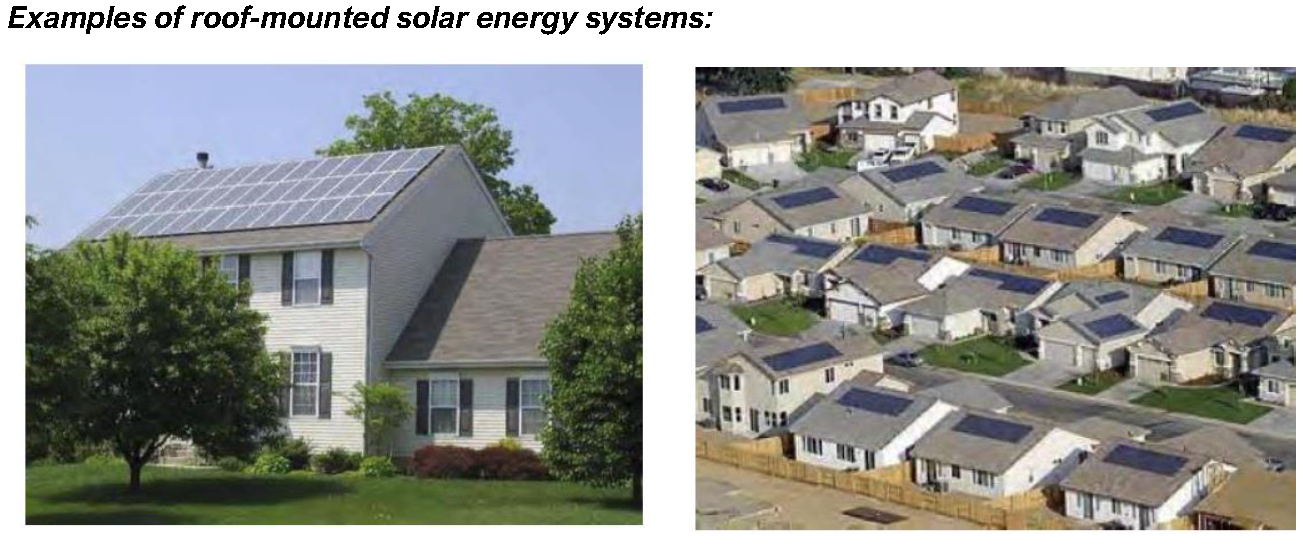
Roof-mounted systems.
a.
The system shall not extend more than ten (10) feet above the height of a low-pitched roof (flat roof to 5:12), may not exceed the ridgeline for pitched roofs and, in any case, shall not exceed the maximum allowed building height.
b.
The solar energy system components on pitched roofs must be mounted as flush to the roof or structure as practicable without significantly impairing the system performance.
c.
The collector surface and mounting devices for roof-mounted solar energy systems shall not extend beyond the exterior perimeter of the building on which the system is mounted or built.
(2)
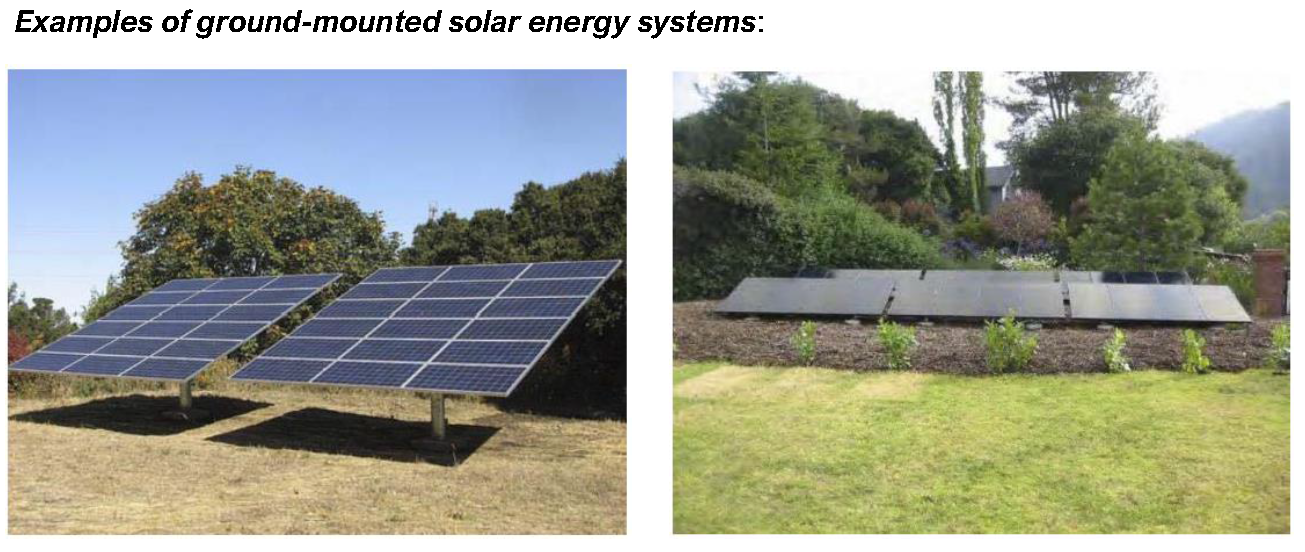
Ground-mounted systems. The height of a ground-mounted solar energy system shall not exceed fifteen (15) feet above the average unaltered grade determined by calculating the average grade within ten (10) feet of the outer perimeter of the system.
(3)
Location on lot.
a.
A solar collection device or combination of devices shall be designed and located to avoid glare or reflection onto adjacent properties and adjacent roadways, and shall not interfere with traffic or create a safety hazard.
b.
Solar energy systems may not extend into the side yard or rear setback.
(4)
Design and submission requirements.
a.
All owners of solar collection devices that generate electrical energy shall submit a map to the Town and emergency service providers noting the location of the solar collection devices and the panel disconnect.
b.
All exterior electrical and/or plumbing lines on ground-mounted systems must be buried below the surface of the ground.
c.
The owner of a grid-tied solar energy system shall provide written approval to the Town from the public utility company of such connection. Off-grid systems shall be exempt from this requirement.
d.
Building, electrical and plumbing permits, as applicable, shall be required for solar energy systems, including support structures, wiring, piping, and related components.
(5)
Decommissioning and removal. If a solar collector ceases to perform its originally intended function or is abandoned for more than twelve (12) consecutive months, the property owner shall remove the collector, mount, associated equipment, and facilities by no later than ninety (90) days after the end of the twelve-month period.
(d)
Solar energy system, large. All large solar energy systems shall comply with the requirements of Section 16-4-7(c) and the following standards:
(1)
Location and layout.
a.
Installation of the solar energy system shall not adversely impact adjacent properties.
b.
Tree removal shall be minimized and any removal shall be approved by the Town as part of the special use permit review process.
c.
Area of use may not exceed five (5) acres on-site. Adjacent properties shall not be used to aggregate solar collection panels to achieve an area exceeding five (5) acres.
d.
The applicant shall demonstrate that a utility solar energy system shall not unreasonably interfere with the view of, or from, sites of significant public interest such as public parks or a national- or state-designated scenic byway.
e.
Every effort must be made to screen the devices from view from public streets. In instances where complete screening is not possible, the devices must be screened and/or located as to have a minimal visual impact as seen from public streets and adjoining properties.
f.
Any earth disturbance as a result of the installation or removal of a solar energy system shall be regraded to natural ground contours, successfully reseeded and maintained in a predominantly weed-free condition.
(2)
Safety and screening.
a.
A clearly visible warning sign concerning voltage must be placed at the base of all pad-mounted transformers and substations.
b.
All mechanical equipment of solar energy systems, including any structure for batteries or storage cells, shall be completely enclosed by a minimum eight-foot-high fence with a self-locking gate, and adequately screened with landscaping, subject to approval by the Town as part of the special use permit review process.
c.
All power transmission lines from a solar energy system to any building or other structure shall be located underground.
(3)
Design.
a.
Other than wire size, there shall be no alteration of utility infrastructure to accommodate the system.
b.
The supporting framework for freestanding solar energy systems shall be constructed of materials that require minimal maintenance, are nonspecular, neutral in color and shall not include unfinished lumber.
(4)
Signs.
a.
A solar energy system shall not be used to display advertising, including signage, streamers, pennants, spinners, reflectors, ribbons, tinsel, balloons, flags, banners, or similar materials.
b.
The manufacturer's and equipment information, warning or indication of ownership shall be allowed on any equipment of the solar energy system.
(5)
Abandonment and decommissioning.
a.
If the owner of a solar energy system begins, but does not complete, construction of the project, the owner shall be responsible for restoring the site to the preconstruction condition within twelve (12) months, in conformance with a plan approved by the Town.
b.
Owners of a large solar energy facilities are required to notify the Town immediately upon cessation or abandonment of the operation. The owner shall be responsible for the removal of the facility within six (6) months from the date the applicant ceases use of the facility or the facility becomes obsolete. At the time of issuance of the special use permit for the construction of the solar energy facility, the owner shall provide financial security in form and amount acceptable to the Town to secure the expense of dismantling and removing said structures. The applicant and Town shall review the financial security annually to ensure that the amount remains sufficient for decommissioning the site.
(Ord. No. 751, § 1, 11-13-2019)
Sec. 16-4-8. - Wireless communication facilities (WCF).
(a)
Purpose and intent. In order to accommodate the communication needs of residents and businesses while protecting the public health, safety, and general welfare of the community, the Board of Trustees finds that these regulations are necessary to:
(1)
Provide for the managed development and installation, maintenance modification, and removal of wireless communications infrastructure in the Town with the fewest number of wireless communications facilities (WCFs) to complete a network without unreasonably discriminating against wireless communications providers of functionally equivalent services, including all of those who install, maintain, operate, and remove WCFs;
(2)
Promote and protect the public health, safety, and welfare by reducing the visibility of WCFs to the fullest extent possible through techniques including but not limited to camouflage design techniques and undergrounding of the equipment associated with WCFs;
(3)
Encourage the deployment of smaller, less intrusive WCFs to supplement existing larger WCFs;
(4)
Encourage the use of wall-mounted panel antennas;
(5)
Encourage roof-mounted antennas only when wall-mounted antennas will not provide adequate service or are not otherwise feasible;
(6)
Encourage the location of towers in non-residential areas in a manner that minimizes the total number of towers needed throughout the community;
(7)
Encourage, strongly, the colocation of WCFs on new and existing sites;
(8)
Encourage owners and users of antennas and towers locate them, to the extent possible, in areas where the adverse impact to the community is minimized;
(9)
Enhance the ability of wireless communications service providers to provide such services to the community quickly, effectively, and efficiently;
(10)
Effectively manage WCFs in the public right-of-way; and
(11)
Manage amateur radio facilities and over-the-air devices in the Town.
(b)
Application.
(1)
The requirements set forth in this Section shall apply to all eligible facilities requests and WCF applications for base stations, alternative tower structures, towers, micro cells, and small cells as defined in Article 2, Definitions and Measurements, and further addressed herein.
(2)
The requirements set forth in this Section shall not apply to:
a.
Amateur radio antennas that are owned and operated by a federally licensed amateur radio station operator or are exclusively receive only antennas, provided that the requirements that the height be no more than the distance from the base of the antenna to the property lines is met.
b.
Pre-existing WCFs. Any WCF for which a permit has been properly issued prior to adoption of this code shall not be required to meet the requirements of this Chapter, other than the requirements of Section 16-4-8(c)(6). Changes and additions to pre-existing WCFs (including trading out of antennas for an equal number of antennas) shall meet applicable requirements of Section 16-4-8(c), Operational Standards. Notwithstanding the foregoing, any modifications qualifying as an eligible facilities request shall be evaluated under this Section.
c.
Miscellaneous antennas. Antennas used for reception of television, multi-channel video programming and radio such as over-the-air receiving device (OTARD) antennas, television broadcast band antennas, satellite earth station antennas and broadcast radio antennas, provided that any requirements related to accessory uses contained in this Code and the requirement that the height be no more than the distance from the base to the property line are met. The Director or his or her designee has the authority to approve modifications to the height restriction related to OTARD antennas and OTARD antenna structures, if in the reasonable discretion of the Town, modifications are necessary to comply with federal law.
d.
A WCF installed upon the declaration of a state of emergency by the federal, state, or local government, or a written determination of serving the general health, safety, and welfare of residents by the Town, or reasonable ability to obtain such written determination within seventy-two (72) hours.
e.
A temporary WCF installed for the purpose of providing sufficient coverage for a special event, subject to administrative approval by the Town.
(c)
Operational standards.
(1)
Federal requirements. All WCFs shall meet the current standards and regulations of the FAA, the FCC and any other agency of the federal government with the authority to regulate WCFs. If such standards and regulations are changed, then the owners of the WCF shall bring such facility into compliance with such revised standards and regulations within the time period mandated by the controlling federal agency. Failure to meet such revised standards and regulations shall constitute grounds for the removal of the WCF at the WCF owner's expense.
(2)
Permission to use public right-of-way or public property. Prior to WCFs being sited in the ROW, the applicant shall have an executed license agreement with the Town, granting a non-exclusive license to use the public right-of-way. Attachment of WCFs on an existing traffic signal, street light pole, or similar structure shall require written evidence of a license, or other legal right or approval, to use such structure by its owner. The applicant shall remain the owner of, and solely responsible for any WCF installed in the ROW.
(3)
Operation and maintenance. To ensure the structural integrity of WCFs, the owner of a WCF shall ensure that it is maintained in compliance with the standards contained in applicable local building and safety codes. If upon inspection, the Town concludes that a WCF fails to comply with such codes and constitutes a danger to persons or property, then, upon written notice being provided to the owner of the WCF, the owner shall have thirty (30) days from the date of notice to bring such WCF into compliance. Upon good cause shown by the owner, the Town Administrator may extend such compliance period not to exceed ninety (90) days from the date of said notice. If the owner fails to bring such WCF into compliance within said time period, the Town may remove such WCF at the owner's expense.
(4)
Abandonment and removal. If a WCF has not been in use for a period of three (3) months, the owner of the WCF shall notify the Town of the non-use and shall indicate whether re-use is expected within the ensuing three (3) months. Any WCF that is not operated for a continuous period of six (6) months shall be considered abandoned. The Town, in its sole discretion, may require an abandoned WCF to be removed. The owner of such WCF shall remove the same within thirty (30) days of receipt of written notice from the Town. If such WCF is not removed within said thirty (30) days, the Town may remove it at the owner's expense and any approved permits for the WCF shall be deemed to have expired. Additionally, the Town, in its sole discretion, shall not approve any new WCF application until the applicant who is also the owner or operator of any such abandoned WCF has removed such WCF or payment for such removal has been made to the Town.
(5)
Hazardous materials. No hazardous materials shall be permitted in association with WCFs, except those necessary for the operation of the WCF and only in accordance with all applicable law governing such materials.
(6)
Colocation requirement. No WCF owner or operator shall unreasonably exclude a telecommunications competitor from using the same facility or location. Upon request by the Town Administrator, the owner or operator shall provide evidence explaining why colocation is not possible at a particular facility or site. In all cases, the applicant shall demonstrate that at least one (1) of the following conditions is present:
a.
The planned equipment and antenna would exceed the structural capacity of the existing or approved tower or base station within a reasonable search area as documented by a qualified and Colorado licensed engineer; or in the alternative, that the existing or approved tower or base station cannot be reinforced, modified or replaced to accommodate the planned or equivalent equipment at a reasonable cost;
b.
Existing or approved towers and base station within the search area cannot accommodate the planned telecommunications facilities at a height necessary to function reasonably, as documented by a qualified and Colorado-licensed engineer; or
c.
Other unforeseen reasons make it unfeasible to locate the planned telecommunications equipment upon an existing or approved tower or building.
(d)
Review procedures and requirements.
(1)
Applicability. No new WCF shall be constructed and no colocation or modification to any WCF may occur except after a written request from an applicant, reviewed and approved by the Town in accordance with this Code. All WCFS except eligible facilities requests which are reviewed under Subsection (1)c. of this Section, shall be reviewed pursuant to the following procedures:
a.
Review procedures for certain WCFs, including base stations, alternative tower structures, small cell facilities, and alternative tower structures within public rights-of-way. Applications for these WCF facilities shall be reviewed by the Town Administrator for conformance to this Section and Section 16-8-4(e), Design Standards. For WCFs in the right-of-way that are found to have a significant visual impact (i.e., proximity to historical sites), be incompatible with the structure of surrounding area, or not meet the intent of these provisions, the Town Administrator may refer the application for special use permit review.
b.
Review procedures for certain WCFs, including towers. Towers, other than those defined or excepted in subsection (1) above, must apply for special use permit review approval. These WCFs shall be reviewed for conformance using the procedures set forth in this Section. All applications for towers shall demonstrate that other alternative design options, such as using base stations or alternative tower structures, are not viable options as determined by the Town.
c.
Review procedures for eligible facilities requests.
1.
Eligible facilities requests shall be considered a use by right subject to administrative review. The Town shall prepare, and from time to time revise and make publicly available, an application form which shall be limited to the information necessary for the Town to consider whether an application is an eligible facilities request. Such information may include, without limitation, whether the project:
i.
Constitutes substantial change;
ii.
Violates a generally applicable law, regulations, or other rule codifying objective standards reasonably related to public health and safety.
The application may not require the applicant to demonstrate a need or business case for the proposed modification or colocation.
2.
Upon receipt of an application for an eligible facilities request pursuant to this Section, the Town Administrator shall review such application to determine whether the application so qualifies.
3.
Timeframe for review. Subject to the tolling provisions of subparagraph 4. below, within sixty (60) days of the date on which an applicant submits an application seeking approval under this Section, the Town shall approve the application unless it determines that the application is not covered by this Subsection, or otherwise in non-conformance with applicable codes.
4.
Tolling of the timeframe for review. The sixty-day review period begins to run when the application is filed, and may be tolled only by mutual agreement of the Town and the applicant, or in cases where the Director determines that the application is incomplete:
i.
To toll the timeframe for incompleteness, the Town must provide written notice to the applicant within thirty (30) days of receipt of the application, specifically delineating all missing documents or information required in the application;
ii.
The timeframe for review begins running again when the applicant makes a supplemental written submission in response to the Town's notice of incompleteness; and
iii.
Following a supplemental submission, the Town will notify the applicant within ten (10) days that the supplemental submission did not provide the information identified in the original notice delineating missing information. The timeframe is tolled in the case of second or subsequent notices pursuant to the procedures identified in Paragraph 4.i. In the case of a second or subsequent notice of incompleteness, the Town may not specify missing information or documents that were not delineated in the original notice of incompleteness.
5.
Failure to act. In the event the Town fails to act on a request seeking approval for an eligible facilities request under this Section within the timeframe for review (accounting for any tolling), the request shall be deemed granted. The request becomes effective when the applicant notifies the Town in writing after the review period has expired (accounting for any tolling) that the application has been deemed granted.
6.
Interaction with Telecommunications Act Section 332(c)(7). If the Town determines that the applicant's request is not an eligible facilities request as delineated in this Chapter, the presumptively reasonable timeframe under Section 332(c)(7), as prescribed by the FCC's shot clock order, will begin to run from the issuance of the Town's decision that the application is not a covered request. To the extent such information is necessary, the Town may request additional information from the applicant to evaluate the application under Section 332(c)(7) reviews.
d.
Review procedures for small cell facilities in the right-of-way.
1.
The Town shall prepare, and from time to time revise, and make publicly available, an application form which shall require submittal of information necessary for the Town to consider whether a project is eligible as a small cell facility in the right-of-way, meeting certain criteria. The application shall not require the applicant to demonstrate a need or business case for any proposed modification or colocation.
2.
Upon receipt of an application for a small cell facility in the right-of-way pursuant to this Section, the Town Administrator shall review such application to determine whether the applications so qualifies. Timeframe for review. Subject to the tolling provisions of subparagraph d., below, within sixty (60) calendar days of the date on which an applicant submits an application seeking approval under this Section, the Town shall approve the application unless it determines that the application is not covered by this Subsection, or otherwise in non-conformance with applicable codes.
(2)
Additional submittal requirements. In addition to the information required elsewhere in this Land Use Code, the following supplemental items are required for all applications for WCFs.
a.
A report from a qualified and licensed professional engineer that:
1.
Includes any and all technical information and design requirements, including colocation requirements, necessary to evaluate the request.
2.
Describes the tower height and design, including a cross-section and elevation.
3.
Documents the height above grade for all potential mounting positions for collocated antennas and the minimum separation distances between antennas.
4.
Describes the tower's capacity, including the number and type of antennas that it can accommodate.
5.
Documents what steps the applicant will take to avoid interference with established public safety telecommunication.
6.
Includes an engineer's stamp and registration number.
7.
A letter of intent committing the tower owner and his successors to allow the shared use of the tower if an additional user agrees in writing to meet reasonable terms and conditions of shared use.
b.
Proof that the proposed tower complies with regulations administered by the Federal Aviation Administration.
c.
Signal non-interference letter;
d.
Radio frequency emissions letter;
e.
Photo simulations showing before and after conditions;
f.
Inventory of sites. Each applicant for a WCF shall provide to the Town Administrator a narrative description and a map of the applicant's existing and currently proposed WCFs within the Town, and outside of the Town within one (1) mile of its boundaries. In addition, the applicant shall inform the Town generally of the areas in which it believes WCFs may need to be located within the next three (3) years. The inventory list should identify the site name, address, and a general description of the facility (i.e., rooftop antennas and ground-mounted equipment). This provision is not intended to be a requirement that the applicant submit its business plan, proprietary information, or make commitments regarding locations of WCFs within the Town. This information will be used to assist in the Town's comprehensive planning process and promote colocation by identifying areas in which WCFs might be appropriately constructed for multiple users.
The Town Administrator may share such information with other applicants applying for administrative approvals or conditional permits under this Section or other organizations seeking to locate WCFs within the jurisdiction of the town, provided however, that the Town Administrator, is not, by sharing such information, in any way representing or warranting that such sites are available or suitable.
g.
Abandonment and removal. Affidavits shall be required from the owner of the property and from the applicant acknowledging that each is responsible for the removal of a WCF that is abandoned or is unused for a period of six (6) months.
(3)
Decision. Any decision to approve, approve with conditions, or deny an application for a WCF, shall be in writing and supported by substantial evidence in a written record. The applicant shall receive a copy of the decision.
(4)
Compliance with applicable law. Notwithstanding the approval of an application for new WCFS or eligible facilities request as described herein, all work done pursuant to WCF applications must be completed in accordance with all applicable building, structural, electrical, and safety requirements as set forth in the Mancos Municipal Code and any other applicable laws or regulations. In addition, all WCF applications shall comply with the following:
a.
Comply with any permit or license issued by a local, state, or federal agency with jurisdiction of the WCF;
b.
Comply with easements, covenants, conditions and/or restrictions on or applicable to the underlying real property;
c.
Be maintained in good working condition and to the standards established at the time of application approval; and
d.
Remain free from trash, debris, litter, graffiti, and other forms of vandalism. Any damage shall be repaired as soon as practicable, and in no instance more than ten (10) calendar days from the time of notification by the Town or after discovery by the owner or operator of the site. Notwithstanding the foregoing, any graffiti on WCFs located in the right-of-way or on other town-owned property may be removed by the Town at its discretion, and the owner and/or operator of the WCF shall pay all costs of such removal within thirty (30) days after receipt of an invoice from the Town.
(e)
Design standards. The requirements set forth in this Section shall apply to the location and design of all WCFs governed by this Code as specified below; provided, however, that the Town may waive these requirements if it determines that the goals of this Section are better served thereby. To that end, WCFs shall be designed and located to minimize the impact on the surrounding neighborhood and to maintain the character and appearance of the Town, consistent with other provisions of this Code.
(1)
Camouflage/concealment. All WCFs and any transmission equipment shall, to the extent possible, use camouflage design techniques including, but not limited to the use of materials, colors, textures, screening, undergrounding, landscaping, or other design options that will blend the WCF into the surrounding natural setting and built environment.
a.
Camouflage design may be of heightened importance where findings of particular sensitivity are made (e.g., proximity to historic, natural, or aesthetically significant structures or areas, views, and/or community features or facilities). In such instances where WCFs are located in areas of high visibility, they shall (where possible) be designed (e.g., placed underground, depressed, or located behind earth berms) to minimize their profile.
b.
The camouflage design may include the use of alternative tower structures should the Town Administrator determine that such design meets the intent of this Code and the community is better served thereby.
c.
All WCFs, such as antennas, vaults, equipment rooms, equipment enclosures, and tower structures shall be constructed out of non-reflective materials (visible exterior surfaces only).
(2)
Colocation. WCFs shall be designed and constructed to permit the facility to accommodate WCFs from at least two (2) wireless service providers on the same WCF, to the extent it is reasonably feasible based upon construction, engineering and design standards, except where such colocation would materially compromise the design intent of the WCF, particularly visually.
(3)
Lights and other attachments.
a.
WCFs shall not be artificially illuminated or display strobe lights, unless required by the Federal Aviation Administration or other governmental authority, or the WCF is mounted on a light pole or other similar structure primarily used for lighting purpose. If lighting is required it shall conform to lighting standards of Article 12, Outdoor Lighting.
b.
All exterior lighting within equipment yards shall be mounted on poles or on the building wall below the height of the screen wall or fence.
c.
No tower shall have constructed on, or attached to, any additional platform, catwalk, crow's nest or like structure (other than those required by industry standards or federal regulations), except during periods of construction or repair).
d.
Signs and advertising. The use of any portion of a tower for signs or advertising device other than public safety warnings, certifications, or other required seals on any wireless communication device or structure is prohibited. However, the telephone numbers to contact in an emergency shall be posted on each facility.
(4)
Noise. Noise generated on the site must not create any noise emitted at levels described in Article 10 of the Mancos Municipal Code, except that a WCF owner or operator shall be permitted to exceed such noise standards for a reasonable period of time during repairs, not to exceed two hours without prior authorization from the Town.
(5)
Landscaping requirements.
a.
WCFs shall be sited in a manner that does not reduce the landscaped areas for the other principal uses on the parcel.
b.
WCFs, including small cells unless an exception is granted by the Town Administrator, shall be landscaped with a buffer of plant materials that effectively screen the view of the WCF from rights-of-way and adjacent properties. Where the Town has requested additional landscaping, the Town may require irrigation requirements for the landscaping.
(6)
Screening requirements.
a.
All equipment, not located within the public right-of-way and not otherwise defined, shall be fully screened within a walled yard or placed in an enclosed building except in cases where a better design alternative exists. The yard shall be enclosed by a solid fence or wall of sufficient height to screen all miscellaneous equipment from view from the public right-of-way or adjacent properties and to provide security.
b.
All structures and improvements associated with the WCF shall be provided with adequate safety equipment and aesthetic treatments, including incorporating landscape screening, to be visually compatible with uses in the surrounding area.
c.
Roof-top mounted equipment shall be screened from off-site views to the extent practical by solid screen walls or the building's parapet.
(7)
WCFs adjacent to single-family residential uses. WCFs shall be sited in a manner that evaluates the proximity of the facility relative to residential structures, neighborhoods, and residential zoning boundaries in order to minimize the visual impacts of WCFs on residential areas.
a.
When placed near residential property, the WCF shall be placed in close proximity to a common property line between adjoining residential properties, such that the WCF minimizes visual impacts equitably among adjacent and nearby properties.
b.
For a corner lot, the WCF may be placed adjacent to a common property line between adjoining residential properties, or on the corner formed by two (2) intersecting streets.
c.
If these siting requirements are not reasonably feasible from a construction, engineering, or design perspective, the applicant may submit a written statement to the Town Administrator requesting the WCF be exempt from these requirements, and offer alternative locations reasonably meeting the intent of this Section.
(8)
Design requirements specific to various types of WCFs.
a.
Base stations.
1.
If an antenna and/or accessory equipment is installed on a base station it shall be of a neutral, non-reflective color that is identical to, or closely compatible with, the color of the base station, or uses other camouflage or concealment design techniques so as to make the antenna and related facilities as visually unobtrusive as possible, including for example, without limitation, painting the antennas and accessory equipment to match the structure.
2.
Ground mounted equipment shall be located in a manner necessary to address both public safety and aesthetic concerns. The Town Administrator may, where appropriate, require a flush-to-grade underground equipment vault.
b.
Alternative tower structures, not in the public right-of-way shall:
1.
Be designed and constructed to look like a building, facility, structure, or other commonplace item, such as but not limited to a tree, public art, or clocktower, typically found in the area.
2.
Be camouflaged/concealed consistent with other existing natural or man-made features in or near the location where the alternative tower structure will be located.
3.
Be compatible with the surrounding area, including architecture, topography, and/or landscaped environment.
4.
Be the minimum size needed to obtain coverage objectives. Height or size of the proposed alternative tower structure should be minimized as much as possible.
5.
Be sited in a manner that is sensitive to the proximity of the facility to residential structures, neighborhoods, and residential zoning district boundaries.
6.
Take into consideration the uses on adjacent and nearby properties and the compatibility of the facility to these uses.
7.
Take into consideration the uses on adjacent and nearby properties and the compatibility of the facility to these uses.
c.
Alternative tower structures in the public right-of-way.
1.
Such facilities shall be subject to the alternative tower structures standards of approval in subsection (8)b., and subject to these additional design criteria.
2.
Alternative tower structures and associated small cells, or micro cells may be deployed in the public right-of-way through the utilization of a street light pole, distribution lines, utility poles, traffic signal or similar structure.
3.
To the extent that an alternative tower structure is a vertical structure located in the public right-of-way, its pole-mounted components shall be located on or within an existing pole serving another utility.
4.
With respect to its pole components, such components shall be located on or within a new utility pole where other utility distribution lines are aerial, and there are no reasonable alternatives, and the applicant is authorized to construct the new utility poles.
5.
Alternative tower structures shall be consistent with the size and shape of similar pole-mounted equipment installed by communications companies on utility poles in the right-of-way near the proposed alternative tower structure.
6.
Alternative tower structures shall be designed such that antenna installations on traffic signal standards are placed in a manner so that the size, appearance, and function of the signal will not be considerably or functionally altered.
7.
Alternative tower structures shall be sized to minimize the negative aesthetic impacts to the right-of-way and adjacent properties.
8.
Ground mounted equipment shall be located in a manner necessary to address both public safety and aesthetic concerns in the reasonable discretion of the Town Administrator, and may, where appropriate, require a flush-to-grade underground equipment vault.
9.
Alternative tower structures shall not alter vehicular circulation or parking within the right-of-way or impede vehicular, bicycle, or pedestrian access or visibility along the right-of-way. The alternative tower structure must comply with the Americans with Disabilities Act and every other local, state, and federal law and regulation. No alternative tower structure may be located or maintained in a manner that causes unreasonable interference.
10.
Alternative tower structures may not be more than five (5) feet taller (as measured from the ground to the top of the pole) than any existing utility or traffic signal pole within a radius of six hundred (600) feet of the pole or structure. A new freestanding alternative tower structure may not be higher than thirty (30) feet. Alternative tower structures located on any existing or replacement pole may not be higher than the height of the existing pole.
11.
Alternative tower structures in the right-of-way shall not exceed eighteen (18) inches in diameter.
12.
Alternative tower structures shall be separated from any other wireless communication facility located in the right-of-way by a distance of at least six hundred (600) feet unless deployed as an existing base station in the right-of-way.
13.
Colocations are strongly encouraged to limit the number of poles within the right-of-way to the extent reasonably feasible from a construction, design and engineering perspective.
14.
Equipment enclosures shall be located out of view to the extent possible and shall comply with all applicable Town criteria.
d.
Tower design. Proposed or modified towers, antennas, accessory structures and buildings shall meet the following design requirements:
1.
Towers shall either maintain a galvanized steel finish or subject to any applicable FAA standards and Town design approval processes, be painted a neutral color so as to reduce visual obtrusiveness.
2.
Wherever possible, towers and antennas shall locate to utilize existing landforms, vegetation, and structures in order to blend into the surrounding built and natural environment through the use of color and camouflaging architectural treatment.
3.
Towers shall be of monopole design, unless the Board of Trustees determines that an alternative design would be more appropriate to or better blend in with the surrounding land uses and environment. Monopole structures shall taper from the base to the tip.
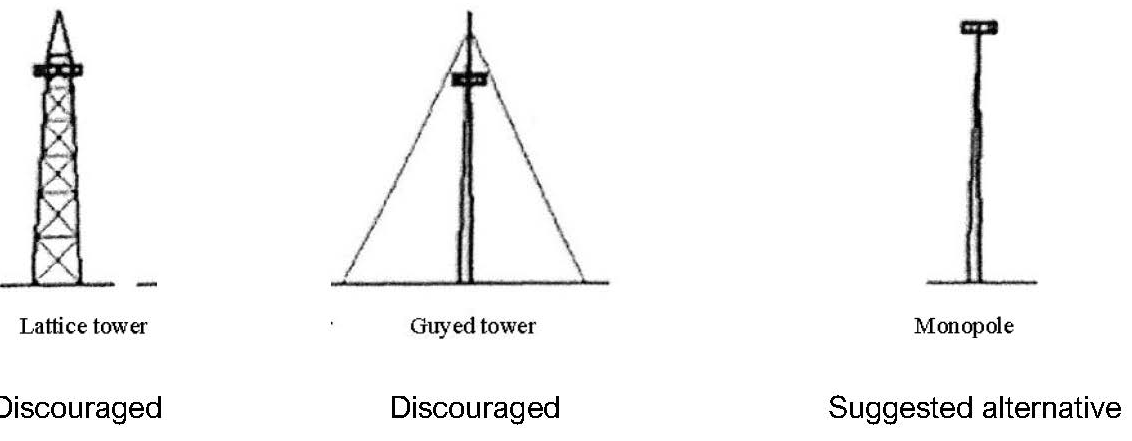
Fig. 16-4.A: Tower design preferences
4.
All towers, excluding alternative tower structures in the right-of-way, shall be enclosed by security fencing or wall and shall also be equipped with an appropriate anti-climbing device.
e.
Tower height. Towers shall be subject to the height restrictions of each zoning district.
1.
The maximum height of all commercial wireless antennas and supporting Towers shall not exceed eighty (80) feet.
2.
No tower shall be in excess of a height equal to the distance from the base of the antenna and tower to the nearest overhead electrical power line, less five (5) feet.
3.
Notwithstanding the above provision to the contrary, the maximum height of all commercial wireless antennas and supporting towers shall not exceed the minimum that is technically necessary to serve the design purpose.
f.
Accessory structure and building design. The design of accessory or related structures or control buildings shall be architecturally designed to blend in with the surrounding buildings and environment, and they shall meet the minimum setback requirements of the underlying zoning district.
g.
The Town, in its discretion may require that all proposed telecommunications facilities shall be engineered and designed structurally in all respects to accommodate both the applicant's antennas and equipment and comparable antennas and equipment for a minimum of two (2) additional uses, if the tower is over sixty (60) feet tall, and one (1) additional user for each additional ten (10) feet over sixty (60) feet.
h.
Base stations.
1.
Antennas and other proposed equipment shall be architecturally compatible with the base station and, when appropriate, colored or otherwise camouflaged to integrate with the base station to which they are attached.
2.
Facilities mounted on a base station shall be installed as flush to the wall as technically practical. The maximum protrusion of such facilities from the building or structure face to which they are attached shall be six feet.
i.
Roof mounted WCFs.
1.
Roof-mounted WCFs may be approved only where an applicant sufficiently demonstrates that a wall mounted WCF is inadequate to provide service. By filing an application for a roof-mounted WCF, an applicant is certifying agreement to the Town's determination that the height extensions described in subsections ii and iii below are the maximum heights that will allow the WCF to be camouflaged, and that any additional increase in height will undermine the camouflage nature of the site.
2.
Roof mounted antennas shall extend no more than ten (10) feet above the parapet of any flat roof or ridge of a sloped roof to which they are attached.
3.
Other roof mounted transmission equipment shall extend no more than ten (10) feet above any parapet of a flat roof upon which they may be placed and shall not be permitted on a sloped roof.
4.
All rooftop equipment and antennas must be adequately screened.
j.
Related accessory equipment.
1.
All buildings, shelter, cabinets, and other accessory components shall be grouped as closely together as technically possible.
2.
The total footprint coverage area of the WCF's accessory equipment shall not exceed three hundred fifty (350) square feet.
3.
No related accessory equipment or accessory structure shall exceed twelve (12) feet in height.
4.
Related accessory equipment, including but not limited to remote radio units, shall be located out of sight whenever possible by locating behind parapet walls or within equipment enclosures. Where such alternate locations are not available, the accessory equipment shall use camouflage design techniques.
(f)
Standards for approval. It is the intent of the Town to provide for approval of WCFs administratively in cases where visual impacts are minimized, view corridors are protected, appropriate camouflage and concealment design techniques are employed to avoid adverse impacts on the surrounding area, and they are designed, maintained, and operated at all times to comply with the provisions of this Chapter and all applicable laws. Notwithstanding the approval of an application for eligible facilities request as described herein, all work done pursuant to WCF applications must be completed in accordance with all applicable building and safety requirements as set forth in municipal code and any other applicable regulations.
(1)
Use by special use permit review. Any application for a WCF which does not comply with the provisions of this Section may seek special use permit review approval.
(2)
Colocation and separation required. No new towers, excepting small cell facilities in the right-of-way, shall be permitted unless the applicant demonstrates to the reasonable satisfaction of the Town that no existing WCFs can accommodate the needs that the applicant proposes to address with its tower application, and sufficient separation of towers is achieved. Evidence may consist of the following:
a.
No existing WCFs with a suitable height are located within the geographic area required to meet the applicant's engineering requirements;
b.
No existing WCFs with a suitable height are located within the geographic area required to meet the applicant's engineering requirements;
c.
The applicant's proposed WCFs would cause electromagnetic interference with the existing WCFs or the existing WCF would cause interference with the applicant's proposed WCF;
d.
The applicant demonstrates that there are other limiting factors that render existing WCFs unsuitable for colocation; and
e.
Towers over eighty (80) feet in height shall not be located within one-quarter-mile from any existing tower that is over eighty (80) feet in height, unless the applicant has shown to the satisfaction of the Town that there are no reasonably suitable alternative sites in the required geographic area which can meet the applicant's needs.
(3)
Siting and setbacks. The following minimum setback requirements shall apply to all WCFs, excepting small cell facilities in the right-of-way; provided, however, that the Town may reduce standard setbacks requirements if the applicant demonstrates that the goals of this Section can be met through performance options or through alternative compliance, or through a variance process. A tower shall meet the greater of the following minimum setbacks from all property lines:
a.
The setback for a principal building within the applicable zoning district;
b.
Twenty-five percent (25%) of the facility height, including WCFs and related accessory equipment; or
c.
For sites within one hundred (100) feet of residential uses, facilities over thirty (30) feet in height shall have a minimum setback from all adjacent residential property lines of one (1) foot for every foot in height.
(g)
Interference with public safety telecommunications. No telecommunications service shall interfere with public safety telecommunications. All applications for new service shall be accompanied by an intermodulation study, which provides a technical evaluation of existing and proposed transmissions and indicates all potential interference problems, except applications for eligible facilities requests which shall only be required to provide a letter from a radio frequency engineer certifying no interference. Before the introduction of new service or changes in existing service, telecommunication providers shall notify the Board of Trustees at least ten (10) calendar days in advance of such changes and allow the Board of Trustees to monitor interference levels during the testing process. The Board of Trustees may require a new conditional use permit for such new services or changes, except eligible facilities requests and applications for small cells in the right-of-way.
(h)
Performance standards. All towers must conform to the applicable performance standards in Section 16-4-9.
(Ord. No. 751, § 1, 11-13-2019; Ord. No. 761, § 1, 10-28-2020)
Sec. 16-4-9. - Generally applicable performance standards.
(a)
Applicability. To protect the public health, safety, and welfare of the Town, all uses in any zone district shall conform in operation, location, and construction to the performance standards of this Section.
(b)
Exemption. The following are exempt from the performance standards:
(1)
Temporary construction, excavation, and grading associated with development for which applicable permits have been issued, and with the installation of streets or utilities; and
(2)
Demolition activities that are necessary and incidental to permitted development on the same lot, on another or several lots being developed at the same time, or in the public right-of-way or easement.
(c)
General. The location, size, design, and operating characteristics of all uses shall minimize adverse effects, including visual impacts on surrounding properties.
(d)
Noise. The sound pressure level of any use, operation, or plant shall not produce noise of such intensity as to create a nuisance or detract from the use and enjoyment of the adjacent property, as measured on the bounding property line. For the purposes of this Article, bounding property line shall be interpreted as being at the far side of any street alley, stream, or other permanently dedicated open space from the noise source when such open space exists between the property line of the noise source and adjacent property. When no such open space exists, the common line between two (2) parcels of property shall be interpreted as the bounding property line.
(e)
Smoke and particulate matter. Any use in any district shall not create smoke and particulate matter that, when considered at the bounding property line of the source of operation, creates a nuisance or distracts from the use and enjoyment of adjacent property. This provision shall not be interpreted as to prevent the normal operation of a permitted wood-burning stove.
(f)
Odorous matter. Any use in any district shall not emit odorous matter that exceeds the odor threshold at the bounding property line or any point beyond the tract on which such use or operation is located. The odor threshold shall be the concentration of odorous matter in the atmosphere necessary to be perceptible to the olfactory nerve of a normal person.
(g)
Fire and explosive hazard material.
(1)
Explosives. No use involving the manufacture or storage of compounds or products that decompose by detonation shall be permitted in any district, except that chlorates, nitrates, phosphorus, and similar substances and compounds in small quantities for use by industry, school laboratories, druggists, or wholesalers may be permitted when approved by the Fire Chief as not presenting a fire or explosion hazard.
(2)
Flammables. The storage and use of all flammable liquids and materials such as pyroxylin plastics, nitrocellulose film, solvents, and petroleum products shall be permitted only when such storage or use conforms to the standards and regulations of the Town.
(h)
Toxic and noxious matter. Any use in any district shall not emit a concentration across the bounding property line of the tract on which such operation or use is located of toxic or noxious matter that will exceed the threshold limits set forth by the Colorado Department of Public Health and Environment.
(i)
Vibration. Any use in any district shall not create earth-borne vibration that, when considered at the bounding property line of the source of operation, creates a nuisance or distracts from the use and enjoyment of adjacent property.
(j)
Glare. Any use in any district shall not be located or conducted so as to produce intense glare or direct illumination across the bounding property line from a visible source of illumination, nor shall any such light be of such intensity as to create a nuisance or detract from the use and enjoyment of adjacent property.
(Ord. No. 751, § 1, 11-13-2019)
Sec. 16-4-10. - Accessory uses.
(a)
Purpose. This Section authorizes the establishment of accessory uses that are customarily subordinate to principal uses, provided that the accessory use complies with all applicable standards in this Section.
(b)
Approval of accessory uses and structures.
(1)
Permitted accessory uses are identified by zone district in Table 16-4.2: Accessory Uses. All accessory uses shall be subject to the standards in this Section, as well as any use-specific standards applicable to the associated principal use as set forth in this Article.
(2)
No accessory use may be established prior to establishment of the principal use with which such accessory use is associated.
(c)
Interpretation of unidentified accessory uses and structures. The Zoning Administrator shall evaluate applications for accessory uses that are not identified in Table 16-4.2 on a case-by-case basis. If the request meets the criteria identified below, the Zoning Administrator is authorized to determine the most similar, and thus most appropriate accessory use and apply the regulations for the similar accessory use to the application.
(1)
The definition of "accessory use" in this Code, and the general accessory use standards and limitations established in this Section;
(2)
The purpose and intent of the district in which the accessory use is located;
(3)
Potential adverse impacts the accessory use or structure may have on other lots, compared with other accessory uses permitted in the district; and
(4)
The compatibility of the accessory use with other principal and accessory uses permitted in the district.
(d)
Generally applicable standards. All accessory uses and structures shall comply with the following standards:
(1)
Compliance with this Code.
a.
All accessory uses and structures shall be subject to the dimensional requirements of the zone district in which they are located except as specifically provided in this Section. In the case of any conflict between the accessory use/structure standards of this Section and any other requirement of this Code, the more restrictive standards shall control.
b.
Accessory uses shall comply with all standards of this Code applicable to the principal use with which they are associated. Parking requirements shall be met for both the principal use and any accessory use.
(2)
Location.
a.
The accessory use or structure shall be conducted or located on the same lot(s) as the principal use.
b.
No accessory building shall be erected in any required setback nor within five (5) feet of any other building except that accessory buildings not exceeding six hundred (600) square feet may be permitted in the required side and rear setbacks provided such accessory buildings are at least five (5) feet from any property line and do not encroach into any access, utility, or drainage easements.
(3)
Dimensions. Unless otherwise specified in this Section, the following dimensional standards apply to accessory uses:
Notes:
[1] Between accessory and primary structure or accessory structure. Accessory structures shall comply with zone district setback requirements between the accessory structure and the lot line.
[2] Except as provided for in Section 16-3-8, the maximum height for accessory uses is twenty (20) feet, and in no case taller than the principal structure.
(e)
Accessory dwelling units (ADUs).
(1)
Applicability.
a.
New units.
1.
New attached and detached accessory dwelling units are permitted by right in the single-family zone districts and are allowed by special use permit in the multifamily and mixed-use zone districts. New, wholly internal ADUs are permitted in commercial districts.
2.
Accessory dwelling units in applicable zones are permitted on any parcel where a single dwelling unit is permitted or currently exists.
3.
The minimum lot size for a lot that has both a primary dwelling unit and an accessory dwelling unit is three thousand (3,000) square feet.
b.
Existing units. Existing residential units in mixed-use and commercial districts that meet the standards of this Section may be used as legal accessory dwelling units. Paragraph (e)(2) will be considered satisfied where the ADU and mixed-use or commercial structure on the same site are in identical ownership.
(2)
Ownership and occupancy.
a.
The property owner shall live in either the primary or accessory dwelling unit, with one (1) of the units serving as their principal residency for at least six (6) months in a year. No third-party rentals, including short-term rentals, shall occur in the owner-occupied unit.
b.
The property owner shall record a deed restriction with the Montezuma County Recorder requiring owner-occupancy of the property. Evidence of recordation of the deed restriction shall be provided to the Town.
c.
The accessory dwelling unit shall not be sold separately or subdivided from the primary dwelling unit or lot.
(3)
Dimensional standards and location.
a.
One (1) accessory dwelling unit is permitted per residential lot. The ADU shall be located on the same lot as the primary unit.
b.
Unless specifically addressed in this Section, accessory dwelling units are subject to the dimensional regulations for a principal building of the underlying zone district; e.g., setback/yard requirements and building coverage.
1.
A detached accessory dwelling unit shall not cover more than thirty percent (30%) of the available rear yard between the primary structure building line and the rear yard setback line.
2.
These standards do not apply to legally established detached garages that contain an accessory dwelling unit. Any expansion of a detached garage for conversion into an ADU shall comply with the appropriate setback and yard requirements for the detached garage.
3.
Maximum height for a new, detached accessory dwelling unit shall not exceed the height of the principal dwelling unit.
4.
The footprint of a detached accessory dwelling unit shall not exceed the footprint of the principal dwelling unit.
c.
An existing accessory structure whose height or setback(s) does not meet the requirements for a dwelling in the zone district may be converted into an accessory dwelling unit, but the structure may not be altered in any manner that would increase the degree of non-conformity.
(4)
Size.
a.
The gross floor area of a new accessory dwelling unit attached or internal to the primary dwelling unit shall not exceed the gross floor area of the primary dwelling unit.
b.
The maximum gross floor area of a new detached accessory dwelling unit shall be no more than eighty percent (80%) of the gross floor area of the principal dwelling unit or seven hundred fifty (750) square feet, whichever is less.
(5)
Construction.
a.
Accessory dwelling units must contain a kitchen or a food prep area, bathroom, and sleeping area for the sole use of the unit.
b.
Water and sewer service shall be provided. The principal unit and accessory unit may share utilities.
c.
Mobile homes, manufactured housing, recreational vehicles, travel trailers, and any other wheeled or transportable structure shall not be used as accessory dwelling units.
d.
An accessory dwelling unit permit application and building permits are required prior to construction. A building permit fee shall be paid prior to issuance of a building permit. No accessory dwelling unit shall be occupied without a certificate of occupancy.
e.
A water and sewer plant investment fee shall be charged prior to the issuance of the building permit per the town's current fee schedule and Chapter 13 of the Mancos Municipal Code. The charge for the water and sewer plant investment fee for the accessory dwelling unit shall be one-third (⅓) of the current tap fee for water and sewer service. In the case of an accessory dwelling unit already in existence at the time of this ordinance, the water and sewer plant investment fees must be paid prior to obtaining a certificate of occupancy. The accessory dwelling unit shall share a tap and utility meters with the principal structure, except where the utility provider requires separate meters for an accessory dwelling unit. The property owners shall be responsible for all water and sewer charges associated with both the principal structure and the ADU and will be billed in a single statement for both the primary structure and the accessory dwelling unit's monthly water and sewer charges.
f.
Accessory dwelling units are subject to a street impact fee per Article 16, Impact Fees which shall be paid prior to a building permit for the accessory dwelling unit. In the case of an accessory dwelling unit already in existence at the time of this ordinance, the street impact fee must be paid based on the fee schedule provided herein prior to obtaining a certificate of occupancy.
(6)
Design.
a.
Accessory dwelling units may be incorporated within or added onto a principal dwelling unit, garage, or other accessory structure, or may be built as a separate, detached structure on a lot where a single-family dwelling exists or will exist.
b.
An ADU, either detached or an extension of an existing structure, shall be designed to maintain the architectural design, style, appearance, and character of the primary structure, including compatibility with the neighborhood.
c.
Accessory dwelling units shall have a separate entrance with a clearly labeled street address. Houses with an incorporated accessory dwelling unit may not create additional entrances facing the same street.
(7)
Parking. The accessory dwelling unit shall have at least one (1) dedicated off-street parking space in addition to the parking required for the primary dwelling unit. An exception to the parking requirement may be granted if it is demonstrated to planning staff that the additional parking space for the ADU is not feasible and/or on-street parking is available without negatively impacting the neighborhood.
(8)
Home occupations. Home occupations are permitted in an accessory dwelling unit.
(9)
Rental. If the property owner chooses to rent the accessory dwelling unit for less than a thirty-day lease (short term rentals), the requirements of Chapter 6 of the Mancos Municipal Code shall apply. A Town business license shall be required, as well as payment of all applicable fees and taxes per Chapter 6 of the Mancos Municipal Code.
(f)
Cottage industry. Cottage industries may include a wide variety of online retail, service and office uses, but shall not include eating and/or drinking establishments. The following cottage industry standards are intended to permit residents to engage in cottage industries that are compatible with residential land uses and to ensure that cottage industries do not adversely affect the integrity of residential areas. A cottage industry shall be considered an accessory use, subject to the following standards:
(1)
The cottage industry shall be permitted only on lots with twice the minimum lot size of the underlying zone district and in lieu of an otherwise permitted dwelling unit.
(2)
The cottage industry shall comply with the compatibility standards of Section 16-10-2. Signage may be permitted pursuant to Article 13, Signs.
(3)
The cottage industry may be located within a single-family dwelling unit, not to exceed forty percent (40%) of the dwelling, or in a separate structure not to exceed one thousand two hundred (1,200) square feet.
(4)
Hours of operation shall be limited to between 8:00 a.m. and dusk.
(5)
All exterior aspects of the operation shall not disrupt the residential character of the area.
(6)
There shall be no visible storage of equipment, materials or vehicles with more than two (2) axles.
(g)
Drive through (thru). A drive through facility may be permitted only as an accessory use; i.e., in combination with other uses such as a bank or financial institution, restaurant, retail store, dry cleaners, laundry, or pharmacy.
(h)
Electric vehicle charging station.
(1)
Where permitted.
a.
Level 1 and 2 electric vehicle charging stations are a permitted use in all zoning districts.
b.
Level 3 electric vehicle charging stations are a permitted use in the C, CMU, and LI zoning districts, and may be permitted through special use permit in any mixed-use zoning district.
c.
Battery exchange stations are permitted in the LI zoning district.
(2)
Standards. Electric vehicle charging stations utilizing parking stalls located in a parking lot, parking garage or in on-street parking spaces shall comply with the following standards:
a.
Except when located in conjunction with single-family residences, electric vehicle charging stations shall be reserved for parking and charging of electric vehicles only. Parking spaces that have electric vehicle charging stations shall be counted toward the required parking for the associated use.
b.
Accessible charging stations shall be located in proximity to the buildings or facility entrances and shall be connected to a barrier-free accessible route of travel.
c.
Equipment mounted on pedestals, lighting posts, bollards, or other devices for on-street charging station shall be designed and located as to not impede pedestrian travel or create trip hazards within the right-of-way.
d.
Charging station outlets and connectors shall be no less than thirty-six (36) inches or no higher than forty-eight (48) inches from the top of the surface where mounted and shall contain a retraction device or a place to hang cords and connectors above the ground surface.
e.
Equipment shall be protected by wheel stops or concrete-filled bollards.
(3)
Notification. The following information shall be posted at all electric vehicle charging stations:
a.
Hour of operations if time limits or tow-away provisions are to be enforced by the property owner;
b.
Usage fees, if applicable; and
c.
Contact information for reporting when the equipment is not operating or other problems.
(i)
Home-based businesses. The Town recognizes that the restrictions set forth in this Section do not anticipate all possible types of home-based businesses. The following operational standards are applicable to all home-based businesses:
(1)
Registration and permitting.
a.
Owners of home occupations shall register the home occupation with the Town.
b.
Applicants with requests for home occupation registration where the home occupation does not comply with this Section may submit a request for a special use permit to approve the home occupation.
(2)
Floor area.
a.
The use of the dwelling unit for the home occupation shall be clearly incidental and subordinate to its use for residential purposes by its occupants.
b.
Up to twenty-five percent (25%) of the floor area of the dwelling unit, but in no case more than five hundred (500) square feet, may be used in the conduct of the home occupation.
(3)
Traffic and parking.
a.
On-street parking is not permitted.
b.
Vehicles used primarily as passenger vehicles including pickup trucks and step-type vans only shall be permitted in connection with the conduct of the customary home occupation.
c.
The home occupation shall not cause the elimination of required off-street parking. No more than two (2) vehicles owned by patrons of the home occupation business shall be parked on-site or off-site at any time.
(4)
Equipment.
a.
No equipment or process shall be used in such home occupation which creates noise, vibration, glare, fumes or electrical interference detectable to the normal senses off the lot, if the occupation is conducted in a single-family housing unit, or outside the housing unit if conducted in other than a single-family housing unit.
b.
In the case of electrical interference, no equipment or process shall be used which creates visual or audible interference in any radio or television receivers off the premises, or causes fluctuations in line voltage off the premises.
(5)
Outdoor merchandise. No display of products shall be visible from the street.
(6)
Number of People.
a.
Only one (1) person other than members of the family residing on the premises shall be engaged in such occupation.
b.
Home occupations shall be limited to no more than five (5) patrons per day.
(j)
Outdoor seating.
(1)
Eating and drinking establishments may provide outdoor seating areas, including rooftop seating, for customers following design review and issuance of a liquor license where applicable. The approval of outdoor seating shall be reviewed against the following criteria:
a.
Outdoor seating areas may not occupy required parking spaces or parking area access aisles.
b.
An outdoor seating area exceeding ten percent (10%) of the indoor building floor area is counted as floor area for purposes of determining off-street parking and loading requirements.
(2)
Sidewalk seating may be permitted under the following conditions:
a.
The area of occupancy must be abutting and contiguous to the restaurant in which food preparation, sanitation and related services for the sidewalk cafe will be performed.
b.
Sidewalk seating may not be enclosed by fixed walls, unless such walls are necessary to comply with requirements to serve alcohol, and shall be open to the air, except that it may have a canopy.
c.
There shall be an ADA-compliant unimpeded sidewalk remaining for pedestrian flow from the face of the curb and the area of sidewalk seating.
d.
The sidewalk seating shall be located a minimum of five (5) feet from driveway and alleys, and ten (10) feet from intersections.
e.
All curbs, alleys, sidewalks and public rights-of-way adjacent to the sidewalk seating shall be kept in a clean and orderly condition.
(k)
Short-term rentals.
(1)
Purpose. The purposes of the Mancos short-term rental unit licensing program are to:
a.
Maintain the viability and affordability of owner and renter-occupied residential housing in Mancos.
b.
Protect existing commercial structures and spaces from investment pressure to convert to residential short-term rental use.
c.
Ensure that traditional residential neighborhoods are not turned into tourist areas to the detriment of full-time residents.
d.
Prevent the creation and use of pseudo-hotels in residential neighborhoods.
e.
Ensure that short-term rental owners maintain compliance with the Town's LUC and other relevant municipal regulations.
f.
Support the property values of all properties in a neighborhood, not just those lots with short-term rentals.
g.
Minimize public safety risks and the noise, trash, and parking problems often associated with short-term rentals.
h.
Give permanent residents the option to occasionally utilize their properties to generate extra income from short-term rentals as long as all of the Town's other policy objectives are met.
i.
Protect the health, safety, and general welfare of the community.
j.
Establish a comprehensive review and licensing process to safeguard the public health, safety, and welfare of the community by regulating and controlling use, occupation, location, and maintenance of short-term rental properties within the Town of Mancos.
(2)
Business license for a short-term rental (STR) required.
a.
Business license issuance.
1.
A business license is required for all short-term rentals. A separate license is required for each short-term rental unit on a property. It shall be unlawful for any person to operate a short-term rental without a valid business license.
2.
The business license must be obtained before the rental is advertised or used, except as provided in Subsection (k)(3), Applicability to existing short-term rental licenses, for properties with existing short-term rental licenses.
3.
Business licenses for short-term rentals are not transferrable and they do not run with the property.
b.
A short-term rental business license shall only be issued to any of the following, whose name shall appear on the deed of the property:
1.
A natural person;
2.
A trust, if the beneficiary of the trust is a natural person; or
3.
A limited liability company or a closely held corporation with three or fewer members or shareholders who are natural persons. Please reference the definition of natural persons.
c.
The business license holder shall be responsible for payment of all taxes, including any applicable sales and lodging taxes.
d.
Renewal.
1.
All business licenses shall be renewed annually pursuant to Mancos Municipal Code Chapter 6, Article 8.
2.
Renewal applications for properties that have been compliant with the short-term rental regulations and that have been submitted for renewal in a timely manner will be given priority processing over new applications.
e.
The regulations in this section apply to short-term rentals only. They do not apply to long-term leases or businesses that provide lodging services with a staffed central check-in desk, such as a hotel or bed and breakfast, when operated in a zone district that permits lodging uses.
(3)
Applicability to existing short-term rental licenses. Property owners with a short-term rental business license issued prior to the adoption of this ordinance have until the end of the current yearly license expiration period (December 31, 2022) to bring the property into compliance with the terms of this section, including compliance with the residency requirement, and apply fora new business license per Mancos Municipal Code Chapter 6, Article 8.
(4)
STR Business License Cap. Up to a maximum total of 15 business licenses for short-term rentals may be issued by the Town. The Town may decide to issue fewer than the maximum total number of licenses in any year.
(5)
Short-term rental eligibility.
a.
The following properties may qualify for use as a short-term rental:
1.
A residential property with an ADU located in a residential zone district where the property owner lives on-site as a primary residence.
2.
Residential properties in mixed-use and commercial zone districts where the property is owned by a local owner.
b.
Residency requirements shall not be eligible for exemption or variance.
c.
Permanently affordable housing, publicly-owned housing, or housing approved to serve workforce housing needs may not be used for short-term rentals.
d.
Nothing in this section shall limit the ability of a property owner; property covenants, conditions, and restrictions (CC&Rs); homeowners' association or similar association from prohibiting or further limiting the short-term rental of property where the authority to do so exists.
(6)
Use and occupancy.
a.
Short-term rentals must be used for lodging purposes only. Occupancy shall be limited to two (2) people per bedroom plus two (2) additional guests.
b.
Short-term rental properties may not be used for commercial purposes or large social gatherings such as weddings or family reunions.
c.
Noise.
1.
Quiet hours shall be from 10:00 p.m. to 7:00 a.m. and no outside assembly of more than the maximum overnight occupancy shall be permitted during this period.
2.
Outdoor amplified sound (microphone or speaker system) shall not be allowed at any time. This provision does not apply to casual music from personal music devices or similar situations that are typical of residential surroundings.
3.
Pets if allowed by owner shall be secured on the property at all times. Continual nuisance barking by unattended pets is prohibited.
(7)
Structure and site requirements.
a.
Sleeping quarters for short-term rentals shall be located in a habitable structure and not in:
1.
Non-residential areas within a building that do not contain finished living space (e.g., shed, garage);
2.
Commercial or industrial spaces; or
3.
Outdoors in temporary structures (e.g., tent) or in a recreational vehicle or tiny home on wheels.
b.
Short-term rental units must contain smoke detectors, fire extinguishers and carbon monoxide detectors; and shall remain compliant with all zoning, building, fire, noise, and other applicable Town and state codes.
c.
Guests shall be provided with instructions about where to park. On-site parking is limited to driveways and garages.
d.
The property owner shall maintain weekly residential trash collection services.
e.
No signage in addition to that allowed for the property in Article 16.13, Signs, is allowed for short-term rentals.
f.
A copy of the business license shall be posted in a prominent location within the rental. The business license shall specify the term of the license, maximum occupancy approved for the short-term rental, contact information for the property owner or manager, location of fire extinguisher(s), and any relevant conditions of the business license approval.
(8)
Business license.
a.
An application for a business license for a short-term rental shall include the following information:
1.
Contact information for the owner (person, trust, or corporation) of the property.
2.
Contact information for the owner's local contact person, who has authority to fix any problems or violations of this section, who is located within thirty (30) minutes of the property and available twenty-four (24) hours a day, seven (7) days a week, at a phone number provided to both the Town and any person staying at the property.
3.
The URL (i.e., the website address) for any and all advertisements of the short-term rental of the property.
4.
Proof of building and fire code compliance.
5.
Proof of commercial general liability insurance.
b.
All properties subject to a business license application must be inspected by the Town for compliance with this LUC and all applicable life safety codes within thirty (30) days prior to the filing of the application.
c.
The Town Administrator shall review a new or renewal application for a short-term rental business license for compliance against the criteria listed below. The Town Administrator may deny a short-term rental business license application or renewal application if any of the following issues are found:
1.
The property has any unresolved code enforcement violations, including issues unrelated to the short-term rental.
2.
The property is not in compliance with all applicable Land Use Code requirements, any permit requirements, or where applicable, any fire, building and safety, or other relevant laws and ordinances.
3.
The applicant has made any false, misleading, or fraudulent statements of material fact in the application, or in any report or statement required to be filed that is related to the application.
4.
The property that is the subject of the application is not available for immediate rental on a short-term basis consistent with the requirements of these regulations.
d.
Issuance and renewal. Business licenses for short-term rentals shall be issued pursuant to the Mancos Municipal Code Chapter 6, Article 8. The issuance of a business license for a short-term rental does not create a continuous right to operate a short-term rental beyond the annual term of the license.
e.
Effect of denial.
1.
If an application for a new or renewal short-term rental business permit is denied, the Town Administrator may not approve a new application for that applicant and location for a one-year period after the denial unless the Planning and Zoning Commission determines that the reason for the denial has been cured or no longer exists.
2.
An applicant who has requested review based on cured circumstances but is denied by the Planning and Zoning Commission may appeal the denial to the Board of Trustees.
f.
Violation and revocation.
1.
A business license may be found in violation and revoked pursuant to Mancos Municipal Code Chapter 6, Article 8.
2.
A license holder who is in notice of violation is prohibited from taking any further or future reservations.
3.
If a short-term rental license is revoked, the short-term rental of the property must cease immediately. The unit shall not be used as a short-term rental until a new business license is issued, which may not be done for a period of one year following the revocation.
4.
No fee refunds shall be issued to any licensee whose short-term rental business license is revoked.
g.
Abandonment. Licensed owners must notify the Town of the closure of an STR within thirty (30) days. Once the use of property for STR occupancy is abandoned, approval of a new business license shall be required before the property may be used again for a short-term rental.
(9)
Periodic life safety inspections. The Town may perform periodic life safety inspections on all short-term rental units.
(10)
Listing information. All short-term rental listings shall include the STR license number and maximum occupancy information.
(11)
Guest information in the rental unit. The following information shall be displayed in a prominent interior and easy to access location in each rental unit:
a.
The owner's and local property management or contact information,
b.
The short-term rental license number,
c.
A copy of the Mancos Short-Term Rental Regulations, and
d.
Site-specific instructions about parking locations and trash pick-up.
(12)
Violation, enforcement, and penalties.
a.
Short-term rental business licenses shall be enforced pursuant to Mancos Municipal Code Chapter 6, Article 8.
b.
The short-term rental license holder shall be held responsible for citations for violations of the municipal code committed by persons at the property during a period when the property is rented on short-term rental basis.
(13)
Definitions.
Accessory dwelling unit (ADU) means a smaller, secondary residential dwelling unit with a separate entrance from the primary one-unit dwelling on the same lot as a primary one-unit dwelling. Accessory dwelling units are independently habitable and provide the basic requirements of living, sleeping, cooking, and sanitation.
Accessory use or structure means a use or structure naturally and normally incidental to and subordinate to the permitted primary structure or use by right of the land or lot area.
Bed and breakfast means a commercial establishment operated in a house, or portion thereof, used by the record owner of the property as a primary residence where short-term lodging rooms and meals are provided to guests for compensation.
Boarding house means an establishment where lodging in individual rooms or units without kitchen facilities is offered to one (1) or more roomers or boarders for direct or indirect compensation for a period of thirty (30) days or more.
Dwelling unit means a building arranged and designed as a dwelling unit and intended to be occupied by one (1) family, which has at least one bathroom and a minimum floor area of five hundred (500) square feet, unless otherwise specified within the appropriate zoning districts. Dwelling units shall include manufactured homes and factory-built homes.
Hotel or motel means a building or group of buildings with guest rooms in which lodging is provided and offered to transient guests for compensation.
Local resident (for the purposes of short-term rental regulations) means a natural person who has primary residence within the 81328 zip code.
Owner means any part owner, joint owner, tenant in common, tenant in partnership, joint tenant, or other person with sole or with concurrent legal and/or beneficial title to the whole or to part of a building or land. This definition also applies to any property manager or property management business.
Person means an individual, proprietorship, trust, partnership, corporation, association, or other legal entity. For purposes of short-term rentals, "person or persons" shall not include any corporation, partnership, firm, association, joint venture, or other similar legal entity unless otherwise specified in the STR regulations.
Primary residence means a dwelling unit that is owner-occupied and is the usual place of return for housing of a person as documented by at least two of the following: Motor vehicle registration, driver's license, Colorado state identification card, voter registration, tax documents, or a utility bill. A person can only have one (1) primary residence.
Short-term rental means the renting, or offer to make available, (by way of a rental agreement, lease, license, or any other means, whether oral or written) for compensation or consideration, of residential property, a full dwelling unit, or accessory dwelling unit for a period of thirty (30) consecutive days or less.
Short-term rental party (or party) means one or more persons who, as a single group, rent a short-term rental unit pursuant to a single reservation and payment.
Short-term rental unit means a full residential dwelling unit or accessory dwelling unit that is rented for compensation or consideration for less than thirty (30) days at a time. This definition does not include bed and breakfasts; boarding houses; hotels; motels; dwelling units owned by the federal government, state, or Town, or any of their agencies; or facilities licensed by the state as health care facilities.
(l)
Wind energy system, small.
(1)
Setback. The base of the tower shall be set back from all property lines, public right-of-ways, and public utility lines a distance equal to the total extended height (e.g., if on a roof, roof height + tower height) plus five (5) feet. Guy wires and other support devices shall be setback at least five (5) feet from all property lines.
(2)
Tower height. The maximum height of any small wind energy system shall be the maximum height allowed in the zone district plus fifty (50) feet.
(3)
Sound. Sound produced by the turbine under normal operating conditions shall not exceed fifty-five (55) dBA for any period of time. The fifty-five (55) dBA sound level may be exceeded during short-term events out of the owner's control such as utility outages and/or severe wind storms.
(4)
Appearance, color, and finish. The turbine and tower shall remain painted or finished in the non-reflective color that was originally applied by the manufacturer. Bright, luminescent, or neon colors are prohibited.
(5)
Clearance. The blade tip or vane of any small wind energy system shall have a minimum ground clearance of fifteen (15) feet as measured at the lowest point of the arc of the blades.
(6)
Signage prohibited. All signs on a wind generator, tower, building, or other structure associated with a small wind energy system visible from any public road, other than the manufacturer's or installer's identification, appropriate warning signs, or owner identification, shall be prohibited.
(7)
Lighting. No illumination of the turbine or tower shall be allowed unless required by the FAA.
(8)
Access. Any climbing foot pegs or rungs below twelve feet of a freestanding tower shall be removed to prevent unauthorized climbing. For lattice or guyed towers, sheets of metal or wood or similar barriers shall be fastened to the bottom tower section such that it cannot readily be climbed.
(9)
Requirement for engineered drawings. Building permit applications for small wind energy systems shall be accompanied by standard drawings of the wind turbine structure and stamped engineered drawings of the tower, base, footings, and/or foundation as provided by the manufacturer.
(10)
Compliance with FAA Regulations. No small wind energy system shall be constructed, altered, or maintained so as to project above any of the imaginary airspace surfaces described in FAR Part 77 of the FAA guidance on airspace protection.
(11)
Compliance with Municipal Code. Small wind energy systems and all associated components shall comply with all applicable building and electrical codes.
(12)
Utility notification. No small wind energy system shall be installed until evidence has been submitted to the Town that the relevant electric utility company has been informed of the customer's intent to install an interconnected customer-owned generator. Off-grid systems shall be exempt from this requirement.
(13)
Abandonment. Wind turbine owners shall provide the Town with annual notification that the system is fully functional. If a wind turbine owner notifies the Town that they system is inoperable, the owner must, within six (6) months, restore their system to operating condition and provide the Town notification of the same. If the owner(s) fails to restore their system to operating condition within the six-month time frame, then the owner shall be required, at his or her expense, to remove the wind turbine from the tower for safety reasons. If the owner(s) fails to remove the wind turbine from the tower, the Town may pursue legal action to have the wind generator removed at the owner's expense.
(Ord. No. 751, § 1, 11-13-2019; Ord. No. 761, § 1, 10-28-2020; Ord. No. 770, § 1, 6-8-2022)
Sec. 16-4-11. - Temporary uses.
(a)
Purpose. This Section allows for the establishment of certain temporary uses and structures of limited duration, provided that such uses comply with the standards in this Subsection and are discontinued upon the expiration of a set time period. Temporary uses shall not involve the construction or alteration of any permanent building or structure.
(b)
Temporary use table. Temporary uses may be approved in the following districts as identified in Table 16-4.3 and the following temporary use standards.
(c)
Classification of temporary uses. The Zoning Administrator shall classify temporary use requests as major or minor based on the following criteria and each type of temporary use application shall be reviewed pursuant to the procedure in Section 16-4-4:
(1)
Major temporary use.
a.
Potential impact on adjacent properties;
b.
Potential impact on traffic, health, or public safety;
c.
Occurs on either developed or undeveloped property; and
d.
Large temporary use for a short duration (less than six (6) months) or any temporary use for a long duration (more than six (6) months). Uses with an anticipated duration of more than one (1) year shall be processed as primary uses.
(2)
Minor temporary use.
a.
Little to no impact on adjacent properties;
b.
Minimal or no impact on traffic, health, or public safety;
c.
Occurs only on developed property; and
d.
Very short duration of use (less than six (6) months).
(d)
Interpretation of unidentified temporary uses. The Zoning Administrator shall evaluate applications for temporary uses that are not identified in this Section on a case-by-case basis. If the request meets the criteria identified below, the Zoning Administrator is authorized to determine the most similar, and thus most appropriate temporary use category and apply the regulations for the similar temporary use to the application.
(1)
The definition of "temporary use" in this Chapter, and the general temporary use standards and limitations established in this Section;
(2)
The purpose and intent of the district in which the temporary use is located;
(3)
Potential adverse impacts the temporary use or structure may have on other lots, compared with other temporary uses permitted in the district; and
(4)
The compatibility of the temporary use with other principal, accessory, and temporary uses permitted in the district.
(e)
General standards for all temporary uses and structures. All temporary uses shall be subject to the issuance of a temporary use permit, and shall meet the following general requirements, unless otherwise specified in this Code.
(1)
Impact on subject property and surrounding properties and uses.
a.
Permanent alterations to the site are prohibited.
b.
If the property is undeveloped, it shall contain sufficient land area to allow the temporary use to occur, as well as any parking and traffic circulation as required that may be associated with the temporary use, without disturbing sensitive or protected resources, including required buffers, one hundred-year floodplains, river protection setbacks, and required landscaping. At the conclusion of the temporary use, or at expiration of the permit, whichever occurs first, all disturbed areas of the site shall be restored or improved to the condition that existed prior to the use.
c.
If the property is developed, the temporary use shall be located so as to have minimal impact on the regular functioning of the principal use unless the proposed temporary use is a short-term enhancement of the principal use, such as sidewalk sales.
d.
Off-street parking shall be adequate to accommodate the proposed temporary use.
e.
Trash containers shall be provided on site for debris, and all waste from the permitted use shall be properly disposed of.
(2)
Compliance with applicable regulations.
a.
The temporary use shall comply with all applicable general and specific regulations of this Section and this Code, unless otherwise expressly stated.
b.
Temporary uses are only permitted on private property with the written permission of the property owner.
c.
All temporary signs associated with the temporary use shall be properly permitted and removed when the activity ends or the permit expires, whichever occurs first.
d.
The temporary use shall not violate any applicable conditions of approval that apply to a principal use on the site.
e.
The applicant or operator must obtain any other required permits, such as health or building permits prior to the commencement of the temporary use.
f.
Tents and other temporary structures shall be located so as not to interfere with the normal operations of any permanent use located on the property, shall be anchored, and meet all requirements of the Code.
(f)
Field office, temporary. A temporary field office shall be promptly removed following the issuing of a certificate of occupancy for the principle structure.
(g)
Portable storage unit. A portable storage unit may be permitted on a residential premises subject to the following:
(1)
A portable storage unit is intended to be used only for temporary storage. It is not intended to be used for long-term, on-site storage, and any such use in any zoning district is expressly prohibited.
(2)
The outside dimensions shall not exceed sixteen (16) feet in length, eight (8) feet in width and nine (9) feet in height.
(3)
Portable storage units are prohibited within any street right-of-way.
(4)
A portable storage unit may be placed on a premises that is zoned non-residential provided the unit is located in a manner which does not hinder pedestrian or vehicular access to the premises, and does not obstruct intersection sight distance.
(h)
RV as temporary home.
(1)
An RV may be occupied as a temporary home by a property owner with a valid construction permit for a period of no more than six (6) months. The property owner may seek one (1), six-month extension from the Town Administrator.
(2)
The RV shall be parked on private property.
(Ord. No. 751, § 1, 11-13-2019)

