
Mancos City Zoning Code
ARTICLE 8
Parking, Loading, and Access Drives
Sec. 16-8-1.- Purpose.
(a)
Off-street parking and loading. The purpose of this Section is to require off-street parking and loading facilities in proportion to the parking demand for each use to ensure functionally adequate, aesthetically pleasing, and secure off-street parking. This Section also facilitates the use of on-street parking for new commercial and public uses that are consistent with the purpose of this LUC and with the current Comprehensive Plan where site constraints exist for adequate off-street parking.
(b)
Purposes. The regulations and design standards of this Section are intended to accomplish the following:
(1)
Ensure the usefulness of parking facilities;
(2)
Ensure sufficient parking spaces on-site to prevent excessive parking on public streets and in residential neighborhoods;
(3)
Ensure that access to parking does not impair the function of adjacent roadways or endanger the public safety; and
(4)
Ensure that projects that are conducive to preserving the "western, small-town character" and improving the quality of life of the community will not be impeded by off-street parking requirements when adequate on-street parking is available.
(Ord. No. 751, § 1, 11-13-2019)
Sec. 16-8-2. - Applicability.
(a)
New and complying development. New development occurring after the effective date of this ordinance shall comply with the following provisions:
(1)
Every use of a building or land outside of the DMU district must provide the minimum required off-street parking spaces.
a.
New development within the DMU district and within the Downtown Center is not required to provide off-street parking or loading.
b.
New development within the DMU district but outside of the Downtown Center (see map in Article 3) shall comply with Section 16-8-3 to the maximum amount feasible as determined through a planning commission site plan review. The planning commission may determine that the site plan establishes reasonable site design that meets other requirements of this Code, such as landscaping or pedestrian connectivity, which standards are better suited to promoting site development in keeping with downtown Mancos than the provision of off-street parking.
(2)
The number of parking spaces may be reduced if the land use or floor area of a building is changed to a use or floor area for which fewer parking spaces are required.
(3)
When a building is expanded or a land use is changed to one that increases the number of parking spaces required, the number of spaces must be increased to meet the minimum standards for the changed or expanded use.
(b)
Existing noncomplying development. Developments with legal, noncomplying parking areas are subject to the following provisions:
(1)
Existing parking spaces may not be reduced below the minimum required.
(2)
A change of use, remodel, or structural alteration that does not increase the required number of parking spaces may be approved without requiring compliance with Section 16-8-3.
(3)
Outside of the Downtown Center (see map in Article 3): A building expansion or change of use that increases the number of parking spaces that would be required by Section 16-8-3 shall provide additional parking spaces only for the increment of the expansion, as if it were a separate development. Only the expanded portion of the parking area shall be required to comply with the provisions of Section 16-8-3.
(4)
Downtown Center (see map in Article 3): No new or additional parking is required for any change of use, remodel, or structural alteration including removal and replacement of an existing structure.
(c)
Waivers. The provision of off-street parking may be waived by the Board of Trustees for publicly funded development in a mixed use, commercial, or public district if the number of spaces eligible for waiver equals the number of available spaces conforming to all the following requirements:
(1)
There are site constraints that prevent the developer from providing required on-site/off-street parking without undue hardship.
(2)
All parking spaces meet the design requirements of this Article.
(3)
There is no conflict with Section 16-8-1, Purpose.
(4)
The Board of Trustees finds the proposed alternative parking spaces acceptable after considering issues, including but not limited to traffic impacts, pedestrian safety, whether the alternative parking is a long-term solution, etc.
(5)
The total number of parking spaces provided by the developer meets the requirements of Section 16-8-3.
(6)
Alternative on-street or public parking lot parking exists within the district.
(7)
The proposed use is deemed by the Board of Trustees to be in conformance with the purposes of this LUC and the current Comprehensive Plan.
(d)
Computing Parking. The minimum number of parking spaces required for a specific development proposal shall be based on the requirements listed in Section 16-8-3 and the following provisions:
(1)
When determination of the number of parking or loading spaces results in a requirement of a fractional space, any fraction shall be rounded down.
(2)
When there are multiple structures on a lot or multiple uses in a structure, parking shall be calculated using the shared parking ratios in Section 16-8-6.
(3)
When the standards use the amount of square footage in buildings as a unit of measurement, all calculations shall be based on gross floor area minus ten percent (10%) to account for spaces utilized for storage, circulation, and utility and equipment rooms.
(4)
Parking spaces required based on the number of beds in a facility shall be calculated based on the number of beds accommodated in the design capacity of the facility.
(5)
When the standards use seating as a unit of measurement, all calculations shall be based on the number of fixed seats. If fixed seats are not provided, then parking shall be determined at a rate of one (1) space per four (4) occupants.
(6)
For any use not specifically listed, the Zoning Administer may interpret the requirements as being equal to the requirements of a similar listed use.
(Ord. No. 751, § 1, 11-13-2019)
Sec. 16-8-3. - Schedule of off-street parking requirement.
Off-street parking spaces shall be provided as follows:
(1)
Downtown parking. Where applicable, parking for within the DMU district shall fall within the following minimum and maximum standards:
(2)
General off-street parking.
a.
Required off-street parking. The minimum number of parking spaces identified in either Table 16-8.2 or Table 16-8.3, as appropriate shall be provided unless otherwise specifically permitted by another section of this Code.
Notes:
The total number of required spaces is cumulative based on the variety of different functions present in a single use.
b.
Parking calculation. Uses that do not have established standards in Tables 16-8.2 or 16-8.3 may be required to establish parking standards pursuant to this Section. Parking calculation may be required for uses that have widely varying parking characteristics that make it difficult to establish a single standard. Upon receiving an application for a use subject to a parking calculation, the Zoning Administrator shall apply the off-street parking standard specified for the listed use that is deemed most similar to the proposed use. The Zoning Administrator may also establish minimum off-street parking requirements based on a parking study prepared by the applicant. Such a study shall include estimates of parking demand based on recommendations of the Institute of Transportation Engineers (ITE), or other acceptable estimates, and shall include other reliable data collected from uses or combinations of uses that are the same as or comparable with the proposed use. Comparability shall be determined by density, scale, bulk, area, type of activity, and location. The study shall document the source of data used to develop the recommendations.
(3)
Parking reductions.
a.
On-street parking. The use of legal, on-street parking to meet a portion of the minimum off-street parking requirements is permitted.
b.
Small use exception. Any individual non-residential use or uses in a space that are cumulatively two thousand (2,000) square feet or smaller shall be exempt from the minimum parking requirements of this Section.
c.
Senior housing.
1.
The required minimum number of off-street parking spaces may be reduced by thirty-three percent (33%) for any group living use or multi-family use in which occupancy of at least eighty percent (80%) of the units is restricted for use by those sixty (60) years of age or older.
2.
The required minimum number of off-street parking spaces may be reduced by fifty percent (50%) for any group living use or multi-family use in which occupancy of more than eighty percent (80%) of the units is restricted for use by those meeting the definition of "handicapped" individuals under the federal Fair Housing Act Amendments.
(Ord. No. 751, § 1, 11-13-2019)
Sec. 16-8-4. - Drive through lanes and vehicle stacking.
(a)
Design.
(1)
Any facility offering drive-through service shall provide stacking lanes which are a minimum of eight (8) feet in width and which provide direct forward access to each service window, station, or other point of service.
(2)
Such stacking lane shall be marked and shall be separate from any other driveway, parking space, or aisle.
(3)
Stacking lanes shall be measured from the point of service and shall provide twenty (20) feet per vehicle.
(4)
Common stacking lanes for several service points may be used for financial and restaurant uses, provided that separate stacking for at least three (3) vehicles is provided for each point of service before stacking is merged into a common lane.
(b)
Stacking lanes required by use type.
(1)
General. Unless otherwise specified below, each service point shall be provided with a stacking lane for a minimum of three (3) vehicles. The off-street loading zone must lie outside the stacking lane.
(2)
Financial. Each teller station at a drive-through financial institution shall be provided with a stacking lane for a minimum of three (3) vehicles.
(3)
Food service. Each remote ordering station and each service window at a food service operation with drive through service shall be provided with a stacking lane for a minimum of five (5) vehicles.
(Ord. No. 751, § 1, 11-13-2019)
Sec. 16-8-5. - Off-site parking.
The Zoning Administrator may allow required parking spaces to be provided on a building site other than that of the use for which the spaces are required. In general, such exception may be considered for employee parking or for institutional type uses such as hospitals, religious assembly, or other uses where longer term parking is common. Off-site parking shall meet the following conditions:
(1)
Same ownership. The parking area is located on land under the same ownership as the use it serves, or a recorded easement in perpetuity that has been established for the use of an off-site location for parking and filed with the county recorder of deeds.
(2)
Distance between off-site parking area and the proposed use.
a.
Off-site parking for multiple-family dwellings shall not be located more than six hundred (600) feet from any normally used entrance of the principal use served.
b.
Off-site parking for nonresidential or mixed uses shall not be located more than six hundred (600) feet from any normally used entrance of the principal use served.
c.
The above distances shall be measured along the shortest legal, practical walking route. This route may include crossing a right-of-way provided it uses a legal crosswalk.
(3)
No undue hazard. The off-site parking area shall be convenient to use without causing unreasonable:
a.
Hazard to pedestrians,
b.
Hazard to vehicular traffic,
c.
Traffic congestion,
d.
Interference with commercial activity or convenient access to other parking areas in the vicinity,
e.
Detriment to the appropriate use of business lands in the vicinity, or
f.
Detriment to any abutting residential neighborhood.
(Ord. No. 751, § 1, 11-13-2019)
Sec. 16-8-6. - Shared parking.
The Zoning Administrator may allow shared parking pursuant to this Section. Shared parking shall mean that where the required spaces provided for one use may also be credited as required spaces for a complementary use. A permanent and irrevocable easement of the parking facilities in favor of the use to be benefited thereby shall be dedicated and recorded in the county records as a condition of such use. Shared parking shall meet the following conditions:
(1)
Proximity to use. Shared parking spaces shall be located within six hundred (600) linear feet of the primary entrance of all uses served as measured along the shortest legal, practical walking route. This route may include crossing a right-of-way provided it uses a legal crosswalk. Such distance shall not apply if a remote parking shuttle bus service is provided and approved as part of a development approval. Shared parking spaces shall not be separated from the use they serve by an arterial or collector street with a right-of-way greater than eighty (80) feet. In addition, adequate and safe pedestrian access must be provided from and to the shared parking areas.
(2)
Same or more intensive use. A shared parking area shall be located on a site with the same or more intensive zone district classification than required for the primary uses served.
(3)
Calculating shared parking.
a.
General. Where two (2) land uses listed in separate use categories in Table 16-4.1, Primary Uses, share a parking lot or structure, the total off-site parking required for those uses may be reduced by the factors shown in Table 16-8.4, below. Total off-street parking required shall be the sum of the two (2) parking requirements for the two (2) uses divided by the factors in Table 16-8.4. If uses in three (3) or more categories of Table 16-4.1 share a parking lot or structure, the Zoning Administrator shall determine the parking reduction based on the relative sizes of the various uses and the reduction factors listed in Table 16-8.4.
b.
Additional joint parking permitted for certain uses. As an alternative to those reduction factors listed in Table 16-8.4, (a) up to fifty percent (50%) of the parking spaces required for food, beverage and indoor entertainment uses, and up to one hundred percent (100%) of parking spaces required for religious assembly uses and elementary, middle, high school, university, or college auditoriums may be used jointly by (b) any non-residential use not normally open, used, or operated during the same hours as those listed in (a).
(Ord. No. 751, § 1, 11-13-2019; Ord. No. 761, § 1, 10-28-2020)
Sec. 16-8-7. - Parking lot layout and construction.
(a)
Parking layout for single-unit and two-unit residential uses.
(1)
Applicability. The following standards shall apply to parking for single unit and two-unit residential uses.
(2)
Parking dimensions. The minimum parking space dimension shall be eight and one-half (8.5) feet by eighteen (18) feet.
(3)
Tandem spaces. Required parking may be provided in tandem spaces to accommodate two (2) vehicles parked end-to-end, under the following circumstances:
a.
May be provided in tandem, either on a driveway, garage, or both;
b.
For each dwelling unit, including accessory dwelling units, at least one parking space shall be provided that is not blocked by another parking space; and
c.
Parking locations and spaces shall be designed to ensure that vehicles do not encroach into a public sidewalk.
(4)
Garage and carports.
a.
To allow for vehicle maneuvering, there shall be a minimum clear distance on private property of eighteen (18) feet perpendicular to the garage doors or carport openings for any opening that is perpendicular to the public right-of-way.
b.
When garage doors or carport openings face an alley, a minimum of eighteen (18) feet shall be provided from the garage door or carport opening to the furthest alley right-of-way boundary.
(b)
Parking layout for all other uses.
(1)
Applicability. The following standards shall apply to parking for all uses except for single-unit and two-unit residential uses.
(2)
Parking Dimensions.
a.
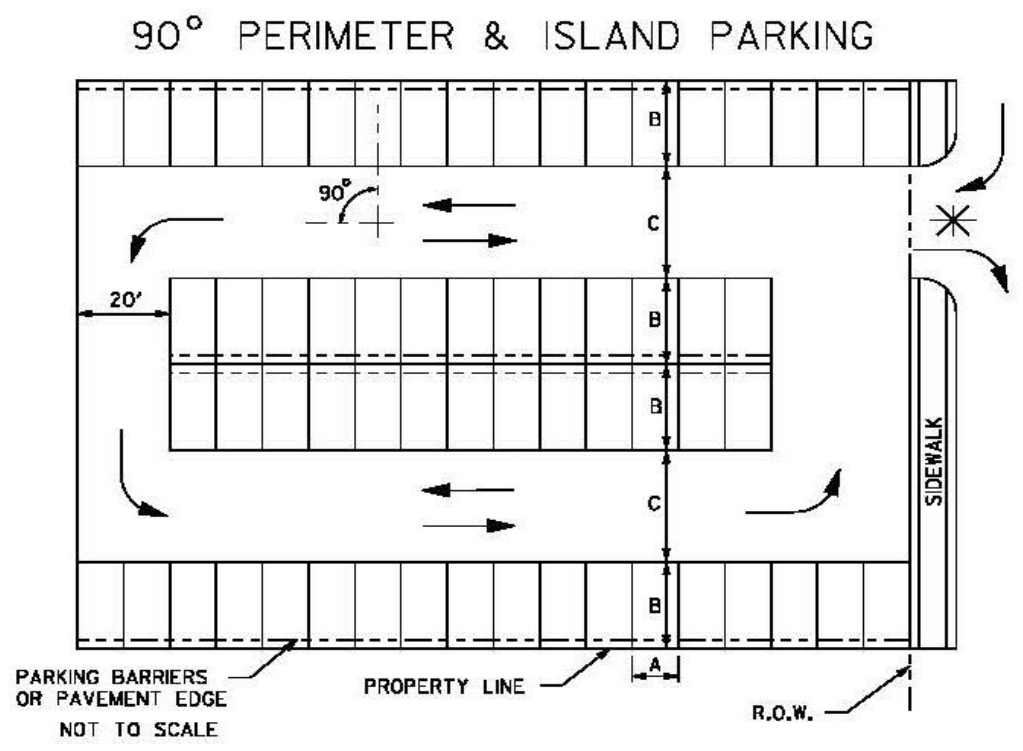
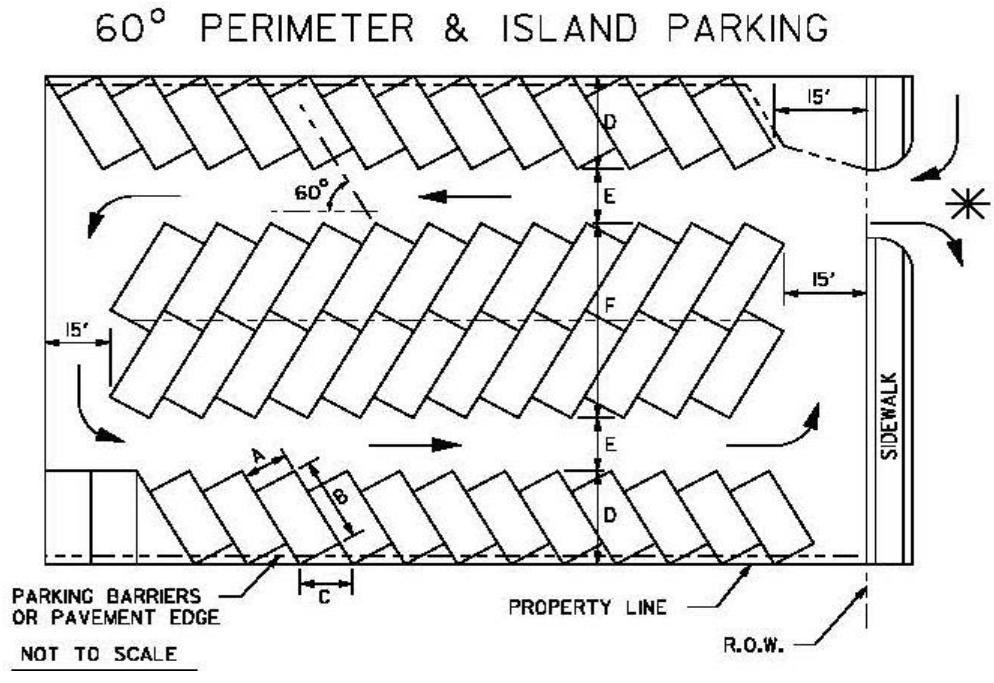
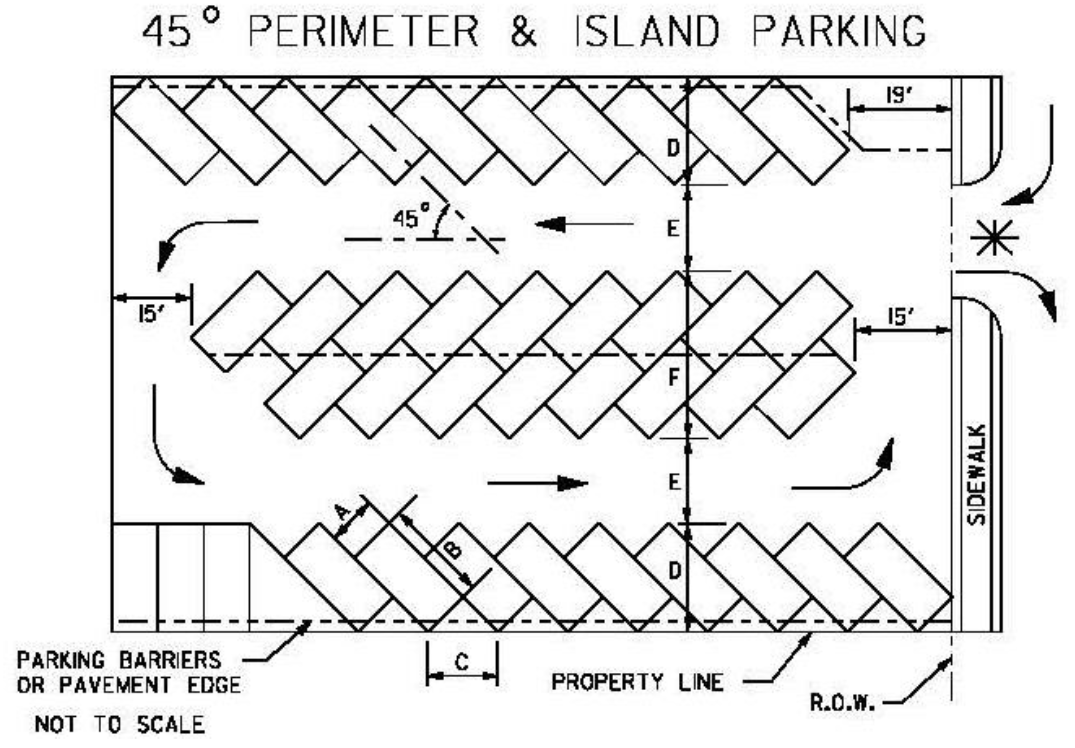
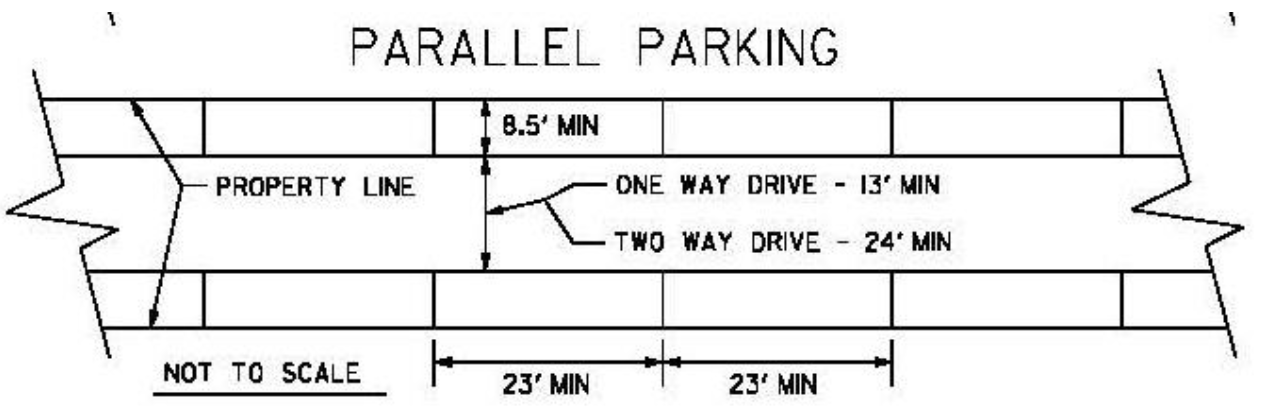
Parking areas shall comply with the dimensions of parking spaces, drives, and aisles in Table 16-8.5, below.
b.
Existing parking structures with parking spaces that do not meet minimum design standards shall be allowed to serve buildings or uses if it can be demonstrated structural constraints prevent the redesign of parking spaces to meet current standards. The design of the structured parking spaces and drive aisles within the parking structure shall be approved by the Town engineer.
(c)
Parking space dimensions, lighting, and design.
(1)
Off-street parking serving commercial and multi-family uses shall be set back at least ten (10) feet beyond the front yard setback. Parking locations and spaces shall be designed to ensure that vehicles do not encroach into a public sidewalk.
(2)
Each off-street parking space shall consist of an open area measuring at least nine (9) feet wide by twenty (20) feet long and seven (7) feet high; provided, however, that parallel parking spaces shall measure at least eight and one-half (8.5) feet wide by twenty-three (23) feet long and seven (7) feet high.
(3)
Each off-street parking space shall open directly onto an aisle or driveway that is not a public street or a public alley. Aisles and driveways shall not be used for parking vehicles.
(4)
Off-street parking must be free of weeds; properly drained; and surfaced with concrete, asphalt, sealed pavers, cobbles, sealed brick, or a material with similar characteristics and uses; and maintained in good condition.
(5)
Security lighting must be provided in parking lots with a minimum ground level illumination of one-half-foot-candle at any location in the lot. Lighting must be arranged to shield illumination of adjoining residential areas.
(d)
Restricted use of parking areas. No automobile trailers, boats, detached campers, junk vehicles, or any other object that will render a parking space unusable shall be parked or stored in a required off-street parking area.
(Ord. No. 751, § 1, 11-13-2019)
Sec. 16-8-8. - Parking garage.
(a)
General standards. The off-street parking required by this Section may be located in a parking structure, whether on the same or on a different lot than the uses which it serves. Such structure shall be subject to the following:
(1)
Ground floor parking provided in a parking structure shall be landscaped and screened, insofar as practicable, from surrounding uses and from public view. In addition, for uses located on the same lot as the structure, the conditions required for shared parking shall apply. For uses located on a different lot as the structure, the conditions required for off-site parking shall apply.
(2)
Parking structures with ground floors that are not completely wrapped with commercial, office, institutional, public uses, or civic uses on the side facing an intersection (except sides abutting alleys) shall not:
a.
Abut street intersections or public/civic use areas,
b.
Be adjacent to public squares, or
c.
Occupy sites that are the terminus of a street vista.
(b)
Design.
(1)
Parking structures should be constructed of materials of similar quality and shall be compatible in appearance with adjacent buildings.
(2)
Facades of parking structures not occupied by commercial, office, institutional, public uses, or civic uses shall be articulated through the use of three (3) or more of the following architectural features:
a.
Windows or window-shaped openings,
b.
Masonry columns,
c.
Decorative wall insets or projections,
d.
Awnings,
e.
Changes in color or texture of materials,
f.
Approved public art,
g.
Integrated landscape planters, or
h.
Other similar features approved by the Town.
(3)
Vehicle entries to off-street parking structures shall be integrated into the placement and design of adjacent buildings or oriented away from the primary street frontage. At a minimum, parking structures shall have user vehicle access from locations that minimize conflicts with pedestrian circulation.
(Ord. No. 751, § 1, 11-13-2019)
Sec. 16-8-9. - Design of loading areas.
Nonresidential uses must provide loading areas in accordance with the following requirements:
(1)
Number of loading areas.
a.
Loading area requirements are calculated using the nonresidential gross floor area in square feet, including outdoor storage of goods.
b.
One (1) loading space is required for any use with a gross area of up to ten thousand (10,000) square feet. Above ten thousand (10,000) square feet, one (1) additional loading space is required per fifteen thousand (15,000) square feet, or fraction thereof.
(2)
Location.
a.
No loading space shall be located within the right-of-way of a public street. Any loading dock or door shall be set back far enough from the right-of-way so that no portion of the right-of-way is occupied by trucks or other vehicles while loading or unloading. The location of the loading area shall not interfere with the free circulation of vehicles in the off-street parking area. No loading space shall be located to block access by emergency vehicles.
b.
Loading spaces shall be located thirty (30) feet from the nearest point of intersection of any two (2) streets.
(3)
Size of berths. The minimum required dimensions of loading spaces, open or enclosed, shall be twelve (12) feet in width by thirty-five (35) feet in length, exclusive of aisle and maneuvering space, and shall have a vertical clearance of at least fifteen (15) feet. Where tractor-trailer units will be using the facility, the minimum length shall be sixty-five (65) feet.
(4)
Access. Each on-site loading space shall be designed with appropriate means of vehicular access to a street or alley in a manner that will least interfere with traffic movement, shall not be designed so as to require trucks using the loading space to back up onto any public street, and shall meet standard Traffic Engineering Department specifications. All driveways servicing loading spaces shall be in accordance with applicable city standards.
(5)
Screening. All on-site loading spaces that are within or abut a residence district or intervening alley shall be completely screened from the adjacent residential lot by building walls or by a uniformly painted solid fence, wall, or door, or any combination thereof, not less than eight (8) feet in height.
(6)
Paving standards. The surface of all open off-street loading spaces shall conform to the requirements for off-street parking areas.
(7)
Use of loading areas.
a.
Required off-street loading spaces and associated aisles and maneuvering areas shall be used for vehicle loading only. No sales, storage, display of merchandise (including automobiles), repair work, or dismantling shall be permitted in such areas.
b.
Space allocated to any loading use shall not be used to satisfy the number of required motor vehicle parking spaces.
(Ord. No. 751, § 1, 11-13-2019)
Sec. 16-8-10. - Driveways and access.
Driveway improvements should be extended and connect directly to the street surface. All required off-street parking shall be provided with driveway access to a public street or alley in accordance with the standards of this Section.
(1)
Minimum driveway width. Driveways shall be a minimum of ten (10) feet in width when serving one (1) dwelling unit or fourteen (14) feet wide when serving more than one (1) residence or another use, such as a boarding house.
(2)
Maximum driveway frontage. The combined width of driveway cuts or entrances shall not be more than forty percent (40%) of the frontage of the lot along any street or alley.
(3)
Maximum driveway grade. The maximum driveway grade shall be twelve percent (12%).
(4)
Corner visibility. No walls, buildings, or other obstruction to view in excess of four (4) feet in height shall be placed on any corner lot within a triangular area formed by the property line and a line connecting them at points thirty (30) feet from the intersection of the property lines.
(Ord. No. 751, § 1, 11-13-2019)

