
Maple Park City Zoning Code
CHAPTER 15
- OUTDOOR LIGHTING
Sec. 11-15-1.- Purpose.
The purpose of this chapter is to provide regulations for outdoor lighting that will:
A.
Permit the use of outdoor lighting that does not exceed the minimum levels specified in IES recommended practices for night-time safety, utility, security, productivity, enjoyment, and commerce.
B.
Minimize adverse offsite impacts of lighting such as light trespass and obtrusive light.
C.
Curtail light pollution, reduce skyglow, and maintain our rural community feel by preserving our dark skies.
D.
Promote driving safety by reducing light pollution that causes visibility issues while driving.
E.
Conserve energy and resources to the greatest extent possible.
(Ord. 2020- 14, 7-7-2020)
Sec. 11-15-2. - Definitions.
Terms shall have the following meanings. If a term is not defined below, the definition found in the latest edition of "Webster's Unabridged Dictionary" shall be the acceptable meaning of the term:
Absolute photometry means photometric measurements (usually of a solid-state luminaire) that directly measures the footprint of the luminaire. Reference Standard IES LM-79.
Architectural lighting means lighting designed to reveal architectural beauty, shape and/or form, and for which lighting for any other purpose is incidental.
Authority means the adopting municipality, agency or other governing body.
Astronomic time switch means an automatic lighting control device that switches outdoor lighting relative to time of solar day with time of year correction.
Backlight means for an exterior luminaire, lumens emitted in the quarter sphere below horizontal and in the opposite direction of the intended orientation of the luminaire. For luminaires with symmetric distribution, backlight will be the same as front light.
Bug means a luminaire classification system that classifies backlight (B), upplight (U), and glare (G).
Canopy means a covered, unconditioned structure with at least one side open for pedestrian and/or vehicular access. (An unconditioned structure is one that may be open to the elements and has no heat or air conditioning.)
Common outdoor areas means one or more of the following: a parking lot, a parking structure or covered vehicular entrance, a common entrance, or public space shared by all occupants of the domiciles.
Curfew means a time defined by the authority when outdoor lighting is reduced or extinguished.
Emergency conditions means generally, lighting that is only energized during an emergency, lighting fed from a backup power source, or lighting for illuminating the path of egress solely during a fire or other emergency situation, or, lighting for security purposes used solely during an alarm.
Foot candle means the unit of measure expressing the quantity of light received on a surface. One-foot candle is the illuminance produced by a candle on a surface one-foot square from a distance of one foot.
Forward light means for an exterior luminaire, lumens emitted in the quarter sphere below horizontal and in the direction of the intended orientation of the luminaire.
Fully shielded luminaire means a luminaire constructed and installed in such a manner that all light emitted by the luminaire, either directly from the lamp or a diffusing element, or indirectly by reflection or re-fraction from any part of the luminaire, is projected below the horizontal plane through the luminaire's lowest light-emitting part.
Glare means lighting entering the eye directly from luminaires or indirectly from reflective surfaces that causes visual discomfort or reduced visibility.
Hardscape means permanent hardscape improvements to the site including parking lots, drives, entrances, curbs, ramps, stairs, steps, medians, walkways and non-vegetated landscaping that is ten feet or less in width. Materials may include concrete, asphalt, stone, gravel, etc.
Hardscape area means the area measured in square feet of all hard- scape. It is used to calculate the total site lumen limit in both the prescriptive method and performance methods. Refer to hardscape definition.
Hardscape perimeter means the perimeter measured in linear feet is used to calculate the total site lumen limit in the performance method. Refer to hardscape definition.
IDA means International Dark-Sky Association.
IESNA means Illuminating Engineering Society of North America.
Impervious material means sealed to severely restrict water entry and movement.
Industry standard lighting software means lighting software that calculates point-by-point illuminance that includes reflected light using either ray-tracing or radiosity methods.
Lamp means a generic term for a source of optical radiation (i.e. "light"), often called a "bulb" or "tube." Examples include incandescent, fluorescent, high-intensity discharge (HID) lamps, and low-pressure sodium (LPS) lamps, as well as light-emitting diode (LED) modules and arrays.
Landscape lighting means lighting of trees, shrubs, or other plant material as well as ponds and other landscape features.
LED means light emitting diode.
Light fixture means also known as a luminaire; the complete lighting unit (fixture), consisting of a lamp, or lamps and ballast(s) (when applicable), together with the parts designed to distribute the light (reflector, lens, diffuser), to position and protect the lamps, and to connect the lamps to the power supply.
Light pollution means any adverse effect of artificial light including, but not limited to, glare, light trespass, sky-glow, energy waste, compromised safety and security, and impacts on the nocturnal environment.
Light trespass means light that falls beyond the property it is intended to illuminate.
Lighting means "electric" or "man-made" or "artificial" lighting. See "lighting equipment."
Lighting equipment means equipment specifically intended to provide gas or electric illumination, including but not limited to, lamp(s), luminaire(s), ballast(s), poles, posts, lens(s), and related structures, electrical wiring, and other necessary or auxiliary components.
Lighting zone means an overlay zoning system establishing legal limits for lighting for particular parcels, areas, or districts in a community.
Lighting equipment means equipment specifically intended to provide gas or electric illumination, including but not limited to, lamp(s), luminaire(s), ballast(s), poles, posts, lens(s), and related structures, electrical wiring, and other necessary or auxiliary components.
Lumen means the unit of measure used to quantify the amount of light produced by a lamp or emitted from a luminaire (as distinct from "watt," a measure of power consumption).
Luminaire means the complete lighting unit (fixture), consisting of a lamp, or lamps and ballast(s) (when applicable), together with the parts designed to distribute the light (reflector, lens, diffuser), to position and protect the lamps, and to connect the lamps to the power supply.
Low voltage landscape lighting means landscape lighting powered at less than 15 volts and limited to luminaires having a rated initial luminaire lumen output of 525 lumens or less.
Luminaire lumens means for luminaires with relative photometry per IES, it is calculated as the sum of the initial lamp lumens for all lamps within an individual luminaire, multiplied by the luminaire efficiency. If the efficiency is not known for a residential luminaire, assume 70 percent. For luminaires with absolute photometry per IES LM-79, it is the total luminaire lumens. The lumen rating of a luminaire assumes the lamp or luminaire is new and has not depreciated in light output.
Lux means the SI unit of illuminance. One lux is one lumen per square meter. One lux is a unit of incident illuminance approximately equal to 1/10-foot candle.
Mounting height means the height of the photometric center of a luminaire above grade level.
New lighting means lighting for areas not previously illuminated, newly installed lighting of any type except for replacement lighting or lighting repairs.
Object means a permanent structure located on a site. Objects may include statues or artwork, garages or canopies, outbuildings, etc.
Object height means the highest point of an entity, but shall not include antennas or similar structures.
Ornamental lighting means lighting that does not impact the function and safety of an area but is purely decorative, or used to illuminate architecture and/or landscaping, and installed for aesthetic effect.
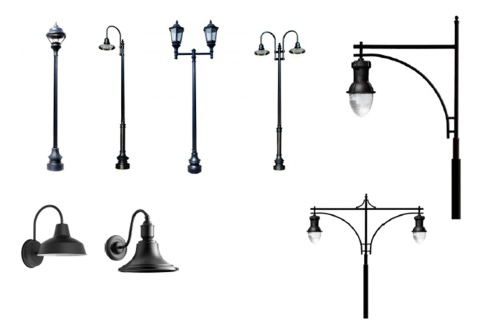
Ornamental street lighting means a luminaire intended for illuminating streets that serves a decorative function in addition to providing optics that effectively deliver street lighting. It has a historical period appearance or decorative appearance, and has the following design characteristics:
A.
Designed to mount on a pole using an arm, pendant, or vertical tenon;
B.
Opaque or translucent top and/or sides;
C.
An optical aperture that is either open or enclosed with a flat, sag or drop lens;
D.
Mounted in a fixed position; and
E.
With its photometric output measured using Type C photometry per IESNA LM-75-01.
Outdoor lighting means lighting equipment installed within the property line and outside the building envelopes, whether attached to poles, building structures, the earth, or any other location, and any associated lighting control equipment.
Relative photometry means photometric measurements made of the lamp plus luminaire, and adjusted to allow for light loss due to reflection or absorption within the luminaire. Reference standard: IES LM-63.
Repair(s) means the reconstruction or renewal of any part of an existing luminaire for the purpose of its on-going operation, other than relamping or replacement of components including capacitor, ballast or photocell. Note that retrofitting a luminaire with new lamp and/or ballast technology is not considered a repair and for the purposes of this chapter the luminaire shall be treated as if new. "Repair" does not include normal relamping or replacement of components including capacitor, ballast, or photocell.
Replacement lighting means lighting installed specifically to replace existing lighting that is sufficiently broken to be beyond repair.
Sales area means uncovered area used for sales of retail goods and materials, including but not limited to automobiles, boats, tractors and other farm equipment, building supplies, and gardening and nursery products.
Seasonal lighting means temporary lighting installed and operated in connection with holidays or traditions.
Shielded directional luminaire means a luminaire that includes an adjustable mounting device allowing aiming in any direction and contains a shield, louver, or baffle to reduce direct view of the lamp.
Sign means advertising, directional or other outdoor promotional display of art, words and/or pictures.
Partly shielded luminaire means a luminaire with opaque top and translucent or perforated sides, designed to emit most light downward.
Pedestrian hardscape means stone, brick, concrete, asphalt or other similar finished surfaces intended primarily for walking, such as sidewalks and pathways.
Photoelectric switch means a control device employing a photocell or photodiode to detect daylight and automatically switch lights off when sufficient daylight is available.
Property line means the edges of the legally defined extent of privately owned property.
Sky glow means the brightening of the nighttime sky that results from scattering and reflection of artificial light by moisture and dust particles in the atmosphere. Skyglow is caused by light directed or reflected upwards or sideways and reduces one's ability to view the night sky.
Temporary lighting means lighting installed and operated for periods not to exceed 60 days, completely removed and not operated again for at least 30 days.
Third party means a party contracted to provide lighting, such as a utility company.
Time switch means an automatic lighting control device that switches lights according to time of day.
Translucent means allowing light to pass through, diffusing it so that objects beyond cannot be seen clearly (not transparent or clear).
Unshielded luminaire means a luminaire capable of emitting light in any direction including downwards.
Upplight means for an exterior luminaire, flux radiated in the hemisphere at or above the horizontal plane.
Vertical illuminance means illuminance measured or calculated in a plane perpendicular to the site boundary or property line.
(Ord. 2020-14, 7-7-2020)
Sec. 11-15-3. - Lighting zones.
The lighting zone shall determine the limitations for lighting as specified in this chapter. The lighting zones shall be as follows:
A.
LZ1: Low ambient lighting.
1.
Areas where lighting might adversely affect flora and fauna or disturb the character of the area. The vision of human residents and users is adapted to low light levels. Lighting may be used for safety and convenience but it is not necessarily uniform or continuous. After curfew, most lighting should be extinguished or reduced as activity levels decline.
2.
Zoning. This shall include any parks, common areas or recreational areas.
B.
LZ2: Moderate ambient lighting.
1.
Areas of human activity where the vision of human residents and users is adapted to moderate light levels. Lighting may typically be used for safety and convenience, but it is not necessarily uniform or continuous. After curfew, lighting may be extinguished or reduced as activity levels decline.
2.
Zoning. This shall include any parcel zoned B-1 Central Business District, B-2 General Commercial District, I-1 Limited Industrial District, or I-2 General Industrial District that is adjacent to any residential districts.
C.
LZ3: Moderately high ambient lighting.
1.
Areas of human activity where the vision of human residents and users is adapted to moderately high light levels. Lighting is generally desired for safety, security and/or convenience and it is often uniform and/or continuous. After curfew, lighting may be extinguished or reduced in most areas as activity levels decline.
2.
Zoning. This shall include any parcel zoned B-1 Central Business District, B-2 General Commercial District, I-1 Limited Industrial District, or I-2 General Industrial District that is not adjacent to any residential districts.
(Ord. 2020-14, 7-7-2020)
Sec. 11-15-4. - General requirements.
A.
Conformance with all applicable codes. All outdoor lighting shall be installed in conformance with the provisions of this chapter, applicable electrical and energy codes, and applicable sections of the building code.
B.
Applicability. Except as described below, all outdoor lighting installed after the date of effect of this chapter shall comply with these requirements. This includes, but is not limited to, new lighting, replacement lighting, or any other lighting whether attached to structures, poles, the earth, or any other location, including lighting installed by any third party.
Exemptions from 11-15-4B. The following are not regulated by this chapter:
1.
Lighting within the public right-of-way or easement for the principal purpose of illuminating roads and highways. No exemption shall apply to any street lighting and to any lighting within the public right-of-way or easement when the purpose of the luminaire is to illuminate areas outside of the public right-of-way or easement.
2.
Lighting for public monuments and statuary.
3.
Lighting solely for signs (lighting for signs is regulated by the sign ordinance).
4.
Repairs to existing luminaires not exceeding 25 percent of total installed luminaires.
5.
Temporary lighting for theatrical, television, performance areas and construction sites.
6.
Underwater lighting in swimming pools and other water features.
7.
Temporary lighting and seasonal lighting provided that individual lamps are less than ten watts and 70 lumens.
8.
Lighting that is only used under emergency conditions.
9.
In lighting zones 2, 3 and 4, low voltage landscape lighting controlled by an automatic device that is set to turn the lights off at one hour after the site is closed to the public or at a time established by the authority.
Exceptions to 11-15-4B. All lighting shall follow provisions in this chapter; however, any special requirements for lighting listed in subsections 1 and 2 below shall take precedence:
1.
Lighting specified or identified in a specific use permit.
2.
Lighting required by federal, state, territorial, commonwealth or provincial laws or regulations.
C.
Lighting control requirements.
1.
Automatic switching requirements. Controls shall be provided that automatically extinguish all outdoor lighting when sufficient daylight is available using a control device or system such as a photoelectric switch, astronomic time switch or equivalent functions from a programmable lighting controller, building automation system or lighting energy management system, all with battery or similar backup power or device.
Exceptions to 11-15-4C.1 Automatic lighting controls are not required for the following:
a.
Lighting under canopies.
b.
Lighting for tunnels, parking garages, garage entrances, and similar conditions.
2.
Automatic lighting reduction requirements. The authority shall establish curfew time(s) after which total outdoor lighting lumens shall be reduced by at least 30 percent or extinguished.
Exceptions to 11-15-4C.2 Lighting reductions are not required for any of the following:
a.
With the exception of landscape lighting, lighting for residential properties including multiple residential properties not having common areas.
b.
When the outdoor lighting consists of only one luminaire.
c.
Code required lighting for steps, stairs, walkways, and building entrances.
d.
When in the opinion of the authority, lighting levels must be maintained.
e.
Motion activated lighting.
f.
Lighting governed by special use permit in which times of operation are specifically identified.
Businesses that operate on a 24-hour basis.
(Ord. 2020-14, 7-7-2020)
Sec. 11-15-5. - Non-residential lighting.
For all non-residential properties, and for multiple residential properties of seven domiciles or more and having common outdoor areas, all outdoor lighting shall comply either with Part A or Part B of this section.
A.
Prescriptive method. An outdoor lighting installation complies with this section if it meets the requirements of subsections 1 and 2, below.
1.
Total site lumen limit. The total installed initial luminaire lumens of all outdoor lighting shall not exceed the total site lumen limit. The total site lumen limit shall be determined using either the parking space method (Table A) or the hardscape area method (Table B).
Only one method shall be used per permit application, and for sites with existing lighting, existing lighting shall be included in the calculation of total installed lumens.
The total installed initial luminaire lumens are calculated as the sum of the initial luminaire lumens for all luminaires.
2.
Limits to off site impacts. All luminaires shall be rated and installed according to Table C.
3.
Light shielding for parking lot illumination.
All parking lot lighting shall have no light emitted above 90 degrees.
Exception:
a.
Ornamental parking lighting shall be permitted by special permit only, and shall meet the requirements of Table C-1 for backlight, Table C-2 for upplight, and Table C-3 for glare, without the need for external field-added modifications.
B.
Performance method.
1.
Total site lumen limit. The total installed initial luminaire lumens of all lighting systems on the site shall not exceed the allowed total initial site lumens. The allowed total initial site lumens shall be determined using Tables D and E. For sites with existing lighting, existing lighting shall be included in the calculation of total installed lumens.
The total installed initial luminaire lumens of all is calculated as the sum of the initial luminaire lumens for all luminaires.
2.
Limits to off site impacts. All luminaires shall be rated and installed using either option A or option B. Only one option may be used per permit application.
Option A: All luminaires shall be rated and installed according to Table C.
Option B: The entire outdoor lighting design shall be analyzed using industry standard lighting software including inter-reflections in the following manner:
a.
Input data shall describe the lighting system including luminaire locations, mounting heights, aiming directions, and employing photometric data tested in accordance with IES guidelines. Buildings or other physical objects on the site within three object heights of the property line must be included in the calculations.
b.
Analysis shall utilize an enclosure comprised of calculation planes with zero reflectance values around the perimeter of the site. The top of the enclosure shall be no less than 33 feet (ten meters) above the tallest luminaire. Calculations shall include total lumens upon the inside surfaces of the box top and vertical sides and maximum vertical illuminance (foot candles and/or lux) on the sides of the enclosure.
The design complies if:
a.
The total lumens on the inside surfaces of the virtual enclosure are less than 15 percent of the total site lumen limit; and
b.
The maximum vertical illuminance on any vertical surface is less than the allowed maximum illuminance per Table F.
(Ord. 2020-14, 7-7-2020)
Sec. 11-15-6. - Lighting by special permit only.
A.
High intensity and special purpose lighting. The following lighting systems are prohibited from being installed or used except by special use permit:
1.
Temporary lighting in which any single luminaire exceeds 20,000 initial luminaire lumens or the total lighting load exceeds 160,000 lumens.
2.
Aerial lasers.
3.
Searchlights.
4.
Other very intense lighting defined as having a light source exceeding 200,000 initial luminaire lumens or an intensity in any direction of more than 2,000,000 candelas.
B.
Complex and non-conforming uses. Upon special permit issued by the authority, lighting not complying with the technical requirements of this chapter but consistent with its intent may be installed for complex sites or uses or special uses including, but not limited to, the following applications:
1.
Sports facilities, including but not limited to unconditioned rinks, open courts, fields, and stadiums.
2.
Construction lighting.
3.
Lighting for industrial sites having special requirements, such as petrochemical manufacturing or storage, shipping piers, etc.
4.
Parking structures.
5.
Urban parks.
6.
Ornamental and architectural lighting of bridges, public monuments, statuary and public buildings.
7.
Theme and amusement parks.
8.
Correctional facilities.
To obtain such a permit, applicants shall demonstrate that the proposed lighting installation:
a.
Has sustained every reasonable effort to mitigate the effects of light on the environment and surrounding properties, supported by a signed statement describing the mitigation measures. Such statement shall be accompanied by the calculations required for the performance method. Employs lighting controls to reduce lighting at a project specific curfew ("curfew") time to be established in the permit.
b.
Complies with the performance method after curfew.
The authority shall review each such application. A permit may be granted if, upon review, the authority believes that the proposed lighting will not create unwarranted glare, sky glow, or light trespass.
Lighting installed prior to the effective date of this chapter shall be subject to the following:
New uses or structures, or change of use. Whenever there is a new use of a property (zoning or variance change) or the use on the property is changed, all outdoor lighting on the property shall be brought into compliance with this chapter before the new or changed use commences.
C.
Additions or alterations.
1.
Major additions. If a major addition occurs on a property, lighting for the entire property shall comply with the requirements of this chapter. For purposes of this section, the following are considered to be major additions:
a.
Additions of 25 percent or more in terms of additional dwelling units, gross floor area, seating capacity, or parking spaces, either with a single addition or with cumulative additions after the effective date of this chapter.
b.
Single or cumulative additions, modification or replacement of 25 percent or more of installed outdoor lighting luminaires existing as of the effective date of this chapter.
2.
Minor modifications, additions, or new lighting fixtures for non-residential and multiple dwellings. For non-residential and multiple dwellings, all additions, modifications, or replacement of more than 25 percent of outdoor lighting fixtures existing as of the effective date of this chapter shall require the submission of a complete inventory and site plan detailing all existing and any proposed new outdoor lighting. Any new lighting shall meet the requirements of this chapter.
3.
Resumption of use after abandonment. If a property with non-conforming lighting is abandoned for a period of six months or more, then all outdoor lighting shall be brought into compliance with this chapter before any further use of the property occurs.
(Ord. 2020-14, 7-7-2020)
Sec. 11-15-7. - Streetlight.
A.
Preamble. The purpose of this chapter is to control the light pollution of street lighting, including all collectors, local streets, alleys, sidewalks and bike- ways, as defined by ANSI/IES RP-8 standard practice for roadway and street lighting and in a manner consistent with the lighting ordinance.
B.
Definitions.
Ornamental street lighting means a luminaire intended for illuminating streets that serves a decorative function in addition to providing optics that effectively deliver street lighting. It has a historical period appearance or decorative appearance, and has the following design characteristics:
1.
Designed to mount on a pole using an arm, pendant, or vertical tenon;
2.
Opaque or translucent top and/or sides;
3.
An optical aperture that is either open or enclosed with a flat, sag or drop lens; mounted in a fixed position; and
4.
With its photometric output measured using Type C photometry per IESNA LM-75-01.
Roadway or highway lighting means lighting provided for freeways, expressways, limited access roadways, and roads on which pedestrians, cyclists, and parked vehicles are generally not present. The primary purpose of roadway or highway lighting is to help the motorist remain on the roadway and help with the detection of obstacles within and beyond the range of the vehicle's headlights.
Street lighting means lighting provided for major, collector, and local roads where pedestrians and cyclists are generally present. The primary purpose of street lighting is to help the motorist identify obstacles, provide adequate visibility of pedestrians and cyclists, and assist in visual search tasks, both on and adjacent to the roadway.
C.
Scope. All street lighting not governed by regulations of federal, state or other superseding jurisdiction.
D.
Street light design requirements.
1.
All streetlights must be black powder coated finish.
2.
All streetlights must have an ornamental base and luminary.
3.
All streetlights must be LED and have a color temperature of 4200 kelvin or less.
4.
All streetlights must comply with all codes and village ordinances.
E.
Warranting. The authority shall establish a warranting process to determine whether lighting is required. Such warranting process shall not assume the need for any lighting nor for continuous lighting unless conditions warrant the need. Lighting shall only be installed where warranted.
F.
Light shielding and distribution. All street lighting shall have no light emitted above 90 degrees.
Exception: Ornamental street lighting for specific districts or projects shall be permitted by special permit only, and shall meet the requirements of Table G below without the need for external field-added modifications.
(Ord. 2020-14, 7-7-2020)
Sec. 11-15-8. - Tables.
TABLE A.
ALLOWED TOTAL INITIAL LUMINAIRE LUMENS PER SITE FOR NON-RESIDENTIAL OUTDOOR LIGHTING,
PER PARKING SPACE METHOD.
May only be applied to properties up to 10 parking spaces (including handicapped accessible spaces).
TABLE B.
ALLOWED TOTAL INITIAL LUMENS PER SITE FOR NON- RESIDENTIAL OUTDOOR LIGHTING, HARDSCAPE
AREA METHOD.
May be used for any project. When lighting intersections of site drives and public streets or road, a total of 600 square feet for each intersection may be added to the actual site hardscape area to provide for intersection lighting.
TABLE C.
LUMEN ALLOWANCES, IN ADDITION TO BASE ALLOWANCE
TABLE D.
MAXIMUM ALLOWABLE BACKLIGHT, UPPLIGHT AND GLARE (BUG) RATINGS.
May be used for any project. A luminaire may be used if it is rated for the lighting zone of the site or lower in number for all ratings B, U and G. Luminaires equipped with adjustable mounting devices permitting alteration of luminaire aiming in the field shall not be permitted.
TABLE E.
PERFORMANCE METHOD ALLOWED TOTAL INITIAL SITE LUMENS.
May be used on any project.
TABLE F.
PERFORMANCE METHOD ADDITIONAL INITIAL LUMINAIRE LUMEN ALLOWANCES.
All of the following are "use it or lose it" allowances. All area and distance measurements in plain view unless otherwise noted.
TABLE G.
MAXIMUM VERTICAL ILLUMINANCE AT ANY POINT IN THE PLANE OF THE PROPERTY LINE
TABLE H.
UPPLIGHT CONTROL REQUIREMENTS FOR ORNAMENTAL STREET LIGHTS
By special permit only.
TABLE I.
EXAMPLES OF FULLY SHIELDED LIGHTING
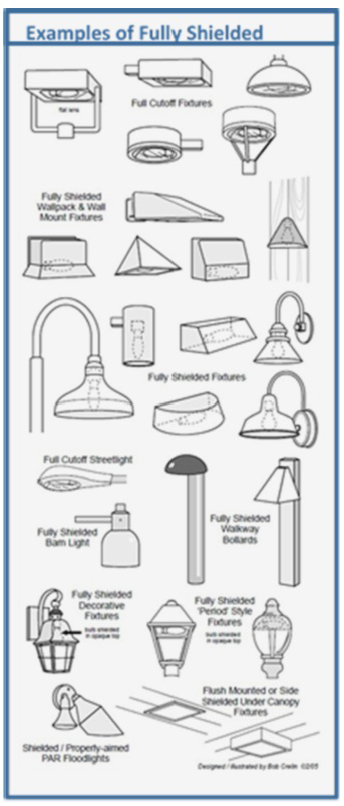
TABLE J.
EXAMPLES OF ORNAMENTAL STREET LIGHTS
(Ord. 2020-14, 7-7-2020)
Sec. 11-15-9. - Enforcement and penalties.
Violations of this chapter shall be subject to the general penalty of the Maple Park Municipal Code, section 1-4-1.
(Ord. 2020-14, 7-7-2020)

