
Maple Park City Zoning Code
CHAPTER 2
- GENERAL PROVISIONS
Sec. 11-2-1.- Interpretation.
A.
Minimum requirements. The provisions herein shall be held to be the minimum requirements for the promotion of the public health, safety, morals, and welfare.
B.
Relationship with other laws. Where the conditions imposed by any provision herein upon the use of land or buildings or upon the bulk of buildings are either more restrictive or less restrictive than conditions imposed by any other provision herein or any other law, ordinance, resolution, rule or regulation of any kind, the regulations which are more restrictive (or which impose higher standards or requirements) shall govern.
C.
Effect of existing agreements. This title is not intended to abrogate any easement, covenant, or any other private agreement, provided that where the regulations of this title are more restrictive (impose higher standards or requirements) than such easements, covenants or other private agreements, the requirements herein shall govern.
(Ord. 2014-13, 7-1-2014; amd. Ord. 2021-15, 11-9-2021)
Sec. 11-2-2. - Scope of regulations.
Change structures or use. Except as may otherwise be provided, all buildings erected hereafter, all uses of land or buildings established hereafter, all alterations or relocation of existing buildings occurring hereafter, and any enlargement of or additions to existing uses occurring hereafter shall be subject to all regulations herein which are applicable to the zoning district in which such buildings, uses or land shall be located.
(Ord. 2014-13, 7-1-2014; amd. Ord. 2021-15, 11-9-2021)
Sec. 11-2-3. - Accessory buildings and uses.
A.
Permitted obstruction. Accessory buildings, structures and uses as permitted in district regulations may be obstructions in required yards as follows:
TABLE 11-2-3A. PERMITTED OBSTRUCTION LOCATIONS
B.
Location. No part of an accessory building shall be located closer than five feet to the side lot line along a required side yard. When a rear yard is required, no part of an accessory building shall be located closer than five feet to the rear lot line or to those portions of the side lot lines abutting such required rear yard, except where there is an accessory building with doors opening onto an alley such building shall not be located closer than ten feet to the rear lot line. In a residential district, no detached accessory building shall be closer than five feet to the principal building nor shall it be located closer to the front lot line than the distance the principal building is located to the front lot line and in no instance should it be located within a required front yard setback. No structure is permitted to be located in any required easement.
C.
Time of construction. No accessory building shall be constructed on any lot prior to the start of construction of the principal building to which it is accessory.
D.
Percentage of required rear yard occupied. No accessory building or buildings shall occupy more than 40 percent of the area of a required rear yard.
E.
Height of accessory buildings in required rear yards. No accessory building or portion thereof located in a required rear yard shall exceed 15 feet in height.
F.
Prohibited accessory buildings. The requirements of subsection F.1 of this section, do not apply to trailers, recreational vehicles, or other similar vehicles, parked on a permitted sales lot:
1.
Not more than two trailers, recreational vehicles, or other similar vehicles shall be parked on any one lot.
2.
No trailer, recreational vehicle, or other similar vehicle shall be used as a dwelling.
3.
No trailer, recreational vehicle, or other similar vehicle shall be used as an office or for any other commercial purpose except for approved construction offices.
4.
No trailer, recreational vehicle, or other similar vehicle shall be used for the storing of personal or business related materials.
5.
The parking of a trailer, recreational vehicle, or similar vehicle is allowed. The parking area must be paved or improved with an approved surface.
6.
The parking of a trailer, recreational vehicle, or similar vehicle, shall comply with the yard requirements for accessory buildings of the district in which it is located. No vehicle shall be parked or stored in a manner that inhibits or impedes travel on public streets and sidewalks.
G.
Foundation requirements for certain accessory buildings. In addition to all other municipal building code requirements, any accessory building having a floor area greater than 200 square feet or a door wider than six feet shall be placed on a permanent concrete slab foundation having specifications approved by the planning and zoning code official.
H.
Number of accessory uses. Only one detached accessory structure shall be permitted per lot.
I.
Generators. Generators are an allowed interior side and rear yard obstruction, provided they comply with the side and rear yard setback requirements.
(Ord. 2014-13, 7-1-2014; amd. Ord. 2021-15, 11-9-2021; Ord. No. 2024-01, §§ 1, 2, 3-5-2024; Ord. No. 2024-02, § 2, 4-2-2024; Ord. No. 2024-03, § 1, 4-2-2024)
Sec. 11-2-4. - Additional regulations for unique uses.
A.
Fences, walls, and hedges.
1.
Except as provided elsewhere in this title, a fence or wall may be erected, placed or maintained along a lot line on residentially zoned property except that no such fence or wall which is located in a required front yard shall exceed a height of three feet.
A corner lot shall be considered to have two front yards; example, the yards that face the public roadway. A fence installed on a corner lot may only be three feet solid board or four feet with 50 percent open slotting in the front yards.
A six-foot fence is not to exceed past the most exterior wall of the house on either yard.
Where such lot line is adjacent to non-residentially zoned property, there shall be an eight-foot limit on the height of a fence or wall along such lot lines, except that no such fence or wall which is located in a required front yard shall exceed a height of three feet.
2.
No fence or wall shall be erected, placed or maintained along a lot line on any non-residentially owned property, adjacent to residentially owned property, to a height exceeding eight feet except that no such fence or wall which is located in a required front yard shall exceed a height of three feet.
3.
In any district, no fence, wall, hedge, or shrubbery shall be erected, constructed, maintained, or grown to height exceeding three feet above the street curb nearest thereto, within 25 feet of the intersection of any street lines or of street lines projected.
4.
Unless a written agreement signed by the adjacent owner of record is filed with the Village Clerk, a fence or wall must be erected, placed, or maintained at least six inches inside the lot line.
5.
No fence equipped with or having barbed wire, spikes, or any similar device, or any electrically charged fence sufficient to cause shock, shall be erected, placed, or maintained within six feet of ground level. However, no such fence shall be allowed in residentially zoned districts.
6.
Screening for daycare centers and nursery schools: The outdoor play area shall be completely screened from view from adjacent uses by solid wood fencing to a height of six feet or by landscaping six feet high by three feet deep. All State regulations concerning outdoor play areas shall apply.
7.
Fence poles and stakes shall be placed on the interior side of the fence so that the more attractive side of the fence faces the exterior of the yard.
B.
Pools.
1.
Definitions.
Swimming Pool means any structure intended for swimming or recreational bathing that contains water over 24 inches deep.
Spa means an above ground self-contained heated or jetted pool. Also known as Jacuzzi or hot tub.
Barrier(s) includes a fence or wall, pool mounted systems and or a power safety cover over the pool. Barriers are not childproof but can provide one layer of protection from entry to pool while unattended.
2.
Location.
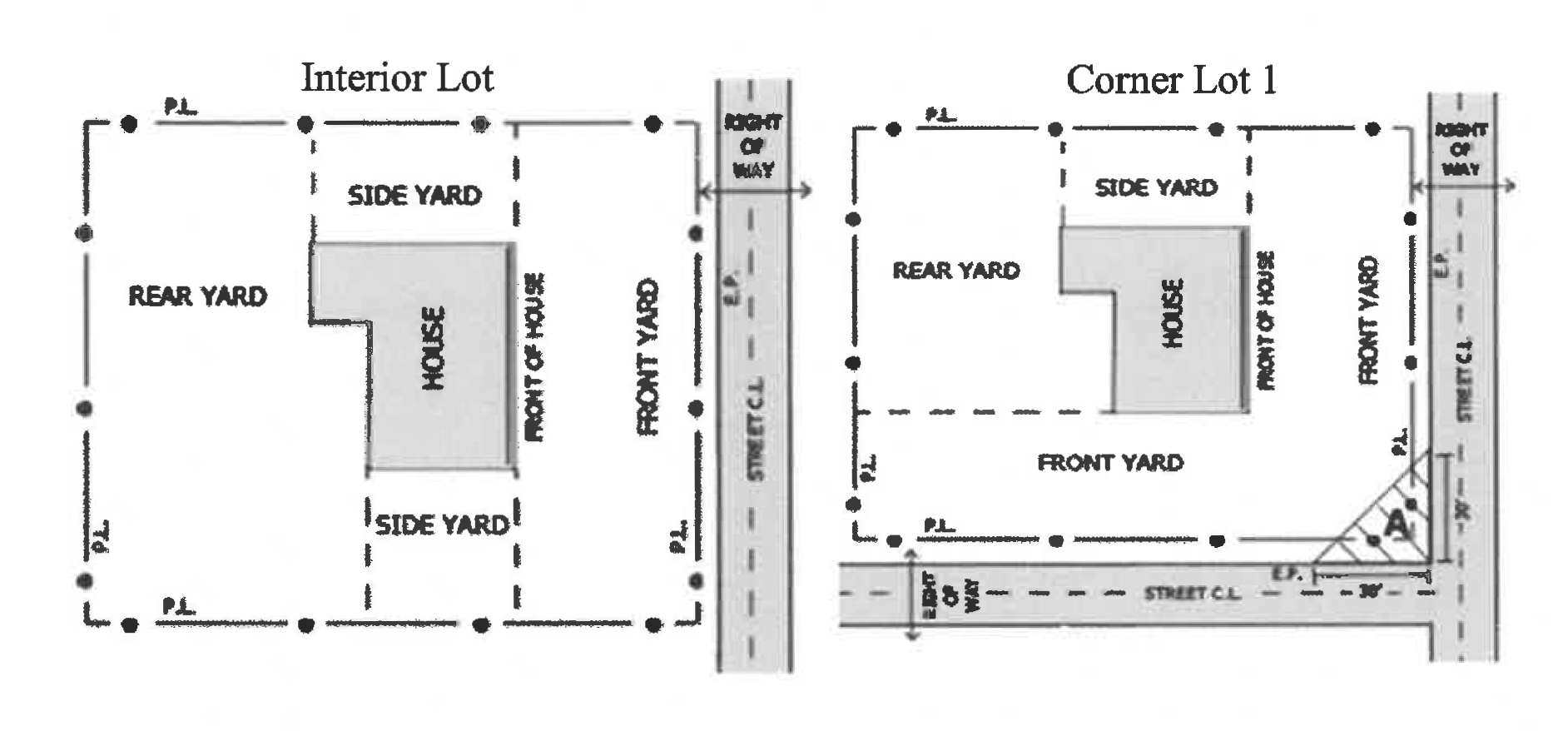
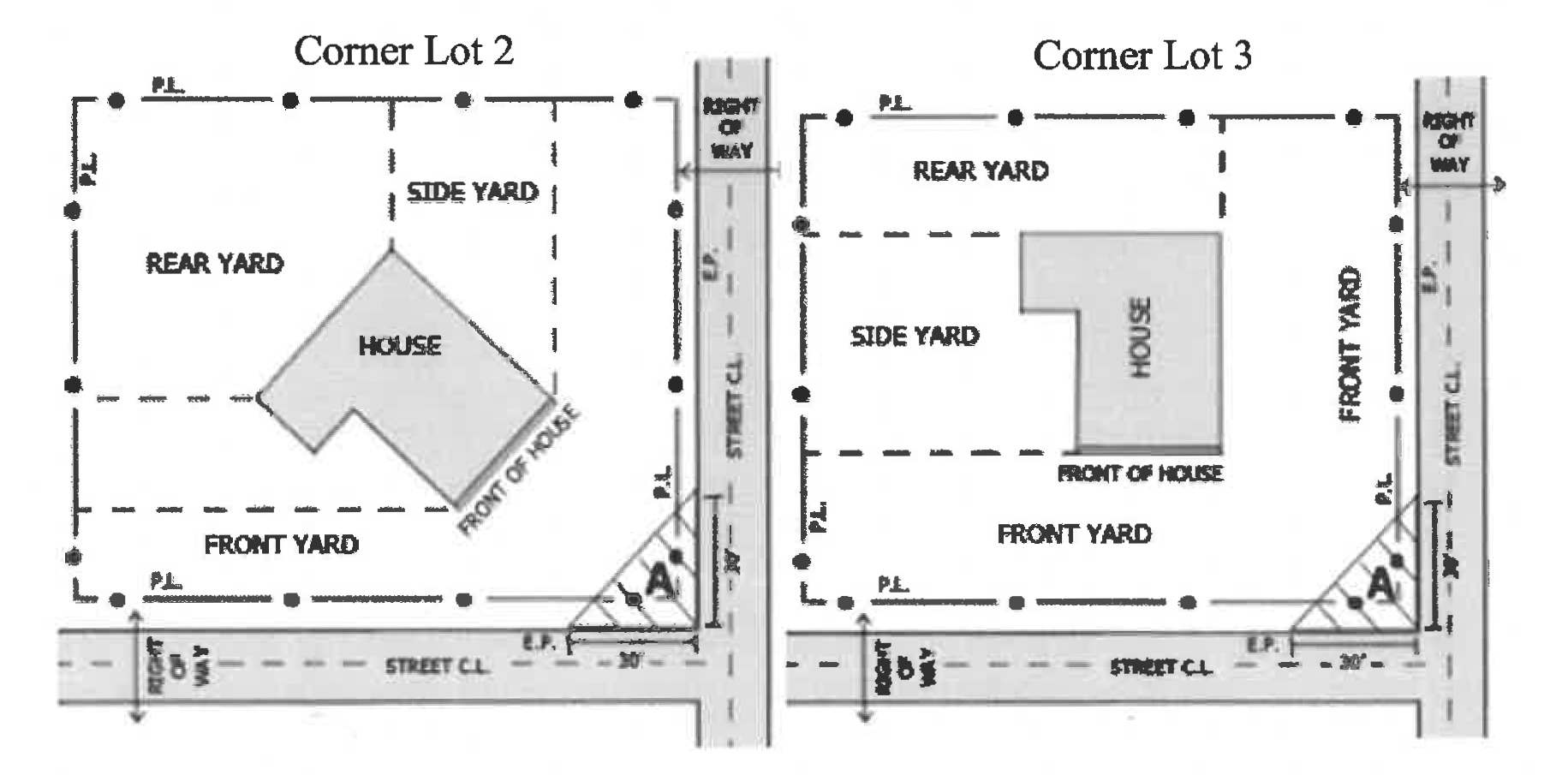
Swimming pools or spas, are not allowed in the front or side yard. If you are on a corner lot both street sides are considered front yards, see Interior and Corner Lot diagrams.
a.
Swimming pools shall be located a minimum of ten feet from the primary structure, measured from the wall of the swimming pool. Spa shall be located a minimum of five feet from the primary building.
b.
Swimming pools and spas shall be located a minimum of ten feet from any property line, including any decking or platform.
c.
Swimming pools and spas shall not be located under any overhead utility wires.
d.
Swimming pools and spas shall be located from septic tank/field or sewer line at least 25 feet for an inground pool; at least ten feet for an above ground pool.
e.
Swimming pools and spas may not be installed in any easement.
3.
Barrier.
a.
Pools that have a depth of 24 inches or less do not require an enclosure or barrier. Pools of 25 inches or greater shall comply with all ordinance requirements.
b.
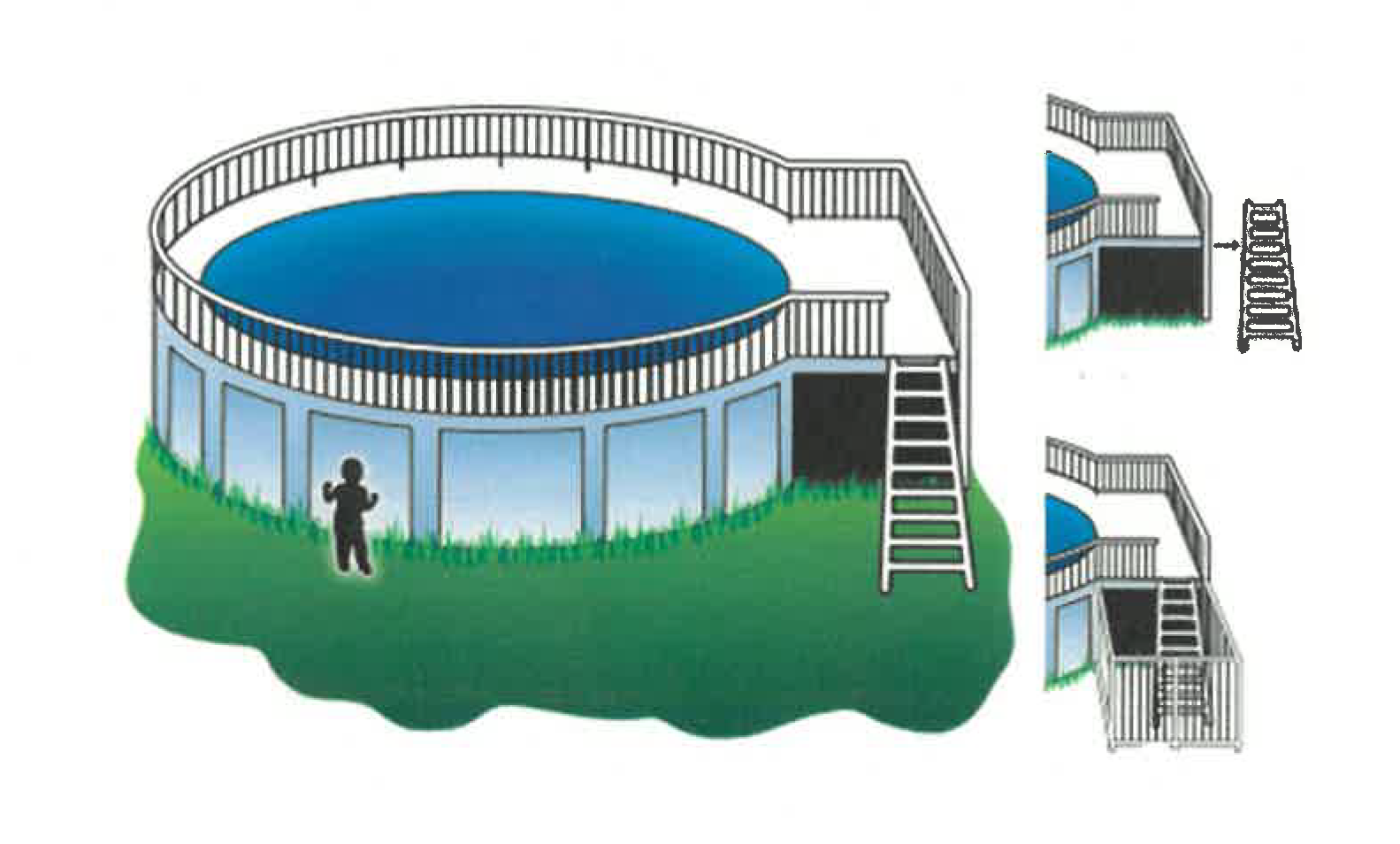
Above ground swimming pools with the top of the wall less than 48 inches above the surrounding grade must be enclosed with an approved barrier at least 48 inches in height and have a gate as an entry point with a latch that either locks three inches below the inside of the top of the gate or latch is over 54 inches above the ground, this is per International Code Council Outdoor Swimming Pool Barrier Requirements.
c.
Above ground swimming pools, which have walls or a wall mounted barrier system that meet the height requirement, shall have steps or a ladder capable of being secured, locked or removed to prevent access.
d.
In-ground pools must have a barrier around the pool area that is a minimum of 48 inches.
e.
Spa may have a locking cover in lieu of a 48 inches tall barrier.
f.
If the barrier connects to the primary structure:
i.
Above ground ladder capable of being secured, locked or removed to prevent access and secured when not in use.
ii.
In ground pools may either have an additional fixed or movable barrier around the pool and or an audible alarm on the door exiting out to the pool area.
4.
Electrical. All pools with electronic pump or filter must be protected by ground fault circuit interrupters, which shall be GFCI receptacle outlets or GFCI circuit breakers.
a.
Swimming pool or spa must have underground outdoor electrical outlet.
i.
All electric shall be in approved conduit and barred underground that meets all electrical code requirements.
ii.
All underground electric shall be inspected prior to burial.
iii.
All receptacles shall have a weatherproof enclosure whether or not the receptacle is being used.
iv.
All swimming pool equipment shall be properly grounded
v.
Underground wiring shall be a minimum of five feet from the swimming pool walls.
vi.
For in-ground swimming pools all metal parts on or in the ground within five feet of the swimming pool walls shall be bonded.
vii.
Receptacles, not serving swimming pool equipment, shall be located a minimum of ten feet from the swimming pool wall.
viii.
All electrical work must be installed per the National Electric Code (NEC) and installed by a qualified provider.
5.
Permit.
a.
Permit application must include:
i.
Plat of survey indicating the location of the pool and barrier, with setbacks marked for each.
ii.
Location of electrical if required.
iii.
Pool permit of any kind does not include the permit for the barrier. If you require a fence (barrier) permit a separate permit application must completed.
(Ord. 2017-15, 8-1-2017; amd. Ord. 2021-15, 11-9-2021; Ord. No. 2024-01, § 5, 3-5-2024)
Cross reference— See also section 8-1-13 of this Code.
Sec. 11-2-5. - Home occupations.
A.
Purpose. The purpose of home occupation standards and requirements is to allow occupations to be conducted in a dwelling unit which are compatible with the neighborhoods in which they are located and which do not interfere with the rights of the surrounding property owners to enjoy the residential character of the neighborhood. Home occupation is an accessory use so located and conducted that the average neighbor, under normal circumstances, would not be aware of its existence.
B.
Standards. A home occupation is permitted in any residence district provided that:
1.
It is conducted entirely within the dwelling unit by a family member residing in the dwelling, and the dwelling unit must be the principal residence of the family member conducting the home occupation.
2.
It is conducted only by a family member residing on the premises, plus only one additional person, whether or not a family member.
3.
It is not conducted from an accessory building or other structure. It does not require internal or external alteration, or involve construction features or use of equipment not customary in a dwelling, and the entrance to the space devoted to such occupation shall be from within the dwelling and not more than one-fourth of the floor area of a story including also a cellar of the dwelling is devoted to such home occupation.
4.
There shall be no signs on the premises advertising the presence of a home occupation.
5.
There shall be no outdoor storage or display of equipment or materials used in the home occupation.
(Ord. 2014-13, 7-1-2014; amd. Ord. 2021-15, 11-9-2021)
Sec. 11-2-6. - Access to public streets.
Except as otherwise provided herein for planned unit developments, every residential building shall be constructed or erected upon a lot or parcel of land, which abuts upon a public street to which ingress and egress is permitted, unless a permanent easement of access to a public street was of record prior to the adoption hereof.
(Ord. 2014-13, 7-1-2014; amd. Ord. 2021-15, 11-9-2021)
Sec. 11-2-7. - Number of buildings on zoning lot.
Except in the case of a planned unit development, not more than one principal detached residential building shall be located on a residential zoning lot, nor shall a principal detached residential building be located on the same zoning lot with any other principal building.
(Ord. 2014-13, 7-1-2014; amd. Ord. 2021-15, 11-9-2021)
Sec. 11-2-8. - Performance standards.
The performance standards for the I-1 District at section 11-8-2 of this title shall also apply to all residential and business districts.
(Ord. 2014-13, 7-1-2014; amd. Ord. 2021-15, 11-9-2021)
Sec. 11-2-9. - Existing special uses.
Where a use is classified as a special use and exists as a permitted use at the date of the adoption hereof, it shall be considered a legal use, without further action of the board of trustees, the planning and zoning commission, or the planning and zoning code official.
(Ord. 2014-13, 7-1-2014; amd. Ord. 2021-15, 11-9-2021)
Sec. 11-2-10. - Design variety for residential construction.
A.
Dwelling similarity; distance. No building permit shall be issued for any type of residential dwelling (i.e., one-, two-, or multiple-family) which is similar in appearance to any other existing residential dwelling on the same street (either side) that is within a distance of five lots from the new residential dwelling.
B.
Corner lot. A residential dwelling on a corner lot may be considered not similar to one adjacent to it if the three dwellings face different streets.
C.
Similarity standards. For purposes of this section, "similar in appearance" shall mean a residential dwelling which is identical to another in any three or more of the following architectural characteristics:
1.
Roof type (gable, hip, mansard, gambrel, flat, combination);
2.
Roof height;
3.
Approximate dimensions (height and length) of the front wall closest to the front lot line;
4.
Shape of the front elevation;
5.
Relative locations and sizes of the windows in the front elevation;
6.
Relative location and dimensions of garage door or doors, if included on the front elevation;
7.
Type of siding (brick veneer, lapped horizontal siding, half timber, board and batten, shakes, etc.) on the front elevation.
D.
Exceptions. The regulations in this section shall not apply in the following instances:
1.
If, on any combination of four consecutive lots, there contains different housing styles, then the similarity standards identified in subsection C of this section shall not apply. For purposes of this subsection, "housing style" shall mean a dwelling unit with a ranch, bilevel, trilevel, one and one-half story, two-story, or three-story design.
2.
If, on any combination of four consecutive lots, there contains residential dwellings with a different number of dwelling units, then the similarity standards identified in subsection C of this section shall not apply.
3.
Upon approval by the board of trustees, these regulations may be waived in cases where the applicant for a building permit could not be expected to anticipate the design of another dwelling unit for which a building permit has already been issued but has not yet been constructed.
4.
These regulations may be waived for residential planned unit developments in which similarity of architectural form and style is an integral part of a unified plan and in which the high quality of building materials, building plans, site plans and land planning details overcome what is otherwise the negative effects of similarity. If the board of trustees is satisfied that such components exist, then it may grant an exception from these regulations as a condition of approval of the planned unit development.
(Ord. 2014-13, 7-1-2014; amd. Ord. 2021-15, 11-9-2021)
Sec. 11-2-11. - Adult-use cannabis.
A.
Purpose and applicability. It is the intent and purpose of this section to provide regulations regarding the cultivation, processing and dispensing of adult-use cannabis occurring within the corporate limits of the Village of Maple Park. Such facilities shall comply with all regulations provided in the Cannabis Regulation and Tax Act (P.A. 101-0027) (Act), as it may be amended from time-to-time, and regulations promulgated thereunder, and the regulations provided below. In the event the Act is amended, the more restrictive of the state or local regulations shall apply.
B.
Conditional use. Adult-use cannabis business establishment facilities, as defined herein, requiring approval of a conditional use in the respective districts in which they are requested shall be processed in accordance with section 11-11-8, special uses, of this chapter and section 11-2-11C, adult-use cannabis facility components, as provided herein.
C.
Adult-Use Cannabis Facility Components. In determining compliance with section 11-11-8, special uses, of this chapter, the following components of the adult-use cannabis facility shall be evaluated based on the entirety of the circumstances affecting the particular property in the context of the existing and intended future use of the properties:
1.
Impact of the proposed facility on existing or planned uses located within the vicinity of the subject property.
2.
Proposed structure in which the facility will be located, including co-tenancy (if in a multi-tenant building), total square footage, security installations/security plan and building code compliance.
3.
Hours of operation and anticipated number of customers/employees.
4.
Anticipated parking demand based on section 11-9-3: and available private parking supply.
5.
Anticipated traffic generation in the context of adjacent roadway capacity and access to such roadways.
6.
Site design, including access points and internal site circulation.
7.
Proposed signage plan.
8.
Compliance with all requirements provided in section 11-2-11D, adult-use cannabis craft grower; section 11-2-11E, adult-use cannabis cultivation center; section 11-2-11F, adult-use cannabis dispensing organization; section 11-2-11G, adult-use cannabis infuser organization; section 11-2-11H, adult-use cannabis processing organization; or section 11-2-11I, adult-use cannabis transporting organization, as applicable.
9.
Other criteria determined to be necessary to assess compliance with section 11-11-8, special uses, of this chapter.
D.
Adult-use cannabis craft grower. In those zoning districts in which an adult-use cannabis craft grower may be located, the proposed facility must comply with the following:
1.
Facility may not be located within 1,000 feet of the property line of a pre-existing public or private nursery school, preschool, primary or secondary school, daycare center, daycare home, group daycare home, part day childcare facility, residential care center. Learning centers and vocational/trade centers shall not be classified as a public or private school for purposes of this section.
2.
Facility may not be located within 1,000 feet of the property line of a pre-existing property zoned or used for residential purposes, religious institutions and parks.
3.
Such distances shall be measured linearly and shall be the shortest distance between the closest points of the property lines of the places. The requirements under this subsection shall not be subject to variance.
4.
Facility may not conduct any sales or distribution of cannabis other than as authorized by the Act.
5.
For purposes of determining required parking, adult-use cannabis craft grower shall comply with section 11-9-2, off-street parking and loading, provided, however, that the village may require that additional parking be provided as a result of the analysis completed through section 11-2-11B, conditional use herein.
6.
Petitioner shall file an affidavit with the village affirming compliance with section 11-2-11C as provided herein and all other requirements of the Act.
E.
Adult-use cannabis cultivation center. In those zoning districts in which an adult-use cannabis cultivation center may be located, the proposed facility must comply with the following:
1.
Facility may not be located within 2,500 feet of the property line of a pre-existing public or private nursery school, preschool, primary or secondary school, daycare center, daycare home, group daycare home, part day childcare facility, residential care center or area zoned for residential use. Learning centers and vocational/trade centers shall not be classified as a public or private school for purposes of this section.
2.
Facility may not be located within 1,000 feet of the property line of a preexisting cultivation center or medical cannabis dispensing organization, religious institutions and parks.
3.
Such distances shall be measured linearly and shall be the shortest distance between the closest points of the property lines of the places. The requirements under this subsection shall not be subject to variance.
4.
Facility may not conduct any sales or distribution of cannabis other than as authorized by the Act.
5.
For purposes of determining required parking, adult-use cannabis cultivation centers shall comply with section 11-9-2, off-street parking and loading, provided, however, that the village may require that additional parking be provided as a result of the analysis completed through section 11-2-11B, conditional use, herein.
6.
Petitioner shall file an affidavit with the village affirming compliance with section 11-2-11C as provided herein and all other requirements of the Act.
F.
Adult-use cannabis dispensing organization. In those zoning districts in which an adult-use cannabis dispensing organization may be located, the proposed facility must comply with the following:
1.
Facility may not be located within 1,000 feet of the property line of a pre-existing public or private nursery school, preschool, primary or secondary school, daycare center, daycare home, group daycare home, part day childcare facility or residential care home. Learning centers and vocational/trade centers shall not be classified as a public or private school for purposes of this section.
2.
Facility may not be located within 1,000 feet of the property line of a pre-existing property zoned or used for residential purposes, religious institutions and parks.
3.
Facility may not be located within 1,500 feet of another dispensary.
4.
Such distances shall be measured linearly and shall be the shortest distance between the closest points of the property lines of the places. The requirements under this subsection shall not be subject to variance.
5.
At least 75 percent of the floor area of any tenant space occupied by a dispensing organization shall be devoted to the activities of the dispensing organization as authorized by the Act, and no dispensing organization shall also sell food for consumption on the premises other than as authorized in subsection 5 below in the same tenant space.
6.
Facility may not conduct any sales or distribution of cannabis other than as authorized by the Act.
7.
The facility shall comply with the following:
a.
Alcohol. Facility shall not sell, distribute or otherwise allow the use of alcohol on the premises.
b.
Sales/distribution. Facility shall not conduct any sales or distribution of cannabis other than as authorized by the Act.
c.
Exterior display. Facility shall not be maintained or operated in a manner that causes, creates or allows the public viewing of cannabis, cannabis infused products, cannabis paraphernalia or similar products from any sidewalk, public or private right-of-way, or any property other than the lot on which the dispensary is located. No portion of the exterior of the dispensary shall utilize or contain any flashing lights, search lights, spotlights, or any similar lighting system.
d.
Drug paraphernalia. Facility shall only display or sell drug paraphernalia in compliance with the Act.
e.
Hours of operation. Facility shall operate only between the hours of 6.00 a.m. and 8.00 p.m.
f.
Age and access limitations. Facility shall not allow any person who is not at least 21 years of age on the premises, nor employ anyone under the age of 21 years.
g.
Residential co-location. No person shall reside in or permit any person to reside in facility or on the property of same.
h.
Drive-through services. Drive-through services shall be prohibited.
i.
Home delivery. Delivery services shall be prohibited.
j.
Outdoor seating. Outdoor seating shall be prohibited.
k.
Loitering. Loitering shall be prohibited at the facility or on the property of same.
l.
Smoking and use of cannabis products. It shall be unlawful to smoke, inhale, or ingest cannabis products in the waiting room, limited access area, or restricted access area of the facility. A sign, at least eight and one-half inches by 11 inches, shall be posted inside the public waiting room, limited access area, and the restricted access area of the dispensary in a conspicuous place and visible to a client and shall include the following language: "Smoking, eating, drinking, or other forms of consumption of cannabis products is prohibited within this dispensary area."
8.
For purposes of determining required parking, said facilities shall comply with section 11-9-2, off-street parking and loading, of the Maple Park Municipal Code, provided, however, that the village may require that additional parking be provided as a result of the analysis completed through section 11-2-11B, conditional use herein.
9.
Petitioner shall file an affidavit with the village affirming compliance with section 11-2-11C: as provided herein and all other requirements of the Act.
G.
Adult-use cannabis infuser organization. In those zoning districts in which an adult-use cannabis infuser organization may be located, the proposed facility must comply with the following:
1.
Facility may not be located within 1,000 feet of the property line of a pre-existing public or private nursery school, preschool, primary or secondary school, daycare center, daycare home, group daycare home, part day childcare facility or residential care home. Learning centers and vocational/trade centers shall not be classified as a public or private school for purposes of this section.
2.
Facility may not be located in a dwelling unit or within 1,000 feet of the property line of a pre-existing property zoned or used for residential purposes, religious institutions and parks.
3.
At least 75 percent of the floor area of any tenant space occupied by an infusing organization shall be devoted to the activities of the infusing organization as authorized by the Act. Facility may not conduct any sales or distribution of cannabis other than as authorized by the Act.
4.
For purposes of determining required parking, said facilities shall comply with section 11-9-2, off-street parking and loading, of the Maple Park Municipal Code, provided, however, that the village may require that additional parking be provided as a result of the analysis completed through section 11-2-11B, conditional use herein.
5.
Petitioner shall file an affidavit with the village affirming compliance with section 11-2-11C as provided herein and all other requirements of the Act.
H.
Adult-use cannabis processing organization. In those zoning districts in which an adult-use cannabis processing organization may be located, the proposed facility must comply with the following:
1.
Facility may not be located within 1,000 feet of the property line of a pre-existing public or private nursery school, preschool, primary or secondary school, daycare center, daycare home, group daycare home, part day childcare facility or residential care home. Learning centers and vocational/trade centers shall not be classified as a public or private school for purposes of this section.
2.
Facility may not be located in a dwelling unit or within 1,000 feet of the property line of a pre-existing property zoned or used for residential purposes, religious institutions and parks.
3.
At least 75 percent of the floor area of any tenant space occupied by a processing organization shall be devoted to the activities of the processing organization as authorized by the Act. Facility may not conduct any sales or distribution of cannabis other than as authorized by the Act.
4.
For purposes of determining required parking, said facilities shall comply with section 11-9-2, off-street parking and loading, of the Maple Park Municipal Code, provided, however, that the village may require that additional parking be provided as a result of the analysis completed through section 11-2-11B, conditional use herein.
5.
Petitioner shall file an affidavit with the village affirming compliance with section 11-2-11C as provided herein and all other requirements of the Act.
I.
Adult-use cannabis transporting organization. In those zoning districts in which an adult-use transporting organization may be located, the proposed facility must comply with the following:
1.
Facility may not be located within 1,000 feet of the property line of a pre-existing public or private nursery school, preschool, primary or secondary school, daycare center, daycare home or residential care home. Learning centers and vocational/trade centers shall not be classified as a public or private school for purposes of this section.
2.
Facility may not be located in a dwelling unit or within 1,000 feet of the property line of a pre-existing property zoned or used for residential purposes, religious institutions and parks.
3.
The transporting organization shall be the sole use of the tenant space in which it is located. Facility may not conduct any sales or distribution of cannabis other than as authorized by the Act.
4.
For purposes of determining required parking, said facilities shall comply with section 11-9-2, off-street parking and loading, of the Maple Park Municipal Code, provided, however, that the village may require that additional parking be provided as a result of the analysis completed through section 11-2-11B, conditional use herein.
5.
Petitioner shall file an affidavit with the village affirming compliance with section 11-2-11C, as provided herein and all other requirements of the Act.
J.
Additional requirements. Petitioner shall install building enhancements, such as security cameras, lighting or other improvements, as set forth in the conditional use permit, to ensure the safety of employees and customers of the adult-use cannabis business establishments, as well as its environs. Said improvements shall be determined based on the specific characteristics of the floor plan for an adult-use cannabis business establishment and the site on which it is located, consistent with the requirements of the Act.
1.
Security and video surveillance.
a.
The adult-use cannabis business establishment shall be an enclosed, locked facility and shall provide and maintain adequate security on the premises, including lighting, video surveillance and alarms reasonably designed to ensure the safety of persons and to protect the premises from theft. The facility shall be enclosed by a minimum eight feet high solid security fence. The fence must be adequately secure to prevent unauthorized entry and include gates tied to an access control system.
b.
The adult-use cannabis business establishment parking area, cultivation, production, warehousing areas and shipping bays and the entire exterior of facility shall be monitored by video surveillance equipment whose live images can be viewed by facility staff, law enforcement, and continually recorded in a tamper proof format.
c.
A sign shall be posted in a prominent location at each entrance to the facility which reads: "These premises are under constant video surveillance."
d.
A sign shall be posted in a conspicuous location at each entrance to the facility that reads: "Persons under 21 years of age not permitted on these premises."
e.
The building inspector shall review the adequacy of lighting, security and video surveillance installations with assistance from the village police chief or designee.
f.
The loading of product shall occur within secure enclosed shipping bays and shall not be visible from the exterior of the building.
g.
An adult-use cannabis business establishment shall report all criminal activities to all appropriate law enforcement agencies immediately upon discovery.
2.
Exterior signage. Other than the signs as specified in this section, all exterior signage shall comply with the provisions of title 11, chapter 10, signs, of this Code, further subject to the following:
a.
Electronic message boards and temporary signs are prohibited.
b.
Signs shall not include any realistic or stylized graphical representation of drug paraphernalia, or cartoonish imagery oriented toward youth.
3.
Noxious odors. An adult-use cannabis business establishment shall operate in a manner that prevents odor impacts on neighboring properties and, if necessary, the facility shall be ventilated with a system for odor control approved by the village building inspector.
K.
Co-location of cannabis business establishments. The village may approve the co-location of an adult-use cannabis dispensing organization with an adult-use cannabis craft grower center or an adult-use cannabis infuser organization, or both, subject to the provisions of the Act and the conditional use criteria within the Maple Park Municipal Code. In a co-location, the floor space requirements of sections 11-2-11F.3 and 11-2-11G.3 shall not apply, but the co-located establishments shall be the sole use of the tenant space.
(Ord. 2020-19, 10-7-2020; amd. Ord. 2021-15, 11-9-2021)

