
Miami Gardens City Zoning Code
ARTICLE XII
OFF-STREET PARKING, LOADING AND VEHICULAR CIRCULATION REQUIREMENTS
Sec. 34-374.- Purpose and intent.
The intent of this article is to ensure adequate and appropriately located off-street parking and loading, to avoid undue congestion on streets, to avoid unnecessary conflicts between vehicles and pedestrians, to preserve and enhance pedestrian activity areas within the city, and to facilitate vehicular access from public rights-of-way to off-street parking facilities.
(Ord. No. 2010-10-218, § 2(12-10), 4-7-2010; Ord. No. 2020-001-420, § 2(Exh. A), 1-22-2020)
Sec. 34-375. - Parking and loading facilities required.
A certificate of use shall not be issued for any structure or use unless required parking spaces and loading facilities are provided. When the use of all or a portion of land or a structure utilized for a business is changed, if the parking requirements for the new use exceed the original parking requirements for the facilities, additional parking shall be provided to meet the requirements for the new use. Any expansion, alteration, or improvement increasing the gross square feet of an existing structure which increases the required number of parking or loading spaces shall be accompanied by a corresponding increase in the number of spaces.
(Ord. No. 2010-10-218, § 2(12-20), 4-7-2010; Ord. No. 2020-001-420, § 2(Exh. A), 1-22-2020)
Sec. 34-376. - General requirements.
(a)
Storm drainage for parking and loading spaces. Off-street parking and loading spaces, for other than single-family residences and duplexes, shall be provided with drainage systems adequately designed and maintained as required by the following:
(1)
To prevent the accumulation of water from normal rainfall; and
(2)
To prevent the runoff of rainfall onto neighborhood property at rates greater than would result if the site were undeveloped. Drainage systems shall be designed in accordance with standards set forth in the city's public works manual and meeting the approval of the public works department.
(b)
Maintenance and good repair. All required off-street parking areas shall be maintained in good repair and shall be kept in a reasonably clean and sanitary condition free from rodents, insects and vermin.
(c)
Parking in open space areas prohibited. Parking in areas for open space, landscaped areas, and lawns shall be prohibited.
(d)
Supplemental parking. Off-street parking spaces that are provided in excess of the number required in this article are discouraged. Additional parking spaces provided may be permitted subject to approval of an administrative variance or waiver as set forth in section 34-49.
(e)
Retention of required off-street parking spaces. Required off-street parking spaces shall not be replaced by any other on-site facility unless equal parking facilities are provided elsewhere. Off-street parking spaces existing on the effective date of the ordinance from which this article is derived shall not be reduced to an amount less than required.
(f)
Ownership of parking and loading spaces. The title of all property on which required parking and loading is provided shall be unified with the title of all property on which the uses served are located. Deed restrictions and other documents which provide for title unification shall be recorded with the city clerk prior and shall be subject to consideration of a development approval.
(g)
Entrances and exits to parking and loading facilities. Entrances and exits to parking and loading spaces shall be located on one or the other:
(1)
Land in the same zoning district as the use served;
(2)
Land in a less restrictive zoning district.
(Ord. No. 2010-10-218, § 2(12-30), 4-7-2010; Ord. No. 2011-21-263, § 2, 10-5-2011; Ord. No. 2020-001-420, § 2(Exh. A), 1-22-2020)
Sec. 34-377. - Parking facility standards for single-family residential and fewer than four dwelling units on a lot.
Developments of fewer than four dwellings on a lot are subject only to the requirements of this section unless otherwise provided in this section.
(1)
Required off-street parking spaces shall be located on the property on which the units are constructed. Required parking may be located in a front yard. Parking areas located in the front yard shall be surfaced with a hard, smooth, non-dusting surface in accordance to the public works manual and meeting the approval of the public works department.
(2)
Each parking space shall comply with the minimum dimensions in section 34-382. Where driveway parking is provided, the minimum length of any driveway shall be 20 feet. Minimum driveway width shall be ten feet minimum for single-loaded driveways and 20 feet maximum for double-loaded driveways. The total width of all driveways combined (circular or multiple driveways) shall not exceed 30 feet. Circular driveways shall provide 25 feet minimum separation between driveways and five feet minimum separation between the property line and the driveway at center of landscape island.
(3)
Driveways for single-family residences and two-family (duplexes) shall be spaced a minimum five feet from any side yard property line and shall be three feet separated from the building.
(4)
Parking spaces for single-family detached, two-family and townhouse dwellings may be provided in the form of a driveway in front of each dwelling unit. Parking may be tandem. Ingress and egress to the parking space may involve backing out onto a public right-of-way, provided that back out parking for townhouses is permitted only on minor, local access streets.
(5)
Installation of a new driveway requires a paved driveway approach. The width of the driveway approach shall match the width of the interior driveway. A vehicular gate shall not be permitted unless a driveway and approach are provided.
(6)
Number of driveways for single family residences. A maximum of two driveways are permitted per residence. Access points shall meet the approval of the public works department.
(Ord. No. 2010-10-218, § 2(12-40), 4-7-2010; Ord. No. 2020-001-420, § 2(Exh. A), 1-22-2020)
Sec. 34-378. - Construction standards, pavement markings and signage.
(a)
[Paving required.] All parking areas shall be paved per requirements of the city public works department. It shall be a violation of this chapter to park on any unpaved areas as described in this article.
(b)
Pavement markings. All required off-street standard parking spaces shall be delineated by four-inch white double striped lines, except concrete pavement shall be delineated by four-inch yellow double striped lines.
(c)
Signage. Traffic control signs and pavement markings shall be used as necessary to ensure safe and efficient traffic operations within all parking and loading areas. All signs shall comply with the latest version of the Manual of Uniform Traffic Control Devices Federal Highway Administration, United States Department of Transportation, as adopted by the state department of transportation, as revised.
For parking stalls where a sidewalk is located in front of the parking stall, signage shall be placed in one the following locations in order of preference:
(1)
Located within grass area beyond sidewalk;
(2)
In front of the parking stall(s) on the asphalt.
Curbs, wheel-stops, or bollards shall be installed to protect landscaped areas, pedestrian area, buildings, and property lines. Parking stall overhang is not permitted. Off-street parking areas are also subject to landscape requirements of article XIV of this chapter.
(Ord. No. 2010-10-218, § 2(12-50), 4-7-2010; Ord. No. 2020-001-420, § 2(Exh. A), 1-22-2020)
Sec. 34-379. - Location of parking facilities.
(a)
Required off-street parking and loading spaces for multiple-family developments of four units or more on one lot, mixed-use projects and nonresidential structures, shall be located on the same property on which the use or structure exists, provided that off-site parking is permitted subject to the following:
(1)
The off-site parking is located within 300 feet of the subject property;
(2)
The off-site parking is located in the same or less restrictive zoning district;
(3)
The off-site parking is located in a district where such facilities are permitted;
(4)
Off-site parking that does not meet the first two criteria above may be permitted subject to approval of an administrative variance and waiver as set forth in section 34-49.
(b)
On-street parking directly and wholly abutting the subject property shall be counted towards the off- street parking requirement, provided that:
(1)
Such spaces are clearly marked on the site plan and pavement in accordance with the appropriate city, county and state standards;
(2)
Such spaces shall be publicly accessible and cannot be reserved or restricted by the owner or tenants of the property;
(3)
On street parking on private streets may be counted towards required parking provided that the road is publicly accessible (not gated) and the streets, parking spaces and sidewalks are constructed consist with the standards for public streets in the city;
(4)
In the event the city, county or state removes the spaces at any time for a public purpose, the property shall be considered lawfully nonconforming with respect to parking.
(Ord. No. 2010-10-218, § 2(12-60), 4-7-2010; Ord. No. 2020-001-420, § 2(Exh. A), 1-22-2020)
Sec. 34-380. - Configuration of parking and loading ingress and egress.
(a)
Ingress to and egress from parking and loading spaces shall be provided in either of the following ways:
(1)
Ingress and egress from parking and loading spaces shall be provided by means of clearly defined drives which lead from public rights-of-way to clearly defined maneuvering lanes which in turn provide access to individual parking or loading spaces. Configurations which require backing directly onto a street, excluding alleys, from a parking or loading space are prohibited except as provided in section 34-377. There shall be a minimum of ten feet separation between all access drives. The separation shall be measured along the curb line.
(2)
Ingress and egress from parking stalls may be provided directly from public alleys. If existing alley width does not comply with minimum aisle requirements, additional parking space aisle or setbacks shall be required as indicated in section 34-382.
(3)
Dead end parking. Dead end parking is strongly discouraged. In instances where dead end parking is necessary due to site constraints, an adequate turnaround space shall be provided in compliance with one of the following alternatives:
a.
Provide at least one backing out stall with the same dimensions of the parking stalls and minimum nine feet backing out space at the end of the drive aisle. Backing out stall shall be clearly marked "No Parking" with stencil or signage.
b.
Provide a 16-foot T-turnaround.
(b)
Common vehicular access points.
(1)
Applicability. The administrative official, in conjunction with the recommendation of the development review committee, may require the provision of common vehicular access points between abutting lots or tracts when all of the following criteria are met:
a.
The proposed use is nonresidential.
b.
The lot or tract has frontage on a street classified as an arterial or collector in the traffic circulation plan element of the comprehensive development master plan.
c.
The provision of common vehicular access points and related common access ways will help mitigate future adverse transportation impact of the proposed use upon traffic safety and vehicular operating capacity of the major thoroughfare in question.
d.
The existing or anticipated land uses adjacent to the lot or tract in question are generally of a similar or compatible character to the proposed use of the lot or tract in question.
e.
The provision of common vehicular access points between lots or tracts is not impractical due to the configuration of existing buildings, structures or other related circumstances.
(2)
Design of common vehicular access points. When common vehicular access points are required, the following design criteria shall apply:
a.
Common vehicular access points shall provide two-way traffic circulation to accommodate a 12-foot-wide access way in each direction.
b.
Common vehicular access points should be located between the parcel line with frontage on the major thoroughfare and the required front yard building setback or base building line, whichever is greater.
c.
Stub-outs and other design features shall be provided to the parcel line in question in order to tie together on-site vehicular traffic circulation of abutting properties.
d.
Off-street parking, common vehicular access ways and related facilities shall be arranged in a manner that coordinates on-site vehicular circulation between abutting lots and tracts.
(3)
Submittal of draft common vehicular access point agreement. When a common vehicular access point agreement is required, a draft copy of such agreement, easement or other similar instrument shall be submitted with a proposed site plan or a proposed tentative plat, whichever is applicable.
(4)
Recording and evidence of common vehicular access point agreement. All common vehicular access point agreements, easements or other similar legal instruments required by the provisions of this schedule shall be recorded by the city clerk. A notarized copy of such recorded agreement, easement or instrument shall be provided to the administrative official prior to the issuance of a building permit or certificate of completion.
(5)
Identification of common vehicular access point agreements on official zoning map. Upon receipt of evidence of common vehicular access point agreement, the administrative official shall cause such agreement to be identified on the properties party to the agreement.
(6)
Temporary vehicular access points. When the lot in question is developed prior to an abutting lot, a temporary vehicular access point on a major thoroughfare may be approved provided, however, that a condition of approval of such temporary vehicular access point shall be removal of same when development of the abutting lot or tract provides common vehicular access and a coordinated system of on-site traffic circulation for both premises. The administrative official shall notify the owner of record of the lot in question by certified mail as to when the temporary vehicular access point shall be removed and any applicable conditions for its removal. The owner shall be responsible for all costs involved in removing the temporary vehicular access point.
(Ord. No. 2010-10-218, § 2(12-70), 4-7-2010; Ord. No. 2020-001-420, § 2(Exh. A), 1-22-2020)
Sec. 34-381. - Number of required off-street parking space requirements for all districts and uses.
(a)
Required parking for multiple uses. Where there are multiple uses including accessory uses within one development, building, or structure, the required parking for each use shall be computed and the summed total number shall be the required number of parking spaces, except as provided in section 34-387 for shared parking.
(b)
Required number of spaces when fractional space computed. When calculations determining the number of required parking spaces result in the requirements of a fractional space, any fraction up to and including one-half shall be disregarded and fractions over one-half shall require one parking space.
(c)
Tandem spaces, valet parking spaces, disabled parking spaces, parking for transporting young children counted towards required spaces. Where in association with a specific use tandem or valet parking is customary or incidental or provided, and required disabled and parking for transporting young children are provided; the provision of such parking shall be counted towards the required number of parking spaces.
(d)
Parking analysis required. Due to the unique and specific requirements that may not be standardized for specific uses, the administrative official may require the submission of a parking analysis to determine the required number of parking spaces, loading spaces, and configuration of the parking areas. Said parking analysis shall provide details of the required parking standards for the specific use. Such study shall be based on and relied upon, but not limited to, other existing parking requirements of similar uses, historical parking data, special parking provisions or accommodations, use of mass transit, reliable statistical planning data and studies, or other reliable sources to allow the administrative official to make the determination.
(e)
Schedule of off-street parking requirements. The minimum number of required off-street parking spaces for specific uses are set forth in table 1 in this subsection. The parking requirement for uses not listed in the table shall be the parking requirement for the most similar related use in the master use and definition list, Appendix A, as determined by the administrative official.
(f)
Parking variance. Ten percent maximum administrative parking reduction may be considered when strict adherence to parking requirements may not be feasible, depending on factors such as the location, size, and nature of the development. Property owners must demonstrate the property presents unique circumstances or hardships that justify the need for reduced parking. Conditions or limitations may be imposed on the property use, if the administrative variance is granted. These could include establishing shared parking agreements, or conducting periodic reviews to assess parking demand. Parking variance is subject to traffic review and approval by the planning and zoning director or designee.
(Ord. No. 2010-10-218, § 2(12-80), 4-7-2010; Ord. No. 2013-19-307, § 2(Exh. A), 9-10-2013; Ord. No. 2016-14-360, § 2(Exh. A), 9-28-2016; Ord. No. 2020-001-420, § 2(Exh. A), 1-22-2020; Ord. No. 2025-002-482, § 2(Exh. A), 1-22-2025)
Sec. 34-382. - Dimensional requirements.
(a)
All off-street parking spaces shall be 8.5 feet in width and 18 feet in depth, unless modified in the table below based upon the angle at which the parking spaces intersect the drive aisle.
(b)
A minimum 25 feet spacing shall be required between the edge of pavement and a intersecting drive aisle or off-street parking space.
(c)
Dimensions for parking aisles and parking spaces for various angles of parking shall be as provided in figure 1 in this section. Two-way directional movement requires a minimum of 24 feet of wide aisle width regardless of parking angle and dimensions.
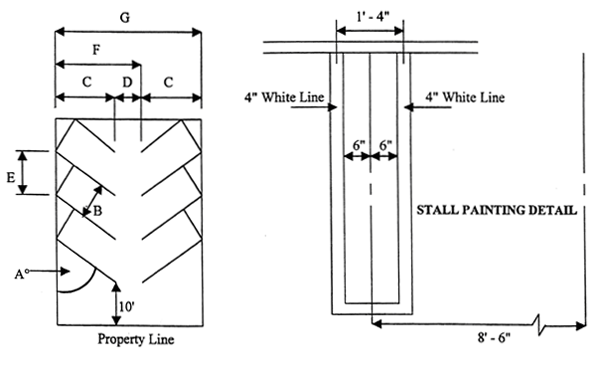
Figure 2: Tandem and Valet Parking
(d)
Tandem and valet parking dimensions. Where tandem and valet parking is provided towards required off-street parking or as additional parking, such parking areas shall conform to the dimensional standards set forth in Figure 2. Except that the tandem parking stalls may be stacked no more than two spaces deep.
(e)
[Reserved.]
(Ord. No. 2010-10-218, § 2(12-90), 4-7-2010; Ord. No. 2014-02-314, § 2(Exh. A), 1-8-2014; Ord. No. 2014-17-328, § 3, 10-8-2014; Ord. No. 2020-001-420, § 2(Exh. A), 1-22-2020)
Sec. 34-383. - Off-street loading spaces.
(a)
Loading spaces for the delivery of goods and services shall be provided in compliance with the requirements of table 2 in this section. Each loading space shall be striped and marked as a "loading zone" and shall be a minimum of 12 feet wide by 25 feet long.
(Ord. No. 2010-10-218, § 2(12-100), 4-7-2010; Ord. No. 2020-001-420, § 2(Exh. A), 1-22-2020)
Sec. 34-384. - Parking for the disabled.
Parking for disabled persons shall be provided as required by state statutes.
(Ord. No. 2010-10-218, § 2(12-110), 4-7-2010; Ord. No. 2020-001-420, § 2(Exh. A), 1-22-2020)
Sec. 34-385. - Veterans parking.
(a)
Spaces required. One parking space specifically designated for veterans shall be required for all commercial uses with 50 parking spaces or more.
(b)
Signage and markings. Veterans parking space shall be prominently posted with an approved permanent above-ground sign which shall not exceed seven feet above grade in height.

Figure 3: Approved permanent above-gournd sign
(Ord. No. 2020-001-420, § 2(Exh. A), 1-22-2020)
Editor's note— Ord. No. 2020-001-420, adopted January 22, 2020, amended § 34-385 in its entirety to read as herein set out. Former § 34-385 pertained to parking for persons transporting young children, and derived from Ord. No. 2020-10-218, adopted April 7, 2010.
Sec. 34-386. - Bicycle parking.
A minimum of one bicycle rack with a capacity to hold at least five bicycles shall be provided on properties with 50 vehicular parking spaces or more. An additional bicycle rack shall be provided for each additional 50 parking spaces required, up to a maximum of three bike racks or 15 bicycle spaces. Bicycle racks shall be located adjacent to the primary building they are intended to serve, as close to the entrance as is practicable.
(Ord. No. 2010-10-218, § 2(12-130), 4-7-2010; Ord. No. 2020-001-420, § 2(Exh. A), 1-22-2020)
Sec. 34-387. - Shared parking.
(a)
Defined. Shared parking occurs when one or more required parking spaces are shared by more than one use. Shared parking may be proposed in conjunction with development approval and shall comply with the methodologies and standards set forth herein.
(b)
Number of spaces. The determination of the required number of parking spaces for a specific use under an approved shared parking program shall be based upon the minimum required parking spaces set forth in section 34-381. The methodology for calculating the required parking for a use under a shared parking program shall be as follows:
(1)
Multiply the minimum parking requirement for each individual use, as provided in table 1 in section 34-381 by the appropriate percentage in table 4 in this section for each of the five designated time periods.
(2)
Add the resulting sum for each of the five vertical columns in the table.
(c)
Minimum requirement. The minimum requirement for shared parking is the highest sum among the five columns resulting from the calculation in subsection (a)(1) of this section.
(1)
Shared parking shall not result in a reduction of more than 25 percent from the minimum parking required without shared parking.
(2)
Parking spaces which are reserved for use by specified individuals, classes of individuals or specified businesses shall not be counted toward meeting shared parking requirements.
(3)
Reserved parking for the disabled shall not be counted towards meeting shared parking requirements.
(d)
Shared parking agreement. The owner or owners of record of a property for which shared parking is requested shall be responsible for preparing a written agreement between the owners of the properties sharing parking and the city, indicating the terms under which the shared parking shall be used. The agreement shall be approved by the city attorney and shall be recorded in the county official records. The owners of record shall update the shared parking agreement to address any change in the uses identified in the agreement which would cause an increase in peak parking demand, or a finding of any other related change in conditions by the administrative official. The modified agreement shall be subject to the review and approval of the administrative official.
(e)
Other methodologies for the calculation of shared parking requirements. In lieu of using table 4 in this section, the minimum total number of required parking spaces may be determined using other acceptable methodologies, as reviewed and approved by the administrative official.
(f)
Single-family residential. Single-family residential uses shall not be eligible for shared parking.
Source: Shared Parking, Urban Land Institute
(Ord. No. 2010-10-218, § 2(12-140), 4-7-2010; Ord. No. 2020-001-420, § 2(Exh. A), 1-22-2020)
Sec. 34-388. - Commercial vehicle, recreational vehicle, and boat definitions.
In addition to words and terms defined herein this chapter, the following words and terms shall be used in the interpretation of parking of commercial vehicles:
(1)
The term "commercial vehicle" means any vehicle which is used in connection with a business, whether with or without signage or identification of such business; designed or used for the carriage of goods, or designed or equipped with a connecting device for the purpose of drawing a trailer, and includes any such motor vehicle that has added, a cabinet box, a platform, a rack, or other equipment for the purpose of carrying goods other than the personal effects of the passengers.
(2)
The term "recreational vehicle" or "RV" means a vehicle designed for off-road recreational operation or as temporary living quarters for recreational, camping, or travel use which either has its own motive power or is mounted on or drawn by another vehicle, specifically including a travel trailer, camping trailer, truck camper, or motor home; excluding a mobile home.
(3)
The term "boat" means a "vessel" as defined by F.S. § 327.02, including a boat trailer thereof, excluding a vessel less than 12 feet in length and less than two feet in height. Boats parked or stored in a residential district shall not exceed 25 feet in length.
(4)
The term "heavy truck, as defined in F.S. § 320.01(10), means any motor vehicle with a net vehicle weight of more than 5,000 pounds, and is registered on the basis of gross vehicle weight in accordance with F.S. § 320.08(4), and is designed or used for the carriage of goods or designed or equipped with a connecting device for the purpose of drawing a trailer that is attached or coupled thereto by means of such connecting device and includes any such motor vehicle to which has been added, a cabinet box, a platform, a rack, or other equipment for the purpose of carrying goods other than the personal effects of the passengers.
(5)
The term "private passenger van, utility van, or private passenger pickup truck" means any private passenger van or private passenger pickup truck having a scale weight (vehicle only) of 5,000 pounds or less and used solely for personal activities; however, any such vehicle (including automobiles) with outside lettering displaying information identifying a business or other non-personal use of any kind, for the purpose of this section, shall be determined to be a commercial vehicle regardless of scale weight, and shall be subject to parking restrictions in residential zoning districts.
(6)
The term "prohibited vehicle" means:
A heavy truck;
A recreational vehicle greater than 25 feet in length;
A boat or recreational vehicle less than 25 feet in length, except as permitted in subsection 34-389 (b) and (c) of this chapter.
A boat, vessel or boat trailer greater than 25 feet in length;
A mobile home; except as permitted per section 34-287 of this chapter.
A bus;
A dump truck;
A tow truck;
A semi-truck with or without a trailer;
Inoperable vehicle;
Machinery, including, but not limited to, front-end loaders, back hoes, tractors and bulldozers;
Any other motor vehicle that has been modified from its original design such that it includes any of the features of the above-enumerated prohibited vehicles.
(Ord. No. 2010-10-218, § 2(12-150), 4-7-2010; Ord. No. 2014-02-314, § 2(Exh. A, 1-8-2014; Ord. No. 2019-010-412, § 2(Exh. A), 7-24-2019; Ord. No. 2024-003-472, § 2(Exh. A), 3-27-2024)
Sec. 34-389. - Commercial vehicle, recreational vehicle, boat parking on single-family residential properties and in single-family residential zoning districts restricted.
(a)
Prohibited. No prohibited vehicle shall be parked or stored on any residential property or in any residential zoning district within the city or any public property including, but not limited to, a yard, setback area, vacant lot, public right-of-way, swale or parkway. Any commercial vehicle over 5,000 pounds, including private passenger van, utility van or private passenger pick-up identifying a business or intended for non-personal use of any kind, shall also be prohibited from residential zoning districts.
(b)
Application, inspection and permit required. Commercial vehicles less than 5,000 pounds, and boats and recreational vehicles less than 25 feet in length shall only be permitted after an application is completed by the owner, the commercial vehicle, boat or recreational vehicle is registered with the city, and the city has issued an annual permit to the owner, after inspection by the city. Permits expire on April 30 each year and must be re-issued annually by May 1 to remain valid. The annual registration fee shall be established by separate resolution. There is no refund of any application fees if the application is denied. No permits shall be issued for vacant lots, multifamily units or townhomes. Only one commercial vehicle, boat or recreational vehicle may be registered at a time, for the same lot within a single-family residential zoning district or on a single-family residential property, subject to the following requirements. No variances or waivers shall be granted from the requirements below:
(1)
The commercial vehicle, boat or recreational vehicle must be owned by the occupant of the residential property and the registration must be current; proof of ownership, registration and residency shall be required as part of the application submittal.
(2)
The commercial vehicle, boat or recreational vehicle shall remain unoccupied and uninhabited while parked or stored on the residential property. The owner shall be required to submit a sworn affidavit confirming that the commercial vehicle, boat or recreational vehicle shall remain unoccupied and uninhabited at all times and shall not be used as an accessory dwelling unit or rental property. It shall be presumed that the commercial vehicle, boat, or recreational vehicle is occupied or inhabited, or that an accessory dwelling unit or rental property has been established when one or more of the following conditions are observed:
a.
There are one or more electrical, water, sewer or utility connections or illegal hook-ups designed to serve the commercial vehicle, boat or RV. The commercial vehicle, boat or RV is advertised for short- or long-term rental in print or online.
b.
The commercial vehicle, boat or RV is occupied.
c.
The commercial vehicle, boat or RV has the appearance of being lived-in during inspection.
d.
The inspector is prohibited from conducting an inspection of the interior of the commercial vehicle, boat or RV during inspection.
The existence of any of the above conditions shall deem the applicant ineligible to apply for a permit for a minimum of three years and the commercial vehicle, boat or RV must be immediately removed from the property.
(3)
The commercial vehicle, boat or recreational vehicle shall be kept in a neat and operable condition, provided that no maintenance or repairs including, but not limited to, brake service, tune-ups, repairs of the internal engine, rear end, transmission, exhaust system, body and chassis, shall be performed while parked or stored on the residential property;
(4)
Boats and recreational vehicles shall be covered at all times with a commercial covering designed for that purpose. Make-shift covers or tarps shall not be permitted;
(5)
The commercial vehicle, boat or recreational vehicle shall be parked or stored in the rear yard at least ten feet from all property lines on a smooth, non-dusting surface consisting of concrete, asphalt or pavers and shall be screened from the right-of-way by a legally permitted solid opaque fence with solid opaque gates both a minimum of six feet in height. Properties without gate access or that require the commercial vehicle, boat or recreational vehicle to be lifted or craned into the rear yard shall not be issued permits.
(6)
The commercial vehicle, boat or recreational vehicle shall be screened from the view of all abutting properties by a legally permitted solid opaque fence a minimum of six feet in height.
(7)
The commercial vehicle, boat or recreational vehicle shall only be permitted on lots with a legally permitted approach and driveway in the front yard on which the commercial vehicle, boat or recreational vehicle can be driven.
(8)
Violation of any of the above requirements after permit issuance shall be considered grounds for the immediate revocation.
(c)
Exceptions. Vehicles providing a service, including the delivery of goods and merchandise, repairs and maintenance, or otherwise engaged in work in a residential district, may park along a public right-of-way or on residential property for the duration of the service or work but not to exceed 12 hours in any 24-hour period. Longer periods may be permitted by the administrative official in the best interests of the occupant of the residential property and of the neighborhood.
These requirements shall not supersede more stringent restrictions contained in any deed, condominium document or similar private instrument.
(Ord. No. 2010-10-218, § 2(12-160), 4-7-2010; Ord. No. 2011-02-244, § 2(App. A), 3-2-2011; Ord. No. 2014-02-314, § 2(Exh. A), 1-8-2014; Ord. No. 2019-010-412, § 2(Exh. A), 7-24-2019; Ord. No. 2024-003-472, § 2(Exh. A), 3-27-2024)
Sec. 34-390. - Commercial vehicle parking in industrially zoned properties restricted.
The parking of commercial vehicles in industrially zoned areas shall be permitted subject to compliance with the following:
(1)
The vehicle shall have a valid motor vehicle, truck registration, heavy truck or any and all other required motor vehicle registration with the state;
(2)
The vehicle shall be operable;
(3)
The vehicle shall be parked in a designated and paved private parking space;
(4)
The vehicle shall not encroach on rights-of-way, sidewalk or landscaped areas.
(Ord. No. 2010-10-218, § 2(12-170), 4-7-2010; Ord. No. 2011-02-244, § 2(App. A), 3-2-2011; Ord. No. 2019-010-412, § 2(Exh. A), 7-24-2019)
Sec. 34-391. - Commercial, vehicle parking in EO, PCD, NC, zoned properties permitted.
(a)
The parking of commercial vehicles in EO entertainment overlay, PCD planned corridor developmentand, NC neighborhood commercial properties shall be permitted subject to compliance with the following:
(1)
The vehicle shall have a valid motor vehicle, or any and all other required motor vehicle registration with the state;
(2)
The vehicle shall be operable;
(3)
The vehicle shall be registered to or directly related to a business operating on the premises;
(4)
The business related to the vehicle in question shall have a valid certificate of use;
(5)
The vehicle in question shall be used on a regular basis to carry out the transportation needs of the business;
(6)
The vehicle shall be parked in a designated and paved private parking space; parking of commercial vehicles shall be located at the rear of the business. If no rear parking is available for the business, the commercial vehicles shall be parked as far away as possible from any street right-of-way.
(7)
The vehicle shall not encroach on rights-of-way, sidewalk or landscaped areas.
(8)
Size of commercial vehicles is limited to vehicles having a scale weight (vehicle only) of 5,000 pounds or less.
(Ord. No. 2010-10-218, § 2(12-180), 4-7-2010; Ord. No. 2019-010-412, § 2(Exh. A), 7-24-2019)
Sec. 34-392. - Commercial parking facilities.
(a)
Off-street parking areas provided as required parking for an established use shall only be utilized as a commercial parking facilities for off-street parking purposes for the use it is designated for.
(b)
Commercial parking garages or facilities shall meet the minimum standards as set forth in this article, and shall be considered a principal use on the property and require all necessary business licenses and a certificate of use from the city.
(c)
Off-street parking spaces provided within commercial parking garages or facilities within the entertainment overlay district (EO) may be counted towards the required off-street parking at the same ratio required for office type and commercial type uses within the EO.
(Ord. No. 2010-10-218, § 2(12-190), 4-7-2010; Ord. No. 2015-03-333, § 2(Exh. A), 3-25-2015)

