
Miami Gardens City Zoning Code
ARTICLE XVII
SIGN REGULATIONS11
Editor's note— Ord. No. 2018-13-394, adopted July 25, 2018, amended art. XVII in its entirety to read as herein set out. Former art. XVII pertained to the same subject matter, consisted of §§ 34-647—34-372, and derived from Ord. No. 2010-10-218, adopted Apr. 7, 2010; Ord. No. 2011-02-244, adopted Mar. 3, 2011; Ord. No. 2012-12-245, adopted Oct. 3, 2012; Ord. No. 2014-02-314, adopted Jan. 8, 2014; and Ord. No. 2015-01-331, adopted Jan. 14, 2015.
Sec. 34-647.- Title.
This article shall be known as the "Sign Code of the City of Miami Gardens" or article XVII of this chapter, zoning and land development.
(Ord. No. 2018-13-394, § 2(Exh. A), 7-25-2018)
Sec. 34-648. - General principles.
The City of Miami Gardens ("city") is located in an area of the county with major transportation thoroughfares including the Palmetto Expressway, N.W. 27th Avenue, and N.W. 2nd Avenue (State Road 441). These three corridors are the emphasis for development and redevelopment in the city's comprehensive development master plan's (CDMP) future land use plan. Consistent with the CDMP, the sign code further emphasizes these corridors and other major thoroughfares in the implementation of development regulations. The standards set forth herein establish criteria for each type of transportation corridor, tied to roadway classification. This provides a more consistent approach to implementation of the code, as opposed to exclusively following zoning district boundaries. Miami-Dade County sign regulations apply as a minimum standard in the city and, if there is a conflict between the county and city regulations, the stricter standard shall apply.
(Ord. No. 2018-13-394, § 2(Exh. A), 7-25-2018)
Sec. 34-649. - Purpose and intent.
(a)
Scope.
(1)
The provisions of this article shall govern the number, size, location, and character of all signs that may be permitted under the terms of this article. No signs shall be permitted on a plot or parcel except in accordance with the provisions of this article.
(2)
This article does not regulate government signs on government property, including, but not limited to, city signs on property owned by the city, the county or the State of Florida, and traffic control devices.
(3)
In the event of any conflict between this article and any declaration of covenants, bylaws, or other restrictions applying to any property within the city, the language affording the more restrictive interpretation shall apply.
(4)
The city specifically finds that these sign regulations are narrowly tailored to achieve the compelling and substantial governmental interests of traffic safety and aesthetics, and that there is no other way for the city to further these interests.
(b)
Purpose.
(1)
Florida Constitution. Article II, Section 7 of the Florida Constitution provides that "[i]t shall be the policy of the state to conserve and protect its natural resources and scenic beauty…" A beautiful environment preserves and enhances the desirability of the city as a place to live and to do business. Implementing the Florida Constitution is a compelling governmental interest.
(2)
Florida statutes. Florida law requires cities to adopt comprehensive plans and implement them through land development regulations (also known as zoning regulations) and approval of development orders that are consistent with the comprehensive plan. See Part II of Chapter 163, Florida Statutes. Florida law specifically requires that the city adopt sign regulations. See F.S. § 163.3202(2)(f). Complying with state law is a compelling governmental interest.
a.
City comprehensive plan elements. What's known today as the City of Miami Gardens was largely initially developed as unincorporated Miami-Dade County subdivisions. After incorporation in 2003, residents of the new city participated in visioning charrettes that helped form the basis for Miami Garden's first comprehensive plan in 2006. The visioning charrettes underscored the residents' concern for the appearance for the community and the strong desire that the city promote aesthetic design in any new development or redevelopment efforts. Cleaning up the community, eliminating freestanding signs, and requiring signs to be coordinated with building architecture were concerns expressed repeatedly during the charrettes. These priorities are reflected in the future land use and transportation elements of the resulting comprehensive plan and in other planning efforts undertaken by the city.
b.
City comprehensive plan goals, objectives and policies. Several goals, objectives and policies of the city's comprehensive plan require the city to encourage compatible development while protecting residential neighborhoods and significant resources in the city and developing a safe transportation system:
LAND DEVELOPMENT REGULATIONS GOAL 2: LOCATIONAL STANDARDS, DESIGN CRITERIA AND PERFORMANCE STANDARDS FOR DEVELOPMENT
Utilize innovative planning techniques, land development regulations and urban design standards that insure overall consistency, compatibility and continuity between land uses while taking advantage of the city's assets.
Policy 2.6.4: Development in commercial and industrial areas shall be designed to have minimal or no adverse impact on adjacent neighborhoods….
Policy 2.13.2: The city shall continue to utilize regulations for the protection of historically and archaeologically significant resources.
TRANSPORTATION ELEMENT GOAL 1: TRANSPORTATION SYSTEM
The City of Miami Gardens shall develop and maintain a safe, convenient, accessible and efficient transportation system.
Objective 1.1: Level-of-Service Standards
To provide a safe, convenient, accessible and efficient transportation system with a Level-of- Service that sustains the City's social, aesthetic, economic, and natural resources.
Policy 1.1.10: The City shall regulate encroachments in the public rights-of-way. No encroachment shall be allowed unless it is permitted by the Building Code or is permitted by a written agreement between the City and the owner of the encroachment. The agreement will identify terms and conditions upon which the encroachment is allowed within the public rights-of-way.
(c)
Caselaw. In accordance with the U.S. Supreme Court's cases on sign regulation, the regulations in this article are not intended to regulate or censor speech based on its content or viewpoint, but rather to regulate the secondary effects of speech that may adversely affect the city's substantial and compelling governmental interests in preserving scenic beauty and community aesthetics, and in vehicular and pedestrian safety in conformance with the First Amendment. These cases and their holdings include, but are not limited to:
(1)
Reed v. Town of Gilbert, U.S., 135 S. Ct. 2218, 192 L.Ed.2d 236 (2015) on the topic of noncommercial temporary signs;
(2)
Metromedia, Inc. v. City of San Diego, 453 U.S. 490 (1981) on the topic of commercial signs and billboard/off-premises signs;
(3)
City of Ladue v. Gilleo, 512 U.S. 43 (1994) on the topic of political protest signs in residential areas;
(4)
Linmark Assocs., Inc. v. Township of Willingboro, 431 U.S. 85 (1977) on the topic of real estate signs in residential areas;
(5)
Burson v. Freeman, 504 U.S. 191 (1992) on the topic of election signs near polling places;
(6)
Central Hudson Gas & Electric Corp. v. Public Service Commission, 447 U.S. 557 (1980) on the topic of regulation of commercial speech; and
(7)
City Council v. Taxpayers for Vincent, 466 U.S. 789 (1984) on the topic of signs on public property.
(d)
Impact of sign clutter. Excessive signage and sign clutter impairs the legibility, aesthetics and orderliness of the city's environment and undermines the effectiveness of governmental signs, traffic control devices and other required signs (e.g., warning signs, directional/informational signs) that are essential to identifying locations for the delivery of emergency services and other compelling governmental purposes. The intent of these sign regulations is to enhance the visual environment of the city, ensure that the residents and visitors can safely navigate through the city to their intended destinations, and promote the continued well-being of the city. It is therefore the purpose of this article to promote aesthetics and the public health, safety and general welfare, and assure the adequate provision of light and air within the city through reasonable, consistent and nondiscriminatory standards for the posting, displaying, erection, use, and maintenance of signs that are no more restrictive than necessary to achieve these governmental interests. With respect to signs advertising business uses, these regulations are specifically intended to avoid excessive competition and clutter among sign displays in the demand for public attention.
(e)
Specific legislative intent. More specifically, the sign regulations in this article are intended to:
(1)
Encourage the effective use of signs as a means of communication in the city;
(2)
Maintain and enhance the scenic beauty of the aesthetic environment and the city's ability to attract sources of economic development and growth;
(3)
Ensure pedestrian and traffic safety by regulating signs, and by uniformly regulating signs along major corridors;
(4)
Minimize the possible adverse effect of signs on nearby public and private property;
(5)
Foster the integration of signage with architectural and landscape designs;
(6)
Lessen the visual clutter that may otherwise be caused by the proliferation, improper placement, illumination, animation, excessive height, and excessive area of signs which compete for the attention of pedestrian and vehicular traffic and are not necessary to aid in wayfinding;
(7)
Allow signs that are compatible with their surroundings and aid orientation, while precluding the placement of signs that contribute to sign clutter or that conceal or obstruct adjacent land uses or signs;
(8)
Encourage and allow signs that are appropriate to the transportation corridor in which they are located, consistent with and serving the needs of the land uses, activities and functions to which they pertain;
(9)
Curtail the size and number of signs to the minimum reasonably necessary to identify a residential or business location, and the nature of such use, and to allow smooth navigation to these locations;
(10)
Establish dimensional limits and placement criteria for signs that are legible and proportional to the size of the lot and building on which the sign is to be placed, or to which it pertains;
(11)
Regulate signs so that they are effective in performing the function of identifying and safely directing pedestrian and vehicular traffic to a destination;
(12)
Preclude signs from conflicting with the principal permitted use of the lot and adjoining lots because of their accessory nature;
(13)
Regulate signs in a manner so as to not interfere with, obstruct the vision of, or distract motorists, bicyclists or pedestrians;
(14)
Except to the extent expressly preempted by state, county or federal law, ensure that signs are constructed, installed and maintained in a safe and satisfactory manner, and protect the public from unsafe signs;
(15)
Preserve, conserve, protect, and enhance the aesthetic quality and scenic beauty of all areas of the city;
(16)
Allow for traffic control devices and government signs without regulation consistent with national standards because they promote highway safety and efficiency by providing for the orderly movement of road users on streets and highways, and by notifying road users of regulations and providing nationally consistent warnings and guidance needed for the safe, uniform and efficient operation of all elements of the traffic stream and modes of travel, while regulating private signs to ensure that their size, location and other attributes do not impair the effectiveness of such traffic control devices;
(17)
Protect property values by ensuring that the size, number and appearance of signs are in harmony with buildings, neighborhoods, structures, and conforming signs in the area;
(18)
Protect property values by precluding, to the maximum extent possible, signs that create a nuisance to the occupancy or use of other properties as a result of their size, height, illumination, brightness, or movement;
(19)
Regulate the appearance and design of signs in a manner that promotes and enhances the beautification of the city and that complements the natural surroundings in recognition of this city's beautification efforts as a source of economic advantage as an attractive place to live and work;
(20)
Classify and categorize signs by type;
(21)
Not regulate signs more than necessary to accomplish the compelling and substantial governmental objectives described herein;
(22)
Enable the fair and consistent enforcement of these sign regulations;
(23)
Permit, regulate and encourage the use of signs with a scale, graphic character, and type of lighting compatible with buildings and uses in the area, and with the zoning district and comprehensive plan land use classification in which they are located, so as to support and complement the goals, objectives and policies set forth in the city's comprehensive plan;
(24)
Establish regulations affecting the design, erection and maintenance of signs for the purpose of ensuring equitable means of graphic communication, while maintaining a harmonious and aesthetically pleasing visual environment within the city;
(25)
Because signs form an integral part of architectural building and site design, require equal attention in their design, placement and construction as to that of the buildings and on the site;
(26)
Be considered the maximum standards allowed for signage and avoid excessive signage;
(27)
Achieve uniform and coordinated permanent signage within each development, by the use of consistency in the sign size, appearance, copy area, letters, location, color, and type of sign throughout the development; and
(28)
Regulate signs in a manner such that any sign is only allowed if it is expressly permitted, and not expressly prohibited; otherwise it is not allowed.
(Ord. No. 2018-13-394, § 2(Exh. A), 7-25-2018)
Sec. 34-650. - Exemption from regulation.
All signs or sign structures erected or required to be erected on city, county or state government property or by an agency of such government are exempt from regulation as provided in section 34-649(a)(2).
(Ord. No. 2018-13-394, § 2(Exh. A), 7-25-2018)
Sec. 34-651. - Sign plan required—Permanent signs.
(a)
Purpose. The purpose of a sign plan is to encourage diversity, creativity, and uniformity of all signs for a more aesthetically pleasing development. Permanent signage on all property other than property zoned for single-family residential use shall be in compliance with an approved sign plan. Owners, or their authorized designee, shall submit a proposed sign plan in an application form approved by the city, with established fees, to the planning and zoning director or designee.
(1)
Approval required. Unless otherwise provided in this article, approval of a sign plan by the city shall be required prior to the issuance of a building permit to install, alter, erect, construct, post, paint, maintain, or relocate any permanent sign.
(2)
Multi-tenant sign plan compliance. When a sign plan is required for multi-tenant development, and an individual sign owner seeks a sign permit for any type of permanent sign in an existing multi-tenant development, the property owners shall file a sign plan with the city in accordance with the provisions set forth in this article at least 30 days prior to the sign permit application being filed. Failure to file such sign plans within the prescribed time frame, shall be a violation of this article by the property owner. The city may review the individual sign permit applications and issue a permit if warranted to individual sign owners, and shall require future sign permits on same property to be in compliance with the criteria set forth in this article herein for sign plan review, and conform to sign permits approved on the property.
(3)
Inclusions. The sign plan shall include all permanent signs to be installed within the property, including any out parcels to be developed sharing common driveways and parking, and shall indicate the following:
a.
Location/placement of all monument, freestanding directional/information, wall signs, and window signs, including setback dimensions from property lines, and spacing.
b.
Size of each sign, indicating sign area, height, dimensions, and area of changeable copy.
c.
Sign copy for each sign.
d.
Type of sign, including the type of lettering (e.g., channel letters), color, materials, changeable copy area.
e.
Type and manner of illumination.
f.
Landscape plan indicating plant material and ground cover.
(4)
Criteria. The planning and zoning director or designee shall decide whether to approve the sign plan within 30 business days of receipt of the application. In reviewing the sign plan, the planning and zoning director or designee shall determine whether to approve the sign plan based solely on if the following criteria have been met:
a.
That the signage is in keeping with the overall architecture and character of the building development.
b.
That the signage is designed to meet the needs of the property for communication, identification, way finding, regulatory and informational messages in keeping with the overall architectural theme of the development.
c.
That the signage proposed is legible, conspicuous and easily readable.
d.
That the visibility and impact of the type of sign, number of signs, design, size, method of, construction, illumination and location of the proposed signs are in compliance with the minimum standards of this article, and do not adversely impact adjoining properties, or create a hazard or health risk.
e.
That the proposed signage is consistent with and not prohibited by this article.
(b)
Appeals. In the event a sign plan is denied, the decision may be appealed to the city council. Such appeal shall be submitted on a form approved by the city and accompanied with the established fee. Such appeal shall be filed with the city clerk within 30 days of the date of the decision being appealed. The city council shall hold a hearing within 30 days following receipt of the written appeal. The appeal shall be conducted as a de novo review, using the quasi-judicial procedures of section 34-44. The city council shall render a written decision within 20 days following the hearing. The decision of the city council shall be the final action of the city. If the city council does not grant the appeal, then the appellant may seek relief in the Circuit Court for Miami-Dade County, as provided by law.
(Ord. No. 2018-13-394, § 2(Exh. A), 7-25-2018)
Sec. 34-652. - Sign permit required; maintenance; compliance.
It shall be unlawful for any person to install, alter, erect, construct, post, paint, maintain, or relocate, within the municipal limits of the city any sign, unless otherwise exempt by this article, without first having obtained a permit from the city. Said permit shall be issued by the planning and zoning director or designee only after determining that all requirements of this article have been met. Before any permit is issued, an application for such permit shall be filed on a form approved by the city with the established fee. The construction or installation of a sign may also require compliance with the Florida Building Code, or other provisions of this Code.
(1)
Permit duration and extension.
a.
Sign permits shall expire within 90 days from date of issuance.
b.
If a sign permit expires, a new sign permit shall be obtained and permit fees paid prior to any sign being installed, altered, erected, constructed, posted, painted, maintained, or relocated.
c.
The planning and zoning director or designee may extend such permit for up to one additional 90-day period if requested by the applicant, and if the proposed sign complies with all requirements in effect at the date of the extension.
d.
A petition for extension shall be filed with the planning and zoning division on a form approved by the city with the established fee for the extension request. If a petition for extension is filed more than 15 days prior to the expiration of the permit, the applicable sign permit fee shall not be required.
(2)
Submittal information. Sign permit applications shall be submitted in the form provided by the city and shall include:
a.
A drawing of the subject site showing the proposed sign location and distance from property lines and from other signs on the site and adjacent properties;
b.
A dimensioned elevation drawing showing the sign area calculations, proposed sign area, stress/wind load levels, and proposed illumination; and
c.
All other information as may be necessary for the planning and zoning director or designee to determine compliance within this article.
(3)
Application review. Upon submission of an application, the planning and zoning director or designee shall review and evaluate the application as follows:
a.
No application shall be accepted until it is deemed complete by the director or designee.
b.
The director or designee shall review all of the information submitted to determine conformity with this article, including without limitation the location of the proposed sign.
c.
The submitted application will be reviewed within 20 business days and any corrections, revisions or deficiencies provided to the applicant within that 20-day period.
d.
Upon each re-submittal of corrected plans, the director or designee shall have ten business days to review the application and provide any corrections, revisions or deficiencies to the applicant. This process shall continue until the applicant has submitted a complete application or demands that the application be reviewed as is, without further revisions.
e.
If an applicant fails to provide additional information as requested by the director or designee within 90 days of the request or respond to the director or designee with a time when the information will be submitted, the application shall be deemed to be withdrawn by the applicant. The applicant shall be entitled to one 90 calendar-day extension upon request, providing the request for extension is granted prior to the expiration of the 90-day period.
f.
The director or designee shall approve or deny the sign permit within 20 business days of receipt of the complete application or the applicant's demand for review as submitted, based on whether it complies with the requirements of this article. The director or designee shall prepare a written notice of the decision, either in the form of an approved sign permit or written notice of denial, and provide such written notice to the applicant of its decision within the 20-day period.
(4)
Appeals. In the event a sign permit is denied by the planning and zoning director or designee, the decision may be appealed to the city council. Such appeal shall be submitted on a form approved by the city and accompanied with the established fee. Such appeal shall be filed with the city clerk within 30 days of the date of the decision being appealed. The city council shall hold a hearing within 30 days following receipt of the written appeal. The appeal shall be conducted as a de novo review, using the quasi-judicial procedures of section 34-44. The city council shall render a written decision within 20 days following the hearing. The decision of the city council shall be the final action of the city. If the city council does not grant the appeal, then the appellant may seek relief in the Circuit Court for Miami-Dade County, as provided by law.
(5)
Identification of sign permit holder required. Each sign requiring a sign permit shall have affixed on each sign the number of the sign permit under which the sign was installed, erected, or mounted, and the sign owner's name and address. For signs not reasonably visible from ground level, such information shall be kept readily available for inspection by the sign owner.
(6)
Compliance with codes. All signs shall conform to the requirements of the building, electrical, and other applicable technical codes, except as may be otherwise provided herein.
(7)
Advertising conflicting with zoning rules. No sign shall be erected or used in a manner which would conflict with the regulations for the district in which it is located, or be in conflict with the use permitted under the certificate of use or occupancy for the property.
(8)
Qualification and certification of erector. Where the erection of any sign requires compliance with any technical code, the erector of the sign shall qualify with the applicable examining board.
(9)
Fees required. If a sign permit and fee are required, no sign shall be installed, altered, erected, constructed, posted, painted, maintained, or relocated, unless the required permit fees are first paid.
(10)
Responsibility for sign. The owner and tenant of the premises, and the owner, erector, and beneficiary of the sign shall be held responsible for any violation of this article; provided, however, that when the sign has been erected in accordance with this chapter, the sign company shall be relieved of further responsibility after final approval of the sign.
(11)
Maintenance. Every sign, together with its framework, braces, angles, or other supports, shall be well-maintained in appearance and in a good, safe and legible condition, properly secured, supported and braced and able to withstand wind pressures as required by the Florida Building Code or any other regulatory code or ordinance in effect within city limits.
a.
In the event that a wall sign is removed, all anchor holes shall be filled and covered in a manner that renders the anchor holes non-discernable with the wall within 60 days of the removal of such sign.
b.
All lights and luminous tubes illuminating a sign shall be maintained in working condition. All replacement bulbs and lenses shall be of the same wattage and color as the light it is replacing unless a change is required to meet existing code requirements.
c.
All landscaping required and provided with monument signs shall be properly maintained in appearance and good safe conditions.
d.
If the use having a sign is discontinued for a period of 90 days, all signs identifying the use must be removed from the site or signs shall be replaced with a blank sign face by the property owner.
(Ord. No. 2018-13-394, § 2(Exh. A), 7-25-2018)
Sec. 34-653. - Signs permitted without sign permit.
The exemption from a sign permit shall not be construed to waive or otherwise exempt compliance with the Florida Building Code, other provisions of this article or Code, or other applicable technical codes, any limitation or restriction on the number, size, height, setback, placement or duration of such signs under this article, or any limitation or restriction under any other applicable law or regulation.
(1)
Signs exempt from sign permit requirements. The following signs may be installed, altered, erected, constructed, posted, painted, maintained, or relocated, without obtaining a sign permit from the city or payment of a sign permit fee:
a.
All signs or sign structures that are exempt from regulation per section 34-650.
b.
Construction signs.
c.
Nameplate signs.
d.
Utility company signs.
e.
Flags.
f.
Real estate signs for residential uses.
(Ord. No. 2018-13-394, § 2(Exh. A), 7-25-2018)
Sec. 34-654. - Nonconforming signs/amortization.
Any lawful permanent sign installed, or erected prior to the adoption of this article or any amendment to this article, that does not comply with the regulations set forth herein, shall be removed or altered to comply with the applicable regulations of this article by July 1, 2020.
(1)
General rule for amortization of nonconforming signs. Legally existing signs that become nonconforming as of the effective date of the adoption of this article shall maintain legally nonconforming status until July 1, 2020, with exceptions as herein contained, at which time all signs not in compliance shall become illegal signs. It shall be unlawful for any sign owner not to be in compliance with the following amortization provisions, with exceptions as herein contained:
a.
As of July 1, 2019, all owners of legally nonconforming signs are required to prepare and submit to the city a proposed sign plan in accordance to regulations herein.
b.
As of December 31, 2019, all owners of legally nonconforming signs are required to have an approved sign plan in compliance with this article.
c.
As of July 1, 2020, all legally nonconforming signs and their supporting members shall be altered, or removed from the property.
d.
The city may deny the issuance of any licenses, permits, certificates of use, to an owner if it is determined that the amortization article is not being complied with.
e.
A property owner may file an application with the city to obtain approval for a certificate of legal conformity. Such determination shall be made by the planning and zoning director or designee after consideration and review of plans that demonstrate that signage on the property is or will be improved to the greatest extent physically possible to comply with all applicable regulations of this article. The city may establish written administrative guidelines for the review and issuance of a certificate of legal conformity for signage that become nonconforming as of the effective date of this amortization provision. Said guidelines may be revised, amended, and modified administratively from time to time.
(2)
Amortization of monument signs along collector and all other rights-of-way. Freestanding and monument signs that were lawfully existing prior to July 1, 2018, that do not comply with the regulations set forth herein, shall remain legally nonconforming signs and will not be required to be amortized out if they meet the following standards:
a.
The total sign area and sign height does not exceed the maximum allowable amounts as may be permitted under the regulations set forth herein this article.
b.
The sign is landscaped, repaired and maintained accordingly in compliance with regulations set forth in this sign code.
c.
If the sign is relocated; moved; or altered at a cost greater than 50 percent of the assessed value of the sign; the legal nonconforming status shall be lost and the sign shall be in required to be in compliance with the regulations set forth in this article.
(3)
Amortization of window signs.
a.
An owner of a window sign shall submit a window sign plan, consistent and in compliance with the provisions of submitting a sign plan by October 1, 2018.
b.
Window signs shall be in compliance with the provisions of this article by January 1, 2019.
(4)
Amortization of temporary signs. All legally existing temporary signs shall be in compliance with the provisions of this article by October 1, 2018.
(5)
Exception for billboards and off-premises signs. Amortization shall not apply to billboard (class C signs in the county Code) and off-premises signs that were lawfully erected on the date of adoption of this article. These signs shall be permitted as legally nonconforming signs. Said signs shall be subject to below provisions regarding maintenance and repair of nonconforming signs. This section shall not be interpreted to prevent the city from entering into relocation agreements for off-premises signs in accordance with F.S. § 70.20, nor shall it be interpreted to interfere with development or lease agreements previously entered into by the city.
(6)
Maintenance and repair of nonconforming signs. Nonconforming signs shall be maintained in a safe condition and may be repaired or otherwise maintained or both, provided the sign structure is not moved, altered or replaced; provided, that the cumulative costs of such repair and maintenance does not exceed 50 percent of the replacement value of the sign. If so, the sign shall comply with the provisions set forth in this article.
(Ord. No. 2018-13-394, § 2(Exh. A), 7-25-2018; Ord. No. 2018-21-402, § 2, 12-12-2018)
Sec. 34-656. - Sign variances.
This sign code seeks to reduce the proliferation of the number, size and types of signs in order to advance all of the substantial and compelling governmental interests described in this article. No sign shall be permitted to be installed, altered, erected, constructed, posted, painted, maintained, or relocated, contrary to the provisions of this article unless a variance is approved by the planning and zoning director or designee, or the city manager as outlined below or the city council pursuant to the provisions below. Variances shall not be granted from the prohibited sign list in section 34-671.
(1)
The planning and zoning director or designee shall determine whether to approve or deny any variance that is 25 percent or less than any applicable standard within 30 days of the determination of completeness of the application. Variances that are within 26 percent to 35 percent of any applicable standard may be approved or denied by the city manager within 30 days of the determination of completeness of the application. Variances which exceed 35 percent of any applicable standard may only be approved after a public hearing by the city council, using quasi-judicial procedures in accordance with section 34-44, to be held within 45 days of the determination of the completeness of the application. The city council shall render a written decision within 20 days following the hearing. The decision of the city council shall be the final action of the city. If the city council does not grant the appeal, then the appellant may seek relief in the Circuit Court of Miami-Dade County, as provided by law.
(2)
The city council shall grant a variance if the following criteria are met:
a.
There is something unique about the building or site configuration that would cause the signage permitted by this article to be ineffective in identifying a use or structure that would otherwise be entitled to a sign, and
b.
The granting of a variance is not contrary to the plan and intent of this article or any adopted redevelopment plan or policies, the aesthetics of the area, and does not create a nuisance or adversely affect any neighboring properties.
(3)
A variance may be sought as set forth below:
a.
Submit a complete application in the form provided by the planning and zoning division, and pay the established fee.
b.
Provide evidence that the granting of the variance is consistent with the criteria set forth above for the granting of such variance.
c.
The planning and zoning director or designee shall review all of the information submitted, and prepare a report on whether the variance meets the requirements of this section.
(4)
Any variance granted pursuant to this section for a sign that does not require a building permit shall become null and void if the approved sign is not installed within 180 days of the written ruling from the city council or the planning and zoning director or designee. Any variance granted pursuant to this section for a sign requiring a building permit shall become null and void if a building permit for the approved sign is not applied for prior to temporary certificate of occupancy or completion or, if there is no such certificate, within 36 months of the written ruling from the city council or the planning and zoning director or designee. The planning and zoning director or designee may issue an extension for up to an additional 180 days upon written request prior to the expiration of the original 180-day or 36-month period. Additionally, the variance shall become null and void in the event that a permit expires or is revoked.
(5)
All signs approved by this variance process must be constructed and installed substantially in compliance with the information and plans presented to staff or the city both in writing and verbally. Failure to construct, or erect a sign substantially in compliance with the information and plans presented shall render the variance null and void, and any sign installed, or erected not in substantial compliance with the information and plans provided for the variance shall be considered an illegal sign.
(Ord. No. 2018-13-394, § 2(Exh. A), 7-25-2018; Ord. No. 2025-001-481, § 2(Exh. A), 1-8-2025)
Sec. 34-657. - General monument and wall sign standards.
The following design and dimensional standards shall be applied and complied with for all monument and wall signs, unless specifically set forth differently in this article.
(1)
Monument sign dimensional standards.
a.
In computing sign area, standard geometry formulas for common shapes shall be used. Common shapes shall include squares, rectangles, trapezoids and triangles. In the case of irregular shapes, the total sign area will be the area of the smallest common shape that encompasses the various components of the sign.
b.
The support base above grade shall be deemed to be part of the sign.
c.
Only one face of a sign is used for the calculation, provided the two sign faces are less than 30 degrees to each other or no more than one 1.5 feet exists between them. Where the sign faces are spaced greater than 1.5 feet apart and greater than 30 degrees then each face shall be calculated towards the permitted sign area.
d.
If sign copy is displayed on more than two sides of the sign, then the additional sign faces shall also be calculated towards the permitted sign area. This calculation shall be applied to information/directional signs, projecting signs and all other signs, except wall and window signs. (See figure 1 in this section.)
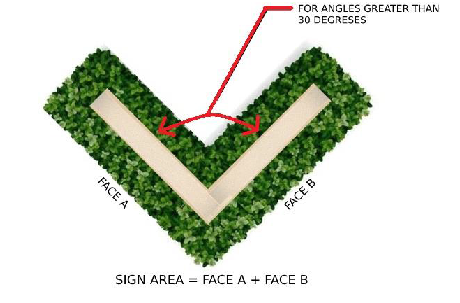
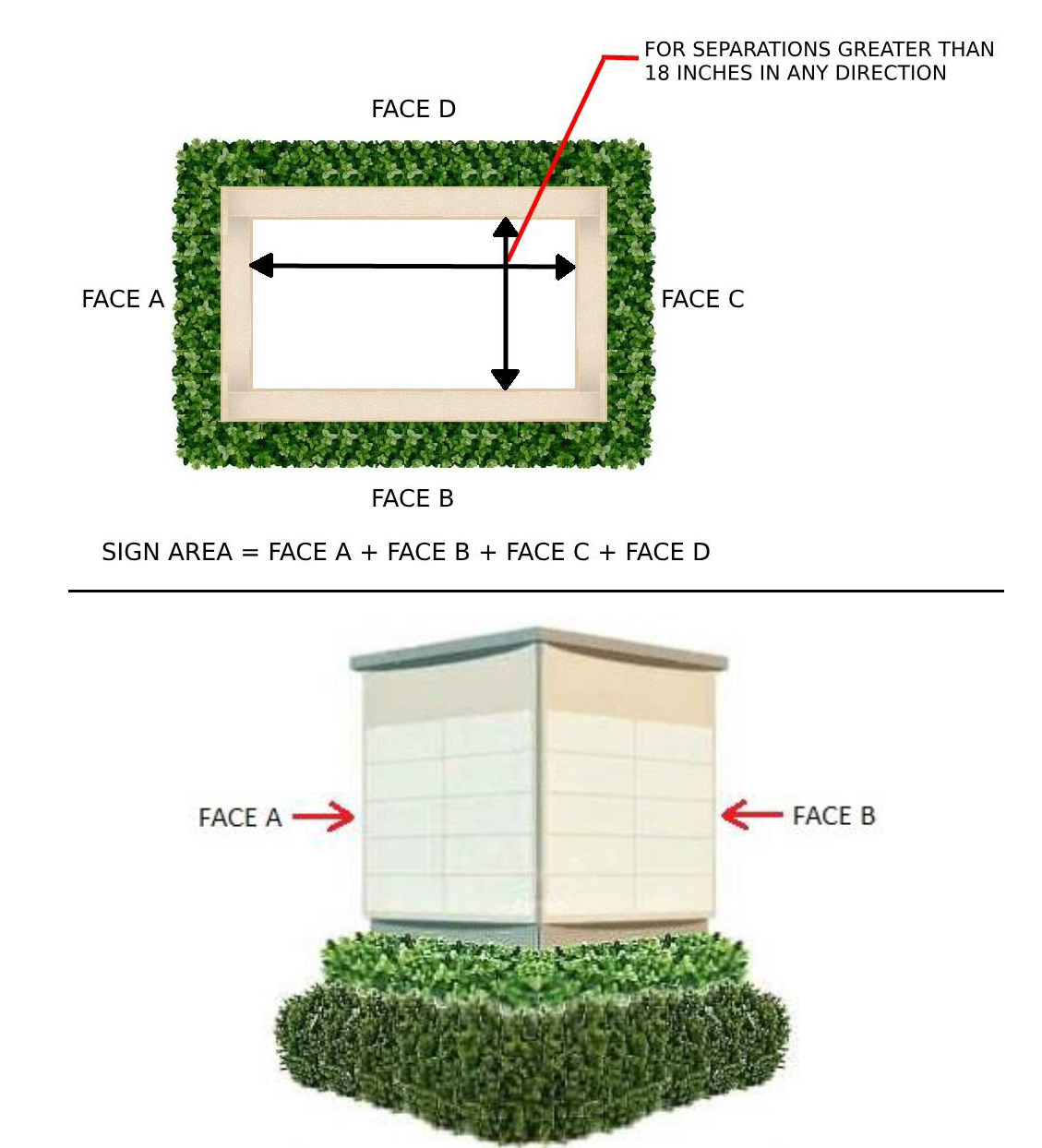
Figure 1: Calculating Sign Area for Multi-Faced Monument Signs
(2)
Design Standards for monument signs. In designing monument signs, the following standards shall be complied with:
a.
Design.
1.
The sign shall be designed so that it meets the definition of a monument sign
2.
The base supporting structure may be designed as multiple bases, provided that at least 80 percent of the footprint of the monument sign shall be in contact with the ground.
b.
Architectural design. Monument signs should incorporate architectural elements from the primary building. Architectural elements may include materials, textures, colors, shapes, ornamentation or other features characteristic of a style.
c.
Landscaping.
1.
A minimum of 50 square feet of landscaping around the base of the sign shall be provided.
2.
Plant material shall be selected to complement and enhance the sign, and a hedge no less than two feet in height, trimmed to assure the legibility of the monument sign, shall be provided to buffer the base of the sign.
3.
Such landscape should be permanently irrigated with an in-ground irrigation system or irrigated in a manner approved by the planning and zoning director or designee.
d.
Illumination.
1.
Monument signs may be illuminated internally or externally.
2.
All internal illumination components shall be enclosed.
3.
All external illumination components shall not be visible from the adjacent rights-of-way.
4.
All illumination should be environmentally friendly and energy efficient, which may include, but is not limited to, the use of solar energy or other alternative sources of energy.
e.
Setback. Monument signs shall be set back from all property lines a minimum of seven feet or as far as necessary to be clear of the sight distance triangle.
f.
Spacing.
1.
Monument signs shall be spaced a minimum of ten feet from any building.
2.
Monument signs shall be spaced a minimum of 25 feet from another monument sign on the same or an adjoining property. Monument signs with automatic changeable copy shall be spaced in accordance with subsection m. below.
g.
Proportion. Monument signs shall be proportionate in height and width at a ratio of 1.0 to 1.5. In either orientation, the width shall not exceed ten feet.
h.
[Reserved.]
i.
Location.
1.
Monument signs shall not be located in the sight distance triangle.
2.
Monument signs shall be oriented to be between 45 degrees and 90 degrees to the abutting right-of-way.
j.
Sign copy. Copy shall be identical on all faces of the sign.
[k.
Reserved.]
l.
Manual changeable copy sign standards. Monument signs with manual changeable copy shall be permitted subject to compliance to the following standards:
1.
The manual changeable copy portion of the sign shall be integrated into the design of the sign. Such changeable copy portions of the sign shall not be an "add-on" but rather must be fully integrated into the sign design.
2.
The manual changeable copy area shall not exceed 30 percent of the total sign area.
3.
The changing of copy on such signs does not require a sign permit.
4.
Manual changeable copy shall not change more than once a day.
5.
Manual changeable copy shall only be permitted on monument signs. Manual changeable copy on any other sign is prohibited.
m.
Automatic changeable copy sign standards. Monument signs with automatic changeable copy shall be permitted on parcels of at least ten gross acres in any zoning district other than R-1 and R-2, subject to compliance to the following standards:
1.
The automatic changeable copy portion of the sign shall be integrated into the design of the monument sign. Such changeable copy portions of the sign shall not be an "add-on" but rather must be fully integrated into the sign design.
2.
Automated changeable copy area shall not exceed 30 percent of the total sign area.
3.
A maximum of one monument sign with automatic changeable copy per development shall be permitted. Parcels or developments that are larger than 50 acres are permitted two automatic changeable copy monument signs.
4.
Automatic changeable copy on monument signs shall only be permitted on properties/developments with a minimum lot frontage of 200 lineal feet on an arterial and collector roadway as defined herein.
5.
The minimum distance between monument signs with automatic changeable copy shall be 500 feet. If the lot dimensions are such that a 500-foot separation is not feasible, the signs shall be constructed at the maximum possible separation, as determined by the planning and zoning director.
6.
Incandescent lamps/bulbs shall not be exposed but shall be covered by translucent lenses or filters. The automatic changeable copy portion of the sign shall be equipped with an automatic operational night dimming device and shall automatically go black in the event of a malfunction. All digital signs shall be modulated so that, from sunset to sunrise, the brightness shall not be more than 500 nits. Sunset and sunrise times are those times established by the Miami office of the National Weather Service. At all other times, the maximum brightness levels shall not exceed 5,000 nits. All digital signs shall have installed ambient light monitors and at all times shall allow such monitors to automatically adjust the brightness level of the sign based on ambient light conditions.
7.
The following operating modes shall be prohibited:
(i)
Flash: The condition created by displaying the same message intermittently by turning it on and off, on and off, with rapidity, or any other delivery mode that creates a flashing effect.
(ii)
Zoom: The look or condition created by expanding a message from a central point to its full size.
(iii)
Traffic control device: Operation of the sign in a mode causing the sign to imitate a traffic control device.
8.
The changing of copy shall not require a sign permit.
9.
Automatic changeable copy shall only be permitted on monument signs. Automatic changeable copy on any other sign, is prohibited.
(Ord. No. 2018-13-394, § 2(Exh. A), 7-25-2018)
Sec. 34-658. - Sign area for monument signs along principal arterial and minor arterial corridors (PAMA).
The signs permitted on property is determined by the property's location on the city's rights-of-way as defined in the city's comprehensive master plan, and depicted on map FLU I-7 of the plan (figure 4 in this section), and determined by the type of use of the property. In addition to applicable criteria and design standards set forth in this article, the following signs shall be permitted as set forth below.
Figure 4: City of Miami Gardens Arterials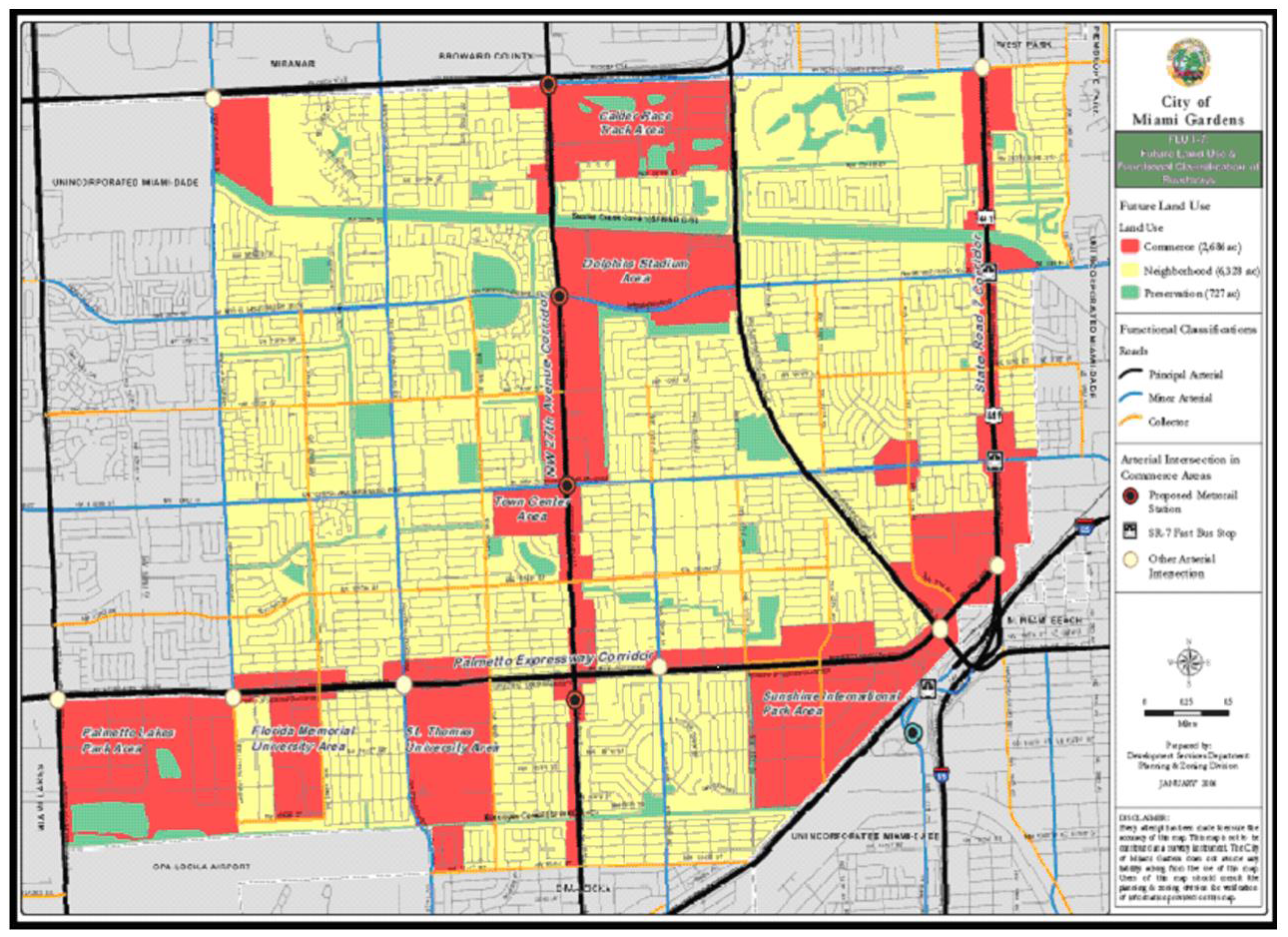
(1)
Monument signs (PAMA). Properties with frontage on a principal arterial or minor arterial right-of-way (figure 5 in this section) shall be permitted the following monument signage:
a.
Number.
1.
One monument sign on properties with a minimum linear lot frontage of 50 or more feet on a public right-of-way.
2.
Monument signs are not permitted on properties with less than 50 linear feet of lot frontage on a right-of-way.
3.
A second monument sign may be allowed if the property has two lot frontages of 50 linear feet or more on a right-of-way or if the property has 500 feet or more of linear lot frontage on one right-of-way. In any event, a maximum of two signs shall be permitted.
b.
Sign area.
1.
Forty square feet for the first 50 feet of lot frontage on a street, plus 0.75 square feet for each additional foot of lot frontage, up to a maximum of 65 square feet total for one sign.
2.
Where two signs are permitted, neither sign shall exceed 65 square feet, for a total of 130 square feet.
c.
Sign height. Ten feet maximum.
Figure 5: Monument Signs on PAMA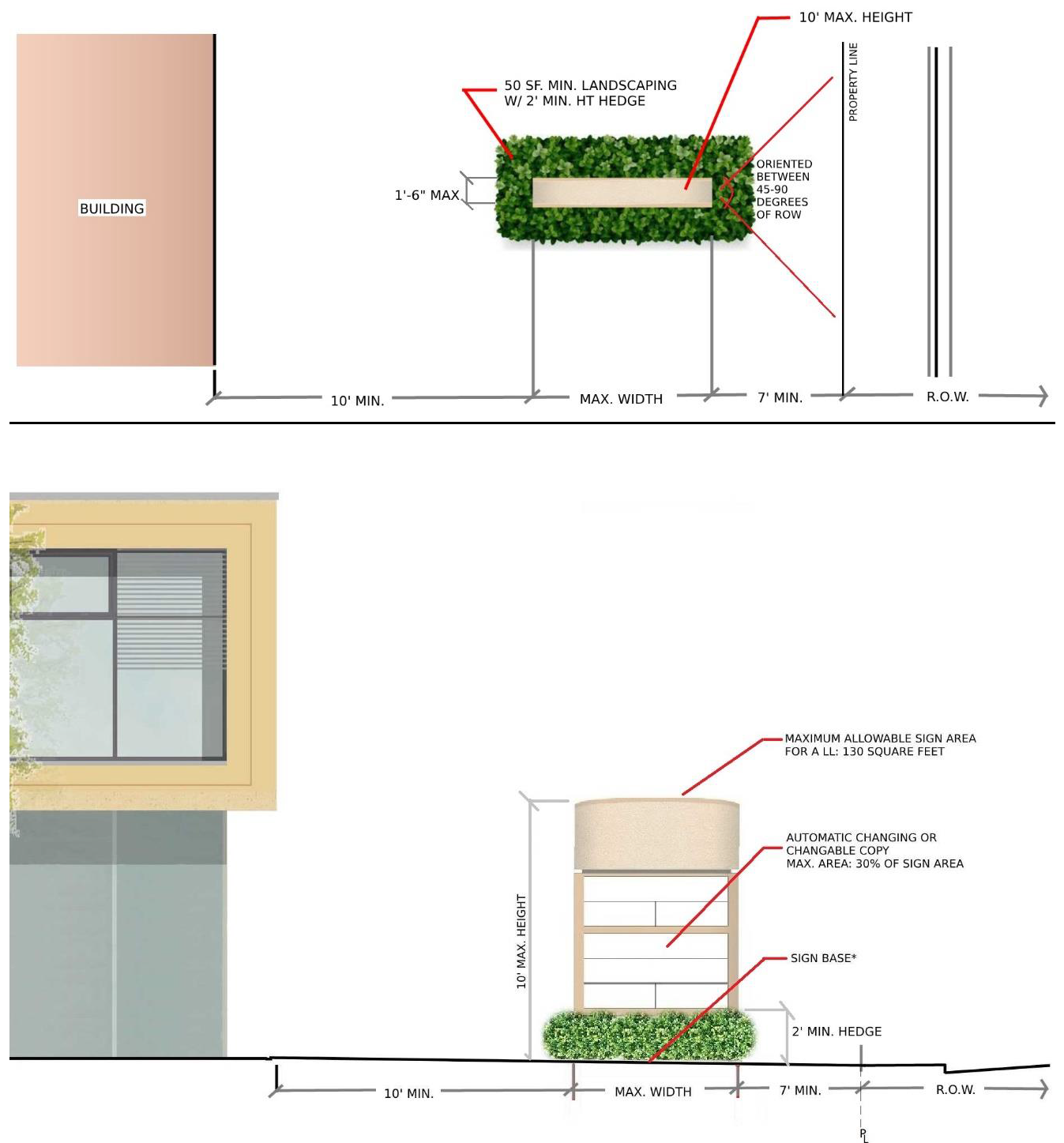
(Ord. No. 2018-13-394, § 2(Exh. A), 7-25-2018)
Sec. 34-659. - Sign area for monument signs along collector and all other rights-of-way.
Properties with frontage rights-of-way other than arterial right-of-ways (figure 6 in this section) shall be permitted the following.
(1)
Monument signs on collectors and all other rights-of-way.
a.
Number. One monument sign on properties with a minimum linear lot frontage of 50 or more feet on a public right-of-way. Monument signs are not permitted on properties with less than 50 linear feet of lot frontage on a right-of-way.
b.
Sign area. Twenty-four square feet for first 50 feet of lot frontage on a street, plus 0.5 square feet for each additional foot of frontage, up to a maximum of 54 square feet.
c.
Multi-use/multi-tenant development. A second freestanding sign may be allowed if the site has more than 500 feet of street frontage. The maximum size of each sign shall be 54 square feet for a total of 108 square feet.
d.
Height. Six feet maximum.
Figure 6: Monument Signs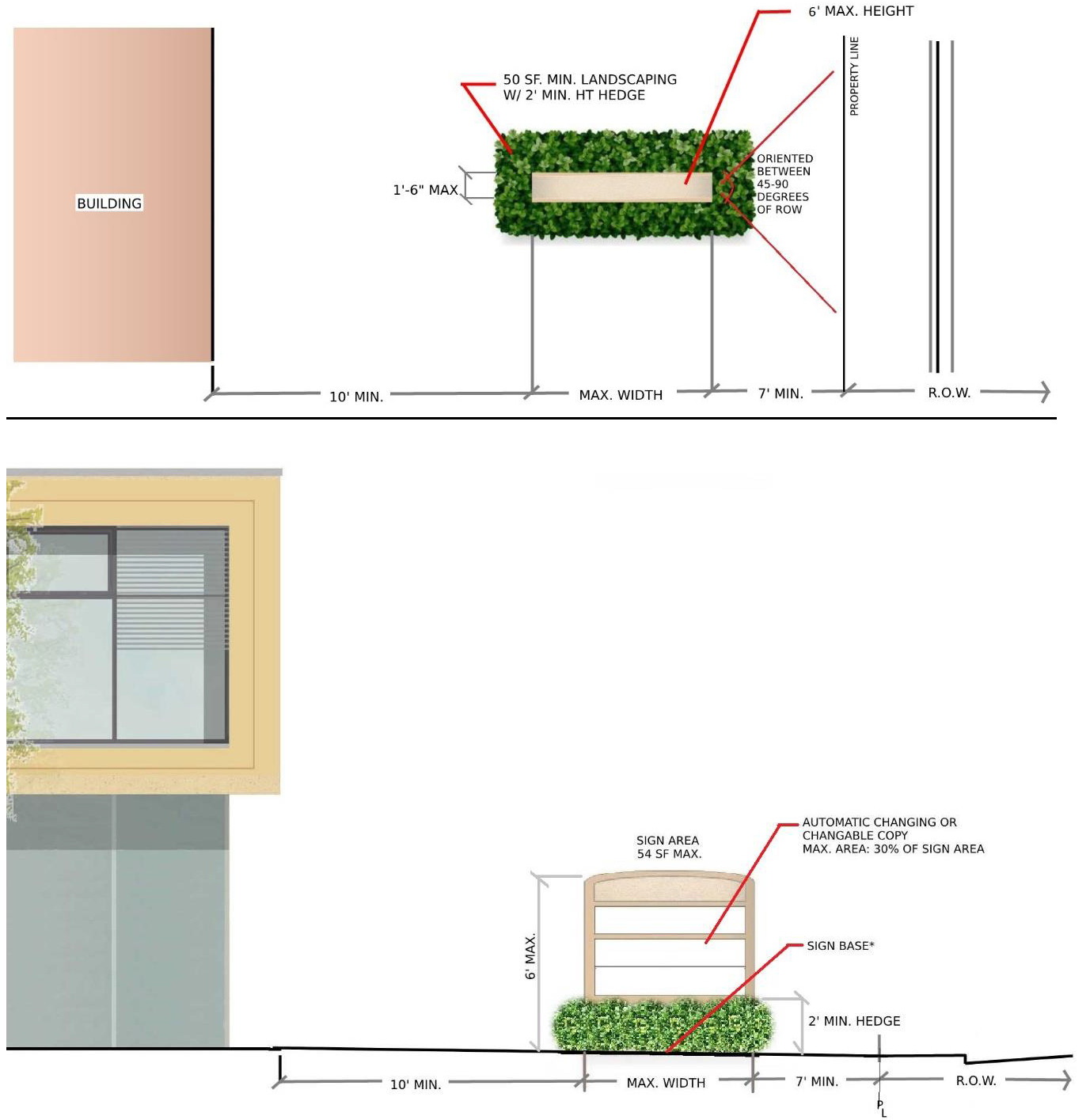
(Ord. No. 2018-13-394, § 2(Exh. A), 7-25-2018)
Sec. 34-660. - Wall signs.
(a)
Wall sign design standards. In designing wall signs, the following standards shall be complied with (see figure 2 in this section.):
(1)
Multiple signs. Where multiple wall signs with the same sign copy are to be placed on different building facades for the same sign owner/tenant/business, each wall sign should be identical in design. The maximum permitted sign area and location of placement shall be that permitted for the location of the sign.
(2)
Sign lettering.
a.
Wall signs shall only be of individually mounted letter, channel lettering or reverse channel lettering type and design and cabinet signs shall only be used to display copy of registered trademarks, logos, and/or slogans.
b.
Lettering shall be centered on the building facade, or the proportionate share of the facade, to which it is affixed.
c.
Anchor tenants are not required to have signs centered on the building facade.
d.
Copy should be of all the same font type. Different lettering size, type, and colors, for trademarked logos and slogans may be used.
(3)
Location.
a.
No wall sign shall extend above the roofline except where an exterior parapet wall projects above the roofline, in which case, such sign may not extend above the top edge of the parapet.
b.
Wall signs shall not be allowed on a building facade abutting a single-family zoned or developed property.
c.
Wall signs shall be located as to not interfere with public alarms, signals, or signs. No sign or support shall be placed in such position or manner as to obstruct or interfere, either physically or visually, with any fire alarm, police alarm, traffic signal or sign or any devices maintained by or under public authority.
(4)
Proportion. Wall signs shall not extend beyond 75 percent of the width of the building facade for a tenant occupying an entire building, or the tenant's proportionate share of the building facade.
(5)
Projection. Wall signs shall not project more than 12 inches from the building surface where it is affixed.
(6)
Sign copy. Wall signs shall not contain more than three lines of copy; when a third line is used, one of the three lines shall not be greater than 50 percent the height of the line with the greatest line height.
(b)
Wall sign dimensional standards.
(1)
Calculating sign area of wall signs.
a.
In calculating the area of wall signs, individual words or components (i.e., logos, trademarks, slogans, major products, services), may be considered separate signs only if they are obviously disassociated from other copy. When signs are enclosed in a border or highlighted by background graphics, the perimeter of such border or background will be used to compute sign area. The total area of components and copy shall be used to determine the total wall sign area.
b.
The building facade measured for the calculation shall only be the facade to which the sign is proposed to be affixed.
(c)
Sign area for wall signs located on a principal or minor arterial (PAMA).
(1)
Number.
a.
One wall sign per building facade with frontage on a right-of-way. An additional wall sign may be located on the building facade if such building facade faces into the parking area and is not abutting single-family residentially developed property.
b.
If permitted a second wall sign, the second sign shall be identical copy, color, illumination method and method of construction. Each sign's size will be determined independently based on the facade frontage.
c.
All buildings that have access from an alley or drive aisle may have one non-illuminated sign, located on the rear door of the building not to exceed three square feet in sign area, and not located higher than eight feet above grade.
(2)
Size.
a.
The total area of the wall sign shall not exceed ten percent of the building facade with frontage on a right-of-way for the first 15 feet in height of the building. The area may be increased by 1.5 percent for each foot of building height above 15 feet measured to the bottom of where the sign is to be located.
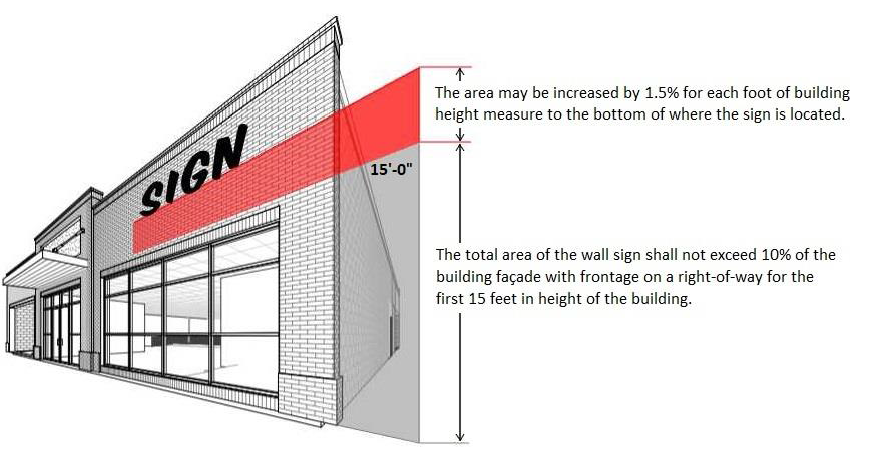
(3)
Multi-use/multi-tenant/multi-story/mixed-use development.
a.
For one- and two-story buildings, one wall sign per tenant's/use's proportionate share of building facade with frontage on a right-of-way, as well as one additional wall type sign located at the rear or side of a building facade if such building facade faces into the parking area and is not abutting single-family residentially developed property.
b.
Tenants/uses that have two facades fronting a right-of-way may have two wall signs. The second sign shall be identical copy, color, illumination method and method of construction. Each sign's size will be determined independently based on the proportionate share of frontage of the facade for each tenant/use.
c.
For buildings with three or more stories, one wall sign per building facade with frontage facing a right-or-way, up to a maximum of two wall signs. In lieu of a wall sign on the building facade with frontage on a right-of-way, one wall sign may be located on the building facade that faces into the parking area, provided that such sign is not abutting single-family residences or single-family residentially zoned property. The second sign shall be identical copy, color, illumination method and method of construction. Each sign's size will be determined independently based on the facade frontage.
d.
Wall signs located on second story building facades shall be permitted up to 50 percent of the sign area as would be permitted on the ground floor building facade.
(d)
Sign area for wall signs located on a collector and all other rights-of-way.
(1)
Number.
a.
One wall sign per building facade with frontage on a right-or-way, up to a maximum of two wall signs. In lieu of a wall sign on the building facade with frontage on a right-of-way one wall sign may be located on the building facade if such building facade faces into the parking area and is not abutting single-family residentially developed property.
b.
If a second wall sign is permitted, the second sign shall be identical copy, color, illumination method and method of construction to the first sign. Each sign's size will be determined independently based on the facade frontage.
(2)
Size.
a.
The total area of the wall sign shall not exceed ten percent of the building facade with frontage on a right-of-way for the first 15 feet in height of the building. The area may be increased by 1.5 percent for each foot of building height measured to the bottom of where the sign is located.
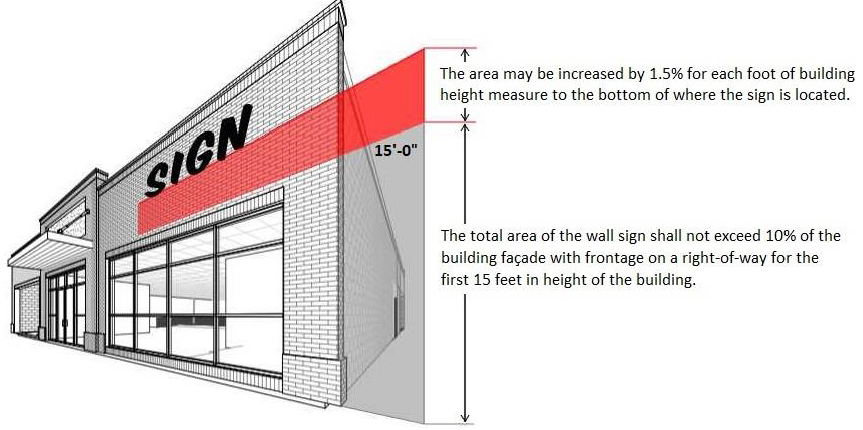
Figure 2: Wall Sign Calculations Diagram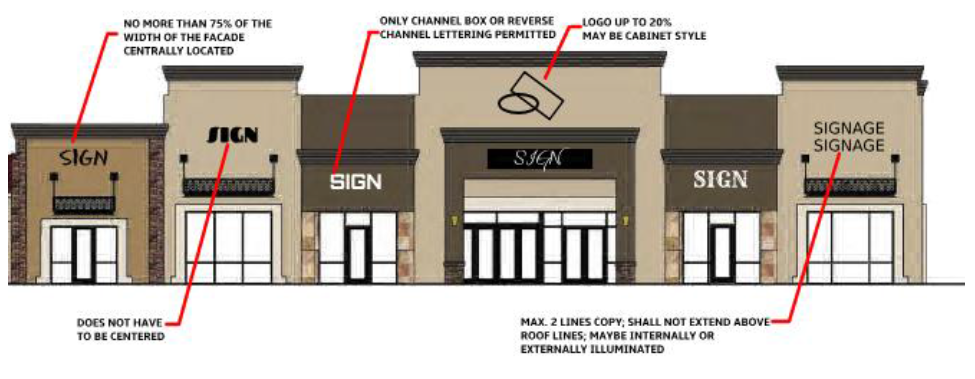
(Ord. No. 2018-13-394, § 2(Exh. A), 7-25-2018)
Sec. 34-661. - Directional/information sign design standards.
In designing directional and information signage the following standards shall be complied with:
(1)
Design. Directional/informational signs may be freestanding, monument, wall signs.
(2)
Size and number. Directional/informational sign shall not exceed two square feet in size. Along collector and all other rights-of-way the planning and zoning director or designee shall determine the maximum size and number of directional/information signs necessary to ensure the visibility and function of the signs, and the location of the signs.
(3)
Setback. Freestanding directional/informational signs shall be setback a minimum of five feet from any property line.
(4)
Spacing. Freestanding directional/informational signs shall be spaced a minimum of ten feet from each other.
(5)
Height.
a.
Wall-mounted directional/informational signs may be mounted at eye level as to be visible to the general public and not intended to be visible from the right-of-way. Along collector and other rights-of-way such signs may be wall mounted as to provide adequate visibility and directions as may be approved by a sign plan permit.
b.
If suspended from a ceiling or structure, minimum clearance shall be 9.0 feet from grade, or if over a vehicle driveway, travel lane minimum clearance shall be 14.0 feet from grade.
(6)
Location.
a.
Directional/information signs may be located within the sight distance triangle providing the sign is not greater than 30 inches in height.
b.
Wall-mounted directional/informational signs may be mounted on walls, fences, or suspended from a ceiling or structure.
c.
Wall-mounted or suspended signs may be parallel or perpendicular to the building wall.
(7)
Illumination. Directional/informational signs may be illuminated internally or externally. If illuminated externally, all components providing illumination shall be adequately screened or recessed as to be not visible from the rights-of-way.
(Ord. No. 2018-13-394, § 2(Exh. A), 7-25-2018)
Sec. 34-662. - Window sign standards.
In designing window signs the following standards shall be complied with (see figure 3 in this section.):
(1)
Design. Window signs shall be professionally installed within the window area.
(2)
Materials. Window signs shall be permanent in nature with acceptable materials to include gold leaf, silver leaf, silk screened, cut or frosted vinyl, and etched glass. Flyers, banners and posters attached to a window shall not be permitted to suffice as permanent window signage.
Figure 3: Window Sign Calculation Diagram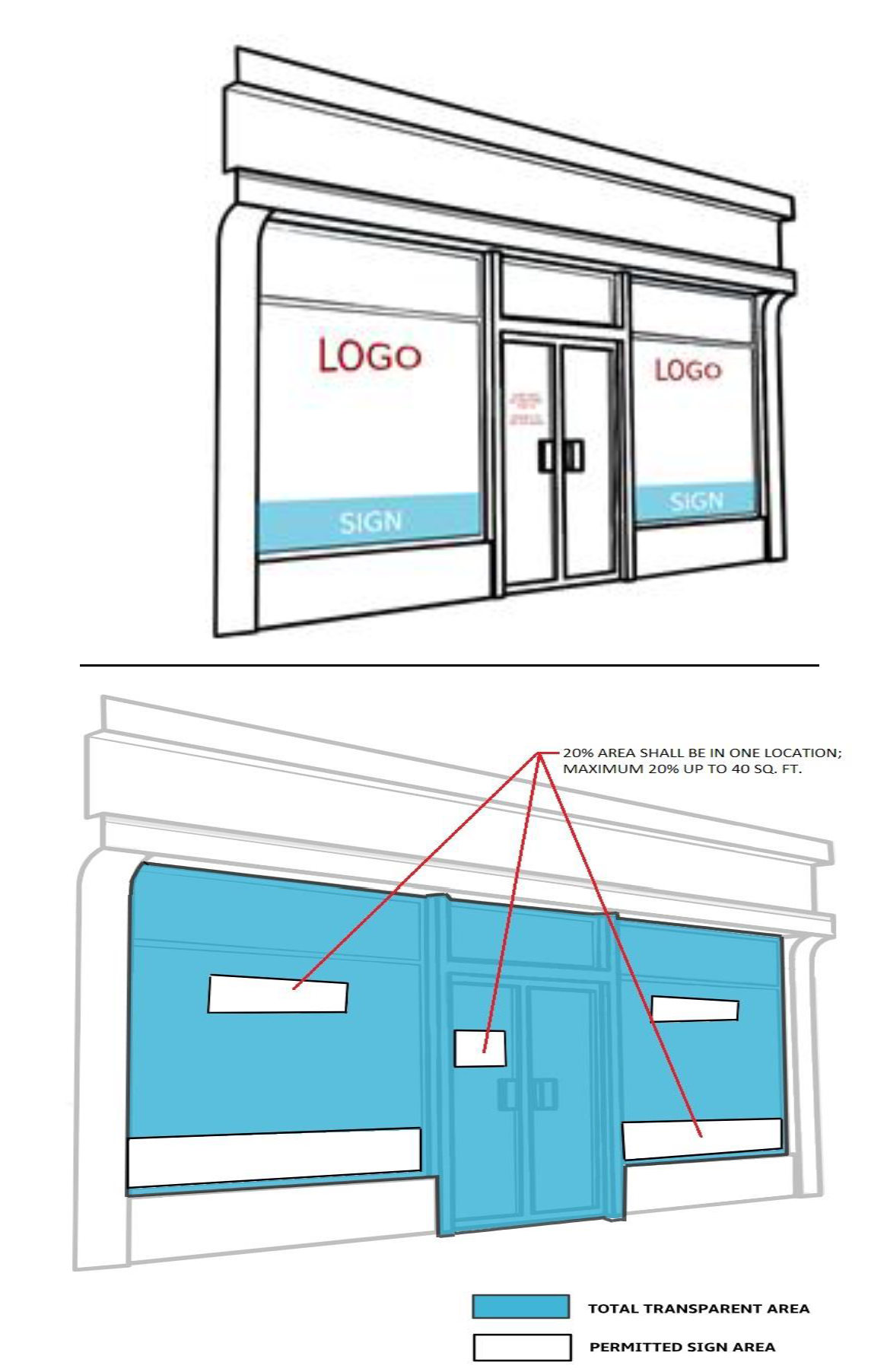
(3)
Area.
a.
For window signs located on the first or ground floor, the total area of all signs affixed or displayed in the window shall not exceed 20 percent of the window area up to a maximum of 40 square feet.
b.
For window signs located on the second floor or above the ground floor, the total area of all signs affixed or displayed in the window shall not exceed ten percent of the window area up to a maximum of 20 square feet.
c.
In calculating the total permitted window sign area, only windows and doors facing a right-of-way, windows on the main entrance of the building, and windows that are on the ground floor shall be used for the calculation. Perimeter borders, stripes and bonding are permitted but will count towards the calculation of window sign area. In calculating the area of window signs, individual words or components (i.e., logos, trademarks, slogans, major products, services, etc.), may be considered separate signs only if they are obviously disassociated from other copy. When signs are enclosed in a border or highlighted by background graphics, the perimeter of such border or background will be used to compute sign area. The total area of components and copy shall be used to determine the total window sign area.
d.
Window sign area shall not be counted towards the maximum wall sign area allowed.
(4)
Location.
a.
Window signs shall only be permitted on windows or doors located on the first or ground floor and located on the second floor, and on windows and doors on the facade facing a public right-of-way or commonly used as the main entrance to the premises.
b.
Window signs shall not be permitted on windows above the ground in multi-story buildings.
c.
All window signs shall be located within the same 20 percent area as depicted on the approved window sign plan.
(Ord. No. 2018-13-394, § 2(Exh. A), 7-25-2018)
Sec. 34-663. - Entrance feature signs.
Entrance feature signs shall be permitted for residential developments, mixed-use developments, neighborhoods, subdivisions, or other geographic areas in the city, subject to compliance to the following standards:
(1)
Number. One entrance feature monument sign or two entrance feature wall signs.
(2)
Sign area.
a.
A maximum entrance feature sign area of up to 24 square feet for developments with less than 100 linear feet of lot frontage on a right-of-way.
b.
Up to a maximum of 64 square feet for developments with 100 lineal feet or greater of lot frontage on a right-of-way. If two wall signs are used, the total area of both wall signs shall not exceed the maximum area permitted.
(3)
Height.
a.
The maximum height of the monument sign shall be six feet measured from grade to the uppermost portion of the monument sign. In the event the grade at the base of the sign is bermed the measurement shall be taken from the grade at the closest right-of-way line to the uppermost point of the sign.
b.
Maximum height of a wall sign shall be six feet measured from grade to the uppermost portion of the wall sign.
(4)
Separation.
a.
Entrance feature monument signs shall be separated from each other by a minimum of 200 feet and from other freestanding signs by at least 50 feet.
b.
Entrance feature wall signs shall be separated by a minimum of 25 feet of other wall signs.
(5)
Setback. Entrance feature monument signs shall be set back a minimum of seven feet from a right-of-way line.
(6)
Location.
a.
Entrance feature monument signs shall be located within 25 feet of the entranceway.
b.
Entrance feature wall signs shall be affixed to a perimeter wall or guardhouse of the development, and shall be within 25 feet of the entranceway.
(7)
Copy. Sign copy shall be limited to no more than two lines of text.
(8)
Availability. The city or a property owner(s) may apply to the planning and zoning director or designee for approval for an entry feature sign to identify a specific geographic area, neighborhood, or subdivision in the city that meets the following criteria:
a.
Number. A maximum of one freestanding entry feature sign may be approved for each major entranceway or visibility point for the geographic area, subdivision or neighborhood.
b.
Size. The maximum size of an entry feature sign for a geographic area, subdivision or neighborhood shall be 32 square feet.
(Ord. No. 2018-13-394, § 2(Exh. A), 7-25-2018)
Sec. 34-664. - Directory signs.
Directory signs shall be permitted subject to compliance to the following standards:
(1)
Number. One directory sign shall be permitted for each multi-use/multi-tenant building on the property.
(2)
Size. Directory signs shall be limited to three square feet in size, and lettering shall not exceed a maximum of three inches in height.
(3)
Location. Directory signs may be freestanding or affixed to the building facade, and shall be setback at least 25 feet from a public right-of-way.
(Ord. No. 2018-13-394, § 2(Exh. A), 7-25-2018)
Sec. 34-665. - Flags.
Flags shall be permitted subject to compliance with all the following standards. Compliance with the United States Flag Code (36 USC 173—178) which is hereby adopted and made part of this section by reference as if it were set forth herein is necessary if the US Flag is to be flown.
(1)
For nonresidential, multifamily residential, commercial and industrial, and mix-use development.
a.
Number. A maximum of one flag pole per property shall be permitted on properties with lot frontages of 100 feet or less; a maximum of two flag poles for properties with lot frontages greater than 100 feet up to 200 feet; and a maximum of three flag poles for properties with lot frontages of greater than 200 feet. No more than three flags shall be flown on one pole, with a maximum of three flags per property or development.
b.
Size. Maximum flag size shall be 40 square feet. The width of the flag shall not be more than 30 percent of the length of the pole to which it is attached.
c.
Height. Maximum pole height shall be 30 feet or not more than ten feet above the roof line of primary building, whichever is less.
d.
Location. All flags shall be flown on a ground-mounted pole designed and constructed as a flag pole, or affixed to a pole affixed to a building. The pole shall be ground-mounted and constructed according to the Florida Building Code. If affixed to a building, the pole shall be no longer than ten feet in length. No rooftop flags are permitted.
e.
Spacing. Multiple flag poles shall be grouped. They shall be located a maximum of ten feet from one another.
f.
Setback. Flag poles shall have a minimum ten-foot setback from all property lines.
g.
Copy. Only non-commercial flags, or registered corporate trademarks, logos, or seals on flags shall be permitted. If the USA flag is flown it shall be flown on at the top, and/or in accordance with United States Flag Code (36 USC 173—178).
h.
Maintenance. Flags and flag poles shall be maintained in good condition as to not be flailed or weathered.
(2)
For single-family residential uses, duplexes, townhouses, and other residential uses.
a.
Number. A maximum of one flag shall be permitted per property.
b.
Size. Maximum size of the flag shall be limited to 24 square feet.
c.
Height. Flag poles shall be limited to no greater than five feet above height of the residence or up to 35 feet, whichever is less.
d.
Location. All flags shall be flown on a flag pole either ground mounted or on a pole affixed to a wall. Flags may only be located in the front yard or rear yard only.
e.
Setback. Flag poles shall setback a minimum of ten feet from front property lines and five feet from all other property lines.
f.
Copy. Only non-commercial flags shall be permitted.
g.
Maintenance. Flags and flag poles shall be maintained in good condition as to not be flailed or weathered.
(3)
Flags in mass prohibited. The flags permitted by this section shall not be used in mass in order to circumvent this article by using said flags primarily as an advertising device.
(Ord. No. 2018-13-394, § 2(Exh. A), 7-25-2018)
Sec. 34-666. - Billboard signs.
Unless approved by contract pursuant to F.S. § 70.20, or previously agreed to by the city by virtue of a development agreement, court order, or lease agreement, new billboard signs erected after July 1, 2019, shall only be permitted along State Road 826 (Palmetto Expressway) and the Florida Turnpike in accordance with the following:
(1)
Number. A maximum of ten new billboards shall be permitted within the jurisdictional limits of the city.
(2)
Distance requirements. New billboard signs shall not be located closer than 3,500 feet from an existing billboard sign or another new billboard sign. Notwithstanding the foregoing, new billboard signs located along the Florida Turnpike and north of the C-9 Canal shall not be located closer than 1,500 from an existing billboard sign or another new billboard sign.
(3)
Size. New billboard signs are limited to a maximum height of 14 feet and maximum width of 48 feet.
(4)
Pole. New billboard signs may be supported by a single pole only, and may have two sign faces per pole.
(5)
Federal and state requirements. New billboard signs shall comply with applicable federal and state requirements.
(Ord. No. 2018-13-394, § 2(Exh. A), 7-25-2018; Ord. No. 2018-21-402, § 2, 12-12-2018; Ord. No. 2025-001-481, § 2(Exh. A), 1-8-2025)
Sec. 34-667. - Vehicle fueling stations and sales.
Due to the unique retail service of vehicle fueling stations and sales, in addition to all the standards set forth herein, the following signs shall also be permitted subject to compliance to the following standards:
(1)
Wall sign. In lieu of locating a wall sign on the building facade, a wall sign may be affixed to the canopy facade.
(2)
Monument sign. In the event the permitted changeable copy of up to 30 percent of the monument sign cannot accommodate the pricing regulations required by law, the changeable copy may be increased the minimum amount for compliance.
(3)
Size. Wall sign on canopies shall be limited to up to 40 percent of the area calculated as permitted for the building facade. The use of color schemes unique to the registered brand shall not be interpreted as a sign required to be included in calculating the permitted wall sign area.
(4)
Gasoline pumps. Up to a total of four square feet of commercial signage shall be permitted to be located on each gasoline pump. Legally required informational signage does not count towards this area limit. Signs, other than required by law, located on top of pumps shall be prohibited.
(5)
Prohibited. Banners, either on or otherwise mounted/placed on/with or connected to pumps shall be prohibited.
(Ord. No. 2018-13-394, § 2(Exh. A), 7-25-2018)
Sec. 34-668. - Theaters, playhouses, places of public assembly, and other similar cultural or civic establishments.
Due to the changing nature and number of events or showings theaters, playhouses, places of public assembly, and other culturally orientated establishments may be permitted an additional manual changeable copy sign. In addition, to standards set forth in this article, the following standards shall be permitted subject to compliance to the following:
(1)
Number. Theaters, playhouses, places of public assembly, and other culturally orientated establishments shall be permitted one additional manual changeable copy sign.
(2)
Sign area. Manual changeable copy area shall be limited to 75 square feet. Additional changeable copy not to exceed 25 square feet per additional theater screen, theater, or use, but not to exceed a total sign square footage of 200 square feet of sign area. Total area shall include the area of the changeable copy and the area of any poster display boxes or frames.
(3)
Wall sign. The manual changeable copy sign may be a cabinet wall sign allowing for interchangeable copy, but shall only be affixed to the front building facade, or facade of the main entrance.
(4)
Display box. Posters and other advertisements shall be only affixed within a professionally constructed display box or frame. Display boxes shall not exceed standard poster sizes.
(Ord. No. 2018-13-394, § 2(Exh. A), 7-25-2018)
Sec. 34-669. - Drive-through signs.
Due to the unique retail service that businesses operating drive through lanes provide and the necessity for efficient and effective service and the need for additional signage with changeable copy to service their customers, businesses with drive through lanes, in addition to signage that may be permitted with compliance with standards in this article herein, shall be permitted additional signage subject to compliance to the following standards:
(1)
Number. Two signs shall be permitted per drive through lane. Drive through signs may be freestanding or affixed to a wall or one of each.
(2)
Size. Each drive through sign shall not exceed 20 square feet in area. Lettering used in the copy shall not exceed six inches in height.
(3)
Spacing. Each drive through sign shall be spaced at minimum of ten feet from each other, and from other freestanding signs on the property.
(4)
Height. Freestanding signs and signs affixed to a wall shall not exceed six feet in height.
(5)
Location. Drive through signs shall be located as to be visible for the drive through lane and not oriented to be visible from rights-of-way, or drive aisles of the development.
(6)
Copy. Drive-through signs may be all manual changeable copy.
(Ord. No. 2018-13-394, § 2(Exh. A), 7-25-2018)
Sec. 34-670. - Temporary signs.
(a)
Temporary signs are permitted in the city for 90 days or for a duration of time specified for the type of sign. Temporary signs require a sign permit if specified below. Temporary signs shall not be illuminated. Failure to remove a temporary sign within the allowed time-frame shall result in a violation of this article. No temporary sign shall be located within, on, or over public right-of-way, public lands, or utility poles, or be located in a required sight visibility triangle. No temporary sign shall impede traffic or pedestrian flow, or create an unsafe or hazardous situation on or off the property. Only the sign face shall be counted toward the maximum sign area allowed. No temporary sign shall be placed upon an unimproved lot without the written consent of the property owner filed with the city clerk prior to posting of the sign. The city council shall have the authority to require a temporary sign bond prior to the installation and/or construction of signs in accordance with this section. Signs not posted in accordance with these regulations shall be subject to removal by the city. Any private owner who fails to remove an unlawful sign from his or her property shall be deemed in violation of this section. Any sign not removed within the required time frame shall be considered an abandoned sign and subject to removal without notice.
(b)
Removal; bond required.
(1)
Application of bond requirement.
a.
Unless exempt under subsection b. below, for all temporary signs at the time of application or prior to installation where no application is required, the applicant shall provide a refundable cash bond to the city's code enforcement department, the condition of which is that all signs permitted in connection with the bond shall be removed by the applicant in accordance with the time limits provided in this section.
b.
The bond requirement for temporary signs shall not apply to any person placing five or fewer temporary signs none of which exceeds a sign area of six square feet per sign, or five or fewer special event banners upon the premises of a special event, none of which exceed a sign area of eight square feet per sign. All temporary signs posted pursuant to this subsection shall otherwise comply with the applicable regulations of this section. Any person who posts temporary signs pursuant to an exemption from the bond requirement shall be subject to a $25.00 penalty per sign which is placed in violation of this section or is not removed within the time frames established by this section.
(2)
Payment of bond. Bonds shall be in the principal sum of $200.00 and the bond shall contain language that authorizes the city to use all or any part of the principal of the bond to cover its expenses in removing the signs if the applicant for the sign permit does not remove the sign within this period of time. Candidates for political office who have qualified by the petition method pursuant to F.S. § 99.095, seeking to post political campaign signs shall be exempt from this bond requirement.
(3)
Failure to obtain approval; removal of signs. If temporary signs are posted and the applicant has failed to obtain approval as required pursuant to this article, the city manager and/or his designee is authorized and directed to cause the signs to be removed immediately. The code compliance director shall keep an estimate of department expenses in removing such signs and no permit will later be granted to any applicant, unless the applicant first pays the expenses of removing such signs, as estimated by the code compliance director. Candidates for political office who have qualified by the petition method pursuant to F.S. § 99.095, seeking to post political campaign signs shall be exempt from this repayment requirement.
(4)
Responsibility for hazards; responsibility for removal of signs. Anyone who has installed a temporary sign, as well as the occupant or property owner, shall remove all such signs upon the issuance of a hurricane watch for the city by the National Hurricane Center of the National Oceanic and Atmospheric Administration National Weather Service. Failure to remove such signs which pose a hazard in hurricane conditions within 24 hours of the issuance of the hurricane watch shall cause the city to retain the bond related to the sign, if applicable, and remove the sign in accordance with the provisions of this section.
(c)
Temporary signs shall be permitted subject to compliance to the following provisions:
(1)
Construction signs.
a.
Sign area. The maximum size allowed shall be nine square feet per sign on residential properties and 32 square feet on nonresidential/mixed use properties.
b.
Sign height. Maximum sign height shall be ten feet.
c.
Duration. Building permits must be issued for the construction in question prior to the placement of a construction sign. All construction signs shall be removed within 15 days after the certificate of occupancy for the structure is issued.
(2)
Temporary construction fence sign (TCFS). Temporary construction fence signs (TCFS) shall be permitted subject to compliance with the following:
a.
Location. Temporary construction fence signs are permitted in all zoning districts. Such signs must be located at the construction site to which they refer. Building permits must be issued for the construction in question prior to the placement of a TCFS. TCFS shall only be permitted along lot frontages on public rights-of-way.
b.
Sign size and sign height. The maximum size allowed shall be nine square feet per sign on residential properties and 32 square feet on nonresidential/mixed-use properties. TCFS may be constructed up to the fence height.
c.
Copy. All copy shall be professionally prepared and affixed.
d.
Permit. A sign permit is required for a TCFS.
e.
Duration. Building permits must be issued for the construction in question prior to the placement of a TCFS. TCFS shall be removed within 15 days after the final certificate of occupancy for the structure is issued.
(3)
Temporary noncommercial speech sign.
a.
Sign size.
(i)
The maximum size allowed shall be nine square feet on residential properties and 44 square feet on nonresidential/mixed use properties.
(ii)
An additional nine square feet of signage (residential) or 32 square feet of signage (nonresidential/mixed-use) may be displayed for the time period beginning 90 days prior to an election and terminating five days after the election.
(iii)
Banner signs shall be allowed on nonresidential and mixed-use developments, up to a maximum size of ten percent of the building facade area on which the banner is mounted.
b.
Setback. Signs shall be set back a minimum of five feet from all property lines.
c.
Sign height. Maximum sign height shall be eight feet.
d.
Duration.
(i)
Temporary noncommercial signs shall not be displayed for more than 90 days.
(ii)
The additional signage described in paragraph (3)a(ii) above shall be erected no earlier than 90 days prior to the first primary election. Signs shall be removed within five days after the last election in the election season.
(4)
Real estate signs (nonresidential and mixed-use developments). A maximum of one sign per lot frontage on a right-of-way, except that properties with a lot frontage of 500 linear feet or more are allowed a maximum of two signs per lot frontage on right-of-way.
a.
Size. Real estate shall not exceed six square feet when affixed to a window or building facade, and 44 square feet when freestanding. The support structure of the freestanding sign shall not be counted towards the area of the sign.
b.
Setback. Freestanding real estate signs shall be set back a minimum of ten feet from all property lines.
c.
Sign height. Real estate signs shall be a maximum height of eight feet.
d.
Spacing. Real estate signs shall be spaced a minimum of 250 feet apart when located on the same property, and spaced a minimum of 100 feet from real estate signs on other property. Real estate signs shall be spaced a minimum of five feet from any other sign on the property.
e.
Location. Freestanding real estate signs shall be placed in landscaped areas of the property whenever feasible, and shall be placed at either a 45-degree or 90-degree angle to the right-of-way.
f.
Maintenance. Real estate signs shall be maintained in good condition and readable and shall not be faded or weathered, and shall be replaced every 12 months.
g.
Copy. Advertising of products or services other than the real estate on which they are located shall be prohibited.
h.
Duration. Real estate signs shall be permitted after a property is listed for sale. Real estate signs shall be removed within 15 days after the sale or transaction of the property.
i.
Permit. A sign permit shall be required.
j.
Banner signs. Real estate banner signs shall be allowed up to a maximum size of ten percent of the building facade area of which the banner is mounted. Real estate banner signs shall only be affixed or mounted to the building facade.
(5)
Real estate signs (single-family residential, individual townhouse, duplexes, and similar dwelling units). Real estate signs shall be permitted subject to compliance to the following standards:
a.
Number. One real estate sign may be installed per property.
b.
Size. The sign shall not exceed four square feet in area.
c.
Setback. Signs shall be setback a minimum of five feet from any property line.
d.
Height. The signs hall be a maximum height of five feet.
e.
Maintenance. Signs and all supporting structures shall be maintained in good condition and readable and shall not be faded or weathered, and shall be replaced every 12 months.
f.
Sign while open. During the period in which a property is available for inspection by prospective buyers, which may only occur between the hours of 9:00 a.m. on Fridays to 10:00 p.m. on Sundays and on federal holidays, an additional sign that does not exceed three square feet in area and two feet in height may be displayed. It shall be freestanding attached to its own support anchored in the ground, and shall not be affixed to the building.
(6)
Banner signs. Banner signs shall be permitted subject to compliance to the following standards:
a.
Permit. A sign permit shall be required for a banner sign. The banner sign permit must be kept on the business premises and readily available for inspection by a code compliance officer or the applicant may be subject to a civil violation notice;
b.
Use. Temporary banner signs can only be issued to bona fide retail/commercial, institutional, educational, religious, or restaurant use located on a single site or in a shopping center;
c.
Material. Banner signs must be of a flexible material; no permanent type signage shall be considered a banner;
d.
Number. Only one banner sign per any one-year period for single use properties can be issued. No more than three banner signs shall be permitted at any one time and in any one-year period in a shopping center with multiple tenants;
e.
Location. Banner signs must be installed on the same property as the business and must be in close proximity to the actual business. Banner signs must be spaced at least ten feet from each other. Banner signs must be installed at least seven feet from the sidewalk. No banner sign may be located on the property as to pose or create a hazardous or health safety concern;
f.
Size. Banner signs may not be greater than 50 square feet in size;
g.
Manner of installation. Banner signs must be mounted temporarily in a landscaped area, on a fence or wall; no permanent installation is allowed; banners cannot be secured to trees, light poles or other structures;
h.
Duration. Applicants have up to 15 days to install the banner and the banner sign may only be displayed for 45 days. Permits will expire 60 days from date of issuance, and all signs shall be removed. The banner and any installation material must be completely removed after 45 days of being installed or before the expiration of the permit, whichever comes first, or the applicant may be subject to a civil code violation.
(7)
Spot/search light sign. Spot/search light signs shall be permitted provided they are in compliance with the following standards:
a.
Number. The maximum number of spot light signs shall be limited to one. One sign shall have a maximum of up to four individual spot lights.
b.
Setback. Spot light signs shall setback a minimum of 15 feet from all property lines.
c.
Location. Spot light signs shall only be located on nonresidential, mixed-use properties. Signs may be located in the front of buildings, and on the property as to not occupy parking areas, or drive aisles.
d.
Duration. Spot light sign shall be permitted per property or development up to three times per calendar year for up to a maximum of three consecutive days at any one time.
e.
Copy. Illumination of copy shall not be permitted.
f.
Permit. A sign permit shall be required for a spot light sign.
(Ord. No. 2018-13-394, § 2(Exh. A), 7-25-2018; Ord. No. 2020-007-426, § 2, 10-14-2020)
Sec. 34-671. - Prohibited signs.
The following signs shall be prohibited in the city:
(1)
Any sign not in compliance with this article.
(2)
Signs so located as to constitute a danger to public safety.
(3)
Any sign with manual or automatic changeable copy that is not a monument sign.
(4)
Window signs above the second floor of any building.
(5)
Awning/canopy signs.
(6)
Any sign not secured to the ground or affixed to a wall or window in accordance with the Florida Building Code.
(7)
Signs located on top of gasoline pumps, unless required by law.
(8)
Any signs which are not traffic control device signs as defined in article XIX of this chapter, but imitate or can be confused with them.
(9)
Vehicle signs that can be viewed from a public right-of-way.
(10)
Roof signs, parapet signs, and signs projecting above a canopy, parapet, or roof of a building.
(11)
Reserved.
(12)
A sign which covers, interrupts or disrupts the major architectural features of a building.
(13)
Signs or sign support that may interfere with public alarms, signals, or signs or placed in such position or manner as to obstruct or interfere, either physically or visually, with any fire alarm, police alarm, traffic signal or sign or any devices maintained by or under public authority.
(14)
Abandoned signs that remain out of compliance of the provisions herein for more than 45 days.
(15)
Animated signs.
(16)
Portable signs.
(17)
Snipe signs.
(18)
Mascot/figurine/costume signs.
(19)
Painted signs and murals.
(20)
Any blinking or flashing lights, revolving or rotating signs, streamer lights, pennants, streamers, and all fluttering, spinning or other type of attention attractors or advertising.
(21)
Signs displayed within, on, or over public right-of-way, public lands, or located in a required sight visibility triangle, or located so as to impede traffic or pedestrian flow, or create an unsafe or hazardous situation on or off the property on which they are displayed.
(Ord. No. 2018-13-394, § 2(Exh. A), 7-25-2018; Ord. No. 2025-001-481, § 2(Exh. A), 1-8-2025)
Sec. 34-672. - Violations and penalties.
(a)
The building official, law enforcement officers, code enforcement officers and the zoning administrator, and their designees of the city shall be authorized to enforce the provisions of this article and pursuant to said authorization shall be empowered to enforce as permitted by law all violations of this article.
(b)
Any person or entity found guilty of violating any section of this article shall be subject to a fine up to $500.00 per violation per day. Each day such violation is committed, or permitted to continue, shall constitute a separate offense and shall be punishable as such hereunder.
(Ord. No. 2018-13-394, § 2(Exh. A), 7-25-2018)
Sec. 34-673. - Substitution of noncommercial speech for commercial speech.
(a)
Notwithstanding any provisions of this article to the contrary, to the extent that this article permits a sign containing commercial content, it shall permit a noncommercial sign to the same extent. The noncommercial message may occupy the entire sign area or any portion thereof, and may substitute for or be combined with the commercial message.
(b)
The sign message may be changed from commercial to noncommercial, or from one noncommercial message to another, as frequently as desired by the sign's owner, provided that the sign is not prohibited and the sign continues to comply with all requirements of this article.
(Ord. No. 2018-13-394, § 2(Exh. A), 7-25-2018)
Sec. 34-674. - Severability.
(a)
Generally. If any part, section, subsection, paragraph, subparagraph, sentence, phrase, clause, term, or word of this chapter is declared unconstitutional by the final and valid judgment or decree of any court of competent jurisdiction, this declaration of unconstitutionality or invalidity shall not affect any other part, section, subsection, paragraph, subparagraph, sentence, phrase, clause, term, or word of this article.
(b)
Severability when less speech results. This subsection shall not be interpreted to limit the effect of subsection 34-674(a) above, or any other applicable severability provisions in the Code of Ordinances or any adopting ordinance. The city council specifically intends that severability shall be applied to these sign regulations even if the result would be to allow less speech in the city, whether by subjecting currently exempt signs to permitting or by some other means.
(c)
Severability of provisions pertaining to prohibited signs. This subsection shall not be interpreted to limit the effect of subsection 34-674(a) above, or any other applicable severability provisions in the Code of Ordinances or any adopting ordinance. The city council specifically intends that severability shall be applied to section 34-671, "prohibited signs" so that each of the prohibited sign types listed in that section shall continue to be prohibited irrespective of whether another sign prohibition is declared unconstitutional or invalid.
(Ord. No. 2018-13-394, § 2(Exh. A), 7-25-2018; Ord. No. 2025-001-481, § 2(Exh. A), 1-8-2025)

