Zoneomics Logo
search icon

Miami Gardens City Zoning Code

ARTICLE XIX

DEFINITIONS AND RULES OF CONSTRUCTION

Sec. 34-729.- Intent.

The following definitions are for words which have special or limited meanings as used in this chapter. In the event a word or term is not defined herein, or in the event of conflict of definitions of words or terms defined herein, the administrative official shall make the final determination on the meaning; such determination shall be made using best available sources that provide common or professionally relied upon definitions.

(Ord. No. 2010-10-218, § 2, 4-7-2010)

Sec. 34-730. - Rules of construction.

The following rules of construction shall apply when not inconsistent with the context in which used, and the legislative intent for enacting the provision, as determined by the city.

(1)

The word "may" is permissive and distinguished from the word "shall."

(2)

Number. A term importing the singular number only may extend and be applied to several persons and things as well as to one person and thing.

(3)

The words "including" and "such as" shall always mean that the listed items following said words are not all inclusive, and shall be read as if the words "but not limited to" follow, unless the context is qualified and clearly states otherwise (ex: "including only the following:").

(4)

The word "oath" means an affirmation in all cases in which, by law, an affirmation may be substituted for an oath, and in such cases, the words "swear" and "sworn" shall be equivalent to the words "affirm" and "affirmed."

(5)

The word "or" may be read as "and"; and the word "and" may be read as "or" unless the context dictates otherwise, such as, but not limited to, their use in a list or series where they identify whether all items are inclusive, exclusive, or whether combinations of items are inclusive.

(6)

The words "and/or" shall mean "all or any."

(7)

The words "preceding" or "following" shall mean next before and next after, respectively.

(8)

The word "shall" is always mandatory and not merely directory.

(9)

The words "signature" and "subscription" include a mark when the person cannot write.

(10)

Tense. Words used in the present tense include the future tense, words in the singular number include the plural and words in the plural number include the singular number.

(11)

The word "used" shall include arranged, designed, constructed, altered, converted, rented, leased or intended to be used.

(12)

The words "designed" and "intended" shall include the word "used."

(13)

The word "occupied" includes arranged, designed, built, altered, converted, rented or leased, or intended to be occupied.

(14)

The word "land" shall include water surface.

(15)

The phrase "use of land" shall include use of buildings and other structures unless the otherwise specified.

(16)

The word "approved" shall mean meeting at a minimum the requirements of these regulations or having been issued a development order in accordance to this chapter.

(17)

The word "person" includes individuals, firms, corporations, associations, trusts, joint venture, partnership, estate, syndicate, fiduciary, government agency, two or more persons having a joint or common interest, any combination of the preceding, and other similar entities.

(18)

Joint authority. All words giving a joint authority to three or more persons or officers shall be construed as giving such authority to a majority of such persons or officers.

(19)

Time.

a.

In computing any period of time prescribed or allowed by this chapter or by order of a court, the day of the act, event or default from which the designated period of time begins to run is not to be included. The last day of the period so computed shall be counted, unless it is a Saturday, Sunday or a legal holiday, in which event the period shall run until the end of the next day which is not a Saturday, Sunday nor a legal holiday.

b.

When the period of time prescribed or allowed is less than seven days, intermediate Saturdays, Sundays and legal holidays shall be excluded in the computation.

c.

The word "month" shall mean a calendar month.

(20)

Titles. Wherever reference is made to officials, boards, departments or agencies of the city by title only, such as "mayor" or "city manager," such title shall be construed as if the words "of the City of Miami Gardens" followed it.

(21)

The words "written" or "in writing" shall be construed to include any representation of words, letters or figures, whether by printing, duplicating, handwriting, or otherwise.

(22)

Any reference to Florida Statutes, Florida Administrative Code, the Florida Building Code, the county Code, the Code of Federal Regulations, or any other official rule or law shall be construed to include the language "as may be amended from time to time," unless otherwise specified.

(Ord. No. 2010-10-218, § 2(19-10), 4-7-2010)

Sec. 34-731. - Abbreviations.

When the following abbreviations are used either in this chapter or in or on documents for development approval, they should have the following meaning:

ac acre
CDMP Comprehensive Development Master Plan
Ch chapter
C.O. Certificate of Use and Occupancy
du dwelling unit
du/ac dwelling units per net acre
F.A.C. Florida Administrative Code
F.A.R. floor area ratio
ft foot, feet
F.S. Florida Statutes
GFA gross floor area
LOS level of service
l.s. landscaping
max. maximum
min. minimum
NVGD National Vertical Geodetic Datum (1929)
% percent
R.O.W. right-of-way
section section
sq. ft. or s.f. square feet
sub subsection
st. street
VUA vehicular use area


(Ord. No. 2010-10-218, § 2(19-20), 4-7-2010)

Sec. 34-732. - Definitions of terms.

Definitions directly associated with landscaping and signage are found in this section.

Abandonment means a discontinuation of a nonconforming use beyond the relevant time limitation set forth in this chapter as where the user has not actively and diligently sought to continue the use or the necessary equipment for the use, if any, has not been continuously maintained on the property.

Accessory building or structure means a building or structure that is customarily co-located on the same lot with the principal building or structure, and which is incidental and subordinate in purpose, dimension, area, and extent to the principal building or structure.

Accessory use means a use that is customarily co-located on the same lot with the principal use and which is incidental and subordinate in purpose, dimension, area, and extent to the principal use.

Accessway means a means of vehicular or pedestrian approach, entry to, or exit from public or private property.

Acre, gross means 43,560 square feet of land area, which includes contiguous, private property under the same ownership and adjoining right-of-way or ingress/egress easement dedicated from such private property, measured to the street centerline.

Acre, net means 43,560 square feet of contiguous, private property under the same ownership.

Adjacent means separated only by a right-of-way for a street, alley, primary power transmission lines, railroad, or a waterway.

Administrative official means the planning and zoning department director or other administrative official designated by the city manager. The term includes designees of the administrative official.

Advertising means any form of public announcement intended to aid, draw the attention to, directly or indirectly, in the sale, use or promotion of a product, commodity, service, activity or entertainment.

Alcoholic beverage establishment means any establishment which has as part of its primary business operation, the consumption, sales and service of alcoholic beverages for consumption on and off the premises.

Alcoholic beverage means distilled spirits and all beverages containing 0.5 percent or more alcohol by volume or as may be defined by F.S. § 561.01(4). The percentage of alcohol by volume shall be determined by measuring the volume of the standard ethyl alcohol in the beverage and comparing it with the volume of the remainder of the ingredients as though said remainder ingredients were distilled water.

Alcoholic beverage, sales of, means any transfer of an alcoholic beverage for a consideration, any gift of an alcoholic beverage in connection with, or as a part of, a transfer of property other than an alcoholic beverage for a consideration, or the serving of an alcoholic beverage by a club licensed under the state's beverage law.

Alley means a minor driveway or roadway which is used primarily for vehicular service access to the back or the side of properties otherwise abutting on a street.

Amusement restaurant/bar means any restaurant or bar that provides activities for patrons such as billiards, games, sports, computer gaming, internet, and other similar activities. The term "amusement restaurant/bar" shall not include restaurants/bars or eating establishments accessory to a casino gaming or racetrack facility.

Anchor tenant means the major tenant/occupant of a building, property or development.

Animal boarding means the keeping of domesticated animals for periods of time exceeding 24 consecutive hours, and which may include the provision of care and grooming services, but does not include the breeding or training of the animals.

Animal hospital means a facility that provides for the medical and surgical care of animals, including, but not limited to, outpatient and boarding services.

Animated sign. See: Sign, animated.

Antenna means any apparatus designed for the transmitting and/or receiving of electromagnetic waves, which includes, but is not limited to, telephonic, radio and television communications.

Antenna dish means an antenna (satellite dish) with a concave shape used for the reception and/or transmission of radio and/or telecommunication signals to and from satellites.

Antenna tower means a structure used to support an antenna at a height above the ground.

Applicant means the owner of record, the owner's agent, or any person with a legal or equitable interest in the property which is subject to the proceeding.

Application for development permit means an application submitted to the city requesting the issuance of a development permit.

Arterial street means streets designated as arterials on the functional roadway classification map of the CDMP, as follows:

(1)

N.W. 57th Avenue (Red Road).

(2)

N.W. 47th Avenue.

(3)

N.W. 37th Avenue (Douglas Road).

(4)

N.W. 27th Avenue.

(5)

N.W. 22nd Avenue south of N.W. 183rd Street.

(6)

N.W. 2nd Avenue (SR 7/US 441).

(7)

Palmetto Expressway frontage road.

(8)

N.W. 215th Street (County Line Road).

(9)

N.W. 199th Street (Dan Marino Boulevard).

(10)

N.W. 183rd Street (Miami Gardens Drive).

Automobile means a motor vehicle designed, marketed and commonly used by the general public for personal, noncommercial transportation on public streets, including a car, pickup truck, motorcycle, sports utility vehicle, or minivan. Mobile homes, trailers and recreational vehicles are not automobiles for purposes of these regulations.

Awning means a roof-like cover, often of fabric, metal, or glass, designed and intended for protection from the weather or as a decorative embellishment, and which projects from a wall or roof of a structure over a window, walk, door, or similar aperture.

Billboard. See: Sign, billboard.

Board, for the purpose of the quasi-judicial procedures of section 34-44, means the city council or other board considering the application and having final jurisdiction within the city related to such order.

Boat means any watercraft or airboat used or capable of being used as a means of transportation on water.

Buffer means an area of landscape open space which is used to screen differing land uses or improvements from each other or from adjacent properties.

Buffer, landscape means an area of land measured horizontally, which is improved with landscape materials separating two distinct land uses, lots or a land use and a public right-of-way. It acts to soften or mitigate the effects of one land use on the other.

Buffer, perimeter landscape means an area of land which is set aside along the perimeter of a parcel of land in which landscaping is required to provide an aesthetic transition between different land uses and to eliminate or reduce the adverse environmental impact, and incompatible land use impacts.

Buffer, transitional means a strip of land measured horizontally between two different land uses, containing a combination of wall and landscape material designed to provide a screen to lessen the negative visual and auditory impacts between the uses.

Build-to-line means a building setback line established at a specified distance from the right-of-way along which the wall of a principal building that faces such right-of-way shall be located for at least the lower three stories.

Building means an structure having a roof supported by columns or walls and intended for the shelter, housing or enclosure of any person, animal, property or use, and meeting the definition of "building" provided in the building code.

Building code means the Florida Building Code, inclusive of Miami-Dade County amendments.

Building and roofed structure height. When height is measured in feet, height shall be the vertical distance measured from grade to the midpoint of sloped roofs, and to the roof deck on flat roofs. A flat roof shall be considered a roof that has a slope of less than seven degrees with the horizontal.

Building permit means a permit issued by the city pursuant to the provisions of the building code.

Building, principal means a building that is occupied by, or devoted to, a principal use, as well as a proposed addition to an existing principal building that is the same size or larger than the existing building.

Building setback. See: Setback.

Canopy means a roof-like cover or awning that is supported by, and projects from, the wall of a building.

Capacity means a quantitative measure of the ability of a public service or facility to provide for use of the service or facility.

Capital improvements element means the capital improvements element of the CDMP.

Carport means an accessory structure or a portion of a main structure designed for the storage of motor vehicles that may include a roof structurally attached to the primary building, and does not have walls on two or more sides.

Certificate of concurrency exemption means a certificate issued by the planning and zoning department pursuant to this article evidencing that a project is exempt from concurrency review.

Certificate of concurrency reservation means a certificate issued by the planning and zoning department pursuant to the terms of this article evidencing that required public facility capacity has been reserved so that levels of service shall be adequate for the project for which the certificate of concurrency reservation is issued.

Certificate of use and occupancy (CO) means a document that is issued by the city to authorize the use and occupancy of a building as required in this chapter.

Charter means the Charter of the City of Miami Gardens, Florida.

City means the City of Miami Gardens, Florida.

City attorney means the city attorney of the City of Miami Gardens or designee.

City clerk means the city clerk of the City of Miami Gardens or designee.

City council means the city council shall mean the city council of the City of Miami Gardens.

City manager means the city manager of the City of Miami Gardens or designee.

Clear trunk means the point above the root ball along the vertical trunk or trunks of a tree at which lateral branching or fronds begin.

Collector street means a street that carries traffic from local streets to arterial streets, or connects arterial streets, and designated on the functional roadway classification map of the CDMP as collector streets:

(1)

N.W. 47th Avenue south of the Palmetto Expressway.

(2)

N.W. 42nd Avenue.

(3)

N.W. 32nd Avenue.

(4)

N.W. 22nd Avenue north of N.W. 183rd Street to N.W. 191st Street.

(5)

N.W. 17th Avenue between the Palmetto Expressway and N.W. 183rd Street.

(6)

N.W. 12th Avenue.

(7)

N.W. 13th Avenue (south of the Palmetto Expressway).

(8)

N.W. 7th Avenue.

(9)

N.W. 215th Street east of N.W. 2nd Avenue.

(10)

N.W. 191st Street west of N.W. 27th Avenue and east of N.W. 12th Avenue.

(11)

N.W. 173rd Drive west of S.W. 12th Avenue.

(12)

Palmetto Expressway frontage road (eastbound and westbound) between N.W. 12th/13th Avenues and N.W. 17th Avenue.

(13)

N.W. 156th Street between N.W. 47th Avenue and N.W. 42nd Avenue.

(14)

N.W. 151st Street.

Colonnade means a roof extending from a building over the sidewalk, open to the street and sidewalk, and supported on the open side by columns or piers.

Commencement of construction. See: Construction, commencement of.

Commencement of development means receipt of a validly issued building permit and the initiation of site improvements not including soil preparation such as land clearing, land filling and soil compaction.

Commercial means engaged in a business, enterprise, activity or other undertaking for profit.

Commercial zoning district. See: District, commercial.

Commercial vehicle. See: Vehicle, commercial.

Completion of construction. See: Construction, completion of.

Competent substantial evidence means evidence that a reasonable mind could accept as adequate to support a conclusion.

Comprehensive development master plan means the City of Miami Gardens comprehensive development master plan adopted by the city council.

Concurrency determination means a document issued by the planning and zoning department stating that there appears to be sufficient public facility capacity so that designated levels of service shall be adequate for the project for which the concurrency determination is issued. A concurrency determination reserves no public facility capacity and is in no way binding on the city.

Concurrency reservation means the act of setting aside a portion of available infrastructure capacity necessary to accommodate valid intermediate or final development orders.

Concurrency statements means written reports issued by concurrency review agencies summarizing existing and anticipated levels of service for those public services and facilities potentially affected by a proposed development subject to a request for development order. The concurrency report shall analyze:

(1)

Whether public facilities and services meet or exceed the standards established in the capital improvements element of the comprehensive development master plan; and

(2)

Whether the requested development order, if approved, would result in a reduction in the level of the service for affected public services and facilities below the level of service standards provided in the comprehensive development master plan. This report may be included in any other timely report or recommendation of the agency which is required by statute, ordinance or regulation.

Conditional certificate of concurrency reservation means a certificate issued by the planning department in conjunction with a development agreement that is approved by the city's administrative official, evidencing that:

(1)

All available public facility capacity to serve a proposed project has been reserved, but such capacity is not adequate to serve the proposed project;

(2)

The additional public facility capacity needed for the proposed project may be assured by an executed development agreement; and

(3)

A request by the applicant has been made for consideration and approval by the city commission of a development agreement concurrent with an application for a final development order.

Condominium means a form of property ownership providing for individual ownership of space in a structure together with an individual interest in the land or other parts of the structure in common with other owners.

Construction, commencement of means the first placement of permanent evidence of a structure on a site pursuant to a duly issued building permit, such as the pouring of slabs or footings. Permanent construction does not include the installation of streets, walkways or other infrastructure, nor does it include excavation or erection of temporary forms.

Construction, completion of means construction shall be completed upon issuance of a certificate of occupancy or certificate of completion, as appropriate.

Councilmember means a member of the City of Miami Gardens City Council. For the purposes of the quasi-judicial procedures in section 34-44, the term "councilmember" shall also mean a member of any other board that is hearing an application that is subject to quasi-judicial procedure.

County means Miami-Dade County.

County road ordinances means Miami-Dade County ordinances, which, taken together, impose countywide traffic performance standards upon certain roadways located within the city.

Cul-de-sac; dead-end street means a minor street that terminates at one end with a turnaround.

Delegation of authority. Wherever in this chapter reference is made to a city officer, a city employee or a city agency, the reference shall include the subordinates of such officer, employee or agency duly designated or authorized to perform the duties or responsibilities of such officer, employee or agency; provided, however, that nothing contained herein shall be construed to relieve any officer or employee of the responsibility for the proper performance of the duties or powers of his position.

De minimis impact means the automotive traffic generation impact of a development activity within the urban service area that:

(1)

Would not exceed more than 0.1 percent of the maximum traffic volume at the adopted level of service standard of the affected transportation facility or facilities; and

(2)

Is caused by an increase of less than or equal to twice the density or intensity of the existing land use within a single ownership.

On vacant land, proposed residential development at a density of less than one dwelling unit per quarter acre, and proposed nonresidential development at an intensity of 0.1 or less F.A.R. shall automatically be considered de minimis. De minimis exceptions shall be permitted within the urban service area. An impact is not de minimis if the cumulative total of the de minimis impacts, from both improved and vacant properties exceeds three percent of the maximum volume at the adopted level of service standard of the affected transportation facility.

Density means a measure of residential intensity that is expressed in "dwelling units per acre" (du/ac). Density is calculated by dividing the number of dwelling units by the area of the lot expressed in acreage. The acreage of land area used in density calculations is the gross acreage, unless otherwise specified in these regulations.

Developer means any person or entity undertaking development.

Development means the act of undertaking development, as defined in F.S. § 380.04. Also used as a noun in reference to a development site under unified control and all of its existing or planned and approved improvements.

Development agreement means an agreement entered into between the city and a developer for the purpose of assuring the city that the developer shall provide required public facility capacity. The term "development agreement" includes, but is not limited to, agreements authorized pursuant to F.S. §§ 163.3220 and 380.01 et seq., both as amended from time to time.

Development order means any order granting, denying, or granting with conditions an application for a development permit.

Development order, final means any development order which results in a quantifiable impact on public facilities, including, without limitation, a building permit, a site plan approval, a development order approving a development of regional impact or a Florida quality development, rezonings for planned developments, developments of significant impact and major amendments thereto, major subdivision approvals, all minor amendments to approvals, and special exception use permits.

(1)

Preliminary subdivision plat approval;

(2)

Final subdivision plat approval;

(3)

Final site plan approval;

(4)

Approval of a PD concept plan;

(5)

Approval of a PD final development plan; or

(6)

Building permit.

Development order, preliminary means any development order other than a final development order, including, without limitation, a rezoning other than for a planned unit development or development of significant impact, a zoning code amendment, a comprehensive development master plan amendment, an annexation, an abandonment, revocable permits, and a zoning variance.

Development permit means any official action of the city having the effect of permitting development, including, without limitation, any building permit, zoning permit, subdivision approval, rezoning (including rezonings for planned developments), certification, special exception, variance, or any other official action of the city having the effect of permitting the development of land.

Dimensional nonconformity means a use that does not meet any of the following standards as set forth in this chapter:

(1)

Minimum yard size;

(2)

Minimum structure or use setback;

(3)

Maximum lot coverage by buildings;

(4)

Maximum height for structures;

(5)

Maximum floor area ratio;

(6)

Maximum impermeable surface;

(7)

Limitations on lighting;

(8)

Limitations on the number of ingress and egress points or lanes;

(9)

Limitations on grades or slopes;

(10)

Limitations on mechanical and utilities equipment;

(11)

Limitations on plant material;

(12)

Other maximum or minimum limitations.

Dissimilar land uses means proximate or directly associated land uses which are contradictory, incongruous, or discordant such as higher intensity residential, commercial or industrial uses located adjacent to lower intensity uses or where one use poses or creates a detrimental impact to abutting uses. Undeveloped land without an approved or established use shall not be considered dissimilar to abutting properties until such time it is determined when use is approved or established.

District, commercial means the NC, neighborhood commercial district.

District, industrial means the I-1 and I-2 industrial districts.

District, nonresidential means the OF, office district; the GP, government properties district; the AU, agricultural and utilities district; and all commercial and industrial districts.

District, residential means the R-1, single-family dwelling residential district; the R-2, two-family dwelling residential district; and the R-15, R-25 and R-50 multiple-family dwelling residential districts.

Drive-through; drive-through service; drive-through facility means an establishment or portion thereof that provides parking, standing or queueing/stacking spaces for motor vehicles for the purpose of providing products or services to patrons while they remain within their motor vehicles. May include, by way of example, one or more service windows, a pneumatic tube delivery system, or a computer terminal or similar device, through which payment is made, and the product or service is provided.

Driveway means:

(1)

The paved area leading from the edge of a street pavement to the street line for the purpose of connecting an off-street vehicular use area with a street;

(2)

A circulation element of off-street vehicular use areas that provides access to off-street parking spaces from a street or alley;

(3)

In relatively large multiple-family and nonresidential developments that have, or are required to have, a hierarchy of on-site vehicular circulation elements, a driveway is a paved surface that connects access aisles, fire zones, drop-off areas and loading spaces, but generally does not provide direct access to parking spaces.

Dumpster means a temporary movable refuse container of one cubic yard or larger.

Dwelling means a building or portion thereof designed or used exclusively for residential occupancy, but not including trailers, campers, mobile homes, hotels, motels, motor lodges, boarding houses, or tents.

Dwelling unit means a building or portion thereof used as a dwelling exclusively for one family, in which all living rooms are accessible to each other from within the building, and which contains living areas, sleeping quarters, cooking facilities, sanitation, heating and air conditioning independent of those for any other family.

Dwelling, multifamily means a building containing three or more dwelling units, other than a townhouse dwelling.

Dwelling, two-family; duplex means a building containing two attached dwelling units for occupation by two separate and distinct families.

Dwelling, single-family means a building containing a single dwelling unit, situated on its own lot. Shall mean the same as single-family detached dwelling unless the context specifies otherwise.

Dwelling, single-family attached. See definition for dwelling, townhouse.

Dwelling, single-family detached means a single-family dwelling that is not attached at any point to an adjacent dwelling.

Dwelling, townhouse means a building containing at least three single-family dwelling units that are attached via party walls (fire-rated and load-bearing), with each unit having a front yard and a rear yard and situated on a platted lot or record. Means the same as dwelling, single-family attached.

Easement or servitude means a strip reserved by the subdivider for public utilities, drainage and other public purposes, the title to which shall remain in the property owner, subject to the right of use designated in the reservation of the servitude.

Entertainment means artistic performance by live actors, singers, dancers, musicians, comedians, poets or any other type performances; disc and video jockeys; mechanical or electronic audio or visual presentation; attractions and activities to create the ambience for dancing.

Entry features means a combination of elements including signs, landscaping, and other architectural elements placed to one or both sides of a roadway or entranceway of a property and/or development, either nonresidential, residential, or mixed-use.

Excavation means the digging, stripping or removal by any process of natural materials or deposits from their natural state and location, said materials and deposits to include rock, stone, minerals, shell, sand, marl, muck and soil, but not including sod. Excavation as used herein shall not include digging for foundations, fences, structures or incidental to construction work, wherein no materials are removed from the premises, except surplus not required for backfill or grading of premises.

Existing development means lawfully existing structures that were approved through the issuance of a certificate of use and occupancy or a certificate of completion as of the effective date of any provision that uses the term.

Ex-parte communication means any written, oral, or graphic communication with a councilmember that may directly or indirectly relate to or which could influence the disposition of an application, other than those made on the record during a quasi-judicial proceeding.

Expert means a person who is qualified in a subject matter by knowledge, skill, experience, training, or education.

Facade means the entire building wall including wall face, parapet, fascia, windows, door, and canopy of an elevation of the building.

Family means any of the following living together as a single housekeeping unit in a dwelling unit: One person; two or more persons related by legal adoption, blood or a licit marriage; a group of not more than three unrelated persons who need not be related; or a group of persons that are disabled as defined by federal law.

Final development order. See: Development order, final.

Final plat. See: Plat, final.

Finished floor elevation (FFE) means the elevation above N.G.V.D. of the lowest inhabitable floor of a building.

First floor or story; ground floor or story means the story in a building that is located and/or accessible at grade.

Flood criteria means the minimum finished elevation required for all lands as established and shown on the flood criteria map recorded in Plat Book 53, pages 68, 69, and 70 of the public records of this county as the same may be modified from time to time.

Floor area means the sum of the inhabitable horizontal area of all floors of all stories of a building or structure under roof, including private garages, excluding basements and sub-basements, covered parking and loading areas, and parking structures, elevator shafts, utility rooms. Enclosed floor area is measured from the exterior face of exterior walls, and from the centerline of a wall separating two buildings. In restaurants, gross floor area shall also include any outdoor or patio floor area used or designed for use for customer service, whether or not under roof.

Floor area ratio (F.A.R.) means a ratio of the total floor area of a building to the total area of a lot or site.

Geologic feature means a natural rock or mineral formation.

Grade, natural means the finished ground level excluding berms or mounded areas.

Green building techniques means techniques intended to increase the efficiency with which buildings and developed properties use resources such as energy, water and materials, and which reduce the building's impacts on human health and the environment through techniques including, but not limited to, better siting, design, construction, operation, and maintenance.

Hardscape means permanent non-vegetation landscape elements such as a trellis, arbor, fountain, pond, garden sculpture, garden lighting, decking, patio, decorative paving, gazebo, and benches for the purposes of landscape and beautification.

Height, unroofed structures means the vertical distance measured from grade to the top of the structure.

Impervious area means any area of land that has been modified to reduce its natural ability to absorb and hold rainfall. Any placement of any nonorganic material which prohibits penetration by liquids or other soluble materials results in the creation of an impervious area.

Improvements, required, means and includes, but is not limited to, paved streets, curbs and gutters, paved sidewalks, paved alleys, water mains and distribution lines, sanitary sewer mains and feeder lines, pump stations, storm sewers and drains, stormwater retention areas, guardrails, pavement marking and traffic control signs, landscaping, permanent reference monuments, and permanent control points.

Inoperable vehicle means a vehicle or trailer, which is incapable of being lawfully operated on the streets of the state, or is in a state of disrepair. A vehicle or trailer shall be deemed inoperative if one or more parts which are required for the operation of the vehicle are missing, dismantled, inoperative or not attached to the vehicle as designed. A vehicle or trailer without a license plate, with a license plate that is not registered to that vehicle, a license plate without a registration sticker affixed to the license plate, or that has a registration sticker that has been expired for a period of at least 90 days, shall be deemed to be an inoperable vehicle.

Intervenor means an individual or group who, under the recognized legal principals of standing, can demonstrate that they will suffer an adverse effect to a protected interest, such as health and safety, police and fire protection service systems, densities or intensities of development, transportation facilities, health care facilities, equipment or services, or environmental and natural resources. The alleged adverse interests may be shared in common with other members of the community at large, but must exceed in degree the general interest in community good shared by all persons.

Keeper and proprietor means a person, firm, association, corporation, club and co-partnership, whether acting by himself or herself or through a servant, agent or employee.

Kiosk means a freestanding structure upon which temporary information and/or posters, notices, and announcements are posted, or a freestanding building with one or more open sides from which commercial activities are conducted.

Kitchen means an area or room of a building designed or used for the cooking and preparation of food that contains, as minimum equipment, cook top, sink and refrigerator.

Land use plan means the adopted City of Miami Gardens Comprehensive Development Master Plan.

Legally existing nonconforming site improvement means an improvement listed hereunder that was lawful with respect to the standards and regulations in effect at the time of permit issuance, but that no longer conforms to standards and regulations as a result of the adoption, revision or amendment of this chapter. Site improvements include:

(1)

Required parking and loading spaces;

(2)

Required dumpster or other trash receptacle space;

(3)

Required vehicle stacking spaces for drive-in services;

(4)

Required access lanes for parking, loading, and trash receptacle spaces;

(5)

Required emergency access lane;

(6)

Required screening, landscaping, and related site improvements;

(7)

Required building design characteristics;

(8)

Required pedestrian circulation;

(9)

Required overhead weather protection;

(10)

Required signs;

(11)

Required lighting; or

(12)

Other site improvements that do not comply with one or more standards or requirements of this chapter.

Legally existing nonconforming structure or building means a building or structure that was lawful with respect to area, dimensions, placement, height, coverage, design, and any other applicable regulation when permits were issued for the construction or improvement of the building or structure, and which no longer conforms to such standards because of the adoption, revision or amendment of this chapter.

Legally existing nonconforming use means a use of land, building or structure that was lawfully established and has been lawfully maintained, but which is no longer conforms to the use regulations of the district in which it is located as a result of the adoption, revision or amendment of this chapter.

Legally existing nonconforming lot means a lot that was lawful with respect to area, dimensions, access, and any other lot regulation prior to the adoption, revision, or amendment of this chapter, and which no longer conforms to the lot standards because of the said adoption, revision or amendment.

Legally existing nonconforming sign. See: Sign, nonconforming.

Level of service (LOS) means an indicator of the extent or degree of service provided by or proposed to be provided by a public facility based on and related to the operational characteristics of the public facility.

Licensee means anyone or entity holding a valid certificate of use, business tax receipt from the city and holding a valid state beverage license.

Limited access highway means a highway which permits no access except at authorized and controlled points, the acquisition of rights-of-way for such highway usually including the acquisition of access rights thereto. Access may also be limited through methods other than acquisition of access right.

Limited access line means a designated line across which there shall be no vehicular access.

Local planning agency means the local planning agency of the City of Miami Gardens, created pursuant to F.S. ch. 163, part II, and charged with the duties set forth in article 720. The city council serves as the city's local planning agency.

Local street means streets on the functional roadway classification map of the CDMP other than a limited access highway, parkway, arterial or collector, which is used primarily for access to the abutting properties.

Lot means a contiguous area of land, comprised of one or more lots of record or portion thereof, intended to be used and/or developed as a single unit, or otherwise planned and developed with infrastructure under unified control. May be also be referred to as "property," "land," or "site."

Lot of record means a parcel of land that is specifically delineated on a recorded plat or described by a legally recorded deed.

Lot area, net means the size of a lot in net acreage (see Acre, net ). Lot area requirements in this chapter are always net acreage requirements unless otherwise provided.

Lot area, gross means the size of a lot plus a portion of abutting right-of-way using gross acreage (see Acre, gross ).

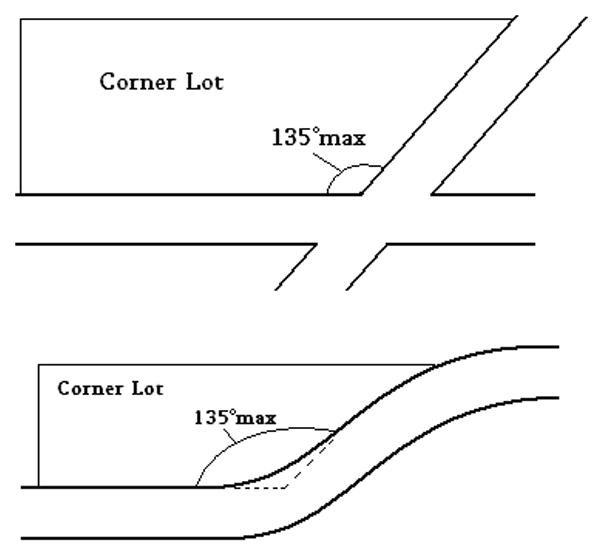
Lot, corner means a lot abutting upon two or more streets at their intersection having an interior angle of less than 135 degrees.
Lot coverage means the percentage of lot area under roof, calculated by dividing the horizontal area of the lot covered by roof by the area of the lot.

Lot frontage means the horizontal distance between the side lot lines measured at the point where the side lot lines intersect a right-of-way. All sides of a lot that abuts a right-of-way shall be considered frontage. On curvilinear streets, the arc between the side lot lines shall be considered the lot frontage.

Lot lines means the legal boundary of a lot or property as specified by survey or plat.

Lot line, front means the lot line abutting a right-of-way. On lots abutting more than one right-of-way the administrative official shall determine the front lot line based upon the shape and orientation of the lot, and the shape and orientation of adjacent lots and the orientation of the principal buildings thereon.

Lot line, rear means the lot line with the shortest horizontal distance abutting another lot or property.

Lot line, side means any lot line not designated as a front or rear lot line. A side lot line separating a lot from a street is called a corner side lot line and a side lot line separating a lot from another lot is called an interior side lot line.

Lot, multiple frontage means a lot with street frontage on three sides. Any lot with street frontage on all sides is classified as a block, and each lot line is a front lot line.

Lot, through means an interior lot having frontage on two streets, other than a corner lot.

Mapped street means any approved street shown on an official map, or the projection of an existing street through an unsubdivided parcel of land, whether the street is dedicated, or in existence or not. For the purpose of this definition all normal five-acre fractional lines shall be deemed the centerline of mapped street, unless waived by the plat division of the appropriate authority.

Marginal access street means a minor street which is parallel and adjacent to arterial streets and which provides access to abutting properties and protection from through traffic.

Masonry wall, decorative means a wall of masonry composition, with a struck natural, painted, stuccoed, or painted struck block finish on both sides with a continuous concrete cap.

Material fact means a fact that bears a logical relationship to one or more issues raised by a quasi- judicial application or the laws and regulations pertaining to the matter requested by the application.

Minor street. See: Local street.

Mixed-use development means a development containing both residential and nonresidential uses in the proportions or amounts required in this chapter, located within the same building or within separate buildings located on the same lot or within a single development.

Multiple-story means a building, structure or portion thereof with two or more stories entirely above grade, including stories used for parking.

Net lot area/acreage. See: Lot area, net and acre, net.

Non-public use means a use that is established and operated as a private enterprise and/or not under ownership of any government entity.

Off-street parking spaces means a space meeting the minimum requirements of these regulations provided for the temporary, transient storage of vehicles located on private property. Spaces provided on public rights-of-way shall not be considered as off-street parking spaces.

Off-street parking garage or structure; off-street structured parking means a structure or portion thereof attached to, or integrally designed within the principal building or structure, consisting of at least two levels used exclusively for parking or storing multiple vehicles. Off-street parking garage or structure shall not be counted towards FAR, or building height calculations.

Off-street parking space means an off-street parking area for the parking of one automobile, having the minimum dimensions, access and construction required by this chapter.

On-street parking space means parking spaces provided on private or public streets for the use by the general public, which may be subject to limited hours of use, and may be metered for use by the city or a governing authority.

One-family dwelling. See: Dwelling, single-family.

Open space, passive means a parcel or area of land or water within a development that is kept in its natural state, and serves as an amenity within that development area. May include bicycle, equestrian and pedestrian trails, noncommercial resource-based facilities such as those for fishing, boating and camping, and interpretive features.

Open space, usable means any open space or recreational facility that is designed or developed with recreation and support facilities for the convenience of the user, including playgrounds, golf courses, athletic fields, sports courts, swimming pools, clubhouses, equestrian facilities; may include pedestrian plazas and similar urban open spaces.

Overlay zoning districts are superimposed over portions of one or more underlying base zone district (and perhaps planned development districts or other overlay districts) with the intent of supplementing generally applicable development regulations with additional deveopment regulations that address special area-specific conditions, features, or plans while maintaining the character and purposes of the underlying zoning districts. Some overlay zoning districts include standards that modify or supersede standards applied by the underlying base zoning district.

Owner means any person that alone, jointly, or severally with others:

(1)

Has legal or equitable title to any premises, dwelling, or dwelling unit, with or without accompanying actual possession thereof; or

(2)

Has charge, care, or control of any premises, dwelling or dwelling unit, as agent of the owner or as executor, administrator, trustee, or guardian of the estate of the beneficial owner.

The person shown on the records of the recorder of deeds of the county to be the owner of a particular property shall be presumed to be the person in control of that property.

Parapet means the extension of the building facade or wall above the roof line.

Participants means members of the general public, other than the applicant, including experts and representatives of units of local governments and governmental agencies, who offer testimony at a quasi-judicial proceeding for the purpose of being heard on an application.

Parkway means a route intended to be used primarily by passenger vehicles that may have a varied right-of-way width, and which right-of-way is or is intended to be developed with a park-like character.

Party means the applicant, a recognized intervenor, and/or the City of Miami Gardens staff.

Permit, building. See: Building permit.

Permit, development. See: Development permit.

Pervious area means land surface that presents an opportunity for precipitation to infiltrate directly into the ground.

Planning and zoning department means the planning and zoning department of the city.

Plat means a map or delineated representation of the subdivision of lands in compliance with, being a complete exact representation of the subdivision and other information in compliance with the requirement of F.S. ch. 177, part I and the provisions of this chapter, and may include the terms "replat," "amended plat," or "revised plat."

Plat division of the appropriate authority means the competent staff, including a professional land surveyor, of the governing body created to review plats or an independent land surveying firm under contract by the governing body to review plats. By definition, the independent land surveying firm shall not be the same as the land surveyor recording the plat, so as to prevent any conflict of interest. Municipalities without a plat division may request the county's plat division to review both tentative and final plats, in which case the subdivider shall pay the same fees to the county as a subdivider within the unincorporated areas of the county would pay.

Plat, final means the final map or drawing up on which the subdivider's plan of subdivision is presented to the governing body for approval, and which, if approved, will be submitted to the clerk for recording.

Plat, tentative means a preliminary map, drawing or chart indicating the proposed layout of the subdivision submitted for approval. Said preliminary map, drawing or chart shall not be considered a boundary survey as defined in chapter 21HH-6 of the Florida Administrative Code, as same may be amended from time to time. It shall be considered a specific purpose survey as defined in said chapter 21HH-6; said specific purpose being for subdivision design, therefore conceptual in nature, and subject to change prior to the boundary survey being made for which a plat of record is being filed.

Platted means land for which a plat has been recorded.

Plaza means a pedestrian-friendly open space area that extend the public realm from the street or sidewalk to the main entry of an adjacent building. Plazas are designed to facilitate pedestrian use, public gatherings and congregations. Plazas are usually provided in front of buildings, incorporating urban design elements such as special pavers, public art, and water features.

Principal building or structure means a building or structure in which the primary or predominant use is being conducted on the property on which it is located.

Professional surveyor and mapper means a person registered in the State of Florida to engage in the practice of surveying and mapping under F.S. §§ 472.001—472.037.

Programmed means an improvement that is included as a proposed project in the capital improvements element (CIE). Such improvements are unfunded unless in the current year of the capital budget.

Programmed for construction means a proposed project that is included in the capital improvements element and scheduled for construction. Such improvements are unfunded unless in the current year of the capital budget.

Project means a single development as designated by the applicant, but two or more purportedly separate developments will be considered one project if the administrative official finds that three or more of the following criteria exist:

(1)

The purportedly separate developments are located within one-quarter mile of each other;

(2)

The same person has an ownership interest or an option to obtain an ownership interest of more than 25 percent of the legal title to each purportedly separate development;

(3)

There is a unified plan of development for the purportedly separate developments;

(4)

The purportedly separate developments voluntarily do or shall share private infrastructure;

(5)

There is or will be a common management or advertising scheme for the purportedly separate developments.

Projecting sign. See: Sign, projecting.

Property includes real and personal property.

Public services and/or public facilities means services for which level of service (LOS) standards are included in the comprehensive development master plan, whether such services or facilities are provided by government, quasi-public or private providers.

Public facilities means roads, sanitary sewer facilities, solid waste facilities, drainage facilities, potable water facilities, parks and recreation facilities or any other facilities provided for the general use and benefit of the community.

Public works department construction manual means the comprehensive set of specifications prepared by the county's department of public works covering the minimum requirements for the design and construction of engineering works such as, but not limited to, streets, roads and highways, sidewalks, filling and grading, excavating, harbors and docks, drainage installation and structures, water control work and water supply, paving installations, curbs and gutters, bridges and overpasses and underpasses, underground sewage collections and disposal systems, underground utility line construction, levees, pumping stations and similar works.

Quasi-judicial proceeding means a hearing held by a board to adjudicate the private rights of an applicant by means of a hearing which comports with due process requirements.

Rear lot line. See: Lot line, rear.

Rear yard. See: Yard, rear.

Record; recorded; of record means the act of, or state of a document being or having been recorded in the official records of the clerk of the circuit and county court. For plats, refers to recording or having been recorded in a specific page in a plat book (PB), and for other documents, usually refers to recording or having been recorded in a specific page or pages of a records book (RB).

Relevant evidence means evidence which tends to prove or disprove a fact that is material to the determination of an application that is the subject of a quasi-judicial proceeding.

Required parking. See: Parking, required.

Required yard. See: Yard, required.

Residential district. See: District, residential.

Right-of-way (R.O.W.) means the area of a highway, road, street, or alley, or other such strip of land, reserved for public use, whether established by prescription, easement, dedication, gift, purchase, eminent domain or any other legal means.

Right-of-way line means the outer boundary line of the ultimate right-of-way of a public or private street as depicted on a survey, plat or official right-of-way map of the city. The ultimate right-of-way for any street is the planned width of the right-of-way prescribed for such street. There is no distinction made in this chapter between the edge of an existing dedicated right-of-way and the planned extent of a right- of-way for purposes of measuring setbacks, yards, clear site distance, etc., even though the full width of same has not yet been dedicated, unless the context specifically refers to an existing dedication, or a street right-of-way as currently dedicated.

Roof line means the top edge of a roof or building parapet, whichever is higher, excluding any mansards, cupolas, pylons, chimneys or minor projections.

Roof sign. See Sign, roof.

Roofline means the highest point on any building where an exterior wall encloses usable floor space. The term "roofline" includes the top of any parapet wall, providing said parapet wall extends around the entire perimeter of the building at the same elevation.

Screen enclosure means an enclosure for the purpose of providing an insect barrier, consisting of a frame that supports a screen covering that possesses at least 50 percent open area per square inch. Screen enclosures do not have the effect of appearance of a roof or a wall, building siding, or louvered structure.

Service impact mitigation measures means measures, other than provision of services or facilities as defined herein, which will demonstrably reduce the impact of the prospective development on said services or facilities.

Service provider, other means any state, regional, municipal or Miami-Dade County agency having construction, operational or maintenance responsibility for public services or facilities as defined herein.

Setback means the horizontal distance in feet between a building or structure and a street right-of-way or lot line. See also: Setback, minimum required; and yard.

Setback line means the vertical plane that represents the depth or extent of a setback or yard.

Setback, minimum required means the minimum setback required by any code provision. A minimum setback requirement creates a minimum yard requirement, and a minimum yard requirement has the same effect as requiring a minimum setback.

Setback encroachment means any of the exceptions to a minimum required setback as specifically provided in this chapter.

Shopping center means a building or buildings containing two or more stores that are used primarily for retail sales but may include commercial trade or professional uses.

Side yard, interior means the area between the interior side lot line and the required interior side building setback line, extending between the front building setback line and the rear building setback line.

Side lot line. See: Lot line, side.

Side street, corner side street means a local street or minor street.

Site means the same as lot.

Site plan means a detailed development plan for a lot or portion thereof that satisfies the requirements of article II of this chapter.

Site-specific means related to an individual lot that can be clearly defined by street address, legal description, or similar means at an identifiable location.

Slogan means the use of a group of words or word which has been designed to create a unique identity or trademark for an organization or corporation.

Special exception means a use or structure that may be authorized by the city council via a public hearing, that would not be appropriate generally or without restriction throughout a district but which, if controlled, could be appropriate within that district. Such uses and structures may be permitted as special exceptions only if specific provision for such use or structure is made in the applicable district regulations and verified through the meeting of specific criteria.

Spot or search light sign. See: Sign, spot or search light.

Staff means the City of Miami Gardens staff.

State means the State of Florida.

Storage area means any exterior area used for the keeping of garbage or trash cans, dumpsters, newspaper containers, oil and bottled gas tanks, swimming pool equipment, air conditioning and mechanical appurtenances; including outdoor storage of merchandise; i.e., lumber, etc.

Stormwater retention/detention area means an area designed, built and used for temporary storage of stormwater.

Story means a complete horizontal division of a building of which at least four feet is above grade, constituting the space between the surface of any floor and the surface of the next floor above it, or if there is no floor above it, then the space between such floor and the roof above it. Levels of a parking structure shall not computed towards maximum building stories heights.

Street line. See: Right-of-way line.

Street width means the shortest distance between the lines delineating the right-of-way of a street.

Street yard. See: Yard, street.

Structure means anything constructed, installed or placed upon the land, or attachment thereto, the use of which requires, occupies or is intended to occupy a permanent or generally fixed location, but excluding landscape materials and earthen berms. By way of example, structures include buildings, sheds, slabs, statues, port-o-cocheres, shipping containers, pools, gazebos, tents, ground signs, fences, and any movable structure while it is located on land that can be used for housing, business, commercial, or office purposes either temporarily or permanently.

Structural alterations means any change, except the repair or replacement, in the supporting members of a building, such as bearing walls, columns, beams or girders or the re-arrangement of any interior partitions affecting more than five percent of the floor area of the building.

Subdivider means any individual, firm, association, syndicate, copartnership, corporation, trust or any other legal entity commencing proceedings under this chapter to effect a subdivision of land hereunder for himself or for another.

Subdivision means:

(1)

The division of land for any use so as to create one or more lots designated of any size for the purpose of transfer of ownership, leasing, or building development. The division of land, zoned for agricultural use or which is unzoned, shall not be deemed a subdivision if the land is being divided into parcels each of which is five acres or more in size, including any official right-of-way.

(2)

The dedication of a road, highway, street, alley, easement through or on a tract of land regardless of area.

(3)

The re-subdivision, or combining of land heretofore divided or platted into lots, sites or parcels for purpose of creating a development tract for the purpose of transfer of ownership, leasing or building development.

Swale means all unpaved portions of a right-of-way located between the edge of pavement and the property line or an open space easement located on property adjacent to the right-of-way line.

Tenant, occupant means any person holding a written or oral lease of, or who occupies the whole or a part of a building or land, either alone or with others.

Tentative plat. See: Plat, tentative.

Through lot. See: Lot, through.

Transient means an individual or group in temporary occupancy of a hotel or motel room or other similar residential facilities such as extended stay or bed and breakfast. Transient occupancy is when it is the intention of the parties that the occupancy will be temporary, typically ten days or less.

Transit oriented development (TOD) means mixed-use development located generally within a one-quarter mile walk to a transit stop via continuous, shaded sidewalks. TODs mix ground floor retail, restaurant, service and entertainment uses with residential, office and/or public uses in a walkable environment, making it convenient for residents and employees to travel by transit, bicycle, foot or car.

Two-family dwelling. See: Dwelling, two-family.

Undeveloped land means land which is unimproved, in that no principal building or structure has been constructed upon it.

Use, principal means the primary use of a property as distinguished from secondary or accessory uses. There may be more than one principal or main use on a lot unless otherwise provided.

Use; use of land means any purpose for which buildings, structures, land, or water may be arranged, designed, intended, maintained, or occupied; or any occupation, business, activity, or operation carried on or intended to be carried on in a building, other structure, or on land. The term use of land shall include use of buildings, structures and water.

Utilities means all lines and facilities related to the provision, distribution, collection, transmission, or disposal of water, storm and sanitary sewage, oil, gas, power, information, telecommunication and telephone cable; includes facilities for the generation of electricity.

Vehicular use area (VUA) means an area used for parking, loading and vehicular access for any property not occupied by a single-family residence.

Vendor means any person, or entity selling alcoholic beverages as defined in this chapter at retail or directly to the consumer.

Vested right means the right to undertake and complete the development and use of property under the terms and conditions of a site specific development plan.

Visual screen means a physical obstruction used to separate two areas or uses which are at least 90 percent opaque. Visual screens shall be living plant material, natural or manmade construction material or any combination thereof.

Wireless support service facilities means any facility that transmits and/or receives signals by electromagnetic or optical means, including antennas, microwave dishes, horns, or similar types of equipment, towers or similar structures supporting such equipment, and equipment buildings.

Yard means an open space on the same lot with a building or structure, unoccupied and unobstructed from the ground upward, except as may be specifically provided in this chapter. Yards are measured perpendicular from the respective property lines and street lines.

Yard, corner side means the street side yard of a corner lot.

Yard, front means a yard across the full width of the lot, extending from the front street line to the front of the principal building on the lot.

Yard, interior side means a yard situated between the building and the side line of the lot and extending between the front yard and the rear yard. Any lot line, other than the rear lot line and the front lot line, shall be deemed a side line.

Yard, rear means a yard extending across the full width of a lot and lying between a rear lot line of the lot and the nearest point of the building. In the case of corner lots, the rear yard shall be the yard opposite the front street line of the lot.

Yard, required means a yard of a minimum area or dimension that must be provided between the minimum setback line and the property line within a property.
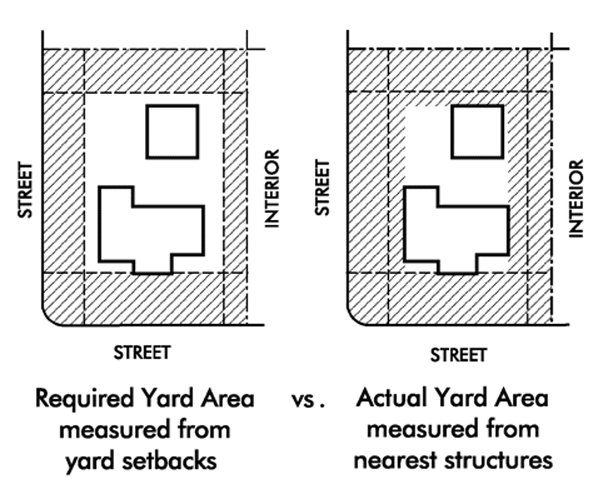
Yard, street means a yard abutting a street.

Zero lot line development means dwellings arranged on individual lots as detached structures with one or more side wall on, or within five feet of a side property line.

Landscape Definitions

In addition to terms and words defined in this chapter, the following definitions shall be used for interpretation of landscape related regulations:

Caliper means, for trees under four inches in diameter, the trunk diameter measured at a height of six inches above the ground at the base of the trunk. For trees four inches and greater in diameter, the trunk diameter measured at 12 inches above the ground at the base of the trunk. For monocots, the trunk diameter measured at a height of one foot above the ground at the base of the trunk.

Diameter at breast height (DBH) means the diameter of a tree's trunk in inches, measured 4½ feet (breast height) above ground level at the base of the trunk. For trees with less than four and one-half feet of clear trunk, the diameter of the largest leader shall be measured at breast height. For trees with multiple trunks, the diameter of the individual trunks shall be measured at breast height.

Controlled plant species means those plant species listed in the landscape manual which tend to become nuisances because of their ability to invade proximal native plant communities or native habitats, but which, if located and cultivated properly may be useful or functional as elements of landscape design

Crown thinning means the thinning of mature shade tree crowns for the purpose of improving light infiltration or the reduction of wind resistance.

Drip line means the outside end of the longest branches of a tree (those that extend the furthest from the trunk) projected vertically to the ground.

Drip line encroachment means any activity that has the effect of causing soil compaction, injury to lower limbs, grade change, contamination of soil, or damage to the root system. Specifically, this definition includes acts such as parking of vehicles, use of heavy earth moving or grading equipment, placement of construction materials, excavation and filling, trenching and the exposure of paints, oils or chemicals within a tree's drip line. Specifically excluded from this definition are routine maintenance activities such as mowing or walking within the tree's drip line.

Drip line encroachment plan means a plan that must be presented as part of the tree permit for all trees whose drip line is planned to be encroached upon by any construction, excavation, fill or other activities associated with the development of the site. Drip line encroachment plans are comprised of:

(1)

Designation of each tree subject to any drip line encroachment;

(2)

The reasons for the encroachment;

(3)

Detailed description of the proposed efforts to protect the tree from damage due to the encroachment; and

(4)

A plan to ensure its survivability as described in the builder's manual of the Florida Department of Agriculture.

Florida friendly landscaping means practices, materials or actions developed by the Florida yards and neighborhood program that help to preserve Florida's natural resources and protect the environment.

Florida yards and neighborhood program means a partnership of the University of Florida/Institute of Food and Agricultural Sciences, Florida's water management districts, the Florida Department of Environmental Protection, the National Estuary Program, the Florida Sea Grant College Program and other agencies, managed locally by the Miami-Dade Cooperative Extension Division of the Consumer Services Department.

Energy conservation zone means a zone located no more than 22 feet from a structure in a 180-degree band from due east of the northeast point of the structure, to due south, to due west of the northwest point of the structure.

Environmentally endangered land means lands that contain natural forest, wetland or native plant communities, rare and endangered plants and animals, endemic species, endangered species habitat, a diversity of species, outstanding geologic or other natural features, or land which functions as an integral and sustaining component of an existing ecosystem.

Equivalent replacement means the replacement of a removed or damaged tree to compensate for that tree's removal or its damage either with one tree the same diameter or a combination of smaller trees that will equal that removed tree's DBH as defined herein. The minimums established in the landscape code of the City of Miami Gardens for tree planting may not count toward the equivalent replacement amount established here. The replacement species shall be trees of similar species to those removed as approved by the planning and zoning and/or public works department.

Equivalent value means an amount of money, which reflects the fair market value of the required replacement trees. The current market price of replacement trees shall be established annually by the public works department, and shall be based on published trade wholesale price lists with the appropriate multiplier which represents maintenance, installation, warranty and other costs.

Hatrack means to flat-cut the top of a tree, severing the leader or leaders, or the removal of any branch three inches or greater in diameter at any point other than the branch collar.

Hazard pruning means the removal of dead, diseased, decayed, or obviously weak branches two inches in diameter or greater.

Heat island means an unnaturally high temperature microclimate resulting from radiation from unshaded impervious surfaces.

Hedge means an evenly spaced planting of shrubs to form a compact, dense, visually opaque living barrier or screen. Plantings designated or required as "hedges" must consist of plants spaced so that they will be tip to tip within six months of the time of planting.

Historic tree means a tree which has been determined by the city council to be of notable historic interest because of its age, type, size or historic association and has been so designated as part of the official records of the city.

Irrigation means the supply of water to landscaped areas by an automatic or manual sprinkler system, or by some other means.

Land clearing means the indiscriminate removal of trees, shrubs and/or undergrowth by stripping or any other process, with the intention of preparing real property for non-agricultural development purposes. This definition shall not include: the selective removal of non-native tree and shrub species when the soil is left relatively undisturbed; removal of dead or nuisance trees; or normal mowing operations.

Landscape manual means the official listing of acceptable and prohibited plant materials and practices maintained by the administrative official.

Landscaping material means any of the following or a combination thereof such as, but not limited to: grass, ground cover, shrubs, vines, hedges, trees or palms; non-living materials such as rocks, pebbles, sand, mulch but not including paving.

Landscape plan means a plan indicating all landscape areas, stormwater retention/detention areas, areas which qualify to be excluded from maximum permitted lawn area, existing vegetation to be retained, proposed plant material, landscape legend, landscape features, planting specifications, and details, and all other relevant information in compliance with this chapter.

Lawn area means an area planted with lawn grasses.

Mulch means an organic material that does not contain arsenic products, such as wood chips, pine straw or bark placed on the soil to reduce evaporation, prevent erosion, control weeds, enrich the soil and lower soil temperature.

Nuisance plants, trees means plants identified as nuisance species in the city's landscape manual.

Plant means an organism of the vegetable kingdom having cellulose cell walls, growing by synthesis of inorganic substances, and lacking the power of locomotion.

Prohibited plant species means those plant species listed in the city's landscape manual as being demonstrably detrimental to native plants, native wildlife, ecosystems, or human health, safety, and welfare.

Protected tree means a tree which has been determined by resolution of the city council or their designee to be of high value because of its type, size or other criteria and which has been so designated as part of the official records of the city.

Shrub means a self-supporting woody perennial plant normally growing to a height of more than two feet but less than ten feet, characterized by multiple stems and branches continuous from the base.

Specimen tree is defined per subsection 34-447(d)(2)(a).

Stabilized lawn area means an area of ground underlain with structural support in the form of grass pavers or stabilized soil prepared to withstand the load of intended vehicular use, such as automobiles, fire trucks and garbage trucks.

Street tree means trees that are planted or required to be planted within the swales and medians of street rights-of-way, and immediately adjacent to street rights-of-way upon private property.

Tree means any living, self-supporting woody perennial plant which at maturity attains a trunk diameter of at least three inches or more when measured at a point four and one-half feet above ground level and which normally attains an overall height of at least 15 feet, usually with one main stem or trunk and many branches.

Tree abuse means destroying the natural habit of growth which causes irreparable damage and permanent disfigurement to a tree such that, even with regrowth, the tree will never regain the original characteristics of its tree species, or is a danger to the public or property, except as required for the purpose of public safety.

Tree canopy means the aerial extent of the branches and foliage of a tree as defined by the drip line.

Tree relocation means to transplant a tree from one location to another either horizontally or vertically.

Tree removal means to permanently remove the trunk and/or root system of a tree.

Tree survey means a sealed survey prepared by a Florida licensed landscape architect or land surveyor which shows, in addition to all boundary information, the exact location, size, botanical and common name, and diameter of all trees at least three inches in diameter measured four and one-half feet above ground level within the area affected by the development. The tree species noted on the tree survey shall be certified by a landscape architect.

Understory means the plant life existing under a tree canopy including ferns, bushes and groundcovers.

Vine means a plant with a flexible stem which normally requires support to reach mature form.

Xeriscape means a type of landscaping utilizing native plants and ground cover that minimizes the use of water, and which is detailed in the city's landscape manual.

(Ord. No. 2010-10-218, § 2(19-30), 4-7-2010; Ord. No. 2014-02-314, § 2(Exh. A), 1-8-2014; Ord. No. 2015-03-333, § 2(Exh. A), 3-25-2015; Ord. No. 2018-03-384, § 5, 2-14-2018; Ord. No. 2018-13-394, § 2(Exh. A), 7-25-2018; Ord. No. 2019-010-412, § 2(Exh. A), 7-24-2019; Ord. No. 2023-009-465, § 2, 9-27-2023; Ord. No. 2025-002-482, § 2(Exh. A), 1-22-2025)

Sec. 34-733. - Master use list and use definitions.

(a)

This list includes activities customary to the use. Uses not specifically listed as permitted, or found to the similar or customary with permitted uses, shall be prohibited.

(b)

This use list shall include all those related uses, but shall be limited to the list of related uses. In the determination of uses not specifically listed, the administrative official shall make the determination as to the appropriate category or deem the use prohibited.

(c)

The following definitions are provided for convenience. In case of conflict with the definitions in sections 34-287 and 34-288, sections 34-287 and 34-288 shall prevail.

APPENDIX A. MASTER USE LIST AND USE DEFINITIONS

Use Related Uses Definition
Adult day care center (See section 34-288 for special requirements) A nonresidential, noninstitutional facility that provides therapeutic programs of social and health services, as well as activities for adults who have functional impairments for a period of less than 24 hours per day.
Adult family care home, up to five residents (See section 34-288 for special requirements) Adult family care homes (AFCHs) are private residences that are licensed to provide housing, meals, and personal care services to older persons and disabled adults who are unable to live independently. AFCHs are owned and operated by licensed AFCH "providers" who live with the residents they serve. In addition, AFCHs are limited to a maximum of five residents. AFCHs are intended to be an alternative to more restrictive, institutional settings for individuals who do not need 24-hour nursing supervision. To reside in an adult family care home, a person must meet the AFCH "residency criteria," which is defined by Florida regulations and by the provider's admission policy. In most cases, AFCHs provide general supervision, assistance with personal care services, and assistance with medications to elders and disabled adults who require such services.
Adult entertainment establishment (See section 34-288 for special requirements) Adult bookstore. Adult entertainment club. Adult modeling establishment. Adult theater. Adult video store. Encounter studio. Massage establishment. (1) Adult bookstore means any business engaged in displaying, distributing, bartering, renting or selling printed matter, pictures, films, graphic or other materials which activity requires the exclusion of minors pursuant to F.S. ch. 847, unless such activity comprises no more than 15 percent of the total floor area and is kept from clear view of minors.
(2) Adult theater means any business engaged in presenting films, theatrical productions, performances, recitals, displays, printed matter or other entertainment which activity requires the exclusion of minors pursuant to F.S. ch. 847.
(3) Adult entertainment club means any business which features live entertainment requiring the exclusion of minors pursuant to F.S. ch. 847.
(4) Adult video store means any business engaged in displaying, renting or selling videotapes which activity requires the exclusion of minors pursuant to F.S. ch. 847, unless such activity comprises no more than 15 percent of the total floor area and is kept from clear view of minors.
(5) Massage establishment means:
a. Any shop, parlor, establishment or place of business wherein all or any one or more of the following named subjects and methods of treatments are administered or practiced: Body massage either by hand or by any mechanical or electrical apparatus or device (excluding fever therapy), applying such movements as stroking, friction, rolling, vibration, kneading, cupping, petrissage, rubbing, effleurage or tapotement.
b. Nothing in this section shall be construed as applying to state- licensed massage therapists, barbers, cosmetologists, manicurists, pedicurists, physical therapists' assistants, midwives, practical nurses, agents, servants or employees in licensed hospitals or nursing home or other licensed medical institutions, licensed physicians, osteopaths, chiropractors, podiatrists, naturopathic physicians or other licensed medical practitioners, or their agents, servants, or employees acting in the course of such agency, service or employment under the supervision of the licensee.
c. Provided, however, that, for the purpose of this section, the term "massage establishment" shall not include any massage establishment wherein at least one state-licensed massage therapist is employed and on duty full time during the hours open for business.
(6) Adult modeling establishment means any establishment offering nude or partially nude modeling sessions or lingerie, swimwear or photography modeling sessions between two or more persons requiring the exclusion of minor pursuant to F.S. ch. 847.
(7) Encounter studio means all establishments offering nude or partially nude encounter sessions between two or more persons, nude or partially nude dance encounter sessions between two or more persons, and sexual consultation requiring the exclusion of minors pursuant to F.S. ch. 847.
Airport, airfield, heliport, public, private (See section 34-288 for special requirements) Airfield
Helistop
Heliport
Airport related uses
Airport means a special facility designed to accommodate the departure and landing of aircraft, equipped with hangars, facilities for refueling and repairing airplanes, taxiways, tie-down areas, and various accommodations for passengers.
Heliport means a facility designed for the landing and takeoff of helicopters.
Helistop means a heliport, but without auxiliary facilities such as parking, waiting room, fueling and maintenance equipment.
Airport-related uses means uses of land which are dependent upon proximity to the airport for effective performance, or which provide services to the airport which improve the effectiveness of the airport, including, but not limited to, aircraft parts manufacture, sales of new and used aircraft and aircraft parts, sales of aircraft fuels, lubricants and other aircraft supplies; airline administrative offices; automobile parking and storage; rental car parking, storage and maintenance; bus, taxi and limousine parking; in-flight kitchen and catering services; aerial photography and air-survey services; air freight and air cargo services; governmental facilities; flight training schools; flight trade schools; aviation research and testing laboratories; temporary contractors' offices and storage areas; other airport-related uses compatible with the operation of airports.
Amusement parks, stadiums, arenas Stadiums
Arenas
Amphitheatres
Arena, auditorium or stadium means an open, or partially or fully enclosed facility primarily used or intended for commercial spectator sports or entertainment. Typical uses include convention and exhibition halls, sports arenas, jai alai frontons, amphitheaters and racetracks.
Animal grooming and pet sitting—indoor The temporary keeping of domesticated household pets that are owned by another person, for a period of time exceeding 24 consecutive hours. May include the provision of care and grooming services, but does not include breeding. No outdoor boarding or incidental activities shall be permitted.
Animal hospital/veterinarian clinic A facility that provides for the medical and surgical care of domesticated animals, including, but not limited to, out-patient and required boarding for treatment services. No outdoor boarding or outdoor incidental activities shall be permitted.
Animal kennel, boarding, dog training facility (See section 34-288 for special requirements) Commercial Kennel, commercial, means a commercial establishment, including any building or land used, for the raising, sale, boarding, breeding and care services for dogs and cats. Typical uses include boarding kennels, pet motels, or dog training centers.
Animal shelters A facility providing temporary housing, food, or both, to indigent, needy, homeless, or transient animals, and may also provide ancillary services such as veterinarian services, adoption services, overnight and boarding services. No outdoor boarding or outdoor incidental activities shall be permitted.
Arcade, video games, electronic gaming (See section 34-288 for special requirements) An establishment containing electronic games and machines that provide amusement, enjoyment, or entertainment and which may be operated upon the insertion of a coin, token or debit card. Examples of such games and machines include video games, pinball machines, timed games where a ball or other object must be tossed or into hoops or holes and other such games. This term shall not include jukeboxes, children's mechanical rides (e.g., horses, rocket ships), machines that sell merchandise, bingo games, or gambling devices.
Assisted Living Facility (ALF) (See section 34-288 for special requirements) A residential care facility licensed by the State of Florida that provides housing, meals, personal care and supportive services to older persons and disabled adults who are unable to live independently but do not require 24-hour nursing supervision, and who meet the 'residency criteria' as defined by Florida regulations.
Auction House—Indoor A building or structure where goods are sold by auction to the highest bidder. Excludes auctioning of automobiles and animals unless authorized in the code as a special event subject to temporary use procedures and requirements.
Banquet hall (See section 34-288 for special Hall for hire
Dancehall
Meeting room
Convention hall
An establishment, or portion of an establishment which rents space, requirements) providing tables, chairs, decor, sound systems and other services for clubs, associations or individuals for the purpose of having a banquet, meeting, party, celebration, wedding, birthday, ball, anniversary or other such activity. Such establishments accessory to a hotel, motel, lodging use shall not be considered a banquet hall for purposes of this definition.
Bar/lounge, wine tasting room (see section 34-288 for special requirements) Sports bar, piano bar, lobby bar, cocktail lounge, outdoor bar, cigar bar, hookah bar, pubs, dive bar, karaoke bar, comedy bar, outdoor patio bar, wine tasting room Wine tasting room means an establishment which serves only wine or nonalcoholic beverages for retail on-premises or off-premises consumption and that does not serve meals. Only appetizers, tapas, snacks and similar types of food may be served. For purposes of this section, "meals" shall mean an assortment of foods commonly ordered in bona fide full-service restaurants as principal meals of the day; Bar/lounge means an establishment where the principal use is the serving of alcoholic beverages on the premises; where seating is provided; where no or limited food is served as meals, appetizers, or snacks; where less than 51 percent of its gross revenue is from the sale of food and nonalcoholic beverages; where background music or limited live entertainment, amusement, and/or broadcast events may be provided. Outdoor bar/lounge shall mean the portion of the principal establishment, which shall include restaurants, hotels, theaters or other similar uses, where the bar/lounge is accessory to the principal establishment or accessory to a racetrack or casino gaming facility.
Blood banks, diagnostic medical treatment centers Dialysis treatment centers Any corporation, partnership or business whatsoever which engages in the activity of receiving or taking blood, plasma or any component thereof from human donors for a monetary consideration.
Box lunches, distribution (see section 34-288 for special requirements) Transient box lunch service.
Bus Charter Service, passenger bus terminal Facilities for commercial transportation operators including the following uses: Airport transportation services. Bus lines. Bus charter services. Limousine rental, with drivers. Sightseeing buses. Taxicab companies. Shall not include public bus stations and rapid transit stations and facilities.
Call center A building, or portion thereof, where outgoing telephone calls or email are made or incoming calls or email are accepted for the purpose of solicitation or customer service.
Car wash—Enclosed (See section 34-288 for special requirements) Car wash facility, stand alone.
Self wash facilities.
Car wash, automatic, means an establishment where the exterior of motor vehicles with a gross vehicle weight of no more than 5,000 pounds, is washed within a enclosed building with entrances and exits of appropriate size to accommodate motor vehicles. The movement of motor vehicles within such establishment shall be along a conveyor belt, moving track or the like, with washing solely by mechanical means. Self-wash facilities shall be included in this definition.
Car wash facility, stand alone, means a permanent establishment or building which principal use on the property is providing facilities for washing and cleaning or detailing motor vehicles with a gross vehicle weight of no more than 5,000 pounds, which may use production line methods with a conveyor, blower, or other mechanical devices, and which must employ some hand labor. Detailing includes hand washing and waxing, striping, and interior cleaning.
Car wash—Outside, hand wash (See section 34-288 for special requirements) The cleaning of the exterior and interior of motor vehicles with a gross vehicle weight of no more than 5,000 pounds, waxing of the exterior detail work of motor vehicles, drying and exterior detail work of motor vehicles.
Car wash - mobile (See section 34-288 for special requirements) Mobile car wash and detailing
Casino gaming facility All related uses as may be licensed under Florida statutes regulating such facilities. As defined in F.S. ch. 849.
Catering service (See section 34-288 for special requirements) Transient catering trucks. An establishment where the primary activity is the preparation of ready to eat meals to be transported for off-premises consumption, and if permitted the sale of alcoholic beverages, shall derive at least 51 percent of its gross revenue from the sale of food and nonalcoholic beverages. This definition shall not apply to catering services provided as accessory uses within hotels, motels, lodging establishments, banquet halls, convention halls, and other similar uses for the exclusive purpose of servicing guests and customers.
Cemetery, mausoleums, crematories (See section 34-288 for special requirements) Mausoleums.
Crematories.
Columbarium.
Cemetery means land used or intended to be used for human burial, including a chapel mausoleum or columbarium.
Crematory means an establishment containing a furnace used for the cremation of human remains. A crematory may be owned by or deal directly only with funeral homes, or may have open access to the public.
Check cashing, bill payments Any establishment other than the United States Postal Service, bank or financial institution that provides check cashing, currency exchange, or money transmitting or remittance services, or issues or redeems money orders, travelers' checks, and other similar instruments.
Community centers Recreation centers. A multipurpose facility providing a wide range of social, cultural, educational, and recreational services and activities of particular interest to the community, including daycare facilities for children. Such facilities shall meet all state and city licensing requirements for that use. A community center may be newly constructed or converted from an existing commercial building, single-family residence, or multifamily dwelling unit.
Community residential home: Up to six residents A type of residential facility deemed to be a single-family unit, and a noncommercial, residential use licensed by the state to serve persons with disabilities as defined by federal law, as well as clients of the Florida Department of Elderly Affairs, the Florida Agency for Persons with Disabilities, the Florida Department of Juvenile Justice, the Florida Department of Children and Family Services, or the Agency for Health Care Administration. Provides a living environment for unrelated residents who operate as the functional equivalent of a family, including such supervision and care by supportive staff as may be necessary to meet the physical, emotional, and social needs of the residents.
Community residential home: Greater than six residents A type of residential facility deemed to be a dwelling licensed by the state to serve persons with disabilities as defined by Federal Law, as well as clients of the Florida Department of Elderly Affairs, the Florida Agency for Persons with Disabilities, the Florida Department of Juvenile Justice, the Florida Department of Children and Family Services, or the Agency for Health Care Administration. Provides a living environment for unrelated residents who operate as the functional equivalent of a family, including such supervision and care by supportive staff as may be necessary to meet the physical, emotional, and social needs of the residents.
Convenience store A retail establishment, 3,000 square feet or less, that sells a variety of convenience goods, such as prepackaged snack and food items, tobacco, periodicals, beverages, household goods, automobile accessories, hardware, pharmaceutical items, prepared foods, and other popular, non-specialty items that consumers generally use or consume frequently, or require on short notice, and which stocks smaller varieties of any type of good than would ordinary general purpose stores or specialty stores such as grocery stores, home supply stores, pharmacies, and hardware stores. May also offer convenience services such as limited banking services.
Copy, printing center A retail establishment that provides document or graphic art duplicating services using photocopying, digital imaging, offset printing, or similar process, and may include collating and binding of reproduced material.
Cultural and civic facilities—libraries, museums Public aquariums.
Public art galleries, but not retail sales.
Public libraries.
Public museums.
Public planetariums.
A building or complex of buildings that houses public or private not-for-profit facilities, offices or services and which may include civic or community centers, theaters predominantly used for live performances, libraries, zoological or botanical gardens, historical landmarks, museums, and similar facilities.
Customer service center A building, or portion thereof, with a waiting room or waiting area and one or more customer service counters whereby customers or the general public can pay bills or taxes, make business transactions, request information, apply for licenses, permits, passports or similar items, register, receive forms, submit forms, request copies of records, and similar activities. Banks and financial institutions are defined to include customer service centers.
Detention facility A penal institution or holding facility for persons awaiting trial or deportation/immigration proceedings.
Warehouse, Distribution center A building or portion thereof, used for storage. Storage may be relatively temporary or long-term. A facility where goods are received in bulk and then transferred, or stored and later transferred for distribution to individual retailers, service providers or end users; or where goods are received in smaller quantities from individuals or businesses and then sorted and shipped in bulk to other distribution centers. Examples include U.S. Postal Service sorting and distribution facilities, FedEx and other package delivery services, and regional warehouses for chain stores or operations such as furniture and grocery retailers.
Donated goods center—New/used (See section 34-288 for special requirements) A facility used to receive materials such as clothing, canned food, and household or office goods donated by the public for distribution to needy families or individuals, or to be taken to a secondhand merchandise store for discounted resale.
Dormitory, fraternity or sorority house, on-campus, off-campus A building in which sleeping rooms are provided for occupancy by, and maintained as a place of residence exclusively for, students of a college or university that are affiliated with the local chapter of a national fraternity or sorority organization, and when approved and regulated by such organization and college or university.
Drug, Pharmacy store An establishment in which primary business is the sale of pharmaceutical and medical items with secondary sales of staple food products, snacks, produce, beverages, household items, convenience items.
Dry cleaning An establishment where clothing and other fabrics are dropped off and picked up on the premises directly by the consumer for cleaning on site or off site at a dry cleaning or commercial laundry plant.
Dry cleaning—Commercial laundry plant A facility where clothing and other fabrics are received from dry cleaners or commercial laundry services for cleaning by immersion and agitation, or by immersion in solvents having little or no water content used for dry cleaning.
Educational and child care facilities—Non-public (See section 34-288 for special requirements) Day nurseries.
Kindergardtens.
After school care, more than five children.
Babysitting service for shoppers.
Private schools.
Elementary, junior, senior high schools.
Family day care home, more than 5 children.
As used in this article, the term "private school" or "nonpublic educational facility" shall mean an institution which provides child care and/or instruction from the infant level through the college level and which does not come under the direct operation and administration of the Miami-Dade County School Board or the State of Florida; only such uses are intended to be controlled by this article and include, but are not limited to, the following:
(a) Day nurseries, more than five children: Child care for infants and children up to and including age six.
(b) Kindergartens, more than five children: Child care and preschool programs for children ages four through six.
(c) After-school care, more than five children: Child care and recreation for children above the age of five when no formal schooling program is conducted and where the care provided is generally after school, on weekends, school holidays and vacations.
(d) Babysitting service for shoppers: Child care for limited time periods (maximum three hours) provided within a shopping center solely for the convenience of the patrons, and limited to not more than 40 children at any one time.
(e) Private school: This term as used herein refers to any private institution providing child care and/or instruction at any level from infants through the college level.
(f) Elementary, junior and senior high schools: References to these schools are to be loosely interpreted to encompass any schools, graded or ungraded, whose students are within the age ranges typically found at these school levels. County-approved charter schools shall be considered as a private educational facility.
Excludes private residences used for an informal cooperative arrangement among neighbors or relatives, or the occasional care of children with or without compensation.
Educational Facilities—Private college, university (See section 34-288 for special requirements) College and university. A post-secondary institution for higher learning that offers state-licensed degree programs culminating in the granting of associate, bachelor, masters, or doctoral degrees, and that may also have research facilities.
Educational facilities—Public, including charter school A school that teaches state- approved academic curriculum to children at the kindergarten through 12th grade levels that are operated as part of the county school system. Charter school: A school that teaches state-approved academic curriculum to children at the kindergarten through 12th grade levels that is an accredited charter school in the county.
Educational facilities—Technical, vocational, training, specialty—Non-public Art schools.
Dance schools.
Medical related schools and institutes.
Martial arts.
Traffic schools.
A school, other than a college, teaching specialized curriculum at the post-secondary (high-school) level, advance level; certification level; including schools for the arts, theatrics, music, dance, vocational schools, technical schools, and trades schools.
Equipment and tool rental An establishment with a principal use of providing short and long term rentals of light equipment and tools, for do-it-yourselfers and professionals with related sales of accessory products.
Family day care home: Five children or less An occupied residence in which child care is regularly provided for children unrelated to the residents of the premises by a resident of the premises, which receives a payment, fee, or grant for any of the children receiving care, whether or not operated for profit, and may be regulated by F.S. § 402.313 and registered or licensed with the Department of Children and Family Services in compliance with state law. Excludes private residences used for an informal cooperative arrangement among neighbors or relatives, or the occasional care of children with or without compensation.
Farms—Produce, livestock, related uses Dairy barns
Fish farms
Hog farms
Groves
Horticultural farming
Hydroponic chemical farming
Livestock and grazing
Poultry farms
Stables
Property or portion of property used for the growing of farm products, such as vegetables, fruits and grain, and their storage, as well as for raising poultry, livestock, fish and animals, and grazing, pasture, or running areas. The term "farm" also means, the operation of an area for one or more of the uses stated in this definition, including dairy farms with the necessary accessory uses for treating or storing the product; provided, however, that the operation of any such accessory uses shall be secondary to that of the normal farming activities.
Poultry farm means the raising of 100 or more poultry and related incidental uses.
Farm worker housing Residential housing provided for with primary purpose of housing temporary farming personnel.
Financial institution (See section 34-288 for special requirements) Banks.
Credit unions.
Investment brokerage establishments.
Savings and loan associations.
ATM.
A financial institution that is open to the public for on-site consumer banking transactions, is and engaged in deposit banking, and that performs closely related functions such as making loans, investments, and fiduciary activities.
Flea market (See section 34-288 for special requirements) Vendors market. A site where space inside or outside a building is rented to vendors for sale of merchandise. This would involve the setting up of two or more booths, tables, platforms, racks or similar display areas for the purpose of selling new and used merchandise, objects or equipment in small quantities. The term "flea market" shall not be intended to include a garage sale, bake sale, fruit or produce stands, wholesale establishments, repair service establishments or any similar activities or sales done by a civic group or by nonprofit organizations.
Food specialty store Special service and product food stores, not otherwise listed: Dairy stores.
Ice cream parlors.
Meat and fish stores.
Vitamins.
Candy, nut and confectionery stores.
A retail establishment with sales limited to a range of food groups and/or related products, for special needs and diets having a gross floor area of 3,000 square feet or less.
Funeral homes Mortuaries. A place of assembly establishment in which the dead are prepared for burial or cremation, and in which persons assemble for wakes and funeral services may be held.
Golf, miniature; Driving range Driving range. A limited area on which golf players hit (drive) golf balls from a central driving tee, and may practice putting.
Miniature golf course. A "putt-putt" courses.
Government facilities, including administrative, support and service Public auto inspection stations. Public buildings and centers. Public maintenance and equipment yards. Public bus stations and rapid transit stations and facilities. See also transit station. A facility owned or operated by the federal government of the United States, the state, the county, the city, or a quasi-governmental agency including, but not limited to, South Florida Water Management District facilities and administration and support facilities of the county school board.
Greenhouses—Plant nurseries, retail or wholesale Garden center. The retail handling of any article, substance, or commodity related to the planting, maintenance, or harvesting of garden plants, shrubs, trees, packaged fertilizers, soils, chemicals, or other nursery goods and related products in small quantities to the consumer.
Plant nursery means a place where plants are propagated and/or grown to usable size for retail sale or wholesale, or for experimentation, and which may include such accessory uses as the limited and incidental sale of accessory items such as greenhouses, the provision of landscape design services, and delivery and installation of plants purchased from the nursery. Expressly excludes lawn and landscape maintenance businesses and mulching operations as commercial or principal uses.
Grocery store A retail establishment with sales of a wide range of household staple foods, products, produce, meat; having a gross floor area of more than 3,000 square feet.
Sport shooting range (indoors) (See section 34- 288 for special requirements) Gun clubs, private, public. Indoor facility designed and operated for discharge of firearms for the purpose of practice shooting and is for commercial purposes.
Halfway house A community-based residential program for persons transitioning out of corrective services, which is operated or contracted by the Department of Juvenile Justice. May also provide ancillary services such as mental health counseling and vocational training. Substance abuse treatment services shall not be provided onsite. Shall not include facilities that are otherwise defined herein as CRHs.
Health club, fitness club A facility for improving physical fitness through exercise, the provision of non-medical body therapeutic treatments and relaxation services, or both. Such services include, but are not limited to, licensed massage therapy and its modalities, facials, exfoliation, waxing, aromatherapy, hydrotherapy, steam and sauna facilities, and nutrition and weight management counseling.
Home occupation office (See section 34-311 and 34-312 for special requirements) A business activity conducted within a dwelling that is accessory to the use of the building for dwelling purposes, that involves only members of the family who reside permanently and continuously in the dwelling, and which does not diminish the residential character of the dwelling. Does not include yard sales conducted in accordance with this chapter, nor include home parties that are held for the purpose of the sale or distribution of goods or services. Office use that provides for no on-site customer interactions or on-site client visits; providing for no external signage; requiring no storage of materials, products, machinery other than required documents; or as may otherwise be permitted by this chapter; providing the primary use of the premises remains residential.
Hospital, private/public Medical center.
Medical observation dormitory
A private or public institution that provides emergency and non-emergency medical care and treatment, including patient sleeping rooms, diagnostic facilities, and surgical facilities. Hospitals include emergency ambulance and rescue service, and medical offices.
Medical observation dormitory. A facility at which research and testing for pharmaceutical and pharmaceutical device companies occurs pursuant to a clinical investigation as defined by 21 CFR § 312.3(b), Code of Federal Regulations. Such investigation is governed by extensive U.S. Food and Drug Administration regulations and involves the overnight stay of human subjects, either healthy volunteers or clinically stable representatives of subpopulations which may ultimately use the tested pharmaceuticals. The facility may include laboratories, dormitory rooms, kitchens, observation rooms and recreation rooms. The scope of services rendered is to consist solely of performing research studies, and does not include other therapy rendered for the benefit of a patient or diagnostic services.
Hospital, psychiatric. Any hospital or medical facility providing overnight psychiatric care or observation.
Hotels, motels, lodging Bed and breakfast establishments.
Extended stay establishments
One or more buildings under singular ownership and control, containing sleeping units—each having a private bathroom—for the purpose of providing transient overnight lodging accommodations to the general public, typically for one to ten days, for compensation. Has a central inner lobby and front desk for on-site reservations, check-in and check-out, daily cleaning services and on-site management. May also include additional services such as restaurants, meeting rooms, spas, entertainment and recreational facilities. There is no distinction made in these regulations between a hotel and motel. Specifically excludes bed and breakfasts.
Extended stay establishments. A hotel designed for guest stays of generally five to 30 days, with kitchens or kitchenettes (i.e., microwave, stove, and refrigerator) in the lodging units for use by the occupants.
Bed and breakfast establishment. An owner-occupied and operated detached dwelling unit that offers sleeping accommodations without individual food preparation facilities, and at least one meal per day prepared within a centralized kitchen for transient guests, for a nightly fee, and which does not utilize outside services or employees, except for those customarily found in single- family residential neighborhoods such as housekeeping and landscape maintenance. Bed and breakfasts accept reservations directly on the premises and advertise themselves as a bed and breakfast.
Industrial uses-heavy (See section 34-288 for special requirements) Abrasive products manufacturing, except not including asbestos products manufacturing. Blast furnaces, steel works and rolling mills. Brick and structural clay tile manufacturing. Catch basin cleaning services. Cement, hydraulic, manufacturing. Ceramic wall and floor tile manufacturing. Cesspool cleaning service. Clay refractories. Concrete, gypsum and plaster products manufacturing. Construction materials not elsewhere classified as wholesale trade, including the following uses: Aggregate, wholesale. Cement, wholesale. Cinders, wholesale. Gravel, wholesale. Lime, wholesale. Sand, wholesale. Stone, crushed, wholesale. Stucco, wholesale. Disinfecting and exterminating services. Fuel dealers. Gas system conversion contractors' shops, work and storage. Iron and steel foundries. Linoleum, asphalt-felt-base, and other hard surface floor coverings manufacturing. Miscellaneous structural clay products manufacturing. Petroleum and petroleum products wholesalers other than bulk stations. Petroleum bulk stations and terminals, wholesale trade.
Primary smelting and refining of nonferrous metals. Railroad equipment manufacturing. Secondary smelting and refining of nonferrous metals. Sawmills. Septic tank cleaning. Sewer cleaning and rodding. Shops, and work and storage yards for lawn and garden service contractors including the following: Garden maintenance contractors. Garden planting contractors. Lawn care contractors. Lawn fertilizing services. Lawn mowing services. Lawn spraying services. Public right-of-way lawn mowing and maintenance contractors. Sprigging service contractors. Shops, and work and storage yards for building construction contractors. Shops, and work and storage yards for construction contractors other than building construction contractors. Shops, and work and storage yards for oil and gas producers and contractors serving oil and gas producers. Shops, and work and storage yards of special trade contractors. Shops, and work storage yards for gas system conversion contractors. Solvents recovery service. Taxidermist. Warehousing, including the following uses:
Chemical bulk stations and terminals for hire.
Petroleum bulk stations and terminals for hire. Chemicals and allied products wholesale trade. Coal and other minerals and ore wholesale trade. Industrial activities that generate negative externalities in terms of emission, odor, noise, vibration, high risk of fire or explosion, or risk of contamination by means of chemicals, biohazards, or radiation. Includes, but is not limited to, heavy manufacturing, landfills, incinerators, biohazard storage, shipping or disposal, slaughterhouses, petroleum storage, and petroleum refining.
Industrial uses-light (See section 34-288 for special requirements) Aircraft and aircraft parts manufacturing. Apparel and other fabric and similar-material finished products manufacturing, not including dyeing, finishing and coating of textile products. Apparel and other fabric and similar- material finished products manufacturing, including dyeing, finishing and coating of textile products. Armature rewinding. Automatic merchandise machine operators and servicers. Bag manufacturing. Bakery products manufacturing. Beverage manufacturing. Boat hiring, except pleasure. Boat livery, except pleasure. Boat rental commercial. Boat yards. Boathouses. Boats, except pleasure, wholesale. Boot and shoe cut stock and findings manufacturing. Broom and brush manufacturing. Burial casket manufacturing.
Canned and preserved food specialties manufacturing. Canned fruits, vegetables, preserves, jams and jellies manufacturing. Carpet and upholstery cleaning including the following uses: Carpet cleaning on customers' premises. Catering establishments. Cleaning and maintenance services. Coin operated music machine operators. Coin operated service machine operators including scales, shoeshine machines and lockers. Commercial testing laboratories. Communication equipment manufacturing. Construction, mining and materials handling machinery and equipment manufacturing. Convention decoration services. Converted paper and paperboard products manufacturing. Costume jewelry, costume novelties, buttons, and miscellaneous notion manufacturing. Cutlery, hand tools, and general hardware manufacturing. Dairy product manufacturing. Decoration services for special events. Die-cut paper and paper and paper products manufacturing. Direct selling establishments. Distribution of advertising materials, including circulars coupons, handbills, samples and shopping news publications.
Distribution of telephone and other directories. Doll manufacturing. Dried and dehydrated fruits, vegetables and soup mixes manufacturing. Drive away automobile. Electric and electronic equipment repair. Electric lighting and wiring equipment manufacturing. Electrical industrial apparatus manufacturing. Electrical transmission and distribution equipment manufacturing. Electronic components and accessories manufacturing. Engine and turbine manufacturing. Envelope manufacturing. Equipment rental and leasing service. Fabricated structural metal products manufacturing. Farm and garden machinery and equipment manufacturing. Farm product warehousing and storage. Food specialty freezing and related packing. Footwear, except rubber, manufacturing. Freezer and locker meat provisioners. Fruit, fruit juice and vegetable freezing and related packing. Furnace and chimney cleaning. Furniture and fixture manufacturing. Furniture cleaning on customers' premises. Furniture stripping and refinishing. Games, toys, and children's vehicle manufacturing, except dolls and bicycles.
General industrial machinery and equipment manufacturing, including all uses listed in SIC group 356. General warehousing and storage. Glass products from purchased glass manufacturing. Grain mill products manufacturing. Guided missile and space vehicle parts manufacturing. Handbags and other personal goods manufacturing. Hardwood veneer and plywood manufacturing. Heating equipment, except electric and warm air, and plumbing fixtures manufacturing. Household appliance manufacturing. Ice dealers, retail. Industrial laundries. Jeweler's findings, materials and lapidary work manufacturing. Jewelry and precious metal products manufacturing. Labeling of bottles, cans and other containers for the trade. Laundry cleaning and garment services. Leather gloves and mittens manufacturing. Locker rental, off-premises. Luggage manufacturing. Mail order houses. Marinas. Marine basins, renting and operating. Marine construction services. Marine salvaging. Marine supplies (dunnage), wholesale. Marine supply dealers. Marine towing.
Marine transportation, deep sea. Marine transportation, local water, ferries and lighterage. Marine transportation, local water, towing and tugboat service. Marine transportation, rivers and canals. Marine wrecking, salvaging and removal of underwater hazards. Marine wrecking, ships for scrap. Ship and boat building and repair. Measuring, analyzing and controlling instrument manufacturing; photographic, medical and optical goods manufacturing; and watch and clock manufacturing. Metal cans and shipping containers manufacturing. Metal slitting and shearing. Metalworking machinery and equipment maufacturing. Millwork. Miscellaneous advertising services including the following uses: Bus card advertising. Car carding services. Display advertising services, except outdoor. Poster advertising services. Miscellaneous electrical machinery, equipment and supplies manufacturing. Miscellaneous fabricated metal products manufacturing. Miscellaneous food preparation and kindled products manufacturing.
Miscellaneous industrial-type business services including the following uses: Apparel pressing services, for the trade. Batik work and other hand painting on textiles. Bronzing baby shoes. Cloth cutting, bolting, or winding. Cosmetic kit assembling and packaging. Cotton inspection services. Cotton sampler service. Embroidering of advertising on shirts. Exhibit construction services. Fire extinguishers, service of. Float construction services. Folding and refolding textile products. Hosiery pairing, on a contract or fee basis. Human skeleton preparation, on material owned by others. Inspection of commodities. Laminating photographs. Liquidators of merchandise, contract. Mannequin service. Mounting merchandise on cards, contract. Outdoor storage facilities for families and small businesses. Packaging and labeling services. Parcel packing services, contract. Produce weighing services. Rug binding for the trade. Sampling of commodities. Tape slitting for the trade (cutting plastic, leather, and other tape into widths).
Textile folding and packing services. Textile sponging or shrinking for tailors and dressmakers. Tobacco sheeting services, contract or fee. Weighing foods and other commodities. Welcome wagon services. Miscellaneous machinery, except electrical, manufacturing. Miscellaneous small item manufacturing, except not including dressing of furs or hand grenades. Miscellaneous small leather goods manufacturing. Miscellaneous sporting and athletic goods manufacturing. Miscellaneous transportation equipment manufacturing. Miscellaneous wood products manufacturing. Transit advertising services. Motion picture and television filming studios. Motor freight transportation, local and long distances. Motor vehicle body manufacturing and assembly. Motor vehicle parts and accessory manufacturing. Motorcycle, bicycle and parts manufacturing. Music distribution service operators and servicers. Music instruments manufacturing. Office computing and accounting machinery, and equipment manufacturing.
Ordinance and accessories manufacturing, but excluding all ammunition manufacturing. Outdoor advertising services. Paints and allied products manufacturing. Paper coating and glazing. Paperboard container and box manufacturing. Particle board manufacturing. Pens, pencils and other office and artist's materials manufacturing. Pickled fruits and vegetables, vegetable sauces and seasoning, and dressing manufacturing. Pottery and related products manufacturing. Poultry and egg processing. Pressed and molded pulp goods manufacturing. Radio and television receiving equipment manufacturing. Radio and television repair. Refrigerated warehousing. Refrigeration and air conditioning service and repair. Refrigerator and service industry machinery manufacturing. Salvaging of damaged merchandise. Sanitary paper products manufacturing. Sausages and other prepared meat products manufacturing. Screw machine products and bolt, nut, screw, rivet and washer manufacturing. Ship and boat building and repairing. Shops or storage yards of building construction contractors.
Shops or storage yards of gas system conversion contractors. Shops or storage yards for lawn and garden service contractors, including the following uses: Garden maintenance contractors. Garden planting contractors. Lawn care contract services. Public right-of-way lawn mowing and maintenance. Sprigging service contractors. Shops or storage yards of special trade contractors. Sign painting and lettering shops, but not including sign manufacturing. Signs and advertising displays manufacturing. Silverware, plated ware, and stainless steel ware manufacturing. Softwood veneer and plywood manufacturing. Special industry machinery and equipment, except metal working machinery and equipment, manufacturing. Special warehousing, except for the following: Chemical bulk stations and terminals for hire. Petroleum bulk stations and terminals for hire. Stationery, tablets and related products manufacturing. Structural industry machinery and equipment, except metal working machinery and equipment, manufacturing.
Structural wood members manufacturing. Sugar and confectionery products manufacturing. Swimming pool cleaning and maintenance service contractors. Tank and tank component manufacturing. Textile mill products manufacturing. Tire retreading and repair shops. Tobacco processing and products manufacturing. Travel trailer and camper manufacturing. Truck trailer manufacturing. Upholstery cleaning on customers' premises. Vegetable fat and oil mills, except not including animal and marine fat and oil manufacturing. Water softener services. Welding repair services. Window cleaning services. Window trimming services.
Wood buildings and mobile homes manufacturing. Wood containers manufacturing. Wood kitchen cabinets manufacturing. Any combination of storage, research, fabrication, development, and testing of finished products intended for end users, rather than for use by other industries for additional processing; and other uses that are compatible with adjacent residential development provided there is basic landscaping buffering, access control and architectural treatment of the industrial development. The determination of compatibility is based upon an absence of negative externalities (noise, glare, smoke, odor, vibration, etc.) detectable by humans at the edge of the lot containing the light industrial use.
Wholesale fireworks. Fireworks shall be defined in accordance with F.S. ch. 791.
Sparklers, retail. Sparklers shall be defined in accordance with F.S. ch. 791.
Laboratory—Medical, research, testing Facilities for scientific research and testing, including by way of example, educational, medical and forensic, engineering, agricultural, geological, pharmaceutical, and dental.
Laundromat, self-service A facility where patrons wash, dry, or dry clean clothing or other fabrics in machines provided on the premises.
Light production, light assembly Aircraft parts. Apparel, fabric and similar material finished products to include dyeing, finishing and coating of textile products. Bakery products. Beverages. Boots and shoes. Canned food. Communication equipment. Costume jewelry, costume novelties, buttons, and miscellaneous notions. Cutlery, hand tools, and general hardware. Dried and dehydrated fruits, vegetables and soup mixes. Electric lighting and wiring equipment. Electrical industrial apparatus. Electrical transmission and distribution equipment. Electronic components and accessories. Fabricated structural metal products. Footwear. Games and toys. Glass products. Handbags and other personal goods. Hardwood veneer and plywood. Heating equipment and plumbing fixtures. Household appliances. Jewelry and precious metal products. Leather gloves and mittens. Luggage. Measuring, analyzing and controlling instruments. Photographic goods and equipment. Medical and optical goods. Watches and clocks. Small leather goods. Sporting and athletic goods. Transportation equipment. Wood products. Motorcycle, bicycle and parts. Music instruments. Office computing and accounting machinery, and equipment. Paints and allied products. Paperboard container and box. Particle board. Pens, pencils and other office and artist's materials. Pickled fruits and vegetables, vegetable sauces and seasoning, and dressing.
Pressed and molded pulp goods. Radio and television receiving equipment. Sanitary paper products. Sausages and other prepared meat products. Screw machine products and bolt, nut, screw, rivet and washer. Softwood veneer and plywood. Residential construction products, including countertops, plumbing fixtures, HVAC equipment and wood kitchen cabinets. Life science and cosmetics goods. Leisure and hospitality goods. Cleaning and maintenance services. Commercial testing laboratories. Direct selling establishments. Distribution of advertising materials, including circulars coupons, handbills, samples and shopping news publications. Electric and electronic equipment repair. Equipment rental and leasing service (indoor display only). Food specialty freezing and related packing. Freezer and locker meat provisions. Fruit, fruit juice and vegetable freezing and related packing. Marine supply dealers. Parcel packing services. Motion picture and television filming studios. Music distribution service operators and servicers. Paper coating and glazing. Refrigerated warehousing (food and goods only) Swimming pool cleaning and maintenance service contractors. Window cleaning services.
Liquor package store An establishment whose vendors are licensed under F.S. 565.02(1)(a) where the primary business is the sale of alcoholic beverages for off-premises consumption.
Maker Space Work space for wood and metal working, textiles, jewelry, artists, crafters, ceramics, robotics, electronics and digital production. Collaborative workspace where people with shared interests, in technology, engineering, art, film, digital production and design, gather to work on projects, share ideas, and learn from each other. These spaces typically provide access to a variety of tools, equipment, and resources that may be too expensive or specialized for individuals to own themselves. Excludes vocational schools, degree-granting art schools and training facilities.
Microbrewery A microbrewery is a commercial facility licensed by the state for the limited-production and packaging of malt beverages for distribution in conjunction with consumption on premises and food sales. Additional areas may be designated within the facility for on-site patrons to include tasting rooms, tours and direct retail sale space.
Mobile home (See section 34-288 for special requirements) Mobile home park
Mobile home
Any area or tract of land designed for the parking or other type of installation of mobile homes or mobile home on spaces or lots offered for lease, rent or sale, including all improvements, buildings, structures, recreation areas, or other facilities for the use of the residents of such development.
Mobile home park means a parcel of land under single ownership which has been planned, zoned, and improved for placement of mobile homes for nontransient residential use.
Mobile home means a single or multifamily dwelling unit constructed on an integral chassis that is transportable over the roadway on wheels attached to the chassis in one or more sections and containing appropriate connections for plumbing and electrical service and that is constructed to standards adopted by the United States Department of Housing and Urban Development.
Nightclub, Discotheque, Club, Cabarets Shall be defined to mean a place of business, or portion of a business located within any building established and operated for the sale of alcoholic beverages to be consumed on the premises and which, the primary activity shall be or to have any of the following:
Dancing by patrons on dance floor clear of tables and chairs.
Provide forms of entertainment, as herein defined, for the enjoyment of the patrons.
Seeks to charge an admission price or obtain other compensation from the patrons for entry to the premises.
Nursing Home A residential facility licensed annually and inspected by the Agency for Health Care Administration (AHCA) where a person lives or can stay temporarily for respite care or recuperation after being in hospital. Nursing Home services include 24-hour nursing care, health monitoring, personal care, social activities, nutritional meals and special diets, and physical, occupational, and speech therapy.
Office—business, sales, professional, semi-professional services Adoption services. Accounting firms. Advertising agencies. Boat and yacht clubs, membership. Insurance agent, broker and service, but not automobile insurance claims centers. Legal offices. Management consulting and public relations offices. Agents and brokers for artists, authors and playwrights. Appraisers, except real estate appraisers. Architects. Automobile recovery services. Automotive insurance claims centers. Bail bonding services. Business brokers. Charge account services. Child guidance agencies. Commercial art, graphics and photography services. Computer and data processing services. Consumer credit reporting agencies, mercantile reporting agencies and adjustment and collection agencies.
Contractors office - no equipment or yard. Corporations for banking abroad. Correspondence schools. Counseling centers. Designers. Detective agencies and protective service offices. Direct mail advertising services. Engineers, planners, surveyors. Family and marriage counseling services. Family location services. Fashion designers. Foreign exchange establishments. Installment sales finance companies. Interior designers and decorators. Land developers. Landscape architects. Licensed small loan lenders. Locksmith and key shops. Manufacturers' representatives. Medical photography and art services. Membership organization offices. Miscellaneous office type business services including the following: Model and acting agencies. Mortgage bankers and brokers. Not-for-profit, quasi-government organizations. Personal credit institutions not engaged in deposit banking. Radio, television and publishers' advertising representative offices. Real estate sales offices. Rediscount and financing institutions.
Referral services for personal and social problem. Safe deposit companies. Security and commodity brokers, dealers, exchanges, and services. Social service organization offices. Social services counseling offices including the following: Sports and entertainment service offices. Stenographic services. Theatrical production and related service offices. Trading stamp promotion, but not trading stamp redemption services. Travel agencies. Trust companies. One or more rooms within a building occupied by people who carry on various business functions of an organization, including, but not limited to, administration, marketing, data and information research, correspondence, formulation of strategies, dispensing of knowledge and advice, product design, consulting, document preparation and editing, record keeping, and business transactions, but excluding customer service centers, call centers and medical offices. Specifically includes the offices of psychologists, mental health counselors and social workers who are licensed to practice their respective professions in the State of Florida.
Offices that do not have any associated warehousing, distribution, customer service center, or commercial vehicles on the same or an abutting lot.
Office—Medical office/medical clinic Chiropodists. Chiropractors. Christian Science practitioners. Cosmetic procedures and surgery. Dentists. Dieticians. Medical clinics by appointment with and without laboratory and other incidental medical services. Midwives. Naturopaths. Nurses, registered and practical. Nutritionists. Occupational therapists. Optometrists. Osteopathic. Outpatient clinics. Rehabilitation centers. Physicians and surgeons. Physiotherapists. Podiatrists. Psychiatrists. Psychoanalysts. Psychologists. Psychotherapists. Urgent care centers. Visiting nurse association. Walk in clinics with and without laboratory and other incidental medical services. An establishment where patients are examined, treated or both on an individual basis by physicians, chiropractors, dentists, osteopaths, optometrists, acupuncturists, and other health practitioners who are duly licensed to practice their respective professions in the state. Does not include personal service establishments or places for treatment of animals, nor does it entail overnight patient stays. The offices of psychologists, social workers and mental health counselors are not medical offices. (See "business and professional office.")
Rehabilitation centers. A type of medical office established to aid persons affected by excessive or illegal use of drugs, narcotics or other hallucinatory substances, not including alcohol, who have developed a dependency on such substances, including, but not limited to, methadone maintenance facilities, and outpatient rehabilitation facilities.
Outdoor storage, open air storage, including vehicles (See section 34-310 for special requirements when this is an accessory use.) Contractor's yard, vehicle, equipment and materials storage. Vehicle storage. Storage and maintenance facilities for local, suburban and intercity passenger transportation operators including the following uses: Airport transportation services. Ambulance service. Automobile rental, with drivers. Bus lines. Bus charter services. Limousine rental, with drivers. School buses. Sightseeing buses. Taxicab companies. The storage of any material for a period greater than 24 hours outside of an enclosed building, including items for sale, lease, processing, and repair (including vehicles).
Contractor's yard means an establishment where machinery or equipment is used for fabricating building-related products, or where building and grounds construction or maintenance equipment and materials are stored. Includes overnight parking of associated motor vehicles and construction equipment. Includes, but is not limited to, shops for signs fabricators; awning fabricators; carpenters; painters; pipefitters; plumbers; electricians; roofers; contractors for HVAC, glass, drywall, stone, flooring, siding, sheet metal, excavating, masonry, lighting, asphalt, pools, pest control, irrigation, solar panels, doors and windows, general handyman services, and landscape installation and maintenance.
Package shipping, mail service A retail business that provides on-premises packaging, postage, private mailbox, and shipping services—via USPS, FedEx, or other commercial shipping company, to walk-in consumers. May also sell boxes, envelopes and related packaging materials, and offer "business center" services such as facsimile, email, and small-quantity photocopying services to the walk-in consumer.
Parking garage, lot—Commercial (See section 34-288 for special requirements) Paid parking lot. Paid parking garage. Property which the principal or accessory use is for vehicle parking, either self-park or valet, where a fee may be imposed for parking, may include short term and public parking. Does not include storage of vehicles or long term parking.
Parking garage. A structure consisting of at least two levels used for parking of automobiles, inclusive of the surface parking underneath the second level.
Commercial parking garage. An off-street parking area, garage, lot, or structure where there is a direct charge for the use of the parking space of which parking is available to the general public.
Pawn shop The location at which a pawnbroker conducts business. Pawnbroker means any person who is engaged in the business of making pawns as defined in F.S. ch. 539, as may be amended, who makes a public display containing the term "pawn," "pawnbroker," or "pawnshop" or any derivative thereof; or who publicly displays a sign or symbol historically identified with pawns.
Personal care services Barber shop. Hair salon. Nails salon. Jewelry repair. Petting sitting service. Tailors. Shoe repair. Licensed massage therapy. Personal training (fitness) studios. Spa/wellness centers. Dry cleaning. A business primarily engaged in providing individual services on the premises involving the care of a person or their apparel, jewelry and other items worn on one's person. Astrologists and other fortune telling activities, medical services, and mortuaries and related businesses shall not be considered personal service establishments.
Place of assembly (See section 34-288 for special requirements) Auction house. Banquet hall. Funeral homes. Places of religious assembly. Private club, not public. Theater (movie, performing arts). Meeting halls. Fraternal lodges. Museums. Libraries. Art galleries. Theaters. Concert halls. Planetariums Any place where people collectively gather for a communal purpose. Public assemblies shall include all of the related uses on the left. Places of public assembly shall not include public schools, restaurants, or public facilities operated by a governmental entity.
Place of religious assembly (See section 34-288 for special requirements) Place of assembly. A building or portion of a building in which an auditorium, meeting hall or similar facility is provided for people to congregate in a common space for a religious purpose.
Private clubs (See section 34-288 under "Places of Public Assembly") Subordinate lodges or clubs of national fraternal or benevolent associations. Nonprofit corporations or clubs devoted to promoting community, municipal, or county development or any phase of community, municipal, or county development. Clubs fostering and promoting the general welfare and prosperity of members of showmen and amusement enterprises. Clubs assisting, promoting, and developing subordinate lodges or clubs of national fraternal or benevolent associations. Clubs promoting, developing, and maintaining cultural relations of people of the same nationality. Buildings or facilities, not open to the general public, owned and operated by a non-profit fraternal or social membership association incorporated under the laws of Florida for members and their bona fide guests, and which may render, as an accessory use, services that are customarily carried on as a business, provided that such services would be permitted as principal or accessory uses in the zoning district governing the private club location, and if permitted, whose sale of alcoholic beverages is by the drink for consumption on the premises.
Farmer's market (See section 34-288 for special requirements) A bona fide farmer's market shall consist of a minimum of five occupied individual stands each of a minimum size of ten feet by ten feet. Any recurrent establishment for the retail sale of fresh produce, fruits, and vegetables and food products derived from such produce, fruits and vegetables. In addition to the aforementioned uses, plants, organic products, jewelry, small gardening implements and supplies, and small food items may also be sold, so long as the main use is the sale of fresh produce, fruits and vegetables and products derived from such produce, fruits and vegetables. In the discretion of the administrative official, food trucks may be permitted in limited numbers, depending upon the size of the farmer's market.
Public parks and recreational facilities A place for active or passive physical recreation that is either publicly owned and available to all city residents, or is privately owned and available only to members and their guests. May have incidental spectator seating, and including, but are not limited to, athletic courts or fields, playgrounds, swimming pools, exercise trails, water parks, golf courses, archery ranges, and skateboarding facilities.
Public safety facility Ambulance services. Fire stations. Police stations. Ambulance services. Firefighting services. Private security services. Police stations, fire stations, emergency shelters, emergency operations centers and other type operations that involve providing services for the safety and welfare of the general public.
Race track-horse A measured course where dogs, horses or automobiles are entered in competition against one another or against time, including tracks used only in the training of animals. May include seating, concession areas, suites, and parking facilities, accessory offices, accessory jockey dormitories, and accessory retail and dining facilities.
Radio and TV studio, music production, movie studio A facility for the production and broadcast of radio and/or television programs, including such elements as offices, dressing rooms, broadcast and taping studios, file rooms, set storage and construction areas, receiving facilities and transmitting facilities operating on other than the commercial or public AM, FM, television or international shortwave broadcast frequencies for the purpose of relaying radio and/or television signals between the radio/TV studio and a radio/TV transmitter site or communications satellites, mobile broadcast units, microwave relay facilities or other such facilities, the use and accessibility of which are limited to the broadcast industry. A building or portion thereof used for production of movies, television, radio, music, including all incidental production services.
Recycling facility, refuse disposal A building or enclosed space used for the collection and processing of recyclable materials limited to paper, glass, plastic, aluminum and metal cans. Processing means the preparation of material for efficient shipment, or to an end-user's specifications, by such means as baling, compacting, flattening, grinding, crushing, mechanical sorting, shredding, cleaning, and manufacturing.
Repair and service shop—General merchandise An establishment that services and repairs household and business items commonly delivered to the establishment by a consumer, such as appliances, personal computers, fax machines, small business machines, furniture, knives and other implements requiring sharpening or grinding, cameras, and musical instruments. Excludes repair of gasoline powered equipment repair such as lawnmowers, air compressors, pressure washers, emergency generators, and automotive repair.
Residential—Mixed-use residential (See section 34-288 for special requirements) The occupancy of a building or lot by residential uses and complementary and integrated commercial or other nonresidential uses.
Residential—Multifamily (See section 34-288 for special requirements) A dwelling containing three or more dwelling units (apartments) that is not a townhouse dwelling.
Residential—Single-family- detached residential (See section 34-288 for special requirements) A detached building designed for and occupied exclusively by a single family, that is located upon its own lot of record that is not shared with any other dwelling, except as may be provided in this chapter for an accessory dwelling unit.
Residential—Townhouse (See section 34-288 for special requirements) A single-family dwelling that is attached along one or both sides by a party wall to other such dwellings of similar design, and forming a group of at least three attached dwellings, such that each dwelling has its own individual entrance at grade level from outside, and has no other unit above, below, behind or in front of it; and such that each unit is on individual platted lots of record.
Residential—Two-family duplex (See section 34-288 for special requirements) A building designed for, or occupied exclusively by, two families living independently of each other with a shared wall attaching the two units.
Restaurant (See section 34-288 for special requirements) Restaurant, Accessory bar/lounge, Sports, Amusement, Coffee/sandwich shop, Cafeteria, Outdoor café, Takeout, food hall Restaurant means any business which primary business is the sale of food prepared on the premises for consumption on or off the premises; where the sale of liquor and/or beer and wine is entirely incidental to the principal use of selling food; where seating and table service with a full menu selection are available during normal business hours; where at least 51 percent of its gross revenue from the sale of food and nonalcoholic beverages.
Accessory bar, lounge means that area or portion of the main restaurant establishment, where alcoholic beverages are served on the premises; where seating is provided; where background music or live entertainment, amusement, and/or broadcast events may be provided; where the hours of operation coincide with those of the main restaurant establishment; and where located logically incidental and accessory within the main restaurant establishment.
Sports restaurant means any restaurant that provides as primary entertainment and enjoyment for a majority of its' patrons broadcasted sports events and other similar events.
Amusement restaurant means any restaurant that provides activities for patrons such as billiards, games, sports, computer gaming, internet, and other similar activities. Shall not include restaurants/bar, eating establishments accessory to a casino gaming or racetrack facility.
Coffee shop/sandwich shop means an eating establishment in which coffee, juices, smoothies and other similar beverages and light meals are served for consumption on the premises or taken off premises by patrons for consumption. Table service and full course meals are not offered to patrons.
Cafeteria means an eating establishment where food is either prepared on the premises or off premises of which food is obtained by self-service and which may be eaten on the premises with provided seating or taken off premises by patrons for consumption.
Outdoor café means a portion of the main restaurant, hotel, or other types of eating establishment which the patron area and table service is provided outdoors.
Restaurants, takeout means an establishment selling food and beverages in a form ready for consumption, all or a significant portion of the consumption occurs off the premises.
Food hall shall be comprised of three or more restaurants, which primary business is the sale of food prepared on the premises for consumption on or off the premises, where sale of liquor and/or beer and wine is entirely incidental to the principal use of selling food. The primary function of a food hall is to provide a variety of dining options rather than serving as a primarily alcohol-focused establishment.
Retail—Big box, club membership, department Commercial establishments that sell or rent commodities in small and bulk quantities directly to consumers, and serve both the day-to-day and needs and durable goods needs of the community. Any retail or wholesale store, or combination of abutting stores that have a gross floor area in excess of 75,000 square feet.
Retail—General, single use Autograph dealers. Book stores. Camera and photographic equipment stores. Carpet, fine rugs and other flooring stores. Discount department stores. Furniture sales and rental establishments. Gem stone stores. Hearing aid stores. Hobby, toy and game stores. Household appliance stores, including lighting fixtures. Jewelry stores. Lawn and garden supply stores. Leather and luggage stores. Mail order and catalogue stores. Marine supplies. Musical instrument stores. Music and record stores. Optician retail sales. Pet stores, but not kennels or veterinary clinics. Radio, television and home electronics stores. Rock and stone specimen stores. Sporting goods, including bicycle sales and repair shops. Drug stores. Dry goods and notions stores. Key shops. Stationary stores. Travel agencies. Variety stores. Gift, novelty, souvenir and sundry shops. Furniture reupholstering and repair, without furniture stripping locker. Rental establishments. Orthopedic and artificial limb stores. Professional equipment and supplies sales.
Security equipment sales, without installation of equipment in motor vehicles. Commercial establishments that sell or rent commodities in small quantities directly to consumers, and serve both the day-to-day and needs and durable goods needs of the community.
Retail—Home improvement, building materials (See section 34-288 for special requirements) Building material dealers, including the following uses: Brick and tile dealers, retail. Cement dealers, retail. Concrete and cinder block dealers, retail. Lime and plaster dealers, retail. Roofing material dealers, retail. Sand and gravel dealers, retail. Structural clay products, retail. Clean building material supply establishments including the following: Cabinets. Doors. Fencing. Flooring. Garage doors. Insulation materials. Lumber. Prefabricated buildings. Roofing materials. Wallboard. Windows and screen. Hardware stores. Lawn and garden centers. Propane retail sales. Home improvement center. A facility engaged in the retail sale of a variety of home improvement products, including hardware, appliances, cleaning supplies, construction supplies, electrical and plumbing fixtures and supplies, paint and wall coverings, lumber, pool supplies, and tools as well as lawn and garden supplies. As an accessory use, a home improvement center may offer the short-term rental of tools, compressors, chain saws, ladders, post-hole diggers, hand trucks and similar light equipment as well as trucks.
Lawn and garden center. The commercial display or sale of landscape materials and related items for the planting, maintaining and accenting landscaped areas, including, but not limited to, trees, plants and sod, seeds, soil, fertilizer, mulch, stakes, lawn chemicals, garden tools and equipment such as lawnmowers and irrigation supplies, and hardscape items such as mulch bed borders, decorative boulders and planting pots. May include installation and delivery of materials to individual retail consumers.
Propane retail sales. Retail sales of propane tanks and fuel for consumer use. Such tanks and services may occur outdoors in confined, secured and marked areas.
Salvage yard, junkyard (See section 34-288 for special requirements) A commercial establishment where waste or discarded or salvaged materials are stored or handled, including, but not limited to, auto wrecking yards, house-wrecking yards, used lumber yards, and places or yards for salvaged house wrecking and structural steel materials and equipment or salvaged machinery, used furniture and household equipment, and the processing of used, discarded, or salvaged materials as part of manufacturing operations.
Secondhand merchandise store/consignment store Retail sale of used merchandise, such as clothing, household furnishing or appliances, sports/recreational equipment, and other items that are generally obtained through donations or gifts, which are priced to sell at below reasonable market value, or where the revenue received from selling same is retained by a charitable or not-for-profit organization or institution.
Seed drying facility Seed drying facility. A bin or other enclosed structure used to remove moisture from seed so that deterioration from insects, mold, and enzymic activity will be negligible. Such bin or structure may house respiration and heating equipment and other associated control devices such as thermostats, air inlets, recirculators, stirrers and other similar devices.
Self-service storage facility (See section 34-288 for special requirements) Self-storage limited access building One or more buildings, or portions thereof, containing independent, fully enclosed storage units that are leased to individuals exclusively for long-term storage of their household goods or personal property, and which are not used for any purpose other than storage.
Self storage limited access. Limited-access means a multi-storied self-service storage facility, with limited access points from the exterior of the building to interior halls that serve individual bays.
Showrooms, retail sales Indoor display of materials, equipment, or products offered for sale primarily on a retail basis.
Showrooms, wholesale sales Apparel, piece goods and notions, wholesale trade. Commercial machinery, equipment and supplies, wholesale trade. Drugs, drug proprietaries and druggists' sundries, wholesale trade. Durable goods not elsewhere classified as wholesale trade.
Electrical goods, wholesale trade. Farm-product raw materials not elsewhere classified as wholesale trade, including the following uses: Animal hair. Bristles. Broomcorn. Feathers. Fibers, vegetable. Furs, raw. Hides. Mohair. Moss. Pelts. Silk, raw. Skins, raw. Wool, raw. Wool tops and nolls. Furniture and home furnishings, wholesale trade. Hardware, and plumbing and heating equipment and supplies, wholesale trade. Jewelry, watches, diamonds and other precious stones, wholesale trade. Nondurable goods not elsewhere classified as wholesale trade, except the following: Bailing of wood shavings for mulch, wholesale. Paper and paper products, wholesale trade. Professional equipment and supplies, wholesale trade. Service establishment equipment and supplies, wholesale trade. Sporting, recreational, photographic and hobby goods, toys and supplies, wholesale trade. Supplies, wholesale trade, including the following uses: Paint brushes, rollers, sprayers, wallpaper. Tobacco and tobacco products wholesale trade. Bailing or wood shavings for mulch wholesale. Beer, wine and distilled alcoholic beverages wholesale trade.
Construction and mining machinery and equipment. Construction materials not elsewhere classified, wholesale trade, including the following uses: Awnings, wholesale. Blocks, building, wholesale. Brick, wholesale. Building stone, wholesale. Concrete building products, wholesale. Felts, tarred, wholesale. Fence and accessories, wire, wholesale. Fiberglass building materials, wholesale. Flue linings, wholesale. Glass, flat, wholesale. Granite building stone, wholesale. Insulation, thermal, wholesale. Masons' materials, wholesale. Marble building stone, wholesale. Plaster, wholesale. Plate glass, wholesale. Prefabricated buildings, wholesale. Sewer pipe, clay, wholesale. Shingles, asbestos cement, wholesale. Shingles, asphalt, wholesale. Siding, sheet metal, wholesale. Stone, building, wholesale. Structural assemblies, prefabricated, wholesale. Tile, wholesale. Terra cotta, wholesale. Window glass, wholesale. Cotton, wholesale trade. Farm and garden machinery and equipment, wholesale trade.
Farm product raw materials not elsewhere classified as wholesale trade, including the following uses: Hops. Oil kernels. Oil nuts. Oil seeds. Peanuts. Pecan shellers. Sugar, raw. Tobacco. Grain, wholesale trade. Groceries and related products, wholesale trade. Industrial machinery and equipment, wholesale trade. Industrial supplies, wholesale trade. Lumber, plywood and millwork, wholesale trade. Metals wholesale service centers, including warehouse facilities. Vehicle and automotive parts and supplies, wholesale trade. Paints, varnishes and supplies wholesale trade, including the following uses: Calcimines. Colors and pigments. Enamels. Lacquers. Paints. Shellac. Varnishes. Scrap and waste materials wholesale trade, including the following uses: Bag reclaiming, wholesale. Bottle, waste, wholesale. Boxes, waste, wholesale. Fur cutting and scraps, wholesale. Textile waste, wholesale. Waste paper, wholesale. Wiping rags, including washing and reconditioning, wholesale. Transportation equipment and supplies, wholesale trade.
Chemicals and allied products, wholesale trade. Coal and other minerals and ore, wholesale trade. Construction materials not elsewhere classified as wholesale trade, including the following uses: Aggregate, wholesale. Cement, wholesale. Cinders, wholesale. Gravel, wholesale. Lime, wholesale. Sand, wholesale. Stone, crushed, wholesale. Stucco, wholesale. Petroleum and petroleum products wholesalers, other than bulk stations. Petroleum bulk stations and terminals, wholesale trade. Indoor display of materials, equipment, or products offered for sale primarily on a wholesale basis.
Small Wireless Facility (See section 34-288 for special requirements) A wireless facility that meets the following qualifications, as defined by F.S. 337.401, which may be amended from time to time: (a) Each antenna associated with the facility is located inside an enclosure of no more than six cubic feet in volume or, in the case of antennas that have exposed elements, each antenna and all of its exposed elements could fit within an enclosure of no more than six cubic feet in volume; and (b) All other wireless equipment associated with the facility is cumulatively no more than 28 cubic feet in volume. The following types of associated ancillary equipment are not included in the calculation of equipment volume: Electric meters, concealment elements, telecommunications demarcation boxes, ground-based enclosures, grounding equipment, power transfer switches, cutoff switches, vertical cable runs for the connection of power and other services, and any utility poles or other support structures.
Smoke Shop/Vape Shop A retail outlet specializing in the selling of electronic cigarette products, tobacco products, smoking equipment; not to include medical marijuana or marijuana paraphernalia.
Solid waste transfer station A temporary storage or collection facility that is operated as a relay point for nonhazardous solid waste deposited by collection vehicles, that ultimately is to be transferred to a permanent disposal facility.
Sports fields, batting cages, basketball courts, racket ball courts, sporting activities—Indoor Gymnasiums. Skating rinks. Swimming pools. Tennis, handball, racquetball and basketball courts. Rock climbing. Billiards hall. Paint ball court. Miniature model car racing. Miniature golf course. Golf driving range. Go cart and other race tracks. Rock climbing walls. Sports or adventure simulators. Video game arcades. Bingo halls. Indoor paintball or laser tag. Billiard halls. Indoor playground. Skating rink. Bowling alleys. BMX bike tracks. The provision of games of skill or recreation facilities, and sports and adventure activities indoors to the general public for a fee. May include incidental uses to the activity and accessory retail, concession stands. Only incidental uses necessary to service the primary use shall be located outdoors.
Sport facilities, tennis clubs, racquetball clubs, fitness/health clubs means any chartered or incorporated club owning or leasing and maintaining any bona fide sports club, tennis club or four-wall indoor racquetball club, or fitness club, with clubhouse facilities, pro shop, locker rooms, and attendants all located on a contiguous tract of land owned or leased by such club.
Sports fields, batting cages, basketball courts, racket ball courts, sporting activities—outdoor Fishing boats and guides, for hire. Swimming pools. Tennis, handball, racquetball and basketball courts. Amusement parks. Drive-in theaters. Go-cart and other vehicular tracks. Golf courses. Miniature golf courses. Sports parks: trampolines, batting cages, etc. Sports and recreation camps. Water slides. Wave pools. Boat excursions and sightseeing docks. Retail boat and yacht basins and marinas. Pony rides. Rock climbing walls. Sports of adventure simulators. Paint ball fields. Miniature model airplane flying field. BMX bike tracks. Equestrian clubs. The provision of games of skill or recreation facilities, or sporting and adventure activities outdoors to the general public for a fee. May include incidental uses to the activity and accessory retail, concession stands.
Sport facilities, tennis clubs, racquetball clubs, fitness/health clubs shall mean any chartered or incorporated club owning or leasing and maintaining any bona fide sports club, tennis club or four-wall indoor racquetball club, or fitness club, with clubhouse facilities, pro shop, locker rooms, and attendants all located on a contiguous tract of land owned or leased by such club.
Studios—Photographic, and instructional A building or portion thereof used for providing individual or group instruction in an activity or discipline that includes, but is not limited to, dance, martial arts, exercise and aerobics, musical instruments, photography, or art.
Tattoo parlor, body piercing
Theater (movie, performing arts) (See section 34-288 for special requirements) Not-for-profit theater. Movie theater. Cinemas. Playhouse. Auditorium. Place of assembly.
Not-for-profit theatres with live performances means any state-chartered not-for-profit legal entity organized principally for the purpose of operating a theatre with live stage performances where, if permitted, sales of alcoholic beverages shall be only for consumption on the premises and only to patrons during any regularly scheduled live theatre performance.
Shelters A facility providing temporary residential housing, rooming-or dormitory-style (with or without board), for persons otherwise homeless, persons at risk, or seeking shelter from abuse. Shall not include halfway housing or facilities that are otherwise licensed as a CRH as herein defined.
Transit station (See also government facilities) Improvements and facilities at selected points along public transit routes for passenger pickup, drop off, transfer, and waiting. Facilities and improvements may include shelters, benches, signs, structures, and other improvements to provide security, protection from the weather, and access to nearby services, and also include accessory convenience retail and personal care services.
Urban agricultural gardens (See section 34-288 for special requirements) A plot of land used as a vegetable garden intended to be cultivated and harvested by a group of residents of the surrounding area. The community vegetable garden shall be the primary use of the land. Land for an urban agricultural garden can be publicly or privately held. Alternatively, community gardens can be seen as a health or recreational amenity and included in public parks, similar to ball fields or playgrounds.
Utilities and related facilities Facilities for the collection and disposal of refuse. Processing of wastes collected through a sewage system. Processing of water for domestic, commercial and industrial uses. Production facilities for electrical service. Production facilities for natural and liquefied petroleum gas. Electrical substations. Gas regulator stations. Major transmission lines. Telephone exchange and transmission equipment buildings. Water pumping stations. All lines and facilities related to the provision, distribution, collection, transmission, or disposal of water, storm and sanitary sewage, oil, gas, power, information, telecommunication and telephone cable; includes facilities for the generation of electricity.
Vehicle fueling stations and sales An establishment whose principal business is the dispensing at retail of gasoline, oils, greases, batteries, tires and accessories for principally for automobiles, and other motor vehicles and vessels and where the following accessory services may be rendered:
(1) Sales and servicing of spark plugs, batteries, and distributors;
(2) Tire servicing and repair, but not recapping or regrooving;
(3) Replacement of water hoses, fan belts, brake fluid, light bulbs, fuses, floor mats, seat covers, windshield wipers and wiper blades, grease retainers, wheel bearings, mirrors and the like;
(4) Radiator cleaning and flushing, provision of water and the like;
(5) Washing and polishing services, sales of automotive washing and polishing materials, but not car laundries;
(6) Providing and repairing fuel pumps, injectors, and lines;
(7) Minor servicing and repair of carburetors;
(8) Emergency wiring repairs;
(9) Adjustment and repair of brakes and alignment of wheels and headlights;
(10) Adjustment of engines, which may involve removal of the head/and or crank case, but not the racing of the engine;
(11) Sale of nonalcoholic beverages and packaged foods from vending machines, coolers or racks, as accessory only to principal operations; and
(12) Provision of road maps and other informational material to customers and provision of restroom facilities.
Vehicle major repair—Mechanical, body. Vehicle towing service Automobile engine rebuild. Automobile paint shops. Automobile repair, general. Automobile top and body shops. Automobile towing services. Automobile undercoating. Rebuilding or reconditioning of motor vehicles, including engines and drive trains; collision service including body, frame or fender straightening or repair; painting or paint shop; towing services.
Vehicle minor repair—Maintenance, service Battery sales and installation. Brake lining sales and installation. Carburetor and fuel systems repair. Minor engine repair. Glass replacement. Muffler and exhaust system sales and installation. Transmission repair and service. Wheel alignment service. Maintenance, minor repair, or replacement of individual automobile engine or interior compartment components that does not include any activity defined as major vehicle repair.
Vehicle—Parts sales and installation A commercial establishment primarily engaged in the retail sale and installation of new vehicular parts, tires, batteries and accessories directly to consumers, and not for resale.
Vehicle—Parts sales, retail A commercial establishment primarily engaged in the retail sale of vehicular parts, tires, batteries and accessories directly to consumers, and not for resale.
Car rental—Automobile only (See section 34-288 for special requirements) Automobile, sport utility and light truck rental.
Rental—Truck and other vehicles Truck, tractor trailer, recreational vehicles, moving vehicles rental.
Vehicle sales—Retail, new automobiles (See section 34-288 for special requirements) New car and truck dealerships. New tractor trailer, large truck dealerships New recreational vehicle sales. New boat sales. New small recreational vehicle sales. New motorcycle, moped, scooter sales. Other new vehicle or vessel sales. A sales franchise or unit of an automobile manufacturer displaying, selling or leasing new automobiles. May include used automobile sales and automobile repair as accessory uses to the sale of new vehicles.
Vehicle sales—Retail, used automobiles (See section 34-288 for special requirements) Used car and truck sales, used tractor trailer and heavy truck sales; used recreational vehicles sales, used motorcycle, moped scooter sales; other used vehicle or vessel sales Any property used for the display, sale or lease of automobiles that have been, or are advertised as having been, previously leased or owned.
Vehicle sales—Wholesale dealer, online, independent dealer. (See section 34-288 for special requirements) New car/used car A facility dedicated exclusively to the online sale of automobiles; no inventory is stored or displayed on-site at any time.
Watchman, manager or caretaker quarters—Temporary, permanent (See section 34-312 for special requirements) A residence, located on a site for occupancy by a property caretaker or security guard.
Water plant, waste water plant A facility designed for treatment and disposal of more than 5,000 gallons per day of wastewater, including large regional plants and above ground package treatment facilities.
Wireless antennas and support services (See section 34-288 for special requirements) Communication tower. Any facility that transmits and/or receives signals by electromagnetic or optical means, including antennas, microwave dishes, horns, or similar types of equipment, towers or similar structures supporting such equipment, and equipment buildings. The structures may or may not be camouflaged.
Communication tower means a ground mounted structure, which is greater than 20 feet in height, intended to support devices used for the transmitting or receiving of television, radio, or wireless telephone communications (excluding those used exclusively for dispatch communication, ham radio, and satellite dishes).
Work-Live Loft
(See section 34-288 for special requirements)
A structure or part of a structure that combines commercial, office, makerspace type uses with an accessory residential component designed to accommodate the needs of a specific profession or trade. The profession or trade activity must be a legitimate business operation, subject to a valid business tax receipt and certificate of use associated with the premises.


(Ord. No. 2010-10-218, § 2(19-30), 4-7-2010; Ord. No. 2010-14-222, § 7, 6-9-2010; Ord. No. 2011-02-244, § 2(App. A), 3-2-2011; Ord. No. 2013-07-295, § 2(exh. A), 4-24-2013; Ord. No. 2013-19-307, § 2(Exh. A), 9-10-2013; Ord. No. 2014-02-314, § 2(Exh. A), 1-8-2014; Ord. No. 2015-05-335, § 4, 5-27-2015; Ord. No. 2016-14-360, § 2(Exh. A), 9-28-2016; Ord. No. 2019-010-412, § 2(Exh. A), 7-24-2019; Ord. No. 2022-007-448, § 2(Exh. A), 3-23-2022; Ord. No. 2025-002-482, § 2(Exh. A), 1-22-2025)
