
Miami Gardens City Zoning Code
ARTICLE XIV
MINIMUM LANDSCAPE AND BUFFERING REQUIREMENTS; FENCES; WALLS; HEDGES, TREE PROTECTION6
Editor's note—Ord. No. 2020-001-420, adopted January 22, 2020, amended art. XIV in its entirety to read as herein set out. Former art. XIV pertained to similar subject matter, and derived from Ord. No. 2010-10-218, adotped April 7, 2010; Ord. No. 2011-02-244, adopted March 2, 2011; Ord. No. 2011-21-263, adopted October 5, 2011; Ord. No. 2014-02-314, adopted January 8, 2014; and Ord. No. 2015-03-333, adopted March 28, 2015.
Sec. 34-439.- In general.
(a)
Purpose and intent. The purpose and intent of this article is to provide regulations for the installation and maintenance of landscaping and landscaped open space, to utilize landscaping and landscaped open space as an effective means of conserving energy, to preserve open space, to maintain and improve the aesthetic quality of the city, thereby promoting the health and general welfare of, and increase the quality of life of residents, businesses, and visitors. In addition, it is the policy of the city council to encourage lush landscape and buffering and maximum greenery, to encourage implementation of Florida Friendly Landscaping principles as identified by the South Florida Water Management District, to preserve and maintain natural vegetative communities, and to maintain and conserve all natural and conservation areas within the city, as identified in the city's comprehensive plan, in as much as:
(1)
The city's comprehensive development master plan identifies the areas of natural vegetation within city boundaries. The loss of these natural areas by indiscriminate removal of this vegetation adversely affects the public health, safety and general welfare.
(2)
Protecting natural vegetation also promotes wildlife habitat, maintains the natural character of neighborhoods, preserves the natural diversity of species, and recognizes the numerous beneficial effects of native trees and sound landscaping practices.
(3)
The city also recognizes that trees and landscaping assist in reducing flooding from stormwater runoff, increase aquifer recharge, provide shade for residents and businesses, and reduce heat and noise pollution.
(4)
Requiring sound landscaping practices, minimizing the loss of native trees and vegetation, and establishing a robust and uniform natural landscape in the city all increase the quality of life for residents and businesses.
(b)
Applicability and compliance of nonconforming developments. The landscaping and buffering requirements of this article shall apply to all development within the city. Existing developments that become nonconforming at the effective date of adoption of the land development regulations shall be subject to compliance as follows:
(1)
Existing development that becomes nonconforming as for the landscaping and buffering regulations as of the effective date of the adoption of this article, but which were in compliance with this article prior to the effective date of this amendment, shall maintain legally nonconforming status until July 1, 2020 with the exception of the following:
a.
Developments that have obtained a vested rights determination.
b.
Developments that have obtained a certificate of legal conformity for landscaping as set forth in subsection 34-59(c), for the provision of the required landscape in compliance to this article, of which compliance to the best extent possible to all landscape and buffering areas required has been met in order to bring the property into conformance of this article.
c.
Single-family residences, duplex residences, and townhouse residences that were built and obtained a certificate of occupancy prior to the effective date of adoption of the land development regulations.
(c)
No variance or waiver. No variance or waiver of these requirements shall be authorized, except that an administrative variance may be granted as set forth in section 34-50 for a contribution of funds in lieu of compliance with the landscape requirements listed in table 1 of subsection 34-444(f).
(d)
Contribution of funds in lieu of compliance to the standards. Where a landscape or buffering requirement set forth in this article cannot be complied with, a waiver to contribute funds in lieu of complying with the requirement may be applied for as an administrative variance or waiver as set forth in section 34-49. The contribution shall be based upon the prevailing cost of the landscaping materials and labor costs on sources deemed acceptable by the administrative official or designee, as such costs may be adjusted for local material and labor cost conditions. Payment under this section shall be deposited in an account to be designated and maintained for landscape and buffering installation in the city. If a contribution of funds in lieu of the landscape and buffering requirement is granted, such requirement shall be required prior the recordation of the plat, or prior to the issuance of building permit for any development on the property.
(e)
[Penalties.] Penalties for violation of this article: unauthorized removal, relocation, root or canopy pruning, maintenance practices causing damage to trees and landscaping, and failure to comply with landscape installation and maintenance requirements within 30 days after notice provided. In addition to all other applicable penalties set forth in this Code, the following additional penalties shall apply:
(1)
First offense with no prior knowledge. Amount of fine is per tree. For landscape installation and maintenance, amount (item a) is attributed per week after 30 days landscape is noncompliant.
a.
Less than 18-inch diameter at four-foot height .....$500.00
b.
18 inches to 36 inches .....$2,000.00
c.
Greater than 36 inches .....$3,000.00
(2)
Second offense or prior knowledge. Double the fines assessed for first offense without prior knowledge.
(3)
Subsequent offenses. Triple the fine assessed for the first offense without prior knowledge.
Sec. 34-440. - Landscape permit and plans required.
Prior to the issuance of a building permit, a landscape permit application, plans and applicable fees shall be submitted to and approved by the administrative official or his designee. For city installation of landscape and related improvements in rights-of-way, payment of fees shall not be required but shall be submitted to the planning and zoning department for review and approval. The administrative official shall approve, approve with conditions, or deny the permit application. A denial of the permit application may require the applicant to provide additional information or an alternative plan for consideration.
(a)
Landscape plans.
(1)
Landscape plan(s) shall be prepared by, and bear the seal of, a landscape architect licensed to practice in the State of Florida. Such plan shall include, at a minimum, the following information:
a.
The landscape plan shall be drawn to a scale equivalent to that of the site plan or other primary plan required for the building permit. Additional smaller scale (more detailed) landscape sheets may be provided as necessary;
b.
Property boundaries, north arrow and graphic scale;
c.
All existing and proposed structures, parking spaces, or other vehicular use areas, access aisles, driveways, coverage of required irrigation systems, utilities location and the location and size of buildings;
d.
Ground mechanical equipment and screening provided pursuant to section 34-418;
e.
All landscape and hardscape features clearly identified;
f.
Parking landscape islands, planting beds and other landscape features properly dimensioned;
g.
Planting details and specifications;
h.
Landscape legend form as prescribed by the administrative official or designee, including, but not limited to, the following:
i.
Site dimensions and landscape calculations;
ii.
The common and scientific name, as well as the quantity and size specifications of all plant materials to be installed;
iii.
All applicable information pursuant to section 34-444 (table 1).
(b)
Vegetation survey. A vegetation survey shall be provided for all sites at the same scale as the landscape plan. The vegetation survey shall provide the following information, and be prepared by an International Society of Arboriculture (ISA) Certified Arborist, Landscape Inspectors' Association of Florida (LIAF) Certified Landscape Inspector, Registered Landscape Architect, or other landscape professional with qualifications accepted by the city.
(1)
Location and graphic representation. The accurate location and graphic representation by size diameter at breast height (DBH), canopy, and type of tree, in relation to existing development of all existing trees of a minimum two inches DBH or ten feet in height or, for native trees, of a minimum one and one-half inches DBH or eight feet in height, including those which are proposed to be removed, relocated or preserved on-site in accordance with the requirements of landscape regulations.
(2)
The boundaries of any native habitat, native plant community, native plant species, and/or natural forest community (as defined and described in Chapter 24 of the Miami Dade County Code) and associated understory that exists on site, as determined by the planning and zoning administrative official.
(3)
Table. A table showing the following information:
a.
The scientific and common name of each tree, each of which shall be numbered;
b.
The diameter at breast height (DBH) of each tree, or if a multiple trunk tree, the sum DBH for all (calculated by taking the square root of the total of the square of each trunk diameter: √(1 st Diameter 2 + 2 nd Diamter 2 + 3 rd Diameter 2 , etc.);
c.
Estimated height, canopy cover, and physical condition of each tree, and whether specimen trees exist on-site.
(c)
Irrigation plan required.
(1)
Single-family and duplex residences in the R1 and R-2 districts. Irrigation shall be provided for all landscape areas for single-family or duplex dwelling, and shall include irrigation for swale areas. For single-family and duplex residences in the R1 and R-2 districts, the irrigation plan may be indicated on a plot plan or a separate drawing prepared by the owner or the owner's agent indicating area to be irrigated, locations and specifications of lines and heads and pump specifications.
(2)
All other development. Irrigation shall be provided for all landscape areas, including swale areas. An irrigation plan shall be required to show the following:
a.
Be drawn on a base plan at the same scale as landscape plans.
b.
Delineate existing and proposed structures, parking areas or other vehicular use areas, access aisles, sidewalks, driveways, the location of utilities and easements, and similar features.
c.
Include water source, design, operating pressure and flow rate per zone, total volume required for typical depths of application, and application rate.
d.
Include locations of pump pipes, controllers, valves, sprinklers; back flow prevention devices, rain sensor/shutoff devices and electrical supply and irrigation details.
e.
Delineate landscape areas, major landscape features, and hydrozones.
(d)
Tree protection plan. This plan shall be presented as part of the tree permit and shall be required for all trees proposed for removal, relocation, or with ground-disturbance or canopy removal proposed within ten feet of the trunk for non-specimen trees, or within 20 feet of the trunk of specimen trees. It shall include:
(1)
Designation of each tree subject to the tree protection plan. For each tree, the canopy shall be shown to scale, along with the critical root zone (CRZ), calculated at eight inches in radius from the trunk for each inch in trunk diameter;
(2)
The reasons for impacts proposed to the canopy or within the CRZ;
(3)
Detailed description of the proposed efforts to protect the trees from damage, which may include tree protection fencing and signage, root pruning, supplemental irrigation, relocation of proposed construction activities and construction monitoring by a certified arborist; and
(4)
A plan to ensure long-term survivability of trees covered in the plan.
(e)
Consideration of credits for existing plant material. In instances where healthy plant material exists on a site, and is to be retained, the administrative official or his designee may adjust the application of the minimum requirements to allow credit for or consideration of such plant material, if such an adjustment is in keeping with and will preserve the intent of this chapter. When allowances are given, in no case shall the quantities of existing plant materials retained to be less than the quantities required in this chapter. In such cases, the applicant shall provide a survey specifying the species, approximate height and caliper, as well as the location and condition of any plant material used as a basis for requesting this adjustment. Any adjustment shall be based on unique circumstances applicable to the plot in question with the object of such adjustment being to preserve existing vegetation or to maintain a tree canopy.
(Ord. No. 2020-001-420, § 2(Exh. A), 1-22-2020; Ord. No. 2025-002-482, § 2(Exh. A), 1-22-2025)
Sec. 34-441. - Landscape plan review criteria.
(a)
Landscape plan review criteria. Landscape plans shall be reviewed in accordance with the following criteria:
(1)
Compliance with chapter. Compliance with all applicable regulations set forth in this chapter.
(2)
Landscape design. Landscape design shall enhance architectural features, relate structure design to the site, visually screen dissimilar uses and unsightly views, reduce noise impacts from major roadways and incompatible uses, strengthen important vistas and reinforce neighboring site design and architecture.
(3)
Preservation requirement. Existing specimen trees and native vegetation (including canopy, understory, and ground cover) shall be preserved to the maximum extent possible and to all applicable requirements of these landscape regulations.
(4)
Water conservation. In order to conserve water, reduce maintenance, and promote plant health, plant species shall be selected and installed based on their water needs, growth rate and size, and resource needs. Plants with similar needs shall be grouped in hydrozones. Adequate growth area based on natural mature shape and size shall be provided for all plant materials.
(5)
Use of native plant species. The plan shall include use of native plant species in order to reestablish an aesthetic regional quality and take advantage of the unique diversity and adaptability of native species to the environmental conditions of South Florida. Where feasible, the reestablishment of native habitats shall be incorporated into the landscape plan. Minimum percentages of native plant species are specified in section 34-445.
(6)
Planting in energy conservation zone. Trees and shrubs shall be planted in the energy conservation zone where feasible, in order to reduce energy consumption by shading buildings and shall be used to reduce heat island effects by shading paved surfaces.
(7)
Street trees. Street trees shall be used to shade roadways and provide visual order. Where feasible, selected species shall be used to establish a road hierarchy by defining different road types.
(8)
Planting material near utility lines. Special attention shall be given to the use of appropriate species located under, or adjacent to, overhead power lines, near native plant communities, and near underground utility lines. Adequate growth area shall be provided for all plant materials.
(9)
Avoidance of visual obstructions. Landscaping shall be designed to provide safe and unobstructed views at intersections of roadways, driveways, recreational paths and sidewalks.
(10)
Historic landscapes and features. Historic landscapes and landscape features designated by local, state or federal governments shall be preserved.
(11)
Standard landscape notes. Landscape plans shall include the standard landscape notes as provided in the city's landscape manual, which at minimum will require a landscape pre-installation meeting with the city.
(12)
Crime prevention through environmental design (CPTED). Landscape designs should incorporate the principles of CPTED in design and maintenance specifications.
Sec. 34-443. - Issuance of certificate of occupancy.
The administrative official or his designee shall inspect all landscaping and no certificate of occupancy or similar authorization will be issued unless the landscaping meets the requirements herein provided, along with any special conditions included in the landscape permit.
(a)
Certification of landscape compliance required. A preparer's certificate of landscape compliance shall be submitted to and approved by the planning and zoning administrative official prior to issuance of any final certificate of occupancy. The preparer's certification of landscape compliance shall contain a statement signed and sealed by a registered landscape architect or by an LIAF certified landscape inspector, that the landscape and irrigation plans have been implemented and that all requirements of these landscape regulations have been met, and/or noting any specific variations or discrepancies. Any changes or substitutions to the approved plan may require approval by the planning and zoning administrative official prior to the implementation of said changes and substitutions. All changes or substitutions to the approved plan shall be noted on both the job site and office copies of the plan, and approved by the city prior to installation. Changes and substitutions of plant material shall be of similar or better quality, quantity and size, as originally approved and shall be in compliance or exceed with the intent and requirements of these landscape regulations. The city may also inspect and verify compliance with landscape plans.
(b)
Written certification. For single-family or duplex residence on its own lot or applicable existing development, the owner or owner's agent (via statement signed and sealed by a registered architect) may certify in writing that landscape and irrigation improvements have been installed according to approved plans. The city may also inspect and verify compliance with landscape plans.
(c)
Effective date of compliance. After a certificate of landscape compliance is provided by an applicant and approved by the city, the landscaping on the site will be subject to compliance reviews and penalties for noncompliance per subsection 34-439(e), regardless of status of certificate of occupancy.
Sec. 34-444. - Landscape, buffering minimum standards.
(a)
Landscape manual reference. The city's landscape manual, which from time to time may be revised, shall be made available to the public, as referenced in this chapter, and shall provide an illustrative and descriptive interpretation of the standards set forth in this chapter and suggested guide for landscaping and irrigation in accordance with the standards and requirements of this chapter. All plant material and installation requirements shall be consistent with the landscape manual. When street, shade, palm, trees, and hedging, sods and other vegetation are referenced in this article, same shall be installed shall be consistent species as with those species listed in the landscape manual, unless otherwise specified. The county's landscape manual shall serve as the city's landscape manual pertaining to sections or terms not provided in the city's landscape manual. If a conflict arises between the landscape manual and this chapter, the latter shall prevail.
(b)
Prohibited and controlled tree species. Prohibited and controlled tree species shall not be counted toward fulfilling minimum tree requirements. Prohibited trees shall be removed from the site.
(c)
Generalized minimum landscape and buffering table. The following table shall be used as general interpretation of the required minimum landscape and buffering standards for the underlying zoning district that all development shall comply with. Further regulations for specific uses may be found under each zoning district regulations that shall be complied.
(Ord. No. 2020-001-420, § 2(Exh. A), 1-22-2020; Ord. No. 2022-007-448, § 2(Exh. A), 3-23-2022; Ord. No. 2025-002-482, § 2(Exh. A), 1-22-2025)
Sec. 34-445. - Landscape and buffering specifications.
The landscape and buffering requirements are subject to the following criteria and subject to certain exceptions, which shall be depicted on landscape plans and related plans as needed to demonstrate compliance.
(a)
General character and plant quality.
(1)
Landscape plantings shall consist primarily of shade trees accented by palms, ornamental trees, shrubs, and groundcover in order to maximize shade over pedestrian and parking areas, to reduce air conditioning requirements for buildings, and to provide aesthetic enhancement;
(2)
Plants installed pursuant to this Code shall conform to or exceed the minimum standards for Florida Grade Number One, as provided in the most current edition of Florida's Grades and Standards for Nursery Plants;
(3)
Landscape plantings shall utilize the principals of Florida Friendly Landscaping to minimize irrigation and maintenance needs;
(4)
Landscape plantings shall be designed to minimize maintenance requirements due to conflicts with roots and branches, and to allow for typical growth forms of trees, palms, and shrubs.
(5)
The landscape design shall provide large, small shrubs and groundcover plantings to achieve a layering of plants. Landscape designs shall seek to utilize complimentary plant types, create pedestrian-friendly spaces, maximize shade, limit overutilized species, and enhance the unique character of each site. The city's landscape manual may contain additional provisions to guide design. Landscape plans which do not meet these design guidelines may not be approved until changes are made to meet the guidelines.
(6)
Trees shall be spaced from each other as well as structures and utilities in order to provide for adequate canopy growth typical of each species, including for street trees and off-street parking area trees. In general, large shade trees (live oak, mahogany) shall have at least 12 feet on each side, medium sized trees (green buttonwood, pink trumpet tree) shall have at least ten feet on each side, and small trees (crabwood, crape myrtle) and palm trees (sabal palm, coconut palm) shall have at least six feet on each side. In order to allow for adequate root space, a minimum of one-half of the minimum canopy space listed above must be pervious available root space, provided on all sides.
(7)
All landscape areas (other than sod) must receive a three-inch layer of mulch at the time of installation. For shrub and groundcover beds, the mulch shall be placed throughout the bed. For trees including street trees, mulch shall be placed in a circle to three feet on each side, with a three-inch gap between the trunk and the mulch. Cypress mulch shall not be used.
(b)
Shade trees. All developments shall provide the required number of shade trees in compliance with the following standards:
(1)
All trees, shall be a minimum of 12 feet high and have a minimum caliper of three inches at time of planting and four feet of clear trunk.
(2)
Thirty percent shall be native species.
(3)
Fifty percent shall be low maintenance and drought tolerant.
(4)
No more than 30 percent of required shade trees shall be palms, where every three palms shall equal one required shade tree.
(5)
Eighty percent of the trees used shall be listed in the city's landscape manual.
(6)
Minimum species diversity standards. The number of species to be planted shall be based on the overall number of trees required. The applicant shall be required to meet the following minimum diversity standards.
(7)
Residential shade trees. Trees shall be planted as to provide shade to residential structures that are of a height of 35 feet or less. The landscape architect shall provide a statement demonstrating how specific landscape trees have been used to promote energy conservation. All exterior air conditioning units, except for air conditioning units placed on the roof, should be shaded by trees and/or shrubs as referenced in the city's landscape manual.
(8)
Shade trees, off-street parking areas. A minimum of one shade tree shall be provided per required landscape island in parking lots. The provision of shade trees in off-street parking areas shall count towards the required number of shade trees, otherwise required.
(9)
Shade trees, grassed areas. Grassed areas that are to be used for organized sports such as football and soccer or other similar sports or playgrounds, that are clearly identified on a landscape plan shall not be counted as part of the net lot area for the purpose of calculating tree requirements.
(c)
Street tree requirements.
(1)
Height, spacing and species. Street trees shall be of a species as listed in the landscape manual and which normally mature at a height of at least 20 feet. Street trees shall have a minimum clear trunk of four feet, an overall minimum height of 14 feet and a minimum caliper of three inches at time of planting, and shall be provided along all roadways individually or clustered, with a maximum average spacing of 30 feet on center, except as otherwise provided in these tree regulations. The 30-foot average spacing requirement for multiple single-family units such as zero-lot-line and townhouse units shall be based on the total linear footage of roadway for the entire project and not based on individual lot widths. Street trees shall be planted no further apart than 60-foot intervals and no closer than 18 feet apart depending on the species.
(2)
Location. Street trees shall be installed on private property within seven feet of the property line. Street trees planted along private roadways shall be placed within seven feet of the edge of roadway pavement or, where present, within seven feet of the sidewalk. Appropriate types of street trees shall be in compliance as listed in the landscape manual. Root barriers shall be placed along the edge of the sidewalk or roadway for all newly planted street trees.
(3)
Maintenance of street trees. When trees are planted within the right-of-way, the owners of land adjacent to the areas where street trees are planted must maintain those areas including the trees, plants and sod, using pruning methods specified in this chapter. Where the city determines that the planting of trees and other landscape material is not appropriate in the public right-of- way, they may require that said trees and landscape material be placed on private property.
(4)
Exceptions.
a.
Power lines. Where the height and location of overhead power lines require the planting of low growing trees, street trees shall have a minimum height of eight feet, a minimum caliper of two inches at time of planting with a maximum average spacing of 25 feet on center.
b.
Street lights. No street trees shall be located closer than 15 feet from street lights, no palms may be closer than seven feet.
c.
Electric, utility lines. The spacing of trees from electric utility lines must follow those guidelines established by Florida Power and Light publication Right Tree, Right Place, available from the public works office.
(d)
Shrubs, hedging. A continuous, extensively planted greenbelt of shrubs and hedging shall be provided along all property lines abutting a public right-of-way in accordance the following minimum standards, except as permitted as set forth in section 34-446:
(1)
A double row of shrubs shall be planted to create a layered effect, with the row closest to the public right of way maintained at a maximum height of two feet, and the interior maintained at a maximum height of four feet. All shrubs shall be a minimum of 18 inches in height when measured immediately after planting. Shrubs shall be provided at a minimum ratio of ten per required tree, with enough density such that shrub branches touch their adjacent neighbor at the time of planting. Of the provided shrubs at least:
a.
Thirty percent shall be native species and no more than 25 percent of the total number of required shrubs shall be of the same species;
b.
Fifty percent shall be low maintenance and drought tolerant;
c.
Eighty percent shall be listed in the city's landscape manual.
d.
When used as a visual screen, buffer, or hedge, shrubs shall be planted at a maximum average spacing of 30 inches on center or if planted at a minimum height of 24 inches, shall have a maximum average spacing of 48 inches on center and shall be maintained so as to form a continuous, unbroken and solid visual screen within one year after time of planting, except penetrated only at approved points for ingress or egress to the property. Shrubs used as a buffer, visual screen, or hedge need not be of the same species;
e.
The height of any hedge may be allowed to exceed four feet up to a maximum of eight feet, if maintaining the hedge in this manner does not violate CPTED principals for the location. The design height of all shrubs must be included in the maintenance plan for the site;
f.
Hedges may be placed on the property lines; however, this regulation shall not be construed to permit such hedges to extend beyond the official right-of-way lines or property lines.
g.
Exception: In PCD EO, hedge not required to be continuous.
(e)
Sod, lawn areas, ground cover. All residential lawn areas, landscape open spaces, landscape buffers, and all other areas not occupied by structures or vehicular use paving shall be planted with sod, lawns, or ground cover in compliance with the following standards:
(1)
Sod and lawn areas. Sod and lawns shall be planted in a species well adapted to localized growing conditions in the city. Lawn areas may be sodded, plugged, sprigged, hydro mulched, or seeded except that solid sod shall be used in swales or other areas subject to erosion. In areas where other than solid sod or grass seed is used, over seeding shall be sown for immediate effect and protection until coverage is otherwise achieved. Property owners are encouraged to limit lawn areas to no more than 25 percent of the area of the site unless there is a dedicated use requiring sodded areas (such as a sports field).
(2)
Ground covers. Ground cover plants used in lieu of grass, in whole or in part, shall be planted in such a manner as to present a finished appearance and reasonably complete coverage within one year after planting.
(3)
Other species and materials in lieu of grass may also be permitted providing such meets the approval of the administrative official. In general, pavement and stone are not acceptable as ground covers.
(f)
Private open space.
(1)
Private open space is required for each single-family residence, each duplex unit, each attached unit (multi-family or townhouse) or detached unit that has direct ground floor access. Said space shall be for the exclusive recreational or leisure use of the inhabitants of the dwelling unit, and shall be located immediately adjacent to the unit, and designed in such a way as to provide privacy from adjacent dwelling units.
(2)
Private open space shall be in addition to the common open space required and the amount of such open space shall be 800 square feet for each single-family detached unit and duplex unit. Multi-family development consisting of units with ground floor access shall provide a minimum of 200 square feet of private open space consisting of a covered private patio or screened porch for each unit regardless of the number of units in the development. Townhouse development shall provide 300 square feet of private open space minimum for interior lots and 500 square feet for corner lots consisting of a covered private patio or screened porch for each unit regardless of the number of units in the development.
(3)
Provisions shall be made in the sale or rental of such units that such private open space is for the exclusive use of the unit concerned.
(4)
A maximum of one tree and no shrubs shall be planted within the private open space in efforts to meet minimum landscape requirements.
(g)
Landscape open space. Developments shall provide the minimum open landscape areas in compliance with the following standards:
(1)
The required landscape open space shall be calculated on the net lot area.
(2)
The provision of all sod, lawn area, ground cover, landscape buffers, off-street parking landscape islands shall be computed towards the required landscape open space requirement.
(3)
Water bodies may be used as part of the required landscaped open space but such water areas shall not be credited for more than 20 percent of the required open space.
(4)
The specific areas within enclosed or unenclosed building areas which are landscaped with grass, trees and/or shrubbery, water areas therein and areas therein with permanent art display may be used as part of the required landscaped open space, but such areas shall not be credited for more than ten percent of the required landscaped open space.
(5)
Landscape open space areas may also include tree preservation zones of "natural forest communities" as defined in chapter 24-5 of the county Code.
(h)
Common open space. Common open space shall be provided in compliance with the following:
(1)
Of the required common open space 50 percent of said space shall be unencumbered with any structure and shall be landscaped with vegetation.
(2)
The remaining 50 percent may be used as swimming pools, tennis courts, shuffleboards, pedestrian walks, entrance features, playgrounds, picnic areas, and other recreational uses that are and shall be for the general use of all residents and visitors of the development.
(3)
Common areas within residential zoning districts such as amenity centers, project entrances, and miscellaneous open spaces including, but not limited to, tot lots and recreation areas, shall have a minimum of one tree and 20 shrubs for each 2,000 square feet of site area or portion thereof, and shall not utilized for structures or vehicular use areas;
(4)
Multifamily, townhouse and single-family residential developments of ten units or more shall provide at least three of the following site amenities: courtyard or pedestrian plaza; walking, jogging and biking trail; seating areas; picnic facilities; outdoor playground; dog park; athletic fields, sports courts; pool and clubhouse. Site amenities shall provide appropriate lighting to meet the requirements of Crime Prevention through Environmental Design (CPTED) principles.
(i)
Landscape buffers. A continuous landscaped greenbelt, except for penetrations for permitted ingress and egress points at the width set forth in the article shall be provided within the required yard setback areas, and should be designed as stormwater filters or bioswales in compliance to the following standards, except as otherwise be permitted as set forth in article XV of this chapter:
(1)
Encumbrances. Buffers may be encumbered by site infrastructure improvements, utilities, but may not be encumbered by any accessory structure.
(2)
Fences and walls. Buffers may be encumbered by fences and walls in compliance with this chapter.
(3)
Design. Design of landscape buffers must be in accordance with guidance from the city's landscape manual for aesthetic quality and to provide adequate screening and a layered effect.
(4)
Landscape berms shall be used to buffer under the following conditions: a. parking and bay areas within industrial developments, b. when the rear yard faces the right of way within townhome or multifamily development and c. as determined by the Planning and Zoning Director or designee.
(j)
Off-street parking areas.
(1)
All required parking area landscaping shall require protection from vehicular encroachment by placing curbing (type D or F) or car stops at perimeter parking at least two feet from the edge of such landscaped areas. Other landscaped areas abutting curved or angular drives shall be curbed. Where the landscape easement abuts onsite vehicular use areas such as traffic lanes, the landscape easement shall be separated from the traffic lanes by continuous concrete curbing with an 18-inch depth below grade. Extruded curbing installed on top of the paving is prohibited. Landscaped areas or islands shall contain clean fill and topsoil to at least the top of the curb.
(2)
Exceptions. Where a setback of less than the required buffer areas is permitted the landscape buffer shall be reduced accordingly.
(3)
Landscape islands, off-street parking areas. Landscape islands shall be provided within off-street parking areas in compliance with the following standards, except as set forth in section 34-532:
a.
Landscape islands shall be calculated as one island per every ten required parking spaces; such requirement shall be rounded down to the nearest ten parking spaces; except as provided in section 34-532 for properties zoned PCD. A curbed landscape island shall be provided at each end of each row of parking stalls.
b.
Landscape islands spacing may vary, but shall not be spaced more than 15 parking spaces apart, except as provided in section 34-532 for properties zoned PCD.
c.
Landscape islands shall be a minimum width of eight feet wide, not including any curbs, and shall be a minimum length of 13.5 feet in length, not including any curbs. If landscape island widths are increased to a minimum of ten feet, then one island shall be required for every 15 parking spaces.
d.
Landscape islands shall be computed towards the required open space requirement.
e.
The soil under landscape islands shall not be compacted. If previously compacted due to site grading, landscape islands shall be excavated to a minimum depth of 24 inches below grade with soil replaced in a loose, friable condition.
f.
A continuous landscape strip a minimum width of five feet, at grade, located between two rows of head-to head parking, may be used in lieu of landscape islands for both rows. Wheel stops shall be used at two feet from the edge of the landscape strip, to prevent vehicular encroachment. These landscape strips may concurrently be used as drainage features, provided the tree species and infrastructure locations do not create conflicts.
g.
Shade trees, off-street parking areas. A minimum of one shade tree shall be provided per required landscape island in parking lots. The provision of shade trees in off-street parking areas shall count towards the required number of shade trees, otherwise required.
(k)
Ground-mounted equipment, walls, and storage areas screening. All ground-mounted mechanical equipment, storage areas, walls, fences, and common trash receptacles shall be screened from view other than the side providing access, using trees, shrubs, and/or hedges in addition to the common area requirements. Landscape plans shall clearly identify the locations of the features which are required to be screened and the type of screening provided per section 34-418.
(Ord. No. 2020-001-420, § 2(Exh. A), 1-22-2020; Ord. No. 2025-002-482, § 2(Exh. A), 1-22-2025)
Sec. 34-446. - Fences, walls and perimeter hedges; sight triangles.
(a)
Public safety. No fence, wall or hedge shall be constructed or maintained within three feet of a fire hydrant, water connection, or other emergency apparatus placed for the purpose of fire protection. Fences, walls or hedges shall not be placed within the area required by applicable fire and life safety codes to be clear and unobstructed for passage of emergency vehicles or for the ingress and egress of persons or animals.
(b)
Special fence prohibitions. No barbed wire, electrical elements, or other hazardous materials shall be maintained as a fence or part of a fence or wall in a residential district. The top surface of any chain link or cyclone fence shall be crimped to eliminate the exposure of sharp edges. All other use of barb wire, electrical elements or other hazardous materials shall only be allowed after administrative variance or waiver approval as set forth in section 34-50.
(c)
Permits required. All fences, walls, or hedges, shall comply with appropriate zoning clearance and building permit procedures. A certificate of occupancy or certificate of use shall not be issued until all required fences, walls, or screening hedges are erected, constructed, or installed.
(d)
Maintenance. All fences and walls shall be maintained in a safe and nonhazardous condition.
(e)
Location on property lines.
(1)
Except as hereinafter restricted, all walls, fences or hedges may be placed on the property lines. This section, however, shall not be construed to permit such walls, fences to extend beyond the official right-of-way lines or property lines.
(2)
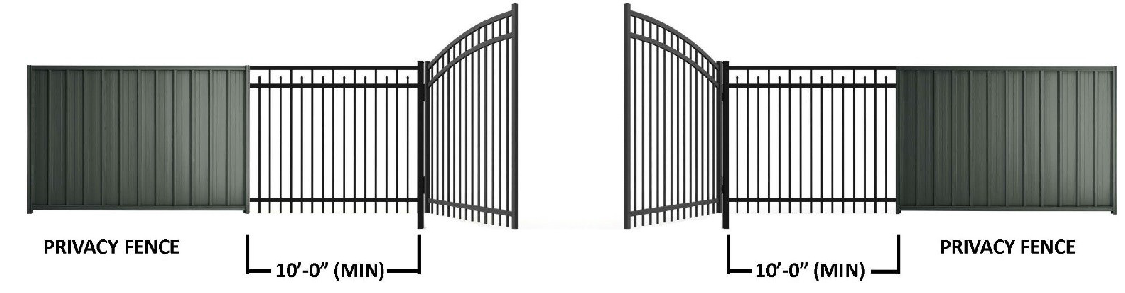
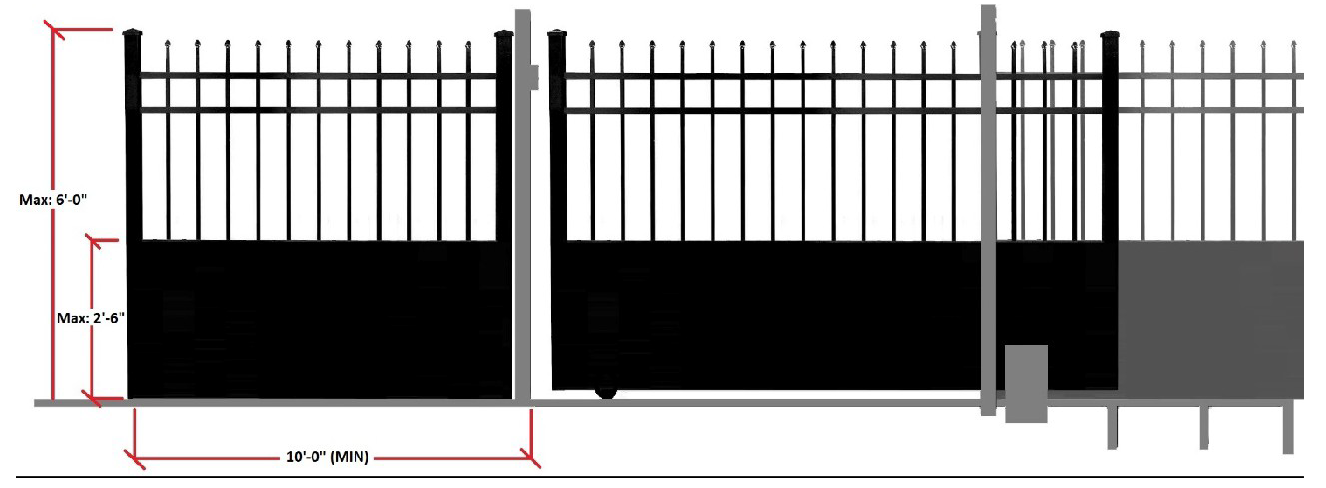
No fence, wall, gate, or opening shall be permitted to swing, roll or otherwise encroach into the right- of-way.
(3)
In PCD, NC and OF the installation of all fences and walls abutting a right-of-way shall be setback a minimum two feet from the property line and shall be landscaped accordingly with a continuous hedge as set forth in this section, except that off-street parking areas abutting rights-of-way shall comply with landscape and buffering and wall requirements set forth in this section.
(f)
Materials.
(1)
Chain link prohibition in front yards. Chain link fence prohibited in all district's front yards, side street yards. Notwithstanding anything in the code to the contrary, chain link fences shall only be permitted behind the front building line. Chain link shall not be permitted along property lines abutting the right- of-way. It is provided, however, that the aforementioned restriction on chain link fences shall not apply in I-1, I-2, GP, or AU zoning districts with bona fide agricultural use. All chain link fences must be vinyl coated color green or black. Bare metal or galvanized chain link fences are prohibited.
(2)
Fences for vacant properties. Fences for vacant lots shall only be split rail type fencing subject to approval by the planning and zoning director or designee. The proposed fencing may be supplemented with street trees and must allow complete visibility of the property to prevent cover from illicit activities. The purpose of this type of fencing is for long-term vacancy management rather than temporary construction needs.
(g)
Fence, wall, hedge maximum height.
Increase and decrease of height. Fence, wall, and hedge heights shall be increased, or decreased for compliance with the following:
(1)
Double frontage lots. When a higher wall, fence or hedge is required as a visual screening buffer at the rear of double frontage lots as set forth in this chapter, such fence or wall may be increased to a height of eight feet, if not otherwise permitted in the underlying zoning district.
(2)
Height at intersection. Fences, walls, or hedges shall not exceed two and one-half feet in height within the safe sight distance triangle, as defined herein this chapter.
(3)
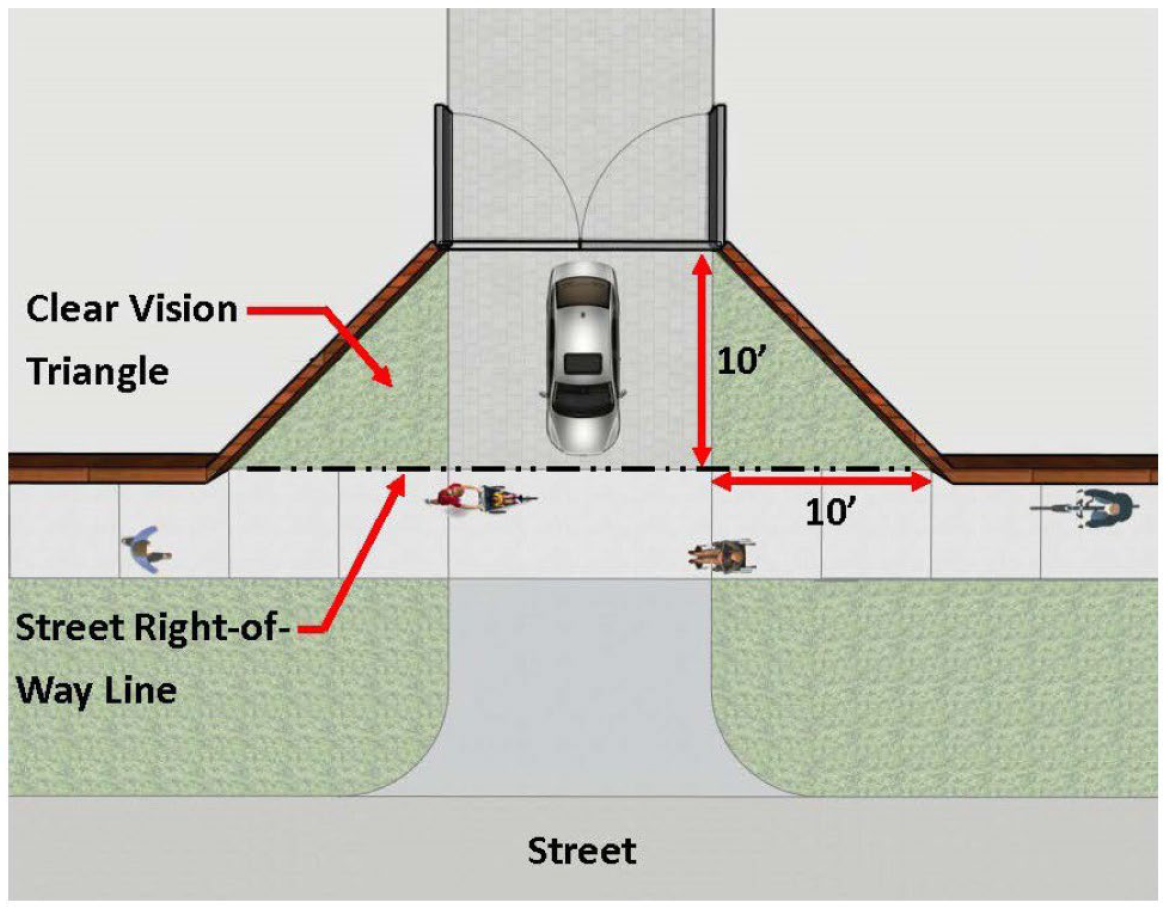
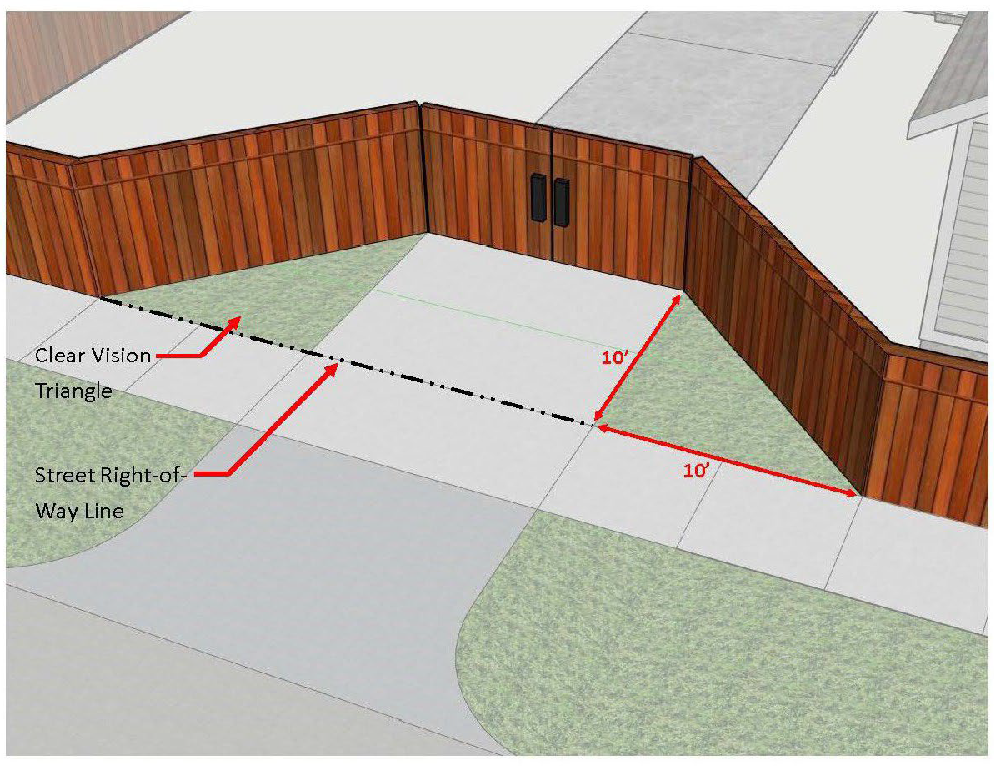
Height limitation. The height of fences, walls, and hedges shall not exceed two and one-half feet in height within ten feet of the edge of driveway leading to a public right-of-way, except that in the R district a fence may be permitted up to the maximum permitted height providing such fence is a maximum 25 percent opaque, and no other structures or portions of the fence, wall interferes with the safe distance visibility triangle.
(4)
Fences for tennis courts; fences and walls for other recreational uses. Fences, and walls for tennis courts may be erected up to 14 feet in height if such fence conforms to accessory use setbacks. Fences and/or walls in connection with other permitted recreational uses, such as baseball backstops, handball courts, and the like, shall be permitted of a height necessary for the particular use if required accessory use setbacks are observed.
(h)
Measuring height of wall, fence, and hedge. The height of a wall, fence or hedge shall be the vertical distance measured from the average elevation of the finished building site to the top of the wall, hedge or fence. The average elevation shall be measured along both sides of the wall, hedge or fence line. Virgin land may not be increased or decreased to affect the permitted (or required) height of a wall, hedge or fence unless the entire building site is graded to even out the level of the site or to increase it to the required the county flood criteria elevation. Average elevation shall be determined by taking elevations along both sides of the wall, hedge or fence line, at five-foot intervals and totaling the same and then dividing the total by the number of stations at which the elevations were taken. Decorative columns, or other types of architectural features shall not be measured as the fence or wall height provided said decorative columns or other types of architectural features do not exceed 20 percent of the permitted height of the fence or wall.
(i)
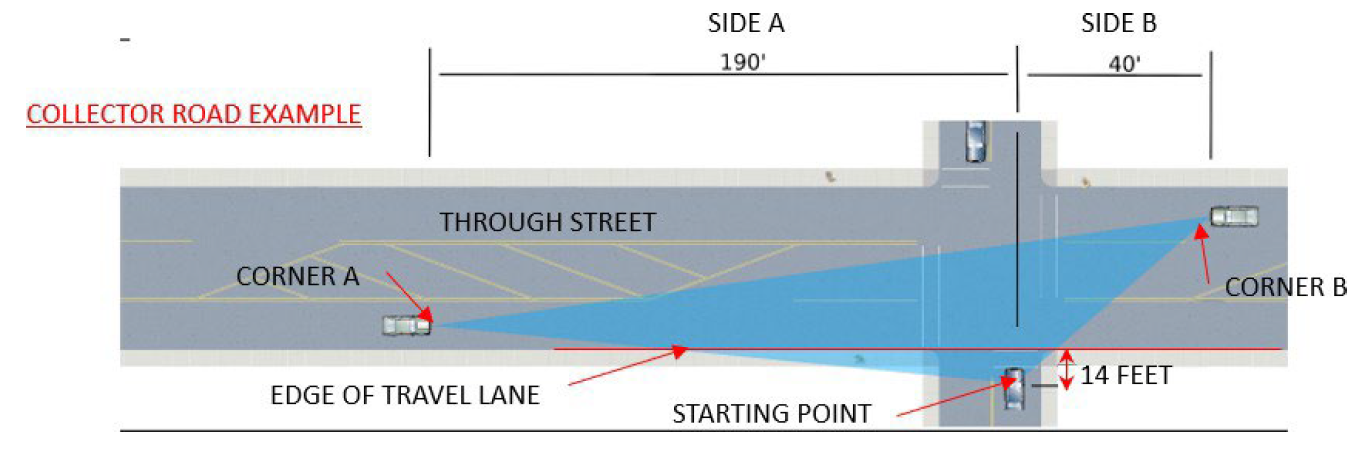
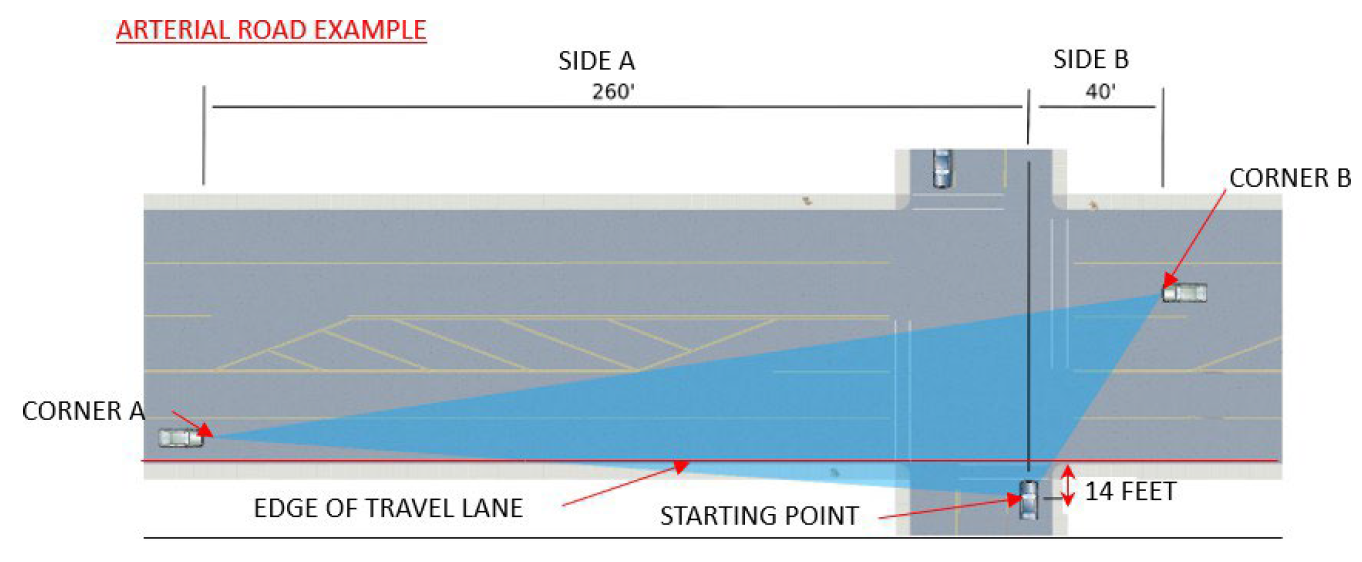
Sight triangle. Safe site distance triangles are required at each intersection of public roads or entrance from a private road or driveway onto a public road. Safe site distances triangle areas are calculated from the viewpoint of a car that will be turning onto or crossing the public road, as shown in the table and graphics below. No proposed landscape vegetation that is two and one-half feet tall or taller (or that will grow above two and one-half feet) may be proposed within the safe site distance triangle. No hardscape elements (rocks, walls, fences, etc.) two and one-half feet tall or taller may be proposed within the safe site distance triangle. Requests for waivers of the site triangle requirements must be made in writing to the director of public works.
*Begin site triangle from a point in the center of the lane or driveway entering the through street, 14 feet back from the edge of the closest travel lane of the through street. The length of Side A is determined by measuring from the starting point and going perpendicular to the left. The actual corner (Corner A) of the triangle is placed at the center of the closest travel lane approaching from the left. The length of Side B is determined by measuring from the starting point and going perpendicular to the right. The actual corner (Corner B) of the triangle is placed at the center of the closest travel lane approaching from the right.
(Ord. No. 2020-001-420, § 2(Exh. A), 1-22-2020; Ord. No. 2023-011-467, § 2(Exh. A), 10-11-2023; Ord. No. 2025-002-482, § 2(Exh. A), 1-22-2025
Sec. 34-447. - Tree preservation and protection permit.
(a)
Applicability. These tree preservation and protection regulations ("tree regulations") shall be a minimum standard for the protection, removal and relocation of trees and shall be enforced by the city.
(b)
Tree impact permit required.
(1)
Tree impacts. A tree impact permit is required for the removal or relocation of any tree in the city not specifically exempted pursuant to subsection 34-447(5). It shall be unlawful for any person, unless otherwise permitted by the terms of these tree regulations to remove, hatrack, effectively destroy, remove greater than 25 percent of a tree's canopy within a 12-month period, impact the critical root zone of a specimen tree, or otherwise conduct canopy or root trimming work not in accordance with ANSI A-300 standards.
(2)
Mitigation for unauthorized removal. In addition to those penalties imposed in this article, trees that have been removed without proper authorization shall be replaced on the basis of twice the standard replacement requirements per section 34-448. If a tree removed is no longer on site, the city shall utilize all readily available records and data such as the stump, historic photos, historic records, etc. to estimate the size of the tree removed.
(4)
Natural forest communities. All trees located within natural forest communities shall also be subject to the requirements of article 3 of chapter 24 of the Miami-Dade County Code, as amended. Applicants will be referred to Miami-Dade County to obtain authorization for vegetation removal activities within natural forest communities.
(5)
Exemptions. The following activities may qualify for exemption from tree removal permit requirements, subject to review by city staff. Applicants must submit a tree removal application to the city to verify applicability of an exemption prior to conducting tree removal.
a.
Vegetation removal and management activities authorized by permit from Miami-Dade County within a designated Natural Forest Community are exempt from additional tree removal permit requirements from the city. Applicants are required to submit approved permit(s) for verification of exemption.
b.
Removal of any dead tree, provided that the tree can be demonstrated to have died from natural causes without significant harm from human activity, and provided the tree is not located within a natural forest community.
b.
Removal of prohibited and controlled species as defined in the Miami Dade County Code and Miami Dade County Landscape Manual.
c.
Removal of any tree which has been destroyed or effectively destroyed by an act of God, or by acts outside of the control of any person, individually or otherwise, who has or had a legal, beneficial or equitable interest in the real property upon which such tree is located, which acts could not have been prevented by the exercise of reasonable care by that person. Where a tree has been destroyed or effectively destroyed as described above, it is the intent of this provision to exempt from liability for such destruction or effective destruction the person who has or had a legal beneficial or equitable interest in the real property upon which such tree is located if the person could not have prevented the destruction by the exercise of reasonable care.
d.
Removing, trimming, cutting or removal of any tree located upon land which is a wetland as defined in this chapter, provided the entity has obtained valid wetlands federal/state/local permits, which contain specific provisions for the trimming/removal of these trees. Mangrove trimming and removal must be authorized under the state's Mangrove Trimming and Preservation Act, §§ 403.9321—403.9334, F.S./chapter 24 of the Miami Dade County Code. The city may request copies of permits/authorizations to verify that the proposed activities qualify for this exemption.
e.
Removal of trees determined by a properly qualified ISA certified arborist to be classified as high risk, where mitigation options to remove risk are not viable.
Notes:
Removal of trees required by an approved landscape plan will require replacement in kind to maintain compliance with the approved plan, regardless of tree mitigation requirements (or lack thereof).
Removal of any tree specifically exempted by state or federal law from requiring a permit for removal must be documented as compliant with the rule by an appropriately qualified ISA certified arborist in a written report, with a courtesy copy provided to the city.
Owners of properties with trees removed under claim of any exemption without documentation to verify the exemption will be subject to tree removal permit requirements including penalties for unauthorized removal as applicable.
(6)
Review of permits for removal in rights-of-way, government properties. The administrative officer or designee shall review and make the determination for tree removal for trees in rights-of-way and on city-owned properties, unless removals within rights-of-way are proposed as part of the site development/building permit process, in which case the permittee shall be responsible for justification for tree removal/relocation and required mitigation. The city shall keep a record of removals within city-owned properties and city-installed landscaping, to ensure that mitigation requirements for these trees are met.
(c)
Application. A tree removal permit application shall be made to the planning and zoning department on a form approved by the administrative official and shall be accompanied by the required fee and required documents for the review of the application, as listed in the city code, the application form, and the landscape manual.
(d)
Review and evaluation of permit application.
(1)
The planning and zoning official shall conduct a review of each completed tree removal permit application. This review and all actions taken by the administrative official under the provisions of these tree regulations shall be conducted using best available practices from biology, botany, forestry, landscape architecture and other relevant fields, and shall be conducted in a manner that is consistent with all applicable goals, objectives and policies outlined in this chapter and in the comprehensive development master plan.
(2)
Upon receipt of a completed permit application, the administrative official or designee may review documentation provided by the applicant and/or visit the site and determine or confirm whether the site contains specimen trees or any other trees subject to the provisions of these regulations. The official may examine:
a.
Specimen tree standard. A specimen tree is hereby defined as having a trunk which measures 18 inches or more in DBH or multiple trunks which collectively measure 18 inches or more in DBH, and based on its health, condition, and species is able to contribute positively to the surrounding community. In general, trees that are listed as Category I Invasive by the FLEPPC and those in poor condition are not considered specimens. The standards to be applied in reviewing tree removal applications involving specimen trees are as follows: Specimen trees shall be preserved. Upon receipt of an application to remove a specimen tree, the administrative official or designee shall consider the following factors in evaluating said application:
i.
Size and configuration of the property.
ii.
Size and configuration of any proposed specimen tree.
iii.
Location of the tree relative to any proposed development.
iv.
Whether or not the tree can be preserved under the proposed plan or any alternative plan.
v.
Health, condition and aesthetic qualities of the tree.
vi.
Whether the tree poses a threat to persons or property. The administrative official or designee may recommend from time to time the designation of certain trees located within the city as specimen trees, regardless of size or species, including Category I Invasive species. The director of the planning department or designee shall either accept, modify or deny the recommendation and may designate those trees as specimen trees. Any tree which has been declared to be a specimen tree in this manner shall be subject to all of the specimen tree protection and other provisions for specimen trees within the city code, and shall not be considered as a non-specimen tree, Category I Invasive, prohibited, or other lower protection status that could otherwise be applicable.
(e)
Issuance. The planning and zoning administrative official or designee may approve, approve with conditions, or deny an application and issue a permit (subject to conditions, limitations or restrictions), for the activity proposed under the permit application.
(f)
Condition for replacement requirements for issuance of tree removal permit. As a condition of the issuance of a tree removal permit, the permittee may be required to replace trees that are authorized to be removed under the provisions of these tree regulations. The number of trees and number of species of trees required for replacement shall be determined according to the specifications contained herein. The planning and zoning official may require that replacement shall be described in a landscape replacement plan which shall meet the minimum requirements of the Code. No tree removal permit shall be issued until the administrative official has approved said plan.
(g)
Tree protection bonds. A bond may be held by the city for one year to insure successful tree replacement for proposed tree relocations and for specimen trees with proposed construction impacts within the critical root zone. Such bond amount shall be assessed at twice the equivalent value of the required replacement tree(s). Relocations or tree protection that are not wholly successful, as determined by the city, may be resolved through replacement plantings or payment to the tree fund. If neither of these options are accomplished within 90 days of notice by the city, the city may retain the entire bond value.
All required plans or covenants are submitted and are in compliance with the standards herein.
(Ord. No. 2020-001-420, § 2(Exh. A), 1-22-2020; Ord. No. 2025-002-482, § 2(Exh. A), 1-22-2025)
Sec. 34-448. - Procedures for determining tree replacement requirements.
The planning and zoning official or designee shall determine the total number and type of replacement trees required for the issuance of a tree removal permit according to the following procedural steps:
(a)
Step 1: Determining existing tree canopy coverage on-site. The area of existing tree canopy coverage of a site shall be determined by the administrative official, using one or any combination of the following methods: Review of aerial photography; on-site inspection; and review of a tree survey. The administrative official may require the applicant to submit a tree survey for the purpose of this determination.
(b)
Step 2: Determining impact area of proposed project. The area of existing canopy coverage which will be affected (impact area) by the applicant's proposed development shall be determined by the administrative official based on a site plan and completed tree removal permit application.
(c)
Step 3: Determining number of replacement trees required to be planted. The total number of trees required for replacement shall be based on the area of impact and the category of replacement tree selected by the applicant. Trees which are not on the county's prohibited species list but which are listed as "Category I" on the Florida Exotic Pest Plant Council's (FLEPPC) current list of invasive species, shall have canopy replacement calculated at 50 percent of actual loss. Each replacement tree shall compensate at a ratio as shown in the table below for the portion of the tree canopy lost in the impact area. The following table shall be used as a standard for determining the required number of replacement trees:
(1)
Compensation for lost canopy. Replacement categories shall compensate for the lost canopy. In the event that a replacement tree actually has more canopy coverage at the time of planting than the amount of credit allowed under the tree replacement formula above, then the applicant shall receive full credit for the canopy coverage provided by the replacement tree at the time of planting. The applicant shall submit a list of proposed replacement trees on a form provided by the administrative official, except when the total number of replacement trees exceeds 20, and then the applicant shall be required to submit a landscape replacement plan consistent with the provisions of this article. Proposed replacement lists or plans are subject to administrative official approval. The administrative official shall approve proposed replacement trees that are consistent with the standards of these tree regulations.
(2)
Minimum species diversity standards. When more than ten trees are required to be planted in accordance with the provisions of this division, a diversity of species shall be required. The number of species to be planted shall be based on the overall number of trees required. The applicant shall be required to meet the following minimum diversity standards:
Permittees shall not be required to plant in excess of six species. The number of trees of each species planted shall be proportional to the number of species required. A minimum of 50 percent of all replacement trees planted shall be native to the county, and no more than 30 percent of the replacement trees shall be palms. However, when native trees are removed, all replacement trees shall be native species. As an alternative to the minimum species diversity required herein, an applicant may propose alternative species diversity in an alternative landscape enhancement plan described in these tree regulations.
(d)
Step 4: Location of replacement trees. Specific placement of replacement trees on-site shall be determined by the applicant. If the site cannot accommodate the required replacement trees because of insufficient planting area as determined by the planning and zoning official, then the applicant shall be required to plant replacement trees at an off-site location subject to the planning and zoning official approval, or, as an alternative, shall provide an equitable contribution to the city tree trust fund in the amount of $2.00 per square foot of lost canopy, to compensate for those replacement trees which cannot be accommodated on-site. The city's landscape manual may adjust this cost periodically (by way of a multiplier) to account for inflation.
(e)
Step 5: Minimum standards for replacement trees.
(1)
All replacement trees shall have a minimum quality of a Florida No. 1 grade or better.
(2)
The city administrative official shall maintain a list of species for each category of replacement tree. This list may be amended from time to time, as necessary. Replacement tree heights shall be determined by overall height measured from where the tree meets the ground to the top- most branch, palm heights are measured by gray wood/clear trunk.
(3)
All category 1 replacement shade trees shall be a minimum of 16 feet in height and three inches DBH at the time of planting and at maturity should have a minimum canopy coverage of 900 square feet under normal growing conditions.
(4)
All category 2 replacement shade trees shall be a minimum of 12 feet in height and two inches DBH at the time of planting and at maturity should have a minimum canopy coverage of 300 square feet under normal growing conditions.
(5)
All category 1 replacement palm trees shall have a minimum height of ten feet at the time of planting and at maturity should have canopy coverage of 300 square feet under normal growing conditions.
(6)
All category 2 replacement palm trees shall have a minimum height of three feet at the time of planting and at maturity should have canopy coverage of 100 square feet under normal growing conditions.
(7)
All replacement small trees shall have a minimum height of six feet and one inch DBH at the time of planting and at maturity should have canopy coverage of 200 square feet under normal growing conditions.
(f)
Replacement of specimen trees.
(1)
Alternate plans. If, upon review of the factors enumerated above, the city official determines that a specimen tree cannot reasonably be preserved under the proposed plan, then the applicant shall provide an alternate plan when feasible, which shall include preservation of the specimen tree and design alterations consistent with the scope and intent of the initially proposed plan. Alterations consistent with the scope and intent of the initially proposed plan may include, but shall not be limited to:
a.
An adjustment of building orientation on a site.
b.
An adjustment of lot lines within a site proposal where said adjustment will not cause an unreasonable loss of usable space. An applicant shall have the burden of proof in the determination of what constitutes an unreasonable loss of usable space.
(2)
Specimen tree relocation. If preservation of the specimen tree and any alternate design consistent with the scope and intent of the initial plan are mutually exclusive, then the administrative official may issue a permit to relocate the specimen tree. If the tree removal permit requires relocation, then the applicant shall be required to relocate the tree in accordance with the standards set forth herein. The city may require detailed specifications for relocation including root pruning, tree lifting/moving, maintenance and care, and review/ acceptance of the contractor proposed to conduct the relocation.
(3)
Removal of specimen tree. If relocation of the specimen tree is not feasible due to the size, health, location, species or any other factor, then a permit may be issued for removal, and tree replacement shall be required.
(4)
Replacement requirements for specimen trees. As a condition of the issuance of a tree removal permit for the removal of a specimen tree, tree replacement requirements shall be as follows: Specimen trees shall be replaced at twice the canopy replacement requirement listed in section 34-448. In addition to the canopy replacement requirement, an equitable contribution will be required. The equitable contribution will be paid to the city's tree trust fund on a per-tree basis for the loss of the functions and values of the tree, at a standard rate of $200.00 per diameter inch removed. The city's landscape manual may adjust these costs periodically (by way of a multiplier) to account for inflation.
(5)
Exemptions. A tree/trees may be exempted from the alternative plans and replacement requirements above, but subject to the (non-specimen) tree replacement requirements above, if all of the following circumstances are met:
a.
Receipt of a statement from a certified arborist which indicates that a specimen tree, due to disease, condition, growth habit, listing as Category I Invasive by the FLEPPC, or any other reasonable botanical factor, does not provide the aesthetic or environmental contribution associated with a specimen tree, or site-specific factor outside of the control of the current and previous property owners or current applicant which makes the tree non-viable. Said statement shall include the specific reasons for the claimed exemption from the provisions of these regulations.
b.
The planning department director or designee reviews and approves the statement from the certified arborist; concurring that the tree/trees should not be considered as specimen(s).
(Ord. No. 2020-001-420, § 2(Exh. A), 1-22-2020; Ord. No. 2025-002-482, § 2(Exh. A), 1-22-2025)
Sec. 34-449. - Tree protection standards.
(a)
Protection requirements during construction. During site development, protection requirements for trees designated for preservation under an approved tree removal permit shall include, but not be limited to, the following:
(1)
Protective barriers shall be placed around the critical root zone of each tree, cluster of trees, or the edge of the preservation area. The critical root zone shall be calculated at eight inches in radius per inch in DBH, with a minimum radius of six feet unless a lesser distance is specified by the administrative official. Protective barriers shall be a minimum of four feet above ground level and shall be constructed of wood, plastic or metal, and shall remain in place until development is completed and the administrative official has authorized their removal. Protective barriers shall be in place prior to the start of any construction, and shall include signage in English and Spanish indicating that disturbance within the protected areas is prohibited.
(2)
Understory plants within protective barriers shall be protected.
(3)
No excess oil, fill, equipment, building materials or building debris shall be placed within the areas surrounded by protective barriers, nor shall there be disposal of any waste material such as paints, oils, solvents, asphalt, concrete, mortar or any other material harmful to trees or understory plants within the areas surrounded by protective barriers, or any ground surfaces or existing drainage facilities on the site.
(4)
Trees shall be braced in such a fashion as to not scar, penetrate, perforate or otherwise inflict damage to the tree.
(5)
Natural grade shall be maintained within protective barriers. In the event that the natural grade of the site is changed as a result of approved site development activities such that the safety of the tree may be endangered, tree wells or retaining walls may be required by the city.
(6)
Underground utility lines shall be placed outside the areas surrounded by protective barriers. If said placement is not possible, disturbance shall be minimized by using techniques such as tunneling or overhead utility lines.
(7)
Fences, walls, and any other construction activity approved by the city to occur within the limits of the CRZ/tree protection area shall be constructed to minimize disturbance to any protected tree to the maximum extent practicable. Postholes and trenches located close to trees shall be dug by hand and adjusted as necessary, using techniques such as discontinuous footings, to avoid damage to major roots. All other work within this area shall be conducted by hand/with hand-held tools, and all paving must be placed above-grade.
(8)
A tree protection plan, as defined in this chapter.
(b)
Tree relocation standards. The relocation of any tree subject to the provisions of these regulations shall be consistent with the minimum standards of the American National Standards Institute (ANSI) and the tree relocation standards promulgated by this chapter and contained within the city's landscape manual.
Sec. 34-450. - City of Miami Gardens Tree Trust Fund.
(a)
Establishment of trust. There is hereby created the Miami Gardens Tree Trust Fund for the purpose of accepting and disbursing the tree mitigation fees paid to the city as part of tree permits. The tree trust fund shall be established and maintained separately from the general revenue and other accounts of the city.
(b)
Use of funds. Funds disbursed from the tree trust fund shall exclusively be used for tree planting and relocation on public property within the city. Trees purchased may also be given to the general public to enhance the tree canopy of the city. Funds from the tree trust fund, in an amount totaling no more than ten percent of fund disbursements in a given year, may be used for supporting activities related to tree replacement and canopy restoration including tree inventories and analysis, landscape design services, landscape inspections of new plantings, irrigation, and staff training for landscape inspections. Allowable expenditures pursuant to this chapter shall be made by the director of planning and zoning or his/her designee.
Sec. 34-451. - Maintenance requirements.
(a)
Responsibility. All owners of land or their agents shall be responsible for the maintenance of all landscaping. This includes mowing and maintaining abutting rights-of-way, swales, lakes and canal banks.
(b)
Intent. Landscaping shall be maintained in a good condition so as to present a healthy, neat and orderly appearance at least equal to the original installation and shall be mowed or trimmed in a manner and at a frequency so as not to detract from the appearance of the general area, which shall include, but not be limited to, hat racking, defacing, or painting of trees, and the proper trimming and pruning techniques as outlined in the city's landscape manual.
(c)
Safety. Landscaping shall be maintained to minimize property damage and public safety hazards, including removal of living, dead or decaying plant material, removal of low hanging branches and those obstructing street lighting and maintenance of sight distance standards as set forth herein.
(d)
Natural habitats. Dead or declining plant material considered to be part of a natural habitat feature located on public property are exempt from these landscaped maintenance provisions except where maintenance is necessary to avoid damage to public property or to mitigate safety hazards.
(e)
Standards. Landscaping shall be maintained in accordance with the following standards. The city may require a landscape maintenance plan as a condition for approval of a landscape plan or tree removal permit, or in response to a finding of noncompliance/ nonconformance of existing landscaping. The contents of the landscape maintenance plan shall follow the requirements stated in the city landscape manual, including the following:
(1)
Insects, disease, etc. Landscaping shall be kept shall be kept free of visible signs of insects and disease and appropriately irrigated and fertilized to enable landscaping to be in a healthy condition.
(2)
Mulch. Three inches of clean, weed-free, approved organic mulch shall be maintained over all areas originally mulched at all times until landscaped area matures to 100 percent coverage. The use of heat-treated mulch obtained from Melaleuca, Eucalyptus, or other invasive plant species is encouraged in order to reduce their impact on the environment and to preserve the remaining native plant communities. For this reason, the use of Cypress mulch is strongly discouraged.
(3)
Turf edge trimming. All roadways, curbs and sidewalks shall be edged to prevent encroachment from the adjacent turfed areas. Line trimmers shall not be used to trim turf abutting trees or other plant material.
(4)
Irrigation systems.
a.
Irrigation systems shall be maintained to eliminate water loss due to damaged, missing or improperly operating sprinkler heads, emitters, pipes.
b.
Irrigation systems shall be designed, installed and maintained to minimize application of water to impervious areas and/or so as not to create a vehicular use hazard on rights-of- way, ingress/egress easements or other vehicular use areas.
c.
Low-volume, drip, trickle and emitter irrigation is encouraged to promote good Florida Friendly principles where applicable.
d.
A functioning rain sensor/shutoff device shall be required on all irrigation systems installed after 1991 as mandated by F.S. § 373.662.
e.
In order to reduce the amount of water lost to evaporation, irrigation systems shall be operated between the hours of 5:00 p.m. and 8:00 a.m. only, or as amended by state, county, city and/or South Florida Water Management District regulations. It is furthermore strongly recommended that irrigation systems operate primarily in the early morning hours after 4:00 a.m. to reduce the likelihood of any horticultural plant diseases developing. Operation of the irrigation system for maintenance, repair, sod installation for new construction and landscape maintenance activities (such as required application of water to apply fertilizer, herbicides and pesticides) is not limited to these hours.
f.
The duration that zones are operated should be adjusted to reflect the size of the zone as well as the needs of the plant material in the zone. Unnecessary and excessive watering can promote root rot and other plant diseases.
g.
Under drought conditions, compliance with the watering restrictions of the South Florida Water Management District is required.
(5)
Pruning. Any necessary tree pruning must conform at a minimum to ANSI A-300 standards and as set forth in the city's landscape manual.

