
Millersville City Zoning Code
ARTICLE XII
BUILDING DESIGN STANDARDS
Sec. 90-171.- Purpose, goals, basis.
(1)
Purpose. Millersville's environment is its most important asset in seeking to attract residents, businesses, and employment opportunities. Its natural environment sets a demanding standard, the rolling hillsides provide an unparalleled setting for places to live, shop, and work. However, as Millersville grew in its early years, and before the advent of design standards, some of the buildings and areas developed in a way which was disappointing to the citizens. New investors deserve to have their investments protected by continuing to apply appropriate design standards to new development.
This article explains the goals and standards which the planning commission will apply in reviewing proposals. It does not reproduce all the specific requirements stated in other parts of this article, the subdivision regulations, or other applicable development standards and regulations. Applicants are advised to consult all such documents prior to preparing plans.
This article also is not intended to discourage applicants from submitting plans which are in the spirit of the standards, but not their letter, particularly if departures hold merit for a particular site or circumstance. In such instances, the Millersville Planning Commission may decide to make exceptions from its standards. The burden of demonstrating that the plan is appropriate falls upon the applicant.
Design review will occur in parallel with other required reviews. The design review process is described step by step in section 90-47 (site plan and design review) of this article. Where site plan review is required, design review will occur at the same time.
(2)
Goals.
(a)
Natural character. Millersville's natural character should be preserved and enhanced with new development. Especially important are retaining mature trees and vegetation, maintaining topography, preserving important views and other natural features, and ensuring that new buildings sit within a generously landscaped setting.
(b)
Compatibility. New buildings should be compatible with their neighbors, assuming that the neighboring structures are a credit to the community. That does not imply uniformity or architectural style, rather a sympathetic response to the height, scale, materials, color, site location and other aspects of nearby structures.
(c)
Orderly public realm. The city's character is largely formed by the appearance of its major roadways. How public and private elements of the streetscape relate to each other provides a sense of order - public roadways, shoulders and medians, utility lines, and traffic signage in relationship to private landscaping, parking areas, building facades and signage. Scrutiny of what may be seen from public ways should be most intense, while less visible private areas of sites should be more at the landowner's discretion.
(d)
Restrained communications. Private signage and advertising should be restrained and not detract from the sense of continuous landscape. The principal purpose of on-site signage is to identify establishments, and to direct those seeking to visit them safely and efficiently to their destination. Signage that is limited in size and set in a strong landscape surrounding can be more visible than a forest of messages.
(e)
Diversity of opportunity. Millersville wishes to attract diverse housing types, services, and other community attractions. In reviewing plans and proposals, it does not wish to rule out particular uses because of costs or burdens imposed. Rather, it wishes to work with developers and builders to find a formula for creating uses that is economically viable as well as harmonious with the environment.
(f)
Residential privacy. The sense of privacy of residential areas should be protected, especially from nuisances created by adjacent uses, such as noise, traffic, high lighting levels, and uncontrolled access. Within residential areas, there should be privacy of individual units.
(g)
History. References to Millersville's past - both its natural and settlement history - should be preserved wherever possible. These include artifacts such as rock fences, stacked stone walls, areas of formal landscape, historic cemeteries and archaeological sites and structures more than 50 years old.
(h)
Utilitarian elements. As a way of reducing disorder and emphasizing the human environment, utilitarian elements should be masked or located out of public view. These include mechanical equipment on buildings, transformers, meters, refuse stations, electric wiring, and service areas.
(3)
Basis/principles.
(a)
To promote qualities in the environment that sustains the community's economic well-being;
(b)
To foster the community's attractiveness and functional utility as a place to live and work;
(c)
To preserve the community's heritage by maintaining the integrity of areas enjoying discernible character contributing to this heritage;
(d)
To safeguard public investment in the community; and
(e)
To raise the level of citizen expectations favoring the quality of the community's visual environment.
(Ord. No. 20-744, 6-1-2020)
Sec. 90-172. - Residential building design standards.
(1)
Applicability. The standards contained in this section apply to the construction or placement of:
(a)
All single-family dwellings to be constructed in a subdivision containing three or more lots granted preliminary or final subdivision approval or preliminary development plan approval after the effective date of this article and all horizontal property regimes (HPR) of any size or number of dwellings constructed after the effective date of this article.
(b)
All additions and renovations of dwellings described in subsection (a), above, as well as the re-construction of said dwellings.
(c)
Dwellings constructed on another parcel and relocated to a lot and manufactured dwelling moved to a lot. This includes lots created prior to May 1, 2020. Only standards of subsection 90-172(9) (moving dwellings and manufactured dwellings into developed areas) apply.
(d)
Townhomes (includes villas, cottages, and two-family dwellings).
(e)
Multifamily residential buildings.
(2)
Design review approval required. Design review approval is required in accordance with section 90-47 (site plan and design review) for townhomes and multifamily residential buildings. Usually this approval is granted concurrent with site plan approval of a project is not required, i.e., for renovations to buildings, yet design review is required. Refer to section 90-47 (site plan and design review).
(3)
Architectural style and compatibility. The architectural style, design, colors, building materials, roof and other similar features of each residential building shall be compatible with existing complying residential buildings within the same subdivision phase or section. In the case of townhomes and multifamily residential buildings, compatibility shall be measured with existing complying townhomes and multifamily residential buildings in the area.
(4)
Building materials. Applicable residential buildings as defined in subsection 90-172(1), should be constructed of brick and/or stone with minimum percentages as specified in the following chart. Approved materials for the remaining percentage of the building are fiber cement board (such as Hardie board), EIFS, stucco, and treated and painted wood, cedar, and redwood. Vinyl, aluminum, and similar siding are limited as shown. All other materials are prohibited. There are no restrictions on building materials for zones not listed in Table 15.
(5)
Front-entry garages.
(a)
SR-1, SR-2, and MFR districts. Front-entry garage doors in SR-1, SR-2, and MFR districts without a planned development overlay shall conform to the following design standards. If more than 50 percent of the homes in a subdivision have front-entry garages, all of the homes shall have carriage style doors and:
1.
Shall have two single-wide doors rather than a double-wide door or
2.
Shall have an arch over the garage door (brick or dryvit), columns, a portico or decorative/ornamental lighting.
(b)
All residential planned developments. Front-entry garage doors for all types of dwellings permitted in all residential planned developments shall conform to design standards as prepared by the developer and approved by the planning commission in conjunction with the approval of the final development plan. The guidelines shall include an appropriate combination of the following or equivalent design standards:
1.
Limit the percentage of homes which will have front entry garages.
2.
Limit the percentage of total home frontage which will be occupied by the garage doors.
3.
Recess garages by at least ten feet.
4.
Two single-wide carriage style garage doors shall be used rather than double-wide doors.
5.
Provide architectural amenities such as arches, columns, porticos and decorative/ornamental lighting.
(6)
Supplemental design standards for multifamily residential buildings. In addition to the standards contained in this article, the following building design standards contained in section 90-173 (commercial building design standards) are to be used as a guide in designing multifamily residential buildings:
(a)
Section 90-173(3) (massing and scale of buildings).
(b)
Section 90-173(5) (orientation of buildings).
(c)
Section 90-173(6)(c) (building color).
(d)
Section 90-173(6)(d) (building façade).
(e)
Section 90-173(6)(e)1. (windows - general guidelines).
(f)
Section 90-173(6)(f) (roofs).
(7)
Supplemental design standards. Reserved.
(8)
Supplemental design standards for townhomes. No attached grouping of townhomes shall be more than six units attached in a row.
(9)
Moving dwellings, manufactured dwellings and mobile homes into developed areas.
(a)
No single-family dwelling shall be moved from an existing foundation to another foundation located within a developed area of single-family residences, unless:
1.
Approval for the movement of the dwelling has been given by the City of Millersville.
2.
A single-family dwelling to be moved is consistent with the age, value, size, and appearance of existing dwellings with the developed area into which the dwelling is proposed to be moved.
3.
It is within 100 square feet of the average size of the existing structures within the developed area; and
4.
The appearance of the dwelling is consistent with those in the developed area, as determined by the body giving approval for the move.
(b)
A manufactured dwelling shall not be moved into a developed area of single-family homes.
(c)
After January 1, 2022, when a mobile home is removed from an existing lot it shall not be replaced. Prior to January 1, 2022, mobile homes shall comply with the following:
1.
Mobile home shall not be moved into a developed area of single-family homes or moved onto a new lot not previously occupied by a mobile home.
2.
Mobile home must be no larger than the mobile home it is replacing.
3.
Mobile home must be constructed after January 1, 2004 and inspected by the Tennessee State Fire Marshal's Office.
(Ord. No. 20-744, 6-1-2020)
Sec. 90-173. - Commercial building design standards.
(1)
Applicability. This section applies to buildings and structures located within commercial zone areas (MXR, MC, O, MXC, GC, and HC), and any multifamily and institutional buildings and structures located within any zoning classification.
(2)
Design review approval required. design review approval is required in accordance with section 90-47 (site plan and design review). Usually this approval is granted concurrent with site plan approval. Nevertheless, there are occasions when site plan approval of a project is not required, i.e., for renovations to buildings, yet design review is still required. Refer to section 90-47 (site plan and design review).
(3)
Massing and scale of buildings. Techniques suggested in these standards provide tools for allowing large buildings while reducing their perceived massiveness. While the footprint of new commercial development may remain large, human scale can be retained through creative massing and organization of building forms and through other techniques including landscaping and berms. These standards will be especially useful for the design of commercial and office buildings but can also apply to multi-family residential buildings, which often have large footprints and multiple stories. The following standards or guidelines, are to be utilized as a basis for establishing the appropriate massing and scale of buildings in Millersville:
(a)
Use building mass appropriate to the site. Place buildings of the greatest footprint, massing, and height in the core of commercial or office developments where the impact on adjacent uses is the least.
(b)
The use of a large, single building mass should be avoided. Break up the front of a large building by dividing it into individual bays of 25 to 40 feet wide. This is a human-scale dimension which improves the pedestrian experience. The use of flat front facades is not permitted.
(c)
Use variation in materials, textures, patterns, colors, and details to break down the mass and scale of the building.
(d)
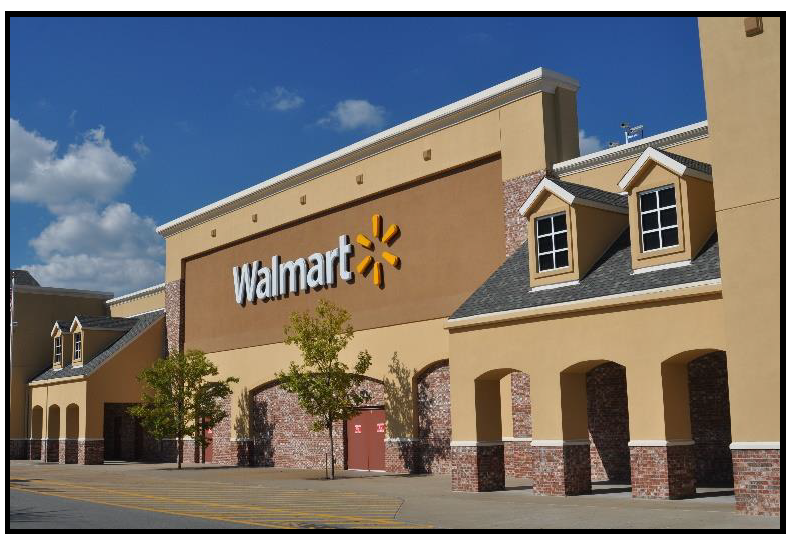
Use building articulation techniques to reduce a building's massing. Water tables, string courses, cornices, material changes and patterns, and fenestration can reduce the apparent height of a large building.
(e)
When making transitions to lower density areas, modulate the mass of the building to relate to smaller buildings. Height can be greater if the mass is modulated and other scale techniques are adopted. Reduce height near the lower density uses.
(4)
Building setback. Buildings shall conform to the minimum front yard/setback requirements. However, when located between buildings with greater setback than required, every effort should be made to place the new building in line with the existing adjoining buildings.
(5)
Orientation of buildings. Building orientation refers to the direction of prominent entrances and front facades of a building. The entrance façade will be the most prominent elevation of a building. The following guidelines are to be utilized as a basis for establishing the proper orientation of buildings in Millersville:
(a)
Buildings shall be sited so that their main entrances are facing the street on which they are located. If a building does not have street frontage, it should be oriented to any public space or its most visible side from the public realm. Buildings should respect the orientation of neighboring buildings and developments. Front facades should face front facades, and sides should face sides. A main entrance façade should not face another building's rear or service façade.
(b)
In many cases, a building may have more than one orientation and need more than one entrance façade. For instance, the prominent front elevation may face a major collector or corridor while elevations facing local streets, parking, or adjoining developments can have secondary facades and entrances. The entrances should be designed to reflect this hierarchy.
(c)
Buildings shall be oriented toward accessible arterial or collector streets rather than nearby freeways.
(d)
Buildings entrances should be designed to reflect their hierarchy within a building or development and should be articulated with architectural elements such as columns, pilasters, arches, or details such as special moldings. Include entry features such as porches, porticoes, arcades, or canopies and changes in massing, wall planes, or roof forms and/or landscaping features such as planters or benches.
(6)
Architectural character and building elements. The establishment of building character, or specific architectural styles, is appropriate to give a distinctive character to a specific area, such as a commercial development, a commercial corridor, or a major commercial intersection. The following standards are to be utilized as a basis for establishing the appropriate character of the architecture and elements of buildings in Millersville:
(a)
Character.
1.
The establishment of a design theme for a large commercial center or a major intersection with a common palette of materials, colors, building and roof forms, and architectural features can create a coordinated and inviting mix of buildings and spaces.
2.
The design themes for office parks should take on a campus appearance where roof forms, building height, materials, and details such as windows all relate closely to one another, creating a unified appearance.
3.
The use of cookie-cutter architectural design should be avoided. Cookie-cutter design utilizes the same architectural details on multiple buildings within a development with no variation for added interest.
4.
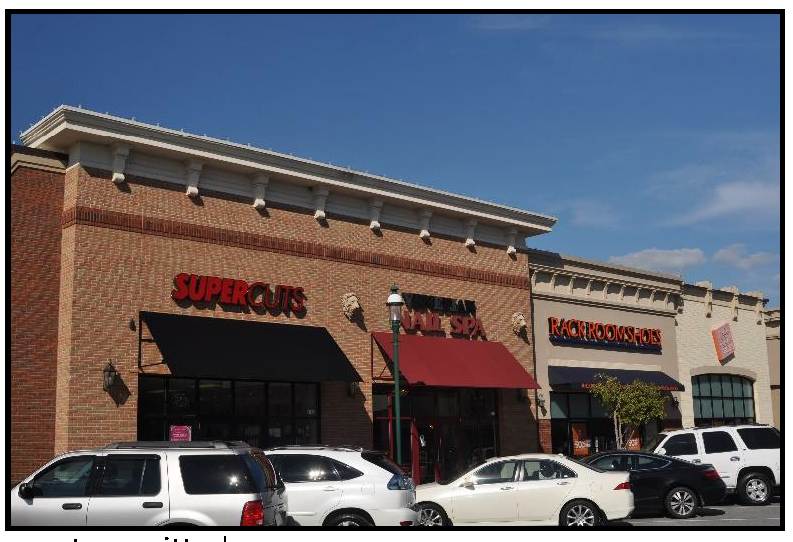
When making transitions between developments, excessive contrast in building scale, forms, materials, or styles are not permitted.
5.
Franchises must also meet these guidelines and blend with Millersville's character. In recent years national retail chains have developed more options in their standardized designs. New franchise designs shall be modified as needed to follow the standards in this document.
(b)
Building materials. The choice of materials and texture has great visual significance. Coordinating materials within a development can tie together buildings of different sizes, uses, and forms, while contrasting materials or textures within large developments may add visual interest and reduce its scale. It is important that new development be compatible with, and respectful of, the strengths of the city's current development fabric. New structures shall be compatible with their neighbors in substantially in compliance with the standards. This does not imply uniformity of architectural style; rather, a similarity to exterior building materials of nearby conforming structures. Choose materials which are high in quality, durable, and which offer texture. Use material and texture changes to help reduce the mass and provide visual interest and variety. Avoid monotony.
1.
Primary building materials. For the purpose of this section, a primary building material is defined as the predominate, most extensive, exterior building material(s) used to clad a façade, excluding storefronts, windows, and doors. A primary building façade is simply the most visible façade from the public realm. In this context, the public realm is the building façade containing the primary entrance, the side of a building facing a street, or a side facing the primary entrance to another building. The following materials are approved as primary building materials:
A.
Brick (clay-fired).
B.
Stone.
C.
Artificial stone products (masonry based, with a fine or rock cast authentic finish such as Arriscraft).
The following materials when used in combination with the above materials, may be approved on a case by case basis with the context of each application and the particular use and quality of each material being the basis for the decision:
A.
Fibrous cement board (simulated wood siding).
B.
Marble.
C.
High quality architectural metals (copper, bronze, low-luster aluminum).
D.
Quik brick (concrete block with an imitation brick finish; half-size or full size) or equivalent.
E.
Exterior insulation finishing system (EIFS).
F.
Cementious stucco.
2.
Trim and accent materials. Trim and accent building materials are clearly subordinate to the primary building materials on a façade. The following materials are acceptable for building trim and accents:
A.
Any building material approved for use as a primary building material.
B.
Fiber cement board.
C.
Exterior Insulation Finishing System (EIFS).
D.
Cementious Stucco.
E.
Metal or vinyl trim (i.e., for flashing; not walls or fascia).
The following materials may be approved on a case-by-case basis:
A.
Wood trim.
B.
Tile.
C.
Split-faced concrete block (integrally colored).
D.
Simulated wood details (for trim, columns, etc.) made of plastic, vinyl, fiberglass, or fibrous cement.
E.
Neon lighting/tubing and strings of LED lighting and similar lighting limited to the walls of commercial buildings in the form of a single enclosed band of such lighting around not more than the perimeter of the building. Such lights shall not be located in the windows or doors or other places within the building or on the property to the extent such lights are visible from a public street.
Exception: Traditional holiday lighting for not more than two 30-day periods per calendar year. These periods may run consecutively.
3.
Remote walls. Facades of buildings which will not be visible to the public realm (front a street, primary entrance to the building or primary entrance of another building) and do not about a residential development/zoning district are considered remote walls. In these instances, the following materials may be approved on a case-by-case basis which would otherwise not be approved for the primary building facades:
A.
Any material approved for primary, trim and accent materials, including those which may be approved on a case-by-case basis, but excluding metal
B.
Tilt-up concrete walls.
4.
New materials. This section is not an exhaustive list of materials which may be approved. The planning commission (or staff, for staff-approved projects) may approve the use of new materials not expressly listed, on a case-by-case basis. This may include new products or synthetic materials which approximate the look, quality, and durability of approved materials. Examples include artificial slate, artificial brick or stone products or clay-fired brick veneers.
5.
Prohibited materials.
A.
Plywood.
B.
Vinyl siding.
C.
Aluminum siding.
D.
Pressboard siding.
E.
Metal.
F.
Cement block, except calcium silicate block may be approved on a case-by-case basis.
G.
Any material which is determined to be out of character with the area.
(c)
Building color. Color is an integral element of the overall design. Brick, stone, and concrete have an inherent color created by nature or during the manufacturing process. Other surfaces will get their color from applied materials such as paint. Awnings and canopies provide other opportunity for color.
1.
Create a coordinated palette of colors for each development. This palette shall be compatible with adjacent conforming developments as well as corridor or intersection themes.
2.
Set the color theme by choosing the color for the material with the most area. If there is more roof than wall area, roof color will be the most important color choice setting the tone for the rest of the colors.
3.
Limit the number of color choices. Generally, there will be a wall color, trim color, accent color, and roof color. All building elements should work within this palette, including chimneys, vents, and gutters.
4.
Use muted earth tone tints of colors such as reds, browns, tans, grays, and greens. Avoid primary colors or bright accent colors and stark contrast colors. Avoid white. Use cream colors instead.
5.
Use color variation to break up mass and provide visual interest.
(d)
Building façade. Unadorned blank walls on any elevation which is visible from streets, from adjoining developments, from parking areas or on a rear elevation which is nor screened are not allowed. Include human-scale elements, particularly at the street level and on facades with a pedestrian focus. The articulation of a façade, both horizontally and vertically, is critical to creating a human scale and reflecting the traditional image and character of Millersville.
1.
Horizontal façade articulation through bay divisions.
A.
Façades of all buildings shall be proportionally divided using architectural elements including windows and entries in conjunction with porches, arcades, canopies, and awnings.
B.
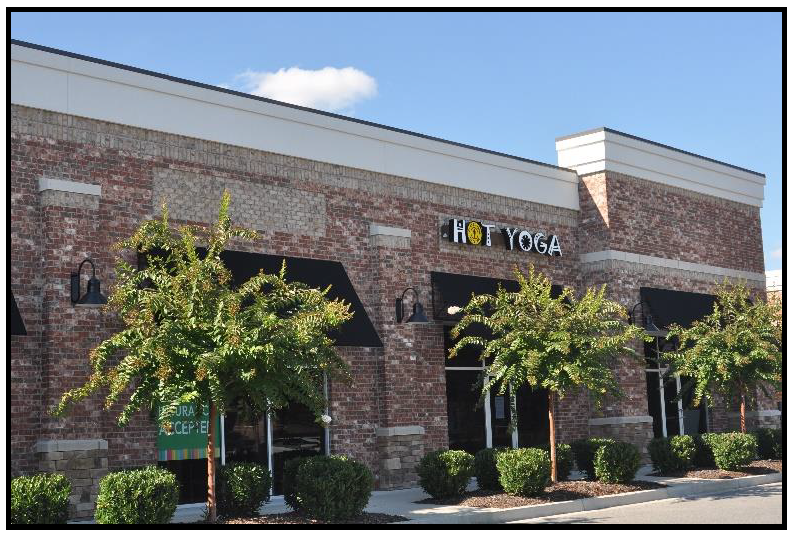
Any wall surface over 40 feet in length should include at least one change in plane.
C.
Larger buildings shall be divided into bays of 25- to 40-foot widths.
D.
Bays can be articulated by a combination of pilasters, piers, differentiation in material, texture, color, or by variation in the wall plane. Pilasters shall project a minimum of four inches. The addition of porches or covered walkways can also be used to articulate facades.
2.
Vertical façade articulation-horizontal bands to break verticality. All buildings shall have a clearly identifiable articulated base, middle and top, which contribute to the human scale of the building.
A.
An articulated base may be defined by a water table, a change in wall plane, or a change in material, texture, or color. For multi-story buildings, a base may be one story tall, defined by a storefront, a cornice or a change in materials.
B.
The middle of a building typically consists of a pattern of upper-story windows or may include recessed panels or other decorative features.
C.
An articulated top could be a roof cornice or a sloped roof with overhanging eaves and could feature brackets or other decorative architectural details.
D.
Stage-set facades, with parapets only on the front, do not meet the intent of these guidelines. Parapets, when used, should be located on all sides of buildings.
E.
When designing the façade, give careful consideration to locating signage within sign bands.
(e)
Windows. The relationship of walls to windows as well as the number, size, and proportion of openings in a wall has an effect on how a building relates to a user. Aside from allowing natural ventilation and light, windows provide a great deal of design character and interest in a building.
1.
General guidelines.
A.
Façades of all buildings shall be proportionally divided using architectural elements including windows and entries in conjunction with porches, arcades, canopies, and awnings.
B.
Use a regular pattern of walls and windows. Maintain an overall pattern so that all of the floors seem part of a whole. Use special windows, window groupings, and a mixture of large and small windows to create a hierarchy of importance of a building, particularly around entrances.
C.
Use patterns of walls and windows which relate to more traditional building design in which there is a larger proportion of walls than windows in upper stories.
D.
Use a proportion of windows (vertical, horizontal, or square) which generally is consistent with the style and context of the building and with the rest of the development.
E.
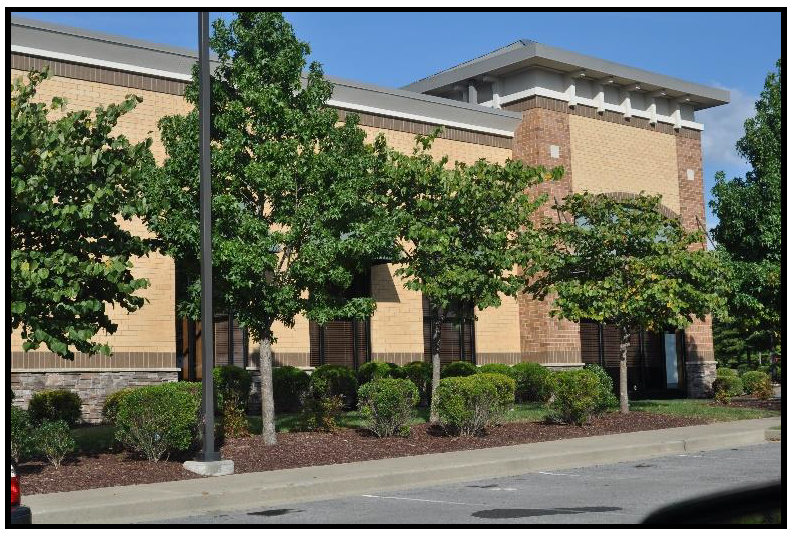
The fronts of commercial buildings facing a street should have display windows on the ground floor. At least 60 percent of the linear horizontal dimension should be covered with windows or doors. For upper stories, between 30 percent and 50 percent of the lineal horizontal dimension should be windows.
F.
For secondary elevations (sides) visible from streets and public areas, storefronts should wrap the corner but do not need to cover the full façade. Façade articulation should continue on these facades.
2.
Storefronts.
A.
Storefronts or large display windows should be used at the street level on the main façade and secondary elevations, especially on facades oriented to pedestrian areas, on all commercial buildings including large-scale, big-box developments.
B.
Quality natural materials such as brick, stone, or marble shall be used. Other materials can be reviewed on a case-by-case basis. Bronze or black aluminum storefronts are the most appropriate colors for storefronts in the majority of Millersville. However, muted earth tones or clear anodized (silver) aluminum storefronts may be appropriate on a case-by-case basis. Novelty colors or franchise colors which are not in keeping with the intent of these standards are prohibited for storefronts.
C.
Consider the use of a knee wall or bulkhead at the base of storefronts instead of carrying the glass through to the ground to give a more traditional look.
D.
Storefronts and display windows shall be designed as an integral part of the building's character and should reflect the architectural style of the building. Storefronts should vary in width for individual retail establishments and should have architectural interest.
(f)
Roofs. The design of a roof can have a significant impact on the character and scale of a building. While larger commercial projects may have roofs hidden behind parapet walls, small commercial buildings, office parks, and multifamily residential developments often have very visible roofs. The importance of roof materials depends on the form of the roof. Certain roof types result in highly visible roof materials.
1.
Roof form should complement the roof forms of neighboring developments to soften transitions between uses and intensities of uses.
2.
Use roof forms which complement the building design and contribute to a human scale. Avoid tall roof areas which overwhelm the height of the building's wall.
3.
Gabled, hipped, or other roof forms which relate to a residential, human scale are encouraged. Steeper forms are associated with more traditional design and are appropriate when the development adjoins a residential use. The use of parapets in these areas should be limited.
4.
Avoid a visible monolithic expanse of roof on large-scale buildings. Break the roof mass with elements such as gables, dormers, or parapets. Scale these features to the scale of the building. When breaking the roof mass, stage-front features which do not blend with other portions of the roof are not permitted.
5.
If a shed roof or flat roof design is used, a parapet wall shall be used on all sides of the building to screen the roof.
6.
Consider using a special roof feature at a gateway or a prominent corner or to highlight entry bays on larger structures.
7.
On roofs which are visible, use quality materials such as standing seam metal, architectural shingles, tile, or slate.
8.
Roof elements of entry features shall be integrated into the building design and shall be finished on all sides.
9.
Any equipment located on a roof shall be screened on all sides of the building including the rear, by architectural elements that are integral to the building such as parapet walls. Roof-mounted screen walls shall not be approved for this purpose. See section 90-124(11)(b).
10.
Roof top access shall be provided internally whenever possible. The utilization of external ladders should be avoided. Paint exterior ladders to match the colors of the wall against which they are located.
(g)
Awnings.
1.
For commercial buildings, awnings are an appropriate architectural detail which add a human scale and highlight a storefront. They provide shelter to pedestrians from the elements and they shield window displays and store interiors from bright sunlight. Although they should not serve as a building's primary architectural element, awnings are encouraged when a structure does not have a covered walk to shield displays and the entry and to add visual interest.
2.
Awnings should not be less than eight feet above the finished sidewalk and should not extend more than four feet from the building wall. Deviations from this requirement shall be reviewed on a case-by-case basis with the stipulation that the request conform to the overall requirements of the standards in relation to scale, color palette, and materials and that they are designed in such a manner consistent with the development and the surrounding development.
3.
Awnings should be broken up into small components, no wider than an articulated bay of the building, and preferably less wide.
4.
Mold- and fire-resistant fabric awnings are encouraged, as are metal. Plastic and vinyl are not permitted.
5.
The choice of colors should be coordinated as a part of an overall color scheme of the building and surrounding developments. Solid colors and stripes are appropriate.
6.
Awning forms may be angled or curved and should have closed ends.
7.
Backlit awnings are prohibited. Down-lighting, such as goose-neck lights, is permitted.
(h)
Canopies, carports, sheds, and similar structures. The architectural character and building elements standards contained in this section are applicable to canopies, carports, sheds, and similar open air commercial structures without walls, in commercial zones except for HC heavy commercial districts which are subject to section 90-174(5)(h) (canopies, carports, sheds, and similar structures). These include fuel center canopies, drive-in restaurant canopies, bank canopies, car wash vacuum cleaner canopies, solar panel canopies, and carports and similar structures. These standards vary depending on which side of the principal building(s) the structure is located.
1.
In front of the principal building(s) and any side of the building adjacent to a street, public or private:
A.
The roof support posts should be metal with brick or stone veneer the entire length of each post. The brick or stone should match any brick or stone on the principal building.
B.
The roof shall have a ceiling, or the roof framing, wiring, conduit and other electrical and mechanical components should be concealed from public view.
C.
Any fascia shall be EIFS, wood, fiber cement board or other approved trim and accent material listed in section 90-173(6)(b)2 (trim and accent materials).
2.
Beside the principal building and behind the front line of the principal building:
A.
The roof support posts should be metal with brick or stone veneer the entire length of each post. The brick or stone should match any brick or stone on the principal building.
B.
The roof structure (beams, fascia, rafters, and other framing members) may be metal. The metal shall be painted to match the principal building. A ceiling is not required.
C.
The posts and fascia may be powder-coated aluminum or vinyl coated.
D.
Visibility of the structures from a public street and surrounding properties shall be screened in accordance with section 90-144(11)(c) (outdoor storage areas).
3.
Behind the principal building:
A.
The roof support posts and roof support structure may be metal painted to match the principal building. A ceiling and screening is not required, or
B.
The posts and roof structure may be unpainted metal without a ceiling provided the structure is not visible from public streets or surrounding property. Screening conforming to section 90-144(11)(c) (outdoor storage areas) may be provided to block visibility.
(i)
Overhead doors for service bays and loading docks.
1.
As per section 90-142(12)(a)3, loading spaces shall not be located in front or corner side yards.
2.
Overhead doors for service bays shall not face a public street nor shall they be on the side of the building facing on-coming traffic. The planning commission may waive this standard provided extra landscaping and/or other means of screening is provided, which, in the opinion of the planning commission, adequately blocks the view of the doors/openings. Doors on other sides of the building shall likewise be properly screened. See section 90-144 (landscaping, screening, and tree preservation).
(7)
Supplemental design standards. Reserved.
(Ord. No. 20-744, 6-1-2020)
Sec. 90-174. - Industrial building design standards.
(1)
Applicability. This article applies to buildings and structures located within the industrial zoned area.
(2)
Design review approval required. Design review approval is required in accordance with section 90-47 (site plan and design review). Usually this approval is granted concurrent with site plan approval. Nevertheless, there are occasions when site plan approval of a project is not required, i.e., for renovations to buildings, yet design review is still required. Refer to section 90-47 (site plan and design review).
(3)
Massing and scale of building. Use variation in materials, textures, patterns, colors, and details to break down the mass and scale of the building. Use building articulation techniques to reduce a building's massing. Water tables, cornices, material changes and patterns, and fenestration can reduce the apparent height of a large building.
(4)
Orientation of buildings. Buildings shall be sited so that their main entrances face the street on which they are located. Buildings shall be oriented toward accessible arterial or collector streets rather than nearby limited access interstate or freeways. Building entrances should be designed to reflect their hierarchy within a building or development and should be articulated with architectural elements such as columns, pilaster, arches, or detail such as special moldings. Include entry features such as porches, canopies, or awnings.
(5)
Architectural character and building elements.
(a)
Character. The design theme for industrial parks should take on a campus appearance where roof forms, building height, materials and details such as windows all relate closely to one another, creating a unified appearance.
(b)
Building materials. Brick, stone, split face concrete block (integrally colored), drivet, stucco, and EIFS are approved as exterior building materials for the front of industrial buildings. On corner lots, both sides of the building facing a street are considered the front of the building. On all other sides facing a street, the above stated materials are approved, or, in lieu thereof, evergreen trees and shrubs may be planted so as to screen the view of these sides, as well as all other sides not facing a street, may be constructed of painted metal siding, painted concrete block (plain or split-faced) or painted concrete tilt-up walls.
(c)
Building color. Colors shall be compatible with adjacent conforming developments. Limit the number of colors. Generally, there will be a wall color, trim color, accent color, and roof color. All building elements should work within this palette. Use muted earth tone tints of colors such as browns, tans, grays, and greens. Avoid primary colors or bright accent colors and stark contrast colors. Use color variation to break up mass and provide visual interest.
(d)
Building façade. Larger buildings should be divided into bays of 50- to 75-foot widths. Bays may be articulated by the use of pilasters, piers, differentiation in material texture or color or by variation in the wall plane. The base of a building may be articulated/defined by a water table, a change in wall plane, or a change in material, texture, or color.
(e)
Windows. The front façades of all buildings shall be proportionally divided using architectural elements including windows and entries in conjunction with porches, canopies, and awnings.
(f)
Roofs. Roof forms should complement the roof forms of neighboring buildings. Use roof forms which complement the building design. On roofs which are visible, use quality materials such as standing seam metal. Any equipment located on the roof shall be screened from all sides of the building.
(g)
Garage doors and loading docks. Garage doors and loading docks must be properly screened from view from the street. See section 90-144 (landscaping, screening, and tree preservation).
(h)
Canopies, carports, sheds, and similar structures. The architectural character and building design standards contained in this article are applicable to canopies, carports, sheds, and similar open-air structures without walls, in I industrial and HC heavy commercial districts. These include solar panel canopies and carports. These standards vary depending on whether the structures are visible from the street or surrounding property.
1.
Structures in front or beside the principal building or otherwise visible from a public street:
A.
The roof support posts should be metal with brick or stone veneer the entire length of each post. The brick or stone should match any brick or stone on the principal building.
B.
The roof structure (beams, fascia, rafters, and other framing members) may be metal. The metal shall be painted to match the principal building. A ceiling is not required.
C.
The posts and fascia may be powder-coated aluminum or vinyl coated.
D.
Visibility of the structures from a public street and surrounding properties shall be screened in accordance with section 90-144(11)(c) (outdoor storage areas).
2.
Structures behind the building or otherwise not visible from a public street:
A.
The structure may be unpainted metal without a ceiling.
B.
These standards apply if the visibility of the structure from the public street is fully screened in accordance with section 90-144(11)(c) (outdoor storage areas).
(Ord. No. 20-744, 6-1-2020)
Sec. 90-175. - Municipal exemptions from design standards.
The following structures located upon city-owned property shall be exempt from design review under this article:
(1)
Dome air-supported structures (see article XVI, definitions).
(2)
Dome membrane-covered frame-supported structures (see article XVI, definitions).
(3)
Dome tensile membrane structures (see article XVI, definitions).
NOTE: This exemption creates the opportunity to cover more athletic fields and maximize the full use of city park properties.
(Ord. No. 20-744, 6-1-2020)

