
Millersville City Zoning Code
ARTICLE XV
WIRELESS TELECOMMUNICATIONS FACILITIES AND TOWERS
Sec. 90-241.- Findings.
The Communications Act of 1934, as amended by the Telecommunications Act of 1996, (the "Act") grants the Federal Communications Commission (FCC) exclusive jurisdiction over:
(1)
The regulation of the environmental effects of radio frequency (RF) emissions from Telecommunications Facilities, and
(2)
The regulation of radio signal interference among users of the RF spectrum.
The city's regulation of telecommunication facilities and towers in the city and adjoining planning jurisdiction will not have the effect of prohibiting any person from providing wireless telecommunications services in violation of the Act.
(Ord. No. 20-744, 6-1-2020)
Sec. 90-242. - Purposes.
The general purpose of this article is to regulate the placement, construction, and modification of telecommunications facilities and towers in order to protect the health, safety, and welfare of the public, while at the same time not unreasonably interfering with the development of the competitive wireless telecommunications marketplace in the jurisdictional area.
Specifically, the purposes of this article are:
(1)
To regulate the location of telecommunications facilities and towers in the city and adjoining planning jurisdiction;
(2)
To protect residential areas and land uses from potential adverse impact of telecommunications facilities and towers;
(3)
To minimize adverse visual impact of telecommunications facilities and towers through careful design, sitting, landscaping, and innovative camouflaging techniques;
(4)
To promote and encourage shared use/colocation of towers and antenna support structures as a primary option rather than construction of additional single-use towers;
(5)
To promote and encourage utilization of technological designs that will either eliminate or reduce the need for erection of new tower structures to support antenna and telecommunications facilities;
(6)
To avoid potential damage to property caused by telecommunications facilities and towers by ensuring such structures are soundly and carefully designed, constructed, modified, maintained, and removed when no longer used or are determined to be structurally unsound; and
(7)
To ensure that telecommunications facilities and towers are compatible with surrounding land uses.
(Ord. No. 20-744, 6-1-2020)
Sec. 90-243. - Special provisions for amateur radio stations.
Amateur radio stations (hams) licensed under FCC regulations shall be exempt from the general requirements of this article. However, amateur radio stations shall adhere to the following regulations:
(1)
No tower shall be placed within any required front, side, or rear setback area.
(2)
Towers shall be placed behind the rear building line of the principal structure on the lot if there is a principal structure on the lot.
(3)
All towers shall be properly grounded as per National Electric Code 810, Section C.
(4)
Amateur towers greater than 100 feet in height are subject to the following provisions:
(a)
At no time shall the fall radius of the tower include any habitable structure not owned by the amateur.
(b)
The applicant shall provide documentation of ownership, lease, or permanent easement rights for the entire fall radius of the tower.
(c)
The tower shall be equipped with guards or other devices to prevent it from being climbed without authorization of the amateur.
(d)
The applicant shall submit documentation to the codes department sufficient to show that all provisions of this article have been met.
(5)
Amateur towers located at a site other than the primary residence of a licensed Ham operator shall meet the requirements for setbacks, fencing, screening, and parking/access as detailed in this article. However, amateur towers without ground mounted equipment or buildings need only meet the requirements for access/parking and be designed so that they are not accessible to unauthorized climbing.
(6)
Temporary towers may be erected for a maximum of 48 hours for special events or emergencies upon approval by the codes department.
(7)
There shall be no more than one tower per lot.
(Ord. No. 20-744, 6-1-2020)
Sec. 90-244. - Development of towers.
(1)
No person shall build, erect, or construct a tower upon any parcel of land within any zoning district set forth above unless a conditional use permit, if required herein, has been granted by the Millersville Board of Zoning Appeals and a site plan is approved by planning commission, and a development permit shall have been issued by the city, all in accordance with the applicable provisions of the zoning ordinance.
(2)
A tower shall be a permitted use in the following zoning districts:
•
Industrial districts.
(3)
A tower shall be a conditional use in the following zoning districts:
•
Residential districts.
→
RR, ER, SR-1, SR-2, and MFR residential districts on publicly owned property and property whose principle use is a church and subject to the special provisions of section 90-259 (special conditions for location of telecommunication facilities within residential districts).
•
Commercial districts.
→
General commercial districts.
→
Heavy commercial districts.
(4)
Towers are exempt from all the maximum height restrictions of the zoning districts where located. Towers shall be permitted to a height of 150 feet. Towers may be permitted in excess of 150 feet in accordance with section 90-257 (criteria for site plan modifications).
(5)
No new tower shall be built, constructed, or erected in the city or its adjoining planning region unless such tower is capable of supporting two other person's operating telecommunications facilities comparable in weight, size, and surface area to the telecommunications facilities to be installed by the applicant on the tower within six months of the completion of the tower construction.
(Ord. No. 20-744, 6-1-2020)
Sec. 90-245. - Application.
An application to develop a telecommunications tower containing the information indicated within this article shall be required of all such proposed facilities. The city may require an applicant to supplement any information that it considers inadequate or that the applicant has failed to supply. The city may deny an application on the basis that the applicant has not satisfactorily supplied the information required in this subsection. Applications shall be reviewed by the city in a prompt manner. All decisions shall be supported in writing, setting forth the reasons for approval or denial.
As a minimum, an application to develop a tower shall include:
(1)
The name, address, and telephone number of the owner and lessee of the parcel of land upon which the tower is situated.
(2)
The legal description, map parcel number, and address of the parcel of land upon which tower is situated.
(3)
The names, addresses, and telephone numbers of all owners of all other towers or usable antenna support structures within a one-mile radius of the proposed new tower site, including city-owned property.
(4)
A description of the design plan proposed by the applicant in the city. The applicant must identify its utilization of the most recent technological design, including microcell design, as part of the design plan. The applicant must demonstrate the need for towers and establish why design alternatives, such as the use of microcell, cannot be utilized to accomplish the provision of the applicant's telecommunication services.
(5)
An affidavit attesting to the fact that applicant made diligent, but unsuccessful, efforts to install or collocate the applicant's telecommunications facilities on city-owned towers or usable antenna support structures (including water tanks) located within a one-mile radius of the proposed tower site.
(6)
An affidavit accompanied by written technical evidence from an engineer(s) attesting to the fact that the applicant made diligent, but unsuccessful, efforts to install or collocate the applicant's telecommunications facilities on towers of usable antenna support structures owned by other persons located within one-mile radius of the proposed tower site.
(7)
A written statement from an engineer(s) that the construction and placement of the tower will not interfere with public safety communications and the usual and customary transmission or reception of radio, television, or other communications services enjoyed by adjacent residential and nonresidential properties.
(8)
Written, technical evidence from an engineer(s) that the proposed structure meets the standards set forth in chapter 90-247 (structural requirements), of this article.
(9)
Written, technical evidence from qualified engineer(s) acceptable to the fire marshal and the building official that the proposed site of the tower or telecommunications facilities does not pose a risk of explosion, fire, or other danger to life or property due to its proximity to volatile, flammable, explosive, or hazardous materials such as LP gas, propane, gasoline, natural gas, or corrosive or other dangerous chemicals.
(10)
In order to assist city staff and the planning commission in evaluating visual impact, the applicant shall submit color photo simulations showing the proposed site of the tower with a photo-realistic representation of the proposed tower as it would appear viewed from the closest residential property and from adjacent roadways.
(11)
The Act gives the FCC sole jurisdiction of the field of regulation of rf emissions and does not allow the city to condition or deny on the basis of RF impacts the approval of any telecommunication facilities which meet FCC standards. In order to provide information to its citizens, the city shall make available upon request copies of ongoing FCC information and RF emission standards for telecommunications facilities transmitting from towers or antenna support structures. Applicants shall be required to submit information on the proposed power density of their proposed telecommunications facilities and demonstrate how this meets FCC standards.
(12)
Antennas or towers for municipal services (not including cell towers) located on property owned, leased, or otherwise controlled by a government entity (municipality) shall be exempt from the requirements of this article, provided a license or lease authorizing such antennas for the governing authority on an approved tower. The antenna and tower and associated authorizing license or lease shall be approved by the Millersville City Commission.
(Ord. No. 20-744, 6-1-2020)
Sec. 90-246. - Setbacks.
(1)
All towers up to 100 feet in height shall be set back on all sides a distance equal to the underlying setback requirement in the applicable zoning district. Towers in excess of 100 feet in height shall be set back one additional foot per each foot of tower height in excess of 100 feet.
(2)
Setback requirements for towers shall be measured from the base of the tower to the property line of the parcel of land on which it is located.
(3)
Setback requirements may be modified, as provided in section 90-247 (criteria for site plan development modifications) when placement of a tower in a location that will reduce the visual impact can be accomplished. For example, adjacent to trees which may visually hide the tower.
(4)
Towers located in any zone other than residential shall be setback from all residentially zoned property a minimum of 200 feet.
(5)
Setback of towers located in residential zones shall be at least 200 feet from all property lines.
(Ord. No. 20-744, 6-1-2020)
Sec. 90-247. - Structural requirements.
All towers must be designed and certified by an engineer to be structurally sound and as a minimum in conformance with the adopted building code and any other standards outlined in this article. All towers in operation shall be fixed to land.
(Ord. No. 20-744, 6-1-2020)
Sec. 90-248. - Separation of towers.
For the purpose of this article, the separation distances between towers shall be measured by following a straight line between the base on the existing or approved structure and the proposed base, pursuant to a site plan of the proposed tower. The minimum tower separation distances from residentially zoned land and from other towers shall be calculated and applied irrespective of city jurisdiction boundaries.
Proposed towers must meet the following minimum separation requirements from existing towers or towers which have a development permit but are not yet constructed at the time a development permit is granted pursuant to this article.
Tower structures shall be separated from all other towers by a minimum of 1,500 feet.
(Ord. No. 20-744, 6-1-2020)
Sec. 90-249. - Method of determining tower height.
Measurement of tower height for the purpose of determining compliance with all requirements of this article shall include the tower structure itself, the base pad, and any other telecommunications facilities attached thereto which extend more than 20 feet over the top of the tower structure itself. Tower height shall be measured from grade.
(Ord. No. 20-744, 6-1-2020)
Sec. 90-250. - Illumination.
Towers shall not be artificially lighted except as required by the Federal Aviation Administration (FAA). Upon commencement of construction of a tower, in cases where there are residential uses located within a distance which is 300 percent of the height of the tower from the tower and when required by federal law, dual mode lighting shall be requested from the FAA.
(Ord. No. 20-744, 6-1-2020)
Sec. 90-251. - Exterior finish.
Towers not requiring FAA painting or marking shall have an exterior finish that enhances compatibility with the natural environment.
(Ord. No. 20-744, 6-1-2020)
Sec. 90-252. - Landscaping and screening.
All landscaping on a parcel of land containing towers, antenna support structures, or telecommunications facilities shall be in accordance with the applicable landscaping requirements in the zoning district where such facilities are located. In order to enhance compatibility with adjacent land uses, the city may require landscaping in excess of the requirements in the zoning ordinance.
At a minimum, there shall be provided and maintained a continuous, solid, evergreen screen around the perimeter of the tower enclosure, except for the entry gate. The entry gate and its support structures shall be constructed as to be 100 percent opaque. The planting bed for the evergreen screen shall be a minimum of eight feet in width and the plantings shall be a minimum of six feet in height at the time of planting.
(Ord. No. 20-744, 6-1-2020)
Sec. 90-253. - Telecommunications facilities on antenna support structures.
Any telecommunications facilities which are not attached to a tower may be permitted on any antenna support structure at least 50 feet tall, regardless of the zoning restrictions applicable to the zoning district where the structure is located.
Telecommunications facilities are prohibited on all other structures. The owner of such structure shall, by written certification to the zoning administrator, establish the following at the time plans are submitted for a building permit.
(1)
That the height from grade of the telecommunications facilities shall not exceed the height from grad of the antenna support structure by more than 20 feet.
(2)
That any telecommunications facilities and their appurtenances, located above the primary roof of an antenna support structure, are set back one foot from the edge of the primary roof for each one foot in height above the primary roof of the telecommunications facilities. This setback requirement shall not apply to telecommunications facilities and their appurtenances, located above the primary roof of an antenna support structure, if such facilities are appropriately screened from view through the use of panels, walls, fences, or other screening techniques approved by the city. Setback requirements shall not apply to stealth antennas which are mounted to the exterior of antenna support structures below the primary roof, but which do not protrude more than 18 inches from the side of such an antenna support structure.
(Ord. No. 20-744, 6-1-2020)
Sec. 90-254. - Modification of towers.
A tower existing prior to the effective date of this article, which was in compliance with the city's zoning regulations immediately prior to the effective date of this article, may continue in existence as a nonconforming structure. Such nonconforming structures may be modified or demolished and rebuilt without complying with any of the additional requirements of this article, except for section 90-248 (separations of towers); 90-252 (landscaping and screening); 90-255 (certification and inspections); and 90-256 (maintenance) provided:
(1)
The tower is being modified or demolished and rebuilt for the sole purpose of accommodating additional telecommunications facilities comparable in weight, size, and surface area to the discrete operating telecommunications facilities of any person currently installed on the tower.
(2)
An application for a development permit is made pursuant to this article allowing the modification or demolition and rebuild of an existing nonconforming tower. The grant of a permit made pursuant to this article shall not be considered a determination that the modified or demolished and rebuilt tower is conforming.
(3)
The height of the modified or rebuilt tower and telecommunications facilities attached, thereto, do not exceed the maximum height allowed in this article.
This provision shall not be interpreted to legalize any structure or use existing at the time this article is adopted which structure or use is in violation of the ordinance prior to enactment of this article.
(Ord. No. 20-744, 6-1-2020)
Sec. 90-255. - Certifications and inspections.
(1)
All towers shall be certified by an engineer to be structurally sound and in conformance with the requirements of the standards set forth by the city's building code and federal and state law. For new monopole towers, such certification shall be submitted with an application pursuant to section 90-245 (application), and every five years, thereafter. For existing monopole towers, certifications shall be submitted within 60 days of the effective date of this article and then every five years, thereafter. For existing lattice or guyed towers, certification shall be submitted within 60 days of the effective date of this article and then every two years, thereafter. The tower owner may be required by the city to submit more frequent certifications should there be a reason to believe that the structural and electrical integrity of the tower is jeopardized.
(2)
The city or its agents shall have authority to enter onto the property upon which a tower is located, between the inspection and certification required above, to inspect the tower for the purpose of determining whether it complies with the building code and all other construction standards provided by the city Code and federal and state law. The city reserves the right to conduct such inspections at any time, upon reasonable notice to the tower owner.
(Ord. No. 20-744, 6-1-2020)
Sec. 90-256. - Maintenance.
(1)
Tower owners shall at all times employ ordinary and reasonable care and shall install and maintain in use nothing less than commonly accepted methods and devices for preventing failures and accidents which are likely to cause damage, injures, or nuisances to the public.
(2)
Tower owners shall install and maintain towers, telecommunication facilities, wires, cables, fixtures, and other equipment in substantial compliance with the requirements of the National Electric Safety Code and all FCC, state, and local regulations, and in such manner that will not interfere with the use of other property.
(3)
All towers, telecommunication facilities, and antenna support structures shall at all times be kept and maintained in good condition, order, and repair so that the same shall not menace or endanger the life or property of any person.
(4)
All maintenance or construction of towers, telecommunication facilities, or antenna support structures shall be performed by licensed maintenance and construction personnel.
(5)
All towers shall maintain compliance with current RF emission standards of the FCC.
(6)
In the event that the use of a tower is discontinued by the tower owner, the tower owner shall provide written notice to the city of its intent to discontinue use and the date when the use shall be discontinued.
(Ord. No. 20-744, 6-1-2020)
Sec. 90-257. - Criteria for site plan development modifications.
(1)
Notwithstanding the tower requirements provided in this article, a modification to the requirements may be approved by the planning commission in accordance with the following:
(a)
In addition to the requirements for a tower, application for modification shall include the following:
1.
A description of how the plan addresses any adverse impact that might occur as a result of approving the modification.
2.
A description of off-site or on-site factors that mitigate any adverse impacts that might occur as a result of the modification.
3.
A technical study that documents and supports the criteria submitted by the applicant upon which the request for modification is based. The technical study shall be certified by an engineer and shall document the existence of the facts related to the proposed modifications and its relationship to surrounding rights-of-way and properties.
4.
For a modification of the setback requirement, the application shall identify all parcels of land where the proposed tower could be located, attempts by the applicant to contract and negotiate an agreement for colocation, and the result of such attempts.
5.
The planning commission may require the application to be reviewed by an independent engineer under contract to the city to determine whether the antenna study supports the basis for the modification requested. The cost of review shall be reimbursed to the city by the applicant.
(b)
The planning commission shall consider the application for modification based on the following criteria:
1.
That the tower as modified will be compatible with and not adversely impact the character and integrity of surrounding properties.
2.
Off-site or on-site conditions exist which mitigate the adverse impacts, if any, created by the modification.
3.
In addition, the planning commission may include conditions on the site where the tower is to be located if such conditions are necessary to preserve the character and integrity of the neighborhoods affected by the proposed tower and mitigate any adverse impacts which arise in connection with the approval of the modification.
(2)
In addition to the requirements of subparagraph 90-257(1) of this article, in the following cases, the applicant must also demonstrate, with written evidence, the following:
(a)
In the case of a requested modification to the setback requirement established in section 20-246 (setbacks), that the setback requirement cannot be met on the parcel of land upon which the tower is proposed to be located and the alternative for the person is to locate the tower at another site which is closer in proximity to a residentially zoned land.
(b)
In the case of a request for modification to the separation and buffer requirements from other towers of section 90-248 (separation of towers) or section 90-252 (landscaping and screening), that the proposed site is standards for separation from residentially zoned lands as provided for in section 90-246 (setbacks).
(c)
In the case of a request for modification of the separation and buffer requirements from residentially zoned land of section 90-246 (setbacks) and 90-252 (landscaping and screening), if the person provides written technical evidence from an engineer(s) that the proposed tower and telecommunications facilities must be located at the proposed site in order to meet the coverage requirements of the applicant's wireless communications system and if the person is willing to create approved landscaping and other buffers to screen the tower from being visible to residentially zoned property.
(3)
In the case of a request for modification of the height limit for towers and telecommunications facilities or to the minimum height requirements for antenna support structures that the modification is necessary to:
(a)
In the case of a request for modification of the height limit for towers and telecommunication facilities or to the minimum height requirements for antenna support structures that the modification is necessary to:
1.
Facilitate colocation of telecommunications facilities in order to avoid construction of a new tower; or
2.
To meet the coverage requirements of the applicant's wireless communication system, which requirements must be documented with written, technical evidence from an engineer(s) that demonstrates that the height of the proposed tower is the minimum height required to function satisfactorily, and no tower that is taller than such minimum height shall be approved.
(Ord. No. 20-744, 6-1-2020)
Sec. 90-258. - Abandonment.
(1)
If any tower shall cease to be used for a period of 365 consecutive days, the planning department shall notify the owner, with a copy to the applicant, that the site has been abandoned. The owner shall have 30 days from receipt of said notice to show, by a preponderance of the evidence, that the tower has been in use or under repair during the period. If the owner fails to show that the tower has been in use or under repair during the period, the planning department shall issue a final determination of abandonment for the site. Upon issuance of the final determination of abandonment, the owner shall, within 75 days, dismantle and remove the tower.
(2)
To secure the obligation set forth in this article, the applicant and/or Owner shall post a surety. Such amount shall be determined by the planning department based on the anticipated cost of the removal of the tower.
(Ord. No. 20-744, 6-1-2020)
Sec. 90-259. - Special conditions for location of telecommunication facilities within residential districts.
The provisions of this article shall apply to the location and expansion of telecommunications facilities within any residential zoning district.
(1)
Property allowed. Towers in residential districts shall be limited to publicly owned property and property whose principal use is a church, and only if the Millersville Board of Zoning Appeals shall have issued a conditional use permit in accordance with the provisions of this article.
(2)
Location and co-location. Antennas shall be located on lawfully pre-existing towers or antenna support structures or other lawfully pre-existing buildings or structures whenever possible. No conditional use permit authorizing construction of a new antenna support structure or addition to or expansion of an existing building or structure shall be authorized within any residential district unless the applicant is able to demonstrate that no lawfully pre-existing building or structure is available, on commercially reasonable terms, and sufficient for the location of an antenna necessary for the provision of personal wireless services.
(3)
Tower design. Every new tower located within any residential zoning district shall:
(a)
Not be illuminated unless otherwise required by federal law or regulations; and
(b)
Be at least 1,500 feet from any other structure.
(4)
Protection against climbing. Every tower shall be protected against unauthorized climbing.
(5)
Color. Every tower shall be of neutral colors that is harmonious with, and which blends with the natural features, buildings, and structures that surround such tower.
(6)
Equipment enclosure. All electronic and other related equipment and appurtenances necessary for operation of any personal wireless services antenna shall, whenever possible be located within a lawfully pre-existing building or structure or be located entirely below grade. When a new structure is required to house such equipment any portion of such structure above grade shall have brick exterior and a shingled, pitched roof.
(Ord. No. 20-744, 6-1-2020)
Sec. 90-260. - Small cell wireless facilities.
The deployment of small cell facilities within existing buildings or on top of existing buildings where the facilities will be completely screened from view of adjacent streets without modification to the building shall not require site plan review.
The deployment of small cell facilities within existing buildings or on top of existing buildings where screening of small cell equipment will require modification to the building shall proceed only in accordance with section 90-173(6)(f)9 (architectural character and building elements).
The deployment of small cell facilities within public right-of-way is not subject to this article.
(1)
General design and construction standards.
(a)
Collocation on a potential support structure (PSS) is encouraged whenever possible.
(b)
Antennas on existing or replaced ps: the antenna(s) associated with installation on existing or replaced PSS must have concealed cable connections, antenna mount, and other hardware. An antenna must be able to fit within an enclosure of no more than six cubic feet in volume.
1.
Pole top cannister. Preferred antennas shall be cannister type mounted to the top of pole; shrouding shall be used to conceal cable connections and transition to the pole, creating an aesthetic uniform look. Pole top cannisters shall not exceed 18 inches in diameter and 36 inches in height. Under no circumstances shall antenna volume exceed six cubic feet.
2.
Panel. Not preferred but where necessary: panel antennas may be approved at the sole discretion of the city. Panel antennas shall either be cylindrical in shape or shrouded in a common cylinder or three-sided banner to conceal connections and cabling. Panel antennas shall not measurably interfere with street or sidewalk lighting.
Panel antennas shall be mounted as close to the pole as possible to minimize visual impact. Panel antennas shall not exceed 24 inches in height and 15 inches in width and 12 inches in depth. Under no circumstances shall antenna volume exceed six cubic feet.
3.
Height limits. A new or existing PSS shall not exceed the height limitations imposed by this article for the type of structure to which the small cell facility is attached, except the light poles may extend to 30 feet in height to accommodate small cell facilities.
4.
Equipment mounted on existing or replaced PSS. All equipment mounted on a PSS must be installed as flush to the pole as possible. All pole mounted equipment shall be located as close together and if possible, on the same side of the pole. Standard color for all equipment shall be black or shall match the color of the pole to where it is attached. Equipment such as transformers, insulators, disconnects, and cables used for electrical distribution shall be mounted and located in accordance with electrical utility standards.
5.
Pole-mounted equipment shrouds. When pole-mounted equipment is either permitted or required, all equipment other than the antenna(s), electric meter, and disconnect switch must be concealed within an equipment shroud. Equipment shrouds may not exceed more than 24 inches from the face of the pole. The equipment should be non-reflective and be colored black or painted to match the existing pole. Equipment shrouds should be mounted flush to the pole. All pole-mounted equipment must be installed as flush to the pole as possible. Any standoff mount for the equipment shroud may not exceed four inches. Shroud or shroud material should be weather resistant such that rust or other side of visible oxidation should not occur.
6.
Ground-mounted equipment. New ground-mounted equipment is not permitted, unless the applicant shows clear and convincing evidence that the equipment cannot be feasibly installed.
A.
As a pole-mounted installation,
B.
In an environmentally controlled underground vault, or
C.
Within an existing street feature (i.e.: bus stop shelter, bench, rubbish disposal bin) for a valid technical reason. Increased costs shall not be considered as valid evidence. If ground-mounted equipment is used, the applicant must conform to the following requirements:
(i)
Self-contained cabinet or shroud. The equipment shroud or cabinet must contain all the equipment associated with the facility other than specific equipment that by the nature of its technology is required to be above ground such as cameras, antennas, lighting, and traffic signaling. The equipment must be concealed from view, cables shall route internally through a tubular pole or concealed in conduit on a pole and run underground between the pole and the ground-mounted cabinet.
(ii)
Concealment. The ground-mounted equipment shall incorporate concealment elements into the proposed design to better align itself with surrounding aesthetic, architecture, similar structures, or public safety elements. Concealment may include, but shall not be limited to, strategic placement in less obtrusive locations, containment within a brick or stone enclosure, or placement within existing or replacement of street furniture.
7.
Utility lines and cabling. Distribution and service lines must be underground. For new or replacement metal poles, underground cables and wire must transition directly into the pole base without any external junction box. For existing PSS, cables and wires shall transition neatly into the pole, and transitions shall be shrouded or otherwise concealed. All construction techniques must comply with federal, state, and local laws and regulations, utility standards, industry standards, and inspection requirements.
8.
Electric meter. Site operators shall use the smallest and least intrusive electric meter available. Whenever permitted by the electric service provider, the electric meter base should be painted to match the PSS.
(2)
Pole/attachment guidelines.
(a)
Type 1: Attachment to existing PSS.
1.
Decorative pole with or without luminaire. All utility, wireline, or wireless service provider equipment shall be mounted behind a shroud. Only two shrouds, including the disconnect and antenna, shall be installed at each location. No ground-mounted equipment, including backup power supply, shall be allowed. The lighting design shall match the existing site lighting.
(b)
Type 2: Attachment to new PSS.
1.
Integrated PSS. In cases where it can be demonstrated that the existing PSS is insufficient, or other criteria dictate a new PSS or replacement of existing PSS to accommodate the wireless service provider equipment, the equipment, upper pole, luminaire, mast arm, luminaire if applicable, antenna enclosure, and all hardware and electrical equipment necessary for a complete assembly shall be integrated into a single pole. Mast arm and luminaire must be the same make and model as unit(s) being replaced. Pole shall be of similar aesthetic and architectural features (i.e., square, round, fluted) as of the PSS being replaced.
2.
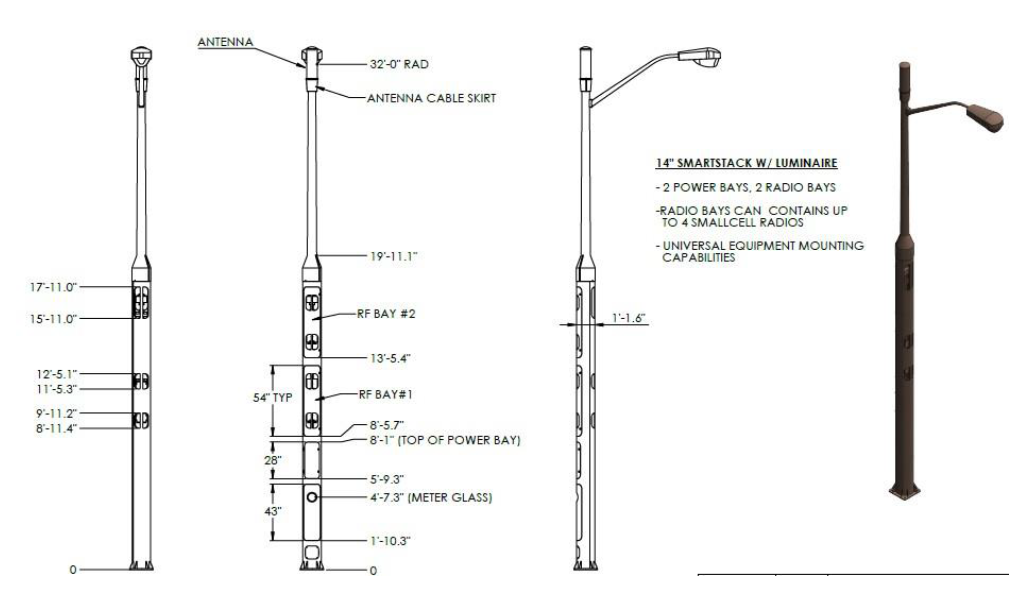
Integrated PSS with luminaire. A Type 2 integrated PSS with luminaire should only be located where an existing PSS can be removed and replaced, or at a new location where it has been identified that a light is necessary. In no case shall these poles exceed 14 inches in diameter.
Figure 7: Schematic of Integrated Lighting Pole Design
EXAMPLE 1: Collocations on existing street light or metal utility pole:
In most cases for safety, structural, and serviceability reasons, an existing metal pole will likely be replaced with one that as close as possible matches the original it replaces. However, in some cases, the foundation and construction of an existing pole is sufficient to allow for collocated equipment. In those cases, equipment shrouds shall be utilized on small cell installations on existing PSS. Top mounting of antennas or antenna canisters are desired for the first installation on an existing streetlight or metal utility pole.
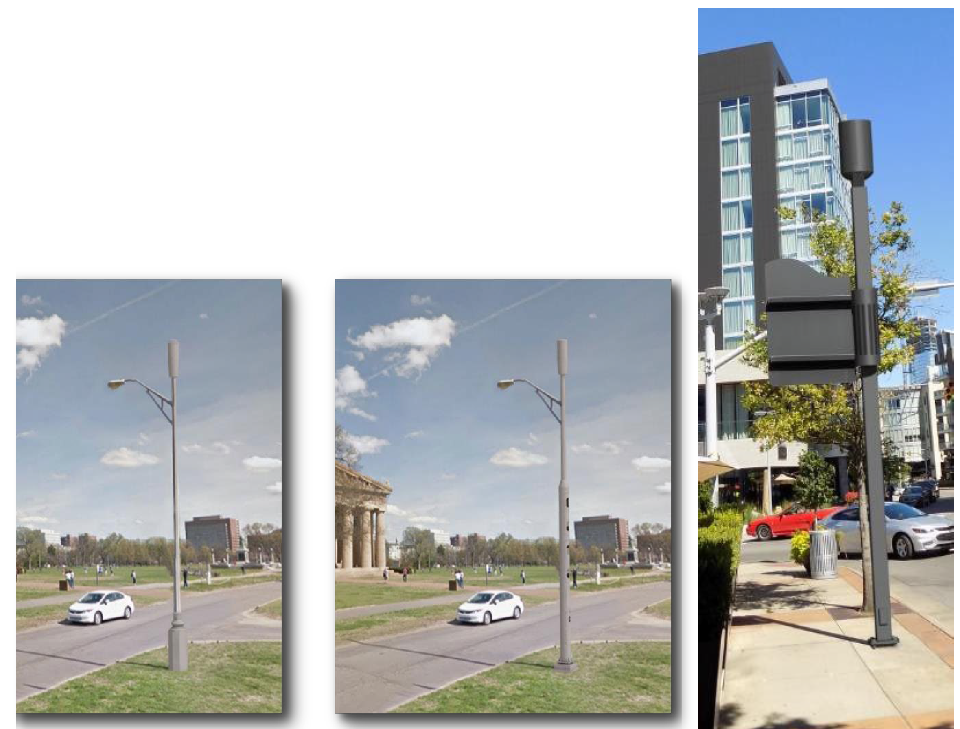
EXAMPLE 2: Existing pole replacement:
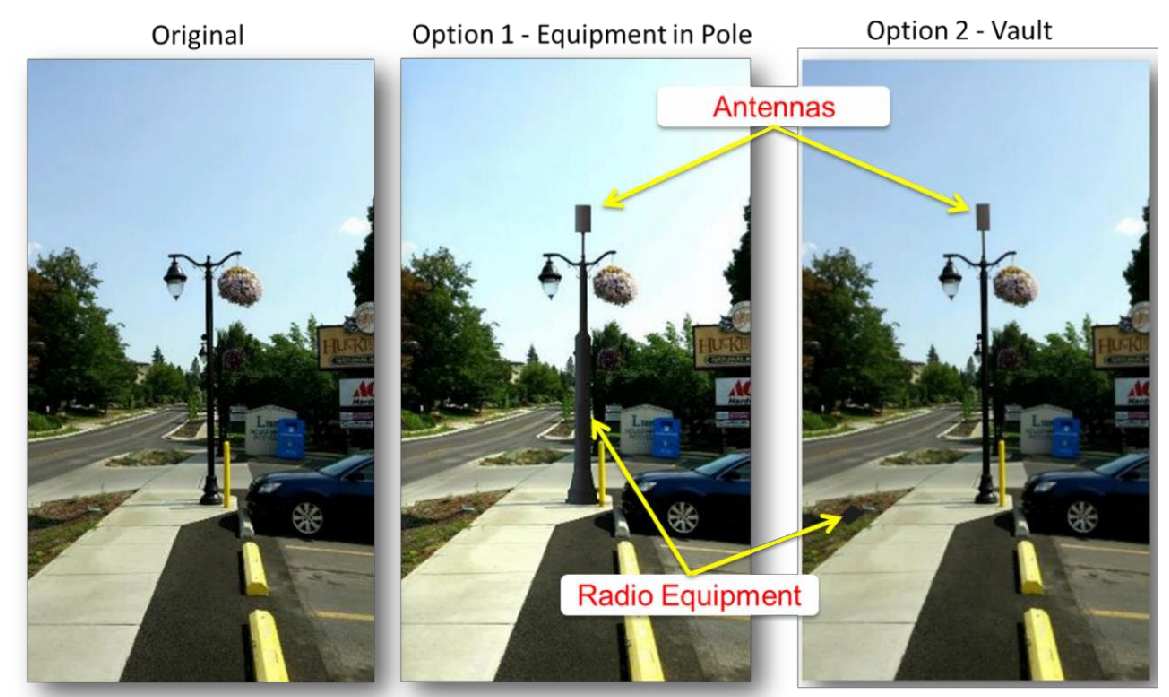
Existing poles, including light poles, may be replaced with a pole of compatible style when and where applicable. Applicants are encouraged to work with the property owner and City of Millersville staff to design and develop a pole that will be able to internally house the required antenna(s) and electronics, which shall be integrated into the design the replacement pole. If the newly designed pole cannot accommodate the electronic equipment internally, an underground vault or a caged equipment configuration shall be utilized.
(c)
Definitions.
Potential support structure ("PSS") means a pole or other structure used for wireline communications, electric distribution, lighting, traffic control, signage, or a similar function, including poles installed solely for collocation of a small wireless facility. When PSS is modified by the term: "new", then "new PSS" means a PSS that does not exist at the time the application if submitted, including, but not limited to, a PSS that will replace an existing pole. The fact that a structure is a PSS does not alone authorize an applicant to collocated on, modify, or replace the PSS until an application is approved and all requirements are satisfied pursuant to this article.
Small wireless facility means a wireless facility with:
•
An antenna that can fit within an enclosure of no more than six cubic feet in volume; and
•
Other wireless equipment in addition to the antenna that is cumulatively no more than 28 cubic feet in volume, regardless of whether the facility is ground-mounted or pole-mounted. Other wireless equipment does not include an electric meter, concealment element, telecommunications demarcation box, grounding equipment, power transfer switch, cut-off switch, or a vertical cable run for the connection of power and other services; and
•
Includes a micro wireless facility.
(Ord. No. 20-744, 6-1-2020)

