
Millersville City Zoning Code
ARTICLE XIII
SIGN STANDARDS
Sec. 90-191.- Purpose.
The purposes of these sign standards are to:
(1)
Encourage the effective use of signs as a means of communication for businesses, organizations, and individuals in the city.
(2)
Provide a means of wayfinding in the community thereby reducing traffic confusion and congestion and improving pedestrian and traffic flow.
(3)
Maintain and enhance the pleasing look of the city.
(4)
Preserve the city as a community that is attractive to business.
(5)
Differentiate in the restriction of signs that may distract drivers in active traffic and those signs that may provide information to drivers while they remain in their cars by out of active traffic.
(6)
Minimize the possible adverse effects of signs on nearby public and private property while protecting First Amendment free speech rights.
(7)
Implements the City of Millersville Land Use Plan.
(Ord. No. 20-744, 6-1-2020)
Sec. 90-192. - General terms.
(1)
Applicability. A sign may be erected, placed, established, painted, created, or maintained on private property in Millersville only in conformance with the standards, procedures, exemptions, and other requirements of this article. This article also applies to signs held or supported by a person.
(2)
Effect. The effect of this article is to:
A.
Establish a permit system to allow a variety of types of signs in commercial and industrial zones and a limited variety of signs in residential zones, subject to the standards and the permit procedures of this article.
B.
Allow certain signs that are small, unobtrusive, and incidental to the principal use of the respective lots on which they are located, subject to the substantive requirements of this article, but without a requirement for permits.
C.
Provide for temporary signs in limited circumstances.
D.
Prohibit all signs not expressly permitted by this article.
E.
Provide for the enforcement of the provisions of this article.
(3)
Exempt from sign regulation. The following signs shall be exempt from regulation under this article:
(a)
Any public notice or warning required by a valid and applicable federal, state, or local law, regulation, or ordinance.
(b)
Traffic control signs such as stop, yield, and similar signs, the faces of which meet the Department of Transportation standards and which contain no commercial message of any sort.
(c)
Any sign not legible from a street (public or private). This includes drive-in and drive-through menu board signs and signs within buildings, including signs at least ten feet back from window.
(d)
Works of art, not including wall murals, that do not include or are otherwise associated with a commercial message, brand, service, or product. (See section 90-200 for wall mural approval process.)
(e)
Any sign that is placed upon City of Millersville owned property at the direction of the City of Millersville. No sign shall be placed any closer to the edge of pavement (public or private) than 12 feet or in such a location which blocks visibility of motorists.
(f)
Any special event signage that is placed on any property within the city that is directly associated with a city sponsored event (city sponsored event shall equate to an event that has a successfully passed resolution from the Millersville City Commission). No sign shall be placed any closer to the edge of pavement (public or private) than 12 feet or in such a location which blocks visibility of motorists.
(4)
Transitional provisions.
(a)
Existing signs. All signs legally erected prior to the effective date of this article are considered legal by this article and may remain in place and in use, subject to certain restrictions on modification, replacement, and other actions affecting the sign, as set forth in this article.
(b)
Existing permits. All holders of permits for signs issued legally prior to the effective date of this article may erect the signs which are the subject of such permits within the times allowed by such permits, and such signs shall then be treated as though they had been erected prior to the effective date of this article. However, such permits may not be extended or amended unless the sign which is the subject of such permit will conform to all the requirements of this article.
(c)
Existing violations. All violations of the sign regulations repealed by this article shall remain violations of the ordinances of the City of Millersville and all penalties and enforcement remedies set forth hereunder shall be available to the City of Millersville as though the violation were a violation of this article. However, if the effect of this article is to make a sign that was formerly nonconforming become conforming, then enforcement action shall cease except to the extent of collecting penalties (other than removal of the sign) for violations that occurred prior to the effective date of this article.
(5)
Permits required. See section 90-51 (sign permit).
(6)
Computations.
(a)
Computation of sign area of individual signs. The area of a sign face (which is also the sign area of a wall sign or other sign with only one face) shall be computed by means of the smallest square, circle, rectangle, triangle, or combination thereof that will encompass the extreme limits of the writing, representation, emblem, or other display, together with any material or color forming an integral part of the background of the display or used to differentiate the sign from the backdrop or structure against which it is placed, but not including any supporting framework, bracing, or decorative fence or wall when such fence or wall otherwise meets the regulations of the ordinances of the City of Millersville and is clearly incidental to the display itself.
(b)
Computation of area of multifaced signs. Where the sign faces of a double-faced sign are parallel or the interior angle formed by the faces is 60 degrees or less, only one display face shall be measured in computing sign area. If the two faces of a double-faced sign are of unequal area, the area of the sign shall be the area of the larger sign. In all other cases, the areas of all faces of a multifaced sign shall be added together to compute the area of the sign.
(c)
Computation of height. The height of a sign shall be computed as the distance from the base of the sign at a computed grade to the top of the highest attached component of the sign. The computed grade shall be the elevation of the nearest point of the crown of a public street or the grade of the land at the principal entrance to the principal structure on the zone lot.
(7)
No variances. Neither the board of zoning appeals nor any other administrative body shall have the power or authority to vary the express terms of this article, including, but not limited to, sign height or setback, the number of signs, the size of an individual sign, the total area of signs on a property, sign lighting, or other characteristics, or sign placement in relation to other signs.
(Ord. No. 20-744, 6-1-2020)
Sec. 90-193. - Permitted signs, location, and number.
(1)
Signs allowed on private property.
(a)
Types of signs permitted. Signs shall be allowed on private property in the City of Millersville in accordance with, and only in accordance with, Table 18 (permitted signs). If the letter "P" appears for a sign type in a column, such sign is allowed without prior permit approval in the zoning district(s) represented by that column. If the letter "S" appears for a sign type in a column, such sign is allowed only with prior permit approval in the zoning district(s) represented by that column.
(b)
Special conditions. Special conditions shall apply to certain types of signs. Those signs are identified with a paragraph number reference in the right-hand column of Table 18 (permitted signs), which number refers to a paragraph is section 90-193(2) (special conditions). A sign of such type shall be permitted only subject to the requirements of those supplemental regulations.
(c)
Number, dimensional, and locational limitations. Although permitted under the previous paragraph, a sign designated by an "S" or a "P" in Table 18 (permitted signs) shall be allowed only if:
1.
The size of any individual ground sign does not exceed the size given for individual sign area in Table 17 (number, dimension, and locations of individual signs) or, chapter 90-193(2) (special conditions), whichever is less.
2.
The height of any ground sign does not exceed the number given for height in Table 17 or section 90-193(2) (special conditions), whichever is less;
3.
Each ground sign shall be set back far enough away from the street to be off the right-of-way. Should Millersville Transportation Plan dictate a greater right-of-way width than exists, said greater right-of-way width shall apply. In no event shall any sign be placed any closer to the edge of the pavement (public or private) than 12 feet or in such a location which blocks visibility of motorists.
4.
The number of principal ground signs per zone lot shall not exceed the number one or the number resulting from the number permitted computation in Table 17 (number, dimensions, and locations of individual signs) or as specified in section 90-193(b) (special conditions).
5.
The area of wall sign(s) on an individual wall does not exceed the area in square feet listed in Table 17 for building signs or as specified in section 90-193(b) (special conditions), whichever is less.
(d)
Permitted characteristics. The characteristics of signs shall conform with the limitations of Table 18 (permitted sign characteristics), and with any additional limitations on characteristics listed in section 90-193(2) (special conditions). "S" in a column indicates that a characteristic is allowed on a wall sign or principal ground sign with a sign permit. Characteristics of other types of signs are limited by the conditions set forth in section 90-193(b) (special conditions).
NOTES:
1.
No more than 50 percent of the area of a principal ground sign may be manual changeable copy.
2.
No more than 80 percent of the area of a principal ground sign may be electronic/digital changeable copy if the following conditions are met:
A.
Sign must be at least 150 feet from the nearest existing residence.
B.
The message may change no more than one time per 15 minutes.
C.
The message transition must be instant and not fade between messages (minimal one sequence change interval).
D.
The illumination of the sign shall not exceed 3.0 foot-candles over ambient lighting conditions, day or night. Measurement shall be as prescribed in the document "Recommended Brightness Levels on On-Premises Electronic Message Centers" published by the International Sign Association. All LED signs shall be equipped with a sensor device that automatically determines the ambient illumination conditions. Maximum illumination from dusk to dawn shall not exceed 500 nits. A malfunctioning sign shall be programmed to shut down.
E.
The sign is not a nonconforming sign (nonconforming signs are not allowed to convert to electronic/digital changeable copy, unless the sign as an element of its nonconformity already has such electronic/digital changeable copy.
F.
Shall be of high-resolution quality (10 mm minimum). (Effective August 1, 2020).
3.
For institutional uses only. See section 90-193(2)(e).
4.
The source of the illumination, i.e. bulbs, neon or fluorescent tubes, LED tubes, strips, etc. shall be enclosed with a translucent surface, such as a plastic face.
5.
Changeable copy signs shall not be allowed on building signs, including canopy signs (see section 90-193(2)(n)).
6.
Some planned developments limit or prohibit internal illumination of ground signs.
7.
All R includes RR, ER, SR-1, SR-2, WR, and THR.
(2)
Special conditions by sign type. The following supplemental regulations apply to particular types of signs or to particular signs in particular circumstances. Where appropriate, the tables refer to the conditions set forth in these supplemental regulations by paragraph number within this article.
(a)
Awning sign. An awning sign shall not cover more than 30 percent of the awning, nor shall it exceed the size allowed for a wall sign. Awnings shall not have backlighting or internal illumination. Downlighting, i.e., goose-neck lights, is permitted. The size of awning signs in combination with wall signs shall not exceed the total area allowed for wall signs as specified by section 90-193(2)((k) (wall sign, commercial, and industrial).
(b)
Building marker. Building marker signs shall be permitted, subject to the following conditions:
1.
Shall not exceed six square feet in area.
2.
Shall contain no logo or commercial message.
3.
Shall be made of permanent material, such as bronze or masonry, and shall be permanently affixed to or made part of the building.
4.
Only one sign allowed per building.
(c)
Directory sign. Directory signs shall be permitted where a particular site includes more than one tenant or occupant, subject to the following conditions:
1.
In shopping centers. Directory signs in shopping centers may be located near entrances to parking areas, but at least 50 feet from any public right-of-way, and at principal intersections within the center, where such intersections are at least 50 feet from any public right-of-way. Such signs may contain logos or business names with arrows or other directional information.
2.
At multifamily projects, office buildings, or business parks. One directory sign may be located near the principal entrance to a parking area for multifamily projects, office buildings, or business parks, as shown on an approved master signage plan. Such sign shall be located away from any public right-of-way, so that drivers can conveniently pull up to and rear the directory without impeding traffic on any driveway or entrance serving the development. Such sign may contain an unlimited number of pieces of information, but letters shall not be more than three inches in height and shall not be legible from any public right-of-way. Such sign may not exceed 16 square feet in area and six feet in height.
(d)
Incidental signs. Incidental signs may carry any type of information except a commercial message that is visible from a position off the lot on which the sign is located. Typical incidental signs include restroom, phone, no parking, entrance, exit, and generic directions such as office, atm, or stores. No such sign shall exceed nine square feet in size.
(e)
Institutional signs.
1.
Residential ground signs in residential zoning districts, an institutional ground sign shall be permitted on the same site as any place of worship, educational facility, hospital, amenity centers, residential clubhouses, or other institution, which is a permitted use in that location, subject to the following:
A.
Shall not exceed four feet in height plus two feet of additional height for each additional five feet of setback beyond the minimum required setback up to a maximum height of eight feet.
B.
Shall not exceed 40 square feet in size.
C.
Up to 50 percent of the surface area on each side of the sign may be a changeable copy sign. Electronic message signs allowed only as per section 90-193(2)(e)1(iv) below.
D.
May be illuminated by external light only except that internal illumination shall be permitted under the following conditions:
(i)
The sign must be at least 150 feet from the nearest existing residence.
(ii)
Lights must be turned off no later than 10:00 p.m. and not turned back on until 7:00 a.m.
(iii)
All electronic messages shall be displayed as illuminated text against a black or non-illuminated background. Black or dark text against an illuminated or bright background is not permitted. Messages shall be text only and one color only. No pictures or anything except text.
(iv)
The illumination of the sign shall not exceed 0.3 foot-candles over ambient lighting conditions, day or night. Measurement shall be as prescribed in the document "Recommended Brightness Levels for On-Premises Electronic Message Centers" published by the International Sign Association. All LED signs shall be equipped with a sensor device that automatically determines the ambient illumination conditions. Maximum illumination from dusk to dawn shall not exceed 500 nits. A sleep mode shall be included in each sign and shall be programmed to comply with the time limitations of this article. A malfunctioning sign shall be programmed to shut down.
(v)
Shall be of high-quality resolution (10 mm minimum).
E.
Shall be a monument style sign.
2.
Residential wall signs. In residential zoning districts, an institutional wall sign shall be permitted on the same size as any place of worship, educational facility, hospital, amenity centers, residential clubhouses, or other institution, which is a permitted use in that location, subject to the following:
A.
Shall not exceed 40 square feet in size per wall.
B.
May be illuminated.
3.
Nonresidential signs. In nonresidential zoning districts, an institution may elect to erect the ground sign that would be permitted to a business in the same location, or it may elect to erect the institutional sign permitted under these provisions, but it may not erect or maintain both.
(f)
Flag. A display of flags shall be subject to the following limitations:
1.
There shall be no more than three flagpoles per principal building on any zone lot. The poles shall be installed in concrete at least three feet deep.
2.
There shall be no more than two flags per pole.
3.
No flag may contain a commercial message except that one of the three allowed flags may contain a commercial message in a nonresidential zone.
4.
No flagpole shall exceed 35 feet in height. Flagpoles on buildings shall not extend more than 15 feet above the highest point of the building or roof.
(g)
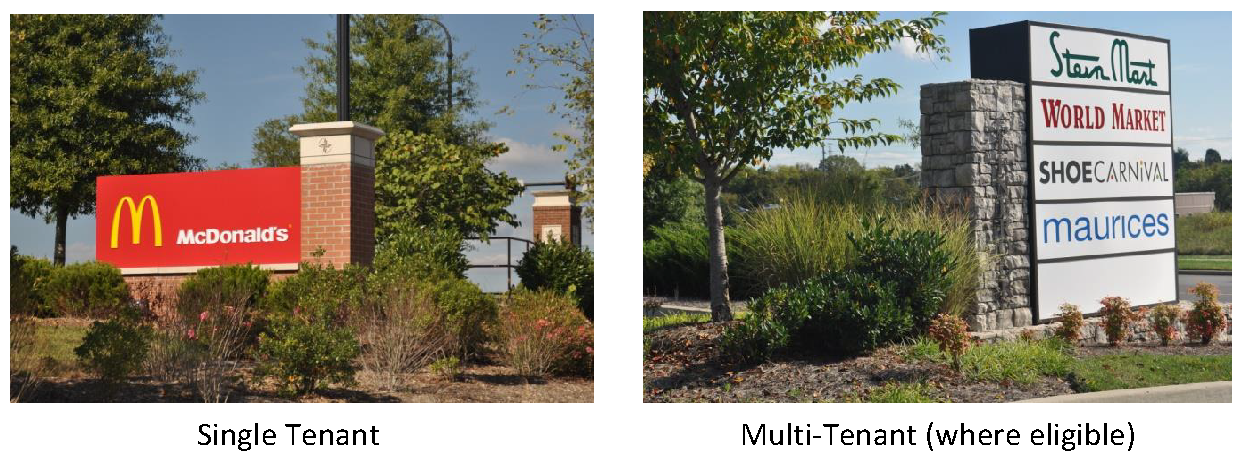
Permanent principal ground sign. A principal ground sign shall be permitted subject to the following:
1.
Shall not exceed the applicable height specified for a ground sign in that district in table 17 (number, dimension, and location of individual signs).
2.
Shall not exceed in square feet the number given in table 17. A ground sign located on a vacant lot shall not exceed 12 square feet until such time that a building permit is issued for consideration. Following issuance of a building permit, the restrictions in Table 19 shall apply.
3.
Setbacks shall conform to section 90-193(1)(c)3.
4.
One permanent principal ground sign is permitted for each 200 feet of street frontage per lot with a maximum of two such signs being permitted. Where more than one sign is allowed, there shall be separation between each sign of at least 200 feet. Corner lots and other multi-frontage lots shall be allowed one sign for each of two street frontages even if there is not 400 feet of total frontage, but provided said signs are separated by at least 200 feet, such distance to be measured parallel to the street frontage rather than in a straight line.
5.
Permanent principal ground signs shall be separated from principal ground signs on other lots by a distance of at least 75 feet. The planning commission may approve a lesser distance in instances where it is not physically possible or otherwise practical, in the opinion of the planning commission, to provide 75 feet separation.
NOTE: Temporary banners are not permitted as principal ground signs.

(h)
Projecting signs. The size of a projecting sign shall not exceed 25 square feet. A projecting sign shall be at least ten feet above any sidewalk, parking lot, driveway, or other vehicular or pedestrian way and shall not exceed 25 feet in height. No projection sign shall extend further from the face of the building wall than six feet. No projection sign shall extend beyond the top of the building wall upon which it is mounted.
(i)
Suspended signs. Suspended signs shall be permitted under canopies attached to buildings at entrances to businesses. Suspended signs shall be subject to the following specific conditions:
1.
One suspended sign allowed per entrance, and the sign may have copy on both sides.
2.
Shall not exceed four square feet in face area on one side.
3.
Shall not be illuminated.
4.
Shall be at least ten feet above any sidewalk, parking lot, driveway, or other vehicular or pedestrian way.
NOTE: Temporary banners are not permitted as suspended signs.
(j)
Temporary signs. The following temporary signs are permitted in addition to whatever permanent signs are permitted:
1.
Temporary wall signs (banners). One banner or other temporary building sign per business shall be permitted in commercial, office, and industrial zones. Such signs shall not exceed 40 square feet in size and shall be securely attached flat against the wall of the building and shall not be erected on poles or any other means of support other than the wall of the principal building on the property. Such banners or other temporary building signs may remain in place for not more than 60 days per year. This time period may be separated into four periods of no more than 15 days each.
2.
Temporary ground signs. One temporary ground sign per lot shall be permitted. Such signs shall not exceed nine square feet in size and four feet in height in residential zones and 12 square feet in size and six feet in height in commercial and industrial zones and may remain in place for 45 days per year. This time period may be separated into three periods of no more than 15 days.
Temporary residential signs shall include political preference message signs, election signs, baby announcements, garage sale signs, lost pet signs, and any other message a property owner wishes to display provided the sign contains no commercial message, except during one of the 15-day periods specified in the above paragraph. No permit is required.
In residential zones, a label issued by the office of the zoning administrator shall be affixed to the front of each temporary ground sign bearing a commercial message. This label shall specify the time period during which the sign is allowed to remain and shall also state the address where the sign is to be displayed.
3.
Exceptions.
A.
Election signs. Temporary election signs may be displayed on private property to express support of, opposition to, or any other opinion on a political candidate or an election issue. The restriction of not more than one temporary ground sign per lot or parcel per calendar year contained in section 90-193(2)(k)2. is waived for election signs under the following conditions:
•
There shall be no more than one sign per candidate or ballot issue for each lot. Corner and double frontage lots shall be allowed to have one sign on each frontage per candidate or issue.
•
All election signs shall be limited to 61 days extending from 60 days prior to the official election day to one day after the official election day (reference: TN Code 2-7-143 (2017)).
•
Candidates which win a primary and remain on the ballot for an additional election shall be allowed to re-erect their signs or leave the signs in place for an additional 61-day period under the above stated terms.
•
Shall not regulate the shape or quantity of political campaign posters or signs placed on private property that is located more than 100 feet from a polling place if the signs or posters are placed on the property by the owner or any lawful resident of the property (reference: TN Code 2-7-143 (2017)).
NOTE: This is for reference only and is superseded by permitted local guidelines as allowed in TN Code 2-7-143.
•
Election signs shall not exceed 16 square feet in size and four feet in height in residential zones and 32 square feet in size and six feet in height in commercial and industrial zones (reference: TN Code 2-7-143 (2017)).
•
May only place signs on property with permission of the property owner or lease holder.
•
No sign shall be placed any closer to the edge of the pavement than 12 feet or in such a location which blocks visibility of motorists.
NOTE: Signs displayed in violation of the sign ordinance will immediately be removed by the planning department staff.
Such election signs are allowed in addition to all other permitted signs. A sign permit is not required for election signs.
B.
Real estate signs. One temporary sign advertising the sale, auction, rental, or lease of real estate may be displayed on private property which is for sale, auction, rental, or lease. The maximum in residential zones is nine square feet in size and four feet in height. The maximum in commercial and industrial zones is 20 square feet in size and eight feet in height. On corner lots and double frontage lots, one such sign may be displayed on each of the two frontages. For this purpose, frontage includes street, lake, and golf course frontages. These two signs shall be separated by at least 100 feet. These signs may remain for as long as the property is for sale, auction, rental, or lease and shall be removed within three days of closing of the sale, end of the auction or rental of the premises.
To accommodate an open house, an open house sign may also be placed on the property under the same size and setback requirements specified above. Furthermore, there may be four off-premises open house directional signs not exceeding one square foot in size or three feet in height. These open house signs shall be allowed on Friday, Saturday, and Sunday only, and removed by 10:00 a.m. Monday. Such off-premises directional sign may not be placed on public property or right-of-way but may be placed on private property with the permission of the owner of that property.
Furthermore, there may be four off-premises auction signs not exceeding nine square feet in size nor four feet in height placed not more than ten days in advance of the auction and removed within three days after the auction. Such signs may not be placed on public property or right-of-way but may be placed on private property with the permission of the owner of that property. No more than one such sign is allowed per lot.
Such signs are allowed in addition to all other permitted signs. A permit is not required.
C.
Real estate development signs. As an accessory use to an approved subdivision or site plan, each new subdivision or development (residential, commercial, or industrial) shall be allowed one temporary real estate development sign to advertise lots for sale within the subdivision or to advertise the development of a commercial or industrial lot.
Such sign shall carry no other commercial message whatsoever and shall not exceed 32 square feet in size or ten feet in height and shall be placed at least 30 feet from the edge of any street, public or private. For a residential site, the sign shall be removed when 90 percent of the lots are built upon, but not later than five years unless an extension is granted by the planning commission. For a commercial site, the development sign must be removed once the permanent sign is installed, not to exceed two years, or prior to issuance of permanent use and occupancy.
No additional real estate signs are allowed on a lot with a real estate development sign. A permit is required for real estate development signs.
(k)
Permanent wall sign, commercial, and industrial. Wall signs in commercial and industrial districts shall be allowed, subject to the following limitations:
1.
A wall sign may be installed or painted only on a building wall of a principal building, as defined in this article and may be on any side of the building;
2.
The total amount of signage per wall of building shall not exceed one square feet per linear foot of length of the wall to which the sign is to be attached plus a setback bonus of one square foot for each additional foot of building setback beyond the required setback with a maximum of two square feet per linear foot of building frontage. Where a building has more than one occupant or tenant, a percentage of the setback bonus shall be allocated corresponding to the tenant's building square footage percentage. Any departure from this formula must be explicitly stated in the master signage plan. In no event shall the allocated setback bonus exceed 100 percent feet of the total amount of signage allowed for the entire building.
3.
Where a wall of a building in a commercial or industrial district faces and is within 100 feet of a residential district, the size and lighting limitations applicable to institutional uses in that zoning district shall apply to the sign(s) on that wall only.
NOTE: Temporary banners are not permitted as permanent wall signs.
(l)
Wall sign, residential.
1.
Single-family dwellings. Single-family residential units (either attached or detached) in zoning districts or portions of planned developments designated for single-family use shall be permitted one wall sign meeting the following criteria:
A.
The sign shall not exceed two square feet in area.
B.
The sign shall not be illuminated.
2.
Multifamily dwellings. Multifamily residential uses located in residential zoning districts, including portions of planned developments designated for residential use, shall be permitted one wall sign per public entrance, for which wall sign shall be subject to the following:
A.
No such sign shall exceed six square feet in area.
B.
Each sign may be illuminated only by direct, external illumination.
C.
The sign shall not contain any commercial message other than information about leasing units in the project on the site. Nonresidential uses in MFR, OT-R, and MXR zones shall be permitted one square foot of wall sign for each linear foot of length of wall to which the sign is to be attached.
(m)
Window sign. Window signs are permitted on the first floor of buildings provided that they cover no more than 20 percent of the gross glass area on any one side of the building or five percent in O and NC districts. Window signs shall not be illuminated except that each business establishment shall be permitted one illuminated window sign not exceeding two square feet in size. The form of illumination may include exposed neon and LED lighting.

(n)
Canopy sign. Signage and/or company logos may be placed upon canopies but shall be limited to cover no more than the lesser of 40 square feet or 20 percent of the total side of the canopy area. Signage and/or logos may be placed on each side of the canopy.
(Ord. No. 20-744, 6-1-2020)
Sec. 90-194. - Prohibited signs.
All signs not expressly permitted under this article or exempt from regulation hereunder in accordance with the previous articles are prohibited. Such signs include, but are not limited to:
(1)
Abandoned or obsolete signs. Such signs and all frames, supporting structure, posts, and appurtenances shall be removed by the owner of the property, his agent, or person having beneficial use of the premises upon which said sign is located.
(2)
Animated (including video signs).
(3)
Beacons.
(a)
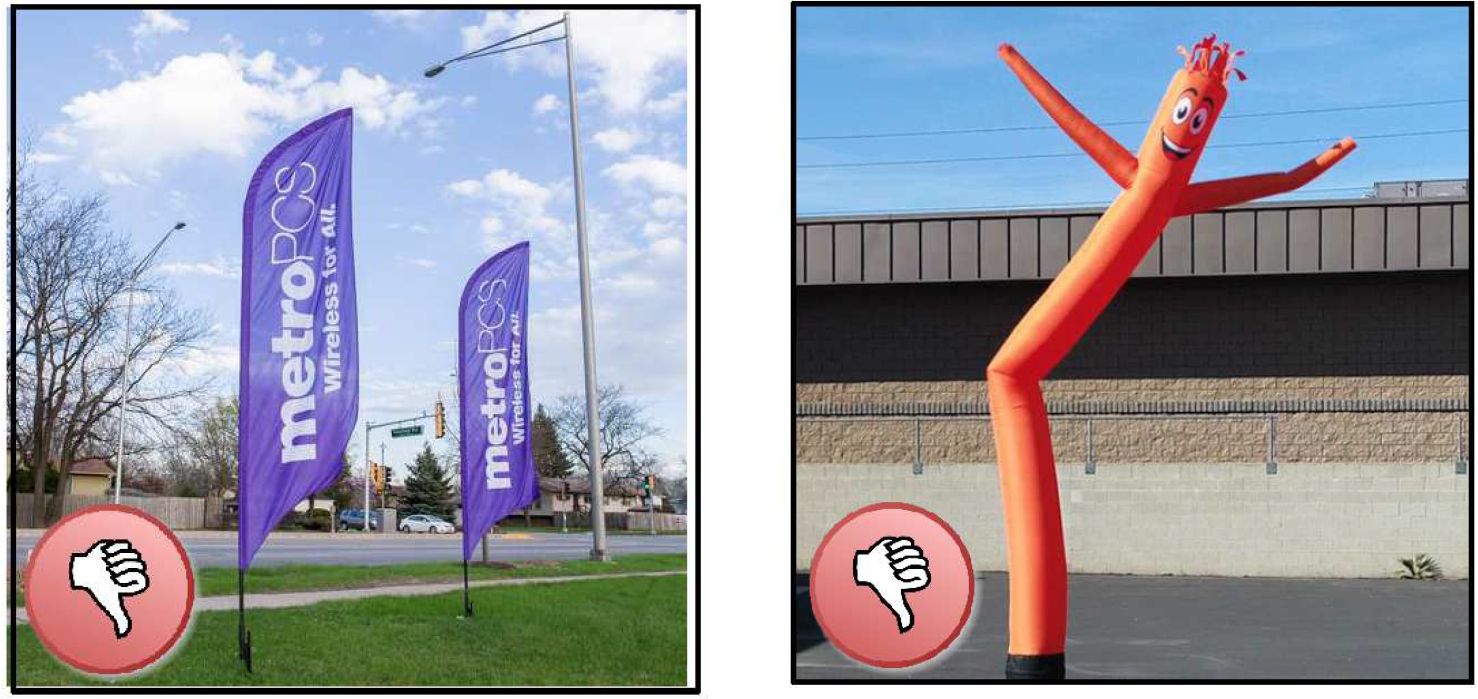
Blade banners, feather flags, swooper flags, teardrop flags, and similar devices.
(4)
Flashing signs, including flashing signs inside the window if visible from the street (public or private).
(5)
Inflatable signs including inflated characters, lighter-than-air devices, and other balloon type devices.
(6)
Obscene signs.
(7)
Other attention-attracting devices except to the extent that they conform fully to the dimensional, design, lighting, and other standards applicable to a sign in the same location.
(8)
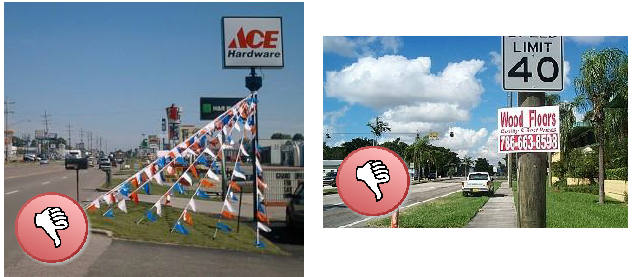
Pennants.
(9)
Roof signs.
(10)
Signs which constitute a traffic hazard described as follows: No signs shall be erected and there shall be no lighting of signs or premises in such a manner or in such location as to obstruct the view of or be confused with any authorized traffic signal, notice, or control device, or with lights on any emergency vehicle, or to create hazards, or distractions to drivers because of direct or reflected natural or artificial light, flashing, intermittent or flickering lighting, real or apparent movement. Any such signs or light sources shall be removed at the direction of the public works department. If not removed by owners or occupants of the property within ten days of notice, the planning department shall otherwise remove the signs and the cost of the removal shall become lien against the property until satisfied.
(11)
Signs on natural features such as trees, vegetation, and rocks.
(12)
Signs in the public right-of-way except as follows:
(a)
Public signs erected by or on behalf of a government body to post legal notices, identify public property, convey public information, and direct or regulate pedestrian or vehicular traffic.
(b)
Bus stop signs erected by a public transit company.
(c)
Informational signs of a public utility regarding its poles, lines, pipes, or other facilities.
(d)
Signs appurtenant to a use of public property permitted under a franchise or lease agreement with the City of Millersville.
(e)
Emergency warning signs erected by a governmental agency, a public utility company or a contractor doing authorized or permitted work within the public right-of-way.
(13)
Signs on utility poles, fences, and benches.
(14)
Streamers.
(15)
Strings of lights (with exception of high-quality lighting for approved outdoor seating for restaurants).
(16)
Vehicle signs.

(Ord. No. 20-744, 6-1-2020)
Sec. 90-195. - Master signage plan.
No permit shall be issued for a principal ground sign or wall sign for a new multi-tenant commercial building unless and until a master signage plan for the zone lot on which the sign will be erected has been submitted to and approved by the planning department as conforming with this article.
(a)
The owners shall submit to the planning department a master signage plan containing the following:
1.
An accurate plot plan of the zone lot, at such scale as the Planning Department may reasonably require.
2.
Location of buildings, parking lots, driveways, and landscaped areas on such zone lot.
3.
Computation of the maximum area for signs, the height of signs, and the number of principal ground signs allowed on the zone lot(s) included in the plan under this article, with such computations following the applicable formula set forth in Table 15 of this article.
4.
An accurate indication on the plot plan of the proposed location of each present and future permanent sign of any type, whether requiring a permit or not, except that incidental signs need not be shown.
5.
Detailed drawings and color renderings of the proposed signage showing dimensions and design sufficient to determine compliance with the requirements of this article, including the design standards contained in section 90-196 (design standards).
6.
The master signage plan shall be signed by all owners or their authorized agents in such form as the planning department may require.
(b)
Any sign design guide and/or master signage plan submitted and approved with any planned development or site plan for the proposed development may be accepted as the master signage plan required by this article if said plan is determined by the planning department as being sufficient to conform to the intent of this article.
(c)
The master signage plan requirement may be waived by the planning department for buildings containing three or fewer tenants or when it is determined that the master sign plans will not serve its intended purpose.
(d)
A master signage plan may be amended by filing a new master signage plan that conforms with all requirements of this article.
(e)
After approval of a master signage plan, no sign shall be erected, placed, painted, or maintained, except in accordance with such plan, and such plan may be enforced in the same way as any provision of this article. In case of any conflict between a provision of a master signage plan and one or more provisions of the City of Millersville Ordinances, the City of Millersville Ordinances shall control.
(Ord. No. 20-744, 6-1-2020)
Sec. 90-196. - Design standards.
(1)
Design review and conformance. Compliance with the following design standards is required for all new permanent signs included replacement signs for which a permit is required as per Table 18 (permitted signs) of this article including principal ground signs, directory ground signs, institutional ground signs, awning signs, suspended signs, projecting signs, wall signs, and canopy signs. The planning department shall, prior to the issuance of a sign permit as required by section 90-51 (sign permits) of this article, review such proposed signs and approve or deny as to conformance with the design standards contained in this article. Denials may be appealed to the planning commission.
(2)
Design principles. Signs should be designed with consideration to the effect the sign will have upon the character of the surrounding area. Signs can complement or detract from the character of the building. Therefore, particular attention should be given to the way in which the sign will be read and whether its design, size, materials, shape, illumination, location, configuration, and character are appropriate to its intended audience or whether a more appropriate sign could better serve its intended purpose and, at the same time, be less visually disruptive.
(3)
Design guidelines.
(a)
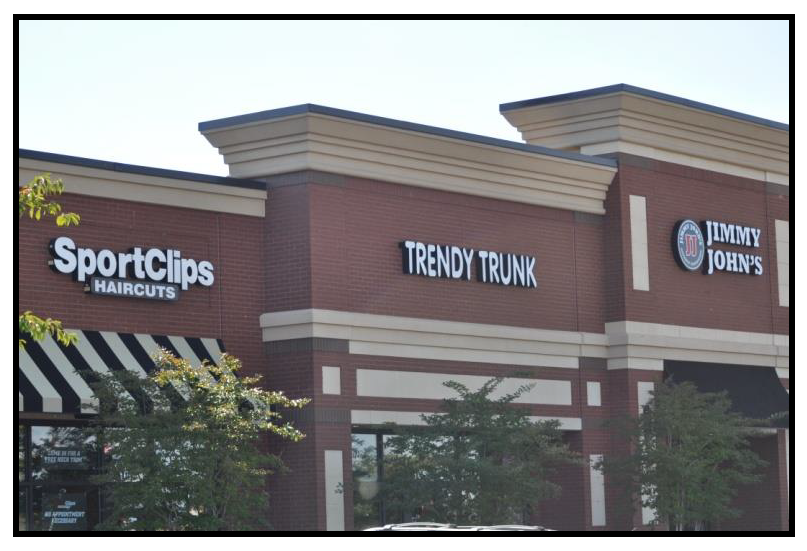
Wall signage should be consistent in size within each development and should be proportional to the building on which each sign is placed. A sign which meets the maximum size limitations may not be appropriate to the scale of the buildings, its architectural features and the character established by the adjacent buildings.
(b)
Wall signs should match the architectural character of buildings within the development and area and of the building on which the sign is to be placed in terms of style, location, configuration, materials, and color.
(c)
Wall signs should not obstruct or crowd architectural elements or details such as cornices, pilasters, windows, and other features which define the design of the building.
(d)
Sign materials must be durable, low maintenance, and of similar quality to the principal structure. Appropriate materials for ground sign background, frame, support, and ornamentation includes brick, natural stone (including panels and imitation stone), and EIFS or similar material when used in combination with brick or stone.
(e)
Signs should not be a material, color(s), or design that attracts attention excessively and disrupts the public environment.
(f)
Signs should not be in the shape of a product or motif, i.e., soda bottle, hamburger, or boot.
(g)
Signs should be primarily for identifying the business and not predominantly for advertising products sold or services rendered.
(h)
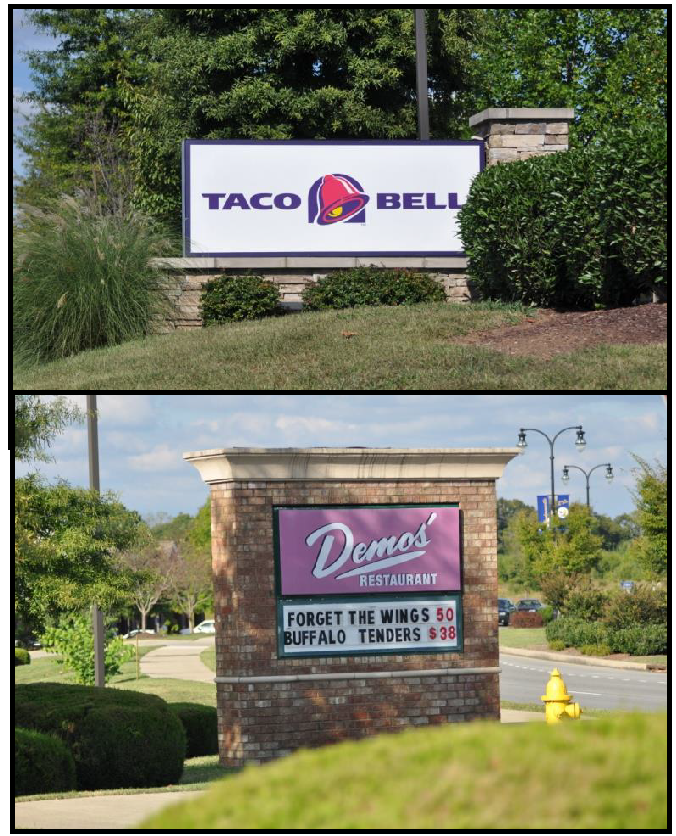
Ground signs must be monument style. Ground signs must be placed on a brick or stone masonry base of at least one and one-half feet in height. Any sign posts must be concealed within the base and structure of the sign, i.e. with brick columns. The base should be constructed of the recommended materials listed previously in section 90-196(3)(d). The base should be complemented with shrubs, flowers, and/or other landscaping. This landscaping should be of a low-growing variety so as not to block the visibility of the sign. This landscaping should also be designed to hide or shield any external light source.
(i)
The frame and other supporting structure of the sign should be as minimal in mass as possible to support the sign and complement the architecture of the principal building. The frame and structure should not cause the overall size of the sign and structure to exceed the permitted maximum size by more than 120 percent. For example, if 60 square feet of sign face is allowed, the total area of the sign and structure should not exceed 132 square feet.
(j)
Ground signs should be placed in the middle of the lot to the extent practical so that visibility of motorist exiting the driveway will not be impeded and so that it will not block, or be block, by the sign on the adjacent lot and so that any future sign on the adjacent lots can achieve the minimum separation required by this article.
(k)
Landscaping around the base of the sign is recommended, especially to screen any external light source.
(l)
Temporary sandwich board type signage is permitted during business hours and must be stored inside during non-business hours. One sign is allowed per business and the sign may not exceed ten square feet in size or five feet in height and not block the sidewalk or the visibility of motorists. Such sign shall be within ten feet of the front of the building and shall conform to the setback requirement. No other temporary signs shall be displayed on the property while a sandwich board sign is in place.
(Ord. No. 20-744, 6-1-2020)
Sec. 90-197. - Construction and maintenance.
(1)
Code compliance. All signs shall comply with the applicable provisions of the building code and the electrical code of the City of Millersville at all times.
(2)
Permanent installation required. Except for permitted banners, flags, temporary signs, and window signs conforming in all respects with the requirements of this article, all signs shall be constructed of permanent materials and shall be permanently attached to the ground, a building, or another structure by direct attachment to a rigid wall, frame, or structure.
(3)
Maintenance. All signs shall be maintained in good structural condition, in compliance with all building and electrical codes, and in conformance with this article, at all times. Specifically:
(a)
A sign shall have no more than 20 percent of its surface area covered with disfigured, cracked, ripped, peeled paint, poster paper, or other material for a period of more than 30 days.
(b)
A sign shall not stand with bent or broken sign facing, with broken supports, loose appendages, or struts, or more than 15 degrees from vertical for a period of no more than ten successive days.
(c)
A sign shall not have weeds, trees, vines, bird nests, or vegetation growing upon it or obscuring the view of the sign from the street or right-of-way from which it is to be view for a period of no more than 30 successive days.
(d)
An internally illuminated sign shall be allowed to stand with only partial illumination for a period of no more than 30 successive days.
(Ord. No. 20-744, 6-1-2020)
Sec. 90-198. - Nonconforming signs.
It is the policy of the City of Millersville to encourage and, to the maximum extent practical, require that all signs within the city be brought into compliance with the requirements of this article.
Subject to the exceptions hereinafter set forth, any nonconforming signs may be continued in operation and maintenance after the effective date of this article, provided that nonconforming signs shall not be:
(1)
Changed to or replaced with another nonconforming sign except changing the sign face or panel. Also, the copy of nonconforming changeable copy signs may be changed.
(2)
Structurally altered so as to extend their useful life.
(3)
Expanded.
(4)
Relocated.
(5)
Re-established after damage of more than 50 percent of the value at the time of such damage or destruction.
(6)
Modified in any way that would increase the degree of nonconformity of such sign.
Nothing in this article shall prevent the strengthening or restoring to a safe condition of any portion of a sign or structure declared unsafe by the building inspector. Such signs may be improved only to the extent that such improvement does not exceed 50 percent of the current market value of the existing sign structure.
Nonconforming signs shall be brought into compliance with this article if at any time such signs are altered, repaired, restored, or rebuilt, such that the cost of alteration or repair, including changes in the face, exceeds 50 percent of the replacement cost of the sign at the time of application for a permit for such alteration or repair, unless the alteration or repair is caused by involuntary damage or casualty or is desired by the owner of the business existing on the effective date of this article, in which case the 50 percent threshold will not apply and the signs may be altered or repaired to any extent. The same nonconforming sign will continue to be nonconforming if the activity type remains the same when a business changes ownership and the 50 percent threshold is not exceeded. Example: McDonalds to Burger King, food service to food service. For purposes of this subsection, all permits within any six consecutive calendar months shall be aggregated for purposes of measuring the 50 percent threshold herein.
However, it is important to note that a single tenant sign that is on a single tenant parcel must be brought into compliance with the sign ordinance if the business activity type changes. Example: McDonalds to The Shoe Store, food service to retail.
(Ord. No. 20-744, 6-1-2020)
Sec. 90-199. - Violations.
See section 90-53 (violations).
(Ord. No. 20-744, 6-1-2020)
Sec. 90-200. - Wall murals.
Wall murals may be allowed, subject to planning commission approval.
(1)
Design standards. The following criteria shall be utilized by the planning commission to evaluate and review for mural approval:
(a)
Shall be an original work of art.
(b)
Shall be designed and constructed under the supervision of a qualified artist/muralist or other qualified professional who has sufficient knowledge and experience in the design and execution of such projects, as well as with the application of the selected medium.
(c)
Shall exhibit excellence in design, content, material, and application while incorporating high-quality materials that will enhance the overall development and appearance of the site.
(d)
Materials shall be securely attached to the building or structure to which it is applied.
(e)
Materials shall be durable and weather resistant to prevent premature deterioration or other unintended change in appearance.
(f)
Materials shall be appropriate for its outdoor location and climate, with special considerations for longevity and if possible, graffiti-resistant.
(g)
Materials used may be, but are not limited to, paint and other artistic mediums such as tile or mosaic.
(h)
Colors should be complementary and harmonious with the exterior colors of the building or structure.
(i)
Design, location, scale, and content should be in keeping with and enhance the building, wall, windows, fence, or other surface on which it is located, as well as the local environment.
(2)
Prohibitions. All criteria not expressly permitted in accordance with the section 90-200(1) above are prohibited. Such criteria include, but are not limited to:
(a)
Applied to any surface that was unlawfully established.
(b)
Constitute or create a traffic hazard for passing motorists.
(c)
Obscure or detract from the significant architectural features of the said structure or have an adverse effect on properties or facing properties.
(d)
Compromise the proper function of any building or use or diminish public safety.
(e)
Installed in locations that conflict with setback requirement of the district in which it is located.
(f)
Be above a height that is or would be nonconforming to current building height limitations.
(g)
Contain a logo or trademarked symbol, except for official government seals.
(h)
Include commercial text or products displaying, mimicking, or construed as symbolizing a specific brand.
(i)
Incorporate recognized signs of hatred or discrimination against any race, color, sex, age, national origin, disability, religion, ancestry, marital status, familial status, gender identity or expression, or sexual orientation.
(j)
Be obscene or harmful to minors as defined by law.
(k)
Consist of any reproduction, copy, or mass-produced work of visual art of any type.
(Ord. No. 20-744, 6-1-2020)

