
Millersville City Zoning Code
ARTICLE X
- SUPPLEMENTARY STANDARDS
Sec. 90-121.- Purpose.
The purpose of this article is to set forth supplemental standards for the use of land and buildings to ensure that the use is compatible with the surrounding area. This article is also intended to set forth standards for other structures and uses on a lot other than for the principal building and use. This includes accessory buildings, structures and uses, and permitted encroachments. This article also sets forth standards for temporary uses and structures.
(Ord. No. 20-744, § 10.1, 6-1-2020)
Sec. 90-122. - Use of land and buildings.
(1)
Use to be in conformity. No building, structure, or premises shall be used or occupied except in conformity with regulations for the zoning district in which it is located. No building or structure shall be erected, reconstructed, extended, enlarged, altered, or moved except in conformity with the regulations of the zoning district in which it is located.
(2)
Number of principal dwellings on a lot. In the RR, ER, SR-1, and SR-2 Districts, there shall be no more than one principal dwelling per lot. In all other districts, more than one building may be erected on a single lot, provided that each building shall comply with all yard and bulk requirements of a district (see below) as though it were a principal building on an individual lot.
(a)
Horizontal property regime (HPR) is allowed in all zones by state law. HPRs shall observe all setback, lot widths, and standards listed in tables 4, 6, 9, and 10.
(b)
More than one principal dwelling per lot shall only be allowed in the following zones utilizing a horizontal property regime (HPR): MXR, NC, O, OTC, MXC, GC, HC, I, THR, and MFR.
EXAMPLE #1 of how to calculate: Assume you wish to build single-family homes within a specified zone utilizing an HPR and you have a 110-foot-wide x 300-foot-deep lot (33,000 square feet). If the minimum lot width is 50 feet and the minimum lot size is 5,000 square feet. Since there is only 110 feet of lot street frontage, you would be limited to two homes that could be constructed on this particular lot due to the minimum lot width requirements that must be met.
EXAMPLE #2 of how to calculate: Assume you wish to build single-family homes within a specified zone, utilizing an HPR and you have a 150-foot-wide x 90-foot-deep lot (13,500 square feet). If the minimum lot width is 50 feet and the minimum lot size is 5,000 square feet. Since the lot is only 13,500 square feet, you would be limited to two homes that could be constructed on this particular lot due to the minimum lot size (5,000 square feet) required for each home.
EXAMPLE #3 of how to calculate: Assume you wish to build townhomes within the MFR zone utilizing an HPR and you have a 110-foot-wide x 300-foot-deep lot (33,000 square feet). Within the MFR zone the minimum lot width is 20 feet and the minimum lot size is 2,400 square feet. Since there is only 110 feet of lot street frontage, you would be limited to five townhome units that could be constructed on this particular lot due to the minimum lot width requirements that must be met.
(3)
All activities within an enclosed building. Within all districts, all activities, including storage, shall be conducted entirely within an enclosed building, with the exception of the following activities and uses:
(a)
Off-street parking and loading, in accordance with section 90-142 (off-street parking and loading).
(b)
Outdoor businesses, and those businesses with an outdoor component, including, but not limited to, outdoor entertainment, outdoor recreation, restaurants, car sales, car washes, kennels, and similar businesses. These businesses may be limited, or outdoor components prohibited, as a condition of a conditional use permit.
(c)
Outdoor storage, and outdoor sales and display areas, in accordance with subsection 90-124(13) (outdoor display) and subsection 90-124(14) (outdoor storage) below.
(d)
Temporary uses, in accordance with section 90-126 (temporary uses).
(4)
Frontage on a public or private street. All buildings shall front on a public or private street. Private streets include streets or drives within a recorded easement.
(5)
Required yards. No lot shall be reduced in area so that the yards are less than required by this article. The yards of a building or structure shall not be considered yard space for any other building or structure. All yards allocated to a building or structure shall be located on the same zoning lot as such building or structure. Yards may be used for parking, landscaping, and other accessory uses provided all requirements of this article are met. Rear yards shall not be required where a building in an industrial zone borders a railroad.
(6)
Applicability of bulk requirements. All buildings and structures erected after the effective date of this article shall meet the lot size, yard size, and other bulk regulations for the zoning district in which the building or structure is located. No existing building shall be enlarged, altered, reconstructed, or relocated in such a manner that conflicts with the regulations of the zoning district in which the building or structure shall be located except as may be allowed by article XIV (nonconforming use standards).
(7)
Applicability of use restrictions. No building, structure, or land shall be used for any use other than one allowed as either a permitted or conditional use in the zoning district in which such building, structure, or land is located. Buildings, structures, or land may also be used for a temporary use or accessory use, in accordance with the requirements of section 90-126 (temporary uses and structures) and section 90-124 (accessory uses, buildings, and structures).
(8)
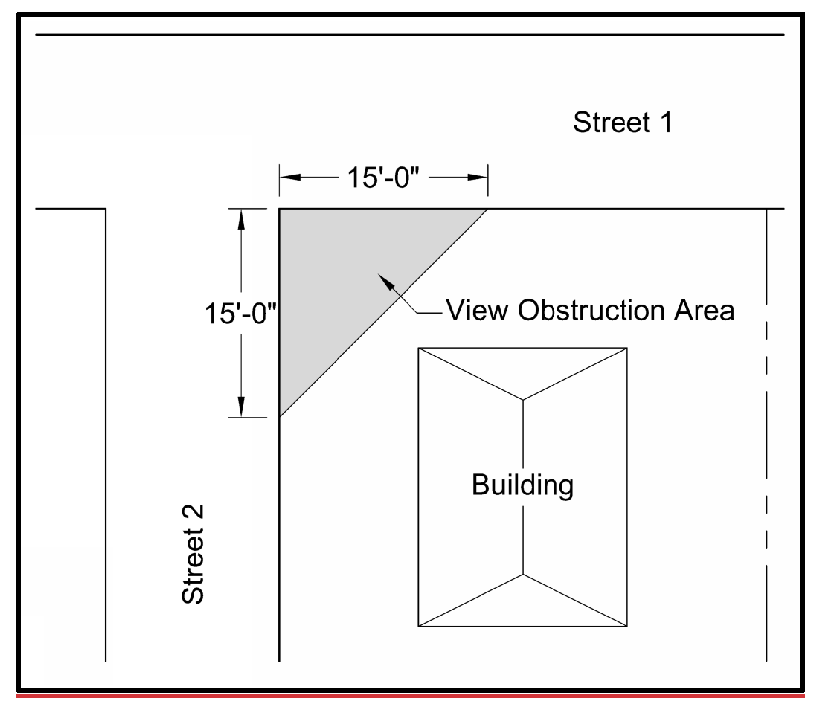
Motorist view obstruction in all districts. The site clearance area at the intersection of two streets within all districts shall be defined as a triangular area of a corner lot measured 15 feet from the point of intersection of the edges the back of the curb along a street; and shall not be obstructed by any sign, wall, fence, hedge, shrub, or other object which exceeds 24 inches in height. Trees may be maintained within this area as long as there is no foliage within 48 inches as measured from the ground to the lower foliage.
In the event that the grade of a lot is higher than the street grade, the height of the wall, fence, hedge, or shrub shall be reduced so that the site clearance is not obstructed 24 inches over the grade of the street. See figure 1: View obstruction.
Figure 1: View Obstruction
(9)
Buildings not to be on easements. No building, pool, deck, patio, or permanent structure shall be located on an easement except as per subsection 90-124(1)(d)4. regarding accessory buildings without a permanent foundation.
(Ord. No. 20-744, § 10.2, 6-1-2020)
Sec. 90-123. - Use-specific standards.
In addition to the use standards below, all uses are required to comply with the provisions of this article including, but not limited to, article XI (site development standards), section 90-142 (off-street parking and loading), section 90-143 (outdoor lighting), section 90-144 (landscaping, screening, and tree preservation), article XII (building design standards), and article XIII (sign standards), and all other city regulations.
(1)
Assisted living facility, home for the aged, independent living facility, and nursing home. Assisted Living facilities, home for the aged, independent living facilities, and nursing homes shall meet all federal, state, and local requirements including, but not limited to, licensing, health, safety, and building code requirements. In addition, the following criteria shall be required:
(a)
The location, design, and operation of the facility shall be compatible with, and shall not adversely affect, adjacent properties, and the surrounding area.
(b)
The facility shall be harmonious with surrounding buildings, in respect to scale, architectural design, and building placement. If located within a residential district, the facility shall not alter the residential character of the neighborhood.
(c)
The surrounding street network shall be capable of accommodating the traffic generated by the facility.
(d)
Minimum lot size is three acres.
(e)
Maximum number of living units:
1.
Assisted living units: 20 units/acre.
2.
Home for aged living units: Five units/acre.
3.
Independent living units: 15 units/acre.
4.
Nursing home living units: 25 units/acre.
(2)
Community residence. Community residences shall meet all federal, state, and local requirements including, but not limited to, licensing, health, safety, and building code requirements. In addition, the following criteria shall be required:
(a)
The location, design, and operation of the facility will not alter the residential character of the neighborhood.
(b)
The facility shall retain a residential character, which shall be compatible with the surrounding neighborhood.
(c)
The operation of the facility shall not adversely impact surrounding properties.
(d)
Adequate parking per resident provided.
(3)
Day care center, adult and child. Day care centers shall meet all federal, state, and local requirements including, but not limited to, licensing, health, safety, and building code requirements. In addition, the following criteria shall be required:
(a)
Adequate sidewalks and exterior lighting shall be provided.
(b)
The amount of traffic or noise to be generated shall not be excessive.
(c)
Adequate open space and recreational areas shall be provided.
(4)
Day care home, adult and child.
(a)
Day care homes shall meet all federal, state, and local requirements including, but not limited to, licensing, health, safety, and building code requirements. In addition, the following criteria shall be required:
1.
Adequate sidewalks and exterior lighting shall be provided.
2.
The amount of traffic or noise to be generated shall not be excessive.
3.
Adequate open space and recreational areas shall be provided.
4.
The day care home shall retain a residential character and the effect of the day care home shall not alter the residential character of the neighborhood.
5.
The operation of the day care home shall not adversely impact surrounding properties.
(b)
Services provided in a protective setting for more than four, up to a maximum of 12, children or adults for less than 24 hours per day.
(c)
Child day care home does not include facilities which receive only children from a single household.
(5)
Entertainment and recreation facilities, indoor or outdoor. Entertainment and recreation facilities shall be designed so that the location of entrances and exits, exterior lighting, service areas, and parking and loading facilities will minimize traffic congestion, pedestrian hazards, and adverse impacts on adjoining properties.
(6)
Kennel.
(a)
Exterior enclosures and runs shall provide protection against weather extremes. Floors of runs shall be made of impervious material to permit proper cleaning and disinfecting.
(b)
All animal quarters and runs are to be kept in a clean, dry, and sanitary condition.
(c)
Fencing surrounding exercise areas and/or runs shall be of a sufficient height to prevent escape and shall be buried as part of installation to prevent escape by digging beneath the fence posts.
(d)
Kennel noise shall be mitigated so as not to create a public nuisance for adjoining properties. This shall exclude noise from exercise or training while outdoors during the daytime. Kennels shall comply with all local noise regulations.
(7)
Motor vehicle service station.
(a)
Motor vehicle service station and fuel center canopies shall be designed with luminaires fully recessed into the ceiling of the canopy to minimize light pollution. Light intensity directly under the canopy shall not exceed 30 foot-candles at any location. All lighting mounted under the canopy, including auxiliary lighting within signage and panels over pumps, shall be included in the 30-foot-candle limit. For service stations and fuel centers adjacent to residential zones, see subsection 90-143(3) (light trespass).
(b)
All motor vehicle service station driveways must be located and designed to ensure that they will not adversely affect the safety and efficiency of traffic circulation on adjoining streets.
(c)
Motor vehicle service stations may offer convenience items for sale as secondary activity.
(d)
Motor vehicle service stations may also include an automatic car wash with one bay. Stacking spaces shall be in accordance with section 90-142 (off-street parking and loading). More than one bay constitutes a separate principal use and requires compliance as such.
(e)
In addition, minor motor vehicle repair shops may be included as part of a motor vehicle service station. However, they shall be subject to the provisions of this article and the standards of subsection 90-123(10) (motor vehicle service and repair, major or minor) below.
(f)
Motor vehicle service and fuel center canopies and their associated columns and supports shall be removed at such time that the fuel center pumps and tanks are removed. New uses of the property, other than those for motor vehicle service and fuel centers, shall not be allowed to utilize the canopies previously constructed. New uses of the property, other than those for motor vehicle service and fuel centers, shall remove the canopies and their associated support columns and supports previously constructed prior to being allowed to occupy the site with the new use.
(8)
Motor vehicle dealership. Newly established used motor vehicle dealerships may be no closer to an existing used car dealership than 1,000 feet. This does not apply to used car sales which are accessory to new car dealerships. Any service and repair facilities, which are open to the public and included as part of the dealership, must also comply with the standards of subsection 90-123(10) (motor vehicle service and repair, major or minor).
(9)
Motor vehicle operations facility. All repair operations and service bays shall be fully enclosed.
(10)
Motor vehicle service and repair, major or minor.
(a)
Minor motor vehicle service and repair shops may not store the same vehicles outdoors on the site for longer than ten days. Major motor vehicle service and repair shops may not store the same vehicles outdoors on the site for longer than 30 days.
(b)
All driveways must be located and designed to ensure that they will not adversely affect the safety and efficiency of traffic circulation on adjoining streets.
(c)
All repair operations shall be fully enclosed. Wrecked or junked vehicles shall not be stored for longer time periods than those specified above and shall be completely screened from the public right-of-way and any adjacent residential districts with a solid board fence and/or evergreen shrubs or equivalent screening as may be approved by the planning department.
(d)
Minor motor vehicle service and repair shops may also include gas stations as a secondary use. All gas stations which are part of such an establishment must comply with the regulations of subsection (7) (motor vehicle service station).
(11)
Adult-oriented establishment. Adult-oriented establishments shall be subject to the following standards:
(a)
No adult-oriented establishment shall be located within 1,000 feet of any other adult-oriented establishment or any residential district, school, place of worship, liquor store, or childcare as measured in a straight line between the nearest parts of the two structures.
(b)
The adult-oriented establishment shall be so designed, located, and operated so that the public health, safety, comfort, convenience, and general welfare will be protected.
(c)
The adult-oriented establishment shall not cause substantial injury to the value of other property in the neighborhood in which it is located.
(d)
The adult-oriented establishment shall not unduly increase traffic congestion in the public streets and highways in the area in which it is located.
(e)
The adult-oriented establishment shall not cause additional public expense for fire or police protection.
(f)
No adult-oriented establishment shall be conducted in any manner that permits the observation of any material depicting, describing, or relating to "specified sexual activities" or "specified anatomical areas" from any public way or from any adjacent property. This provision shall apply to any display, decoration, sign, show window, or other opening.
(12)
Radio and television towers and transmission facilities.
(a)
Site plan and design review approval is required in accordance with section 90-47 (site plan and design review).
(b)
All towers shall conform to the definition of tower as stated in article XVI (definitions).
(c)
The maximum height is 150 feet unless further restricted by the board of zoning appeals in the granting of a conditional use permit, if required.
(d)
All towers and facilities shall conform to the following provisions contained in article XV (wireless telecommunications facilities and towers):
1.
Section 90-246, setbacks.
2.
Section 90-247, structural requirements.
3.
Section 90-248, separation of towers.
4.
Section 90-250, illumination.
5.
Section 90-251, exterior finish.
6.
Section 90-252, landscaping and inspections.
7.
Section 90-255, certifications and inspections.
8.
Section 90-256, maintenance.
9.
Section 90-258, abandonment.
10.
Section 90-259 (special conditions for location of telecommunications facilities within residential districts), subsections 90-259(1) (property allowed), 90-259(3) (tower design), 90-259(4) (protection against climbing), 90-259(5) (color), 90-259(6) (equipment enclosure).
(13)
Social club or lodge.
(a)
Social clubs or lodges shall be designed so that the location of entrances and exits, exterior lighting, service areas, and parking and loading facilities will minimize traffic congestion, pedestrian hazards, and adverse impacts on adjoining properties.
(b)
Social clubs and lodges are permitted to serve food and meals on premises. There shall be no sleeping facilities.
(14)
Wireless telecommunications facilities and towers. See article XV (wireless telecommunications facilities and towers).
(15)
Recycling drop-off center.
(a)
All recyclables to be kept in leak-free enclosed bins.
(b)
All recyclables to be removed from the site no less than every two days.
(c)
All storage/collection bins and equipment to be screened as per subsection 90-144(11)(c) (outdoor storage area).
(d)
The site shall be kept odor free (at the property lines) and shall be kept free of bees and other insects.
(e)
Site plan approval is required as per section 90-47 (site plan and design review).
(f)
See also subsection 90-124(7) (donation and recycle collection bins) for recycle collection bins as an accessory use.
(Ord. No. 20-744, § 10.3, 6-1-2020)
Sec. 90-124. - Accessory uses, buildings, and structures.
The purpose of this section is to authorize the establishment of accessory uses, buildings, and structures that are incidental and customarily subordinate to principal uses. The city's intent in adopting this section is to allow a broad range of accessory uses, buildings and structures, so long as such uses are located on the same lot as the principal use, and so long as they comply with the standards set forth in this section in order to reduce potentially adverse impacts on surrounding lands.
(1)
General standards and limitations.
(a)
Compliance with ordinance requirements. All accessory uses and accessory buildings and structures shall conform to the applicable requirements of this article. The provisions of this section establish additional standards and restrictions for particular accessory uses and structures. Barns and other farm buildings on property where agricultural uses are permitted are exempt from subsections (1)(e) through (1)(i) of this section.
NOTE: Agricultural uses are permitted on RR and ER property containing at least ten acres and on any legally pre-existing/non-conforming farms.
(b)
General standards. All accessory uses and accessory structures shall meet the following standards:
1.
Directly serve the principal use or structure;
2.
Be customarily accessory and clearly incidental and subordinate to principal use or structure;
3.
Be subordinate in area, extent, and purpose to the principal use or structure;
4.
Be owned or operated by the same person or company as the principal use or structure;
5.
Be located on the same lot as the principal use or structure;
6.
Together with the principal use or structure, shall not violate the bulk, density, parking, landscaping, or open space standards of this article; except that a variance or conditional use may be granted (whichever is applicable — see table 1) from the standards contained in subsection subsections (d), (e), (f), and (g) of this subsection and from the minimum setback/yard requirements of this article;
7.
Not to be constructed or established prior to the time the principal use or structure is constructed or established; and
8.
Not constitute a combination use, which is the combination of two principal uses. Combination uses will not meet the above standards in terms of being subordinate or providing service to the principal use.
9.
Be a permitted or conditional use in the zone in which it is located or specifically listed as an accessory use in subsections (2)—(23) of this section or as allowed by subsection (d)2.
(c)
Permitted accessory uses.
1.
Subsections (2) through (23) list permitted accessory uses. Specific standards for these uses are given, including the extent to which each use may encroach into the required yards. Section 90-125 (permitted encroachments) includes table 11 which lists additional permitted accessory uses and the extent to which they may encroach into required yards. Together, these two sections list all known accessory uses.
2.
The planning director shall evaluate potential accessory uses that are not identified in subsections (2) through (23) and table 11 (permitted encroachments) on a case-by-case basis, as an interpretation. In making the interpretation, the planning director shall apply the following standards:
A.
The definition of accessory use (see article XVI: definitions), and the general accessory use standards established in subsection (1)(b) (general standards).
B.
The purpose and intent of the zoning district in which the accessory use is located (see articles VI and VII).
C.
Any potential adverse impacts the accessory use may have on other lands in the area, compared with other accessory uses permitted in the zoning district.
D.
The compatibility of the accessory use, including the structure in which it is housed, with other principal and accessory uses permitted in the zoning district.
(d)
Location of accessory buildings and structures.
1.
Accessory buildings and structures are prohibited within required yards of any lot, unless otherwise permitted by this article.
2.
Within all residential zones, accessory buildings and structures with a roof are further prohibited from being located in front of the principal building, unless otherwise permitted by this article, or a variance is granted for such by the board of zoning appeals. (table 1)
3.
The following exceptions to 1. and 2. above are allowed:
A.
Accessory buildings and structures with a roof located at least ten feet from the principal building and not exceeding 400 square feet in size are allowed to encroach in the required rear and side yards as follows:
B.
Arbors, trellises, gazebos, and pergolas which are detached from the principal building and which do not exceed 120 square feet of combined size or 15 feet in height in addition to being allowed the exceptions contained in subsection (1)(d)3.A. may be located in front of the principal building and may encroach into the required front yard to within 20 feet of the street.
4.
Accessory buildings and structures with a roof and a permanent foundation (concrete slabs or piers), and pools (and their aprons and/or decks) shall not be located on an easement. However, accessory building and structures with a roof without a permanent foundation may be located on an easement provided the property owner submits a notarized letter acknowledging that they could be required by any party having a right to the use of the easement to move the building off the easement.
NOTE: The city's current building code requires a permanent foundation for all buildings 200 square feet and larger.
(e)
Maximum number and size of accessory buildings and structures.
1.
In all residential zones a maximum of two detached accessory buildings and structures with a roof shall be permitted on a zone lot. Arbors, trellises, gazebos, and pergolas which do not exceed 120 square feet of combined size or 15 feet in height are exempt from this restriction.
NOTE: Pools (in-ground or above-ground) do not count since they are structures without a roof.
2.
In all residential zones, the area of all residential accessory buildings and structures with a roof on a zone lot shall not exceed the lesser of:
A.
Fifty percent of the area of the principal dwelling or 800 square feet on lots up to 15,000 square feet in size.
NOTE: Detached accessory dwelling is not allowed.
B.
Fifty percent of the area of the principal dwelling or 1,200 square feet on lots between 15,001 and 29,999 square feet in size.
NOTE: Detached accessory dwelling is not allowed.
C.
Fifty percent of the area of the principal dwelling or 1,500 square feet on lots between 30,000 square feet and 43,559 square feet (one foot less than one acre) in size.
NOTE: Detached accessory dwelling may be allowed if granted a conditional use permit and is limited in total size to a maximum of 1,200 square feet. (See subsection (2)(c).)
D.
Fifty percent of the area of the principal dwelling or 1,800 square feet on lots between one acre (43,560 square feet) and 130,679 square feet (one foot less than three acres) in size.
NOTE: Detached accessory dwelling may be allowed if granted a conditional use permit and is limited in total size to a maximum of 1,500 square feet. (See subsection (2)(c).)
E.
Fifty percent of the area of the principal dwelling or 2,500 square feet on lots over three acres (130,680 square feet) in size.
NOTE: Detached accessory dwelling may be allowed if granted a conditional use permit and is limited in total size to a maximum of 1,800 square feet. (See subsection (2)(c).)
Area for calculation of all structures (principal dwellings and accessory buildings) refers to the area in square feet of all floors above grade, including covered porches and patios, attached garage and carport. Refer to tables 4 and 9 for maximum lot coverage.
(f)
Maximum height of accessory building and structures. In all residential zones, the height of the accessory buildings and structures shall not exceed the height of the principal building on the zone lot.
EXCEPTION: If the principal building is a one-story dwelling, an accessory building or structure may be constructed to a height not exceeding one and one-half times the height of the principal building. However, the accessory building or structure shall not exceed the height specified by table 4 (residential districts lot and building bulk standards).
(g)
Construction standards.
1.
Accessory buildings and structures with a roof in all residential zones located in any yard other than the rear yard of an interior lot and which exceed 400 square feet shall be constructed of the same materials as the principal building and shall be the same architectural design and quality as the principal residential structure on the property. When the principal structure is predominantly brick or stone, the introduction of wood or fibrous cement siding over a matching brick or stone perimeter foundation wall is appropriate to re-enforce the subordinate nature of the accessory building. This does not preclude the construction of an open carport within the side and corner side yards provided the roof, column, and other components match the house.
NOTE:
(1) This prohibits metal carport awnings and RV awnings.
(2) As per subsection (1)(d)2., accessory buildings may not be located in the front yard in residential zones.
2.
Metal buildings exceeding 200 square feet are prohibited in all yards, other than in the rear yard of an interior lot. The board of zoning appeals may grant a conditional use permit for metal buildings exceeding this 200 limit.
3.
Metal buildings exceeding 400 square feet are prohibited in rear yards of an interior lot. The board of zoning appeals may grant a conditional use permit for metal buildings exceeding 400 square feet limit.
4.
Tents shall not be used for accessory buildings. Awnings with plastic, vinyl, or similar roofs or sides are prohibited in all residential zones.
(h)
Zoning permit required. A zoning permit must be secured from the planning department prior to the construction or placement of an accessory building or structure which has a roof and is or exceeds 200 square feet in size. A zoning permit is also required for certain accessory uses listed in subsections (2) through (23) below.
(i)
Maintenance required. All accessory buildings shall be maintained in accordance with the city's property maintenance and related codes.
(2)
Accessory apartments (attached to or within) and dwellings (detached).
(a)
General. A business accessory apartment is permitted under the terms of subsection (d) below.
A lot which is zoned to allow a single-family detached dwelling may include an accessory apartment (attached to or within) or accessory dwelling (detached) upon the lot as an accessory use under the following general conditions as well as the conditions listed in subsections (b) and (c) below.
1.
The lot, dwelling, and accessory apartment (attached to or within) or accessory dwelling (detached) shall be under single ownership and shall remain under single ownership. The lot shall not be subdivided except in conformance with the requirements of the Millersville Zoning Ordinance, Subdivision Regulations and Construction Codes and all other applicable laws. Neither shall the dwelling or accessory apartment (attached to or within) or accessory dwelling (detached) be conveyed to a separate owner as a condominium or by any other means of conveyance.
2.
At least one owner of the premises must reside in either the dwelling or the accessory apartment (attached to or within) or dwelling (detached) or both. For purposes of this section, "reside" means that this is the owner's principal place of residence for at least 75 percent of the year.
3.
The people residing in the accessory apartment or dwelling shall be parents, grandparents, great grandparents, children, step-children, in-laws, or niece or nephews of one or more of the people residing in the dwelling, or they may be a domestic employee(s) of the people residing in the dwelling or a family member of the employee(s).
4.
There shall be but one water and gas utility meter and connection to serve both the dwelling and accessory apartment or dwelling.
5.
The lot shall have but one driveway to serve both the dwelling and the accessory apartment or dwelling.
6.
At least four off-street parking spaces must be provided. Garage or carport spaces do not count toward meeting this requirement.
7.
An instrument must be recorded with the county registrar's office covenanting that the property will be utilized in accordance with the terms of this article. The covenant shall run with the land and be binding to future owners.
8.
A zoning permit shall be secured for an accessory apartment or accessory dwelling prior to construction and/or occupancy of the accessory apartment or accessory dwelling.
9.
There shall be but one mailbox and address to serve both the dwelling and accessory apartment or dwelling.
10.
Verification must be provided from the appropriate utility provider confirming sufficient capacity for the additional effluent or from the county environmental office confirming sufficient percolation of the soil and sufficient septic tank capacity for the added living quarters.
(b)
Accessory apartment (attached to or within the principal dwelling).
1.
For the purposes of this section, an accessory apartment is a dwelling unit within the principal dwelling on the lot or within an addition to the principal dwelling. It contains independent living facilities, including kitchen and bedrooms.
2.
The heated area of the accessory apartment shall not exceed 40 percent of the total heated area of the dwelling and apartment combined.
3.
The dwelling shall have only one front door per street frontage.
(c)
Accessory dwelling (detached from the principal dwelling).
1.
For the purpose of this section, an accessory dwelling is a dwelling unit in a separate structure from the principal dwelling on the lot. It contains independent living facilities, including a kitchen and bedrooms. It is detached from the principal dwelling and may be above a detached garage provided the garage is located in the rear yard of the principal dwelling, that is behind the rear plane of the principal dwelling. The accessory dwelling and the principal dwelling may be connected by a breezeway, hallway, or similar structure. Under such conditions, the accessory dwelling is still considered an accessory dwelling (detached) and not an accessory apartment (attached).
2.
An accessory dwelling is not permitted if restrictive private covenants prohibit such structures.
3.
The lot shall contain a minimum of 30,000 square feet, and the maximum number and size of the accessory buildings and structures with a roof, including the accessory dwelling, shall comply with subsection (1)(e).
NOTE: No lot 29,999 square feet or smaller shall be allowed to construct an accessory dwelling. There is no variance available.
4.
The accessory dwelling shall be located in the rear yard of the principal dwelling, that is behind the rear plane of the principal dwelling.
5.
The accessory dwelling shall be consistent and complimentary to the principal dwelling in terms of architectural design, building materials, and colors. This includes roof form and pitch. When the principal dwelling is predominately brick and stone, the introduction of fibrous cement siding over a matching brick or stone perimeter foundation is appropriate to reinforce the ancillary and subordinate nature of the accessory dwelling. Accessory dwellings shall be located and oriented to minimize its impact on the privacy of neighbors.
6.
A conditional use permit by the board of zoning appeals is required.
7.
Any door on the front of the accessory dwelling which is visible from the street shall appear clearly secondary to the front door of the principal dwelling.
8.
The accessory dwelling and principal dwelling may be inspected on a periodic basis to confirm continuing compliance with the terms of this article.
(d)
Business accessory apartments. A commercial establishment (business, industry, institution, community facility, or otherwise) may contain within one principal building, one accessory apartment occupied by the owner and family of the owner or by an employee and family of the employee, provided the apartment does not exceed 25 percent of the heated area of the building or 1,000 square feet, whichever is less.
(3)
Amateur (HAM and CB) radio equipment.
(a)
Towers that solely support amateur (HAM and CB) radio equipment shall be permitted only in the rear yard. Towers shall not exceed the maximum building height of the applicable district by more than ten feet, unless a taller tower is technically necessary to engage successfully in amateur radio communications. Such taller height may only be approved by the planning commission in accordance with subsection (c) below.
(b)
Antenna may be ground-, building-, or roof-mounted, provided they do not exceed the maximum building height by more than ten feet unless a taller antenna is technically necessary to engage successfully in amateur radio communications. Such taller height may only be approved by the planning commission in accordance with subsection (c) below. Every effort shall be made to install radio antennae in locations that are not readily visible from neighboring properties or from the public right-of-way.
(c)
The planning commission may approve a taller antenna or tower provided the operator provides evidence that a taller tower and/or antenna are necessary to engage successfully in amateur radio communications. As part of the application, the applicant must submit a site plan for staff review and approval showing the proposed location of the tower and/or antenna, as well as its relation to the principal building and any additional accessory structures.
(d)
Antennae and/or towers owned and operated by the city are exempt from these requirements.
(4)
Auto repair at a residential (auto hobbyist). Automobile repair at a residential use shall comply with the following standards:
(a)
Automobile repair activities shall be limited to vehicles owned by the person inhabiting the principal use.
(b)
All repair shall be within an enclosed garage or out of sight of a public right-of-way.
(c)
In no instance shall there be more than one inoperable vehicle stored outside a fully enclosed structure.
(d)
Activities that create objectionable noise shall not take place between the hours of 9:00 p.m. and 7:00 a.m.
(5)
Child and family care.
(a)
Child and family care for up to four preteen children and/or adults is allowed as an accessory use in a detached single-family dwelling.
(b)
Child care for preteen children and for adults is allowed as an accessory use in any commercial establishment, industry, institutional use, and community facility use provided it is for the family members of the employees and does not exceed 25 percent of the area of the principal buildings on the property.
(6)
Decks and patios. Decks and patios shall not be located on easements. A zoning permit must be secured before construction commences. See section 90-125 (permitted encroachments).
(7)
Donation and recycle collection bins. Donation, recycle, and similar collection bins are permitted as an accessory use at schools and other government facilities and on commercial and industrial sites under the following conditions:
(a)
No more than two bins per parcel.
(b)
Bins shall not exceed 200 cubic feet total.
(c)
Bins shall be located at least 100 feet from the front property line and, in the case of a corner lot, and side street property line.
(d)
Bins shall be located beside or behind the building; otherwise, the bins must be screened from view from the street(s) by evergreen landscaping or an approved panel.
(e)
If located in a parking space, the bins shall be adjacent to a landscape island and screened as specified above in condition (d). The parking space(s) used shall be in excess of the number of spaces required by the zoning ordinance.
(f)
Loading and unloading of the bins shall not block traffic or interfere with motorists' visibility.
(g)
Bins shall be emptied on a regular basis such that goods do not overflow and such that it does not cause a nuisance. Items placed outside of the bins shall be removed within 24 hours of notification.
(h)
Bins shall be kept clean and well maintained.
(i)
Contact information shall be placed on the bins in a permanent manner. No banners, posters, or temporary signs are allowed.
(8)
Electrical generators. Emergency electrical generators may only be installed as follows:
(a)
An emergency electrical generator must comply with the same yard/setback requirements as the principal building.
(b)
An emergency electrical generator located in the interior side yard, corner side yard, or front yard shall be screened.
(c)
Screening materials may be masonry, wood, landscaped hedges or other opaque material, and shall screen the generators so no portion is visible from a street or the ground level of a building on an adjoining lot. Color and texture of a masonry screen wall shall be compatible with the color and texture of the principal building on the site.
(9)
Fences. A zoning permit is required prior to the erection or replacement of any fence in commercial or industrial zoned areas. Within any residential zoned area, a zoning permit is required prior to erection or replacement of any fence within any front or corner side yard. Height of all fences shall be measured from existing grade, unless otherwise specified.
(a)
Fences in residential districts. Fences constructed in residential districts after the adoption of this article shall conform to the following:
1.
Fences located in the rear yard and interior side yards of the interior lots and double-frontage lots, including alley lots:
A.
Fences may be erected as close to the rear and interior side property lines as desired by the owners. It is the responsibility of the owner and their contractor to make sure the fence does not encroach onto the adjoining property.
B.
Along the rear property line of double-frontage lots, including alley lots, the fence must not encroach upon street or alley right-of-way, an alley easement, or upon future/planned right-of-way as specified by the City of Millersville.
NOTE: Under no circumstances, however, shall the fence be closer than ten feet to the edge of pavement of the street or five feet to the alley.
C.
The fence may not exceed six feet in height.
2.
Fences located in the corner side yard of lots:
A.
Fences must be set back a minimum of 50 percent of the required depth of the street side.
B.
The fence may not exceed six feet in height.
EXAMPLE: Side street setback of 20 feet would have a minimum setback of ten feet.
C.
For lots less than two acres in size, the setback restriction previously specified above is reduced to zero feet for fences which do not exceed 42 inches in height and are constructed of the following materials:
i.
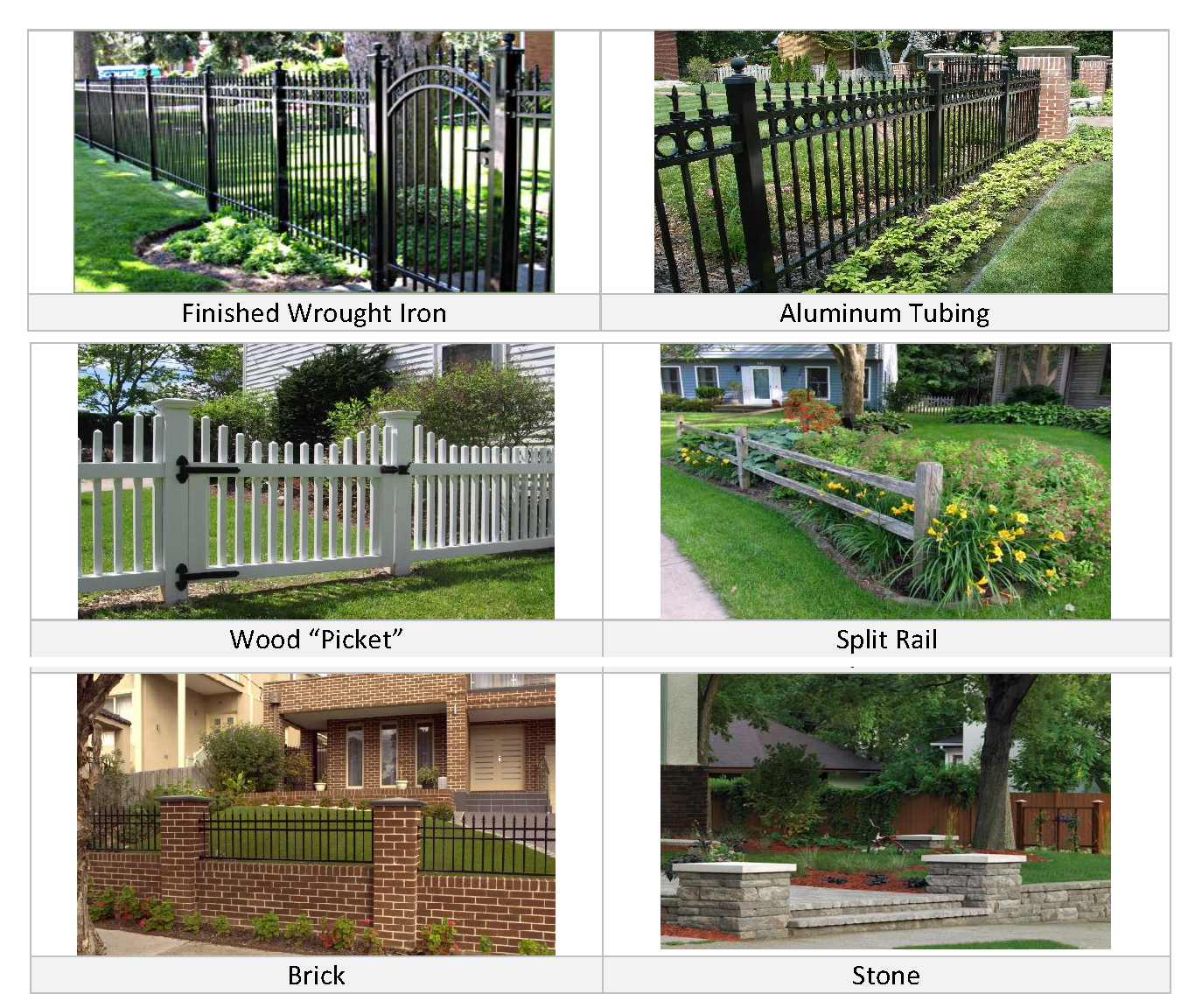
Finished wrought iron, aluminum tubing, wood "picket" fencing, split rail, brick, stone, or are constructed with similar decorative materials and design as approved by the planning department or planning commission.
ii.
The equivalent to the above or compatible with the design, architecture, and building materials in the neighborhood.
iii.
See Figure 2 below.
Figure 2: Permitted Fence Style Examples (Wrought Iron, Aluminum Tubing, Wood "Picket",
Split Rail, Brick, and Stone)
D.
For lots of two acres or greater, the fence may be up to 60 inches in height. In addition to the fence styles listed above (subsection (a)2.C, above), the fence may be "ranch style."
i.
Ranch style fences shall be constructed of treated wood, vinyl, or an equivalent material.
ii.
See Figure 3 below.
Figure 3: Permitted Fence Style Examples ("Ranch Style" and Wire Exception)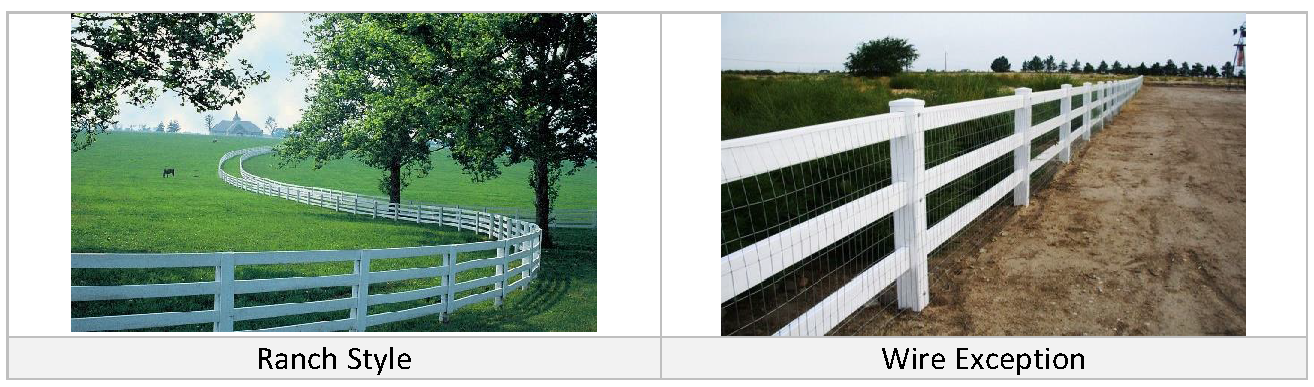
E.
The fence shall not encroach upon street right-of-way, including future/planned right-of-way. Under no circumstances, however, shall the fence be located any closer than ten feet to the edge of pavement of the street.
3.
Fences located in the front yard of interior, corner, and double frontage lots, including alley lots:
A.
Fences shall not be located any closer to the lot line than the home, except as provided below.
B.
For lots less than two acres in size, the setback restriction previously specified (subsection (a)2.A, above) is reduced to zero feet for fences which do not exceed 42 inches in height and are constructed of the following materials:
i.
Finished wrought iron, aluminum tubing, wood "picket" fencing, split rail, brick, stone, or are constructed with similar decorative materials and design as approved by the planning department or planning commission.
ii.
The equivalent to the above or compatible with the design, architecture, and building materials in the neighborhood.
iii.
See Figure 2 above (subsection (a)2.C).
4.
For lots of two acres or greater, the fence may be up to 60 inches in height. In addition to the fence styles listed above (subsection (a)2.C), the fence may be "ranch style".
A.
Ranch style fences shall be constructed of treated wood, vinyl, or an equivalent material.
B.
See Figure 3 above (subsection (a)2.D).
5.
The fence shall not encroach upon street right-of-way, including future/planned right-of-way as specified by the City of Millersville. Under no circumstances, however, shall the fence be located any closer than ten feet to the edge of pavement of the street.
6.
Fences located in residential townhome, condominium, and apartment developments shall conform to the standards specified in subsection (a) above. In conjunction with site plan and design review approval for such developments, the developer may propose, and the planning commission may approve, standards which are tailored to the architecture and design of the particular development, provided such standards are consistent and equivalent to the standards above, as determined by the planning commission.
(b)
Fences in commercial districts.
1.
Fences are prohibited in the front or corner side yard unless approved by the planning commission in conjunction with a site plan and design review approval.
2.
Fences may not exceed eight feet in height except when required by subsection 90-144(10) (buffer yards) and 90-144(11) (screening requirements) to be a greater height.
3.
See subsection 90-144(10) (buffer yards) for fencing required to buffer residential uses.
4.
Fences in commercial and industrial developments shall conform to the standards specified above. In conjunction with site plan and design review approval for such developments, the developer may propose, and the planning commission may approve, standards which are tailored to the architecture and design of the particular development, provided such standards are consistent and equivalent as determined by the planning commission.
(c)
Fences for buffers and screening. Fencing shall be required for screening in accordance with subsection 90-144(10) (buffer yards) and 90-144(11) (screening requirements).
(d)
Fence construction and design requirement.
1.
The framing members of all board fences shall not be directly visible from the street on which it is located. Placement of the framing members of board fences on the outside face of the fence directly visible from the street may be approved by the planning department if it is determined that it enhances the architectural character of the fence.
NOTE: There is no requirement to face framing members of board fences between adjoining properties that are not directly visible from the street.
2.
A fence or wall, including all posts, bases, and other structural parts shall be completely within the boundaries of the lot on which it is located.
3.
Fences shall only be constructed of the following materials:
A.
Treated wood, cedar, or redwood.
B.
Simulated wood, including vinyl-covered, synthetic composite, or equivalent.
C.
Decorative brick or stone.
D.
Wrought iron or aluminum designed to simulate wrought iron.
E.
Coated chain-link - brown, black, or green in color only.
F.
Any other combination of material which the planning department determines to be equivalent to the above in terms of quality and appearance.
G.
Wire fencing that is secondary in nature and located on the interior side of the fence (owner side) may be allowed in combination with any fence that would otherwise meet the above material requirements (ex. Horse wire fencing fastened behind a three- or four-rail wood fence). In no instance, however, shall wire fencing of any type be allowed as the primary fencing material. See Figure 3 above.
H.
See Figure 4 below.
Figure 4: Permitted Fence Styles (Treated Wood, Vinyl, Wrought Iron/Simulated Wrought
Iron, Coated Chain Link)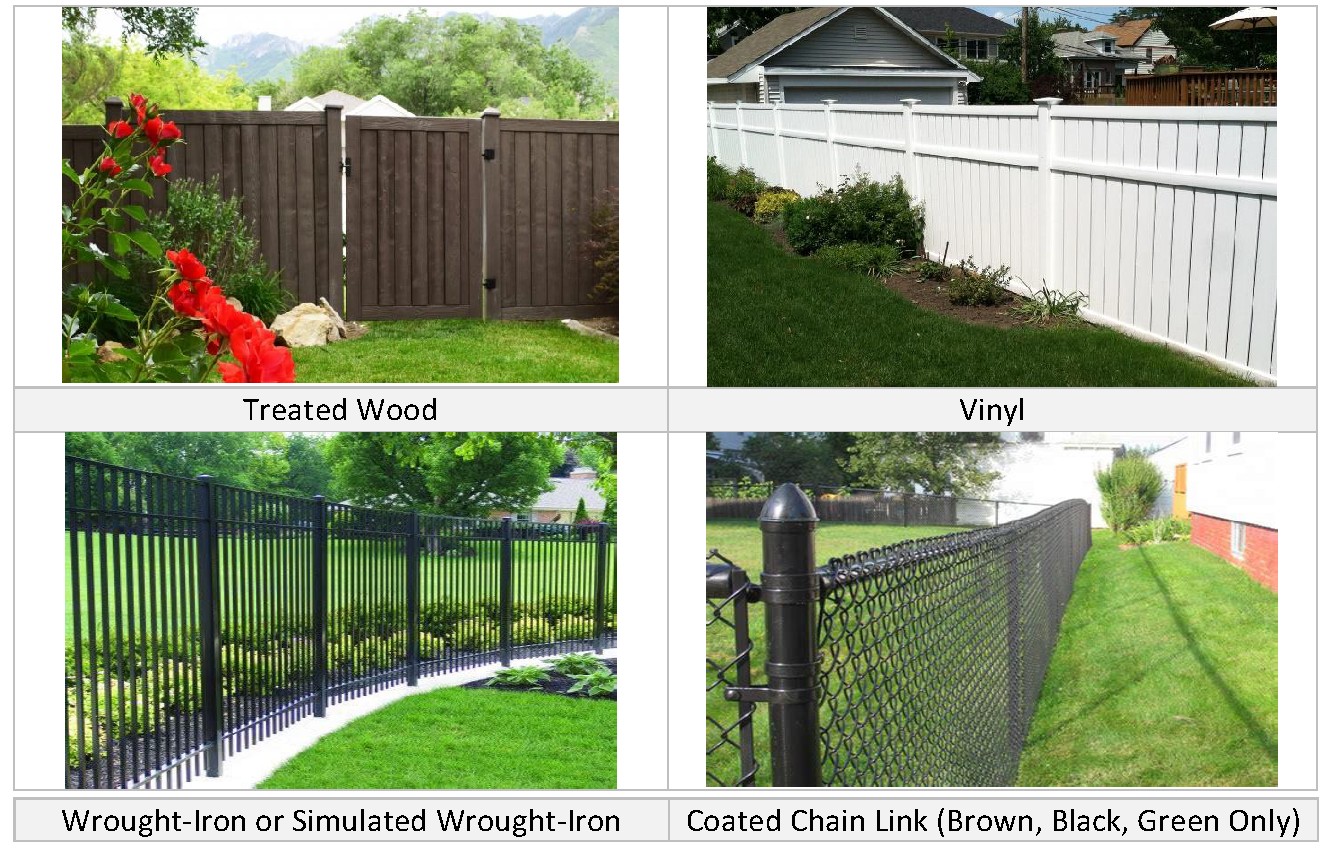
(e)
Nonconforming fences. Existing fences which are an existing legal nonconforming structure may be repaired or reconstructed. However, any change to fence style or material, height, or length shall not be permitted without approval of the planning department in the form of staff-approved site plan and design review (see chapter 90-224 nonconforming structure guidelines).
(10)
Home occupations.
(a)
General. The following standards are intended to ensure that home occupations, conducted in a dwelling, are compatible with the neighborhoods in which they are located and do not interfere with the rights of the surrounding property owners to enjoy the established character of the neighborhood.
(b)
Minor home occupation. A minor home occupation is permitted by right provided a minor home occupation permit is secured and renewed every two years. A minor home occupation shall meet the following requirements and limitations:
1.
The minor home occupation shall be conducted entirely within the dwelling and shall be clearly secondary to the use of the dwelling for residential purposes. The dwelling is considered to be the house and any attached garage and any addition to the house but does not include a detached garage or building.
2.
Use of a detached accessory building for minor home occupation purposes is prohibited.
3.
A minor home occupation shall not exceed 25 percent of the total floor area of the principal building.
4.
A minor home occupation shall not be established prior to the member(s) of the family conducting the minor home occupation taking possession of, and residing in, the dwelling.
5.
No person other than a family member residing on the premises shall be employed as part of a minor home occupation unless such employee(s) works off-premises. No contractor, contract employee, consultant, associate, or any other person associated with the business shall be on the premises for purposes of conducting business.
6.
There shall be no customers, clients, or the like on the premises of a minor home occupation.
7.
There shall be no more than one commercial vehicle on the premises. This includes cars, trucks, vans, and trailers with the business name and logo. They may be loaded with the tools of the trade and merchandise. Wreckers are prohibited. See also subsection (15) (parking) of this section for limits on length of vehicles and trailers. Vehicles shall not be parked on the street. If parked in the front yard, it must be parked in the driveway.
8.
The receipt, sale, or shipment of deliveries shall not be permitted on or from the premises, with the exception of regular U.S. mail and/or an express shipping service that is characteristic of service to residential neighborhoods.
9.
The minor home occupation shall not change the fire rating of the structure.
10.
The minor home occupation shall not generate noise, solid waste, vibration, glare, fumes, odors, or electrical interference beyond what normally occurs in a residential use.
11.
No outdoor storage or display of materials, merchandise, inventory, heavy equipment, or anything associated with the minor home occupation shall be permitted.
12.
No exterior alteration that changes the residential character of the principal building shall be permitted. No exterior building signs shall be permitted unless authorized by article XIII (signs).
13.
Any type of motor vehicle service and repair is a prohibited minor home occupation. Day care homes are not considered a home occupation. (See section 90-123.)
14.
A minor home occupation permit is required prior to starting the minor home occupation. This permit must be renewed every two years.
(c)
Major home occupation. A major home occupation is allowed only with the approval of the board of zoning appeals. Such approval shall follow the process of a conditional use permit and the duration of the permit shall be specifically determined. A major home occupation shall meet the following requirements and limitations:
1.
The major home occupation shall be conducted entirely within the dwelling and shall be clearly secondary to the use of the dwelling for residential purposes. The dwelling is considered to be the house and any attached garage and any addition to the house, but not a detached garage or building. However, a major home occupation may be conducted within a detached garage or building with the approval of the board of zoning appeals.
2.
The major home occupation shall not exceed 25 percent of the total floor area of the principal building.
3.
A major home occupation shall not be established prior to the member(s) of the family conducting the major home occupation taking possession of, and residing in, the dwelling.
4.
A major home occupation may include two employees, contractors, or others as listed above who do not reside on the premises and provided they are not on the premises between the hours of 10:00 p.m. and 7:00 a.m. The board of zoning appeals may, with the approval of the major home occupation conditional use permit, further restrict the number of employees and the hours of operation.
5.
A major home occupation may have no more than two customers or other persons other than employees on the premises at one time and not more than eight per day and provided they are not on the premises between the hours of 10:00 p.m. and 7:00 a.m. The board of appeals, with the approval of the major home occupation conditional use permit, may further restrict the number of customers and the hours of operations.
6.
There shall be no more than one commercial vehicle on the premises. This includes cars, trucks, vans, and trailers with the business name and logo. They may be loaded with the tools of the trade and merchandise. Wreckers are prohibited. See also subsection (16) below, (parking) for limits on length of vehicles and trailers. Vehicles shall not be parked on the street. If parked in the front yard, it must be parked in the driveway.
7.
The receipt, sale, or shipment of deliveries shall not be permitted on or from the premises, with the exception of regular U.S. mail and/or an express shipping service that is characteristic of service to residential neighborhoods.
8.
The major home occupation shall not change the fire rating of the structure.
9.
A major home occupation shall not generate noise, solid waste, vibration, glare, fumes, odors, or electrical interference beyond what normally occurs in a residential use.
10.
No outside storage or display of materials, merchandise, inventory, heavy equipment, or anything associated with the major home occupation shall be permitted.
11.
No exterior alteration that changes the residential character of the principal building shall be permitted. No exterior building signs shall be permitted unless authorized by article XIII (signs).
12.
Any type of motor vehicle service and repair is a prohibited major home occupation. Day care homes are not considered a home occupation (see subsection 90-123(3)).
(11)
Mechanical equipment.
(a)
In all districts, all ground-based mechanical equipment including, but not limited to, heating, ventilating, and air-conditioning (HVAC) units and sewer grinder pumps, may encroach into one required side yard up to 70 percent of the width of the required yard, into the required front and side street yard up to 20 percent of the width of the required yard, and into the required rear yard up to 50 percent) of the width of the required yard. Existing HVAC units and other mechanical equipment may be replaced in the same existing nonconforming location, as long as the units do not increase the extent or degree of nonconformity, with respect to the minimum required yard by more than 25 percent.
(b)
Any HVAC units located on the roof of any structure in any zoning district shall be screened by an architectural feature forming an integral part of the building. (See subsection 90-173(6)(f)1.)
(12)
Outdoor restaurant seating. Outdoor restaurant seating is considered an accessory use to a restaurant.
(a)
Outdoor restaurant seating shall be subject to staff-level site plan/ design review.
(b)
Outdoor restaurant seating shall not interfere with the use of parking spaces and aisles.
(c)
Outdoor restaurant seating shall not be located in any required yard that abuts a residential use or district, unless an alley or street is located between the use and a residential use or district.
(d)
No additional parking spaces shall be required for the first 20 outdoor restaurant seats. One parking space shall be provided for each four seats and above 20 provided outdoor restaurant seats.
EXAMPLE: Five, eight, or 20 outdoor seats would require no additional parking, but 26 outdoor seats would require one additional parking space and 36 outdoor seats would require three additional parking spaces.
(13)
Outdoor display. Outdoor display may be allowed as an accessory use for all retail uses, motor vehicle rental, motor vehicle service station/fuel center, and heavy retail and rental. It is the intent of this article to allow the display of merchandise for sale, but not where the display of such items impedes the flow of pedestrian or vehicular traffic, or creates an unsafe condition. The outdoor display of goods shall meet all of the following standards:
(a)
Outdoor display areas shall be depicted upon the site plan for a new retail and wholesale buildings.
(b)
All outdoor display of goods in front of the building or between the building and any side street shall be located immediately adjacent to the storefront and within 20 feet of the building and not in drive aisles, loading zones, fire lanes, or parking lots.
(c)
All outdoor display beside and behind the building shall not be located within the required side or rear yards and shall not exceed 40 percent of the combined required and non-required yards.
(d)
Outdoor display areas shall be limited to no more than one-half of the length of the store front.
(e)
In the case of a shopping center, the storefront shall include the entire frontage of the shopping center façade, meaning that the total amount of display for all the in-line tenants combined shall not exceed 50 percent of the aggregate store front of the total shopping center.
(f)
The outdoor display area shall take place on an improved surface such as the sidewalk or pavement.
(g)
At least five feet along the parking lot side of the display shall be maintained free of obstruction to allow for pedestrian and handicap movement, such that handicapped pedestrians and others do not have to enter the parking lot or drive aisle to walk around the display.
(h)
Any proposed display which does not conform to the above standards may be approved by the planning commission in the form of site plan and design review approval.
(i)
The outdoor display of cars, trucks, trailers, boats, recreational vehicles, farm equipment, construction equipment, motorcycles, landscape materials, and similar items for sale or rent which are customarily displayed outdoors shall be exempt from the above standards provided they are located out of the street right-of-way and at least 20 feet from the edge of pavement of the adjoining street(s).
(j)
See subsection 90-126(3)(e) (sidewalk and other outdoor sales).
(14)
Outdoor storage. Outdoor storage of materials used by the principal business on the site may be allowed as an accessory use in accordance with the following standards:
(a)
Each outdoor storage area shall be located at the side or rear of the principal structure.
(b)
Each outdoor storage shall be screened in accordance with subsection 90-144(11)(c) (screening requirements, outdoor storage areas).
(c)
For the purpose of this article, the parking of vehicles, trucks, and trailers associated with the business is not considered storage.
(d)
Any proposed storage which would not conform to these standards may be approved by the planning commission in the form of site plan and design review approval.
(e)
Storage within over-the-road trailers, freight containers, and similar structures are prohibited in all zones except as allowed on a temporary basis by subsection 90-126(3)(j) (temporary uses).
(f)
Where there is no principal building on the site, storage is a principal use, and, as such shall be subject to site plan and design review approval.
(15)
Parking.
(a)
Off-street parking and loading are permitted as an accessory use. Requirements and standards are contained in section 90-142 (outdoor parking and loading) which specifies the minimum number of parking spaces required for each required for each land use classification. Parking lot design standards are also included as well as standards for off-street loading.
(b)
The parking of the following commercial vehicles and/or trailers is permitted as a residential accessory use:
1.
One commercial vehicle not exceeding 22 feet in length or eight feet in height, or,
2.
One commercial vehicle and attached trailer not exceeding 30 feet in length or eight feet in height,
3.
One detached trailer, not attached to a vehicle not exceeding 18 feet in length or four feet in height.
These vehicles and trailers shall not be parked on the street or between the street or side street and residence except in a paved driveway.
Specifically prohibited are semi-tractor trailers and dump trucks.
Heavy construction equipment is also prohibited in residential zones. This includes bulldozers, end loaders, backhoes, and similar equipment.
The above standards shall not preclude temporary parking in connection with commercial service, sales and delivery, or construction projects.
(c)
The parking and storage of recreational vehicles, campers, travel trailers, motor homes, boats, boat trailers, and similar items are permitted as a residential accessory use provided they are not parked on the street or in the required front and corner side yards for more than three days per calendar month except in the driveway. Furthermore, not more than one shall be parked between the house and the street or any side street, even if parked in a driveway.
No recreational vehicle, camper, travel trailer, motor home or the like shall be used for living, sleeping, or housekeeping purposes except for visitors for not more than two weeks per calendar year.
(16)
Pets, poultry, and other animals. The following pets, poultry, and other animals are permitted as an accessory use in the zones specified. Where a maximum number of such animals is specified based on lot area, this number is the collective maximum number allowed for all such animals on the lot.
(a)
Dogs, cats, and rabbits are allowed as a residential accessory use in all zones under the following conditions:
1.
One per 3,000 square feet of lot area.
2.
Subject to Animal Control Ordinance.
(b)
Chickens, ducks, and similar fowl are allowed as a residential accessory use in RR, ER, SR-1, SR-2, and zones under the following conditions:
1.
One per 10,000 square feet of lot area.
2.
Shall be fenced in rear yard.
3.
No roosters.
4.
Shall be located at least 15 feet from all property lines except where adjacent to other such animals.
(c)
Pot-bell pigs, pygmy goats, and similar animals are permitted in RR, ER, SR-1, and SR-2 zones under the following conditions:
1.
One per 10,000 square feet of lot area.
2.
Shall be fenced in the rear yard.
3.
Shall be located at least 15 from all property lines except where adjacent to other such animals.
(d)
Horses, ponies, goats, and similar large animals are permitted in RR, ER, and SR-1 zones under the following conditions:
1.
One per 30,000 square feet of lot area.
2.
Shall be kept in a stable or within a fenced area or otherwise secured behind the house or beside the house. On a corner lot, the animal(s) shall not be kept in the area between the house and the side street.
3.
Shall be located at least 50 feet from all property lines except where adjacent to other such animals.
(e)
Exotic animals are allowed as a residential accessory use in RR, ER, SR-1, and SR-2 zones under the following conditions:
1.
One per 20,000 square feet of lot area.
2.
The animals are confined at all times.
(f)
Beehives (colonies) are allowed as a residential accessory use in RR, ER, and SR-1 zones under the following conditions:
1.
One beehive colony per 5,000 square feet of lot area.
2.
Conformance with state law (see TN Department of Agriculture).
3.
Must be located in the rear lot area and no closer than 20 feet to any property line.
4.
Must have a fresh water and mineral water source on site for the colony.
(g)
Breeding and raising of animals for sale in a residential zone is prohibited except for one litter per parcel per year. The restriction on the maximum number of animals per square foot of lot area shall not apply to the litter for a period of eight weeks following birth.
(h)
Livestock and all other animal keeping and raising is restricted to RR and ER zones on parcels of land containing a minimum of ten acres.
(17)
Porches.
(a)
Unenclosed porches, with roof, columns, and rails only, may encroach eight feet into any front, corner side, or rear yard, but shall not encroach into any existing or proposed utility or drainage easements.
(b)
Enclosed, or partially enclosed porches, with roof, columns and any type of continuous wall including screens, must meet all setback requirements.
(c)
Steps and stoops are not considered porches. Existing stoops, as of the date of adoption of this article, located in the interior side yard, shall be considered conforming uses and may be repaired or replaced.
(18)
Production of goods at a retail business and restaurant. Production of goods for sale by a firm engaged in a permitted principal commercial activity on the same zone lot is permitted as an accessory use, but only if:
(a)
At least 50 percent of all goods so produced are sold on premises and must be sold by the same firm.
(b)
Such production does not occupy more than 49 percent of the total floor area.
(c)
Such production does not in any case occupy more than 2,000 square feet of such floor area.
(d)
Such production may only be permitted in an enclosed building.
(19)
Retaining walls.
(a)
If the face of a new building is within five feet of a retaining wall, the height of the retaining wall shall be included in the building height calculation. The combination of the retaining wall height and the remainder of the building height above the wall shall not exceed the maximum building height limitation.
(b)
Retaining walls greater than five feet in height must be located at least five feet from any property line.
(20)
Satellite dish antennas.
(a)
Satellite dish antennas shall be permanently installed on a building, in the ground, or on a foundation.
(b)
Subject to operational requirements, the dish color shall be of a neutral color, such as white or grey, and shall blend with the surroundings as best as possible. No additional signs or advertising shall be permitted on satellite dish itself, aside from the logos of the satellite dish service provider or dish manufacturer.
(c)
Cables and lines serving ground-mounted satellite dish antennas shall be located underground and/or along the wall or roof of the building to which it is attached.
(d)
Compliance with all federal, state, and local regulations shall be required in the construction, installation, and operation of satellite dish antennas.
(e)
All exposed surfaces of the antenna shall be kept clean and all supports shall be painted to maintain a well-kept appearance. Antennas no longer in use must be removed.
(f)
Satellite dish antenna greater than one meter in diameter shall be located in the rear or interior side yard, and shall be set back a distance from all lot lines that is at least equal to the height of the dish, but in no case less than five feet from any lot line.
(21)
Signs. See article XIII.
(22)
Solar panels.
(a)
One- and two-family residential. Solar panels are allowed as an accessory use at one and family residences on the roof of the residence and accessory buildings and as free-standing structures in the rear yard. A zoning permit is required prior to erecting the panels.
(b)
Multifamily residential and institutional. Solar panels are allowed as an accessory use at townhome and multi-family residential buildings and institutional buildings in residential zones, provided the panels are located on the roof of the buildings, including garages, carports, and other accessory buildings.
NOTE: Garages, carports, and other accessory buildings at townhome and multifamily residential and institutional developments are subject to site plan and design review approval. As such, landscaping and screening are required as per section 90-144 (landscaping, screening, and tree preservation). Refer to these chapters.
(c)
Commercial and industrial districts. Solar panels are allowed as an accessory use in commercial and industrial districts provided the panels are placed on the roof of the principal or accessory buildings. See subsection 90-173(6)((h) for design standards for canopies and carports on which solar panels may be placed in commercial districts. See subsection 90-174(5)(h) for industrial district standards. Solar panels may be freestanding in commercial and industrial districts if located behind the principal building(s) and not visible from any public streets or surrounding property. Screening may be provided as per subsection 90-144(11)(c) to block visibility.
(23)
Swimming pools and hot tubs.
(a)
Location.
1.
Swimming pools and hot tubs and any related equipment are permitted within the rear yard and must be located at least five feet from any lot line.
Measurement shall be from the lot line to the nearest part of the pool, excluding apron and deck. Pools shall not be located on any easement. This includes the apron and deck.
2.
Swimming pools and hot tubs may be located between the house and the front lot line or the corner street lot line provided they do not encroach into the required yard setbacks and provided they are screened from view from the street(s) with evergreen landscaping. Landscaping shall be sufficient in height and spacing to block 90 percent of the view from the street(s) or enclosed with a wall, six feet in height minimum, which is constructed of the same materials as the house and which are otherwise architecturally consistent with the house. Plans drawn up by a licensed architect must be submitted to and approved by the planning department prior to the issuance of the zoning permit. This screening shall be maintained as long as the pool or hot tub is in place.
3.
A zoning permit must be secured prior to commencement of construction.
(b)
Walkways. A grade-level walkway or deck surrounding the pool or hot tub must be located at least five feet from any lot line in the rear yard.
A pool walkway or deck elevated one foot of more above grade must be located at least ten feet from any lot line in the rear yard.
(c)
Fencing. All pools and hot tubs shall be enclosed by a fence conforming to the requirement of subsection 90-124(9) (fences) of this article, the city's pool code, and any other law.
(Ord. No. 20-744, § 10.4, 6-1-2020)
Sec. 90-125. - Permitted encroachments and height exceptions.
(1)
Permitted encroachments into required yards. An encroachment is the extension or placement of any structure or building, or component of such, into a required yard setback. Additional restrictions on permitted encroachments, including additional setback requirements and bulk regulations, can be found in section 90-124 (accessory uses) above and are referenced within the following table. Permitted encroachments are found in Table 11 (Permitted Encroachments).
(2)
Permitted exceptions from height limitations. The height limitations specified by Tables 4, 6, 9, and 10 shall not apply to water tanks installed by a state regulated water utility district or telecommunication towers as regulated by article XV (wireless telecommunications facilities and towers). Church steeples, spires, chimneys, and similar structures are exempt provided they do not exceed 80 feet in height as measured from the ground.
(Ord. No. 20-744, 6-1-2020)
Sec. 90-126. - Temporary uses and structures.
(1)
Temporary use and structure permit application.
(a)
Unless specifically exempt below, any person, firm, or corporation desiring to conduct a temporary use within the City of Millersville shall first obtain a temporary use permit. Such person, firm, or corporation shall file a written application with the planning department on a form provided by the city, together with an application fee as required by separate ordinance. For any event not conducted by the owners of the property where the temporary use is to occur, a letter from the property owner granting permission to conduct the event shall be provided. A permit is not required for temporary uses to be conducted on city property, provided such use has been approved by the appropriate city official and provided the temporary use complies with all other provisions of this article.
(b)
The planning department shall grant temporary use permits for those uses listed below so long as it is determined that the proposed use, including the erection of any temporary building or structure, complies with the requirements of this article and this article. Unless expressly provided in this article, every temporary use shall comply with the bulk requirements applicable in the district in which the temporary use is located.
(c)
Temporary uses not specifically listed herein shall require the specific approval of the planning commission. The process for approval shall be the same as for a site plan, except that the submittal items shall conform to the requirements for a staff approved site plan. Such uses may be allowed in any zoning district, provided that such temporary use is consistent with the purpose and intent of this article and the zoning district in which it is located.
(d)
Every temporary use shall comply with this article and all local regulations. The planning department may impose other conditions, as part of this temporary use permit approval, as necessary to achieve the purposes of this article, and to protect the public health, safety, comfort, convenience, and general welfare. No temporary use shall be permitted in any district if it would have a significant negative impact on any adjacent property or on the area as a whole.
(2)
General provisions. Only those temporary uses as defined in article XVI (definitions) and as specified below are allowed in Millersville. Every temporary use shall comply with all the requirements listed below.
(a)
No temporary use shall be permitted that causes, or threatens to cause, an on-site or off-site threat to the public health, safety, comfort, convenience, and general welfare.
(b)
Every temporary use shall be operated in accordance with such restrictions and conditions as the fire, police, and codes departments may require. If required by the city, the operator of the temporary use shall employ appropriate security personnel.
(c)
No temporary use shall be permitted if the additional vehicular traffic reasonably expected to be generated by such would have undue detrimental effects on surrounding streets and uses.
(d)
No temporary use shall be permitted on any site without adequate all-weather, dust-free, off-street parking sufficient to meet the demands of the temporary use. No temporary use shall be authorized that would unreasonably reduce the amount of parking spaces available for use in connection with permanent uses located on the lot in question. Adequate drive aisles and fire lanes shall be provided. The planning department may make an assessment of the total number of parking spaces that will be reasonably required in connection with a proposed temporary use, on the basis of the particular use, its intensity and the availability of other parking facilities in the area. The planning department shall approve such temporary use only if such parking spaces are provided.
(e)
No temporary use shall be permitted if such use would conflict with another previously authorized temporary use.
(f)
Signs shall be permitted only in accordance with article XIII (sign standards).
(g)
Temporary structures, including tents, vendor carts and kiosks, portable buildings, trailers, over-the-road trailers, freight containers, recreational vehicles and mobile homes, used in conjunction with the temporary uses listed below are permitted as stated below, otherwise they are prohibited. All temporary structures are subject to being inspected for compliance with all applicable fire, life safety, building, electrical, and related codes.
(h)
The operation of all temporary uses shall be subject to the Millersville Noise Ordinance.
(i)
All temporary uses shall comply with all applicable local, county, and state environmental, solid waste disposal and sanitary waste disposal regulations. Any required health department certificate shall be plainly displayed.
(j)
Temporary uses which require use of public right-of-way, parks, or other public property shall first secure approval of the appropriate city representative. All such uses shall be coordinated with the appropriate city, county, and state officials.
(k)
Trash generated by the temporary use shall be removed daily.
(l)
Any required business license shall be obtained.
(3)
Permitted temporary uses.
(a)
Carnivals, circuses, and haunted houses. Carnivals, circuses, and haunted houses are allowed in all commercial zoning districts, except O, and NC, and in all industrial districts. Carnivals include pony rides. These uses shall be evaluated on the basis of the adequacy of the parcel size, parking provisions, traffic, access, and the absence of undue adverse impact, including noise, on other properties. Temporary structures may be used, provided they conform to all applicable laws. These uses need not comply with the yard requirements and the maximum height requirements of this article. The concessionaire responsible for the operation of any such use shall:
1.
Submit, in advance of the event, a site layout displaying adequate ingress and egress routes for emergency vehicles, with no dead-end aisles.
2.
Comply with all local regulations.
3.
Provide refuse containers in the number and locations required by the city. All containers shall be properly serviced.
4.
Provide for thorough clean-up of the site at the completion of the event.
5.
Provide proof that all amusement devices have been state inspected, if required.
6.
Upon written notice from the city, immediately stop the use of any amusement device or structure found by the city to pose a threat to the public safety.
7.
Provide a $5,000.00 surety conforming to the requirements of section 90-50(5) of this article. Pony rides are exempt from this requirement.
8.
Carnivals and circuses must cease operation and completely clear and clear the site within 15 days of first occupying the site. Haunted houses have 45 days.
9.
Only operate one such event per zone lot per 12-month period, with exception of pony rides which may operate up to four times per parcel per 12-month period.
10.
Limit operation of the event to between the hours of 8:00 a.m. and 11:00 p.m.
(b)
Christmas tree, pumpkin, and plant sales. Christmas tree, pumpkin, and plant sales are allowed in commercial zoning districts. Plants include seasonal flowers and potted plants, not shrubs and trees other than Christmas trees. These uses shall be evaluated based on the adequacy of the parcel size, parking provisions, traffic, access, and the absence of undue adverse impact on other properties. Tents, trailers, and recreational vehicles may be used, provided they conform with all applicable laws. Each sale shall be limited to a period not to exceed 45 consecutive days. There shall be no more than two such sales per parcel per 12-month period.
(c)
Fireworks. Fireworks sales are prohibited in the city. Such sales are limited to 45 days prior to Christmas and July 4. Tents, over-the-roads trailers, freight containers, and recreational vehicles may be used, provided they conform to all applicable laws. Signs must conform to article XIII (sign standards).
(d)
Civic, non-profit, religious events, and festivals. Civic, non-profit and religious events, festivals, bazaars, bands, arts and crafts sales, fundraisers, car shows, farmers markets, and the like are allowed in commercial and industrial districts, property in residential districts in use as government and educational uses, religious uses, cultural uses, recreational and entertainment uses. These uses shall be evaluated based on the adequacy of the parcel size, parking provisions, traffic, access, and adverse impact on other properties. Tents, food trucks, and vendor carts and trailers may be used provided they conform to all applicable laws. Such events conducted in a residential zone are limited to a maximum of three consecutive days per event and not more than four such events per calendar year per parcel and the hours of operation are limited to 8:00 a.m. and 11:00 p.m. Such events conducted in nonresidential zones are limited to a maximum of ten consecutive days per event.
(e)
Sidewalk and other outdoor sales. Sidewalk and other outdoor sales for special sales events or other purposes are permitted in all commercial and industrial zones. They shall be in conjunction with, and clearly incidental to, an existing permanent on-site use and are permitted to display and sell only merchandise that is found in the on-site store. Tents and vendor carts and trailers may be used provided they are at least 20 feet from the street and otherwise conform to all applicable laws. No sidewalk/outdoor sale shall be permitted for a period of more than seven successive days and no more than six sales shall be permitted in any 12-month period. The above provisions do not preclude the outdoor storage and display of merchandise as permitted/regulated by section 90-124(13) and 90-124(14) of this article.
(f)
Mobile vendors. Mobile vendors, including the sale of prepared food, produce, and new merchandise from a cart, kiosk, or tent, which conform to all applicable laws, are permitted in all commercial districts. Mobile vendors operating in conjunction with other permitted temporary uses, i.e., carnivals, circuses, and civic, non-profit, religious events, and festivals, shall abide by the standards of such other temporary use rather than the standards of this subsection. Applications for mobile vendors shall be evaluated by the planning department based on the adequacy of the parking provisions, traffic, access, and impact on the neighborhood and compliance with the following required standards.
1.
The lot on which they are located must contain a minimum of one acre.
2.
The mobile vendor shall be a minimum of 100 feet from any public street.
3.
Must be at least 1,000 feet from any other vendor, except that group of not more than three mobile vendors located within 50 feet of each other shall be considered a single vendor in regard to the 1,000-foot separation requirement.
4.
Must be at least 1,000 feet from a permanent business which sells the same items unless notarized permission is obtained in writing from the permanent business agreeing to the mobile vendor to be closer than 1,000 feet. (See appendix E: Consent for property use for mobile vendor.)
5.
No lot or parcel may be occupied by a mobile vendor or group of three vendors for more than six one-week periods during the calendar year. Periods may be consecutive. This time limitation shall not apply to a single vendor located within 20 feet of the principal building on the lot or parcel.
6.
Tables seating no more than eight persons may be provided for food vendors, provided trash receptacles are also provided and emptied as necessary to maintain a clean and sanitary site. All tables, chairs, and trash receptacles and other items associated with the operation shall be removed by the end of the period(s) specified in subsection (3)(f)5, above.
7.
Business license must be prominently displayed. Food vendors must also display the required health department food service permit.
8.
No mobile vendor may operate in a location that impedes the ingress to, egress from, or signage of another business or otherwise causes undue interference with access to other businesses or emergency areas, paths, or facilities.
9.
Mobile vendors may operate in city parks or on city-owned property with permission of the City of Millersville.
(g)
Temporary portable classrooms. Temporary portable classrooms are permitted at public and private primary and secondary schools. These classrooms shall not contain any sleeping or cooking accommodations. No portable building shall be used as an office. The portable classrooms must be of high quality and in good repair. Site plan approval is required.
(h)
Temporary construction offices. In any district, a temporary use permit may be issued for a trailer for a contractor's temporary office and equipment sheds incidental to a construction project. Such permit shall not be valid for more than one year but may be renewed for six-month extensions for a particular use granted. Such use shall be removed immediately upon expiration of the temporary use permit, whichever occurs sooner. These uses shall not contain any sleeping or cooking accommodations, except those located in a model unit for demonstration purposes only. No trailer, unit, or office shall be used as the general office or headquarters of any firm. All temporary construction offices and equipment sheds must be of high quality and in good repair.
(i)
Temporary offices. In any commercial or industrial district, a temporary use permit may be issued for a modular or manufactured building for temporary office use, such as hiring and pre-sales. This building must be placed on or adjacent to the site where the permanent building for this business or industry is being constructed. The permanent building must be substantially complete. Temporary offices must be of high quality and in good repair. Vehicular and emergency vehicle access to the office must be complete as well as adequate parking. The permit shall not exceed 90 days unless approved by the planning department director.
(j)
Temporary storage within over-the-road trailers or freight containers.
1.
Storage within over-the-road trailers or freight containers shall not exceed 90 days within a 12-month period in all commercial districts and industrial districts. At the end of the 90 days, any trailers shall be totally removed from the premises or location where the storage occurred. Storage is not allowed within visibility of a public street or residential neighborhood. A temporary use permit is required.
2.
The temporary storage of two portable containers, not exceeding a total of 2,000 cubic feet, are permitted within all residential zoning districts for a maximum of 90 days in a one-year period. An extension of an additional 30 days may be granted by the planning director. Requests for longer periods of time shall require the approval of a conditional use permit by the board of zoning appeals. Portable containers shall not be allowed to be placed on sidewalks, roadways, and public right-of-way.
(k)
Model homes, subdivision/builder information, and sales office. In any residential district, a temporary use permit may be issued by the planning department to allow the use of a dwelling unit or club house as a model home and/or subdivision and/or building information and sales office. This permit may be modified to reflect moving the model home or information and sales office to a new location in the same subdivision. Said use shall be discontinued when all homes in the subdivision, except the model, have been sold. All regulations pertaining to signs as contained in article XIII (sign standards) shall apply. Any parking lots or other parking areas, other than driveways and parking which are accessory to the dwelling, shall require the submittal of a site plan for review and approval of the planning department staff. A modular or manufactured building may be approved by the planning department until a dwelling or the club house is complete.
(l)
Garage sales. Garage, yard, estate, and home sales are allowed in any yard, garage, carport, driveway, or in the home in any district operated by the owner or occupant of the dwelling unit where the sale is being conducted. These uses shall be limited to a period not to exceed three consecutive days and no more than three sales shall be conducted from the same residence in any 12-month period. Such sales are exempt from permit and parking requirements. All items associated with a sale must be removed from all yards, carports, and other areas visible from any property line within three days of conclusion of each sale. A permit shall be obtained from the City of Millersville at least three days prior to the first date of the sale.
(Ord. No. 20-744, 6-1-2020)

