
Millington City Zoning Code
ARTICLE IV
- GENERAL PROVISIONS
Sec. 36-400. - Introduction.
Wherever any provision of this chapter imposes more stringent requirements, regulations, restrictions or limitations than are imposed or required by the provisions of any other law or ordinance, then the provisions of this chapter shall govern. Whenever the provisions of any other law or ordinance impose more stringent requirements than are imposed or required by this chapter, then the provisions of such ordinance shall govern.
Sec. 36-401. - Effect of zoning.
No building or structure, or part of the building or structure, shall hereafter be erected, constructed or altered and maintained, and no new use or change shall be made or maintained of any building, structure or land, or part thereof, except in conformity with the provisions of this chapter.
Sec. 36-402. - Accessory buildings.
Accessory buildings, except as otherwise permitted in this chapter, shall be subject to the following regulations:
(1)
Where the accessory building is structurally attached to a main building, it shall be subject to, and must conform to, all regulations of this chapter applicable to the main building.
(2)
Detached buildings accessory to residential buildings shall not be erected in any required yard, except a rear yard.
(3)
Buildings accessory to residential buildings may not exceed the ground floor area of the main building.
(4)
No detached building accessory to a residential building shall be located closer than ten feet to any main building nor shall it be located closer than ten feet to any side or rear lot line. In those instances where the rear lot line is coterminous with an alley right-of-way, the accessory building shall not be closer than five feet to such rear lot line. In no instance shall an accessory building be located within a dedicated easement right-of-way. (See Figure 4-1) The side yard setback for accessory structures shall be the lesser of ten feet or the side yard setback for principal structures in those cases where the side yard setback has been reduced under the provisions of section 36-406.
Figure 4-1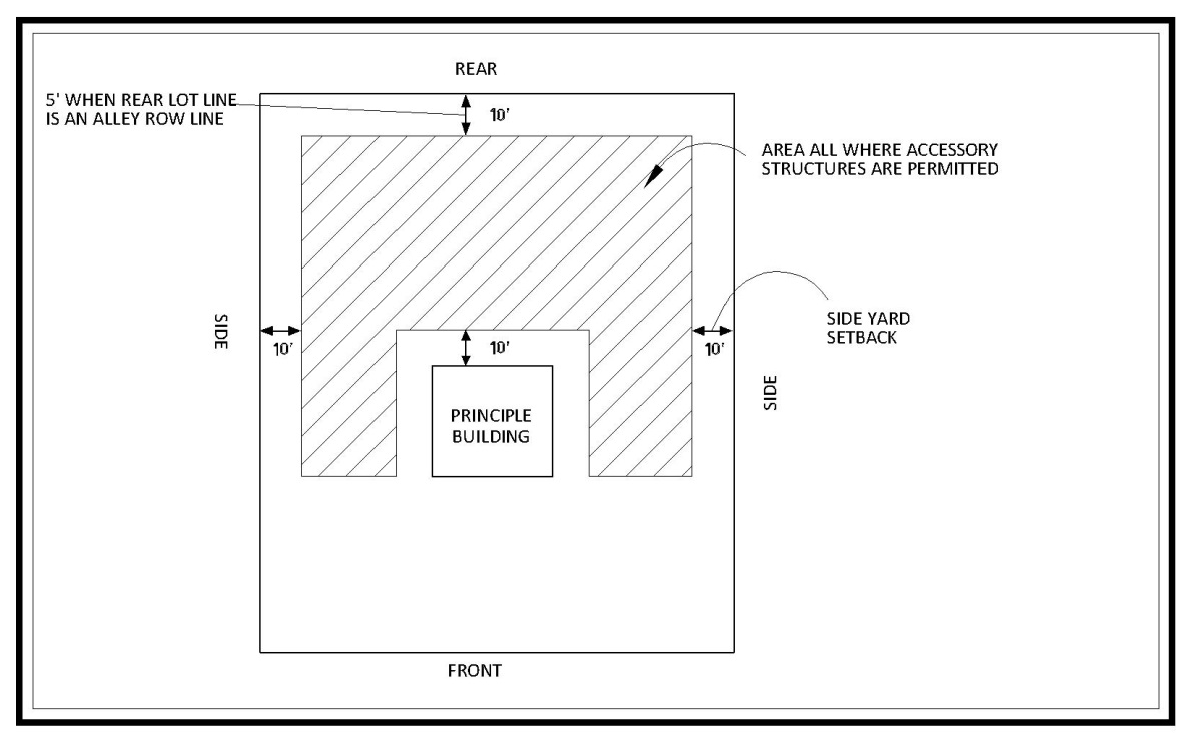
(5)
No detached accessory building in the R-1, or R-3 districts shall exceed one story or 16 feet in height (see Figure 2-2 for measuring building height). Accessory buildings in all other districts may be constructed to equal the permitted maximum height of structures in such districts, subject to the Planning Commission review and approval.
(6)
When a building accessory to a residential building is located on a corner lot, the side lot line of which is substantially a continuation of the front lot line of the lot to its rear, such building shall not project beyond the front yard setback required on the lot in the rear of such corner lot. A building accessory to a residential building shall in no case be located nearer than ten feet to a street right-of-way line. (See Figure 4-2).
Figure 4-2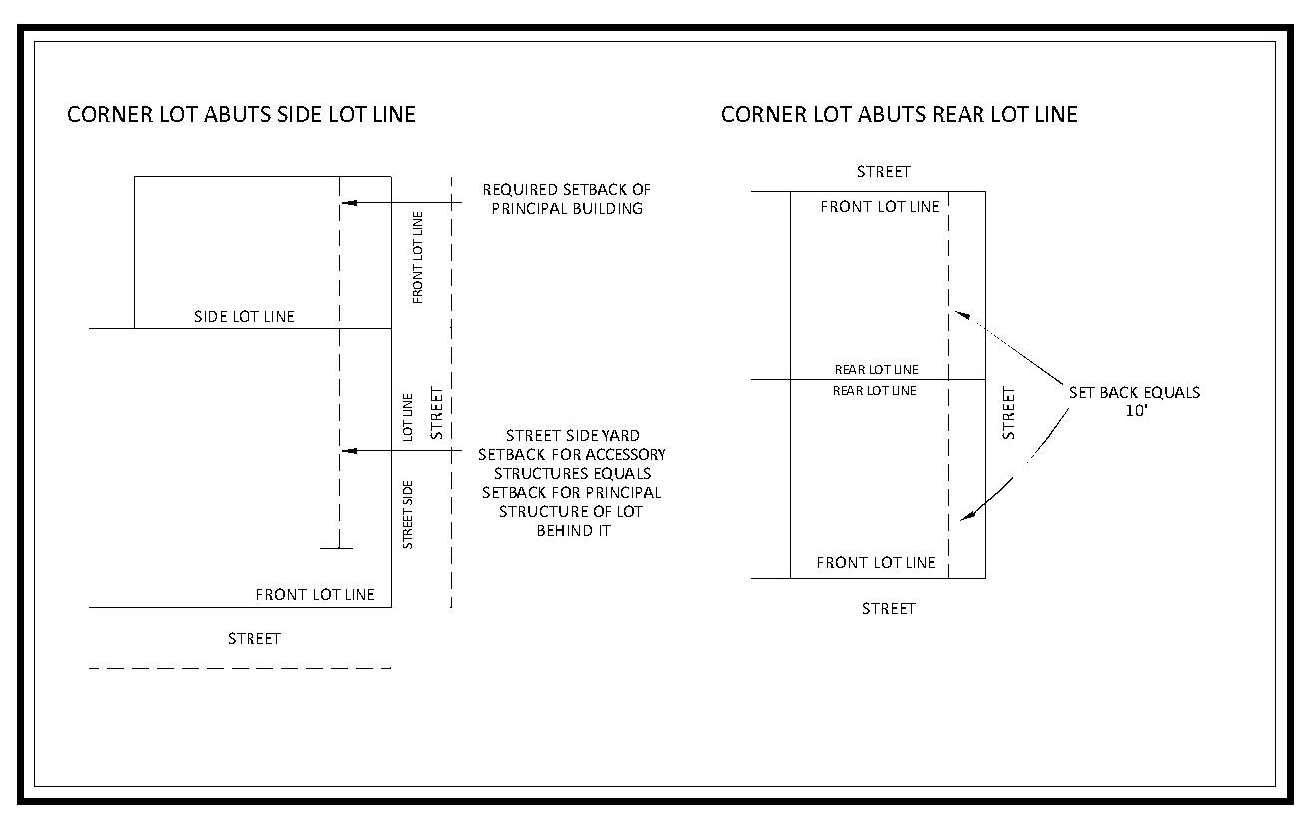
(7)
No accessory building or structure may be erected or used upon a lot on which there is no principal building, however an accessory building or structure may be erected in advance of the principal building by a special permit issued by the planning commission. If the planning commission approves the accessory building to be constructed prior to construction of the principal building, construction of the principal building must begin within 90 days of completion of the accessory building. A performance guarantee may be required to ensure completion of the principal building.
(8)
The combined maximum square footage of all accessory structures on a residential lot in the R-1 and R-3 zoning districts shall be 1,000 square feet. However, if the lot exceeds 12,000 square feet the combined maximum square footage may be increased by four percent of the lot area that the property exceeds 12,000 square feet. (For example; if a lot in the R-1 District is 30,000 square feet in area. 30,000 - 12,000 = 18,000. 18,000 *.04 = 720. The combined maximum square footage may be a maximum of 1,720 square feet). In no case shall the combined maximum square footage of accessory structures in the R-1 or R-3 district exceed 2,500 square feet. The maximum number of accessory buildings shall be limited to three in the R-1 district and R-3 districts. In any case the lot must still comply with the maximum lot coverage requirements in the R-1 and R-3 districts in Table 3-3. Schedule of regulations.
(9)
Accessory buildings. Accessory dwelling units (ADU's) are intended to provide flexible housing options in the village by allowing homeowners to establish a second dwelling unit on their property. ADU's are subject to the following standards:
a.
ADU's shall be limited to permitted districts and properties with a single-family dwelling unit as the principle use. ADU's shall be subordinate to the single-family dwelling unit.
b.
The owner of the property shall live on site, either in the principle dwelling unit or the accessory dwelling unit.
c.
ADU's shall have their own separate entrance, kitchen, sleeping area, and full bathroom facilities.
d.
ADU's may be attached to the single-family dwelling unit and may occupy a basement, ground floor or upper floor of the principle dwelling, or may occupy a separate, detached accessory building.
e.
All ADU's shall meet applicable building and fire codes.
f.
Building materials and designs used on detached ADU's or additions to the principle dwelling for an attached ADU, shall be of similar style as that of the principle dwelling.
g.
The minimum size living shall be 350 square feet.
h.
The maximum size shall not exceed 880 square feet, or the size of the principle dwelling unit, whichever is less.
(Ord. No. 108 , § 1, 12-14-2020)
Sec. 36-403. - Corner clearance.
In all districts, no fence, wall, shrubbery, sign or other obstruction to vision above a height of 30 inches from the established street grades shall be permitted within the triangular area formed at the intersection of any street right-of-way lines by a straight line drawn between such right-of-way lines at a distance along each line of 25 feet from their point of intersection or within ten feet of the point intersection of a street right-of-way line and the edge of a driveway. (See Figures 4-3 and 4-4).
Figure 4-3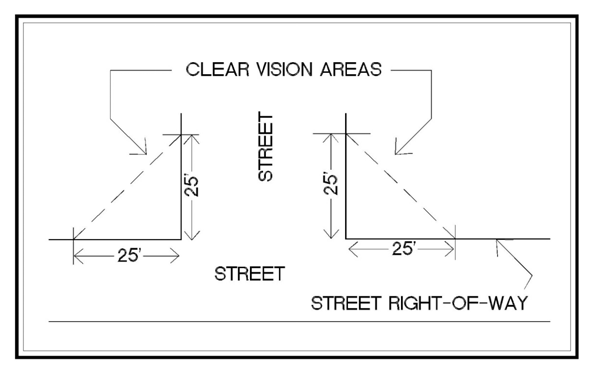
Figure 4-4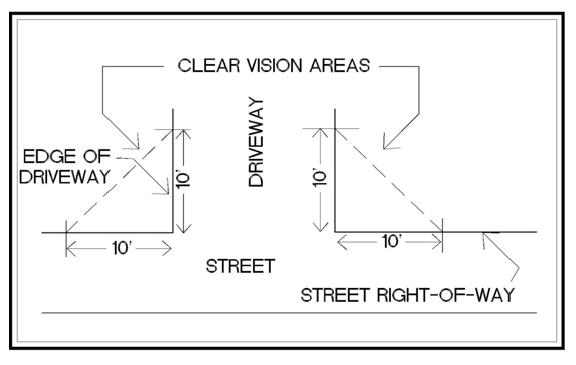
Sec. 36-404. - Exterior lighting.
All lighting for parking areas or for the external illumination of buildings and uses shall be directed from and shall be shielded from adjacent residential districts and shall also be so arranged as to not adversely affect driver visibility on adjacent thoroughfares. Use of cut-off fixtures to direct light towards the ground is required for all lighting for non-single family uses. No lighting may exceed .1 candle feet the property line of an adjacent residential lot.
Sec. 36-405. - General exceptions to area, height, and use.
(1)
Essential services. Essential services, as defined in article II, shall be permitted as authorized and regulated by law and other ordinances of the village. It is the intention of this article to exempt such essential services from the application of this chapter.
(2)
Voting place. The provisions of this chapter shall not be so construed as to interfere with the temporary use of any property as a voting place in connection with a municipal or other public election.
(3)
Height limit. The height limitations of this chapter shall not apply for farm buildings, chimneys, church spires, flagpoles, public monuments or wireless communication support structure and other communication towers; provided, however, that the planning commission may specify a height limit for any such structure when such structure requires authorization as a special exception use.
(4)
Lots adjoining alleys. In calculating the area of a lot that adjoins an alley or lane, for the purpose of applying lot area requirements of this chapter, one-half the width of such alley abutting the lot shall be considered as part of such lot.
(5)
Driveways, sidewalks, patios and terraces. For the purpose of this chapter, access drives may be placed in the required front or side yards so as to provide access to rear yards and/or accessory or attached structures. These drives shall not be considered as structural violations in front and side yards. Further, any walk, terrace or other pavement serving the like function, and not in excess of nine inches above the grade upon which placed, shall for the purpose of this chapter not be considered to be a structure, and shall be permitted in any required yards.
(6)
Side yard setbacks. When a legal non-conforming lot does not meet the minimum requirements for lot width in this chapter, the side yard setback requirements for that lot shall be reduced by a percentage equal the percentage the lot meets the minimum lot width requirement. For example a lot 80 feet wide in a district requiring a minimum width of 100 and a side yard setback of ten feet would have a side yard setback of eight feet. In no instance shall a side yard setback be reduced to less than five feet under the terms of this exception.
(7)
Front yard setbacks. The front yard setback of a lot on a block where 80 percent of the lots are built on may be reduced to the average setback of the existing buildings. (See Figure 4-5).
Figure 4-5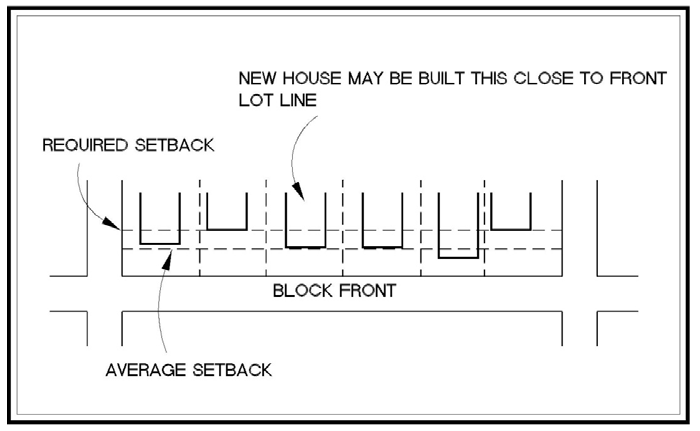
Sec. 36-406. - Performance standards.
No use otherwise allowed shall be permitted within any district which does not conform to the following standards of use, occupancy and operation, which standards are hereby established as the minimum requirements to be maintained within such area:
(1)
Smoke. It shall be unlawful for any person to cause or permit to be discharged into the atmosphere from any single source of emission, smoke of a density equal to or darker than No. 2 of the Ringelmann chart except:
(a)
Smoke of a density equal to but not darker than No. 2 on the Ringelmann chart may be emitted for not more than three minutes in any 30-minute period.
(b)
Smoke of a density equal to but not darker than No. 3 of the Ringelmann chart may be emitted for not more than three minutes in any 60-minute period, but such emissions shall not be permitted on more than three occasions during any 24-hour period.
Method of measurement: For the purpose of grading the density of smoke, the Ringelmann chart, as now published and used by the United States Bureau of Mines, which is hereby made a part of this chapter, shall be the standard. However, the umbrascope readings of smoke densities may be used when correlated with the Ringelmann chart.
(2)
Dust, dirt and fly ash. No person shall operate or cause to be operated, maintained or cause to be maintained, any process for any purpose, or furnace or combustion device for the burning of coal or other natural or synthetic fuels, without maintaining and operating, while using such process or furnace or combustion device, recognized and approved equipment means, methods, devices or contrivance to reduce the quantity of gasborne or airborne solids or fumes emitted into the open air, which is operated in conjunction with such process, furnace or combustion device so that the quantity of gasborne or airborne solids shall not exceed 0.20 grains per cubic foot of the carrying medium at a temperature of 500 degrees Fahrenheit.
Method of measurement: For the purpose of determining the adequacy of such devices, these conditions are to be conformed to when the percentage of excess air in the stack does not exceed 50 percent at full load. The foregoing requirement shall be measured by the ASME Test Code for dust-separating apparatus. All other forms of dust, dirt, and fly ash shall be completely eliminated insofar as escape or emission into the open air is concerned. The building inspector may require such additional data as is deemed necessary to show that adequate and approved provisions for the prevention and elimination of dust, dirt, and fly ash have been made.
(3)
Open storage. The open storage of any industrial equipment, vehicles, and all materials, including wastes, shall be screened from public view, from a public street and from adjoining properties by an enclosure consisting of a wall not less than the height of the equipment, vehicles, and materials stored. Whenever such open storage is adjacent to a residential zone in either a front, side, or rear lot line relationship, whether immediately abutting or across a right-of-way from such zone, there shall be provided an obscuring masonry wall or wood fence of at least six feet in height.
(4)
Glare and radioactive materials. Glare from any process (such as or similar to arc welding, or acetylene torch cutting) which emits harmful ultraviolet rays shall be performed in such a manner as not to be seen from any point beyond the property line, and as not to create a public nuisance or hazard along lot lines. Radioactive materials and wastes, and including electromagnetic radiation such as X-ray machine operation, shall not be emitted to exceed quantities established as safe by the U.S. Bureau of Standards, when measured at the property line.
(5)
Fire and explosive hazards. The storage and handling of flammable liquids, liquefied petroleum gases, and explosives shall comply with the state rules and regulations, as established by state law.
(6)
Noise. Objectionable sounds, including those of an intermittent nature, shall be controlled so as not to become a nuisance to adjacent uses.
(7)
Odors. Creation of offensive odors shall be prohibited.
(8)
Hazardous substances. All businesses or industries that store, use or generate hazardous substances as defined in this chapter, in quantities greater than 25 gallons or 220 pounds per month whichever is less, shall meet all state and federal requirements for storage, spill prevention, record keeping, emergency response, transport and disposal of said hazardous substances. No discharge to groundwater, including direct and indirect discharges, shall be allowed without required permits and approvals.
Sec. 36-407. - Required area or space.
Neither lot nor lots in common ownership, nor yard, court, parking space or any other place shall be divided, altered, or reduced as to be less than the minimum allowable dimensions as defined in this chapter. If such areas are already less than the minimum allowable dimensions, they shall not be divided, altered or reduced further.
Sec. 36-408. - Substandard dwelling occupancy during the construction of a dwelling.
For the express purpose of promoting the health, safety and general welfare of the inhabitants of the village, and of reducing hazards to health, life and property, no basement-dwelling, cellar-dwelling, garage-house, tent, camper, travel trailer, recreational vehicle, mobile home not installed according the requirements of this chapter, or other substandard structure shall be erected or moved upon any premises and used for dwelling purposes except as authorized by a temporary use permit issued by the planning commission.
Sec. 36-409. - Temporary use of recreational vehicles as dwellings.
Travel trailers, motor homes and other similar recreational vehicles designed with sleeping accommodations shall not be occupied for transient purposes for a continuous period exceeding 30 days per year, provided the zoning administrator may grant up to an additional 30 days provided the use of the recreational vehicle has complied with all applicable ordinances of the village.
Sec. 36-410. - Curb cuts and driveways.
Curb cuts and driveways may be located only upon approval by the zoning administrator except for driveways accessing M-15, which require approval of the Michigan Department of Transportation.
Sec. 36-411. - Lot grades.
(1)
All structures shall be constructed or located with a ground elevation such as to provide a sloping grade to cause the surface drainage to flow away from the walls of such structures.
(2)
No premises shall be filled or graded so as to discharge surface runoff on abutting premises in such a manner as to cause ponding or surface accumulation of such run-off on those premises, or to interfere with existing storm water drainage patterns and shall be approved by the village building inspector. If it impacts a village drain the improvement shall be reviewed by the village DPW Director.
Sec. 36-412. - Sewage disposal and water supply.
A safe and sanitary means of collection and disposal of sewage and industrial waste and a safe and sanitary water supply system complying with the requirements of the Village of Millington, shall be provided for each building or structure hereafter erected, altered or moved upon any premises and used in whole or in part for human habitation or congregation, including dwelling, business, recreational, commercial, industrial or other purposes.
Sec. 36-413. - Division of lots or parcels.
No new parcel or lot shall be created and no existing lot shall be modified inconsistent with the requirements of this chapter.
Sec. 36-414. - Lot frontage.
Any lot created after the adoption of this chapter shall have frontage on a public street greater than or equal to the minimum lot width required for the zoning district in which the lot is located. Lots located on a cul-de-sac or a curvilinear street shall have frontage greater than or equal to 80 percent of the minimum lot width required for the zoning district in which the lot is located, provided the minimum lot width is met at the required front setback. (See Figure 4-5).
Sec. 36-415. - Structure completion.
All structures or additions to structures shall be completed on the outside in conformance with the building code and with finish materials; such as wood, brick, or brick veneer, shingle, concrete or similar performance tested material within one year after construction is started unless an extension for not more than one additional year is granted by the zoning administrator.
Sec. 36-416. - Excavations or holes.
The construction, maintenance or existence within the village of any unprotected, unbarricaded, open or dangerous excavations, holes, pits, or wells, which constitute or are reasonably likely to constitute a danger or menace to the public health, safety or welfare, are hereby prohibited; provided, however, this section shall not prevent any excavation under a permit issued, pursuant to this chapter, where such excavations are properly protected and warning signs posted in such a manner as may be approved by the building inspector; and provided further, that this section shall not apply to natural bodies of water or to ditches, streams, reservoirs, or other major bodies of water created or existing by authority of the State of Michigan, the county, the village, or other governmental agency.

