
Millington City Zoning Code
ARTICLE VIII
- LANDSCAPING FENCES, GREENBELTS, AND SCREENING
Sec. 36-800. - Purpose.
The purpose of this section is to promote the public health, safety and welfare by establishing minimum standards for the amount, design, installation and maintenance of landscaping.
Landscaping is considered by the village to be an important element of land development which is a critical factor in maintaining an attractive community character and conserving the value of land and buildings in the village. In addition to the enhancement of property values, landscaping serves a public purpose by:
(a)
Acting as a buffer between adjacent land uses.
(b)
Creating privacy between neighboring lots.
(c)
Reducing noise pollution, air pollution, and glare.
(d)
Reducing flooding by increased floodwater retention.
The landscape standards of this section are considered the minimum necessary to achieve the objectives noted above. In several instances, the standards are intentionally flexible to encourage creative design. Applicants are encouraged to provide additional landscaping to improve the function, appearance and value of their property.
Sec. 36-801. - Applicability.
The standards contained in this section shall be applicable to all development which requires a site plan or special exception use permit subject to the following limitations:
(1)
Expansion or renovation of existing uses that require site plan approval shall adhere to the landscaping requirements of this section insofar as practical. The planning commission shall have the authority to decrease or otherwise modify the landscaping requirements of this section.
Sec. 36-802. - Requirements.
(1)
Minimum landscaping requirement—All parcels. Any area not occupied by buildings, parking, driveways or similar improvements shall at a minimum be landscaped with grass that is maintained in compliance with village ordinances.
(2)
General landscaping requirements. The following additional landscaping requirements shall be met:
(a)
No landscape area shall be used for parking or display purposes.
(b)
No synthetic plant materials such as artificial grass, shrubs, trees, or flowers shall be used to fulfill any landscaping requirements.
(c)
Berms, whenever utilized, shall be designed and landscaped to minimize erosion. Berms adjacent to public right-of-way shall have a slope no greater than 3:1 unless designed as part of a retaining wall.
(d)
All landscaping materials shall consist of healthy specimens compatible with local climate, soil characteristics, drainage, and water supply. All plant material shall be reasonably resistant to drought and disease.
(e)
Grass or other living plants shall be primary ground cover in required landscaped areas. Both sod planting and seeding are acceptable.
(f)
Landscaping plans shall be submitted as part of the site plan review process.
(g)
Existing vegetation/natural features. Buildings shall be sited to protect existing natural areas such as steep natural grades, trees, significant groupings of healthy vegetation (shrubs and deciduous trees, evergreens, flowering trees) and rock outcroppings. To the extent practical, these areas shall be incorporated into the overall site plan. Preserved trees, shrubs and the root zone (radius of 1½ feet from the trunk of tree for every one inch of the tree caliper) of trees shall be protected during construction with high visibility barriers that are not supported by the tree.
(h)
Native plants are encouraged. Invasive plant species and those deemed by the village to be susceptible to disease, storm damage or other undesirable characteristics as listed in article 8, section 36-802(4) are prohibited.
(3)
Parking lot landscaping. All off-street parking areas except those serving a four family dwelling or less, shall be landscaped according to the following minimum requirements:
(a)
Landscape islands within parking lots should generally be at least one parking space in size, with no landscape island less than 50 square feet in area.
(b)
Landscape islands shall be no less than five feet wide.
(c)
The square footage of landscaped islands within a parking lot shall equal a total of at least 16 square feet per parking space.
(d)
There shall be a minimum of one deciduous shade tree planted in the parking area for every ten parking spaces within parking lots with more than 20 spaces.
(e)
Within parking lots, landscape islands should be located to define parking areas and assist in clarifying appropriate circulation patterns.
(f)
All landscape islands shall be protected by monolithic curbs or wheel stops and remain free of trash, litter, and car bumper overhangs.
(g)
Perimeter landscaping around parking lots may be included in the landscaping requirements, provided at least two-thirds of the trees are located inside the perimeter of the parking lot and that all trees comply with the corner clearance requirements of section 36-403. Examples of distribution of trees is shown in Figure 8-1.
Figure 8-1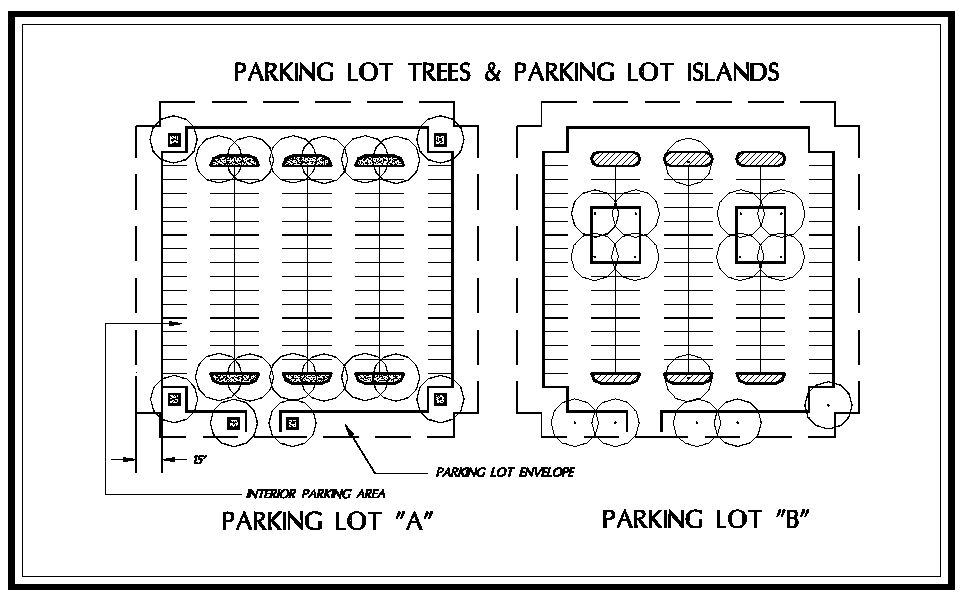
(4)
Prohibited trees. The following trees are not permitted for use as required landscaping as they split easily, their wood is brittle and breaks easily, they bear fruit or seed pods that can stain vehicles, drives and sidewalks and they are unusually susceptible to disease or insect pests:
(a)
Boxelder.
(b)
Red Maple.
(c)
Silver Maple.
(d)
Horse Chestnut.
(e)
Hickories.
(f)
Catalpa.
(g)
Hawthorns.
(h)
Black Walnut.
(i)
Mulberry.
(j)
Poplars.
(k)
Willows.
(l)
American Elm.
(m)
Siberian Elm.
(n)
Slippery Elm, Red Elm.
(o)
Ash.
(5)
Minimum standards for installation and maintenance. The following are the minimum standards for installation and maintenance of required landscaping.
(a)
Installation. Landscaping shall be installed in a sound workman like manner and conform to the American Standard for Nursery Stock ANSI Z60.1. If building or paving construction is completed during a planting season, then no certificate of occupancy will be issued unless the landscaping meets the requirements herein provided. If building or paving construction is completed in an off planting season, the certificate of occupancy will be issued only after the owner provides a performance bond to ensure installation of required landscaping in the next planting season.
(b)
Material removal. Tree stakes, guy wires and tree wrap are to be removed by the applicant after one year.
(c)
Maintenance. Greenbelt areas and plant materials required by this chapter shall be kept free from refuse and debris. Plant materials shall be maintained in a healthy growing condition, neat and orderly in appearance in perpetuity from the time of planting. If any plant material required by this chapter dies or becomes diseased, they shall be replaced by the applicant/owner within 30 days of written notice from the village or within an extended time period as specified in said notice.
(6)
Screening requirements by district and use.
(a)
The following districts require a wall, fence, or greenbelt/landscaped area on sides of properties whose lot lines abut or are adjacent to a residential property or district.
1.
C-1 and C-2 District. A minimum six foot high wall, fence or greenbelt/landscaped area pursuant to specifications of this section.
2.
IND District. A minimum six foot high wall, fence, or greenbelt/landscaped area pursuant to specifications of this section.
(b)
The following uses require specific fence and screening requirements as follows:
1.
Drive-through businesses. A minimum six foot high wall, fence, or greenbelt/landscaped area on sides of the property abutting a residential property or district.
2.
Gasoline service stations. A minimum six foot high wall, fence, or greenbelt/landscaped area on sides of the property abutting a residential property or district.
3.
Telecommunications towers. A minimum six foot high wall, fence, or greenbelt/landscaped area on all sides of the property.
(c)
Wall and fence requirements may be substituted with greenbelt/landscaping strips consisting of shrubbery, trees, and other plant items designed to obscure the use from the abutting residential district. The greenbelt/landscaping strip shall consist of an area at least ten feet wide planted with two deciduous canopy trees and four large shrubs, or one canopy tree, one evergreen tree and four large shrubs per each 25 linear feet along the property line. All property line distances shall be rounded upward to the nearest foot. The planning commission may modify these requirements on a case by case basis when they determine that site specific conditions such as differences in elevation or existing vegetation allows for relaxation of these requirements.
(7)
Refuse container screening requirements.
(a)
Intent. The intent of this section is to establish rules for enclosed dumpster areas in order to:
1.
Prevent accumulations of garbage and rubbish from spreading throughout the village and endangering the health of citizens.
2.
Enhance the aesthetic appearance of the community.
(b)
Screening requirements for existing dumpsters. This subsection is intended to regulate dumpsters placed within the village on or before the date of adoption of this chapter.
1.
Existing dumpsters which, in the judgment of the administrative officer, meet the intent of this section shall be exempt from the specific requirements herein.
2.
Existing dumpsters which, in the judgment of the administrative officer, do not meet the intent of this subsection shall either be removed or brought into compliance on or before January 1, 2013 with installation of any screening needed to prevent the dumpster from being seen from:
a.
A Village street or other ROW; or
b.
A residence (regardless of zoning).
3.
Screening may be accomplished by:
a.
Full dumpster enclosure;
b.
Partial dumpster enclosure (one, two or three sides);
c.
Six foot opaque fence located at property lines;
d.
Six foot opaque fence located between the dumpster and the viewer's location;
e.
Year around landscaping (coniferous/evergreen); or
f.
Any combination of the above.
(c)
Any person aggrieved by a decision of the administrative officer under this section may appeal the same to the board of appeals in accordance with article XV.
(d)
Screening requirements for new dumpsters. The requirements of this section are not intended to apply to dumpsters that were placed with the village prior to [the date of adoption of the ordinance from which this chapter derives] and enclosed in a manner that meets the general intent of this section. All dumpsters placed within the village [on or after the date of adoption of the ordinance from which this chapter derives] shall meet the following requirements:
1.
All properties that utilize a dumpster shall also provide an enclosed dumpster area.
2.
All dumpster enclosures shall be located behind the front building line or behind the front corner of the primary structure, whichever is greater distance from the front property line. If the topography or other conditions will not allow the dumpster enclosure to meet this requirement, the planning commission shall designate an appropriate location.
3.
Dumpsters shall be surrounded by an opaque enclosure that is compatible with the design and color of the principle building. Approved materials include: masonry, brick, stone, 29ga steel panel, vinyl and cementitious fiberboard. Stained board-on-board fencing with six inch wide boards, three runners and stained cap rail may also be used, but must be restained on a regular basis to maintain the original stained color and integrity of the board.
4.
Dumpster enclosures shall have a minimum height of six feet. If the dumpster is taller than four feet; the enclosure shall be two feet taller in height than the dumpster.
5.
All dumpster enclosures shall be placed on a concrete pad with a concrete apron.
6.
Dumpster enclosures shall not be located on any required parking spaces.
7.
Dumpster enclosures shall not be located any closer than five feet to a lot line or building. Maintain a minimum five foot separation from combustible construction and eaves.
8.
Dumpster enclosures shall not be located within any required buffers or easements.
9.
Dumpster enclosures shall be located at least 50 feet away from a lot line adjoining existing residential development or undeveloped land in a residential zoning district.
(e)
Dumpster Enclosure Specifications. The requirements for dumpster enclosures shall include the following:
1.
A permit is required for the construction of a new dumpster enclosure. The structure must comply with the installation standards of the fence section 36-1405 of this chapter.
2.
A plot plan, showing the location of the dumpster enclosure on the lot and all the overhead utilities is required.
3.
The enclosure shall be large enough to accommodate the dumpster and be placed on the lot for adequate service from the rubbish company.
4.
The enclosure shall be placed on a concrete pad with a minimum concrete depth of four inches.
5.
The fencing shall be an opaque type material of either wood, concrete, brick, stone or vinyl.
6.
The fence height shall fully enclose the dumpster and shall not exceed eight feet in height.
7.
The enclosure shall be constructed in such a manner that all structural members, including braces, posts, poles and other projections, shall be on the interior side of the fence.
8.
The gates shall be constructed with commercial grade hinges, poles and hasps. Gates should swing out to an angle greater than 90 degrees and create an opening large enough for the garbage truck to access the dumpster. Pins should hold the gates open while the dumpster is being serviced.
9.
The gates shall have a closing latch and gate must remain closed at all times except during service.
10.
All fence and gate posts must be buried in the ground a minimum of 36" on top of a concrete or gravel footing. NO temporary post or fence panels are allowed.
(8)
Requirements for screening fencing or walls. Fences or walls required under this chapter for screening purposes shall comply with the standards listed below:
(a)
Walls or fences shall be located so as to abut the applicant's property line except where underground utilities interfere or where this chapter requires conformance with yard setback lines.
(b)
Walls or fences must be maintained in good condition by the property owner.
(c)
The finished side or most visibly attractive side of a wall or decorative wood fencing shall face the exterior of the property line. Posts shall be on the side of the wall or fence facing the interior of the lot or parcel of land upon which the wall or fence is constructed.
(d)
Fences may be composed of wood or vinyl and with minimum openings to ensure its effectiveness in providing screening. Chain link fences with plastic slats are not permitted as required screening fencing.
(e)
Walls shall be composed of brick. Poured concrete or concrete block walls are not allowed as required screening walls.
(f)
Minimum height for required screening fencing or walls is six feet. A height over six feet but no greater than eight feet may be allowed for commercial and industrial parcels. Outdoor storage that is being screened may not be stacked above the height of the screening fence or wall.
(9)
Regulations for non-required fences and wall. Where a property owner wishes to erect a fence or wall that is not otherwise required by the provisions of this section, the fence or wall shall comply with the standards listed below:
(a)
Fences and walls in all residential districts which enclose property and/or are within a required side or rear yard, shall not exceed six feet in height, measured from the surface of the ground, and shall not extend toward the front of the lot nearer than the front of the house or the required minimum front yard setback whichever is greater.
(b)
No wall, fence, or hedge planting shall exceed a height of three feet within any residential front yard. Clear vision fences are permitted in front yards, but shall not exceed four feet in height. Corner lots shall comply with the requirements of section 36-403, Corner clearance.
(c)
Fences in commercial and industrial districts shall not exceed a height of eight feet measured from the surface of the ground.
(d)
Fences shall not interfere with underground utility lines and shall be set back from all property lines. If written permission is obtained from adjacent property owners, fences may be placed on the property lines.
(e)
Fences in all residential districts shall not contain barbed wire, razor wire, or be charged with electricity in any fashion.
(f)
A zoning permit shall be secured prior to erection, construction, replacement or substantially repairing of any fence in any zoning district, other than on property used for agricultural purposes.
(g)
It shall be the obligation and sole responsibility of persons erecting fences in this village to determine the location of property lines. The zoning administrator may require proof that property lines have been established prior to issuance of a zoning permit for a fence. The village shall not determine property or lot lines, and the issuance of a construction permit to erect a fence shall in no way be construed as a determination of the correct, valid or legal location for the fence, or prejudice, in any way, the rights of adjacent or abutting property owners.
(h)
Fence material shall be painted or stained with a uniform color on both sides and the finished side of the fence shall face out.
(i)
Where a lot borders a lake or stream, fences in the waterfront yard shall not exceed three feet in height nor otherwise unreasonably restrict views of the water from adjacent properties.
(j)
The regulations set forth in this section shall not apply to fences erected on lands in agricultural districts, the primary use of which land is the operation of a farm as herein defined.
(Ord. No. 105 , § 1, 12-14-2020)

