
Millington City Zoning Code
ARTICLE VII
- NON-CONFORMING USES
Sec. 36-700. - Intent.
The lawful use of any building or land at the time of the enactment of this chapter may be continued although such use does not conform with the provisions of this chapter. It is the intent of this chapter to permit non-conformities of lots, buildings and other structures, and uses of buildings and land to continue until they are removed. It is further the intent of this chapter that non-conformities shall not be enlarged upon, expanded or extended except as otherwise permitted, nor be used as grounds for adding other structures or uses prohibited elsewhere in the same district.
Sec. 36-701. - Types of non-conformities.
(1)
Non-conforming lots of record. In any district, a structure and accessory building may be erected on a lot which fails to meet the district requirements for lot area or width, provided that said lot existed at the effective date of this chapter or any affecting amendment. However, the proposed structure and accessory building must still meet the yard dimensions and requirements for the district in which such lot is located.
If two or more contiguous lots in single ownership are of record at the time of passage or amendment of this chapter, such lots shall be treated as one lot and may not be split in any way that creates a non-conforming lot or increases an existing non-conformity.
(2)
Non-conforming uses of land. Where at the time of passage of this chapter lawful use of land exists which would not be permitted by the regulations imposed by this chapter, the use may be continued so long as it remains otherwise lawful, provided:
(a)
No such non-conforming use shall be enlarged or increased, nor extended to occupy a greater area of land than was occupied at the effective date of adoption or amendment of this chapter.
(b)
No such non-conforming use shall be moved in whole or in part to any portion of the lot or parcel other than that occupied by such use at the effective date of adoption or amendment of this chapter.
(c)
If any such non-conforming use of land ceases for any reason for a period of more than one year, before the non-conforming use may be re-established the planning commission shall hold a public hearing to determine if the non-conforming use was abandoned using the standards in section 36-702(6). If it is determined that the non-conforming use was abandoned than any future use must be conforming with the district in which such land is located.
(d)
No additional structure not conforming to the requirements of this chapter shall be erected in connection with such non-conforming use of land.
(e)
A non-conforming use may not be changed to another non-conforming use. If a non-conforming use of land changes to a conforming use, it may not revert back to a non-conforming use.
(3)
Non-conforming structures. Where a lawful structure exists at the effective date of adoption or amendment of this chapter that could not be built under the terms of this chapter by reason of restrictions on area, lot coverage, height, yards, its location on the lot or other requirements concerning the structure, such structure may be continued so long as it remains otherwise lawful, subject to the following provisions:
(a)
No such non-conforming structure may be enlarged or altered in a way which increases its non-conformity, but any structure or portion of it may be altered in a manner that does not increase or which decreases its non-conformity. Figure 7-1 identifies the type of changes that constitute an increase in non-conformity.
Figure 7-1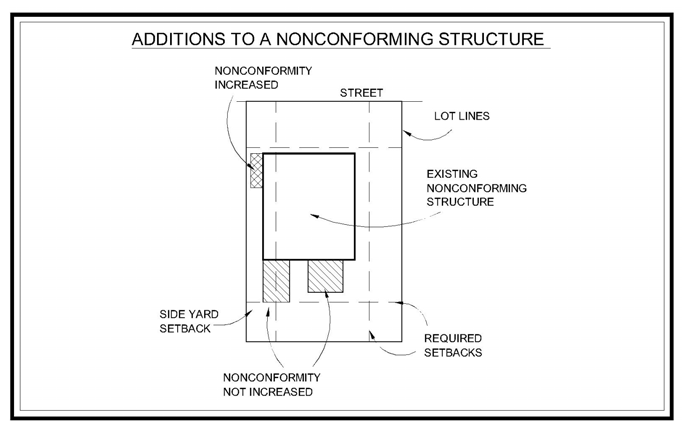
(b)
Should such non-conforming structure or non-conforming portion of structure other than a single family home be destroyed by any means to an extent of more than 65 percent of its replacement cost at time of destruction, it shall not be reconstructed except in conformity with the provisions of this chapter. Replacement cost shall be assumed to be twice the buildings assessed value unless the property owner provides an estimate for replacement value prepared by a licensed builder or architect and approved by the village building inspector. A single family residence may be rebuilt even if it is a non-conforming building, provided reconstruction occurs on the previous building foot print, is begun within one year of the destruction and is completed within two years.
(c)
Should such structure be moved for any reason for any distance whatsoever, it shall thereafter conform to the regulations for the district in which it is located after it is moved.
(4)
Non-conforming uses of structures or of structures and premises in combination. If a lawful use of a structure, or of a structure and land in combination exists at the effective date of adoption or amendment of this chapter, that would not be allowed in the district under the terms of this chapter, the lawful use may be continued so long as it remains otherwise lawful, subject to the following provisions:
(a)
No existing structure devoted to a use not permitted by this chapter in the district in which it is located shall be enlarged, extended, constructed, reconstructed, moved or structurally altered except in changing the use of the structure to a use permitted in the district in which it is located.
(b)
Any non-conforming use may be extended throughout any parts of a building which were manifestly arranged or designed for such use at the time of adoption or amendment of this chapter, but no such use shall be extended to occupy any land outside such building.
(c)
If a non-conforming use changes to a conforming use, it may not revert back to a non-conforming use.
(d)
When a non-conforming use is discontinued for a year, before the non-conforming use may be re-established the Planning Commission shall hold a public hearing to determine if the non-conforming use was abandoned using the standards in section 36-702(6). If it is determined that the non-conforming use was abandoned than any future use must be conforming with the district in which such land is located.
(e)
When non-conforming use status applies to a structure and premises in combination, removal or destruction of the structure shall eliminate the non-conforming status of the land. Destruction for the purpose of this subsection is defined as damage or dilapidation to an extent of more than 65 percent of the replacement cost at time of destruction. Replacement cost shall be assumed to be twice the buildings assessed value unless the property owner provides an estimate for replacement value prepared by a licensed builder or architect and approved by the village building inspector. A single family residence may be rebuilt even if it is a non-conforming use, provided reconstruction occurs on the previous building foot print, is begun within one year of the destruction and is completed within two years.
(5)
Non-conforming Improvements. Zoning provisions dealing with improvements that are not structures, including parking lots and landscaping shall specify how non-conformities shall be addressed in their related articles including article V, Signs, article VI, Parking, and article VIII, Landscaping.
Sec. 36-702. - General provisions.
(1)
Completion of the construction of non-conforming use or structure. To avoid undue hardship, nothing in this chapter shall be deemed to require a change in the plans, construction or designated use of any building on which a valid zoning permit was lawfully acquired prior to the effective date of the chapter provision that causes the non-conformity and which is completed within the time limits of the permit.
(2)
Repairs and maintenance. On any non-conforming structure or portion of a structure containing a non-conforming use, work may be done in any period of 12 consecutive months on ordinary repairs, or on repair or replacement of non-bearing walls, fixtures, wiring, or plumbing, to an extent not exceeding 20 percent of the current replacement cost of the non-conforming structure or non-conforming portion of the structure as the case may be, provided that the cubic content existing when it became non-conforming shall not be increased.
If a non-conforming structure or portion of a structure containing a non-conforming use becomes physically unsafe or unlawful due to lack of repairs and maintenance, and is declared by any duly authorized official to be unsafe or unlawful by reason of physical condition, it shall not thereafter be restored, repaired, or rebuilt except in conformity with the regulations of the district in which it is located. Nothing in this chapter shall be deemed to prevent the strengthening or restoring to a safe condition of any building or part of it declared to be unsafe by any official charged with protecting the public safety, upon order of such official.
(3)
Change of ownership. There may be a change of tenancy, ownership or management of any existing non-conforming uses of land, structures and premises, provided there is no change in the nature or character of such non-conforming uses.
(4)
Determining non-conforming status. To be eligible for treatment as a legal non-conformity a lot, structure or use must have been legal when it was established. The zoning administrator has the authority to review a potential non-conformity identified by a property owner. The zoning administrator shall use documentation such as deeds, surveys, building permit and assessing records, news articles and aerial photography to determine the history of the non-conformity. A determination by the zoning administrator shall be in writing to the property owner, who shall have the right to appeal the administrative decision as authorized under article XIII of this chapter.
(5)
Class A and B non-conformities. Although it is the intent of this chapter to discourage the continuation of non-conforming uses and structures, it is recognized that the continuation of certain non-conformities may be appropriate. To address these circumstances, this chapter establishes procedures to allow the planning commission to designate specific non-conforming uses or structures as "Class A". Such uses or structures will have less stringent standards for expansion or resumption.
(a)
Effect of Class A designation.
1.
Class A non-conforming uses may be reestablished if the structure housing it is damaged or destroyed.
2.
Class A non-conforming uses may be reestablished when otherwise meeting the standards for abandonment of the use. The Class A non-conforming use may not be reestablished if it is replaced with a conforming use.
3.
Class A non-conforming uses, structures housing non-conforming uses and non-conforming structures may be expanded or improved.
4.
Class A non-conforming structures may be rebuilt if the structure is damaged or destroyed to any extent.
5.
Rights granted non-conforming uses and structures listed above are contingent on compliance with any standards imposed by the planning commission as part of the Class A designation, including compliance with any approved site plan.
(b)
Class A designation process.
1.
An applicant for Class A designation shall submit an application to the zoning administrator.
2.
Notice of a public hearing shall be provided as outlined for special use permits in section 36-1100(2) of this chapter.
3.
The planning commission shall hold a public hearing on the Class A designation.
4.
The planning commission shall approve, approve with conditions or deny the request for Class A designation.
5.
The planning commission may impose conditions on an approval. The condition may include compliance with a site plan of the site.
(c)
Standards for approval of Class A designation. In order to approve a use for Class A designation the use or structure must have been lawful at its inception. In addition, the following criteria shall be used by the planning commission in evaluating a use to determine if continuation of the use or structure would be appropriate:
1.
Continuance of the use or structure does not significantly depress property values of nearby properties.
2.
Continuance of the use or structure would not be contrary to the public health, safety or welfare or the spirit of the ordinance.
3.
No useful purpose would be served by strict application of the provisions of this chapter with which the use or structure does not conform.
4.
The property cannot be reasonably used as currently zoned.
(d)
Revocation of Class A designation.
1.
Revocation of a Class A designation may be initiated by the zoning administrator or the planning commission.
2.
Revocation of Class A designation shall comply with the procedures outlined in section 36-700(10)(b) of this chapter.
3.
Class A designation may only be revoked if the non-conforming use or structure violated a condition of approval.
(e)
Class B non-conforming uses or structures. All non-conforming uses or structures, not designated Class A, shall be Class B, non-conforming uses or structures. Class B non-conforming uses and structures shall comply with all the provisions of this chapter relative to non-conforming uses and structures.
(6)
Standards for determining abandonment. If the planning department identifies a legal non-conforming use that they believe has been abandoned, they shall submit the property to the ZBA for a determination of abandonment. The ZBA shall hold a public hearing, following notice as outlined in Article 13 of this notice. The ZBA shall determine whether or not intent to abandon the non-conforming use was demonstrated based on a preponderance of the following factors.
(a)
Reports such as from the building inspection or health department indicating the property is or has not been suitable for occupation.
(b)
Disconnection of utilities.
(c)
Evidence that the use was relocated to a new site.
(d)
Evidence of a "going out of business" sale.
(e)
Signs advertising the business has been removed.
(f)
The use has been discontinued for one year, except where government action such as road construction has prevented access to the premises, or where a clear intent to discontinue has not been demonstrated.
(g)
Removal of the equipment or fixtures necessary for the operation of the non-conforming use.
(h)
Request by the property owner for changes in their property tax designation inconsistent with the non-conforming use.
(i)
Other actions by the property owner or lessee that demonstrates an intent to abandon the non-conforming use.
(7)
Status of uses requiring a special land use. A use established legally without SUP approval which now requires SUP approval due to a text change or rezoning is a non-conforming use until it receives SUP approval. Any existing use approved as a SUP previously under this chapter shall be deemed a conforming use.

