
Millington City Zoning Code
ARTICLE VI
- PARKING
Sec. 36-600. - Parking.
(1)
Purpose and scope. The purpose of this chapter is to prescribe regulations for off-street parking of motor vehicles, recreational vehicles, trucks, and trailers in residential and non-residential zoning districts, to ensure by the provisions of these regulations that adequate parking and access is provided in a safe and convenient manner, and to afford reasonable protection to adjacent land uses from light, noise, air pollution, and other effects of parking areas.
The following general provisions apply to parking:
(a)
At the time any building or structure is erected, enlarged, or increased in capacity, or uses established, off-street parking and loading spaces shall be provided in all zoning districts according to the requirements of this chapter.
(b)
No parking or loading area or space which exists at the time of the adoption of this chapter shall be relinquished or reduced in any manner below the requirements established by this chapter.
(c)
Parking areas must be in the same zoning classification as the property it serves unless the property proposed for parking is zoned for a use of higher intensity than the property it serves.
(d)
When the term "floor area" or "usable floor area" is used in this section in reference to determining the number of parking spaces, it shall refer to "usable floor area" in the definitions section.
(e)
When calculating parking for single family and duplex residences the driveway area shall be included with 200 square feet of driveway per space.
(2)
Off-street parking requirements. Off-street parking required in conjunction with all land and building uses shall be provided as prescribed in this section:
(a)
For uses not specifically mentioned in this section, off-street parking requirements shall be determined from the requirements for similar uses, as determined by the planning commission.
(b)
Any area once designated as required off-street parking shall never be changed to any other uses unless and until equal required facilities are provided elsewhere. Off-street parking existing at the effective date of the ordinance from which this chapter was derived in connection with the operation of an existing building, shall not be reduced to an amount less than would be required in this section for such building or use. This required off street parking may be removed if the use it was designed to serve ceases to exist.
(c)
Two or more buildings or uses may collectively provide the required off-street parking, in which case the required number of parking spaces shall not be less than the sum of the requirements for the several individual uses computed separately. However, in cases of dual functioning of off-street parking where operating hours do not overlap, the Planning Commission may grant a special exception based on the peak hour demand.
(d)
Required off-street parking shall be for the use of occupants, employees, visitors and patrons, and shall be limited in use to motor vehicles. The storage of merchandise, motor vehicles for sale or the repair of vehicles is prohibited. However, businesses are also allowed to use non-required parking spaces for temporary outdoor sales or display. Off-street parking, whether public or private, for non-residential uses shall be either on the same lot or within 300 feet of the building it is intended to serve, measured from the nearest point of the building to the nearest point of the off-street parking lot, without crossing any major street.
(e)
When units or measurements determining the number of required parking spaces result in the requirements of a fractional space, any fraction up to and including one-half shall be disregarded, and fractions over one-half shall require one parking space.
(f)
Commercial vehicles on residential lots: The open storage or outdoor parking of semi-tractor trucks and/or semi-trailers, straight trucks over 14,000 Gross Vehicle Weight Rating (GVWR) or a weight class of four or greater, bulldozers, earth carriers, cranes or any other similar equipment or machinery is prohibited on any lot, unless the storage or sales of such vehicles is an approved use for the principal building on the site or unless the vehicles are temporarily parked while in use for approved construction on the property.
(g)
The minimum number of off-street parking spaces by type of use shall be determined in accordance with the requirements in Figure 6-2. The planning commission may reduce or waive the number of required off-street parking spaces for parcels in the C-1 zoning district based on the availability of on-street or public off-street spaces and hardship in providing the required number of off-street spaces.
(3)
Configuration standards for off-street parking. The following standards apply to all uses other than single family and duplex residences.
All off-street parking lots as required in this section shall be laid out, constructed and maintained in accordance with Figure 6-1 and the following standards and regulations:
(a)
No parking lot shall be constructed unless and until a permit therefor is issued by the zoning administrator, unless the parking lot is part of a site plan in which case the Planning Commission shall review it. Application for a permit shall be submitted in such form as may be determined by the zoning administrator, and shall be accompanied with two sets of plans for the development and construction of the parking lot showing that the provisions of this section will be fully complied with.
(b)
Plans for the layout of off-street parking facilities shall be in accord with the following minimum dimensional requirements as shown in Figure 6-1 with the exception that spaces shall be ten feet wide wherever there is new site construction or parking lot expansion.
(c)
All spaces shall be provided adequate access by means of maneuvering lanes. Backing directly onto a street shall be prohibited.
Figure 6-1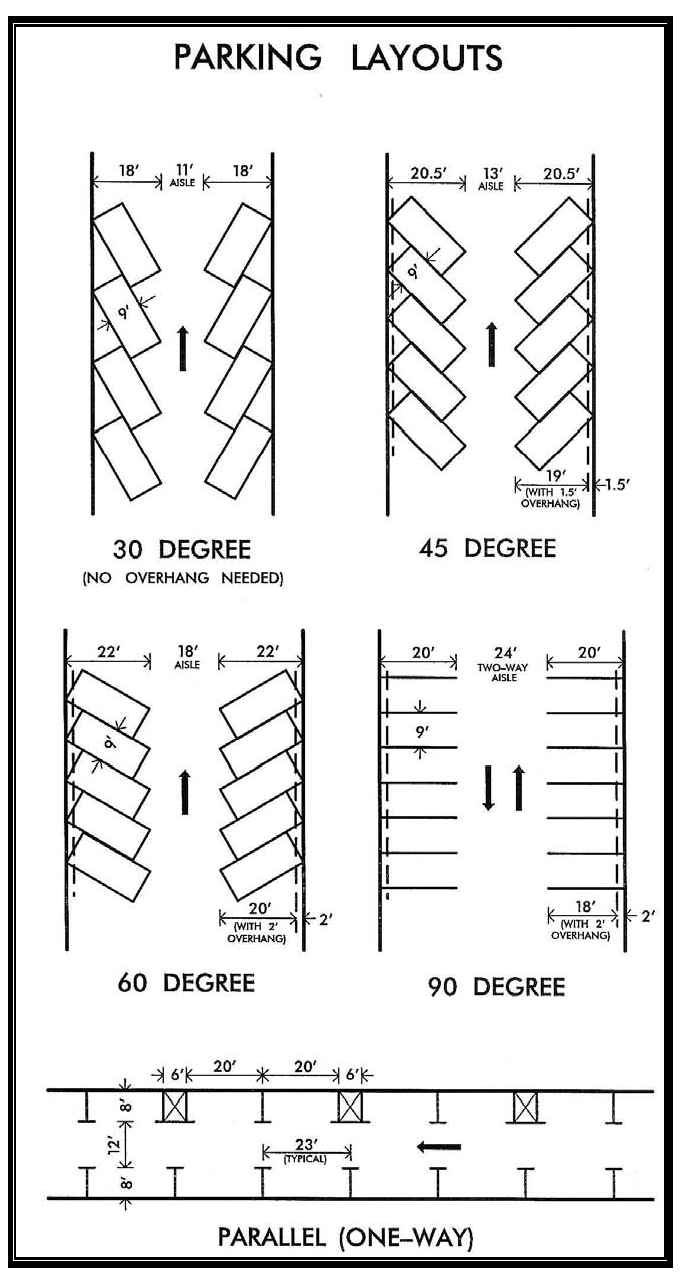
(d)
Adequate ingress and egress to the parking lot by means of clearly limited and defined drives shall be provided for all vehicles. Ingress and egress to a parking lot lying in an area zoned other than single-family residential use shall not be across land zoned for single family residential use.
(e)
All maneuvering lane widths shall permit one-way traffic movement, except that the 90-degree pattern may permit two-way movement.
(f)
Each entrance and exit to and from any off-street parking lot, located in an area zoned for single-family residential use, shall be at least 25 feet distant from any adjacent property located in any single-family residential district.
(g)
Where the next zoning district is designated as a residential district, screening shall follow the landscaping standards of article VIII.
(h)
The entire parking area, including parking spaces and maneuvering lanes, required under this section shall be provided with asphaltic or concrete surfacing in accordance with specifications approved by the planning commission. The parking area shall be surfaced within one year of the date the permit is issued. Off-street parking areas shall be drained so as to dispose of all surface water accumulated in the parking area in such a way as to preclude drainage of water onto adjacent property or toward buildings, and plans shall meet the approval of the building inspector. The planning commission may require stormwater detention or retention if necessary to permit stormwater runoff to be handled by the village stormwater system.
(i)
All lighting used to illuminate any off-street parking area shall be so installed as to be confined within and directed onto the parking area only.
(j)
The planning commission, upon application of the property owner to the zoning administrator, may modify the fence or greenbelt requirements pursuant to this chapter where it is shown that under such unusual and unique circumstances, no good purpose would be served by such requirements.
(k)
Off-street parking lots shall also conform to the parking lot landscaping standards as set forth in article VIII of this chapter.
(l)
All parking must comply with barrier free requirements of the Michigan Building Code.
(4)
Loading and unloading standards for off-street parking. On the same premises with every building, structure, or part of building or structure, involving the receipt or distribution of vehicles or materials or merchandise, there shall be provided and maintained on the lot, adequate space for standing, loading and unloading in order to avoid undue interference with public use of dedicated rights-of-way. Such space shall be provided in accordance with distribution of vehicles or materials or merchandise. Such space shall be provided in accordance with Figure 6-2 and as follows:
(a)
Loading/unloading spaces shall be located in side or rear yards, shall be screened by six foot high fences or walls from property zoned or used for residential purposes, and shall be at least 50 feet from the residential lot line. The Planning Commission may modify these requirements.
(b)
All spaces shall be laid out in the dimension of at least ten by 50 feet, or 500 square feet in area, with clearance of at least 14 feet in height. All loading and unloading spaces shall be provided with a pavement having an asphaltic or Portland cement binder so as to provide a permanent, durable and dustless surface. All spaces in the IND District shall be provided in the ratio of spaces to floor area in accordance with Figure 6-2.
Figure 6-2 Loading and Unloading Standard

