
Millwood City Zoning Code
CHAPTER 17
50 - ELECTRIC VEHICLE INFRASTRUCTURE
17.50.010 - Purpose.
The purpose of this chapter is to facilitate adequate and convenient electric vehicle infrastructure to serve the needs of the traveling public, to provide opportunities for Millwood residents to have safe and efficient access to electric charging stations located at their place of residence, and to provide the opportunity for mixed-use, commercial, and industrial developments to supply electrical vehicle infrastructure services to their tenants, customers, and employees.
(Ord. No. 527, § 1, 6-14-2022)
17.50.030 - Review process.
A.
Charging Stations. In general, charging stations do not require permits from the city unless their installation involves new construction, additions and/or structural alterations to existing buildings, or if their installation is governed by other requirements of city code. Electrical installations are under the administration of the Washington State Department of Labor and Industries and no aspect of the electrical infrastructure is administered by the city.
(Ord. No. 527, § 1, 6-14-2022)
17.50.040 - Design criteria.
A.
Design criteria for electric vehicle charging stations or battery exchange stations within commercial, industrial, and mixed-use zoning districts:
1.
Electric vehicle charging stations may be reserved for parking only while "charging" electric vehicles. "Charging" means an electric vehicle is parked at the charging station and is connected to the charging station equipment. Spaces for electric vehicle charging shall be included in the overall parking required for the site.
2.
If posted, signage should include identifying voltage and amperage levels, time of use, fees or safety information. (See examples below of typical signage.)
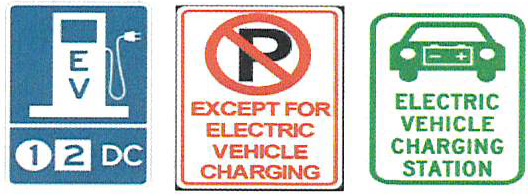
Signage on charging stations open to public use shall include text indicating type of charging (Level 1, 2, or 3 with maximum voltage or amperage), hours of operation, fees and basic instructions.
a.
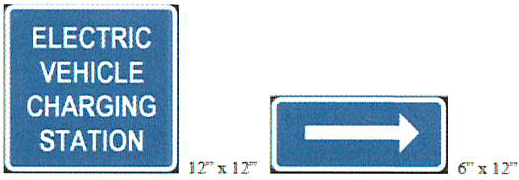
Signs may be located to guide motorists to the charging station space(s). If such signs are not visible from the public street, they are exempt from the sign standards and permit requirements. (See example below of typical signage.)
b.
Where charging station equipment is provided adjacent to a pedestrian circulation area, such as a sidewalk or accessible route to the building entrance, charging equipment shall be located so as to not interfere with accessibility requirements of WAC 51-50-005, as amended.
c.
Design shall be appropriate to the location and use. Facilities should be readily identifiable by electric car users but blended into the surrounding landscape/architecture for compatibility with the character and use of the site.
3.
Electric vehicle battery exchange stations shall comply with the following additional standards:
1.
All batteries shall be stored in an enclosed building. No outdoor storage is permitted.
2.
All batteries that are beyond their useful life shall be recycled or disposed of in accordance with requirements established by the state department of ecology, state department of transportation, and the Environmental Protection Agency.
(Ord. No. 527, § 1, 6-14-2022)

