
Monte Vista City Zoning Code
ARTICLE 16
Overlay Districts
Sec. 12-16-10. - Definitions.
(a)
A property may be considered by the City for historic designation under the following criteria:
(1)
The structure is at least fifty (50) years old;
(2)
The structure has importance to the City in terms of architectural, cultural, social/ political or geographic elements; and/or
(3)
The structure is listed upon the state and/or national historical registry.
(b)
Properties that are historically designated by the City shall fall within one (1) of two (2) tiers, defined as the following:
(1)
Tier I: Structures residing within the City's historic overlay district and/or any structure already listed on the National Register of Historic Places or the Colorado Register of Historic Properties.
(2)
Tier II: Structures meeting one (1) or more criteria for historic designation that are outside the City's historic overlay district.
(c)
The City's historic overlay district consists of the area bounded by the railroad tracks on the northeast, Third Avenue on the south and Broadway Avenue on the west.
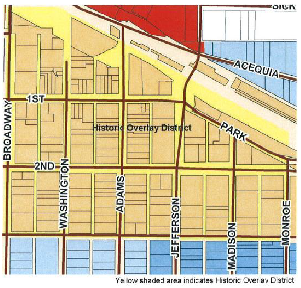
(Ord. 789 §18-366, 2006; Ord. 820, 2010)
Sec. 12-16-20. - Purpose and intent.
The purpose of this Article is to identify and preserve historic structures for the educational, cultural and economic benefit of the City's citizens by:
(1)
Preserving, protecting, enhancing and regulating the use of buildings and structures that are reminders of past eras, events and people important in local, state or national history, which are landmarks in the history of architecture, which provide examples of the physical surroundings in which past generations lived or which are archaeologically significant;
(2)
Ensuring that the historic character is preserved in development and maintenance of such buildings and structures;
(3)
Stimulating educational and cultural dimensions by fostering the knowledge of the City's heritage and cultivating civic pride in the accomplishments of the past;
(4)
Enhancing property values, stabilizing neighborhoods and promoting tourist trade and interest; and
(5)
Cooperating with state and federal historical preservation efforts.
It is not the intention of this Article to preserve every old building in the City, but rather to provide a process to evaluate and protect only those buildings and structures deemed to have historical significance, striking a reasonable balance between private property rights and the public interest. This Section is meant to ensure that demolition of buildings and structures important to the City's heritage will be carefully weighed with other alternatives, and alterations to such buildings and structures and new construction will respect the character of each such setting, not by imitating surrounding structures, but by being compatible with them.
(Ord. 789 §18-367, 2006; Ord. 820, 2010)
Sec. 12-16-30. - Historic registry.
The City shall maintain a registry of buildings and structures designated as "historic," meeting the definition outlined in Section 12-16-10. Such registry shall be maintained by the City Clerk and shall be made available for public inspection during regular business hours.
(Ord. 789 §18-368, 2006; Ord. 820, 2010)
Sec. 12-16-40. - Monte Vista Historic Preservation Commission, established.
(a)
The Monte Vista Historic Preservation Commission is established with the general purpose to aid in the preservation of historic properties and districts within the City. All meetings of the Commission shall be open to the public.
(b)
The Commission shall consist of five (5) residents of the Monte Vista Community and a nonvoting secretary, all of whom shall be appointed by the City Council. At least two (2) of the members shall have demonstrated expertise in real estate, construction, architecture, property development or some other land use profession.
(c)
Appointments to the Commission shall be for a period of three (3) years, except when vacancies occur prior to the expiration of a regular term; in that case, the unexpired term shall be filled by appointment of the City Council and last until the expiration date of the term. In addition to the regular members, the City Council may appoint two (2) alternate members for staggered three-year terms. In the event that a regular member is temporarily unable to act owing to absence from the City, an illness, interest in a case before the Commission or any other cause, an alternate member may serve instead, with full voting power. The City Council shall have the power to remove any member of the Commission for cause after official public hearing in which the member shall have right to counsel and to confront hostile witnesses.
(d)
The members of the Commission shall elect from among themselves a chairperson to serve for a term of one (1) year.
(e)
The Commission has the power to recommend to the City Council designation of a property for historic preservation. A simple majority vote shall be made in accordance with Section 12-16-50 below.
(Ord. 789 §18-369, 2006; Ord. 820, 2010; Ord. 823, 2010)
Sec. 12-16-50. - Process for designation of historic landmark.
(a)
Any individual structure or building within the City is eligible for designation as an historic landmark.
(b)
Inclusion of any property in the National Register of Historic Places as provided in the National Historic Preservation Act of 1966 or state historic registry shall mean that the landmark is automatically designated a local historic landmark subject to the protections of this Article.
(c)
An application for historic designation may be submitted by the property owner, by a member of the Historic Preservation Commission or by a member of the City Council. The application shall be on a form as provided by the Community Development Department and shall be submitted to the Community Development Department, which shall first review the application for eligibility under the Historic Preservation Ordinance and forward it for review to the Monte Vista Historic Preservation Commission for review and recommendation. The application must be accompanied by a minimum nonrefundable review and processing fee which is on file in the office of the City Clerk. If the application is made by anyone other than the property owner, the Community Development Department shall promptly send the owner a copy of the application via certified mail. The property owner may file a written objection to the application with the Community Development Department within thirty (30) days after the date the application is mailed to the owner.
(d)
In accordance with its own rules and bylaws, the Historic Preservation Commission shall review the application for historic designation and shall make a recommendation to the City Council on whether the City Council should grant historic designation. Failure of the Historic Preservation Commission to provide a recommendation within thirty (30) days of the date that the application is sent to it for referral shall be deemed to be a recommendation for denial.
(e)
Upon receipt of a recommendation from the Monte Vista Historic Preservation Commission, or after the passage of thirty (30) days from the date an application is sent to the Historic Preservation Commission for referral, the Community Development Department staff shall schedule a City Council public hearing on such historic designation applications. Notice of the public hearing shall be made in accordance with Section 12-3-320. If the property owner files a written objection to the application, City Council shall hold said hearing within forty-five (45) days of the date of receipt of the recommendation of the Historic Preservation Commission or within forty-five (45) days after the passage of thirty (30) days from the date the application is sent to the Historic Preservation Commission for referral.
(Ord. 789 §18-370, 2006; Ord. 820, 2010)
Sec. 12-16-60. - City Council designation.
(a)
Following public hearing, the City Council may designate by ordinance historic landmarks in the City to accomplish the purposes of this Article. In making such designations, the City Council shall consider the recommendation of the Historic Preservation Commission, the testimony and evidence presented at the public hearing and the following criteria:
(1)
No structure or building shall be granted historic designation unless City Council determines that the property owner will retain the ability to earn a reasonable return on the property which is the subject of the application; and
(2)
The City Council shall consider whether the structure is of particular historical, architectural, cultural or archaeological significance which:
a.
Exemplifies or reflects the broad cultural, political, economic or social history of the nation, state or community; or
b.
Is identified with historic persons or with important events in national, state or local history; or
c.
Embodies distinguishing characteristics of an architectural type inherently valuable for the study of a period, style, method of construction or of indigenous materials or craftsmanship; or
d.
Is representative of the notable work of a master builder, designer or architect whose individual ability has been recognized; or
e.
Is recommended as an historic landmark by the Historic Preservation Commission.
(b)
The City Council may grant historic designation in the presence of one (1) or more of the criteria set forth in Subparagraphs (2)a.—(2)e. above, but need not find that all of those criteria are met.
(c)
If an application for historic designation is submitted by either a City Council member or a member of the Historic Preservation Commission and the property owner does not desire historic designation and so indicates by filing a written protest before the scheduled public hearing, historic designation shall be granted only upon a three-fourths (¾) vote of the entire City Council.
(d)
It shall be unlawful to demolish, destroy or undertake any major change to a structure which is the subject of a pending historic designation application until such time as the City Council has determined whether such designation shall or shall not be granted.
(e)
The Community Development Department and the City Clerk shall maintain an inventory of all designated historic landmarks and all structures which are the subject of pending applications for historic designation. Upon receipt of an application for either a permit or a request to carry out any new construction, alteration, removal or demolition of a structure on or in an historic landmark or on a structure which is the subject of a pending application for historic designation, or a zoning change or development plan change, the Community Development Department shall either consider a permit for such work if it constitutes a "minor change" to the building or forward such permit application for "major" changes to the Historic Preservation Commission for review within thirty (30) working days, in accordance with Section 12-16-100 of this Article, pertaining to historic property alteration permits. No permit shall be issued or request granted by said department before approval for work and the work plan has been approved by the City Council.
(Ord. 820, 2010)
Sec. 12-16-70. - Designation recordings.
Within fifteen (15) days of a City Council designation of a historic landmark, the City shall cause the recording of such designation with the City Clerk and the Rio Grange County Clerk's Office. Such recording shall include the following:
(1)
Address and legal description of the real property affected by the historic landmark designation which underlies the structure which has been designated as historic;
(2)
A statement that such real property is subject to Section 12-16-50 of the Monte Vista Zoning Code, pertaining to the historic landmark requirements.
(Ord. 820, 2010)
Sec. 12-16-80. - Monte Vista architecture.
(a)
For the purpose of identifying historic styles of architecture and aiding in designation of historic structures in compliance with the Section, the following architectural distinctions shall be made:
(1)
Romanesque Revival period: (1840s - 1890s), characterized by round arches over windows and entries, thick masonry walls, facades with contrasting building materials, some rounded towers with conical roofs may be present; mostly used in commercial applications.
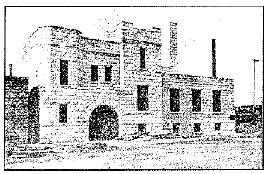
Romanesque Revival period
(2)
Italianate period: (1850's - 1880's), characterized by two (2) to three (3) stories in homes, low-pitched roofs, arched/curved windows, often extensive porches; also used in commercial applications often with large eaves and decorative window areas and columns.
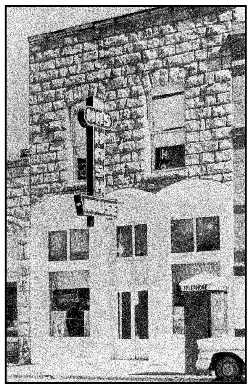
Italianate period
(3)
Second Empire/Folk Victorian period: (1860s - 1910s), characterized by Italianate influence with rounded windows, but also with intricate detail in porch or window overhangs, Folk Victorian often seen with L-shaped floor plans; primarily used in housing.
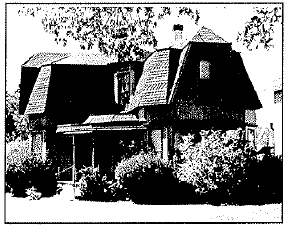
Second Empire/Folk Victorian
period
(4)
Mission Revival period (1900s - 1940's), characterized by Mission-shaped dormers or parapets, exposed rafters, red-tiled roofs, stucco walls, arched windows and doors.
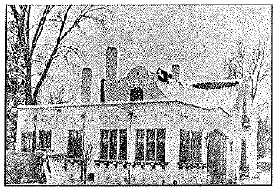
Mission Revival period
(5)
Pueblo Revival period: (1912 - present), evolved out of Santa Fe, style includes flat roofs with parapeted walls, rounded walls, stucco building material, round roof beams that often extend through the exterior walls.
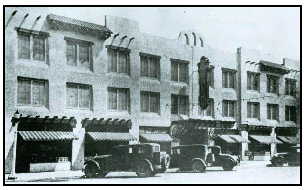
Pueblo Revival period
(6)
Moderne period: (1925 - 1940's), characterized by smooth, rounded walls, often built in stucco, flat roofs, horizontal alignment of architectural elements and windows, some grooved portions of walls, glass block windows; usually used in commercial applications.
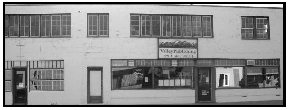
Moderne period
(7)
Miesian period: (1920's - 1960's), characterized by simplicity in form, usually with glass over metal skeletons, usually used in commercial applications.
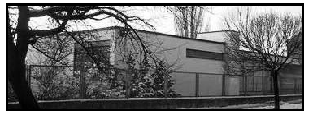
Miesian period
(b)
Many of the buildings in Monte Vista's historic areas demonstrate a range of the identified styles, thus making it difficult to neatly classify many buildings. In identifying buildings for historic designation, this diversity in building styles will be considered in an effort to preserve this unique application of influences.
(c)
Newer buildings to be constructed within identified historic districts will not be required to artificially recreate the classic styles of Monte Vista architecture, but instead develop in a manner compatible with those styles. Compatibility may be achieved in adherence instead to building form requirements of the zoning district, such as to building orientation, placement on the lot, building height and setback requirements.
(d)
The following materials are prohibited for use as exterior materials within historically designated districts: prefabricated concrete panels; metal. The principal materials used on building facades should be indigenous to historic districts, including stone, brick, wood or stucco. Stucco must not be applied over stone or brick. Long, blank walls shall be avoided.
(Ord. 820, 2010)
Sec. 12-16-90. - Limitations on development affecting historic landmarks.
(a)
No person shall carry out or cause to be carried out on any historic landmark any alteration, construction, removal or demolition, or make any changes that would impair the historic nature of the landmark without first obtaining a historic property alteration permit in accordance with this Article.
(b)
Limitations shall pertain only to the external portion of an historically designated structure. Nothing in this Section shall be construed to regulate the internal space of a structure, which may be altered under the regular process of building, under Chapter 14 of this Code.
(c)
Nothing in this Section shall be construed to prevent any alteration, construction, removal or demolition necessary to correct an unsafe or dangerous condition of any structure or parts thereof where such condition is declared unsafe or dangerous by the Community Development Department or local fire department, and where the proposed measures have been declared necessary by the City Manager to correct the conditions is performed. Any temporary measures required by the City under this Section may be taken without first obtaining a historic property alteration permit, but a permit is required for permanent alteration, removal or demolition of an historic landmark.
(d)
If the City provides the applicant with an historic property alteration permit, the applicant must apply for a building permit within six (6) months of the date of the permit.
(e)
If the City denies an historic property alteration permit, no person may submit a subsequent application for the same project within one (1) year from the date of the denial.
(Ord. 820, 2010)
Sec. 12-16-100. - Historic property alteration permits.
(a)
An historic property alteration permit must be obtained prior to any external alteration, construction, removal or demolition impacting a historically designated property.
(b)
Applications for an historic property alteration permit shall be submitted to the Community Development Department on a form provided by said department and shall contain such information required to assure full presentation of facts necessary for proper consideration of the permit. The application must be accompanied by a minimum nonrefundable review and processing fee which is on file in the office of the City Clerk. The applicant shall also pay actual costs in excess of the established fee which are incurred by the City relative to review and processing of the permit application.
(c)
Permit applications for minor changes shall be determined by staff of the Community Development Department in accordance with this Article. Applications for major changes shall be submitted for consideration first by the Monte Vista Historic Preservation Commission, which may recommend to City Council approval, approval with conditions or denial of the application. City Council shall make the final decision, in accordance with this Article.
(d)
The staff of the Community Development Department shall determine whether the permit application constitutes a "minor" or "major" change to the historic property.
(1)
Permits for minor changes. The staff of the Community Development Department shall grant a permit for minor changes if the requested alteration consists of paint for windows and trim. Paint color must be chosen from the historic color selection and may be chosen by Community Development Department personnel and the building owner. Any person aggrieved by the determination of the Community Development Department shall have the option to appeal the Department's decision to the Board of Adjustment via the appeal procedure outlined in Article II of this Chapter.
(2)
Permits for major changes. All proposed exterior work shall require a permit. Proposed work shall not adversely impact the special character or special historical, architectural or archaeological nature of the landmark or site. The staff of the Community Development Department shall collect the permit application for major changes and schedule it for hearing at a regular meeting of the Historic Preservation Commission. The Community Development Department staff shall notify the applicant of the date of the hearing, in accordance with Section 12-3-320 of this Chapter. Posted notice and mailed notice to residents within three hundred (300) feet of the site also shall be conducted in accordance with Section 12-3-320 of this Chapter. At the conclusion of the hearing, the Commission shall forward to the City Council a recommendation to approve, approve with conditions or deny a permit. Within forty-five (45) days of the hearing, the City Council shall review the recommendation and approve, approve with conditions or deny the permit in accordance with the recommendation of the Historic Preservation Commission. In the event of a denial recommendation by the Commission, the City Council may issue an approval or approval with conditions based on a vote of four (4) of its members. If the permit is denied, the reasons shall be stated in writing and furnished to the applicant.
(Ord. 820, 2010; Ord. 828, 2011)
Sec. 12-16-105. - Exempt projects.
Projects exempt from the permit and review processes include interior renovation. As a general rule, any project that would constitute a noticeable change to the exterior of the building should be submitted via the permit process.
(Ord. 820, 2010; Ord. 828, 2011)
Sec. 12-16-110. - Purpose.
The 1st Avenue Overlay District is designed to protect the City's western gateway and residential neighborhood character of 1st Avenue between Batterson Street and the alley west of Morris Street. Any or all of the uses enumerated in the RL District are available for inclusion in the 1st Avenue Overlay District.
(Ord. 789 §18-372, 2006; Ord. 811 §1, 2009)
Sec. 12-16-120. - Applicability.
These standards shall apply only within the 1st Avenue Overlay District. This Division establishes standards and criteria to be used in the review of the development applications proposed within 1st Avenue Overlay District. In no instance shall this Code require renovation or changes to existing properties or structures when no development applications are required to be submitted. These regulations shall only be applicable when development is proposed by an applicant.
(Ord. 789 §18-373, 2006)
Sec. 12-16-130. - Standards.
(a)
All development within the 1st Avenue Overlay District shall be consistent with the intent of the master plan and the policies therein.
(b)
All development within the 1st Avenue Overlay District shall be designed in a manner such that, wherever possible, it protects the residential character of the neighborhood, including considerations of architecture, landscaping and property maintenance.
(c)
Development of single vacant sites or redevelopment of existing structures within the 1st Avenue Overlay District shall be compatible with adjacent properties.
(d)
The design and placement of buildings and structures shall be consistent and compatible with other buildings and structures in the 1st Avenue Overlay District.
(e)
Architectural compatibility with adjacent development in the 1st Avenue Overlay District shall be provided through the use of similar colors, building materials, design details, massing, scale or architectural style, including such structural features as porches, alcoves, bay windows, broken-roof pitch lines, wood trim, shutters and other exterior decorative features.
(f)
All lots in the 1st Avenue Overlay District shall be landscaped and all landscaping shall be maintained in a healthy, mature condition.
(g)
Landscaping compatibility with adjacent development in the 1st Avenue Overlay District shall be provided. The use of deciduous trees, such as Linden and Cottonwood, along with a traditional sod or lawn seed mixture, is preferred for parcels along First Avenue. Crabapple and Chinese elm trees are prohibited.
(Ord. 789 §18-374, 2006)
Sec. 12-16-140. - Review procedure.
Whenever development is proposed (including change in use of an existing structure) in the 1st Avenue Overlay District, a site plan addressing the criteria in this Division shall be submitted to the City. The City Council, at a public meeting and upon review of the recommendation of the Planning and Zoning Commission, shall approve, approve with conditions or deny the site plan.
(Ord. 789 §18-375, 2006)
Sec. 12-16-210. - Purpose.
The Central Business Overlay District is designed to establish standards for the Central Business District bordered by the railroad tracks on the northeast, Third Avenue on the south and Broadway on the west.
(Ord. 789 §18-376)
Sec. 12-16-220. - Applicability and standards.
(a)
These standards shall apply only within the Central Business District. This Division establishes standards and criteria to be used in the review of development applications proposed within the Central Business District. In no instance shall this Code require renovation or changes to existing properties or structures when no development applications are required to be submitted. These regulations shall only be applicable when development is proposed by an applicant. Standards include:
(1)
All development within the Central Business District shall be consistent with the intent of the master plan and the policies therein.
(2)
All development within the Central Business District shall be designed in a manner such that, wherever possible, it protects the residential character of the neighborhood, including considerations of architecture, landscaping and property maintenance.
(3)
Development of single vacant sites or redevelopment of existing structures within the Central Business District shall be compatible with adjacent properties.
(4)
The design and placement of buildings and structures shall be consistent and compatible with other buildings and structures in the Central Business District.
(5)
Architectural compatibility with adjacent development in the Central Business District shall be provided through the use of similar colors, building materials, design details, massing, scale or architectural style, including such structural features as porches, alcoves, bay windows, broken-roof pitch lines, wood trim, shutters and other exterior decorative features.
(6)
All lots in the Central Business District shall be landscaped unless structures occupy the full lot. All landscaping shall be maintained in a healthy, mature condition. Landscaping compatibility with adjacent development in the Central Business District shall be provided.
(7)
If rental dwelling units are present in a multi-story building also containing a business, the dwelling unit must be on the upper floor and the business on the bottom floor. If a rental dwelling unit is present in a single-story building also containing a business, the dwelling unit must be in the back and the business in the front facing the street.
(8)
Lot setback and building height standards are set forth in Table 12-15 below.
(b)
Review procedure. Whenever development is proposed (including change in use of an existing structure) in the Central Business District, a site plan addressing the criteria in this Section shall be submitted to the City. The City Council, at a public meeting and upon review of the recommendation of the Planning and Zoning Commission, shall approve, approve with conditions or deny the site plan.
Table 12-15
Central Business District Standards
(Ord. 789 §18-377, 2006; Ord. 811 §1, 2009)

