
Monte Vista City Zoning Code
ARTICLE 20
Signs and Murals2
Editor's note— Ord. No. 917, adopted February 2, 2023, repealed the former Article 20, §§ 12-20-10—12-20-110, and enacted a new Article 20 as set out herein. The former Article 20 pertained to signs and derived from Ord. 789 §§ 18-561—18-571, 2006; Ord. 811 §1, 2009; Ord. No. 913, § 1, Aug. 4, 2022.
Sec. 12-20-10. - Purpose and intent.
(a)
General purposes. The intent of this Division is to provide a legal framework for an orderly but balanced system of signage in the City. Regulations of such factors as size, location, illumination, etc., will encourage the communication of information and orientation for both visitors and citizens, provide for the effective identification of business establishments and minimize distractions to motorists and pedestrians while promoting economic and aesthetic values and character of the community.
(b)
Objectives.
(1)
To preserve the value of private property by assuring the compatibility of signage with surrounding land uses.
(2)
To establish procedures and regulations which control the location, size, type, and number of signs permitted and which regulate and control all other matters pertaining to signs.
(3)
To protect and encourage local tourist-related businesses for the general economic well-being of the City.
(4)
To encourage sound signage practices and sign placement.
(5)
To provide for special regulations in areas which, by nature or location, are unique to certain areas of the City.
(6)
To provide for an equitable mechanism whereby those signs, which are nonconforming to these regulations, can be removed.
(Ord. No. 917, 2-2-2023)
Sec. 12-20-20. - Definitions.
This Division shall be known as the "Sign Code." All words used in this Division, except where specifically defined herein, shall carry their customary meaning when not inconsistent with the context in which they are used. Definitions contained in Chapter 12 shall apply to this Division. The following words as hereinafter set forth shall have the meanings as hereinafter defined:
Abandoned sign means a sign no longer in use or a sign providing obsolete or outdated copy information.
Advertising sign means a sign which directs attention to a business commodity, service or entertainment which is conducted, sold, or offered.
Animated sign means any sign or part of a sign which changes physical position by any movement or rotation or signs that simulate movement by means of lighting.
Area means the total exposed surface devoted to a sign message, including ornamentation, embellishment, and symbols, but excluding supporting structures.
Awning sign means a wall sign which is painted, stitched, sewn, or stained onto the exterior of an awning. An awning is a shelter supported entirely from the exterior wall of a building and composed of non-rigid materials except for the supporting framework.
Billboard sign means a sign supported by multiple poles or posts and at least eight (8) feet in width and four (4) feet in height.
Building facade means the frontage of a building which faces and is most nearly parallel to a public or private street. There can be only one (1) building facade for each street upon which a building faces.
Bulletin board sign means a sign that is accessory to a church, school or public or nonprofit institution announcing the name of the institution or organization and announcements of persons, events or activities occurring at the institution. The sign may also present a greeting or similar message.
Canopy sign means a wall sign with the business information printed or embroidered on the surface of the canopy which is permanently affixed to a roofed shelter and supported by a building by columns extending from the ground or by a combination of a building and columns.
Changeable-letter sign means a sign whereon provisions are made for letters or characters to be placed in or upon the surface area, either manually or electronically, to provide a message or picture.
Decorative projecting sign means a sign composed of wood, fiberglass, plastic, metal and/or similar materials compatible with and complementing the theme of downtown development and historic restoration.
Digital Sign means a changeable copy sign that uses a matrix of illumination elements, such as light emitting diodes, (LED), liquid crystal display (LCD), plasma display, individual light bulbs, or other digital or analog electronic media to display or project copy which can be modified by electronic processes.
Direct illumination means a sign characterized by lighted lettering.
Directional sign means any sign that directs the movement or placement of pedestrian or vehicular traffic.
Electrical sign means any sign containing electrical wiring. This does not include signs illuminated by an exterior light source.
Erect means to construct or allow to be constructed.
Face means the surface of a sign directed to the viewer (which may be single-face, double-face, or multi-face) upon, against or through which the message is displayed or illuminated.
Freestanding sign means a detached sign which is supported by one (1) or more columns, uprights or braces extended from the ground or from an object on the ground, or a detached sign which is erected on the ground; provided that no part of the sign is attached to any part of any building structure or other sign.
Ground/monument sign means a type of freestanding sign utilizing no pole or similar supports and constructed from ground level utilizing rock, stone, brick, masonry, wood, and similar building materials. Ground signs may have changeable, affixed, or inlaid lettering and may or may not be illuminated. Ground signs shall not exceed six (6) feet in height and twelve (12) feet in length and may be double- or multi-faced.
Home occupation sign means a decorative sign placed on the premises of a residence in a residential area designed to identify a home occupation but clearly secondary to the character of the residence.
Identification sign means a sign identifying the name of a business or residential neighborhood.
Illuminated sign means a sign lighted by or exposed to artificial lighting either by indirect lighting or by internal illumination.
Indirect lighting means a light from a source projected onto the face of the sign.
Internal illumination means a light from a source concealed or contained within the sign, and which becomes visible through a translucent surface.
Maintain means to preserve or keep in repair such sign, including any illumination source, in a neat and orderly condition and in good working order at all times to prevent the development of any rust, corrosion, rotting or other deterioration in the physical appearance or safety of such sign.
Nonconforming sign means a sign which fails to conform to the requirements and provisions of this Division, and which was lawfully erected, altered, moved, or maintained under previous ordinances of the City, but does not conform to the provisions of this Division or has been subsequently granted a variance from this Division.
Off-premises advertising sign means a sign relating to a business or its products or services, which is not located on the same premises as the business.
Owner means the owner of a sign, the lessee of the sign, the fee holder of the property upon which the sign is located, the lease holder of such property or the individual, person or business who has purchased the sign.
Pedestrian-oriented sign means a sign located in such a manner as to be generally viewed or read by a person who is walking.
Permanent sign means a sign which is permanently affixed or attached to the ground or to a structure.
Pole sign means a sign supported by a single pole, and which sign may be metal, plastic, or similar material and may be illuminated.
Portable sign means a sign which is not permanently affixed or attached to the ground or to a structure or which is mounted upon, painted, or otherwise erected upon a vehicle, van, truck, automobile, bus, railroad car or other vehicle in operating condition.
Premises means the central, actual, physical location where an activity is routinely conducted. The premises include the primary structure, parking facilities and private roadway if they are necessary to the principal activity.
Prohibited sign means a sign failing to conform to the provisions and requirements of this Division.
Projecting sign means any sign supported by a building wall and projecting therefrom at least twelve (12) inches or more horizontally beyond the surface of the building to which the sign is attached.
Property/parcel means a contiguous area of land under one (1) ownership.
Public use means a use which is owned and operated for the public by school districts or special districts, or by City, County, State or Federal government.
Roof line means the low edge of the roof or top of the top edge of a parapet.
Sign means any object, device, display or structure or part thereof which is used to advertise, identify, display, direct or attract attention to an object, person, institution, organization, business, product, service, event, or location by any means, including words, letters, figures, designs, symbols, fixtures, colors, motion, illumination, or projected images.
Standard brand-name signs. A standard brand-name sign is any sign devoted to the advertising of any standard brand-name commodity or service which is not the principal commodity or service being sold or rendered on the premises or are not a part of the name or business concern involved. Not more than twenty percent (20%) of the total allowable sign area for any permitted use shall be devoted to the advertising of any standard brand-name commodity or service.
Temporary sign means a banner, pennant, poster, or advertising display constructed of cloth, canvas, plastic sheet, cardboard, wallboard or other like materials, or a sign mounted on a trailer or other moveable device which is intended to be displayed for a limited period of time.
Theater marquee sign means a changeable letter sign which may protrude from the building structure which it advertises.
Variance means a special ruling or allowance by the Board of Adjustment which does not require compliance with a specific portion of this Division.
Wall sign means a sign attached to, painted on, or erected against a wall of a building or structure which extends no more than twelve (12) inches from the wall surface upon which it is attached and whose display surface is parallel to the face of the building to which the sign is attached.
Wind sign means any sign in the nature of banners, flags, pennants or other objects of material, fastened in such a manner as to move upon being subjected to pressure by wind or breeze.
Window sign means:
a.
Permanent. Any sign visible from the exterior of a building or structure which is painted, attached, glued, or otherwise affixed to a window or depicted upon a card, paper or other material and placed, taped, or displayed from a window for the specific purpose of identifying the proprietor or name of the business to the passerby.
b.
Temporary. A sign visible from the exterior of a building or structure which is painted, attached, glued or otherwise affixed to a window or depicted upon a card, paper or other material and placed, taped or displayed on a window for the specific purpose of attracting attention of the passerby to a sale or to promotional items or other products or services, other than the identity of the proprietor or the name of the business.
(Ord. No. 917, 2-2-2023)
Sec. 12-20-30. - Temporary signs.
Temporary signs do not require a permit from the City however they must be temporary in nature and must adhere to the following guidelines.
(1)
Single Event Temporary: Pertains to any temporary sign for an event which has a single occurrence regardless of the amount of time the event takes place in such as a weekend garage sale, concert, or festival.
a.
Signs cannot be placed more than thirty (30) days prior to the event
b.
Signs must be removed not more than seven (7) days after the event's conclusion
(2)
Enduring Event Temporary: Pertains to any event that is recurring over a short duration such as, Farmers Market, Art Walk, etc.
a.
Cannot be placed more than thirty (30) days prior to the event
b.
Must be removed not more than seven (7) days after the last day of the event.
(3)
Political. Political signs displayed on private property in accordance with an official election or signs erected on behalf of candidates for public office, provided that:
a.
The total area of all such signs on a lot does not exceed sixteen (16) square feet.
b.
All such signs may be erected no sooner than sixty (60) days in advance of the election for which they were made.
c.
The signs are removed within seven (7) days after the election for which they were made.
The property owner upon whose land the sign is placed shall give written permission for the placement of said signs and will be responsible for violations. Signs shall not be placed in the public right-of-way.
(Ord. No. 917, 2-2-2023)
Sec. 12-20-40. - Prohibited signs.
The following signs are inconsistent with the purposes and standards in this Division and are prohibited in all zoning districts.
(1)
Revolving beacon, flashing, blinking, rotating, and moving signs or is designed to compel attention, except for time and temperature devices.
(2)
Any sign that is erected in such a location as to cause visual obstruction or interference with motor vehicle traffic or traffic-control devices, including any sign that obstructs clear vision in any direction from any street intersection or driveway.
(3)
Any sign, other than traffic-control signs, erected, constructed, or maintained within, over or upon the right-of-way of any road or highway, except in the case of a sign for which a permit has been issued within the requirements of this Division.
(4)
Off-premises advertising signs or any other sign not pertinent and clearly incidental to the permitted use on the property where located, except for temporary subdivision directional signs and political signs and signs permitted in the CH and I Districts in accordance with Section 12-20-110 of this Division.
(5)
Any sign which interferes with free passage from or obstructs any fire escape, downspout, window, door, stairway, ladder or opening intended as a means of ingress or egress or providing light or air.
(6)
Any sign located in such a way as to intentionally deny an adjoining property owner visual access to an existing sign.
(7)
Patterned signs that give the illusion of motion or changing of copy.
(8)
Abandoned or unused sign, including a sign located off-premises, which is a sign that advertises an activity, business, product, or service no longer produced or conducted upon the premises upon which such sign is located.
(9)
Any sign or sign structure which:
a.
Is structurally unsafe
b.
Constitutes a hazard to safety or health by reason of inadequate maintenance or dilapidation
c.
Is not kept in good repair
d.
Is capable of causing electrical shocks to persons likely to come in contact with the sign.
(10)
Any sign or sign structure which:
a.
In any other way obstructs the view of, may be confused with or purports to be an official traffic sign, signal or device or any other official sign;
b.
Creates in any other way an unsafe distraction for motor vehicle operators; or
c.
Obstructs the view of motor vehicle operators entering a public roadway from any parking area, service drive, private driveway, alley, or other thoroughfare.
(Ord. No. 917, 2-2-2023)
Sec. 12-20-50. - Sign permits.
(a)
Sign permit required. To ensure compliance with the regulations of this Division, a sign permit shall be required in order to erect, move, alter, reconstruct or repair any sign, except signs that are considered temporary in accordance with Section 12-20-30 below. In multiple tenant buildings, a separate permit shall be required for each business entity's signs. All electrical signs must receive an electrical permit prior to receiving a sign permit.
(b)
Obtaining this permit will be free of cost. However, failure to obtain a permit prior to installation will result in a $100.00 fee assessed to the building owner, and a permit must be obtained. If a permit is not obtained and/or the sign does not meet the regulations of this Division, it will be required to be removed or altered to meet the regulations within 15 days or it shall be subject to the penalties set forth in 12-20-70 (c)
(c)
Application for a sign permit.
(1)
Sign permit application requirements. Applications for sign permits shall be made in writing on forms furnished by the City. The application shall contain:
a.
The location by street number and the legal description of the property upon which the sign is proposed;
b.
Names and addresses of the owner, sign contractor and erectors
c.
Legible site plans which include the specific location of the sign and setbacks to adjacent property lines and buildings. The site plan shall also include the outline of building elevations showing all existing and proposed signs. Site plans for off-site signs shall show the location of any other existing off-site signs within one hundred (100) feet;
d.
A detailed drawing indicating the sign elevation, dimensions, materials, and colors of the proposed sign structure. A certification by a structural engineer may be required for freestanding or projecting signs;
e.
A graphic drawing or photograph of the sign copy;
f.
A description of the lighting to be used, if applicable;
g.
Electrical permit for all illuminated signs;
h.
Proof of general liability insurance covering freestanding signs and projecting wall signs;
i.
If the sign is to be located off the premises advertised, a written lease or permission from the property owner of the site on which the sign will be located; and
j.
Payment of appropriate sign permit fees as established by the current fee schedule.
(2)
Application will be submitted to the City Clerk's office. Application will then be sent to the staff for review. The review process may take up to ten (10) business days from submittal. Upon staff approval of the sign application the approved permit will be issued to the applicant.
(3)
Appeal of sign permit denial or approval with conditions. When a variance is requested for a sign, said request for variance shall be heard and acted upon by the Board of Adjustment after action by the staff. Such request for variance shall not be heard until all other administrative procedures required for issuance of a sign permit have been completed. The Board of Adjustment is authorized to grant a variance from the provisions of this Division when it finds that unique situations require a deviation from such provisions and that the purpose and intent of this Division are not violated.
(Ord. No. 917, 2-2-2023)
Sec. 12-20-60. - Exceptional design signs.
Provisions for exceptional design. To encourage the integration of signage into the visual framework of its location, special consideration may be given to signs of exceptional design. Such special consideration may, in some cases, result in a relaxation of the dimensional and locational standards specified in this chapter. Such a relaxation of standards is not to be confused with a variance. Rather, the relaxation is to be based on an exceptional effort toward creating visual harmony between the sign, the building(s), and the site where it is to be located through the use of exceptional design resulting in signs that demonstrate an exceptionally high quality of design creativity and crafting and add aesthetic value to the city. Property or business owners are eligible to apply for an exceptional design sign permit, which will be reviewed by the design review committee, consisting of the City Manager and two (2) other members of city staff appointed by the city manager. The committee shall approve or disapprove of the application. If the sign design is disapproved by the design committee, the requestor can ask that the Board of Adjustment review the sign and overturn the design committee's decision.
(1)
The design review committee shall consider applications for signs of exceptional design. Such applications shall be submitted with the standard sign permit application, and presented to the design review committee with a narrative outlining the proposed plan addressing, but not limited to, the following:
a.
How the physical components of the sign address legibility, visibility, readability, and aesthetics in relation to traffic speed, color combinations, sign placement, etc.;
b.
The relationship of the proposed sign to the community vision for the zone, as expressed in the comprehensive plan, intent of the zone, and development design guidelines. In the Central Business District in particular, signs designed to enhance the historic character of downtown may be given special consideration;
c.
Relationship of the sign to the immediate surroundings, including existing and proposed buildings, other signs, and landscape;
d.
Relationship of the sign to the business that the sign is to promote; and,
e.
A colored rendering, showing the proposed sign, dimensions of the sign, and location of the sign.
(2)
The design review committee will consider the forgoing factors, as well as the following factors:
a.
Architectural Style,
b.
Color,
c.
Contextual Criteria,
d.
Design Quality,
e.
Illumination,
f.
Neighborhood Impacts,
g.
Sign Materials;
(3)
After considering the foregoing issues, the design review committee, in its discretion, may allow relaxation of the dimensional and locational standards of this Division if the committee finds that the proposed sign exhibits a high degree of imagination and inventiveness, materials and workmanship, and that relaxation of those standards would better serve the public interest than would strict adherence to those standards, and lead to a better and more aesthetically pleasing sign.
(Ord. No. 917, 2-2-2023)
Sec. 12-20-70. - Administration and enforcement.
The following regulations apply to all signage and/or to the specific type of sign hereinafter indicated:
(1)
Regulation and standards:
a.
Sign permits shall not be issued for new signage at business locations where nonconforming signage exists.
b.
Signs specifically identified in this Division shall be eligible to receive a sign permit, temporary signs are permitted in accordance with 12-20-30.
c.
In all instances, any sign erected within the City must comply with the provisions of the current Building Code adopted by Rio Grande County.
(2)
Enforcement: Failure to comply with this Division will constitute a nuisance and will be addressed under Section 5-2-10 et seq of the Monte Vista Municipal Code.
(3)
Penalties: A violation of any of the provisions of this Division shall be punishable in accordance with the provisions of Section 1-4-20 of this Code. In addition, after a citation has been issued, each day a violation continues to occur shall constitute a separate violation for the above-described fine. Further, the Municipal Court may enjoin the removal of signs which do not conform to the provisions of this Division.
Removal of prohibited signs:
(a)
Removal. Any prohibited, nonconforming, or unused sign which is not removed from the premises by the owner, user or property owner within the time frames prescribed in this Division shall be subject to removal by order of the City Manager in accordance with the provisions and procedures detailed in Sec 12-20-70(3)(b). Any prohibited sign (unused sign) which is not removed from the premises by the owner, user of property within thirty (30), days shall also be considered a violation of the provisions of this Division, and shall be subject to the penalty as set forth in Sec 12-20-70 (3).
(b)
Removal by City. Upon failure of the owner, user or property owner to comply within the specified time requirements as set forth in this Division, the City Manager is hereby authorized to cause such prohibited, nonconforming or unused sign to be removed, and any expense attendant thereto shall be paid by the owner, agent or person having the beneficial use of the building, structure or premises upon which the sign is located. If said removal or alteration expense remains unpaid for more than thirty (30) days after said removal or alteration is performed and a bill for the same was mailed to the owner, agent or person having beneficial use of the building, structure or premises, by first-class mail, postage prepaid, with a certificate of mailing, said unpaid charge shall constitute a lien upon the real estate and may be certified by the City Clerk to the County Treasurer as a lien assessment, to be applied and collected by the County Treasurer as an addition to the ad valorem taxes upon said property.
(c)
Storage of removed signs. Signs removed in compliance with this Subparagraph shall be stored by the City for thirty (30) days, during which they may be recovered by the owner only upon payment to the City for costs of removal and storage. If not recovered within the thirty-day period, the sign and supporting structure shall be declared abandoned and made property of the City for disposition. The costs of removal, storage (up to thirty [30] days), and disposal may be billed to the owner. If not paid, the applicable costs may be imposed as a tax lien against the property.
(Ord. No. 917, 2-2-2023)
Sec. 12-20-80. - Measurement of sign area and height.
(1)
Sign surface area. The area of a geometric shape enclosing any message, logo, symbol, name, photograph, or display face shall be measured using standard mathematical formulas. Time and temperature devices shall not be included within the measurement of maximum sign area.
(2)
Sign support. Supporting framework or bracing that is clearly incidental to the display itself shall not be computed as sign area.
(3)
Back-to-back (double-faced) signs. Back-to-back signs shall be regarded as a single sign only if mounted on a single structure and the distance between each sign face does not exceed two (2) feet at any point.
(4)
Three-dimensional signs. Where a sign consists of one (1) or more three-dimensional objects (i.e.; balls, cubes, clusters of objects, sculpture), the sign area shall be measured as their maximum projection upon a vertical plane.
(5)
Wall signs. If a sign is attached to a wall, only that portion of the wall onto which the sign face or letters are placed shall be calculated in the sign area.
(6)
Sign height. The height of a sign shall be measured from the highest point of a sign to the ground surface beneath it. When berms are used in conjunction with signage, the height of the sign shall be measured from the mean elevation of the fronting street.
Sign Surface Area
SIGN MEASUREMENT DETAILS
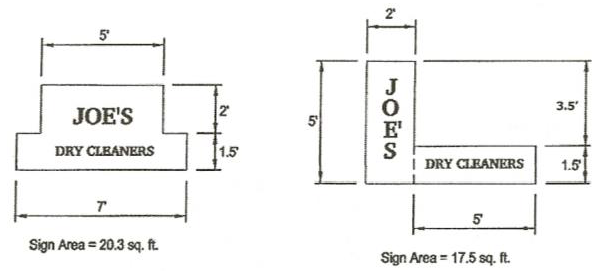
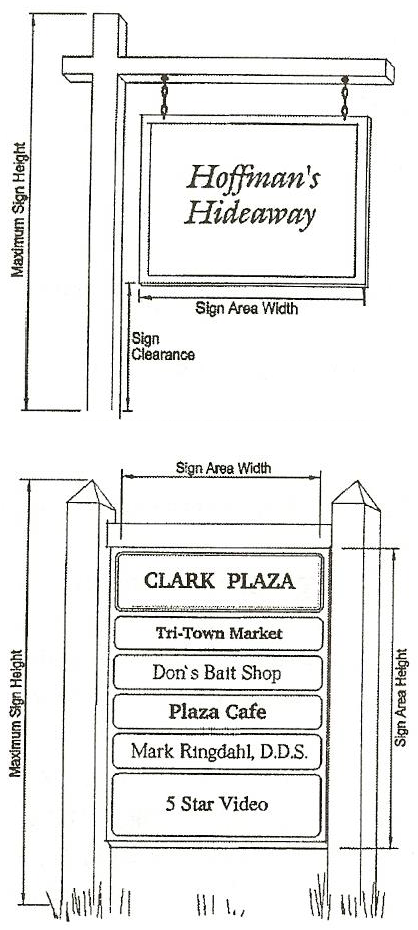
(Ord. No. 917, 2-2-2023)
Sec. 12-20-90. - Sign design.
(a)
Design compatibility.
(1)
Creative design encouraged. Signs shall make a positive contribution to the general appearance of the street and commercial area in which they are located. A well-designed sign can be a major asset to a building. The City encourages imaginative and innovative sign design.
(2)
Visibility. Signs shall not visually overpower nor obscure architectural features.
(3)
Integrate signs with the building and landscaping. Consider coordinating the sign with the architectural design, overall color scheme and landscaping. Signs shall be designed to complement or enhance the other signs for a building.
(4)
Unified sign band. Whenever possible, signs located on buildings with the same block face shall be placed at the same height in order to create a unified sign band. Locate wall signs at the first-floor level only for retail uses.
(5)
Monument signs: A maximum of one (1) monument sign per facility or subdivision is permitted.
(6)
Pedestrian-oriented signs. Pedestrian- oriented signs are encouraged. It is desirable to include a pedestrian-oriented sign as one (1) of the permitted signs for a business. These signs are designed for and directed toward pedestrians so they can easily and comfortably read the sign as they stand adjacent to the business.
(7)
Road right-of-way. No sign shall be erected within the road right-of-way or near the intersection of any road or driveway in such a manner as to obstruct free and clear vision of motorists or pedestrians or at any location where, by reason of the position, shape, or color, it may interfere with, obstruct the view of or be confused with any authorized traffic sign, signal, or device. Signs located at an intersection must be outside of the sight distance triangle.
(8)
Landscaping. Freestanding signs shall be landscaped at their base in a way harmonious with the landscape concept for the whole site. Landscaping shall form an attractive, dense cluster at the base of the sign that is equally attractive in winter and summer.
(9)
Reduce sign impact. Because residential and commercial uses generally exist in close proximity, signs shall be designed and located so that they have little or no impact on adjacent residential neighborhoods. Small-scale signs are encouraged.
(b)
Materials. Signs shall be constructed of durable, high-quality architectural materials.
(c)
Sign illumination.
(1)
Sign illumination shall complement, not overpower, the overall composition of the site.
(2)
Use a direct light source. All lighted signs shall have their lighting directed in such a manner as to illuminate only the face of the sign. When external light sources are directed at the sign surface, the light source must be concealed from pedestrians' and motorists' "lines of sight."
(3)
Signs must be illuminated in a way that does not cause glare onto the street and adjacent properties. Signs shall be lit only to the minimum level for nighttime readability.
(4)
All lighted signs shall meet all applicable electrical codes, and the electrical components used shall bear the label of an approval agency. Additionally, electrical permits shall be obtained for electric signs.
(5)
Neon tubing is an acceptable method of sign illumination for window signs in commercial districts.
(6)
The use of individually cut back-lit letter signs is encouraged.
(Ord. No. 917, 2-2-2023)
Sec. 12-20-100. - Sign installation and maintenance.
(a)
Installation.
(1)
All signs shall be mounted so that the method of installation is concealed unless integral to the signs overall artistic design.
(2)
Projecting signs shall be mounted so they generally align with others in the block.
(b)
Maintenance.
(1)
The owner of a sign and the owner of the premises on which such sign is located shall be jointly and severally liable to maintain such sign, including any illumination sources in a neat and orderly condition and in good working order at all times, and to prevent the development of any rust, corrosion, rotting or other deterioration in the physical appearance or safety of such sign. The sign must also be in compliance with all building and electrical codes.
(2)
The owner of any sign regulated by this Division shall be required to keep signs and supporting hardware, including temporary signs and time and temperature signs, structurally safe, clean, free of visible defects and functioning properly at all times. Repairs to signs shall be equal to or better in quality of materials and design than the original sign.
(3)
The City Manager may inspect any sign governed by this Division and shall have the authority to order the painting, repair, alteration, or removal of a sign which constitutes a hazard to safety, health, or public welfare by reason of inadequate maintenance, dilapidation, or obsolescence.
(Ord. No. 917, 2-2-2023)
Sec. 12-20-110. - Standards for specific types of signs.
(a)
Awning signs.
(1)
Location. Signs may be placed only on awnings that are located on first- and second story building frontages, including those fronting a parking lot or pedestrian way. No awning sign shall project beyond, above or below the face of an awning.
(2)
Maximum area and height. Sign area shall comply with the requirements established by Section 12-20-110 below. No structural element of an awning shall be located less than eight (8) feet above finished grade. Awnings on which awning signs are mounted may extend over a public right-of-way no more than seven (7) feet from the face of a supporting building. No awning, with or without signage, shall extend above the roof line of any building.
(3)
Required maintenance. Awnings shall be regularly cleaned and kept free of debris and visible defects.
(b)
Canopy signs.
(1)
Maximum area and height. Sign area shall comply with the requirements established by Section 12-20-110 below. No canopy, with or without signage, shall extend above the roof line of any building. No canopy sign shall project above the top of the canopy upon which it is mounted. However, such sign may project horizontally from the face of a canopy the distance necessary to accommodate the letter thickness and required electrical equipment, but not more than twelve (12) inches (measured from the bottom of the sign). Under-canopy signs which are perpendicular to the face of the building shall be deemed to be projecting wall signs. Under-canopy signs which are parallel to the face of the building shall be a minimum of eight (8) feet above grade and shall be deemed to be flush wall signs.
(2)
Required maintenance. Canopies shall be regularly cleaned and kept free of debris and visible defects.
(c)
Freestanding signs.
(1)
Location. The sign may be located only on a site frontage adjoining a public street. No freestanding sign in any zoning district can be erected closer than eight (8) feet from any curb line, nor closer than four (4) feet to any building. No freestanding signs in business and industrial districts may be located less than twenty-five (25) feet from any property line adjacent to a residential zoning district line.
(2)
Maximum area and height. The sign shall comply with the height and area requirements established in Section 12-20-120 below.
(3)
Sign mounting. The sign shall be mounted on one (1) or more posts or have a solid monument-type base. Posts shall not have a diameter greater than twelve (12) inches.
(4)
Pole signs. Pole signs should not be so large as to obscure the patterns of front facades and yards. Pole signs shall be no higher than the structure's roofline or the first floor's roofline of a multi-story building
(d)
Monument signs.
(1)
Location. The sign may be located only along a site frontage adjoining a public street.
(2)
Maximum area and height. The sign shall comply with the height and area requirements established in Section 12-20-120 below.
(3)
Design. The design of a monument sign shall be consistent with the overall scale of the building. The design and placement of the sign shall not obstruct traffic safety sight distance areas. Project monument signs shall contain only the name and address of the project which it identifies.
(e)
Off-premises advertising signs. Off-premises advertising signs, also known as off-site signs, are generally prohibited, except for those placed within the CH and I Districts. Off-premises signs shall not:
(1)
Interfere with pedestrian or vehicular safety.
(2)
Detract from the pedestrian quality of the surrounding area.
(3)
Add to an over-proliferation of signs on one (1) property or in an area.
(4)
Measure more than four (4) square feet.
(5)
Measure more than twelve (12) feet in height.
(6)
Number more than three (3) for any organization.
(7)
The owner of the sign shall be responsible for repair and maintenance of the sign.
(f)
Projecting signs.
(1)
Location. Projecting signs shall be placed only on a ground-floor facade except for businesses located above the ground level with direct exterior pedestrian access. Projecting signs should be mounted so that they generally align with others in the block. This helps to create a "canopy line" that gives scale to the sidewalk.
(2)
Maximum area and height. Projecting signs shall not be higher than the wall from which the sign projects if attached to a single-story building or the height of the bottom of any second-story window if attached to a multi-story building. Projecting signs must have eight (8) feet of clearance and may not extend more than four (4) feet from the building wall except where the sign is an integral part of an approved canopy or awning. The size of projecting signs is limited to three (3) feet wide and six (6) square feet.
(3)
Sign structure. Sign supports and brackets shall be compatible with the design and scale of the sign.
(4)
Quantity. The number of projecting signs is limited to one (1) per business.
(g)
Time and/or temperature signs.
(1)
Maximum area. Time and/or temperature signs which do not exceed ten (10) square feet shall not be required to be included in the allowable sign area permitted provided that any identification or advertising which is attached to or made part of the same sign structure shall be included in the allowable sign area for the premises.
(2)
Design. The sign shall be designed in a manner that is compatible with other signs on the site and with the structure on which it is placed.
(3)
Maintenance. It shall be the responsibility of the owner of such signs to maintain such signs and ensure that they are kept accurate. If these conditions are not met, the sign shall be repaired or removed.
(h)
Wall signs.
(1)
Location. The sign shall not be placed to obstruct any portion of a window, doorway, or other architectural detail. Locate wall signs on buildings at the first-floor level only for retail uses. No part of a wall sign shall be located more than twenty-five (25) feet above grade level.
(2)
Maximum area and height. Wall signs shall not be higher than the eave line of the principal building. The sign shall comply with the height and area requirements established in Section 12-20-120 below.
(3)
Projection from wall. No sign part, including cut-out letters, may project from the surface upon which it is attached more than required for construction purposes, and in no case more than twelve (12) inches.
(4)
Design. Wall signs shall identify the individual business, building or building complex by name or trademark only.
(i)
Window signs. A window sign is a sign that is painted on, applied, or attached to a window or that can be read through the window from the public right-of-way, placed at or below the second-floor level.
(1)
Maximum area. When a sign is displayed in a window and is visible beyond the boundaries of the lot upon which the sign is displayed, the total area of such sign shall not exceed:
a.
Twenty-five percent (25%) of the window or door area at the ground-floor level; and
b.
Twenty-five percent (25%) of the total allowable sign area for the premises.
(2)
Lighting. All illuminated window signs shall be included in the total allowable sign area for the premises.
(3)
Temporary posters announcing, or advertising events sponsored by noncommercial organizations shall be exempt from limitations for window signs.
(Ord. No. 917, 2-2-2023)
Sec. 12-20-120. - Sign standards by zone district.
(a)
Residential signs. Signs in the RU, RE, RL, RM, RH, Mfg-H and MSW Districts, listed in Table 12-22 below, may include and shall be limited to:
(b)
Commercial Business signs. Signs in the CB District, listed in Table 12-23 below, may include and shall be limited to:
(c)
Commercial Highway and Industrial District signs. Signs in the CH and I Districts, listed in Table 12-23 below, may include and shall be limited to:
(Ord. No. 917, 2-2-2023)
Sec. 12-20-200. - Definition and standards.
(a)
Purpose. Properly placed and designed murals in commercially zoned areas of the City shall contribute and conform to the City's character, aesthetics, culture, vision, and traditional events.
(b)
Definition. Mural means a hand produced or machined graphic applied or affixed to the exterior of a building wall through the application of paint, canvas, tile, metal panels, applied sheet graphics or other medium generally so that the wall becomes the background surface or platform for the graphic, generally for the purpose of decoration or artistic expression which has the effect of enhancement of the City's natural environment, culture, vision, and primary event celebrations, including but not limited to, painting.
(c)
Mural placement. Murals shall be allowed in all commercial districts of the City. Murals are generally intended for placement on the non-primary façade of a building and, where compatible with the building's placement and structure and, with the approval of the City Manager, on the primary façade. A primary facade is defined, for purposes of this section, as the building elevation that faces the adjacent street right-of-way and is the primary customer entrance. Buildings located on a block corner with the primary customer entrance located diagonally at the building corner to both intersecting streets shall be considered to have two (2) primary façades and shall necessitate the choice of either facade by the owner. In such case, the choice shall require the approval of the City Manager.
(d)
Specific Prohibited mural types.
i.
Murals or other representations which imitate or appear to imitate any official traffic sign or device which appears to regulate or direct the movement of traffic, or which interferes with the proper operation of any traffic sign or signal, or which obstructs or physically interferes with a motor vehicle operator's view of approaching, merging, or intersecting traffic.
ii.
Murals that project from the wall surface, except for the minimum necessary protrusion to mount the mural to the wall or structure.
iii.
Murals which contain material that when taken as a whole (i) applying contemporary community standards, its predominant appeal is to prurient interest in sex; and (ii) the average person, applying contemporary community standards, would find the material depicts or describes sexual conduct in a patently offensive way; and (iii) a reasonable person would find the material lacks serious literary, artistic, political or scientific value.
iv.
Murals that are directed to incite or produce imminent lawless action and are likely to incite or produce such action.
v.
Murals that convey threats of violence that are directed at a person or group of persons that have the intent of placing the target at risk of bodily harm.
vi.
Murals where the intended audience is commercial or actual or potential consumers, and where the content of the message is commercial in character.
vii.
Murals commonly known as "graffiti".
viii.
Murals which are not consistent with the message and purposes described in Section 12-20-200(a) above.
(e)
Surface preparation on historic buildings. Treatments that cause damage to historic materials shall not be used.
(f)
Maintenance. The mural shall be kept in good condition by the owner and/or person in possession for the life of the mural according to the maintenance schedule and responsibilities approved by the City Manager and incorporated into the Mural Permit. A mural exhibit shall be deemed to be in a state of disrepair when twenty-five (25) percent or more of the display surface area contains peeling, fading, or flaking paint or is otherwise not preserved in the manner in which it was originally created. Murals should be covered with a protective coating which allows for simple removal of any marring, debris, or vandalism. The display surface shall be kept clean and neatly painted and free from corrosion. Any mural that is not maintained according to the maintenance schedule incorporated into the mural permit or that falls into a state of disrepair may be ordered removed or covered with opaque paint, similar to the primary building materials/colors or other appropriate material by the City Manager, all in the manner provided for in the mural permit. Murals subject to removal shall be provided a time limit of thirty (30) days from the date of the written notice for such removal or covering. Additional time may be authorized by the City Manager for good cause. This covenant shall run with the land and shall be binding upon the owner, his or her designees, heirs, successors, and assigns.
(g)
Design standards.
i.
Explanatory wording relative to the graphic may be incorporated into the mural. Artist signatures shall be allowed and limited to maximum of two (2) square feet in size.
ii.
The proposed mural will not have an adverse impact on the safe and efficient movement of vehicular or pedestrian traffic.
iii.
The location and scale of the mural should be in keeping with and enhance the building or structure on which it is located. The proposed mural shall be well integrated with the building's façade and other elements of the property and enhance the architecture or aesthetics of a building or wall.
iv.
The proposed mural, by its design, construction, and location, will not have a substantial adverse effect on abutting property or the permitted use thereof. The proposed mural shall not be detrimental to the public health, safety, or welfare.
v.
The mural will not have a detrimental effect on the structural integrity of the wall on which it is applied/affixed.
vi.
The maintenance schedule is reasonable for the mural and the building on which it is applied/affixed.
vii.
The mural may be attached by using an alternate medium (i.e. canvas, tile, metal panels, or similar materials with an approved attachment method) or may be otherwise applied by methods that will not damage the wall surface including brick.
a.
New materials such as applied sheet graphics and appliqués that can be removed readily from brick may be utilized.
b.
Other new materials can be utilized provided they are found to be non-detrimental to the surface on which applied.
(Ord. No. 917, 2-2-2023)
Sec. 12-20-210. - Mural permit.
No mural shall be installed unless written permission is first obtained from the owner of the building upon which the mural is to be placed, or the building owner's agent, and a mural permit is obtained from the office of the City Clerk, approved by the City Manager. The City shall either issue a permit, a permit with conditions, or a denial with stated reasons within thirty (30) days from the date on which the application has been filed.
(a)
Application requirements. Each permit application shall contain, but not be limited to, the following information:
i.
Site plan showing the lot and building dimensions and indicating the proposed location of the mural.
ii.
Pictures of the building elevations.
iii.
A scale drawing and color photo of the building elevation showing the proposed size and placement of the mural.
iv.
A colored drawing of the proposed mural.
v.
A description of the proposed maintenance schedule that includes the time frame for the life of the mural and method for removal, if applicable.
vi.
Written confirmation by the mural provider/installer that no damage or negative impact will occur to the wall surface that the mural is to be applied or affixed to.
vii.
Written permission from the owner of the building to which the mural is intended to be applied, if applicant is not the building owner.
viii.
An acknowledgement that the mural must be removed or covered if so ordered by the City Manager for failure to maintain or for reaching a state of dilapidation, as described in subsection 12-20-200(d) above.
(b)
Mural permit approval. Applications for a mural permit in the downtown area shall be reviewed for approval by the City Manager. No mural permit shall be approved unless the City Manager finds that these requirements have been fulfilled.
(c)
Appeals. Appeals of the City Manager's decision to approve or not approve a mural application may be made in writing to the City Clerk within ten (10) days of the City Manager's decision and thereafter referred to the City Board of Adjustment for consideration and appropriate decision.
Violation/Penalty. A violation of any of the provisions of this Section 12-20-200 and 12-20-210 shall be punishable in accordance with the provisions of Section 1-4-20 of this Code. Each day of continued violation shall constitute a separate offence.
(Ord. No. 917, 2-2-2023)

