
Monte Vista City Zoning Code
ARTICLE 17
Supplementary Regulations
Sec. 12-17-10.- Accessory uses and structures.
(a)
Accessory uses shall comply with all requirements for the principal use, except where specifically modified by this Chapter, and shall also comply with the following limitations:
(1)
A greenhouse or hothouse may be an accessory to a dwelling only if there are no sales from the premises.
(2)
A guesthouse may be maintained in a residential district accessory to a dwelling, provided that the guesthouse is used for the occasional housing of guests of the occupants of the principal dwelling, so long as the guesthouse is not used for commercial purposes and no charge is made for the use of the premises.
(3)
The renting of rooms to one (1) person, not a member of the family residing in the same one-unit dwelling may be permitted as an accessory use, provided that the total number of unrelated persons, including roomers in any one (1) dwelling unit, shall not exceed three (3) persons.
(4)
A swimming pool may be permitted in any district as an accessory use subject to the following additional requirements:
a.
No public or private swimming pool may be located in any required front or side setback abutting a street.
b.
Every swimming pool must be completely surrounded by a fence or wall not less than six (6) feet in height, with no openings large enough to permit children to pass through other than gates or doors that can be fastened to protect against entry. A building may be used as part of the required enclosure.
c.
All gates or doors opening through such enclosures must be equipped with self-closing and self-latching devices for keeping the gate or door securely closed at all times when not in actual use.
d.
All swimming pools shall comply with the State Building Code and the National Electrical Safety Code.
(b)
Accessory structures shall comply with all requirements for the principal structure except where specifically modified by this Chapter, and shall also comply with the following limitations:
(1)
No part of any accessory structure shall be located closer than ten (10) feet to any principal structure unless it is attached to, or forms a part of, the principal structure.
(2)
Accessory structures shall not be located in the front setback of a principal structure.
(3)
Accessory structures on corner lots in RL, RM, RH, Mfg-H and MSW Districts may be set back from the side street a distance of fifteen (15) feet if built behind the principal structure.
(c)
Accessory structures and uses shall otherwise comply with the regulations applicable in the district in which they are located.
(Ord. 789 §18-378, 2006)
Sec. 12-17-20. - Temporary uses.
(a)
The temporary uses of land shown on Table 12-16 are permitted in particular zoning districts, subject to specific regulations and time limits and to the other applicable regulations of the district in which the use is permitted. In addition, temporary uses may be subject to the provisions of Chapter 4, Article 7 of this Code.
(b)
No temporary use permit shall be required for outside displays for sale of items from vending machines, newspaper sales racks and other machines.
(c)
Temporary structures shall be removed not more than seven (7) calendar days after occupancy of the permanent building is permitted. Temporary stands, motor vehicles and trailers shall be removed on the date of termination of the permit unless a specific date is stated.
Table 12-16
Temporary Use Chart
(Ord. 789 §18-379, 2006; Ord. 805 §4, 2008; Ord. 813, 2009; Ord. 861, 2015)
Sec. 12-17-30. - Landscaping.
All new permitted and special review uses in all Districts are required to submit a landscaping plan as part of the application for a site permit and building permit.
(Ord. 789 §18-380, 2006; Ord. 811 §1, 2009)
Sec. 12-17-40. - Architectural and placement standards.
(a)
The purpose of these standards is to require that homes be placed within neighborhoods in a manner that assures that the homes are compatible with adjacent properties and reflect the character of the neighborhoods in the City.
(1)
Any person wishing to place a one-unit dwelling, two-unit dwelling or manufactured home Class A on a lot of record within the City shall provide to the City Manager the following on a form provided by the City or copies of original documents:
a.
Scaled building site plan for the lot showing proposed location of the single-family home on the lot, including all setbacks required in the zone district, all adjacent rights-of-ways, lot lines and lot dimensions.
b.
Location of required off-street parking spaces.
c.
All existing and proposed sidewalks, curb cuts, driveway, access and handicapped ramps.
(2)
Regulations: All one-unit dwellings, two-unit dwellings and manufactured homes Class A shall:
a.
Be placed on a subdivided lot of record.
b.
Use at least eight (8) of the following design features:
1.
The front of the dwelling shall be parallel (within thirty [30] degrees) to the front lot line (see Figure 12-1).
2.
A roof with a pitch that is 4:12 or greater.
3.
A hip roof.
4.
Have masonry or other contrasting material that project from the wall plane on the building facade that is parallel (within thirty [30] degrees) to the front lot line.
5.
An architecturally similar garage or carport.
6.
One (1) or more dormers that are parallel (within thirty [30] degrees) to the front lot line (see Figure 12-2).
7.
Three (3) or more gables (see Figure 12-3).
8.
Building face or roof offsets (minimum twelve-inch offset) that are parallel (within thirty [30] degrees) to the front lot line (see Figure 12-4);
9.
Two (2) or more windows, with a combined minimum of twenty (20) square feet of glazed area, that are parallel (within thirty [30] degrees) to the front lot line, at least one (1) of which has a minimum operable opening of twenty (20) inches wide and twenty-four (24) inches high.
10.
Bay or bowed windows that are parallel (within [30] degrees) to the front lot line.
11.
Window shutter on the front, side and rear windows.
12.
Minimum ten-inch eaves (all house eaves).
13.
One (1) or more of the following types of exterior siding:
a)
Horizontal lap siding, including simulated horizontal lap siding;
b)
Vertical siding, with a pattern repeat of less than twelve (12) inches;
c)
Beveled siding;
d)
Stucco; or
e)
Brick.
14.
A recessed front entry (minimum eighteen [18] inches) which is parallel (within [30] degrees) to the front lot line.
15.
A covered porch entry (minimum five-foot depth) for the front entrance. When the front entrance is not parallel to the front lot line, the porch shall be visible from the street (see Figure 12-5).
16.
Wood or composition trim, nominal four (4) inches for exterior siding.
17.
More than one (1) exterior material or contrasting color (not including trim material).
Figure 12-1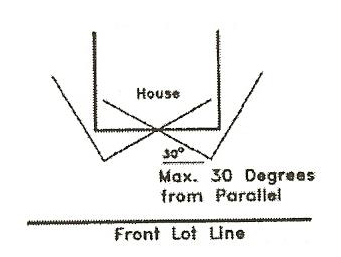
Figure 12-2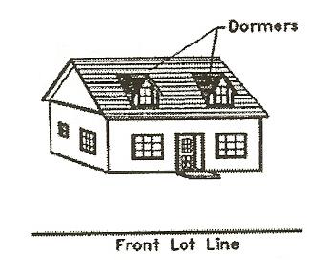
Figure 12-3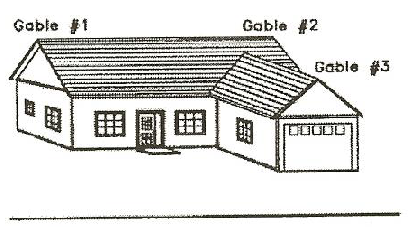
Figure 12-4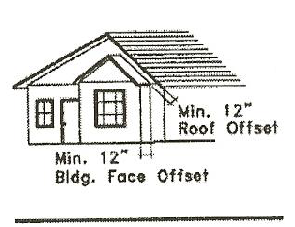
Figure 12-5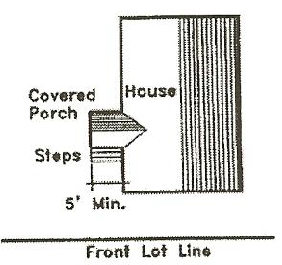
(3)
Restrictions: All one-unit dwellings, two-unit dwelling and manufactured homes Class A shall:
a.
Obtain site permits required and issued by the City.
b.
Obtain building permits required by the City.
c.
Have a paved (asphalt, gravel or concrete) driveway, off-street parking spaces, as required, and sidewalk from either the public sidewalk or driveway to the front entry.
d.
Be placed on a permanent poured-in-place concrete perimeter foundation with no more than twelve (12) inches of concrete exposed above the grade on the street face, which meets all applicable codes as determined from plans and specifications submitted to obtain a building and site siting permit;
(b)
A certificate of occupancy shall not be issued by the City Manager if it is found that less than eight (8) of the design features are used in the construction of a new one-unit dwelling, two-unit dwelling or manufactured home.
(Ord. 789 §18-381, 2006)
Sec. 12-17-50. - Building height exceptions.
The following types of structures or structural parts are not subject to the building height limitations of this Chapter: chimneys, storage tanks, water towers, church spires, belfries, domes, public monuments, fire and hose towers, observation towers, transmission towers, utility poles, flagpoles, radio and television towers, masts, aerials, cooling towers, elevator shafts, grain elevators, ranch and farm accessory uses, silos, outdoor movie screens and other similar projections.
(Ord. 789 §18-384, 2006)
Sec. 12-17-60. - Projections from buildings.
Cornices, eaves, canopies, sunshades, gutters, chimneys, flues, belt courses, leaders, sills, pilasters, lintels, ornamental features and other similar architectural features may not be constructed within three (3) feet of the property line or project more than three (3) feet into required open space as established by coverage standards.
(Ord. 789 §18-385, 2006)
Sec. 12-17-70. - Vision clearance.
(a)
The vision clearance area shall contain no plantings, walls, fences, structures or temporary or permanent obstructions between two and one-half (2½) feet and eight (8) feet in height, except for trees or signs. The height shall be measured from the top of the curb or existing grade.
(b)
Vision clearance areas shall be provided with the following distance establishing the size of the vision clearance area:
(1)
At street intersections in the RU, RE, RL, RM, RH, Mfg-H and MSW Districts, the minimum distance shall be thirty (30) feet. At alley intersections in a residential district, the minimum distance shall be ten (10) feet.
(2)
At street intersections in the CH and I Districts, the minimum distance shall be fifteen (15) feet. When the angle of intersection between streets is less than thirty (30) degrees, the distance shall be twenty-five (25) feet. At alley intersections, the minimum distance shall be ten (10) feet.
(Ord. 789 §18-386, 2006)
Sec. 12-17-80. - Screening.
(a)
All exterior business and industrial activity areas, including but not limited to parking areas, service areas and outdoor storage areas, shall be screened by means of plant materials, earth mounding, architectural screens or siting so as to provide visual and aural separation between these elements and adjacent residential property, whether existing or proposed.
(b)
Salvage junkyards shall be screened with no less than an eight-foot-high opaque solid fence or earth berm so as to provide visual and aural separation between such use and adjacent areas.
(c)
All extractive industries shall be screened by means of plant materials, earth mounding or solid fencing no less than eight (8) feet in height to provide visual and aural separation between such use and adjacent areas.
(d)
The boundary of the manufactured home single-wide park shall be landscaped including hedges, evergreens, shrubbery or a six-foot screening wall which will serve as a buffer. Such landscaping, fences or walls, and the setback areas adjacent thereto, shall be properly maintained by the park owner.
(Ord. 789 §18-387, 2006)
Sec. 12-17-90. - Animals.
(a)
The following Table 12-17 identifies limitations on the number and type of animals permitted in each zoning district. The animal inventory of pet shops is exempt from these limitations. Said inventory numbers shall be governed by regulations pertaining to retail and wholesale pet animal dealerships (pet shops) set by the Colorado Pet Animal Care Facilities Program.
Table 12-17
Animal Regulations
(b)
Animal-based businesses.
1.
It is unlawful for any person to maintain or operate any pet shop, animal day care center or kennel within the City without first having obtained a license. The annual license fee for such businesses shall be set by resolution of the City Council. License applications must be accompanied by a copy of the applicant's current state license issued by the Colorado Department of Agriculture Animal Industry Division. Applications must also be accompanied by a plan for animal waste management. The City may revoke or suspend any animal-based business license issued under this Article when the facility for which such license has been issued is found to be in violation of this Chapter or of any other applicable law. This Article shall not apply to and shall not be construed to require an animal-based business license for a veterinarian to board animals receiving veterinary medical care or to board animals which are under observation.
2.
Pet shops, animal day care centers and kennels shall be confined in a building that is totally enclosed, and all animals shall be confined exclusively to that building. Such businesses may not have outside runs or pens, and none of the animals owned by such businesses shall be harbored or housed outside of the building at any time for any reason.
3.
The sale or offering for sale of sick, injured, weak or unweaned animals is prohibited.
4.
All pet shops, animal day care centers and kennels shall be maintained according to the regulations enacted for such businesses by the Colorado Pet Animal Care Facilities Program. Copies of such regulations are available for review at the Community Development Department or from the state Program, 700 Kipling Street, Suite 4000, Lakewood, CO 80215. Regulations include standards for physical facilities, sanitation, ventilation, lighting, heating, cooling, humidity, spatial and enclosure requirements, nutrition, humane care, medical treatment, methods of operation and recordkeeping.
(c)
Additional regulations pertaining to control of animals in the City are specified in Chapter 6 of this Code.
(Ord. 789 §18-388, 2006; Ord. 805 §3, 2008)
Sec. 12-17-100. - Manufactured homes.
Manufactured homes may be locatable in the RU, Mfg-H and MSW Districts as a permitted use. See Table 12-3 Use Chart at Section 12-5-120 of this Chapter for requirements. In addition, manufactured homes Class A may be approved as a special review use in the RL and RM Districts provided that the City Manager certifies, prior to the location of a manufactured home, that the applicant has complied with "acceptable similarity standards" and that the housing is internally compatible and consistent with the surrounding housing development as follows:
(1)
Each housing unit shall be situated on a lot so that the placement is consistent and compatible with the placement of other residential units in the surrounding neighborhood and in accordance with the requirements and provisions of this Chapter.
(2)
In development of single vacant sites within a developed area, the unit shall be compatible with structures on adjacent properties. Development of manufactured housing shall comply with the site plan, development standards or other design criteria as required for the underlying zone required by City subdivision regulations and zoning regulations.
(3)
Units shall not be less than twenty-four (24) feet in width or thirty-six (36) feet in length.
(4)
The main roof shall be pitched rather than flat.
(5)
Each unit shall be faced in wood siding, brick, a combination thereof or other cosmetically equivalent exterior siding.
(6)
The engineered permanent foundation shall be the same as required for "site built"/"stick built" housing within the City, as required by the Building Code.
(7)
Landscaping of the lots shall be consistent with the provisions of this Chapter.
(8)
All units shall include a garage unless such a requirement is inconsistent with the surrounding neighborhood.
(9)
Architectural compatibility with adjacent development shall be provided through the use of similar colors, building materials, design details, massing, scale or architectural style, including such structural features as porches, alcoves, bay windows, broken-roof pitch lines, wood trim, shutters and other exterior decorative features.
(Ord. 789 §18-389, 2006)
Sec. 12-17-110. - Storage and parking of commercial vehicles, railcars, camping units, manufactured homes single-wide, recreational equipment, buses, trailers and similar units.
Commercial vehicles, railcars, camping units, manufactured homes single-wide, recreational equipment, boats, buses, trailers and other similar units shall not be parked or stored on any lot or upon any public right-of-way in any zoning district contrary to this Section, except in accordance with the following provisions:
(1)
Not more than one (1) commercial vehicle (not to exceed one and one-half [1½] tons rated capacity) on a residential lot, or combination of lots under single ownership, shall be permitted, and in no case shall a commercial vehicle used for hauling explosives, gasoline or liquefied petroleum products be permitted.
(2)
Buses, trailers and commercial vehicles not to exceed one and one-half (1½) tons rated capacity, camping units, recreational equipment (which includes, but is not limited to, ATVs and snowmobiles), boats and similar units may be parked or stored on a residential lot, or combination of lots under single ownership, subject to the following conditions:
a.
If such units or vehicles are parked in any required front setback, they shall be parked on a constructed driveway. A constructed driveway is an off-street parking area built of asphalt, concrete, rock or gravel that occupies no more than forty percent (40%) of the front setback area. Driveways built of rock or gravel shall be not less than three (3) inches deep and have an outer border to contain the material.
b.
If such units or vehicles are parked in any required side setback, they shall be confined to one (1) side setback only.
c.
No such units and vehicles shall be parked or stored upon any public right-of-way.
d.
No such units and vehicles shall be parked in a manner as to obstruct motorists' view of street intersections or pose any other driver safety hazards, in accordance with the provisions of Section 12-17-70 and the definition of vision clearance area in Section 12-1-10 of this Chapter.
e.
A camping unit or recreational vehicle shall not be occupied for more than thirty (30) days in any one (1) year while it is parked or stored in any area within the City, except in a mobile home park or campground authorized under Article 5 of this Chapter.
RV PARKING AREAS
TYPICAL LOT DIAGRAM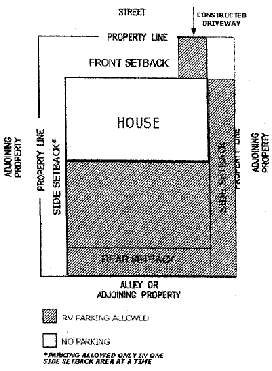
RV PARKING AREAS
CORNER LOT DIAGRAM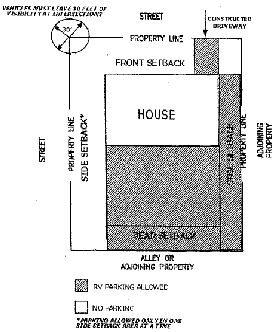
(3)
Railcars may not be stored in any residential, industrial or commercial zone of the City when not connected to a rail line.
(4)
A manufactured home single-wide shall not be stored within the City limits except in a licensed mobile home park.
(5)
Commercial vehicles, railcars, camping units, manufactured homes single-wide, recreational equipment, boats, buses, trailers and similar units shall be considered stored if not moved for seven (7) consecutive days.
(6)
Parking and operation restrictions of commercial and other specified vehicles upon public rights-of-way:
a.
Commercial vehicle, for the purpose of this Paragraph, is defined as any tandem or single-axle vehicle having a gross vehicle weight rating (GVWR) of thirty-six thousand (36,000) pounds or more;
b.
Commercial vehicles, railcars and similar units, designed primarily for conveying products and services, shall only be allowed in commercial and industrial zone districts of the City, upon public rights-of-way. However commercial vehicles and similar units shall be allowed to enter residential areas for the purpose of delivery or retrieval of products and services to specific residences in said areas, as well as commercial vehicles necessarily utilizing the City streets for the purpose of construction or contracting in residentially zoned districts.
c.
Parking restrictions in residential, commercial and industrial zone districts: No person shall park any commercial vehicle or similar unit, designed primarily for conveying products and services, for more than one (1) hour upon any public right-of-way or place ordinarily used for vehicular parking which is zoned residential. No person shall park any such commercial vehicle or railcar for more than forty-eight (48) hours in any area which is zoned commercial or industrial. Movement of said vehicle from one (1) location to another within the City shall be no defense to this Section.
This provision shall not apply to any commercial vehicle, railcar or similar unit which is leased or owned by any permittee granted a permit for construction or repair work or by a public utility engaged in work for which no such permit is required or a vehicle leased or owned by any contractor hired by such permittee or public utility, provided that the commercial vehicle or similar unit is used in such construction or repair site or within one hundred fifty (150) feet thereof as measured from the limits of the work area as specified in the permit and only during the period of actual construction; or to any such trailer, semi-trailer, tractor trailer or commercial vehicle or railcar which is leased or owned by a City department or contractor or vendor hired by such City department for construction or repair work or by a subcontractor thereof.
(7)
Commercial vehicles carrying flammable gases or liquids. No commercial vehicle used for transportation of flammable gases or liquids shall be parked in the City in excess of one (1) hour. No driver, operator or attendant shall leave a commercial vehicle unattended during the loading or unloading of flammable gases or liquids. No commercial vehicle used for transportation of flammable gases or liquids shall be parked nearer than twenty-five (25) feet to any building except when loading or unloading such flammable gases or liquids.
(8)
Towing authorized. The Police Department is authorized to remove and tow away by a commercial towing service any commercial vehicles, camping units, recreational equipment, buses, trailers and similar units parked in violation of this Section. Such items so towed for illegal parking shall be stored in a safe place and shall be returned to the owner or operator of such vehicle upon payment of the towing and storage fees.
(9)
Every person convicted of a violation of this Section may be punished in accordance with the provisions of Section 1-4-20 of this Code.
(Ord. 796 §B, 2008; Ord. 811 §1, 2009)
Sec. 12-17-120. - Home occupations.
The purposes of this Section are to encourage major business activities to be conducted in appropriate commercial zones, to allow for home occupations that are compatible with the neighborhoods in which they are located as an accessory use, to safeguard peace, quiet and domestic tranquility within certain residential neighborhoods within the City, to protect residents from excessive noise, excessive traffic, nuisance, fire hazard and other possible adverse effects of commercial uses being conducted in residential areas, to provide a means to terminate home occupations if disruption of a residential neighborhood occurs and to preserve the residential character of residentially zoned areas of the City while allowing limited home occupations.
(1)
Home occupation license. A home occupation shall be conducted within the City only in residentially zoned areas, and in compliance with the following provisions:
a.
No home occupation may be conducted by any person in the City without having first procured a valid and current license to conduct the same.
b.
A license to conduct a home occupation shall be issued by the City Clerk upon recommendation for approval from the City Manager and based upon the following criteria, and the holder of any license shall be bound by said criteria:
1.
The home occupation shall be an accessory use by a bona fide resident of the dwelling that is clearly secondary and incidental to the family use of the dwelling unit. There shall be no physical evidence of the home occupation other than allowed signage.
2.
The home occupation shall not physically change or alter the external appearance of the principal or accessory structures. Interior alterations for the purpose of accommodating the home occupation are prohibited if such alteration eliminates either the kitchen, dining area, bathrooms, living room and/or all of the bedrooms.
3.
The home occupation shall not involve the use of any yard space for storage or display of supplies, inventory or equipment when such use is in conjunction with the sale or production of goods or services.
4.
There shall be complete conformity with fire, building, plumbing, electrical and all other municipal, county, state and federal codes.
5.
The home occupation shall not necessitate a demand for municipal, community or utility services that are substantially in excess of those usually and customarily provided for residential uses.
6.
The home occupation shall not directly or indirectly interfere with or disrupt the peace, quiet and domestic tranquility of the neighborhood by producing or creating odor, smoke, dust, heat, fumes, light, glare, construction, sounds, noises, vibrations or other nuisances, including interferences with radio and television reception or other adverse effects associated with its use as a business that may be discernable beyond the premises.
7.
No process may be used in home occupations which is hazardous to the public, health, safety, morals or welfare.
8.
Visitors, customers and vehicular traffic shall not exceed that normally and reasonably occurring in the neighborhood where the home occupation is conducted so that neighbors will not be significantly impacted by its existence.
9.
The home occupation may include the sale of commodities; however, direct sale from display shelves is not permitted at the premises.
10.
Vehicles or equipment may not be used primarily for the purpose of advertising the home occupation at the site of the home occupation. Any vehicles or equipment displaying such advertising shall not be visible from the public right-of-way.
11.
The receipt or delivery of merchandise, goods or supplies for use in the home occupation shall be limited to vehicles with a gross vehicle weight rating of thirty-six thousand (36,000) pounds or less.
12.
No visitors in conjunction with the home occupation (clients, patrons, students, pupils, etc.) shall be permitted between the hours of 10:00 p.m. and 6:00 a.m.
13.
The home occupation shall be carried on wholly within the principal and/or accessory building.
14.
The home occupation shall not occupy more than twenty-five percent (25%) of the gross floor area of the home and, if located in an accessory building, not more than five percent (5%) of the total lot area.
15.
Home occupation signs shall be decorative, the design of which shall be approved in advance of placement by the City Manager, shall not exceed six (6) square feet per face, and may be placed anywhere on the premises below the roof line of the residence or building to which it is attached. The design may not project onto a public right-of-way and may not be illuminated, except for indirect lighting, from between dusk until 10:00 p.m.
16.
Home occupation licenses are not transferable to any person other than the original applicant, or to locations other than that indicated in the original application.
17.
Although more than one (1) home occupation may be allowed at any residential dwelling, the provisions of this Section shall apply to the total area allowed for all such home occupations.
18.
Each home occupation shall require a current City sales tax license and state sales tax license.
(2)
It shall be unlawful for any person to engage in or conduct a home occupation within the City without first having procured a home occupation license, a City sales tax license and a state sales tax license. Such licenses shall be renewed yearly and shall be maintained in good standing in compliance with the provisions of this Section, as well as all other provisions of this Code and the State statutes.
(3)
The City Council may, by resolution, from time to time adopt application and licensing fees for home occupations, and such fee schedules are incorporated by reference into the provisions of this Section.
(4)
Any violations of this Section shall be punishable in accordance with the provisions of Section 1-4-20 of this Code.
(Ord. 789 §18-391, 2006; Ord. 811 §1, 2009)
Sec. 12-17-130. - Drive-in facilities.
(a)
Any use permitted in a zoning district which intends to conduct a portion or all of its business with persons desiring to remain in their automobiles or which allows products to be consumed on the premises outside the principal building, and which is not subject to special review use provisions of Sections 12-5-40 through 12-5-120 of this Chapter or is not part of a planned unit development under Article 18 of this Chapter, must submit a site plan to be reviewed and approved by the Planning and Zoning Commission.
(b)
In reviewing and approving the site plan for such a use, the Planning and Zoning Commission must be satisfied that the traffic circulation on and adjacent to the site conforms to the following criteria:
(1)
Traffic circulation shall be arranged so that internal pedestrian and vehicular movements are compatible and traffic hazards are minimized.
(2)
Traffic circulation, ingress and egress shall be arranged so as to minimize hazardous or adverse effects on adjacent sites and streets.
(Ord. 789 §18-392, 2006)
Sec. 12-17-140. - Extractive industries and salvage yards.
Extractive industries and salvage yards shall be located a minimum of six hundred sixty (660) feet from any residential district or school.
(Ord. 789 §18-393, 2006; Ord. 805 §3, 2008)
Sec. 12-17-150. - Commercial Mobile Radio Systems (CMRS).
(a)
All proposed CMRS facilities shall be reviewed pursuant to the following procedures:
(1)
Building- or structure-mounted CMRS facilities shall be reviewed by the City Manager for compliance with the requirements of this Chapter.
(2)
Roof-mounted and freestanding CMRS facilities must receive a special review use permit.
(b)
Multiple providers. No more than one (1) roof-mounted or freestanding CMRS facility may be constructed or maintained upon a property in single ownership; provided, however, that additional CMRS facilities may be approved at the same location by special review use, provided that all other requirements of this Chapter are met.
(c)
Building- or structure-mounted CMRS facilities shall be subject to the following requirements:
(1)
Such facilities shall be architecturally compatible with and colored to match the building or structure to which they are attached.
(2)
The maximum protrusion of such facilities from the building or structure face to which they are attached shall be two (2) feet.
(3)
Building- or structure-mounted whip antennas shall extend no more than ten (10) feet above the highest point of the building or structure to which they are attached.
(d)
Roof-mounted CMRS facilities shall be screened or camouflaged as appropriate from view from adjacent property lines. Such facilities are additionally subject to the following requirements:
(1)
Such facilities shall be architecturally compatible with and colored to match the building or structure to which they are attached.
(2)
Roof-mounted CMRS whip antennas shall extend no more than ten (10) feet above the parapet of any flat root or ridge of a sloped roof to which they are attached.
(3)
Roof-mounted CMRS panel antennas shall extend no more than seven (7) feet above the parapet of a flat roof or ridge of a sloped roof to which they are mounted.
(4)
Roof-mounted CMRS accessory structures shall extend no more than seven (7) feet above any parapet of a flat roof upon which they may be placed, and shall not be permitted on a sloped roof.
(e)
Freestanding CMRS facilities shall be visually screened from adjacent residential development and public rights-of-way as follows:
(1)
All accessory buildings and equipment cabinets shall be totally screened from view from adjacent property lines.
(2)
Screening, landscaping and/or exterior building finishes and colors shall be compatible with the existing character of the site and adjacent properties and shall be determined as part of the special review use permit review process.
(f)
No CMRS facility shall exceed the height of one hundred fifty (150) feet above ground level.
(g)
The construction and use of a CMRS facility shall not cause interference to other adjacent CMRS facilities. The City shall be held harmless if interference occurs.
(h)
CMRS facilities which are abandoned by disconnection of power service, equipment removal or loss of lease for greater than six (6) months shall be removed by the CMRS facility owner. Should the owner fail to remove the facilities, the City may do so at its option and the costs thereof shall be a charge against the owner.
(i)
Standards for approval:
(1)
Existing or approved towers cannot accommodate the telecommunications equipment planned for the proposed tower.
(2)
The tower shall not constitute a hazard to aircraft.
(3)
The tower shall be placed on the property to contain on site all ice-fall or debris from tower failure.
(4)
The tower shall provide for shared capacity if technically practicable.
(5)
The tower shall have the least practicable adverse visual impact on the environment.
(6)
The tower shall not emit radiation that will adversely affect human health.
(7)
The tower shall be the minimum height needed to accommodate the antenna.
(8)
The tower shall comply with all applicable federal and state regulations.
(9)
The design of the tower shall ensure structural integrity. The proposed tower shall have adequate measures to discourage unauthorized climbing and to ensure the security thereof.
(10)
All reasonably possible sites for the tower have been considered, and the proposed site is the most appropriate, available site from a land use perspective.
(Ord. 789 §18-395, 2006; Ord. 860, 2015)

