
Moraga City Zoning Code
CHAPTER 8
76 - OFF-STREET PARKING AND LOADING
8.76.010 - Intent.
It is the intent of this chapter that all land uses shall be provided with sufficient space located off-street for the parking of vehicles to meet the needs of persons employed at or making use of such land uses. No application for a building permit for the erection of a new structure or for the enlargement of an existing structure, or for the development of a land use shall be approved unless it includes off-street parking facilities as required by this chapter.
The inclusion of uses for the purpose of calculating parking requirements is not an authorization of land uses otherwise not authorized in this title.
(Prior code § 8-1901)
8.76.020 - Application to existing land uses.
A.
The requirements set forth in Sections 8.76.030 through 8.76.080 and Sections 8.76.100 through 8.76.120 apply to each land use irrespective of the date the use began.
B.
The number of required spaces set forth in Section 8.76.090 applies to each land use irrespective of the date when the use began so long as the number of required spaces for a use existing on October 8, 1980 does not increase. However, where there is a change of use in a building existing on October 8, 1980, and the application of Section 8.76.090 results in an increase in the number of parking spaces for that use, the new use is subject to the increased parking space requirement of Section 8.76.090.
(Prior code § 8-1902)
8.76.030 - Fractional parking space.
In computing the required number of off-street parking spaces, each fractional parking requirement shall be rounded up to the next whole number.
(Prior code § 8-1903)
8.76.040 - Mixed uses.
Where property is occupied or intended to be occupied by two or more establishments falling into different classes of uses, the off-street parking required shall be the sum of the requirements for the various individual establishments, computed separately; off-street parking provided for one use shall not be considered as being provided for any other use except as provided in Section 8.76.080.
(Prior code § 8-1904)
8.76.050 - Design and layout.
Off-street parking areas shall be designed in such a manner as to conform to the following regulations, subject to review and approval by the zoning administrator:
A.
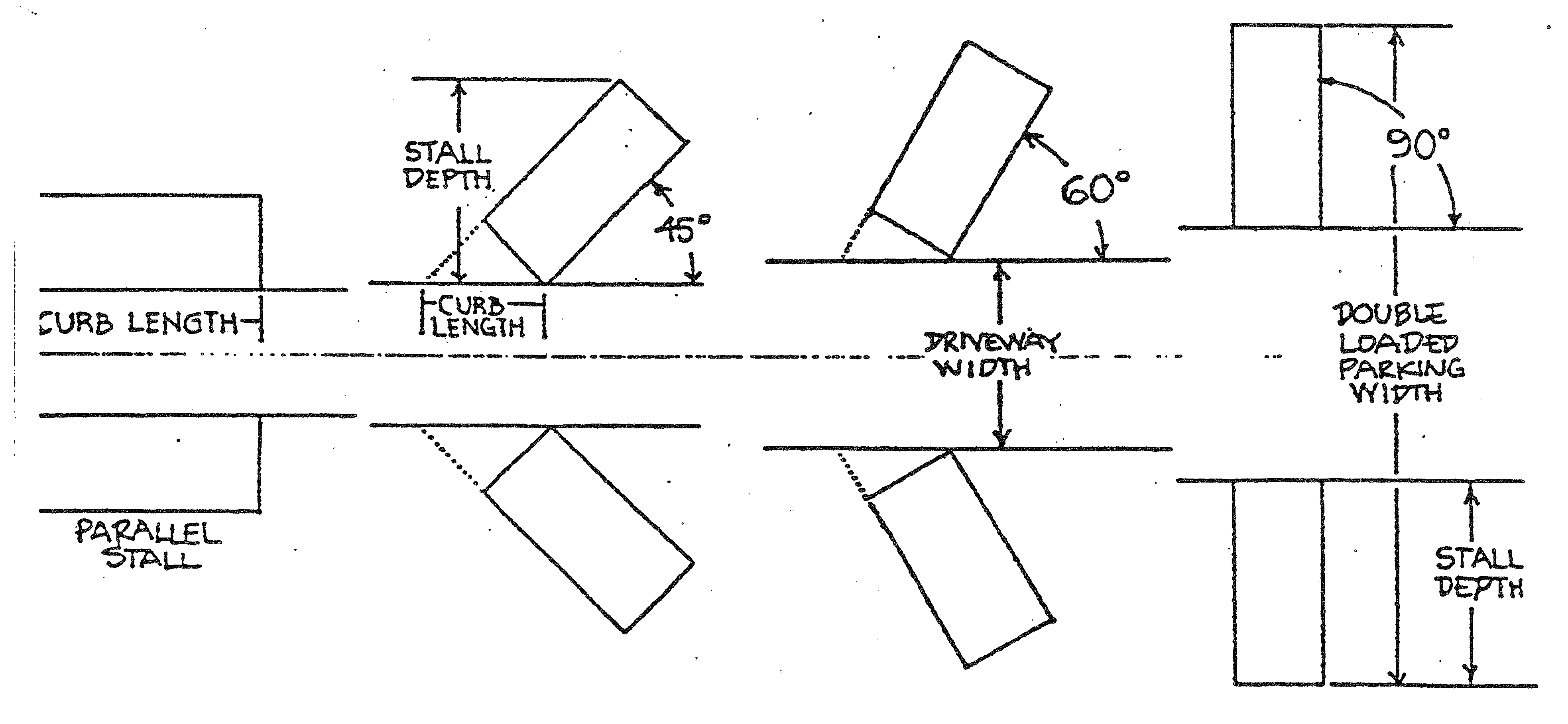
Dimensions of the required off-street parking spaces and driveways shall have minimums as per the following table:
B.
All off-street parking facilities shall be designed with appropriate maneuvering areas and means of vehicular access to the main and auxiliary streets. Where the parking area does not abut on a street, there shall be provided an access drive not less than twelve (12) feet in width in the case of one-way traffic and not less than twenty (20) feet in width in all other cases, leading to the parking area in such a manner as to secure the most appropriate development of the property in question.
C.
Required off-street parking areas shall be surfaced with an asphaltic or Portland cement binder pavement, or similar material so as to provide a durable and dustless surface, and shall be so graded, drained and maintained as to prevent the ponding of water.
D.
Parking areas shall not be used for vehicle sales storage, repair work, dismantling or servicing of any kind.
E.
A planter or landscaped strip adjacent to a street right-of-way shall be at least ten feet in width depending upon site constraints and an approved design concept for the project. Within this planter or landscaped strip, an irrigation system shall be installed and maintained in an operational condition. Such a landscaped strip or planter shall be provided to create the necessary visual and physical break between the pedestrian traffic utilizing the sidewalks along the streets and the vehicular traffic in the parking area, and by this means, substantially reduce the traffic hazard to the pedestrian. Dead corners and other waste areas shall be landscaped to provide a visual break in the paved area. Parking areas of more than five parking spaces shall provide, in addition to the required parking areas, an area equal to not less than ten percent of the total parking area devoted to landscaping.
F.
Landscape credit permitting a reduction in the ten percent landscaped area otherwise required may be granted for special design features such as kiosks, covered walkways, fountains, landscaped sitting areas and other design amenities that compliment the design of the site.
G.
Trees shall be used to provide a physical break of the off-street parking area and foster an umbrella effect.
H.
Parking spaces shall be marked or maintained on the pavement and any other directional marking or signs shall be installed as permitted or required, to insure the maximum utilization of space, sufficient traffic flow, and general safety.
I.
Lighting, if provided, shall be so designed that the orientation and intensity of lighting will not produce a glare or otherwise adversely affect nearby user or users of the public right-of-way.
J.
Access to public parking areas and curb cuts for driveways shall be so located as to insure an efficient and safe traffic flow into the parking areas and along the public streets.
K.
Parking areas shall be designed so that vehicular parking does not overhang sidewalks.
L.
Within any of the commercial, office and multiple family residential zones, parking areas shall be designed so that vehicle is not able to back out of the parking areas on to a sidewalk, street or adjacent property.
M.
A six-foot high solid fence, or masonry wall of acceptable design, shall be provided along the edge(s) of any public parking areas adjacent to residentially zoned property to protect these residential properties from the interruption and nuisances of the vehicles using the parking area.
N.
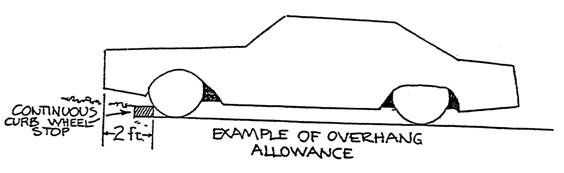
A barrier curb or wheel stop at least six inches in height shall be provided adjacent to landscaping, buildings, and other areas to prevent damage to these facilities by vehicles utilizing the parking areas. The diagram that follows is made a part of this section:
O.
Access for the handicapped shall be provided as set forth in applicable state and federal laws.
P.
Electric Vehicle Charging Spaces. Each EV charging space provided in a parking area counts as one space toward the minimum number of parking spaces required in Section 8.76.090. The following requirements apply to each EV charging space:
1.
Each EV charging space must be accessible to persons with disabilities.
2.
Each EV charging space must include a posted sign and painted curb, or ground markings, indicating that the space is exclusively for EV charging purposes.
3.
EV charging equipment must be located so that pedestrians are not required to cross between the EV charging space and the EV charging equipment. The EV charging equipment may not obstruct any Americans with Disabilities Act-compliant sidewalk, entrance, curb-cut, or ramp, while in use or otherwise.
4.
EV charging equipment must be illuminated by lighting to enable the equipment to be used at night.
5.
Concrete-filled steel bollards or other similar barriers must be installed between EV charging equipment and an EV charging space if either of the following applies:
a.
The EV charging equipment is located less than twenty-four (24) inches away from the EV charging space that it serves; or
b.
The EV charging equipment is located twenty-four (24) inches or more away from the EV charging space that it serves and does not include, between the space and the equipment, a curb measuring at least six inches high.
6.
An electric vehicle may occupy an EV charging space only while charging is in progress. Parking in an EV charging space when charging is not in progress is prohibited.
7.
EV charging equipment must be maintained in working order at all times. The name and telephone number of the party responsible for maintaining and repairing the equipment must be posted on the equipment and updated as necessary.
(Prior code § 8-1906)
(Ord. No. 300, § 3(Exh. A), 10-12-2022)
8.76.060 - Maintenance and operation.
All required parking and landscaped areas shall be provided and maintained. Off-street parking facilities shall not be reduced in total area, except when such reduction is in conformity with the requirements of this code.
(Prior code § 8-1907)
8.76.070 - Joint uses.
This chapter is not intended to prevent joint use of off-street parking for two or more land uses if the total of such spaces when used together is not less than the sum of the requirements for the various individual uses computed separately in accordance with this chapter, except as otherwise provided in Section 8.76.080.
(Prior code § 8-1908)
8.76.080 - Shared parking.
A.
When an application for a conditional use permit proposes to use a property that has already been approved for one or more other uses, the planning commission may authorize a reduction in the total number of parking spaces required, provided the uses have differing peak time parking needs and the number of parking spaces is adequate for the peak needs of the property.
B.
When an application for a permitted use proposes to use a property that has already been approved for one or more other uses, the planning director may, after giving notice to the planning commission, authorize a reduction in the total number of parking spaces required, provided the uses have differing peak time parking needs and the number of parking spaces is adequate for the peak needs of the property.
C.
For developments within the MCSP area, required parking for areas serving two or more use types shall be calculated using the following table.
1.
If there are two proposed uses being served, then the normal parking requirement for each use type shall be divided by the shared parking factor identified for those two uses in the table. For example, for a development with both a retail use and a residential use, the normal parking requirement for each use would be divided by one point two (1.2) (according to the table).
2.
If there are three or more uses being served, then the normal parking for each use type shall be divided by highest shared parking factor identified for the co-occurrence of any two uses in the table. For example, a development with lodging, office, and retail uses would divide the normal parking requirement for each use by one point seven (1.7),(the largest shared parking factor out of all co-occurrences of uses).
3.
If a specific use is not identified in the table above, the planning director shall determine which uses shall be used for calculation of shared parking reductions.
(Ord. 202 § 1, 2004)
(Ord. No. 293, § 3(Exh. A), 11-10-2020)
8.76.090 - Off-street parking requirements for nonresidential uses.
Off-street parking spaces shall be provided for each land use on the basis of the following schedules:
A.
Hospital: one space for each two beds;
B.
Sanitariums, convalescent homes, rest homes, nursing homes: one space for each three beds;
C.
Churches: one space for each three seats;
D.
Bowling alleys: seven spaces for each alley, plus one space for each two employees;
E.
Rooming and lodging houses: one space for each bedroom;
F.
Theaters: one space for each four seats;
G.
Sports arenas: one space for each four seats;
H.
Auditoriums: one space for each four seats;
I.
Night clubs, cocktail lounges and restaurants: one space for each three seats;
J.
Medical and dental offices: six spaces for each physician or dentist;
K.
Banks, business and professional offices, other than medical and dental offices: one space for each two hundred fifty (250) square feet of gross floor area;
L.
Retail stores and shops, except as otherwise specified herein: one space for each two hundred fifty (250) square feet of gross floor area;
M.
Commercial service, repair shops and wholesale establishments: one space for each five hundred (500) square feet of gross floor area;
N.
Retail stores which handle only bulky merchandise, such as furniture, household appliances, and motor vehicles: one space for each five hundred (500) square feet of floor area;
O.
Warehouses and other storage buildings, one space for each one thousand (1,000) square feet of gross floor area;
P.
Mortuaries: one space for each fifty (50) square feet of gross floor area in chapel areas;
Q.
Assembly halls without fixed seats: one space for each forty (40) square feet of gross floor area;
R.
Retail and wholesale establishments conducted primarily outside of buildings: one space for each two employees;
S.
Parks, schools and related public or private facilities shall provide parking based upon a study of similar activities or uses;
T.
Residential use: see Section 8.76.100;
U.
Public facilities: the planning commission shall fix the requirements using comparable private uses as a guide;
V.
For a use not specified in this section, the same number of off-street parking spaces shall be provided as are required for the most similar specified use.
(Prior code § 8-1910)
(Ord. No. 316, § 5, 6-25-2025)
Editor's note— Ord. No. 316, § 5, adopted June 25, 2025, amended the title of § 8.76.090 to read as herein set out. The former § 8.76.090 title pertained to "Number of required spaces."
8.76.100 - Off-street parking requirements for residential uses.
A.
Every single-family dwelling unit, including townhomes and detached dwelling units, shall have two covered off-street automobile parking spaces.
B.
Every multi-family dwelling unit with two bedrooms or more shall have two covered off-street automobile parking spaces.
C.
Every multi-family studio and one-bedroom dwelling unit shall have at least one covered off-street automobile parking space.
D.
For single-family detached units, parking shall be located on the same parcel as the dwelling unit. In the case of a dwelling unit in a planned development district, multi-family development, or mixed-use building, the parking spaces need not be on the same parcel.
E.
Senior housing shall have at least 0.5 automobile parking spaces per bedroom (studio units shall count as one bedroom for the purpose of this calculation), plus one additional parking space per employee on-site at peak staffing.
F.
Dependent senior residential units shall have at least 0.3 automobile parking spaces per unit, plus one additional parking space per employee on-site at peak staffing.
G.
The requirements specified in this section are subject to state laws which may supersede local parking standards for certain housing types, including accessory dwelling units and projects receiving state density bonuses. In the event of a conflict, the parking requirements established by the State of California in effect at the time shall apply.
H.
Certain housing types, such as emergency shelters, residential care facilities, and low barrier navigation centers, are subject to parking requirements established by state law. Where a parking requirement for a particular housing type is not stated in this chapter, the applicable standard established by the State of California, if one exists, shall apply.
I.
Parking requirements for multi-family housing, including senior housing, may be reduced by up to twenty (20) percent where a car-sharing program for occupants is provided. At least one shared vehicle shall be permanently available for every twenty-five (25) units to qualify for this reduction.
J.
In mixed-use zoning districts, interior, podium-type garage parking for the exclusive use of multi-family housing occupants and their guests shall not be counted toward a project's floor area when calculating floor area ratio (FAR). Garage parking serving nonresidential uses (e.g, office, retail, etc.) shall be included as floor area for FAR calculation purposes.
K.
Each parking space in multi-family and mixed-use projects shall meet the dimensional requirements established by Section 8.76.050, and shall not be located within the required front or side yard setback of the principal structure.
L.
For single-family detached units, each parking space shall have minimum dimensions of nine feet by nineteen (19) feet and shall not be located within the required front or side yard setback of the principal structure. Driveway width standards of Section 8.76.050 do not apply to single-family detached units.
M.
Each dwelling on a lot in the 3-DU per acre, 2-DU per acre, 1-DU per acre, rural residential, and open space zones, with less than forty-five (45) feet of frontage or which has a front setback of more than seventy-five (75) feet, shall have two guest parking spaces. The spaces may be open or covered and shall have adequate turn around space. (See Section 8.148.030 for recreational vehicle parking requirements.) These requirements do not apply to accessory dwelling units.
N.
Guest parking shall be provided for dwelling units in residential zones R-6 and higher, and for dwelling units located in mixed use zones. The off-street guest parking requirement shall be one parking space for projects with two to four units and may be covered or uncovered. For projects with five or more units, one additional parking space shall be required for every four units. Fractional requirements for guest parking shall be rounded up, as required by Section 8.76.030. Guest parking may include available curb parking along the subject property's street frontage. However, guest parking shall not be located within the required front or side yard setback of the principal structure.
O.
No vehicle may be parked in an area of the parcel not reasonably intended for parking unless the vehicle is adequately screened from view. The area of the parcel "reasonably intended for parking" includes: (1) a garage or carport; (2) a paved driveway whose width does not exceed the width of the garage and setbacks meet zoning requirements; (3) for designated parking areas pre-existing the adoption of the ordinance codified in this section for the parking of not more than three vehicles; and (4) other paved area approved for parking by the design review board. "Adequately screened from view" means substantially screened from a street or other property by a fence or landscaping so that the vehicle is not visible or is barely visible.
P.
Storage of recreational-type vehicles on private property is regulated under Section 8.148.030. Storage and repair of vehicles is regulated under Chapter 8.120.
(Prior code § 8-1911)
(Ord. No. 309, § 5(Exh. B, 5), 5-10-2023; Ord. No. 316, § 5, 6-25-2025)
8.76.110 - Requirements in non-business areas.
Whenever one or more parcels of land adjoin a district allowing business uses, off-street parking may be allowed on these parcels to serve authorized retail business uses, after the issuance of a land use permit, if:
A.
The parking areas are limited to an area contiguous with and within one hundred fifty (150) feet of the boundary of the district allowing the retail business use. Areas beyond this distance may be used for landscaping and planting;
B.
The parking area is for private passenger vehicle parking only;
C.
No commercial repair work or sales of any kind are allowed;
D.
No signs are permitted other than those to guide traffic, to identify the parking lot, and to state the condition of use;
E.
The parking area is designed and developed in the manner and with the conditions deemed proper and adequate to protect residences in the vicinity. These conditions shall include, among others, the following:
1.
Proper planting and screening shall be provided either with fencing or planting, or both, to protect nearby residences from noise, light, and other detrimental effects;
2.
The entrance and exits shall be designed and located to minimize conflict with both existing and reasonably foreseeable vehicular and pedestrian traffic;
3.
The area used for drives and parking shall be suitably graded, drained and maintained;
4.
Proper provisions shall be made for adequate lighting of entrances, exits, and parking areas, with measures to shield adjacent streets and residential areas from the lights;
5.
Establishment of the parking area shall be subject to the approval of a detailed plot plan depicting and delineating the above requirements and planning location of parking attendant's shelter, together with other necessary elements to constitute a proper parking area.
(Prior code § 8-1912)
8.76.120 - Loading spaces.
A.
In any district, in connection with every building or part thereof, hereafter erected or enlarged which is to be used for manufacturing, storage, warehousing, goods' display, retail sales, wholesaling, hotel, hospital, mortuary, laundry, dry cleaning, or other uses similarly requiring the receipt or distribution by vehicles of materials, there shall be provided and maintained on the same lot with each building, off-street loading spaces as per the following schedule:
10,000—20,000 square feet of gross floor area, one space,
20,001—30,000 square feet of gross floor area, two spaces,
30,001—45,000 square feet of gross floor area, three spaces,
45,001—75,000 square feet of gross floor area, four spaces,
plus one space for each additional seventy-five thousand (75,000) square feet of gross floor area. As an alternative to this requirement, it may be demonstrated that adequate loading areas may be provided through the use of wider aisles when approved by the design review board.
B.
In addition, the following requirements shall be provided:
1.
No loading operation for any use required to provide off-street loading space, nor the parking of any vehicle incident to such loading operation shall be permitted within any street right-of-way;
2.
Each off-street loading space shall have a minimum width of ten (10) feet, a minimum length of thirty-five (35) feet, and a minimum height of fifteen (15) feet;
3.
Off-street loading spaces required by this section shall be separately and permanently maintained as such and shall be used only for this purpose. No part of a required loading space shall be encroached upon by buildings, storage, or any other activity;
4.
Each off-street loading space shall be accessible from a public street and shall not be located within the required front yard or side yard, nor cause trucks to encroach upon the front yard or side yard during the process of loading unloading;
5.
Off-street loading, parking and maneuvering areas shall not be located within fifty (50) feet of property lines unless the design mitigates any adverse aspects.
(Prior code § 8-1913)
8.76.130 - Modification.
A.
The planning commission may grant a modification of a requirement in this chapter after review by the design review board.
The following findings must be made in order to approve a modification:
1.
The modification is justified based on the existing locations of building, parking areas and other access points.
2.
Existing facilities on the same parcel are sufficient to provide adequate services.
3.
The design is consistent with the intent of this chapter and is complementary to and compatible with existing development on the same site.
4.
The modification will not have an adverse effect on other properties in the vicinity of the project.
B.
The planning commission may encourage a reduction of a standard in this chapter when it finds that the standard being reduced is adequately compensated through improved design, such as special landscaping or other site design features.
(Prior code § 8-1914)

