Zoneomics Logo
search icon

Moraga City Zoning Code

CHAPTER 8

144 - WIRELESS COMMUNICATIONS FACILITIES, SATELLITE DISHES AND MISCELLANEOUS ANTENNAS

8.144.010 - Purpose and intent.

A.

The purpose of this article is to regulate wireless communication transmission and/or reception facilities (hereinafter called "wireless communications facilities") to minimize the potential health, safety and aesthetic impacts of such facilities on the community to the extent permitted under federal and California State law, as follows:

1.

To establish development standards to regulate the placement and design of wireless communication facilities so as to preserve the unique aesthetic and visual character of the town;

2.

To establish development standards of wireless communications facilities in accordance with federal laws, including small cell wireless facilities as defined herein;

3.

To acknowledge the community benefit associated with the provision of wireless communications facilities within the town and to provide incentives for well-designed and well-placed facilities;

4.

To pursue additional benefits from the wireless communication facilities to the public by encouraging the leasing of publicly owned properties where feasible for the development of wireless communication facilities; and

5.

Encourage the location of wireless communications facilities in commercial districts and generally discourage the location of such facilities in residential districts and visually sensitive areas.

B.

This article is not intended to, nor shall it be interpreted or applied to:

1.

Prohibit or effectively prohibit any personal wireless service provider's ability to provide personal wireless services;

2.

Prohibit or effectively prohibit any entity's ability to provide any interstate or intrastate telecommunications service, subject to any competitively neutral and non-discriminatory rules, regulations or other legal requirements;

3.

Unreasonably discriminate among providers of functionally equivalent services;

4.

Deny any request for authorization to place, construct or modify personal wireless service facilities on the basis of environmental effects of radio frequency emissions to the extent that such wireless facilities comply with the FCC's regulations concerning such emissions; and

5.

Otherwise authorize the town to regulate in areas preempted by any applicable federal or California State law.

(Ord. 176 § 1 (part), 1999: prior code § 8-6001)

(Ord. No. 282, § 2, 4-24-2019; Ord. No. 297, § 3(Exh. A), 12-8-2021)

8.144.020 - Definitions.

As used in this article:

"Antenna" means a device for transmitting and receiving radiofrequency signals. Antenna includes panel antennas, reflecting discs, microwave dishes, whip antennas, directional and non-directional antennas, multiple antenna configurations, or other similar devices and configurations. Antenna includes a distributed antenna system (DAS), which is a network of spatially-separated antenna sites connected to a common source that provides wireless service within a geographic area or structure.

"Arterial street" means any street that collects collector streets with a traffic volume of seven thousand five hundred (7,500) to fifteen thousand (15,000) vehicles per day, including, but not limited to Canyon Road, Moraga Road, Moraga Way, Rheem Boulevard, and St. Mary's Road.

"Applicant" means those qualified applicants who meet the requirements of Moraga Municipal Code Section 8.12.030.

"Approval authority" means the commission, board or official responsible for review of permit applications and vested with the authority to approve or deny such applications.

"Collector Street" means any street that collects local streets and feeds into arterial streets with a typical traffic volume of two thousand (2,000) to seven thousand five hundred (7,500) vehicles per day, including, but not limited to Bollinger Canyon, Calle La Mesa, Camino Pablo, Camino Ricardo, Campolindo Drive, Corliss Drive, Country Club Drive, De La Cruz, portions of Donald Drive, Fernwood Drive, Larch Avenue, Natalie Drive, Paseo Del Rio, Paseo Grande, Rimer Drive, Sanders Drive, School Street, Shuey Drive, Tharp Drive, and Via Granada.

"Collocation" means the same as defined by the FCC in 47 C.F.R. § 1.6100(b)(2), as may be amended or superseded.

"Equipment cabinet" is a cabinet, structure or building used to house equipment associated with a wireless communication facility.

"Eligible facilities request" means the same as defined by the FCC in 47 C.F.R. § 1.6100(b)(3), as may be amended or superseded.

"Eligible support structure" means the same as defined by the FCC in 47 C.F.R. § 1.6100(b)(4), as may be amended or superseded.

"Federal Communication Commission (FCC)" is an independent United States government agency responsible for the regulation of interstate and international communications by radio, television, wire, satellite and cable.

"Hilltop" is any prominent high point of land exposed to view from the surrounding low-lying areas.

"Monopole" is a single, free-standing pole, post piling, tower or similar structure over fifteen (15) feet in height used to support equipment associated with a wireless communication facility.

"MOSO" is a voter-approved ballot initiative which regulates development on lands within the town designated as open space-Moraga Open Space Ordinance or MOSO.

"Permittee" means any person, contractor, utility or public agency that has been issued a permit pursuant to this article, including any lawful successor, transferee, or assignee of the original permittee. All obligations, responsibilities, and other requirements of the permittee shall be binding on successors in interest of the original permittee.

"Persons entitled to notice" means the record owners and legal occupants of all properties within three hundred (300) feet from the proposed project site. Notice to the legal occupants shall be deemed given when mailed to the property's physical address.

"Planning director" means the planning director for the town or the planning director's designee.

"Related equipment" means all equipment ancillary to the transmission and reception of any signal via radio frequencies. Such equipment may include, but is not limited to, cable, guy wires, conduit, conductors and power lines and their supporting poles.

"Ridgeline" means a crest or peak as defined in chapter 8.128.

"Section 6409" means Section 6409(a) of the middle-class tax relief and Job Creation Act of 2012, Pub. L. No. 122-96, 126 Stat. 156, codified as 47 U.S.C. § 1455(a), as may be amended.

"Service provider" means any authorized provider of wireless communications services.

"Silhouette" means a representation of the outline or profile of the antenna associated with a telecommunication facility, as seen from an elevation perspective.

"Small cell site permit" is a permit issued by the Town of Moraga for the installation of a small cell wireless facility.

"Small cell wireless facility" is a wireless communications facility that meets the definition set forth in FCC in 47 C.F.R. § 1.6002(l), as may be amended or superseded.

"Stealth design" means a small cell facility designed to look like something other than a wireless communications facility and is concealed from view by being designed as a structure, improvement or feature that is consistent with the surrounding environment in which is located, such as a flag pole or tree.

"Wireless communications facility" means wireless facilities that transmit and/or receive electromagnetic signals, including, but not limited to the following technologies: cellular, personal communication services (PCS), general mobile radio services (GMRS), family radio service (R/C), interactive video and data services (IVDS), low power radio service (LPRS) and paging systems. It includes antennas and all other types of equipment used in the transmission or receipt of such signals, structures designed and placed specifically to support this equipment; associated equipment cabinets and/or buildings; and other accessory development. It does not include radio and television towers, antennas or related equipment for commercial broadcast or amateur use; citizens band and any other miscellaneous telemetric and control communications systems.

"Wireless services" has the same meaning as set forth in 47 U.S.C. Section 332(c)(7)(C)(i), as may be amended or superseded.

"Working days" shall mean days the Town of Moraga Town Offices are opened for business.

(Ord. 176 § 1 (part), 1999: prior code § 8-6002)

(Ord. No. 282, § 2, 4-24-2019; Ord. No. 297, § 3(Exh. A), 12-8-2021; Ord. No. 311, § 14, 12-13-2023)

8.144.030 - General development standards.

The following development standards shall apply to the development of all new wireless communication facilities except small cell wireless facilities.

A.

Ground Mounted Equipment. All ground mounted wireless communication equipment, antennas, poles, dishes, cabinets, structures, towers or other appurtenances shall be:

1.

Of a minimal functional height or no greater than twenty (20) feet, whichever is less;

2.

Have a nonreflective finish and shall be painted or otherwise treated to minimize visual impacts;

3.

Shall be sited to be screened by existing development, topography or vegetation to the extent consistent with proper operation of the wireless communication facility. Additional new vegetation and its proper irrigation where practical, or other screening may be required as a condition of approval.

B.

Roof and Building Mounted Equipment. Roof and building mounted equipment, including monopoles and antennas shall:

1.

Be located as far away as feasible and aesthetically practicable from the outer edge of a building. Antennas attached to a building shall be painted or treated to match the exterior of the building or background visible beyond the antenna;

2.

Avoid being mounted on the peaks of roofs to the greatest extent possible and all other related equipment shall be screened or hidden from view.

C.

A wireless communication facility shall comply with all applicable FCC standards for radio frequency emissions and shall not adversely affect the public health, safety or welfare.

D.

All new wireless communication facilities shall be collocated with existing and/or with other planned new facilities whenever feasible and aesthetically desirable. Collocation is discouraged when it will increase visual impacts. Service providers are encouraged to collocate with other facilities such as light standards, utility poles and other structures where the collocation is found to minimize the overall visual impact.

E.

Any exterior lighting shall be manually operated and used only during night maintenance or emergencies. The lighting shall be constructed or located so that only the intended area is illuminated and off-site glare is fully controlled.

F.

Where feasible, the location of commercial wireless communication facilities shall be encouraged to be located on publicly-owned property or public easement or right-of-way.

G.

All equipment associated with a wireless communication facility shall be removed within thirty (30) days of the discontinuation of use and the site shall be restored to its original preconstruction condition in a manner consistent with continued use by any collocated facility. The town shall be given thirty (30) days' notice of intent to discontinue use of the facility prior to discontinuation of use.

H.

All proposals for wireless communications facilities shall include a description of the site selection process undertaken, including coverage objectives and alternative site analysis.

I.

Antennas and equipment buildings shall not be located closer than three hundred (300) feet from a residential structure and one hundred (100) feet from residential property line.

(Ord. 176 § 1 (part), 1999: prior code § 8-6003)

(Ord. No. 282, § 2, 4-24-2019)

8.144.035 - General development standards and procedures for small cell wireless facilities.

A.

Applicability. This section applies to all small cell wireless facilities seeking to locate in the town, including, but not limited to, those small cell wireless facilities located in the public right-of-way, outside the public right-of-way, stand-alone facilities, collocations and small cell wireless facilities installed on buildings, structures and utility poles.

B.

Approvals Required. A small cell wireless facility may be constructed upon issuance of a small cell site permit in accordance with this section, instead of an issuance of a conditional use permit under Section 8.144.080. The planning director shall act as the approval authority for the issuance of the small cell site permit. All small cell wireless facilities proposed to be installed shall require submittal and ministerial review and approval by the planning director prior to building permit approval for such facilities. Additionally, applicants shall obtain any permits required under Chapter 12.06 and Chapter 14.04 for installation of small cell wireless facilities in the public right-of-way. The applicant may, but is not required, to submit applications for any other permits required for the small cell wireless facility at the same time and if the applicant files complete application for these permits, the complete permit applications shall be reviewed concurrently with the small cell site permit application.

C.

Development Standards. The following development standards shall apply to the issuance of a small cell site permit, except for applications for an eligible facilities request:

1.

Location of Small Cell Wireless Facilities. Small cell wireless facilities are encouraged to be located in commercial, industrial and public/semi-public zoning districts whenever feasible.

a.

Zoning District Order of Preference. The order of preference for the zoning district for small cell wireless facility installations in the town, from most preferred to least preferred, is as follows:

i.

Community commercial, MCSP commercial, planned development-commercial, and research and development district zones;

ii.

Limited commercial, and institutional district (nonschool) zones;

iii.

Mixed zones, including MCSP mixed office/residential, MCSP mixed retail/residential, Rheem Park mixed commercial/residential and Rheem Park mixed office/residential;

iv.

MOSO and nonMOSO open space district zones; or

v.

Residential and institutional district (schools) zones.

b.

Configuration of Small Cell Wireless Facilities within Each Zoning District—Order of Preference. The order of preference for the configuration for small cell wireless facilities on public property outside the right-of-way or on private property, from most preferred to least preferred, is as follows:

i.

Collocations in locations already containing wireless communication facilities;

ii.

Collocations in locations already containing existing support structures but not containing wireless communication facilities;

iii.

New monopoles or other new support structures.

c.

For small cell wireless facilities outside of the public right-of-way, in addition to the foregoing preferences, small cell wireless facilities outside of the public right-of-way are also encouraged to be located at least five hundred (500) feet from the nearest other small cell wireless facility.

d.

Location Within the Public Right-of-Way—Order of Preference. The order of preference for the location of a small cell wireless facility in the public right-of-way, from most preferred to least preferred as follows:

i.

Installations on arterial streets;

ii.

Installations on collector streets; or

iii.

Installations on streets that are not arterial streets or collector streets.

2.

Any applicant proposing to install a small cell wireless facility shall pay the fee for a small cell site permit established by town council resolution.

3.

All proposed installations on existing utility poles, street lights, traffic signals, electric, gas, and other utility structures, and other similar facilities as defined in Section 12.06.020 (jointly, "approved structures"), located within the public right-of-way shall use the design techniques set forth in this section to minimize visual impacts to the public right-of-way. Antennas and pole-mounted equipment shall be screened, concealed or disguised with shrouding or some other method to match the appearance of the existing structure or be integrated into the support structure of the proposed facility and utilize nonreflective materials and colors that match the approved structure to which is attached so as to be hidden from view. Screening/concealing equipment shall be of minimal, functional size necessary to achieve concealment objectives under this subsection. Cabling and conduit shall be hidden from view by integrating such cabling or conduit into existing equipment where technically feasible, and visible spooling of cable shall be prohibited.

4.

All cables or wiring associated with a facility shall be concealed within a sleeve between the bottom of the antenna and the mounting bracket.

5.

All small cell wireless facilities shall include signage that accurately identifies the facility's owner/operator, the site name or identification number, and a phone number to the owner/operator's network operations center. No other signage except that required by law or recommended by FCC, OSHA or other federal government agency for compliance with radio-frequency emissions regulations shall be allowed on any small cell wireless facility.

6.

All non-antenna equipment, other than radios and electric meters, including equipment which is susceptible to being installed in an equipment cabinet, for small cell wireless facilities in the public right-of-way, shall be installed underground in any area in which the existing utilities are primarily located underground, unless the installation of such equipment underground is not technically feasible. If the applicant contends that undergrounding is technically infeasible, the applicant shall submit documentation to the planning director sufficient for the planning director to make a determination of whether and to what extent such undergrounding is technically feasible. In all other areas, equipment shall be installed underground when the planning director finds that the above-ground equipment would impede pedestrian travel or cause the right-of-way to be inaccessible to pedestrian travel. This undergrounding requirement shall not apply to cabling and conduit necessary to mount the antenna of a small cell wireless facility on a new or existing pole, nor apply to non-antenna equipment concealed from public view by being structurally integrated into the construction of a new or existing pole for any utility.

7.

All vents, exhausts and similar features for undergrounded equipment shall be flush to grade to the maximum extent feasible.

8.

In no case shall a small cell wireless facility block any public sidewalk or functionally impede an accessible path of travel.

9.

All disturbed or damaged pavement, soils and/or landscaping within or adjacent to the public right-of-way shall be replaced.

10.

New landscaping shall be required for small cell wireless facility installations outside of the public right-of-way to provide screening to conceal any equipment, including but not limited to an equipment cabinet, that is installed on the ground from view. New landscaping shall be drought-tolerant and designed and installed to be natural in appearance. New landscaping shall not be required for installations in the public right-of-way.

11.

Noise. All small cell wireless facilities must comply with all applicable noise control standards and regulations in the general plan and the Municipal Code, Chapter 7.12 (Noise Control), and shall not cause, either individually or cumulatively with other noise-emitting uses, the ambient noise to exceed those standards provided in the general plan or the Municipal Code.

12.

Small cell wireless facilities outside of the public right-of-way shall be designed as stealth design facilities and all equipment shall be designed to achieve concealment objectives under this subsection. The small cell wireless facility shall be architecturally integrated to the extent technically feasible to match the underlying structure in proportion, quality and architectural style and finish. Cabling and conduit shall be hidden from public view where technically feasible, and visible spooling of cable shall be prohibited. The applicant shall submit documentation to the planning director sufficient for the planning director to make a determination of whether and to what extent such architectural integration and concealment of cable and conduit is technically feasible.

13.

The town shall be given thirty (30) days' notice of intent to discontinue use of any small cell wireless facility by the service provider or its designee prior to the discontinuation. All equipment associated with a discontinued small cell wireless facility shall be removed within ninety (90) days of the discontinuation of use and the site shall be restored to its original preconstruction condition in a manner consistent with continued use by any collocated facility. The town may deem a facility abandoned and discontinued under this subsection if the permittee fails to respond within thirty (30) calendar days to a written notice sent by certified U.S. mail, return receipt requested, from the planning director that states the basis for the planning director's belief that the facility has been abandoned or discontinued for a continuous period of one hundred eighty (180) days. A decision of the planning director to deem a facility abandoned shall be provided to the service provider in writing, by certified U.S. mail, return receipt requested, and shall be subject to appeal in accordance with Section 1.16.010. A permit shall not be rescinded for discontinuance until the completion of the applicable appeal or the end of the applicable appeal period if no timely appeal is filed.

D.

All applications for small cell wireless facilities shall be subject to the following procedures:

1.

Any applicant proposing to install a small cell wireless facility shall submit an application to the planning department for a small cell site permit and pay the applicable fee for a small cell site permit established by town council resolution.

2.

The application requirements shall include the following:

a.

Detailed site and engineering plans for each proposed small cell wireless facility installation, including all related equipment necessary for its operation signed and stamped by a licensed or registered engineer, that depict all the existing and proposed improvements, equipment and conditions related to the proposed project;

b.

Documents showing the geographic service area for the proposed small cell wireless facility installation, and all of applicant's existing site installations in the town or proposed site installations which are pending review by the town at the time the application is submitted;

c.

Depictions of all proposed small cell wireless facility related equipment and photo simulations of the proposed small cell wireless facility in the proposed site;

d.

Certification by a certified radio-frequency engineer that the small cell wireless facility installation will be in compliance with the FCC standards for RF emissions as they relate to the general public, as to both (i) the individual small cell wireless facility installed by the applicant, and (ii) the total emissions that will be generated by all radio-frequency emitting equipment collocated on the same structure after installation of the new small cell wireless facility;

e.

Documentation demonstrating compliance with the location preference standards in Section 8.144.035(C)(1) or the explanation as to the reason(s) for the failure to locate the small cell wireless facility in accordance with the preferred installation preferences.

f.

The town council further authorizes the planning director to establish other reasonable rules and regulations, which may include without limitation application form, regular hours for appointments with applicants, as the planning director deems necessary or appropriate to organize, document and manage the application intake process. All such rules and regulations must be in written form and publicly stated to provide applicants with prior notice.

3.

The town may retain a consultant, at the sole expense of the applicant, with specialized training, experience and/or expertise in telecommunications issues satisfactory to the planning director in connection with the review of any permit application. The planning director may request an independent consultant review any issue that involves specialized or expert knowledge in connection with the review of the small cell wireless facilities application, including but not limited to, whether and to what extent a proposed project will comply with applicable laws relating to radio frequency emissions. Consultant fees shall be limited to the actual and reasonable cost for the services to be provided, as determined by the planning director.

4.

Within ten days of submission of any application, the planning director or designee shall determine whether the application is complete, and if not complete, shall provide the applicant notice that the application is incomplete and identify materials or information needed to complete the application and the specific rule or regulation creating the obligation to submit such materials or information.

5.

The planning director shall approve an application ministerially and without a public hearing.

6.

The planning director may approve an application when they find that:

a.

The proposed project meets the definition of a small cell wireless facility as defined Section 8.144.020; and

b.

The proposed project complies with all applicable requirements prescribed in Section 8.144.035(C) to the greatest extent possible without resulting in an effective prohibition of service; and

c.

The applicant has demonstrated that the proposed project will comply with all applicable health and safety regulations, which include without limitation the Americans with Disabilities Act and all FCC regulations relating to radio frequency emissions; and

d.

Conditions of approval imposed by the planning director shall be limited to compliance with requirements set forth in this section, other sections of the town code applicable to infrastructure deployments, or requirements necessary to comply with applicable state or federal law.

7.

Decision Notices. Within five working days after the planning director acts on an application or before the FCC shot clock expires (whichever occurs first), they shall notify the Applicant of such action by written notice. If the planning director denies the application, the written notice must contain the reason(s) for the denial and information on how to file an appeal.

8.

A permit issued for a small cell wireless facility shall be valid for a ten year period following its issuance, and it shall automatically expire on the ten year anniversary of its issuance unless renewed prior to its expiration.

9.

Any decision to approve or deny a small cell wireless facility shall be appealable directly to the town council. Appeals shall be filed within five business days of a decision having been rendered. Any such appeal shall include a letter identifying the appellant's name, address and contact information and providing the basis for the appeal. All appeals shall be subject to the appeal fees established in the town's master fee schedule. Appeals of an approval shall not be permitted to the extent that the appeal is based on the environmental effects of radio frequency emissions, unless the appeal is filed on the basis that the small cell wireless facility does not comply with FCC regulations on radio frequency emissions. Appeals shall be decided in accordance with time periods and procedures established by applicable laws and regulations, including, but not limited to, decisions of the Federal Communications Commission.

E.

Notice. Within five working days after a small cell site permit application is deemed complete, and prior to any approval or denial, the town shall mail public notice to all persons entitled to notice. The notice must contain: (1) a general project description; (2) the applicant's identification and contact information as provided on the application submitted to the town; (3) contact information for the planning department for interested parties to submit comments; (4) a statement that the planning director will act on the application without a public hearing but that any interested person or entity may appeal the planning director's decision directly to the town council; and (5) a general statement that the FCC requires the town take final action on such applications within certain time periods established by the FCC, including all appeals; and (6) general information regarding the process for any decision of the planning director pursuant to MMC Chapter 8.12.

F.

Standard Conditions of Approval for Small Cell Site Permits. In addition to any other conditions of approval permitted under federal and state law and this code that the planning director deems appropriate or required under this code, all small cell site permits under this subsection shall include the following standard conditions of approval:

1.

As-Built Plans. The permittee shall submit to the planning director an as-built set of plans and photographs depicting the entire small cell wireless facility as modified, including all related equipment and all utilities, within ninety (90) days after the completion of construction.

2.

Indemnification. To the fullest extent permitted by law, the permittee and, if applicable, the owner of the property upon which the small cell wireless facility is installed, shall defend, indemnify and hold harmless the town, its agents, officers, officials, and employees (i) from any and all damages, liabilities, injuries, losses, costs, and expenses, and from any and all claims, demands, lawsuits, writs of mandamus, and other actions or proceedings brought against the town or its agents, officers, officials, or employees to challenge, attack, seek to modify, set aside, void or annul the town 's approval of the small cell site permit, and (ii) from any and all damages, liabilities, injuries, losses, costs, and expenses, and any and all claims, demands, lawsuits, or causes of action and other actions or proceedings of any kind or form, whether for personal injury, death or property damage, arising out of or in connection with the activities or performance of the permittee or, if applicable, the property owner or any of each one's agents, employees, licensees, contractors, subcontractors, or independent contractors. In the event the town becomes aware of any such actions or claims, the town shall promptly notify the permittee and, if applicable, the property owner and shall reasonably cooperate in the defense. The town shall have the right to approve, which approval shall not be unreasonably withheld, the legal counsel providing the town 's defense, and the property owner and/or permittee (as applicable) shall reimburse town for any costs and expenses directly and necessarily incurred by the town in the course of the defense.

3.

Compliance with Applicable Laws. The permittee shall comply with all applicable provisions of this code, any permit issued under this code, and all other applicable federal, state, and local laws. Any failure by the town to enforce compliance with any applicable laws shall not relieve any permittee of its obligations under this code, any permit issued under this code, or all other applicable laws and regulations.

4.

Compliance with Approved Plans. The proposed project shall be built in compliance with the approved plans on file.

5.

Violations. The small cell wireless facility shall be developed, maintained, and operated in full compliance with the conditions of the small cell site permit, any other applicable permit, and any law, statute, ordinance or other regulation applicable to any development or activity on the site. Failure of the permittee to cease any development or activity not in full compliance shall be a violation of these conditions. Any violation of this code, the conditions of approval for the small cell site permit, or any other law, statute, ordinance or other regulation applicable to any development or activity on the site may result in the revocation of this permit. The remedies specified in this section shall be cumulative and the town may resort to any other remedy available at law or in equity and resort to any one remedy shall not cause an election precluding the use of any other remedy with respect to a violation.

6.

Insurance. Permittee shall, at all times relevant to the small cell site permit issued, obtain and maintain insurance coverage at least as broad as follows:

a.

Commercial General Liability. Insurance Services Office Form CG 00 01 covering commercial general liability ("CGL") on an "occurrence" basis, with limits not less than two million dollars ($2,000,000.00) per occurrence or five million dollars ($5,000,000.00) in the aggregate. If a general aggregate limit applies, either the general aggregate limit shall apply separately to this project/location or the general aggregate limit shall be twice the required occurrence limit. CGL insurance must include coverage for the following: Bodily injury and property damage; personal injury/advertising injury; premises/operations liability; products/completed operations liability; aggregate limits that apply per project; explosion, collapse and underground ("UCX") exclusion deleted; contractual liability with respect to the permit; broad form property damage; and independent consultants coverage. The policy shall contain no endorsements or provisions limiting coverage for (i) contractual liability; ii) cross liability exclusion for claims or suits by one insured against another; (iii) products/completed operations liability; or (iv) contain any other exclusion contrary to the conditions in the permit.

b.

Automotive Insurance. Insurance Services Office Form Number CA 00 01 covering, Code 1 (any auto), or if permittee has no owned autos, Code 8(hired) and 9 (non-owned), with limit no less than one million dollars ($1,000,000.00) per accident for bodily injury and property damage.

c.

Workers' Compensation. The permittee shall certify that it is aware of the provisions of California Labor Code § 3700, which requires every employer to be insured against liability for workers' compensation or to undertake self-insurance in accordance with the provisions of that code, and further certifies that the permittee will comply with such provisions before commencing work under this permit. To the extent the permittee has employees at any time during the term of this permit, at all times during the performance of the work under this permit the Permittee shall maintain insurance as required by the State of California, with statutory limits, and employer's liability insurance with limit of no less than one million dollars ($1,000,000.00) per accident for bodily injury or disease.

d.

Errors and Omissions Policy. The permittee shall maintain professional liability (errors and omissions) insurance appropriate to the permittee's profession, with limit no less than one million dollars ($1,000,000.00) per occurrence or claim. This insurance shall be endorsed to include contractual liability applicable to the permit and shall be written on a policy form coverage specifically designed to protect against acts, errors or omissions of the permittee. "Covered professional services" as designed in the policy must specifically include work performed under the permit.

e.

Umbrella Policy. If an umbrella or excess liability insurance policy is used to satisfy the minimum requirements for CGL or automobile liability insurance coverage listed above, the umbrella or excess liability policies shall provide coverage at least as broad as specified for the underlying coverages and covering those insured in the underlying policies. Coverage shall be "pay on behalf," with defense costs payable in addition to policy limits. Permittee shall provide a "follow form" endorsement or schedule of underlying coverage satisfactory to the town indicating that such coverage is subject to the same terms and conditions as the underlying liability policy.

f.

Endorsements. The relevant policy(ies) shall name the town, its elected/appointed officials, commission members, officers, representatives, and employees as additional insureds. If requested, the permittee shall provide the town with a certificate of insurance to provide evidence of insurance as requested by the town. Licensee will endeavor to provide the town with thirty (30) days prior written notice of cancellation upon receipt of notice thereof from its insurer(s).

7.

At all times the permit is in effect, the permittee shall ensure that the small cell wireless facility complies with the most current applicable regulatory and operational standards, including, but not limited to, radio frequency emissions standards adopted by the FCC. The small cell wireless facility shall be tested by the permittee at time of construction of the facility to verify compliance with FCC radio frequency emissions standards and the permittee shall provide proof of certification of the testing results to the town. Testing shall be conducted with the facility operating at maximum power and shall measure total emissions from the small cell wireless facility site. Such testing shall be conducted during normal business hours and on a non-holiday weekday. The foregoing testing shall also be conducted at the time of renewal of a small cell site permit.

G.

Eligible Facilities Request. An eligible facilities request for modification of an existing wireless tower or base station that involves a small cell wireless facility on an eligible support structure, as those terms are defined in 47 CFR § 1.6100 or any modification of an eligible facilities request for an existing small cell wireless facility that has been permitted shall be ministerially approved by the planning director if the planning director determines that the application meets the requirements of an eligible facilities request in accordance with requirements under 47 C.F.R. § 1.16100. The grant or approval of such an eligible facilities request shall not be deemed to extend the underlying permit term. An application for an eligible facilities request shall not be subject to the notice requirements in Section 8.144.035(E).

H.

Changes in Law. Following any changes in applicable federal or state law pertaining to small cell wireless facilities, the planning director may consider such changes in the review of the pending application, as allowed by law. If a small cell wireless facility is seeking a renewal of its small cell site permit, the renewal application shall be reviewed based on applicable current federal or state law.

(Ord. No. 282, § 2, 4-24-2019; Ord. No. 297, § 3(Exh. A), 12-8-2021; Ord. No. 307, § 6(Exh. B, 10), 2-22-2023)

8.144.040 - Business, commercial, and mixed-use district development standards.

Wireless communication facilities may be allowed, and siting shall be encouraged to be located in business, commercial, and mixed-use districts. In addition to the general development standards provided in Section 8.144.030, the following development standards shall apply to the development of all new wireless communication facilities in business, commercial and mixed-use districts. Notwithstanding the foregoing, this section shall not apply to small cell wireless facilities as they are governed by Section 8.144.035 of the Moraga Municipal Code.

A.

Antennas and the associated mountings shall generally not project beyond a maximum of eighteen (18) inches from the face of the building.

B.

Roof mounted antennas shall be located in the least visible location and shall not exceed twenty (20) feet above the parapet line of the building or the maximum building height of the district, whichever is less.

C.

Façade or building mounted antennas shall be painted to match the background or shall be designed to match architectural features of the building.

The facilities shall comply with the above development standards unless the applicant establishes and it is determined by the planning commission that there is no other optimal location for the carrier to provide adequate coverage, and it is determined that compliance with these standards would violate federal law. The burden shall be on the applicant to prove to the satisfaction of the planning commission that there are no optimal locations where adequate coverage could be provided.

(Ord. 176 § 1 (part), 1999: prior code § 8-6004)

(Ord. No. 311, § 15, 12-13-2023)

8.144.050 - Residential district development standards.

A wireless communication facility shall not be located in a residential district unless it is determined by the planning commission that there is no other alternative location for the carrier to provide adequate coverage. In addition to the general development standards provided in Section 8.144.030, the following development standards shall apply to the development of all new wireless communication facilities in residential districts.

A.

A minimum lot size of one acre or larger is required.

B.

Freestanding roof mounted antennas shall not be allowed on residential buildings.

C.

All facilities shall be substantially screened from view by existing or new landscaping.

The facilities shall comply with the above development standards unless the applicant establishes and it is determined by the planning commission that there is no other optimal location for the carrier to provide adequate coverage, and it is determined that compliance with these standards would violate federal law. The burden shall be on the applicant to prove to the satisfaction of the planning commission that there is no optimal locations where adequate coverage could be provided.

(Ord. 176 § 1 (part), 1999: prior code § 8-6005)

8.144.060 - Open space and open space MOSO district development standards.

A.

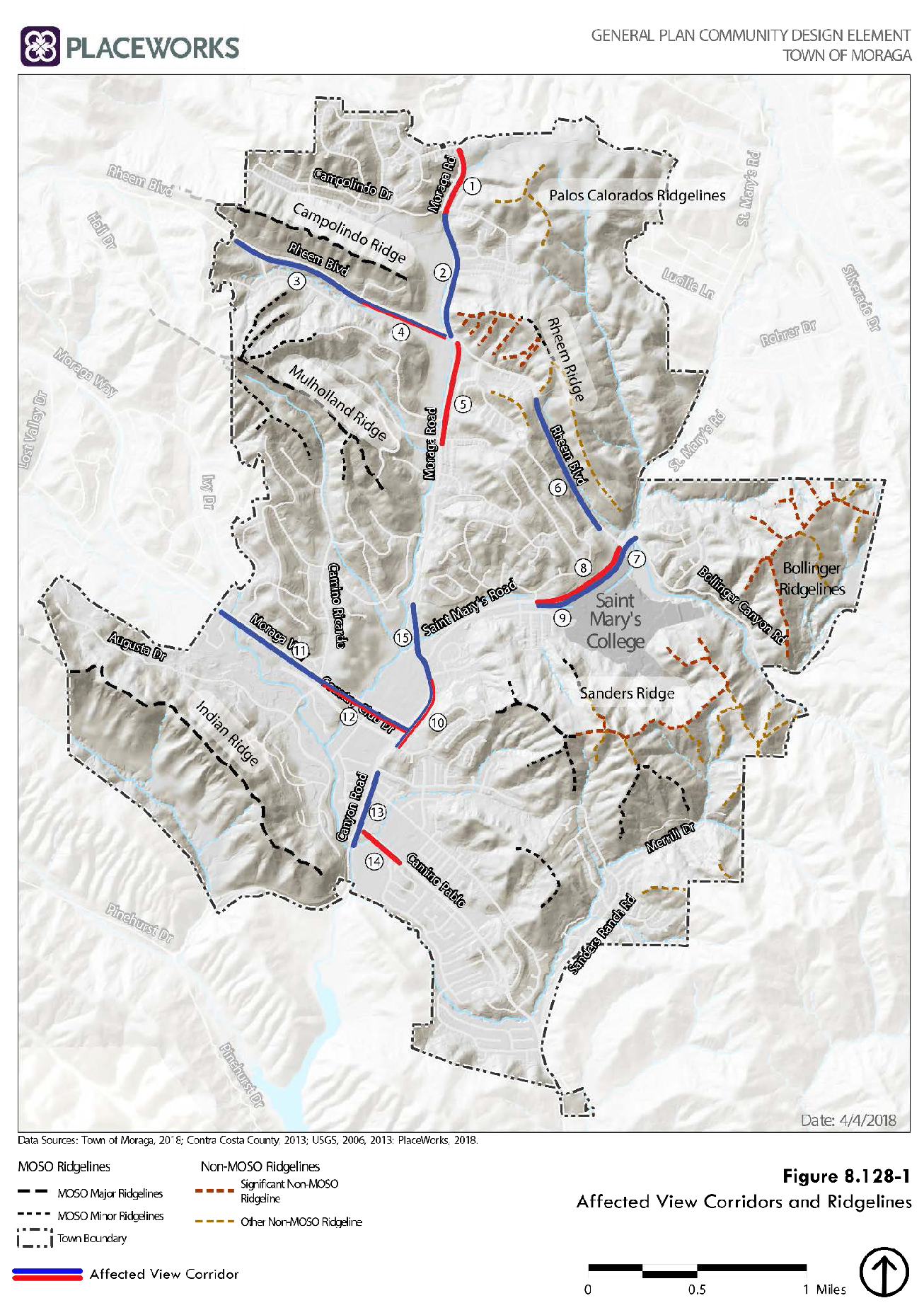
In addition to the general development standards provided in Section 8.144.030, facilities proposed to be located within the town's open space and ridgeline areas as defined by Chapter 8.128 and the general plan shall comply with the following development standards.

1.

No wireless communication facilities which do not as of the effective date of the ordinance codified in this chapter have a conditional or temporary use permit shall be located within five hundred (500) feet of a major ridgeline as defined in the Moraga open space ordinance (MOSO).

2.

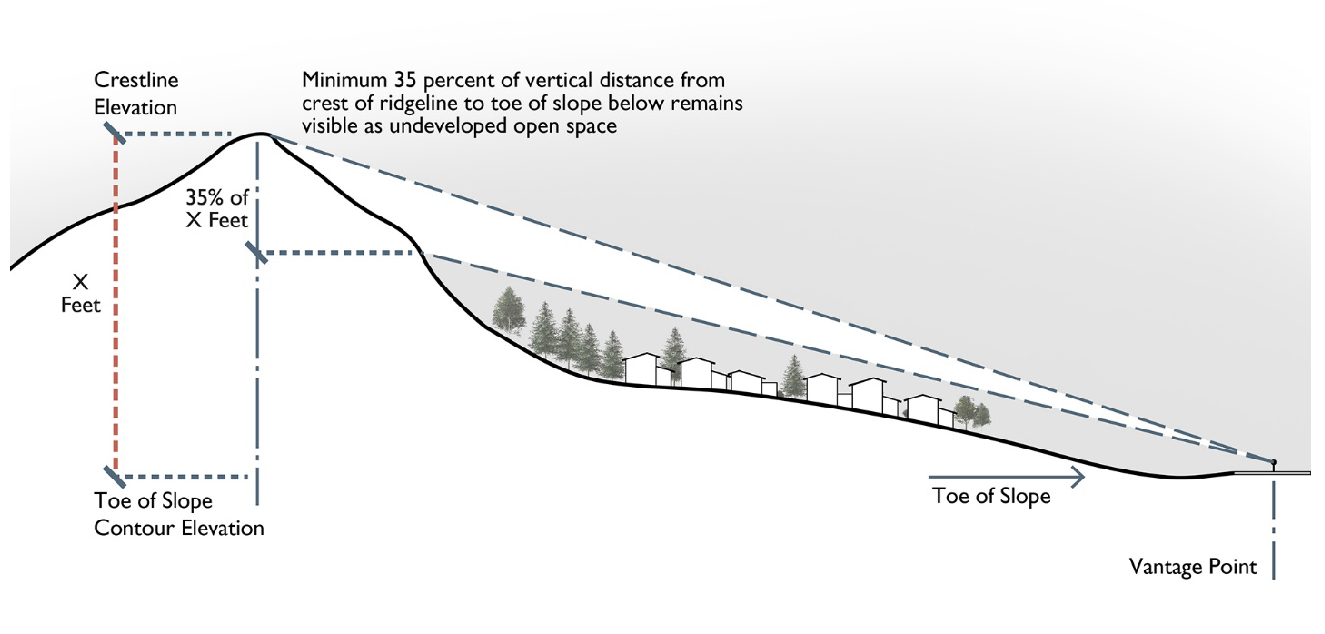
No wireless communication facilities which do not as of the effective date of said ordinance have a conditional or temporary use permit shall be located on the crest of a minor ridge with an elevation of eight hundred (800) feet or greater as defined in the Moraga open space ordinance (MOSO), nor shall the silhouette of an antenna be visible above the ridge as viewed from a lower elevation perspective generally available to the public.

3.

No wireless communications facilities which do not as of the effective date of said ordinance have a conditional or temporary use permit shall be located on areas where the slope has a grade of twenty (20) percent or greater in MOSO open space.

4.

Special design considerations such as designing facilities to appear as natural features found in the immediate area, such as rocks or trees, shall be considered in approving facilities for such use.

B.

The facilities shall comply with the above development standards unless the applicant establishes and it is determined by the planning commission that there is no other optimal location for the carrier to provide adequate coverage, and it is determined that compliance with these standards would violate federal law. The burden shall be on the applicant to prove to the satisfaction of the planning commission that there is no optimal locations where adequate coverage could be provided.

C.

Notwithstanding the foregoing, any temporary use permits which are valid as of the effective date of said ordinance must receive approval by the planning commission of a conditional use permit in order to be in compliance with this chapter.

(Ord. 176 § 1 (part), 1999: prior code § 8-6006)

8.144.070 - General conditions of approval.

In determining whether to grant or deny approval for a wireless communications facility, the planning commission may require more stringent standards than the development standards of this chapter. The planning commission may attach such conditions as it considers necessary to ensure visual and land use compatibility with the surroundings so as to avoid adverse effects on the health, safety, and welfare of the town's residents, to protect existing vegetation, and to minimize the proliferation of such facilities, including but not limited to:

A.

Wireless communications facilities shall have a nonreflective finish and be painted to be compatible with the surrounding area and landscaped to minimize visual impacts;

B.

If not screened from view, equipment enclosures shall be compatible with the design scale, materials, colors and landscaping of other existing structures on the site; and

C.

Stealth design of antennas shall be required as necessary to minimize visual impact.

D.

Wireless communication facilities shall be constructed and operated in such a manner as to minimize noise impacts on nearby residents and the public. Noise reduction shall be accomplished through the following measures:

1.

A maximum allowable exterior noise level of sixty (60) dB at the property line of the facility must not be exceeded.

2.

Any maintenance or testing that will create noise that is audible from residences and other nearby sensitive receptors shall occur between the hours of eight a.m. to five p.m. Monday through Friday, excluding emergency repairs.

3.

Backup generators shall comply with the same noise standards referenced above and shall only be operated during power outages, emergency occurrences, or for testing and maintenance in accordance with subsection (D)(2) of this section.

E.

Additional landscaping or other screening shall be provided.

(Ord. 176 § 1 (part), 1999: prior code § 8-6007)

8.144.080 - Review and approval.

A.

Wireless communication facility is permitted in all zoning districts on the issuance of a conditional use permit subject to findings stated in Section 8.12.120. Any decision denying an application for a wireless communication facility shall be in writing.

B.

All conditional use permits for wireless communications facilities shall be valid for an initial period of ten years. The conditional use permit may be extended by the planning commission for an additional ten-year period following a public hearing and verification of continued compliance with the conditions of approval and a showing that the facility has been upgraded to minimize its impact, including community aesthetics, to the greatest extent permitted by the technology that exists at the time of renewal and is consistent with the provisions of federal law.

C.

At all times the permit is in effect, the permittee shall ensure that the wireless communication facility complies with the most current applicable regulatory and operational standards, including, but not limited to, radio frequency emissions standards adopted by the FCC. Wireless communication facilities shall be tested by the permittee at time of construction of the facility to verify compliance with FCC radio frequency emissions standards and the permittee shall provide proof of certification of the testing results to the town. Testing shall be conducted with the facility operating at maximum power and shall measure total emissions from the small cell wireless facility site. Such testing shall be conducted during normal business hours and on a nonholiday weekday. The foregoing testing shall also be conducted at the time of renewal of the wireless communication facility conditional use permit.

D.

All applications for wireless communications facilities shall include a five-year wireless communications facilities master plan. The master plan shall consist of the following components:

1.

A large-scale map of the town showing the five-year plan for wireless communication facility sites and planned coverage;

2.

A written list of existing, proposed and anticipated wireless communication facility sites of the service provider over a five year period; and

3.

A description of the location of each site and the types of installations, including antennas and equipment.

E.

The planning commission may require technical evaluations and other technical assistance for the purpose of making any determination required by this chapter, including, but not limited to confirming compliance with FCC radio frequency emission standards, the electromagnetic frequency need of the applicant and identifying alternative solutions and sites that better meet the criteria and legislative intent of this chapter. The cost of these technical services shall be borne by the applicant.

F.

Any modifications to the master plan require an approval by the planning commission.

G.

This section shall not apply to small cell wireless communication facilities as they are governed by Section 8.144.035 of the Moraga Municipal Code.

(Ord. 176 § 1 (part), 1999: prior code § 8-6008)

(Ord. No. 311, § 16, 12-13-2023)

8.144.090 - Exemptions and special provisions for Section 6409 approvals.

A.

Exempt facilities shall include private, noncommercial wireless communications facilities or systems which are contained entirely on the site for the purpose of serving the premises upon which the facility is located and having no potential visual, noise, thermal or radio frequency interference impacts to surrounding properties or the community.

B.

All requests for approval to collocate, replace or remove transmission equipment at an existing wireless communication facility submitted pursuant to Section 6409 will be reviewed under the procedures in this section. A conditional use permit is not required for any request that qualifies for approval pursuant to Section 6409 under the standards in this section. To the extent that the applicant's request does not qualify for approval under Section 6409, the applicant may submit the same or a substantially similar application for a conditional use permit under the general provisions in this chapter.

1.

Applicability. This Section 8.144.090.B applies to all requests for approval to collocate, replace or remove transmission equipment at an existing wireless communication facility submitted pursuant to Section 6409. However, the applicant may voluntarily elect to seek a conditional use permit under the general provisions of this chapter.

2.

Additional Section 6409 Definitions. In addition to the definitions in Section 8.144.020, the abbreviations, phrases, terms and words used in this section will have the following meanings assigned to them unless context indicates otherwise. Undefined phrases, terms or words in this section will have the meanings assigned to them in 47 U.S.C. § 153, as may be amended from time to time and, if not defined therein, will have their ordinary meanings. In the event that any definition assigned to any phrase, term or word in this section conflicts with any federal or state-mandated definition, the federal or state-mandated definition will control.

a.

"Collocation" means the same as defined by the FCC in 47 C.F.R. § 1.40001(b)(2), as may be amended.

b.

"Eligible facilities request" means the same as defined by the FCC in 47 C.F.R. § 1.40001(b)(3), as may be amended.

c.

"Eligible support structure" means the same as defined by the FCC in 47 C.F.R. § 1.4000l(b)(4), as may be amended.

d.

"Existing" means the same as defined by the FCC in 47 C.F.R. § 1.40001(b)(4), as may be amended.

e.

"Site" means the same as defined by the FCC in 47 C.F.R. § l.4000l(b)(6), as may be amended.

f.

"Substantial change" means the same as defined by the FCC in 47 C.F.R. § 1.40001(b)(7), as may be amended.

3.

Required Approval. Any request to collocate, replace or remove transmission equipment at an existing wireless communication facility submitted with a written request for approval under Section 6409 shall require an approval in such form determined by the planning director consistent with all valid and enforceable terms and conditions of the underlying permit or other prior regulatory authorization for the wireless communication facility (each amendment a "Section 6409 approval"). Each Section 6409 approval shall be subject to the planning director's approval, conditional approval, or denial without prejudice pursuant to the standards and procedures in this section. However, the applicant may voluntarily elect to seek a wireless conditional use permit subject to the general standards and procedures in this chapter.

4.

Decisions; Appeals.

a.

Administrative Review. The planning director shall review a complete and duly filed application for a Section 6409 approval and may act on such application without prior notice or a public hearing.

b.

Decision Notices for Denials. In the event that the planning director denies the application, the written notice to the applicant must contain (1) the reasons for the decision; (2) a statement that denial will be without prejudice; and (3) instructions for how and when to file an appeal.

c.

Required Findings for Approval. The planning director may approve or conditionally approve any application for a Section 6409 approval when the approval authority finds that the proposed project:

i.

Involves collocation, removal, or replacement of transmission equipment on an existing wireless communication facility; and

ii.

Does not substantially change the physical dimensions of the existing wireless communication facility.

d.

Criteria for Denial without Prejudice. Notwithstanding any other provision in this chapter, and consistent with all applicable federal laws and regulations, the planning director may deny without prejudice any application for a Section 6409 approval when the approval authority finds that the proposed project:

i.

Does not meet the findings required in Section 8.144.090.B.4.c;

ii.

Involves the replacement of the entire support structure; or

iii.

Violates any legally enforceable law, regulation, rule, standard or permit condition reasonably related to public health or safety.

e.

Conditional Approvals. Subject to any applicable limitations in federal or state law, nothing in this Section 8.144.090.B is intended to limit the planning director authority to conditionally approve an application for a Section 6409 approval to protect and promote the public health and safety.

f.

Appeals. Any applicant may appeal the approval authority's written decision to deny without prejudice an application for Section 6409 approval. The written appeal together with any applicable appeal fee must be tendered to the town clerk within ten calendar days from the approval authority's written decision and must state in plain terms the grounds for reversal and the facts that support those grounds. The town manager shall be the appellate authority for all appeals from the approval authority's written decision to deny without prejudice an application for Section 6409 approval. The town manager shall review the application de novo without notice, or a public hearing; provided, however, that the town manager's decision shall be limited to only whether the application should be approved or denied in accordance with the provisions in this Section 8.144.090.B and any other applicable laws. The town manager shall issue a written decision that contains the reasons for the decision, and such decision shall be final and not subject to any further administrative appeals.

5.

This section shall apply to small cell wireless facilities, except that to the extent any provision of this section conflicts with Section 8.144.035(G), this section shall prevail.

(Ord. No. 311, § 17, 12-13-2023)

Editor's note— Ord. No. 311, § 17, adopted Dec. 13, 2023, repealed the former § 8.144.090 and enacted a new § 8.144.090 as set out herein. The former § 8.144.090 pertained to exemptions and derived from prior code § 8-6009; Ord. 176 § 1 (part), adopted 1999.

8.144.100 - Purpose and intent.

The purpose of this article is to regulate the installation of radio towers, antennas or related equipment for commercial broadcast or amateur use; television, citizens band and other miscellaneous telemetric and control communications systems and related equipment in all zoning districts within the town. Such installations, unless controlled, may adversely affect the aesthetics of the town's open space, residential and commercial areas and may adversely affect the health and safety of the town's residents. Therefore, the installation of these wireless communications facilities is regulated to protect views from public right-of-ways and other properties, while not preventing installation of such systems in a manner which would compromise suitable performance.

(Ord. 176 § 1 (part), 1999: prior code § 8-6020)

8.144.110 - Definitions.

As used in this article:

"Antenna" is any system of poles, panels, rods, reflecting discs, wires or similar devices used for the transmission or reception of radio frequency signals of any mode.

"Tower" is an open frame, grid constructed structure and supporting antennas or other equipment that transmits or receives electromagnetic signals that are part of an AM, FM or television signal or which supports antennas necessary for a cable system.

"Hilltop" is any prominent high point of land exposed to view from the surrounding low-lying areas.

"Monopole" is a single, free-standing pole, post or similar structure over fifteen (15) feet in height used to support equipment associated with a wireless communication facility.

"Moraga open space ordinance (MOSO)" is a voter-approved ballot initiative which regulates development on lands within the town designated as open space-MOSO.

"Ridgeline" means a crest or peak as defined in Chapter 8.128.

"Satellite dish antenna" is any device incorporating an electromagnetic reflective surface that is solid, open mesh, shallow dish, cone or bowl shaped and is used to transmit or receive electromagnetic signals transmitted directly from a satellite.

"Silhouette" means a representation of the outline or profile of the antenna, as seen from an elevation perspective.

(Ord. 176 § 1 (part), 1999: prior code § 8-6021)

8.144.120 - Open space and open space MOSO district development standards.

In addition to the general development standards of Article 1 of this chapter, satellite dish and miscellaneous antennas proposed to be located within the town's open space and ridgeline areas as defined by Chapter 8.128 and the general plan shall comply with the following development standards set forth in this district.

A.

No satellite dish or miscellaneous antennas shall be located within five hundred (500) feet of a major ridgeline as defined in the Moraga open space ordinance (MOSO).

B.

No satellite dish or miscellaneous antennas shall be located on the crest of a minor ridge with an elevation of eight hundred (800) feet or greater as defined in the Moraga open space ordinance (MOSO), nor shall the silhouette of an antenna be visible above the ridge as viewed from a lower elevation perspective generally available to the public.

C.

No satellite dish or miscellaneous antennas shall be located on areas where the slope has a grade of twenty (20) percent or greater in MOSO open space.

D.

All standards set forth in Section 8.144.130.

The facilities shall comply with the above development standards unless the applicant establishes and it is determined by the planning commission that there is no other optimal location for the operator to provide adequate coverage, and it is determined that compliance with these standards would violate federal law. The burden shall be on the applicant to prove to the satisfaction of the planning commission that there is no optimal locations where adequate coverage could be provided.

(Ord. 176 § 1 (part), 1999: prior code § 8-6022)

8.144.130 - Development standards.

A.

Along with the general development standards set forth in Article 1 of this chapter, the following standards shall apply in all zoning districts for satellite dish antennas greater than one meter in any dimension.

1.

Approval. Installation of a satellite dish antenna shall require approval of a permit by the zoning administrator.

2.

Number. No more than one satellite dish antenna shall be permitted per parcel unless approved by the zoning administrator.

3.

Height. A satellite dish antenna shall be no higher than twelve (12) feet above the ground at any point.

4.

Signage. No signage of any kind shall be posted or display on any satellite dish antenna.

5.

Color. All satellite dish antennas that are not screened shall be painted with as unobtrusive a color as possible given the location.

6.

Location. Satellite dish antennas in excess of one meter in any dimension shall not be located on the roof of a structure and shall otherwise meet the building setbacks of the property. Dishes shall be located in rear yards and be substantially screened from view off-site. Satellite dish antennas shall not be located in the front yard area.

B.

Antennas expressly designed for private residential reception of satellite television signals, which have an overall size of less than one meter in any dimension are exempt.

(Ord. 176 § 1 (part), 1999: prior code § 8-6023)

8.144.140 - Amateur radio and miscellaneous wireless communication facilities exemptions.

The following installations in all zoning districts (except MOSO districts) are exempt from this article, provided they are located on or behind a structure and meet the following standards:

A.

A ground or building mounted receive-only radio or television antenna including any mast, if the height (post and antenna) does not exceed thirty-five (35) feet above ground level;

B.

A ground or building mounted citizen band radio antenna or antenna operated by a federally licensed amateur radio operator as part of the amateur radio service including any, supporting structure, if the total height (structure and antenna) does not exceed thirty-five feet above ground level unless a conditional use permit is approved by the planning commission, subject to findings stated in Section 8.12.120.

(Ord. 176 § 1 (part), 1999: prior code § 8-6024)

8.144.150 - Towers.

A.

Approval of any tower including commercial broadcast tower for radio or television shall require approval of a conditional use permit.

B.

Towers shall be of a minimum functional height or shall not exceed the building height limit for the zoning district, whichever is less.

C.

Broadcast towers shall not be located closer than three hundred (300) feet from a residential structure and one hundred (100) feet from a residential property line.

D.

All other towers are subject to the provisions of Section 8.144.030.

(Ord. 176 § 1 (part), 1999: prior code § 8-6025)