
Morton Grove City Zoning Code
CHAPTER 12
11 LANDSCAPING AND TREES
12-11-1: DEFINITIONS
COVERED PROPERTY: Properties not exempted by Section 12-11-7.
CRITICAL ROOT ZONE: A circular region measured outward from the tree trunk representing the essential area of the roots that must, when possible, be maintained or protected for the tree's survival. The root zone is one foot (1') of radial distance for every inch of tree DBH.
DIAMETER AT BREAST HEIGHT (DBH): Tree trunk diameter measured in inches at the height of four and one-half feet (4 1/2') aboveground.
DISEASED: A severe disease or pest that is known to cause or is causing the death of a tree.
NUISANCE TREE: The following types of trees:
- Any and all species of Elm Trees that are infected with Dutch Elm Disease;
- Any and all species of Ash Trees that are infected with Emerald Ash Borer;
- Any tree, including its limbs, that constitutes an immediate or imminent hazard to persons, property, or the general public.
PROTECTED TREE: Any tree located within or partially within a Covered Property with a diameter at breast height of twelve inches (12”) or greater.
TREE TECHNICAL MANUAL: Document maintained by the director of public works that establishes standards and specifications for trees pursuant to Section 7-2-11.
UNDESIRABLE TREE: A tree that is of a species that is:
- Included in the "Chicago Botanic Garden" list of "Invasive Plants in the Chicago Region," as amended;
- Not well established for the climate of the region;
- Likely to have a high mortality rate for the region;
- Likely to become Diseased; or
- Predisposed to structural deficiencies.
12-11-2: GENERAL PROVISIONS
- Review Required:
- The regulations herein apply to all properties designated below where a building permit is required for construction or reconstruction of floor area or exterior modification, including site improvements. The building commissioner may waive the review requirement provided the project is deemed to have an insignificant impact on the appearance of the property:
- Multiple dwelling developments in excess of two (2) units;
- Business and commercial unit developments;
- Industrial units and developments;
- All planned unit developments and special uses;
- All common, single-family subdivision developments, including streets, rights of way, public areas and other general development features and models to be offered for sale;
- Municipal and other public facilities and lands;
- Construction, reconstruction, and expansion in floor area fronting on a street of one- and two-family residential dwellings, not including detached accessory structures.
- Landscape and tree preservation plans are to be reviewed by the appearance review commission, and an appearance certificate by the commission granted, prior to the issuance of a building permit. For one- and two-family residential dwellings covered under subsection g above, the landscape and tree preservation plan shall be reviewed by the building commissioner or his/her designee, and if deemed not to meet the standards of this chapter, will be forwarded to the appearance review commission for their review.
- Landscape and Tree Preservation Plan Requirements: The requirements of this section shall apply to all landscape and tree preservation plans. However, the building commissioner shall have the authority to waive or modify the technical requirements of the section when in the opinion of the building commissioner the waiver or modification will not adversely impact surrounding properties, will not violate the intent or spirit of this title, and there are special circumstances unique to the property or the development that would create practical difficulties if the technical requirement of this title were imposed.
- Landscape plans shall be prepared by a licensed design professional registered in the State of Illinois, unless for single-family or two-family dwellings, and include:
- The location and dimensions of all existing and proposed structures, property lines, easements, utilities, parking lots and driveways, roadways and rights-of-way, sidewalks, signs, refuse disposal areas, sidewalks, fences, electrical equipment, recreational facilities, and drainage facilities.
- The location, quantity, size and name, both botanical and common, of all proposed plant material including, but not limited to, shade and evergreen trees, shrubs, groundcover, annuals/perennials, and turf.
- Tree preservation plans must be prepared by a certified arborist or licensed design professional registered in the State of Illinois, unless for single-family or two-family dwellings, and include:
- The location, species, DBH and Critical Root Zones of all existing trees on the subject property and adjacent rights-of-way;
- Identification of Protected Trees as herein defined, all existing trees to be protected, and existing trees to be removed on the property and adjacent rights-of-way;
- The location and type of protective fencing to be placed on the property and adjacent rights-of-way;
- The location of Critical Root Zone areas and the types and locations of protection to be provided to minimize damage to tree roots in such areas, such as wood chips and exterior plywood;
- A description of other required tree preservation procedures, such as root and crown pruning;
- The location, shape, and spatial arrangement of all temporary and permanent driveways, parking areas, and temporary material storage sites and access ways; and
- The location of any new utility services, including water, sanitary sewer, storm sewer, gas, electric, telecommunications or any modification to existing utility services, that may impact existing private or public trees.
- Landscape plans shall be prepared by a licensed design professional registered in the State of Illinois, unless for single-family or two-family dwellings, and include:
- The regulations herein apply to all properties designated below where a building permit is required for construction or reconstruction of floor area or exterior modification, including site improvements. The building commissioner may waive the review requirement provided the project is deemed to have an insignificant impact on the appearance of the property:
- Landscaping and Trees Required:
- All sites shall provide landscaped or sodded areas comprised of the following minimum percentage requirements:
- Multi-family residential: Fifty percent (50%) of the required front yard.
- Industrial: Fifteen percent (15%) of the total site.
- Commercial: Five percent (5%) of the total site.
- Within Village tax increment financing (TIF) districts: Eight percent (8%) of total site, the majority of which is to be provided along street right of way.
- Residential subdivisions, single-family, and two-family dwellings: For front yards and side yards abutting a street, foundation plantings are required. Foundation plantings shall be planted in a landscape bed measuring no less than three feet (3’) in depth. Plantings shall provide no less than fifty percent (50%) coverage of the landscape bed, shall be installed across no less than fifty percent (50%) of the length of the facade of the building, not including where driveways and walkways are located, and shall be no less than eighteen inches (18”) in height at the time of planting. Required foundation plantings may be waived by the building commissioner where such plantings are not feasible.
- One (1) tree shall be planted or preserved on private property per required yard abutting a street unless inadequate space is available, as determined by the building commissioner. Every reasonable effort must be made to retain existing trees in all development.
- All parking lots shall be landscaped in accordance with section 12-11-3 of this chapter.
- Retention or detention ponds and lakes shall be included under the term "landscaped areas".
- The placement of trees in public parkways, areas or rights of way adjacent to private property is required where they do not exist already. Trees shall have a DBH, of not less than two and one-half inches (2 1/2"), and shall be spaced not more than forty feet (40') apart. Surface areas shall be sodded or contain other harmonious and attractive treatments.
- All sites shall provide landscaped or sodded areas comprised of the following minimum percentage requirements:
- Landscape Design Standards:
- Landscape elements included in these criteria are all forms of planting and vegetation, ground forms, rock groupings, water patterns and all visible construction, except buildings and utilitarian structures.
- Where natural or existing topographic patterns contribute to beauty and utility of a development, they shall be preserved and enhanced. Modification to topography will be permitted where it contributes to good appearance and does not adversely affect adjacent properties.
- Grades of walks, parking spaces, terraces and other paved areas shall provide an inviting and stable appearance for walking, and if seating is provided, for sitting.
- Landscape treatment shall be provided to enhance architectural features, strengthen vistas and important axis.
- Unity of design shall be achieved by repetition of certain plant varieties and other materials, and by correlation with adjacent developments.
- Plant material shall be selected for interest in its structure, texture, color and for its ultimate growth. Plants that are indigenous to the area and others that will be hardy, harmonious to the design, and of good appearance shall be used.
- In areas where general planting will not prosper, other materials such as fences, walls and pavings of wood, brick, stone, ornamental gravel and cobbles may be used. Carefully selected plants as noted on the following lists shall be combined with such materials where possible. (Ord. 07-07, 3-26-2007)
12-11-3: APPROPRIATE SPECIES AND PLANTING REQUIREMENTS
- Species Selection: Plant material must be selected for its form, texture, color, pattern of growth and suitability to local conditions. The use of invasive species is prohibited. Invasive species shall be those included in the "Chicago Botanic Garden" list of "Invasive Plants in the Chicago Region," as amended.
- Tree Species Diversity: Diversity among trees is required to reduce the risk of losing a large population of plants due to disease. If there are fewer than four (4) required trees, they may all be the same species. If there are between five (5) and ten (10) required trees, no more than forty (40) percent can be of one species. If there are more than ten (10) required trees, no more than twenty-five (25) percent can be of one species. This standard applies only to trees being planted and not to existing trees.
- Street And Parkway Trees: All trees planted on public rights of way shall be species listed in the Street and Parkway Tree List maintained by the Public Works Department. The director of public works has the authority to determine the species of street and parkway trees.
- Required Trees on Private Property: Required trees planted on private property pursuant to Section 12-11-7 may not be of species listed in the Restricted Tree List maintained by the Public Works Department.
- Tree Size:
- All shade trees to be planted shall have a minimum DBH of two and one-half inches (2-1/2").
- Ornamental trees shall have a minimum height of six feet (6') or DBH of two inches (2").
- Evergreen trees shall have a minimum height of five feet (5').
- Shrubs: All shrubs to be planted shall be of minimum height of twenty-four inches (24") unless otherwise required by this Chapter
- Planting Requrements:
- All trees shall be furnished balled and burlapped.
- All shrubs shall be furnished balled and burlapped, or potted.
- With the exception of single-family residences, all landscaped areas shall be provided with an underground irrigation system or readily available water supply with at least one outlet within one hundred fifty feet (150') of the plant material or an alternate method to be approved by the appearance review commission.
- All landscaping shall be installed according to accepted commercial planting procedures. Planting Requirements:
- All plantings shall meet or exceed standards contained in "American Standard for Nursery Stock" (ANSI Z60.1 - 1973) as amended.
- For all privately owned property, landscaping exceeding two feet (2’) in height shall not be located within a 45-degree 10-foot by 10-foot sight line triangle at any point where a vehicular access way intersects a driveway, alley, sidewalk, or other vehicular or pedestrian access way. Where a driveway intersects an alley, the dimensions of the 45-degree sight line triangle shall be determined by the distance between the garage and alley, to a maximum of 10 feet. If no garage exists, the 10- foot by 10-foot sight line triangle shall apply.
12-11-4: PARKING LOT LANDSCAPING REQUIREMENTS
- General Requirements: All paved ground surface areas that require landscaping shall meet or exceed the following general landscaping requirements:
- Installation: All vehicle parking lots shall be constructed with continuous concrete curbing. Placement of parking curbing shall allow for auto overhangs and sufficient space for interior planting and required perimeter planting areas.
- Planting: Planting areas shall be water permeable areas of not less than thirty six (36) square feet and a minimum radius of three feet (3') measured in the direction of possible vehicle encroachment from the center of the tree trunk to the near edge of the landscaped area.
- Maintenance: All landscaping and trees provided on site and between the property line and the continuous curbing adjacent to street frontages shall be maintained by the property owner in accordance with the standards set forth in section 12-11-7 of this chapter.
- Specific Requirements: All paved ground surface areas shall meet the following specific landscaping requirements which shall be considered complementary to the landscaping provisions of any Village of Morton Grove ordinance or resolution.
- Required Landscaping Adjacent To Public Right Of Way:
- Where paved ground surface areas are located adjacent to public streets or sidewalks, landscaping shall be provided between the public street or sidewalk and the paved ground surface area. Said landscaping shall include a landscaped yard at least five feet (5') in width containing a year round dense opaque screen of landscaping three feet (3') in height, or an earth berm at least three feet (3') in height with a maximum slope of three to one (3:1). Screening along public roads shall be maintained at height of three feet (3').
- Where paved ground surface areas are located adjacent to public alleys:
- Landscaping adjacent to public alleys shall not be required where all the parking spaces are screened from public streets by buildings, affront the alley, and are within thirty feet (30') of the screening building.
- For all paved ground surface areas adjacent to alleys not screened by buildings, screening shall be required at five feet (5') in height. Said screen may be comprised of any type of screen listed in section 12-11-4, "Screening", of this chapter. Landscaping shall be at least three feet (3') in height at the time of planting, but must grow to, and be maintained at, five feet (5'). All screens shall be erected a minimum of one foot (1') within the side or rear lot line adjacent to the off street parking and/or loading areas. If space becomes a problem, the screening may be installed on the opposite side of the alley with permission of the affected property owner(s). If the required screening is other than landscaping, the one foot (1') area between the property line and the required screening shall be covered with an impervious surface.
- Where access to an alley is provided from an off street parking and/or loading area, the height of the required screening on either side of the accessway shall be thirty inches (30") for a minimum of fifteen feet (15') to provide adequate sight clearance and the width of the interruption in the required screening for the provision of access shall be equal to the width of the drive aisle as required.
- Required Landscaping Adjacent To Other Properties: Where paved ground surface areas are adjacent to surrounding properties, landscaping shall be installed to screen paved ground surface area from adjacent properties as provided below. Landscaping is not required if the paved ground surface area is completely screened from surrounding properties by intervening buildings or structures.
- Where paved ground surface areas are adjacent to properties zoned exclusively for residential land uses, all land between the paved ground surface area and the property line, except accessways, shall be landscaped. Said landscaping shall include a buffer yard at least five feet (5') in width, containing either berm, hedge, maintenance free barrier or combination of the above at least five feet (5') in height, but not more than six feet (6') in height. Where hedge of living plant material is used for a barrier, it shall be thirty inches (30") in height at time of planting and shall attain opacity within twelve (12) months under normal growing conditions. A minimum of one tree shall be planted for each forty (40) linear feet of common lot line or fraction thereof.
- Where the adjacent property is zoned for nonresidential land uses or where the adjacent property contains a conforming hedge or wall, a minimum of one tree shall be planted for each forty (40) linear feet of common lot line or fraction thereof. Said tree(s) shall be installed in the buffer area adjacent to each of the adjoining properties.
- Internal Landscaping Regulations:
- Parking lots two thousand (2,000) square feet or less are not required to provide interior landscaping.
- All planting islands for parking lots shall be a minimum of forty (40) square feet.
- All parking areas more than two thousand (2,000) square feet shall have internal landscaping to channelize and define logical areas for pedestrians and vehicular circulation and to provide areas for accumulation of snow. All interior landscaping shall be protected from vehicular encroachment by curbing, wheel stops or guardrail and should be raised above the grade of the parking spaces. Required internal landscaping is as follows:
- Parking areas two thousand (2,000) to twenty thousand (20,000) square feet: A minimum of five percent (5%) of the paved area of the parking lot not including buffer landscape areas developed around the parking lot.
- Parking areas larger than twenty thousand (20,000) square feet: A minimum of seven percent (7%) of the paved area of the parking lot not including buffer landscape areas developed around the parking lot. Where practical, each separate landscaped area shall contain at least one tree, and a tree shall be planted for each one hundred (100) square feet of interior landscaping. For double-row landscape islands, two (2) trees shall be required. Landscaping dividing strips with or without walkways shall be used to subdivide parking areas into parking bays. Each parking bay shall have a maximum of twenty (20) spaces in an uninterrupted row.
- Other paved ground surface areas exceeding five thousand (5,000) square feet such as playgrounds, courtyards, etc., shall have two (2) square feet of interior landscaping for each one hundred (100) square feet of paving. Each separate landscaped area shall contain at least one tree, and a tree shall be planted for each one hundred (100) square feet of interior landscaping.
- Mixed usage of areas where a paved ground surface area is used for several functions, such as a parking lot and a playground or playing field, etc.: The landscaping requirements for parking lots will be applied to the amount of surface area used for automobile parking, even if it is used for recreation as well. Landscaping requirements for open space and recreational use will be applied to any surface area used for recreation and not parking.
- Required Landscaping Adjacent To Public Right Of Way:
- Sight Distances For Landscaping Adjacent To Accessways:
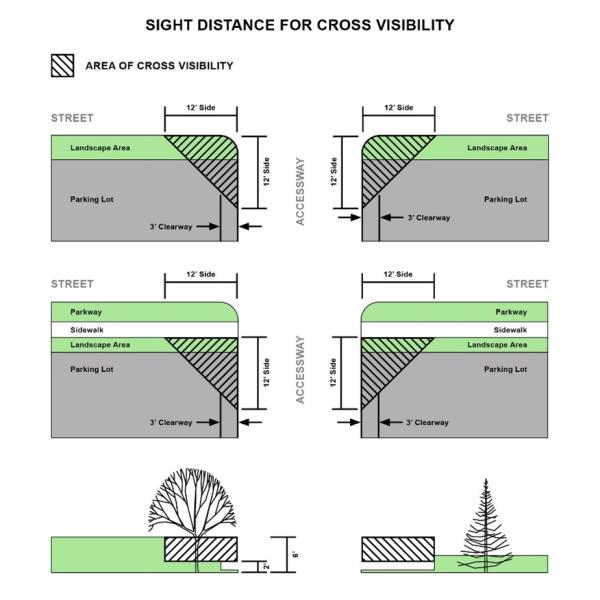
- Intersection Visibility: Where an accessway intersects a public right of way, or a public right of way intersects another public right of way, landscaping shall be used to define the intersection; provided, however, all landscaping within the areas of cross visibility as described below (subsection C2 of this section) shall be maintained at a level between two (2) and six feet (6') from grade. Trees shall have limbs and foliage trimmed in such a manner that no limbs or foliage extend into the cross visibility, provided they are so located so as not to create a traffic hazard. Landscaping, except grass and ground cover, shall not be located closer than three feet (3') from the edge of any accessway pavement.
- Area Of Cross Visibility: The property located at the intersection of an accessway and a public road or sidewalk forms a triangle with sides twelve feet (12') along the accessway and twelve feet (12') along the public road or sidewalk. This area is measured from a point in line with the smallest width of the accessway and the public road pavement line or the public sidewalk pavement line nearest the parking lot. The third side of the triangle is formed by connecting the ends of two (2) 12-foot sides.
- Existing Developed Areas: All property with existing paved ground surface areas on the effective date of this title shall not be required to conform to provisions of this chapter unless exterior reconstruction, exterior expansion or exterior improvements on the property requiring a building permit are undertaken.
- No structure shall be required to be altered or moved, except during reconstruction, to meet the provisions of this chapter.
- When reconstructing, no existing parking area twenty thousand (20,000) square feet or less shall be required to lose more than one out of twenty (20) parking spaces or three percent (3%) of the parking areas, whichever is greater.
- No parking area greater than twenty thousand (20,000) square feet shall be required to lose for landscaping purposes more than one and one-half (1 1/2) out of twenty (20) parking spaces or five percent (5%) of the parking area, whichever is greater.
- It shall not be necessary for any parking area to be reduced below the minimum standards set forth in any other Village of Morton Grove ordinance in order to meet the provisions of this section.
12-11-5: SCREENING
- Areas Required: All storage areas, service yards, loading docks and ramps, electrical equipment enclosures, incinerators and equipment for the disposal of materials, and storage tanks, shall be screened from view from access streets and adjacent properties by means of a fence, berm, wall, dense opaque landscaping materials or any combination of these. Trash areas shall be screened with the materials listed below, except that landscape materials shall not be used nor shall landscape materials be placed adjacent to said trash areas.
- Types Of Screening:
- Screening shall be of a type that is equally effective in winter and summer.
- Only the following types of visual screening shall be permitted for the purpose of this chapter:
- Masonry wall.
- Reinforced concrete wall with decorative finish.
- Solid or overlapping wood fence.
- Dense evergreen living shrubs.
- Earthen berm with approved landscaping.
- Combination of the above.
- Wrought iron fencing with appropriate landscaping - chainlink fencing is strictly prohibited.
- The height of the required screening shall be five feet (5'), except as noted elsewhere in this title.
- Screening In Utility Easements: When the required screening would fall in a utility easement of an alley boundary which is used by one or more of the utility companies for this service, the screening must be reviewed by the building department. The building commissioner shall determine after a review of written statements from the utility company whether each utility company is now using the easement or plans to in the future and the characteristics of such use, its relationship to other utilities and the access needed for installation and maintenance. When the utility easement is or will be in use, the building commissioner shall determine when the required screening on a lot would interfere with the utility companies' use of the easement and shall then determine, after consultation with the appearance review commission, a suitable location for such screening. (Ord. 07-07, 3-26-2007)
12-11-6: TREE PRESERVATION
12-11-7: TREES ON PRIVATE PROPERTY
- Exempt Properties. The requirements of this section shall not apply to municipal and other public facilities and lands and zoning lots in the R-1 Single Family Residence, R-2 Single Family Residence, or R-3 General Residence Districts with an existing single-family or two-family home having less than 21,780 square feet (0.5 acres) of land area unless controlled by or to be controlled by a planned unit development, special use permit, or subdivision ordinance within twenty-four (24) months. Properties not exempted by this section shall hereinafter be referred to as “Covered Property.”
- Permit Required. A tree removal permit is required for the removal of any tree located within or partially within a Covered Property with a diameter at breast height of twelve inches (12”) or greater, hereinafter referred to as a “Protected Tree.”
- Protected Tree Replacement.
Unless otherwise provided by this section, tree replacement or a fee-in-lieu shall be required for the removal as follows:
Replacement Tree(s) 1 (one) Replacement Tree per Protected Tree(s) being removed must be planted on a privately owned property Fee-In-Lieu Fee per Protected Tree(s) as provided for in Section 1-11-4. - Replacement and fee-in-lieu requirements shall not apply to the removal of a Protected Tree if one of the following conditions is met, adequate documents verifying the condition are provided by the owner to the Village, and the condition is verified in writing by the building commissioner:
- Nuisance trees
- Diseased or poor condition trees
- Undesirable trees
- Utility work
- Emergencies
- Demonstrated hardship subject to approval of the Village Administrator
- Replacement trees shall have a minimum diameter at breast height of two and one-half inches (2 1/2") for shade trees and six feet (6’) in height for evergreen trees.
- Replacement and fee-in-lieu requirements shall not apply to the removal of a Protected Tree if one of the following conditions is met, adequate documents verifying the condition are provided by the owner to the Village, and the condition is verified in writing by the building commissioner:
- Replacement trees shall be planted prior to (i) close-out of the site development or building permit, (ii) issuance of any certificate of occupancy, or (iii) within twelve (12) months of permit issuance, whichever is earlier. The required fee-in-lieu will be collected as part of the permit fee and held in escrow for up to twelve (12) months. If the required plantings have not occurred by that time, the fee-in-lieu will be retained and deposited to the Tree Planting Fund.
- Replacement trees shall be maintained in good condition for a minimum of five (5) years from the date of planting. If the tree is removed for any reason except utility work, safety hazard, emergency, or demonstrated hardship within five (5) years after planting, it must be replaced with a qualifying replacement tree in the same location or at an approved alternative location within six (6) months from the date of removal.
- Penalties. Any person violating any of the provisions of this chapter shall be fined in accordance with title 1, chapter 4 of this code. Each day that a violation is permitted to exist shall constitute a separate offense. Additionally, the requirements for tree replacement and fee-in-lieu payment shall double for the removal of each Protected Tree without a tree removal permit.
12-11-8: MAINTENANCE
- The owner of a property shall be responsible for the maintenance of all landscaping and trees in good condition so as to present a neat, healthy and orderly appearance, free of refuse and debris, so it conforms to standards established within this code and any approved landscape plan and tree preservation plan for the property. This includes, but is not limited to, maintaining the landscaping and trees at the appropriate height and the replacement of dead or damaged plants and trees. Necessary replacement shall be made within the time period not to exceed one hundred twenty (120) days after notification by the Village of Morton Grove of a violation of this chapter.
- All planting areas shall be kept free of weeds or plant growth that are noxious, detrimental to the public health or are unsightly. This shall include planting areas within the property and within rights of way.

