
Morton Grove City Zoning Code
CHAPTER 12
3 REGULATION OF SPECIFIC USES IN ALL ZONING DISTRICTS
12-3-1: REGULATION OF SPECIFIC USES
Below are various accessory uses allowed in all zoning districts, but which require special regulation. (Ord. 07-07, 3-26-2007)
12-3-2: STORM SHELTERS
- Storm shelters, intended to provide protection to human life during periods of danger from storms, nuclear fallout, air raids or other emergencies, may be constructed, erected, and maintained in any district as principal or accessory uses, subject to all yard and area requirements applicable in the districts where located.
- Such shelters may be contained in other structures or may be constructed separately. If entirely underground, storm shelters may be constructed within the rear yard. (Ord. 07-07, 3-26-2007)
12-3-3: RECREATIONAL AND COMMERCIAL VEHICLES
- Prohibitions: Recreational vehicles shall not be:
- Permitted as an accessory use to any principal building,
- Occupied for living purposes, or
- Stored during periods of nonuse in required front and corner side yards.
- Storage: Storage of recreational vehicles is permitted in rear yards provided that the storage location is screened to the maximum height allowable.
- Commercial and Recreational Vehicle Restrictions in Residential Districts:
- General Requirements: The following general requirements shall apply to all commercial and recreational vehicles except where indicated:
- No more than one commercial vehicle and one recreational vehicle or two (2) recreational vehicles allowed by this section shall be parked or stored on a zoning lot.
- Parking and storage of vehicles shall be limited to side yards and rear yards, except in cases where front yard parking is allowed by variation approved by the zoning board of appeals as provided for in this title.
- Open parking and storage areas shall be improved with gravel or an all weather hard surface such as concrete, asphalt, or paving bricks. (Ord. 07-07, 3-26-2007)
- All open parking areas shall be screened from adjacent lots and streets by a solid fence, or dense opaque shrubbery capable for year round screening, six feet (6') high. (Ord. 08-19, 6-9-2008)
- Use and parking of commercial and recreational vehicles on public streets and alleys shall comply with title 5, chapter 8, "Vehicle Equipment, Loads", and title 5, chapter 9, "Parking Regulations", of this code.
- Commercial Vehicles:
- Commercial vehicles with an Illinois license plate designation of "B" or "D" parked or stored in the open shall be limited to less than eight feet (8') in total height, including any roof mounted appurtenances.
- Signage on commercial vehicles parked or stored in the open shall conform to the criteria listed below:
- Advertising or business designations affixed to the vehicle shall be no more than forty percent (40%) of the area of the side, front, or rear of the vehicle for vehicles parked in a rear or side yard in a screened area; or if allowed in the front yard, no more than twenty percent (20%) of the area of the side, front, or rear of the vehicle; the signage percentage shall be calculated independently for each side, the front, and the rear of the subject vehicle.
- Advertising or business designations shall be confined below a line six feet (6') off the ground.
- The area of the advertising or business designation shall be the largest rectangle necessary to completely enclose all of the characters.
- The area of the side of a commercial vehicle shall be measured from the rear edge of the driver's compartment door to the rear edge of the vehicle, and measured from the top of the vehicle, excluding rooftop appurtenances, to the centerline of the tires.
- The area of the front and rear of the vehicle shall be measured between the vehicle sides, and measured from the top of the vehicle, excluding rooftop appurtenances, and the centerline of the tires.
- Commercial vehicles exceeding the height limits of subsection C2a of this section or commercial vehicles with an Illinois license plate designation of "F" shall be parked or stored in a fully enclosed garage.
- Commercial vehicles with an Illinois license plate designation of "H" or higher shall be prohibited from parking on zoning lots in residential districts.
- Vehicles with a taxi/livery plate, that are less than eight feet (8') in total height, including any roof mounted appurtenances, and that have no other commercial markings, signage, advertising, or business designation, shall be treated as non-commercial vehicles. A maximum of one non-commercial taxi/livery vehicle may be parked outside of a fully enclosed garage.
- Recreational Vehicles:
- Recreational vehicles parked or stored in the open shall not exceed thirty feet (30') in length, and ten feet (10') in height, measured to the roofline of the vehicle. Snowmobiles and watercraft shall be measured including the trailer.
- Recreational vehicles exceeding the dimensions identified in subsection C3a of this section shall be parked or stored in a fully enclosed garage.
- Recreational vehicles may be temporarily parked on front yard driveways for a maximum of five (5) days to allow for the loading, unloading and maintenance of the vehicle. The vehicle must be removed from the property for a minimum of twenty four (24) hours between each five (5) day period. (Ord. 07-07, 3-26-2007)
- General Requirements: The following general requirements shall apply to all commercial and recreational vehicles except where indicated:
12-3-4: HOME OCCUPATIONS
There are permitted in all residential dwelling units home occupations of the type that will be compatible with the neighborhood character, and will comply with the following standards:
- The home occupation and all related activity, including minimal incidental storage, shall be conducted completely within the dwelling unit and any totally enclosed accessory structure.
- The outside display of goods and the outside storage of equipment, materials, or motor vehicles utilized exclusively in the home occupation shall be prohibited.
- The home occupation shall not generate noise, vibration, glare, fumes, odors, noxious matter, electrical interference, or any nuisance beyond that which normally occurs in the zoning district in which it is located.
- The home occupation shall generate no more traffic than an average residence in the area; this prohibition includes, but is not limited to, the dispatching of employees from the premises.
- The home occupation shall be subordinate and incidental to the principal use of the buildings or structure for residential purposes. Not more than two hundred fifty (250) square feet shall be devoted to the home occupation.
- The owner/operator of the home occupation must reside on the premises.
- Employees shall be limited to persons in residence on the premises and to one nonresident person.
- There shall be no signs, display, or activity that will indicate from the exterior that the building is being used, in part, for any purpose other than that of a dwelling.
- No alteration of any kind shall be made to the principal building which changes its residential character as a dwelling unit, including the enlargement of public utility services or the installation of special equipment attached to walls, floors or ceilings.
- Only mechanical equipment which is permissible for purely domestic or household purposes shall be used in the conduct of the home occupation.
- There shall be no commodities sold or services rendered that require receipt or delivery of merchandise, goods or equipment by other than a passenger motor vehicle or by parcel or letter carrier mail service.
- All home occupations shall be subject to applicable business licensing and inspection requirements.
- No commercial dumpsters shall be allowed. (Ord. 07-07, 3-26-2007)
12-3-5: FENCES
Fences are permitted in all districts, subject to the following restrictions:
- No fence shall be allowed on any part of a front yard or any part of a required rear yard that front a street, such as in the case of through lots or multi-frontage corner lots.
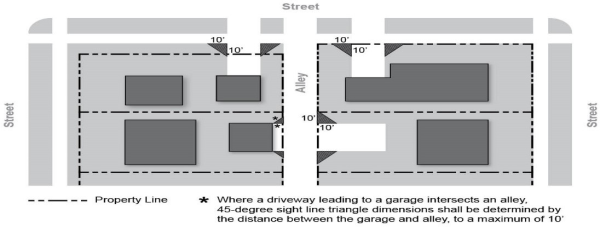
- Fences shall not be located within a 45-degree 10-foot by 10-foot sight line triangle at any point where the vehicular access way intersects a driveway, alley, sidewalk, or other vehicular or pedestrian access way. Where a driveway intersects an alley, the dimensions of the 45-degree sight line triangle shall be determined by the distance between the garage and alley, to a maximum of 10 feet. If no garage exists, the 10- foot by 10-foot sight line triangle shall apply.
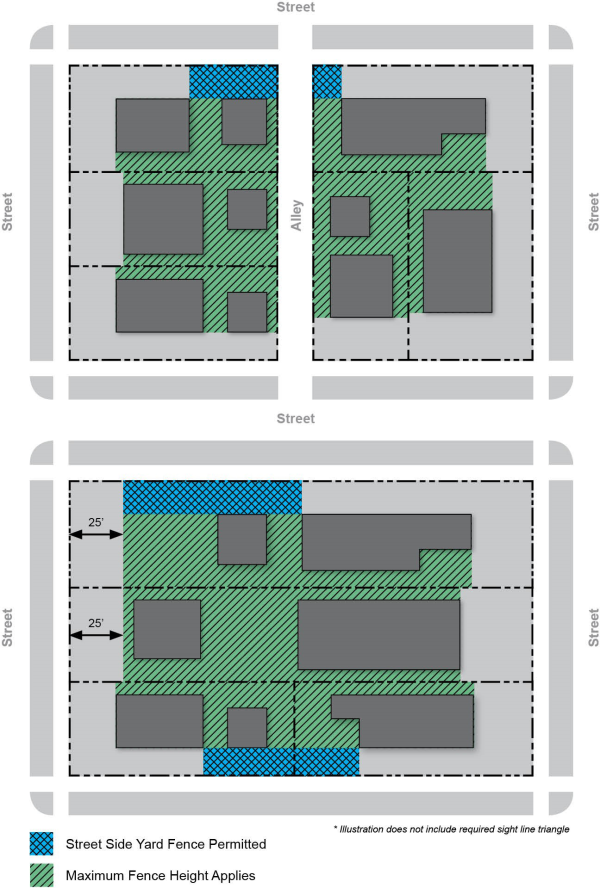
SIGHT LINE TRIANGLE - Fences shall be permitted within portions of the street side yard of corner lots, which is defined as the yard abutting a street that does not meet the definition of “Lot Frontage” and “Lot Line, Rear,” in accordance with Section 12-17-1 of the Unified Development Code, with the following requirements:
- The street side yard of a subject property which is part of a block where the entire block face, between two public streets, includes only street side yards, but not on lots where the block face, between two public streets, includes one or more front yard, on lots with street frontage on three (3) sides where the street side yard is within the required front yard setbacks, or on through lots.
- The fence shall only be permitted to enclose that portion of the street side yard that is in line with and behind the rear portion of the principal structure closest to the street side yard property line;
- The fence shall not be higher than 48 inches (4 ft.);
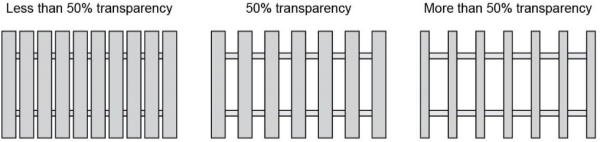
- The fence shall have a minimum transparency of 50%; and
- The fence shall not be made of chain-link material.
FENCE TRANSPARENCY - The table lists maximum fence heights for properties in the various zoning districts.
Lot In Zoning District Attributing Lot In Zoning District Residential Commercial Manufacturing Residential 6 feet 7 feet 7 feet Residential - within designated street side
yard area, per Sec. 12-3-5.B.4 feet 4 feet 4 feet Commercial 7 feet 7 feet 7 feet Manufacturing 7 feet 7 feet 7 feet - In no event shall any fence be placed or maintained in a location relative to a public or private street, alley, driveway or other means of egress such that the sight of oncoming vehicular or pedestrian traffic is impaired for users of such means of ingress and egress.
- All fences must be installed in accordance with title 10, chapter 9 of this code.
- Any applications for variations to the fence requirements, included herewith, shall be reviewed based on the following:
- The proposed fence variation shall meet with the intent of the design and development standards established in 12-3-5:B., above;
- The proposed fence variation shall not have an adverse impact on the immediate abutters or the character of the surrounding neighborhood;
- The proposed fence variation shall not create obstructions in required sight lines at areas where a pedestrian or vehicular ways intersect with driveways, streets, alleys, or other pedestrian or vehicular access way.
(Ord. 20-01, 1-27-2020)
12-3-6: TELECOMMUNICATIONS FACILITIES
- Purpose and Intent: The purpose of this section is to regulate the operation, siting, design, appearance, construction, modification, and removal of telecommunications facilities in order to protect the public health, safety, and general welfare of the community while providing the managed development of wireless telecommunications infrastructure consistent with the Federal Telecommunications Act of 1996 and subsequent amendments, and related requirements as established by state statute. For the purposes of this section, telecommunications facilities shall include telecommunications towers, antennas, and ancillary equipment. The regulations set forth in this section are intended to ensure that telecommunications facilities are compatible with surrounding land uses; to preserve property values within the Village; to allow for the continued use and enjoyment of surrounding properties; to minimize the visual impact of telecommunications facilities on the character and appearance of the immediate surroundings and the Village through careful siting and design standards; to encourage the shared use of existing telecommunications towers and alternative support structures in order to minimize the number of towers needed to serve the community; and to avoid potential damage to property caused by telecommunications facilities by ensuring that such structures are soundly and carefully designed, constructed, modified, maintained, and removed when no longer in use or determined to be structurally unsound.
- Applicability: This section applies to any telecommunications tower, tower site, alternative support structure, telecommunications antenna, and ancillary equipment as defined in Subsection 12-3-6:D, “Definitions.” This section does not apply to the following:
- Small wireless facilities or wireless support structures for small wireless facilities. Small wireless facilities or wireless support structures for small wireless facilities are separately regulated by this Code.
- Commercial radio and television stations and towers (transmitting and/or receiving).
- Interpretation:
- The provisions of these regulations are not intended to and shall not be interpreted or applied so as to prohibit or have the effect of prohibiting the provision of commercial wireless communication services, nor shall the provisions of this section be applied in such a manner as to unreasonably discriminate between providers of functionally equivalent commercial wireless communication services. To the extent that any provision or provisions of these regulations are inconsistent or in conflict with any provision of this code, the provisions of these regulations shall be deemed to control.
- The Federal Telecommunications Act of 1996 grants the Federal Communications Commission (FCC) exclusive jurisdiction over the regulation of the environmental effects of radio frequency (RF) emissions from telecommunications towers, antennas, and ancillary equipment, and the regulation of radio signal interference among users of the RF spectrum. No decision to deny an application for a special use permit or building permit for the construction, installation, or modification of any telecommunications facility may be based on the environmental effects of radio frequency emissions to the extent that such facility complies with the FCC’s regulations concerning such emissions.
- Definitions: For the purpose of this section, the following definitions are adopted:
Alternative support structure: Any structure or building, other than a tower, which can be used for the location of telecommunications antennas and/or ancillary equipment. Antenna: Any exterior apparatus designed for telephonic, radio, data, Internet, or television communications through the sending or receiving of electromagnetic waves, and including ancillary equipment attached to a tower, structure or building, for the purposes of providing such service. Applicant: Any service provider or person, partnership, or company, who files an application for any permit or approval necessary to install, maintain, modify or remove a telecommunications facility. Application: The process by which an applicant submits a request to construct, build, modify, or erect a telecommunications facility upon a parcel of land within the Village, and shall include all written documentation, verbal statements, and representations, in whatever form or forum, made by an applicant to the Village concerning such a request. Collocation: The shared-use of a tower or alternative support structure or building by more than one (1) wireless telecommunications service provider. Disguised support structure (or tower): Any telecommunications support structure or building, tower, antenna and/or ancillary equipment which is designed to enhance compatibility with adjacent land uses, including, but not limited to, architecturally screened roof or wall mounted antennas, antennas integrated into architectural elements, and towers designed to look other than like a tower. Engineer: Any engineer licensed by the State of Illinois. FCC: The Federal Communications Commission. Service provider: Any corporation, company, association, firm, partnership, limited liability corporation, other entity or individual or person licensed by the FCC which provides wired or wireless telecommunications services. Telecommunications antenna: Any cables, wires, lines, wave guides, and any other ancillary equipment or devices (including equipment shelters, enclosures or cabinets) that are associated with the transmission or reception of wireless telecommunications which a person or service provider seeks to locate or has installed upon or near a tower or alternative support structure or building. Telecommunications facility: Telecommunications towers, telecommunications antennas, and ancillary telecommunications equipment. Tower: Any structure, including self-supporting lattice, guyed, or monopole structures, that is designed and constructed primarily for the purpose of supporting one (1) or more wireless telecommunications antennas and/or ancillary equipment. Tower Height: The vertical distance measured from the average grade of the base of the structure, including the main tower and base pad, at ground level to its highest point, including all attachments thereto. Tower site: A tract or parcel of land, including any leased portion thereof, upon which contains or is proposed to contain wireless telecommunications service towers, antennas and/or ancillary equipment, including support structures or buildings, and accessory buildings or shelters, and may include other uses associated with and ancillary to telecommunications services.
- General Requirements:
- Building Permit. A building and/or electrical permit is required for the installation, replacement, or modification of any telecommunications facility located in the Village of Morton Grove and regulated by this section.
- Principal or Accessory Use. Telecommunications facilities may be considered a principal use or an accessory use to nonresidential uses, subject to compliance with this section.
- Collocation. No new telecommunications tower shall be built, constructed, or erected in the Village unless such tower is capable of collocating other operating telecommunications antennas and/or ancillary equipment comparable in weight, size, and surface area to the telecommunications antennas and/or ancillary equipment installed by the applicant on the tower within six (6) months of the completion of the tower construction.
- Setback. Setback requirements shall be measured from the base of the structure to the property line of the parcel of land on which it is to be located.
- Telecommunications towers, antennas, and ancillary equipment shall be set back a minimum of fifty feet (50’) from front and street side lot lines.
- On lots with a principal structure, towers shall be located within a rear or interior side yard and ancillary equipment may be installed to within three feet (3') of either interior side or rear lot lines.
- On lots without a principal structure, all telecommunications towers, antennas, and ancillary equipment shall meet the principal structure setback requirements of the underlying zoning district.
- Towers shall be located a minimum of one-hundred feet (100’), or a distance equal to the tower height, whichever is greater, from any property located within a residential zoning district.
- Towers shall be located a minimum of fifty feet (50’), or a distance equal to one-half (1/2) the tower height, whichever is less, from any property located within a commercial zoning district.
- Towers shall be located a minimum of one-hundred feet (100’), or a distance equal to the tower height, whichever is greater, from any property used for residential purposes in any zoning district.
- Antenna and antenna support structures may be located less than ten feet (10') but no less than three feet (3’) to any building on the same lot. However, any ancillary equipment for servicing antennas shall be at least ten feet (10') from any building on the same lot.
- No antenna, antenna support structure or ancillary equipment for servicing antennas shall physically encroach in any manner upon the adjoining property or upon the public way.
- Telecommunications towers, antennas, and ancillary equipment shall be set back a minimum of fifty feet (50’) from front and street side lot lines.
- Siting: In siting new telecommunications facilities, all applicants shall be required, and shall demonstrate by substantive evidence, that due consideration has been given to locations of higher preference, subject to the order of preference as follows:
- First Preference. The collocation of telecommunications antennas and/or ancillary equipment on existing towers.
- Second Preference. The collocation of telecommunications antennas and/or ancillary equipment on existing alternative support structures or buildings if collocation is not technologically or economically feasible on existing towers.
- Third Preference. The location of new towers on property located within the M-1, M-2, and M-O/R manufacturing zoning districts if collocation on existing towers or alternative support structures or buildings is not technologically or economically feasible.
- Fourth Preference. The location of new towers on land located with the C-1, C-2, and C/R commercial zoning districts if collocation on existing towers or alternative support structures or buildings, or the location of new towers, on land located within the M-1, M-2, and M-O/R zoning districts is not technologically or economically feasible.
- Fifth Preference. The location of new towers on land located within the R-1, R-2, and R-3 residential zoning districts if collocation on existing towers or alternative support structures or buildings, or the location of new towers, on land located within the C-1, C-2, C/R, M-1, M-2, and M-O/R commercial and manufacturing zoning districts is not technologically or economically feasible.
- First Preference. The collocation of telecommunications antennas and/or ancillary equipment on existing towers.
- Separation. Separation distances between telecommunications towers shall be measured by drawing or following a straight line between the base of the existing tower or structure and the base of the proposed tower or structure. Proposed tower structures shall be separated by a minimum of fifteen-hundred feet (1,500’) from all other existing towers or towers which have been issued a building or special use permit but are not yet constructed at the time the building or special use permit is granted.
- Structural Integrity. All telecommunications towers shall be designed and certified by an engineer to be structurally sound and, at minimum, in conformance with this section and with all applicable federal, state, and Village regulations.
- Design. All new towers shall be of a self-supporting mono-pole type design. Guyed or lattice towers shall be prohibited.
- Height. Telecommunications towers shall be exempt from the maximum height restrictions of the underlying zoning district. Tower height shall be permitted to a maximum of fifty feet (50’) in residential zoning districts and one-hundred feet (100’) in commercial and manufacturing zoning districts.
- Signs and Advertising. The placement of signs or other forms of advertising on telecommunications towers, structures or equipment shelters regulated by the provisions of these regulations, other than one (1) identification sign not exceeding one (1) square foot in size, shall be prohibited.
- Lighting. Telecommunications towers shall not be artificially lighted except as may be required by the Federal Aviation Administration (FAA) or other state or federal agencies having jurisdiction. If such lighting is required, the applicant shall provide a detailed plan for sufficient lighting of as unobtrusive and inoffensive an effect as is permissible under state and federal regulations. For security purposes, equipment enclosures, cabinets, or shelters may have lighting if such lighting does not exceed zero (0) footcandles over ambient lighting conditions at any lot line and does not cause glare onto adjacent properties.
- Screening. All telecommunications sites, including towers, ground-mounted equipment, and equipment enclosures, shall be surrounded by a minimum six-foot (6’) high fence. Such fencing shall be of residential quality wood privacy fencing or masonry, or as otherwise approved by the Village Administrator. The Plan Commission may recommend screening and landscaping in excess of the requirements of this subsection in order to enhance compatibility with adjacent land uses.
- Off-street Parking. A minimum of one (1) paved vehicular parking space for periodic maintenance and service shall be provided on-site and shall be designed in accordance with this title. No telecommunications tower, tower site, antennae, or ancillary equipment considered an accessory use shall reduce the amount of on-site parking to less than 1.0 space per 250 square feet of gross floor area of any principal building serving any principal use.
- Stormwater Detention. No telecommunications tower, tower site, antenna, or ancillary equipment shall interfere with or reduce on-site stormwater detention.
- Building Permit. A building and/or electrical permit is required for the installation, replacement, or modification of any telecommunications facility located in the Village of Morton Grove and regulated by this section.
- Permitted Uses: Subject to compliance with the provisions of subsection 12-3-6:C, “General Requirements,” the following shall be a permitted use in all zoning districts:
- The installation of additional, or replacement of, telecommunications antennas and/or ancillary equipment, including antennas and equipment shelters, to any existing tower, including, but not limited to, water and high-voltage transmission towers, existing on the effective date of these regulations or subsequently approved in accordance with these regulations, shall be permitted provided that any additional equipment shelters are located within the existing tower site area.
- The installation of any telecommunications antennas and/or ancillary equipment which is not attached to a tower shall be permitted on any alternative support structure or building that is at least thirty (30) feet in height, provided that the following requirements are met:
- Telecommunications antennas and ancillary equipment attached to existing buildings or structures shall be exempt from the maximum height restrictions of the underlying zoning district, but shall not result in an overall increase in height of the structure of more than twenty percent (20%) of the structure’s height without the equipment or ten feet (10’), whichever is less.
- Telecommunications antennas and ancillary equipment located above the primary roof of an alternative support structure or building shall be set back a minimum of one (1) foot from the edge of the primary roof for each one (1) foot in height above the primary roof of the alternative support structure or building. This setback requirement shall not apply to telecommunications antennas and/or ancillary equipment which are located above the primary roof of an alternative support structure or building if such equipment is appropriately screened from view through the use of architectural panels, walls, fences, or other such screening techniques.
- Telecommunications antennas and ancillary equipment which are mounted to the exterior of an alternative support structure or building and are located below the primary roof shall not be mounted to any building facade facing a street, shall not protrude more than two (2) feet from the side of such alternative structure or building, and shall be appropriately screened from view through the use of architectural panels, walls, fences, or other such screening techniques.
- The installation of telecommunications antennas and/or ancillary equipment or the construction of a new tower on any land or building owned by the Village, regardless of the zoning district in which such land is located, following the approval of a lease or other such agreement by the Village Board of Trustees.
- Towers erected and maintained for a period of not more than thirty (30) days shall be permitted in all zoning districts for the purpose of replacing an existing tower, testing an existing or proposed telecommunications system or network, or special events requiring mobile towers. The Village Administrator may grant an extension of time upon the applicant’s showing of cause.
- Special Uses: All proposals to install or modify telecommunications facilities not otherwise permitted in Section 12-3-6:F, “Permitted Uses,” or any proposals requiring a variation from this section shall require approval of a Special Use Permit, subject to the procedures set forth in section 12-16-4, “Procedure for Plan Commission,” and shall be required to provide written evidence and supplemental exhibits attesting to compliance with the following requirements as part of the Special Use Application:
- Location. Any applicant proposing to construct a new telecommunications tower shall be required to demonstrate that the tower must be located at the proposed site to satisfy its function in the applicant’s telecommunications system or network. Applicants shall also demonstrate that they have made a diligent effort to collocate their telecommunications antennas and/or ancillary equipment on existing towers or alternative support structures or buildings, and to locate the proposed tower, in accordance with the order of preference as established in Section 12-3-6:C.4, and that due to physical constraints and economic or technological feasibility, that collocation is not feasible and no other more preferred location for the proposed tower is available.
- Height. Any applicant proposing to construct a new telecommunications tower shall be required to demonstrate that the tower height is the minimum height necessary to fulfill tower functions.
- Collocation. Any applicant proposing to construct a new telecommunications tower shall be required to demonstrate that the tower can accommodate the collocation of at least one (1) other service provider’s telecommunications antennas and/or ancillary equipment. The applicant shall provide a written statement committing to making the proposed tower available for use by other telecommunications service providers subject to "reasonable" technological and financial terms. The statement shall include a provision that the applicant or tower owner is fully aware that the willful and knowing failure to agree to collocation or to negotiate in good faith with potential users shall be unlawful and shall, among other remedies of the Village, be cause for the withholding or revocation of the Special Use Permit or any future building permits issued to the same applicant or tower owner to install, build or modify telecommunications towers within the Village.
- FCC Licensing. All applications for a Special Use Permit to construct a new telecommunications tower shall be considered by the Village only upon the applicant having demonstrated that it is an FCC licensed telecommunications service provider or that it has agreements with an FCC licensed telecommunications service provider for use or lease of the proposed tower.
- FAA Compliance. Any applicant proposing to construct a new telecommunications tower shall be required to demonstrate that the proposed tower is in compliance with Federal Aviation Administration (FAA) regulations. The applicant shall submit a letter of "Determination of No Hazard to Air Navigation" issued by the FAA or evidence that the proposed tower is exempt from notice of construction or alteration per Title 14 of the Code of Federal Regulations, part 77.
- Interference. Each application proposing to construct a new telecommunications tower shall include a written statement from an engineer(s) that the construction and placement and proposed use of the antennas will not interfere with public safety communications and usual and customary transmission or reception of radio, television, or other communications services enjoyed by adjacent properties.
- Stealth Design. The applicant shall submit as part of its application three (3) proposals illustrating the proposed telecommunications support structure or tower as a disguised support structure (or tower). The Appearance Review Commission or Plan Commission may recommend modifications to the proposals to ensure the proposals are appropriate in scale and design for the climate and geography of Morton Grove and the best advantage of the community. A disguised support structure (or tower) shall not be required if applicant can demonstrate that natural conditions surrounding the facility mitigate visual impacts. The Plan Commission shall recommend one final design for a disguised support structure to the Village Board of Trustees.
- The Village may hire, if it deems necessary, an independent technical expert to review and evaluate any special use application for a proposed telecommunications facility. The applicant shall pay the costs of said review, including any administrative costs incurred by the Village.
- Location. Any applicant proposing to construct a new telecommunications tower shall be required to demonstrate that the tower must be located at the proposed site to satisfy its function in the applicant’s telecommunications system or network. Applicants shall also demonstrate that they have made a diligent effort to collocate their telecommunications antennas and/or ancillary equipment on existing towers or alternative support structures or buildings, and to locate the proposed tower, in accordance with the order of preference as established in Section 12-3-6:C.4, and that due to physical constraints and economic or technological feasibility, that collocation is not feasible and no other more preferred location for the proposed tower is available.
- Certifications and Inspections: All towers shall be certified by an engineer to be structurally sound and in conformance with the requirements of the building codes adopted by the Village and all other construction standards set forth by federal and state law. For new towers, such certification shall be submitted upon completion of construction of the tower, and every five (5) years thereafter. For existing towers, certification shall be submitted within one hundred and eighty (180) days of the effective date of these regulations and then every five (5) years thereafter. The tower owner may be required by the Village to submit more frequent certifications should there be reason to believe that the structural and/or electrical integrity of the tower is jeopardized.
The Village or its agents shall have authority to enter onto the property upon which a tower is located, between the inspections and certifications required above, to inspect the tower for the purpose of determining whether it complies with the Village's adopted building codes and all other construction standards adopted by the Village, and all applicable federal and state laws. The village shall reserve the right to conduct such inspections at any time, upon reasonable notice to the tower owner. All expenses related to such inspections by the Village shall be borne by the tower owner. - Maintenance: Tower owners shall at all times employ ordinary and reasonable care and shall install and maintain in use nothing less than commonly accepted methods and devices for preventing failures and accidents which are likely to cause damage, injuries, or nuisances to the public. Towers, telecommunications antennas and/or equipment, including wires, cables, fixtures, and other equipment shall be maintained in substantial compliance with the requirements of the replacing NEC with National Electric Safety Code (NESC) and all federal, state, and local regulations, and in such manner that will not interfere with the use of other property, and, shall at all times be kept and maintained in good condition, order, and repair so that the same shall not menace or endanger the life or property of any person.
- Abandonment: In the event that the use of a tower is discontinued, the tower owner shall provide written notice to the Village of its intent to discontinue use not less than ten (10) days from the date when the use will be discontinued. Upon discontinuance of the use of the tower, the tower owner shall, within ninety (90) days, dismantle and remove the tower. If it is determined by the Village any tower has ceased to be used for a period of one-hundred and eighty (180) consecutive days, and the tower owner has not notified the Village of the discontinuance of use, as required in this section, the Village shall notify the tower owner that the site will be subject to a determination that such site has been abandoned. The tower owner shall have thirty (30) days from receipt of said notice to show, by a preponderance of the evidence, that the tower has been in use or under repair during the period. If the tower owner fails to show that the tower has been in use or under repair during the period, the Village shall issue a final determination of abandonment for the site. Upon issuance of the final determination of abandonment, the tower owner shall, within ninety (90) days, dismantle and remove the tower.
12-3-7: ABOVEGROUND STORAGE TANKS
All aboveground storage tanks shall meet the standards set forth by the Morton Grove fire code (title 9, chapter 4, article A of this code) and Morton Grove building code (title 10 of this code). (Ord. 07-07, 3-26-2007)
12-3-8: TEMPORARY TRAILERS
- Contractor's Construction Offices: Temporary buildings and trailers for use by contractors and for sales offices during the construction of buildings and site improvements in conjunction with a valid building permit shall be permitted.
- Other Uses: Other temporary trailers such as mobile classrooms, offices and storage trailers shall require a special use permit. (Ord. 07-07, 3-26-2007)

