
Nags Head City Zoning Code
ARTICLE 11
- ENVIRONMENTAL REGULATIONS
Section 11.1 - Purpose and Intent.
The purpose of this Part is to proactively protect, maintain and enhance the public health, safety, environment and general welfare by establishing requirements and procedures to effectively manage the site development process including the use of fill, site grading, and stormwater management for the purposes of both water quantity management for flood prevention and water quality protection with the goals to:
11.1.1. Control and minimize impacts associated with stormwater runoff from all development and redevelopment.
11.1.2. Mitigate current stormwater problems and prevent future problems associated with stormwater runoff.
11.1.3. Preserve water quality through proactive management practices.
11.1.4. Facilitate public understanding of stormwater management.
11.1.5. Encourage the use of pilings and open foundations and minimize the use of fill, consistent with FEMA's coastal construction recommendations.
11.1.6. Improve stormwater management through use of low impact development techniques.
11.1.7. Establish requirements for on-going management and maintenance of stormwater management practices.
11.1.8. Establish application and enforcement procedures that address land disturbance, sedimentation and erosion control, the use of fill, and stormwater management practices consistent with associated Town ordinances and state and federal laws and regulations, to include:
11.1.8.1. Soil erosion and sedimentation control provisions (Article 11, Part II);
11.1.8.2. Excavations (Chapter 18 of the Town Code of Ordinances);
11.1.8.3. Flood damage prevention provisions (Article 11, Part III);
11.1.8.4. NCDEQ stormwater management (NCAC T15: 02H .1000);
11.1.8.5. NCDEQ soil erosion and sedimentation control (G.S. 113A-50—113A-71);
11.1.8.6. NCDEQ and Dare County Health Department subsurface, ground-absorption wastewater effluent disposal (NCAC T15A: 18A. 1900).
11.1.9. Establish public awareness of potential surface and subsurface water drainage problems recognizing that development potential of some land may be limited.
11.1.10. Regulate development and redevelopment which may create additional stormwater related burdens to the Town or adjacent properties.
11.1.11. Cause every development and redevelopment employing stormwater management practices to develop a maintenance plan, and place responsibility for maintenance with the property owners.
(Ord. No. 22-02-005, Art. III, Pt. I, 2-2-2022)
Section 11.2 - Applicability of Article 11, Part I Provisions and Exceptions.
11.2.1. The provisions of this Part are applicable to all development and/or redevelopment within the jurisdiction of the Town, except for land disturbance associated with investigation services, (i.e., lot or boundary survey), the evaluation of a property for septic suitability, or repair of existing septic systems.
11.2.2. No development activity, including clearing, grading of a lot, the deposition of fill or the stockpiling of material for future use, shall occur except in compliance with the provisions, conditions, and limitations of a land disturbance permit as issued by a UDO Administrator. Other permits and plans may also be required, such as a floodplain permit, a sedimentation and erosion control permit, responsibility form, or sedimentation and erosion control plan, zoning, and building permits, in accordance with federal, state or local laws.
11.2.3. The applicable permit shall govern the design, installation, and construction of stormwater management and control practices on the site. Compliance after project construction is governed by the maintenance provisions of this ordinance and may require submission of a maintenance report upon request of the Town.
11.2.4. The Town shall establish a fee schedule and stormwater review policy which may be amended and updated at the Board of Commissioners' direction.
11.2.5. Applications must be complete and submitted to the Planning Department along with the appropriate fee established pursuant to this section. If the Stormwater Administrator or his or her designee finds that an application is incomplete, the applicant shall be notified of the deficient elements and shall be provided with an opportunity to submit a complete application. Before a land disturbance permit application is deemed complete, the Town or the applicant may request a consultation on a concept for the post-construction stormwater management system to be utilized in the proposed development project.
11.2.6. Upon completion of a project, and before a certificate of compliance may be granted, the applicant shall certify that Stormwater Improvements and/or Stormwater Control Measures have been constructed in accordance with the approved stormwater management plans. For all projects other than single-family and two-family uses, best management practices shall be documented on the construction record filed with the Town for certificates of compliance.
11.2.7. Installation of all stormwater management practices installed under the requirements of this ordinance shall be made prior to certificate of compliance unless financially guaranteed. The Town may enter into an agreement with the permit holder whereby the permit holder shall agree to complete all required improvements as specified on the approved land disturbance permit or stormwater plan, within a reasonable timeframe as determined by the Town. To secure this agreement, the permit holder shall provide a guarantee not exceeding 1.25 times (or 125 percent of) the projected cost of the improvements in the form of a performance bond with cost estimates to be reviewed and approved by the UDO Administrator. The surety performance bond shall be obtained from a surety bonding company authorized to do business in North Carolina and shall be payable to the Town of Nags Head. The duration of the bond shall be until such time as the improvements are approved by the Town, or three years.
11.2.8. An approved land disturbance permit expires if work does not commence within six months of the date of issuance, or if work is discontinued for a period of more than one year, or the expiration or completion of a building permit. A new land disturbance permit shall be obtained to replace the expired permit before work can commence or re-commence unless the UDO Administrator grants a single, one-year extension of this time limit, for good cause shown, upon receiving a written request from the applicant before the expiration of the approved plan.
(Ord. No. 21-06-012, Art. III, Pt. XII(Att. L), 6-2-2021; Ord. No. 22-02-005, Art. III, Pt. I, 2-2-2022)
Section 11.3 - Administration.
11.3.1. Designation of Stormwater Administrator.
The UDO Administrator or his/her designee(s) is hereby appointed to administer and
implement the provisions of this Part.
11.3.2. Duties and Responsibilities of the Stormwater Administrator.
Duties of the Stormwater Administrator shall include, but not be limited to:
11.3.2.1. Managing land disturbance permit applications and review of associated plans in accordance with the standards of this Part;
11.3.2.2. Issuance of land disturbance permits through the supervision of zoning administration and building inspections, so that land disturbance permits are integrated within site plan approval and any conditions placed upon a floodplain or development permit;
11.3.2.3. Coordinating the application of this Part with the Town's engineer and zoning administration, building inspections, public works, floodplain management, and sedimentation and erosion control program functions;
11.3.2.4. Ensuring the enforcement of this Part, including plan review, issuance of notices of violations, and monitoring of operations and maintenance requirements on an on-going basis;
11.3.2.5. Maintaining up to date resource materials including the current edition of the North Carolina NC DEQ Stormwater Design Manual and the Town of Nags Head Low Impact Development Manual;
11.3.2.6. Promoting public education and reference materials on stormwater management, flood prevention and water quality protection.
(Ord. No. 22-02-005, Art. III, Pt. I, 2-2-2022)
Section 11.4 - General Standards for Commercial, Mixed use, and All Non-Single Family or Non-Two-Family Residential Development, including Multi-Family Development.
11.4.1. Redevelopment of property with existing commercial uses, mixed land uses or residential uses other than single-family or two-family residential uses does not require submission of a stormwater plan under the following circumstances:
11.4.1.1. The redevelopment is consistent with the zoning regulations of this UDO relating to redevelopment and nonconformities;
11.4.1.2. The redevelopment does not result in a net gain in built upon area;
11.4.1.3. The redevelopment does not include the importation of any fill material that results in elevation gain higher than pre-demolition grade.
11.4.1.4. The redevelopment includes a stormwater retrofit associated with flood mitigation property improvements which limits the importation of earthen fill material to no greater than 12 inches in depth.
11.4.2. All redevelopment of property with commercial uses, mixed land uses or residential uses other than single-family or two-family residential uses resulting in a net gain in built upon area requires submission of a stormwater plan showing that the stormwater runoff generated by the increase will be directed into an approved stormwater management system designed to accommodate 4.3 inches of rainfall and that any best management practices constructed for the additional runoff comply with the same commercial standards established in subsection 11.4.3, below.
11.4.3. All other development or redevelopment of property with commercial uses, mixed land uses or residential uses other than single-family or two-family residential uses requires submission of a stormwater plan showing that the development will meet or exceed the following standards:
11.4.3.1. All runoff from the project's built-upon area must be directed into an approved stormwater management system designed to accommodate the volume of runoff generated by a 4.3-inch design storm.
11.4.3.2. Infiltration systems shall provide a minimum of one foot of vertical clearance from the seasonal high water table and must be located in soils classified as sandy texture soils with a minimum infiltration rate of 0.52 inches per hour. Infiltration systems shall maintain a maximum retention time of five days for the 4.3-inch design storm.
11.4.3.3. Wet retention systems shall maintain a minimum retention time of 48 hours and a maximum retention time of five days for the 4.3-inch design storm.
11.4.3.4. Overflows and discharges from best management practices shall discharge to an established drainage outfall or drainage way which is maintained by a government entity or the subdivision homeowner's association or as approved by the Town or other appropriate federal, state or local entity.
11.4.3.5. All required state and federal permits shall be acquired prior to the establishment of a discharge into a drainage way. In no instance shall the system discharge to adjoining private property without the written consent of the adjoining property owner, establishment of appropriate easements, and filing of maintenance agreements with the Town.
11.4.3.6. Fill shall not be permitted to exceed the regulatory flood protection elevation (RFPE), the amount for wastewater permits required by the Dare County Health Department, or two (2) feet above pre-development surface elevation, whichever is higher.
In no case shall fill be placed or a lot be graded such that off-site drainage patterns are altered to direct stormwater runoff onto another property unless part of an approved plan with appropriate agreements or easements.
11.4.3.7. Copies of operations and maintenance agreements must be filed with the Town prior to the issuance of the certificate of compliance.
11.4.3.8. During construction, to prevent adverse effects onto adjoining properties or rights-of-way, temporary and/or permanent runoff control measures shall be installed after placement of fill. This can be achieved via implementation of:
11.4.3.8.1. Installation of earthen diversion berms along the periphery of the property, or
11.4.3.8.2. Installation of permanent stormwater control measures which shall be maintained and kept operational for the duration of construction, or
11.4.3.8.3. Other approved methods of erosion and stormwater control measures.
11.4.3.9. On-site permanent runoff control measures shall be installed, in conjunction with other on-site stormwater management practices, to intercept rainfall runoff from driveways that are sloped or graded towards the street or right-of-way. On-site permanent runoff control practices include, but are not limited to, slotted drains, or other approved methods of diverting, collecting and managing on-site runoff.
11.4.4. Allowance for partial, temporary retention of stormwater within parking lots on all commercial sites. Up to 20 percent of a site's parking area may retain runoff up to 48 hours after a 4.3-inch rainfall event, so long as:
11.4.4.1. Accessible parking spaces, as required by the American Disabilities Act (ADA), shall not be affected.
11.4.4.2. Drive aisles, fire lanes, loading zones, ingress and egress facilities, traffic ways, pedestrian ways and other site access features shall not be affected.
11.4.4.3. No impacts of stormwater shall be allowed to entities other than parking spaces and stormwater BMPs.
11.4.5. Allowance for stormwater control and conveyance facilities built by others on Town rights-of-way or on adjacent or Town-owned properties upon approval of the Board of Commissioners. If as part of development or redevelopment there is an opportunity to improve, mitigate or correct a drainage problem caused by stormwater runoff from the site under review, the Board of Commissioners may approve stormwater management improvements outside of the subject property boundary if:
11.4.5.1. An encroachment agreement and/or easement is put in place to allow for construction and use of the stormwater management improvements; and
11.4.5.2. A maintenance agreement is filed with the Town establishing maintenance responsibilities and enforcement methods.
(Ord. No. 21-06-012, Art. III, Pt. XII(Att. L), 6-2-2021; Ord. No. 22-02-005, Art. III, Pt. I, 2-2-2022)
Section 11.5 - General Standards for Residential Development on Individual Lots.
11.5.1. Stormwater Management Plan Applicability.
Stormwater management requirements shall apply to the following types of development:
New detached single-family and two-family residential properties;
Existing single-family and two-family residential properties where more than 500 square feet of new built-upon area is being added. In such cases, the stormwater management requirements shall apply only to the new built-upon area;
Removal and replacement of driveways. In instances where an existing driveway and parking area not meeting the standards of this section is being removed and replaced, the new driveway and/or parking area shall be designed so as to minimize the discharge of stormwater into the right-of-way or onto adjacent properties.
11.5.2. Stormwater Management Standards.
11.5.2.1. Projects that add built-upon area, as defined in Appendix A of the UDO, in excess of section 11.5.1.2., shall be designed so that runoff is not directly discharged onto adjacent properties or into the street and/or street right-of-way.
11.5.2.2. Stormwater management plans that are prepared and submitted in accordance with section 11.5.4., which may include Stormwater Improvements as shown in Appendix A of the Town's Low-Impact Development Manual and/or which are approved by the Stormwater Administrator, may be incorporated into the project design to demonstrate compliance. Alternatively, the following techniques may be utilized in lieu of constructing Stormwater Improvements:
11.5.2.2.1. Stormwater runoff may be directed or rerouted to stabilized open space areas on the lot where the discharge area is at least 25 feet from all lot lines. If the discharge area contains significant stands of vegetation, the setback may be reduced to ten feet from all lot lines. Stormwater shall not be directly discharged onto an onsite wastewater system drain field.
11.5.2.2.2. No Stormwater Improvements shall be required in cases where the at-grade elevation measured ten (10) feet beyond the property line onto the adjacent property is equal to or higher than the proposed finished grade elevation. This shall be measured from either the top of the slab or from the proposed elevation under the building if no slab is proposed.
11.5.2.2.3. The Public Works Director may approve discharge of runoff into street right-of-way as part of the overall drainage plan and right-of-way drainage infrastructure improvements.
Stormwater Improvements shall be maintained in a manner consistent with the applicable requirements of the issued permit.
On-site permanent runoff control improvements shall be installed, to intercept rainfall runoff from driveways that are sloped or graded towards the street or right-of-way. On-site permanent runoff control practices include, but are not limited to, permeable pavement ribbons, slotted drains, or other approved methods of diverting, collecting and managing on-site runoff.
Open drainage systems shall not be located beneath a building.
11.5.2.6. A stormwater plan designed by a registered design professional to retain a 1.5-inch storm shall satisfy the requirements of Section 11.5.2.
11.5.2.7. No fill material shall be re-distributed or placed on a lot in the rear or side setback areas unless the final horizontal to vertical slope is 4:1 or less. This shall be calculated from the finished final grade to the rear and side property lines. All burden shall be on the applicant to confirm this condition.
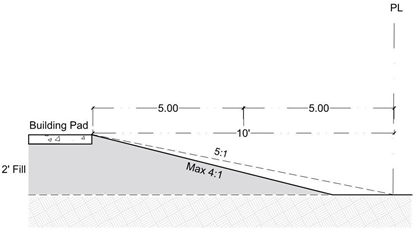
Setback Requirement Where Fill is Used. A Stormwater measure may be required as per
11.5.2.2. Setbacks vary by zoning district.
11.5.2.8. The construction and use of bulkheads, walls, and other structural controls to retain the placement of fill on property shall only be permitted:
11.5.2.8.1. In the immediate area of the on-site sewage disposal system as approved by the Dare County Health Department for the installation of such system, or
11.5.2.8.2. In those areas of the property where the naturally occurring slope exceeds 3:1 or greater in steepness, or
11.5.2.8.3. In those areas of where a retaining wall is necessary to achieve compliance with the fill requirement in 11.5.2.7. Retaining walls used on fill slopes , shall not retain more than two feet of fill, and shall not exceed two feet total height from original grade.
11.5.2.9. The allowable depth or elevations for fill are in subsection 11.5.3 of this section.
11.5.3. Standard for Depth or Elevation of Fill.
Any residential development or redevelopment which utilizes fill shall be limited
to the following standards:
11.5.3.1. Properties East of NC 12 and SR 1243.
11.5.3.1.1. The placement of site-compatible, non-structural fill under or around an elevated building is limited to two (2) feet. Fill greater than two (2) feet must include an analysis prepared by a qualified registered design professional demonstrating no harmful diversion of floodwaters or wave runup and wave deflection that would increase damage to adjacent elevated buildings and structures. Excavated material moved or relocated onsite is considered fill.
11.5.3.1.2. The fill material must be similar and consistent with the natural soils in the area.
11.5.3.1.3. Minor grading and the placement of minor quantities of nonstructural fill, outside the areas referenced in 11.5.3.1.1., may be permitted for landscaping and for drainage purposes and for support of parking slabs, pool decks, patios and walkways.
11.5.3.1.4. Nonstructural fill with finished slopes that are steeper than five (5) units horizontal to one (1) unit vertical shall be permitted only if an analysis prepared by a qualified registered design professional demonstrates no harmful diversion of floodwaters or wave runup and wave deflection that would increase damage to adjacent elevated buildings and structures.
11.5.3.1.5. No bulkheads are allowed.
11.5.3.1.6. Within the Village at Nags Head, only parcels with direct frontage on the Atlantic Ocean/ocean beach shall be considered a Coastal High Hazard area with an RFPE of 12.
11.5.3.2. Properties West of NC 12 and SR 1243.
11.5.3.2.1. Fill shall not be permitted to exceed the regulatory flood protection elevation (RFPE), the amount for wastewater permits required by the Dare County Health Department, or two (2) feet above pre-development surface elevation, whichever is higher.
11.5.3.3. Pre-development surface elevations shall be taken at the four corners of the building footprint. These elevations shall be averaged for the purposes of determining fill height. In cases where the building footprint is irregular and has more than four sides, pre-development surface elevations shall be taken using the four outermost building corners.
11.5.3.4. Lot depressions may be filled, either by grading materials from other locations on the lot or by bringing in like-kind material, no higher than to the level of the directly adjacent pre-disturbance elevation completely surrounding the depression. The post-fill condition shall be considered as the pre-development surface elevation for the purpose of determining fill height.
11.5.4. Plan Submittal, Review and Approval for Residential Development on Individual
Lots.
It is the responsibility of an applicant to provide sufficient information in the
plan so that the Town or its agents may reasonably evaluate the environmental characteristics
of the affected areas, the potential and predicted impacts of the proposed activity
on area surface waters, and the effectiveness and acceptability of those measures
proposed by the applicant for reducing adverse impacts. The applicant shall provide,
as necessary, maps, tables, photographs, narrative descriptions and explanations to
demonstrate compliance with the Town's stormwater management standards.
11.5.4.1. The stormwater management plan shall be submitted as part of the application for a building permit or land disturbance permit.
11.5.4.2. The stormwater management plan need not be prepared by a registered design professional. However, the Town will consider plans and additional alternatives to meet the stormwater requirements if prepared by a registered design professional. An on-site meeting with the stormwater administrator or his/her designee is strongly encouraged prior to plan preparation.
11.5.4.3. The stormwater management design information may be depicted on a site survey that is also utilized for zoning, CAMA, or other Town approvals. At a minimum the plan shall include:
11.5.4.3.1. Existing Conditions. The conditions of the site shall be described in general, including the following:
11.5.4.3.1.1. The direction of flow of stormwater runoff under existing conditions.
11.5.4.3.1.2. The location of areas on the site where stormwater collects or infiltrates into the ground.
11.5.4.3.1.3. A survey of the site, including topography. The survey shall be prepared by a licensed surveyor and shall include the minimum required elevation information as referenced in the Town of Nags Head's Minimum Required Survey Information Template which can be found in Appendix A of the Town's Low Impact Development Manual. The survey must also show the location of drainage ditches within the area surveyed, and the location of wetlands, and ponds.
11.5.4.3.1.4. Approximate elevation of seasonal high-water table. "Seasonal high wetness condition" as indicated by the Dare County Health Department site evaluation is acceptable for determining vertical separation compliance of Stormwater Improvements on single family and two-family residential projects. Also, include any fill requirements provided with the Dare County Health Department septic approval.
11.5.4.3.2. Proposed Alterations. Proposed alterations of the site shall be described, including:
11.5.4.3.2.1. Change(s) in topography. The proposed final elevations shall be shown in a manner that can be distinguished from the existing elevations. If there are abrupt changes in elevations, these should be clearly identified in the plans. These should be plotted on a scale that is easy to read and in a form that conveys the nature of changes that are proposed.
11.5.4.3.2.2. Identification and quantification of the area(s) that will be covered with built-upon area and a description of the surfacing material(s).
11.5.4.3.2.3. The proposed area to be preserved and/or planted with vegetation as well as any significant existing vegetation.
11.5.4.3.2.4. Identification and quantification any other site improvements such as pools, wood slatted decks, and permeable pavement.
11.5.4.3.2.5. The size and location of any buildings or other structures, including bulkheads or retaining walls.
11.5.4.3.2.6. Stormwater Improvements shall be described, and their location identified on the survey.
11.5.4.3.2.7. Erosion and Sediment Control Measures. A description of the measures that will be put in place for the control of erosion and sedimentation shall be provided.
11.5.4.3.2.8. Other Information. The applicant shall provide other information which the Town or its designated agent deems necessary for an evaluation of the development proposal for compliance with this chapter.
11.5.4.4. Elevation data shall be provided on the foundation survey as required, and/or on the as built survey so as to determine compliance with the maximum fill height requirements of this chapter.
11.5.4.5. Upon completion of stormwater management improvements, the stormwater administrator or his/her designee shall verify compliance via field inspection. Once a project is completed, stormwater management features shall be maintained in accordance with the approved plan and subsequent certificate of compliance.
(Ord. No. 20-06-008, Art. II, Pt. VII, 6-3-2020; Ord. No. 20-09-013, Art. III, Pt. I, 9-2-2020; Ord. No. 21-06-012, Art. III, Pt. XII(Att. L), 6-2-2021; Ord. No. 22-02-005, Art. III, Pt. I, 2-2-2022)
Section 11.6 - General Standards for Subdivisions.
11.6.1. Commercial Subdivisions.
All runoff from the subdivision's built-upon area, must be directed into an approved
stormwater management system designed to accommodate the runoff generated by a 4.3-inch
design storm. Overflow shall not be conveyed off-site to private property or public
rights-of-way for disposal except upon the establishment of appropriate easements
and maintenance agreements among all impacted parties and upon Town approval.
11.6.2. Residential Subdivisions.
All runoff from the subdivision's built-upon area, including proposed streets, must
be directed into an approved stormwater management system designed to accommodate
the runoff generated by a 1.5-inch design storm. Overflow shall not be conveyed off-site
to private property or public rights-of-way for disposal except upon the establishment
of appropriate easements and maintenance agreements among all impacted parties and
upon Town approval.
11.6.3. Future Phase Development.
Management of stormwater from part or all of the future development on commercial
or residential sites may be deferred in a phased plan until a given phase is subject
to site plan review. The subdivision plat shall clearly identify the specific areas
of future phase development and the extent to which management of stormwater is deferred.
11.6.4. ROW/Common Areas.
Use of fill within proposed rights-of-way or other common areas shall not exceed the
Regulatory Flood Protection Elevation (RFPE) for the zone in which the fill is proposed.
11.6.5. Operation and Maintenance Agreement.
All stormwater plans must include an operation and maintenance agreement that provides
for on-going maintenance of the proposed stormwater management system and which assigns
responsibility to an owners association as part of any covenants or deeds that run
with the individual parcels.
(Ord. No. 22-02-005, Art. III, Pt. I, 2-2-2022)
Section 11.7 - Stormwater Management Plan Submittal and Approval Requirements.
11.7.1. Preparer's Certification.
Commercial, mixed-use or multi-lot development such as a subdivision, stormwater management
plans and supporting technical documents shall be prepared by a qualified and registered
design professional knowledgeable within the field of work for the performance of
the design, construction, and operation and maintenance of what is being proposed.
11.7.2. Supporting Documentation.
Supporting plans and documentation including assumptions, methodology, calculations
and conclusions shall be submitted to the Town as part of the application.
11.7.2.1. For all subdivisions and commercial applications, a stormwater management plan with all supporting documentation meeting all Town requirements and standards shall be submitted with the plat or site plan application for approval by the Town Engineer.
11.7.2.2. For special uses, a preliminary stormwater management plan shall be submitted with the special use permit application. A stormwater management plan with all supporting documentation meeting all Town requirements and standards shall be submitted with, or in advance of, the application for a building permit.
11.7.3. Submittal Requirements.
The stormwater management plan shall include engineered drawings, non-engineered drawings,
maps, assumptions, calculations and narrative statements, including:
11.7.3.1. Existing Conditions. Sheets or maps indicating existing features, including buildings, ground surface elevations, landforms, parking areas, roadways, structures, subsurface utilities, surface utilities, surface waters, watercourses, vegetation, and other significant elements. Elevations shall be provided in sufficient detail to determine the efficacy of proposed stormwater improvements and compliance with all stormwater and fill requirements. At a minimum, pre-disturbance spot elevations shall be provided beneath proposed improvements and along property lines adjacent to any fill slopes.
11.7.3.2. Project boundaries clearly depicted and labeled, including any staging areas.
11.7.3.3. Locations and elevations of the adjoining street pavement, shoulder, ditches, and drainage systems, as well as upstream and downstream driveway culverts.
11.7.3.4. Approximate elevation of seasonal high-water table. "Seasonal high wetness condition" as indicated by the Dare County Health Department site evaluation is acceptable for determining vertical separation compliance of BMPs on single family and two-family residential projects. Also include any fill requirements provided with the Dare County Health Department septic approval.
11.7.3.5. Distance Measurements. Lateral and vertical separation distances from AECs, state surface waters, subsurface water conditions, above ground and underground utilities, or other separation distances as required by existing federal, state or local laws clearly depicted.
11.7.3.6. Proposed Conditions. Sheets or maps indicating location of proposed features including areas where fill will be placed including the toe of fill slopes, buildings, ground surface elevations, landforms, parking areas, roadways, structures, subsurface utilities, landscaping, and other significant elements.
11.7.3.7. Drawings shall describe the proposed elements and their association with existing elements with spot elevations depicted in areas of proposed fill and finished floor elevations for all proposed buildings/structures described. Notational information shall be provided which includes existing surface elevation at each site element, proposed maximum fill depths for each site element, and maximum fill depth within the project site.
11.7.3.8. Location and description of stormwater BMPs proposed to capture runoff from all surfaces within a given drainage area.
11.7.3.9. Location of erosion control measures relative to fill slopes and disturbed areas. This shall include any temporary measures that will be necessary to retain stormwater or other construction related water discharges on the property during construction prior to the installation of final stormwater improvements.
11.7.4. Operations and Maintenance Agreement.
An operations and maintenance agreement shall be submitted to and be approved by the
Town. The operations and maintenance agreement shall address sediment removal, mowing
and re-vegetation, immediate repair of eroded areas, debris removal, and unclogging
of any structures. The operations and maintenance agreement may provide for access
by the Town and its agents to all stormwater management measures at the site for the
purposes of inspection, maintenance, reporting, and repair operations. The operations
and maintenance plan shall run with the property and compliance shall be the responsibility
of the property owner.
11.7.5. Easements/Covenants.
Copies of all recorded easements or covenants that run with the property and are necessary
for continued function of the best management practices utilized for plan approval.
11.7.6. Certification.
Upon completion of construction, stormwater management facilities shall be certified
by the stormwater plan preparer or a qualified and authorized professional as having
been constructed in substantial conformity with the Town-approved plans and specifications.
The acceptability of a certification by any other person than the person who prepared
the original design shall be at the sole discretion of the Town. A copy of this documentation
shall be submitted to the Town prior to the issuance of a certificate of compliance.
11.7.7. Construction Record or As-Built Plans.
The construction record survey or plan shall include any on-site stormwater management
measures and shall be prepared once final construction has been completed. These plans
shall be prepared by a licensed surveyor and shall include all of the elements shown
as proposed on the approved construction plans and depict sufficient topographic information
to demonstrate compliance with the approved plans. These shall be submitted to the
Town prior to the issuance of a certificate of compliance.
(Ord. No. 21-06-012, Art. III, Pt. XII(Att. L), 6-2-2021)
Section 11.8 - Operations and Maintenance Requirements.
11.8.1. For All Projects Other than Residential Development on Individual Lots.
11.8.1.1. An operations and maintenance agreement based on the operations and maintenance plan shall be executed by the owner or amongst the owners and approved by the Town prior to issuance of a certificate of compliance.
11.8.1.2. The operations and maintenance agreement:
11.8.1.2.1. Shall require the owner or owners to maintain, repair, and if necessary, reconstruct the stormwater management features, and
11.8.1.2.2. Shall state the terms, conditions, and schedule of maintenance for the stormwater management features, and
11.8.1.2.3. May grant to the Town a right of entry into the property to inspect, monitor, maintain, repair, or reconstruct the stormwater management features. However, in no case shall the right of entry confer an obligation on the Town to assume responsibility for the stormwater management features.
11.8.1.3. Operations and maintenance agreement recordation requirements. Prior to issuance of a certificate of compliance for any project served by stormwater management features required by this ordinance, the operations and maintenance agreement shall be recorded as a deed restriction or protective covenant with the Dare County Register of Deeds Office binding all subsequent property owners to compliance with the agreement.
11.8.2. Approval Required.
The Town-approved stormwater management system shall not be altered without approval
of the Town Engineer.
11.8.3. Maintenance.
Failure to maintain on-site stormwater management facilities shall be grounds for
a notice of violation, civil penalties and possible revocation of occupancy permits
in accordance with Section 1.10, Violation of UDO Regulations.
(Ord. No. 21-06-012, Art. III, Pt. XII(Att. L), 6-2-2021)
Section 11.9 - Reference Documents.
11.9.1. The Town has prepared a Low Impact Development Manual which includes guidance on specific Stormwater Improvements and other requirements of this ordinance. The Town will make copies of the most current Town of Nags Head Low Impact Development Manual and the most current NCDEQ Stormwater Design manual available to applicants.
11.9.2. Applicants for permits under this Part shall refer to the most current editions of the NCDEQ Stormwater Design Manual and the Town's Low Impact Development Manual if citing them for the design, construction and maintenance management practices on the site associated with the application. Stormwater treatment practices that are designed, constructed, and maintained in accordance with the NCDEQ Stormwater Design Manual and the Town's Low Impact Development Manual will be presumed to meet the minimum water quality and quantity performance standards of this Part.
11.9.3. Applicants for permits under this Part may propose utilization of a stormwater management practice or practices which are not designed, constructed, or maintained in accordance with the NCDEQ Stormwater Design Manual and the Town Low Impact Development Manual. In such cases, the applicant shall have the burden of demonstrating that the practice(s) will satisfy the minimum water quality and quantity performance standards of this ordinance and the practices must be approved by the UDO Administrator.
11.9.4. Upon review and evaluation of an application for a permit under this Part, the Stormwater Administrator may recommend management practices regarding a particular site. If upon review and inspection the UDO Administrator determines that the environmental conditions of a particular site will not support the management practices proposed by an applicant, the UDO Administrator may require reasonable changes to the application, professional certification of a particular design and/or evaluation of the proposal by the Town Engineer. The UDO Administrator may require any reasonable changes to an application proposed by the Town Engineer.
(Ord. No. 22-02-005, Art. III, Pt. I, 2-2-2022)
Section 11.10 - Discharge of Stormwater, Pool Water, Hot Tub Water, and De-Watering Effluent.
11.10.1. It shall be prohibited to discharge or direct water onto adjoining properties to include retained stormwater runoff, swimming pools, hot tubs, heating and air conditioning systems, or groundwater from de-watering activities.
11.10.2. Discharge of retained stormwater or water from other sources into the Town right-of-way is allowable only with the written permission of the Town Manager, Public Works Director, Town Engineer, or their designee.
11.10.3. Temporary discharge of retained stormwater or water from other sources into the NCDOT right-of-way is allowable only with permission of NCDOT and a properly executed NCDOT encroachment agreement. Upon a determination that this section is being violated, the Stormwater Administrator, or their designee, may immediately issue a notice of violation and civil citation without need for a warning citation under Section 1.10, Violation of UDO Regulations or Town Code 1-6. Upon receipt of the notice of violation, the violator shall immediately cease and desist the activity which is in violation of this section. In the event that a violation imminently affects public safety, health or welfare, the Town may take action to abate the violation in a manner which appropriately balances the need for public safety with the need for due process of law.
(Ord. No. 21-06-012, Art. III, Pt. XII(Att. L), 6-2-2021; Ord. No. 22-02-005, Art. III, Pt. I, 2-2-2022; Ord. No. 23-07-021, Art. III, Pt. I, 7-5-2023)
Section 11.11 - Public/Private Conflicts.
Where it has been determined that stormwater runoff from Town rights-of-way or Town-owned facilities contributes to a stormwater runoff problem on private property, a landowner may file a written request to the Board of Commissioners to consider landowner's concerns or to propose a solution. The Town Board may consider requests and determine whether or not to take any action.
Section 11.12 - Drainage within Town Rights-of-Way.
11.12.1. An un-obstructed flow path for drainage infrastructure along Town rights-of-way shall be maintained. Town rights-of-way are necessary for legal/uncontested access by local government to drainage courses and infrastructure so that they may be constructed, maintained and improved to enhance public health and safety. Improperly installed fencing, landscaping, or the creation of other impediments or changes within the right-of-way may interfere with drainage along the roadway.
11.12.2. Construction or installation of permanent or temporary structures, landscaping, grading alterations, or other encroachments within, under, above, or upon any public right-of-way, are prohibited without the express permission from the Town.
11.12.3. Homeowners shall be responsible for maintenance of Town approved right-of-way encroachments, including culverts, other stormwater improvements, driveway maintenance, routine grounds maintenance such as grass mowing, and trash or debris removal that may impede the flow of water within drainage conveyances.
11.12.4. Upon approval by the Board of Commissioners, the Town may allow and may accept for maintenance, stormwater control and conveyance facilities built by others on Town rights-of-way or on Town-owned properties.
11.12.4.1. The design of such facilities shall be approved by the Town at the sole discretion of the Town, and the construction of such facilities shall be in strict conformity with the approved design.
11.12.4.2. Approval can only be granted after an identification and evaluation analysis of significant cumulative impacts on the entire drainage system, up to the ultimate point of disposal, utilizing such supporting information, documents, evaluations, studies and other resources as the Town may deem necessary.
11.12.4.3. The Town may establish and impose review fees to cover the cost of design review and construction inspection, and facility fees to cover the cost of capital impacts resulting from the proposed facilities.
11.12.4.4. The operation and maintenance of facilities accepted by the Town for maintenance on Town rights-of-way or Town-owned property shall be at the expense of the Town.
(Ord. No. 22-02-005, Art. III, Pt. I, 2-2-2022)
Section 11.13 - Penalties for Violation of Article 11, Part I.
Violation of this Article 11, Part I shall subject the offender to remedies prescribed in Section 1.10, Violation of UDO Regulations or Chapter 1-6 of the Town Code.
Section 11.14 - Variances, Waivers, and Appeals.
Variances, Waivers, and appeals to Part I, Stormwater, Fill, and Runoff Management shall be granted in accordance with Article 3, Legislative/Quasi-Judicial Procedures.
Section 11.15 - Conflict with Other Laws.
Where this Part imposes greater restrictions or higher standards than required in any federal or state statute or other local ordinance or regulation, the provisions of this Part shall govern. When the provisions of any other statute or local ordinance impose greater restrictions or higher standards than are required by the provisions of this Part, the provisions of that statute or ordinance shall govern.
Section 11.16 - Validity.
If any section, subsection, sentence, clause or phrase of this Part is for any reason held to be invalid, that decision shall not affect the validity of the remaining portions of this Part. The Board of Commissioners declares that it would have passed the ordinance and each section, clause and phrase of it even if any one or more sections, sentences, clauses or phrases may be declared invalid.
Section 11.21 - Purpose and Intent.
11.21.1. Title.
This Article 11, Part II may be cited as the "Town of Nags Head Soil Erosion and Sedimentation Control
Ordinance."
11.21.2. Purpose.
This Article 11, Part II is adopted for the purposes of:
11.21.2.1. Regulating certain land-disturbing activity to control accelerated erosion and sedimentation in order to prevent the pollution of water and other damage to lakes, watercourses, and other public and private property by sedimentation;
11.21.2.2. Establishing procedures through which these purposes can be fulfilled; and
11.21.2.3. Provide soil erosion and sedimentation control regulations which are consistent with other stormwater management regulations of the Town.
Section 11.22 - Scope of Article 11, Part II and Exclusions.
11.22.1. Geographical Scope of Regulated Land-Disturbing Activity.
This Part shall apply to land-disturbing activity within the territorial jurisdiction
of the Town of Nags Head and to the extraterritorial jurisdiction of the Town of Nags
Head as allowed by agreement between local governments, the extent of annexation or
other appropriate legal instrument of law.
11.22.2. Exclusions from Regulated Land-Disturbing Activity.
Notwithstanding the general applicability of this Part to all land-disturbing activities,
this Part shall not apply to the following types of land-disturbing activity:
11.22.2.1. Activities, including the breeding and grazing of livestock, undertaken on agricultural land for the production of plants and animals useful to man including, but not limited to:
11.22.2.1.1. Forages and sod crops, grains and feed crops, tobacco, cotton, and peanuts.
11.22.2.1.2. Dairy animals and dairy products.
11.22.2.1.3. Poultry and poultry products.
11.22.2.1.4. Livestock, including beef cattle, sheep, swine, horses, ponies, mules, and goats.
11.22.2.1.5. Bees and apiary products.
11.22.2.1.6. Fur producing animals.
11.22.2.2. Activities undertaken on forestland for the production and harvesting of timber and timber products and conducted in accordance with best management practices set out in "Forest Practice Guidelines Related to Water Quality", as adopted by the department. If land-disturbing activity undertaken on forest land for the production and harvesting of timber and timber products is not conducted in accordance with "Forest Practice Guidelines Related to Water Quality", the provisions of this Part shall apply to such activity and any related land-disturbing activity on the tract.
11.22.2.3. Activities for which a permit is required under the Mining Act of 1971, G.S. Ch. 74, Art. 7.
11.22.2.4. Land-disturbing activity over which the state has exclusive regulatory jurisdiction as provided in G.S. 113A-56(a).
11.22.2.5. An activity which is essential to protect human life during an emergency.
11.22.3. Plan Approval Requirement for Land-Disturbing Activity.
No person shall undertake any land-disturbing activity subject to this Part without
first obtaining a land disturbance permit and any other plan approvals required from
the Town, state or federal government.
11.22.4. Protection of Property.
Persons conducting land-disturbing activity shall take all reasonable measures to
protect all public and private property from damage caused by such activity, and any
land disturbance abutting a property boundary or drainage swale within a public right-of-way
shall require the installation of sediment fencing secured and staked along the length
of the disturbed area.
11.22.5. More Restrictive Rules Shall Apply.
Whenever conflicts exist between federal, state or local laws, ordinances or rules,
the more restrictive provision shall apply.
11.22.6. Plan Approval Exceptions.
A land disturbance permit is required prior to any land-disturbing activity. Other
Town requirements related to Flood Damage Prevention (Article 11, Part III) or Stormwater, Fill and Runoff Management (Article 11, Part I), may also be required. A sedimentation plan shall only be required if the
disturbance exceeds 5,000 square feet in surface area. In determining the area, lands
under one or diverse ownership being developed as a unit will be aggregated.
Section 11.23 - Mandatory Standards for Land-Disturbing Activity.
No land-disturbing activity subject to the control of this Part shall be undertaken except in accordance with the following mandatory standards:
11.23.1. Buffer Zone.
No land-disturbing activity during periods of construction or improvement to land
shall be permitted in proximity to a lake or natural watercourse unless a buffer zone
is provided along the margin of the watercourse of sufficient width to confine visible
siltation within the twenty-five (25) percent of the buffer zone nearest the land-disturbing
activity.
11.23.1.1. Projects On, Over or Under Water. This subsection shall not apply to a land-disturbing activity in connection with the construction of facilities to be located on, over, or under a lake or natural watercourse.
11.23.1.2. Buffer Measurement. Unless otherwise provided, the width of a buffer zone is measured from the edge of the water to the nearest edge of the disturbed area, with the twenty-five (25) percent of the strip nearer the land-disturbing activity containing natural or artificial means of confining visible siltation.
11.23.2. Graded Slopes and Fills.
The angle for graded slopes and fills shall be no greater than the angle which can
be retained by vegetative cover or other adequate erosion control devices or structures.
In any event, slopes left exposed shall, within 21 calendar days, be planted or otherwise
provided with temporary or permanent ground cover, devices, or structures sufficient
to restrain erosion.
11.23.3. Fill Material.
Unless a permit from the NCDEQ Division of Waste Management to operate a landfill
is on file for the official site, acceptable fill material shall be free of organic
or other degradable materials, masonry, concrete and brick exceeding twelve (12) inches,
and any materials which would cause the site to be regulated as a landfill of the
state.
11.23.4. Ground Cover.
Whenever land-disturbing activity is undertaken where more than 5,000 square feet
is uncovered, the person conducting the land-disturbing activity shall install such
sedimentation and erosion control devices and practices as are sufficient to retain
the sediment generated by the land-disturbing activity within the boundaries of the
tract during construction upon and development of such tract, and shall plant or otherwise
provide a permanent ground cover sufficient to restrain erosion after completion of
construction or development. Except as provided in subsection 11.26.5, provisions
for a ground cover sufficient to restrain erosion must be accomplished within fifteen
(15) working days or ninety (90) calendar days, following completion of construction
or development whichever period is shorter.
11.23.5. Prior Plan Approval.
No person shall initiate any land-disturbing activity that will disturb more than
5,000 square feet on a tract unless, thirty (30) or more days prior to initiating
the activity, a soil erosion and sedimentation control plan is filed with and approved
by the Town. An erosion and sedimentation control plan may be filed less than thirty
(30) days prior to initialization of a land-disturbing activity if the plan is submitted
under an approved express permit program. The land-disturbing activity may be initiated
and conducted in accordance with the plan once the plan has been approved. The Town
shall forward to the NCDEQ Division of Water Resources a copy of each plan for a land-disturbing
activity that involves the utilization of ditches for the purpose of dewatering or
lowering the water table of the tract.
11.23.6. Approved Plan.
The land-disturbing activity shall be conducted in accordance with the approved erosion
and sedimentation control plan.
Section 11.24 - Erosion and Sedimentation Control Plans.
11.24.1. Plan Submission.
An erosion control plan shall be prepared for all land-disturbing activity subject
to this Part whenever the proposed activity will disturb an area of more than 5,000
square feet. Three (3) copies of the plan shall be filed with the Town at least thirty
(30) days prior to the commencement of the proposed activity.
11.24.2. Financial Responsibility and Ownership.
Plans may be disapproved unless accompanied by an authorized statement of financial
responsibility and ownership. This statement shall be signed by the person financially
responsible for the land-disturbing activity or his attorney in fact. The statement
shall include the mailing and street addresses of the principal place of business
of:
11.24.2.1. The person financially responsible;
11.24.2.2. The owner of the land; and
11.24.2.3. Any registered agents.
If the person financially responsible is not a resident of the state, a state agent must be designated in the statement for the purpose of receiving notice of compliance or noncompliance with the plan, the Act, this Part or rules or orders adopted or issued pursuant to this Part. If the applicant is not the owner of the land to be disturbed, the draft plan must include the owner's written consent for the applicant to submit a draft erosion and sedimentation control plan and to conduct the anticipated land-disturbing activity.
11.24.3. Environmental Policy Act Document.
Any plan submitted for a land-disturbing activity for which an environmental document
is required by the North Carolina Environmental Policy Act (G.S. 113A-01 et seq.)
shall be deemed incomplete until a complete environmental document is available for
review. The Town shall promptly notify the person submitting the plan that the 30-day
time limit for review of the plan pursuant to this Part, shall not begin until a complete
environmental document is available for review.
11.24.4. Content.
The plan required by this section shall contain architectural and engineering drawings,
maps, assumptions, calculations, and narrative statements as needed to adequately
describe the proposed development of the tract and the measures planned to comply
with the requirements of this Part. Plan content may vary to meet the needs of specific
site requirements. Detailed guidelines for plan preparation may be obtained from the
Town on request.
11.24.5. Timeline for Decisions on Plans.
The Town will review each complete plan submitted to them and within thirty (30) days
of receipt thereof will notify the person submitting the plan that it has been approved,
approved with modifications, approved with performance reservations, or disapproved.
Failure to approve, approve with modifications, or disapprove a complete erosion and
sedimentation control plan, or revised erosion control plan, within thirty (30) days
of receipt shall be deemed approval. Disapproval of a plan must specifically state
in writing the reasons for disapproval. The Town must approve, approve with modifications,
or disapprove a revised plan within fifteen (15) days of receipt, or it is deemed
to be approved. When deemed necessary, a preconstruction conference may be required.
No person with an approved plan may initiate the land-disturbing activity without
notifying the Town of the date that the activity shall begin. If, following commencement
of a land-disturbing activity pursuant to an approved plan, the Town determines that
the plan is inadequate to meet the requirements of this Part, the Town may require
any revision that is necessary to comply with this Part. Failure to approve, approve
with modifications, or disapprove a revised erosion control plan within fifteen (15)
days of receipt shall be deemed approval of the plan. An erosion control plan approved
under this Part expires three (3) years after the date of written approval, or upon
expiration of a required environmental document, whichever occurs first.
11.24.6. Approval.
The Town shall only approve a plan upon determining that it complies with all applicable
state and local regulations for erosion and sedimentation control. Approval assumes
the applicant's compliance with the federal and state water quality laws, regulations
and rules. The Town shall condition approval of plans upon the applicant's compliance
with federal and state water quality laws, regulations and rules. The Town may establish
an expiration date, not to exceed three (3) years, for plans approved under this Part.
11.24.7. Disapproval for Content.
The Town shall disapprove a plan or draft plan based on its content. A disapproval
based upon a plan's content must specifically state in writing the reasons for disapproval.
11.24.8. Other Disapprovals.
The Town may disapprove an erosion control plan or draft plan if implementation of
the plan would result in a violation of rules adopted by the environmental management
commission to protect riparian buffers along surface waters. An erosion control plan
may be disapproved upon a finding that an applicant, or a parent, subsidiary or other
affiliate of the applicant:
11.24.8.1. Is conducting or has conducted land-disturbing activity without an approved plan, or has received notice of violation of a plan previously approved by the commission or a local government pursuant to the Act and has not complied with the notice within the time specified in the notice; 11.24.8.2. Has failed to pay a civil penalty assessed pursuant to the Act or a local ordinance adopted pursuant to the Act by the time the payment is due;
11.24.8.3. Has been convicted of a misdemeanor pursuant to G.S. 113A-64(b) or any criminal provision of a local ordinance adopted pursuant to the Act; or
11.24.8.4. Has failed to substantially comply with state rules or local ordinances and regulations adopted pursuant to the Act.
For purposes of this subsection, an applicant's record may be considered for only the two (2) years prior to the application date.
In the event that a plan is disapproved pursuant to this subsection, the Town shall notify the director of such disapproval within ten (10) days. The Town shall advise the applicant and the director in writing as to the specific reasons that the plan was denied.
11.24.9. Notice of Activity Initiation.
No person may initiate an approved land-disturbing activity before notifying the Town
of the date that land-disturbing activity will begin.
11.24.10. Preconstruction Conference.
When deemed necessary by the approving authority a preconstruction conference may
be required.
11.24.11. Display of Plan Approval.
A plan approval issued under this section shall be prominently displayed until all
construction is complete, all permanent sedimentation and erosion control measures
are installed, and the site has been stabilized. A copy of the approved plan shall
be kept on file at the job site.
11.24.12. Required Revisions.
After approving a plan, if the Town either upon review of such plan or on inspection
of the job site, determines that a significant risk of accelerated erosion or offsite
sedimentation exists, the Town shall require a revised plan. Pending the preparation
of the revised plan, work shall cease or shall continue under conditions outlined
by the appropriate authority. If following commencement of a land-disturbing activity
pursuant to an approved plan, the Town determines that the plan is inadequate to meet
the requirements of this Part, the Town may require any revision of the plan that
is necessary to comply with this Part.
11.24.13. Amendment to a Plan.
Applications for amendment of an erosion control plan in written and/or graphic form
may be made at any time under the same conditions as the original application. Until
such time as such amendment is approved by the Town the land-disturbing activity shall
not proceed except in accordance with the erosion control plan as originally approved.
11.24.14. Failure to File a Plan.
Any person engaged in land-disturbing activity who fails to file a plan in accordance
with this Part, or who conducts a land-disturbing activity except in accordance with
provisions of an approved plan shall be deemed in violation of this Part.
11.24.15. Inspections.
The landowner, the financially responsible party, or the landowner's or the financially
responsible party's agent shall perform an inspection of the area covered by the plan
after each phase of the plan has been completed and after establishment of temporary
ground cover in accordance with G.S. 113A-57(2). The person who performs the inspection
shall maintain and make available a record of the inspection at the site of the land-disturbing
activity. The record shall set out any significant deviation from the approved erosion
control plan, identify any measures that may be required to correct the deviation,
and document the completion of those measures. The record shall be maintained until
permanent ground cover has been established as required by the approved erosion and
sedimentation control plan. The inspections required by this subsection shall be in
addition to inspections required by G.S. 113A-61.1.
Section 11.25 - Basic Control Objectives.
An erosion and sedimentation control plan may be disapproved if the plan fails to address the following control objectives:
11.25.1. Identify Critical Areas.
On-site areas which are subject to severe erosion and offsite areas which are especially
vulnerable to damage from erosion and/or sedimentation are to be identified and receive
special attention.
11.25.2. Limit Time of Exposure.
All land-disturbing activity is to be planned and conducted to limit exposure to the
shortest feasible time.
11.25.3. Limit Exposed Areas.
All land-disturbing activity is to be planned and conducted to minimize the size of
the area to be exposed at any one time.
11.25.4. Control Surface Water.
Surface water runoff originating upgrade of exposed areas should be controlled to
reduce erosion and sediment loss during the period of exposure.
11.25.5. Control Sedimentation.
All land-disturbing activity is to be planned and conducted so as to prevent offsite
sedimentation damage.
11.25.6. Manage Stormwater Runoff.
When the increase in the velocity of stormwater runoff resulting from a land-disturbing
activity is sufficient to cause accelerated erosion of the receiving watercourse,
plans are to include measures to control the velocity at the point of discharge, so
as to minimize accelerated erosion of the site and increased sedimentation of the
stream.
Section 11.26 - Design and Performance Standards.
11.26.1. Design.
Except as provided in subsection 11.26.2.2 of this section, erosion and sedimentation
control measures, structures, and devices shall be so planned, designed, and constructed
as to provide protection from anticipated winds and from the calculated maximum peak
rate of runoff from the ten-year storm. Runoff rates shall be calculated using the
procedures in the USDA, Soil Conservation Service's "National Engineering Field Manual
for Conservation Practices," or other acceptable calculation procedures.
11.26.2. HQW Zones.
In high quality water (HQW) zones the following design standards shall apply:
11.26.2.1. Limit on Uncovered Area. Uncovered areas in HQW zones shall be limited at any time to a maximum total area within the boundaries of the tract of twenty (20) acres. Only the portion of the land-disturbing activity within an HQW zone shall be governed by this section. Larger areas may be uncovered within the boundaries of the tract with the written approval of the director.
11.26.2.2. Maximum Peak Rate of Runoff Protection. Erosion and sedimentation control measures, structures, and devices within HQW zones shall be so planned, designed and constructed to provide protection from anticipated winds and from the runoff of the 25-year storm which produces the maximum peak rate of runoff as calculated according to procedures in the USDA Natural Resources Conservation Service's "National Engineering Field Manual for Conservation Practices," or according to procedures adopted by any other agency of this state or the United States or any generally recognized organization or association.
11.26.3. Settling Efficiency.
Sediment basins within HQW zones shall be designed and constructed such that the basin
will have a settling efficiency of at least seventy (70) percent for the forty (40)
micron (0.04 mm) size soil particle transported into the basin by the runoff of that
25-year storm which produces the maximum peak rate of runoff as calculated according
to procedures in the USDA Natural Resources Conservation Service's "National Engineering
Field Manual for Conservation Practices" or according to procedures adopted by any
other agency of this state or the United States or any generally recognized organization
or association.
11.26.4. Grade.
Newly constructed open channels in HQW zones shall be designed and constructed with
side slopes no steeper than two horizontal to one vertical if a vegetative cover is
used for stabilization unless soil conditions permit a steeper slope or where the
slopes are stabilized by using mechanical devices, structural devices or other acceptable
ditch liners. In any event, the angle for side slopes shall be sufficient to restrain
accelerated erosion.
11.26.5. Ground Cover.
Ground cover sufficient to restrain erosion must be provided for any portion of a
land-disturbing activity in a HQW zone within fifteen (15) working days or forty-five
(45) calendar days following completion of construction or development, whichever
period is shorter.
Section 11.27 - Stormwater Outlet Protection.
11.27.1. Intent.
Stream banks and channels downstream from any land-disturbing activity shall be protected
from increased degradation by accelerated erosion caused by increased velocity of
runoff from the land-disturbing activity.
11.27.2. Performance Standard.
Persons shall conduct land-disturbing activity so that the post construction velocity
of the ten-year storm runoff in the receiving watercourse to the discharge point does
not exceed the greater of:
11.27.2.1. The velocity established by the Maximum Permissible Velocities Table set out within this subsection; or
11.27.2.2. The velocity of the ten-year storm runoff in the receiving watercourse prior to development.
If conditions 11.27.2.1 or 11.27.2.2 of this subsection cannot be met, then the receiving watercourse to and including the discharge point shall be designed and constructed to withstand the expected velocity anywhere the velocity exceeds the "prior to development" velocity by ten (10) percent.
The following is a table for maximum permissible velocity for stormwater discharges in feet per second (FPS) and meters per second (MPS):
Source: Adapted from recommendations by Special Committee on Irrigation Research, American Society of Civil Engineers, 1926, for channels with straight alignment. For sinuous channels, multiply allowable velocity by 0.95 for slightly sinuous channels, by 0.9 for moderately sinuous channels, and by 0.8 for highly sinuous channels.
11.27.3. Acceptable Management Measures.
Measures applied alone or in combination to satisfy the intent of this section are
acceptable if there are no objectionable secondary consequences. The Town recognizes
that the management of stormwater runoff to minimize or control downstream channel
and bank erosion is a developing technology. Innovative techniques and ideas will
be considered and may be used when shown to have the potential to produce successful
results. Some alternatives are to:
11.27.3.1. Avoid increases in surface runoff volume and velocity by including measures to promote infiltration to compensate for increased runoff from areas rendered impervious.
11.27.3.2. Avoid increases in stormwater discharge velocities by using vegetated or roughened swales and waterways in lieu of closed drains and high velocity paved sections.
11.27.3.3. Provide energy dissipaters at outlets of storm drainage facilities to reduce flow velocities to the point of discharge. These may range from simple rip-rapped sections to complex structures.
11.27.3.4. Protect watercourses subject to accelerated erosion by improving cross sections and/or providing erosion-resistant lining.
11.27.3.5. Upgrade or replace the receiving device structure, or watercourse such that it will receive and conduct the flow to a point where it is no longer subject to degradation from the increased rate of flow or increased velocity.
11.27.4. Exceptions.
This section shall not apply where it can be demonstrated that stormwater discharge
velocities will not create an erosion problem in the receiving watercourse.
Section 11.28 - Borrow and Waste Areas.
When the person conducting the land-disturbing activity is also the person conducting the borrow or waste disposal activity, sites from which borrow is obtained and which are not regulated by the provisions of the Mining Act of 1971, G.S. 74-46 et seq., and waste areas for surplus materials other than landfills regulated by the department's division of waste management shall be considered as part of the land-disturbing activity where the borrow material is being used or from which the waste material originated. When the person conducting the land-disturbing activity is not the person obtaining the borrow and/or disposing of the waste, these areas shall be considered a separate land-disturbing activity.
Section 11.29 - Access and Haul Roads.
Temporary access and haul roads, other than public roads, constructed or used in connection with any land-disturbing activity shall be considered a part of such activity.
Section 11.30 - Operations in Lakes or Natural Watercourses.
Land-disturbing activity in connection with construction in, on, over or under a lake or natural watercourse shall minimize the extent and duration of disruption of the stream channel. Where relocation of a stream forms an essential part of the proposed activity, the relocation shall minimize unnecessary changes in the stream flow characteristics.
Section 11.31 - Responsibility for Maintenance.
During the development of a site, the person conducting the land-disturbing activity shall install and maintain all temporary and permanent erosion and sedimentation control measures as required by the approved plan or any provision of this Part, the Act, or any order adopted pursuant to this Part or the Act. After site development, the landowner or person in possession or control of the land shall install and/or maintain all necessary temporary and permanent erosion and sediment control measures, except those measures installed within a road or street right-of-way or easement accepted for maintenance by a governmental agency.
Section 11.32 - Additional Measures.
Whenever the Town determines that significant sedimentation is occurring as a result of land-disturbing activity, despite application and maintenance of protective practices, the person conducting the land-disturbing activity will be required to and shall take additional protective action.
Section 11.33 - Existing Uncovered Areas.
11.33.1. All uncovered sites existing on the effective date of this Part which resulted from land-disturbing activity, which exceed 5,000 square feet, are subject to continued accelerated erosion and which are causing offsite damage from sedimentation shall be provided with a ground cover or other protective measures, structures or devices sufficient to restrain accelerated erosion and control offsite sedimentation.
11.33.2. The Town shall serve upon the landowner or other person in possession or control of the land, a written notice of violation to comply with the Act, this Part, a rule or order adopted or issued pursuant to the Act or by the Town. The notice shall be sent by either registered or certified mail, return receipt requested, or other means reasonably calculated to give actual notice. The notice will set forth the measures needed to comply and will state the time within which such measures must be completed. In determining the measures required and the time allowed for compliance, the authority serving notice shall take into consideration the economic feasibility, technology and quantity of work required and shall set reasonable and attainable time limits for compliance.
11.33.3. The Town reserves the right to require preparation and approval of an erosion control plan in any instance where extensive control measures are required.
11.33.4. This section shall not require ground cover on cleared land forming the future basin of a planned reservoir.
Section 11.34 - Fees.
Fees for the review and approval of plans as required by this Part shall be in the amount specified in the Town consolidated fee schedule, as amended. Fees shall be payable to the Town and shall be due and payable at the time of plan application submittal.
Section 11.35 - Plan Appeals.
11.35.1. Except as provided in subsection 11.35.2 of this section the appeal of a disapproval or approval with modifications of a plan shall be governed by the following provisions:
11.35.1.1. The disapproval or modification of any proposed erosion control plan by the Town shall entitle the person submitting the plan to a public hearing if such person submits a written demand for a hearing within fifteen (15) days after receipt of a written notice of disapproval or modifications.
11.35.1.2. Hearings held pursuant to this section shall be conducted by the Board of Commissioners within forty-five (45) days after the receipt of a request for a hearing.
11.35.1.3. With forty-five (45) days after the hearing, the Board of Commissioners of the Town will render its final decision on the erosion control plan upon which a hearing was requested.
11.35.1.4. If the Town upholds the disapproval or modification of a proposed soil erosion and sedimentation control plan following the hearing, the person submitting the plan shall then be entitled to appeal the Town's decision to the commission as provided in G.S. 113A-61(c) and title 15A NCAC 4B.0018(d).
11.35.2. In the event that a plan is disapproved pursuant to subsection 11.24.8, the applicant may appeal the Town's disapproval of the plan directly to the commission.
Section 11.36 - Inspections and Investigations.
11.36.1. Inspection.
Agents, officials or other qualified persons authorized by the Town will periodically
inspect the sites of land-disturbing activity to ensure compliance with the Act, this
Part, or rules or orders adopted or issued pursuant to this Part, and to determine
whether the measures required in the plan are effective in controlling erosion and
sediment resulting from land-disturbing activity. Notice of the right to inspect shall
be included in the certificate of approval of each plan.
11.36.2. Willful Resistance, Delay, or Obstruction.
No person shall willfully resist, delay, or obstruct an authorized representative,
employee, or agent of the Town while that person is inspecting or attempting to inspect
a land-disturbing activity under this section.
11.36.3. Notice of Violation.
If the Town determines that a person engaged in land-disturbing activity has failed
to comply with the Act, this Part, or rules, or orders adopted or issued pursuant
to this Part, a notice of violation shall be served upon that person by either registered
or certified mail, return receipt requested, or other means reasonably calculated
to give actual notice. The notice shall specify a date, by which the person must comply
with the Act, this Part, or rules, or orders adopted or issued pursuant to this Part
and inform the person of the actions that need to be taken to comply with the Act,
this Part, or rules or orders adopted or issued pursuant to this Part. Any person
who fails to comply within the time specified is subject to additional civil and criminal
penalties for a continuing violation as provided in G.S. 113A-64 and this Part.
11.36.4. Investigation.
The Town shall have the power to conduct such investigations as it may reasonably
deem necessary to carry out its duties as prescribed in this Part and for this purpose
to enter at reasonable times upon any property, public or private, for the purpose
of investigating and inspecting the sites of any land-disturbing activity.
11.36.5. Statements and Reports.
The Town shall also have the power to require written statements, or the filing of
reports under oath, with respect to pertinent questions relating to land-disturbing
activity.
Section 11.37 - Stormwater Outlet Protection.
11.37.1. Civil Penalties.
11.37.1.1. Civil Penalty for a Violation. Any person who violates any of the provisions of this Part, or rule or order adopted or issued pursuant to this Part, or who initiates or continues a land-disturbing activity for which an erosion control plan is required except in accordance with the terms, conditions and provisions of an approved plan, shall be subject to a civil penalty. The maximum civil penalty amount that the Town may assess per violation is $5,000.00. A civil penalty may be assessed from the date of the violation. Each day of continuing violation shall constitute a separate violation.
11.37.1.2. Civil Penalty Assessment Factors. The Board of Commissioners shall determine the amount of the civil penalty based upon the following factors:
11.37.1.2.1. The degree and extent of harm caused by the violation;
11.37.1.2.2. The cost of rectifying the damage;
11.37.1.2.3. The amount of money the violator saved by noncompliance;
11.37.1.2.4. Whether the violation was committed willfully; and
11.37.1.2.5. The prior record of the violator in complying or failing to comply with this Part.
11.37.1.3. Notice of Civil Penalty Assessment. Notice of assessment shall be by either registered or certified mail, return receipt requested, or other means reasonably calculated to give notice and shall direct the violator to either pay the assessment or contest the assessment, within 30 days after receipt of the notice of assessment, by written demand for a hearing.
11.37.1.4. Hearing. Hearings held pursuant to this section shall be conducted by the Board of Commissioners within forty-five (45) days after the receipt of a request for a hearing.
11.37.1.5. Final Decision. Within forty-five (45) days after the hearing, the Board of Commissioners of the Town will render its final decision on the alleged violation of the erosion control plan upon which a hearing was requested.
11.37.1.6. Appeal of Final Decision. Appeal from the final decision of the Board of Commissioners shall be to the superior court of the county where the violation occurred. Such appeals must be made within thirty (30) days of the final decision.
11.37.1.7. Collection. If the payment is not received within thirty (30) days after demand for payment is made, the Town may institute a civil action to recover the amount of the assessment. The civil action may be brought in the superior court of the county where the violation occurred, or the violator's residence or principal place of business is located. Such civil actions must be filed within three (3) years of the date the assessment was due. An assessment that is not contested is due when the violator is served with a notice of assessment. An assessment that is contested is due at the conclusion of the administrative and judicial review of the assessment.
11.37.1.8. Credit of Civil Penalties. Civil penalties collected pursuant to this Part shall be credited to civil penalty and forfeiture fund.
11.37.2. Criminal Penalties.
Any person who knowingly or willfully violates any provision of this Part, or rule
or order adopted or issued pursuant to this Part, or who knowingly or willfully initiates
or continues a land-disturbing activity for which an erosion control plan is required
except in accordance with the terms, conditions and provisions of an approved plan,
shall be guilty of a Class 2 misdemeanor, which may include a fine not to exceed $5,000.00,
as provided in G.S. 113A-64.
Section 11.38 - Injunctive Relief.
11.38.1. Violation of Local Program.
Whenever the Board of Commissioners has reasonable cause to believe that any person
is violating or threatening to violate this Part, or any rule or order adopted or
issued by the Town, or any term, condition or provision of an approved erosion control
plan, it may, either before or after the institution of any other action or proceeding
authorized by this Part, institute a civil action in the name of the Town, for injunctive
relief to restrain the violation or threatened violation. The action shall be brought
in the superior court of the county.
11.38.2. Abatement of Violation.
Upon determination by a court that an alleged violation is occurring or is threatened,
the court shall enter any order or judgment necessary to abate the violation, to ensure
that restoration is performed, or to prevent the threatened violation. The institution
of an action for injunctive relief under this section shall not relieve any party
to the proceedings from any civil or criminal penalty prescribed for violations of
this Part.
Section 11.39 - Restoration of Areas Affected by Failure to Comply.
The Town may require a person who engaged in a land-disturbing activity and failed to retain sediment generated by the activity, as required by G.S. 113A-57(3), to restore the waters and land affected by the failure so as to minimize the detrimental effects of the resulting pollution by sedimentation. This authority is in addition to any other civil or criminal penalty or injunctive relief authorized under this Part.
Section 11.41 - Statutory Authorization, Findings of Fact, Purpose and Objectives.
11.41.1. Statutory Authorization.
The Legislature of the State of North Carolina has in Part 6, Article 21 of Chapter
143; Article 6 of Chapter 153A; Article 8 of Chapter 160A; and Article 7, 9, and 11 of Chapter 160D (Effective January 1, 2021) of the North Carolina General
Statutes, delegated to local governmental units the authority to adopt regulations
designed to promote the public health, safety, and general welfare of its citizenry.
Therefore, the Board of Commissioners does ordain as follows in this Article 11, Part III.
11.41.2. Findings of Fact.
11.41.2.1. The flood prone areas of the Town are subject to periodic inundation which results in loss of life, property, health and safety hazards, disruption of commerce and governmental services, extraordinary public expenditures for flood protection and relief, and impairment of the tax base, all of which adversely affect the public health, safety and general welfare.
11.41.2.2. These flood losses are caused by the cumulative effect of obstructions in floodplains causing increases in flood heights and velocities, and by the occupancy in flood prone areas of uses vulnerable to floods or other hazards.
11.41.3. Statement of Purpose.
It is the purpose of this Article 11, Part III to promote the public health, safety and general welfare and to minimize
public and private losses due to flood conditions within flood prone areas by provisions
designed to:
11.41.3.1. Restrict or prohibit uses which are dangerous to health, safety and property due to water or erosion hazards, or which result in damaging increases in erosion or in flood heights or velocities;
11.41.3.2. Require that uses vulnerable to floods, including facilities which serve such uses, be protected against flood damage at the time of initial construction;
11.41.3.3. Control the alteration of natural floodplains, stream channels, and natural protective barriers which are involved in the accommodation of floodwaters;
11.41.3.4. Control filling, grading, dredging and other development which may increase erosion or flood damage; and
11.41.3.5. Prevent or regulate the construction of flood barriers which will unnaturally divert floodwaters, or which may increase flood hazards to other lands.
11.41.4. Objectives.
The objectives of this article are to:
11.41.4.1. Protect human life, safety and health;
11.41.4.2. Minimize expenditure of public money for costly flood control projects;
11.41.4.3. Minimize the need for rescue and relief efforts associated with flooding and generally undertaken at the expense of the general public;
11.41.4.4. Minimize prolonged business losses and interruptions;
11.41.4.5. Minimize damage to public facilities and utilities, such as water and gas mains, electric, telephone, cable and sewer lines, streets and bridges, located in flood prone areas;
11.41.4.6. Minimize damage to private and public property due to flooding;
11.41.4.7. Make flood insurance available to the community through the National Flood Insurance Program (NFIP);
11.41.4.8. Maintain the natural and beneficial functions of floodplains;
11.41.4.9. Help maintain a stable tax base by providing for the sound use and development of flood-prone areas; and
11.41.4.10. To ensure that potential homebuyers are notified that property is in a Special Flood Hazard Area (SFHA) or other areas prone to flooding.
11.41.4.11. Mitigate flood risks in Nags Head by implementing local elevation standards for all Special Flood Hazards Areas and Shaded X and X flood zones.
(Ord. No. 20-06-008, Art. II, Pt. I, 6-3-2020)
Section 11.42 - General Provisions.
11.42.1. Lands to Which this Article 11, Part III Applies.
This Article 11, Part III shall apply to all areas within the jurisdiction of the Town, including
Extra-Territorial Jurisdictions (ETJs) as allowed by law.
11.42.2. Basis for Establishing the Special Flood Hazard Areas.
The special flood hazard areas are those identified under the Cooperating Technical
State (CTS) agreement between the State of North Carolina and FEMA in its Flood Insurance
Study (FIS) dated June 19, 2020 for Town of Nags Head, Dare County and associated
DFIRM panels, including any digital data developed as part of the FIS, which are adopted
by reference and declared a part of this ordinance, and all revisions thereto after
January 1, 2021. Future revisions to the FIS and DFIRM panels that do not change flood
hazard data within the jurisdictional authority of the Town of Nags Head are also
adopted by reference and declared a part of this ordinance. Subsequent Letter of Map
Revisions (LOMRs) and/or Physical Map Revisions (PMRs) shall be adopted within 3 months.
11.42.3. Establishment of a Local Elevation Standard (LES)
The Local Elevation Standard means a locally adopted elevation level used as the Regulatory
Flood Protection Elevation (RFPE) to mitigate flood hazards in the Shaded X, X, AE,
AO, VE, as depicted on the FIRMs for Nags Head. These areas may be vulnerable to flooding
from storm surge, wind-driven tides, and excessive rainfall. Many of these areas have
repetitively flooded and continue to remain at risk to flooding. Therefore, an elevation
standard and other floodplain development standards are needed to meet the objectives
of this Section as identified in 11.41.4.
11.42.3.1. In Nags Head the RFPE is as defined as:
11.42.3.1.1. Coastal High Hazard Areas (CHHA)- Properties located to the east of NC 12 and SR 1243 are located in an active oceanfront environment that is vulnerable to storm surge, erosion, sea level rise, and other hazards. These areas have special flood hazards associated with high velocity waters from storm surges or seismic activity and, therefore, the RFPE is 12 feet NAVD 1988.
Within the Village of Nags Head, only parcels with direct frontage on the Atlantic Ocean/ocean beach shall be considered a Coastal High Hazard Area with an RFPE of 12.
11.42.3.1.2. Properties west of NC 12 and SR 1243- The RFPE for properties located west of NC 12 and SR 1243 and in flood zones Shaded X, X, or AE, is 9 feet NAVD 1988. This includes properties abutting US 64, also known as the Causeway.
11.42.4. Establishment of Floodplain Development Permit.
A floodplain development permit shall be required in conformance with the provisions
of this Part prior to the commencement of any development activities within the AE,
AO, VE, Shaded X or X zone.
11.42.5. Compliance.
No structure or land shall hereafter be located, extended, converted, altered or developed
in any way without full compliance with the terms of this Part and other applicable
regulations.
11.42.6. Abrogation and Greater Restrictions.
This Part is not intended to repeal, abrogate or impair any existing easements, covenants
or deed restrictions. However, where this Part and another provision conflict or overlap,
whichever imposes the more stringent restrictions shall prevail.
11.42.7. Interpretation.
In the interpretation and application of this Part, all provisions shall be considered
as minimum requirements; liberally construed in favor of the Board of Commissioners;
and deemed neither to limit nor repeal any other powers granted under state statutes.
11.42.8. Warning and Disclaimer of Liability.
The degree of flood protection required by this Part is considered reasonable for
regulatory purposes and is based on scientific and engineering considerations. Larger
floods can and will occur; actual flood heights may be increased by manmade or natural
causes. This Part does not imply that land outside the special flood hazard areas
or uses permitted within such areas will be free from flooding or flood damages. This
Part shall not create liability on the part of the Town or by an officer or employee
thereof for any flood damages that result from reliance on this Part or any administrative
decision lawfully made thereunder.
11.42.9. Penalties for Violations.
Violation of the provisions of this Part or failure to comply with of its requirements,
including violation of conditions and safeguards established in connection with grants
of variance or special exceptions, shall constitute a Class 1 misdemeanor pursuant
to NC G.S. § 143-215.58. Any person who violates this article or fails to comply with
any of its requirements shall, upon conviction thereof, be fined not more than $500.00
or imprisoned for not more than 30 days, or both. Each day such violation continues
shall be considered a separate offense. Nothing herein contained shall prevent the
Town from taking such other lawful action as it necessary to prevent or remedy any
violation. Other lawful actions may include, but shall not be limited to, those provisions
in Section 1.10, Violation of UDO Regulations.
(Ord. No. 20-06-008, Art. II, Pt. I, 6-3-2020; Ord. No. 22-03-006, Art. III, Pt. II, 3-2-2022)
Section 11.43 - Administration.
11.43.1. Designation of Floodplain Administrator.
The Chief Building Inspector or his designee, hereinafter referred to as the "Floodplain
Administrator", is hereby appointed to administer and implement the provisions of
this Part. In instances where the Floodplain Administrator receives assistance from
others to complete tasks to administer and implement this ordinance, the Floodplain
Administrator shall be responsible for the coordination and community's overall compliance
with the National Flood Insurance Program and the provisions of this ordinance.
(Ord. No. 20-06-008, Art. II, Pt. I, 6-3-2020)
11.43.2. Duties and Responsibilities of the Floodplain Administrator.
Duties of the floodplain administrator shall include, but not be limited to:
11.43.2.1. Review all floodplain development applications and issue permits for all proposed development Shaded X, X, AE, AO, and VE flood zones to assure that all requirements of this Part have been satisfied.
11.43.2.2. Review all proposed development to assure that all necessary local, state and federal permits have been received, including Section 404 of the Federal Water Pollution Control Act Amendments of 1972, 33 U.S.C. 1334.
11.43.2.3. Notifying adjacent communities and the North Carolina Department of Public Safety, Division of Emergency Management, State Coordinator for the National Flood Insurance Program prior to any alterations or relocation of a watercourse and submitting evidence of such notification to FEMA.
11.43.2.4. Assuring that maintenance is provided within the altered or relocated portion of such watercourse so that the flood-carrying capacity is maintained.
11.43.2.5. Obtaining the actual elevation (in relation to NAVD 1988) of the reference level (including the basement) and all attendant utilities of all new or substantially improved structures in accordance with subsection 11.43.5.1 of this section.
11.43.2.6. Obtaining the actual elevation (in relation to NAVD 1988) to which all new or substantially improved structures and utilities have been floodproofed in accordance with subsection 11.43.5.1 of this section.
11.43.2.7. Obtain actual elevation (in relation to NAVD 1988) of all public utilities in accordance with subsection 11.43.5.1 of this section.
11.43.2.8. When floodproofing is utilized for a particular structure, the floodplain administrator shall obtain certifications from a registered professional engineer or architect in accordance with subsection 11.43.5.2 of this section and subsection 11.44.2.2.
11.43.2.9. Where interpretation is needed as to the exact location of the boundaries of the special flood hazard areas (for example, where there appears to be a conflict between a mapped boundary and actual field conditions) or Shaded X or X flood zones, the floodplain administrator shall make the necessary interpretation. The person contesting the location of the boundary shall be given a reasonable opportunity to appeal the interpretation as provided in this Part.
11.43.2.10. When the lowest floor and the lowest adjacent grade of a structure or the lowest ground elevation of a parcel or structure in a special flood hazard area is above the base flood elevation, advise the property owner of the option to apply for a letter of map amendment (LOMA) from FEMA. However, if the property is to be removed from the V Zone it must not be located seaward of the landward toe of the primary frontal dune. Maintain a copy of the letter of map amendment (LOMA) issued by FEMA in the floodplain development permit file.
11.43.2.11. Making on-site inspections of work in progress. As the work pursuant to a floodplain development permit progresses, the floodplain administrator shall make as many inspections of the work as may be necessary to ensure that the work is being done according to the provisions of this article and terms of the permit. In exercising this power, the floodplain administrator has a right, upon presentation of proper credentials, to enter on any premises within the jurisdiction of the Town at any reasonable hour for the purposes of inspection or other enforcement action.
11.43.2.12. Issue stop work orders as required. Whenever a building or part thereof is being constructed, reconstructed, altered, or repaired in violation of this Part, the floodplain administrator may order the work to be immediately stopped. The stop-work order shall be in writing and directed to the person doing the work. The stop-work order shall state the specific work to be stopped, the specific reasons(s) for the stoppage, and the conditions(s) under which the work may be resumed. Violation of a stop-work order constitutes a misdemeanor.
11.43.2.13. Revoke floodplain development permits as required. The floodplain administrator may revoke and require the return of the floodplain development permit by notifying the permit holder in writing stating the reason(s) for the revocation. Permits shall be revoked for any substantial departure from the approved application, plans, or specifications; for refusal or failure to comply with the requirements of state or local laws; or for false statements or misrepresentations made in securing the permit. Any floodplain development permit mistakenly issued in violation of any applicable state or local law may be revoked.
11.43.2.14. Permanently maintain all records pertaining to the administration of this Part and making these records available for public inspection, recognizing that such information may be subject to the Privacy Act of 1974, as amended.
11.43.2.15. Providing the North Carolina Department of Public Safety, Division of Emergency Management, State Coordinator for the National Flood Insurance Program with two copies of the maps delineating new corporate limits within six months from date of annexation or change in corporate boundaries.
11.43.2.16. Make periodic inspections throughout the jurisdiction of the Town. The floodplain administrator and each member of his or her inspections department shall have a right, upon presentation of proper credentials, to enter on any premises within the territorial jurisdiction of the department at any reasonable hour for the purposes of inspection or other enforcement action.
11.43.2.17. Follow through with corrective procedures of subsection 11.43.6.
11.43.2.18. Review, provide input, and make recommendations for variance requests.
11.43.2.19. Maintain a current map repository to include, but not limited to, historical and effective FIS report, historical and effective FIRM and other official flood maps and studies adopted in accordance with subsection 11.42.2 of this Part, including any revisions thereto including letters of map change, issued by FEMA. Notify state and FEMA of mapping needs.
11.43.2.20. Coordinate revisions to FIS reports and FIRMS, including letters of map revision based on fill (LOMR-F) and letters of map revision (LOMR).
(Ord. No. 20-06-008, Art. II, Pt. I, 6-3-2020)
11.43.3. Floodplain Development Application Requirements.
Application for a floodplain development permit shall be made to the floodplain administrator
on forms prior to any development activities. The following items shall be presented
to the floodplain administrator to apply for a floodplain development permit:
11.43.3.1. Two copies of a plot plan drawn to scale, along with an electronic version, which shall include, but shall not be limited to, the following specific details of the proposed floodplain development; at the discretion of the floodplain administrator, such plot plans shall be certified by a North Carolina registered land surveyor or professional engineer:
11.43.3.1.1. The nature, location, dimensions, and elevations of the area of development/disturbance; existing and proposed structures, utility systems, grading/pavement areas, location of fill materials, storage areas, drainage facilities, and other development;
11.43.3.1.2. The boundary of any special flood hazard area or any Shaded X or X Zone as delineated on the FIRM or other flood map as determined in subsection 11.42.2 or a statement that the entire lot is within the special flood hazard area;
11.43.3.1.3. Flood zone(s), including any Shaded X or X zone, designation of the proposed development area as determined on the FIRM or other flood map as determined in subsection 11.42.2;
11.43.3.1.4. The base flood elevation (BFE) and/or the Regulatory Flood Protection Elevation (RFPE) where provided as set forth in subsection 11.42.2;
11.43.3.1.5. The old and new location of any watercourse that will be altered or relocated as a result of proposed development; and
11.43.3.1.6. The boundary and designation date of the CBRS area or OPA, if applicable.
11.43.3.2. Proposed elevation, and method thereof, of all development including but not limited to:
11.43.3.2.1. The elevation in relation to NAVD 1988 of the proposed reference level (including the basement) of all new and substantial improvements; and
11.43.3.2.2. Elevation in relation to NAVD 1988 to which any non-residential structure in zone AE, AO, Shaded X, or X Zone will be floodproofed; and
11.43.3.2.3. Elevation in relation to NAVD 1988 to which any proposed utility systems will be elevated or floodproofed.
11.43.3.3. If floodproofing, a floodproofing certificate (FEMA Form 086-0-34) with supporting data, an operational plan, and an inspection and maintenance plan that includes, but is not limited to, installation, exercise, and maintenance of floodproofing measures.
11.43.3.4. A foundation plan, drawn to scale, which shall include details of the proposed foundation system to ensure all provisions of this Part are met. These details include but are not limited to:
11.43.3.4.1. The proposed method of elevation, if applicable (i.e., fill, solid foundation perimeter wall, solid backfilled foundation, open foundation, open foundation on columns/posts/piers/piles/shear walls).
11.43.3.4.2. Openings to facilitate equalization of hydrostatic flood forces on walls in accordance with subsection 11.44.2.4 when solid foundation perimeter walls are used in zones AE or Shaded X or X Zone.
11.43.3.4.3. The following, in coastal high hazard areas, in accordance with subsection 11.44.2.4.4 and subsection 11.44.3:
11.43.3.4.3.1. V-Zone certification with accompanying plans and specifications verifying the engineered structure and any breakaway wall designs (breakaway wall designs are only for accessory structures). In addition, prior to the Certificate of Compliance/Occupancy issuance, the floodplain administrator may require a registered professional engineer or architect to certify that the finished construction is compliant with the design, specifications and plans for VE Zone construction if determined necessary.
11.43.3.4.3.2. Plans for open wood lattice or insect screening, if applicable.
11.43.3.4.3.3. Plans for non-structural fill, if applicable. If non-structural fill is proposed, it must demonstrate through coastal engineering analysis that the proposed fill would not result in any increase in the base flood elevation or otherwise cause adverse impacts by wave ramping and deflection onto the subject structure or adjacent properties.
11.43.3.5. Usage details of any enclosed areas below the regulatory flood protection elevation.
11.43.3.6. Plans and/or details for the protection of public utilities and facilities such as sewer, gas, electrical, and water systems to be located and constructed to minimize flood damage.
11.43.3.7. Certification that all other local, state and federal permits required prior to floodplain development permit issuance (wetlands, endangered species, erosion and sedimentation control, Coastal Area Management Act (CAMA), riparian buffers, mining, etc.) have been received.
11.43.3.8. Documentation for placement of recreational vehicles and/or temporary structures, when applicable, to ensure subsections 11.44.2.3 and 11.44.2.5 of this Part are met.
11.43.3.9. A description of proposed watercourse alteration or relocation, when applicable, including an engineering report on the effects of the proposed project on the flood-carrying capacity of the watercourse and the effects on properties located both upstream and downstream; and a map (if not shown on the plot plan) showing the location of the proposed watercourse alteration and relocation.
11.43.3.10. In Shaded X and X zones, a survey prepared by a licensed North Carolina surveyor may be used to demonstrate the natural grades of the parcel relative to the RFPE.
(Ord. No. 20-06-008, Art. II, Pt. I, 6-3-2020)
11.43.4. Floodplain Development Permit Requirements.
The Floodplain Development Permit shall include, but not be limited to:
11.43.4.1. A complete description of all the development to be permitted under the floodplain development permit. (e.g. house, garage, pool, septic, bulkhead, cabana, pier, bridge, mining, dredging, filling, grading, paving, excavation or drilling operations, or storage of equipment or materials, etc.).
11.43.4.2. The flood zone determination for the proposed development per available data specified in subsection 11.42.2.
11.43.4.3. The regulatory flood protection elevation required for the reference level and all attendant utilities.
11.43.4.4. The regulatory flood protection elevation required for the protection of all public utilities.
11.43.4.5. All certification submittal requirements with timelines.
11.43.4.6. The flood openings requirements, if in zones AE, Shaded X, or X Zone.
11.43.4.7. Limitations of use of the enclosures below the lowest floor, not to exceed 300 square feet in area, (i.e. parking, building access and limited storage only).
11.43.4.8. A statement, if in zone VE, that there shall be no alteration of sand dunes which would increase potential flood damage.
11.43.4.9. A statement, if in zone VE, that there shall be no fill used for structural support.
11.43.4.10 A statement, that all materials below BFE/RFPE must be flood resistant materials.
(Ord. No. 20-06-008, Art. II, Pt. I, 6-3-2020)
11.43.5. Floodplain Development Certification Requirements.
11.43.5.1. Elevation Certificates for AE, AO, VE, Shaded X, and X Zones.
11.43.5.1.1. An elevation certificate (FEMA Form 086-0-33) may be required prior to the actual start of any new construction if determined necessary by the floodplain administrator. It shall be the duty of the permit holder to submit to the floodplain administrator a certification of elevation of the reference level, in relation to NAVD 1988. The floodplain administrator shall review the certificate data submitted. Deficiencies detected by such review shall be corrected by the permit holder prior to the beginning of construction. Failure to submit the certification or failure to make required corrections shall be cause to deny a floodplain development permit.
11.43.5.1.2. An elevation certificate (FEMA 086-0-33) is required after the reference level is established. Within 21 calendar days of establishment of the reference level elevation, it shall be the duty of the permit holder to submit to the floodplain administrator a certification of the elevation of the reference level, in relation to NAVD 1988. Any work done within the 21 calendar-day-period and prior to submission of the certification shall be at the permit holder's risk. The floodplain administrator shall review the certificate data submitted. Deficiencies detected by such review shall be corrected by the permit holder immediately and prior to further work being permitted to proceed. Failure to submit the certification or failure to make the required corrections shall be cause to issue a stop-work order for the project.
11.43.5.1.3. A final Finished Construction elevation certificate (FEMA 086-0-33) is required after construction is completed and prior to certificate of compliance/occupancy issuance. It shall be the duty of the permit holder to submit to the floodplain administrator a certification of final as-built construction of the elevation of the reference level and all attendant utilities. The floodplain administrator shall review the certificate data submitted. Deficiencies detected by such review shall be corrected by the permit holder immediately and prior to certificate of compliance/occupancy issuance. In some instances, another certification may be required to certify corrected as-built construction. Failure to submit the certification or failure to make required corrections shall be cause to withhold the issuance to a certificate of compliance/occupancy. The Finished Construction Elevation Certificate certifier shall provide at least 2 photographs showing the front and rear of the building taken within 90 days from the date of certification. The photographs must be taken with views confirming the building description and diagram number provided in Section A. To the extent possible, these photographs should show the entire building including foundation. If the building has split-level or multi-level areas, provide at least 2 additional photographs showing side views of the building. In addition, when applicable, provide a photograph of the foundation showing a representative example of the flood openings or vents. All photographs must be in color and measure at least 3" × 3". Digital photographs are acceptable.
11.43.5.1.4. For Shaded X and X flood zones east of NC 12 and SR 1243, the submission of the under construction elevation certificate may be waived if a survey of the parcel was used to certify the natural grade of the parcel was to or above 12 feet at the time of permit application. For Shaded X and X flood zones west of NC 12 and SR 1243, the submission of the under construction elevation certificate may be waived if a survey of the parcel was used to certify the natural grade of the parcel was to or above 9 feet at the time of permit application. In all cases, a finished construction elevation certificate is required at the completion of the project.
11.43.5.2. Floodproofing Certificate. If non-residential floodproofing is used to meet the regulatory flood protection elevation requirements, a floodproofing certificate (FEMA 086-0-33), with supporting data, an operational plan, and an inspection and maintenance plan is required prior to the actual start of any new construction. It shall be the duty of the permit holder to submit to the floodplain administrator a certification of the floodproofed design elevation of the reference level and all attendant utilities in relation to NAVD 1988. Floodproofing certification shall be prepared by or under the direct supervision of a professional engineer or architect and certified by same. The floodplain administrator shall review the certificate data, the operational plan, and the inspection and maintenance plan. Deficiencies detected by such review shall be corrected by the applicant prior to permit approval. Failure to submit the certification or failure to make required corrections shall be cause to deny a floodplain development permit. Failure to construct in accordance with the certified design shall be cause to withhold the issuance of a certificate of compliance/occupancy.
11.43.5.3. A final Finished Construction Floodproofing Certificate (FEMA Form 086-0-34), with supporting data, an operational plan, and an inspection and maintenance plan are required prior to the issuance of a Certificate of Compliance/Occupancy. It shall be the duty of the permit holder to submit to the Floodplain Administrator a certification of the floodproofed design elevation of the reference level and all attendant utilities, in relation to NAVD 1988. Floodproofing certificate shall be prepared by or under the direct supervision of a professional engineer or architect and certified by same. The Floodplain Administrator shall review the certificate data, the operational plan, and the inspection and maintenance plan. Deficiencies detected by such review shall be corrected by the applicant prior to Certificate of Occupancy. Failure to submit the certification or failure to make required corrections shall be cause to deny a Floodplain Development Permit. Failure to construct in accordance with the certified design shall be cause to deny a Certificate of Compliance/Occupancy.
11.43.5.4. If a watercourse is to be altered or relocated, a description of the extent of the watercourse alteration or relocation, a professional engineer's certified report on the effects of the proposed project on the flood-carrying capacity of the watercourse and the effects to properties located both upstream and downstream; and a map showing the location of the proposed watercourse alteration or relocation shall be submitted by the permit applicant prior to issuance of a floodplain development permit.
11.43.5.5. Certification Exemptions. The following structures, if located within zones AE, AO, and Shaded X or X, are exempt from the elevation/floodproofing certification requirements specified in subsections 11.43.5.1.1 and 11.43.5.1.2 above:
11.43.5.5.1. Recreational vehicles meeting requirements of subsection 11.44.2.3;
11.43.5.5.2. Temporary structures meeting requirements of subsection 11.44.2.5; and
11.43.5.5.3. Accessory structures less than 150 square feet meeting or $5,000 or less and meeting requirements of requirements of subsection 11.44.2.6.
11.43.5.6. A V-Zone certification with accompanying design plans and specifications is required prior to issuance of a floodplain development permit within coastal high hazard areas. It shall be the duty of the permit applicant to submit to the floodplain administrator said certification to ensure the design standards of this Part are met. A registered professional engineer or architect shall develop or review the structural design, plans and specifications for construction and certify that the design and methods of construction to be used are in accordance with accepted standards of practice for meeting the provisions of this Part. This certification is not a substitute for an elevation certificate. In addition, prior to the Certificate of Compliance/Occupancy issuance, the floodplain administrator may require a registered professional engineer or architect to shall certify that the finished construction is compliant with the design, specifications and plans for VE Zone construction if determined necessary.
11.43.5.7. Determinations for existing buildings and structures. For applications for building permits to improve buildings and structures, including alterations, movement, enlargement, replacement, repair, change of occupancy, additions, rehabilitations, renovations, substantial improvements, repairs of substantial damage, and any other improvement of or work on such buildings and structures, the Floodplain Administrator, in coordination with the Building Official, shall:
11.43.5.7.1. Estimate the market value, or require the applicant to obtain an appraisal of the market value prepared by a qualified independent appraiser, of the building or structure before the start of construction of the proposed work; in the case of repair, the market value of the building or structure shall be the market value before the damage occurred and before any repairs are made;
11.43.5.7.2. Compare the cost to perform the improvement, the cost to repair a damaged building to its pre-damaged condition, or the combined costs of improvements and repairs, if applicable, to the market value of the building or structure;
11.43.5.7.3 Determine and document whether the proposed work constitutes substantial improvement or repair of substantial damage; and
11.43.5.7.4. Notify the applicant if it is determined that the work constitutes substantial improvement or repair of substantial damage and that compliance with the flood resistant construction requirements of the NC Building Code and this ordinance is required.
(Ord. No. 20-06-008, Art. II, Pt. I, 6-3-2020)
11.43.6. Corrective Procedures.
11.43.6.1. Violations to be corrected. When the floodplain administrator finds violations of applicable state and local laws, it shall be his duty to notify the owner or occupant of the building of the violation. The owner or occupant shall immediately remedy each of the violations of law cited in such notification.
11.43.6.2. Actions in event of failure to take corrective action. If the owner of a building or property shall fail to take prompt corrective action, the floodplain administrator shall give the owner written notice, by certified or registered mail, to his last known address or by personal service that:
11.43.6.2.1. The building or property is in violation of the flood damage prevention regulations;
11.43.6.2.2. A hearing will be held before the floodplain administrator at a designated place and time, not later than ten (10) working days after the date of the notice, at which time the owner shall be entitled to be heard in person or by counsel and to present arguments and evidence pertaining to the matter; and
11.43.6.2.3. Following the hearing, the floodplain administrator may issue such order to alter, vacate or demolish the building; or to remove fill as appears appropriate.
11.43.6.3. Order to take corrective action. If, upon a hearing held pursuant to the notice prescribed above, the floodplain administrator shall find that the building or development is in violation of this Part, he or she shall issue an order in writing to the owner, requiring the owner to remedy the violation within such period not less than sixty (60) days, nor more than one hundred and eighty (180) calendar days, as the floodplain administrator may prescribe; provided, however, that where the floodplain administrator finds that there is imminent danger to life or other property, he or she may issue an order that corrective action be taken in such lesser period as may be feasible.
11.43.6.4. Appeal. Any owner who has received an order to take corrective action may appeal the order to the board of adjustment by giving notice of appeal in writing to the floodplain administrator and the Town Clerk within ten (10) days following issuance of the final order. In the absence of an appeal, the order of the floodplain administrator shall be final. The Board of Adjustment shall hear an appeal within a reasonable time and may affirm, modify and affirm, or revoke the order.
11.43.6.5. Failure to comply with order. If the owner of a building or property fails to comply with an order to take corrective action from which no appeal has been taken, or fails to comply with an order of the board of adjustment following an appeal, the owner shall be guilty of a misdemeanor and shall be punished in the discretion of the court.
(Ord. No. 20-06-008, Art. II, Pt. I, 6-3-2020)
11.43.7. Variance Procedures.
Variance procedures shall be applied in AE, AO, VE, and Shaded X and X flood zones
in accordance with Section 3.10, Variances of this UDO and the following additional provisions:
11.43.7.1. The Board of Adjustment, as established by the Town, shall hear and decide requests for variances from the requirements of this Part.
11.43.7.2. Any person aggrieved by the decision of the Board of Adjustment may appeal such decision to superior court, as provided in NCGS Chapter 7A.
11.43.7.3. Variances may be issued for:
11.43.7.3.1. The repair or rehabilitation of historic structures upon the determination that the proposed repair or rehabilitation will not preclude the structure's continued designation as a historic structure and the variance is the minimum necessary to preserve the historic character and design of the structure.
11.43.7.3.2. Functionally dependent facilities if determined to meet the definition as stated in Appendix A, provided provisions of subsections 11.43.7.10.2 and 11.43.7.10.3 have been satisfied, and such facilities are protected by methods that minimize flood damages during the base flood and create no additional threats to public safety; or
11.43.7.3.3. Any other type of development provided it meets the requirements stated in this section.
11.43.7.4. In passing upon variances, the Board of Adjustment shall consider all technical evaluations, all relevant factors, all standards specified in other sections of this Part and the:
11.43.7.4.1. Danger that materials may be swept onto other lands to the injury of others;
11.43.7.4.2. Danger to life and property due to flooding or erosion damage;
11.43.7.4.3. Susceptibility of the proposed facility and its contents to flood damage and the effect of such damage on the individual owner;
11.43.7.4.4. Importance of the services provided by the proposed facility to the community;
11.43.7.4.5. Necessity to the facility of a waterfront location as defined under Appendix A as a functionally dependent facility, where applicable;
11.43.7.4.6. Availability of alternative locations, not subject to flooding or erosion damage, for the proposed use;
11.43.7.4.7. Compatibility of the proposed use with existing and anticipated development;
11.43.7.4.8. Relationship of the proposed use to the Town's Comprehensive Plan and floodplain management program for that area;
11.43.7.4.9. Safety of access to the property in times of flood for ordinary and emergency vehicles;
11.43.7.4.10. Expected heights, velocity, duration, rate of rise and sediment transport of the floodwaters and the effects of wave action, if applicable, expected at the site; and
11.43.7.4.11. Costs of providing governmental services during and after flood conditions including maintenance and repair of public utilities and facilities such as sewer, gas, electrical and water systems, and streets and bridges.
11.43.7.5. A written report addressing each of the above factors shall be submitted with the application for a variance.
11.43.7.6. Upon consideration of the factors listed in subsection 11.43.7.4 of this Part and the purposes of this Part, the Board of Adjustment may attach such conditions to the granting of variances as it deems necessary to further the purposes of this Part.
11.43.7.7. Any applicant to whom a variance is granted shall be given written notice specifying the difference between the RFPE and the elevation to which the structure is to be built and that such construction below the RFPE increases risks to life and property, and that the issuance of a variance to construct a structure below the RFPE will result in increased premium rates for flood insurance up to $25.00 per $100.00 of insurance coverage. Such notification shall be maintained with a record of all variance actions, including justification for their insurance.
11.43.7.8. The floodplain administrator shall maintain the records of all appeal actions and report any variances to the Federal Emergency Management Agency and the State of North Carolina upon request.
11.43.7.9. Conditions for variances.
11.43.7.9.1. Variances shall not be issued when the variance will make the structure in violation of other federal, state or local laws, regulations or ordinances.
11.43.7.9.2. Variances shall only be issued upon a determination that the variance is the minimum necessary, considering the flood hazard, to afford relief.
11.43.7.9.3. Variances shall only be issued prior to development permit approval.
11.43.7.9.4. Variances shall only be issued upon:
11.43.7.9.4.1. A showing of good and sufficient cause;
11.43.7.9.4.2. A determination that failure to grant the variance would result in exceptional hardship; and
11.43.7.9.4.3. A determination that the granting of a variance will not result in increased flood heights, additional threats to public safety, or extraordinary public expense, create nuisance, cause fraud on or victimization of the public, or conflict with existing local laws or ordinances
11.43.7.10. A variance may be issued for solid waste disposal facilities or sites, hazardous waste management facilities, salvage yards, and chemical storage facilities that are located in special flood hazard areas provided that all of the following conditions are met:
11.43.7.10.1. The use serves a critical need in the community;
11.43.7.10.2. No feasible locations exist for the use outside the SFHA;
11.43.7.10.3. The reference level of any structure is elevated or floodproofed to at least the RFPE;
11.43.7.10.4. The use complies with all other applicable federal, state and local laws; and
11.43.7.10.5. The Town has notified the Secretary of the North Carolina Department of Public Safety of its intention to grant a variance at least 30 calendar days prior to granting the variance.
(Ord. No. 20-06-008, Art. II, Pt. I, 6-3-2020)
Section 11.44 - Provisions for Flood Hazard Reduction.
11.44.1. General Standards. The following provisions are required in Shaded X, X, AE, AO, and VE flood zones:
11.44.1.1. All new construction and substantial improvements shall be designed (or modified) and adequately anchored to prevent flotation, collapse or lateral movement of the structure.
11.44.1.2. All new construction or substantial improvements shall be constructed with materials and utility equipment resistant to flood damage in accordance with the FEMA Technical Bulletin 2, Flood Damage-Resistant Materials Requirements.
11.44.1.3. All new construction or substantial improvements shall be constructed by methods and practices that minimize flood damages.
11.44.1.4. All new electrical, heating, ventilation, plumbing, air conditioning equipment and other service facilities shall be located at or above the RFPE or designed and/or installed so as to prevent water from entering or accumulating within the components during occurrence of base flood. These include, but are not limited to, HVAC equipment, water softener units, bath/kitchen fixtures, ductwork, electric/gas meter panels/boxes, utility, cable boxes, appliances (washers, dryers, refrigerators, freezers, freezers, etc.), hot water heaters, and electric outlets/switches.
11.44.1.4.1. Replacements that are part of a substantial improvement, electrical, heating, ventilation, plumbing, air conditioning equipment, and other service equipment shall also meet the above provisions.
11.44.1.4.2. Replacements that are for maintenance and not part of a substantial improvement, may be installed at the original location provided the addition and/or improvements only comply with the standards for new construction consistent with the code and requirements for the original structure.
11.44.1.5. All new and replacement water supply systems shall be designed to minimize or eliminate infiltration of floodwaters into the systems.
11.44.1.6. New and replacement sanitary sewage systems shall be designed to minimize or eliminate infiltration of floodwaters into the systems and discharges from the systems into floodwaters.
11.44.1.7. On-site waste disposal systems shall be located and constructed to avoid impairment to them or contamination from them during flooding.
11.44.1.8. Nothing in this ordinance shall prevent the repair, reconstruction, or replacement of a building or structure existing on the effective date of this ordinance and located totally or partially within the floodway, non-encroachment area, or stream setback, provided there is no additional encroachment below the Regulatory Flood Protection Elevation in the floodway, non-encroachment area, or stream setback, and provided that such repair, reconstruction, or replacement meets all of the other requirements of this ordinance.
11.44.1.9. New solid waste disposal facilities and sites, hazardous waste management facilities, salvage yards, and chemical storage facilities shall not be permitted except by variance as specified in subsection 11.43.7.10. A structure or tank for chemical or fuel storage incidental to an allowed use or to the operation of a water treatment plant or wastewater treatment facility may be located in an SFHA only if the structure or tank is either elevated or floodproofed to at least the regulatory flood protection elevation and certified according to subsection 11.43.5 of this Part.
11.44.1.10. All subdivision proposals and other development proposals shall be consistent with the need to minimize flood damage.
11.44.1.11. All subdivision proposals and other development proposals shall have public utilities and facilities such as sewer, gas, electrical, and water systems located and constructed to minimize flood damage.
11.44.1.12. All subdivision proposals and other development proposals shall have adequate drainage provided to reduce exposure to flood hazards.
11.44.1.13. All subdivision proposals and other development proposals shall have received all necessary permits from those governmental agencies for which approval is required by federal or state law, including Section 404 of the Federal Water Pollution Control Act Amendment of 1972, 33 U.S.C. 1334.
11.44.1.14. When a structure is partially located in a Special Flood Hazard Area or Shaded X or X flood zone, the entire structure shall meet the requirements for new construction and substantial improvements.
11.44.1.15. When a structure is located in multiple flood hazard zones or in a flood hazard risk zone with multiple base flood elevations, the provisions for the more restrictive flood hazard risk zone and the highest RFPE shall apply.
(Ord. No. 20-06-008, Art. II, Pt. I, 6-3-2020)
11.44.2. Specific Standards.
In Shaded X, X, AE, AO, and VE flood zones as set forth in subsection 11.42.2 and
11.42.3, the following provisions, in addition to subsection 11.44.1 of this section
are required:
11.44.2.1. Residential Construction. New construction or substantial improvement of any residential structure shall have the reference level, including the basement, elevated no lower than the regulatory flood protection elevation, as defined in Appendix A.
11.44.2.2. Non-Residential Construction. New construction and substantial improvement of any commercial, industrial, or other non-residential structure shall have the reference level, including basement, elevated no lower than the regulatory flood protection elevation, as defined in Appendix A. Structures located in AE, AO, Shaded X, and X zones may be floodproofed to the regulatory flood protection elevation in lieu of elevation provided that all areas of the structure, together with attendant utility and sanitary facilities, below the regulatory flood protection elevation are watertight with walls substantially impermeable to the passage of water, using structural components having the capability of resisting hydrostatic and hydrodynamic loads and the effect of buoyancy. For AO Zones, the floodproofing elevation shall be in accordance Section 11.44.3. and 11.44.5. A registered professional engineer or architect shall certify that the standards of this subsection are satisfied. Such certification shall be provided to the floodplain administrator as set forth in subsection 11.43.5, along with the operational and the inspection and maintenance plan.
11.44.2.3. Recreational Vehicles. Recreational vehicles placed on sites shall either:
11.44.2.3.1. Be on-site for fewer than 180 days; or
11.44.2.3.2. Be fully licensed and ready for highway use (a recreational vehicle is ready for highway use if it is on its wheels or jacking system, is attached to the site only by quick-disconnect type utilities, and has no permanently attached additions); or
11.44.2.3.3. Meet all the requirements for new construction, including anchoring and elevation requirements of subsection 11.42.3 and subsections 11.44.1 of this section.
11.44.2.4. Elevated Buildings. Fully enclosed areas of new construction and substantially improved structures, which are below the regulatory flood protection elevation in AE, AO, Shaded X, or X Zones:
11.44.2.4.1. Shall not be designed or used for human habitation, but shall only be used for parking of vehicles, building access, or limited storage of maintenance equipment used in connection with the premises. Access to the enclosed area shall be the minimum necessary to allow for parking of vehicles (garage door) or limited storage of maintenance equipment (standard exterior door), or entry to the living area (stairway or elevator). The interior portion of such enclosed area shall not be finished or partitioned into separate rooms, except to enclose storage areas;
11.44.2.4.2. Shall not be temperature-controlled or conditioned Non-temperature controlled dehumidifiers may be used in enclosed areas and shall not result in the enclosed area being determined to be conditioned space;
11.44.2.4.3. Shall be constructed entirely of flood-resistant materials, up to the regulatory flood protection elevation;
11.44.2.4.4. Shall not, in areas governed by the local elevation standard, exceed 300 "square feet in area" below the reference level with the exception of crawl space construction, and shall also include flood openings to automatically equalize hydrostatic flood forces on walls by allowing for the entry and exit of floodwaters. For the purposes of this requirement, enclosures shall be measured to the outside of the wall framing (to calculate floor area) excluding the thickness of sheathing, siding, or trim applied to the outside of the framing. To meet this requirement, the openings must either be certified by a professional engineer or architect or meet or exceed the following minimum design criteria:
11.44.2.4.4.1. A minimum of two flood openings on different sides of each enclosed area subject to flooding;
11.44.2.4.4.2. The total net area of all flood openings must be at least one square inch for each square foot of enclosed area subject to flooding or a minimum of one engineered square inch for each square foot of enclosed area for an engineered opening;
11.44.2.4.4.3. If a building has more than one enclosed area, each enclosed area must have flood openings to allow floodwaters to automatically enter and exit;
11.44.2.4.4.4. The bottom of all required flood openings shall be no higher than one foot above the adjacent grade;
11.44.2.4.4.5. Flood openings may be equipped with screens, louvers, or other coverings or devices, provided they permit the automatic flow of floodwaters in both directions; and
11.44.2.4.4.6. Enclosures made of flexible skirting are not considered enclosures for regulatory purposes, and, therefore, do not require flood openings. Masonry or wood underpinning, regardless of structural status, is considered an enclosure and requires flood openings as outlined above.
11.44.2.4.5. Shall allow, in coastal high hazard areas (zones VE), open wood latticework or insect screening, provided it is not part of the structural support of the building and is designed so as to breakaway, under abnormally high tides or wave action, without causing damage to the structural integrity of the building.
11.44.2.4.6. Property owners shall be required to execute and record a non-conversion agreement prior to issuance of a building permit declaring that the area below the lowest floor shall not be improved, finished or otherwise converted to habitable space; The Town of Nags Head will have the right to inspect the enclosed area .This agreement shall be recorded with the Dare County Register of Deeds and shall transfer with the property in perpetuity.
11.44.2.4.7. Release of restrictive covenant. If a property which is bound by a non-conversion agreement is modified to remove enclosed areas below BFE, then the owner may request release of restrictive covenant after staff inspection and submittal of confirming documentation.
11.44.2.5. Temporary Non-Residential Structures. Prior to the issuance of a floodplain development permit, for a temporary structure, all applicants must submit to the floodplain administrator a plan for the removal of such structures in the event of a hurricane, flash flood or other type of flood warning notification. The following information shall be submitted in writing to the floodplain administrator for review and written approval:
11.44.2.5.1. A specified time period for which the temporary use will be permitted. The time specified should not exceed three months, renewable up to one year;
11.44.2.5.2. The name, address and phone number of the individual responsible for the removal of the temporary structure;
11.44.2.5.3. The time frame prior to the event at which a structure will be removed (i.e.: minimum of 72 hours before landfall of a hurricane or immediately upon flood warning notification);
11.44.2.5.4. A copy of the contract or other suitable instrument with a trucking company to ensure the availability of removal equipment when needed; and
11.44.2.5.5. Designation, accompanied by documentation, of a location outside the Special Flood Hazard Area to which the temporary structure will be moved.
11.44.2.6. Accessory Structure. Accessory structures (sheds, detached garages, etc.), shall meet the following criteria:
11.44.2.6.1. Accessory structures with floor area located below the regulatory flood protection elevation shall not be used for human habitation, (including working, sleeping, living, cooking or restroom areas).
11.44.2.6.2. Accessory structures shall not be temperature controlled.
11.44.2.6.3. Any portion of an accessory structure located below the regulatory flood protection elevation shall not exceed 300 "square feet in area."
11.44.2.6.4. Accessory structures shall be designed to have low flood damage potential.
11.44.2.6.5. Accessory structures shall be constructed and placed on the building site so as to offer the minimum resistance to the flow of floodwaters.
11.44.2.6.6. Accessory structures shall be firmly anchored in accordance with subsection 11.44.1.1 of this section.
11.44.2.6.7. All service facilities such as electrical and heating equipment shall be installed in accordance with subsection 11.44.1.4 of this section.
11.44.2.6.8. Flood openings to facilitate automatic equalization of hydrostatic flood forces shall be provided below regulatory flood protection elevation in conformance with subsection 11.44.2.4.3 of this section.
11.44.2.6.9. An accessory structure with a footprint less than 150 square feet or that is a minimal investment of $5,000 or less and that satisfies the criteria outlined above does not require an elevation or floodproofing certificate. Elevation or floodproofing certifications are required for all other accessory structures in accordance with subsection 11.43.5.
11.44.2.6.10. Other secondary structures located on the same parcel, in addition to a principal use structure, which feature conditioned, temperature-controlled areas elevated above the regulatory flood protection elevation shall be constructed consistent with Section 11.44.1. General Standards and 11.44.2. Specific Standards. The certification requirements of 11.43.5.1. Elevation Certificates shall apply.
11.44.2.6.11. Accessory structures, regardless of the size or cost, shall not be placed below elevated buildings in Coastal High Hazard Areas (CHHA).
11.44.2.7. Additions/Improvements/Conversions.
11.44.2.7.1. Additions and/or improvements to pre-FIRM structures when the addition and/or improvements in combination with any interior modifications to the existing structure are:
11.44.2.7.1.1. Not a substantial improvement, the addition and/or improvements must be designed to minimize flood damages and must not be any more nonconforming than the existing structure.
11.44.2.7.1.2. A substantial improvement, with modifications/rehabilitations/improvements to the existing structure or the common wall is structurally modified more than installing a doorway, both the existing structure and the addition and/or improvements must comply with the standards for new construction.
11.44.2.7.2. Additions to pre-FIRM or post-FIRM structures with no modifications to the existing structure other than a standard door in the common wall shall require only the addition to comply with the standards for new construction.
11.44.2.7.3. Additions and/or improvements to post-FIRM structures when the addition and/or improvements in combination with any interior modifications to the existing structure are:
11.44.2.7.3.1. Not a substantial improvement, the addition and/or improvements only must comply with the standards for new construction consistent with the code and requirements for the original structure.
11.44.2.7.3.2. A substantial improvement, both the existing structure and the addition and/or improvements must comply with the standards for new construction.
11.44.2.7.4. Where an independent perimeter load-bearing wall is provided between the addition and the existing building, the addition(s) shall be considered a separate building and only the addition must comply with the standards for new construction.
11.44.2.7.5. Any combination of repair, reconstruction, rehabilitation, addition or improvement of a building or structure taking place during a 365 day period, the cumulative cost of which equals or exceeds 50 percent of the market value of the structure before the improvement or repair is started must comply with the standards for new construction. For each building or structure, the 365 day period begins on the date of the first improvement or repair of that building or structure subsequent to the effective date of this ordinance. If the structure has sustained substantial damage, any repairs are considered substantial improvement regardless of the actual repair work performed. The requirement does not, however, include either:
11.44.2.7.6. Any project for improvement of a building required to correct existing health, sanitary or safety code violations identified by the building official and that are the minimum necessary to assume safe living conditions.
11.44.2.7.7. Any alteration of a historic structure provided that the alteration will not preclude the structure's continued designation as a historic structure.
11.44.2.7.8. Areas in existing structures shall not be converted for use as conditioned, temperature controlled space unless the reference level is located to or above the RFPE.
11.44.2.7.9. Additional Standards in Shaded X and X Flood Zones
11.44.2.7.9.1. The substantial improvement/substantial damage definitions as established in Appendix A, Definitions, do not apply to Shaded X and X zones.
11.44.2.7.9.2. In structures located west of NC 12 and SR 1243 where the reference level of existing conditioned, temperature controlled space is located below the RFPE, such space may be increased at the same level, without having to be elevated to or above the RFPE.
11.44.2.7.9.3. Remodeling or renovations of existing habitable area in structures with the reference level located below the current applicable RFPE that do not increase the footprint of the structure may be authorized at the existing reference level or higher.
11.44.2.7.9.4. Reconstruction of damaged portions of a structure may be authorized at the existing reference level or higher. However, if a structure is entirely demolished, for whatever reason, the replacement structure shall be constructed to or above the RFPE.
11.44.2.7.9.5. Structures that are relocated on the same site or to another site shall be elevated to or above the applicable RFPE of the lot or to or above the RFPE of the new site.
11.44.2.7.9.6. Areas in existing structures shall not be converted for use as conditioned, temperature controlled space unless the reference level is located to or above the RFPE.
11.44.2.8. Tanks. When gas and liquid storage tanks are to be placed within the Shaded X, X, AE, AO, or VE flood zones, the following criteria shall be met:
11.44.2.8.1. Underground tanks. Underground tanks in flood hazard areas shall be anchored to prevent flotation, collapse or lateral movement resulting from hydrodynamic and hydrostatic loads during conditions of the design flood, including the effects of buoyancy assuming the tank is empty;
11.44.2.8.2. Above-ground tanks, elevated. Above-ground tanks in flood hazard areas shall be elevated to or above the Regulatory Flood Protection Elevation on a supporting structure that is designed to prevent flotation, collapse or lateral movement during conditions of the design flood. Tank-supporting structures shall meet the foundation requirements of the applicable flood hazard area;
11.44.2.8.3. Above-ground tanks, not elevated. Above-ground tanks that do not meet the elevation requirements of Section 11.44.2.2. of this ordinance shall not be permitted in V or VE Zones. Tanks may be permitted in other flood hazard areas provided the tanks are designed, constructed, installed, and anchored to resist all flood-related and other loads, including the effects of buoyancy, during conditions of the design flood and without release of contents in the floodwaters or infiltration by floodwaters into the tanks. Tanks shall be designed, constructed, installed, and anchored to resist the potential buoyant and other flood forces acting on an empty tank during design flood conditions.
11.44.2.8.4. Tank inlets and vents. Tank inlets, fill openings, outlets and vents shall be:
11.44.2.8.4.1. At or above the Regulatory Flood Protection Elevation or fitted with covers designed to prevent the inflow of floodwater or outflow of the contents of the tanks during conditions of the design flood; and
11.44.2.8.4.2. Anchored to prevent lateral movement resulting from hydrodynamic and hydrostatic loads, including the effects of buoyancy, during conditions of the design flood.
(Ord. No. 20-06-008, Art. II, Pt. I, 6-3-2020)
11.44.3. Coastal High Hazard Areas (Zones VE) and Properties East of NC 12 and SR
1243.
Coastal high hazard areas are special flood hazard areas established in subsection
11.42.2 and designated as zones VE. Properties located to the east of NC 12 and SR
1243 are located in an active oceanfront environment that is vulnerable to storm surge,
erosion, sea level rise, and other hazards. These areas have special flood hazards
associated with high velocity waters from storm surges or seismic activity and, therefore,
in addition to meeting all requirements of Part III Flood Damage Prevention, the following
provisions shall apply:
11.44.3.1 All new construction and substantial improvements shall:
11.44.3.1.1. Be located landward of the reach of mean high tide;
11.44.3.1.2. Be located landward of the first line of stable natural vegetation; and
11.44.3.1.3. Comply with all applicable Coastal Area Management Act (CAMA) setback requirements.
11.44.3.2. All new construction and substantial improvements shall be elevated so that the bottom of the lowest horizontal structural member of the lowest floor (excluding pilings or columns) is no lower than the regulatory flood protection elevation. Floodproofing shall not be utilized on any structures in VE zones to satisfy the regulatory flood protection elevation requirements.
11.44.3.3. All new construction and substantial improvements, including properties with elevations above the regulatory flood protection elevation, shall have the space below the bottom of the lowest horizontal structural member of the lowest floor either be free of obstruction or constructed with open wood latticework or insect screening so as not to impede the flow of floodwaters, provided they are not part of the structural support of the building and are designed so as to breakaway, under abnormally high tides or wave action without causing damage to the elevated portion of the building or supporting foundation system or otherwise jeopardizing the structural integrity of the building in accordance with subsection 11.43.3. The following design specifications shall be met:
11.44.3.3.1. Design plans shall be submitted in accordance with subsection 11.43.3.
11.44.3.3.2. Material shall consist of open wood or plastic lattice having at least 40 percent of its area open, or insect screening.
11.44.3.4. All new construction and substantial improvements shall be securely anchored to an open "pile or column foundation" to allow floodwaters and waves to pass beneath the structure. "All pilings and columns and the structures attached thereto shall be anchored to resist flotation, collapse and lateral movement due to the effect of wind and water loads acting simultaneously on all building components."
11.44.3.4.1. Water loading values used shall be those associated with the base flood.
11.44.3.4.2. Wind loading values used shall be those required by the current edition of the North Carolina State Building Code.
11.44.3.5. All new construction, initiated after the adoption of this UDO, located east of NC 12 and SR 1243 shall limit the total enclosed habitable living space of individual structures to 5,000 square feet. Enclosed habitable living space for large residential dwellings shall also include any enclosed habitable space that may be present in any accessory structure or accessory dwelling that is located on the same lot as the principal structure.
11.44.3.6. For concrete pads, including patios, decks, parking pads, walkways, driveways, pool decks, etc. the following is required:
11.44.3.6.1. Shall be structurally independent of the primary structural foundation system of the structure and shall not adversely affect structures through redirection of floodwaters or debris; and
11.44.3.6.2. Shall be constructed to breakaway cleanly during design flood conditions, shall be frangible, and shall not produce debris capable of causing damage to any structure. (The installation of concrete in small segments (approximately 4 feet x 4 feet) that will easily break up during the base flood event, or score concrete in 4 feet x 4 feet maximum segments is acceptable to meet this standard); and
11.44.3.6.3. Reinforcing, including welded wire fabric, shall not be used in order to minimize the potential for concreted pads being a source of debris; and
11.44.3.6.4. Pad thickness shall not exceed 4 inches; or
11.44.3.6.5. Provide a Design Professional's certification stating the design and method of construction to be used meet the applicable criteria of this section.
11.44.3.7. For swimming pools and spas, the following is required:
11.44.3.7.1. Be designed to withstand all flood-related loads and load combinations.
11.44.3.7.2. Be elevated so that the lowest horizontal structural member is elevated above the RFPE; or
11.44.3.7.3. Be designed and constructed to break away during design flood conditions without producing debris capable of causing damage to any structure; or
11.44.3.7.4. Be sited to remain in the ground during design flood conditions without obstructing flow that results in damage to any structure.
11.44.3.7.5. Registered design professionals must certify to local officials that a pool or spa beneath or near a VE Zone building will not be subject to flotation or displacement that will damage building foundations or elevated portions of the building or any nearby buildings during a coastal flood.
11.44.3.7.6. Pool equipment shall be located above the RFPE whenever practicable. Pool equipment shall not be located beneath an elevated structure.
11.44.3.8. All elevators, vertical platform lifts, chair lifts, etc., the following is required:
11.44.3.8.1. Elevator enclosures must be designed to resist hydrodynamic and hydrostatic forces as well as erosion, scour, and waves.
11.44.3.8.2. Utility equipment in Coastal High Hazard Areas (VE Zones) must not be mounted on, pass through, or be located along breakaway walls.
11.44.3.8.3. The cab, machine/equipment room, hydraulic pump, hydraulic reservoir, counter weight and roller guides, hoist cable, limit switches, electric hoist motor, electrical junction box, circuit panel, and electrical control panel are all required to be above RFPE. When this equipment cannot be located above the RFPE, it must be constructed using flood damage-resistant components.
11.44.3.8.4. Elevator shafts/enclosures that extend below the RFPE shall be constructed of reinforced masonry block or reinforced concrete walls and located on the landward side of the building to provide increased protection from flood damage. Drainage must be provided for the elevator pit.
11.44.3.8.5. Flood damage-resistant materials can also be used inside and outside the elevator cab to reduce flood damage. Use only stainless steel doors and door frames below the BFE. Grouting in of door frames and sills is recommended.
11.44.3.8.6. If an elevator is designed to provide access to areas below the BFE, it shall be equipped with a float switch system that will activate during a flood and send the elevator cab to a floor above the RFPE.
11.44.3.9. Accessory structures, regardless of size or cost, shall not be permitted below elevated structures.
11.44.3.10. A registered professional engineer, professional land surveyor, or architect shall certify that the design, specifications and plans for construction are in compliance with the provisions contained in subsection 11.43.2, subsections 11.44.3.1 and 11.44.3.2, subsection 11.44.3.4 and subsection 11.44.3.6 of this Part on the current version of the North Carolina "National Flood Insurance Program V-Zone Certification" form or equivalent local version. In addition, prior to the Certificate of Compliance/Occupancy issuance, the floodplain administrator may require a registered professional engineer or architect to certify the finished construction is compliant with the design, specifications and plans for VE Zone construction if determined necessary.
11.44.3.11. Fill/Grading
11.44.3.11.1. Fill shall conform to Section 11.5.3.1.
11.44.3.12. There shall be no alteration of sand dunes or mangrove stands which would increase potential flood damage.
11.44.3.13. Recreational vehicles may be permitted in coastal high hazard areas provided that they meet the recreational vehicle criteria of subsection 11.44.2.3 of this section and the temporary structure provisions of subsection 11.44.2.5 of this section.
11.44.3.14. A deck that is structurally attached to a building or structure shall have the bottom of the lowest horizontal structural member at or above the Regulatory Flood Protection Elevation and any supporting members that extend below the Regulatory Flood Protection Elevation shall comply with the foundation requirements that apply to the building or structure, which shall be designed to accommodate any increased loads resulting from the attached deck. The increased loads must be considered in the design of the primary structure and included in the V-Zone Certification required under Section 11.43.5.6.
11.44.3.15. A deck or patio that is located below the Regulatory Flood Protection Elevation shall be structurally independent from buildings or structures and their foundation systems, and shall be designed and constructed either to remain intact and in place during design flood conditions or to break apart into small pieces to minimize debris during flooding that is capable of causing structural damage to the building or structure or to adjacent buildings and structures.
11.44.3.16. In coastal high hazard areas, development activities other than buildings and structures shall be permitted only if also authorized by the appropriate state or local authority; if located outside the footprint of, and not structurally attached to, buildings and structures; and if analyses prepared by qualified registered design professionals demonstrate no harmful diversion of floodwaters or wave runup and wave deflection that would increase damage to adjacent buildings and structures. Such other development activities include but are not limited to:
11.44.3.16.1. Bulkheads, seawalls, retaining walls, revetments, and similar erosion control structures;
11.44.3.16.2. Solid fences and privacy walls, and fences prone to trapping debris, unless designed and constructed to fail under flood conditions less than the design flood or otherwise function to avoid obstruction of floodwaters.
11.44.3.16.3. Docks, piers, and similar structures.
11.44.3.17. No more than four (4) electrical outlets and no more than four (4) electrical switches may be permitted below RFPE unless required by building code.
11.44.5. Standards for Areas Of Shallow Flooding (Zone AO).
Located within the Special Flood Hazard Areas established in Article 3, Section B, are areas designated as shallow flooding areas. These areas have special
flood hazards associated with base flood depths of one (1) to three (3) feet where
a clearly defined channel does not exist and where the path of flooding is unpredictable
and indeterminate. In addition to Sections 11.44.1. and 11.44.2., all new construction
and substantial improvements shall meet the requirements of Section 11.44.3. Coastal
High Hazard Areas (Zones VE) and Properties East of NC 12 and SR 1243.
(Ord. No. 20-06-008, Art. II, Pt. I, 6-3-2020; Ord. No. 22-02-005, Art. III, Pt. II, 2-2-2022)
Section 11.45 - Remedies.
Any violation of this Article 11, Part III shall be subject to the remedies as stated in Section 1.10, Violation of UDO Regulations of this UDO.
(Ord. No. 20-06-008, Art. II, Pt. I, 6-3-2020)
Section 11.46 - Legal Status Provisions.
11.46.1. Effect on Rights and Liabilities Under the Existing Flood Damage Prevention
Ordinance.
This Article 11, Part III in part comes forward by re-enactment of some of the provisions of the
flood damage prevention ordinance enacted February 3, 1975 as amended, and it is not
the intention to repeal but rather to re-enact and continue to enforce without interruption
of such existing provisions, so that all rights and liabilities that have accrued
thereunder are reserved and may be enforced. The enactment of this Article 11, Part III shall not affect any action, suit or proceeding instituted or pending.
All provisions of the flood damage prevention ordinance of the Town of Nags Head enacted
on February 3, 1975, as amended, which are not reenacted herein are repealed.
11.46.2. Effect Upon Outstanding Floodplain Development Permits.
Nothing herein contained shall require any change in the plans, construction, size,
or designated use of any development or any part thereof for which a floodplain development
permit has been granted by the floodplain administrator or his or her authorized agents
before the time of passage of this Article 11, Part III; provided, however, that when construction is not begun under such outstanding
permit within a period of six (6) months subsequent to the date of issuance of the
outstanding permit, construction or use shall be in conformity with the provisions
of this Article 11, Part III.
11.46.3. Severability.
If any section, clause, sentence, or phrase of the Ordinance is held to be invalid
or unconstitutional by any court of competent jurisdiction, then said holding shall
in no way effect the validity of the remaining portions of this Ordinance.
(Ord. No. 20-06-008, Art. II, Pt. I, 6-3-2020)
Section 11.47 - Effective Date.
This ordinance shall become effective June 19, 2020.
(Ord. No. 20-06-008, Art. II, Pt. I, 6-3-2020)
Section 11.48 - Adoption Certification.
I hereby certify that this is a true and correct copy of the Flood Damage Prevention Ordinance as adopted by the Board of Commissioners of the Town of Nags Head, North Carolina, on the 3rd day of June, 2020.
WITNESS my hand and the official seal of the Town of Nags Head by Town Clerk Carolyn F. Morris; this the 9 th day of June 2020.
_______________________________
(signature)
(Ord. No. 20-06-008, Art. II, Pt. I, 6-3-2020)

