
Nags Head City Zoning Code
Appendix A
Definitions
Section A.1 - Purpose.
For the purposes of this UDO, certain words, concepts, and ideas are defined herein. Except as defined herein, all other words used in this Ordinance shall have their customary dictionary definition.
Section A.2 - Interpretation.
A.2.1. As used in this UDO, words importing the masculine gender include the feminine and neuter.
A.2.2. Terms used in the singular include the plural and the plural includes the singular number.
A.2.3. Terms used in the past or present tense include the future as well as the past and present.
A.2.4. The term "person" shall include a corporation, firm, partnership, association, organization and any other group acting as a unit, as well as an individual.
A.2.5. The words "may" and "should" are permissive; an officially adopted course or method of action intended to be followed.
A.2.6. The words "shall" and "will" are always mandatory and not merely directive; expresses determination to implement/take action.
A.2.7. The word "used for" shall include the meaning "designed for."
A.2.8. The term "used" or "occupied" as applied to any land or building shall be construed to include the terms "intended, arranged, or designed to be used or occupied."
A.2.9. The term "lot" includes the terms "plot," "parcel," "site," and "tract."
A.2.10. The term "building" includes the term "structure."
A.2.11. The word "includes" shall not limit the term to specified examples but is intended to extend its meaning to all other instances or circumstances of like kind or character.
A.2.12. The terms "the Town" or "this Town" shall mean the Town of Nags Head, in the County of Dare, in the State of North Carolina, except as otherwise provided.
A.2.13. The term "County" shall mean the County of Dare, in the State of North Carolina, except as otherwise provided.
A.2.14. The terms "state" or "this state" shall be construed to mean the State of North Carolina, except as otherwise provided.
A.2.15. The word "UDO Administrator" shall mean the UDO Administrator or his/her designee.
A.2.16. The words "Planning Board" shall mean the "Town of Nags Head Planning Board."
A.2.17. The terms "Board of Commissioners" and "commissioners" shall mean the Mayor and Commissioners, or governing body, of the Town of Nags Head, North Carolina.
A.2.18. The words "Board of Adjustment" shall mean the "Town of Nags Head Board of Adjustment."
A.2.19. The words "map," and "zoning map" shall mean the "Official Zoning Map for the Town of Nags Head, North Carolina."
A.2.20. The terms "GS" and "G.S." refers to the latest edition of the General Statutes of North Carolina, as amended.
A.2.21. The term "US 158" shall mean United States Highway 158 or US Highway 158, also referred to as South Croatan Highway.
A.2.22. The term "NC 12" shall mean North Carolina Highway 12, also referred to as South Virginia Dare Trail.
A.2.23. The term "SR 1243" shall mean North Carolina State Road 1243, also referred to as South Old Oregon Inlet Road.
Section A.3 - Acronyms.
Section A.4 - Definitions.
___A___
Abandoned vehicle means, as authorized and defined in G.S. 160A-303, a motor vehicle which is left:
(1)
Upon a public street or highway in violation of a law or ordinance prohibiting parking;
(2)
On a public street or highway for longer than seven days;
(3)
On property owned or operated by the Town for longer than 24 hours; or
(4)
On private property without the consent of the owner, occupant or lessee thereof, for longer than two hours.
Abandonment means the relinquishment of property, or cessation of the use of property, by the owner or lessee without any intention of transferring rights to the property to another owner or of resuming the use of the property.
Abutting means having property or zoning district lines in common. Lots are also considered to be abutting if they are directly opposite each other and separated by a street or alley.
Accelerated erosion means any increase over the rate of natural erosion as a result of land-disturbing activity (for the purposes of Article 11, Part II, Soil Erosion and Sedimentation Control).
Act means the North Carolina Sedimentation Pollution Control Act of 1973 and all rules and orders adopted pursuant to it (for the purposes of Article 11, Part II, Soil Erosion and Sedimentation Control).
Addition (to an existing building) means an extension or increase in the floor area or height of a building or structure.
Adequate erosion control measure, structure or device means one which controls the soil material within the land area under responsible control of the person conducting the land-disturbing activity (for the purposes of Article 11, Part II, Soil Erosion and Sedimentation Control).
Administrative approval means approval that the UDO Administrator or designee is authorized to grant after Administrative Review.
Administrative Decision means decisions made in the implementation, administration, or enforcement of development regulations that involve the determination of facts and the application of objective standards set forth in this chapter. These are sometimes referred to as ministerial decisions or administrative determinations.
Administrative Hearing means a proceeding to gather facts needed to make an administrative decision.
Administrative review means non-discretionary evaluation of an application by the UDO Administrator or designee. This process is not subject to a public hearing.
Adult arcade means any place to which the public is permitted or invited wherein coin-operated or slug-operated or electronically, electrically, or mechanically controlled still or motion picture machines, projectors, or other image-producing devices are maintained to show images to five or fewer persons per machine at any one time, and where the images so displayed are distinguished or characterized by the depicting or describing of specified sexual activities or specified anatomical areas.
Adult bookstore means as defined in G.S. 14-202.10(1) which is incorporated in this definition by reference.
Adult cabaret means a nightclub, bar, restaurant, or similar commercial establishment that for at least ten percent of its business hours in any 24-hour period features:
(1)
Persons who appear in a state of nudity or semi-nudity;
(2)
Live performances that are characterized by the exposure of specified anatomical areas or by specified sexual activities;
(3)
Films, motion pictures, video cassettes, slides, or other photographic reproductions that are characterized by the depiction or description of specified sexual activities or specified anatomical areas; or
(4)
Persons who engage in lewd, lascivious or erotic dancing or performances that are intended for the sexual interests or titillation of an audience or customers.
Adult day service center means a facility that provides day care on a regular basis for more than two hours per day for more than five adults, who are in need of supervision due to a physical or mental disability, and which does not provide overnight accommodations. Specifically, this definition excludes halfway houses and rehabilitation clinics.
Adult escort means a person who, for consideration, agrees or offers to act as a companion, guide, or date for another person for the purpose of participating in, engaging in, providing, or facilitating specified sexual activities.
Adult escort agency means a person or business that furnishes, offers to furnish, or advertises to furnish adult escorts as one of its business purposes for a fee, tip, or other consideration.
Adult establishment as defined in G.S. 14-202.10(2) which is incorporated in this definition by reference.
Adult live entertainment as defined in G.S. 14-202.10(3) which is incorporated in this definition by reference.
Adult live entertainment business as defined in G.S. 14-202.10(4) which is incorporated in this definition by reference.
Adult media center means, but is not limited to, an adult bookstore, and an adult video store and means any place:
(1)
Which receives more than 50 percent of its gross income during any calendar month from the sale, rental, or both of books, periodicals, magazines, videotapes, CD-ROM, computer software, movies, and other products offered in photographic, print, electronic, magnetic, or digital or other imaging media which are distinguished or characterized by their emphasis on matter depicting, describing, or presenting specified anatomical areas as defined in G.S. 14-202.10(10), or specified sexual activities as defined in G.S. 14-202.10(11), or sexually oriented devices, as defined in G.S. 14-202.10(9), or any combination thereof; or
(2)
Having more than 25 percent of its merchandise inventory consisting of books, periodicals, magazines, videotapes, CD-ROM, computer software, movies, and other products offered in photographic, print, electronic, magnetic, or digital or other imaging media which are distinguished or characterized by their emphasis on matter depicting, describing, or presenting specified anatomical areas as defined in G.S. 14-202.10(10), or specified sexual activities as defined in G.S. 14-202.10(11), or sexually oriented devices, as defined in G.S. 14-202.10(9), or any combination thereof.
A commercial establishment may have other business purposes on the same building site that do not involve the offering for sale or rental of material depicting or describing specified sexual activities or specified anatomical areas and still be categorized as adult media center. Such other business purposes will not serve to exempt such commercial establishments from being categorized as an adult media center so long as one of its business purposes is the offering for sale or rental for consideration the specified materials which depict or describe specified sexual activities or specified anatomical areas.
Adult mini-motion picture theater as defined in G.S. 14-202.10(6), which is incorporated in this definition by reference.
Adult motel means a hotel, motel or similar commercial establishment that:
(1)
Offers accommodation to the public for any form of consideration and provides patrons with closed-circuit television transmissions, films, motion pictures, videocassettes, slides, or other photographic reproductions that are characterized by the depiction or description of specified sexual activities or specified anatomical areas; and has a sign visible from the public right-of-way that advertises the availability of this adult type of photographic reproductions; or
(2)
Offers a sleeping room for rent for a period of time that is less than 12 hours; or
(3)
Allows a tenant or occupant of a sleeping room to sub-rent the room for a period of time that is less than 12 hours.
Adult motion picture theater as defined in G.S. 14-202.10(5), which is incorporated in this definition by reference.
Adult theater means a theater, concert hall, auditorium, or similar commercial establishment that for at least ten percent of its business hours in any day, features persons who appear in a state of nudity or live performances that are characterized by the exposure of specified anatomical areas or by specified sexual activities.
Adult video store means a commercial establishment that, as one of its principal business purposes, offers for sale or rental for any form of consideration any one or more of the following: books, magazines, periodicals or other printed matter, or photographs, films, motion picture, videotapes or videocassettes, video reproductions, CD-ROMs, slides, or other visual representations which depict or describe specified sexual activities or specified anatomical areas; or any combination thereof.
Aerial adventure park means a place, typically a series of interconnected towers, platforms, and/or poles, consisting of a variety outdoor recreation elements including but not limited to, rope climbing exercises, obstacle courses, and zip-lines.
Affiliate means a person that directly, or indirectly through one or more intermediaries, controls, is controlled by, or is under common control of another person (for the purposes of Article 11, Part II, Soil Erosion and Sedimentation Control).
Alcohol and drug outpatient treatment facility means an outpatient facility which provides care for persons with drug and/or alcohol dependency problems and which may include outpatient follow-up care to the facility's patients.
Alteration of a watercourse means a dam, impoundment, channel relocation, change in channel alignment, channelization, or change in cross-sectional area of the channel or the channel capacity, or any other form of modification which may alter, impede, retard or change the direction and/or velocity of the riverine flow of water during conditions of the base flood.
Amusement arcade means a building or any part of a building in which five or more pinball machines, video games or machines or other similar player operated amusement devices are maintained. The term adult arcade is specifically excluded from this definition.
Antenna means any communication equipment that transmits and/or receives electromagnetic radio signals used in the provision of all types of wireless communication services.
Antenna array means a single or group of antenna elements and associated mounting hardware, transmission lines, or other appurtenances which share a common attachment device such as a mounting frame or mounting support structure for the sole purpose of transmitting or receiving electromagnetic radio signals used in the provision of all types of wireless communication services.
Apartment or Apartment Style Design means a residential architectural and planning design characterized by single-family attached dwelling units constructed on multiple floors and separated by shared vertical walls and shared horizontal ceilings, floors, planes, or surfaces. For the purposes of this chapter, a series or group of Apartment units shall be considered a multi-family development.
Appeal means a request for a review of the UDO Administrator's interpretation and/or decision of any provision of this Unified Development Ordinance.
Applicable codes means the North Carolina State Building Code and any other uniform building, fire, electrical, plumbing, or mechanical codes adopted by a recognized national code organization together with State or local amendments to those codes enacted solely to address imminent threats of destruction or property or injury to persons.
Application, wireless facilities means a request that is submitted by an applicant to the Town for a permit to collocate wireless facilities or to approve the installation, modification, or replacement of a utility pole, Town utility pole, or wireless support structure.
Area of future-conditions flood hazard means the land area that would be inundated by the 1-percent-annual-chance (100-year) flood based on future-conditions hydrology.
Area of shallow flooding means a designated Zone AO or AH on a community's Flood Insurance Rate Map (FIRM) with base flood depths determined to be from one (1) to three (3) feet. These areas are located where a clearly defined channel does not exist, where the path of flooding is unpredictable and indeterminate, and where velocity flow may be evident.
Area of Special Flood Hazard: see Special Flood Hazard Area (SFHA).
Art gallery means a room or structure in which original works of art or limited editions of original art are bought, sold, loaned, appraised, or exhibited to the general public.
Art gallery, owner occupied means a structure for the collection, display and/or distribution of objects of art and generally open to the public and operated by the art gallery owner residing at the structure and does not employ any person outside the immediate family.
Artisan's workshop means an establishment for the preparation, display, and sale of individually crafted artwork, jewelry, furniture, sculpture, pottery, leathercraft, hand-woven articles, and related items.
Assisted living residence means any group housing and services program for two or more unrelated adults, by whatever name it is called, that makes available, at a minimum, one meal a day and housekeeping services and provides personal care services directly or through a formal written agreement with one or more licensed home care or hospice agencies. Settings in which services are delivered may include self-contained apartment units or single or shared room units with private or area baths. There are three types of assisted living residences: adult care homes, adult care homes that serve only elderly persons, and multi-unit assisted housing with services. As used in this definition, "elderly person" means: (i) any person who has attained the age of 55 years or older and requires assistance with activities of daily living, housing, and services; or (ii) any adult who has a primary diagnosis of Alzheimer's disease or other form of dementia who requires assistance with activities of daily living, housing, and services provided by a licensed Alzheimer's and dementia care unit.
(1)
Adult care home means an assisted living residence in which the housing management provides 24-hour scheduled and unscheduled personal care services to two or more residents, either directly or for scheduled needs, through formal written agreement with licensed home care or hospice agencies. Some licensed adult care homes provide supervision to persons with cognitive impairments whose decisions, if made independently, may jeopardize the safety or well-being of themselves or others and therefore require supervision. Medication in an adult care home may be administered by designated trained staff. Adult care homes that provide care to two to six unrelated residents are commonly called family care homes. Adult care homes include halfway houses and drug rehab facilities.
(2)
Multi-unit assisted housing with services means an assisted living residence in which hands-on personal care services and nursing services which are arranged by housing management are provided by a licensed home care or hospice agency through an individualized written care plan. The housing management has a financial interest or financial affiliation or formal written agreement which makes personal care services accessible and available through at least one licensed home care or hospice agency. The resident has a choice of any provider, and the housing management may not combine charges for housing and personal care services. All residents, or other compensatory agents, must be capable, through informed consent, of entering into a contract and must not be in need of 24-hour supervision. Assistance with self-administration of medications may be provided by appropriately trained staff when delegated by a licensed nurse according to the home care agency's established plan of care.
Auction house means a building and/or land used for the temporary storage and sale on-premises of new and/or used goods by means of request or invitation for bids.
Automated Ice Vending means an ice production machine or facility that may operate without full-time service personnel, designed to store and/or manufacture ice for the purpose of ice dispensing. These units are activated by the insertion of money, credit cards, check cards, token, or similar means. Ice is bagged automatically or dispensed in bulk to the consumer.
Automobile dealership means a retail business primarily housed in a structure and characterized by a mixture of related uses upon a commercial site; however, the principal use of the site shall be the marketing of new or used automobiles, whether by sale, rent, lease or other commercial or financial means. Secondary supporting uses may also exist upon the same site, such as maintenance, repair and service areas, parts storage areas and financial service areas.
Average footcandles means the average of a number of points of footcandle calculations or footcandle measurements in a given area.
___B___
Base flood means the flood having a one percent chance of being equaled or exceeded in any given year.
Base flood elevation (BFE) means a determination of the water surface elevations of the base flood as published in the flood insurance study and in accordance with the Town's flood damage prevention ordinance (Article 11, Part III). When the BFE has not been provided in a "special flood hazard area," it may be obtained from engineering studies available from a Federal, State, or other source using FEMA approved engineering methodologies. This elevation, when combined with the "freeboard," establishes the "regulatory flood protection elevation."
Base station means a station at a specific site authorized to communicate with mobile stations, generally consisting of radio receivers, antennas, coaxial cables, power supplies, and other associated electronics.
Basement means any area of the building which has its floor subgrade (below ground level) on all sides (for the purposes of Article 11, Part III, Flood Damage Prevention).
Beach recreation equipment rentals and sales means a business involved in the rental and sale of non-motorized beach equipment such as kayaks, bicycles, surfboards, boogie boards, canopies, chairs and umbrellas for off premise use.
Bed and breakfast means a single-family dwelling that consists of the rental of more than two bedrooms on a daily or weekly basis. The rooms shall not be equipped to allow the preparation of meals, although meals may be provided to overnight guests in a common area by the proprietor of the establishment. The bed and breakfast operation shall be owner occupied and conducted by persons who are full-time residents of the single-family dwelling.
Bedroom means a room designated as a sleeping or bedroom on the plans by the Dare County Health Department.
Being conducted means a land-disturbing activity has been initiated and permanent stabilization of the site has not been completed (for the purposes of Article 11, Part II, Soil Erosion and Sedimentation Control).
Best management practices or BMPs, also known as Stormwater Control Measures (SCM) or stormwater management practices, are techniques implemented as a way of treating or limiting pollutants and other damaging effects of stormwater runoff in order to meet legislative and North Carolina Administrative Code requirements. This term means a permanent stormwater device that is designed, constructed, and maintained to remove pollutants from stormwater runoff by promoting settling or infiltration; or to mimic the natural hydrologic cycle by promoting infiltration, evapotranspiration, post-filtration discharge, reuse of stormwater, or a combination thereof. Common stormwater control measures include, but are not limited to, infiltration systems, permeable pavements, stormwater wetlands, wet ponds, bioretention cells and vegetative treatment swales.
Birth center means an accredited facility designed and intended for uncomplicated childbirth procedures with patients staying less than 24 hours.
Block means that portion of any street lying between its intersection with other streets.
Boarding house means a single-family dwelling containing at least two rooms, which are intended to be rented or otherwise occupied by individuals outside of the permitted family members occupying the dwelling unit, where communal facilities (such as a kitchen) are available in such dwelling unit for use by the tenants.
Boat rental establishment means a business involved in the rental of boats, jet skis, windsurfers, and other personal watercraft for use in the sound waters only. The term includes both powered and non-powered watercraft. The term shall not include amusement rides for use in manmade ponds or pools.
Bona fide Farm Purposes means agricultural activities set forth in G.S. 160S-903.
Borrow fill means fill material which is required for on-site construction and which is obtained from other locations (for the purposes of Article 11, Environmental Regulations, Part II, Soil Erosion and Sedimentation Control).
Breakaway wall means a wall that is not part of the structural support of the building and is intended through its design and construction to collapse under specific lateral loading forces without causing damage to the elevated portion of the building or the supporting foundation system (for the purposes of Article 11, Part III, Flood Damage Prevention).
Buffer yard means a yard which contains materials used to provide sight and sound screening from adjoining properties and rights-of-way. The required height and width of the buffer yard and materials used in its construction vary according to use.
Buffer yard, mature or mature buffer means an established vegetated area already in existence at the time of development or redevelopment which contains trees, shrubs, or combination thereof creating a densely vegetated landscape, which has the effect of providing an opaque visual barrier along a property's boundaries and within the property's yard setback.
Buffer zone means the strip of land adjacent to a lake or natural watercourse (for the purposes of Article 11, Part II, Soil Erosion and Sedimentation Control).
Building means Any structure used or intended for supporting or sheltering any use or occupancy. For the purposes of Article 11, Part III, Flood Damage Prevention, see the definition for Structure.
Building, accessory means a subordinate building consisting of walls and a roof, the use of which is clearly incidental to that of a principal building on the same lot.
Building materials means any material such as lumber, brick, block, stone, plaster, concrete, asphalt, roofing shingles, gutters and other substances accumulated as the result of repairs or additions to existing buildings or structures, construction of new buildings or structures or the demolition of existing buildings or structures.
Building permit means the permit required for new construction, additions, remodeling, rehabilitation, or other improvements to an existing structure pursuant to Article 4, Development Review Process of this UDO and 160D-1110.
Building, principal means a building in which is considered the primary or predominant use of the lot on which it is located.
Building setback line means the required minimum distance between any building and the adjacent right-of-way or property line.
Building site means the area necessary within a lot of disturbed land and vegetation required for placement of principal structures (exclusive of decks) and accessory structures, its accessways and utilities, including areas disturbed for parking lots, power lines, driveways, septic tank drainfields, cemeteries and hiking trails.
Built-upon area (BUA) means that portion of a development project that is covered by impervious materials or partially impervious surfaces and used to calculate stormwater runoff potential, including buildings; pavement and compacted gravel areas such as roads or parking lots, and paths and recreation facilities such as athletic courts and concrete pool decks. Built-upon area does not include the surface area of pools, wooden slatted decks, or un-compacted, washed gravel, or pervious or partially pervious paving material to the extent that the paving material absorbs water or allows water to infiltrate through the paving material. Built-upon area is distinct from "lot coverage" as defined herein.
Business or construction trailer means any trailer which, as its primary use, is used as a permanent, semi-permanent or temporary office or other place of business, or type of business, and from which a business may be operated.
Business trash means any waste accumulation of dust, paper, sawdust, cardboard, excelsior, rags or other accumulations other than garbage or household trash which are usually attendant to the operation of stores, offices and similar businesses.
___C___
Capital costs means costs spent for developing public or community service facilities; such costs are limited to capital outlay items listed in the "Uniform Local Government Accounting Systems" procedural manual prepared by the state local government commission. Capital costs include payment of principal and interest on any debt or other financial obligation incurred by the Town with respect to a public facility.
Capital improvements plan means the plan adopted by the Town, projecting the capital needs and expenditures by the Town.
Car wash means the use of a site for washing and cleaning of vehicles and other light duty equipment.
Cemetery means land used or intended to be used for the burial of the human dead and dedicated for cemetery purposes, and specifically excluding crematories, mausoleums and mortuaries.
Channel means a portion of the electromagnetic frequency spectrum that is capable of carrying one standard video signal, in either analog or digital form. Consistent with future changes in technology and/or applicable law, the parties may mutually agree to a different definition in an individual franchise agreement.
Chemical storage facility means a building, portion of a building, or exterior area adjacent to a building used for the storage of any chemical or chemically reactive products (for the purposes of Article 11, Part III, Flood Damage Prevention).
Child care facility includes child care centers, family child care homes, and any other child care arrangement not excluded by G.S. 110-86(2) that provides child care, regardless of the time of day, wherever operated, and whether or not operated for profit.
(1)
Child care center means any place where, at any one time, there are three or more preschool-age children or nine or more school-age children receiving child care.
(2)
Family child care home means a child care arrangement located in a residence where, at any one time, more than two (2) children, but less than nine (9) children, receive child care.
Cluster housing means a development in which more than one dwelling unit is placed on a lot. For the purposes of this UDO, cluster housing shall only pertain to dwelling units that are threatened by shoreline erosion and are being relocated onto a lot containing another dwelling unit.
Coastal A Zone (CAZ) means an area within a special flood hazard area, landward of a V zone or landward of an open coast without mapped V zones; in a Coastal A Zone, the principal source of flooding must be astronomical tides, storm surges, seiches, or tsunamis, not riverine flooding. During the base flood conditions, the potential for wave heights shall be greater than or equal to 1.5 feet. Coastal A Zones are not normally designated on FIRMs (see Limit of Moderate Wave Action (LiMWA).
Coastal Area Management Act (CAMA) means North Carolina's Coastal Area Management Act. This Act, along with the Dredge and Fill Law and the Federal Coastal Zone Management Act, is managed through NC Department of Environmental Quality's (NCDEQ's) Division of Coastal Management (DCM).
Coastal Barrier Resources System (CBRS) consists of undeveloped portions of coastal and adjoining areas established by the Coastal Barrier Resources Act (CoBRA) of 1982, the Coastal Barrier Improvement Act (CBIA) of 1990 and subsequent revisions, and includes areas owned by federal or state governments or private conservation organizations identified as otherwise protected areas (OPA).
Coastal counties means the following counties: Beaufort, Bertie, Brunswick, Camden, Carteret, Chowan, Craven, Currituck, Dare, Gates, Hertford, Hyde, New Hanover, Onslow, Pamlico, Pasquotank, Pender, Perquimans, Tyrrell, and Washington (for the purposes of Article 11, Part II, Soil Erosion and Sedimentation Control).
Coastal high hazard area means a Special Flood Hazard Area extending from offshore to the inland limit of a primary frontal dune along an open coast and any other area subject to high velocity wave action from storms or seismic sources. The area is designated on a FIRM, or other adopted flood map as determined in Article 11, Part III, Flood Damage Prevention, as Zone VE, or any property east of NC 12 and SR 1243.
Coffee shop means an establishment primarily engaged in the serving of coffee beverages and other non-alcoholic beverages and food items and classified and regulated by the Dare County Health Department as a coffee shop with a customer service area not exceeding 385 square feet. Permitted accessory uses include but are not limited to retail sales of packaged coffee and retail merchandise. There shall be no drive-in or drive-through beverage service.
Collection means the act of removing solid waste to the transfer stations or the facility.
Collector street means a street which serves or is designed to serve as a trafficway for a neighborhood or as a feeder to a major street from local access streets.
Co-location or co-located means the installation of new antenna arrays on previously approved structures, including towers, buildings, utility poles, and water tanks.
Commercial crop production means the production of crops or produce for sale, to wholesale or retail establishments.
Commercial marina means any publicly or privately owned dock, basin or wet storage facility constructed to accommodate mooring for more than four boats or providing, but not limited to, any of the following services for a fee: Permanent or temporary transient docking spaces, dry storage, fueling facilities, haul-out facilities and repair service. Site plans which have been approved by the board of commissioners for outdoor recreational uses are not considered a commercial marina.
Commercial transitional protective yard means a buffered protective yard on a commercial (C-1, C-2, C-3, and C-4, and C-5) lot. A commercial transitional protective yard is a required open space other than a court unoccupied and unobstructed by any structure or portion of a structure; provided, however, that fences, poles, posts may be permitted in any commercial transitional protective yard, subject to height limitations and requirements limiting obstruction of visibility or any other requirement of this UDO.
Commercial with accessory residential means a principal commercial use with accessory single-family residences either attached or detached. This use could include single-family residential, duplex, or multiple detached single-family residential dwelling units configured in a cottage court arrangement.
Communication facility means the set of equipment and network components, including wires and cables and associated facilities used by a communications service provider to provide communications service.
Communication tower, major means any tower over 70 feet in height, measured from ground level to the highest point intended for transmitting or receiving radio, television or telephone or wireless communications.
Communication tower, minor means any tower 70 feet or less in height, measured from ground level to the highest point intended for transmitting or receiving radio, television or telephone or wireless communications.
Communications service means cable service as defined in 47 U.S.C. § 522(6), information service as defined in 47 U.S.C. § 153(24), telecommunications service as defined in 47 U.S.C. § 153(53); or wireless services.
Communications service provider means a cable operator as defined in 47 U.S.C. § 522(5); a provider of information service, as defined in 47 U.S.C. § 153(24); a telecommunications carrier, as defined in 47 U.S.C. § 153(51); or a wireless provider.
Community garden means a use in which land is managed by a group of individuals to grow food or ornamental crops such as flowers, for donation or for use by those cultivating the land. Community Gardens may be divided into separate plots for cultivation by one or more individuals or may be farmed collectively by members of the group and may include common areas maintained and used by group members.
Competent evidence refers to the NC General Statutes requirement that the rules of evidence as applied in the trial division of the General Court of Justice ordinarily be followed but adds the important exception that "when evidence is not reasonably available under such rules to show relevant facts, they may be shown by the most reliable and substantial evidence available." The Board just limits itself to the type of evidence that ought to be admissible before local administrative agencies generally. The term "competent" is essentially a synonym for "admissible before a local board."
Completion of construction or development means that no further land-disturbing activity is required on a phase of a project except that which is necessary for establishing a permanent ground cover (for the purposes of Article 11, Part II, Soil Erosion and Sedimentation Control).
Comprehensive Plan means a comprehensive plan that has been officially adopted by the governing board pursuant to G.S. 160D-501.
Computation of time means the time within which an act is to be done shall be computed by excluding the first and including the last day; and if the last day is Saturday, Sunday or a legal holiday, that shall be excluded.
Concealed building mounted antenna (flush) means a building mounted antenna or antenna array which is concealed by, but not limited to, being located beneath the roof line, being screened behind an opaque facade, or blended into the building structure with faux windows, dormers or other architectural features that appear as part of the existing or proposed structure so that the antenna or antenna array is not visible by ordinary observation from the ground at the perimeter of the property boundary in any direction (360 degrees).
Condominium means ownership in common with others of a parcel of land and certain parts of a building thereon which would normally be used by all the occupants, together with individual ownership in fee of a particular unit in such building.
Convenience Store means a retail store that provides the public with a convenient location to purchase a variety of primarily packaged consumable products, generally food, beverages, and other household supplies. A convenience store is often found in conjunction with a fueling station.
Correlated color temperature or CCT means the perceived color of the light emitted by a lamp, expressed in kelvin (K) units. The lower the kelvin rating, the "warmer" or more yellow the light; the higher the rating, the "cooler" or more blue the light.
Cottage court means a residential type development with three or more detached single-family dwellings, on-site management office, and/or another complementary business use on one lot.
Crawl space construction means the enclosed under-floor space between the bottom of the floor joists and the earth under any building (for the purposes of Article 11, Part III, Flood Damage Prevention).
Crowd gathering activities in indoor public assemblies means all events or activities within places of indoor public assembly designed for multiple activities and intended to attract large numbers of people. Such events and activities may include conferences, conventions, private parties, catered meals, and general retail in the form of craft fairs, food fairs and indoor flea markets.
Currency/cash converter means either (i) a person engaged in the business of purchasing goods from the public for cash at a permanently located retail store or (ii) an itinerant merchant as defined in G.S. 66-250(1) who holds himself or herself out to the public by signs, advertising, or other methods as engaging in that business. The term does not include any of the following:
a.
Pawnbrokers, except with regard to the purchase of a gift card or merchandise card.
b.
Persons whose goods purchases are made directly from manufacturers or wholesalers for their inventories.
c.
Precious metals dealers, to the extent that their transactions are regulated under Part 2 of this Article.
d.
Purchases by persons primarily in the business of obtaining from the public, either by purchase or exchange, used clothing, children's furniture, and children's products, provided (i) the amount paid for the individual item purchased is less than fifty dollars ($50.00) and (ii) the individual item purchased is not a gift card or merchandise card of any value.
e.
Purchases by persons primarily in the business of obtaining from the public, either by purchase or exchange, sporting goods and sporting equipment, provided (i) the amount paid for the individual item purchased is less than fifty dollars ($50.00) and (ii) the individual item purchased is not a gift card or merchandise card of any value.
Customer service area means the area within a restaurant or restaurant drive-in, open to the general public and designated for the purchase and/or consumption of food, drink, or other similar items. Customer service area shall include indoor and/or outdoor seating areas, indoor and/or outdoor lounge and bar areas, decks, porches, and patios but shall not include stairs, stair landings, handicapped ramps, restrooms, kitchen and food preparation areas, private offices, loading areas, hallways, exit access and exit discharge areas, and any other areas not open to the general public. Customer service area shall not include outdoor seating areas, or outdoor decks, porches or patios where such areas are not designated for the purchase of food, drink, or similar items and instead are used primarily as waiting areas for customers who are waiting to be seated in indoor customer service areas. Additionally, customer service area shall not include any outdoor areas used by the customers of restaurants located in shopping centers.
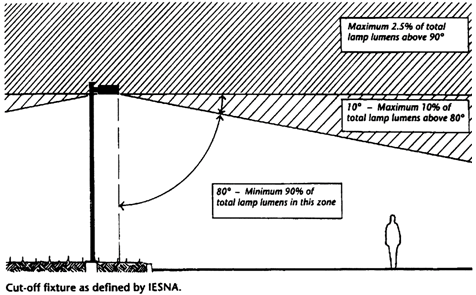
Cutoff fixture means a flat lens, full cutoff fixture that by its design, directs a minimum of 90 percent of total lamp lumens within 80 degrees of the vertical plane of the light fixture and a maximum of ten percent of the total lamp lumens above 80 degrees from the vertical plane, and no more than 2.5 percent of total lamp lumens above 90 degrees. Full cutoff fixtures must be installed in a horizontal position as designed.
___D___
Dare County Health Department means the Dare County Department of Health and Human Services.
Decision-Making Board means a governing board, planning board, board of adjustment, historic board, or other board assigned to make quasi-judicial decisions under this chapter.
Dedication means a gift to the general public or a municipality, by the owner, of the right to use land for stated purposes. Since a transfer of property is involved, a dedication must be made by written instrument.
Department means the NC Department of Environmental Quality (NCDEQ) (for the purposes of Article 11, Part II, Soil Erosion and Sedimentation Control).
Design flood see: Regulatory Flood Protection Elevation.
Design storm or design depth means a rainfall event, expressed in depth, measured in inches, for the purposes of Article 11, Part I, Stormwater, Fill & Runoff Management and independent of storm duration, utilized for the calculation of storage volume required for BMPs. Design storm depth varies by fill depth, flood zone, and use as specified in Article 11, Part I.
Designated public events site means a use as set forth in Section 6.6, Table of Uses and Activities. This use shall include a parcel or contiguous group of parcels of acreage greater than ten, owned by the public and designated by the board of commissioners, as part of the special use permit process, for the purpose of creating a variety of opportunities for recreation, leisure, social or cultural experiences and special events in accordance with the regulations of this Code. Public event sites may include temporary and fixed structures, as approved by the building inspector and/or the Fire Marshal or their designee, and can host multiple uses with an events site and management plan and permit approved by the Town Manager or their designee.
Determination means a written, final, and binding order, requirement or determination regarding an administrative decision.
Developer means a person, including a governmental agency or redevelopment authority, who undertakes any development and who is the landowner of the property to be developed or who has been authorized by the land owner to undertake development on that property.
Development means any of the following:
a.
The construction, erection, alteration, enlargement, renovation, substantial repair, movement to another site, or demolition of any structure.
b.
The excavation, grading, filling, clearing, or alteration of land.
c.
The subdivision of land as defined in G.S. 160D-802.
d.
The initiation or substantial change in the use of land or the intensity of the use of land.
This definition does not alter the scope of regulatory authority granted by this chapter.
Development activity means any activity defined as Development which will necessitate a Floodplain Development Permit. This term includes buildings, structures, and non-structural items, including (but not limited to) fill, bulkheads, piers, pools, docks, landings, ramps, and erosion control/stabilization measures.
Development Approval means an administrative or quasi-judicial approval made pursuant to this chapter that is written and that is required prior to commencing development or undertaking a specific activity, project, or development proposal. Development approvals include, but are not limited to, zoning permits, site plan approvals, special use permits (formerly conditional use permits), variances, and certificates of appropriateness. The term also includes all other regulatory approvals required by regulations adopted pursuant to this chapter, including plat approvals, permits issued, development agreements entered into, and building permits issued.
Development Regulation means a unified development ordinance, zoning regulation, subdivision regulation, erosion and sedimentation control regulation, floodplain or flood damage prevention regulation, mountain ridge protection regulation, stormwater control regulation, wireless telecommunication facility regulation, historic preservation or landmark regulation, housing code, State Building Code enforcement, or any other regulation adopted pursuant to this chapter.
Dialysis center means a building or structure or portion thereof in which persons with impaired kidney function have toxins removed from their blood on a periodic basis through the use of dialysis machines. Application of the term shall be limited to facilities staffed routinely by nurses and/or technicians and not by a doctor.
Digital Flood Insurance Rate Map (DFIRM) means the digital official map of a community, issued by the Federal Emergency Management Agency (FEMA), on which both the Special Flood Hazard Areas and the risk premium zones applicable to the community are delineated.
Director means the director of the Division of Energy, Mineral, and Land Resources of the NC Department of Environmental Quality (for the purposes of Article 11, Part II, Soil Erosion and Sedimentation Control).
Discharge point means that point at which runoff leaves a tract of land (for the purposes of Article 11, Part II, Soil Erosion and Sedimentation Control).
Dish antenna means any accessory structure capable of receiving radio or television signals from a transmitter or a transmitter relay which is located in planetary orbit or land based.
Disposal means, as defined in G.S. 130A-290(a)(6), the discharge, deposit, injection, dumping, spilling, leaking or placing of any solid waste into or on any land or water so that the solid waste or any constituent part of the solid waste may enter the environment or be emitted into the air or discharged into any waters, including groundwaters (for the purposes of Article 11, Part III, Flood Damage Prevention).
Disposal Field aka 'drain field' or 'dispersal field' means an area of ground under whose surface the overflow from a septic tank is distributed in drain tile to be absorbed in the soil.
District means the Dare Soil and Water Conservation District created pursuant to G.S. Ch. 139.
Dock, private means an estuarine pier or dock which may be permitted as an accessory use to the principal use, and shall be for the exclusive use of the landowner and shall not provide any services of a commercial marina.
Docking facility means any publicly or privately-owned dock, basin or wet storage facility constructed to accommodate mooring for four or less boats as an accessory to a principal commercial use.
Dormitory means a commercial facility used for monthly rental housing of unrelated residents in a communal non-transient living arrangement. The facility shall consist of separate sleeping, bathing, and common living areas.
Drainage area means the entire tributary area contributing surface runoff to a point of interest.
Drainfield shall also mean nitrification field or wastewater disposal area.
Drive aisle means the area of driveway necessary for vehicles to access parking stalls and for emergency vehicle access to structures.
Driveway means an improved accessway for vehicular traffic with the purpose of providing access to parking or maneuvering space from a public street or highway into an abutting property.
Driveway apron means that portion of a driveway which connects to the adjacent street or highway, usually within the right-of-way for that street.
Dry hydrant means an arrangement of pipe permanently connected to a water source other than a piped, pressurized water supply system that provides a ready means of water supply for fire-fighting purposes and that utilizes the drafting (suction) capability of the fire department pump.
Dry well means a structure or series of structures located to collect and discharge stormwater through a subterranean chamber which allows collected water to dissipate and infiltrate into the ground.
Dwelling means any building, structure, manufactured home, or mobile home, or part thereof, used and occupied for human habitation or intended to be so used, and includes any outhouses and appurtenances belonging thereto or usually enjoyed therewith. The term does not include any manufactured home, mobile home, or recreational vehicle, if used solely for a seasonal vacation purpose.
Dwelling, accessory means a secondary dwelling unit established in conjunction with, and clearly subordinate to, a principal dwelling unit, whether part of the same structure as the principal dwelling unit or as a detached structure on the same lot.
Dwelling, large residential means a single-family dwelling or two-family dwelling (duplex) that has 3,500 or more square feet of enclosed habitable living space.
Dwelling, Multi-Family or Dwelling Unit, Multi-Family means a single-family dwelling unit located within a multi-family development.
Dwelling, single-family means a dwelling containing one dwelling unit, designed for or occupied exclusively by one family.
Dwelling, two-family, also referred to as a duplex, means a dwelling containing two dwelling units, designed for or occupied by two families, each of which has direct access to the outside.
Dwelling unit means a single unit providing complete, independent living facilities for one or more persons, including permanent provisions for living, sleeping, eating, cooking and sanitation.
___E___
Earth station see: Dish Antenna.
Easement means a grant by the property owner for use, by the public, a corporation or person, of a strip of land for specified purposes.
Easement, access means an easement created for the purpose of providing vehicular or pedestrian access to property.
Educational facility, pre-school means a facility for the organized instruction of children not yet attending primary or secondary school.
Electric vehicle means any vehicle that operates, either partially or exclusively, on electrical energy from the grid, or an off-board source, that is stored on-board for energy purposes. Electric vehicle includes: (1) a battery powered electric vehicle; and (2) a plug-in hybrid electric vehicle.
Electric vehicle battery exchange station means a facility that provides through labor or automation the exchange and replacement of depleted batteries in electric vehicles with a fully charged battery which meets or exceeds federal, state, and/or local requirements. Such stations may be provided as a service or accessory to an automobile repair use; such stations are not permitted as a principal use.
Electric vehicle charging station means an electrical component assembly or cluster of component assemblies designed to charge batteries within electric vehicles and which meet or exceed federal, state, and/or local requirements. Such stations may be privately available or available to the generally public depending upon the use to which they are accessory; stations are not permitted as a principal use.
Electroluminescent means direct conversion of electric energy to light by a solid phosphor, or other materials, subjected to an electrical current.
Elevated building means a non-basement building which has its lowest elevated floor raised above ground level by foundation walls, shear walls, posts, piers, pilings, or columns (for the purpose of Article 11, Part III, Flood Damage Prevention).
Elevation means:
(1)
A vertical distance above or below mean sea level;
(2)
A fully dimensioned drawing to the front, rear, or side of a structure showing features and their relationship to grade, sea-level, or other reference point.
Eligible facilities request means a request for modification of an existing wireless tower or a base station that involves collocation of new transmission equipment or replacement of transmission equipment but does not include a substantial modification.
Enclosure/Enclosed Area means that portion of an elevated building below the lowest elevated floor that is either partially or fully shut in by rigid/solid walls and is located either partially or fully below the RFPE.
Encroachment means the advance or infringement of uses, fill, excavation, buildings, permanent structures or development into a floodplain, which may impede or alter the flow capacity of a floodplain (for the purpose of Article 11, Part III, Flood Damage Prevention).
Encroachment means the location of a structure within a required yard that is not permissible under the requirements of this UDO. Article 8, District Development Standards, contains the minimum yard requirements for the Town's primary and special zoning districts.
Energy dissipater means a structure or a shaped channel section with mechanical armoring placed at the outlet of pipes or conduits to receive and break down the energy from high velocity flow (for the purposes of Article 11, Part II, Soil Erosion and Sedimentation Control).
Engineer means a professional engineer registered in the state to act as duly authorized representative of the developer or the Town.
Environmental awareness area is an area designated and maintained for the purpose of conservation and environmental education. This may include non-profit wildlife, ecological preserves, watershed construction areas, interpretive signage, trails, research stations and appurtenant office, restroom and mechanical facilities (and is distinct from the definition of "area of environmental concern" or "AEC," which is a CAMA designation).
Equipment compound means an area surrounding or near the base of wireless support structure within which a wireless facility is located.
Erosion means the wearing away of land surface by the action of wind, water, gravity or any combination thereof (for the purposes of Article 11, Part II, Soil Erosion and Sedimentation Control).
Erosion escarpment means the normal vertical drop in the beach profile caused from high tide and/or storm tide erosion.
Erosion, natural means the wearing away of the earth's surface by water, wind or other natural agents under natural environmental conditions undisturbed by man (for the purposes of Article 11, Part II, Soil Erosion and Sedimentation Control).
Estuarine frontal dunes means the dunes which are the first mounds of sand located landward of the estuarine waters of the Roanoke Sound and having a minimum elevation equal to or greater than the mean flood level plus six feet (nine feet plus six feet). For the purpose of this article, estuarine frontal dunes occur in the area southerly of the northwest boundary of Parcel 13, Tax Map 185, as shown on Tax Maps 185 and 186. The estuarine frontal dunes extend southward and terminate at the southwest boundary of the SED-80 district.
Evidentiary Hearing means a hearing to gather competent, material, and substantial evidence in order to make findings for a quasi-judicial decision required by a development regulation adopted under this chapter.
Existing building and existing structure means any building and/or structure for which the "start of construction" commenced before the community entered the NFIP, dated November 10, 1972.
Existing manufactured home park or manufactured home subdivision means a manufactured home park or subdivision for which the construction of facilities for servicing the lots on which the manufactured homes are to be affixed (including, at a minimum, the installation of utilities, either final site grading or the pouring of concrete pads, and the construction of streets) was completed before February 3, 1975 (for the purposes of Article 11, Part III, Flood Damage Prevention).
Ex parte is a Latin legal term meaning "from (by or for) [the/a] party." An ex parte decision is one decided by a judge without requiring all of the parties to the controversy to be present.
___F___
Fall zone means the area in which a wireless support structure may be expected to fall in the event of a structural failure, as measured by engineering standards.
Family means any group of people operating as a single housekeeping unit occupying a dwelling unit.
Family care home means a home with support and supervisory personnel that provides room and board, personal care and habilitation services in a family environment for not more than six resident persons with disabilities. "Person with disabilities" means a person with a temporary or permanent physical, emotional, or mental disability, including but not limited to mental retardation, cerebral palsy, epilepsy, autism, hearing and sight impairments, emotional disturbances and orthopedic impairments but not including mentally ill persons who are dangerous to others as defined in G.S. 122C-3(11)b.
Family foster home means the private residence of one or more individuals who permanently reside as members of the household and who provide continuing full-time foster care for a child or children who are placed there by a child placing agency or who provide continuing full-time foster care for two or more children who are unrelated to the adult members of the household by blood, marriage, guardianship, or adoption.
Farm stand means a temporary open-air stand or place for the seasonal selling of agricultural produce. A produce stand is portable and capable of being dismantled or removed from the sales site.
Farmers Market, Municipally-Operated means a municipally operated, seasonal market that is open to the public and held on Town property where individuals offer for sale locally produced and/or acquired items such as seasonal fresh produce, fruits, flowers, dairy, meats, prepared foods, seafood, beverages, farm products, arts and crafts, and wares, which are dispensed from booths located on-site. Other secondary activities could include, but are not limited to, art shows, live music, educational and learning activities, kids programming, and other municipally organized events and activities.
Fence means any artificially constructed barrier of any material or combination of materials erected to enclose or screen areas of land.
Fill is the depositing of soil, rock, or other earthen materials by artificial means, but not including poured slab, asphalt, porous pavement, Turfstone™, or other manmade materials or surfaces designed in association with construction. Excavated material moved or relocated onsite is not considered fill for the purposes of determining fill height.
Fill height is the difference between the post-development surface elevation and the pre-development surface elevation.
Fine craft and folk art production means a variety of crafts and arts rooted in community and cultural traditions that generally expresses and encompasses a range of utilitarian and decorative media including cloth, wood, paper, clay, metal and more. The term does not include Artisan's Workshop as defined herein.
Flag pole means a pole with a pulley and a cord on which a flag or flag sign is raised and flown.
Flood or flooding means a general and temporary condition of partial or complete inundation of normally dry land areas from:
(1)
The overflow of inland or tidal waters; or
(2)
The unusual and rapid accumulation of runoff or surface waters from any source.
Flood Boundary or Floodway Map (FBFM) means an official map of a community, issued by the FEMA, on which the Special Flood Hazard Areas and the floodways are delineated. This official map is a supplement to and shall be used in conjunction with the Flood Insurance Rate Map (FIRM).
Flood Hazard Boundary Map (FHBM) means an official map of a community, issued by the FEMA, where the boundaries of the Special Flood Hazard Areas have been defined as Zone A.
Flood insurance means the insurance coverage provided under the National Flood Insurance Program.
Flood Insurance Rate Map (FIRM) means an official map of a community issued by the Federal Emergency Management Agency on which both the special flood hazard areas and the risk premium zones applicable to the community are delineated (also see DFRIM).
Flood Insurance Study (FIS) means an examination, evaluation, and determination of flood hazards, corresponding water surface elevations (if appropriate), flood hazard risk zones, and other flood data in a community issued by the Federal Emergency Management Agency. The flood insurance study report includes Flood Insurance Rate Maps (FIRM's) and Flood Boundary and Floodway Maps (FBFMs), if published.
Flood zone means a geographical area shown on a Flood Hazard Boundary Map or Flood Insurance Rate Map that reflects the severity or type of flooding in the area.
Floodlight means a light fixture usually capable of being pointed in any direction that is designed to project a light beam to an object or surface area to a luminance considerably greater than its surroundings.
Floodplain means any land susceptible to being inundated by water from any source.
Floodplain administrator is the individual appointed to administer and enforce the floodplain management regulations.
Floodplain development permit means any type of permit that is required in conformance with the provisions of this UDO, prior to the commencement of any development activity.
Floodplain management means the operation of an overall program of corrective and preventative measures for reducing flood damage and preserving and enhancing, where possible, natural resources in the floodplain, including, but not limited to, emergency preparedness plans, flood control works, floodplain management regulations, and open space plans.
Floodplain management regulations means Article 11, Part III of this UDO and other zoning ordinances, subdivision regulations, building codes, health regulations, special purpose ordinances, and other applications of police power which control development in flood-prone areas. This term describes federal, state or local regulations, in any combinations thereof, which provide standards for preventing and reducing flood loss and damage.
Flood-prone area see: Floodplain.
Floodproofing means any combination of structural and nonstructural additions, changes, or adjustments to structures, which reduce or eliminate flood damage to real estate or improved real property, water and sanitation facilities, structures, and their contents.
Flood-resistant material means any building product [material, component or system] capable of withstanding direct and prolonged contact (minimum 72 hours) with floodwaters without sustaining damage that requires more than low-cost cosmetic repair. Any material that is water-soluble or is not resistant to alkali or acid in water, including normal adhesives for above-grade use, is not flood-resistant. Pressure-treated lumber or naturally decay-resistant lumbers are acceptable flooring materials. Sheet-type flooring coverings that restrict evaporation from below and materials that are impervious, but dimensionally unstable are not acceptable. Materials that absorb or retain water excessively after submergence are not flood-resistant. Please refer to Technical Bulletin 2, Flood Damage-Resistant Materials Requirements, and available from the FEMA. Class 4 and 5 materials, referenced therein, are acceptable flood-resistant materials.
Floodway means the channel of a river or other watercourse, including the area above a bridge or culvert when applicable, and the adjacent land areas that must be reserved in order to discharge the base flood without cumulatively increasing the water surface elevation more than one (1) foot.
Floodway encroachment analysis means an engineering analysis of the impact that a proposed encroachment into a floodway or non-encroachment area is expected to have on the floodway boundaries and flood levels during the occurrence of the base flood discharge. The evaluation shall be prepared by a qualified North Carolina licensed engineer using standard engineering methods and hydraulic models meeting the minimum requirement of the National Flood Insurance Program.
Floor Area Ratio (FAR) means the quotient resulting from division of the gross floor area of all buildings on a lot by the area of the lot.
Flyboard means a type of jetpack which supplies propulsion to drive the flyboard through water, the rider typically stands on a board connected by a long hose to a watercraft.
Food bank means a building or portion of a building from which foodstuffs are distributed to indigent individuals or families.
Food truck means a licensed vehicle or trailer equipped with facilities for cooking and selling food which satisfies local and state regulations for health and sanitation standards.
Footcandle means the unit of measure of illuminance on a surface. Footcandles are the ratio of the quantity of light in lumens divided by the surface area in square feet on which the lumens are falling. One lumen per square foot is one footcandle.
Forest canopy means (collectively) the light-intercepting layer formed by all of the tree tops and ultimate leaf bearing branches in a forest; the uppermost layer of vegetation in a forest. In the Nags Head Woods, the forest canopy may be kept to near constant height by the pruning effect of salt mist nearer the ocean or it may become irregular in height where salt impact is less.
Forest sub-canopy means a light-intercepting understory layer formed by shade-tolerant saplings, shrubs and small trees beneath the canopy of a forest. The Nags Head Woods sub-canopy species include dogwood, muscle wood, hop hornbeam and holly.
Free of obstruction means a space below the lowest floor of an elevated structure, located in a coastal high hazard area or VE-zone, that must be open and designed to be free and clear to allow floodwaters to flow freely beneath the structure. The space below the lowest floor that is unobstructed shall be a minimum vertical distance of 18 inches measured from the bottom of the lowest horizontal structural member of the lowest floor to the highest finished grade directly beneath the structure. Breakaway walls cannot be utilized to meet the free of obstruction requirement.
Freeboard means the height added to the BFE to account for the many unknown factors that could contribute to flood heights greater than the height calculated for a selected size flood and floodway conditions, such as wave action, blockage of bridge or culvert openings, storm surge or precipitation exceeding the base flood and the hydrological effects of urbanization on the watershed. The base flood elevation plus the freeboard establishes the "regulatory flood protection elevation."
Frontal dune means, in areas where there is a primary dune, that dune shall be deemed to be the frontal dune. Where there is no primary dune, the frontal dune is deemed to be the first mound of sand located landward of the ocean beach having sufficient vegetation, height, continuity and configuration to offer protective value. Manmade mounds seaward of the natural line of frontal dunes and dunes created after June 1, 1979, shall not be considered to be frontal or primary dunes, except where no frontal or primary dune exists.
Fueling Station means retail place of business operated for the purpose of storing and dispensing motor vehicle fuel to the general public.
Fully shielded means a light fixture that is constructed or sufficiently shielded by an opaque housing, in such a manner that all light emitted is below the horizontal plane as determined by photometric test or certified by the manufacturer.
Functionally dependent facility means a facility which cannot be used for its intended purpose unless it is located or carried out in close proximity to water, such as a docking or port facility necessary for the loading and unloading of cargo or passengers, shipbuilding, or ship repair. The term does not include long-term storage, manufacture, sales or service facilities (for the purposes of Article 11, Part III, Flood Damage Prevention).
Furniture showroom means a retail establishment that utilizes large, open floor areas to display furniture or mattresses.
Furniture store means an establishment that sells goods and/or movable objects, intended to support various human activities such as seating, eating, and sleeping, for furnishing or improving housing units that make a room or other area ready for occupancy.
___G___
General contractor's office means a building or portion of a building occupied as an office by a "general contractor" as defined in G.S. 87-1.
Glare means the sensation produced by luminance within the visual field that is significantly greater than the luminance to which the eyes are adapted, causing annoyance, discomfort, or loss of visual performance. It results from high luminance or insufficiently shielded light sources in the field of view or from reflecting areas of high luminance. There are two types:
(1)
Disability glare affects visual performance and reduces the ability to see or identify objects. It is often accompanied by discomfort.
(2)
Discomfort glare produces discomfort but does not necessarily interfere with visual performance or visibility.
Governing Board means the Board of Commissioners shall be known as the governing board for the Town of Nags Head.
Grade means the average elevation of the land around a building as measured at the four corners of the structure or at four points around the building distributed evenly, or as the natural elevation of land within a property measured in feet above sea level.
Grading means any cut or fill, or combination thereof, or re-compaction of soil, rock or other earthen materials.
Granny pods/temporary health care structure means a transportable residential structure, providing an environment facilitating a caregiver's provision of care for a mentally or physically impaired person, that: (i) is primarily assembled at a location other than its site of installation; (ii) is limited to one occupant who shall be the mentally or physically impaired person, (iii) has no more than 300 gross square feet; and (iv) complies with applicable provisions of the State Building Code and G.S. 143-139.1.
Grantee means a person who is granted a franchise or that person's lawful successors, transferees or assigns.
Grantor means the Town of Nags Head.
Gravel means a clean or washed, loose aggregation of well-rounded spherical stones, commonly referred to as pea gravel or river rock, that are up to three inches in diameter where 50 percent is larger than ¼-inch with less than five percent fines. Gravel is not crushed stone or rock.
Grocery Store means a retail store that specializes in selling food, both fresh and prepackaged. A grocery store sells items such as fresh produce, meats, dairy, and often times bakery goods alongside canned, frozen and prepared foods. In addition, a grocery store will sell a full range of household, healthcare, and personal care items.
Gross floor area means that area in square feet measured from the outside walls of a structure.
Ground cover means any natural vegetative growth or other material which renders the soil surface stable against accelerated erosion (for the purposes of Article 11, Part II, Soil Erosion and Sedimentation Control).
Groundwater recharge area means a catchment basin or watershed underlain by layers of alternating permeable and impermeable strata such that excess rainfall not lost by evapotranspiration or runoff is retained and stored in subterranean porous layers of soil. Nags Head Woods acts as a groundwater recharge area since porous sandy soils permit little runoff of excess precipitation. For the purposes of this UDO, components of this system include ponds, wetland swales, bay forests, dunes and marsh.
Group demonstration means any assembly or concert of action between or among any two or more persons for the purpose of protesting or demonstrating for or against any matter, or of making known any position or promotion of such persons or matter, or of or on behalf of any organization, group, corporation or class of persons, or for the purpose of attracting attention to such assembly.
Group development means a group of buildings on a single site which are occupied and used for professional offices, retail, personal services, indoor recreation facilities, and/or restaurant uses.
___H___
Habitable building area means a finished space in an enclosed portion of the building used for any purpose other than storage.
Habitable floors means any floor usable for living purposes, which includes working, sleeping, eating, cooking, or recreation or a combination thereof, except for a floor used only for storage purposes.
Haunted house means an indoor entertainment facility utilizing sets, props, and displays for a family-oriented environment.
Hazardous waste management facility means, as defined in G.S. 130, Article 9, a facility for the collection, storage, processing, treatment, recycling, recovery, or disposal of hazardous waste (for the purposes of Article 11, Part III, Flood Damage Prevention).
Height means the vertical distance measured from the tallest part of a building to the ground at the base of the building. Typically, height is measured from the tallest portion of the roof to the top of the concrete slab. In cases where a concrete slab is not present, height is measured from the tallest part of the roof to the average finished grade using the corners at the base of the building.
•
In Shaded X, X, or AE special flood hazard area west of NC 12 and SR 1243, as defined in 11.42.3.1.2, height will be measured from the regulatory flood protection elevation or finished grade, whichever is higher. In cases where there is a ground floor enclosure below the regulatory flood protection elevation, height shall be measured from finished grade.
•
In coastal high hazard areas and VE zones east of NC 12 and SR 1243 as defined in 11.42.3.1.1., height shall be measured from regulatory flood protection elevation (lowest horizontal structural member). In cases where the finished grade elevation is above the regulatory flood protection elevation, height shall be measured at approximately eighteen (18) inches above the highest, undisturbed, finished grade directly beneath the structure (free-of-obstruction).
Height, wind energy facility means the distance measured from grade at the center of the tower to the highest point of the turbine rotor or tip of the turbine blade when it reaches its highest elevation.
Heliport means an area providing for the takeoff and landing of helicopters and fuel facilities (whether fixed or mobile) or appurtenant areas for parking, maintenance, and repair of helicopters.
High hazard flood area means the area subject to high velocity waters (including, but not limited to, hurricane wave wash) in a storm having a one percent chance of being equaled or exceeded in any given year, as identified as zone V1-30 on the flood insurance rate maps of the Federal Insurance Administration, US Department of Housing and Urban Development. In the absence of these rate maps, other available base flood elevation data prepared by a federal, state or other source may be used, provided that such data source is approved by the Town.
High quality water (HQW) zones means for the coastal counties areas within 575 feet of high quality waters and for the remainder of the state are areas within one mile and drain to HQW's (for the purposes of Article 11, Part II, Soil Erosion and Sedimentation Control).
High quality waters means those classified as such in 15A NCAC 2B.0101(e)(5) - General Procedures, which is incorporated in this section by reference to include further amendments pursuant to G.S. 150B-14(c) (for the purposes of Article 11, Part II, Soil Erosion and Sedimentation Control).
Highest adjacent grade (HAG) means the highest natural elevation of the ground surface, prior to construction, immediately next to the proposed walls of the structure.
Historic structure means any structure that is:
(1)
Listed individually in the National Register of Historic Places (a listing by the US Department of the Interior) or preliminarily determined by the Secretary of the Interior as meeting the requirements for individual listing on the National Register;
(2)
Certified or preliminarily determined by the Secretary of the Interior as contributing to the historical significance of a registered historic district or a district preliminarily determined by the Secretary to qualify as a registered historic district; or
(3)
Individually listed on a local inventory of historic landmarks in communities with a "certified local government (CLG) program"; or
(4)
Certified as contributing to the historical significance of a historic district designated by a community with a "certified local government program."
Certified local government (CLG) programs are approved by the US Department of the Interior in cooperation with the North Carolina Department of Cultural Resources through the state historical preservation officer as having met the requirements of the National Historic Preservation Act of 1966 as amended in 1980.
Home center means a retail outlet carrying products for home improvements, remodeling maintenance, decorating, home care, recreational leisure and related needs, including hardware, appliances, lumber and other building materials, but only in such amounts as will meet the need for self-pickup individuals, do-it-yourself customers, and not amounting to a lumber yard or building material storage yard from which deliveries are made to commercial customers.
Home occupation, class 1 means a professional services occupation commonly carried on within the dwelling by a member(s) of the household who occupy the dwelling. A home occupation shall be secondary to the use of the dwelling for living purposes.
Home occupation, class 2 means a professional service occupation that is limited to services without any on-site/wholesale sales of commodities owned and/or operated by member(s) of the household who occupy the dwelling. These services may include real estate sales, law practice, accounting services, handmade goods, including baked goods (as long as they are sold off-site), and other similar professional occupations. A home occupation shall be secondary to the use of the dwelling for living purposes.
Home occupation, class 3 means an occupation carried on within the dwelling owned and/or operated by member(s) of the household who occupy the dwelling that may involve the creation, display, or sale of artistic wares, crafts, pieces of art, sculptures, or other creations, and handmade goods (including baked goods). A home occupation shall be secondary to the use of the dwelling for living purposes.
Hospital means an institution providing physical services primarily for human inpatient medical or surgical care for the sick or injured. A hospital may include related facilities such as laboratories, outpatient services, training facilities, central service facilities, mental health and staff offices. A hospital shall include an on-site heliport.
Hotel means a structure containing hotel units, hotel suites, and or efficiency units with 24-hour, on-site management and intended for transient guests on a rental basis.
Hotel efficiency unit means a lodging unit having living and cooking facilities and also meeting the following requirements:
(1)
Efficiency units shall be limited to one bedroom.
(2)
The kitchen area shall comprise no more than ten percent of the entire unit.
Hotel suite means lodging unit having living and cooking facilities within a hotel and also meeting the following requirements:
(1)
Units shall be limited to two bedrooms.
(2)
The kitchen area shall comprise no more than ten percent of the entire unit.
Hotel unit means a lodging unit which does not contain independent cooking facilities and is designed and intended for transient guests on a rental basis. This definition shall include rental units customarily found in motels, hotels, inns and motor lodges.
Housekeeping unit means any household whose members are an interactive group of persons jointly occupying a dwelling unit, including joint access to and use of all common areas including living, kitchen, and eating areas within the dwelling unit, and sharing household activities and responsibilities such as meals, chores, expenses and maintenance, and whose makeup is determined by the members of the unit rather than by the landlord, property manager, or other third party.
___I___
Impacts of stormwater means impacts associated with inadequate storage, conveyance, or ponding of stormwater runoff, including erosion, intermittent flooding, or chronic flooding.
Impervious surface means any surface which, because of its material composition or compacted nature, impedes or prevents natural infiltration of stormwater into the soil.
Improvements are all changes or additions made on or to the land, excluding buildings and structures and including, but not limited to:
(1)
Street and roads and related curbing;
(2)
Sidewalks;
(3)
Storm drains and mains;
(4)
Water lines, water mains and fire hydrants;
(5)
Sewer lines and sewer mains;
(6)
Any sewerage treatment facility of any kind except one-family or two-family residence septic tanks;
(7)
Surface and subsurface electric and telephone and cable television lines and conduits;
(8)
Recreational facilities, except recreational facilities intended for use by an individual for his own private purposes which include, but are not limited to:
a.
Playgrounds;
b.
Parks;
c.
Marinas;
d.
Beaches and swimming pools;
e.
Golf courses;
(9)
Street lighting and related electric wires;
(10)
Natural gas lines;
(11)
Parking lots.
Incipient inlet means an ocean-to-sound inlet which has been formed, or an inlet in the first stages of formation, or an inlet which has opened and is now closed, as a result of a severe storm event.
Incipient inlet high hazard area means that land area on both sides of an inlet, an incipient inlet, or former inlet which has closed.
Indoor entertainment means performances, entertainment, or presentations consisting of or using electric or electronic amplified sound by live entertainers, or by prerecorded media, presented before audiences or customers. Sexually oriented business activities and adult live entertainment are specifically excluded from this indoor entertainment definition.
Indoor entertainment facilities means facilities as a part of, or included in the design or plan of, a building or structure to accommodate indoor entertainment as a principal or accessory use. Indoor entertainment facilities must be constructed to meet noise buffering requirements of the zoning district where located.
Indoor fitness center means a building which is occupied and used exclusively for physical health fitness programs and to provide facilities for group and individual exercise including aerobics, weightlifting, martial arts, stretching and meditation.
Indoor place of amusement and entertainment means any place of amusement and entertainment which operates indoors within a building which is completely walled on all sides and has a complete roof; except, a tent or temporary structure or building.
Indoor public assembly facility means a facility designated for multiple activities. The allowed activities may include conferences, conventions, concerts, private parties, catered meals, and general retail in the form of craft fairs, food fairs and indoor flea markets.
Indoor recreation activities means family indoor recreation uses either as a principal or accessory use.
Inn see: Hotel.
ISO footcandle diagram means lines plotted on a set of coordinates to show all points on a surface where equal levels of illuminance occur.
___J___
Jetpack means a device, usually worn on the back, which is propelled by jets of escaping gases or liquids to allow a single user to propel themselves in the air.
Junk means old or scrap metals, rope, rags, batteries, paper, trash, rubber or debris. Junked, dismantled or wrecked motor vehicles or parts thereof and iron, steel and other old or scrap ferrous or nonferrous material are also junk. The term junk shall also include old or salvaged building materials, appliances, dismantled or wrecked boats, machinery and machinery parts, or parts thereof, and any item which is either in a wholly or partially rusted, wrecked, dismantled or inoperative condition.
Junked motor vehicle means, as authorized and defined in G.S. 160A-303.2, a vehicle that does not display a current license plate upon that vehicle and that:
(1)
Is partially dismantled or wrecked;
(2)
Cannot be self-propelled or moved in the manner in which it originally was intended to move; or
(3)
Is more than five years old and appears to be worth less than $100.00.
Junkyard means an open storage area such as an automobile wrecking yard, building material salvage yard, scrap metal processing yard or any lot, land or structure or part thereof where an area of 600 square feet or larger is used for storing, keeping, buying, processing or selling junk. In addition, any open storage area on which three vehicles without proper, current license plates are located shall be considered a junkyard.
___K___
Reserved.
___L___
Lake or natural watercourse means any stream, river, brook, swamp, sound, bay, creek, run, branch, canal, waterway or estuary and any reservoir, lake or pond, natural or impounded, in which sediment may be moved or carried in suspension, and which could be damaged by accumulation of sediment (for the purposes of Article 11, Environmental Regulations, Part II, Soil Erosion and Sedimentation Control).
Lamp means a bulb, tube, or light emitting diode (LED) that is a light source.
Land development regulations means any ordinance enacted pursuant to Part 3E of Article 19 of Chapter 160A of the North Carolina General Statutes (G.S. 160A-19-3E).
Land-disturbing activity means any use of the land by any person in residential, industrial, educational, institutional or commercial development, highway and road construction and maintenance that results in a change in the natural cover or topography and that may cause or contribute to sedimentation, excluding disturbance allowable for site investigations (for the purposes of Article 11, Part II, Soil Erosion and Sedimentation Control).
Landowner means the holder of the title in fee simple. Absent evidence to the contrary, the town may rely on the county tax records to determine who is a landowner. The landowner may authorize a person holding a valid option, lease, or contract to purchase to act as his or her agent or representative for the purpose of making applications for development approvals.
Large Multi-Family Development means a development containing more than six multi-family dwelling units.
Legislative Decision means the adoption, amendment, or repeal of a regulation under this chapter. The term also includes the decision to approve, amend, or rescind a development agreement consistent with the provisions of GS 160D, Article 10.
Legislative Hearing means a hearing to solicit public comment on a proposed legislative decision.
Letter of Map Change (LOMC) means an official determination issued by FEMA that amends or revises an effective Flood Insurance Rate Map or Flood Insurance Study. Letters of Map Change include:
(1)
Letter of Map Amendment (LOMA) means an official amendment, by letter, to an effective National Flood Insurance Program map. A LOMA is based on technical data showing that a property had been inadvertently mapped as being in the floodplain but is actually on natural high ground above the base flood elevation. A LOMA amends the current effective Flood Insurance Rate Map and establishes that a specific property, portion of a property, or structure is not located in a special flood hazard area.
(2)
Letter of Map Revision (LOMR) means a revision based on technical data that may show changes to flood zones, flood elevations, special flood hazard area boundaries and floodway delineations, and other planimetric features.
(3)
Letter of Map Revision Based on Fill (LOMR-F) means a determination that a structure or parcel of land has been elevated by fill above the BFE and is, therefore, no longer located within the special flood hazard area. In order to qualify for this determination, the fill must have been permitted and placed in accordance with the community's floodplain management regulations.
(4)
Conditional Letter of Map Revision (CLOMR) means a formal review and comment as to whether a proposed project complies with the minimum NFIP requirements for such projects with respect to delineation of special flood hazard areas. A CLOMR does not revise the effective Flood Insurance Rate Map or Flood Insurance Study; upon submission and approval of certified as-built documentation, a Letter of Map Revision may be issued by FEMA to revise the effective FIRM.
Light duty truck means any motor vehicle rated at 8,500 pounds Gross Vehicular Weight Rating or less which has a vehicular curb weight of 6,000 pounds or less and which has a basic vehicle frontal area of 45 square feet or less as defined in 40 CFR 86.082-2 and is:
(1)
Designed primarily for purposes of transportation of property or is a derivation of such a vehicle; or
(2)
Designed primarily for transportation of persons and has a capacity of more than 12 persons; or
(3)
Available with special features enabling off-street or off-highway operation and use.
Light fixture means any electrically powered illuminating device, reflective surface, lamp or any similar device, permanently installed or portable, used for illumination or advertisement, including illuminated signs.
Limit of Moderate Wave Action (LiMWA) means the boundary line given by FEMA on coastal map studies marking the extents of Coastal A Zones (CAZ).
Loading and unloading area means any space or area used by any moving vehicle for the purpose of receiving, shipping and transporting goods, wares, commodities and persons.
Local damage assessment team means a damage assessment team, required by the state division of emergency management, whose function is to assess losses to property immediately after a storm. The assessment is used to determine if the area can qualify for federal or state disaster assistance.
Local Elevation Standard means a locally adopted elevation level used as the Regulatory Flood Protection Elevation (RFPE) to mitigate flood hazards in the Shaded X, X, AE, AO, VE, as depicted on the FIRMs for Nags Head. These areas may be vulnerable to flooding from storm surge, wind-driven tides, and excessive rainfall. Many of these areas have repetitively flooded and continue to remain at risk to flooding.
Local government means any county, incorporated village, town or city, or any combination of counties, incorporated villages, towns and cities, acting through a joint program pursuant to the provisions of the Act (for the purposes of Article 11, Part II, Soil Erosion and Sedimentation Control).
Long-term occupancy/tenancy means the occupancy of a single-family dwelling by an owner, tenant, or other lawful occupant for a period of ninety (90) consecutive calendar days or more.
Lot means a portion of a subdivision or any other parcel of land which is subject to this UDO, intended as a unit for transfer of ownership, for development or for both. The term "lot" includes the terms "plot," "parcel" or "tract."
Lot area means the total horizontal area included within lot lines.
Lot balancing is the act of grading a site utilizing existing on-site material for purposes such as providing a level building pad or vehicular areas. Lot balancing does not include the importation of fill.
Lot, corner means a lot abutting upon two streets at their intersection, provided that the interior angle at the intersection of two such streets is less than 135 degrees.
Lot coverage means that portion of the lot area, expressed as a percentage, that is covered or occupied by impervious surfaces or structures. For the purposes of determining lot coverage, the following features shall be considered impervious: any principal or accessory use or structure located above the ground including decks; parking areas; vehicular use areas; roadways; access ways; and sidewalks or walkways that prevent the infiltration of rainwater. Lot coverage is utilized to determine zoning compliance and is distinct from the amount of built upon area used in stormwater management calculations.
Lot depth means the average distance from the front lot line to the rear lot line measured in a general direction with the side lot lines of a lot.
Lot lines means the lines bounding a lot:
(1)
Lot line, front means the line separating a lot from the right-of-way of the street which is designated by the owner as the front street, except that where there is an access easement, that easement line shall be the front lot line, rather than the street itself.
(2)
Lot line, rear means the lot boundary opposite and most distant from the front lot line. In the case of a pointed or irregular lot, it shall be an imaginary line parallel to and farthest from the front lot line, not less than 30 feet long and wholly within the lot.
(3)
Lot line, side means a side lot line is any lot boundary line not a front lot line or rear lot line.
Lot of record means a lot which is part of a subdivision or a lot or parcel described by metes and bounds which has been legally created and recorded in the office of the Dare County Register of Deeds.
Lot width means the width of a lot at the required building setback line measured at right angles to its depth. However, within the SED-80 district, the required lot width shall be measured at the actual building line.
Low impact development is a stormwater management design framework aimed at minimizing the negative impacts of stormwater runoff by mimicking pre-development hydrology.
Low impact development solutions to reduce stormwater runoff, or the Town BMP manual means the local reference guide designed to provide information for low impact development practices and which can be utilized to assist with compliance for residential projects using two feet or less of fill under Article 11, Part I, Stormwater, Fill & Runoff Management. All references herein to the Town BMP manual or "Low Impact Development Solutions to Reduce Stormwater Runoff," are to the latest edition or revision.
Lowest adjacent grade (LAG) means the elevation of the ground, sidewalk or patio slab immediately next to the building, or deck support, after completion of the building.
Lowest floor means the lowest floor of the lowest enclosed area (including the basement). An unfinished or flood-resistant enclosure, usable solely for parking of vehicles, building access, or limited storage in an area other than a basement area is not considered a building's lowest floor, provided that such enclosure is not built so as to render the structure in violation of the applicable non-elevation design requirements of Article 11, Part III, Flood Damage Prevention.
Lowest horizontal structural member means the lowest beam, joist, or other horizontal member that supports the building.
Lumen means the unit of measure of the quantity of light emitted by a light source, irrespective of direction.
Luminescent means any surface that is illuminated through the use of phosphorescent or luminescent paint or material.
___M___
Maids' quarters means an attached or detached individual dwelling unit identified as being an historic structure and listed individually in the National Register of Historic Places, a listing by the US Department of the Interior, or has preliminary been determined by the Secretary of the Interior as meeting the requirements for individual listing on the National Register.
Maintained footcandles means footcandles (minimum, maximum, or average) that are calculated with an adjustment for a maintenance factor that includes dirt buildup, lamp lumen depreciation, ballast factor, etc. The system is in effect over designed initially and then over time allowed to reach a maintained footcandle level.
Major damaged structure means a structure that can be made habitable with extensive repairs. Damage may include foundation, roof structure, and major structural components. The indicator for this category is if the cost to repair is greater than ten percent and less than 50 percent of the replacement cost at the time of damage.
Manufactured home means a structure as defined in NCGS 143-145(7).
Map Repository means the location of the official flood hazard data to be applied for floodplain management. It is a central location in which flood data is stored and managed; in North Carolina, FEMA has recognized that the application of digital flood hazard data products carries the same authority as hard copy products. Therefore, the NCEM's Floodplain Mapping Program websites house current and historical flood hazard data. For effective flood hazard data, the NC FRIS website (http://FRIS.NC.GOV/FRIS) is the map repository, and for historical flood hazard data the FloodNC website (http://FLOODNC.GOV/NCFLOOD) is the map repository.
Market value means the building value, not including the land value and that of any accessory structures or other improvements on the lot. Market value may be established by independent appraisal prepared by a certified professional appraiser; replacement cost depreciated for age of building and quality of construction (Actual Cash Value); or adjusted tax assessed values.
Marshlands means those lands, bordering on bodies of water, which are periodically subject to overflow by such bodies of water, and which lands are usually soft and wet and covered with or support the growth of "marsh grass," even though at times they may be solid, dry and firm.
Massage and bodywork therapist means a person licensed by the NC Massage and Bodywork Therapy Board and conducting massage and bodywork therapy.
Massage and bodywork therapy means systems of activity applied to the soft tissues of the human body for therapeutic, educational, or relaxation purposes. The application may include:
(1)
Pressure, friction, stroking, rocking, kneading, percussion, or passive or active stretching within the normal anatomical range of movement.
(2)
Complementary methods, including the external application of water, heat, cold, lubricants, and other topical preparations.
(3)
The use of mechanical devices that mimic or enhance actions that may possibly be done by the hands.
Massage and bodywork therapy establishment means any duly licensed site or premises in which massage and bodywork therapy is practiced. This term does not include any of the following:
(1)
On-site massage performed at the location of the customer.
(2)
Stand-alone devices, such as chairs, that are operated by the customer.
(3)
Establishments located within the confines of a hospital, nursing home, or other similar establishment or facility licensed or otherwise regulated by the NC Department of Health and Human Services.
(4)
Massage and bodywork therapy provided by a sole practitioner.
(5)
A student clinic operated by a Board-approved school or a massage and bodywork therapy program offered by community colleges in North Carolina that are accredited by the Southern Association of Colleges and Schools or massage and bodywork therapy programs offered by a degree or diploma granting college or university accredited by any accrediting agency that is recognized by the United States Department of Education and licensed by the North Carolina Community College System or The University of North Carolina Board of Governors or exempt from such licensure pursuant to G.S. 116-15(c).
(6)
Chiropractic physician offices that provide massage and bodywork therapy only by massage and bodywork therapists currently licensed in North Carolina.
Maximum footcandle means the maximum footcandle point calculation or measurement in a given area.
Mean high water (MHW) means 1.18 feet above the National Geodetic Vertical Datum, 1988.
Medical clinic means a building or structure or portion thereof where medical services are provided by three or more doctors or practitioners for outpatients only.
Medical office means a building or structure or portion thereof where persons receive outpatient medical examinations, treatments, and procedures from licensed practitioners. This definition shall include doctor's and dentist's offices, and the offices of any other licensed and/or certified health care providers.
Mentally or physically impaired person means a person who is a resident of this State and who requires assistance with two or more activities of daily living (bathing, dressing, personal hygiene, ambulation or locomotion, transferring, toileting, and eating) as certified in writing by a physician licensed to practice in this State.
Metaphysical wellness services means hypnosis, past life regression, energy healing practices, phrenology, astrology, and intuitive readings such as psychic, palm, tarot and oracle cards for which there is no professional licensing recognized by the State of North Carolina.
Microbrewery means a facility for the production and packaging of malt beverages of low alcoholic content for distribution, retail, or wholesale, on- or off-premises.
Micro-wireless facility means a small wireless facility that is no larger in dimension than twenty-four (24) inches in length, fifteen (15) inches in width, and twelve (12) inches in height and that has an exterior antenna, if any, no longer than eleven (11) inches.
Migrating dune means an area of unstabilized sand subject to movement under the influence of winds. Migrating dunes occur in the Nags Head Woods along the eastern boundary of the dune ridge maritime forest and along the oceanfront.
Minimum footcandle means the minimum footcandle point calculation or measurement in a given area.
Mini-storage means a building or group of buildings in a controlled access and fenced compound that contains varying sizes of individual compartmentalized and controlled access stalls or lockers for the storage of customers' belongings.
Minor damaged structure means a structure that can be made habitable in a short period of time with minimal repairs. Damage may include doors, windows, floors, furnaces, water heaters, and other minor structural damage. An indicator for this category is if the cost to repair is ten percent or less of the replacement cost at the time of damage.
Mixed use development means a single building containing more than one type of land use or single development of more than one building, and use, under common ownership, where the different types of land uses are in close proximity, planned as a unified complementary whole, and functionally integrated to the use of shared vehicular and pedestrian access and parking areas. Mixed use is defined by a combination of professional offices, personal services, indoor recreation facilities, retail, and/or restaurant uses in combination with residential development.
Modular unit means a factory-fabricated transportable building designed to be used by itself or to be incorporated with similar units at a building site into a modular structure. The term is intended to apply to major assemblies and does not include prefabricated panels, trusses, plumbing trees, and other prefabricated sub-elements which are to be incorporated into a structure at the site.
Monopole means a slender self-supporting communications tower consisting of a single pole.
Motel see: Hotel.
Motor lodge see: Hotel.
Motor vehicle or vehicle means all machines designed or intended to travel over land by self-propulsion or while attached to any self-propelled vehicle.
Multi-Family Development means a development containing no less than three multi-family dwelling units and shall be characterized as either a large multi-family development or a small multi-family development.
Multi-level deck platform means any deck structure, with a support structure independent of a principal or accessory structure, containing two or more elevation-separated deck platforms. This definition does not include decking customarily found in conjunction with residential dwellings when located within the CAMA Ocean Hazard Area and required to be structurally detached pursuant to 15A NCAC 07H 0.300, when such decking is in contact with the principal or accessory structure on two or more levels.
Multiple principal uses means multiple, unrelated, primary or predominate uses located within one building.
___N___
Nags Head (Town of) Soil Erosion and Sedimentation Control Ordinance means Article 11, Part II of this UDO. Article 11, Part II shall also include the Act and all rules and orders adopted pursuant to the Act or this UDO (for the purposes of Article 11, Part II, Soil Erosion and Sedimentation Control).
Navigational light means a light used to guide or direct ships, boats or other types of watercraft and which may have a flashing or intermittent pattern of illumination.
Net buildable land means that portion of any lot that does not include estuarine marsh, fresh water marsh, ponds, wetland swales or streams (as determined or defined by CAMA or the US Army Corps of Engineers).
New construction means any new development, construction, or installation that results in real property improvement or that requires any building permit, certification, or other action permitting real property improvement. The term includes the installation of factory-built or modular housing. The term does not include fences, poles, pipelines, transmission lines, advertising signs, or similar structures and improvements that do not generate the need for additional or expanded community facilities upon completion of the additions or improvements. The term excludes the renovation and repair of existing structures and accessory uses and their structures, unless such renovations and repairs and accessory uses shall cause an increase in the off-street parking requirements or a change in occupancy as occupancy is defined by the state building code. The term also excludes additions, unless such addition causes an increase in the off-street parking requirements or a change in occupancy as occupancy is defined by the state building code.
New construction means structures for which the "start of construction" commenced on or after February 3, 1975, and includes any subsequent improvements to such structures (for the purposes of Article 11, Part III, Flood Damage Prevention).
Nonconforming lot means a legally created lot which does not have required frontage on a Town-approved street or fails to meet minimum dimensional requirements for the district in which it is located.
Nonconforming sign means a legally erected sign which is not in compliance with the regulations imposed by this UDO.
Nonconforming site means an existing site which was legally developed that no longer conforms to one or more of the regulations applicable to the district in which the site is located. A site may be nonconforming due to excessive lot coverage, inadequate or nonconforming parking facilities, nonconforming outdoor lighting, inadequate buffering or other regulations, excluding signs, which are not in compliance with the provisions of this UDO. A nonconforming site may be in conjunction with nonconforming structures or nonconforming uses.
Nonconforming structure means a legally created structure that fails to meet the minimum dimensional requirements for the district in which it is located.
Nonconforming use means the use of a structure or land which does not conform with the regulations of the district in which such structure or land is situated but was previously lawful.
Non-conversion agreement means a document stating that the owner will not convert or alter what has been constructed and approved. Violation of the agreement is considered a violation of the ordinance and, therefore, subject to the same enforcement procedures and penalties. The agreement must be filed with the recorded deed for the property. The agreement must show the clerk's or recorder's stamps and/or notations that the filing has been completed.
Non-encroachment area (NEA) means the channel of a river or other watercourse, including the area above a bridge or culvert when applicable, and the adjacent land areas that must be reserved in order to discharge the base flood without cumulatively increasing the water surface elevation more than one (1) foot as designated in the Flood Insurance Study report.
Non-profit/community outreach center means a building that is owned and operated by a non-profit entity that is exempt under section 501(c)(3) or section 501(c)(7) of the Internal Revenue Code and is occupied and used exclusively as a community center providing social and/or recreational programs but which does not provide:
(1)
Overnight accommodations; or
(2)
Any business offices; and
Specifically, this definition excludes halfway houses and rehabilitation clinics.
Non-profit/outreach center with aquatic fitness facility means a building that is occupied and used exclusively as an aquatic fitness center providing social and/or recreational programs, wellness center, health fitness programs, child and youth services, and/or public divine worship activities, but which does not provide overnight accommodations; and is owned and operated by a non-profit entity that is exempt under section 501(c)(3) or 501(c)(7) of the Internal Revenue Code. This definition specifically excludes halfway houses.
Non-profit wildlife and ecological preserve means a natural wildlife and ecological protected area with facilities intended to support the preservation of the natural environment and provide educational programming to the public.
North Carolina DEQ Stormwater Design Manual is the stormwater design manual approved by North Carolina. All references herein to the NC Stormwater Design manual are to the latest published edition or revision.
Nude model studio means any place where a person who appears in a state of nudity or displays specified anatomical areas is provided to be observed, sketched, drawn, painted, sculptured, photographed, or similarly depicted by other persons who pay money or any form of consideration. There is excepted from this definition any studio which is part of a school for artists who are regularly enrolled in a course of instruction in the arts, and in which the use of nude models involves less than ten percent of the course hours.
Nudity or a state of nudity means the appearance of a human bare buttock, anus, male genitals, female genitals, or female breast without a fully opaque complete covering of the breast below a point immediately above the top of the areola, or human male genitals in a discernibly turgid state even if completely and opaquely covered.
Nuisance vehicle means a vehicle on public or private property that is determined and declared to be a health or safety hazard, a public nuisance, and unlawful, and including a vehicle found to be:
(1)
A breeding ground or harbor for mosquitoes, other insects, rats or other pests;
(2)
A point of uncontrolled growth of weeds or other noxious vegetation;
(3)
A point of collection of pools or ponds of water;
(4)
A point of concentration of quantities of gasoline, oil or other flammable or explosive materials as evidenced by odor;
(5)
One which has areas of confinement, such as trunks, hoods, etc., which cannot be operated from inside the area of confinement;
(6)
One so situated or located that there is a danger of it falling or turning over;
(7)
One which is a point of collection of garbage, food waste, animal waste, or any other rotten or putrescible matter of any kind;
(8)
One which has sharp parts thereof which are jagged or contain sharp edges of metal or glass; or
(9)
Any other vehicle specifically declared a health and safety hazard and a public nuisance by the police department or Town Manager.
Nursing home means a facility, however named, which is advertised, announced, or maintained for the express or implied purpose of providing nursing or convalescent care for three or more persons unrelated to the licensee. A nursing home is a home for chronic or convalescent patients, who, on admission, are not as a rule, acutely ill and who do not usually require special facilities such as an operating room, X-ray facilities, laboratory facilities, and obstetrical facilities. A nursing home provides care for persons who have remedial ailments or other ailments, for which medical and nursing care are indicated; who, however, are not sick enough to require general hospital care. Nursing care is their primary need, but they will require continuing medical supervision.
___O___
Oath shall be construed to include an affirmation in all cases in which, by law, an affirmation may be substituted for an oath, and in such cases the terms "swear" and "sworn" shall be equivalent to the terms "affirm" and "affirmed."
Ocean beach means the area of land consisting of unconsolidated soil material that extends from the mean low water line landward to a point where either the growth of vegetation occurs; or a distinct change in slope or elevation alters the configuration of the land form, whichever is farther landward.
Ocean erodible area means the area in which there exists a substantial possibility of excessive erosion and significant shoreline fluctuation. The oceanward boundary of this area is the mean low water line. The landward extent of this area is the distance landward from the first line of stable and natural vegetation as defined in 15A NCAC 07H .0305(a)(5) to the recession line established by multiplying the long-term annual erosion rate times 90; provided that, where there has been no long-term erosion or the rate is less than two feet per year, this distance shall be set at 120 feet landward from the first line of stable natural vegetation. For the purposes of this UDO, the erosion rates are the long-term average based on available historical data. The current long-term average erosion rate data for each segment of the North Carolina coast is depicted on maps entitled "2011 Long-Term Average Annual Shoreline Rate Update" and approved by the Coastal Resources Commission on May 5, 2011 (except as such rates may be varied in individual contested cases or in declaratory or interpretive rulings). In all cases, the rate of shoreline change shall be no less than two feet of erosion per year. The maps are available from the UDO Administrator.
Ocean hazard area means the area consisting of the ocean erodible area and the high hazard flood area.
Oceanfront setback means a line which is measured in a landward direction from the vegetation line for the purposes of establishing the minimum required setback distance for oceanfront development as prescribed by the Coastal Area Management Act. The oceanfront setback is determined using the total floor area of a structure and the erosion rate of the property in question, as determined by the North Carolina Division of Coastal Management.
Octave means the interval of frequency between two sounds whose frequency ratio is two.
Official time standard shall mean standard time or daylight-saving time as may be in current use in the Town, whenever certain hours are named in this UDO.
Officials, departments, boards, commissions, etc., as referenced in this UDO by title only, shall be deemed to refer to officials, departments, etc. of the Town of Nags Head, North Carolina.
Open space means an unoccupied natural, grassed or landscaped space open to the sky.
Open storage means unroofed storage area.
Open vertical fixture means a lighting fixture that is an unshielded, high intensity discharge fixture with an open bottom refractor.
Operations and maintenance agreement means the owner's document that is filed with the Town at the time of the certificate of compliance which provides SCM maintenance instructions and inspection schedule.
Otherwise Protected Area (OPA) see: Coastal Barrier Resources System (CBRS).
Outdoor aquatics facility means a facility where water sports are performed outdoors in a swimming pool and/or wading pool. The term does not include private swimming pools.
Outdoor performances and events such as fairs, festivals, musical concerts, sporting events, contests, promotional events or other types of performances or events on public or private lands that:
(1)
Represent a use or uses of land, buildings, and structures not intended to be of a permanent duration;
(2)
Are intended to or likely to attract substantial crowds, participants and/or spectators;
(3)
Are advertised and/or open to the general public; and
(4)
Are unlike the customary or usual activities generally associated with the principal use of the property where the performance or event is to be located.
Outdoor place of amusement and entertainment means any place of amusement and entertainment which operates out of doors or outside a building or structure which is completely walled on all sides or not having a complete roof. Any shed or building within the terms of this UDO not completely walled in on all sides, and any tent or temporary structure or building, shall be deemed to be an outdoor place of amusement and entertainment. No outdoor place of amusement and entertainment shall be open for business, operate, or be open for customers, clients or members, nor shall any owner, tenant, lessee, manager, or operator thereof, allow such place to be open for business, operate, or be open for customers, clients, or members thereof, between the hours of 12:00 midnight and 7:00 a.m. local time.
Outdoor stand means an approved area where the sale of produce, hot dogs, coffee, ice cream or Italian ice, fudge, or reservations or ticket sales occurs from a cart or structure.
Oversized vehicle means any motor vehicle, boat or trailer, which exceeds either ten feet in width or 20 feet in length, exclusive of fixtures or accessories.
Owner as applied to any property, shall include any part owner, joint owner, tenant in common, joint tenant or tenant by the entirety, of the whole or a part of such property.
___P___
Parade means any parade, march, ceremony, show, exhibition or procession of any kind in or upon the public streets, sidewalks, alleys, parks or other public grounds or places in the Town.
Parent means an affiliate that directly, or indirectly through one or more intermediaries, controls another person (for the purposes of Article 11, Part II, Soil Erosion and Sedimentation Control).
Park means any public land available for recreational, education, cultural or aesthetic use.
Parking, off-street means a designated vehicular storage space located outside of any dedicated public right-of-way and contained within a property boundary.
Parking, on-street means a vehicular storage space as permitted by the Town within a public right-of-way.
Parking space or stall means a designated vehicular storage space within a public or private parking area.
Participating customers means all single-family, two-family and multi-family residential customers presently being served by the Town public services department and solid waste division.
Pedicab means a non-motorized for-hire vehicle, propelled by human power, for which public patronage is solicited and for which the charges are based upon the number of miles operated or zone covered.
Pennants means small usually multicolored, plastic or fabric flags held together by a string or cord, and generally used to attract attention to a business or site.
Permeable pavement means paving materials that absorb water or allow water to infiltrate through the paving material. Permeable pavement materials include pervious concrete, porous asphalt, permeable interlocking concrete pavers, concrete grid pavers, Turfstone TM, gravel meeting the definition of this section, and other proven technologies available as covered in the NC Best Management Practices Manual and as approved by the Town Engineer for appropriateness to the site and existing conditions. Compacted gravel shall not be considered permeable pavement.
Person means any individual, association, partnership, or corporation and includes any officer, employee, department, agency or instrumentality of the United States, the state or any political subdivision thereof.
Person conducting land-disturbing activity means any person who may be held responsible for a violation unless expressly provided otherwise by this UDO, the Act or any order adopted pursuant to this UDO or the Act (for the purposes of Article 11, Environmental Regulations, Part II, Soil Erosion and Sedimentation Control).
Person responsible for land disturbance violation means:
(1)
The developer or other person who has or holds himself out as having financial or operational control over the land-disturbing activity; or
(2)
The landowner or person in possession or control of the land when he has, directly or indirectly, allowed the land-disturbing activity or has benefited from it, or failed to comply with any duty imposed by any provision of this UDO, the Act, or any order adopted pursuant to this chapter or the Act (for the purposes of Article 11, Part II, Soil Erosion and Sedimentation Control).
Personal property includes every species of property except real property.
Phase of grading means one of two types of grading, rough or fine (for the purposes of Article 11, Part II, Soil Erosion and Sedimentation Control).
Picket line means one or more persons formed together for the purpose of making known any position or promotion of such persons, or of or on behalf of any organization, group, corporation or class of persons.
Pier means a wharf, deck, quay, or other structure allowing access to water for private recreational and/or commercial boating, swimming, diving, fishing and transportation. The term pier includes docks.
Pier, commercial fishing means a privately, jointly, or publicly owned structure used for recreational or commercial activity where a user fee is required or the use of the pier involves goods which are introduced into commerce.
Pier, private means a privately-owned structure used specifically for recreational and/or fishing-related activities that is for the exclusive use of the owner.
Place of amusement and entertainment means any site, location, lot, building or structure of any description whatsoever, whether indoors or outdoors, at which entertainment or amusement is provided to or for the general public or private membership, whether free or for charge or donation.
Plan means an erosion and sedimentation control plan (for the purposes of Article 11, Environmental Regulations, Part II, Soil Erosion and Sedimentation Control).
Planning and Development Regulation Jurisdiction means the geographic area defined in G.S. 160D within which the town may undertake planning and apply the development regulations authorized by this chapter.
Plat, final means a drawing, in final form, showing a proposed subdivision, containing all information or detail required by law and by this UDO and which complies with G.S. 39-32.1, 39-32.2 and 47-30, to be presented to the Planning Board for approval, and which, if approved, may be duly filed or recorded by the applicant in the office of the Dare County Register of Deeds.
Plat, preliminary means a drawing clearly marked "preliminary plat" showing the features of a proposed subdivision as specified in Article 10, Part V, Subdivision Regulations, submitted to the Planning Board for the purpose of consideration prior to submission of the plat in final form, and in sufficient detail to clearly illustrate the layout of the proposed subdivision.
Pond means a small body of standing water with rooted plants growing across it (or at least capable of supporting plants all the way across). In Nags Head Woods, ponds often exhibit moderate seasonal variations in water depth.
Post-development surface elevation means the finished or final land surface grades recorded at the completion of construction activities.
Post-FIRM means construction or other development for which the start of construction occurred on or after November 10, 1972, the effective date of the initial Flood Insurance Rate Map.
Pre-development surface elevation means the land surface grades existing prior to any land-disturbing or grading activities.
Pre-FIRM means construction or other development for which the start of construction occurred before November 10, 1972, the effective date of the initial Flood Insurance Rate Map.
Preliminary sketch means a sketch of a proposed subdivision, showing the information specified in Section 4.22, Initial Conference; Preliminary Sketch, which is to enable the subdivider to reach a general understanding as to the form of the layout and objectives of this UDO.
Primary dune means the first mound of sand located landward of the ocean beach having an elevation equal to the mean flood level (in a storm having a one percent chance of being equaled or exceed in any given year) for the area plus six feet. The primary dune extends landward to the lowest elevation in the depression landward of that same mound of sand (commonly referred to as the "dune trough").
Primary frontal dune (PFD) means a continuous or nearly continuous mound or ridge of sand with relatively steep seaward and landward slopes immediately landward and adjacent to the beach and subject to erosion and over-topping from high tides and waves during major coastal storms. The inland limit of the primary frontal dune occurs at the point where there is a distinct change from a relatively steep slope to a relatively mild slope (for the purposes of Article 11, Part III, Flood Damage Prevention).
Principal Place of Residence means the home or place in which one's habitation is fixed, and to which one has present intention of returning after a departure or absence therefrom.
Principally above ground means that at least 51 percent of the actual cash value of the structure is above ground (for the purposes of Article 11, Part III, Flood Damage Prevention).
Private club (non-profit) means a noncommercial club, owned and operated by a non-profit legal entity composed of and with membership restricted to residents and owners of lots or dwellings in the residential development containing the private club.
Property means all real property subject to UDO regulations and restrictions and zoning boundaries by the Town. The term includes any improvements or structures customarily regarded as a part of real property.
Public safety and/or nuisance means anything which is injurious to the safety or health of an entire community or neighborhood, or any considerable number of persons, or unlawfully obstructs the free passage or use, in the customary manner, of any navigable lake, or river, bay, stream, canal or basin (for the purposes of Article 11, Part III, Flood Damage Prevention).
Public trust beach area means the area adjacent to the Atlantic Ocean that is subject to public trust rights. This area is in constant flux due to the action of wind, waves, tides, and storms and includes the wet sand area of the beach that is subject to regular flooding by tides, i.e., state owned property seaward of the mean high water mark, and the dry sand area of the beach that is subject to occasional flooding by tides, including wind tides other than those resulting from a hurricane or tropical storm. Natural indicators of the landward extent of the public trust beach area include, but are not limited to, the first line of stable, natural vegetation; the toe of the frontal dune; and the storm trash line.
Public water supply well field means a well or series of wells operated by a governmental entity to provide water for its citizens.
___Q___
Qualified Person means a person working/employed in Dare County, NC. A qualified person includes but is not limited to any person who has an internship with an employer if the employer's place of business is physically located in Dare County, NC, or a person who works remotely for an employer if the person's principal place of residence and the employer's place of business are both physically located in Dare County, NC.
Quasi-judicial decision means a decision involving the findings of facts regarding a specific application of a development regulation and that requires the exercise of discretion when applying the standards of the regulation. The term includes, but is not limited to, decisions involving variances, special use permits, certificates of appropriateness, and appeals of administrative determinations. Decisions on the approval of subdivision plats and site plans are quasi-judicial in nature if the regulation authorizes a decision-making board to approve or deny the application based not only upon whether the application complies with the specific requirements set forth in the regulation, but also on whether the applications with one or more generally stated standards requiring a discretionary decision on the findings to be made by the decision-making board.
___R___
Real estate rental management facility means a building containing those uses, including but not limited to, administrative offices and warehouse/storage areas for the convenience, maintenance, housekeeping and service of rental homes and properties.
Real property includes lands, tenements and hereditaments.
Recessed or flush-mounted means a fixture that is mounted above the ceiling with the opening, lens, or cover of the fixture recessed or level with the ceiling surface, and all light emitted is below the horizontal plane.
Recreational vehicle (RV) means a vehicle which is built on a single chassis; 400 square feet or less when measured at the largest horizontal projection; designed to be self-propelled or permanently towable by a light-duty truck; designed primarily not for use as a permanent dwelling but as temporary living quarters for recreational, camping, travel or seasonal use; and is fully licensed and ready for highway use.
Redevelopment means any development activity that physically alters an existing developed site.
Reference level is:
(1)
The reference level is the bottom of the lowest floor or the bottom of the lowest attendant utility including ductwork, whichever is lower, with only flood resistant materials located below the reference level west of NC 12 and SR 1243.
(2)
The reference level is the bottom of the lowest horizontal structural member of the lowest floor for structures in Coastal High Hazard Areas (CHHA) east of NC 12 and SR 1243.
Reflective means any light that is reflected light back towards its source in intensity many times greater than would be reflected by a white painted surface. Reflectorized materials may include, but are not limited to reflective sheeting, glass beads and glass or plastic reflectors and shall also include reflective elements that sparkle in the sunlight or that contain luminous paint that glows in the dark.
Regulatory flood protection elevation means the Local Elevation Standard (LES). The Local Elevation Standard is a locally adopted elevation level used as the Regulatory Flood Protection Elevation (RFPE) to mitigate flood hazards in the Shaded X, X, AE, AO, VE, as depicted on the FIRMs for Nags Head. These areas may be vulnerable to flooding from storm surge, wind-driven tides, and excessive rainfall. Many of these areas have repetitively flooded and continue to remain at risk to flooding.
Coastal High Hazard Areas (CHHA) - Properties located to the east of NC 12 and SR 1243 are located in an active oceanfront environment that is vulnerable to storm surge, erosion, sea level rise, and other hazards. These areas have special flood hazards associated with high velocity waters from storm surges or seismic activity and, therefore, the RFPE is 12 feet NAVD 1988.
Properties west of NC 12 and SR 1243 - The RFPE for properties located west of NC 12 and SR 1243 and in flood zones Shaded X, X, or AE, is 9 feet NAVD 1988. This includes properties abutting US 64, also known as the Causeway.
Within the Village of Nags Head, only parcels with direct frontage on the Atlantic Ocean/ocean beach shall be considered a Coastal High Hazard Area with an RFPE of 12.
Reinforced turf means a turf or grassed surface which is reinforced through an underlying grid, honeycomb or other reinforcement structure which holds up under light automobile traffic and parking use while providing a porous, vegetated medium that allows stormwater to infiltrate.
Religious complex means a church (a building primarily used for public divine worship) or a church and any related structures including a parsonage, one (1) additional single-family dwelling for housing church staff, fellowship halls, educational buildings, youth centers, recreational facilities (which include playgrounds), day care centers, parochial schools or similar structures or areas located on a single site.
Remedy a violation means to bring the structure or other development into compliance with state and local floodplain management regulations or, if this is not possible, to reduce the impacts of its noncompliance. Ways that impacts may be reduced include protecting the structure or other affected development from flood damages, implementing the enforcement provisions of this article, or otherwise deterring future similar violations, or reducing federal financial exposure with regard to the structure or other development (for the purposes of Article 11, Part III, Flood Damage Prevention).
Reservation means a reservation of land which does not involve any transfer of property rights. It simply involves a retention of property rights by the subdivider.
Residential group development means the use of a site for occupancy by groups of people not defined as a family, on a weekly or longer basis. Typical uses include fraternity or sorority houses, dormitories, residence halls, boarding/lodging houses, convents, and monasteries.
Restaurant means an establishment engaged in the service of food and/or beverages to patrons seated inside a building. A restaurant site may contain more than one principal restaurant building, or one principal restaurant building in combination with another principal drive-in restaurant, drive-through restaurant, or takeout restaurant building.
Restaurant, drive-in means an establishment whose principal business is the serving of prepared food, desserts and/or beverages to a customer, either within a motor vehicle parked upon the premises or at other facilities on the premises outside the restaurant building.
Restaurant, drive-through means an establishment where drive lane facilities are provided for the serving of prepared food, frozen desserts or beverages directly to a customer in a motor vehicle by a means which eliminates the need for the customer to exit the motor vehicle.
Restaurant, neighborhood means a restaurant situated and designed to serve a small client base fronting on NC 12 comprised of less than 1,000 square feet of indoor customer service area.
Restaurant, sit-down means an establishment that sells food and beverages in a ready-to-consume state primarily to persons who are seated within the building or outside on the premises.
Restaurant, takeout means an establishment engaged in the preparation of food and/or beverages which are delivered or picked up and consumed by patrons off-premises.
Retail, general means establishments that provide goods directly to the consumer where such goods are available for immediate purchase and removal from the premises by the purchaser.
Reverse Lit means a type of sign and/or sign illumination using an opaque face and sides, generally constructed of aluminum, and a clear polycarbonate back or no back. Light does not pass through the face of the sign, but rather comes out of the back of the sign and is cast off the wall behind the sign, thereby creating a silhouette of the outline of the sign face. Also known and referred to as "Reverse Back Lit", "Halo", or "Halo Lit" sign or sign illumination.
Ridgeline forest means a type of maritime forest in which the pruning effect of salt mist is moderated by distance from the ocean source. The forest canopy is dominated by various evergreen oaks (live, laurel, water) and an understory sub-canopy of dogwood, muscle wood, hop hornbeam and holly. In the Nags Head Woods, the dune ridge maritime forest typically occupies the highest dunes along a major north-south oriented dune ridge near the eastern boundary of the district.
Right-of-way means each of the following which have been, or are hereafter, dedicated to the public and maintained by any public authority or by others and located within the Town, including without limitation, the surface and space within, above and below any real property in which the Town has an interest in law or equity, whether held in fee, or other estate or interest, or as a trustee for the public, including, but not limited to, any public street, boulevard, road, highway, freeway, lane, alley, court, sidewalk, parkway, swale, river, tunnel, viaduct, bridge, park, or any other place, area, easements, rights-of-way and similar public property and areas, or real property owned by or under the control of the Town.
Riverine means relating to, formed by, or resembling a river (including tributaries), stream, brook, etc.
Roanoke Sound dune ridge means the western ridges of the westernmost north-to-south oriented dune. This dune ridge forms a natural barrier between the high ground of the dune ridge and the lower terrain to the west. For the purpose of this section, the Roanoke Sound dune ridge is located in the area northward of the northwest boundary of Parcel 13, Tax Map 186, as shown on Tax Map 185 and 186, and generally west of the Nags Head Woods Road, and extends northward to the Town's northern limits.
Roof line means the top plate or roof panel of a building or structure.
___S___
Salt marsh means a flat bed of salt-resistant grasses, sedges and/or rushes that is periodically flooded by salt or brackish water. In Nags Head Woods, salt marsh extends in an irregular band along the foot of the westernmost forested dunes westerly to the edge of the estuary. Characteristic plants include cattails, giant cordgrass and black needle rush.
Salvage yard means any non-residential property used for the storage, collection, and/or recycling of any type of equipment, and including but not limited to, vehicles, appliances and related machinery (for the purposes of Article 11, Part III, Flood Damage Prevention).
Sand dunes means naturally occurring accumulations of sand in ridges or mounds landward of the beach.
School means any state-accredited public or non-profit educational institution including primary and secondary schools, both public and private.
Search ring means the area within which a wireless support facility or wireless facility must be located in order to meet service objectives of the wireless service provider using the wireless facility or wireless support structure.
Secondary Structure means a structure that features habitable conditioned space above the RFPE located on the same parcel as a primary use structure. A secondary structure is not an accessory structure as defined in this section. A secondary structure is subject to the same standards as a primary use structure.
Sediment means solid particulate matter, both mineral and organic, that has been or is being transported by water, air, gravity or ice from its site of origin (for the purposes of Article 11, Part II, Soil Erosion and Sedimentation Control).
Sedimentation means the process by which sediment resulting from accelerated erosion has been or is being transported off the site of the land-disturbing activity or into a lake or natural watercourse (for the purposes of Article 11, Part II, Soil Erosion and Sedimentation Control).
Semi-nude means a state of dress in which clothing covers no more than the human bare buttock, anus, male genitals, female genitals, or female breast without a fully opaque complete covering of the breast below a point immediately above the top of the areola, or human male genitals in a discernibly turgid state even if completely and opaquely covered.
Septic System means a subsurface wastewater system consisting of a settling tank and a subsurface disposal field.
Septic System Area means an area containing the septic tank, disposal field/drain field and other components of a working septic system as approved on a recorded plat or an approved, stamped site plan by the Dare County Environmental Health Department.
Septic Tank means a watertight receptacle for sewage which, after bacterial action, discharges the effluent.
Sexual encounter center means a business or commercial enterprise that, as one of its business purposes, offers for any form of consideration:
(1)
Physical contact by customers in the form of wrestling or tumbling between persons of the opposite sex; or
(2)
Activities between male and female persons, or persons of the same sex when one or more of the persons is in a state of nudity or semi-nudity.
Sexually oriented business means a business which offers its customers or patrons any device, activity or demonstration depicting specified sexual activities, or which is intended to appeal to sexual interests, titillation or arousal of the customer or patron. A sexually oriented business shall include an adult establishment as defined in G.S. 14-202.10(2) and, in addition, without limitation: adult arcade, adult bookstore, adult video store, adult cabaret, adult media center, adult live entertainment business, adult motel, adult motion picture theater, adult mini-motion picture theater, adult theater, adult movie studio for the purpose making pornographic films, adult escort agency, nude model studio, and sexual encounter center.
Sexually oriented business activities means those activities usually provided for, promoted, or offered by a sexually oriented business, whether or not, as the principal business purpose or as a sideline or accessory business purpose, and whether or not in connection with or on the same premises with a business which is not a sexually oriented business.
Sexually oriented devices as defined in G.S. 14-202.10(9) which is incorporated in this definition by reference.
Shaded X Zone means areas of moderate flood hazard shown on the FIRM and are the areas between the limits of the base flood and the 0.2% annual chance for flood. Also commonly referred to as the 500-year flood.
Shared driveway means a driveway shared by two (2) adjacent property owners that is privately-owned and maintained.
Shear wall means walls used for structural support but not structurally joined or enclosed at the end (except by breakaway walls). Shear walls are parallel or nearly parallel to the flow of the water.
Shooting Range, Police means an area designed for the safe discharge and use of firearms for the purpose of law enforcement training.
Shopping Center means a single, commercial structure which includes or is designed to include two or more establishments with a combined floor area of at least 10,000 square feet planned for a single or contiguous lot.
Short-term rental means the rental of residential property for vacation, leisure, recreation, or other purposes for fewer than thirty (30) days by a person who has a permanent residence to which he/she intends to return.
Short-term rental, partial house means a resident occupied single-family dwelling that consists of the rental of up to two guest rooms for vacation, leisure, recreation, or other purposes for fewer than thirty (30) days. The partial house short-term rental should be subordinate and incidental to the principal residential use of the dwelling.
Short-term rental, whole house means the rental of an entire single-family dwelling to a group operating as one housekeeping unit for vacation, leisure, recreation, or other purposes for fewer than thirty (30) days.
Shrubs means woody plants with several permanent stems instead of a single trunk.
Sidewalks shall include any portion of a street, between the curb line and the adjacent property line intended for the use of pedestrians.
Sign means any surface, fabric or device bearing lettered, pictorial or sculptured matter designed to convey information visually and exposed to public view, or any structures, including billboard or poster panel, designed to carry visual information. Municipal public works of art are not considered signage.
Sign area means the area of signs composed, in whole or in part, of freestanding letters, devices or sculptured matter not mounted on a measurable surface shall be construed to be the area of the least square, rectangle or circle that will enclose the letters, devices and/or sculptured matter. The area of a double-faced sign shall be the area of one face of the sign, provided that the two faces are of the same size and are parallel to one another with no more than 24 inches between each sign face.
Sign, bulletin board means a sign used to announce meetings or programs to be held on the premises of a church, school, auditorium, library, museum, community recreation center or similar noncommercial places of public assembly.
Sign, commercial means a sign which directs attention to a business, profession or industry located upon the premises where the sign is displayed, to type of products sold, manufactured or assembled, and/or to service or entertainment offered on said premises; but not a sign pertaining to the preceding if such activity is only minor and incidental to the principal use of the premises. Prior to the issuance of a certificate of completion a commercial sign may be erected on a premises provided a site plan has been approved by the Town and the required building permit(s) has been issued.
Sign, commercial flag means a sign made of fabric or other flexible material and displayed as a flag on a flag pole having a commercial message. Flag signs shall not exceed 24 square feet in area and 14 feet in height and shall be allowed only on freestanding flag poles.
Sign, digital means any sign featuring electronic display or moving images created by incandescent, LCD, plasma, LED or projected images for any purposes other than traffic control devices. This definition is intended to include any sign containing incandescent lights or exposed light bulbs used as a message or reader board, or to project images. This definition does not include LED technology used only for the purpose of illuminating a structural sign face.
Sign, externally illuminated means a sign illuminated by an externally light source, directed solely toward such sign.
Sign, flag (non-advertising, non-informational) means a piece of fabric or other flexible material attached to a freestanding flagpole.
Sign, internally illuminated means a sign illuminated by an internal light source, utilizing translucent panels, canvas or other fabric, letters, devices or other similar components to create an image by allowing light to pass through. A "Reverse Lit" sign is not an internally illuminated sign.
Sign, noncommercial means a sign that contains no commercial advertising or statements, logos, designs or trademarks designed or intended to promote or produce financial gain other than donations for charitable organizations such as groups which are tax exempt pursuant to the Internal Revenue Code.
Sign, outdoor advertising (and structure) means a sign and structure which directs attention to a business, commodity, service or entertainment conducted, sold, or offered:
(1)
Only elsewhere than upon the premises where the sign is displayed; or
(2)
As a minor or incidental activity upon the premises where the sign is displayed.
Sign, permanent means a sign attached or affixed to a building, window, or structure, or to the ground in a manner that enables the sign to resist environmental loads, such as wind, and that precludes ready removal or movement of the sign and whose intended use appears to be indefinite.
Sign, temporary means a type of non-permanent sign located on private property that is generally displayed for a limited period of time in conjunction with a specific activity or event occurring at the property.
Siltation means sediment resulting from accelerated erosion, which is settleable or removable by properly designed, constructed and maintained control measures; and which has been transported from its point of origin within the site of a land-disturbing activity; and which has been deposited or is in suspension in water (for the purposes of Article 11, Part II, Soil Erosion and Sedimentation Control).
Site means the area or parcel of land on which a business or residence is located and operated. A site may be one or more subdivided lots, unsubdivided parcels, tracts, or areas of land which join and are being developed under a common scheme of development.
Site element means improvements to the existing land form for the purposes of development to include buildings, pavement, decks, landscaping, pools or other accessory structures.
Site plan means a scaled drawing and supporting text showing the relationship between lot lines and the existing and proposed uses, buildings, or structures on the lot. The site plan may include site-specific details such as building areas, building height and floor area, setbacks from lot lines and street rights-of-way, intensities, densities, utility lines and locations, parking, access points, roads, and stormwater control facilities that are depicted to show compliance with all legally required development regulations that are applicable to the project and the site plan review. A site plan approval based solely upon application of objective standards is an administrative decision and a site plan approval based in whole or in part upon the application of standards involving judgement and discretion is a quasi-judicial decision.
(1)
Site plan, major means all site plans not meeting the requirements for a minor site plan.
(2)
Site plan, minor includes the following: increases in lot coverage or building floor area not greater than 1,000 square feet, changes to stormwater management measures, landscape buffering, vegetation preservation area, signage, or site lighting for existing development, and/or any temporary changes to sites as part of activities eligible for and subject to the issuance of a Temporary Use Permit.
Site specific development plan means a plan which has been submitted to the Town by a landowner describing with certainty the type and intensity of use for a specific parcel or parcels of property. Such site specific development plan shall be presented to the Town as specified and subject to all provisions of Section 3.8, application for building permits for special uses.
Skate park facility means a facility for the use of skateboards, roller skates, and inline roller skates.
Sleeping Unit means a room or space in which people sleep, which can also include permanent provisions for living, eating, and either sanitation or kitchen facilities but not both. Such rooms and spaces that are also part of a dwelling unit are not sleeping units.
Small fishing skiff means a rental skiff, used for fishing, 16 feet or less in length, powered by either electric or four-cycle engine of 25 horsepower or less.
Small Multi-Family Development means a development containing no less than three multi-family dwelling units and no more than six multi-family dwelling units.
Small wireless facility means a wireless facility that meets both of the following qualifications:
(1)
Each antenna is located inside an enclosure of no more than six (6) cubic volume or, in the case of an antenna that has exposed elements, the antenna and all of its exposed elements, if enclosed, could fit within an enclosure of no more than six (6) cubic feet.
(2)
All other wireless equipment associated with the facility has a cumulative volume of no more than twenty-eight (28) cubic feet. For purposes of this subdivision, the following types of ancillary equipment are not included in the calculation of equipment volume: electric meters, concealment elements, communications demarcation boxes, ground-based enclosures, grounding equipment, power transfer switches, cut-off switches, vertical cable runs for the connection of power and other services, and other support services.
Soft play means indoor juvenile entertainment that features physical interaction with inflated, textile play structures, such as bouncing chambers and ball-crawling pits, and other similar play apparatus.
Soil erosion and sedimentation control plan means a plan designed by the Soil Conservation Service or a comparable organization that will ensure the stabilization and subsequent revegetation of all areas that have been disturbed to the extent that bare land has become exposed.
Solar energy facility means a solar collector or other device or structural design feature of a structure that relies upon sunshine as an energy source and is capable of collecting, distributing, and storing (if appropriate to the technology) the sun's radiant energy for a beneficial use.
Solid waste disposal facility means, as defined in G.S. 130A-290(a)(35), any facility involved in the disposal of solid waste (for the purposes of Article 11, Part III, Flood Damage Prevention).
Solid waste disposal site means, as defined in G.S. 130A-290(a)(36), any place to which solid wastes are disposed of by incineration, sanitary landfill, or any other method (for the purposes of Article 11, Part III, Flood Damage Prevention).
Special flood hazard area (SFHA) means the land in the floodplain subject to a one percent or greater chance of being flooded in any given year, as determined in Article 11, Part III, Flood Damage Prevention.
Special use permit (SUP) means a permit issued to authorize development or land uses in a particular zoning district upon presentation of competent, material, and substantial evidence establishing compliance with one or more general standards requiring that judgement and discretion be exercised as well as compliance with specific standards. This definition includes permits previously referred to as "conditional use permits" or "special exceptions".
Specified anatomical areas as defined in G.S. 14-202.10(10) which is incorporated in this definition by reference.
Specified sexual activities means as defined in G.S. 14-202.10(11) which is incorporated in this definition by reference.
Sport-climbing wall means an artificial attempt to recreate the characteristics of a rock-climbing face. They are usually incorporated into existing internal or external walls but can be a freestanding structure. The purpose of climbing walls is to allow basic climbing instruction and sport climbing. They allow climbers to experience the same faceholds, cracks, overhangs and other features one might expect to find at a natural climbing area.
Standing means the following persons who shall have standing to file a petition or appeal under this UDO:
(1)
Any person meeting any of the following criteria:
a.
Has an ownership interest in the property that is the subject of the decision being appealed, a leasehold interest in the property that is the subject of the decision being appealed, or an interest created by easement, restriction, or covenant in the property that is the subject of the decision being appealed.
b.
Has an option or contract to purchase the property that is the subject of the decision being appealed.
c.
Was an applicant before the decision-making board whose decision is being appealed.
(2)
Any other person who will suffer special damages as the result of the decision being appealed.
(3)
An incorporated or unincorporated association to which owners or lessees of property in a designated area belong by virtue of their owning or leasing property in that area, or an association otherwise organized to protect and foster the interest of the particular neighborhood or local area, so long as at least one of the members of the association would have standing as an individual to challenge the decision being appealed, and the association was not created in response to the particular development or issue that is the subject of the appeal.
(4)
A Town whose decision-making board has made a decision that the Board of Commissioners believes improperly grants a variance or is otherwise inconsistent with the proper interpretation of an ordinance adopted by the Board of Commissioners.
Start of construction includes substantial improvement and means the date the building permit was issued, provided the actual start of construction, repair, reconstruction, rehabilitation, addition placement or other improvement was within 180 days, unless a lesser period of time is required, of the permit date. The actual start means the first placement of permanent construction of a structure (including a manufactured home) on a site, such as the pouring of slabs or footings, installation of piles, construction of columns, or any work beyond the stage of excavation or the placement of a manufactured home on a foundation. Permanent construction does not include land preparation, such as clearing, grading and filling; nor does it include the installation of streets and/or walkways; nor does it include excavation for a basement, footings, piers or foundations or the erection of temporary forms; nor does it include the installation on the property of accessory buildings, such as garages or sheds not occupied as dwelling units or not part of the main structure. For a substantial improvement, the actual start of construction means the first alteration of any wall, ceiling, floor, or other structural part of the building, whether or not that alteration affects the external dimensions of the building (for the purposes of Article 11, Part III, Flood Damage Prevention).
Static Line means the vegetation line that existed within one year prior to the onset of project construction for a large-scale beach fill project. Once established, this shall be the reference line for measuring oceanfront setbacks in all locations where it is landward of the first line of stable natural vegetation. This line is established in coordination with the Division of Coastal Management and is depicted on published maps for the community that has conducted the large-scale beach fill project.
Storm drainage facilities means the system of inlets, conduits, channels, ditches and appurtenances which serve to collect and convey stormwater through and from a given drainage area (for the purposes of Article 11, Part II, Soil Erosion and Sedimentation Control).
Storm event means any natural weather event causing damage and destruction of property. A storm event may include, but not be limited to, hurricanes, tropical storms, northeasters, erosion, flood, tornadoes, severe thunderstorms, fire, waterspouts, and ice or snow storms.
Stormwater Control Measure or SCM, also known as Best Management Practices or BMP means a permanent structural device that is designed, constructed, and maintained to remove pollutants from stormwater runoff by promoting settling or filtration; or to mimic the natural hydrologic cycle by promoting filtration, evapo-transpiration, post-filtration discharge, reuse of stormwater, or a combination thereof.
Stormwater improvement is a change or addition made on or to the land, excluding buildings, that improve infiltration into the ground and the retention of stormwater runoff.
Stormwater management system refers to a drainage network or series of best management practices working together as part of a comprehensive approach to handling stormwater.
Stormwater retrofit means implementation of stormwater management for an existing site, which previously had no stormwater management measures in place, measures inadequate to meet the stormwater management requirements of this UDO, or measures in adequate to meet other stormwater management goals or requirements.
Stormwater runoff means the flow of surface water resulting from precipitation and distinct from runoff created by human activity such as pumping or draining (for the purposes of Article 11, Environmental Regulations, Part II, Soil Erosion and Sedimentation Control).
Street includes any public way, road, highway, street, avenue, boulevard, parkway, alley, lane, viaduct, bridge, and the approaches thereto within the Town and shall mean the entire width of the right-of-way between abutting property lines.
Street, collector means a street which serves or is designed to serve as a traffic-way for a neighborhood or as a feeder to a major street from local access streets. Collector streets collect traffic from 100 to 400 dwelling units.
Street, environmental means a local street intended to serve primarily as a direct access to residentially zoned properties in environmentally sensitive areas with a projected low traffic count, on which through traffic is discouraged and which is designed to serve no more than 50 dwelling units. An environmental street shall be a cul-de-sac, a loop street less than 2,000 feet in length or a street that does not connect with more than one major street, unless otherwise required by Town Code Chapter 36, Streets, Sidewalks, & Other Public Places. An environmental street is only allowed within 100 feet of estuarine waters, within a maritime forest, a residential subdivision street located wholly or partially within the CAMA Fresh Pond area of environmental concern (AEC). A street location within an environmentally sensitive area may be selected only if no other feasible location exists within the proposed development.
Street, local access means a street intended to serve primarily as a direct access to abutting properties, and on which through traffic is discouraged. A local access street is a cul-de-sac, a loop street less than 2,500 feet in length, or a street less than one mile in length which does not connect major streets. A local access street does not collect traffic from more than 100 dwelling units.
Street, major means a street which serves or is designed to serve heavy flows of traffic and which is used primarily as a route for traffic between communities or other heavy traffic-generating areas. Specifically, the term includes any state-maintained highway.
Street, marginal access means a local access street which parallels and is immediately adjacent to a major street or highway and which provides access to the properties abutting it and separates the abutting properties from the major street or highway right-of-way.
Street, subcollector means existing streets for which the right-of-way is less than 60 feet.
Structure means anything constructed or erected, the use of which requires location on the ground or attachment to something having location on the ground.
Structure means a walled and roofed building, a manufactured home, or a gas or liquid, or liquefied gas storage tank that is principally above ground (for the purposes of Article 11, Part III, Flood Damage Prevention).
Structure, accessory (appurtenant structure) means a structure located on the same parcel of property as the principal structure and the use of which is incidental to the use of the principal structure. Garages, carports and storage sheds are common accessory structures.
Structure highlighting means:
(1)
Exposed or channel neon, argon, krypton or similar gas tube lighting, not utilized as a part of permitted signage, that directs attention to a building, or structure;
(2)
Any unshielded light source, or light source that illuminates a translucent or opaque two- or three-dimensional surface, or object, that is not part of a permitted sign, that directs attention to a building or structure.
Structure, midpoint is defined as the halfway point of the principal structure measured from front to rear on the property, including decks.
Subdivider means any person who shall lay out any subdivision or part thereof, as defined in this section, either for himself or others.
Subdivision means the division of land for the purpose of sale or development as specified in G.S. 160D-802.
Subdivision, major means any subdivision not classified as a minor subdivision including, but not limited to, subdivisions of five or more lots, or any size subdivision requiring any new street or extension of municipal facilities.
Subdivision, minor means any subdivision containing not more than four lots fronting on an existing street, not involving any new street or road or the extension of municipal facilities, not adversely affecting the development of the remainder of the parcel or adjoining property and not in conflict with any provision or portion of the master plan, official map, or this UDO.
Subsidiary means an affiliate that is directly, or indirectly through one or more intermediaries, controlled by another person (for the purposes of Article 11, Part II, Soil Erosion and Sedimentation Control).
Substantial damage means damage of any origin sustained by a structure during any one-year period whereby the cost of restoring the structure to its before damaged condition would equal or exceed 50 percent of the market value of the structure before the damage occurred. See definition of substantial improvement.
Substantial improvement means any combination of repairs, reconstruction, rehabilitation, addition or other improvement of a structure, taking place during any one-year period for which the cost equals or exceeds 50 percent of the market value of the structure before the "start of construction" of the improvement. This term includes structures which have incurred "substantial damage," regardless of the actual repair work performed. The term does not, however, include either:
(1)
Any correction of existing violations of state or local health, sanitary or safety code specifications which have been identified by the local code enforcement official and which are the minimum necessary to ensure safe living conditions; or
(2)
Any alteration of a historic structure, provided that the alteration will not preclude the structure's continued designation as a historic structure and the alteration is approved by variance issued pursuant to 11.43.7. Variance Procedures.
Substantial modification (wireless facility) means the mounting of a proposed wireless facility on a wireless support structure that substantially changes the physical dimensions of the support structure. A mounting is presumed to be a substantial modification if it meets any one or more of the criteria listed below. The burden is on the local government to demonstrate that a mounting that does not meet the listed criteria constitutes a substantial change to the physical dimensions of the wireless support structure.
(1)
Increasing the existing vertical height of the structure by the greater of: (i) more than ten percent (10%); or (ii) the height of one additional antenna array with separation from the nearest existing antenna not to exceed twenty (20) feet.
(2)
Except where necessary to shelter the antenna from inclement weather or to connect the antenna to the tower via cable, adding an appurtenance to the body of a wireless support structure that protrudes horizontally from the edge of the wireless support structure the greater of: (i) more than twenty (20) feet; or (ii) more than the width of the wireless support structure at the level of the appurtenance.
(3)
Increasing the square footage of the existing equipment compound by more than 2,500 square feet.
Surveyor means a person licensed as a land surveyor by the state.
Swimming pool means a structure, whether above or below grade level, designed to hold water more than 30 inches deep to be used for recreational purposes.
___T___
Technical bulletin and technical fact sheet mean a FEMA publication that provides guidance concerning the building performance standards of the NFIP, which are contained in Title 44 of the U.S. Code of Federal Regulations at Section 60.3. The bulletins and fact sheets are intended for use primarily by State and local officials responsible for interpreting and enforcing NFIP regulations and by members of the development community, such as design professionals and builders. New bulletins, as well as updates of existing bulletins, are issued periodically as needed. The bulletins do not create regulations; rather they provide specific guidance for complying with the minimum requirements of existing NFIP regulations. It should be noted that Technical Bulletins and Technical Fact Sheets provide guidance on the minimum requirements of the NFIP regulations. State or community requirements that exceed those of the NFIP take precedence. Design professionals should contact the community officials to determine whether more restrictive State or local regulations apply to the building or site in question. All applicable standards of the State or local building code must also be met for any building in a flood hazard area.
Temperature controlled means having the temperature regulated by a heating and/or cooling system, built-in or appliance.
Temporary emergency, construction, or repair residence means a subordinate residence that is: (i) located on the same lot as a single-family dwelling made uninhabitable by fire, flood, or other natural disaster and occupied by the persons displaced by such disaster, or (ii) located on the same lot as a residence that is under construction or undergoing substantial repairs or reconstruction and occupied by the persons intending to live in such permanent residence when the work is completed.
Temporary structure or building means any structure or building intended for temporary use, or which is not permanently anchored or attached to a permanent foundation.
Temporary use permit means a permit issued by the Town Manager and UDO Administrator that allows for reasonable accommodations in zoning regulations for the temporary use or temporary modification of use of property.
Ten-year storm means the rainfall of an intensity expected to be equaled or exceeded, on the average, once in ten years, and of a duration which will produce the maximum peak rate of runoff, from the watershed of interest under average antecedent wetness conditions (for the purposes of Article 11, Part II, Soil Erosion and Sedimentation Control).
Tenant means one who resides on or has the temporary use or occupancy of real property owned by another person. In the case of residential property, the term "tenant" shall be considered to mean any individual actually residing at the residential location, whether such person is listed on a lease or not.
Top plate means the point at which the structural wall framing, and the structural roof framing join together at the top of the uppermost habitable floor. When a building is designed with top plates at more than one horizontal level, the uppermost plate is the one referred to and regulated by this UDO.
Tour boat means a vessel used to transport passengers for passive nature or recreational enjoyment from a shore-based site to a destination or attraction and returning to the same shore-based site without embarking or disembarking passengers enroute. A tour boat does not include charter boat, guide boat, or water taxi boat.
Town means the Town of Nags Head, North Carolina as it is now, or may in the future be, constituted.
Town Administrator means a person designated by the Town Manager to represent the Town in all business with the grantee.
Town right-of-way means a right-of-way owned, leased, or operated by the Town, including any public street or alley that is not part of the State highway system.
Town utility pole means a pole owned by a Town located in a Town right-of-way that provides lighting, traffic control, or similar function.
Townhouse or Townhouse Style Design means a residential architectural and planning design characterized by single-family attached dwelling units constructed in a series or group of units and separated by shared vertical walls. For the purposes of this chapter, a series or group of Townhouse units shall be considered a multi-family development.
Tract means all contiguous land and bodies of water being disturbed or to be disturbed as a unit, regardless of ownership (for the purposes of Article 11, Part II, Soil Erosion and Sedimentation Control).
Trade association means an unincorporated or incorporated association of members of a particular profession or trade formed for the advancement of the trade or the betterment of its members in the trade.
Trade association office means a building or portion of a building wherein an unincorporated or incorporated association of members of a particular profession perform noncommercial, predominantly administrative and/or clerical activities, educational, and/or training activities and meetings necessary for the advancement of the trade or the betterment of its members in the trade.
Trade center means a structure containing two or more individual units, primarily devoted to service and wholesale operations and the storage of materials for off-site work.
Trailer includes any of the following:
(1)
Travel trailer means a vehicular, portable structure built on a chassis, designed to be used as a temporary dwelling for travel, recreational and vacation uses, and, when factory equipped for the roads, it shall have a body width not exceeding eight feet and a body length not exceeding 32 feet.
(2)
Pickup coach means a structure designed to be mounted on a truck chassis for use as a temporary dwelling for travel, recreation and vacation.
(3)
Motor home means a portable, temporary dwelling to be used for travel, recreation, and vacation, constructed as an integral part of a self-propelled vehicle.
(4)
Camping trailer means a folding structure of canvas or other material mounted on wheels and designed for travel, recreation and vacation use.
Trailer park means a parcel or tract of land under single ownership which has been planned and improved for open-air camping or the temporary placement of trailers as a service to the traveling public.
Transient occupancy means occupancy by the same individual or owner for a combined period of no greater than 30 days in any single calendar year.
Tree means a woody perennial plant with one main stem or trunk which develops many branches, usually at some height above the ground.
Tree removal means removal of a tree or portion of a tree or any act which causes a tree to die within a period of two years including, but not limited to, damage inflicted upon the root system by machinery, storage of materials and soil compaction; changing the natural grade above the root system or around the trunk; damage inflicted on the tree permitting infection or pest infestation; excessive pruning; or paving with concrete, asphalt or other impervious material within such proximity as to be harmful to the tree.
Tutoring Facility/Learning Center means a private, for profit or non-profit, use for the instruction of students in subjects and materials commonly taught in primary and secondary schools, for test-preparation, or the teaching of music and visual arts.
Twenty-five year storm means the stormwater runoff resulting from a rainfall of an intensity expected to be equaled or exceeded, on the average, once in 25 years, and of a duration which will produce the maximum peak rate of runoff, from the watershed of interest under average antecedent wetness conditions (for the purposes of Article 11, Part II, Soil Erosion and Sedimentation Control).
___U___
Uncovered means the removal of ground cover from, on or above the soil surface (for the purposes of Article 11, Part II, Soil Erosion and Sedimentation Control).
Undertaken means the initiating of any activity or phase of activity which results or will result in a change in the ground cover or topography of a tract of land (for the purposes of Article 11, Part II, Soil Erosion and Sedimentation Control).
Use means:
(1)
Any purpose for which a building or other structure or a tract of land may be designed, arranged, maintained or occupied; or
(2)
Any activity, occupation, business or operation carried on in a building or other structure or on a tract of land.
Use, accessory means a building, structure or use which meets all of the following criteria:
(1)
It is clearly incidental to and customarily found in connection with a principal building or use;
(2)
It is subordinate to and serves a principal building or a principal use;
(3)
It is subordinate in area, extent or purpose to the principal building or principal use served;
(4)
It contributes to the comfort, convenience or needs of occupants, or business in the principal building or the principal use served;
(5)
It is located on the same lot as the principal building or use served; and
(6)
Is not a sexually oriented business or a sexually oriented business activity.
Utility pole means a structure that is designed for and used to carry lines, cables, wires, lighting facilities, or small wireless facilities for telephone, cable television, electricity, lighting, or wireless services.
___V___
Variance means a relaxation of the terms of this UDO where such variance will not be contrary to the public interest and where, owing to conditions peculiar to the property and not the result of the actions of the applicant, a literal enforcement of this UDO would result in unnecessary and undue hardship.
Vegetation line means the first line of stable natural vegetation or the static line, as defined by CAMA, which shall be used as the reference point for measuring oceanfront setbacks. In cases where the static line is landward of the first line of stable natural vegetation, the static line shall be used for the measurement. In areas where there is no stable natural vegetation present and a static line has not been established, this line shall be established by connecting or extending the lines from the nearest adjacent vegetation on either side of the site and by extrapolating (by either on-ground observation or by aerial photographic interpretation) to establish the line.
Velocity means the average velocity of flow through the cross section of the main channel at the peak flow of the storm of interest. The cross section of the main channel shall be that area defined by the geometry of the channel plus the area of flow below the flood height defined by vertical lines at the main channel banks. Overload flows are not to be included for the purpose of computing velocity of flow (for the purposes of Article 11, Part II, Soil Erosion and Sedimentation Control).
Vessel means a vessel as defined in G.S. 76A-2.
Violation means the failure of a structure or other development to be fully compliant with the community's floodplain management regulations. A structure or other development without the elevation certificate, other certifications, or other evidence of compliance required Article 11, Part III is presumed to be in violation until such time as that documentation is provided (for the purposes of Article 11, Part III, Flood Damage Prevention).
___W___
Waste means surplus materials resulting from on-site construction and disposed of at other locations (for the purposes of Article 11, Part II, Soil Erosion and Sedimentation Control).
Water surface elevation (WSE) means the height, in relation to NAVD 1988, of floods of various magnitudes and frequencies in coastal or riverine floodplains (for the purposes of Article 11, Part III, Flood Damage Prevention).
Watercourse means a lake, river, creek, stream, wash, channel or other topographic feature on or over which water flows at least periodically. Watercourse includes specifically designated areas in which substantial flood damage may occur (for the purposes of Article 11, Part III, Flood Damage Prevention).
Watercraft, non-powered means an apparatus including, but not limited to, sailboat, canoe, kayak, windsurfer, stand-up paddle board, pedal boat, which does not have a motor or engine designed to propel such craft or apparatus.
Watercraft, personal means a small vessel that uses an outboard or propeller-driven motor, or an inboard motor powering a water jet pump, as its primary source of motive power and which is designed to be operated by a person sitting, standing, or kneeling on, or being towed behind the vessel, rather than in the conventional manner of sitting or standing inside the vessel.
Watercraft, powered means an apparatus including, but not limited to, fishing skiff, fishing boat, guide boat, designed for use on water, including trailers therefor, and motors or engines designed to propel such craft or apparatus.
Wetland swales means seasonally flooded or water-saturated depressions located between drier adjacent dune ridges. The vegetation cover includes a tree canopy. The general aspect of a swale greatly resembles that of a forested swamp, of which it may be considered a subunit. In the Nags Head Woods, dominant wetland swale vegetation includes sweet gum, black gum, red maple, buttonbush and cattails. Swales may become flooded seasonally or following heavy rainfall.
Wetlands means areas that are inundated or saturated by an accumulation of surface or ground water at a frequency and duration sufficient to support, and that under normal circumstances do support, a prevalence of vegetation typically adapted for life in saturated soil conditions.
Wind energy means kinetic energy present in wind motion that can be converted to mechanical energy for driving pumps, mills, and electric power generators.
Wind energy facility, rooftop means no more than two commercially manufactured roof-mounted systems per site, attached to either principal or accessory structures, designed to supplement other electricity sources as an accessory use to existing principal buildings or facilities, wherein the power generated is used primarily for on-site consumption having a total rated capacity of ten kW or less. The structural, mechanical, and electrical installation of such facilities shall conform to all applicable local, state and federal code and permitting requirements.
Wind energy facility, small means a single system designed to supplement other electricity sources as an accessory use to existing principal buildings or facilities, wherein the power generated is used primarily for on-site consumption. A small wind energy conversion system consists of a single wind turbine, a tower, and associated control or conversion electronics, which has a total rated capacity of 20 kW or less.
Wind energy facility, vertical axis means a system where the main rotor shaft is set vertically, and the main components are located at the base of the turbine. They are designed to supplement other electricity sources as an accessory use to existing principal buildings or facilities, wherein power-generated is used primarily for on-site consumption. A vertical axis wind energy facility consists of a single wind turbine, a tower, and associated control or conversion electronics.
Wireless facility means equipment at a fixed location that enables wireless communications between use equipment and a communications network, including: (i) equipment associated with wireless communications; and (ii) radio transceivers, antennas, wires, coaxial or fiber optic cable, regular and backup power supplies, and comparable equipment, regardless of technological configuration. The term includes small wireless facilities. The term shall not include any of the following:
(1)
The structure of improvements on, under, within, or adjacent to which the equipment is collocated.
(2)
Wireline backhaul facilities.
(3)
Coaxial or fiber optic cable that is between wireless structures or utility poles or Town utility poles or that is otherwise not immediately adjacent to or directly associated with a particular antenna.
Wireless infrastructure provider means any person with a certificate to provide telecommunications service in the State who builds or installs wireless communication transmission equipment, wireless facilities, or wireless support structures for small wireless facilities but that does not provide wireless services.
Wireless provider means a wireless infrastructure provider or a wireless services provider.
Wireless services means any services, using licensed or unlicensed wireless spectrum, including the use of Wi-Fi, whether at a fixed location or mobile, provided to the public using wireless facilities.
Wireless services provider means a person who provides wireless services.
Wireless services structure means a new or existing structure, such as a monopole, lattice tower, or guyed tower that is designed to support or capable of supporting wireless facilities. A utility pole or a Town utility pole is not a wireless support structure.
Workforce Housing or workforce housing unit means the following:
a.
A dwelling unit which is occupied by at least one qualified person under a long-term occupancy/tenancy, and
b.
A dwelling unit which is the principal place of residence for at least one qualified person, and
c.
A dwelling unit which has been encumbered by the owner of the dwelling unit with recorded restriction covenants to ensure compliance with this definition and Section 7.5 of the Town Code. The recorded restrictive covenant shall expressly identify the Town as the sole beneficiary of the recorded restrictive covenant, which shall include the express power and authority of the Town to enforce the recorded restrictive both in law and in equity, including the use of judicial injunctive relief. The Town staff shall provide the owner with the exact wording of the restrictive covenant to be recorded by the owner with the Dare County Register of Deeds in order to satisfy this requirement, and Town staff shall verify such recordation. The recorded restrictive covenant shall appear in the recorded chain of title of the dwelling unit and in the case of a multi-family development, the recorded restrictive covenant shall also be contained in the multi-family development's recorded declaration of covenants establishing the multi-family development.
Nothing in this definition shall preclude employers from purchasing workforce housing units to provide accommodation for their employees, provided the employees are qualified persons who occupy such workforce housing units within Dare County and the workforce housing unit is the employee's principal place of residence, even if owned by the employer.
Working days (soil erosion and sedimentation control) means days exclusive of Saturday and Sunday during which weather conditions or soil conditions permit land-disturbing activity to be undertaken (for the purposes of Article 11, Part II, Soil Erosion and Sedimentation Control).
___X___
X Zone means the areas of minimal flood hazard shown on the FIRM which are areas outside of the Special Flood Hazards Areas and higher than the elevation of the 0.2% annual flood chance. Also referred to as Unshaded X zone.
___Y___
Yard means a required open space, unoccupied and unobstructed by any structure or portion of a structure from 12 inches above the general ground level of the graded lot upward, provided that, fences, walls, poles, posts and other customary yard accessories, ornaments and furniture may be permitted in any yard subject to height limitations and requirements limiting obstruction of visibility or any other requirement of this UDO. Further, customary accessory buildings or structures, including pools and pool surrounds, may be located in any rear or side yard no closer than five feet to any property line and subject to other limitations of this UDO. For lots of record which front on access easements, yard and lot depth measurements shall be made from the edge of the easement rather than from the lot line.
(1)
Yard, front means a yard extending between side lot lines across the front of a lot adjoining the public street. Depth of required front yard shall be measured at right angles to a straight line joining the foremost points of the side lot lines. The foremost point of the side lot line, in the case of rounded property corners at street intersections, shall be assumed to be the point at which the side and front lot lines would have met without such rounding. Front and rear yard lines shall be essentially parallel.
(2)
Yard, rear means a yard extending across the rear of the lot between side lot lines. Depth of a required rear yard shall be measured in such a manner that the yard established is a strip of the minimum width required by district regulations with its inner edge parallel with the rear lot line.
(3)
Yard, side means a yard extending from the rear line of the required front yard to the rear yard. Width of a required side yard shall be measured in such a manner that the yard established is a strip of the minimum width required by district regulations with its inner edge parallel with the side lot line.
___Z___
Zoning means a police power measure, enacted primarily by general purpose units of local government, in which the community is divided into districts or zones within which permitted and conditional uses are established as are regulations governing lot size, building bulk, placement, and other development standards. Requirements vary from district to district, but they must be uniform within districts. The Zoning Code consists of two parts: a text and a map.
Zoning districts means those districts depicted on the official zoning map and described in Article 6 Zoning Districts of this UDO.
Zoning Map Amendment or Rezoning means an amendment to a zoning regulation for the purpose of changing the zoning district that is applied to a specified property or properties. The term also includes (i) the initial application of zoning when land is added to the territorial jurisdiction of the town that has previously adopted zoning regulations and (ii) the application of an overlay zoning district or a conditional zoning district. The term does not include (i) the initial adoption of a zoning map by the town (ii) the repeal of a zoning map and readoption of a new zoning map for the entire planning and development regulation jurisdiction, or (iii) updating the zoning map to incorporate amendments to the names of zoning districts made by zoning text amendments where there are no changes in the boundaries of the zoning district or land uses permitted in the district.
Zoning permit means a permit issued by the UDO Administrator that authorizes the recipient to make use of property in accordance with the requirements of this UDO.
(Ord. No. 19-09-011, Pt. I, 9-16-2019; Ord. No. 20-06-006, Art. III, Pt. III, 6-3-2020; Ord. No. 20-06-007, Art. III, Pts. I, II, 6-3-2020; Ord. No. 20-06-008, Art. II, Pts. II, III, 6-3-2020; Ord. No. 20-07-010, Art. III, Pt. II, 7-1-2020; Ord. No. 20-09-014, Art. III, Pt. I, 9-2-2020; Ord. No. 21-05-009, Art. III, Pt. VI, 5-5-2021; Ord. No. 21-05-010, Art. III, Pt. VI, 5-5-2021; Ord. No. 21-06-012, Art. III, Pt. I(Att. A), 6-2-2021; Ord. No. 22-02-005, Art. III, Pt. III, 2-2-2022; Ord. No. 22-03-006, Art. III, Pt. I, 3-2-2022; Ord. No. 23-03-009, Art. III, Pt. XVI, 3-15-2023; Ord. No. 23-12-028, Art. III, Pt. IV, 12-6-2023; Ord. No. 24-04-009, Art. III, Pt. I, 4-3-2024; Ord. No. 24-06-013, Art. III, Pt. II, 6-5-2024; Ord. No. 24-09-022, Art. III, Pt. I, 9-4-2024; Ord. No. 24-10-026, Art. III, Pt. I, 10-2-2024; Ord. No. 25-11-003, Art. III, Pt. I, 11-5-2025)
Town of Nags Head Residential Design Guidelines
Table of Contents
Terminology .....UDOB:5
Introduction .....UDOB:7
Design Elements .....UDOB:8
Porches .....UDOB:9
Dormers .....UDOB:11
Coastal Watch Towers .....UDOB:13
Building Form .....UDOB:15
Roofs .....UDOB:17
Siding Materials .....UDOB:19
Miscellaneous Details .....UDOB:21
Appendix A Residential Architectural Design Guidelines .....UDOB:23
Point Tabulation Form Instructions .....UDOB:23
Appendix B .....UDOB:25
Point Calculation - Porch Example .....UDOB:25
Second Floor Plan - Example .....UDOB:26
Point Calculation - Elevations .....UDOB:27
Elevations .....UDOB:28
Terminology
Base flood elevation (BFE). The height or elevation of the base flood as determined by FEMA. This is expressed in feet and represents the distance above sea level.
Base form. Shape of the building exterior wall perimeter in plan view. This does not include porches. See example below for outline of base form.
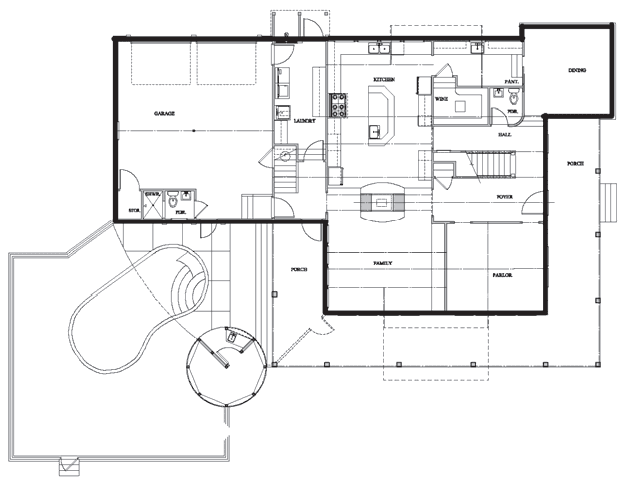
Beauty band. Horizontal trim details which break up large areas of siding usually aligned with floor level.
Board and batten. A siding detail which consists of narrow vertical siding trim (i.e., 1/4" x 1-1/2) spaced eight to 12 inches apart over flat siding. Historically this detail was made up of wide boards attached vertically to the building with narrow boards covering the joints.
Bump-out. A break in the façade of the building which extends perpendicular from the exterior wall having its own independent roof structure or creating a variation of the main roof structure.
Dormer. Walls with a window(s) placed vertically in a sloping roof with its own independent roof structure.
Façade. The face or exterior form of a building.
Fascia. A plain horizontal band sometimes placed at the termination of a roof at the edge of a building.*
Finish grade. Final level of the ground at the base of a building.
First floor. The first habitable floor four feet or greater above the RFE or grade, whichever is higher. See diagrams below.
Gable. The triangular upper portion of a wall at the end of a pitched roof.*
Ground floor. A habitable floor which is less than four feet above RFE. See First floor.
Heated living area. the area (in plan view) of a building which is mechanically heated and/or cooled.
Hip. The external angle formed at the intersection of two sloping roof surfaces.*
Picket. Vertical member connecting the top and bottom of a railing.
Plan area. The area of a horizontal building section.
Porch. Areas that are open and unobstructed (except for guard railings) to the exterior and are covered by a pitched roof that is supported by columns.
Proportion. Relation of things or parts of a thing.** In architecture, it is the relationship of building elements.
Rectilinear. Form or shape made up of right or 90 degree angles.
Regulatory flood protection elevation (RFE). The "base flood elevation" plus the "freeboard". In "special flood hazard areas" where base flood elevations (BFE) have been determined, this elevation shall be the BFE plus one foot of freeboard.
Ridge. A horizontal, longitudinal timber at the apex of a roof supporting the ends of the roof.*
Roof. Upper covering of a building.**
Scale. Size relationship of building parts to the whole building and the building to the environment.
Second floor. A habitable floor level above the first floor. See First floor.
Shed. A single sloping roof form.
Siding. Outermost covering or material applied to the exterior walls of a building.
Top plate. The top horizontal framing member of a building wall.
Watch tower. A vertical projection above the sloped main roof of a building with windows around all sides.
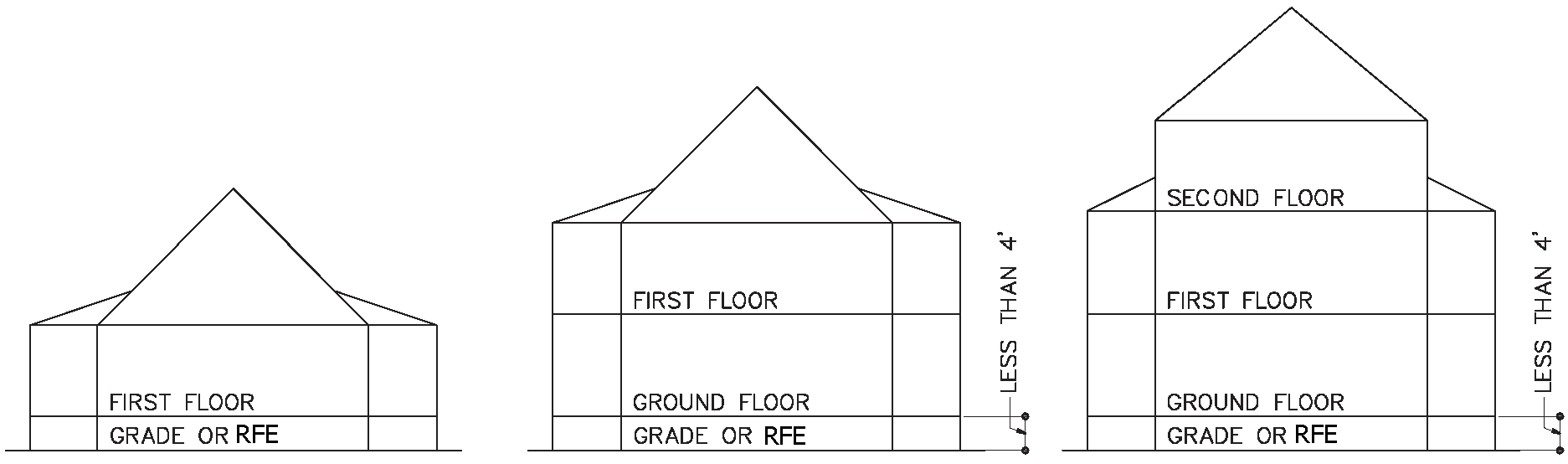
* The Penguin Dictionary of Architecture, John Fleming, Hugh Honour, Nikolaus Pevsner, Penguin Books 1991.
** The American Century Dictionary, Warner Books 1997.
Introduction
The Town of Nags Head has initiated a series of policies and regulations to promote and encourage the unique and historical elements of residential architecture held to be valued as an integral part of the town image. One component of these regulations is a series of architectural design guidelines that may be applied to certain residential structures within the town.
The goal of these design guidelines is to produce architecture with a "Nags Head style" or "coastal style" without stifling creative design or causing a monotonous built environment. A point system will be used to encourage the desired design for certain residential structures. Applicants, at their discretion, will choose from a menu of design elements to achieve unique designs that are reflective of the aforementioned design styles. The "Nags Head style" is architectural design reminiscent of the existing houses on the oceanfront near Jockey's Ridge (see illustration 1) and the "Coastal style" is architectural design reminiscent of the historic life saving service buildings of eastern North Carolina (see illustration 2).
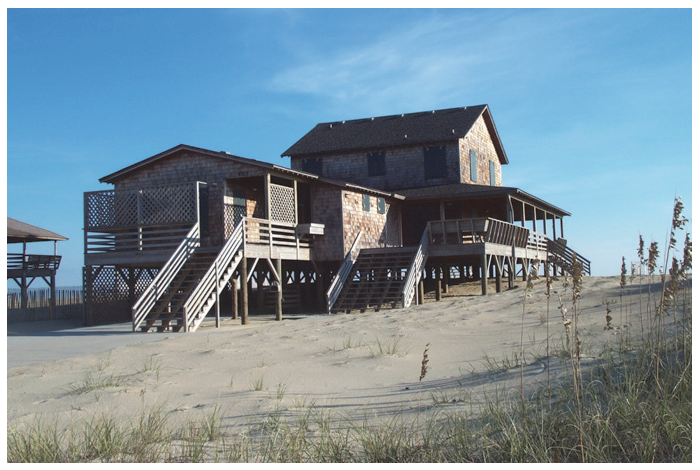 1. Nixon Residence, Nags Head, NC
| 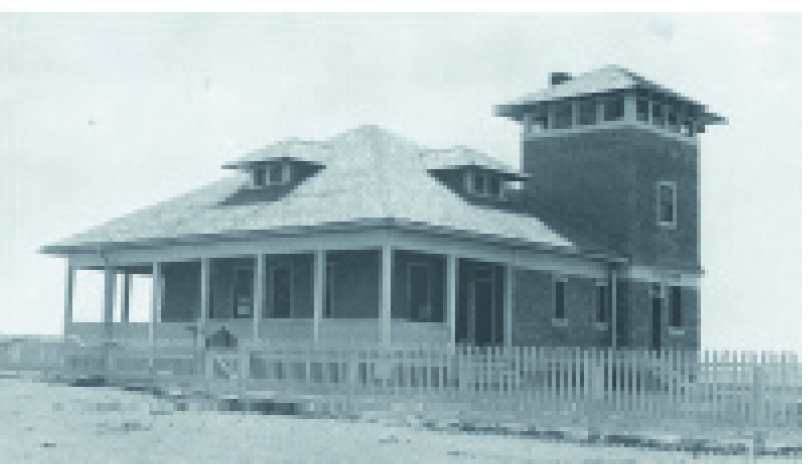 2. 1903 Kinnakeet Life Saving Station, Avon, NC
|
The most desirable design element of these styles is the wrap-around porch which shall have the greatest value in the point system. Other elements include dormers, coastal watch towers, pitched roofs, siding materials, and other miscellaneous details such as exposed rafter tails, working shutters, and porch column trim.
This manual has been created to assist property owners and residential developers with these design guidelines to ensure that the development application process is as efficient as possible. In this manual you will find a description of the design features or "design elements" that are being encouraged throughout the town. Also included is a description of the point system that is being used to evaluate each building design. Finally, examples have been incorporated to illustrate how individual design elements are assigned points and how combinations of design elements can be used to achieve the desired point totals for each residential structure.
Our community can be enhanced by the improvement of the built environment. By using a palette of architectural details blended together in a cohesive design, we can create a pleasing built landscape that will complement the beautiful area in which we live.
Design Elements
Design elements give architecture a particular style or appeal. A number of design elements have been identified that contribute to the "Nags Head" and "coastal" architectural styles. Many of these were mentioned in the introduction. If these design elements are incorporated in proper proportion, we can create the desired architectural style.
The written and illustrated design criteria contained on the following pages has been specified for each design element to create the appearance of the original architecture. This is important because these elements, if not sized properly, can appear applied to the "skin" of the house making the architecture look contrived or forced. The elements need to look functional. A simple rule of thumb although not a standard to evaluate the design, is to determine if the element is useable. For example, operable shutters inherently have a more desirable look than shutters permanently attached to the side of a window with no working hardware.
Combinations of these design elements, at the discretion of the applicant, may be included in any new residential construction or remodeling project that meets one of the following criteria:
•
New residential construction where the heated living area is 3,500 square feet or greater.
•
Remodel of an existing residential structure where the heated living area is being increased to 3,500 square feet or greater and where the value of the project exceeds 100 percent of the current assessed value of the structure.
•
Remodel of an existing residential structure that is 3,500 square feet or greater and where the value of the project exceeds 100 percent of the current assessed tax value of the structure.
It is important to note that the design guidelines are not required by the ordinance, and projects meeting the above criteria may use the design guidelines to qualify for incentives as outlined in Town Zoning Ordinance. The size of the house, based on the total enclosed habitable square footage, will determine the total number of points that must be achieved. The minimum number of required points is determined by multiplying the total enclosed habitable square footage by 0.025. In addition to the design criteria specified for each design element, the following pages include a discussion of the point values assigned to each design element and how these can be determined.
Porches
Porches, while being a standard architectural feature on "Nags Head Style" homes, can soften the harshness of a plain rectilinear form and create an appealing transition from inside to outside. Historically, the function of porches in this environment was to shade windows from direct sun and create a place in the shade to take advantage of breezes. The porches also offered protection of windows and doors in the event of storms.
All rectilinear areas that are open and unobstructed (except for guard railings) to the exterior, covered by a pitched roof which is supported by columns, shall be considered a porch. Porches shall also have the following characteristics (see illustration 3):
1.
Porch depth - A minimum porch depth of six feet is just enough to give the appearance of a working porch. However, it may be a little narrow for use with chairs. Eight feet is the minimum for comfortable placement of chairs. Porches become disproportionately deep after ten feet. Porch depth is calculated from the exterior wall of the structure to the exterior edge of the porch column.
2.
Roof pitch - For the porch roof pitch to have the desired look, a minimum of three-twelfths pitch should be used. Historically, porch roof pitches were steep to shed rain water, which is still an important consideration today.
3.
Guard railing - The use of a top and bottom rail is desirable and more historic than the now dated look of pickets overlapping the deck band. Intermediate horizontal rail enclosures can be used as well as vertical pickets and is probably a more desired look. However, this does create the potential for use as a ladder by small children.
4.
Porch plans shall be square or rectangular in plan.
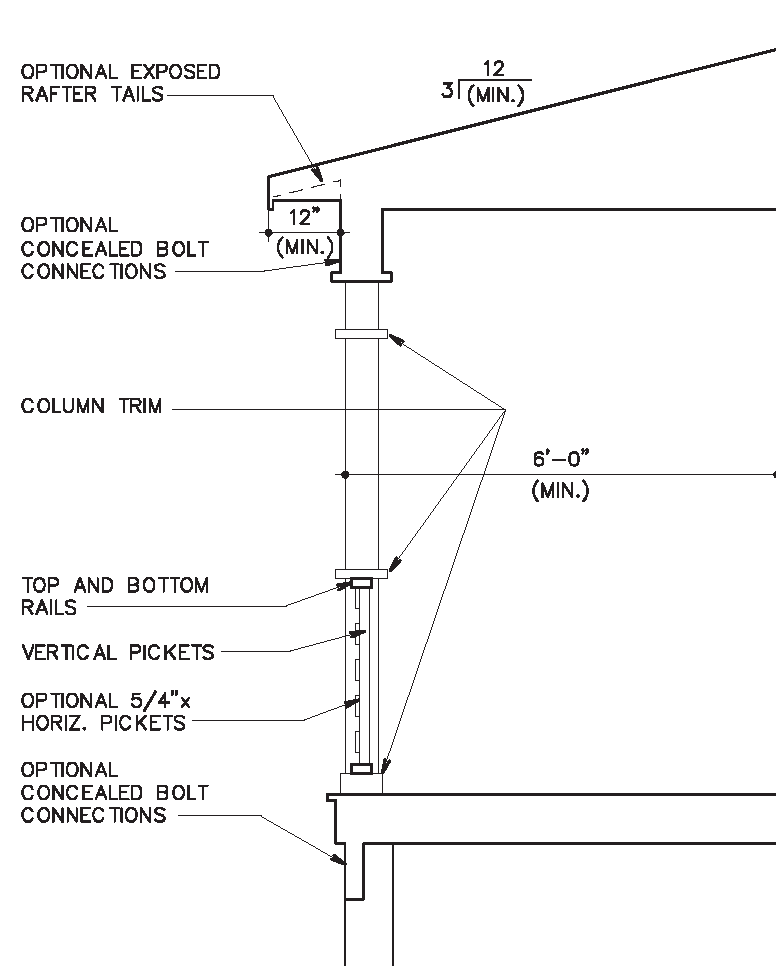
Illustration 3
5.
First floor - The first floor shall be the first habitable floor four feet or greater above RFE or grade, whichever is higher. A habitable floor level less than four feet above BFE or grade shall be considered a ground floor. In structures having three floor levels, the first level shall be considered the ground floor, the second floor level, the first floor and the third level, the second floor. See terminology for diagram.
Scoring
First floor porch. To calculate the number of possible points for a first floor porch, two measurements will be needed:
1)
The perimeter of heated living area of the first floor (b1).
2)
The perimeter of the portion of the first floor that has an adjacent porch meeting the required specifications (p1).
Divide the perimeter with the porch (p1) by the perimeter of the entire floor (b1). For first floor porches, multiply the result by 150 to calculate the total points.
(p1/b1)*150 = points for first floor porch
Second Floor Porch. To calculate the number of possible points for a second floor porch, two measurements will be needed:
1)
The perimeter of heated living area of the second floor (b2).
2)
The perimeter of the portion of the second floor that has an adjacent porch meeting the required specifications (p2).
Divide the perimeter with the porch (p2) by the perimeter of the entire floor (b2). For second floor porches, multiply the result by 75 to calculate the total points.
(p2/b2)*75 = points for second floor porch
A diagram illustrating this calculation is included in Appendix B.
Porch
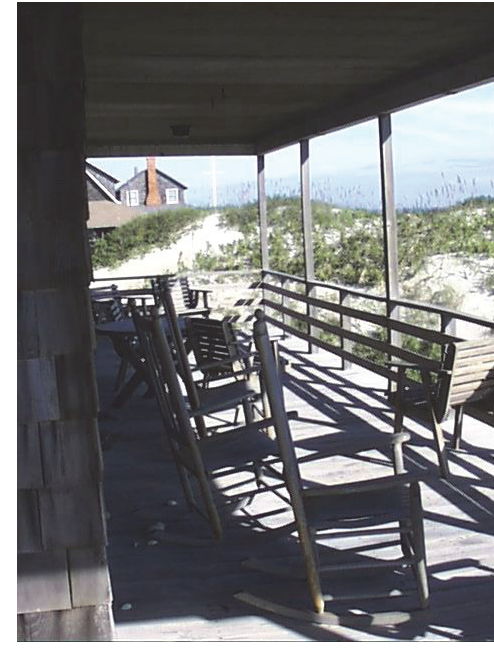 |
Wrap-around porch
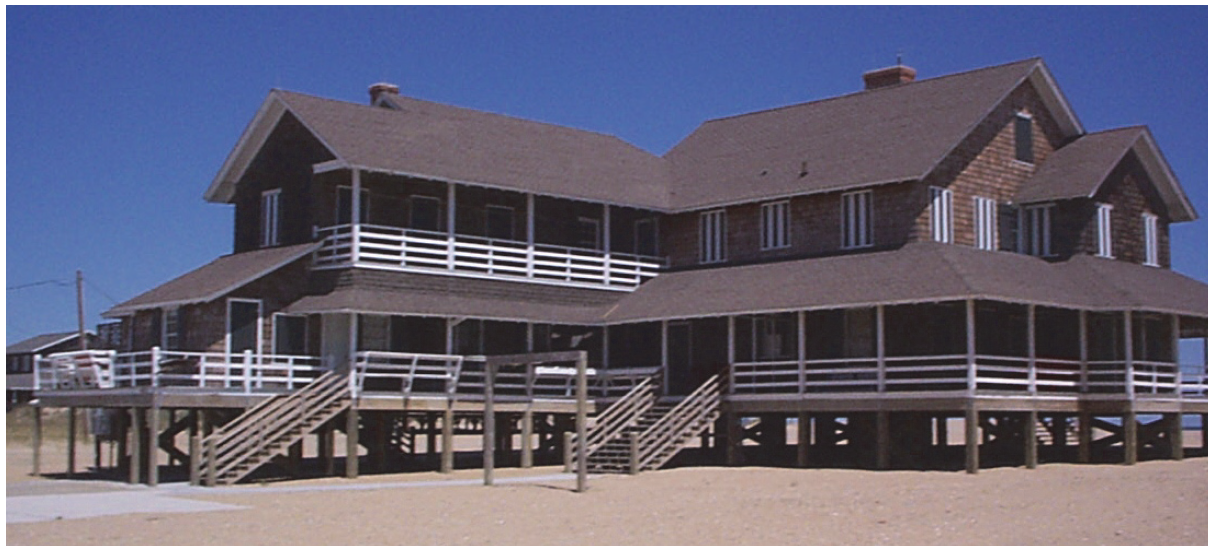 |
Dormers
Dormers are constructed in a roof to provide light and ventilation into habitable or attic space. Dormers can also create head room thus making a useable space out of the roof structure. From an architectural point of view, dormers break up the monotony of a large roof and, if the roof structure becomes habitable, make the structure seem shorter and smaller. A window placed vertically in a roof having a hip, gable, or shed roof can be considered a dormer (see illustrations 4 and 5).
1.
Hip and gable dormers - A minimum width of five feet, height of four feet (from roof to top plate of dormer at front) and a pitch of six-twelfths will give the desired appearance. If the dormer is too small it starts to appear out of character with the desired architectural style. The roof for this size of dormer should be hipped or gabled.
2.
Shed dormer - A minimum width of 12 feet, height of four feet (from roof to top plate of dormer at front) and a pitch of three-twelfths will give the desired appearance. If the dormer is made too small it starts to appear out of character with the desired architectural style. The roof for this size of dormer should be a shed.
3.
A dormer should be square or rectangular in plan.
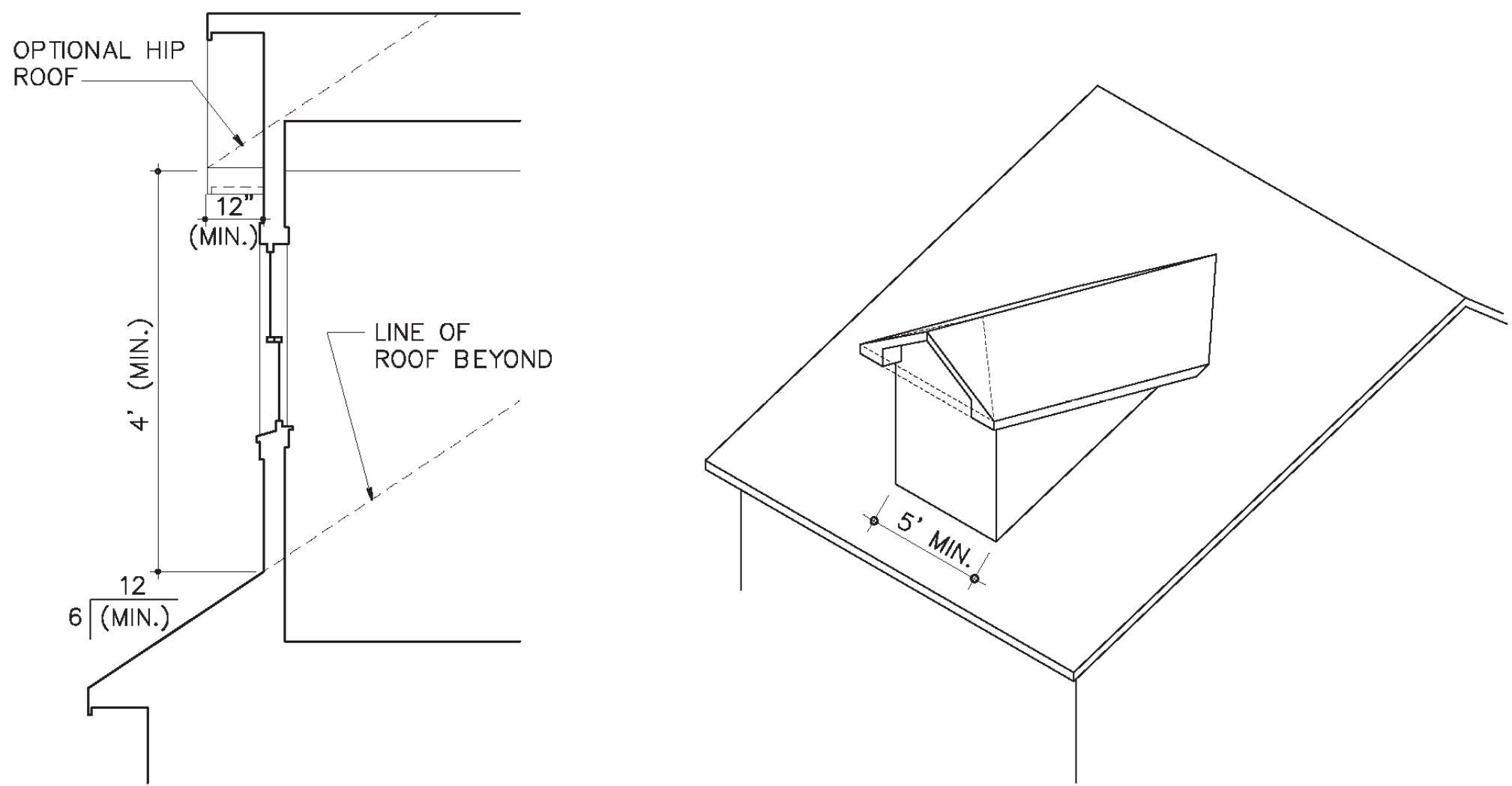
Illustration 4
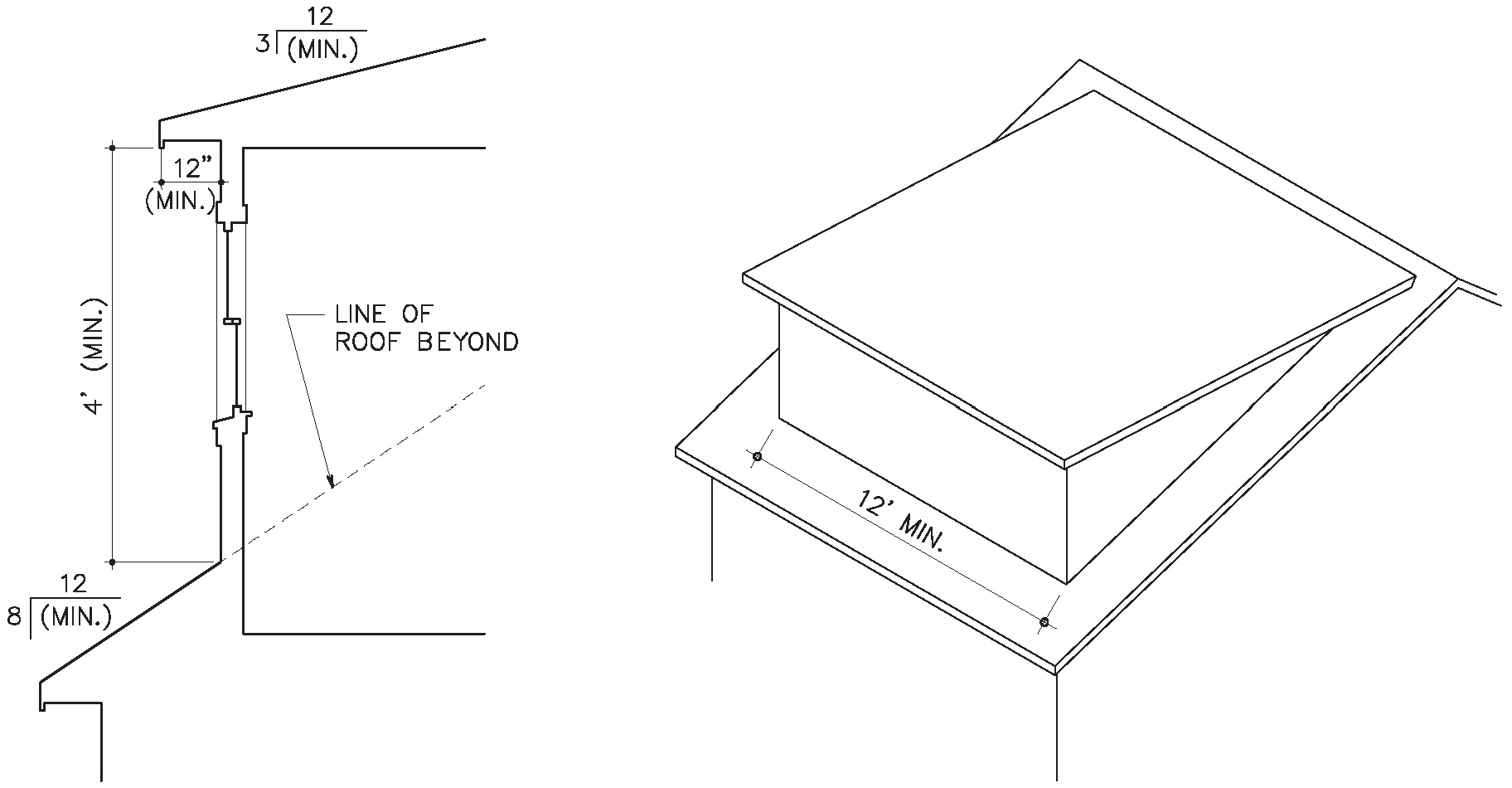
Illustration 5
Scoring
To calculate the points for hip or gable dormers, multiply the total number (n) of dormers meeting the required specifications by five.
n x 5 = points for hip or gable dormers
To calculate the points for shed dormers, multiply the total number (n) of dormers by ten. If the length (L) of the shed dormer is greater than 12 feet, additional points will be awarded. Add only the number of feet greater than 12 to the score. For instance, if the dormer is 16 feet in length, four feet will be added to the score.
n(10) + L = points for shed dormers
A maximum of 25 points will be awarded for dormers.
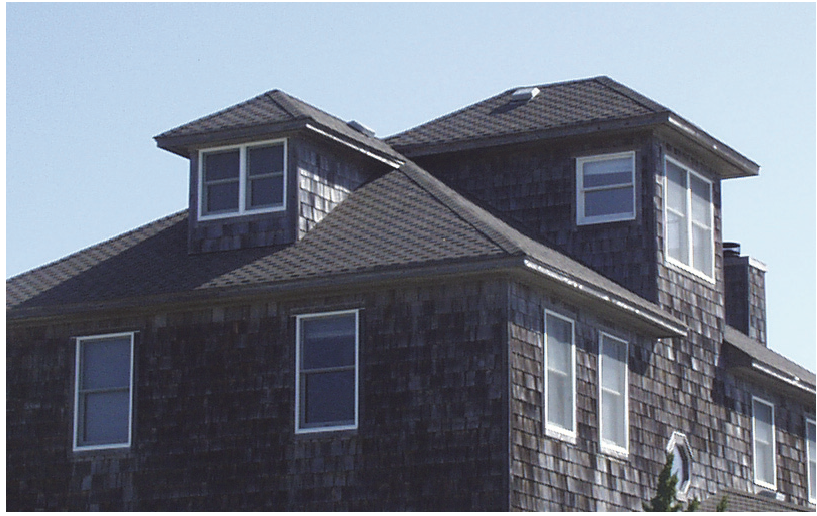 Hip Dormers
| 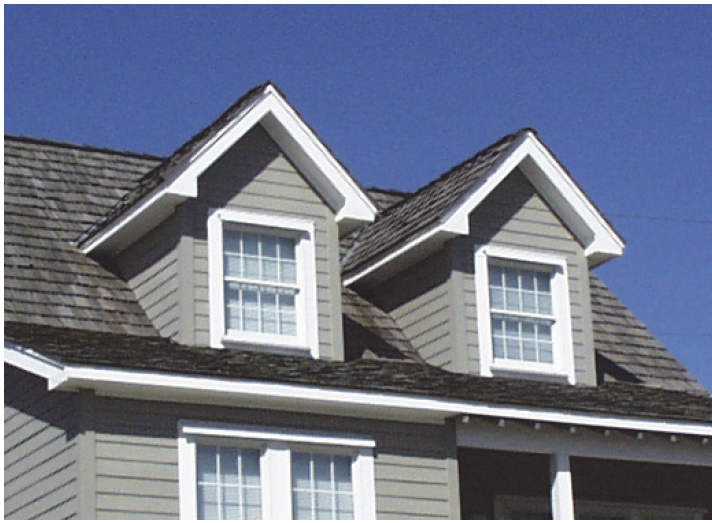 Gable Dormers
|
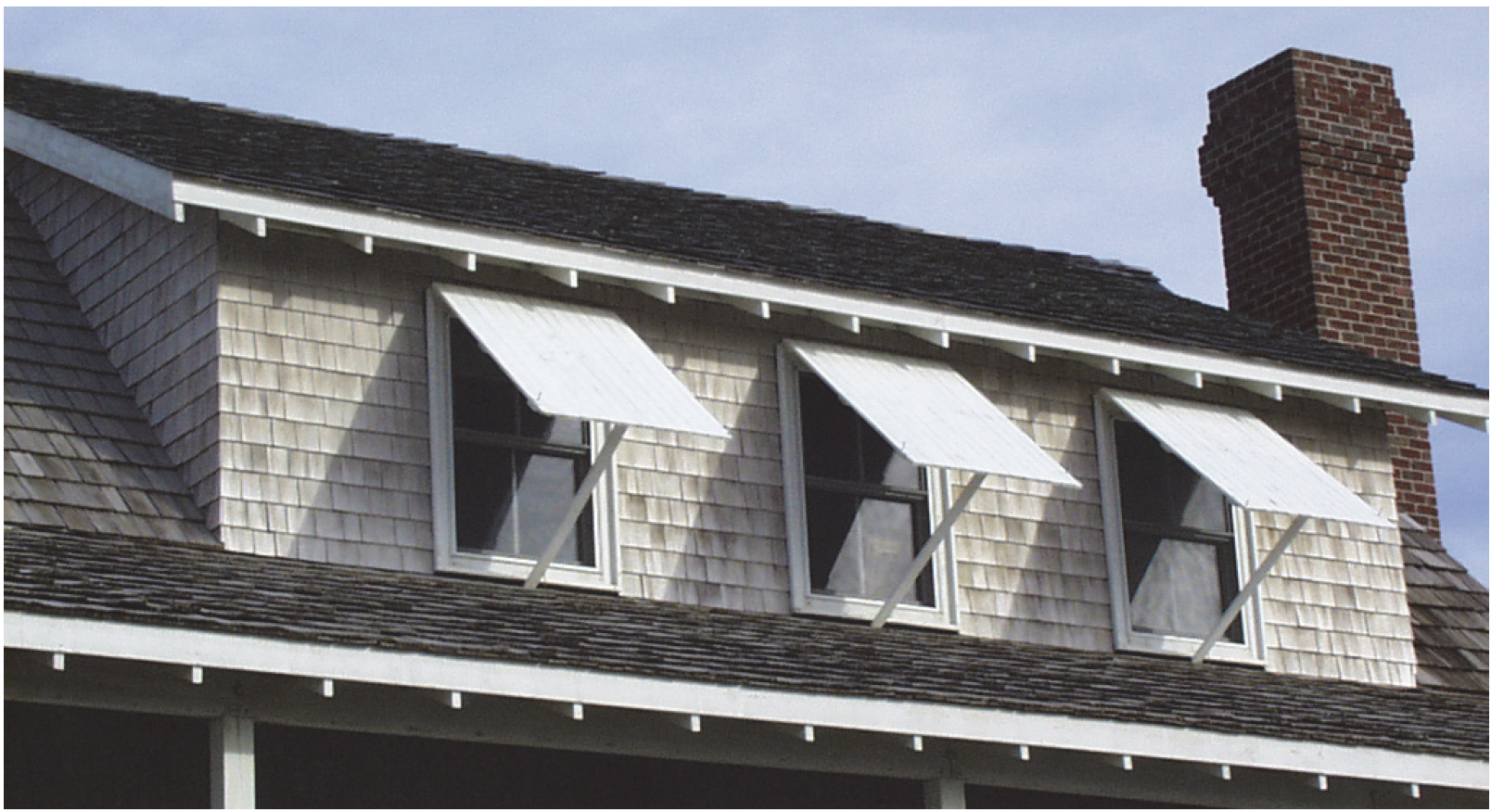
Shed Dormer
Coastal Watch Towers
Historically, coastal watch towers provided a view up and down the beach for the men of the life saving service. They had windows around all sides and projected above the ridge of the main roof to achieve their intended function.
A vertical projection above the sloped main roof with the following characteristics shall achieve the desired architectural style (See illustration 6):
1.
A tower that is at least six feet wide and no more than 14 feet wide and at least 60 square feet and not more than 196 square feet is within the size of the original "coastal watch towers".
2.
The tower should maintain windows on all sides to have the impression of offering a 360 degree view of the land.
3.
The roof should be at least a six-twelfths pitch to match the design intent.
4.
These structures should be square or rectangular in plan.
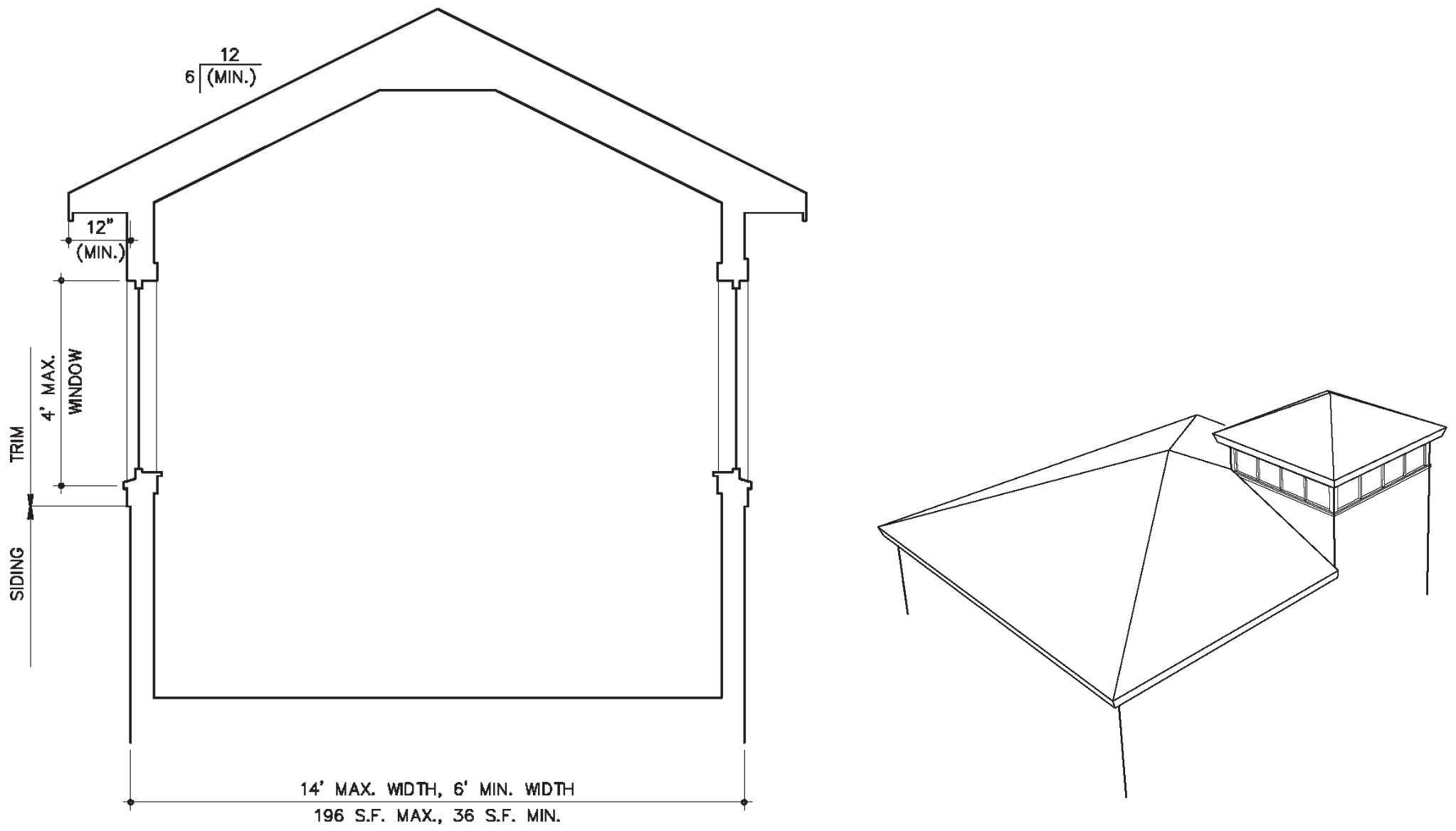
Illustration 6
Scoring
Coastal watch towers meeting the above specifications will be awarded ten points.
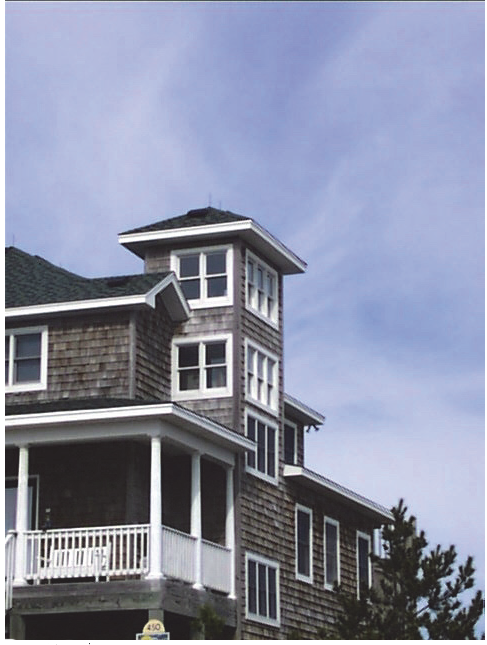
Coastal Watch Tower
Building Form
The proper building form is essential to create the desired architectural style. With the addition of a "wrap-around" porch to a simple rectilinear form, we can achieve the "Nags Head style". However, there are many structures with base forms that give variety to an otherwise plain shape.
In the heated area of a building, the following characteristics are desired:
1.
Bump-outs - A break in the façade of the building which extends at least two feet perpendicular from the exterior wall and is at least 25 percent of the façade area, either as one element or several, shall be considered a bump-out (see illustrations 7 and 8). A bump out should have its own independent roof structure or should result in a variation of the main roof structure.
2.
Combination base forms - A building having a combination of base forms was historically the result of some sort of addition. This addition was usually large enough to include one or more rooms. For a structure to meet this type of form, it should have at least two base forms one being as least 25 percent of the size of the main or largest forms. The base forms should be considered the plan area of heated space (see illustration 9).
3.
The baseform of the building shall be square or rectangular in plan.
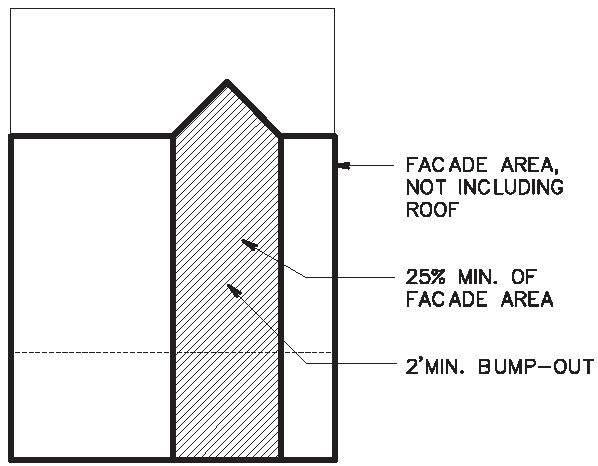
Illustration 7
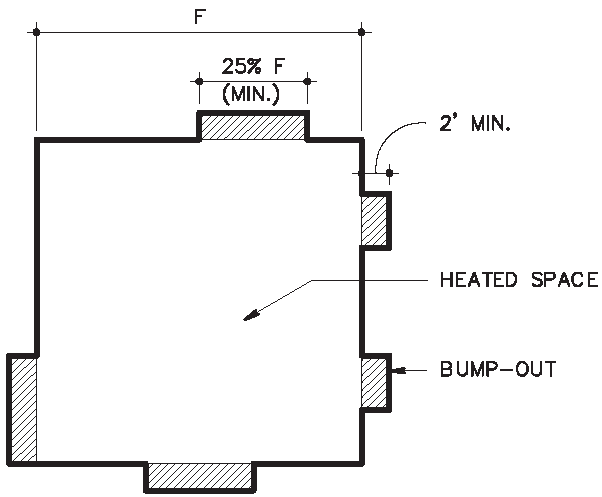 Illustration 8
| 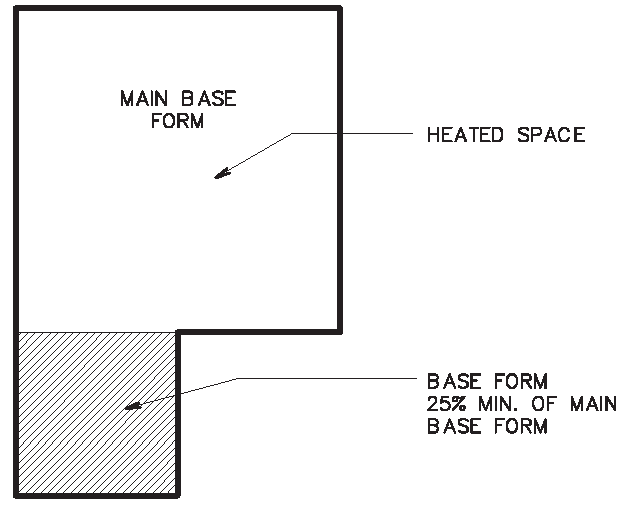 Illustration 9
|
Scoring
1.
Bump outs meeting the required specifications will be awarded ten points per side or façade (f).
F = façade with required bump out
F x 10 = points for bump outs
2.
A structure that is designed with a combination of base forms will be awarded 40 points.
The maximum score for the building form category is 40 points. Points will not be awarded for bump outs if a structure is already receiving the maximum points for a combination base form.
A diagram illustrating the calculation of points for building form is included in Appendix B.
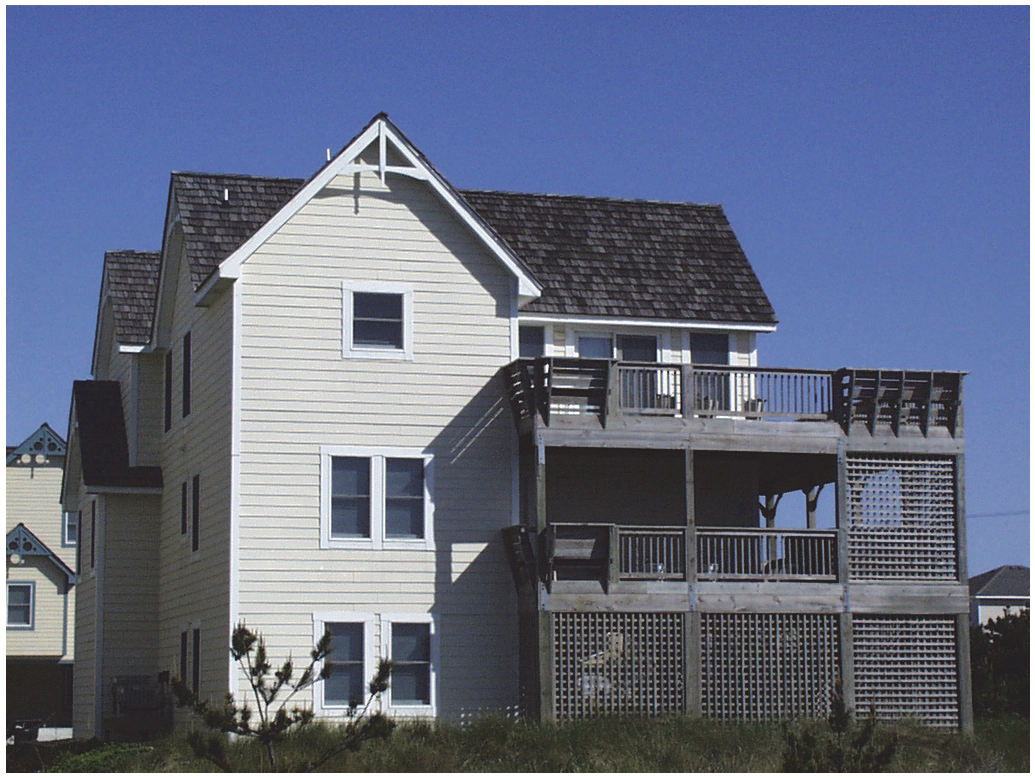
Bump-outs
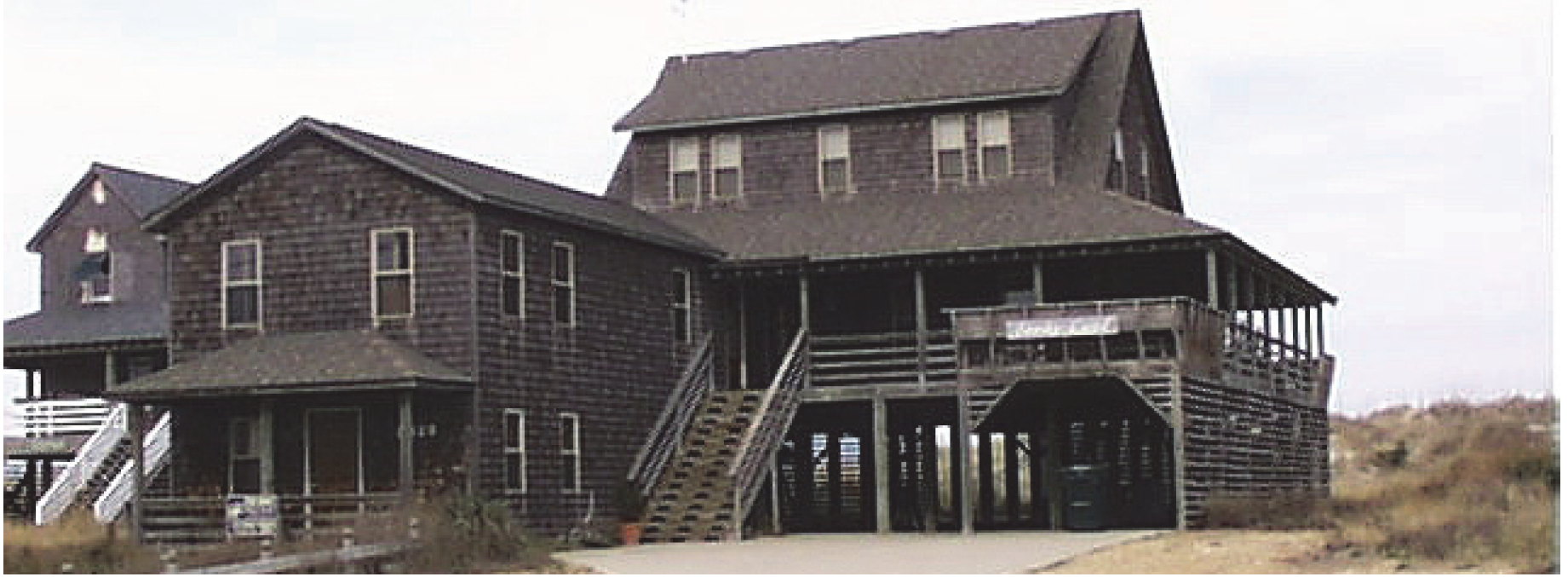
Combination Base Forms
Roofs
The roof of the house plays a tremendous role in establishing the form of the structure. With proper pitch and type, the roof can go a long way in achieving the desired form. The "Nags Head" and "coastal" styles both use roofs that have a reasonable pitch to shed stormwater.
The roofs should have the following characteristics:
1.
Main roof pitch - The main roof pitch should be a minimum of eight-twelfths.
2.
Main roof form - The main roof is that portion of the roof covering the largest habitable part of the structure. Gable, hip and intersecting gable or hip roofs which are rectilinear in plan are standard for the desired architectural style. Shed, gambrel, opposing sheds, or mansard roofs (on the main roof) evoke architectural styles that are not historically common to this area.
3.
In order to avoid the contemporary "chalet" house look, the structure should have one full floor height below the main roof eave. Roofs that incorporate dormers would not apply to this requirement.
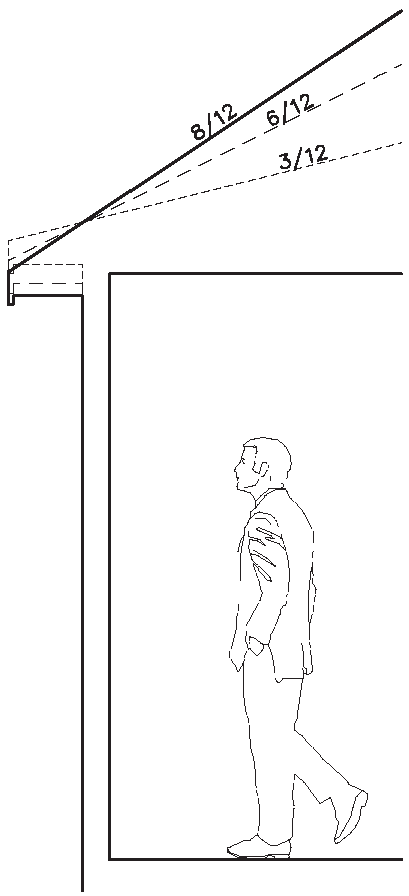
Roof Pitches
Scoring
A roof meeting the required specifications will be awarded 25 points.
 Dutch Hip Roof
|  Intersecting Gable Roof
|
 Gable Roof
|  Gambrel Roof
|
 Hip Roof
|  Mansard Roof
|
 Opposing Shed Roof
|  Shed Roof
|
Siding Materials
Historically, the most common siding material on the Outer Banks was the wood shingle. This is certainly a major element in "Nags Head" and "Coastal" style architecture. Most historic uses of this material involved allowing the shingles to weather to a natural gray; however, staining the material is an acceptable option.
Siding materials should be one of the following which must cover at least 80% of the siding area:
1.
Wood shingles - Wood material should be red cedar, white cedar, juniper, or pressure treated pine.
2.
Simulated wood shingles - Material may be any type which mimics the appearance of wood shingles or shakes including cementitious and vinyl products.
Scoring
A structure with wood shingle or shake siding meeting the required specifications will be awarded 25 points.
A structure with simulated wood shingle siding meeting the required specifications will be awarded 12 points.
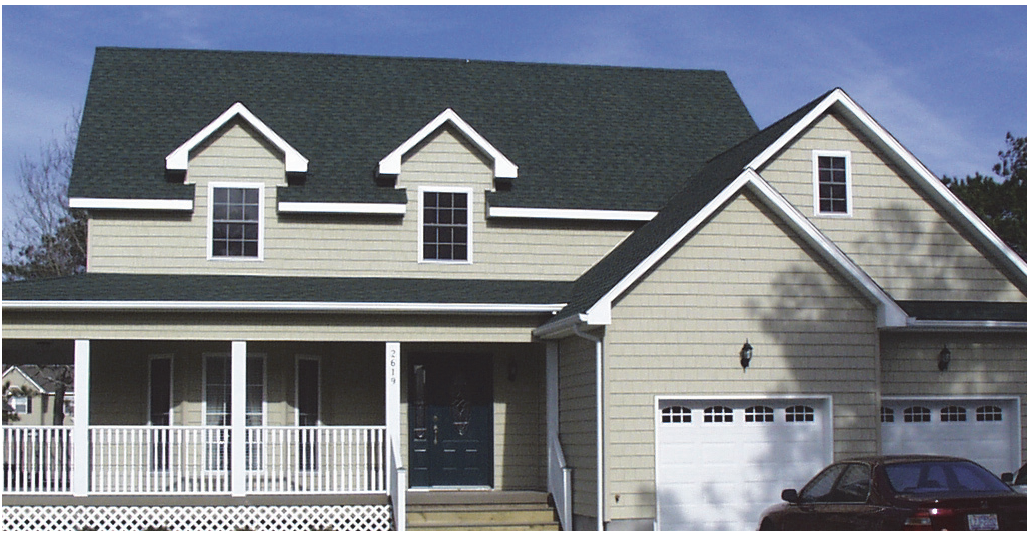
Vinyl Shingle Siding
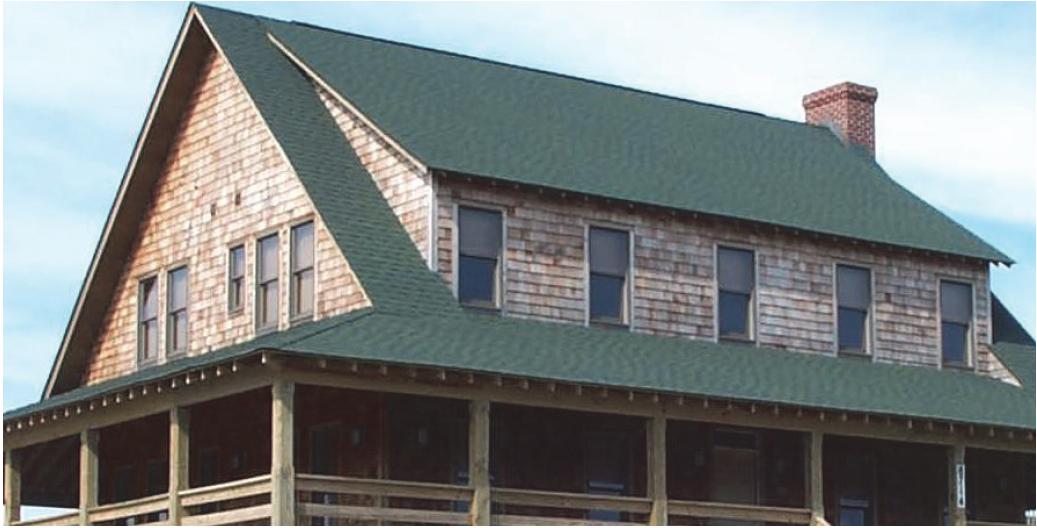
Wood Shingle Siding
Miscellaneous Details
These details should be applied throughout the design wherever possible and reasonable.
A building may include any of the following:
1.
Working Shutters - Shutters should be designed and installed to protect the windows in the event of a storm. Both side and top hinged shutters are part of the desired architectural style; however, rolling shutters are not. The shutters should be a board and batten style.
2.
Windows - 75% of the predominate window shape should be rectangular and be double or single hung.
3.
Beauty Bands - Beauty bands are horizontal trim details which break up large areas of siding. This trim should be a minimum of eight (8") inches wide and should be at floor level.
4.
Exposed Rafter Tails - Exposed rafter tails are the portion of roof rafters which extend beyond the plane of the exterior wall or the porch columns supporting the roof at the eaves. The rafter tails should be seen or exposed to the exterior. They can be constructed of pressure treated or painted material.
5.
Porch Column Trim - At a minimum, this should include some type of trim at the top (capital trim) and bottom of the column (base trim). Additional trim can be added at the railing height.
6.
Gable Bracket - The gable bracket, at a minimum, consists of a horizontal and a vertical piece of trim aligned with the eave fascia at a gable roof. This trim should be placed at the center of the gable and mimic the traditional "Life Saving Station" detail.
Scoring
For features that meet the required specifications, the following points will be awarded:
1.
Working Shutters - 15 points
2.
Windows - 20 points
3.
Beauty Bands - 5 points
4.
Exposed Rafter Tails - 5 points
5.
Porch Column Trim - 5 points
6.
Gable Bracket - 5 points
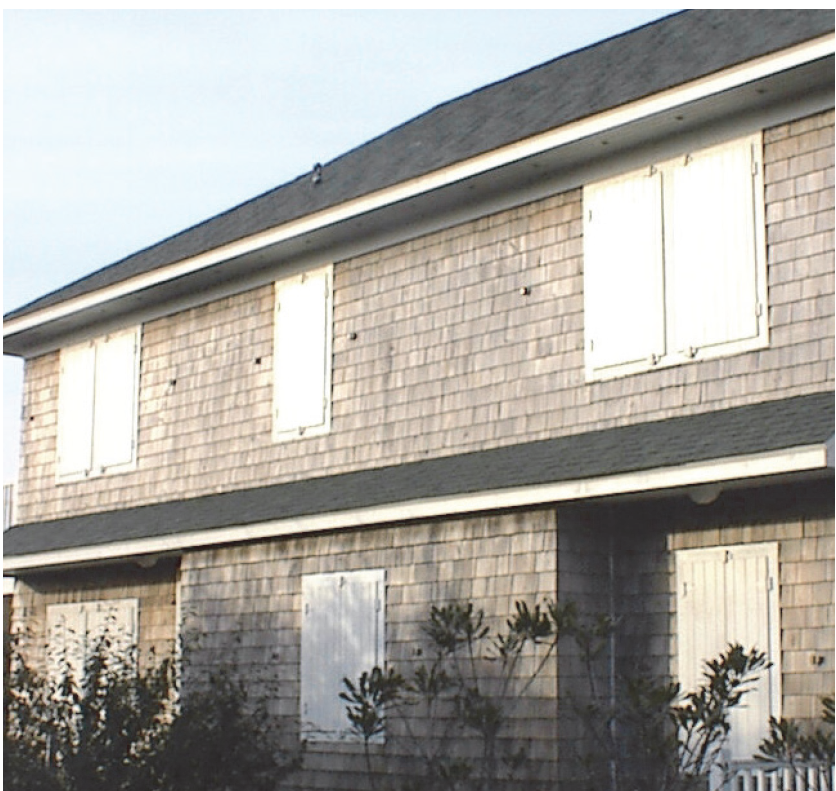 Working Shutters (side hinge)
| 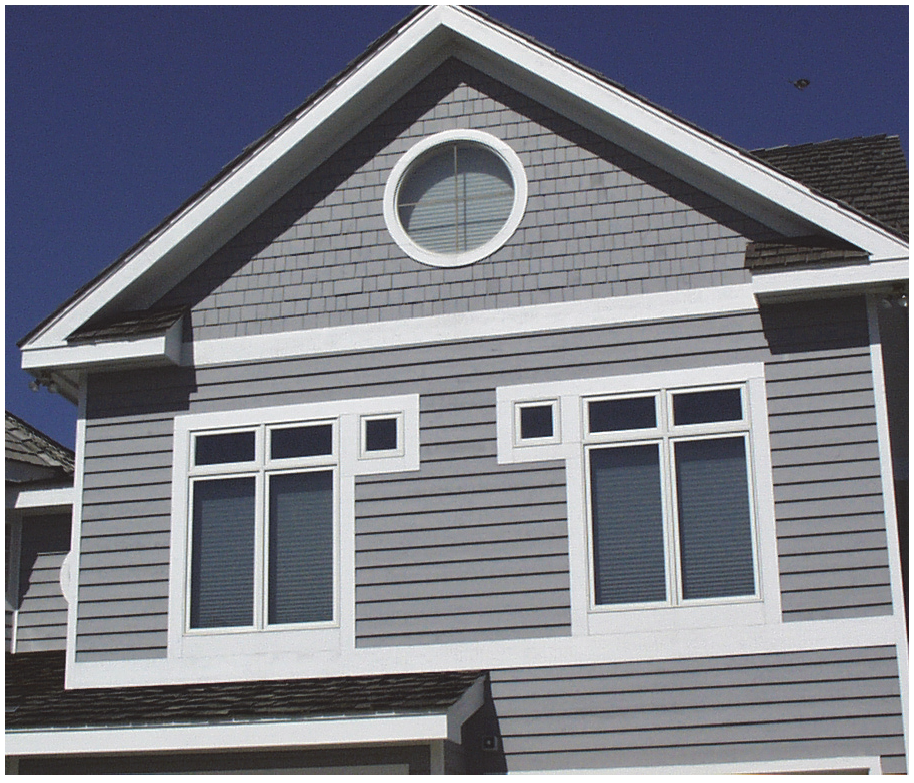 Beauty Bands
|
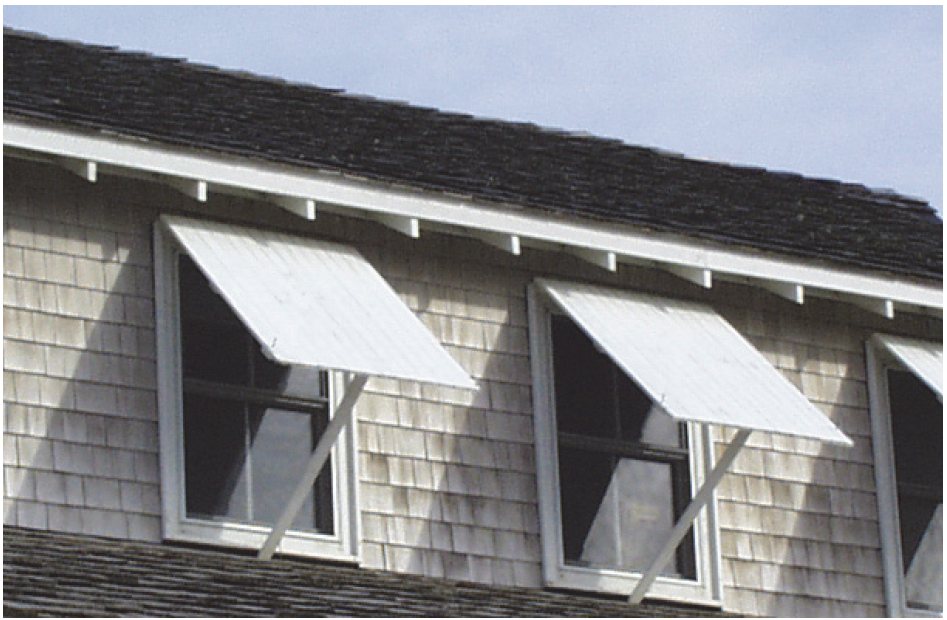 Working Shutters (top hinge)
| 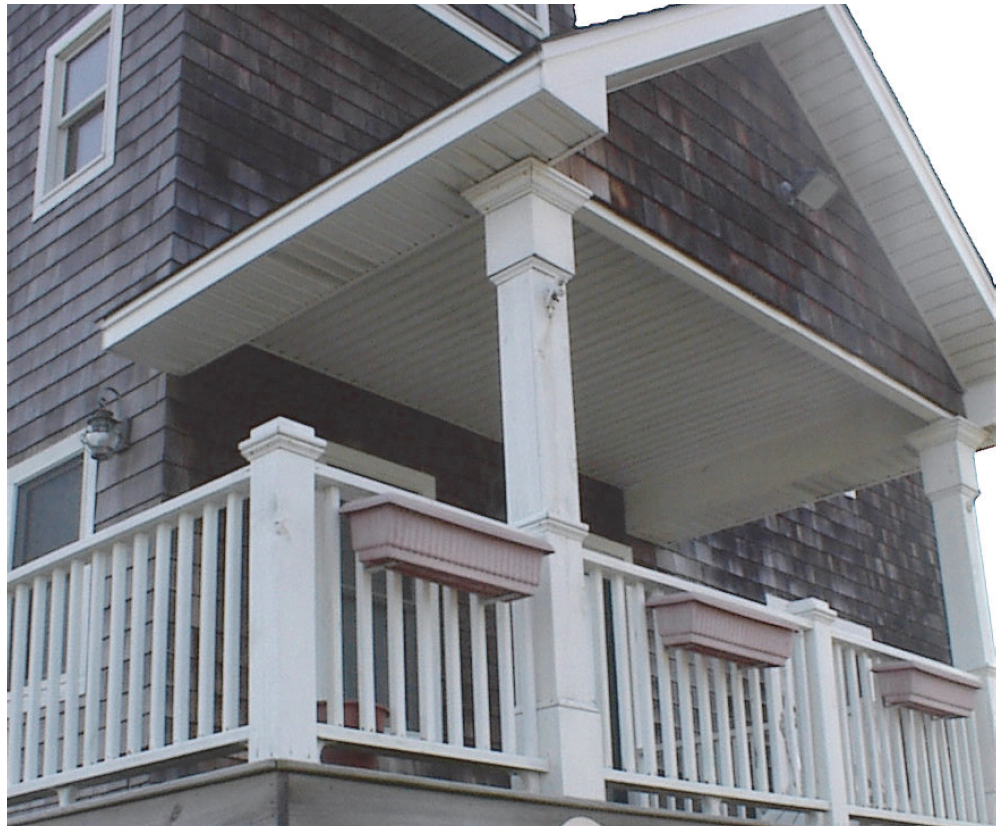 Porch Column Trim
|
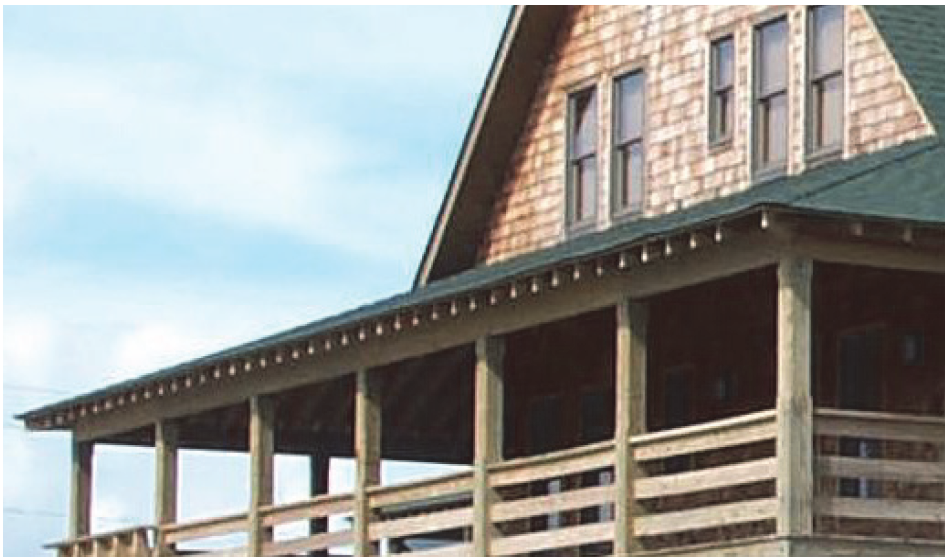 Exposed Rafters
| 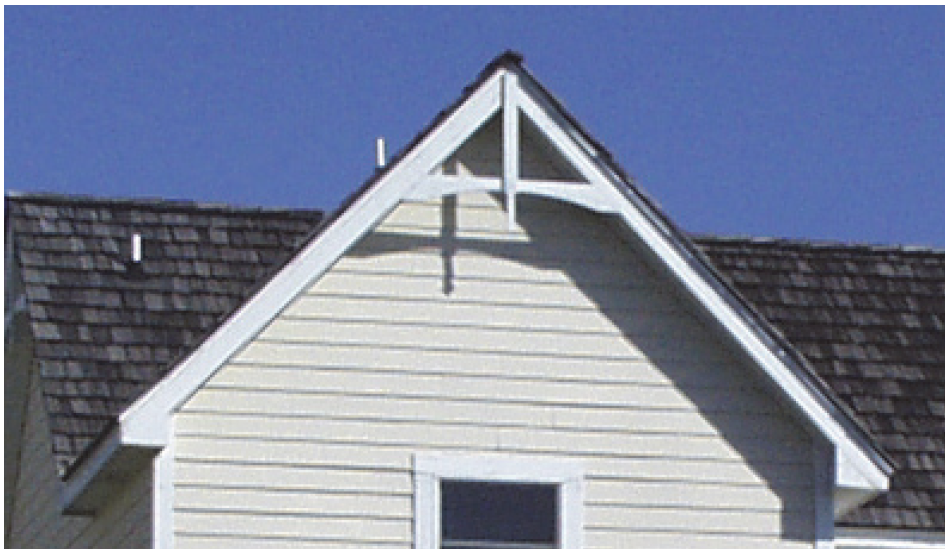 Gable Bracket
|
Point Tabulation Form Instructions
The Town of Nags Head has initiated a series of policies and regulations to promote and encourage the unique and historical elements of residential architecture held to be valued as an integral part of the town image. One component of these regulations is a series of architectural design guidelines that may be applied to certain residential structures within the town. The architectural design guidelines and the associated architectural point system are described in detail in the Town of Nags Head Residential Design Guidelines. Copies of this document can be obtained from the planning and development department or can be downloaded from the town website at (www.nagsheadnc.gov).
If your project meets one of the following criteria and you are electing to use the Nags Head Residential Design Guidelines, the town would request that you submit a completed residential design point tabulation form (see attached) with your development permit application form:
-
New residential construction where the heated living area is 3,500 square feet or greater.
-
Remodel of an existing residential structure where the heated living area is being increased to 3,500 square feet or greater and where the value of the project exceeds 100 percent of the current assessed value of the structure.
-
Remodel of an existing residential structure that is 3,500 square feet or greater and where the value of the project exceeds 100 percent of the current assessed tax value of the structure.
In addition to this completed form, please identify on the building plans in sufficient detail (elevations and floor plans) the elements that have been incorporated to satisfy the point requirements of the architectural design standards. An example of a completed residential design point tabulation form is included in Appendix B of the Town of Nags Head Residential Design Guidelines.
This information will be reviewed by town planning and development staff as part of the development permit application process. For questions or information regarding these policies and procedures, please contact the planning and development department at 252-441-7016.
Town of Nags Head Residential Design Guidelines - Point Tabulation Form
The architectural design elements listed in the table below have been assigned individual point values. At the discretion of the applicant, a combination of these elements should be incorporated into the design of each dwelling in order to achieve the minimum required point totals. To calculate the required points, multiply the total enclosed habitable square footage by 0.025. Please refer to the Town of Nags Head Residential Design Guidelines for a description of each design element and their required specifications. This document can be obtained from the planning and development department (252-441-7016) or can be downloaded at the town website (www.nagsheadnc.gov).
*Meeting the specifications as indicated in the Town of Nags Head Residential Design Guidelines
Elevations
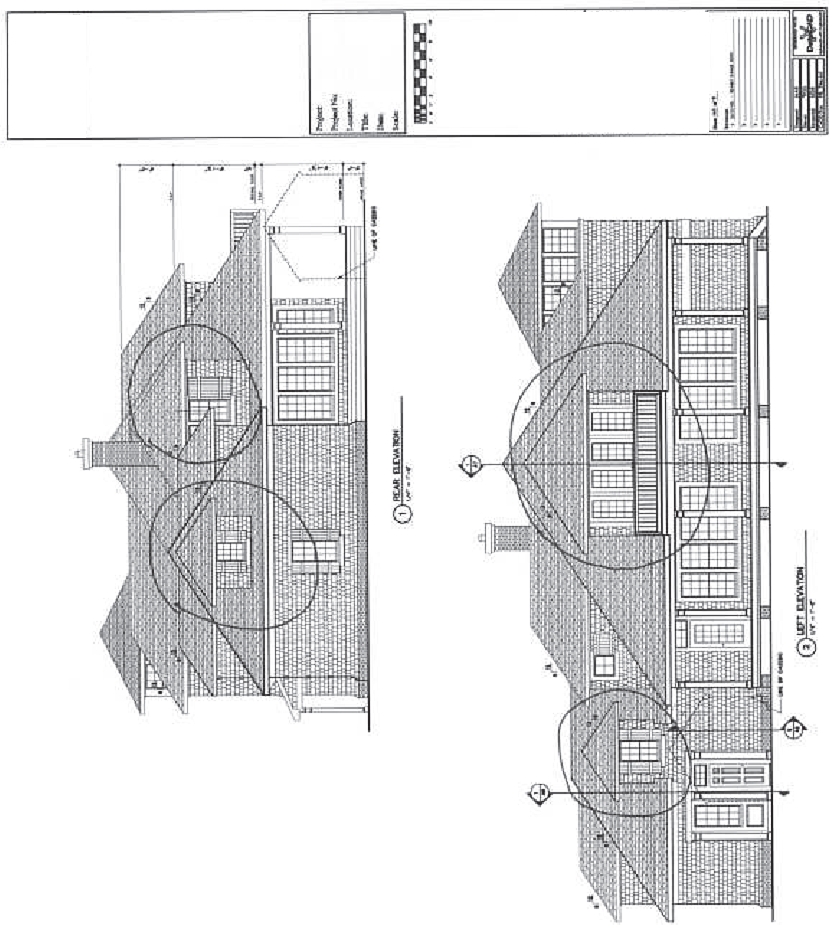
Nags Head Residential Design Guidelines
Residential Design Guidelines - Point Tabulation Form
(Ord. No. 19-08-009, Pt. I, 8-7-2019)

