
Nauvoo City Zoning Code
CHAPTER 1
GENERAL PROVISIONS
10-1-1: SHORT TITLE:
The regulations contained in this title, as amended from time to time, shall be cited as the ZONING ORDINANCE OF THE CITY OF NAUVOO, ILLINOIS, and shall be referred to herein as "this title". (Ord. 2001-2, 6-12-2001)
10-1-2: PURPOSE:
The purpose of this title is to promote the health, safety and general welfare of the residents of Nauvoo; to encourage the most appropriate use of land throughout the city; to promote traffic safety; to provide safety from fire and other hazards; to provide adequate light and air; to prevent overcrowding of real estate; to promote a wholesome home environment; to prevent housing development in unsanitary areas; to provide an adequate street system; to promote the coordinated development of unbuilt areas; to preserve and promote the beauty of the community; to provide an allotment of land area in new development sufficient for all the requirements of community life; to conserve natural and cultural resources; to provide for adequate public services; and to enhance the value of property within the city. The foregoing purposes shall be implemented by establishment of the zoning districts adopted hereby and herein and by compliance with all of the other provisions of this title. This title is intended to carry out and be consistent with the city's comprehensive plan. (Ord. 2001-2, 6-12-2001)
10-1-3: DEFINITIONS:
For the purposes of this title, certain terms and words are hereby defined. All words not defined herein shall carry their customary and usual meanings. Words used in the present tense shall include the future, the singular number shall include the plural, and the plural number includes the singular; the word "shall" is mandatory, and the word "may" is permissive; the word "person" includes a firm, association, organization, partnership, trust, company or corporation, as well as an individual; the words "used" or "occupied" include the words intended, designed or arranged to be used or occupied.
ACCESSORY BUILDING OR STRUCTURE: A detached, subordinate building, the use of which is clearly incidental and related to that of the principal building or use of the land, and which is located on the same land as the principal building or use. The detached subordinate building, accessory building, or structure must be set back at least ten feet (10') from the adjacent property lines. For residential uses, accessory buildings and structures shall include, but not be limited to, the following:
A. Garage.
B. Gazebo.
C. Greenhouse.
D. "Home workshop", as defined below.
E. Recreational facilities for the use of occupants of the residence, such as a swimming pool or a tennis court, and related structures.
F. Wharf, dock, landing, or boathouse.
(Note: The yard requirements for permitted uses apply to permitted accessory uses.)
ADULT USES: A commercial use characterized by activities that provide entertainment which is sexual or erotic in nature and therefore appropriate for adults only. Specific uses in this title classified as adult uses are:
A. Adult Amusement Establishment: An establishment which provides amusement or entertainment which is distinguished or characterized by an emphasis on material depicting, describing, or related to specified sexual activities or specified anatomical areas and where admittance is limited to adults or admittance is advertised or promoted as being restricted to adults. The establishment may be, but is not limited to, an indoor restaurant, lounge, nightclub, or any other facility regardless of whether food, drink, or alcoholic beverages are served; or
1. An establishment which features topless dancers, exotic dancers, strippers, male or female impersonators, or similar entertainment; or
2. An establishment which, upon payment of a fee, provides an escort or a dance partner to its patrons.
B. Adult Bookstore: An establishment having a substantial or significant portion of its stock in trade books, magazines, and other periodicals which are distinguished or characterized by their emphasis on matter depicting, describing, or relating to specified sexual activities or specified anatomical areas or an establishment with a segment or section devoted to the sale or display of such material.
C. Adult Entertainment Establishment: An indoor restaurant, lounge, nightclub, or any other facility regardless of whether food, drink, or alcoholic beverages are served, where, in all or part thereof, live entertainment is provided for patrons which is sexually erotic in nature, where admittance is limited to adults or admittance is advertised or promoted as being restricted to adults.
D. Adult Photo Studio: An establishment which, upon payment of a fee, provides photographic equipment or models for the purpose of photographing specified anatomical areas.
E. Adult Theater: A theater, used for presenting material distinguished or characterized by an emphasis on matter depicting, describing, or relating to specified sexual activities or specified anatomical areas for observation by patrons therein.
AGRICULTURE: The use of land for purposes of growing the usual farm products, including vegetables, fruits, trees and grains; pasturage; dairying; animal and poultry husbandry; and the necessary accessory uses for treating or storing the produce; provided that the operation of such accessory uses shall be secondary to that of the regular agricultural activities.
ALLEY: A public way, other than a street, twenty feet (20') or less in width affording a secondary means of access to abutting property.
AUTOMOBILE WRECKING: The dismantling or wrecking of motor vehicles or trailers or the storage, sale or dumping of dismantled or wrecked vehicles or their parts.
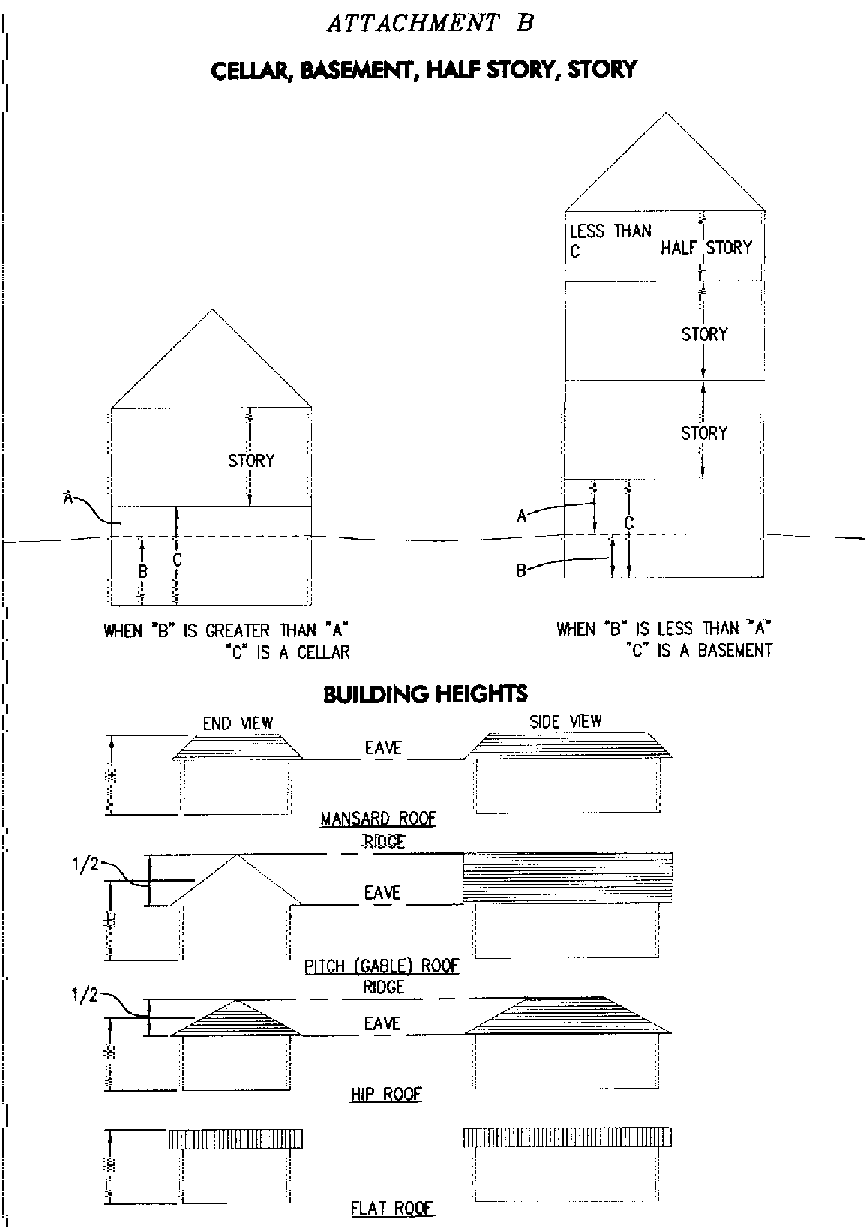
BASEMENT: A story having part, but not more than, one-half (1/2) of its height below grade. A basement is counted as a story for the purpose of height regulation. (See attachment B of this section for illustrations of story calculations.)
BED AND BREAKFAST: A building of residential character other than a hotel, motel or boarding house, which is compatible with the neighborhood and which:
A. Provides temporary lodging for less than thirty (30) days;
B. Provides temporary lodging in five (5) or fewer rooms for guests;
C. Provides one or more meals daily for guests;
D. Has a manager of the inn residing on the premises at all times;
E. Does not provide the accessory uses associated with a hotel;
F. "Guestroom" shall mean a sleeping room intended to serve no more than two (2) transient guests per night;
G. All future bed and breakfasts will only be allowed in the commercial district.
BILLBOARD: Includes all structures, regardless of the materials used in the construction of the same, that are erected, maintained or used for the public display of posters, painted signs, wall signs (whether the structure is placed on the wall or painted on the wall itself), pictures or other pictorial reading matter which advertises a business or attraction which is not carried on or manufactured in or upon the premises upon which said signs or billboards are located.
BOARDING HOUSE: A building other than a hotel or restaurant where meals or lodging are regularly furnished by prearrangement for compensation for persons not members of an immediate family, but not exceeding three (3) persons and not open to tourist or transient customers as a bed and breakfast establishment. "Immediate family" means husband, wife, child or grandparents only.
BUILDING: Any structure designed or intended for the support, enclosure, shelter or protection of persons, animals or property; but not including signs or billboards.
BUILDING, HEIGHT OF: The vertical distance from the average finished grade at the building line to the highest point of the coping of a flat roof or to the deck line of a mansard roof or to the average height of the highest gable of a pitch or hip roof. (See attachment B of this section for illustrations of roof height calculations.)
CARPORT: A roofed structure providing space for the parking of motor vehicles and enclosed on not more than two (2) sides. For the purposes of this title, a carport attached to a principal building shall be considered as part of the principal building and subject to all yard requirements herein.
CELLAR: That portion of a building having more than one-half (1/2) of its height below grade. A cellar is not included in computing the number of stories for the purpose of height measurement. (See attachment B of this section for illustrations of story calculations.)
CHILDCARE FACILITY: Any person, group of persons, agency, association or organization, whether established for gain or otherwise, who or which receives or arranges for care or placement of one or more children, unrelated to the operator of the facility, apart from the parents, with or without the transfer of the right of custody in any facility as defined in the childcare act of 1969 1 , established and maintained for the care of children.
CLINIC, MEDICAL OR DENTAL: A building or buildings in which physicians, dentists, or physicians and dentists, chiropractors, optometrists, ophthalmologists, and allied professional assistants are associated for the purpose of carrying on their profession.
CLUB OR LODGE, PRIVATE: A nonprofit association of persons who are bona fide members paying dues which owns, hires or leases a building or portion thereof, the use of such premises being restricted to members and their guests.
DAYCARE CENTER: Any childcare facility which regularly provides daycare for less than twenty four (24) hours per day for more than eight (8) children in a family home or more than three (3) children in a facility other than a family home, including senior citizen buildings. The term does not include:
A. Programs operated by public or private elementary school systems or secondary level school units or institutions of higher learning which serve children who shall have attained the age of three (3) years;
B. Programs or that portion of the program which serves children who shall have attained the age of three (3) years and which are recognized by the state board of education;
C. Educational program or programs serving children who shall have attained the age of three (3) years and which are operated by a school which is registered with the state board of education and which is recognized or accredited by a recognized national or multistate educational organization or association which regularly recognizes or accredits schools;
D. Programs which exclusively serve or that portion of the program which serves handicapped children who shall have attained the age of three (3) years but are less than twenty one (21) years of age and which are registered and approved as meeting standards of the state board of education and applicable fire marshal standards;
E. Facilities operated in connection with a shopping center of service, religious services or other similar facility where transient children are cared for temporarily while parents or custodians of the children are occupied on the premises and readily available;
F. Any type of daycare center that is conducted on federal government premises;
G. Special activities programs, including athletics, crafts instruction and similar activities conducted on an organized and periodic basis by civic, charitable and governmental organizations;
H. Part day childcare facilities, as defined in section 2.10 of the act; or
I. Programs or that portion of the program which:
1. Serves children who shall have attained the age of three (3) years,
2. Is operated by churches or religious institutions as described in section 501(c)(3) of the federal internal revenue code,
3. Receives no governmental aid,
4. Is operated as a component of religious, nonprofit, elementary school,
5. Operates primarily to provide religious education, and
6. Meets appropriate state or local health and fire safety standards.
For purposes of this definition, "children who have attained the age of three (3) years" shall mean children who are three (3) years of age, but less than four (4) years of age, at the time of enrollment in the program 2 .
DAYCARE HOMES 3 : Family homes which receive more than three (3), up to a maximum of twelve (12), children for less than twenty four (24) hours per day. The maximum of twelve (12) children includes the family's natural, foster or adopted children and all other persons under the age of twelve (12). The term does not include facilities which receive only children from a single household.
DOG KENNEL: The keeping of any dog or dogs regardless of number, for sale, breeding, boarding or treatment purposes, except in an animal hospital, veterinary clinic or pet shop, as may be permitted by law; or the keeping of five (5) or more dogs six (6) months or older on premises used for residential purposes; or the keeping of more than one dog on vacant property or on property used for business or commercial purposes shall constitute a kennel.
DORMITORY: A building with rooms providing sleeping and living accommodations for a number of usually unrelated persons; usually associated with an educational institution.
DWELLING: Any stationary, permanent building or portion thereof which is designed or used exclusively for residential purposes; but not including a tent, cabin, hotel, motel, trailer or mobile home.
DWELLING, CONDOMINIUM: A multiple dwelling as defined herein whereby the title to each dwelling unit is held in separate ownership, and the real estate on which the units are located is held in common ownership solely by the owners of the units with each owner having an undivided interest in the common real estate.
DWELLING, MULTIPLE-FAMILY: A residence designed for or occupied by three (3) or more families, with separate housekeeping and cooking facilities for each.
DWELLING, ROW: Three (3) or more attached dwellings in a continuous row, each such dwelling designed and erected as a unit on a separate lot and separated from one another by an approved wall or walls. Also referred to as a townhouse.
DWELLING, SINGLE-FAMILY: A detached residence designed for or occupied by one family only.
DWELLING, TWO-FAMILY OR DUPLEX: A detached residence designed for or occupied by two (2) families only, with separate housekeeping and cooking facilities for each. Duplex units may only be adjacent, side by side, to each other.
DWELLING UNIT: A room or group of rooms which are arranged, designed or used as living quarters for the occupancy of one family and containing bathroom and/or kitchen facilities.
FAMILY: The body of persons related by blood, marriage or adoption, or not more than four (4) unrelated persons who live together in one dwelling unit as a single housekeeping entity.
FEEDLOT: Any parcel of land or premises on which the principal use is the concentrated feeding within a confined area of cattle, hogs or sheep. The term does not include areas which are used for the raising of crops or other vegetation and upon which livestock are allowed to graze or feed.
FOUNDATIONS: The minimum requirements for the foundation of a manufactured home, placed outside of an approved mobile home park, shall be a perimeter trench footing that is no smaller than the width and length of the proposed home. The minimum trench footing width shall be eight inches (8") but in no event less than the width of the foundation wall. The trench footing depth shall be forty two (42) to forty eight inches (48"). No reinforcement is required. The foundation wall shall be concrete or four (4), six (6), or eight inch (8") concrete block. An access door to the underfloor space shall be provided. All other state support and tie down requirements shall be met.
The foundation of a manufactured home may also be constructed of such alternate building systems that have been reviewed and approved by the building inspector.
It is the intent herein to provide a foundation which is compatible with the structural design of a manufactured home, and ensures visual compatibility with surrounding site built residential structures.
GARAGE, PRIVATE: An accessory structure or part of a dwelling designed and used for housing one or more vehicles owned and used by the occupants of the principal building.
GARAGE, PUBLIC PARKING: A structure, or portion thereof, designed and used for short term parking or storage of motor vehicles.
GARAGE, SERVICE: A building, or portion thereof, designed and used for the service, repairing, or equipping of motor vehicles. A service garage may also contain facilities for the retail sale of gasoline and other automotive products.
GAS STATION: A structure designed or used for the retail sale or supply of fuels, lubricants, air, water, washing and polishing services and other operating commodities or accessories on or in such vehicles, and including the customary space and facilities for the installation of such commodities or accessories on or in such vehicles; but not including space or facilities for the storage, painting, major repair, refinishing, bodywork or other major serving of motor vehicles.
GROUP DAYCARE HOME 4 : A family home which receives more than three (3), up to sixteen (16), children less than twenty four (24) hours per day. The number counted includes the family's natural, foster, or adopted children and all other persons under the age of twelve (12).
GROUP HOME 5 : A childcare facility which provides care for no more than ten (10) children placed by and under the supervision of a licensed child welfare agency with these homes being owned or rented, staffed, maintained and otherwise operated by the agency. (PA 79-1016)
GUESTHOUSE: A guesthouse or cottage is a dwelling unit in a building separate from and in addition to the principal residential building on a lot but not exceeding fifty percent (50%) of the floor area of said principal residential building, intended for intermittent or temporary occupancy. No such living quarters shall be rented, leased, or otherwise be made available for compensation of any kind and shall be used only for the housing of guests. If the guesthouse or cottage is occupied by the property owner, the main residence shall not be rented, leased or made available for compensation.
HOME OCCUPATION: A domestic activity carried on by members of a family residing on the premises, but excluding beauty shops, barbershops, music schools, convalescent or nursing homes, tourist homes, or other establishments offering services to the general public, and providing there are no displays that will indicate from the exterior of the building that it is being utilized, in whole or in part, for any purpose other than that of a dwelling; providing, no person is employed other than a member of the family residing on the premises, and no mechanical equipment is used except such as is customary for purely domestic or household purposes. The keeping of not more than three (3) roomers or boarders shall be considered a permitted home occupation. The care and supervision of not more than twelve (12) children other than those residing on the premises shall be considered a permitted home occupation. (See definitions of Daycare Homes and Group Daycare Home.)
HOME WORKSHOP OR WORKROOM: A workshop, located within a principal building or within an accessory building, which is used primarily by the occupants of the dwelling unit for personal use and not a commercial use.
HOTEL/MOTEL: Includes every building or structure kept, used, maintained, advertised, and held out to the public to be a place where temporary lodging is offered for adequate pay to transient guests.
JUNKYARD: An open area or fenced enclosure where used or secondhand materials are bought, sold, exchanged, stored, baled, packed, disassembled or handled including, but not limited to, scrap iron and other metals, paper, rags, rubber tires and bottles. A junkyard includes an automobile wrecking yard, but does not include uses established entirely within enclosed buildings.
LODGING OR ROOMING HOUSE: A room rented as sleeping and living quarters, but without cooking facilities and with or without an individual bathroom. In a suite of rooms, each room shall be counted as one lodging room.
LOT: A parcel of land of at least a sufficient size to meet minimum zoning requirements for use, coverage and area and to provide such yards and other open spaces as are herein required. Such lot shall have frontage on an improved public street or on an approved private street and may consist of:
A. A single lot of record;
B. A portion of a lot of record;
C. A combination of complete lots of record, of complete lots of record and portions of lots of record or of portions of lots of record; or
D. A parcel of land described by metes and bounds; provided that in no case of division or combination shall any residual lot or parcel be created which does not meet the requirements of this title.
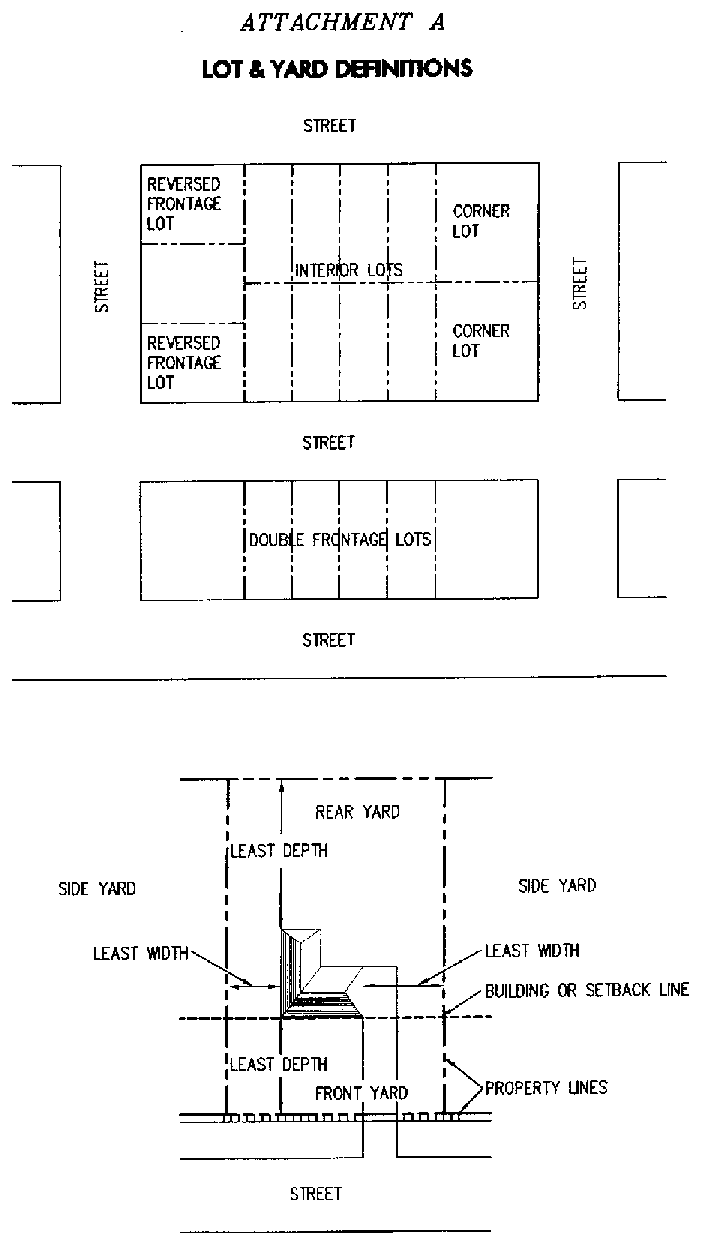
LOT, CORNER: A lot abutting upon two (2) or more streets at their intersection.
LOT, DEPTH: The mean horizontal distance between the front and rear lot lines.
LOT, DOUBLE FRONTAGE: A lot having a frontage on two (2) nonintersecting streets, as distinguished from a corner lot.
LOT, INTERIOR: A lot other than a corner lot.
LOT LINES: The lines bounding a lot, including the right of way line of any public road or highway acquired by easement.
LOT OF RECORD: A lot which is part of a subdivision or official plat recorded in the office of the recorder of deeds for Hancock County or a lot or parcel described by metes and bounds, the description of which has been so recorded.
LOT, REVERSED FRONTAGE: A corner lot, the side street line of which is substantially a continuation of the front lot line of the first platted lot to its rear. (See attachment A of this section for illustrations of lot types.)
LOT WIDTH: The width of a lot measured at the building line and at right angles to its depth.
MANUFACTURED HOME: A factory built, single-family structure which is manufactured or constructed under the authority of 42 United States code (USC) section 5403, federal manufactured home construction and safety standards; and displays a seal from the United States department of housing and urban development; and was constructed on or after June 15, 1976, and is to be used as a place for human habitation; and is not constructed or equipped with a permanent hitch or other device allowing it to be moved other than for the purpose of moving to a permanent site; and which does not have permanently attached to its body or frame any wheels or axles.
For the purpose of these regulations, a manufactured home shall be considered the same as any site built, single-family detached dwelling. It shall be located in accordance with the setback, lot size, minimum square footage and hook up requirements for a site built, single-family detached dwelling on the same lot. It shall be installed with a permanent foundation system for a manufactured home as described in this section under the definition of "foundations".
MOBILE HOME: Any vehicle without motive power used or so manufactured or constructed as to permit its being used as a conveyance upon the public street or highways and so designed, constructed or reconstructed as will permit the vehicle to be used as a place for human habitation by one or more persons; but shall also include any such vehicle with motive power not registered as a motor vehicle in Illinois. A mobile home is not built to mandatory building code, contains no state or federal seals, and was built before June 15, 1976. A mobile home shall not be construed to be a travel trailer or other form of recreational vehicle. A mobile home is only permitted in an approved mobile home park.
MOBILE HOME PARK: Any lot or portion of a lot upon which one or more trailers or mobile homes, occupied for dwelling or sleeping purposes, are located, regardless of whether or not a charge is made for such accommodation.
MODULAR HOME: Factory built structure built on a permanent chassis which is manufactured to be used as place of human habitation; is constructed to comply with Illinois state building codes for modular factory built structures; and displays the seal issued by the state. Once certified by the state, a modular home shall be subject to the same standards as a site built home. It shall be located in accordance with the setback, lot size, minimum square footage and hookup requirements for a site built, single-family dwelling or multi-family dwelling on the same lot, whichever is applicable. It shall be installed with a permanent foundation system as required by codes for a site built, single- family or multi-family detached dwelling, whichever is applicable.
NONCONFORMING BUILDING: A nonconforming building or structure is one that does not meet the space and/or bulk standards of the district in which it is located. It is allowed solely because it was in lawful existence as of the effective date hereof or as of the effective date of any subsequent amendment which rendered the building nonconforming.
NONCONFORMING LOT: A single lot which as of the effective date hereof or as of the effective date of any subsequent amendment does not meet the minimum lot area, net lot area per dwelling unit, minimum street frontage, or other similar lot requirements of the district in which it is located. It is allowed solely because it was in lawful existence as of the effective date hereof or as of the effective date of a subsequent amendment which rendered the lot nonconforming.
NONCONFORMING USE: A use of premises that is not a permitted or conditional use in the district in which it is located, but which is allowed to remain solely because it was in lawful existence as of the effective date hereof or as of the effective date of any subsequent amendment which rendered the use nonconforming.
NURSING OR CONVALESCENT HOME: A building or structure having accommodations and where care is provided for invalid, infirm, aged, convalescent or physically disabled or injured persons.
PERMANENT: Continuing or enduring for a minimum of sixty (60) days in the same state, status, place, or the like, without fundamental or marked change, not subject to fluctuation, or alteration, fixed or intended to be fixed; lasting; abiding; stable; not temporary or transient. Generally opposed in law to "temporary", but not always meaning "perpetual".
PRINCIPAL USE: The main use of land or structures as distinguished from an accessory use.
RECREATIONAL VEHICLE: Every camping trailer, motor home, mini- motor home, travel trailer, truck camper or van camper used primarily for recreational purposes and not used commercially nor owned by a commercial business.
RESIDENT: Any person who occupies a dwelling within the state, has a present intent to remain within the state for a period of time, and manifests the genuineness of that intent by establishing an ongoing physical presence within the state together with indicia that his presence within the state is something other than transitory in nature.
RIGHT OF WAY: Entire width of property dedicated for public uses, such as streets, sidewalks, water and sewer lines, and the like.
SIGN: Any identification, description, illustration, or device, illuminated or nonilluminated, which is visible to the general public and directs attention to a product, service, place, activity, person, institution, business or solicitation, including any permanently installed or situated merchandise; or any emblem, painting, flag, banner, pennant, or placard designed to advertise, identify or convey information. Sign supports are considered part of the sign. (See attachment C of this section for sign type illustration.)
SIGN, ANIMATED: A sign which involves motion or rotation of any part, created by artificial means, or which displays flashing, revolving or intermittent lights.
SIGN AREA: The entire background area of a sign upon which copy could be placed. In computing area of a sign background, only that face or faces which can be seen from one direction at one time shall be counted. The supporting incidental structure of the sign shall not be used in computing sign area. (See attachment C of this section for sign area illustration.)
SIGN, AWNING: A sign that is mounted or painted on, or attached to an awning, canopy, or marquee.
SIGN, CHANGEABLE COPY: Any wall or ground sign or portion thereof with characters, letters, or illustrations that can be changed or rearranged without altering the face or the surface of the sign, excluding time/temperature signs.
SIGN, COPY: The message or advertisement, and any other symbols on the face of a sign.
SIGN, DIRECTIONAL: A sign identifying entrances, exits, aisles, ramps, and similar traffic related information.
SIGN FACE: The area or display surface used for the message.
SIGN, GROUND OR MONUMENT: Any sign placed upon or supported by the ground independent of any other structure.
SIGN, INFORMATION: A sign which identifies a residence, a noncommercial activity, including historic markers, or a sign conveying cautionary and similar information.
SIGN, POLE: Any sign supported by uprights or braces placed upon or in the ground and not attached to any building.
SIGN, PORTABLE: A sign that is not permanent, affixed to a building, structure, or to the ground. Such sign may be mounted on wheels to make it transportable.
SIGN, PROJECTING: A sign that is wholly or partly dependent upon a building for support and which projects more than twelve inches (12") from such building.
SIGN, ROOF: A sign that is mounted on the roof of a building or which is wholly dependent upon a building for support and which projects above the point of a building with a flat roof, the eave line of a building with a gambrel, gable, or hip roof, or the deck line of a building with a mansard roof.
SIGN, TEMPORARY: A sign intended for use for only a limited period of time.
SIGN, WALL: A sign fastened to or painted on the wall of a building or structure in such a manner that the wall becomes the supporting structure for, or forms the background surface of the sign and which does not project more than twelve inches (12") from such building or structure.
SIGN, WINDOW: A sign that is applied or attached to the interior of a window or located in such a manner within the building that it can readily be seen from the exterior of the building through a window.
SPECIAL USE PERMIT: A permit granted by the planning commission in any zoning district for a special use listed in chapter 10 of this title. The planning commission may grant a special use permit provided that:
A. The use is specifically authorized as a special use in chapter 10 of this title;
B. All other requirements of this title are met;
C. The special use will not create a danger to the public health, safety, or welfare; nor cause an extraordinary public expense, nor create a nuisance.
STABLE, PRIVATE: A detached accessory building for the keeping of livestock owned by the occupants of the premises and not kept for hire, remuneration, or sale.
STABLE, PUBLIC: A detached accessory building where horses are boarded and/or kept for hire.
STORY: That portion of a building included between the surface of any floor and the surface of the floor next above it. If there is no floor above it, then the space between such floor and the ceiling or roof next above it shall be considered a story.
STORY, HALF: A space under a sloping roof which has the line of intersection of roof decking and exterior wall face not more than four feet (4') above the top floor level.
STRUCTURAL ALTERATIONS: Any change other than incidental repairs, in the supporting members of a building or structure such as bearing walls or partitions, columns, beams or girders, or any substantial change in the roof or exterior walls.
STRUCTURE: Anything constructed or erected, the use of which requires location on the ground, or attachment to something having location on the ground.
TEMPORARY: That which is to last for a limited time only, as distinguished from that which is perpetual, or indefinite, in its duration. Opposite of permanent.
TIMESHARE: The renting of a single piece of real estate, often a vacation home, to many different parties, each having a specified block of time during which they may use it. Rental is on a transient basis and for a charge, meaning any form of remuneration such as cash, goods, services, barter, donations, forgiveness of indebtedness, or other like payment. Timeshare property rental income is subject to the city of Nauvoo's hotel-motel tax.
TRAILER PARK: See definition of Mobile Home Park.
TRANSIENT: One who, or that which, is temporary. Synonymous with transitory, fugitive, fleeting, momentary.
TRANSIENT PERSON: Within venue statute, one who is found in state but who has no fixed place of residence therein. Person is in a place only temporarily.
TRAVEL TRAILER: A recreational vehicle not used commercially, with or without motive power, designed as a temporary dwelling, not exceeding eight feet (8') in width and forty feet (40') in length, exclusive of a separate towing unit. The term travel trailer shall include a pickup coach, motor home, camp trailer or other similar mobile and temporary dwellings commonly used for travel, recreation or vacation quarters.
TRAVEL TRAILER PARK: A place where three (3) or more recreational vehicles are parked for six (6) or more days in a calendar year.
VACATION HOME: A home used for recreational purposes that may also be rented out at times to others. Rental is on a transient basis and for a charge, meaning any form of remuneration such as cash, goods, services, barter, donations, forgiveness of indebtedness, or other like payment. Vacation home rental income is subject to the city of Nauvoo's hotel-motel tax. Note: The property is classified as a vacation home rental if your personal use is more than the longer of fourteen (14) days or ten percent (10%) of the number of days actually rented during the year at a fair market value.
YARD: An open space on the same lot with a building or structure unoccupied and unobstructed by any portion of a structure from thirty inches (30") above the general ground level of the graded lot upward, except as may be provided by other sections of this title. In measuring a yard for the purpose of determining the depth of a front yard or the depth of a rear yard, the least distance between the lot line and the main building shall be used. In measuring a yard for the purpose of determining the width of a side yard, the least distance between the lot line and the nearest permitted building shall be used. Structural or mechanical devices added to existing structures to make them accessible to physically disadvantaged persons may encroach into the required setbacks and buffers. (See attachment A of this section for yard illustration.)
YARD, FRONT: A yard extending across the full width of the lot and measured between the front line and the building or any projection thereof, other than the projection of the usual steps or unenclosed porches. On corner lots, the front yard shall be considered as the yard adjacent to the street upon which the lot has its least dimension. Certain architectural features, such as, but not limited to, cornices, eaves, stoops and gutters, may project no more than three feet (3') into the required front yard. (See attachment A of this section for yard illustration.)
Where the average of the front yard setbacks for all adjacent lots, which are located within two hundred feet (200') of either side of a lot, is less than the minimum required front yard, the required setback line may be reduced to this lesser average depth, but in no case, to less than ten feet (10'). For the purpose of computing such average, an adjacent vacant lot shall be considered, as having the minimum required front yard setback specified for the zoning district.
YARD, REAR: A yard extending across the full width of the lot and measured between the rear lot line and the building or any projections other than steps, unenclosed balconies or unenclosed porches. On both corner lots and interior, the opposite end of the lot from the front yard. Certain architectural features, such as, but not limited to, cornices, eaves, stoops and gutters, may project no more than five feet (5') into the required side yard. (See attachment A of this section for yard illustration.)
YARD, SIDE: A yard extending from the front yard to the rear yard and measured between the side lot lines and the nearest building. Certain architectural features, such as, but not limited to, cornices, eaves, stoops and gutters, may project no more than two feet (2') into the required side yard. (See attachment A of this section for yard illustration.)
(Ord. 2001-2, 6-12-2001; amd. Ord. 2003-11, 4-13-2004; Ord. 2004-14, 6-14-2005; Ord. 2005-16, 5-9-2006; Ord. 2008-12, 6-9-2009)
10-1-4: ESTABLISHMENT OF DISTRICTS:
In order to carry out the purpose and intent of this title, the area of the city is hereby divided into ten (10) zoning district classifications as follows:RRRural residential districtRSingle- and two-family residential dwelling districtRMFResidential multiple-family dwelling districtRMHResidential mobile home park districtTTPTravel trailer park districtOMOutdoor museum districtCCommercial districtCBDCentral business districtILight industrial districtPUDPlanned unit development district
(Ord. 2001-2, 6-12-2001)
10-1-5: BOUNDARIES AND OFFICIAL MAP:
The boundaries of these districts are indicated upon the official zoning map of the city, which is made a part of this title by reference hereto. The official zoning map and all notations, references and other matters shown thereon shall be as much a part of this title as if the notations, references and other matters set forth by said map were all fully described herein.
The official zoning map shall be on file in the office of the city clerk and shall be identified by the signature of the mayor attested by the city clerk under the certification that this is the official zoning map referred to in section 18-2 of the zoning ordinance. A copy of the official zoning map shall be available for public inspection in city hall during normal business hours.
If, in accordance with the provisions of this title, changes are made in the district boundaries or other matter portrayed on the official zoning map, the ordinance number and date of said change shall be recorded by the city clerk on the official zoning map.
A revised zoning map shall be produced by the city at the end of each fiscal year upon which are delineated all amendments and changes that occurred during that fiscal year. The city council shall adopt a new official zoning map at the end of the fiscal year, if necessary, which shall supersede the prior official zoning map.
Where uncertainty exists as to the boundaries of districts as shown on the official zoning map, the following rules shall apply:
A. If a boundary is on or in a street, alley, highway, road, or other public right of way, or follows a river, streambed, drainageway or railroad track, then such a zone boundary shall be the center of the street, alley, highway, road, other public right of way, river, streambed, drainageway or railroad track.
B. If a boundary line follows lot or property boundary lines, then such lot or property lines shall be construed to be the zone boundaries.
C. In the case of unsubdivided property, where a zone boundary divides a lot or parcel, the location of the zone boundary, unless precisely indicated on the zoning map by dimensions or legal description, shall be determined by the use of the scale appearing on the zoning map.
D. Upon vacation or abandonment of any public street, alley, right of way, or any public easement, the area vacated or abandoned shall be included in the same zone as the property to which it reverts unless otherwise specified in the instrument of vacation or abandonment.
E. The planning commission shall, by written decisions, determine the location of any zone boundaries whose location is in dispute or uncertain. (Ord. 2001-2, 6-12-2001)

