
Nauvoo City Zoning Code
CHAPTER 3
OFF STREET PARKING AND LOADING
10-3-4: CBD Off Street Parking Requirements
10-3-1: STATEMENT OF INTENT:
It is the purpose and intent of this chapter that off street parking and loading areas be provided and adequately maintained in every zoning district for the purposes of promoting safe and efficient parking of motor vehicles; to avoid unnecessary congestion and interference with public use of streets; and to protect and preserve the appearance, character, and value of the surrounding neighborhoods. (Ord. 2001-2, 6-12-2001)
10-3-2: GENERAL PROVISIONS:
A. In all zoning districts, off street parking and loading requirements shall be provided in amounts not less than specified for the various districts.
B. The planning commission, after consultation with the city engineer, shall make a determination, in the cases of uses not listed in section 10-3-3 of this chapter of the minimum required off street parking spaces.
In reaching the determination, the planning commission and the city engineer, shall be guided by the requirements for similar uses, the number and kind of vehicles likely to be attracted to the proposed use and studies of the parking requirements of such uses in other jurisdictions.
The planning commission may approve alternative parking standards in situations where an applicant can sufficiently demonstrate that a particular situation is unusual, unique, or poses practical difficulty, and upon submission of adequate technical justification such as independent parking analysis, Urban Land Institute (ULI) or Institute of Transportation Engineers (ITE) parking standards, or similar justification.
C. Additional parking shall be provided and maintained in proper ratio to any increase in floor area or building use capacity.
D. For the purposes of determining off street parking and loading requirements, the following provisions shall apply:
1. "Usable floor area" as applied to offices, merchandising or service types of uses, shall mean the floor area used or intended to be used for services to the public as customers, patrons, clients, patients, or tenants, including areas occupied by fixtures and equipment used for display or sale of merchandise, but excluding floor areas which are used exclusively for storage, for housing of mechanical equipment integral to the building, for maintenance facilities, stairwells, restrooms, or for those areas so restricted that customers, patients, clients, salesmen, and the general public are denied access. Measurement of usable floor area shall be the sum of the horizontal area of each story of a structure measured from the interior faces of the exterior walls.
2. Where benches, pews or other similar seating facilities are used as seats, each twenty four inches (24") of such seating facilities shall be counted as one seat.
E. In the case of mixed uses in the same building at the same time, the total requirements for off street parking and loading shall be the sum of the requirements for the separate individual uses computed separately.
F. Joint or collective provision of off street parking for buildings or uses on two (2) or more properties shall not be less than the sum of the requirements for the participating individual uses computed separately.
G. It shall be unlawful to use any of the off street parking or loading areas established to meet the requirements of this title for any purpose other than the parking of licensed vehicles or the loading and unloading of necessary service trucks.
H. Off street parking shall be no closer to any principal building than five feet (5'). Bumper guards shall be installed to prevent yard encroachment.
I. In the residential zoning districts and in C and I districts within fifty feet (50') of a residential zoning district, no parking space may be located in a front yard.
J. Parking spaces may be provided in side and rear yards in the residential zoning districts and in any yard in C and I districts except that in the C and I districts no parking space may be provided in a front yard unless the building is set back at least thirty feet (30') from the street, and further provided that the parking use must conform to the permitted land use for the district.
K. Parking spaces for any use specifically permitted in a residential zoning district may be provided on a lot adjoining that use provided there is compliance with all the requirements of subsections I and J of this section.
L. Where parking is provided in a commercial district adjacent to a residential district or where five (5) or more parking spaces are provided for use in a residential district adjacent to a residential district, all parking spaces, loading spaces and drives, shall be set back from the residential district fifteen feet (15'). This setback shall be a landscaped area providing sight proof landscaping and/or fencing to screen the use from adjacent properties as approved on a site plan per requirements in chapter 4 of this title.
M. Where parking is provided in a manufacturing district adjacent to a residential district, all parking spaces, loading spaces and internal drives except for fire lanes, ingress and egress, shall be set back from the residential district thirty feet (30'). This setback shall be a landscaped area providing sight proof landscaping and/or fencing to screen the use from adjacent properties as approved on a site plan per requirements in chapter 4 of this title.
N. When determination of the number of off street parking spaces or loading spaces required by this title results in a requirement of a fractional space, any fraction in excess of one-half (1/2) shall be counted as one parking space; any fraction of one-half (1/2) or less may be disregarded.
O. No repairs or services to vehicles shall be carried on or permitted in off street parking areas.
P. No vehicular display for purpose of sale shall be carried on or permitted upon such premises unless such display is by a licensed automobile dealer on a properly zoned parcel.
Q. In the residential zoning districts, the only off street parking permitted is that parking which is an accessory use to the primary residential dwelling. The use of an off street parking lot in a residential district by a nearby or adjacent to a commercial use is prohibited.
R. Off street parking required for enlargements or change of use. Existing buildings not complying with off street parking requirements may be remodeled, repaired and structurally altered, but any enlargement or change of use of a structure or building which would require a greater number of parking spaces than was required for the prior use must provide the required parking spaces for such enlargement or use. (Ord. 2001-2, 6-12-2001)
10-3-3: OFF STREET PARKING REQUIREMENTS:
The minimum number of off street parking spaces, including garage parking spaces, by type of use shall be determined in accordance with the following schedule:
Use | Minimum Number Of Standard Off Street Parking Spaces Per Unit Of Measure |
Use | Minimum Number Of Standard Off Street Parking Spaces Per Unit Of Measure | ||
A. Residential And Housing Uses: | |||
1. Bed and breakfast | 1 space per guestroom, plus 2 spaces for residents. | ||
2. Boarding house | 1 space per guestroom, plus 2 spaces for residents. | ||
3. Dormitory | 1 space for each 3 persons in residence. | ||
4. Fraternity or sorority | 1 space for each 3 persons in residence. | ||
5. Group homes, halfway houses, community living facilities | 1 space for each 2 beds plus 1 space for each employee. | ||
6. Homes for the aged and convalescent homes | 1 space for each 4, plus 1 space for each employee. | ||
7. Mobile home parks | 2 spaces for each dwelling unit. | ||
8. Residential, multiple-family | 2 spaces for each dwelling unit. | ||
9. Residential, one-family and two-family | 2 spaces for each dwelling unit. | ||
10. Timeshare/vacation home | 2 spaces for each dwelling unit containing 3 or more bedrooms. | ||
B. Institutional And Cultural: | |||
1. Churches, temples buildings of similar use with fixed seats | 1 space for each 3 seats. | ||
2. Elementary and junior high | 1 space for each 1 teacher and administrator, in addition to the requirements of the auditorium and/or similar place(s) of assembly. | ||
3. Libraries, museums and post office buildings | 1 space for each 800 square feet of usable floor area. | ||
4. Lodge halls, meeting halls, and community centers or buildings of similar use without fixed seats | 1 space for each 5 persons of legal capacity as established by local, county, or state fire, building or health codes. | ||
5. Preschool childcare (day nurseries) | 1 space for each employee. Sufficient area shall be set aside for dropping off and picking up children in a safe manner that will not cause the children to cross the parking area or lines of traffic. | ||
6. Public office building not elsewhere specified | 1 space for each 300 square feet of usable floor area, plus 1 space for each employee employed therein. | ||
7. Senior high schools, vocational schools, and community colleges | 1 space for each 1 teacher and administrator and 1 space for each 10 students, in addition to the requirements of the auditorium and/or similar place of assembly. | ||
8. Theaters and auditoriums | 1 space for each 4 seats. | ||
C. Business And Commercial: | |||
1. Assembly halls, without fixed seats, for commercial recreation including dance halls, pool or billiard parlors, skating rinks and exhibition halls or buildings for similar assembly uses | 1 space for each 50 square feet of usable floor area. | ||
2. Auction house | 1 space per 2 seats or 2 per 100 square feet of gross leasable area, whichever is greater. | ||
3. Auto body shop | 1 space per service bay and 1 space per employee. | ||
4. Automobile service stations | 2 spaces for each lubrication stall, rack or pit, and 1 space for each employee. | ||
5. Auto parts store | 1 space per 200 square feet of usable floor area, plus 1 space for each employee. | ||
6. Auto rental | 1 space per 400 square feet of gross floor area. | ||
7. Auto wash (automatic) | 1 space for each 1 employee. In addition, adequate waiting space for autos shall be provided on the premises to accommodate 50 percent of the hourly rate of capacity. | ||
8. Auto wash (self-serve) | 1 space for each 1 employee. In addition, adequate waiting space for autos shall be provided on the premises to accommodate 50 percent of the hourly rate of capacity. | ||
9. Bait shop | 1 space per 200 square feet of usable floor area. | ||
10. Beauty parlor or barbershop | 2 spaces per beauty or barber chair. | ||
11. Convenience store | 1 space for each 200 square feet of usable floor area, plus 1 space per employee. | ||
12. Drive in restaurants or similar drive in uses for sale of beverages, food or refreshments | 1 space for each 15 square feet of usable floor area, plus 1 space for each 1 employee on the largest work shift. | ||
13. Drive through facility (see also restaurant and bank drive through) | For uses not mentioned with drive through windows, provide a minimum of 3 stacking spaces for each drive through window. Each line of stacking space must be at least 9 feet wide and must be delineated with pavement markings. Such spaces shall be designed so as not to impede pedestrian or vehicular circulation on the site or on any abutting street. | ||
14. Dry cleaning | 3 spaces, plus 1 space for each 500 square feet of gross floor area in excess of 1,000 square feet. | ||
15. Furniture and appliance stores; household equipment repair shops; showroom of a plumber, decorator, electrician or similar trade; shoe repair and other similar uses | 1 space for each 400 square feet of usable floor area. (For that floor area used in processing, 1 additional space shall be provided for each 2 persons employed therein.) | ||
16. Laundromats and coin operated dry cleaners | 1 space for each 2 washing machines. | ||
17. Mortuary establishments | 1 space for each 50 square feet of usable floor space. | ||
18. Motel, hotel, or other commercial lodging establishments | 1 space for each 1 occupancy unit, plus 1 space for each 1 employee, plus extra spaces for dining rooms or meeting rooms as required by subsections B4 and C20 of this section where the capacity of such areas exceeds the number of beds in the building. | ||
19. Motor vehicle, boat, camper, recreational vehicle sales and service establishments | 1 space for each 200 square feet of usable floor space of salesroom and 1 space for each 1 auto service stall in the service room. | ||
20. Restaurant or establishments for sale and consumption of beverages, food or refreshments on the premises | 1 space per 2.3 persons maximum occupancy. | ||
21. Restaurant with drive through window | 1 space per 2.3 persons maximum occupancy. In addition, a minimum of 11 stacking spaces are to be provided for the drive through window, with a minimum of 5 spaces between ordering and pick up. Each line of stacking space must be at least 9 feet wide and must be delineated with pavement markings. Such spaces shall be designed so as not to impede pedestrian or vehicular circulation on the site or on any abutting street. | ||
22. Retail stores except as otherwise specified herein (includes antique stores and antique malls) | 1 space for each 200 square feet of usable floor space. | ||
D. Offices: | |||
1. Banks or other financial institutions without drive through facilities | 1 space for each 150 square feet of usable floor space. | ||
2. Banks or other financial institutions with drive through facilities | 1 space for each 150 square feet of usable floor space, plus 5 stacking spaces for each drive through teller station, including automatic teller machines. Each lane of stacking space must be at least 9 feet wide and must be delineated with pavement markings. Such spaces shall be designed so as not to impede pedestrian or vehicular circulation on the site or on any abutting street. | ||
3. Business offices or professional offices except as indicated in subsections D4, D5 and D6 of this section | 1 space for each 200 square feet of usable space. | ||
4. Equipment rental and leasing | 1 space for each 300 square feet of usable floor area. | ||
5. Exterminators | 1 space for each 800 square feet of gross floor area. | ||
6. Professional offices of doctors, dentists, veterinarians, or similar professions | 1 space for each 25 square feet of usable floor area in waiting rooms, and 1 space for each examining room, dental chair, or similar use area. | ||
E. Recreational: | |||
1. Boat dock, harbor, marinas | 0.7 spaces for every berth or mooring, 2 spaces for every 3 employees on the largest work shift, plus 1 space for every vehicle customarily used in operation of the use or stored on the premises. | ||
2. Bowling alleys | 4 spaces for each 1 bowling lane plus 1 space per employee, in addition to requirements for a place serving food or beverages on the site. | ||
3. Dance school, gymnastics and fitness complex, community center | 1 space for each 300 square feet of usable floor space. | ||
4. Golf course | 6 spaces for each golf hole and 1 space for each employee on the largest work shift. | ||
5. Golf driving range | 1 space per tee, plus 1 space per employee on the largest work shift. | ||
6. Miniature or par 3 golf courses | 3 spaces for each 1 hole plus 1 space for each 1 employee. | ||
7. Private golf clubs, swimming pool clubs, tennis clubs, or other similar uses | 1 space for each 2 member families or individuals, plus spaces required for each accessory area such as a restaurant, bar, pro shop, or equipment sales. | ||
8. Public swimming pool | 2 spaces for every 100 square feet of water area, plus 1 space for each employee on the largest work shift. | ||
9. Stadium, sports arena, or similar place of assembly | 1 space for each 3 seats or 6 feet of benches, and 1 space for each 1 employee. | ||
F. Industrial: | |||
1. Manufacturing, fabrication, sheet metal and welding shops, junkyards, salvage yards, meatpacking plants, wholesale distribution, warehouses, reclamation plants, mail order sales | 1 space for every employee on the largest work shift, plus 1 space for every vehicle customarily used in operation of the use or stored on the premises. | ||
(Ord. 2001-2, 6-12-2001; amd. Ord. 2003-11, 4-13-2004)
10-3-4: CBD OFF STREET PARKING REQUIREMENTS:
A. Purpose: It is the purpose and intent of this section to apply flexible off street parking and loading requirements for the central business district (CBD). The goal is to accommodate the special needs of the area, encourage and promote redevelopment, optimize existing parking facilities, promote shared parking and public transportation, and prevent existing historic structures from being demolished for new parking areas. The parking regulations are waived in the CBD to aid in the renewal and rebuilding of the downtown.
B. General Provisions:
1. For purposes of this section, the central business district (CBD) shall be defined as areas with CBD zoning.
2. All buildings in the CBD are exempt from parking requirements. The private market will ensure an adequate parking supply.
3. No off street parking spaces shall be permitted in front of a structure.
4. The reciprocal (shared) use of parking facilities provided to serve any property or use is encouraged in the CBD. The applicant shall show that there is no substantial conflict in the principal operating hours of the buildings or uses for which the reciprocal use of parking is proposed. A reciprocal parking agreement shall be approved by the planning commission and recorded with the Hancock County recorder's office.
5. All shared parking facilities shall be located within six hundred feet (600') (horizontal distance) of the use served.
6. Shared parking proposals involving existing municipal parking lots shall be reviewed during the site plan review process.
7. The use of parking lot landscaping at the perimeter, adjacent to streets and on landscape islands is strongly encouraged but not required. If landscaping is to be provided, a landscaping plan shall be submitted with the site plan for review by the planning commission.
8. Property owners seeking to demolish historic structures in the CBD shall comply with section 6-2-1, "Destruction To Historical Buildings Restricted", of this code.
9. Where parking is provided in the CBD adjacent to a residential zoning district, all parking spaces, loading spaces and drives shall be set back from the residential zoning district ten feet (10'). This setback shall provide sight proof landscaping and/or fencing to screen the use from adjacent properties as approved on a site plan per requirements in chapter 4 of this title. (Ord. 2001-2, 6-12-2001)
10-3-5: EXCLUSIONS, REDUCTIONS AND EXCEPTIONS FROM THE PARKING REQUIREMENTS:
A. Off street parking and loading regulations shall not apply to uses approved or existing prior to the enactment of this title. All off street parking regulations do not apply to the central business district except in case of new structures or additions, then parking regulations shall be followed as defined in this chapter. (Ord. 2007-11, 5-13-2008)
B. The planning commission or their authorized designee may grant a parking reduction for commercial developments, industrial developments and mixed use developments not to exceed twenty percent (20%) of the required parking. For parking reductions greater than twenty percent (20%) of the required parking, the applicant must petition the zoning board of appeals. To qualify, the applicant must submit documentation which meets the following criteria, as applicable, during the site plan review process:
1. The parking needs will be adequately served.
2. A mix of residential uses with either office or retail uses is proposed, and the parking needs of all uses will be accommodated through shared parking.
3. If shared use of common parking is proposed, varying time periods of use will accommodate proposed parking needs. The applicant shall show there is no substantial conflict in the principal operating hours of the buildings or uses (activities) for which the shared use of parking is proposed.
4. The applicant provides an acceptable proposal for an alternate mode of transportation program, including a description of existing and proposed facilities and assurances that the use of alternate modes of transportation will continue to reduce the need for on site parking on an ongoing basis.
5. The joint use of abutting traversable driveways on adjoining properties may be permitted to satisfy the driveway requirements of this title subject to the following conditions:
a. A recordable instrument conveying the right of shared use, duly executed by the affected property owners, is furnished to corporate counsel and recorded by the Hancock County recorder of deeds;
b. Said instrument is approved by the corporate counsel; and
c. Said instrument shall clearly state that it is terminable only with the consent of the city of Nauvoo.
C. If any reduction sought under this section is directly related to the nature of the use and occupancy of the property, any material change in such use of occupancy shall nullify such reduction. (Ord. 2001-2, 6-12-2001)
10-3-6: SITE DEVELOPMENT AND CONSTRUCTION REQUIREMENTS:
A. Paved And Drainage: Off street parking and loading for all uses except single-family dwelling units shall be paved and shall be provided with adequate drainage to dispose of all surface water.
B. Safety Curbs: Where any parking area adjoins an existing or proposed sidewalk, the owner shall erect safety curbs on the private property to prevent vehicles from crossing the sidewalk, excepting in the case of a single-family lot.
C. Pavement Surface: Loading areas, parking lots, driveways, accessways and any other areas on which motor vehicles are parked or stored, or which are used for motor vehicle circulation, shall be constructed with a dust free surface. Acceptable pavement surfaces include concrete, asphalt, or oil and chip. Concrete wheel stops shall be used on oil and chip surfaces to designate the parking stalls in lieu of painted striping. Property owners are allowed to have a temporary gravel surface for a maximum period of one year. This stipulation is intended to allow time for settlement, compaction or allow for off season construction.
D. Curbs And Gutters: Combination concrete curbs and gutters or concrete barrier curbs are required around all landscape islands. The materials and design shall conform to the specifications contained in the most recent edition of the "Standard Specifications For Road And Bridge Construction", adopted by the Illinois department of transportation.
E. Striping: Single striping shall be provided for all parking stalls as a minimum. Each stripe shall be a minimum of four inches (4") in width and eighteen feet (18') in length for each parking space. Striping of each parking space shall be painted in yellow or white. Thermoplastic pavement markings are an acceptable alternative. All areas designated as fire lanes shall be marked by posting of signs and/or yellow markings, provided that signs shall be used wherever feasible.
F. Restriping: Parking lots existing prior to the date of this title may be restriped in the course of normal maintenance in accordance with their original plans and requirements.
G. Parking Lot Design: The following are requirements for parking lot design:
1. Circulation aisles shall align with one another.
2. Smooth and efficient on site circulation must be provided.
3. Shared interconnects and shared driveways with adjoining properties shall be provided wherever feasible as determined by the planning commission or their authorized designee.
4. All parking stalls shall have a minimum dimension of nine feet (9') wide by eighteen feet (18') long. This rectangular area must be included in all shapes of parking stalls for any angle of parking. An automobile overhang may be included in stall depth calculations where such overhang does not extend beyond a required parking setback line or encroach upon a sidewalk. When an automobile overhang beyond an installed curb is included in the stall depth calculation, such overhang shall be considered as part of the parking stall for landscaping or setback purposes.
H. Access: Except on lots accommodating single-family dwellings, each off street parking space shall open directly upon an aisle or driveway at least twelve feet (12') wide for one-way travel or twenty four feet (24') wide for two-way travel. However, a ten foot (10') wide aisle for one-way travel is permitted provided that there are no points of vehicular or pedestrian access to any building from the driving aisle. The minimum width of an access drive intersecting a street or alley is twenty four feet (24') for two-way travel or twelve feet (12') for one-way travel. The minimum return radius from an access drive to a street or alley shall be twenty feet (20') as measured from the back of the curb wherever possible.
I. Maintenance: Upon completion, all parking areas shall be properly maintained at all times, without potholes, broken curbing, or other irregularities. (Ord. 2001-2, 6-12-2001)
10-3-7: PHYSICALLY HANDICAPPED OFF STREET PARKING PROVISIONS:
A. Required Number Of Spaces: If any parking is provided for employees, visitors, or both, the minimum number of accessible parking spaces to be provided for handicapped persons shall be according to the current edition of the Illinois accessibility code. Accessible parking spaces to be provided for handicapped persons are as follows:
SPACE REQUIREMENTS
Total Off Street Parking Spaces
Provided | Number Of Accessible Parking Spaces Required |
Total Off Street Parking Spaces
Provided | Number Of Accessible Parking Spaces Required | |
1 to 25 | 1 | |
26 to 50 | 2 | |
51 to 75 | 3 | |
76 to 100 | 4 | |
101 to 150 | 5 | |
151 to 200 | 6 | |
201 to 300 | 7 | |
301 to 400 | 8 | |
401 to 500 | 9 | |
501 to 1,000 | 2 percent of total number | |
Over 1,000 | 20 plus 1 for each 100 over 1,000 | |
Medical facilities specializing in treatment of persons with mobility impairments | 20 percent of total number | |
Outpatient medical facilities | 10 percent of total number | |
(Ord. 2001-2, 6-12-2001)
Note: If only one space is provided, it must be van accessible. (Ord. 2007-16, 6-10-2008)
B. Location: Accessible parking spaces shall be placed on the shortest accessible route to an accessible entrance of the building. The accessible parking space shall be placed nearest an existing ramp, even if it means placing the space further from the accessible door. The ramp, however, must not be placed in an access aisle. If a curb ramp is new, both the curb ramp and the accessible parking space must be closest to the accessible entrance. (Ord. 2001-2, 6-12-2001)
C. General Provisions: Accessible car and van parking spaces shall comply with ICC/ANSI A177.1, chapter 5, section 502.
1. Vehicle Space Size: Car parking spaces shall be ninety six inches (96") (2,440 mm) minimum in width. Van parking spaces shall be one hundred thirty two inches (132") (3,350 mm) minimum in width.
a. Exception: Van parking spaces shall be permitted to be ninety six inches (96") (2,440 mm) minimum in width where the adjacent access aisle is ninety six inches (96") (2,440 mm) minimum in width.
Figure 502.2 Vehicle Parking Space Size
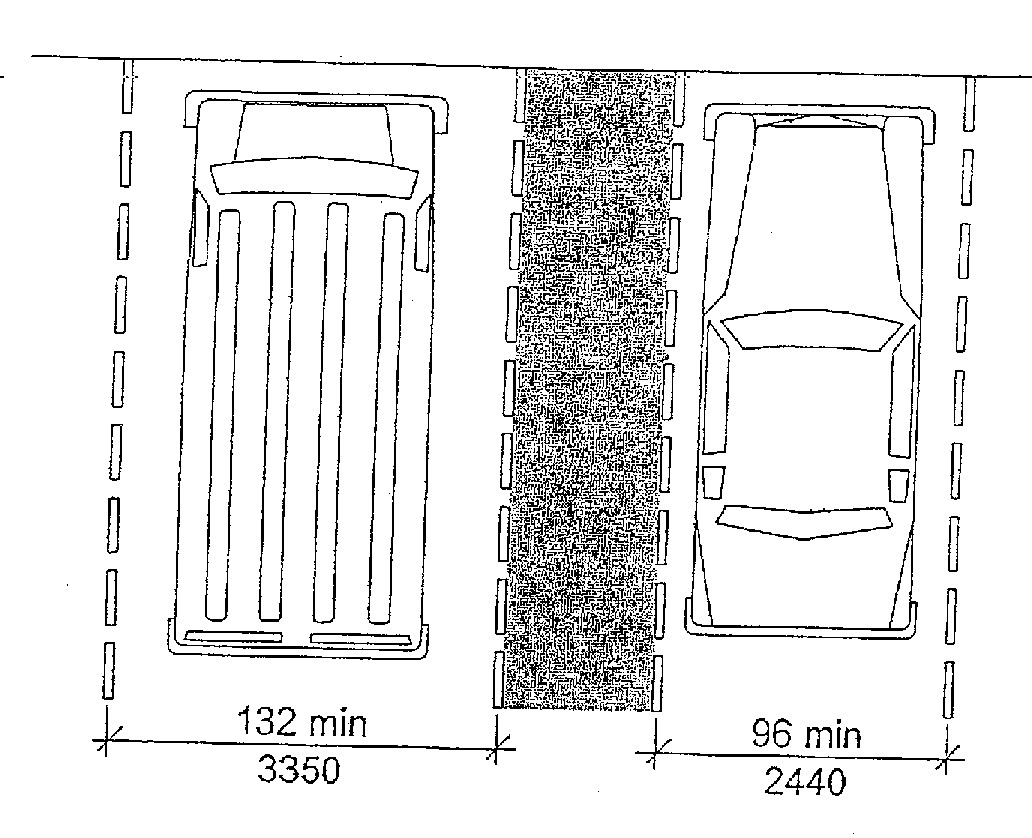
2. Vehicle Space Marking: Car and van parking spaces shall be marked to define the width. Where parking spaces are marked with lines, the width measurements of parking spaces and adjacent access aisles shall be made from the centerline of the markings.
3. Access Aisle: Car and van parking spaces shall have an adjacent access aisle complying with figure 502.4 of this section.
Figure 502.4 Parking Space Access Aisle

4. Location: Access aisles shall adjoin an accessible route. Two (2) parking spaces shall be permitted to share a common access aisle with the access aisle on the passenger side of the van space. Access aisles shall not overlap with the vehicular way. Parking spaces shall be permitted to have access aisles placed on either side of the car or van parking space. Van parking spaces that are angled shall have access aisles located on the passenger side of the parking space.
5. Width: Access aisles serving car and van parking spaces shall be sixty inches (60") (1,525 mm) minimum in width.
6. Length: Access aisles shall extend the full length of the parking spaces they serve.
7. Marking: Access aisles shall be marked so as to discourage parking in them. Where access aisles are marked with lines, the width measurements of access aisles and adjacent parking spaces shall be made from the centerline of the markings. (ICC/ANSI A177.1, chapter 5, 502.2-502.4.4, 2003.)
D. Parking Surfaces: Surfaces shall be stable, firm and slip resistant. Changes in level of surfaces shall comply with section 303 (ICC/ANSI A117.1, 2003).
E. Signage: Each handicapped parking space shall have a painted international symbol of accessibility on the pavement. In addition, all facilities shall mount on a permanent post, or wall, in the center of accessible parking spaces the following appropriate sign: a U.S. department of transportation R7-8 (reserved parking) sign, R7-8A (handicap parking) sign or R7-8C (van handicap parking) sign. Fines shall meet Illinois vehicle code (see subsection 9-2-3F of this code). These signs shall be posted no lower than four feet (4') aboveground and no more than five feet (5') from the front of the space. (Ord. 2007-16, 6-10-2008)
10-3-8: LANDSCAPING:
A. Purpose: It is the purpose and intent of these regulations to provide adequate protection for contiguous property against undesirable effects caused by the creation and operation of parking and loading areas, and to protect and preserve the appearance and character of the surrounding neighborhoods through the screening effects and aesthetic qualities of landscaping. The addition of landscaping in parking lots adjacent to streets, along the perimeter and in landscape islands is recommended when feasible. Landscaping not only improves the parking area aesthetically, but it provides a safety barrier between vehicles and pedestrians, it absorbs noise, traps dust, controls erosion, allows groundwater recharge, reduces the intrusion of headlights and other glare, and it provides a natural habitat for birds and other animal life.
B. Landscaping: Landscaping in parking lots adjacent to streets and around parking lots is recommended to improve the aesthetics of parking lots and to increase the amount of pervious surfaces which reduces the water runoff. Creative and attractive landscape designs are encouraged where landscaping is incorporated into the design of berms, fences, walls, etc.
If the property owner decides to install landscaping, the following items should be considered in order for the landscaping to survive and be successful:
1. Landscaping materials that are hardy and native to the area should be selected wherever feasible and the plantings should be free of insects and diseases.
2. Existing trees should be preserved to the greatest extent possible and incorporated into the design of the parking lot.
3. When selecting the landscaping species and location, consideration should be given to the location of underground and overhead utilities to avoid any interference.
4. Landscaping islands should be adequately sized to protect the landscaping to ensure its survival. Examples of minimal landscape island dimensions to consider are shown in figures 2, 3, and 4 of this section.
5. The best professional practices of the American society of landscape architects regarding planting, installation, trimming, fertilizing and other maintenance should be followed.


C. Quality: Plant material and grasses shall be of generally acceptable varieties and species, free of insects and diseases, and hardy to the Nauvoo area.
D. Maintenance Of Landscaping And Screening: All landscaping and screening should be installed and permanently maintained as follows:
1. All new landscaped areas should be installed within six (6) months after the occupancy or use of the building or premises. Dead plant materials should be replaced within twelve (12) months with living plant material, taking into consideration the season of the year, and shall have at least the same quantity and quality of landscaping as initially approved. This includes, but is not limited to, the replacement of plants damaged by insects, diseases, vehicular traffic, acts of God, and vandalism.
2. All landscaping and screening should be maintained in a healthy, neat, trimmed, clean and weed free condition. Landscaped areas should be covered with either grass and/or other types of pervious ground cover located beneath and surrounding the trees and shrubs.
3. Landscaped areas within and immediately adjacent to an off street parking or loading area should be protected from the encroachment of motor vehicles by placing, along the entire perimeter of the landscaped area, a six inch (6") concrete curb or other curbing material per the requirements in section 10-3-6 of this chapter.
E. Visibility: Parking lots and loading areas shall not allow foliage or other landscape screening structures to obstruct visibility or to create hazards for ingress or egress to these areas. Opaque landscaping, berms, fences or walls shall be no higher than thirty inches (30") in such locations where vehicular or pedestrian safety is a factor.
F. Outdoor Refuse Collection: Refuse areas shall not be located within front yards or within required parking setbacks. Outdoor refuse collection containers and similar facilities shall be screened from public view on all four (4) sides. The area shall be visually screened with an opaque material, which may include shrubs, walls, fences or berms that are a minimum of six feet (6') in height. Single-family homes shall be exempt from this provision. (Ord. 2001-2, 6-12-2001)
10-3-9: AREA REQUIREMENTS FOR OFF STREET LOADING/UNLOADING:
A. Purpose: The following regulations, applicable to new construction in all zoning districts except for single-family lots, are established to increase safety and decrease congestion in the public streets, to set standards for the requirement of off street loading facilities in proportion to the amount of traffic generated by each use, and to eliminate the on street parking of vehicles along major traffic routes.
B. Location: All required loading berths shall be located on the same zoning lot as the use served. No loading berth for vehicles over two (2) tons shall be closer than fifty feet (50') to any property in a residential district. No permitted or required loading berth shall be located within twenty five feet (25') of the nearest point of intersection of any two (2) streets. No loading berths shall be located in required side yards.
C. Design And Maintenance:
1. Size: The number and size of loading spaces must be equal to the maximum number and size of vehicles which would be simultaneously loaded or unloaded in connection with the business conducted on the property.
Each required loading berth shall have a minimum width of twelve feet (12') and a minimum vertical clearance of fourteen feet (14') above finished grade of the space. The length shall be a minimum of thirty feet (30') for local delivery and sixty feet (60') for semitrailers.
2. Access: Each required off street loading berth shall be designed with appropriate means of vehicular access to a street or alley in a manner which will least interfere with traffic movements.
3. Projection: No portion of a vehicle shall project into a street, drive, alley, or other public right of way while being loaded or unloaded.
4. Exclusive Use: Spaces allocated to any off street loading shall not, while so allocated, be used to satisfy the space requirements for any off street parking facilities or portions thereof.
5. Surfacing: All open off street loading finish surfaces shall comply with the provisions in section 10-3-6 of this chapter.
D. Repair And Service: No motor vehicle repair work or service of any kind shall be permitted in conjunction with loading facilities provided in any residential or commercial district. (Ord. 2001-2, 6-12-2001)

