
Neptune Beach City Zoning Code
ARTICLE I
- IN GENERAL2
Editor's note— Ord. No. 2004-10, § 1, adopted Oct. 4, 2004, amended art. I in its entirety to read as herein set out. Former art. I, §§ 27-1—27-23, pertained to similar provisions, and derived from Ord. No. 90-6-9, § 1, 9-12-90; Ord. No. 91-1-5, § 2, 5-6-91; Ord. No. 92-2-9, § 1, 9-8-92; Ord. No. 1994-15, §§ 1, 2, 8-1-94; Ord. No. 1995-04, § 1, 8-28-95; Ord. No. 2003-01, § 1, 2-3-03; Ord. No. 2003-02, § 1, 5-5-03.
Sec. 27-2. - Title.
This Code shall be entitled and may be cited as the "Unified Land Development Code of Neptune Beach, Florida" and may be referred to herein as the "Code."
(Ord. No. 2004-10, § 1, 10-4-04)
Sec. 27-3. - Authority.
This Unified Land Development Code is enacted pursuant to the requirements and authority of the Local Government Comprehensive Planning and Land Development Regulation Act, F.S. § 163.3202, the general powers as outlined in F.S. Ch. 166, as may be amended from time to time, and the Code of Federal Regulations (CFR) for the National Program Code of Federal Regulations (CFR) for the National Flood Insurance Program: 44 CFR Parts 59, 60, 65, and 70.
(Ord. No. 2004-10, § 1, 10-4-04; Ord. No. 2011-25, § 1, 12-5-11; Ord. No. 2012-11, § 2, 12-4-12; Ord. No. 2013-01, § 2, 5-6-13)
Sec. 27-4. - General applicability.
Except as specifically provided, the provisions of this Code shall apply to all development in the city, and no development shall be undertaken without prior authorization pursuant to this Code.
(Ord. No. 2004-10, § 1, 10-4-04)
Sec. 27-5. - Exceptions.
(a)
Previously issued development permits. The provisions of this Code and any amendments thereto shall not affect the validity of any lawfully issued and effective development permit if:
(1)
The development activity authorized by the permit has been commenced prior to the effective date of this Code or any amendment thereto, or will be commenced after the effective date of this Code but within six (6) months of issuance of the building permit; and
(2)
The development activity continues without interruption (except because of war or natural disaster) until the development is complete, and a city building inspection occurs at least once every six (6) months. If the development permit expires, any further development on that site shall occur only in conformance with the requirements of this Code or amendment thereto.
(b)
Previously approved development orders. Projects with development orders that have not expired at the time this Code or an amendment thereto is adopted, and on which development activity has commenced or does commence and proceeds according to the time limits in the regulations under which the development was originally approved, must meet only the requirements of the regulations in effect when the development plan was approved. If the development plan expires or is otherwise invalidated, any further development on that site shall occur only in conformance with the requirements of this Code or amendment thereto.
(Ord. No. 2004-10, § 1, 10-4-04)
Sec. 27-6. - General description of the code.
Chapter 27 contains unified land development regulations for the City of Neptune Beach, an integrated and unified set of procedures, conditions, and requirements which all development in the city must follow. Every attempt has been made to make this Code as easy as possible for interested residents, developers, and local government staff to use.
For organizational purposes, this Code is divided into eighteen (18) different articles. A description of each article follows:
Article I contains general provisions necessary to determine the applicability of the Code and to ensure its legal validity.
Articles II and III presents the mechanisms for the administration of this Code.
Article IV defines what uses are allowable and at what density or intensity.
Article V contains provisions for accessory structures and uses that are permitted along with principal uses as described in the previous article.
Article VI describes under what conditions and how the concurrency requirements shall be met. In order for the concurrency requirements to be met, each development proposal must show that, adopted levels of service for certain public facilities and services will not be degraded by the impact of the development.
The next three (3) articles describe whether any portions of a proposed development must remain totally or partially free of development activity.
Article VII addresses measures to protect potable water wellfields, article VIII outlines measures to protect the habitat of threatened and endangered species, and wetlands; and article IX provides for the protection of certain trees and installation of landscaping.
Once the developable portions of the site have been determined, the next question is how the actual development will be designed and what improvements will be required.
Articles X through XIV contain minimum standards for streets, utilities, stormwater, parking, and solid waste, for controlling the design of the development to maximum public benefit.
Article XV provides standards and prohibitions relating to signs.
Article XVI formerly provide the mechanisms for architectural review, while article XVII formerly describe the requirements for historic preservation.
The last article, article XVIII, provides conditions for nonconforming lots, structures, uses, and signs.
(Ord. No. 2004-10, § 1, 10-4-04; Ord. No. 2022-03, § 1(Exh. A), 8-1-22)
Sec. 27-7. - General findings.
(a)
Statutory requirement. F.S. Ch. 163, pt. II, requires Neptune Beach to adopt a single code of development regulations which is consistent with and in furtherance of the goals, objectives, and policies of the adopted comprehensive plan.
(b)
General public need. Controlling the location, design and construction of development within the city is necessary to maintain and improve the quality of life in the city. The districts and regulations contained herein are designed to regulate the traffic circulation on public streets and highways; to provide adequate light, air and open spaces; to promote civic amenities of natural, and cultural importance and of beauty and visual interest. Additionally, they are designed to regulate density of population and thus prevent the overcrowding of land in order to facilitate the provision of adequate community facilities and services such as water, sewer, parks, and similar city functions as outlined in the comprehensive plan.
(Ord. No. 2004-10, § 1, 10-4-04)
Sec. 27-7.1. - Adoption of comprehensive plan.
The Comprehensive Plan for the City of Neptune Beach, a copy of which is filed in the office of the city clerk on the date Ordinance No. 2021-13 was passed, has been approved and adopted as the comprehensive plan to guide the future development and growth of the City of Neptune Beach, Florida, as mandated by the Community Planning Act in F.S. Ch. 163, pt. II.
(Ord. No. 2004-10, § 1, 10-4-04; Ord. No. 2022-03, § 1(Exh. A), 8-1-22)
Sec. 27-8. - Relationship of this Code to the comprehensive plan.
The Local Government Comprehensive Planning and Land Development Regulation Act, F.S. Ch. 163, pt. II, provides that local governments adopt a comprehensive plan and land development regulations that implement the adopted comprehensive plan. The standards and provisions in this chapter have been designed to implement the comprehensive plan for Neptune Beach, as may be amended from time to time. When an amendment to the comprehensive plan creates inconsistency with this Code, then this Code shall be amended, as provided for in this Code, so as to be consistent with the amended comprehensive plan.
(Ord. No. 2004-10, § 1, 10-4-04)
Sec. 27-9. - Relationship of this Code to other regulations.
In addition to meeting the regulations contained in this Code, proposed developments shall comply with all applicable regulations of federal, state, and county agencies and the St. Johns River Water Management District. In all cases, the strictest of the applicable standards shall apply.
(Ord. No. 2004-10, § 1, 10-4-04; Ord. No. 2022-03, § 1(Exh. A), 8-1-22)
Sec. 27-10. - Relationship of specific provisions in Code to general provisions in Code.
More specific provisions of this Code shall be followed in lieu of more general provisions that may be more lenient than or in conflict with the more specific provisions. In all cases, the strictest of the applicable standards shall apply.
(Ord. No. 2004-10, § 1, 10-4-04)
Sec. 27-11. - Incorporation by reference.
The following materials are incorporated into and made part of this Code by reference:
(1)
The most current effective dated Flood Insurance Rate Map for Neptune Beach, as may be amended from time to time.
(2)
The map identified by the title, "Zoning Map; Neptune Beach, Florida", which shows the boundaries and designations of the districts provided for in article IV, as amended from time to time.
(Ord. No. 2004-10, § 1, 10-4-04; Ord. No. 2022-03, § 1(Exh. A), 8-1-22)
Sec. 27-12. - General rules of interpretation.
In the interpretation and application of this Code, all provisions shall be construed in favor of the objectives and purposes of the city and deemed neither to limit, nor repeal any other powers granted under state statutes.
(Ord. No. 2004-10, § 1, 10-4-04)
Sec. 27-13. - Responsibility for interpretation.
In the event that any question arises concerning any provision or the application of any provision of this Code, the city manager, or designee shall be responsible for such interpretation and shall look to the comprehensive plan for guidance. This responsibility for interpretation shall be limited to standards, regulations, and requirements of this Code, but shall not be construed to include interpretation of any technical codes adopted by reference in this Code, nor be construed as overriding the responsibilities given to any commission, board or official named in other sections or articles of this Code.
(Ord. No. 2004-10, § 1, 10-4-04)
Sec. 27-14. - Interpretation of terms and words.
(a)
Words importing the masculine gender shall be construed to include the feminine and neuter.
(b)
Words in the singular shall include the plural and words in the plural shall include the singular, when not inconsistent with the text.
(c)
The word "shall" is mandatory; "may" is permissive.
(d)
The word "and" means must include, "or" allows for alternatives.
(e)
Words used in the present tense include the future, when not inconsistent with the text.
(Ord. No. 2004-10, § 1, 10-4-04; Ord. No. 2022-03, § 1(Exh. A), 8-1-22)
Sec. 27-15. - Definitions.
For the purpose of this Code, certain terms and phrases are defined. Where words or terms are not defined, they shall have their ordinarily accepted meanings or such as the context may imply. Words and phrases that apply to more than one (1) article or division are defined below and shall have the meaning ascribed to them, except where the context clearly indicates a different meaning:
Abut means to physically touch or border upon; or to share a common property line.
Access means an approach or entry to or exit from a property.
Accessory structure means a subordinate structure customarily incidental to and located upon the same lot occupied by a principal structure, to include, but not limited to, gazebos, permanent storage buildings, noncommercial greenhouses, detached garages, playhouses, and other buildings not designed or intended for habitation such as satellite dish, radio, or television antennae, swimming pool, hot tub, and similar structure, and fences, walls and hedges.
Accessory use means a use of land or of a structure or portion thereof customarily incidental and subordinate to the principal use of the land or of the structure and located on the same parcel with the principal use.
Accessway means a public or private roadway, providing access onto a right-of-way (ROW) with a paved street, such as a public or private street, driveway, or alley.
Addition means an extension or increase in floor area or height of a building or structure beyond the existing building envelope.
Adjacent means being separated by a common border, or by a road, street or natural feature, but otherwise visually and/or physically connected.
Adult arcade amusement center means a business: (1) that is located on the "premises" of a facility that is licensed by the State of Florida pursuant to F.S. Ch. 550; (2) that operates adult arcade amusement machines; and (3) that is licensed under this chapter.
Adult congregate living facility (ACLF) means a type of residential care facility as defined in F.S. Ch. 400, Pt. II.
Adult day care means a licensed facility as defined in F.S. Ch. 400, Pt. IV.
Adult entertainment and service means any establishment or business operated for commercial gain that profits from the delivery of nude or semi-nude entertainment as defined in section 4-26.
Aggrieved or adversely affected person means any person or local government that will suffer an adverse effect to an interest protected or furthered by the local government comprehensive plan, including interests related to health and safety, police and fire protection service systems, densities or intensities of development, transportation facilities, health care facilities, equipment, or services, and environmental or natural resources. The alleged adverse interest may be shared in common with other members of the community at large but must exceed in degree the general interest in community good shared by all persons. The term includes the owner, developer, or applicant for a development approval.
Agricultural stands means either tents (including canopies) or mobile units, including trailers, for the sale of unprocessed agricultural products, to include fresh fruits and vegetables, including legumes.
Aisle means the accessway by which cars enter and depart parking spaces.
Alcoholic beverages include, beer and malt beverages, wine, and liquor, as defined by F.S. Chs. 563, 564 and 565, respectively.
Alley means a special type of street that provides a secondary means of access to lots (section 27-476).
Alteration means any change in size, shape, character or use of a building or structure, or any change in the electric, plumbing, heating/ventilation/air conditioning (HVAC), or gas systems.
Alteration, major of a historically significant structure means work that will change the original appearance of a historically significant building or structure located within a historic district, as defined in this article, including, but not limited to, the following:
(1)
Installation or removal of metal awnings or metal canopies.
(2)
Installation or removal of all decks or porches above the first-floor level.
(3)
Installation or removal of all decks or porches that face public rights-of-way.
(4)
Installation of an exterior door or door frame, or the infill of an existing exterior door opening.
(5)
Installation or removal of any exterior wall, including the enclosure of any porch or other outdoor area with any material other than insect screening.
(6)
The installation or relocation of wood, chain-link, masonry (garden walls) or wrought iron fencing, or the removal of masonry (garden walls) or wrought iron fencing.
(7)
The installation or removal of all fire escapes, exterior stairs or ramps for persons with disabilities.
(8)
Painting unpainted masonry including stone, brick, terra-cotta, and concrete.
(9)
Installation or removal of railings or other wood wrought iron or masonry detailing.
(10)
Abrasive cleaning of exterior walls.
(11)
Installation of new roofing materials, or removal of existing roofing materials.
(12)
Installation or removal of security grilles, except that in no case shall permission to install such grilles be completely denied.
(13)
Installation of new exterior siding materials, or removal of existing exterior siding materials.
(14)
Installation or removal of exterior skylights.
(15)
Installation of exterior screen windows or exterior screen doors.
(16)
Installation of an exterior window or window frame or the infill of an existing exterior window opening.
Alteration, minor of a historic structure means work that is not ordinary maintenance as defined in this article but that will not result in a change to the original appearance, as defined in this article.
Amenity means a natural, historic or manmade feature which enhances or makes more attractive or satisfying a particular property.
Animated sign means any sign or part of a sign, including the advertising message, which changes physical position by any means of movement.
Appeal means administrative, legislative, and quasi-judicial decisions are addressed in division 7 of article III of chapter 27.
Art project means a mural, illustration, painting or sculpture that is approved by the city council as art that enhances the commercial district.
Attenuation means the reduction of post-development stormwater characteristics to the historical pre-development levels for peak discharge rate and volume (article XII).
Automatic changeable message device means any sign, which through a mechanical, electrical, solar, or other power source is capable of delivering messages, which rotate or appear to rotate, change or move at any time and in any way, including tri-vision or any multi-prism sign faces.
Awning or canopy means any shelter, supported partially or entirely from the exterior wall of a building.
Balcony means a platform that projects from the wall of a building and is enclosed by a parapet or railing.
Bar, saloon, or tavern means any establishment devoted primarily to the sale and on-premises consumption of malt, vinous or other alcoholic beverages.
Bed and breakfast means a commercial establishment housed in a building or part thereof, other than a motel or hotel, that offers overnight accommodations and a breakfast for a daily charge and which also serves as the primary residence of the operator or owner.
Bikeway (section 27-476) means any transportation facility which is specifically designated for bicycle use, whether or not such facility is designated for the exclusive use of bicyclists or is to be shared with other vehicles.
Billboard means a type of permanent freestanding sign, where the bottom of the sign is at least twenty (20) feet above the ground, and which is at least two hundred (200) square feet in area.
Block means a parcel of land usually bounded on all sides by streets or other transportation routes such as railroad lines, or by physical barriers such as waterbodies or public open space, and not traversed by a through street.
Boarding (lodging, rooming) house means a building or part thereof, other than a hotel, motel, or restaurant, where lodging and/or meals are provided for compensation.
Boathouse lots are defined as lots which exist along the waterfront and were accepted by the city under the premise that these lots would serve only as water access for the residents of a specific subdivision. As such, the purpose and intention of these boathouse lots is to serve as accessory lots to the main residential properties within that subdivision.
Boatyard means a facility for the construction or major repair of watercraft including overhaul of hull, engines, and other major components.
Boutique shall mean any retail establishment selling clothing, specialty food goods, gifts, and antiques, located in a freestanding building not more than two (2) stories in height and not containing more than two thousand (2,000) square feet on either floor.
Breezeway means a roofed, open-sided passageway, for connecting a principal structure to an accessory structure.
Buffer yard means an area of land, together with specific type and amount of planting thereon and any structures which may be required between land uses to eliminate or minimize conflicts between them.
Buildable area means the portion of a lot remaining after required yards have been provided.
Building means any structure, either temporary or permanent, having a roof impervious to weather and used or built for the shelter or enclosure of persons, animals, chattels, or property of any kind. This definition shall include tents, awnings, cabanas, or vehicles situated on private property and serving in any way the function of a building; but it does not include screened enclosures not having a roof impervious to weather.
Building elevation means the intervening distance above the crown of the road in front of the building at which the ground or first floor of a building is erected.
Building, principal means a building in which is conducted, or in which is intended to be conducted, the main or principal use of the lot on which it is located.
Building setback means the minimum horizontal distance between the front, rear, or sidelines of the lot and the front, rear, or sidelines of the structure.
Building sign means a type of permanent sign displayed upon or attached to any part of the exterior of a building, including walls, windows, doors, parapets, marquees, and roof slopes of forty-five (45) degrees or steeper (see Figure 27-576-1).
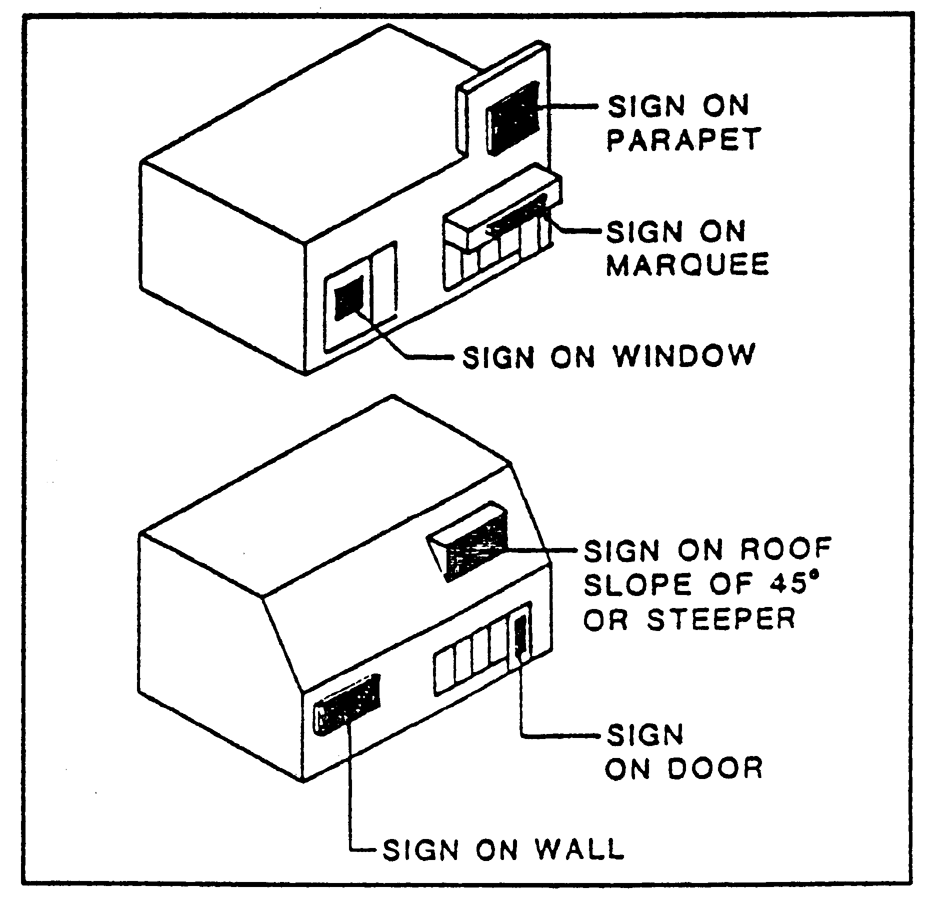
Figure 27-576-1
Bus or other transportation terminal means any establishment that offers transportation to a group of persons. Freight or truck terminals and similar uses shall not constitute a use under this definition.
Business school means an establishment offering to the public, for a consideration, instruction in administration, accounting, bookkeeping, computer use, typewriting, and other skills for use in commercial or service activities.
Caliper means a measurement of the size of a replacement tree at a predetermined point. Trunk diameter for trees up to four (4) inches is to be measured six (6) inches above the soil line. Trees four (4) inches in diameter and greater will be measured twelve (12) inches above the soil line.
Cannabis means all parts of any plant of the genus Cannabis, whether growing or not; the seeds thereof; the resin extracted from any part of the plant; and every compound, manufacture, salt, derivative, mixture, or preparation of the plant or its seeds or resin.
Cannabis dispensing business means a business location offering cannabis for retail sale pursuant to a license to dispense cannabis issued under applicable law.
Capacity, available means that portion of the design capacity that can be reserved on a first-come first-serve basis.
Capacity, design means the maximum level of service that the public facility is capable of providing at the adopted level of service standard.
Capacity, improvement means added facility capacity that will result from capital improvements made by the city or by a developer.
Capacity, reserved means that portion of the design capacity that has been reserved for valid concurrency certificates and for developments that were issued a development permit prior to April 1, 1990.
Capacity, used means that portion of the design capacity that is allocated for and serves existing development.
Capital improvement includes the purchase, construction, or improvement of a public facility which has an estimated cost of twenty-five thousand dollars ($25,000.00) or more.
Capital improvements element means that part of the comprehensive plan.
Car sales or motor vehicle sales means a lot or group of contiguous lots, used for the storage, display, and sales of new and used automobiles. The term shall not be construed to include the storage, display, or sale of motorhomes or similar vehicles or boats.
Car wash means establishments primarily engaged in washing cars or in furnishing facilities for the self-service washing of cars.
Catered event is defined as an event in which a property owner hosting a private special event pays the food truck operator or owner for the service and no individual "walk-up" sales occur.
Champion trees are those trees that have been identified by the state division of forestry as being the largest of their species within the state or by the American Forestry Association as the largest of their species in the U.S.
Change of occupancy means a discontinuance of an existing commercial activity or residency and the establishment of a new commercial activity or permanent residency.
Child day care means a licensed facility which during a part of a twenty-four-hour day regularly gives care to unrelated children, as discussed in the F.S. § 402.302.
Clear cutting means the removal from a parcel of land of all-natural vegetation such as trees, shrubs, and vines.
Clear visibility triangle means that area formed by connecting a point on each curb line or edge of pavement to be located at the distance from the intersection of the street centerlines as required, and a third line connecting the two (2) points as depicted in Figure 27-15-1.
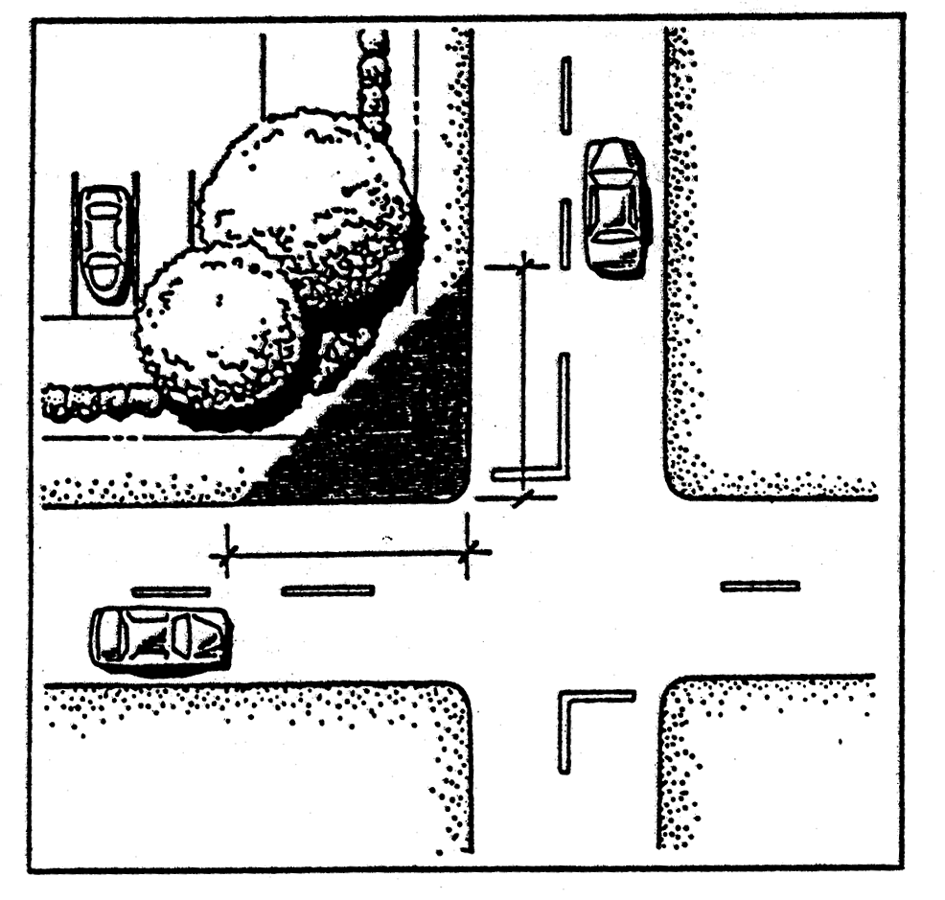
Figure 27-15-1
Clinic means an establishment where patients, who are not lodged overnight, are admitted for examination and treatment by one (1) person or a group of persons practicing any form of medical care, whether such persons are medical doctors, chiropractors, osteopaths, chiropodists, naturopath, optometrists, dentists, or any such profession, the practice of which is legal in the State of Florida.
Coastal building zone means the land area from the seasonal high-water line to a line one thousand five hundred (1,500) feet landward from the coastal construction control line.
Coastal construction control line. The line established by the State of Florida pursuant to F.S. § 161.053, and recorded in the official records of the community, which defines that portion of the beach-dune system subject to severe fluctuations based on a 100-year storm surge, storm waves or other predictable weather conditions.
College, university, community college means a degree-granting establishment, accredited, or qualified for accreditation by the Southern Association of Colleges and Schools, providing formal academic education and generally requiring for admission at least a high school diploma or equivalent academic training, including colleges, community colleges, universities, technical institutes, seminaries, and professional schools (architectural, dental, engineering, law, medical, etc.). Accessory uses under this definition include but are not limited to, dormitories, cafeterias, bookstores, libraries, classrooms, administrative offices, research facilities, sports arenas, and auditoriums.
Commercial vehicle means any motor vehicle licensed by the state as a commercial vehicle, any vehicle designed for a commercial or industrial function, or any vehicle marked with commercial advertising.
Community center means a building or lands open to the public and used for recreational, social, educational, and cultural activities, usually owned, and operated by public or nonprofit group or agency.
Comprehensive plan means the current comprehensive plan, as amended that the City of Neptune Beach adopted pursuant to F.S. Ch. 163, Pt. II, including all elements and sub-elements, and not including the text, maps, figures, and tables prepared to support the adopted comprehensive plan.
Concurrency means a condition where development has, or will have, the necessary public and/or private facilities and services at the adopted level of service standard concurrent with the impacts of the development.
Concurrency certificate means a certificate that indicates whether the proposed development is exempt from concurrency requirements or whether there is adequate capacity for concurrency if the proposed development is approved or approved with conditions.
Conditional letter of map revision (CLOMR). A formal review and comment as to whether a proposed flood protection project or other project complies with the minimum NFIP requirements for such projects with respect to delineation of special flood hazard areas. A CLOMR does not revise the effective flood insurance rate map or flood insurance study; upon submission and approval of certified as-built documentation, a letter of map revision may be issued by FEMA to revise the effective FIRM.
Condominium means a building or group of buildings in which units are owned by one (1) or more persons and in which there is appurtenant to each unit an undivided share in common elements.
Corner lot visibility triangle means a triangular area including that portion of the public right-of-way and any corner lots within the adjacent curb lines, or roadway edge if no curb is present, and a diagonal line intersecting such curb lines at points thirty-five (35) feet back from their intersection (such curb lines being extended if necessary to determine intersection point). For corner lots fronting arterial roads, the setback distance for the two (2) points shall be fifty (50) feet from their intersection.
Cul-de-sac (section 27-476) means a local street that terminates in a vehicle turnaround.
Day means a working day unless a calendar day is indicated.
Day spa means any business that provides beauty, cosmetic and therapeutic services, administered by licensed professionals in which the customers are not lodged overnight. Day spas at a minimum shall include nonsurgical cosmetic treatments, periodic medical cosmetic treatments and massage therapy pursuant to F.S. Ch. 480. Other allowable services are limited to tanning, hair styling, facials, waxing, body wraps, salt scrubs, skin exfoliations, manicures and pedicures.
Deck means any elevated outdoor platform without a roof which can either be attached or detached from a structure.
Defects (tree) means deficiencies in the integrity of a tree caused by either: 1) injury or disease that seriously weakens the stems, roots, or branches of trees, predisposing them to fail; or 2) structural problems arising from poor tree architecture, including V-shaped crotches in stems and branches that lead to weak unions, shallow rooting habits, inherently brittle wood, etc.
Demolition means the act or process of demolishing; to tear down, destroy, raze, or remove all or a significant portion of a building or structure, and including partial demolition.
Density means the ratio of the number of dwelling units to the gross site area of the lands on which such dwelling units are located.
•
For new development and significant redevelopment, gross site area means the entire site area, including land that will become streets and open spaces, but excluding any existing rights-of-way.
•
For buildings on lots that have already been subdivided and streets have already been created, gross area means the entire lot area without inclusion of the adjoining local public right-of-way. Notwithstanding the preceding sentence, one-half the width of the adjoining local public right-of-way shall be included in the calculation of gross area for any lot on which a residential building existed at the time of this ordinance if:
º
Calculation of the gross area of the lot without inclusion of one-half the width of the adjoining local public right-of-way would result in such lot not meeting the minimum calculation required to permit a single residential unit on the lot; and
º
Calculation of the gross area of the lot with inclusion of one-half the width of the adjoining local public right-of-way would result in such lot meeting the minimum calculation required to permit a single residential unit on the lot.
Detention means the collection and storage of surface water for subsequent gradual discharge.
Developable land means all of a parcel of land except lands lying within proposed public rights-of-way; marshlands, swamps, floodplains, easements, or other environmentally sensitive lands where local, state or federal regulations otherwise prohibit development; and bodies of water such as ponds, lakes and reservoirs, either natural or manmade.
Developed (section 27-445) means that point in time when the building and site have received final inspections and certificates of occupancy issued.
Developer means any person who engages in or proposes to engage in a development activity as defined in this Code either as the owner or as the agent of a property owner.
Development means development activity explicitly includes any of the following activities:
(1)
Construction, clearing, filling, excavating, grading, paving, dredging, mining, drainage, water management systems, drilling or otherwise significantly disturbing the soil of a site;
(2)
Building, installing, enlarging, replacing or substantially restoring a structure, impervious or semi-impervious surfaces, or water management system and including the long-term storage of materials;
(3)
Subdividing land into two (2) or more parcels;
(4)
Removal of protected trees;
(5)
Erection of a permanent sign unless expressly exempted;
(6)
Changing or expanding any use of a site so that the need for off-street parking is increased (see article XIII), or trips per day are increased; and
(7)
Construction, elimination, or alteration of a driveway onto a public street.
Development order means the approval of a preliminary or final development plan in accordance with article III. A development order is not a development permit as defined by this Code.
Development permit means an official administrative document of the city which authorizes the commencement of construction or land alteration without need for further application and approval. Development permits include: All types of construction permits (plumbing, electrical, foundation, mechanical, and so forth, in addition to the building permit itself), grading and clearing permits, tree removal permits, sign permits, resurfacing permits, etc.
Development plan means in order to obtain development orders, preliminary and final development plans must be submitted to Neptune Beach in accordance with division 2 of article III of chapter 27.
Divided roadway (section 27-473) means any roadway where the travel lanes are divided to protect environmental features or avoid excessive grading. In the case of a divided roadway, the design standards shall be applied to the aggregate dimensions of the two (2) street segments.
Drip line (section 27-445) means the vertical line running through the outermost portion of the tree extending to the ground.
Driveway is defined as a way for vehicular access that connects public roadways and off-street vehicular use areas.
Driveway apron is defined as the portion of a driveway between the property line and the curb or curb line if no curb is present.
Driveway visibility triangle means a triangular area extending ten (10) feet along the driveway edge and the sidewalk edge, from the point where the driveway meets the sidewalk, and within a diagonal line connecting those two (2) points. If no sidewalk is present, the vision triangle shall mean the area extending fifteen (15) feet along the driveway edge and the curb line, or roadway edge if no curb is present, from the point where the driveway meets the curb, and within a diagonal line connecting those two (2) points. For driveways intersecting arterial roads the triangle shall extend thirty (30) feet in both directions.
Drive-thru facility means an establishment or portion thereof where a patron is provided products or services of any type without departing from a vehicle or where a patron may temporarily depart from a vehicle in a non-parking space while servicing it, such as a do-it-yourself car wash or fuel pump.
Duplex (two-family residence) means a building on a single lot containing two (2) dwelling units, each of which is totally separated from the other by an unpierced wall extending from ground to roof or an unpierced ceiling and floor extending from exterior wall to exterior wall. A common stairwell exterior to both dwelling units may be provided.
Dwelling means a building, or a portion of a building, designed exclusively for residential occupancy, including single-family, two-family (duplex), townhouses, and multifamily, but not including, hotels, motels, or boarding houses.
Dwelling unit means a single housing unit providing complete, independent living facilities for one (1) housekeeping unit, including permanent provisions for living, sleeping, eating, storage or preparation of food and sanitation. This definition includes site-built homes and modular homes manufactured under the Florida Manufactured Building Act and certified by the Florida Department of Community Affairs as complying with the structural requirements of the Standard Building Code.
Easement means the right to use the real property of another for a specific purpose.
Electronic game promotions means a business which, conducts giveaways through drawings by chance conducted in connection with the sale of a consumer product or service, sweepstakes, and game promotions that do not otherwise violate Florida law. This includes but is not limited to, electronic equipment used to display the results of a drawing by chance conducted in connection with the sale of a consumer product or service or game promotion by simulating a game or games ordinarily played on a slot machine. It also includes the conduction of drawings by chance conducted in connection with the sale of a consumer product or service and game promotions, and to regulate all operators who utilize electronic equipment for that purpose in accordance with the provisions of F.S. §§ 849.0935 and 849.094, regardless of whether said operators are required to register with the State of Florida pursuant to F.S. § 849.094.
Encroachment means the placement of fill, excavation, buildings, permanent structures, accessory structures, any other development or portion thereof extending into a required setback, easement, right-of-way, or other such appurtenances.
Endangered species means any flora or fauna that is so designated in Section 39.27.003, Florida Administrative Code or in 50 CFR 17.11-12.
Facade area means the area of a building within a two-dimensional geometric figure coinciding with the outer edges of the walls, windows, doors, parapets, marquees, and roof slopes greater than forty-five (45) degrees of a building which is owned by or under lease to a single occupant (see Figure 27-576-2).
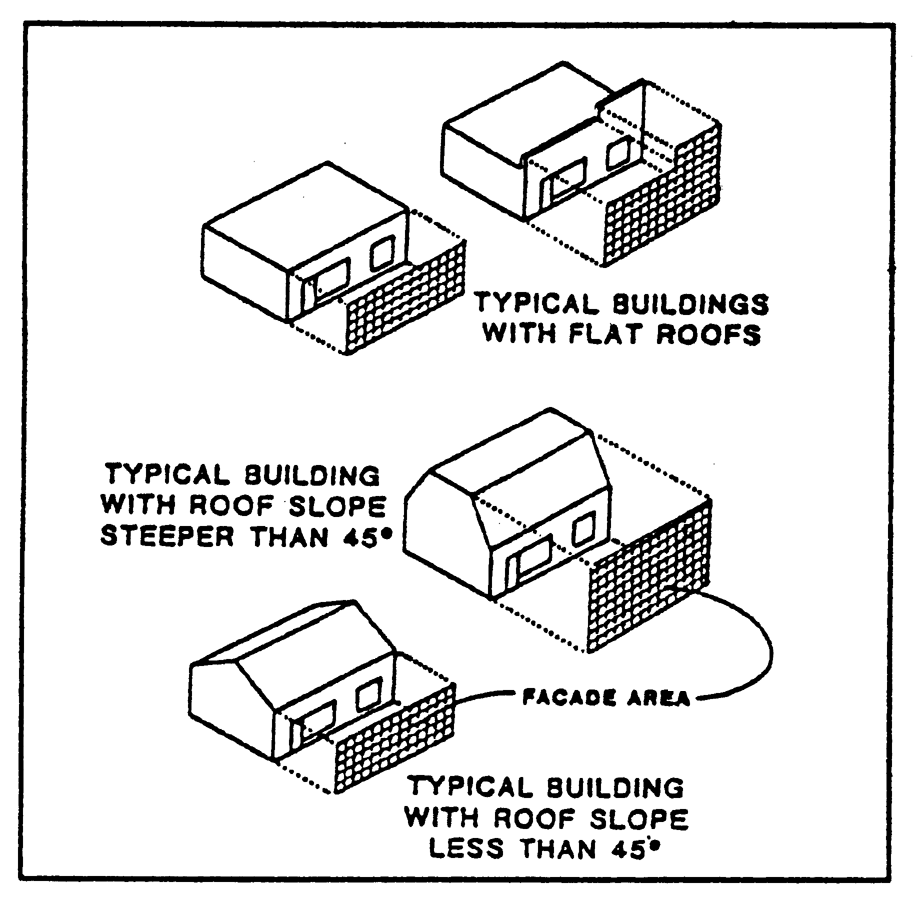
Figure 27-576-2
Failure (tree) means the breakage of stem, branches, roots, or loss of mechanical support in the root system.
Family means one (1) or more persons occupying and living in a single dwelling unit; provided that unless all members are related by law, blood, adoption or marriage, no family shall contain more than four (4) unrelated persons. Domestic servants are excluded.
Family amusement arcade means a business which, in addition to a food and beverage business for which it possesses state and local licenses, also operates an integrated arcade business that complies with F.S. § 849.161(1)(a)1., catering primarily to families and minors.
Final development order means the final authorization of a development project; the authorization which must be granted prior to issuance of a development permit as defined for purposes of this Code. (The final development order authorizes the project, whereas a development permit authorizes specific components of the project, such as building construction, parking lot installation, landscaping, and the like.) For purposes of this Code the final development plan approval is the final development order.
Final development plan means a completed drawing, sketch, site plan, construction drawings or schematic or any other related documents either drawn or written that has been certified by a registered surveyor or engineer if applicable, that shows the intended use of the property and design features pertinent to its potential development and is completed for approval.
Financial services include banks, savings and loan associations, loan companies, mortgage brokers, stockbrokers, and similar institutions.
Five-year schedule of capital improvements means that schedule adopted as part of the comprehensive plan.
Florida Building Code. The family of codes adopted by the Florida Building Commission, including Florida Building Code, Building; Florida Building Code, Residential; Florida Building Code, Existing Building; Florida Building Code, Mechanical; Florida Building Code, Plumbing; Florida Building Code, Fuel Gas.
Food truck is defined as a vehicle, trailer or other similar mobile food unit equipped with facilities for cooking and/or preparing and selling food or other items for human or animal consumption or use.
Footprint means the shape of a building's base area within the perimeter of a building's foundation.
Freestanding sign means any sign, which is incorporated into or supported by structures or supports in or upon the ground, independent of support from any building. Freestanding sign includes pole sign, pylon sign, ground sign or monument sign.
Frontage means the length of property abutting a private or public right-of-way.
Funeral establishment means a facility as defined in F.S. Ch. 470.
Future land use map means the map adopted as part of the comprehensive plan depicting the land use designations throughout the city that may be amended from time to time.
Garage means a building or space used for the storage of motor vehicles.
Garage, parking means a building or portion thereof designed or used for temporary parking of motor vehicles.
Garage apartment. See "Accessory structure" (Ord. No. 2001-10).
Gas station, automotive or service station means any building, structure, or land used for the dispensing, sale or offering for sale at retail of any automotive or alternative fuels, oils, or accessories with or without any automotive servicing.
Geometric shape means any of the following geometric shapes used to determine sign area: square, rectangle, parallelogram, triangle, circle or semi-circle.
Grade means a reference plane representing the average of finished ground level adjoining the building at all exterior walls. When the finished grade level slopes away from the exterior walls, the reference plane shall be established by the lowest points within the area between the building and the property line or between the building and a point six (6) feet from the building, whichever is closer to the building.
Green space means land that is partly or completely covered with grass, trees, shrubs, or other vegetation.
Gross density (see definition of "Density").
Gross floor area means the sum of the gross horizontal area of all floors of a building measured from the exterior faces of the exterior walls.
Gross site area means:
•
For new development and significant redevelopment, gross site area means the entire site area, including land that will become streets and open spaces, but excluding any existing public rights-of-way.
•
For buildings on lots that have already been subdivided and streets have already been created, gross area means the entire lot area without inclusion of the adjoining local public right-of-way. Notwithstanding the preceding sentence, one-half the width of the adjoining local public right-of-way shall be included in the calculation of gross area for any lot on which a residential building existed at the time of this ordinance if:
º
Calculation of the gross area of the lot without inclusion of one-half the width of the adjoining local public right-of-way would result in such lot not meeting the minimum calculation required to permit a single residential unit on the lot; and
º
Calculation of the gross area of the lot with inclusion of one-half the width of the adjoining local public right-of-way would result in such lot meeting the minimum calculation required to permit a single residential unit on the lot.
Group home means a dwelling unit licensed to serve clients of the HRS, providing a living environment for residents who operate as the functional equivalent of a family, including supervision and care by support staff as may be necessary to meet the physical, emotional, and social life needs of residents.
Hazard tree means a tree that has structural defects in the roots, stem, or branches that may cause the tree or tree part(s) to fail, and where such failures have been demonstrated to pose a moderate, high, or extreme level of risk to property damage or personal injury, as defined in the ISA Best Management Practices—Tree Risk Assessment.
Hedge means a fence formed by a row of closely planted shrubs or bushes, typically of such species as English Privet, Indian Hawthorne, Ligustrum or other such evergreen species. This definition is not intended to include other closely planted species commonly referred to as flowering plants such as azaleas, roses, or other such plants that are not usually planted to establish a boundary or fence-like effect.
Height, building means the vertical distance measured from the greater of eighteen (18) inches above the crown of the road in front of the building or proposed building or the average of the existing grade of the lot (prior to the addition of fill material). The lower point of reference for determining the height of a commercial or residential building in a flood zone will be the base flood elevation required for habitable space as set by FEMA's Flood Insurance Rate Maps (FIRMs) and required by the Florida Administrative Code.
Heritage tree means any tree that because of its age, size, type, historical association, or horticultural value is of special importance to the city.
Historic district means a geographical area designated pursuant to this article that contains one (1) or more landmarks and which may have within its boundaries or other buildings or structures, that while not of such historical, cultural, archaeological, or architectural significance as to warrant designation as landmarks, nevertheless contribute to the overall visual setting of or characteristics of the landmarks located within the district.
Historically significant means any structure or area that is included or is eligible for inclusion on the National Register of Historic Places, the Florida Master Site File, or local historic registry.
Home-based business means a business that is operated in whole or in part, from a residential dwelling and meets the criteria set forth in section 27-332 of this Code.
Hospital means a facility as defined in F.S. Ch. 395, Pt. I.
Hotel or motel means a building or group of buildings in which rental units are offered to the public at a daily charge. The building or buildings may include such ancillary uses as a coffee shop, dining room, restaurant, meeting rooms, and similar uses intended as a service to the overnight guests. Multiple-family dwellings and rooming or boardinghouses, where rentals are for periods of a week or longer, shall not constitute a use under this definition.
Household pet means any domestic animal normally owned or kept as a pet, including cats, dogs, and other animals deemed by the city manager or designee to be appropriate as domestic pets. Poultry (as defined in chapter 6), hoofed animals of any type, predatory animals, or any animals which are normally raised to provide food for people shall not be considered to be household pets.
HRS means the Florida Department of Health and Rehabilitative Services.
Illicit discharge and illegal dumping shall mean any discharge or dumping nearby to or into the municipal separate storm sewer system (MS4) that is not composed entirely of stormwater except for discharges resulting from firefighting activities and a few other categories listed in Part II.A.7a of the city's NPDES stormwater MS4 permit. Common sources and types of non-stormwater include, septic system effluent, vehicle wash water from commercial establishments, washdown, spills, leaks, yard debris, grass clippings, pet waste, litter, trash, midnight dumping, mulch, fertilizer, pesticides, paints, solvents, motor oil, antifreeze, fuel, spills, among other sources and substances.
Illuminated sign means any sign which contains a source of light, or which is designed or arranged to reflect light from an artificial source including indirect lighting, neon, incandescent lights, back-lighting, and also shall include signs with reflectors that depend upon automobile headlights for an image.
Impervious surface and semi-impervious means a surface that has been compacted or covered with a layer of material so that it is highly resistant to infiltration by water. It includes, but is not limited to, buildings, roofs, concrete, sidewalks, driveways, pools, and pavement areas, and semi-impervious surfaces such as compacted clay and other similar surfaces, such that the permeability and infiltration capacity is less than that of the existing, uncompacted, native soil subgrade.
Improvement means any manmade, immovable item which becomes part of, is placed upon, or is affixed to real estate.
Intensification of use means a change in a property, structure, or use resulting in increased requirements for parking, egress, occupancy load, or fire regulations, or expansion of electrical, mechanical, or plumbing systems.
Intersection means the crossing, or meeting without crossing, of one (1) roadway with another.
Kennel means any lot or premises on which three (3) or more dogs over four (4) months old are kept for boarding, training, or sale.
Kitchen means an area equipped for food storage, preparation, and/or cooking in one (1) household.
Land includes the words marsh, water, and swamp.
Landmark means a building or structure designated as such by an ordinance of city council, that is worthy of protection, rehabilitation, and restoration because of its historical, cultural, archaeological and/or architectural significance to the City of Neptune Beach, the county, state, or nation.
Laundromat means a business that provides coin-operated washing, drying, and/or ironing machines for hire to be used by customers on the premises.
Light manufacturing means the manufacturing, fabricating, or casting of individual components of a larger unit or a complete unit. All such processing and storage of materials must occur indoors and would not typically generate noise, vibration, smoke, dust, or odor detectable at the property line. Light manufacturing shall be limited to the production of the following goods: Electrical instruments, office machines, precision instruments, electronic devices, optical goods, musical instruments, cabinet making, ceramics, apparel, light sheet metal products, plastic goods, glassware, pharmaceutical goods, and food products, but not animal slaughtering or curing. However, light manufacturing excludes any uses that would require a multi-sector generic permit for stormwater discharge associated with industrial activity (MSGP).
Performance standards: All activities shall be in conformance with standards established by the county, state, and federal government. Activities shall emit no obnoxious, toxic, or corrosive dust, dirt, fly ash, fumes, vapors, or gases which can cause damage to human health, to animals or vegetation, or to other forms of property.
(1)
Any business that receives a special exception from the city council for light manufacturing must provide a landscape buffer that meets the requirements of subsection 27-459(3)b. of this Code, unless the business for which the special exception is granted already has a landscape buffer that was previously approved as part of the development review process.
(2)
Any use which requires a Title V general permit, or a non-Title V general permit from the Florida Department of Environmental Protection's Air Resource Management Division is not eligible for special exception approval.
(3)
Light manufacturing facilities shall be limited to ten (10) employees or less.
(4)
The light manufacturing operation shall be self-contained inside the permanent structure and shall not be conducted outdoors, in order to minimize noise, glare, odor, etc.
(5)
Refer to section 23-60, Prohibited substances.
Liquor license means a license issued by the state for the retail sale, service, and on- or off-premises consumption of liquor, beer, or wine.
Living area means the area inside the walls enclosing the living unit, excluding service and utility areas, building storage areas, stair wells, or open or screened porches and patios.
Loading space (section 27-536) means a portion of the vehicle accommodation area or a portion of the principal building set aside for the purpose of unloading or loading said vehicle.
Local street (section 27-473) means a roadway which provides direct access to abutting residential properties and is designed to carry no more traffic than is generated on the street itself and no more than one thousand six hundred (1,600) vehicles per day.
Lot means a parcel of land whose boundaries have been established by some legal instrument such as a recorded deed or a recorded map and which is recognized as a separate legal entity for purpose of transfer of title.
Lot, corner means a lot abutting upon two (2) or more streets at their intersections (see Figure 27-15-2).
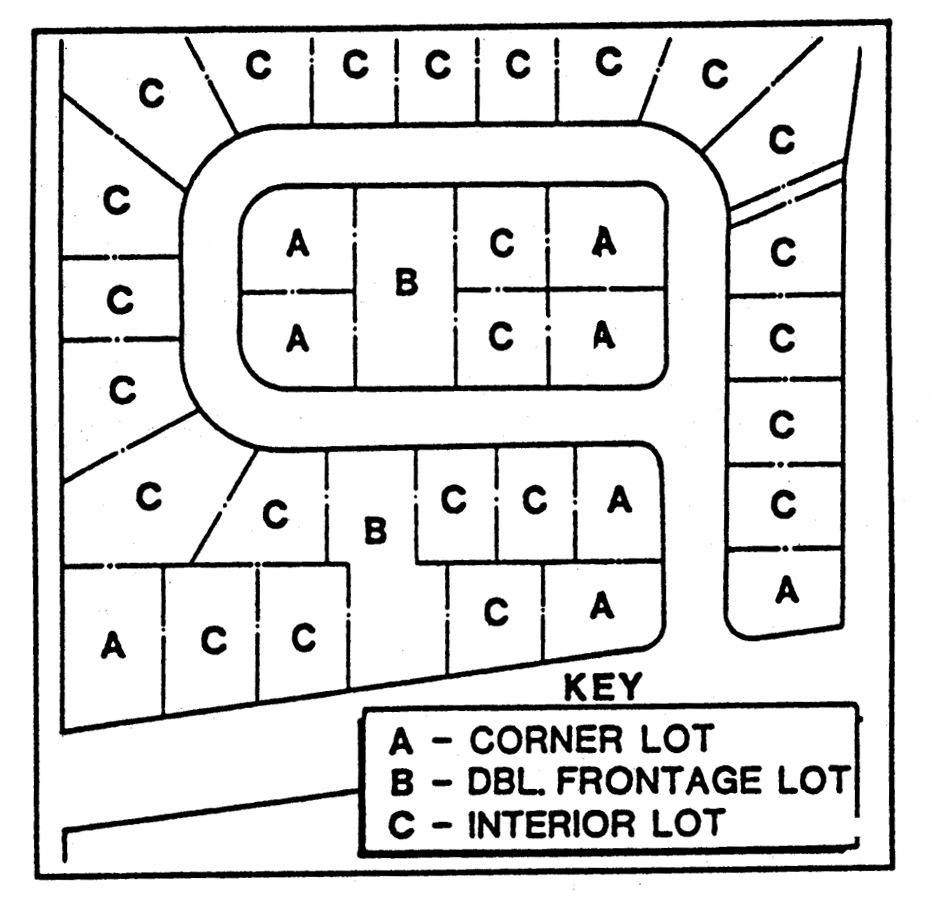
Figure 27-15-2
Lot, double frontage means any interior lot having frontage on two (2) nonintersecting streets, as distinguished from a corner lot (see Figure 27-15-2), or oceanfront lots.
Lot, interior means a lot other than a corner lot (see Figure 27-15-2).
Lot, width means the distance measured in a straight line along the street right-of-way between the side lot lines as measured at the front building restriction line.
Lot coverage means the area of a lot or parcel of land that is occupied or covered by any impervious surface.
Lot of record means a parcel of land, the deed or plat of subdivision (which has been approved by the City of Neptune Beach) of which has been recorded in the Office of the Clerk of the Circuit Court of Duval County, Florida, or prior incorporation into the city.
Low impact design (LID) means the principles to integrate the following concepts into the design process: use hydrology as the integrating framework, control stormwater at the source, minimize impervious surface area, create a multi-functional landscape and infrastructure, use of Florida-friendly landscaping, promote stormwater harvesting to reduce demands on potable water, promote recharge of groundwater supplies, protect surface waters, and improve air quality and reduce urban heat island effects through the use of vegetation and trees.
Lowest adjacent grade means the lowest natural elevation of the ground surface, prior to construction, next to the proposed walls of a structure.
Major deviation means a deviation other than a minor deviation, from a final development plan, including any changes in use or concurrency.
Major recreational equipment means any large motorized or non-motorized vehicle used for recreational purposes, such as motorhomes, trailers, campers and camper shells, boats, and trailers, converted buses and trucks, dune buggies and sand rails, and trailers, cases or boxes on wheels used to transport and/or store equipment, as well as any vehicle required to carry an "RV" tag or not licensed for legal street use.
Medical/dental clinic means any establishment where patients, who are not lodged overnight, are admitted for examination and treatment by a person or persons affiliated with a group practicing various specialties of the healing arts, whether the persons are medical doctors, chiropractors, osteopaths, chiropodists, naturopaths, optometrists, dentists, or any such profession, the practice of which is regulated by the state.
Medical marijuana treatment center means an establishment as defined and further set forth in F.S. § 381.986(8), that operates for the purpose of dispensing medical marijuana, as defined, and further set forth in F.S. § 381.986.
Mini-warehouse means any personal storage building which is subdivided by permanent partitions into spaces with an exterior independent entrance under the exclusive control of the tenant thereof.
Minor arterial (section 27-475) means a roadway that connects and supports the principal arterial road system. Although its main function is still traffic movement, it performs this function at a lower level and places more emphasis on property access than does the principal arterial.
Minor deviation means a deviation from a final development plan that is necessary in light of technical or engineering considerations first discovered during actual development and not reasonably anticipated during the initial approval process, including the following:
(1)
Alteration of the location of any walkway, islands, landscaping, or structure by not more than five (5) feet; excluding driveway connections to public streets.
(2)
Reduction of the total amount of open space by not more than five (5) percent, or reduction of the yard area or open space associated with any single structure by not more than five (5) percent; provided that such reduction does not permit the required yard area or open space to be less than that required by this Code.
Minor replat means the subdivision of a single lot or parcel of land into two (2) lots or parcels, or the subdivision of a parcel into two (2) or more lots solely for the purpose of increasing the area of two (2) or more adjacent lots or parcels of land, where there are no roadway, drainage, or other required improvements, and where the resultant lots comply with the standards of this Code.
Modular home means a dwelling unit constructed in accordance with applicable building codes and that is substantially constructed in a manufacturing plant and transported to the building site for assembly on a permanent foundation.
Moped shall mean a type of small motorcycle, which is comprised of two (2) wheels, a seat with a footrest in front, foot pedals, a handlebar for steering, and an engine in the back. The engine size is typically fifty (50) cc's or less, as mopeds often also rely on the rider's pedaling for power.
Motor vehicle service means a building or lot where battery, tires and other repair services except body work or painting are rendered.
Motorized kick scooter shall mean a motor-powered personal mobility device, typically electric, which is comprised of two (2) small wheels, a platform deck, and handlebars for steering. While designed to be ridden standing upright on the deck, some can be converted into seated scooters with a removable seat accessory. Top speeds vary from fifteen (15) to thirty (30) miles per hour and these scooters typically weigh between twenty (20) and thirty-five (35) pounds.
Moving and storage facility means any establishment that stores material not owned by the operator of the establishment to include mini warehouses.
Multifamily means any building containing three (3) or more dwelling units.
Multiple occupancy complex means any commercial use consisting of a parcel of property, or parcel of contiguous properties, existing as a unified or coordinated project, with a building or buildings housing more than one (1) occupant.
Municipal separate storm sewer system or MS4 means all of the components of the city's master stormwater system.
Net usable acreage means the square footage of a parcel land that has the ability to be developed after factoring out such items as jurisdictional wetlands, easements, waterbodies or any other feature precluding development.
Night club means a restaurant, dining room, bar or other similar establishment providing food or refreshments, wherein paid floor shows, or other forms of paid entertainment are provided for customers as part of the commercial enterprise. Night clubs are required to meet special requirements for assembly occupancies in the Florida Fire Prevention Code.
Nonconforming lot of record means any lot of record recorded prior to January 1, 1991 that does not conform to the lot area or width requirements established for the zoning district in which said lot is located. A lot of record recorded after January 1, 1991, will also be a nonconforming lot of record if the lot area or width requirements are later changed such that the lot no longer complies with the zoning district in which said lot is located.
Nonconforming sign means any sign so designated by section 27-707 of this Code.
Nonconforming structure means any structure that does not conform with the provisions of the zoning district where the structure is located due to noncompliance with the dimensional standards in chapters 27 or 30.
Nonconforming use means any use of a structure, or use outside a structure, that does not conform with the uses allowed for the parcel's zoning district or with density restrictions imposed by the adopted future land use map.
Nonresidential district includes the following zoning districts: C-1, C-2, C-3, CBD, and conservation.
Notice of commencement means the formal notice that must be filed with the Duval County Clerk of Courts before improvements to real property begin, as described in F.S. § 713.13.
Nursing home means a facility as defined in F.S. Ch. 400, Pt. I.
Oceanfront lot means any parcel of land that abuts the Atlantic Ocean at the east property line.
Office means any establishment that conforms to the following characteristics:
(1)
No retail sales, display or storage of merchandise;
(2)
No manufacture, repair or work of a mechanical nature;
(3)
No machinery, except for normal office equipment such as typewriters, calculators and computers.
Off-street loading means loading spaces located beyond the public rights-of-way of a street or highway.
Off-street parking means parking spaces located beyond the public rights-of-way of a street or highway.
Open-air markets mean areas in which vendors sell flowers, plants, plant materials, fruits, produce, vegetables and other non-commercially processed food items and hand-crafted items which are made by the vendor or the vendors' immediate family, and who do not sell those items exclusively in compliance with the licensing and building regulations relating to permanent business establishments.
Open space means the total amount of open space between and around structures including necessary outdoor living space, outdoor recreation space, outdoor parking space, and streets in the project other than existing public rights-of-way.
Ordinary maintenance means work which does not require a construction permit and that is done to repair damage or to prevent deterioration or decay of a building, pavement, structure, or part thereof as nearly as practicable to its originally permitted condition prior to the damage, deterioration, or decay.
Original appearance means that appearance (except for color) which closely resembles the appearance of either: (1) the feature on the building as it was originally built or was likely to have been built; or (2) the feature on the building as it presently exists so long as the present appearance is appropriate to the style and materials of the building.
Outdoor living space means the total outdoor area including required outdoor recreation space, but excluding buildings, garages, carports, driveways, roadways, stormwater management facilities, or parking areas. The outdoor living space is part of the required open space.
Outdoor recreation space means the total amount of usable area permanently set aside or designed specifically for recreation space for the development.
Overlay district means a district with special regulations that apply in addition to regulations in the base zoning district; see section 27-224.
Owner means a person who, or entity which, alone, jointly, or severally with others, or in a representative capacity (including without limitation, executor, personal representative, or trustee) has legal or equitable title to any property in question, or a tenant, if the tenancy is chargeable under his lease for the maintenance of the property.
Owner of record means the person, corporation, or other legal entity listed as owner on the records of Duval County, Florida.
Package liquor store means any establishment where alcoholic beverages with an alcoholic content in excess of fourteen (14) percent are dispensed or sold in containers for consumption off the premises.
Parcel means a unit of land within legally established property lines.
Park means a tract of land, designated, and used by the public for active and passive recreational purposes.
Parking, on-street means designated spaces along a roadway where vehicles may be parked.
Parking lot or vehicle accommodation area means an area, or plot of ground, used for the storage or parking of motor vehicles, either for compensation or to provide an accessory service to a business, industrial or residential use.
Parking space means a portion of a parking lot in which one (1) motor vehicle is to be parked.
Parking structure means a multi-level structure designed and intended for the primary use of parking motor vehicles.
Patio means a paved area situated directly on the ground which can either be attached or detached from a structure.
Permanent sign means any sign, which is designed, constructed, and intended for more than short-term use, including freestanding signs, and building signs.
Person means an individual, corporation, governmental agency, business trust, estate, trust, partnership, association, two (2) or more persons having a joint or common interest, or any other legal entity.
Pervious pavements mean pavements that have air spaces that allow water to move through the pavement, base material, and subbase, and then infiltrate into the ground. Pervious pavement may include an aggregate base as a reservoir and must have suitable native soils as a subgrade to support infiltrating into the ground. Pervious pavement is designed to accept precipitation, reduce runoff, and is typically thicker than traditional pavements to support the same loads. Pervious pavement systems shall have a permeability and infiltration capacity greater than that of the existing uncompacted native soil subgrade that typically has an infiltration capacity that exceeds twenty (20) inches per hour. Traditional solid brick paver systems or systems with base, subbase, or subgrade that are impervious or semi-impervious shall not be considered as a pervious pavement.
Pharmacy means an establishment wherein the principal use is the dispensing of prescription and patent medicines and drugs and related products, but where nonmedical products such as greeting cards, magazines, cosmetics, and photographic supplies may also be sold.
Phasing means the incremental staging of development.
Plat, replat, amended plat, or revised plat means a map or drawing upon which an exact representation of a subdivision of lands and other information is presented in compliance with the requirements of all applicable sections of this Code.
Portable sign means any sign which is manifestly designed to be transported by trailer or on its own wheels, including such signs even though the wheels may be removed, and the remaining chassis or support structure converted to an "A" or "T" frame sign and attached temporarily or permanently to the ground.
Portable storage unit means any container designed for the storage of personal property which is typically rented to owners or occupants of property for their temporary use, and which is delivered and removed by truck.
Pre-development means the historical condition of a parcel of land prior to any land disturbing activities that have taken place.
Preliminary development order means any preliminary order that grants, denies, or grants with conditions a development project or activity. A preliminary development order that grants approval does not authorize actual construction, mining, or alterations to land and/or structures. A preliminary development order may authorize a change in the allowable use of land or a building and may include conceptual and conditional approvals where a series of sequential approvals are required before action authorizes commencement of construction or land alteration. For purposes of this Code preliminary development orders include future land use map amendments, comprehensive plan amendments which affect land use or development standards, preliminary development plan approval, and master plan approval.
Preliminary development plan means a conceptual drawing, sketch, or schematic or any other document either drawn or written, that shows the intended use of the property and design features pertinent to its potential development.
Premises means a building or structure and its associated grounds including parking lots, open spaces, recreational areas, and stormwater management facilities.
Principal arterial (section 27-475) means a roadway that is part of an interconnected network of continuous routes serving transportation corridors or business areas with high traffic volumes and long trips, the primary function of which is to provide safe and efficient service for major traffic movements in which access is subordinate.
Principal structure means the primary dwelling unit or structure located on the lot that houses a principal use, and not any other accessory structure or building.
Private club means buildings or facilities owned or operated by a corporation, association, or persons for a social, educational, or recreational purpose; but not primarily for profit or to render a service that is customarily carried on as a business.
Projected impact means the calculated usage of a facility.
Protected wellhead means those wellheads with a permitted capacity of one hundred thousand (100,000) GPD or more.
Public facility(ies) includes any or all of the following: Roads, sanitary sewer, potable water, drainage, solid waste, and/or recreation and open space.
Public park/recreation area means a tract of land within a municipality or unincorporated area which is kept for ornament and/or recreation and which is maintained as public property.
Quasi-judicial, (adj.) means relating to a judicial act performed by an official who is not a judge. Quasi-judicial acts are subject to review by courts.
Radio/television broadcasting studio means a facility for the production and broadcast of radio and television shows including things as offices, dressing rooms, broadcast and taping studios, file rooms, set storage and related installations, but not including radio and television transmitting and receiving facilities, as defined in this Code.
Rebranding of a sign means any change or alteration in franchise identification or any distinguishing mark, color pattern, logo, symbol, trademark, name, word, phrase, sentence, or any combination thereof used to identify, advertise, or distinguish the brand, product, or service available in or on the property.
Recreation vehicle means a vehicular-type portable structure without permanent foundation, which can be towed, hauled, or driven and primarily designed as temporary living accommodation for recreation, camping, and travel use and including, but not limited to, travel trailers, truck campers, camping trailers, and self-propelled motorhomes.
Recycling collection center means a facility where recovered materials (generally newspapers, plastics, metals, glass, and paper) are delivered for further processing (sorting, baling, condensing, etc.) for shipment to recovered material markets.
Regulated tree means any tree that is at least six (6) inches in diameter or two (2) feet in circumference, whichever is lesser at a point four and one-half (4.5) feet above ground level and/or requires a permit for removal or relocation.
Remodel, major means a project that has fifty (50) percent or more of a dwelling's exterior walls, measured in linear feet, removed. Removal means either that no studs remain or that if some studs remain, the wall except for the studs has been stripped bare such that one can see through the wall. Any portion of an exterior wall so described shall be included in the calculation.
Remove means to relocate a building or structure on its site or to another site.
Renovation, major means a physical change to an establishment or residence or portion thereof, including the replacement or upgrading of major systems, which extends the useful life. Examples include, but are not limited to, demolition of the interior or exterior of a building or portion thereof, including the removal and subsequent replacement of electrical, plumbing, heating, ventilating and air conditions systems, fixed equipment and interior walls and partitions (whether fixed or moveable). Replacement of broken, dated or worn equipment/items, including, but not limited to, individual air conditioning units, bathroom tile, shower stalls that do not require any additional or new plumbing, electrical, etc. shall not be considered a major renovation.
Repair means restoration of portions of a building to its condition as before decay, wear, or damage, but not including alteration of the shape or size of any portion.
Repair (sign) means to restore to the same condition or state after damage, dilapidation, decay, or partial destruction.
Replacement stock (section 27-445) means any immature tree, other than palm trees, with a minimum diameter of two (2) inches at ground level and having a height of at least four (4) feet.
Residence, multifamily means any residential structure containing three (3) or more separate dwelling units.
Residence, single-family means a structure containing one (1) dwelling unit, and not attached to any other dwelling unit by any means.
Residence, two-family (duplex). (See definition of "Duplex".)
Residential treatment facility means a facility other than a hospital, nursing home, or group care home, having one (1) or more supervisors residing on the premises and providing board, lodging, medication and other treatment and counseling for persons progressing from relatively intensive treatment for criminal conduct, delinquency, mental or emotional illness, alcoholism, drug addiction or similar conditions, as well as providing relatively intensive diagnostic or therapeutic services for alcoholism, drug abuse, mental illness, emotional problems, developmental disabilities or similar conditions for its residents. Nothing shall prevent a residential treatment facility from having outpatients. The residents are generally intending to return to full normal participation in community life.
Restaurant, carry-out and delivery means any establishment whose principal business is the sale of food and beverages to the consumer in a ready-to-consume state for consumption off-premises and whose principal method of operation includes pick-up by the customer or delivery by an employee.
Restaurant, drive-in means any restaurant defined in this article that also provides dedicated parking spaces where customers order food or beverages to be consumed in their vehicle.
Restaurant, fast-food means any establishment whose principal business is the sale of food and beverages to the customer in a ready-to-consume state for consumption either within the building or for carry-out with consumption off the premises, or where permitted, in adjoining outdoor seating.
Restaurant, interior service means any establishment whose principal business is the sale of foods and beverages to the customer in a ready-to-consume state and whose principal method of operation includes service by a restaurant employee at a table or counter at which said items are consumed on-premises, or where permitted, in adjoining outdoor seating. A cafeteria shall be deemed an interior service restaurant.
Retail, general means any establishment that sells products at a retail level.
Retention means the collection and storage of runoff without subsequent discharge to surface waters.
Right-of-way means the area of a highway, road, street, way, parkway, electric transmission line, gas pipeline, water main, or other such strip of land reserved for public use, whether established by prescription, easement, dedication, gift, purchase, eminent domain, or any other legal means. Dedication of right-of-way and any obligation to maintain it must be approved by the City of Neptune Beach, and must adhere to F.S. 177.081(3).
Roadway means a way for vehicular traffic, whether designated as a street, highway, alley, avenue, boulevard, lane, court, place, or however designated, whenever dedicated to public use.
Roof line means a horizontal line intersecting the highest point or points of a roof.
Roof sign means a sign placed above the roof line of a building or on or against a roof slope of less than forty-five (45) degrees.
Sandwich board sign means any self-supporting, A-shaped freestanding sign with only two (2) visible sides that are situated adjacent to a business.
Scooter shall mean a type of small motorcycle, which is comprised of two (2) wheels, a single or double seat with a footrest in front, a handlebar for steering, and an engine in the back. Unlike mopeds, there are no foot pedals, and the engine power can vary from fifty (50) cc's to two hundred fifty (250) cc's. Though unlike motorcycles they typically have automatic transmissions, scooters must also have all the same equipment as motorcycles, including turn signals, a license plate, and headlights.
Seat means (for the purposes of determining the number of off-street parking spaces) the number of chairs, stools or each twenty-four (24) inches of benches or pews, installed or indicated. For areas without seating, such as standing space, dance floors, bars, etc. each seven (7) square feet of floor space shall constitute a seat.
Sediment means the mineral or organic particulate material that is in suspension or has settled in surface water.
Shopping center means a group of retail stores or service establishments planned and developed as a unit by one (1) operator, owner, organization, or corporation for sale or for lease upon the site on which they are built.
Short-term rentals means the rental of a private dwelling, including, but not limited to, a single-family home, a townhouse, duplex, triplex, multifamily, condominium, or the like which is rented, leased or advertised for a term period less than twenty-eight (28) days. Short-term rentals shall be considered to be "commercial uses" as are motels, motor lodges, resort rentals, bed and breakfasts or tourist court uses.
Sidewalk means a paved area intended primarily for the use of pedestrians, which is typically, though not always, located within a public street right-of-way.
Sign means any identification, description, illustration, or device illuminated or non-illuminated, which is visible from any outdoor place, open to the public and which directs attention to a product, service, place, activity, person, institution, or business thereof, including any permanently installed or situated merchandise, or any emblem, painting, banner, pennant, placard, designed to advertise, identify, or convey information, with the exception of customary window displays, official public notices and court markers required by federal, state or local regulations; also excepting, newspapers, leaflets and books intended for individual distribution to members of the public, attire that is being worn, badges, and similar personal gear. Sign shall also include all outdoor advertising displays as described within Section 3108.1.1, Florida Building Code, and all signs shall conform to the requirements of Section 3108 of the Florida Building Code. The term shall exclude architectural features or part not intended to communicate information.
Sign area means the area within the smallest regular geometric shape which contains the entire sign copy, but not including any supporting framework, braces or supports.
Sign copy means the linguistic or graphic content, including trim and borders, of a sign.
Sign face means the part of a sign that is or may be used to display sign copy.
Sign height means the vertical distance from the finished grade at the base of the supporting structure to the top of the sign, or its frame or supporting structure, whichever is higher (see Figure 27-576-4).
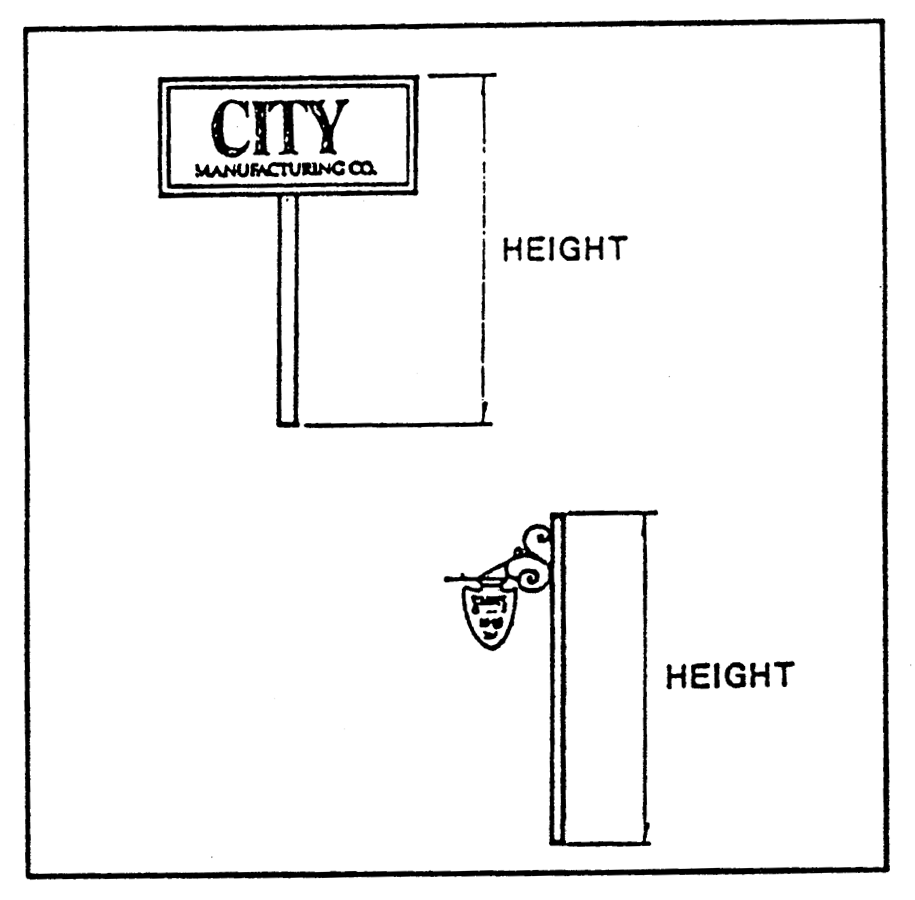
27-576-4
Sign structure means any construction used or designed to support a sign.
Single-family lot (section 27-445) means an area of land not larger than five (5) acres in size, developed for and restricted to, a single-family residence.
Site means generally, any tract, lot or parcel of land or combination of tracts, lots, or parcels of land that are in one (1) ownership, or in diverse ownership but contiguous, and which are to be developed as a single unit, subdivision, or project.
Snipe sign means any temporary, unpermitted, non-political, and non-religious sign of any material, including paper, plastic, cardboard, wood, or metal when tacked, nailed or attached in any way to trees, poles, stakes, fences, the ground, or other objects where such sign may or may not be applicable to the present use of the property upon which such sign is located.
Social, fraternal club and lodge means a group of people formally organized for a common interest, usually cultural, religious or entertainment, with regular meetings, rituals, and formal membership requirements, and includes Knights of Columbus, Masons, Moose, Elks, etc.
Special event means an occasional or periodic gathering hosted, sponsored, or authorized by a property owner.
Special exception means a use that would not be appropriate generally or without restriction throughout the zoning district but which, if controlled as to the number, area, location, or relation to the neighborhood, could promote the public health, safety, welfare, morals, order, comfort, convenience, appearance, prosperity, or general welfare.
Species of special concern (section 27-422) means any flora or fauna designated as such by the State of Florida.
Stormwater means the flow of water which results from, and that occurs following a rainfall.
Stormwater management facilities means those facilities systems which are designed and constructed or implemented to control discharges necessitated by rainfall events, and may incorporate methods to collect, convey, store, absorb, inhibit, treat, use or reuse water to prevent or reduce flooding, over drainage, environmental degradation and pollution, or otherwise affect the quality and quantity of discharges.
Story means that portion of a building included between the upper surface of any floor and the upper surface of the next floor above it or the roof.
Street, collector means a road, which in addition to providing access to abutting properties, is designed to connect local streets with arterials, as designated in the Neptune Beach Comprehensive Plan.
Street, cul-de-sac (section 27-476) means a local street no longer than six hundred (600) feet in length that terminates in a circular vehicle turnaround.
Street, local (section 27-476) means a roadway which provides direct access to abutting properties and is designed to carry no more traffic than is generated on the street itself and no more than one thousand six hundred (1,600) vehicles per day.
Street, principal, or minor arterial means a part of the roadway system serving as a principal network for through traffic flow, including all state roads and any other roadway serving a similar function as designated in the Neptune Beach Comprehensive Plan.
Structurally altered means any change, except for repair or replacement, in the supporting members of a building, such as bearing walls, columns, beams or girders, floor or roof joists or trusses.
Structure means anything constructed, installed, or portable, the use of which requires a location on a parcel of land. It includes a movable structure while it is located on land which can be used for housing, business, commercial, agricultural, or office purposes either temporarily or permanently. It also includes, but is not limited to, buildings, walls, gates, monuments, fountains, fences, swimming pools, poles, pipelines, transmission lines, tracks and signs.
Subdivision means any subdivision or re-subdivision of a subdivision, tract, parcel or lot of land into two (2) or more lots or parcels by means of mapping, platting, conveyance, change or rearrangement of boundaries. See subdivision requirements in division 3 of article III of chapter 27.
Swale means a shallow channel that functions as an intermittent drainage way.
Swimming pool means a structure above or below ground level used for bathing, wading, or swimming purposes and being over twenty-four (24) inches deep at any point from the top of the structure wall to the bottom of the structure.
Tandem parking space means a parking space that abuts a second parking space in such a manner that vehicular access to the tandem space can be made only through the second parking space.
Temporary sign means any permitted sign, which is designed, constructed, and intended to be used on a short-term basis. A permanent sign with periodic changes to the message shall not be considered as a temporary sign.
Temporary structure means a subordinate structure that is intended to occupy a portion of the lot in which the principal structure resides, for only such time as the use is necessary and is further specified by this Code, to include, but not limited to, portable storage units commonly referred to PODS, canopies, tents, fences of a transient nature such as barricades.
Theater means an establishment offering live presentations or showing motion pictures to be viewed in an auditorium.
Threatened species means any flora or fauna that is so designated in Section 39-27.004, Florida Administrative Code or in 50 CFR 17.11-12.
Townhouse means a single-family dwelling constructed in a series or group of attached units in which each unit has its own front and rear access to the outside and no unit is located over another unit, with property lines and fire walls as required by the Florida Building Code, separating each unit.
Trade school means an establishment in which is offered, for compensation, instruction in a trade or craft, including, but not limited to, carpentry, masonry, metal working, machinery repair and operation, welding, fabrication, and the like.
Traffic impact study (TIS) means a study carried out by a registered professional transportation engineer that investigates the impact of a proposed development or other improvement on vehicle, pedestrian, or cyclist safety, and on traffic operations, recommending any mitigating measures that may be required as a result of that impact.
Tree (section 27-445) means any living, self-supporting perennial plant which has a trunk diameter of at least four (4) inches measured three (3) feet above grade (at the base of the tree) and normally grows to a minimum overall height of fifteen (15) feet.
Trees planted for harvest (section 27-445) means all trees which have been planted or shall be planted with the bona fide intention at the time of said planting to commercially harvest said trees in the future. These trees shall include, by way of illustration and not limitation, Christmas trees, slash pines, and pulpwood.
Use means the purpose for which land or water, or a structure thereon is designated, arranged, or intended to be occupied or utilized or for which it is occupied or maintained.
Variance means a grant of relief from any of the requirements of chapter 27, which permits construction in a manner that would not otherwise be permitted by chapter 27, to the extent allowed by the provisions of division 8 of article IV of chapter 27.
Vehicle sign means any sign affixed to a vehicle.
Veterinary clinic means a facility that has been issued a premises permit to engage in the practice of veterinary medicine as provided for in F.S. Ch. 474.
Vocational school means an establishment in which is offered, for compensation, instruction in a vocation such as, but not limited to, barbering, cosmetology, hair styling, bartending, and interior decorating.
Warehouse/mini-warehouse means a structure used primarily for the storage and distribution of goods or materials.
Wellhead buffer zone means all land within a one hundred-foot buffer around the wellhead protection zone as depicted in Figure 27-375-1.
Wellhead protection zone means all land within a two hundred-foot radius of an existing or designated protected wellhead as depicted in Figure 27-375-1.
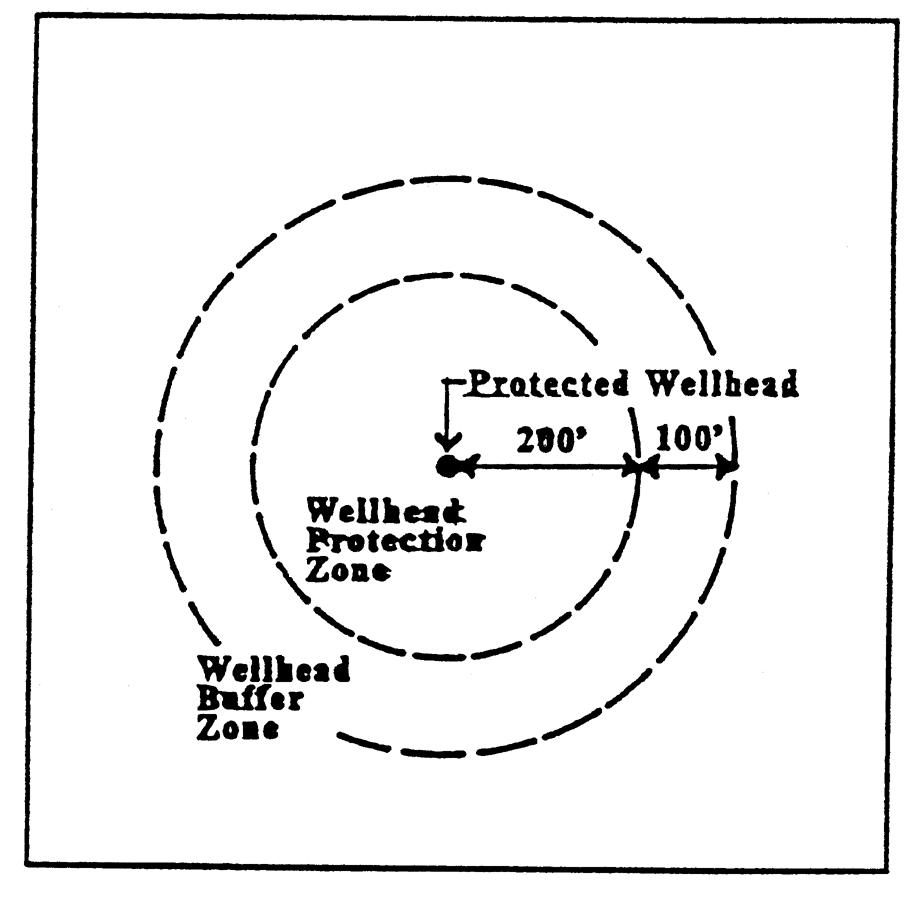
Figure 27-375-1
Wetlands protection zone/wetlands, jurisdictional shall have the same meaning as the definition of "wetlands" set forth in F.S. § 373.019(22), as may be amended from time to time. The delineation of jurisdictional wetland boundaries shall be made by professionally accepted methodology consistent with the unified state-wide methodology for the delineation of the extent of wetlands ratified by the state legislature pursuant to F.S. Ch. 373.
Wholesale sales means any establishment engaged in on-premises sales of goods primarily to customers engaged in the business of reselling the goods.
Wind sign means any device, including, but not limited to, one (1) or more banners, flags, pennants, ribbons, spinners, streamers or captive balloons, or other objects or material fastened in such a manner as to move upon being subjected to pressure by wind not specifically exempted by section 27-580 of this Code (see Figure 27-576-5).
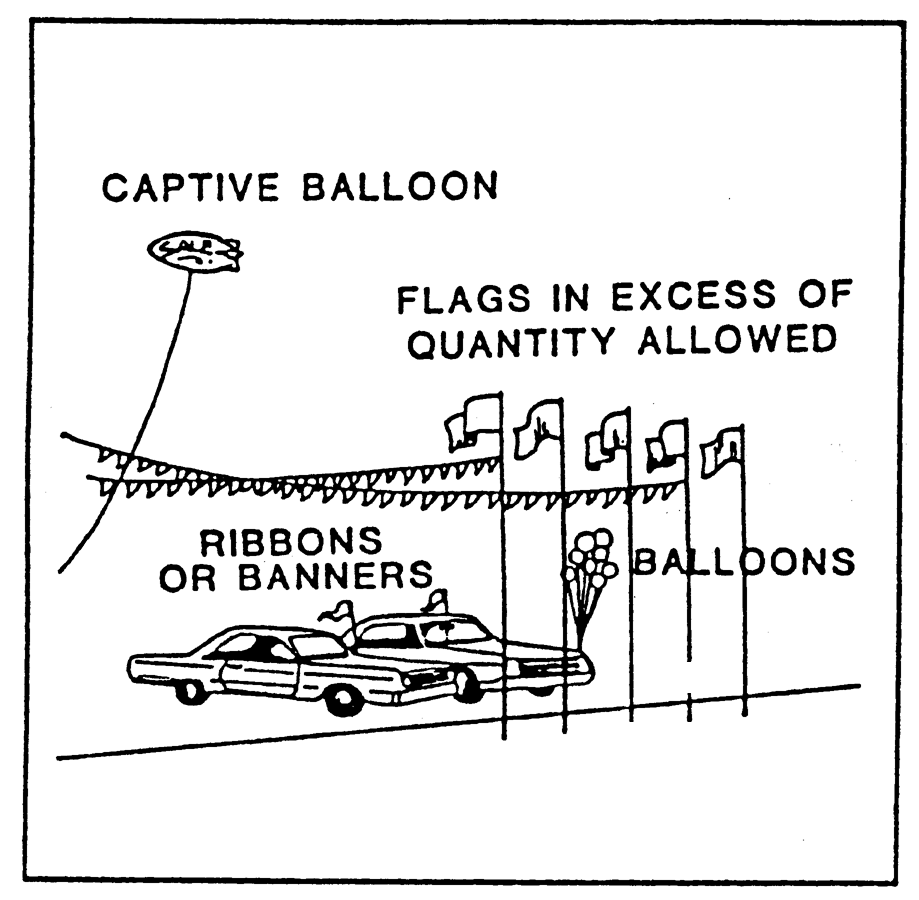
Figure 27-576-5
Worship facility means a building used primarily as a place wherein persons regularly assemble for religious worship, instruction, or education, including churches, synagogues, temples, sanctuaries, chapels and cathedrals and buildings associated with same, such as parsonages, friaries, convents, fellowship halls, Sunday schools, and rectories. Parochial child day care centers and primary and/or secondary educational facilities that are owned or operated by an established worship facility shall be included in this definition.
Written or in writing means any representation of words, letters, or figures, whether by printing or otherwise.
Yard means an open space on the same lot with a building or proposed building, unoccupied and unobstructed from the ground upward, except by trees or shrubbery or as otherwise provided herein.
Yard, corner side means the yard extending along the street upon which it has the largest exterior frontage. (See Figure 27-15-2.)
Yard, front means a yard that extends across the front of a lot between the lot lines, from the front line of any building or proposed building, excluding steps, to the front of the lot. On corner lots, the front yard shall be considered the area directly situated in front of the primary façade of the structure.
Yard, rear means a yard that extends across the rear of a lot between the side lot lines and measured between the rear line of the lot and the rear line of the building or proposed building, excluding steps and unenclosed porches. (See Figure 27-15-3.)
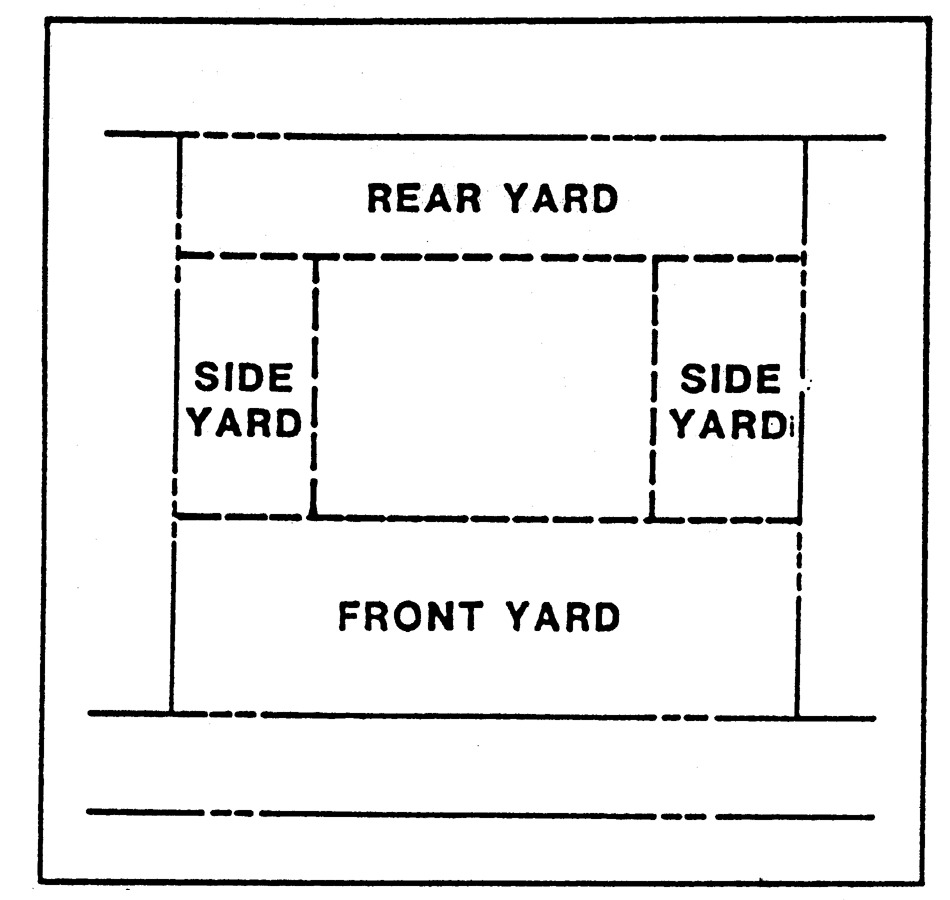
Figure 27-15-3
Yard, side means a yard between any building or proposed building and the sideline of the lot and extending from the front yard line to the rear building line, excluding steps.
Year means a calendar year, unless otherwise indicated.
Zoning map means that map adopted by reference in section 27-9.
Zoning permit means a permit that is issued by the city manager or designee after determining that the proposed use is consistent with the uses permitted in that zoning district.
(Ord. No. 2004-10, § 1, 10-4-04; Ord. No. 2004-18, § 1, 12-6-04; Ord. No. 2005-03, § 1, 3-7-05; Ord. No. 2006-03, § 1, 3-6-06; Ord. No. 2006-06, § 1, 5-1-06; Ord. No. 2007-07, § 1, 6-4-07; Ord. No. 2008-10, § 1, 9-8-08; Ord. No. 2010-10, § 1, 7-12-10; Ord. No. 2010-14, § 3, 9-7-10; Ord. No. 2011-03, § 1, 2-17-11; Ord. No. 2011-09, § 1, 6-6-11; Ord. No. 2011-25, § 2, 12-5-11; Ord. No. 2012-11, § 2, 12-4-12; Ord. No. 2013-01, § 2, 5-6-13; Ord. No. 2015-14, § 1, 10-5-15; Ord. No. 2016-07, § 1, 7-6-16; Ord. No. 2017-16, § 1, 6-5-17; Ord. No. 2017-10, § 1, 7-5-17; Ord. No. 2017-32, § 2, 1-8-18; Ord. No. 2018-02, § 1, 4-2-18; Ord. No. 2022-03, § 1(Exh. A), 8-1-22; Ord. No. 2023-11, § 1(Exh. A), 1-2-24)
Sec. 27-16. - Reserved.
Editor's note— Ord. No. 2022-03, § 1(Exh. A), adopted Aug. 1, 2022, deleted § 27-16 entitled "Computation of required or permitted units," which derived from Ord. No. 2004-10, § 1, adopted Oct. 4, 2004. See § 27-242 for similar provisions.
Sec. 27-17. - Computation of time.
The computation of time for deadlines or periods of time prescribed or allowed shall follow the rules as provided for in section 1-12 of the Code of Ordinances.
(Ord. No. 2004-10, § 1, 10-4-04)
Sec. 27-18. - Fees.
Reasonable fees sufficient to cover the costs of administration, inspection, publication of notice, and similar matters may be charged applicants for zoning permits, concurrency certificates, sign permits, tree permits, conditional use permits, special use permits, subdivision plat approval, zoning amendments, variances, application for appeals, and other administrative relief. The amount of the fees shall be established by resolution of the city council.
(Ord. No. 2004-10, § 1, 10-4-04)
Sec. 27-19. - Use of graphic renderings in Code.
(a)
Purpose. Throughout this Code, graphic renderings are included to assist the user in understanding narrative portions of this Code, especially definitions.
(b)
Effect upon Code. No provision of this Code shall be held invalid by reason of deficiency in any such graphic.
(Ord. No. 2004-10, § 1, 10-4-04)
Sec. 27-20. - Abrogation.
This Code is not intended to repeal, abrogate, or interfere with any existing easements, covenants, or deed restrictions duly recorded in the public records of the city or county.
(Ord. No. 2004-10, § 1, 10-4-04)
Sec. 27-21. - Severability.
If any section, subsection, paragraph, sentence, clause, or phrase of this Code is for any reason held by any court of competent jurisdiction to be unconstitutional or otherwise invalid, the validity of the remaining portions of this Code shall continue in full force and effect.
(Ord. No. 2004-10, § 1, 10-4-04)
Sec. 27-22. - Effective date.
This Code shall be effective on April 1, 1991, as later revised by Ordinance 2004-10 on October 4, 2004. Later amendments to this Code become effective on the date stated in the amending ordinance or as provided by state law.
(Ord. No. 2004-10, § 1, 10-4-04; Ord. No. 2022-03, § 1(Exh. A), 8-1-22)
Sec. 27-23. - Adopting disclosure procedures related to ex-parte communications with public officials.
The city council of the city hereby adopts the following public disclosure process relating to elected and/or appointed public officials who hold positions on any board, council or commission charged with making recommendations and/or taking final action on any quasi-judicial proceeding.
Access permitted: Any person not otherwise prohibited by statute, Charter provision or ordinance may discuss with any local public official (elected and/or appointed) the merits of any matter on which quasi-judicial action may be taken by any board, council or commission on which the local public official is a member, so long as the following process is observed:
(1)
The substance of any exparte communication with a local public official (appointed and/or elected) which relates to quasi-judicial action pending before the official shall not be presumed prejudicial to the action if the subject of the communication and the identity of the person, group or entity with whom the communication took place is disclosed and made a part of the record before final action on the matter.
(2)
A local public official may read a written communication from any person. However, a written communication that relates to quasi-judicial action pending before a local public official shall not be presumed prejudicial to the action and such written communication shall be made a part of the record before final action on the matter.
(3)
Local public officials may conduct investigations and site visits and may receive expert opinions regarding quasi-judicial action pending before them. Such activities shall not be presumed prejudicial to the action if the existence of the investigation, site visit or expert opinion is made a part of the record before final action on the matter.
(4)
Disclosure made pursuant to subsections (1), (2) and (3) must be made during the public meeting, but prior to the vote being taken on such matters, so that persons who have opinions contrary to those expressed in the ex-parte communication are given a reasonable opportunity to refute or respond to the communication. This section shall not subject local public officials to F.S. Ch. 112, Pt. III, for not complying with this subsection.
(Ord. No. 2004-10, § 1, 10-4-04)
Sec. 27-24. - Reserved.
Editor's note— Ord. No. 2022-03, § 1(Exh. A), adopted Aug. 1, 2022, deleted § 27-24 entitled "Encroachment and reduction of lot area," which derived from Ord. No. 2004-10, § 1, adopted Oct. 4, 2004.

