
Neptune Beach City Zoning Code
ARTICLE IX
TREE PROTECTION AND LANDSCAPING17
Editor's note— Ordinance No. 2004-10, § 1, adopted October 4, 2004, amended article IX in its entirety to read as herein set out. Former article IX, §§ 27-441—27-457, pertained to similar provisions, and derived from Ord. No. 91-1-5, § 2, 5-6-91.
Sec. 27-442. - Purpose and intent.
The purpose of this article is to preserve and protect trees within the city; to provide minimum landscaping criteria; to ensure preservation of the existing native landscape; and to ensure quality landscape design, installation, and maintenance of new landscaping that will enhance the city's natural landscape. To this end, the subsequent sections are provided to achieve the following goals:
(1)
Improve the appearance of commercial, governmental, industrial and residential areas through incorporation of landscaping into development in ways that harmonize and enhance the natural and manmade environment;
(2)
Preserve existing natural trees and vegetation. Discourage removal of any healthy, noninvasive trees and clear-cutting of wooded land;
(3)
Incorporate native plants, plant communities and ecosystems into landscape design where possible;
(4)
Maintain the existing natural character of the city through preservation of existing trees and vegetation;
(5)
Balance the existing landscape with new landscape additions that are complementary;
(6)
Provide landscape buffers to enhance transportation corridors, abate noise, minimize adverse impacts of adjacent differing land uses, and reduce surface heat of impervious surfaces;
(7)
Promote water and energy conservation through Xeriscape principles;
(8)
Reduce maintenance costs through preservation of existing landscape, and through appropriate and proper use of plant materials; and
(9)
Promote and support city-wide tree planting to enhance the city's designation as a Tree City U.S.A., by upholding the program's four (4) overarching standards:
•
Maintaining a tree board or department;
•
Having a community tree ordinance;
•
Spending at least two dollars ($2.00) per capita on urban forestry; and
•
Celebrating Arbor Day.
(Ord. No. 2004-10, § 1, 10-4-04; Ord. No. 2022-03, § 1(Exh. A), 8-1-22)
Sec. 27-443. - Applicability.
The terms and provisions of this article shall apply to all land uses within the city. Special provisions for single-family or two-family (duplex) lots are addressed in section 27-457 of this article.
(Ord. No. 2004-10, § 1, 10-4-04; Ord. No. 2022-03, § 1(Exh. A), 8-1-22)
Sec. 27-444. - Definitions.
Refer to article I for definitions.
(Ord. No. 2004-10, § 1, 10-4-04)
Sec. 27-445. - Permit required for tree removal or relocation.
No person shall directly or indirectly cut down, destroy, remove, move, or effectively destroy through damaging, or authorize the cutting down, destroying, removing, moving, or damaging of any and all living trees greater than six (6) inches or more in caliper or two (2) feet in circumference, whichever dimension is lesser, at a point four and one-half (4½) feet above ground level, without a tree permit. Trees which require such permit for removal or relocation shall hereinafter be called "regulated trees."
(1)
Exceptions are as follows:
a.
No heritage or champion tree as defined in this article may be removed or relocated except as noted in section 27-448.
b.
Hazard trees which have been identified by an ISA certified arborist or Florida licensed landscape architect with up-to-date tree risk assessment qualification and which have been inspected and documented per ISA standards may be removed, relocated, replaced, trimmed, or pruned, without a tree permit or replacement trees. Removal or replacement shall only be permitted in this instance if the risk assessment documentation does not indicate any other practical mitigation alternatives, such as pruning, topping, bracing, or removal of the target. The city manager or designee shall review all risk assessment documentation to verify the conditions for removal prior to any action.
c.
Removal or relocation of regulated trees subject to development plan approval shall not require a separate tree permit in conjunction with the development plan. Plans for tree removal or relocation will be considered and either approved or denied as part of the development review process. After a certificate of occupancy has been issued for a development, any tree removal shall require either a tree permit or an approved plan amendment. Failure to obtain a permit before removing or relocating a regulated tree shall be subject to the measures in section 27-452.
d.
Any tree that poses a danger to life safety, city infrastructure, or property, as verified by an ISA certified arborist or Florida licensed landscape architect with up-to-date tree risk assessment qualification, may be removed by order of the city manager or designee.
e.
Any tree species identified by an ISA certified arborist or Florida licensed landscape architect as a Category I or Category II invasive by the Florida Exotic Pest Plant Council shall be identified and removed from the property. No tree permit or replacement trees are needed for their removal.
f.
Replacement trees from the city's tree list, located in section 27-450 shall be required for any trees removed per section 27-447.
(2)
Removal of trees located in a buildable area or yard area where a structure or improvement is to be placed and for which a tree permit application has been filed may be approved by the city manager or designee, so long as it has it has been demonstrated by the property owner that the tree or trees unreasonably restrict the permitted use of the property and that no other building footprint and/or site configurations are possible without removal of said trees. Trees located in the front yard setback shall not be considered to be located within the buildable area or yard. Ingress and egress to the garages are not considered the buildable area or yard. Trees on the public right-of-way shall not be considered for removal as a result of restrictions to ingress or egress to garages or parking on the site, except if demonstrated that there is no other reasonable access to and from the property from the public right-of-way. An application for a tree permit must be filed, per the requirements of section 27-446. Replacement trees may be required for any trees removed.
(Ord. No. 2004-10, § 1, 10-4-04; Ord. No. 2004-19, § I, 1-3-05; Ord. No. 2006-02, § 1, 3-6-06; Ord. No. 2006-12, § I, 7-10-06; Ord. No. 2022-03, § 1(Exh. A), 8-1-22)
Sec. 27-446. - Permit application procedures.
The following procedures shall be followed and shall govern the granting of tree permits pursuant to this section:
(1)
Application. Permits for removal, relocation or alteration of trees shall be obtained by making application in a form prescribed by the city council to the following appropriate public bodies:
a.
For removal or relocation of regulated trees not associated with a site plan approval of the community development board, an application shall be filed with the city manager's office, as described below.
b.
For pruning of six-inch or larger diameter limbs on regulated trees, a tree permit will be required. This provision relates to pruning or alteration only, and applies to any development.
(2)
Submittals. No permit fee shall be charged for authorized tree removal within the city. Each application for a tree permit to alter, remove, relocate, or replace trees covered herein shall be accompanied by a written statement indicating the reasons for the requested action, at least one (1) photograph for each tree designated for removal showing its current overall condition, and two (2) copies of a legible site plan drawn to the largest practical scale indicating the following:
a.
Location, species and size of all existing trees on the site, assigned with a unique identification number, and a proposed outcome (e.g., donated, retained, removed, or relocated).
b.
Trees designated for on-site relocation shall clearly illustrate both the existing and proposed locations and shall identify likely means of access and method of relocation.
c.
Champion and heritage trees, as defined in section 27-448, shall be identified as such on all submittals and any associated removal or replacement calculations shall be separate from all other trees and considered on a tree-by-tree basis. Size of tree shall be measured per section 27-445.
d.
Location of all existing or proposed structures, improvements, and site uses, properly dimensioned in reference to property lines, setback and yard requirements in spatial relationship.
e.
Location and dimension of all required landscape buffers or screening areas.
f.
Proposed changes, if any, in site elevations, grades and major contours.
g.
Location of existing or proposed utility service.
h.
Applications involving developed properties may be based on drawings showing only that portion of the site directly involved and adjacent structures and vegetation.
i.
For trees that are to be retained, each application should contain the extents of all tree protection boundaries on-site per section 27-449 and a statement of how these tree areas are to be protected during construction and landscape operations.
j.
A statement that identifies replacement trees for any trees removed. Any regulated tree being removed that requires a tree permit, per section 27-445, shall be replaced with trees per the requirements of section 27-447.
k.
Application review and permit issue. Upon receipt of proper application, the city manager or designee shall review the application, and may request more documentation before making a determination to either approve, approve with conditions, or deny the permit within ten (10) working days of filing. This may include a field check of the site and referral of the application for recommendations to other appropriate administrative departments or agencies.
(3)
Permit form. Permits shall be issued by the city manager and may set forth in detail the conditions upon which the permit is granted. One (1) permit may cover several trees or groups of trees for one (1) parcel of land, or for multiple, contiguous parcels.
(Ord. No. 2004-10, § 1, 10-4-04; Ord. No. 2006-02, § 2, 3-6-06; Ord. No. 2010-14, § 41, 9-7-10; Ord. No. 2022-03, § 1(Exh. A), 8-1-22)
Sec. 27-447. - Standards for replacement or relocation.
(a)
Replacement or relocation.
(1)
Replacement. In all cases wherein this Code shall require replacement of any tree removed, the replacement shall be made as defined in this section. In determining the required replacement of trees, the city manager or designee shall consider the intended use of the property, with an evaluation of the following:
a.
Size. Replacement trees shall be a minimum of four-inch caliper with a height of at least ten (10) feet for shade trees, or eight (8) feet for ornamental and understory trees. All replacement trees shall be Florida Nursery Grade Number 1 or better. The property owner shall guarantee survival of replacement trees for one (1) year from the date of planting, barring any force majeure events.
b.
Caliper bonus. The use of larger diameter trees to accommodate the required replacement is strongly encouraged. Each additional inch of size provided, including and above eight-inch caliper shall be counted with a two-inch bonus (e.g., a ten-inch caliper replacement tree may be counted as a twelve-inch caliper replacement tree). The caliper bonus shall not apply to the replacement of heritage or champion trees.
c.
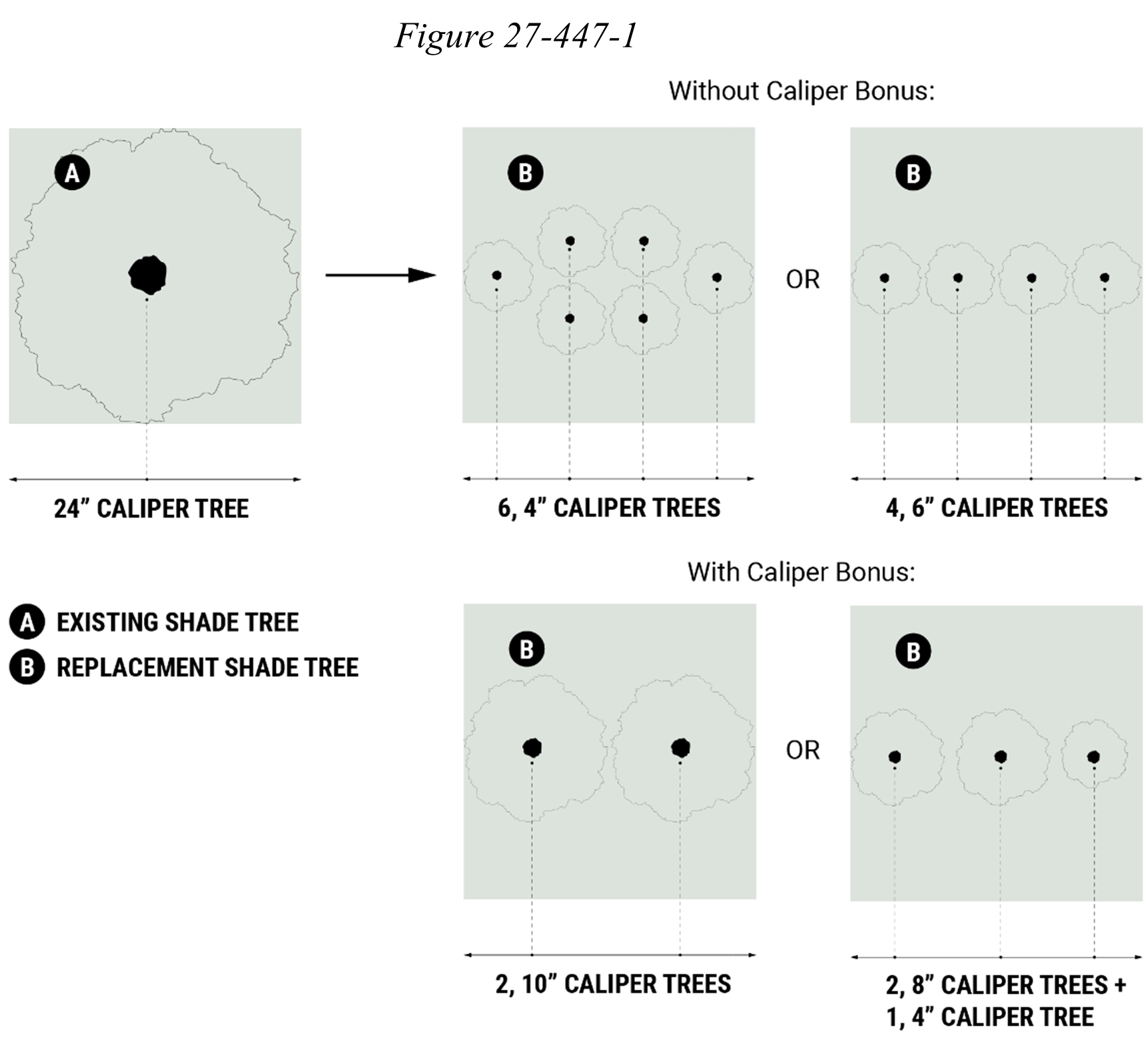
Shade trees, as defined by the city's approved tree list located in section 27-540, which are designated for removal, shall be replaced on an inch-for-inch (1:1) diameter basis with one (1) or more trees from the same shade tree portion of the city's tree list. The sum total of the calipers of the replacement trees must equal or surpass that of the removed tree or trees (e.g., a twenty-four-inch caliper oak designated for removal may be replaced by six (6), four-inch caliper shade trees or four (4), six-inch caliper shade trees, or utilizing the caliper bonus defined in this section, two (2), ten-inch caliper shade trees or two (2), eight-inch caliper and one (1), four-inch caliper shade trees). Caliper measurement shall be rounded up to the nearest inch.
d.
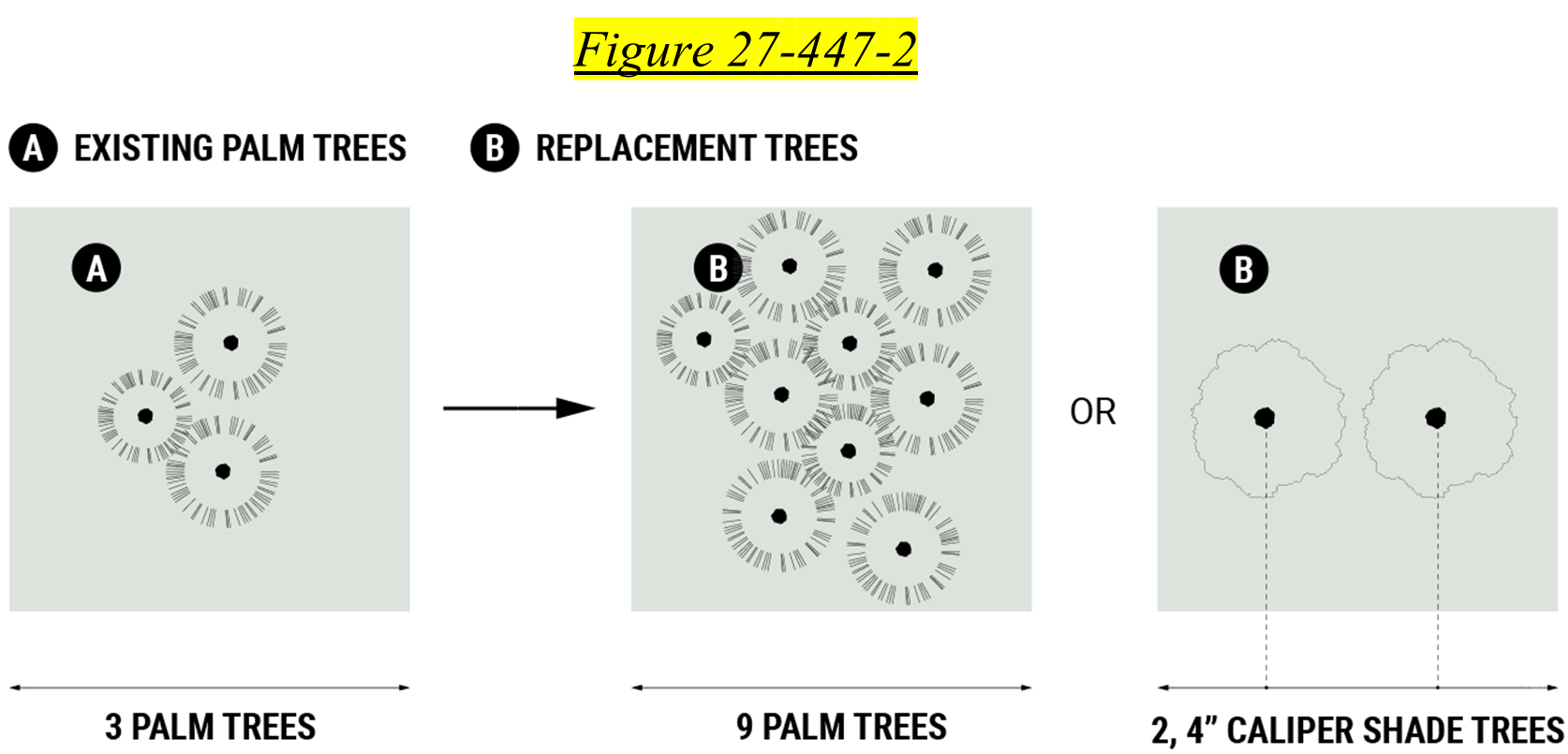
Palm trees of any species designated for removal may be replaced on a one-to-three (1:3) basis with palm species from the city's approved tree list located in section 27-450 (e.g., three (3) palms designated for removal shall be replaced by a minimum of nine (9) palm trees). Palm trees designated for removal may also be replaced on a two-to-one (2:1) basis, rounding up to the next even number, with tree species from the shade tree portion of the city's approved tree list (e.g., five (5) palm trees designated for removal shall be rounded to six (6), requiring a minimum of three (3), four-inch caliper shade trees as replacement, or utilizing the caliper bonus defined in this section, one (1), ten-inch caliper shade tree).
e.
Understory and ornamental trees, as defined by the city's approved tree list, located in section 27-450, designated for removal, shall be replaced on an inch-to-inch (1:1) diameter basis, or equivalent measure, with tree species from the shade tree or understory and ornamental tree portions of the city's tree list. As with shade tree replacement (see Figure 27-447-1), the sum total of the calipers of the replacement trees must equal or surpass that of the removed understory/ornamental tree or trees (e.g., a twelve-inch caliper ornamental tree designated for removal shall require a minimum of three (3), four-inch caliper trees or two (2), six-inch caliper trees as replacement, or utilizing the caliper bonus defined in this section, one (1), ten-inch caliper tree). Caliper measurement shall be rounded up to the nearest inch.
f.
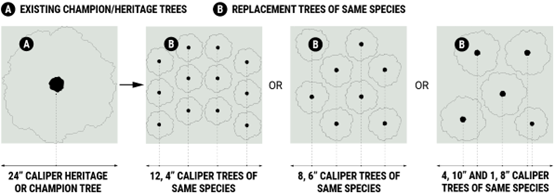
Heritage or champion trees, as defined in section 27-448, designated for removal shall be replaced on a one-inch for two-inch (1:2) diameter basis, with a tree or trees of the same species. The sum total of the calipers of the replacement trees must at least double that of the removed heritage or champion tree (e.g., a twenty-four-inch caliper bald cypress designated for removal shall require replacement bald cypress trees of a combined forty-eight-inch caliper, such as twelve (12), four-inch caliper trees; eight (8), six-inch caliper trees; six (6), eight-inch caliper trees; or four (4), twelve-inch caliper trees). Caliper measurement shall be rounded up to the nearest inch. The caliper bonus may not be used for the replacement of heritage or champion trees.
g.
Replacement may not be required for diseased trees being removed. Documentation of diseased trees shall accommodate all submittals as described in section 27-446.
h.
Maintenance of replacement trees. Replacement trees shall be maintained through appropriate watering, nutrients, and pruning to guarantee their survival and growth. The city manager or designee shall require any replacement trees that die within five (5) years of planting shall be replaced to meet the original requirements.
(2)
Relocation. Trees relocated within the site, shall be placed as close as possible to the original tree location, and shall not be relocated to interfere with the root systems or canopy of any champion or heritage tree. The relocation of palm trees into clusters of the same species is encouraged. All relocated trees shall be warrantied for a period of five (5) years and kept in good health. Replacement of relocated trees, should they not survive the warranty period, shall be replaced at a one-to-one (1:1) ratio.
(b)
Alternatives to on-site replacement. If upon evaluation of these conditions, it is determined by the city manager or his designee that the applicant's site may not best be suited for the location of some or all of the required replacement trees, the city manager may allow the applicant to contribute to the city's tree fund per section 27-458.
(c)
Off-site tree replacement locations. Staff will evaluate locations for tree replacement out of the tree fund, section 27-458, based on location and type of tree to be planted.
(d)
Credit for existing trees. Existing vegetation may be credited for landscape materials required by this section. Such vegetation shall meet the minimum specifications for new landscape material and be located within the area for which credit is requested.
(1)
Credit for trees shall be granted at an inch-for-inch basis. No credit shall be granted where existing vegetation does not satisfy screening purposes, serve necessary functions or meet minimum planting standards, as defined in this Code.
(2)
The city may grant credit for existing trees which are defined as heritage or champion trees in this Code at a two-inch for one-inch (2:1) basis. This provision shall be reviewed on a case-by-case basis depending on surrounding existing vegetation, and the age, health, type, size and location of the specimen tree. If the tree dies, the developer or property owner shall be required to install a replacement tree as required in this section.
(Ord. No. 2004-10, § 1, 10-4-04; Ord. No. 2022-03, § 1(Exh. A), 8-1-22)
Sec. 27-448. - Champion and heritage trees.
(a)
Champion trees are those trees that have been identified by the state division of forestry as being the largest of their species within the state or by the American Forestry Association as the largest of their species in the U.S. The current list of champion trees in the city and the county which have been identified is on file in the department of planning and development.
(b)
Heritage trees. The following species are heritage trees:
(1)
Bald cypress (Taxodium distichum) twenty (20) inches in diameter or greater.
(2)
Cedar (Juniperus silicicola) (Southern red cedar), J. virginiana (Eastern red cedar) twenty (20) inches in diameter or greater.
(3)
Elm (Ulmus alata) (winged elm), Ulmus american floridana (Florida elm) thirty (30) inches in diameter or greater.
(4)
Heritage oaks (Quercus alba (white oak), Q. austrina (bluff oak), Q. geminata (sand live oak), Q. prinus (swamp chestnut or basket oak), Q. virginiana (live oak)) thirty (30) inches in diameter or greater.
(5)
Hickory (Carya illinoensis) (pecan), C. tomentosa (mockernut), C. glabra (pignut hickory) thirty (30) inches in diameter or greater.
(6)
Loblolly bay (Gordonia lasianthus) twenty (20) inches in diameter or greater.
(7)
Magnolia (Magnolia grandiflora) (Southern magnolia), Magnolia virginiana (sweetbay magnolia) twenty (20) inches in diameter or greater.
(8)
Maples (Acer rubrum) (red maple), A. barbatum (Florida maple) twenty (20) inches in diameter or greater.
(9)
Tupelo (Nyssa sylvatica) thirty (30) inches in diameter or greater.
(10)
White ash (Fraxinus americana) thirty (30) inches in diameter or greater.
(c)
Champion and heritage trees shall be considered regulated trees in all areas of the city, and their removal shall be strongly discouraged.
(d)
Prior to removal of any tree, the owner shall give the city first right of refusal to relocate any/all heritage or champion trees, otherwise designated for removal by the applicant.
(e)
Any permission given for the removal of any heritage or champion tree that is healthy and that is not causing structural damage, whether this permission is through an approved development plan or through the issuance of a tree permit, will require replacement on a two-inch for one-inch (2:1) basis, measured per specifications of section 27-445. Trees may be planted on-site or off-site or given to the city for planting on public property.
(f)
The removal, relocation or replacement of any champion or heritage trees shall be by community development board approval. The city council will approve the removal, relocation or replacement of any heritage or champion tree when such removal, relocation or replacement is proposed as part of the subdivision approval process.
(Ord. No. 2004-10, § 1, 10-4-04; Ord. No. 2006-02, § 3, 3-6-06; Ord. No. 2010-14, § 42, 9-7-10; Ord. No. 2022-03, § 1(Exh. A), 8-1-22)
Sec. 27-449. - Tree preservation during development and construction.
(a)
Barriers required. During construction, protective barriers shall be placed, as necessary, to prevent the destruction or damaging of trees. Trees destroyed or receiving major damage shall be replaced before issuance of a certificate of occupancy or use, if such certificate is required, unless approval for their removal has been granted under permit. The city manager or designee shall determine what trees, if any, require protection or replacement.
(b)
Barriers. All regulated trees not designated for removal shall be required by the terms of the permit to be protected by barriers erected prior to construction of any structures, road, utility service or other improvements.
(c)
[Encroachment prevention.] Such barriers shall be plainly visible and shall create a continuous boundary in order to prevent encroachment by machinery, vehicles or the storage of materials. Protective posts of nominal two (2) inches by four (4) inches or larger wooden posts, two (2) inches outer diameter or larger pipe, or other post material of equivalent size and strength shall be implanted deep enough in the ground to be stable with at least three (3) feet of the post visible above the ground.
(d)
Drip line. Barriers shall be placed at the drip line, though never less than ten (10) feet from the trunk of a protected tree unless approved by an arborist and the city manager or designee, for all trees determined to remain and for relocated trees, both before and after relocation. Barriers for champion and heritage trees shall extend to one and one-half (1.5) times the extents of the drip line.
(1)
In cases where complying with the above placement of barriers is found to unduly restrict development of the property, the city manager or designee may approve alternative methods of protection.
(2)
No grade changes shall be made within the protective barrier zones without prior approval of the city manager or designee. Where roots greater than one (1) inch in diameter are damaged or exposed, they shall be cut cleanly and recovered with soil.
(3)
Protective barriers shall remain in place and intact until such time as landscape operations begin or construction needs dictate a temporary removal that will not harm the tree.
(4)
Landscape preparation in the protected area shall be limited to shallow discing of the area. Discing shall be limited to a depth of two (2) inches unless specifically approved otherwise by the city manager or designee, the community development board the city council as applicable.
(5)
No building materials, machinery or harmful chemicals shall be placed within protective barriers, except short-duration placements of fill soil that will not harm the tree. Such short-duration placements shall not exceed thirty (30) days.
(6)
The standards established in the American National Standard for Tree Care Operations (ANSI A300), Part 5, "Management of Trees and Shrubs During Site Planning, Site Development, and Construction," as published by the Tree Care Industry Association, the standards of the National Arborist Association, or other nationally recognized arboricultural standards approved by the city manager or designee shall be used as guidelines for tree protection, planting, pruning and care.
(7)
Attachments to trees prohibited. No attachments or wires other than those of a protective and nondamaging nature shall be attached to any tree.
(8)
Any/all measures shall be taken to avoid soil compaction impacting protected trees for the duration of construction. In cases where the temporary removal of a barrier may be necessary, a sufficient layer of mulch or similar materials shall be placed so as to prevent soil compaction.
(9)
Inspections. The city manager or designee shall conduct periodic inspections of the site before work begins and/or during clearing, construction and/or post-construction phases of development in order to ensure compliance with these regulations and the intent of this section.
(Ord. No. 2004-10, § 1, 10-4-04; Ord. No. 2010-14, § 43, 9-7-10; Ord. No. 2022-03, § 1(Exh. A), 8-1-22)
Sec. 27-450. - Approved tree list.
(a)
City tree list. Replacement trees, as required per section 27-447 shall be selected from the following list. This list was generated based on species hardiness, disease- and pest-resistance, availability and size variance. It is not the intent to unreasonably limit the selection of replacements. Therefore, replacement trees not included on the city's tree list but suggested by the applicant may be considered, and approved or denied, during the tree permit application process.
Table 27-449.1. City of Neptune Beach Approved Tree List
(Ord. No. 2004-10, § 1, 10-4-04; Ord. No. 2022-03, § 1(Exh. A), 8-1-22)
Sec. 27-451. - Regulations pertaining to utility companies.
(a)
In the event any electric, water, telephone, or other public utility firm or corporation plans to extend, maintain, or relocate service such that any tree on any unimproved lot or tract will be removed, said utility shall make application for a tree permit as described in section 27-446. Any public utility wishing to prune trees on a right-of-way shall notify the city manager in writing one (1) week in advance of the time and place these pruning activities will take place. The city manager or designee shall supervise these activities as necessary and shall have the authority to regulate or halt such pruning when these actions are deemed detrimental to the trees or beyond that needed to insure continued utility service.
(b)
A utility company shall not remove or alter any trees at a distance greater than five (5) feet from the utility pole, structure or conductor within the city without a permit having first been obtained.
(c)
The city shall observe the requirements of this section.
(Ord. No. 2004-10, § 1, 10-4-04; Ord. No. 2022-03, § 1(Exh. A), 8-1-22)
Sec. 27-452. - Unauthorized removal of or damage to regulated trees.
(a)
If a regulated tree, to include heritage or champion trees as defined in section 27-448, is removed without permit, or is altered or damaged such that the likelihood for disease or premature death is increased, the tree removal contractor and/or property owner shall pay a fine of twice the tree fund fee, as established in section 27-458, per diameter inch of the trunk, measured at four and one-half (4½) feet above the ground. In the event that a tree has been completely removed from the site, the measurement will be taken as the diameter of the remaining stump. In the event that no portion of a stump remains, documents such as a tree survey, building plans, etc., may be used to determine the size of the regulated tree removed. All violations of section 27-452 shall be referred to the code enforcement board for disposition.
(b)
Clear-cutting of land is prohibited. If any parcel of land is clear cut without a tree removal permit, the tree removal contractor and/or property owner shall be subject to enforcement in accordance with article VII of chapter 2 of this Code and fined a minimum of five thousand dollars ($5,000.00).
(c)
All fines imposed through the code enforcement process in article VII of chapter 2 for unauthorized removal or damage of regulated trees shall be paid to the City of Neptune Beach. All fines collected shall be deposited into the city's tree mitigation fund.
(Ord. No. 2004-10, § 1, 10-4-04; Ord. No. 2006-02, § 4, 3-6-06; Ord. No. 2022-03, § 1(Exh. A), 8-1-22)
Sec. 27-453. - Procedure for appeal.
(a)
Any denial of a tree permit by the city staff of this article may be appealed within thirty (30) days of said decision to the community development board for final disposition as specified in section 27-133. The community development board through competent testimony may, in their discretion, affirm, overturn, or modify any decision made in the administration of this article.
(b)
Appeals of the enforcement of this article shall be made as provided for in section 27-445.
(Ord. No. 2004-10, § 1, 10-4-04; Ord. No. 2006-02, § 5, 3-6-06; Ord. No. 2010-14, § 44, 9-7-10; Ord. No. 2022-03, § 1(Exh. A), 8-1-22)
Sec. 27-454. - Violation; denial of permits, certificates.
No building permits shall be issued on lands where violations of this article are determined to exist, including payment of all fines levied for violations, or appropriate remedial action as agreed to by the city manager or designee and completed by the owner of the land. A certificate of occupancy shall not be issued for any construction until all applicable remedies have been accomplished.
(Ord. No. 2004-10, § 1, 10-4-04)
Sec. 27-455. - Minimum landscape requirements.
(a)
Requirements of these sections do not exempt property owners from compliance with any other section of this article.
(b)
Minimum percentage of developed area devoted to landscaping. Property shall be designed, constructed and used so that the total of the areas devoted to landscape materials of any site is at least twenty (20) percent of the gross area of each parcel.
(c)
For property within the central business district, all portions of a site that are not otherwise covered by structures or pavement shall be landscaped. Because the landscaped areas are minimal within the CBD, the use of more dense plant materials is required. Landscape materials for sites within the CBD shall include trees, shrubs, vines and groundcovers. Therefore, sod shall not be used as a landscape material in the CBD.
(d)
Landscape and/or planting plans for all nonresidential developments shall be prepared by a landscape architect registered in the State of Florida.
(e)
Minimum requirements for landscaped areas. All development except individual, single-family and two-family (duplex) residential lots shall meet the requirements of these sections. See section 27-457 for specific requirements for individual, single-family and duplex residential lots. However, all other development shall comply with the following:
(1)
An automatic irrigation system shall be supplied for all newly landscaped areas. System shall include a pressure vacuum breaker-type backflow preventer, rain sensor, electric timer and valves, and sprinkler heads, and all pipe and materials necessary for a fully functioning system. The design of the irrigation system shall promote water conservation through methods such as efficient zoning of heads and/or micro-irrigation. The irrigation system shall be designed and located to minimize the watering of impervious surfaces. Irrigation shall not be required for existing natural vegetation areas.
(2)
Plants shall be sized such that, within three (3) years of the time of planting, at least half of the required landscaped development shall be devoted to living plants. Remaining landscape areas shall be mulched with organic materials.
(3)
When a landscaped area is adjacent to or within a vehicular use area, curbing shall be used to protect landscaped areas from encroachment. Parking spaces shall be designed to provide pervious surface for the vehicle overhang area.
(4)
Shrubs and trees shall be placed away from the wheel stop, so that they will not be encroached upon by vehicles. In lieu of curbing, the alternative means of preventing encroachment shall be shown on the site plan.
(5)
All required trees shall be selected from the shade tree section of the city tree list in section 27-450. In order to encourage plant diversity, no more than fifty (50) percent of the selected trees for one (1) plan shall be from the same genus.
(6)
Any landscaped area adjacent to an intersection or driveway shall conform to the requirements for the vision triangle, as defined in article I.
(7)
Where gravel is used as landscaping groundcover, a concrete, stone paver, or similar barrier must be used to contain the gravel and keep it from entering streets, drains, culverts, and any other transportation and stormwater system.
(f)
Ocean-front lots. Oceanfront lots of any type shall be landscaped with salt-tolerant plant material only.
(g)
Exemptions.
(1)
All parking garages shall be exempt from this section, pertaining to landscaping requirements for vehicular use areas; however, vehicles shall be screened from adjacent properties and public rights-of-way through the use of opaque materials at ground level.
(2)
Parking lots under lease. The area of any lot under lease which contains required parking spaces for any use shall comply with the provisions of this section as a precondition to the issuance of any development order issued in connection with such lot for such use.
(h)
Minimum submittal criteria.
(1)
All planting plans shall be drawn to scale and have a north arrow, and shall accurately depict all buildings, pavement, on-site facilities, utilities and lighting systems. The landscape drawing or accompanying development plan must give the permitted use of adjacent parcels and the total square footage of all pavement on-site.
(2)
A plant schedule shall be provided showing the botanical name, size, spacing and number of all required plant materials. During construction, any tree or shrub may be substituted for the identified plant, provided that the shrub is adaptable to the amount of sun/shade, wet/dry and size conditions where it will be planted, and insofar as the provisions for diversity described in this article and all required tree replacement calculations are met. The use of additional plant material beyond the minimum required is strongly encouraged. However, plant materials shown that are additional to the required materials shall not be subject to inspection, and should be identified on the planting plans as "supplementary."
(3)
A tree table shall be provided showing the calculated requirements for trees to be planted, including all information as required for submittals per section 27-446.
(i)
Design principles and standards. All landscaped areas required by this article shall conform to the following general guidelines:
(1)
The preservation of native trees and shrubs is strongly encouraged to maintain healthy, varied and energy-efficient vegetation throughout the city, and to maintain habitat for native wildlife species.
(2)
The planting plans should integrate the elements of the proposed development with existing topography, hydrology and soils in order to prevent adverse impacts such as sedimentation of surface waters, erosion and dust.
(3)
The functional elements of the development plan, particularly the drainage systems and internal circulation systems for vehicles and pedestrians, should be integrated into the planting plan. The landscaped areas should be integrated, to promote the continuity of on-site and off-site open space and greenway systems, and to enhance environmental features.
(4)
The selection and placement of landscaping materials should maximize the conservation of energy through shading of buildings, streets, pedestrian ways, bikeways and parking areas. The use of wind for ventilation and the effect on existing or future solar access shall be considered.
(5)
Landscaping design should consider the aesthetic and functional aspects of vegetation, both when initially installed and when the vegetation has reached maturity. Newly installed plants should be placed at intervals appropriate to the size of the plant at maturity, and the design should use short-term and long-term elements to satisfy the general design principles of this section over time.
(6)
The natural and visual environment should be enhanced through the use of materials which achieve a variety with respect to seasonal changes, species of living material selected, textures, colors and size at maturity.
(7)
The placement of trees around buildings should permit access to the building by emergency vehicles.
(j)
The installation of invasive nonnative Category 1 and Category 2 species as defined by the Florida Department of Agriculture and Consumer Services (FDACS) and Florida Exotic Pest Plan Council (FLEPPC) is prohibited.
(Ord. No. 2004-10, § 1, 10-4-04; Ord. No. 2006-02, § 6, 3-6-06; Ord. No. 2011-19, § 1, 10-10-11; Ord. No. 2022-03, § 1(Exh. A), 8-1-22)
Sec. 27-456. - Landscaping buffers.
(a)
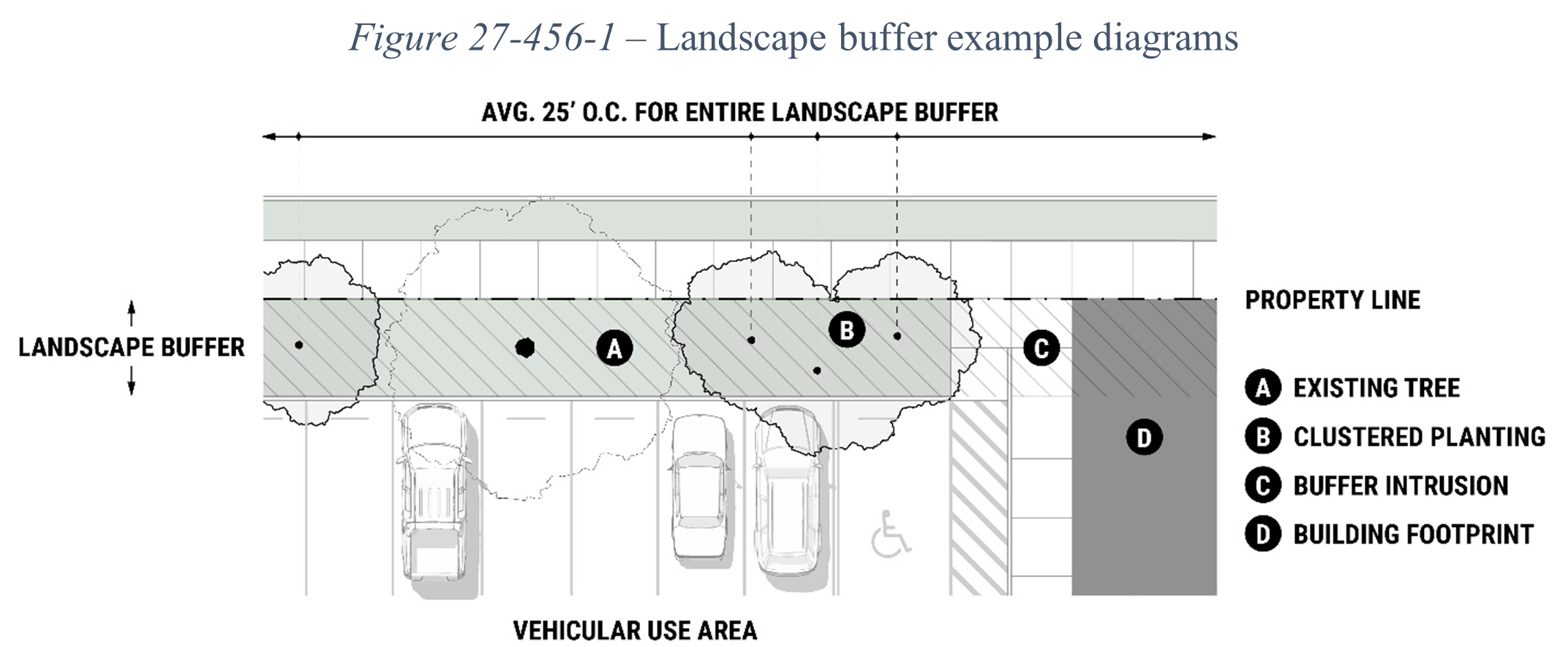
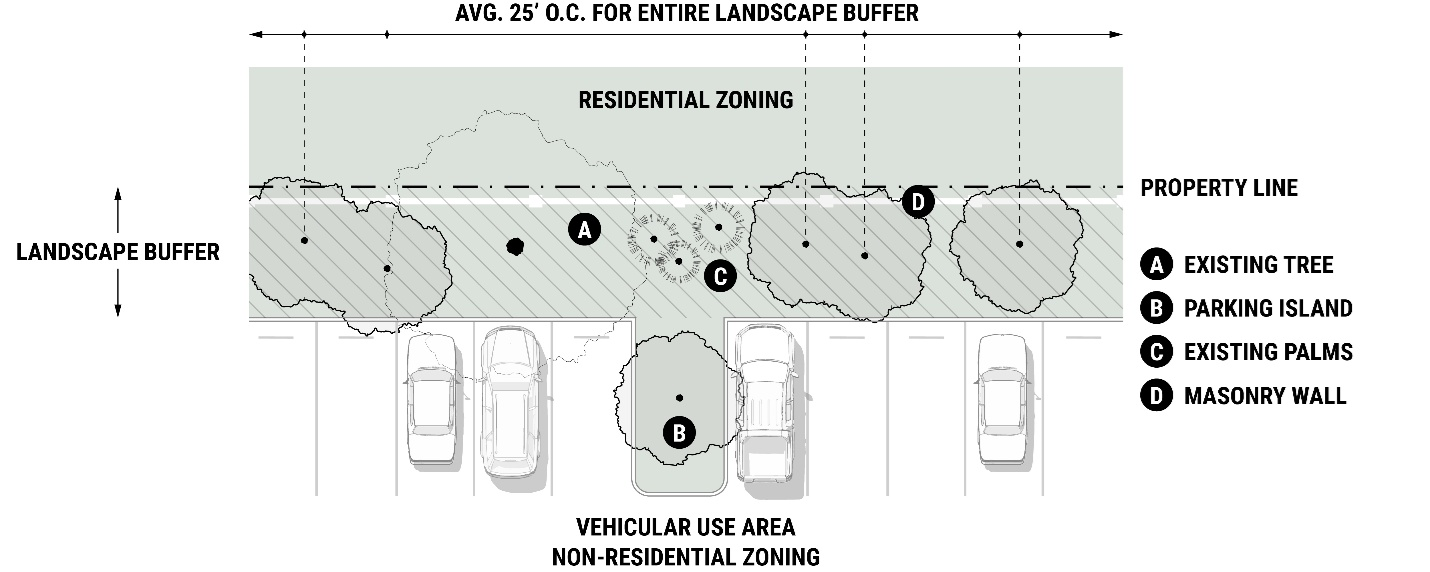
Generally. This section provides landscaping methods which are intended to set minimum requirements for the landscaping of vehicular use areas and certain perimeter areas abutting public rights-of-way within commercial zoning districts and between zoning classifications. Vehicular use areas and retention ponds may not be located within landscape buffers, though swales may be permitted within landscape buffers on a case-by-case basis. These requirements are illustrated in Figures 27-456-1 and 27-456-2 and are described herein as follows.
(b)
Size. Measurement of all landscape buffers shall be from the property line and shall extend along the entire length of the property line abutting the right-of-way.
(1)
Vehicular use areas shall be separated by a landscaped buffer area, a minimum of ten (10) feet in width, from any boundary of the property on which the vehicular use area is located.
(2)
Vehicular use areas abutting residential-zoned property shall be separated by a landscape buffer area of fifteen (15) feet in width.
(c)
Intrusions. Landscape buffer areas may only be altered or intruded upon for the following purposes and any such alterations or intrusions shall be in compliance with an approved development site plan:
(1)
Ingress and egress to vehicular use areas, drive aisles, and loading areas, per lot standards and allowable curb cuts defined in sections 27-235 and 27-243;
(2)
Pedestrian walkways or access to buildings and structures as necessary;
(3)
Bicycle and/or other transportation infrastructure;
(4)
Installation of stormwater, drainage, or utility improvements as necessary;
(5)
Grading or retention as necessary;
(6)
Selective clearing for visibility of freestanding signs;
(7)
The regular pruning of trees to provide clear trunk and visibility as required by the Florida Department of Transportation;
(8)
The installation of tree protection barriers as defined in this section;
(9)
The regular removal of dead materials and debris;
(10)
The installation of additional landscape materials required by this Code; or
(11)
A clear path of three (3) feet through vegetative buffers shall be maintained to allow for a fire department connection.
(d)
Exceptions. A landscape buffer area is not required:
(1)
For property located within the city's central business district (CBD);
(2)
For front and side setbacks less than or equal to ten (10) feet. In these cases, only rear lot lines shall adhere to any requirements defined in this section;
(3)
For side lot lines wherein, a residential lot is adjoined to another residential lot;
(4)
When the paved ground surface area is completely screened from adjacent properties or public rights-of-way by intervening buildings or structures;
(5)
When an agreement to operate abutting properties as essentially one (1) contiguous parking facility is in force. The agreement shall be executed by the owners of the abutting properties, and shall bind their successors, heirs, and assigns. Prior to the issuance of any building permit for any site having such a contiguous parking facility, the agreement shall be recorded in the public records of the county; or
(6)
When the required landscape buffer area would conflict with utility installations, and such conflicts cannot be resolved, such areas may be planted with shrubs and such understory trees as may be acceptable to the utility.
(e)
Modification of requirements. The community development board or staff, when only staff review is required, may determine that:
(1)
Screening is better achieved by relocation of the landscape buffer area;
(2)
There is an unresolvable conflict between other element(s) of the development plan and the location, width or height of the landscape buffer area, and that the public interest is therefore best served by relocation of the landscape buffer area, lowering the height of required material or the substitution of a solid fence or wall in conjunction with a reduction in width; or
(3)
That the screening would only serve to emphasize a long driveway that would otherwise be unobtrusive.
(f)
Planting. A landscape buffer area shall contain:
(1)
Trees. Landscape buffer areas shall include a calculated average of one (1) shade tree, as defined in the city's approved tree list, located in section 27-450, and sized as defined in section 27-447, for every fifteen (15) linear feet of frontage. The average spacing for proposed tree plantings shall be measured sequentially from tree-to-tree and the following conditions shall be considered while measuring:
a.
Clusters of no less than three (3) shade trees shall occur at all intrusions, as defined in this section, into the landscape buffer.
b.
Existing trees retained within the landscape buffer area, including champion and heritage trees shall be exempt from this calculation.
c.
Palms, understory, and ornamental trees of any species, as defined in the city's approved tree list, located in section 27-540 shall be exempt from this calculation except for when the use of shade trees is prohibited under overhead utilities.
d.
Trees proposed within landscape buffer areas may be counted towards the required tree replacement total as defined in section 27-447.
e.
Ornamental shrubs, native privacy plants, or other non-invasive landscape hedging shall be used between the required tree plantings, except that a five-foot gap may be permitted for intrusions.
(2)
Visibility. In addition to trees, a landscape buffer area shall contain an opaque screen composed of either plant materials, or a combination of plant materials and masonry walls.
a.
For the screening of vehicular use areas, landscape buffers shall be comprised of landscape materials, including hedges, shrubs, and groundcover plantings and shall be arranged to provide a visual screen of seventy-five (75) percent opacity and achieve a height of at least three (3) feet within three (3) years.
b.
For the screening of vehicular use areas from residential zoned property, landscape buffers shall be comprised of landscape materials, including hedges, shrubs, and groundcover plantings and shall be a visual screen of seventy-five (75) percent opacity and achieve a height of at least six (6) feet within twenty-four (24) months of planting.
c.
A six-foot masonry wall may be used as a buffer. However, trees, ornamental shrubs, or other plantings shall be used to minimize the harsh aesthetic of the wall.
d.
The community development board, during development plan review, may determine that natural vegetation is sufficient to screen adjacent properties and rights-of-way. In such instance the existing vegetation, including understory plants and bushes, is protected from pruning and removal, except that diseased plant material and invasive nonnative species may be replaced in accordance with this section. Where encroachments are made for utility connections, replacement plants appropriate to the ecosystem shall be required.
(3)
Interior requirements. Interior areas required to be landscaped include terminal parking islands, interior islands, divider medians, and islands at T-intersections.
a.
The placement of landscaped areas throughout the interior of the paved area shall be one (1) interior landscaped island for each ten (10) parking spaces, with a terminal island at each end of five (5) or more contiguous parking spaces. At no time shall a row of parking have landscape areas greater than one hundred thirty-five (135) feet apart or closer than thirty-five (35) feet. Standards for minimum landscape islands are included in article IV.
b.
Terminal islands: One (1) shade tree per three hundred (300) square feet of interior landscape area, minimum one (1) shade tree per terminal island area. Shrubs or groundcovers shall be planted to cover thirty-five (35) percent of terminal islands, with a two-foot strip of mulch or sod adjacent to parking spaces, and a three-foot strip of mulch or sod adjacent to access drives.
c.
Interior islands: One (1) shade tree per three hundred (300) square feet of interior landscape area, minimum one (1) shade tree per interior island area.
d.
Divider medians: One (1) shade tree per thirty (30) linear feet of divider median, or fraction thereof. A continuous shrub hedge shall be planted in all divider medians that separate parking from access drives.
e.
The community development board, or city council and city manager or designee, through development plan review, may allow the relocation of such landscape areas to preserve existing trees, or where it is determined, upon review and recommendation of the city manager's designee, that the relocation is necessary for the safe maneuvering of vehicles or pedestrians.
(Ord. No. 2004-10, § 1, 10-4-04; Ord. No. 2010-14, § 45, 9-7-10; Ord. No. 2022-03, § 1(Exh. A), 8-1-22)
Editor's note— Ord. No. 2022-03, § 1(Exh. A), adopted Aug. 1, 2022, deleted former § 27-456 entitled "Credit for existing vegetation," which derived from Ord. No. 2004-10, § 1, adopted Oct. 4, 2004, and further amended the Code by renumbering existing §§ 27-457 and 27-458 as §§ 27-456 and 27-457 as herein set out.
Sec. 27-457. - Residential landscape requirements.
(a)
One (1) shade tree shall be planted or preserved for every three thousand (3,000) square feet of a residential lot or fraction thereof. No more than ten (10) new trees shall be required to be planted on any residential lot that is to be developed for one (1) single-family dwelling or one (1) two-family (duplex) residential structure as a result of this provision.
(b)
One (1) street tree from the shade tree portion of the city's approved tree list, located in section 27-450, shall be planted within five (5) feet of the public right-of-way for every forty-five (45) linear feet of street. In residential subdivisions, where property on one (1) side of the right-of-way is not owned by the subdivider, such street trees shall be planted alternately on either side of the street. Street trees planted or preserved per this requirement shall not count towards the overall shade tree requirement.
(c)
All required trees shall be selected from the city tree list in section 27-450.
(d)
Landscaping of the City of Neptune Beach street ends terminating at the Atlantic Ocean and at the intracoastal waterway that, by its location or characteristics of growth, creates the image of private property or has the effect of appropriating public property for private use shall be prohibited. Except at beach access points, voluntary care of the street ends rights-of-way to include a minimum level of landscaping and beautification for the public benefit may be approved by the city manager upon submission of a right-of-way permit application. Landscaping shall be limited to a maximum of three (3) feet.
(e)
Where gravel is used as landscaping groundcover, a concrete, stone paver, or similar barrier must be used to contain the gravel and keep it from entering streets, drains, culverts, and any other transportation and stormwater system.
(Ord. No. 2004-10, § 1, 10-4-04; Ord. No. 2005-06, § 1, 5-2-05; Ord. No. 2022-03, § 1(Exh. A), 8-1-22)
Sec. 27-458. - Tree conservation and trust fund.
(a)
Establishment of trust fund. The city council hereby recognizes the establishment of the tree conservation trust fund ("tree fund") for the purposes of accepting and disbursing monies paid to the city as part of tree mitigation and any other funds deposited with the city for the purpose of tree and vegetation conservation and protection. This fund shall be used solely for the planting of trees, the protection and conservation of existing trees where appropriate, or the re-establishment of vegetative resources in the city and any other ancillary costs associated with such activities, provided that such ancillary costs shall not exceed twenty (20) percent of the cost of the particular project.
(b)
Terms of existence. The tree fund shall be self-perpetuating from year to year unless specifically terminated by the city council.
(c)
Tree fund assets. All funds received shall be placed in trust for and inure to the public use and environmental benefit of the city.
(d)
Tree fund administration.
(1)
Trust funds shall be used only for the purposes designated by the city in accordance with the intent of this chapter.
(2)
All mitigation funds collected pursuant to this chapter shall be deposited in the tree fund, which shall be a separate account established and maintained apart from the general revenue fund of the city.
(3)
The city manager will bring plans for the use of the tree fund expenditures to council for approval.
(e)
Disbursal of tree conservation trust fund assets.
(1)
Expenditures for projects funded by the tree conservation trust fund shall be made in accordance with the established purchasing procedures of the city.
(2)
Priority shall be given to the use of funds for projects that plant or replace trees or vegetation along public rights-of-way or on properties and lands in public use that will provide needed shade, aesthetic enhancement or the re-establishment of tree canopy in neighborhoods and along public roadways.
(f)
Triggers and controlling provisions of the Code.
(1)
For purposes of triggering any fund payment pursuant to this section, subsections 27-447(b) and 27-448(d) shall be controlling.
(2)
The applicant shall have the option of either:
a.
Replacing the removed tree pursuant to subsections 27-447(b) and 27-448(d);
b.
Paying the entire balance owed to the trust fund pursuant to subsection (3) below.
(3)
The applicant shall pay a sum equal to one hundred eighty-five dollars ($185.00) per caliper inch of trees(s) removed to offset or mitigate the removal of a qualifying tree or when replacement trees are deemed unsuitable for the site per subsection 27-447(b). The one hundred eighty-five-dollar ($185.00) rate shall be reviewed annually by city staff to determine that it is a sufficient amount to fully account and mitigate for the removal of qualifying trees.
(4)
The applicant shall pay a sum equal to one hundred eighty-five dollars ($185.00) per caliper inch of tree(s) when replacement trees are determined not to be suited for the location of the site per subsection 27-447(b).
(Ord. No. 2016-05, § 1, 6-6-16; Ord. No. 2022-03, § 1(Exh. A), 8-1-22)
Editor's note— Ord. No. 2022-03, § 1(Exh. A), adopted Aug. 1, 2022, deleted former § 27-459 entitled "Landscape buffers," which derived from Ord. No. 2004-10, § 1, adopted Oct. 4, 2004, and further amended the Code by renumbering existing § 27-460 as § 27-458 as herein set out above.

