
Neptune Beach City Zoning Code
ARTICLE V
- ACCESSORY STRUCTURES AND USES13
Editor's note— Ord. No. 2004-10, § 1, adopted Oct. 4, 2004, amended art. V in its entirety to read as herein set out. Former art. V, §§ 27-321—27-333, pertained to similar provisions, and derived from Ord. No. 91-1-5, § 2, 5-6-91; Ord. No. 92-2-9, § 1, 9-8-92; Ord. No. 93-2-4, § 1, 4-5-93; Ord. No. 1993-4, § 1, 6-21-93; Ord. No. 2001-08, §§ 1—4, 7-9-01; Ord. No. 2004-04, § 1, 4-5-04; Ord. No. 2003-02, § 2, 5-5-03.
Sec. 27-321.- Intent.
Accessory uses and structures are permitted in all districts provided such uses and structures are of a nature customarily incidental and clearly subordinate to a permitted principal use or structure and, unless otherwise provided, are located on the same lot (or contiguous lot in the same ownership) as such principal use or structure. Any structure or portion thereof, attached to the principal structure on a lot, shall be considered a part of the principal structure and not an accessory structure. Accessory uses shall not involve operations or structures that are not compatible with the character of the zoning district where located.
(Ord. No. 2004-10, § 1, 10-4-04)
Sec. 27-322. - Generally.
This article establishes standards to regulate the location, installation, configuration, and use of accessory buildings and structures, and the conduct of accessory uses, in order to ensure that they are not harmful either aesthetically or physically to residents and surrounding areas.
(Ord. No. 2004-10, § 1, 10-4-04)
Sec. 27-323. - Applicability.
It shall be unlawful to erect, cause to [be] erected, maintain or cause to be maintained, any accessory structure or to conduct any accessory use not expressly authorized by, or specifically exempted from, this Code.
(Ord. No. 2004-10, § 1, 10-4-04)
Sec. 27-324. - Definitions.
Refer to article I for definitions.
(Ord. No. 2004-10, § 1, 10-4-04)
Sec. 27-325. - General standards and requirements.
Any number of different accessory structures may be located on a parcel, provided that the following requirements are met:
(1)
There shall be a principal structure on the parcel, as permitted by this Code.
(2)
All accessory structures shall comply with standards pertaining to the principal use of the lot, unless exempted or superseded elsewhere in the Code.
(3)
Accessory structures shall not be located in a required buffer, drainage areas, easements, or required landscape area.
(4)
Accessory structures shall not adversely impact adjacent structures or uses and shall comply with all nuisance regulations in chapter 28 of this Code.
(5)
Accessory structures shall comply with article XII, Stormwater Management and Erosion Control requirements of this chapter, and shall be included in all calculations of impervious surface and stormwater runoff or any site design requirements applying to the principal use of the parcel. Impervious surface and stormwater drainage calculations shall encompass and evaluate the entire parcel on which the accessory structure is located.
(6)
Accessory structures shall be shown on any development plan with full supporting documentation as required in article III of this chapter.
(7)
Accessory uses shall not alter the essential character of the area surrounding the site or involve operations or structures not in keeping with the character of the district where located.
(Ord. No. 2004-10, § 1, 10-4-04; Ord. No. 2014-11, § 1, 7-7-14; Ord. No. 2022-03, § 1(Exh. A), 8-1-22)
Sec. 27-326. - Radio and television antennae.
The erection or construction of any outside telephone antenna, radio tower, or similar structure or tower shall be accomplished in such a manner as to be safe and secure and shall not be erected or constructed in such a manner as to constitute a hazard to the safety of the person or property of others.
(Ord. No. 2004-10, § 1, 10-4-04)
Sec. 27-327. - Satellite dish antennae.
All satellite dish antenna installed after the effective date of this code and satellite dish antenna lawfully installed prior to the enactment of this Code that are moved or replaced shall comply with the following:
(1)
The satellite dish antenna installation and any part thereof shall maintain vertical and horizontal clearances from any electric lines and shall conform to the National Electric Safety Code.
(2)
The satellite dish antenna installation shall meet all FCC (Federal Communication Commission) and manufacturer specifications, rules, and requirements.
(3)
The satellite dish antenna shall be of a nonreflective surface material and shall be made, to the maximum extent possible, to conform and blend, taking into consideration color and location, with the surrounding area and structures.
(4)
The satellite dish antenna shall contain no advertising or signage of any type.
(5)
The satellite dish antenna installation shall be permitted to be placed in side and rear areas of the principal structure or commercial structure only.
(6)
The satellite dish antenna shall, to the maximum extent possible, be screened from view from any public rights-of-way.
(7)
A satellite dish antenna shall be considered an accessory structure to the principal dwelling or nonresidential structure and shall not constitute the principal use of the property.
(8)
The satellite dish antenna installed pursuant to this subsection shall not be used for any commercial purposes. It shall only provide service to the principal structure.
(9)
Satellite dish antenna installations shall be limited to one (1) installation per residential lot.
(10)
The maximum size of the satellite dish antenna shall not exceed twenty-four (24) inches in diameter.
(11)
If a satellite dish antenna is to be installed on the roof of any principal structure it shall be screened from view and not visible from the principal public right-of-way.
(12)
The satellite dish antenna shall not be portable.
(Ord. No. 2004-10, § 1, 10-4-04)
State Law reference— State satellite network, F.S. § 1001.27.
Sec. 27-328. - Other accessory structures.
(a)
Except as provided elsewhere in this article, accessory structures shall be permitted provided that the:
(1)
Accessory structures shall be located in rear yards and the side yards of interior lots;
(2)
Accessory structures shall not be located in front yards, exterior side yards or within three (3) feet of any side yard of an interior lot or rear property lines, in any residential district except as follows:
a.
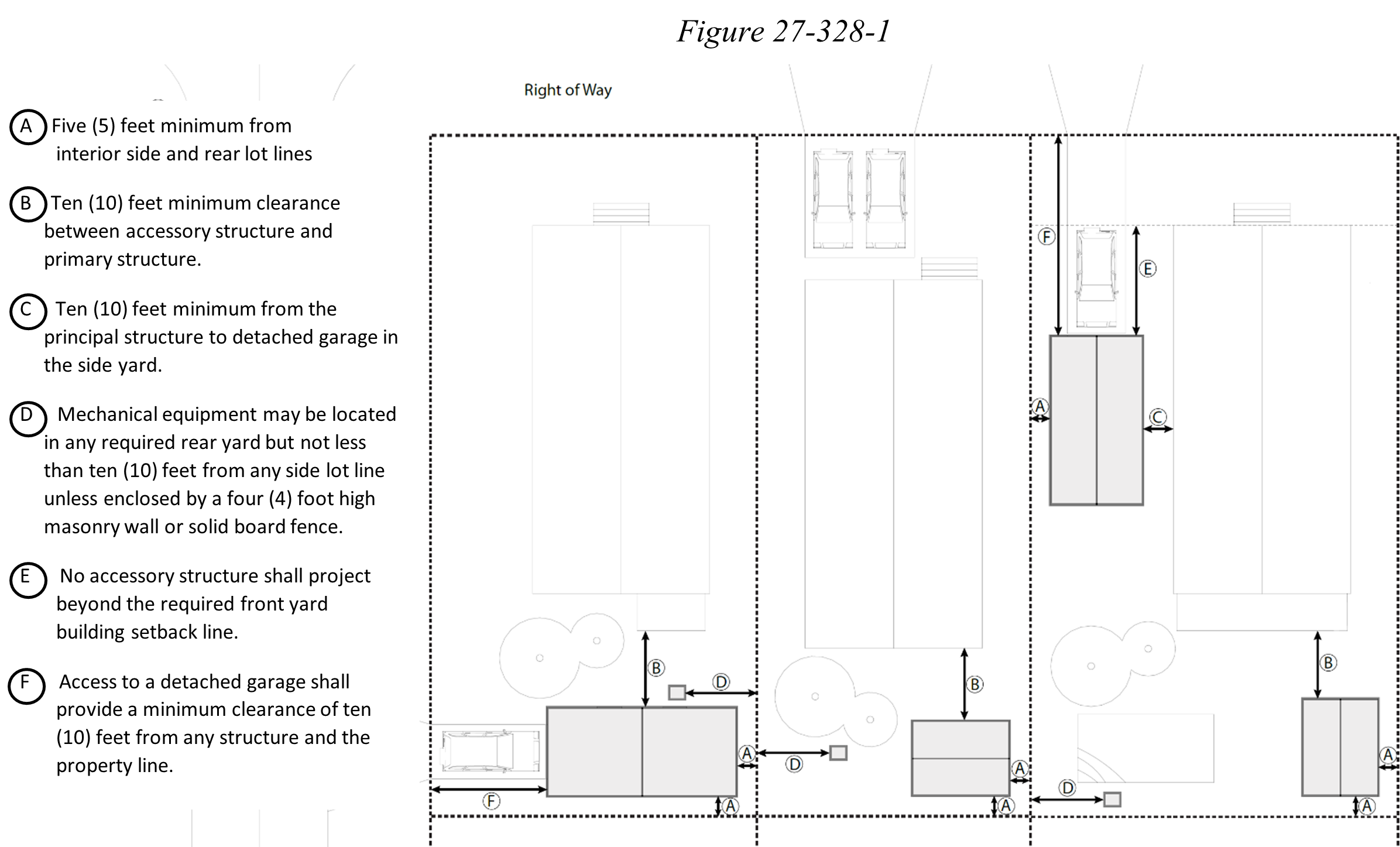
On multiple frontage lots, through lots and corner lots, accessory structures may only be located in any required interior side yard and/or required rear yard but not less than three (3) feet from any of those lot lines (refer to Figure 27-328-1 and Figure 27-328-2).
b.
Accessory structures (except as provided elsewhere in this article) shall be separated from the principal structure by not less than ten (10) feet. Detached garages located in the side yard, however, may be separated by no less than five (5) feet, as measured from the eave, of the principal structure with approval from the city manager or designee.
c.
Accessory structures may be located in required side or rear yards, but not less than five (5) feet from any lot line. In addition, no accessory building on a corner lot in a residential district shall project beyond the required front yard building setback line, required corner yard setback, or beyond either plane of the house (whichever is more restrictive) for either exterior lot line.
d.
Air conditioning compressors serving central systems (other than window units) or other mechanical or electrical equipment designed to serve the principal structure may be located in any required rear yards, but not in any front yard, and not less than ten (10) feet from any side lot line, except in the following instances:
1.
When any mechanical or electrical equipment is proposed within a yard and is enclosed by a masonry wall at least four (4) feet high, it may be located within two (2) feet of any side lot line.
2.
When any mechanical or electrical equipment is proposed within a yard and is enclosed by a solid board fence at least four (4) feet high, it may be located within five (5) feet of any side lot line.
e.
Garages and carports existing or constructed shall not be enclosed at a later date, unless considerations are made so that the subsequent structure is in keeping or consistent with the main building. Where appropriate, garages should be oriented to the alley with the required yard off of the alley considered a rear yard.
(3)
Accessory structure does not exceed twelve (12) feet in height or fourteen (14) feet in height for a two (2) car garage with a vertical exterior wall height not to exceed eight (8) feet in height.
(4)
Accessory structures shall not exceed the floor areas described in Table 27-328-1 below.
Table 27-328-1
(5)
No more than three (3) accessory structures per lot, excluding subsection 27-328(2)c., and swimming pools.
(6)
Detached garages shall have an access driveway as described in section 27-480 except that the use of pervious driveway material of construction material is encouraged.
(7)
Access to a detached garage shall provide a minimum access clearance of ten (10) feet between any structure and the property line.
(b)
Vehicles, major recreational equipment and manufactured homes shall not be used as accessory structures and shall be parked in side yards or rear yards. In no circumstance shall a major recreational vehicle or equipment be parked within a clear visibility triangle.
(Ord. No. 2004-10, § 1, 10-4-04; Ord. No. 2012-05, § 1, 4-2-12; Ord. No. 2022-03, § 1(Exh. A), 8-1-22)
Sec. 27-329. - Swimming pools, pool enclosures, hot tubs, and similar structures.
Swimming pools, pool enclosures, hot tubs, and similar structures shall be permitted, provided that the following design criteria are met:
(1)
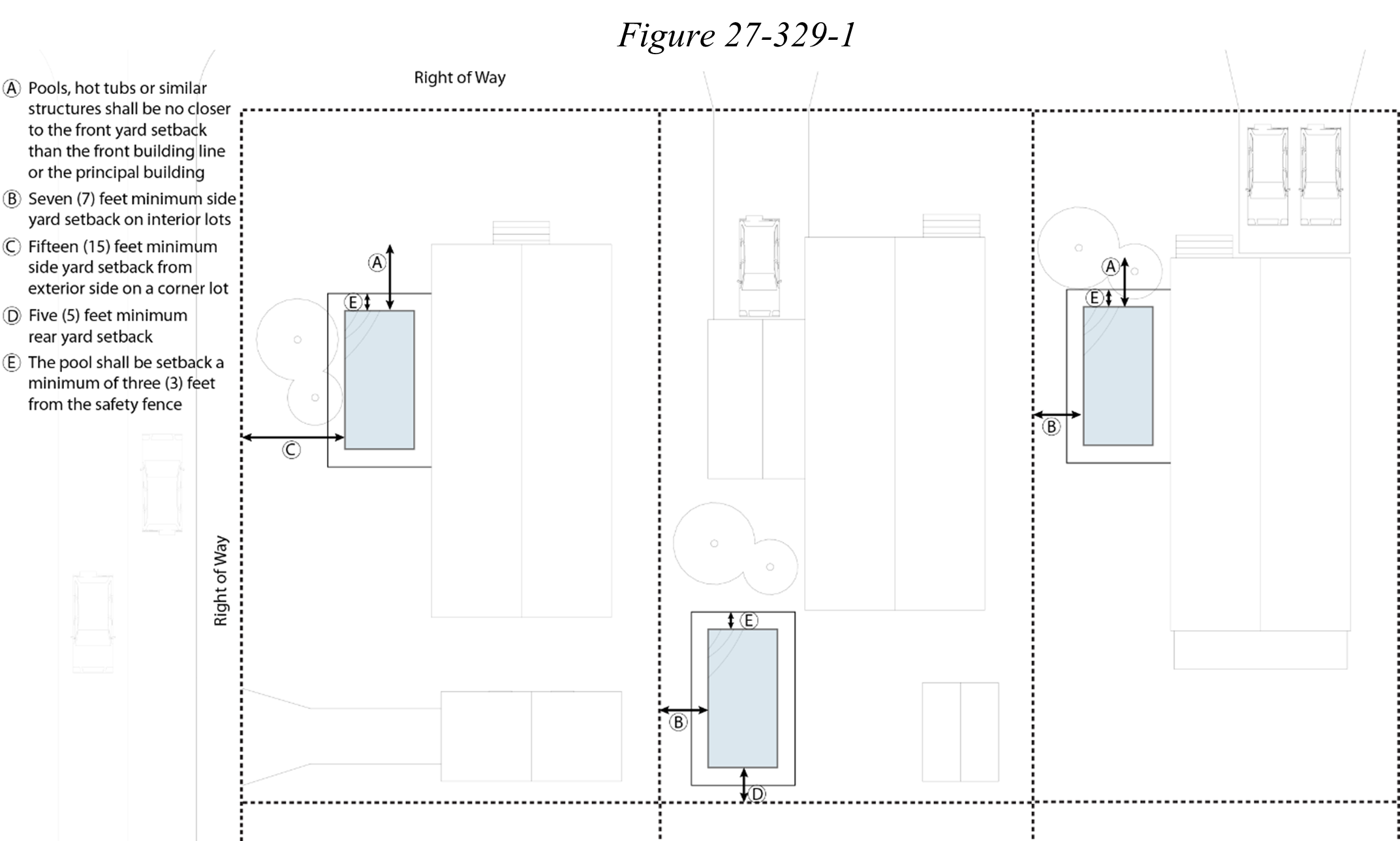
Setbacks. Pools, hot tubs, or similar structures shall be located in side or rear yards. The minimum front setback for a pool, hot tub, or similar structure shall be no closer to the front yard setback than the front building line of the main or principal building as shown in Figure 27-329-1. In the case of a double frontage lot, a pool may be located in any yard provided that setback requirements are met.
(2)
Setback maintained. A minimum of seven (7) feet from the side yard on an interior lot, fifteen (15) feet exterior side yard on a corner lot, seven (7) feet front yard setback on a double frontage lot, and five (5) feet rear yard setbacks shall be maintained (refer to Figure 27-329-2). Minimum setbacks shall be measured from the lip of the pool.
(3)
Safety fences. Swimming pools and hot tubs shall be surrounded by an approved wall or fence, which is at least four (4) feet in height, but not over eight (8) feet, and controls unrestrained admittance to the enclosed area through the use of self-closing and self-latching doors and gates. The pool shall be setback at least three (3) feet from the wall or fence, as measured to the lip of the pool.
(4)
Electric power lines. Swimming pools and similar structures shall not be located under overhead electric power lines unless enclosed in conduit and rigidly supported, nor shall any power line be nearer than ten (10) feet horizontally or vertically from the pool's water edge.
(5)
Excavations. Excavations shall not exceed a 1:1 slope from the foundation of an existing house, unless a trench wall is provided.
(6)
Lights. Underwater lights used to illuminate the interior of the pool shall be so arranged as not to reflect light onto adjoining premises.
(Ord. No. 2004-10, § 1, 10-4-04; Ord. No. 2022-03, § 1(Exh. A), 8-1-22)
State Law reference— Public swimming and bathing facilities, F.S. Ch. 514.
Sec. 27-330. - Fences, walls and hedges.
(a)
Fences, walls or hedges may be located in all front, side and rear yard setback areas, subject to the following conditions:
(1)
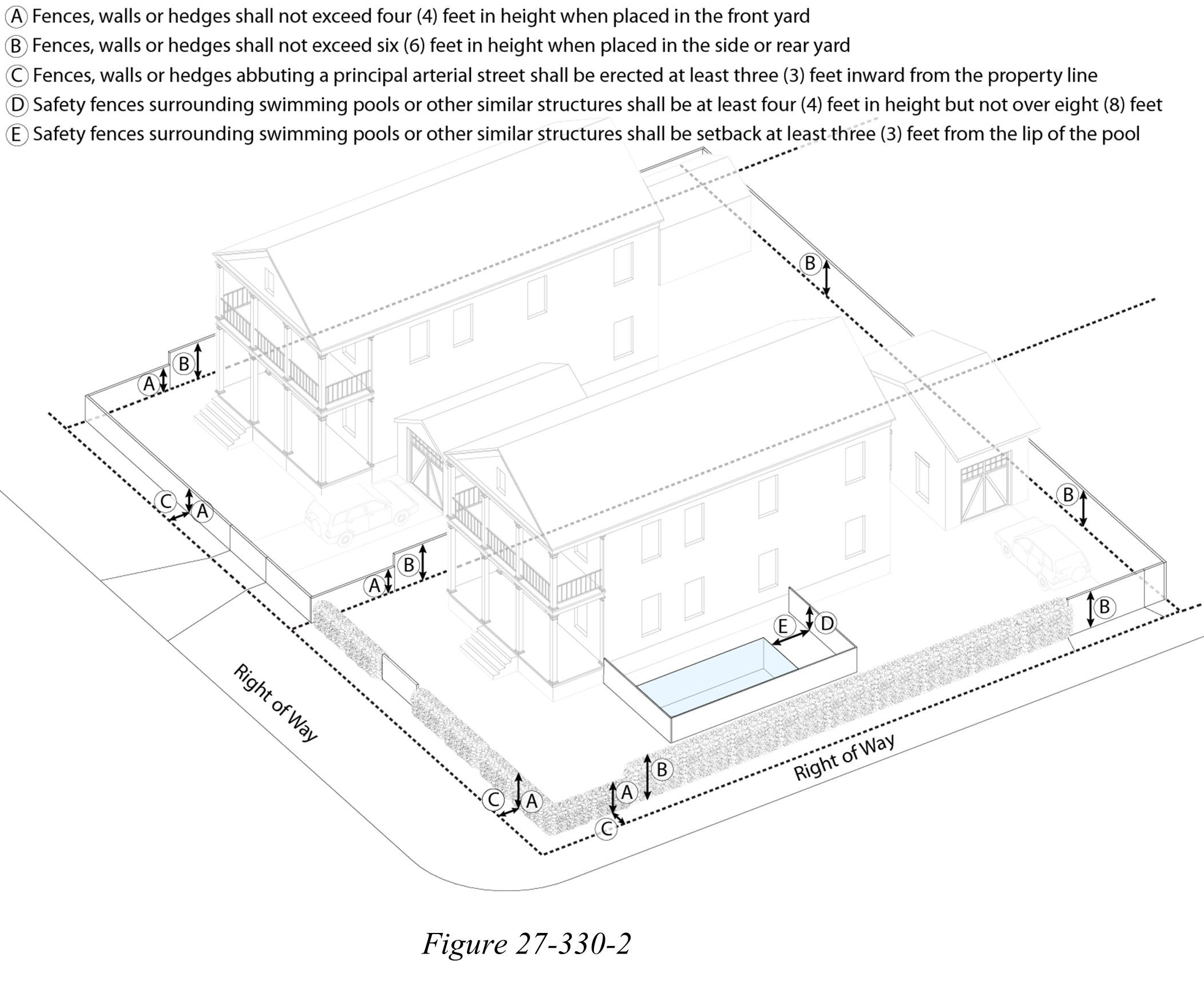
Height of fences, walls or hedges. Fences, walls or hedges shall not exceed four (4) feet in height when placed in the front yard, six (6) feet in height when placed in the side yard, and six (6) feet in height when placed in the rear yard. In the event that a rear yard of a residentially zoned property abuts commercially zoned property, an eight-foot fence for only the rear yard may be constructed with the approval of the city manager, or designee. If a building is situated on the lot closer to the front setback line than the currently required setback, the fence shall not exceed four (4) feet in height forward of the front building line (refer to Figure 27-330-2). For anyone except public government agencies, proposed fences shall meet these height standards.
(2)
Any fence located adjacent to a public right-of-way or private road shall be placed with the finished side facing that right-of-way. In residential zoning districts, fences, walls, or hedges shall not exceed six (6) feet in height when placed in exterior side yards abutting a principal arterial (third street). Such fences or walls are encouraged to meet higher quality construction standards in order to provide genuine sound attenuation. Such fences or walls shall be erected at least three (3) feet inward from the property line and shall be landscaped on the exterior (highway) side by the property owner using evergreen or other perennial plants.
(3)
Fences designed to have airflow, such as shadow box or lattice style fences are to be encouraged to allow for the free flow of breezes. Picket, shadow box and other decorative style fences in keeping with the character and context of the neighborhood are encouraged; chain-link fences are generally discouraged.
(4)
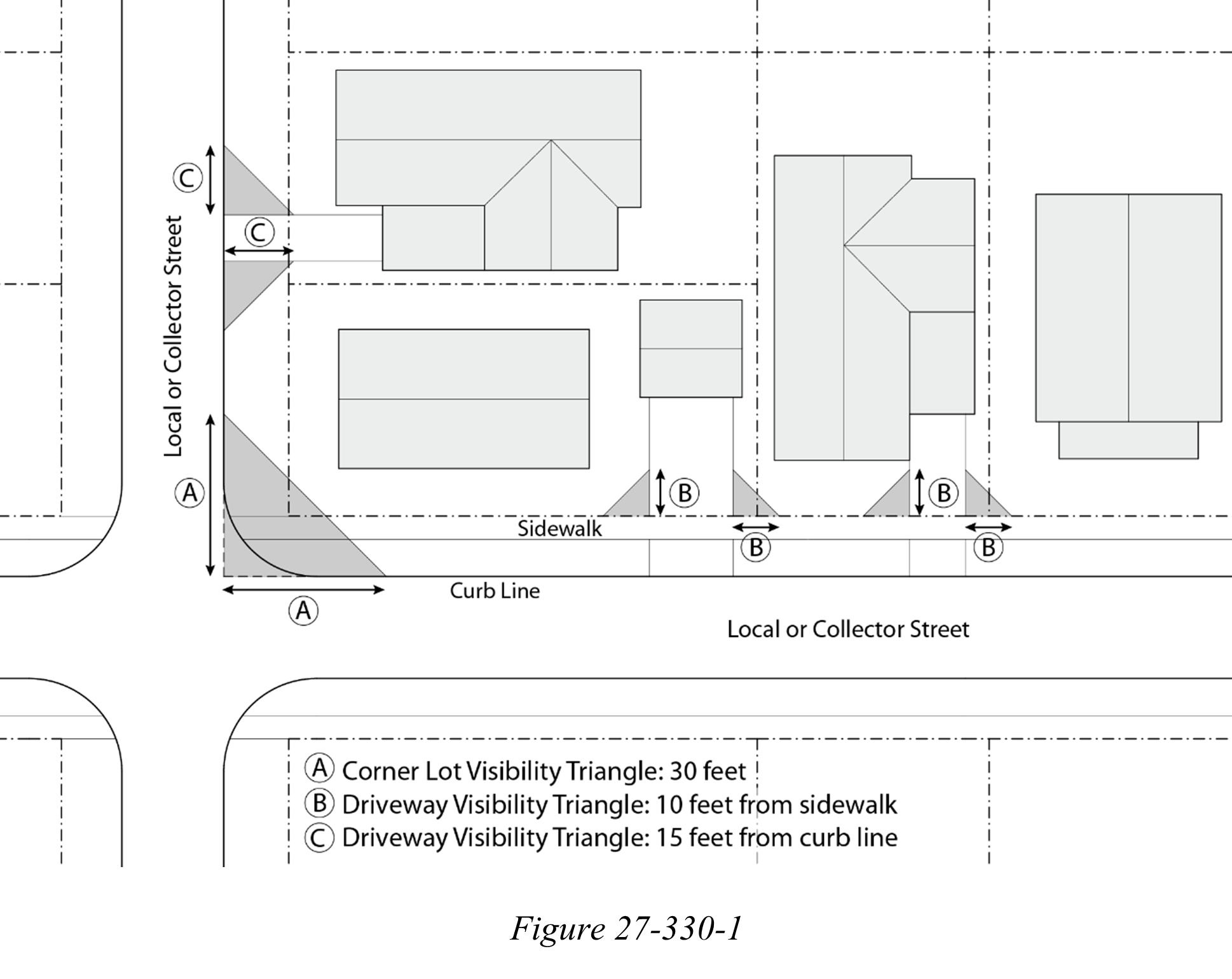
No fence, wall, hedge, or other plantings greater than three (3) feet in height shall be located in the clear visibility triangle on corner lots or in such a way to block the line of sight for motorized vehicles leaving driveways. The vision triangle area shall be determined as follows:
a.
Corner lot visibility triangle. Means a triangular area including that portion of the public right-of-way and any corner lots within the adjacent curb lines, or roadway edge if no curb is present, and a diagonal line intersecting such curb lines at points thirty-five (35) feet back from their intersection (such curb lines being extended if necessary to determine intersection point). For corner lots fronting arterial roads, the setback distance for the two (2) points shall be fifty (50) feet from their intersection.
b.
Driveway visibility triangle. Means a triangular area extending ten (10) feet along the driveway edge and the sidewalk edge, from the point where the driveway meets the sidewalk, and within a diagonal line connecting those two (2) points. If no sidewalk is present, the vision triangle shall mean the area extending fifteen (15) feet along the driveway edge and the curb line, or roadway edge if no curb is present, from the point where the driveway meets the curb, and within a diagonal line connecting those two (2) points. For driveways intersecting arterial roads the triangle shall extend thirty (30) feet in both directions.
(5)
No fence, wall, hedge, or other plantings shall be constructed or installed in such a manner as to interfere with drainage on the site.
(6)
Fence posts shall be resistant to decay, corrosion, and termite infestation. The posts must also be pressure-treated for strength and endurance.
(7)
Fences installed on the ocean side of ocean front lots shall not exceed four (4) feet in height within the required front setback.
(8)
All replacement fences must meet current zoning requirements.
(9)
The use of barbed-wire and razor wire is prohibited by section 8-4 in all zoning districts.
(10)
All fences shall be maintained in a good state of repair and structurally sound condition, including, but not limited to, painting and repainting; replacement of missing, decayed, corroded, or damaged component parts, and keeping level. Failure to maintain and repair fences may result in the fence being declared a nuisance and abated in accordance with the provisions of chapter 28 of this Code.
(b)
Point of reference for measurement. The point of reference for determining the height of a fence, wall or hedge shall be the natural lay of the land along the fence, wall or hedge.
(c)
Height exemption for public agencies. A fence required for safety and protection of hazard by a public agency may not be subject to the height limitations above. Approval to exceed minimum height standards may be given to public agencies by the city upon receipt of satisfactory evidence of the need to exceed height standards for safety/security.
(Ord. No. 2004-10, § 1, 10-4-04; Ord. No. 2004-15, § 1, 9-20-04; Ord. No. 2005-10, § 1, 5-2-05; Ord. No. 2014-02, § 1, 3-3-14; Ord. No. 2016-10, § 1, 8-1-16; Ord. No. 2022-03, § 1(Exh. A), 8-1-22)
Sec. 27-331. - Temporary structures.
(a)
Temporary construction trailers or structures.
(1)
Subject to the following provisions, any person shall obtain a building permit for the construction and/or use of a temporary trailer or structure to be used only as a construction shed and tool house for contractors and construction workers on the site and limited to the time period of construction. This temporary trailer or structure shall not be placed or erected on the property prior to the issuance of a building permit for the applicable construction, and shall be immediately removed upon completion of the construction project or in the absence of a valid, unexpired building permit.
(2)
It shall be a violation of this section for any person to use the construction trailer or structure for sales purposes without first applying to and receiving written permission from the city council.
(3)
Construction trailers and structures shall not be used for the purpose of living quarters, and the trailers or structures shall have upon the unit, or attached thereto, an identification sign designating the owner or company and the words "construction office" in full view.
(b)
Temporary storage structures and uses. Enclosed portable storage units and structures and accommodations intended only for temporary storage may be used following the receipt of a building permit, payment of the required fee, and subject to the following provisions:
The building permit submittal package must contain a construction plan designating the proposed location of the temporary storage structure on the lot.
(1)
Within all residential zoning districts, enclosed portable storage units and structures and accommodations intended only for the temporary storage of personal household belongings of occupants of the property may be placed on the property for a period not to exceed fifteen (15) days or three hundred sixty (360) hours. Registration shall be required for each such use of any temporary storage structures. An extension may be requested in writing to the city manager or his designee for extenuating circumstances.
(2)
In the event of damage to a residential dwelling by fire, storm, flood or other such property loss, this period of time may be extended to forty-five (45) days upon request to and written approval of the city manager.
(3)
Within all nonresidential zoning districts, enclosed portable storage units and structures and accommodations intended only for storage, may be used for temporary storage of items related to the business located on the property, for a period not to exceed thirty (30) days. Such structures shall not be located within required front yards and shall not be used to store any chemical, hazardous, flammable or combustible materials.
(4)
Temporary storage structures and portable storage units shall not be placed on any street or alley right-of-way or public property. These structures must be placed on the lot in which the use is intended.
(c)
All structures. All temporary and portable storage units and structures, construction trailers and the like, shall be constructed, altered, repaired, enlarged, placed, moved or demolished in accordance with applicable provisions of the Florida Building Code as well as all applicable federal, state and local regulations applying to the use and development of land. The issuance of building permits, where required, verifying such compliance shall be administered by the building official.
(Ord. No. 2005-03, § 2, 3-7-05; Ord. No. 2007-20, § 1, 2-4-07; Ord. No. 2022-03, § 1(Exh. A), 8-1-22)
Sec. 27-332. - Home-based businesses.
This section acknowledges the ability of residents to conduct small-scale home-based businesses that are secondary to the primary use of their residence, in accordance with F.S. § 559.955. This section also provides regulations to preserve the character of residential neighborhoods.
(1)
As an accessory use, the activities of the home-based business must remain secondary to the property's legal use as a residence. The home must remain consistent with the surrounding residential area as viewed from the street, without additional client or consumer entrances for the home-based business. External modifications to a home to accommodate a home-based business must conform with the residential character and architectural aesthetics of the neighborhood.
(2)
An employee or proprietor of the business must live in the home. Up to two (2) non-resident employees or independent contractors may also work at the business. The business may also have remote employees that neither live in the home nor work on-site.
(3)
The business may not conduct retail transactions from a structure other than the home; however, incidental business uses, and activities may be conducted at the residential property.
(4)
Additional parking spaces are not required for the business, but any on-site parking spaces that serve the business must comply with requirements of this Code. Any vehicles or trailers parked at or near the business must be parked in legal parking spaces that comply with all restrictions in this Code that apply to the home, and they may not be parked over a sidewalk or on any unimproved surfaces at the residence. Heavy equipment (commercial, industrial, or agricultural vehicles, equipment, or machinery) shall not be parked or stored where it would be visible from the street or neighboring property in any residential district except for at structures or activities permitted in such residential districts by the terms of this chapter.
(5)
No signs are allowed for the business; signs are regulated by article XV of chapter 27.
(6)
The business must comply with all local, state, and federal regulations with respect to the use, storage, or disposal of any corrosive, combustible, or other hazardous or flammable materials or liquids, including the requirements in section 23-60 of this Code regarding prohibited substances.
(7)
Home-based businesses may be restricted further on land that is subject to deed restrictions when such documents are valid and recorded in the public records of Duval County.
(Ord. No. 2004-10, § 1, 10-4-04; Ord. No. 2022-03, § 1(Exh. A), 8-1-22; Ord. No. 2023-09, § 1(Exh. A), 9-18-23)
Sec. 27-335. - Parking, storage or use of major recreational equipment.
(a)
No major recreational equipment, as defined herein, shall be used for living, sleeping or housekeeping purposes when parked or stored in a residentially zoned lot or in any other location not approved for such use. Major recreational equipment may be parked or stored in a required rear or side yard but not in the front or corner side yard and not within three (3) feet of any property line; provided, however, that such equipment may be parked anywhere on residential premises for a period not to exceed twenty-four (24) hours during loading and unloading. For purposes of this section, the term major recreational equipment shall be as listed in article I, to include sand dune buggies, cases or boxes on wheels for transporting recreational equipment and other similar trucks or equipment.
(b)
Major recreational equipment shall also be limited to two (2) total on a property. Each piece of equipment shall not exceed twenty-eight (28) feet in length.
(Ord. No. 2023-09, § 1(Exh. A), 9-18-23)
Sec. 27-336. - Parking of commercial vehicles in residential districts.
(a)
Commercial vehicles shall not be parked in any residential district except as permitted for home-based business according to the restrictions in section 27-332 or as may be required for normal loading or unloading of such vehicles and during the time normally required for service at dwellings, or at structures or activities permitted in such residential districts by the terms of this chapter. The term "commercial vehicle" shall refer to any motor vehicle more than five thousand five hundred (5,500) pounds curb weight, unless excepted in this section, used primarily for a business or commercial purpose and not used primarily for personal, non-business transportation. The term "commercial vehicle" shall not be deemed to include law enforcement vehicles or recreational or utility vehicles or vehicles such as pick-up trucks, vans, or cars, even if they include decals for the business, if they are used by the property occupant on a daily basis for normal transportation and are not used at the property for commercial purposes.
(b)
Commercial vehicles do not include those for which their parking at a residential property is ancillary to the residential use of the property. Examples of indications that the commercial purpose is primary, rather than ancillary, include, but are not limited to, more than one (1) vehicle displaying the information of a commercial business being parked at the same property, the loading of employees or equipment on the residential property or adjacent right-of-way other than the residents of such property, and the parking of the vehicle with displays of information of a commercial business associated with a home-based business as described in F.S. Ch. 559, on the right-of-way adjacent to a residential property or on unimproved surfaces at the property.
(c)
Any vehicle with more than two (2) axles and four (4) regular-sized tires shall be considered a commercial vehicle. Any vehicle that utilizes anything other than tires for locomotion (e.g., skids, belts, or similar items) shall be deemed commercial equipment and be prohibited.
(Ord. No. 2023-09, § 1(Exh. A), 9-18-23)
Sec. 27-338. - Docks, retaining walls and boathouses.
(a)
Purpose and intent. It is the intent of this section to insure that on intracoastal, lake front, marsh front, canal front, and stream front lots, no boating hazards will be created, effective flow of stormwater runoff will be maintained and water pollution from stormwater runoff and other sources will be minimized.
(b)
Site plan. A building permit shall not be issued for any new dock, addition to any existing dock, fence or wall, or significant change of an existing property on an intracoastal, lake front, marsh front, canal front, or stream front lot until a satisfactory site plan therefore is reviewed and approved.
(c)
Docks. The following minimum or maximum standards shall apply to all construction or renovation of docks:
(1)
A building permit is required and all construction will adhere to Florida Building Code. Construction plans for docks shall be submitted for development review. All dock facilities are subject to and shall comply with all federal and state requirements and permits, including but not limited to, the requirements and permits of the Florida Department of Environmental Protection, the U.S. Army Corps of Engineers and the St. Johns River Water Management District. Permits from the Neptune Beach Building Department shall be approved but not issued until receipt and confirmation of required federal and state approvals.
(2)
No dredging or filling of marshlands shall be permitted except for that necessary to install dock pilings. Reasonable maintenance dredging within the main channel banks is permitted.
(3)
Docks shall only extend far enough to reach a maximum water depth of four (4) feet below mean low-water, twenty (20) percent of the width of the waterbody (measured from mean high-water line to mean high-water line), or five hundred (500) feet, whichever is less. Docks shall be sited so as to extend to the nearest navigable waterbody and no further. If a bulkhead exists along the shoreline and the water depth at that point is already four (4) feet below mean low-water, the dock shall not extend more than twenty-five (25) feet beyond the bulkhead.
(4)
The access walkway of docks shall be a maximum of four (4) feet in width. A single terminal platform of any dock shall be a maximum of two hundred (200) square feet and shall be constructed and located only at the terminal end portion of the dock, furthest from the shoreline. Boards used to construct the surface of the dock shall not exceed eight (8) inches in width and shall be spaced at least one-half inch apart.
(5)
If the length of the shoreline is sixty-five (65) feet or more any new dock with an access walkway (a walkway extending out from the abutting property) shall be constructed twenty-five (25) feet from a side lot line. Docks without an access walkway must be set back at least ten (10) feet from the property line. If the shoreline length is less than sixty-five (65) feet a dock shall be centered between the property lines.
(6)
Only one (1) dock is permitted per lot of record with no more than one (1) dock allowed per single-family home.
(7)
Docks shall be constructed no higher than five (5) feet above the mean high-water line (for open water) and above the average ground contour (for ephemeral lands).
(8)
To ensure that all docks shall be utilized only for boating or other recreational activities and not as living space, there shall be no bathrooms or cooking facilities permitted on docks, nor as an improvement to an existing boathouse. No enclosed walls shall be permitted.
(9)
Boat storage includes the area to store a boat and the necessary ramp/walkway to access the boat if applicable. The total area calculation for a dock includes the boat storage, ramp/walkway and any portions of the roof that hangs over the water beyond the dock platform.
(10)
Boat storage mechanisms can be ride-on-ramp, vertical wench or any other industry acceptable standard.
(11)
The sale or lease of a portion of an intracoastal, lakefront, marsh front, canal front and stream front lot after June 4, 2007, shall be construed as a subdivision and shall not enable the owners to make application for a dock and/or boathouse unless that subdivision has received the approval of the city council.
(12)
Lighting fixtures may be installed upon docks, boat davits and boat lifts only in accordance with the following standards:
a.
Lighting required under federal laws or regulations as an aid to navigation is permitted on the docks, boat davits and boat lifts, in accordance with United States Coast Guard standards.
b.
Other lighting fixtures may be installed on docks only providing they are mushroom-type fixtures designed to direct light downward, installed at least twenty-five (25) feet apart, not more than one (1) foot above the surface of the dock, and limited to twenty-five-watt incandescent yellow bulbs.
c.
All existing lighting on docks, boat davits and boat lifts which does not conform to these standards shall be deemed nonconforming and shall be made to conform.
(d)
Retaining walls. The construction of retaining walls or seawalls shall be performed in accordance with this chapter and chapter 8 of Code of Ordinances for the City of Neptune Beach.
(e)
Boathouse lots. Boathouse lots are defined as lots which exist along the water front and were accepted by the city under the premise that these lots would serve only as water access for the residents of a specific subdivision. As such, the purpose and intention of these boathouse lots is to serve as accessory lots to the main residential properties within that subdivision. In accordance with the policies contained with chapter 27, Land Development Regulations, the following regulations shall apply:
(1)
The buildability and use of all boathouse lots, which are determined to be accessory lots shall be restricted to the owners of real property within the subdivision in which these accessory boathouse lots were platted.
(2)
Boathouse lots which are held June 4, 2007, by property owners residing outside of the subdivision for which they are platted shall be nonconforming boathouse lots which may still be used for constructing a boathouse and for water access. However, any boathouse lots owned by real property owners on June 4, 2007, in the subdivision for which they were platted, shall only be buildable and used to serve the lake access need of residents of that subdivision.
(3)
Minimum lot widths shall be fifty (50) feet.
(f)
This section is exempt from the provisions of section 27-328, Other accessory structures.
(Ord. No. 2017-15, § 1, 6-5-17)
Editor's note— Formerly § 27-338 was entitled "Attached duplex or multifamily units," and derived from Ord. No. 2004-10, § 1, adopted Oct. 4, 2004. Said provisions have been relocated by Ord. No. 2017-14. See subsection 27-227(b)(2) herein.
Sec. 27-339. - Allowing dogs in outside dining areas under certain conditions.
(a)
The city manager may issue a permit to eating establishments allowing dogs in outside dining areas.
(b)
The issue of the permit will be based on the required guidelines in F.S. § 509.233.
(c)
Permit holders permit will be revoked for failure to adhere to the guidelines set out in the permit as required by F.S. § 509.233.
(Ord. No. 2008-14, § 1, 12-2-08)

