
Neptune Beach City Zoning Code
ARTICLE X
- STREETS, SIDEWALKS AND RIGHTS-OF-WAY18
Editor's note— Ord. No. 2004-10, § 1, adopted Oct. 4, 2004, amended art. X in its entirety to read as herein set out. Former art. X, §§ 27-471—27-480, pertained to similar provisions, and derived from Ord. No. 91-1-5, § 2, 5-6-91. Ord. No. 2002-02, § 8, 5-6-02; Ord. No. 2004-02, § 1, 5-10-04.
Sec. 27-471.- Generally.
This article establishes minimum requirements for the development of public and private streets, bikeways, pedestrian ways, and access control to and from public streets. These standards are intended to minimize the negative traffic impacts of development and to assure that all developments adequately provide for the safe and efficient movement of vehicles and people consistent with good engineering and development design practices.
(Ord. No. 2004-10, § 1, 10-4-04)
Sec. 27-472. - Definitions.
Refer to article I for definitions.
(Ord. No. 2004-10, § 1, 10-4-04)
Sec. 27-473. - Transportation analysis.
Any new development or substantial redevelopment project within the city that is estimated by the city manager or designee to generate five hundred (500) or more average daily trips, and/or fifty (50) or more peak hour trips, shall be required to undertake a traffic impact study. The purpose of the study shall be to identify and assess on-site, near site and off-site transportation improvement needs related to the project within one-half mile of the property. Trip estimates shall be based on trip generation rates from the most current edition of "Trip Generation" (published by the Institute of Transportation Engineers). Trip generation rates from other sources may be used if the developer demonstrates to the city's satisfaction that the alternative source better reflects local conditions. In addition, the city manager or designee may waive the study requirement or otherwise adjust the study area boundaries based upon a reasonable determination that the project will not unduly impact the existing public transportation system.
(Ord. No. 2004-10, § 1, 10-4-04)
Sec. 27-474. - Developer improvements requirements.
Any developer of property within the city shall be responsible for those transportation improvements within and directly adjacent to the site necessary to accommodate the increased demand from the project. Such site related improvements may include, but not be limited to:
•
Roadway, including any on-street parking, and pedestrian way construction;
•
Driveway improvements and exclusive turn lanes at site access points, including signing, signalization and pavement markings; and
•
Site-related intersection modifications at any off-site intersection within five hundred (500) feet of the nearest edge of the property or additional distance as determined by the traffic impact study.
All necessary roadway improvements shall be provided at the expense of the developer in conformance with this article. The developer may elect to request advertising for and receipt of contractor's proposals for construction of minimum improvements by the city, and the award and administration of construction contracts. The developer shall deposit with the city, through direct payment or the posting of a performance bond or other surety acceptable to the city, the entire cost of such improvements before the award of contracts. The developer shall have all engineering and design performed at his expense before advertising for bids.
(Ord. No. 2004-10, § 1, 10-4-04; Ord. No. 2022-03, § 1(Exh. A), 8-1-22)
Sec. 27-475. - Street classification.
To regulate street design standards such as access, road and right-of-way widths, circulation patterns, design speed, and construction standards, all existing and all proposed streets in the city shall be classified. The functional classifications for existing roadways, which include principal arterial, minor arterial, major collector, and local road, are described in the transportation element of the city's comprehensive plan and shown on Map B-1 of that element. Proposed streets shall be classified based on anticipated road function per publications such as the "Traffic Engineering Handbook" (by the Institute of Transportation Engineers) and/or "A Policy on Geometric Design of Highways and Streets" (by the American Association of State Highway and Transportation Officials).
(Ord. No. 2004-10, § 1, 10-4-04; Ord. No. 2022-03, § 1(Exh. A), 8-1-22)
Sec. 27-476. - Street design standards.
(a)
Specifications. All construction shall conform to the current edition of "Standard Specifications for Road and Bridge Construction," published by Florida Department of Transportation.
(b)
Subgrade. The roadway shall be built upon stabilized subgrade at a minimum lime rock bearing ration of forty (40) pounds per inch, LBR40. Where the subgrade does not exceed a state-bearing test of forty (40) pounds per square inch, a subgrade shall exceed this strength.
(c)
Base construction. Base construction shall utilize only solid limerock, soil-cement, crush-crete, graded aggregate base, black base (bituminous base), crushed shell, or sand bituminous road mix. Solid limerock is not preferred and should be avoided if possible.
(d)
Surfacing. Surfacing shall consist of FDOT type S-I asphaltic concrete surface course with a finish surface course FDOT type S-III, crowned to a finish slope of one-fourth-inch per foot.
(e)
Dimensions. Minimum dimensions shall conform to the following table:
* These represent minimum lane widths. Staff would like the ability to consider several traffic calming design solutions, including narrower lane widths, when constructing or improving streets.
(f)
Cross slope. To balance drainage requirements with vehicle operation, the recommended roadway cross slope is two (2) percent for roadways with four (4) or less lanes, and three (3) percent when three (3) lanes or more in each direction are present. Cross slopes for roadways shall not be greater than four (4) percent, nor less than one and one-half (1.5) percent.
(g)
Street intersection angle. To the extent possible, streets should intersect at a perpendicular (ninety (90) degree) angle. Acute angles less than eighty-five (85) degrees or obtuse angles greater than ninety-five (95) degrees at street intersections shall be avoided. Where an acute or obtuse angle occurs between streets at their intersection, the alignment shall be curved so that tangents to the curves shall intersect as closely as feasible at right angles. Transition fillets at intersections shall be constructed, having a radius of at least fifty (50) feet. The right-of-way shall be curved to the same concentric radius.
(h)
Horizontal curvature. Where a deflection angle of more than ten (10) degrees in alignment of a street occurs, a curve of reasonably long radius shall be introduced. On all streets except local streets, the centerline radius curvature shall not be less than three hundred (300) feet; on local streets, the radius curvature shall not be less than one hundred (100) feet.
(i)
Street names. Street names shall be appropriate designations and not presently encountered in the county east of the intracoastal. Street signposts readable from all approaches, eight (8) feet high, of corrosion-resistant materials, shall be constructed at each street intersection.
(j)
Cul-de-sacs. No new cul-de-sacs shall be created in Neptune Beach as of the date of incorporation of this Code. Existing cul-de-sacs shall conform to the following criteria:
(1)
Streets ending in cul-de-sacs shall not exceed five hundred (500) feet in length from the center of the turnaround to the nearest street intersection.
(2)
No cul-de-sacs shall be permitted to be platted unless there are platted lots on each side and around the outer perimeter thereof.
(3)
Cul-de-sacs shall be provided with a chord dimension at the building restriction line equal to or exceeding the minimum street frontage requirement.
(4)
Cul-de-sacs shall have an unobstructed twelve-foot-wide moving lane with a minimum outside turning radius of thirty-eight (38) feet. Upon a favorable determination by the city manager or designee, lands inscribed within a maximum inside turning radius of fourteen (14) feet may be retained as planted open space; in this case, the planted area shall be delineated with raised concrete curbing and shall provide for clear visibility between two (2) feet and eight (8) above the adjacent roadway centerline grade (see Figure 27-476-1).
Figure 27-476-1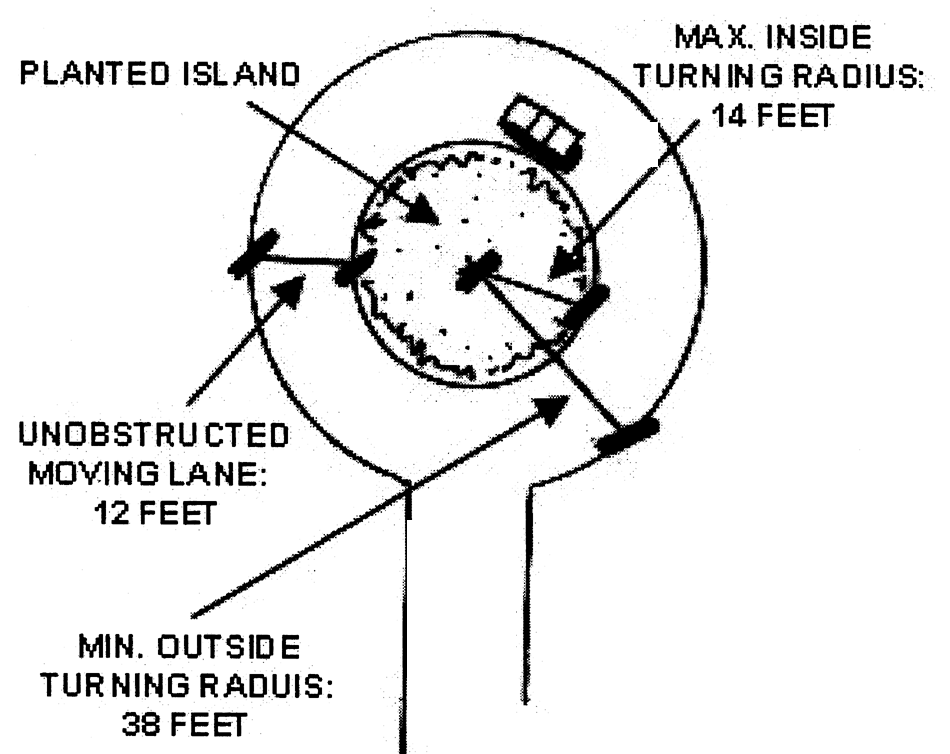
(5)
Cul-de-sacs greater than three hundred (300) feet in length shall include the posting of a "No Outlet" sign at the nearest street intersection.
(6)
Cul-de-sacs shall not be permitted in the R-3, R-4, R-5, C-1, C-2, C-3, and CBD districts.
(k)
Collector streets. At least one (1) end of all collector streets shall terminate on arterial streets.
(l)
Local streets. At least one (1) end of a local street shall terminate on a collector or higher order street. Local streets are generally discouraged from direct connections with arterial streets.
(1)
The City of Neptune Beach street ends terminating at the Atlantic Ocean and at the intracoastal waterway are special public rights-of-way which shall be carefully preserved for present and future public use.
(2)
Public walkways and ramps may be built in these rights-of-way. No other construction is permitted in these rights-of-way except as necessary to access adjacent properties when no other means of access to said properties is possible.
(3)
In the event that access through a street end right-of-way is necessary, the design and construction of such access shall be approved or disapproved by the city council after appropriate development review. Criteria for approval shall include maximum preservation of greenspace within the street ends and the use of pervious paving materials.
(4)
In no case may access ways to adjacent properties be designed or landscaped in order to create the image of private property.
(m)
Alleys. No new alleys shall be dedicated to the City of Neptune Beach. Existing alleys shall conform to the following criteria:
(1)
Alleys shall be provided whenever possible at the rear lot lines of all business and commercial subdivisions.
(2)
Alleys shall be prohibited in residential subdivisions, unless the developer designs the subdivision with alleys as an integral element of the project. Where alleys are utilized as an integral design feature, they shall provide for connections to no fewer than five (5) and no more than fifteen (15) residences per side, and shall terminate at both ends with a local street.
(n)
Environmentally sensitive areas. Streets shall be laid out to minimize negative impacts to environmentally sensitive areas, such as wetlands. In the event that impacts cannot be avoided, the developer shall meet all applicable requirements of local, state or federal permitting agencies.
(o)
Minimum stormwater management requirements. All roadway construction shall meet minimum stormwater management requirements of the appropriate local or state permitting agencies. Curbs and gutters shall be constructed along the edges of all street pavements for all new development and redevelopment, as set forth in section 27-519.
(p)
Inter-neighborhood traffic flow. Streets in a new development shall be logically connected to rights-of-way in adjacent areas to allow for safe and efficient traffic flow between neighborhoods or subdivisions. If adjacent lands are unplatted, stub outs in the new development shall be provided for future connection to the adjacent unplatted land. Pedestrian and/or bikeway systems also shall be connected. To the extent that such pedestrian and bikeway connections may contribute to undesired increases in cut-through traffic then the community development board may recommend a withholding or modification to this requirement.
(q)
Through traffic. Residential streets shall be arranged or otherwise designed to discourage high speeds or excessive volumes of cut through traffic.
(r)
Offset intersections. Where an offset (jog) is necessary at an intersection, the distance between centerlines of the intersecting streets shall be no less than one hundred fifty (150) feet.
(s)
Street intersection spacing. No two (2) local streets may intersect with any other local street on the same side at a distance of less than two hundred and fifty (250) feet measured from centerline to centerline of the intersecting street. When the intersected street is an arterial, the distance between intersecting streets shall be no less than six hundred sixty (660) feet. New intersections along one (1) side of an existing street shall, where possible, coincide with existing intersections on the other side.
(t)
Deceleration and left and right turning lanes. Deceleration and left and right turning lanes shall be provided on collector or arterial streets according to the following guidelines, or as otherwise required by state department of transportation regulations. In addition, and based upon the submission of a traffic impact study acceptable to city, the city manager or designee may waive the requirements based upon a reasonable determination that the absence of such a lane will not adversely impact traffic conditions:
(1)
A single right or left turn lane, with a minimum taper of fifty (50) feet, shall be designed to store the number of vehicles likely to accumulate during a critical period, as dictated by a traffic impact study. For low volume intersections where a traffic impact study is not justified, a minimum one hundred (100) foot queue length (four (4) cars) should be provided in urban areas, and a minimum fifty-foot length queue length (two (2) cars) should be provided in suburban or rural areas. This queue length excludes the taper length.
(2)
For double left or right turn lanes, the taper shall be a minimum of one hundred (100) feet in length.
(u)
Intersection visibility. In order to provide a clear view of intersecting streets to the motorist, nothing within the clear visibility triangle, as determined by the Florida Greenbook calculations, shall be erected, placed, parked, planted, or allowed to grow in such a manner as to materially impede vision between a height of two (2) feet and eight (8) feet above the grade, measured at the centerline of the intersection. The following shall be permitted within the clear visibility triangle:
(1)
Shade and palm trees with a minimum pruning height of eight (8) feet above the sidewalks grade and twelve (12) feet above vehicular traffic lanes grade.
(v)
Signage, pavement markings and signalization. The developer shall provide all necessary roadway signs, pavement markings and traffic signalization as may be required by the city, based upon the guidelines in the Manual of Uniform Traffic Control Devices, or alternative city standards as approved by the community development board. At least two (2) street name signs shall be placed at each four-way street intersection, and one (1) at each "T" intersection. Signs shall be installed under light standards and free of visual obstruction. The design of street name signs shall be consistent, of a style appropriate to the community, and of a uniform size and color. In new developments, stop bars shall be painted with thermoplastic paint and reflective materials.
(w)
Blocks.
(1)
Where a tract of land is bounded by streets forming a block, said block shall have sufficient width to provide for two (2) tiers of lots of appropriate depths.
(2)
The lengths, widths and shapes of blocks shall be consistent with adjacent areas. In no case shall block lengths in residential areas exceed eight hundred (800) feet, nor be less than two hundred and fifty (250) feet in length.
(Ord. No. 2004-10, § 1, 10-4-04; Ord. No. 2005-06, § 2, 5-2-05; Ord. No. 2010-14, § 46, 9-7-10; Ord. No. 2013-09, § 1, 10-7-13; Ord. No. 2022-03, § 1(Exh. A), 8-1-22)
Sec. 27-477. - Dedication of streets.
(a)
Public streets shall be dedicated to the city upon completion, inspection, and acceptance by the city.
(1)
Public streets dedicated to the city must comply with all local standards, dedication language, city ordinances, and be free of any contingencies or variances.
(b)
Private streets may be allowed within developments that will remain under common ownership, provided they are designed and constructed pursuant the standards as provided for in this Code. All private streets shall be maintained through a covenant that runs with the land in the form of, but not limited to, a homeowners' or condominium association or such other legal mechanism as will assure the city and owners of contiguous property that the street shall be continually and properly maintained. The city and contiguous owners shall be provided with a legal right to enforce the assurance that the road will be continually maintained. Legal documents acceptable in form and content to the city shall be reviewed by the city manager or designee prior to development approval.
(Ord. No. 2004-10, § 1, 10-4-04; Ord. No. 2022-03, § 1(Exh. A), 8-1-22)
Sec. 27-478. - Dedication of right-of-way.
(a)
As a minimum requirement, the following right-of-way widths shall be dedicated:
(1)
Arterial streets, fifty (50) feet each side of the centerline;
(2)
Collector streets, thirty-three (33) feet each side of the centerline;
(3)
Local streets, twenty-five (25) feet each side of the centerline;
(4)
Cul-de-sacs, radius of fifty (50) feet.
(b)
Future right-of-way. Where roadway construction, improvement or reconstruction is not required to serve the needs of the proposed development project, future rights-of-way shall nevertheless be reserved for future use. No part of the reserved area shall be used to satisfy minimum requirements of this Code.
(c)
Protection and use of right-of-way. The following provisions apply to the use of rights-of-way:
(1)
No encroachment shall be permitted into existing right-of-way, except for temporary and conditional use authorized by the city through a right-of-way use agreement in which the city is not responsible for any damage to appurtenances erected in the right-of-way, and that those appurtenances so erected can be removed for public purpose and further that the city is not obligated to replace those appurtenances this agreement is executed by the city manager and public works director.
(2)
Use of the right-of-way for public or private utilities, including, but not limited to, sanitary sewer, potable water, telephone wires, cable television wires, gas lines, or electricity transmission, shall be allowed subject to the applicable specifications.
(3)
Sidewalks and bicycle ways shall be placed within the right-of-way.
(d)
Vacations of right-of-way. Applications to vacate a right-of-way may be approved upon a finding that all of the following conditions are met:
(1)
The request is consistent with the transportation circulation element of the comprehensive plan.
(2)
The right-of-way does not provide the sole access to any property. Remaining access shall not be by easement.
(3)
The vacation would not jeopardize the current or future location of any utility.
(Ord. No. 2004-10, § 1, 10-4-04; Ord. No. 2022-03, § 1(Exh. A), 8-1-22)
Sec. 27-479. - Sidewalks and bikeways.
(a)
No person shall lay any sidewalk or foot paving on the public rights-of-way of the city without a permit. Sidewalks laid in public rights-of-way shall be a minimum of six (6) feet wide and shall be laid with a slope of one-fourth-inch per foot toward the street. Sidewalks, when constructed in front of any high traffic area or driveway apron, shall be at least six (6) inches deep. The Florida Design Manual is the basis for the design and construction for new sidewalks. Sidewalks are required to be maintained in good condition as determined by the public works director, or designee. Any damage as a result of construction, age, neglect, or substandard design shall require payment to the city's sidewalk construction fund or must be repaired or replaced by the property owner.
(b)
Sidewalks shall be provided on one (1) or both sides of residential streets as provided in subsections (e)—(g) below.
(c)
Access for persons with disabilities. Sidewalks shall be ADA accessible and a minimum width of six (6) feet. Sidewalks and intersections shall be ADA accessible with early detection plates at all conflict points, including curb ramps, transit or ride-hailing boarding areas, cut-through pedestrian refuge islands, and where bicycle lanes cross sidewalks. Curb ramps shall have a minimum width of thirty-six (36) inches, with a minimum top landing of thirty-six (36) by thirty-six (36) inches and a maximum slope of 1:12. Perpendicular curb ramps are preferred to parallel ramps and diagonal curb ramp, located on the apex of the intersection curve, should be avoided whenever possible.
(d)
Right-of-way/sidewalk lease restriction. Outside seating for restaurants, coffee shops and sidewalk cafes may be operated by the management of adjacent permitted food service establishments, subject to the following provisions:
(1)
The city council shall determine and establish by resolution the charges, terms and termination procedures for right-of-way/sidewalk uses.
(2)
Approval of the proposed right-of-way/sidewalk lease by the city council will be deemed the equivalent of the granting of a permit as subsequent sections state.
(3)
The unenclosed portion of the restaurant or cafe shall be accessory to or under the same ownership or control as the restaurant or cafe which is operated within a totally and permanently enclosed building on the same lot.
(4)
The area of unenclosed, outdoor customer service area of a restaurant or cafe shall not exceed fifteen (15) percent of the total enclosed area of the restaurant or cafe.
(5)
Outside seating within public rights-of-way may be permitted under a renewable annual lease agreement approved by the city council. As a condition of the lease, the owner of such establishment shall agree in writing to maintain that portion of the right-of-way where the outside seating is located. The owner/lessee/lessor of the business establishment and the property owner shall agree in writing to hold the city harmless for any personal injury or property damage resulting from the existence or operation of, and the condition and maintenance of the right-of-way upon which any outside seating is located, and shall furnish evidence of general liability insurance in the amount of one million dollars ($1,000,000.00) per person and two million dollars ($2,000,000.00) per occurrence with the city as additional named insured.
(6)
Outdoor dining is permitted only where the sidewalk is wide enough to adequately accommodate both the usual pedestrian traffic in the area and the operation of the proposed activity. The outdoor dining area shall leave not less than five (5) consecutive feet of sidewalk width at every point which is clear and unimpeded for pedestrian traffic.
(7)
Outside seating areas shall be defined by an enclosure of at least three (3) feet in height measured from the ground or sidewalk level. Enclosures shall be designed in compliance with ADA accessibility guidelines and shall provide safe pedestrian access to the public right-of-way and designated parking spaces. Such enclosure may consist of screens, planters, fencing or other similar materials.
(8)
Alcoholic beverages shall not be allowed outside the limits of the outdoor seating area, and measures shall be taken to educate customers of the prohibition of alcohol leaving the premises.
(9)
Alcoholic beverages shall be served with meals only and all sales shall end at 1:30 a.m.
(10)
The hours of operation shall be limited to the open of business to 2:00 a.m.
(11)
No heating or cooking of food or open flames shall be allowed in outside seating areas.
(12)
There shall be no use, operation or playing of any musical instrument, loudspeaker, sound amplifier, or other machine for the production or reproduction of sound in such a manner as to constitute a violation of the City of Neptune Beach's ordinances which regulate noise.
(13)
Lighting to serve outside seating areas shall be white in color and shall not project onto adjacent property.
(14)
The outside seating area shall be designated as a nonsmoking area. It shall be assumed that an outdoor dining area is a privilege and not a right. The city council or designee shall have the right to prohibit the operation of an outdoor dining area at any time because of anticipated or unanticipated problems or conflicts with the use of the sidewalk area. Such problems and conflicts may arise from, but are not limited to, scheduled festivals and similar events, parades, marches, or repairs to the street or sidewalk. To the extent that is possible, the permittee shall be given prior notice of any time period during which the operation of the outdoor dining area will be prohibited.
(15)
As stated in subsection (d)(14) above, outdoor dining permits are to be considered a privilege and not a right. The outdoor dining permit may be revoked by the city council following notice of the permittee. Any lease for the use of the city's right-of-way shall include a provision authorizing the right of city to terminate such lease in accordance with this section. In the event the lease fails to include such a provision, the operation of outdoor dining in accordance with such an outdoor dining permit shall be deemed to grant consent of the applicant to the right of the city to terminate any lease in accordance with this section without the requirement for further amendment to such lease. The permit may be revoked if one (1) or more conditions outlined in this section have been violated, or if the outdoor dining area is being operated in a manner which constitutes a public nuisance not specifically outlined in the above article. Following the revocation of an outdoor dining permit, no application for the same site shall be filed within one (1) year from the date of revocation.
(16)
The community development director, building official, code enforcement officer, or other person authorized by the city manager, shall be authorized to enforce provisions of this section and to take such action as may be necessary to ensure compliance with the regulations, general provisions or conditions imposed upon the outdoor dining permit.
(e)
Sidewalks required. For significant new development and redevelopment involving more than two (2) acres of land, property owners shall be required to install sidewalks along their street-facing property lines. Except as provided otherwise herein, sidewalks shall be required on one (1) or both sides of all streets in accordance with the City of Neptune Beach Sidewalk Plan adopted from time to time by the city manager or their designee, subject to the following:
(1)
Modification of sidewalk location. The public works director, or designee, shall be authorized to approve or require modifications in sidewalk locations to accommodate unique design characteristics or to protect existing trees or when there is a conflict between the required sidewalk and the provisions of this Code.
(f)
Payment in lieu of construction.
(1)
When not physically practical. Upon request of a building permit applicant, the public works director, or designee, shall be authorized to determine that construction of sidewalks is not physically practical. Examples of factors that may make sidewalk construction not physically practical include but are not limited to the following:
a.
Existing physical impediments;
b.
Substantial grade changes;
c.
Trees;
d.
Impending road/right-of-way construction;
e.
Impacts on pedestrian network; and/or
f.
A determination made by the public works director, or designee, that sidewalk construction is not physically practical.
(2)
Sidewalk construction fund. If the public works director, or designee, determines that sidewalk construction is not physically practical, the permit applicant shall not be required to construct sidewalks. Instead, the permit applicant shall make a payment into the sidewalk construction fund to be established by the city prior to issuance of any permit for development of the site. Such payment shall be the equivalent of the per linear foot cost to the city for installing the sidewalk, based upon the usual cost to the city to install sidewalk at such time, using a six-inch minimum thickness of concrete for the driveway and a four-inch minimum thickness of concrete for the remainder of the parcel frontage. The city shall expend proceeds from the sidewalk construction fund for sidewalk construction only.
(g)
Appeals.
(1)
Any person desiring to appeal a determination issued by the public works director, or designee, is hereinafter referred to as "appellant." In order to secure administrative review under this subsection, appellant must file a written notice of appeal with the City of Neptune Beach City Manager within ten (10) calendar days of the decision sought to be appealed. A required processing fee, as established from time-to-time by the city manager, may be required with the notice of appeal in order to defray actual administrative costs associated with processing the appeal.
(2)
All notices of appeal shall include a full explanation of the reasons for the appeal, specifying the grounds therefore, and containing any documentation which the applicant desires to be considered.
(3)
Within thirty (30) days following the receipt of the notice of appeal, the city manager will review the submitted documents and any other relevant material. The thirty-day review period may be extended if additional information is needed from the appellant in order to render a decision. Upon completion of the administrative review, the city manager will provide a written response to the appellant.
(4)
Appellant may appeal the determination of the city manager by filing a written notice of appeal to city council. Said filing shall be made with the city clerk for the city within fifteen (15) days following receipt of the city manager's determination. All notices of appeal to city council shall include a full explanation of the reasons for the appeal, specifying the grounds therefore, and containing any documentation which the applicant desires to be considered. The appeal shall contain the name and address of the person(s) filing the appeal and shall state their capacity to act as a representative or agent if they are not the owner of the property.
(5)
The city clerk is responsible for scheduling the appeal before the city council and will provide at least ten (10) days' notice to the appellant of the date of the designated council meeting. Postponements of the city council appeal date may be granted by the city clerk if they are requested in writing at least ten (10) days in advance of the scheduled city council meeting date. When an appeal is scheduled before the city council, the appellant and the city staff shall each be given five (5) minutes for presentation at the meeting.
(Ord. No. 2004-10, § 1, 10-4-04; Ord. No. 2005-20, § 1, 10-3-05; Ord. No. 2007-19, § 1, 12-3-07; Ord. No. 2009-11, § 1, 11-2-09; Ord. No. 2020-10, § 1, 10-5-20; Ord. No. 2022-03, § 1(Exh. A), 8-1-22)
Sec. 27-480. - Driveway aprons and pavement material.
(a)
All motor vehicle access driveway aprons shall be surfaced with an approved type of concrete or asphalt pavement or similar structural course such as bricks or decorative pavers and shall extend to the curb when curbing is installed or to the curb line of the street where no such curbing exists.
(b)
Gravel, crushed shell, and other nonasphaltic or nonconcrete driveways are permitted in residential and natural areas, subject to approval by the city manager or designee. Wood chip driveways are expressly prohibited in zoning districts. Such aggregate materials shall follow the additional provisions to protect the adjoining roadway:
(1)
Have a minimum eight-inch wide mountable ribbon curbing or containment barrier along the entire joint between the aggregate and adjacent roadway or sidewalk to prevent intrusion of any loose material onto the adjacent roadway or sidewalk.
(2)
Be located a minimum of six (6) feet from any pond, stream, watercourse, lake, wetland, swale, retention system, detention system, stormwater inlet, curb inlet, or seawall to prevent the intrusion of any loose material or erosion into the waterway.
(3)
Have a maximum permissible width of eighteen (18) feet in the rights-of-way.
(Ord. No. 2004-10, § 1, 10-4-04; Ord. No. 2022-03, § 1(Exh. A), 8-1-22)
Sec. 27-481. - Establishing lease criteria for encumbrance of parking spaces in the central business district.
The city shall enter into a lease agreement with any business owner within the central business district that encumbers parking spaces for the placement of a dumpster or other use by the business approved by the city council. The lease agreement shall be for a term of one (1) year, which shall automatically renew unless either party provides thirty-day notice of termination prior to the end of the term. The rent shall be calculated on a per-parking space basis. The value of each parking space shall be determined by the average amount of revenue generated by each space in the central business district as reported by the budgetary report provided for the city's annual budget which is published in October of each year. The amount of rent shall be automatically adjusted in the January following each renewal of the lease agreement. Any lease agreement for a dumpster shall require construction of a masonry, gated enclosure that is consistent with the aesthetics and character of the business's building. Construction of all enclosures must meet the requirements found in the city's land development code. The enclosure shall also meet additional requirements of the waste management vendor to allow unencumbered pick-ups. The lease agreement shall require the tenant provide an up-front deposit sufficient to restore the leased area to pre-lease conditions. The amount of the deposit shall be determined on a case-by-case basis and shall be equal to the estimated amount of the restoration. The lease agreement may contain other terms and conditions negotiated by the city attorney or city staff and each lease agreement shall be approved by the city council. The provisions of this part shall apply to all existing leases upon renewal. Staff shall review all leases on an annual basis.
(Ord. No. 2025-16, § 2, 10-6-25)

