
Neptune Beach City Zoning Code
ARTICLE IV
LAND USE11
Editor's note— Ordinance No. 2004-10, § 1, adopted October 4, 2004, amended art. IV in its entirety to read as herein set out. Former art. IV, §§ 27-211—27-243, pertained to similar provisions, and derived from Ord. No. 91-1-5, § 2, 5-6-91; Ord. No. 1994-3, §§ 1—3, 3-7-94; Ord. No. 2002-04, § 1, 7-1-02; Ord. No. 2002-05, § 1, 7-11-02; Ord. No. 2002-06, § 1, 11-4-02; Ord. No. 2002-12, § 1, 11-4-02; Ord. No. 2003-08, § 1, 9-2-03.
Sec. 27-212. - Generally.
This article establishes zoning districts and describes the uses that may occur within each district and establishes minimum and maximum building requirements.
(Ord. No. 2004-10, § 1, 10-4-04)
Sec. 27-213. - Applicability.
All uses of land or buildings that are erected, reconstructed, enlarged, moved, or structurally altered, shall comply with all the district regulations established by this article for the district in which the building or land is located.
(Ord. No. 2004-10, § 1, 10-4-04)
Sec. 27-214. - Findings of fact.
The city council finds that unrestricted use of land and uncontrolled development can reduce the quality of life for the residents and visitors to Neptune Beach. In addition, the control of land uses and development promotes the public health, safety general welfare, and the natural, historical and cultural environment.
(Ord. No. 2004-10, § 1, 10-4-04)
Sec. 27-215. - Purpose and intent.
(a)
The City of Neptune Beach, Florida is a residential community. The primary goals of the city, upon which the comprehensive plan was developed, are to preserve the natural beauty, pleasant environment and unique character of the city; to retain the quality of our existing residential neighborhoods by encouraging the residents to maintain and improve their property and protect these areas from the encroachment of detrimental and noncompatible land uses; and to insure that future residential areas are well planned and provided with full and adequate urban services.
(b)
The intent of this zoning article is to ensure that the city's adopted goals are pursued and to insure that other necessary and desired land uses are regulated. This article is also adopted for the following purposes:
(1)
To regulate and limit the height and size of buildings;
(2)
To regulate and limit the intensity of the use of land;
(3)
To regulate traffic circulation on public streets and highways in order to lessen congestion;
(4)
To provide for adequate light, air, open space and scenic views;
(5)
To promote civic amenities of natural, historical, and cultural importance and of beauty and visual interest;
(6)
To regulate density of population and thus prevent the overcrowding of land in order to facilitate the provision of adequate community facilities and services such as water, sewerage, schools, parks and similar city functions;
(7)
To promote a wholesome, serviceable and attractive city, increase the safety and security of home life, and preserve and create a more favorable living environment;
(8)
To classify, regulate and restrict the location of trades and industries; and
(9)
To minimize the conflict between land uses.
(Ord. No. 2004-10, § 1, 10-4-04; Ord. No. 2022-03, § 1(Exh. A), 8-1-22)
Sec. 27-216. - Definitions.
The definitions are found in article I.
(Ord. No. 2004-10, § 1, 10-4-04)
Sec. 27-217. - Zoning map.
(a)
There shall be a map known and designated as the "Zoning Map: Neptune Beach, Florida" that is hereby incorporated by reference. Said map may be referred to herein as the "zoning map." This map shall show:
(1)
The boundaries and designations of all zoning districts within the city and subsequent amendments;
(2)
The date of adoption and subsequent amendments;
(3)
The signatures of the mayor and city clerk of Neptune Beach; and
(4)
The number of the adoption ordinance.
(b)
The city clerk shall keep the original zoning map as a public record and a reproducible copy.
(c)
Copies of the zoning map may be obtained from the city clerk for a fee established by the city manager to cover the cost of reproduction.
(Ord. No. 2004-10, § 1, 10-4-04)
Sec. 27-218. - Amendments to zoning map.
(a)
Amendments to the zoning map shall be made as set forth in article III.
(b)
The city manager or designee shall update the zoning map as soon as possible after amendments are made to district boundaries or when a rezoning of land is approved by the city council and shall indicate on the map the date of revision.
(c)
The city clerk shall keep copies of superseded prints of the zoning map for historical reference as a public record.
(d)
Under no circumstance shall any district be established, combined, amended, or abolished that would be inconsistent with the comprehensive plan, until such time as the comprehensive plan is amended to allow such action.
(Ord. No. 2004-10, § 1, 10-4-04)
State Law reference— Amendments to zoning map, F.S. § 166.041.
Sec. 27-219. - Interpretation of zoning district boundaries.
Interpretations regarding boundaries of zoning districts shall be made in accordance with the following rules, provided that the result of such application is not inconsistent with the comprehensive plan:
(1)
Boundaries shown as following or approximately following any street or alley shall be construed as following the centerline of the street or alley.
(2)
Boundaries shown as following or approximately following any platted lot line or other property line shall be construed as following such line.
(3)
Boundaries shown as following or approximately following natural features shall be construed as following such features.
(4)
Boundaries indicated as following city limits shall be construed as following such city limits.
(5)
Distances not specifically indicated shall be determined by the scale of the map.
(6)
Where any street or alley is officially vacated or abandoned, the regulations applicable to each parcel of abutting property shall apply to that portion of such street or alley added thereto by virtue of such vacation or abandonment.
(7)
In cases where any further uncertainty exists, the community development board shall consider the intent of the zoning map as to location of such boundaries, and provide the city council with its recommendation; however the city council shall make the final interpretation.
(Ord. No. 2004-10, § 1, 10-4-04; Ord. No. 2010-14, § 35, 9-7-10)
Sec. 27-220. - Division of lot of record by district boundary.
Where a district boundary clearly divides a lot of record, the zoning district classification imposing the strictest regulations shall prevail through out the entire lot, and any proposed development herein, shall be reviewed as per the special exception procedure outlined in article III.
(Ord. No. 2004-10, § 1, 10-4-04)
Sec. 27-221. - Zoning districts established.
The following base districts are hereby established:
(1)
Residential R-l;
(2)
Residential R-2;
(3)
Residential R-3;
(4)
Residential R-4;
(5)
Residential R-5;
(6)
Commercial C-l;
(7)
Commercial C-2;
(8)
Commercial C-3;
(9)
Central business district CBD;
(10)
Conservation.
(Ord. No. 2004-10, § 1, 10-4-04)
Sec. 27-222. - Purpose and intent of zoning districts.
(a)
The City of Neptune Beach has developed over the years as a city with unique character and environment. Since a primary goal of the city is to retain this environment as much as possible, this zoning article must impose certain appropriate restrictions on the use of land within the city limits of Neptune Beach to ensure that future development is in keeping with the existing development.
(b)
The regulations and requirements herein set forth have been made in accordance with the city's comprehensive plan, with reasonable consideration having been given to, among other things, the prevailing land uses, growth characteristics and the character of respective districts and their suitability for particular uses, and the encouragement of the most appropriate use of land throughout the city.
(1)
The design goals for new construction or improvements are as follows:
a.
To preserve the natural beauty of Neptune Beach and protect the residential character of the city from the effects of inharmonious and out of scale developments.
b.
To encourage originality, flexibility, and innovation in site planning and development.
c.
To discourage monotonous, drab, unsightly, dreary and inharmonious developments.
d.
To conserve the city's natural beauty and visual character and charm by ensuring that structures and other improvements are properly related to their sites, and to surrounding sites and structures, with due regard to the aesthetic qualities of the natural terrain and landscaping, and that proper attention is given to exterior appearances of buildings, structures, and other improvements.
e.
To protect and enhance the city's aesthetic and natural appeal.
f.
To maintain and improve property values.
g.
To achieve the beneficial influence of pleasant environments for living and working.
h.
To foster citizen participation in local government and in community growth, change and improvements.
i.
To sustain the comfort, health, tranquility and contentment of residents by reason of the city's favorable environment.
j.
To preserve distinctive examples of existing architecture that have contributed to the historic development of Neptune Beach's character.
(2)
The design objectives for new construction or improvements are as follows:
a.
Site design. Good site design is essential to good building design. Site improvements should be compatible with, and sensitive to, the natural features of the site and the surrounding area. Design solutions should relate to and take advantage of site topography, trees, vegetation and slope. Designs should recognize the limitations of the land and work with these limitations rather than ignoring them or trying to override them.
b.
Neighborhood design. Site improvements should be compatible with structures existing on neighboring parcels and should be sensitive to their designs and property rights. Designs which conflict with the use and enjoyment of any property should be avoided. Buildings should be designed in scale with the neighborhood and should complement the character of the neighborhood, rather than conflict with it.
c.
Scale, mass and bulk. Buildings should not present excess visual mass or bulk to public view or to adjoining properties. Large box-like buildings and buildings with large, blank or continuous, unrelieved surfaces can appear massive. When viewed from the public right-of-way, excessive mass detracts from the character of Neptune Beach's individual neighborhoods. When viewed from adjoining properties, excess mass can effectively act as a wall that dominates neighboring structures, and interferes with the enjoyment of open space and the free passage of light and air. The use of natural materials, the breaking up of building planes and the creative use of landscaping can all be used to avoid excess mass as shown in Figure 27-222-1. Buildings with uninterrupted facades of more than two hundred (200) feet long are prohibited.
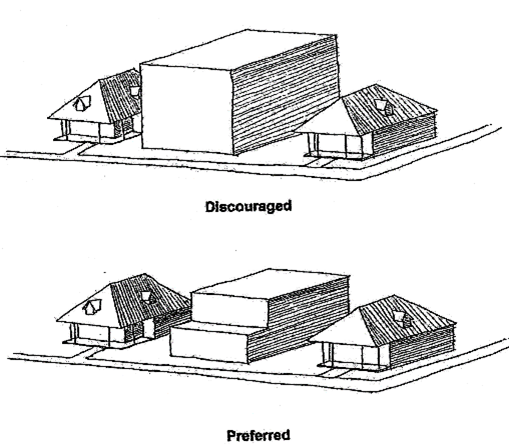
Figure 27-222-1
d.
Recreational structures. Recreational improvements such as swimming pools, spas, tennis courts, basketball courts, etc., should be located on properties so that the use and enjoyment does not negatively impact adjacent properties from an activity or visual context.
e.
Boxed-in neighbors. Designs should protect and preserve the light, air and open space of surrounding properties when considered cumulatively with other buildings in the neighborhood. Designs incorporating tall or bulky building elements located near the property line of an adjoining site that is already partially boxed-in by previous development should be avoided.
f.
Architectural style. Neptune Beach contains an eclectic mix of architectural styles including virtually all of the traditional and contemporary architectural styles, in whole or in part. Compatibility with neighborhood character demands the use of architectural styles and elements that are commonly found in Neptune Beach and within Florida. Unique architectural styles that are uncommon in residential environments should be avoided.
g.
Privacy. Designs should respect the privacy of neighbors. The placement of windows, doors, balconies, and decks should be sensitive to similar improvements on neighboring properties.
h.
Landscaping. Designs should coordinate building elements with landscaping to achieve a pleasing overall site design. Landscaping can achieve other design objectives such as breaking up mass and bulk, and protecting privacy, but such use of landscaping should not substitute for good building design in conformance with all design objectives.
i.
Protect the urban tree canopy. Site improvements should be designed to preserve significant trees and to maintain the urban tree canopy as a distinctive feature of our city's charm.
j.
Private views. Design should respect views enjoyed by neighboring parcels. It is the intent of this objective to balance the private rights to views from all parcels that will be affected by a proposed building or addition. No single parcel should enjoy a greater right than other parcels except the natural advantages of each site's topography. Buildings which substantially eliminate an existing view enjoyed on another parcel should be avoided.
k.
Equity. Design controls should be fair and not grant privileges to some sites while withholding them from other sites. The design review process should be fair and decisions should be reached in an unbiased manner.
(3)
The residential R-1 and residential R-2 zoning districts are intended to provide for single-family residences with densities not to exceed five (5) dwelling units per acre. Other nonresidential uses are permitted that are consistent with the residential character of this district and as specified in section 27-226. This district corresponds to the Suburban Residential I designation on the adopted future land use map.
(4)
The residential R-3 zoning district is intended to provide for single-family residences with densities not to exceed five (5) dwelling units per acre. Other nonresidential uses are permitted that are consistent with the residential character of this district and as specified in section 27-226. This district corresponds to the Traditional Residential I designation on the adopted future land use map.
(5)
The residential R-4 zoning district is intended to provide for single-family residences and two-family (duplex) residences with densities not to exceed ten (10) dwelling units per acre. Other nonresidential uses are permitted that are consistent with the residential character of this district. This district corresponds to the Suburban Residential II and Traditional Residential II designations on the adopted future land use map. The Residential Conservation (RC) overlay, which covers a portion of the R-4 zoning district, implements comprehensive plan policies adopted in 2021 regarding two-family (duplex) residences east of 3rd Street (see section 27-242).
(6)
The residential R-5 zoning district is intended to provide for single-family residences, two-family (duplex) residences, and multifamily residences with densities not to exceed seventeen (17) dwelling units per acre. Other nonresidential uses are permitted that are consistent with the residential character of this district. This district corresponds to the Suburban Residential III and Traditional Residential III designations on the adopted future land use map.
(7)
The commercial C-l, zoning district is intended to provide for services and retail sales that meet routine needs of residents in buildings that promote walkability. This district corresponds to the walkable commercial corridor designation on the adopted future land use map.
(8)
The commercial C-2, zoning district is intended to provide for retail sales and services for one (1) or more neighborhoods. This district corresponds to the Commercial I and neighborhood center designations on the adopted future land use map.
(9)
The commercial C-3, zoning district is intended to provide retail sales and services that serve the overall community. This district corresponds to the Commercial II designation on the adopted future land use map.
(10)
The central business district CBD, zoning district is intended to allow a mix of commercial uses and compatible residential uses that will encourage an urban intensive, pedestrian oriented neighborhood ambiance. The CBD is further established to encourage the continuation of the present unique Central Business District of Neptune Beach, as well as, the continuation of its present aesthetically pleasing environment, to provide areas for the concentration of compatible land uses, to provide sufficient space for appropriate commercial, miscellaneous service activities and residences which will strengthen the city's economic base, and to prevent the intrusion of objectionable land uses. This district corresponds to the town center designation on the adopted future land use map.
(11)
The conservation zoning district provides protection for environmentally sensitive lands.
(Ord. No. 2004-10, § 1, 10-4-04; Ord. No. 2006-08, § 1, 6-5-06; Ord. No. 2006-13, § 2, 7-10-06; Ord. No. 2022-03, § 1(Exh. A), 8-1-22)
Sec. 27-223. - Regulations to apply uniformly throughout zoning district.
The regulations for each zoning district as contained in this Code shall apply uniformly to each structure and use and to all land and water within the boundaries of the zoning district, except where this Code specifically indicates otherwise, such as for overlay districts.
(Ord. No. 2004-10, § 1, 10-4-04; Ord. No. 2022-03, § 1(Exh. A), 8-1-22)
Sec. 27-224. - Overlay districts established.
This Code establishes several overlay districts, meaning that these districts are overlaid upon the other established base zoning districts which are listed in section 27-221. Special regulations that apply to these overlay districts are provided in other portions of this Code. The following overlay districts have been established and provide special regulations that apply in addition to regulations in the base zoning districts:
(1)
Neighborhood Center (NC), as described in Table 27-239 and in section 27-247 of this article.
(2)
Residential Conservation (RC), as described in Table 27-239 and in section 27-243 of this article.
(3)
Coastal high-hazard area (CHHA), as described on Maps A-3 and E-1 and in policies under Objective E.1.4 in the Neptune Beach Comprehensive Plan.
(4)
Areas where buildings must be elevated, from Flood Insurance Rate Maps (FIRM), as described in chapter 30 of this Code.
(Ord. No. 2004-10, § 1, 10-4-04; Ord. No. 2022-03, § 1(Exh. A), 8-1-22)
Editor's note— Prior to the inclusion of Ord. No. 2022-03, § 27-224 was entitled "Special flood hazard district, shallow flooding district, and coastal high hazard district established."
Sec. 27-225. - Uses expressly prohibited within zoning districts.
The following uses are expressly prohibited within the zoning districts as provided for below:
(1)
R-1, R-2, R-3, R-4, and R-5 districts: In addition to the provisions of subsection 27-226(d) below, the following uses are expressly prohibited: Short-term rentals and all commercial activities, except home-based businesses as provided for in article V.
(2)
C-1 district: Residential dwellings, mini-warehouses, gas stations, drive-thru facilities for any purpose, drive-in restaurants, bingo and gambling (except for as stated in F.S. Ch. 24).
(3)
C-2 district: Residential dwellings, gas stations, mini-warehouses, bingo and gambling (except for as stated in F.S. Ch. 24).
(4)
C-3 district: Residential dwellings, mini-warehouses bingo and gambling (except for as stated in F.S. Ch. 24).
(5)
CBD district: Mini-warehouses, gas stations, drive-thru facilities for any purpose, drive-in restaurants, bingo and gambling (except for as stated in F.S. Ch. 24).
(6)
All zoning districts: Adult arcade amusement center, electronic game promotions, game centers/arcades, gaming, video poker establishments, computer game centers, and/or games played on individual machines and/or computers, including any type of card, token and/or coin-operated video and/or simulated games and/or similar activities and/or machines which are played for any type of compensation and/or reward, warehousing, and mini-warehousing.
(Ord. No. 2004-10, § 1, 10-4-04; Ord. No. 2007-07, § 2, 6-4-07; Ord. No. 2008-10, § 2, 9-8-08; Ord. No. 2011-03, § 2, 2-17-11; Ord. No. 2016-07, § 2, 7-6-16; Ord. No. 2016-08, § 1, 8-1-16; Ord. No. 2022-03, § 1(Exh. A), 8-1-22)
Sec. 27-226. - Allowable uses within zoning districts.
(a)
All uses shall conform to the standards for each zoning district as provided below:
(1)
Because the lists of permissible uses are not exclusive, those uses not listed shall be prohibited. If a proposed use might fall within more than one (1) group of uses identified in section 27-226, the city manager or designee will determine which most closely and most specifically matches the proposed use, taking into account the reasonably expected land-use impacts from the proposed use.
(2)
Parcels with the following designations on the adopted future land use map have typically been assigned the same zoning district as comparable abutting land:
a.
Government and public utilities.
b.
Education.
c.
Recreation and open space.
(b)
Conservation (CON):
(1)
Intent. The CON zoning district is intended to provide for protection for environmentally sensitive lands. This district corresponds to the conservation designation on the adopted future land use map.
(2)
Permitted uses. The uses permitted within the CON zoning district shall be:
a.
Single-family residence by special exception;
b.
Docks;
c.
Retaining walls.
(c)
Residential-1 (R-1):
(1)
Intent. The R-1 zoning districts are intended to provide for single-family residences. This district corresponds to portions of the Suburban Residential I designation on the adopted future land use map.
(2)
Permitted uses. The uses permitted within the R-1 zoning district shall be:
a.
Single-family residence;
b.
Public park/recreation area;
c.
Family day care home, as defined by F.S. §§ 402.26—402.319;
d.
Accessory structures and uses as defined by article V.
(3)
Uses by special exception. The uses permitted by special exception within the R-1 zoning district shall be:
a.
Government uses, buildings and utilities;
b.
Primary/secondary education facilities;
c.
Worship facility and childcare associated with facility.
(d)
Residential-2 (R-2):
(1)
Intent. The R-2 zoning districts are intended to provide for single-family residences. This district corresponds to portions of the Suburban Residential I designation on the adopted future land use map.
(2)
Permitted uses. The use permitted within the R-2 zoning district shall be:
a.
Single-family residence;
b.
Public park/recreation area;
c.
Family day care home, as defined by F.S. §§ 402.26—402.319;
d.
Accessory structures and uses as defined by article V.
(3)
Uses by special exception. The uses permitted by special exception within the R-2 zoning district shall be:
a.
Government uses, buildings and utilities;
b.
Primary/secondary education facilities;
c.
Worship facility and childcare associated with facility.
(e)
Residential-3 (R-3):
(1)
Intent. The R-3 zoning districts are intended to provide for single-family residences. This district corresponds to the Traditional Residential I designation on the adopted future land use map.
(2)
Permitted uses. The use permitted within the R-3 zoning district shall be:
a.
Single-family residence;
b.
Public park/recreation area;
c.
Family day care home, as defined by F.S. §§ 402.26—402.319;
d.
Accessory structures and uses as defined by article V.
(3)
Uses by special exception. The uses permitted by special exception within the R-3 zoning district shall be:
a.
Government uses, buildings and utilities;
b.
Primary/secondary education facilities;
c.
Worship facility and childcare associated with facility.
(f)
Residential-4 (R-4):
(1)
Intent. The R-4 zoning district is intended to provide for single-family and two-family (duplex) residences with densities not to exceed ten (10) dwelling units per acre. This district corresponds to the Suburban Residential II designation and the Traditional Residential II designation on the adopted future land use map. The residential conservation (RC) overlay applies to R-4 land east of 3rd Street, which has been assigned to the Traditional Residential II designation on the adopted future land use map.
(2)
Permitted uses. The uses permitted within the R-4 zoning district shall be:
a.
Single-family residence;
b.
Two-family (duplex) residence;
c.
Public park/recreation area;
d.
Family day care home, as defined by F.S. §§ 402.26—402.319;
e.
Accessory structures and uses as defined by article V.
(3)
Uses by special exception. The uses permitted by special exception within the R-4 zoning district shall be:
a.
Government uses, buildings and utilities;
b.
Primary/secondary education facilities;
c.
Worship facility and childcare associated with facility.
(g)
Residential-5 (R-5):
(1)
Intent. The R-5 zoning districts are intended to provide for single-family residences, two-family (duplex) residences and multifamily residences with densities not to exceed seventeen (17) dwelling units per acre. This district corresponds to the Suburban Residential III and Traditional Residential III designations on the adopted future land use map.
(2)
Permitted uses. The uses permitted within the R-5 zoning district shall be:
a.
Single-family residence;
b.
Two-family (duplex) residence;
c.
Multifamily residence;
d.
Public park/recreation area;
e.
Family day care home, as defined by F.S. §§ 402.26—402.319;
f.
Accessory structures and uses as defined by article V.
(3)
Uses by special exception. The uses permitted by special exception within the R-5 zoning district shall be:
a.
Government uses, buildings and utilities;
b.
Primary/secondary education facilities;
c.
Worship facility and childcare associated with facility;
d.
Adult day care;
e.
Child day care;
f.
Nursing home;
g.
Adult congregate living facility.
(h)
Commercial-1 (C-1):
(1)
Intent. The C-1 zoning districts are intended to provide for office, retail sales, and professional services. This district corresponds to the walkable commercial corridor designation on the adopted future land use map.
(2)
Permitted uses. The uses permitted within the C-1 zoning district shall be:
a.
Business and professional offices including, architects, accountants, doctors, dentists, miscellaneous health offices and clinics, veterinary clinic, and legal services;
b.
Financial institution, insurance, and real estate offices;
c.
Personal service establishments as follows: laundry, cleaning and garment services; photographic studios; beauty and barber shops, day spa, nail and waxing salon; shoe repair and miscellaneous personal services (not including tattoo establishments); cleaning and janitorial services (no outdoor storage of vehicles, materials, equipment or supplies);
d.
Travel agencies;
e.
Photographic studios;
f.
Public Park/recreation area;
g.
Library, museum, and art gallery.
(3)
Uses by special exception. The uses permitted by special exception within the C-1 zoning district shall be:
a.
Retail sales;
b.
Parking lot (not associated with any business); excluding parking structures;
c.
Government uses, buildings and utilities;
d.
Primary/secondary education facilities;
e.
Dance, art, dramatic, gymnastics and music studio;
f.
Worship facility and childcare associated with facility;
g.
Miscellaneous personal services;
h.
Accessory structures and uses for storage as defined by article V.
(i)
Commercial-2 (C-2):
(1)
Intent. The C-2 zoning districts are intended to provide for retail sales and service for one (1) or more neighborhoods. This district corresponds to the Commercial I and neighborhood center designations on the adopted future land use map.
(2)
Permitted uses. The uses permitted within the C-2 zoning district shall be:
a.
Interior service restaurant, carry-out and delivery restaurant, fast-food restaurant, drive-in restaurant;
b.
Outdoor seating/dining for restaurant on private property (see subsection 27-227(b)(5));
c.
Business and professional offices as follows: Building contractors and subcontractors (no outdoor storage of vehicles, materials, equipment or supplies), architects, accountants, doctors, dentists, miscellaneous health offices and clinics, veterinary clinic, and legal services;
d.
Financial institution, insurance and real estate offices;
e.
Travel agencies;
f.
Retail sales, shopping center, wholesale sales (no on-site storage of stock), furniture and appliance sales, package liquor store and pharmacy;
g.
Personal service establishments as follows: Laundry, cleaning, and garment services; photographic studios; beauty and barber shops, day spa, nail and waxing salon; shoe repair and miscellaneous personal services (not including tattoo establishments); cleaning and janitorial services (no outdoor storage of vehicles, materials, equipment or supplies);
h.
Dance, art, dramatic, gymnastics and music studio;
i.
Library, museum, and art gallery;
j.
Public park/recreation area;
k.
Recreation, amusement, and entertainment (including, bowling alley, skating rink, billiard and pool hall, arcade, miniature golf, indoor athletic and exercise facilities, tennis, handball, or racquetball facility);
l.
Radio and television broadcasting studio;
m.
Adult congregate living facilities;
n.
Funeral establishment;
o.
Social, fraternal club, lodge, and union hall;
p.
Medical marijuana treatment center.
(3)
Uses by special exception. The uses permitted by special exception within the C-2 zoning district shall be:
a.
Outdoor seating/dining for restaurant on public property (see subsection 27-227(b)(5));
b.
Motor vehicle service;
c.
Parking lot/structure (not associated with any business);
d.
Moving business (no mini-warehouses);
e.
Government uses, buildings and utilities;
f.
Recycling collection center;
g.
Primary/secondary education facilities;
h.
Worship facility and childcare associated with facility;
i.
Recreation, amusement, and entertainment (including, theater, night club, private club, and bar/tavern);
j.
Light manufacturing;
k.
Wholesale sales (on-site storage of stock);
l.
Day care facilities;
m.
Accessory structures and uses for storage as defined by article V.
(j)
Commercial-3 (C-3):
(1)
Intent. The C-3 zoning districts are intended to provide for retail sales and service that serve the overall community. This district corresponds to the Commercial II designation on the adopted future land use map.
(2)
Permitted uses. The uses permitted within the C-3 zoning district shall be:
a.
Hospital;
b.
Hotel/motel;
c.
Interior service restaurant, carry-out and delivery restaurant, fast-food restaurant, drive-in restaurant;
d.
Outdoor seating/dining for restaurant on private property (see subsection 27-227(b)(5));
e.
Business and professional offices as follows: Building contractors and subcontractors (no outdoor storage of vehicles, materials, equipment, or supplies), architects, accountants, doctors, dentists, miscellaneous health offices and clinics, veterinary clinic, and legal services;
f.
Financial institution, insurance and real estate offices;
g.
Indoor athletic and exercise facility;
h.
Personal service establishments as follows: Laundry, cleaning and garment services; photographic studios; beauty and barber shops, day spa, nail and waxing salon; shoe repair and miscellaneous personal services (not including tattoo establishments); cleaning and janitorial services (no outdoor storage of vehicles, materials, equipment or supplies);
i.
Retail sales, shopping center wholesale sales (no on-site storage of stock), furniture and appliance sales, package liquor store, pharmacy;
j.
Parking lot/structure (not associated with any business);
k.
Trade business or vocational school, college, community college or university;
l.
Dance, art, dramatic, gymnastics and music studio;
m.
Library, museum, and art gallery;
n.
Public park/recreation area;
o.
Recreation, amusement, and entertainment (including, bowling alley, skating rink, billiard and pool hall, arcade, miniature golf, indoor athletic and exercise facilities, tennis, handball or racquetball facility, theater, night club, private club and bar/tavern);
p.
Radio and television broadcasting studio;
q.
Nursing home;
r.
Adult congregate living facility;
s.
Funeral establishment;
t.
Medical marijuana treatment center.
(3)
Uses by special exception. The uses permitted by special exception within the C-3 zoning district shall be:
a.
Outdoor seating/dining for restaurant on public property (see subsection 27-227(b)(5));
b.
Wholesale sales (on-site storage of stock);
c.
Adult entertainment and service;
d.
Bus or other transportation terminal;
e.
Motor vehicle services;
f.
Moving business (no mini-warehouses);
g.
Government uses, buildings and utilities;
h.
Recycling collection center;
i.
Worship facility and childcare associated with facility;
j.
Social, fraternal club, lodge, and union hall;
k.
Light manufacturing;
l.
Day care facilities;
m.
Accessory structures and uses for storage as defined by article V.
(k)
Central business district (CBD):
(1)
Intent. The CBD zoning district is intended to allow a mix of commercial uses and compatible residential uses that will encourage an urban intensive, pedestrian oriented, neighborhood ambiance. The CBD is further established to encourage the continuation of the present unique Central Business District of Neptune Beach, as well as, the continuation of its present aesthetically pleasing environment, to provide areas for the concentration of compatible land uses, to provide sufficient space for appropriate commercial, miscellaneous service activities and residences which will strengthen the city's economic base, and to prevent the intrusion of objectionable land uses. This district corresponds to the town center designation on the adopted future land use map.
(2)
Permitted uses. The uses permitted within the CBD zoning district shall be:
a.
Hotel/motel;
b.
Bed and breakfast;
c.
Interior service restaurant, carry-out and delivery restaurant;
d.
Outdoor seating/dining for restaurant on private property (see subsection 27-227(b)(5));
e.
Professional offices (including, architects, accountants, doctors, dentists, home health care services, legal services, realtors, veterinary clinic);
f.
Financial institution, insurance and real estate offices;
g.
Personal service establishments limited to the following: photographic studios, beauty and barber shops, day spa, nail, and waxing salon;
h.
Retail sales, wholesale sales (including on-site storage of stock), package liquor store, and pharmacy;
i.
Government uses, buildings and utilities;
j.
Dance, art, dramatic, gymnastics and music studio;
k.
Library, museum, and art gallery;
l.
Public park/recreation area;
m.
Recreation, amusement, and entertainment (including, billiard and pool hall, arcade, miniature golf, theater, night club, private club, and bar/tavern).
(3)
Uses by special exception. The uses permitted by special exception within the CBD zoning district shall be:
a.
Single-family, two-family (duplex) and multifamily residences;
b.
Outdoor seating/dining for restaurant on public property (see subsection 27-227(b)(5));
c.
Parking lot/structure (not associated with any business);
d.
Social, fraternal club, lodge, and union hall;
e.
Indoor athletic and exercise facility;
f.
Accessory structures and uses for storage as defined by article V.
(Ord. No. 2004-10, § 1, 10-4-04; Ord. No. 2004-18, 12-6-2004; Ord. No. 2011-13, § 1, 9-12-11; Ord. No. 2016-07, § 3, 7-6-16; Ord. No. 2017-32, § 3, 1-8-18; Ord. No. 2018-04, § 1, 6-4-18; Ord. No. 2022-03, § 1(Exh. A), 8-1-22)
Sec. 27-227. - Special restrictions and conditions on allowable uses within zoning districts.
(a)
No use that produces undue vibration, dust, smoke, fumes, or noise or that is otherwise offensive, obnoxious, or detrimental to the neighborhood shall be permitted.
(b)
The following special restrictions and conditions apply to the permissible uses identified below:
(1)
Two-family residence (duplex):
a.
Applicable building code requirements related to construction of the type of units proposed shall be met.
b.
The subject lot or parcel of land shall not be subdivided illegally and shall only be developed according to the criteria established in the appropriate Code section.
c.
Also see section 27-242 regarding two-family (duplex) residences east of 3rd Street.
(2)
Multifamily units: Each structure containing multifamily units or each development of contiguous multifamily units shall comply with all regulations for multifamily dwellings of the districts where permitted. In addition to regulations applicable to the entire building or development, the following regulations shall apply to individual single-family units in such buildings or development:
a.
No side yards shall be required for individual interior units. Exterior units shall have a minimum side yard requirement of ten (10) feet.
b.
Each unit shall have access to a public or private street.
(3)
Child day care:
a.
All facilities, operation and maintenance shall meet all applicable city or state regulations for such use and must be licensed appropriately.
b.
A development plan shall be submitted indicating designated indoor and outdoor space, fences or walls, vehicular ingress and egress, off-street parking areas, and loading and unloading areas.
(4)
Fast-food restaurant: Fast-food restaurants may have drive-thru facilities, provided the following conditions are met:
a.
Adequate off-street areas shall be provided for the stacking of vehicles.
b.
Vehicular ingress and egress shall be limited to adjacent major or secondary streets.
c.
All drive-thru facilities shall be located to the side or rear of the building away from the principle abutting thoroughfares. Drive-through windows shall be located to the rear of the building facing away from the principal abutting thoroughfare.
(5)
Interior service restaurant:
a.
Restaurants that sell alcoholic beverages shall conform to the following conditions:
1.
The alcoholic beverages shall be sold only for consumption on the premises.
2.
Said restaurant shall have an inside seating capacity of and be equipped to serve not less than one hundred fifty (150) people meals at one (1) time.
3.
Said restaurant shall derive at least fifty-one (51) percent of its gross revenue from the sale of food and nonalcoholic beverages.
4.
Any alcoholic beverage license issued to any such restaurant under the general law of the state shall not be moved to a new location, such licenses being valid only on the premises of such restaurant.
b.
Outdoor seating may be permitted by right or as a special exception in commercial zoning districts, and shall only be provided in a controlled area, attached to the main interior service area and shall also be situated in a manner that allows for unimpeded pedestrian access along adjacent sidewalks or pedestrian ways.
c.
Outdoor seating requests for public property not owned by the interior service restaurant may be permitted as a special exception and must follow the provisions outlined in subsection 27-479(d).
d.
Dumpster enclosures shall be maintained as not to cause noticeable smells.
(6)
Retail, general:
a.
Outdoor sales must be an accessory use to the principal use and shall be limited to one (1) sale display area per retail store. Neptune Beach general retail stores may have outside sales on the premises of their licensed store. The sale shall be conducted by employees of the store and items offered for sale shall be property of the store and not a consignment operation or arrangement. Only products normally sold at these stores may be sold outside. Stores must apply for a yearly permit approved by the city manager or designee.
1.
Outdoor sales and the outdoor display area must be on private property and located only in the central business district (CBD), C-1, C-2 and C-3 zoning districts.
2.
Outdoor sales cannot occur in the right-of-way.
3.
The outdoor sale display area cannot exceed one hundred fifty (150) square feet.
4.
No outdoor sales shall be allowed in the area set aside, required, or designated for parking, ADA routes, drive isles, driveways, maneuvering areas or unloading/loading areas. An ADA clear path must be maintained around all items in display area.
5.
Any items located outdoors that meet the definition of a sign must conform to the appropriate sign ordinance and regulations.
6.
Items outdoors can only be displayed during the hours when the business is open to the public.
7.
The outdoor display area shall not be placed so as to obstruct vehicular traffic sight.
8.
Tents, lights, banners, or other items prohibited by the Code are not allowed in conjunction with outdoor sales.
9.
Outdoor sales in violation of this section will result in immediate removal of the outdoor items for sale and outdoor sale privileges will be revoked for one (1) year.
b.
No more than forty (40) percent of the gross floor area shall be used for storage.
c.
Retail licensing shall not be construed to allow for the sale of motor vehicles on the premises.
d.
Outdoor sales of fireworks are prohibited.
e.
Drive-thru facilities are allowed only in the C-2 and C-3 zoning districts and shall be located to the side or rear of the building away from the principle abutting thoroughfares.
e.
In the C-1 zoning district only, retail shall be limited to boutiques as defined in section 27-15 and shall only operate between the hours of 10:00 a.m. and 8:00 p.m.
(7)
Adult entertainment and service: No adult bookstore or adult motion picture theater shall be located within two thousand five hundred (2,500) feet of any worship facility, residential district, establishment for the sale of alcoholic beverages for consumption on-premises, hotel/motel, primary or secondary school, park, or theater. All adult entertainment and service shall meet the requirements of F.S. Ch. 847.
(8)
Dry cleaner: Facilities shall not exceed two thousand five hundred (2,500) square feet in area and shall be subject to all regulatory requirements for registration and handling of hazardous materials, including all requirements in chapter 23 and in article XII of chapter 27.
a.
Drive-thru facilities are allowed only in the C-2 and C-3 zoning districts and shall be located to the side or rear of the building away from the principle abutting thoroughfares.
(9)
Parking lot:
a.
No source of illumination for such lots shall be directly visible from any window in any residence.
b.
There shall be no sales or service activity of any kind on such lots without obtaining the appropriate permit from the building department.
c.
If the parking lot is located in a residential district, there shall be no movement of any vehicles on such lots between the hours of 11:00 p.m. and 7:00 a.m.
d.
If in a residential district, no vehicles normally prohibited from being parked in a residential district shall be permitted to be parked in such lot as outlined in section 27-335 of this Code.
(10)
Fire station: Shall be located on a principal or minor arterial as delineated on the future land use and traffic circulation maps.
(11)
Police station: Shall be located on a principal or minor arterial as delineated on the future land use and traffic circulation maps.
(12)
Post office: Shall be located on a principal or minor arterial as delineated on the future land use and traffic circulation maps.
(13)
Cultural, religious, philanthropic, social, and fraternal uses: Shall be located on a principal or minor arterial as delineated on the future land use and traffic circulation maps.
(14)
Radio and television broadcasting studio: No outside antenna.
(15)
Moving business by exception only: No more than three (3) trucks, not to exceed thirty-three (33) feet each, shall be stored on-site and no storage of items to be moved shall be permitted.
(16)
All other drive-thru facilities: Drive-thru facilities are allowed only in the C-2 and C-3 zoning districts and shall be located to the side or rear of the building away from the principle abutting thoroughfares.
(17)
Medical marijuana treatment center:
a.
Shall not be located within eight hundred (800) feet, by following the shortest route of ordinary pedestrian travel along public thoroughfares from the main entrance of any proposed location of any such business, of any other medical marijuana treatment center, or any pre-school, elementary, middle, or high school, church, or other place of worship.
b.
Shall not operate between the hours of 2:00 a.m. and 7:00 a.m., all days of the week.
c.
All cannabis dispensaries, medical marijuana treatment centers, and retail locations selling or otherwise providing to any customer, patron, or individual any items under this section shall conform to all regulations set forth under F.S. § 381.986.
(Ord. No. 2004-10, § 1, 10-4-04; Ord. No. 2006-10, § 1, 6-5-06; Ord. No. 2006-11, § 1, 8-7-06; Ord. No. 2008-05, § 1, 7-7-08; Ord. No. 2010-12, § 1, 9-7-10; Ord. No. 2010-21, § 1, 12-7-10; Ord. No. 2017-14, § 1, 6-5-17; Ord. No. 2017-32, § 4, 1-8-18; Ord. No. 2022-03, § 1(Exh. A), 8-1-22)
Sec. 27-228. - Uses permitted by special exception.
The community development board may review and the city council may permit those uses, as listed in section 27-226, that require a special exception permit according to the procedures and conditions outlined in article III of this Code.
(Ord. No. 2004-10, § 1, 10-4-04; Ord. No. 2010-14, § 36, 9-7-10)
Sec. 27-229. - Lot area requirements.
Lots shall have at least the minimum and no more than the maximum areas as provided for in Table 27-239.
(Ord. No. 2004-10, § 1, 10-4-04; Ord. No. 2004-17, § 2, 11-1-04; Ord. No. 2022-03, § 1(Exh. A), 8-1-22)
Sec. 27-230. - Minimum lot width requirements.
Lots shall have at least the minimum frontage at the building restriction line as provided for in Table 27-239.
(Ord. No. 2004-10, § 1, 10-4-04; Ord. No. 2022-03, § 1(Exh. A), 8-1-22)
Sec. 27-231. - Front yard setback requirements.
(a)
Except as provided in subsections (b) and (c) below, front yards shall have at least the minimum setback distances as provided for in Table 27-239.
(b)
[Specific areas:]
(1)
West side of Penman Road from Atlantic Blvd., to Seagate Ave: Thirty-five (35) feet.
(2)
North side of Seagate Avenue from Penman Road to the western city limits: Thirty-five (35) feet.
(3)
Florida Boulevard from Penman Road to Atlantic Boulevard: Thirty-five (35) feet.
(c)
The following special requirements shall apply where appropriate:
(1)
Where lots comprising twenty-five (25) percent or more of the frontage on the same street within the block are developed with buildings having an average yard with a variation in depth of not more than six (6) feet, no building hereafter erected or structurally altered shall project beyond or behind the average front yard so established (refer to Figure 27-231-1).
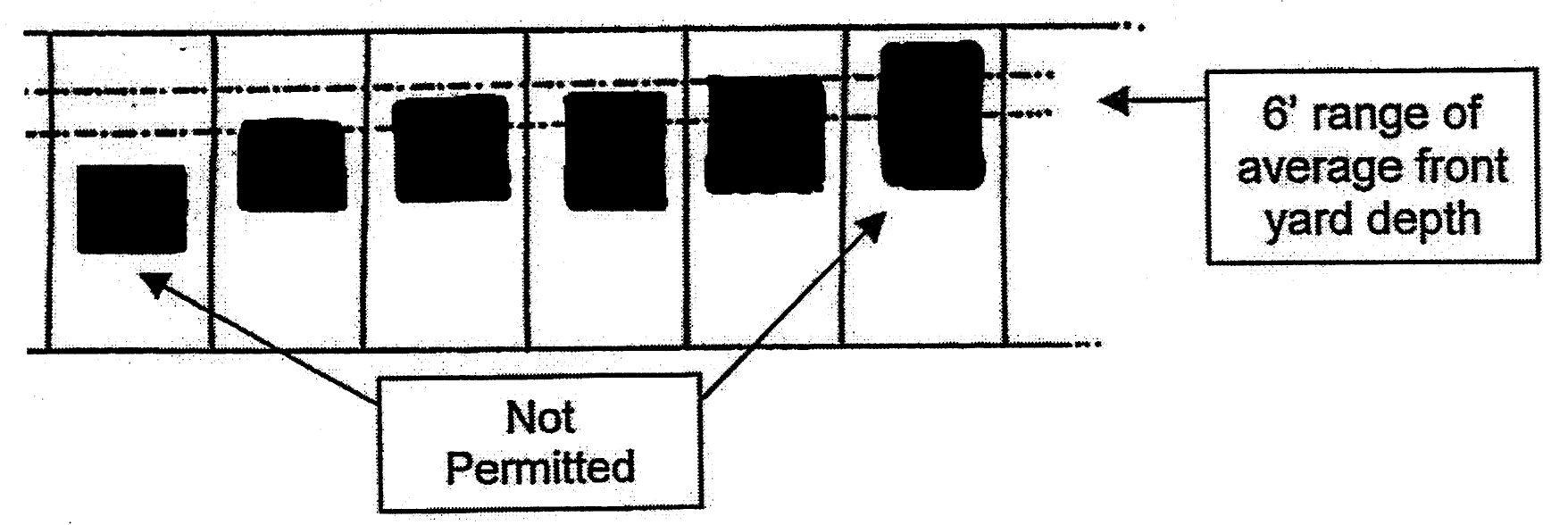
Figure 27-231-1
(2)
Where interior lots have a double frontage, unless the prevailing front yard pattern on adjoining lots indicates otherwise, the required front yard shall be provided on both streets or the oceanfront for oceanfront lots. Where one (1) of the front yards that would normally be required on a double frontage lot is not in keeping with the prevailing yard pattern, the city manager or designee may waive the requirement for the normal front yard and substitute a special yard requirement, which shall not exceed the average of the yards provided on adjacent lots.
(3)
Front yards on corner lots. The front yard shall be considered the area directly situated in front of the primary façade of the structure. Where the front yard on corner lots, as defined herein, is not keeping with the prevailing yard pattern, the city manager or designee may waive the requirement for the determination of the normal front yard and substitute a special yard requirement, which shall not exceed the average of the yards provided on adjacent lots.
(4)
Front yards on oceanfront lots. Oceanfront lots shall be considered through lots or double frontage lots, such that there is a front on the street side, as well as the ocean side (refer to Figure 27-231-2).
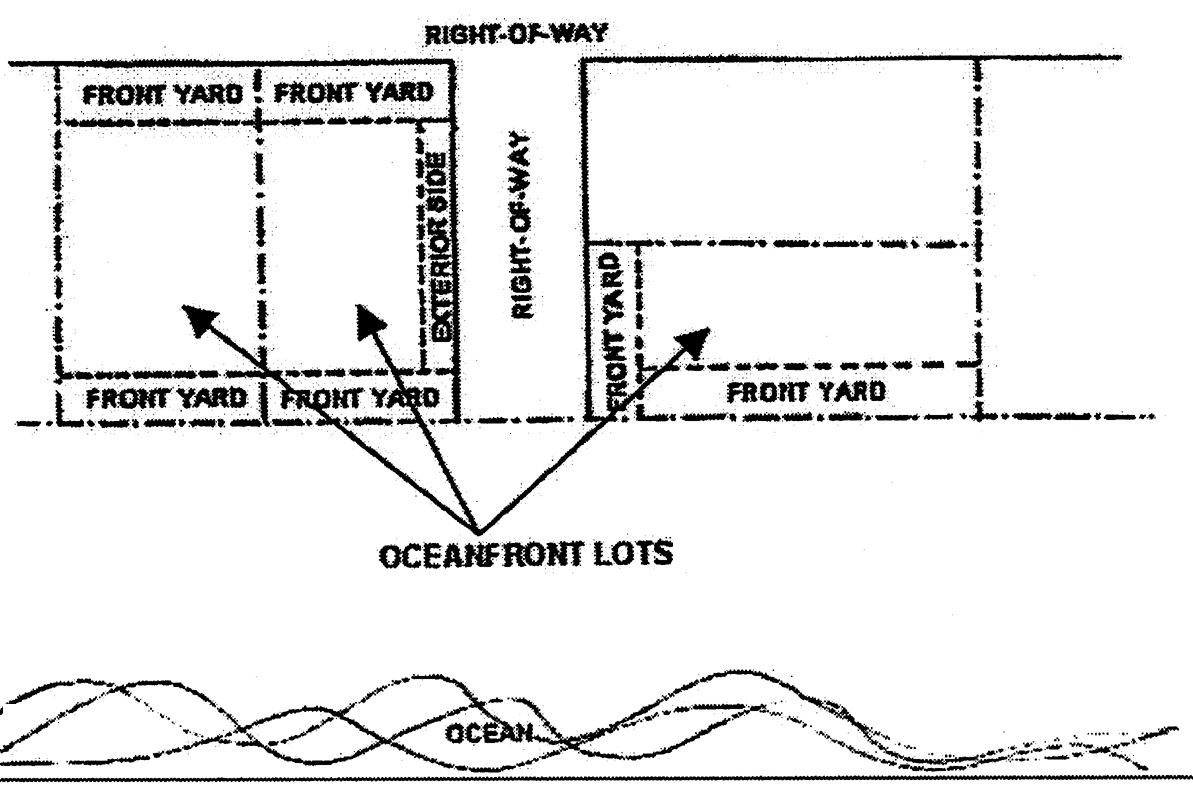
Figure 27-231-2
(5)
Properties developed with minimum front yard setbacks shall be required to provide an adequate parking area with an appropriately designed side or rear driveway/parking court, garage, or carport.
(Ord. No. 2004-10, § 1, 10-4-04; Ord. No. 2011-10, § 1, 6-6-11; Ord. No. 2012-04, § 1, 4-2-12; Ord. No. 2022-03, § 1(Exh. A), 8-1-22)
Sec. 27-232. - Side yard setback requirements.
Side yards shall have at least the minimum setback distances as provided for in Table 27-239.
(Ord. No. 2004-10, § 1, 10-4-04; Ord. No. 2022-03, § 1(Exh. A), 8-1-22)
Sec. 27-233. - Rear yard setback requirements.
Rear yards shall have at least the minimum setback distances as provided for in Table 27-239.
(Ord. No. 2004-10, § 1, 10-4-04; Ord. No. 2022-03, § 1(Exh. A), 8-1-22)
Sec. 27-234. - Measurement of minimum required yard setback.
Front yard setbacks shall be measured from the front of the building, excluding steps, to the front of the lot. Side yard setbacks shall be measured from the side of the building, excluding steps, to the adjoining lot line. Rear yard setbacks shall be measured from the rear of the building, excluding steps and unenclosed porches, and decks with the deck floor less than thirty (30) inches above grade, to the rear lot line.
(Ord. No. 2004-10, § 1, 10-4-04)
Sec. 27-235. - Encroachments into and use of front, side, and rear yards.
(a)
Front, side, and rear yards shall be open and unobstructed from the ground to the sky, except as may be otherwise permitted by this Code and except as follows below, provided such encroachments, and uses comply with all building code and fire prevention provisions (chapters 8 and 10, respectively). Permitted encroachment may not be added onto one another.
(1)
Fences and garden elements. Flagpoles, fences, walls, hedges are permitted subject to other applicable provisions of this Code. Fences and garden/yard walls may encroach into required setbacks. All support structures shall be located towards the inside of the fence.
(2)
Architectural projections. Sills, belt courses, cornices, buttresses, pilasters, chimneys, fireplaces, flues, roof overhangs, and similar architectural projections (including gutters) for principal structures may encroach up to two (2) feet from the building into any required yard setback. Bay windows, which must provide habitable interior space and include at least three (3) windows, may encroach up to three (3) feet, for existing structures only, from the building into the front, side street, and rear yards.
(3)
Awnings and entry canopies. In residential buildings, awnings, hoods, and canopies over windows and doors may extend up to four (4) feet from the building into any required yard and shall be no closer than three (3) feet from any interior side or rear property line. They shall include appropriate design measures (e.g., rain gutters, deflection devices, etc.) to prevent stormwater from discharging onto adjacent properties. In existing commercial buildings, awnings and entry canopies may extend up to ten (10) feet into the required front, rear, or street-facing side yard setback. Awnings and entry canopies shall not encroach upon the public right-of-way, except in the central business district where they may cover a portion or all of the sidewalk, provided a minimum vertical clearance of eight (8) feet is maintained underneath them. In these cases, FDOT and Beaches Energy approval may be required.
(4)
Galleries. These frontage types, permitted only in commercial zoning districts, may encroach up to ten (10) feet into any required front and street-facing side yard. In the central business district, these elements may also encroach into the public right-of-way covering a portion or all of the sidewalk, provided a minimum vertical clearance of eight (8) feet and a gap of two (2) feet between the outside of the columns and the curb face is maintained. In these cases, FDOT and Beaches Energy approval may be required. Public works and any other public utility shall not be liable for damages to a gallery structure resulting from repairs to sidewalks, utilities, or other infrastructure within the right-of-way.
(5)
Projecting porches, stoops, and porticos. These entry elements, including steps or ramps to access such, may encroach a maximum of five (5) feet into any required front yard and shall be no closer than five (5) feet of any property line.
(6)
Balconies and upper-level decks and patios. Balconies may encroach a maximum of six (6) feet into any required yard setback for existing residential structures and shall be no closer than five (5) feet of any interior side or rear yard property line. Except within the central business district, balconies shall not encroach upon any public sidewalk. Upper-level decks and patios, which are distinguishable from balconies by the need for structural columns or posts, shall only be permitted in the rear yard and shall not be visible from the street or sidewalk. These upper-level decks may encroach a maximum of six (6) into the required rear yard.
(7)
Motor vehicle structures. All carports, porte cocheres, awnings and temporary structures designed to provide shelter for motor vehicles must meet all of the building code requirements, including, without limitation, wind load requirements. As these appurtenances are defined by this Code as structures, they must meet all zoning requirements that are applicable to the main structure such as setbacks, etc.
(8)
Uncovered or unenclosed outdoor structures. Patios serving the ground level of a building, when constructed at ground level, shall be no closer that five (5) feet from any rear or side property line.
a.
Decks constructed with a height of more than twenty-four (24) inches above the surrounding finished grade, shall be no closer than ten (10) feet away from of any rear property line.
(9)
Accessibility structures. Required ADA-compliant ramps for person(s) with disabilities and fire escapes may encroach into any yard but may not be closer than five (5) feet to any property line. Such features shall not be located in a front yard if it is possible to accommodate them in a side or rear yard.
(10)
Walkways and driveways. Uncovered and unenclosed walkways and driveways may encroach up to one hundred (100) percent of the depth of any required setback unless a landscaped buffer is required. The combined width of driveways along any street-facing yard setback for residential lots may not exceed twenty (20) feet and additional requirements must be met for driveways in the R-4 district (see section 27-243).
(b)
No part of a required yard or other open space provided in connection with one (1) structure or use shall be used to meet the requirements for another structure or use.
(Ord. No. 2004-10, § 1, 10-4-04; Ord. No. 2022-03, § 1(Exh. A), 8-1-22)
Sec. 27-236. - Frontage requirements and standards.
(a)
Intent. This section sets forth the standards applicable to the development of private frontages. Private frontages are the components of a building that provide an important transition between the public realm (street and sidewalk) and the private realm (yard or building). For each frontage type, a description, dimensional standards, and additional standards are provided. Existing structures that do not meet these requirements and standards are to be considered valid non-conforming structures.
(b)
Applicability. Standards apply to development in the C-1, C-3, and CBD zoning districts and in the NC and RC overlay districts. Encroachments listed in subsection (e) below, shall be limited to existing properties. New developments, including residential construction, shall meet all setback requirements unless granted approval of a variance through the community development board and/or city council.
(c)
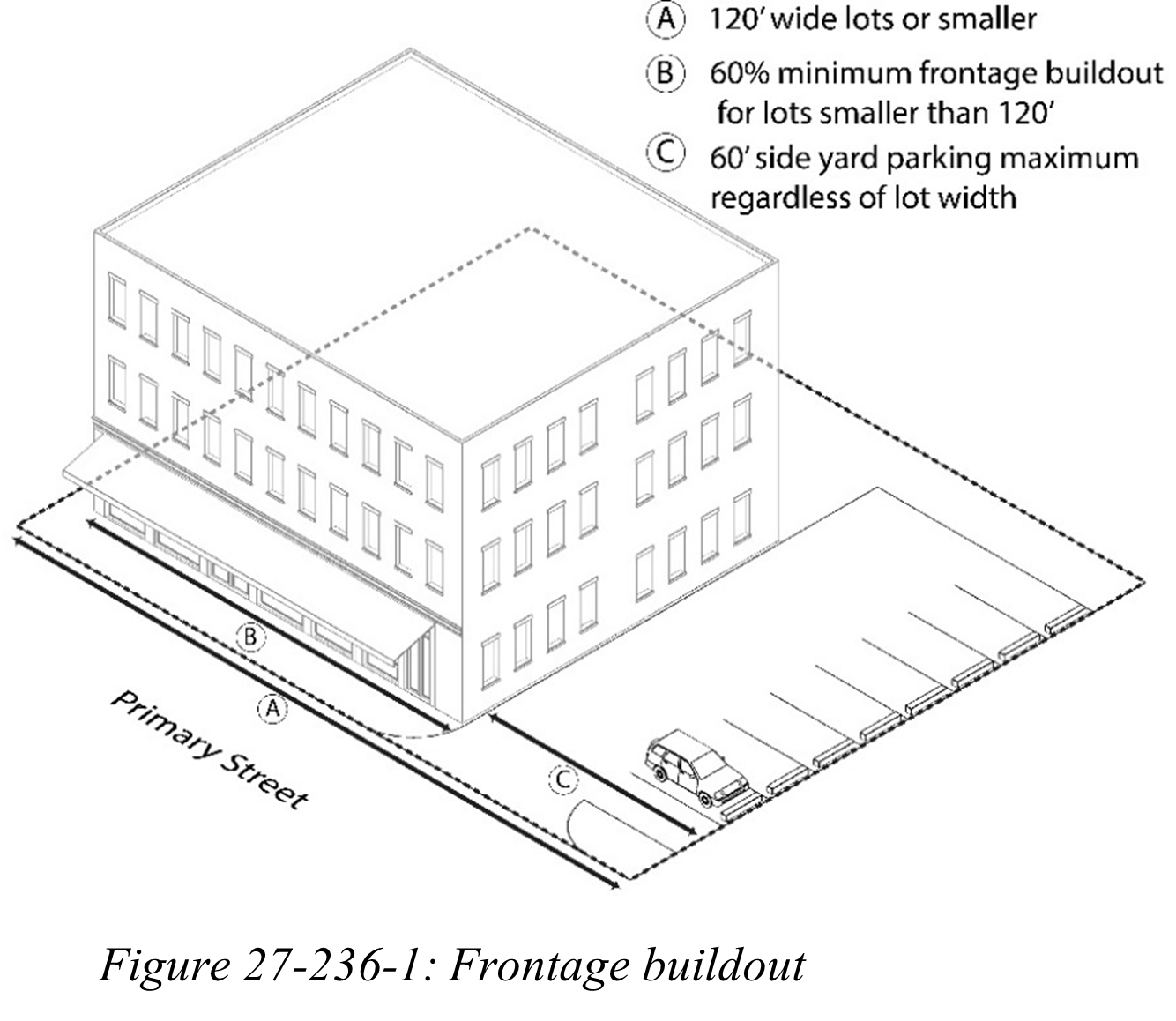
Frontage buildout requirement. This requirement refers to the percentage of the lot width that shall have a building façade at the primary street setback line. This requirement shall only refer to commercial development in the following districts as noted below and in Table 27-239:
(1)
C-1, C-2, and C-3 district: Seventy (70) percent minimum frontage buildout (a reduction to sixty (60) percent shall be granted for lots one hundred twenty (120) feet wide or less to accommodate side yard parking). In general, side yard parking in these districts will only be permitted up to sixty (60) feet in width, regardless of lot width.
(2)
CBD and NC overlay district: Seventy (70) percent minimum frontage buildout.
(d)
Permitted and required frontages. Unless otherwise specified, all frontage elements must be contained within the encroachment areas described in section 27-235. Table 27-236 below describes the permitted and required frontages for the R-4, CBD, C-1, C-3, and NC overlay zoning districts.
[Table Notes:]
(1)
R Required: At least one of these is required along the primary frontage of the building.
(2)
CR Conditionally Required: At least one of these may be required in combination with the Storefront, Lobby, or Terrace to provide shade.
(3)
O Optional: These frontages are permitted, but not required.
(4)
- Prohibited: These frontages are not permitted.
Table 27-236
(e)
Standards.
(1)
Gallery. A gallery is a one- to two-story colonnaded structure attached to the front of a building that projects out over the sidewalk providing shade and protection from the elements. It is typically used for ground floor commercial frontages on buildings set close to or at the right-of-way line.
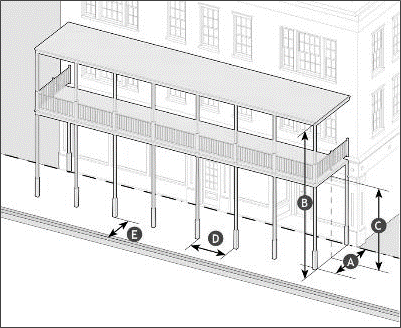 | a. Standards | |
| Dimensions | ||
Depth
10' min.
 | ||
Height
1--2 stories
 | ||
Vertical Clearance
11' min.
 | ||
Column Spacing
10' min.
 | ||
Clearance to Street Curb
2' min.
 | ||
| Additional | ||
| Must extend the full length of the building façade and must have a consistent depth | ||
| May only be combined with Storefront Frontage Type | ||
| May encroach beyond the right-of-way line up to 10' to cover part/all of the sidewalk. FDOT and Beaches Energy approval may be required where applicable. | ||
(2)
Storefront. A Storefront is an assembly of commercial entry doors and windows that provide access and light into a commercial space, as well as space to display goods, services, and signage.
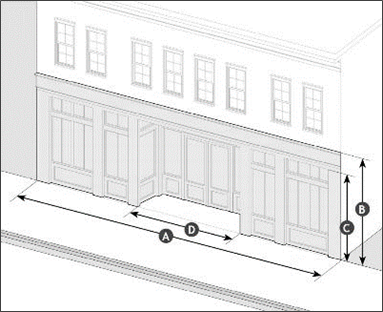 | a. Standards | |
| Dimensions | ||
|
Length
15' min.
| ||
| Height | ||
|
Overall
18' max.
| ||
|
Display Window
8' min.
| ||
|
Recessed Entry Width
15' max.
| ||
| Additional | ||
| If the sidewalk is less than 8' wide, a recessed entry at least 3' deep must be provided to accommodate the door swing | ||
| Must provide an unobstructed view of the interior or a lighted and maintained display(s) area | ||
| Must be combined with either a gallery, awning, entry canopy, or overhead balcony | ||
| Exterior security grilles, gates, and roll-downs are prohibited | ||
(3)
Lobby entrance. A lobby entrance is an assembly of entry doors and windows providing access and light to the lobby of a building. It is appropriate for lobbies such as those found in office, civic/institutional, and multifamily residential buildings, to name a few.
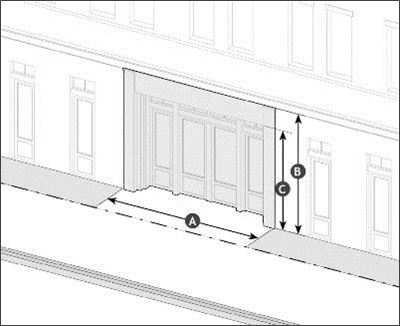 | a. Standards | |
| Dimensions | ||
|
Length
15' min., 30' max.
| ||
| Height | ||
|
Overall
18' max.
| ||
|
Glazing/Window
8' min.
| ||
| Additional | ||
| If the sidewalk is less than 8' wide and there is no front setback, a recessed entry at least 3' deep must be provided to accommodate the door swing | ||
| Must provide an unobstructed view of the interior | ||
| Unless recessed a minimum of 3', a lobby entrance must be combined with either a gallery, awning, entry canopy, or overhead balcony | ||
| If set back from the lot line, the frontage area must be paved | ||
(4)
Awning. An awning is a wall-mounted frame covered with fabric or other material that provides shade and protection over a storefront, lobby, or other entrance.
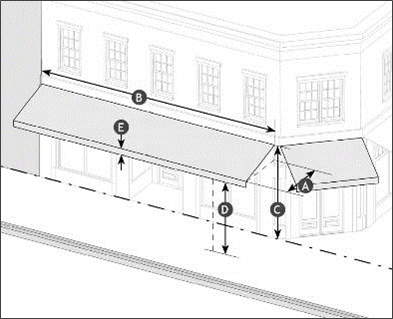 | a. Standards | |
| Dimensions | ||
|
Projection
3' min.
| ||
|
Length
4' min.
| ||
|
Height
15' max.
| ||
|
VerticalClearance
8' min.
| ||
|
Valance Height
12" max.
| ||
| Additional | ||
| Must be securely attached and must fit the full length of the door/window it is attached to | ||
| Must be made of durable, weather-resistant material | ||
| Internally illuminated or back-lit awnings are prohibited | ||
| May encroach beyond the right-of-way line up to 10' to cover part or all of the public sidewalk. FDOT and Beaches Energy approval may be required where applicable. | ||
(5)
Entry canopy—Large. An entry canopy is a solid wall-mounted structure that provides shade and protection from the elements over a storefront, lobby, or other building entrance.
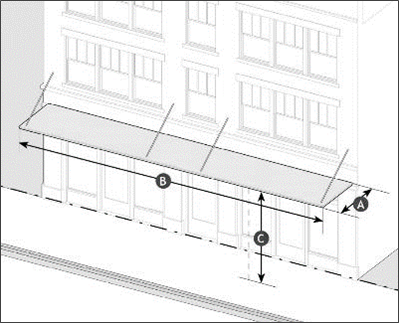 | a. Standards | |
| Dimensions | ||
|
Projection
3' min.
| ||
|
Length
4' min.
| ||
|
Vertical Clearance
8' min.
| ||
| Additional | ||
| Must be securely and visibly attached to the façade with brackets, cables, or rods | ||
| The length of the canopy must be equal to or greater than the width of the doorway and/or window surround or exterior casing it is mounted over | ||
| May encroach beyond the right-of-way line up to 10' in to cover part or all of the public sidewalk. FDOT and Beaches Energy approval may be required where applicable. | ||
(6)
Overhead balcony—Large. An overhead balcony frontage is essentially a cantilevered gallery. Like the gallery, this structure projects out over the sidewalk providing shade and protection from the elements. It is typically used for ground floor commercial frontages on buildings set close to or at the right-of-way line. These structures shall not be enclosed.
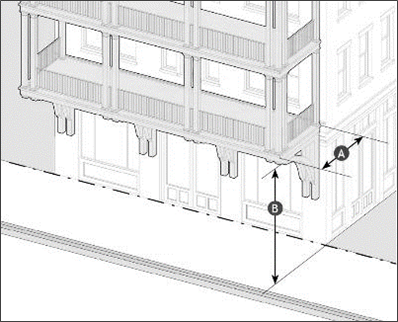 | a. Standards | |
| Dimensions | ||
|
Depth
6' max.
| ||
|
VerticalClearance
8' min.
| ||
| Additional | ||
| Visible brackets or structural supports must be adequately spaced so as to be well integrated and harmonious with the windows and doors below | ||
| May only be combined with Storefront and Lobby Frontage Type and must extend at least the full length of those frontages | ||
| May encroach beyond the right-of-way line up to 8' to cover part/all of the sidewalk. FDOT and Beaches Energy approval may be required where applicable. | ||
(7)
Forecourt. A forecourt is a frontage type wherein a portion of the building façade is on or close to the minimum setback line and the central portion of the façade is pushed back to creating a small court space. This centered court space can be used as an entry court or shared garden for multifamily residential buildings, or as an additional shopping or restaurant seating area in commercial and retail service areas.
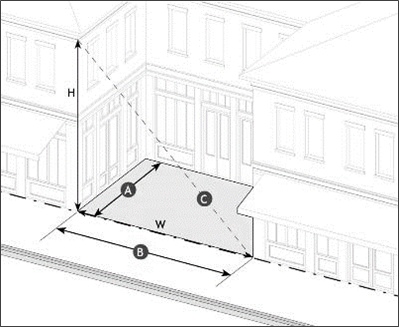 | a. Standards | |
| Dimensions | ||
|
Depth, Clear
12' min.
| ||
|
Width, Clear
12' min.
| ||
|
Ratio, Height to width
2:1 max.
| ||
| Additional | ||
| Entry into the building is required along the primary frontage parallel to the sidewalks and encouraged along each of the three frontages within the court | ||
(8)
Terrace. In a terrace frontage the main façade of the building is at or near the minimum setback line with an elevated terrace providing public circulation between the building entrances and the public right-of-way. This type is typical along streets with slopes or grade changes but is also a useful for mixed-use and commercial buildings that must address changing flood elevation requirements and sea level rise.
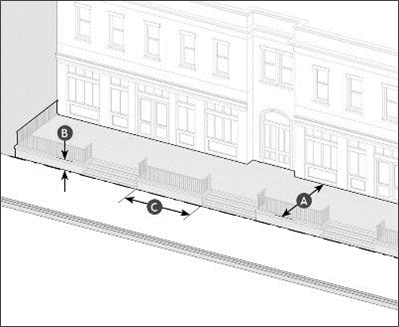 | a. Standards | |
| Dimensions | ||
|
Depth, Clear
8' min.
| ||
|
Finish Levelabove Sidewalk
3' 6" max.
| ||
|
Distancebetween Stairs
50' max.
| ||
| Additional | ||
| Low walls, which can be used as seating are encouraged | ||
| If railings are used they must allow pedestrians on the sidewalk to see through the posts and rails | ||
| Must be implemented in conjunction with the Shopfront or Lobby frontage types and feature at least one shade element (awning, entry canopy, or similar) | ||
(9)
Portico. A portico is a small projecting porch at the entrance of a building that features a set of stairs leading to a covered landing with a roof structure supported by columns, piers, or posts. It is not meant to accommodate outdoor furniture like a porch is. Porticos are appropriate for ground floor residential frontages.
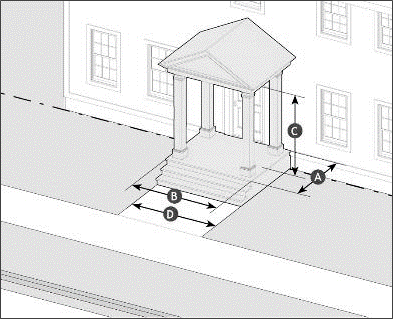 | a. Standards | |
| Dimensions | ||
|
Landing Depth
4' min., 6' max.
| ||
|
Landing Width
4' min., 8' max.
| ||
|
Clear Height
8' min.
| ||
|
Path of Travel, Width
3' min.
| ||
| Additional | ||
| Stairs may be perpendicular or parallel to the building façade, but must lead directly to an abutting sidewalk. Stairs shall not be placed more than 5' into the front setback. | ||
(10)
Stoop. A stoop is a small projecting landing at the entrance of a buildings that features a set of stairs leading to a front door. Landings are elevated off the ground with stairs or ramps that may be front or side-loaded, though in either case leading to a paved path connected to the sidewalk. It is appropriate for ground floor residential buildings with small front setbacks.
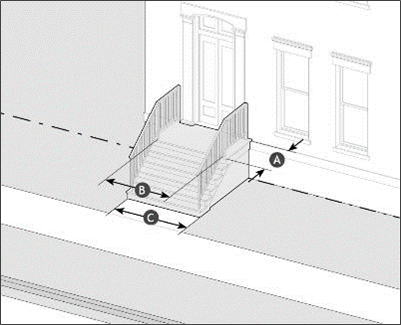 | a. Standards | |
| Dimensions | ||
|
Landing Depth
4' min., 6' max.
| ||
|
Landing Width
4' min., 8' max.
| ||
|
Path of Travel, Width
3' min.
| ||
| Additional | ||
| Unless entry doors are recessed more than 3', stoops should also include an overhead balcony or entry canopy for shade | ||
| Stairs may be perpendicular or parallel to the building façade, but shall not be placed more than 5' into the front setback. | ||
| Gates are not permitted | ||
(11)
Porch—Projecting. A projecting porch is a medium-sized structure attached to a building façade that features a set of stairs leading to a covered platform with a roof structure supported by columns, piers, or posts and enclosed by railings. It is appropriate for residential buildings with small to medium setbacks.
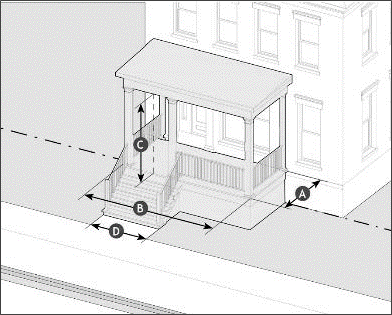 | a. Standards | |
| Dimensions | ||
|
Depth, Clear
6' min.
| ||
|
Width, Clear
8' min.
| ||
|
Clear Height
8' min.
| ||
|
Path of Travel, Width
3' min.
| ||
| Additional | ||
| Must be open on three sides and have a roof | ||
| Must have a minimum 4' x 6' clear floor area for furniture | ||
| Porch railings must allow pedestrians to see through the posts and rails | ||
| Porches may be screened but cannot be permanently enclosed. Porches shall not be placed more than 5' into the front setback. | ||
(12)
Porch—Engaged. An engaged porch is a medium-sized structure attached to a building on two (2) sides that features a set of stairs leading to a covered platform with a roof structure supported by columns, piers, or posts and enclosed by railings. It is appropriate for residential buildings with small to medium setbacks.
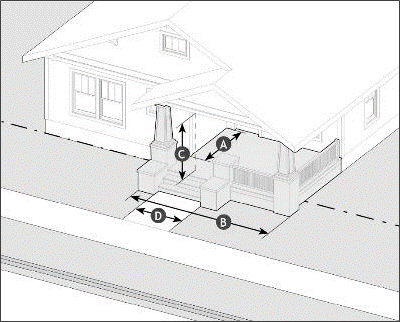 | a. Standards | |
| Dimensions | ||
|
Depth, Clear
6' min.
| ||
|
Width, Clear
8' min.
| ||
|
Clear Height
8' min.
| ||
|
Path of Travel, Width
3' min.
| ||
| Additional | ||
| Must be open on two sides | ||
| Must have a minimum 4' x 6' clear floor area for furniture | ||
| Porch railings must allow pedestrians to see through the posts and rails | ||
| Porches may be screened but cannot be permanently enclosed. Porches shall not be placed more than 5' into the front setback. | ||
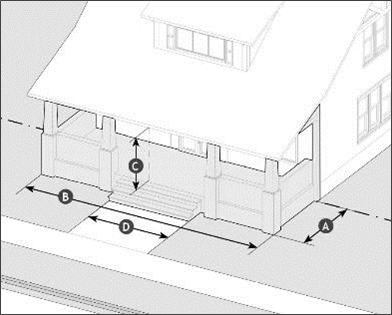
(13)
Porch—Integral. An integral porch is a medium-sized outdoor space that features a set of stairs leading to a covered platform enclosed by railings or a low wall. Unlike projecting porches, the floor and roof are set within the main structure instead of being attached to it. It is appropriate for buildings with small to medium setbacks.
 | a. Standards | |
| Dimensions | ||
|
Depth, Clear
6' min.
| ||
|
Width, Clear
Width of façade
| ||
|
Clear Height
8' min.
| ||
|
Path of Travel, Width
3' min.
| ||
| Additional | ||
| Must be open on three sides | ||
| Must have a minimum 4' x 6' clear floor area for furniture | ||
| Porch railings must allow pedestrians to see through the posts and rails, though a low wall up to 2.5' in height can be used | ||
| Porches may be screened but cannot be permanently enclosed. Porches shall not be placed more than 5' into the front setback. | ||
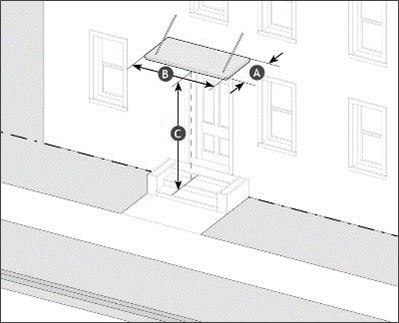
(14)
Entry canopy—Small. An entry canopy is a solid wall-mounted structure that provides shade and protection from the elements over a ground floor residential entryway. It is appropriate for residential buildings with small to medium setbacks.
 | a. Standards | |
| Dimensions | ||
|
Projection
2' min., 4' max.
| ||
|
Length
3' 6" min.
| ||
|
Vertical Clearance
8' min.
| ||
| Additional | ||
| Must be securely and visibly attached to the façade with brackets, cables, or rods | ||
| Length of canopy must be equal to or greater than the width of the doorway surround, trim, or exteror casing | ||
| Should be implemented in conjunction with the Stoop frontage type. Entry canopies shall not extend beyond 5' into the front setback. | ||
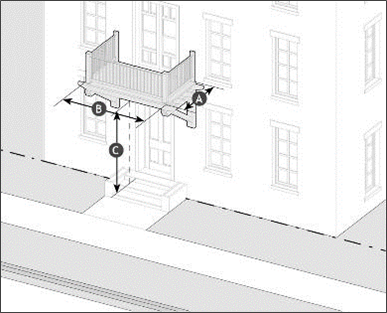
(15)
Overhead balcony—Small. A small overhead balcony frontage is an attached second story balcony centered over a front entry way that provides shade and protection from the elements. It is typically used for ground floor residential frontages on buildings with small front setbacks.
 | a. Standards | |
| Dimensions | ||
|
Depth
2' min., 4' max.
| ||
|
Width
3' 6" max.
| ||
|
Vertical Clearance
8' min.
| ||
| Additional | ||
| Width of balcony must be equal to or greater than the width of the doorway surround, trim, or exteror casing | ||
| Should be implemented in conjunction with the Stoop frontage type. Overhead balconies shall not extend more than 5' into the front setback. | ||
(Ord. No. 2022-03, § 1(Exh. A), 8-1-22)
Editor's note— Ord. No. 2022-03, § 1(Exh. A), adopted Aug. 1, 2022, amended § 27-236 in its entirety to read as herein set out. Former § 27-236 was entitled "Multiple use of required yards prohibited," and derived from Ord. No. 2004-10, § 1, adopted Oct. 4, 2004.
Sec. 27-237. - Building area requirements.
Principal buildings shall not exceed the maximum floor areas, exclusive of the required architectural elements, as provided for below:
(1)
R-1 district: Total floor area of all buildings are limited to a maximum floor area ratio (FAR) of seventy-five (75) percent of the total lot area. Balconies, porches, and other architectural features are excluded from the FAR requirement. Except, breezeways are limited to fifteen (15) feet in length from the vertical exterior wall of the principal structure to the vertical exterior wall of an accessory structure.
The FAR is calculated by dividing the gross floor area by the total lot area. The total lot area for this provision shall be the boundary of the parcel as indicated by the property lines unless the lot is non-conforming, in which case, one-half the width of the adjacent local right-of-way may be used.
(2)
R-2 district: Total floor area of all buildings are limited to a maximum floor area ratio (FAR) of seventy (70) percent of the total lot area. Balconies, porches, and other architectural features are excluded from the FAR requirement. Except, breezeways are limited to fifteen (15) feet in length from the vertical exterior wall of the principal structure to the vertical exterior wall of an accessory structure.
The FAR is calculated by dividing the gross floor area by the total lot area. The total lot area for this provision shall be the boundary of the parcel as indicated by the property lines unless the lot is non-conforming, in which case, one-half the width of the adjacent local right-of-way may be used.
(3)
R-3 district: Total floor area of all buildings are limited to a maximum floor area ratio (FAR) of sixty-five (65) percent of the total lot area. Balconies, porches, and other architectural features are excluded from the FAR requirement. Except, breezeways are limited to fifteen (15) feet in length from the vertical exterior wall of the principal structure to the vertical exterior wall of an accessory structure.
The FAR is calculated by dividing the gross floor area by the total lot area. The total lot area for this provision shall be the boundary of the parcel as indicated by the property lines unless the lot is non-conforming, in which case, one-half the width of the adjacent local right-of-way may be used.
(4)
R-4 district: Total floor area of all buildings are limited to a maximum floor area ratio (FAR) of sixty-five (65) percent of the total lot area. Balconies, porches, and other architectural features are excluded from the FAR requirement. Breezeways are limited to fifteen (15) feet in length from the vertical exterior wall of the principal structure to the vertical exterior wall of an accessory structure.
The FAR is calculated by dividing the gross floor area by the total lot area. The total lot area for this provision shall be the boundary of the parcel as indicated by the property lines unless the lot is non-conforming, in which case, one-half the width of the adjacent local right-of-way may be used.
(5)
R-5 district: Not applicable.
(6)
C-1 district: In order to promote a more human-scaled environment along the 3 rd Street Corridor, no freestanding building for any permitted use shall exceed thirty thousand (30,000) square feet in total gross floor area, as defined in section 27-15 of this Code. A structure may be constructed on a single parcel so long as the structure does not exceed one hundred (100) linear feet of frontage without a ten-foot separation between any additional structures constructed upon the same parcel of land. Furthermore, boutiques are limited to two (2) stories and no more than two thousand (2,000) square feet per floor. Wholesale warehouses, or other freestanding buildings for any permitted use located within one thousand (1,000) linear feet of each other that operate under common business ownership or management, share a warehouse or distribution facility, or otherwise operate as an associated, integrated, or cooperative business shall not exceed a combined thirty thousand (30,000) square feet of total gross floor area in aggregate.
(7)
C-2 district: No retail store, wholesale warehouse, nor any freestanding building for any permitted use shall exceed sixty thousand (60,000) square feet in total gross floor area, as defined in section 27-15 of this Code. Shopping centers may be constructed so long as no single unit within such center exceeds this sixty thousand (60,000) square foot limit. Furthermore, any retail stores, wholesale warehouses, or other freestanding buildings for any permitted use located within one thousand (1,000) linear feet of each other that operate under common business ownership or management, share a warehouse or distribution facility, or otherwise operate as an associated, integrated, or cooperative business shall not exceed a combined sixty thousand (60,000) square feet of total gross floor area in aggregate.
(8)
C-3 district: No retail store, wholesale warehouse, nor any freestanding building for any permitted use shall exceed sixty thousand (60,000) square feet in total gross floor area, as defined in section 27-15 of this Code. Shopping centers may be constructed so long as no single unit within such center exceeds these sixty thousand (60,000) square feet limit. Furthermore, any retail stores, wholesale warehouses, or other freestanding buildings for any permitted use located within one thousand (1,000) linear feet of each other that operate under common business ownership or management, share a warehouse or distribution facility, or otherwise operate as an associated, integrated, or cooperative business shall not exceed a combined sixty thousand (60,000) square feet of total gross floor area in aggregate.
(9)
CBD district: In order to preserve the small scale and quaint commercial character of the central business district, which also seeks to provide spaces for small local businesses, no freestanding building in the CBD shall exceed a gross floor area of twenty-five thousand (25,000) square feet.
(10)
NC overlay: In order to better match the surrounding residential character, no freestanding commercial building in the neighborhood commercial overlay shall exceed a gross floor area of twenty thousand (20,000) square feet.
(11)
RC overlay: Total floor area of all buildings are limited to a maximum floor area ratio (FAR) of sixty-five (65) percent of the total lot area. Balconies, porches, and other required architectural features are excluded from the FAR requirement.
The FAR is calculated by dividing the gross floor area by the total lot area. The total lot area for this provision shall be the boundary of the parcel as indicated by the property lines.
(Ord. No. 2004-10, § 1, 10-4-04; Ord. No. 2013-03, § 1, 4-2-12; Ord. No. 2015-14, § 2, 10-5-15; Ord. No. 2022-03, § 1(Exh. A), 8-1-22; Ord. No. 2023-01, § 1(Exh. A), 4-3-23)
Sec. 27-238. - Maximum lot coverage.
(a)
The impervious surface on any lot, or parcel of land, shall not exceed the maximum area as provided for below, and for purposes of calculation, shall include all impervious areas, such as pool areas, hot tubs, and driveways; "gross site area" is defined in article I.
(1)
R-1 district: Fifty (50) percent of gross site area.
(2)
R-2 district: Fifty (50) percent of gross site area.
(3)
R-3 district: Fifty (50) percent of gross site area.
(4)
R-4 district: Fifty (50) percent of gross site area.
(5)
R-5 district: For apartment complexes, thirty-five (35) percent of gross site area. For single-family dwellings, fifty (50) percent of gross site area. For multifamily residences on lots less than one-half acre, seventy (70) percent of gross site area.
(6)
C-1 district: Seventy (70) percent of gross site area unless otherwise specified in the Table 27-239.
(7)
C-2 district: Seventy (70) percent of gross site area unless otherwise specified in the Table 27-239.
(8)
C-3 district: Seventy-five (75) percent of gross site area unless otherwise specified in the Table 27-239.
(9)
CBD district: Eighty-five (85) percent of gross site area.
(10)
Conservation district: Twenty-five (25) percent of gross site area.
(12)
NC overlay: Seventy (70) percent of gross site area.
(13)
RC overlay: Fifty (50) percent of gross site area.
(b)
Pervious pavements, as defined in section 27-516, shall not count towards impervious surface areas. Semi-pervious pavers and surfaces that do not meet the standards defined in section 27-516 for pervious pavement, engineered water detention systems, and other low-impact design strategies are encouraged in all zoning districts and shall be credited with a percentage of the covered area, as determined by the building official or licensed professional engineer, using area and volume calculations. The techniques or systems used for a credited area must be installed for long-term effect.
If the applicant desires to increase the impervious area beyond the percent coverage prescribed in this section, drainage runoff calculations shall be provided that indicate no increase in runoff between the pre-construction and post-construction condition. This calculation shall be prepared, signed, and sealed by a licensed professional engineer, registered in the State of Florida.
(c)
Additionally, all stormwater management requirements of the St. Johns River Water Management District shall be met.
(Ord. No. 2004-10, § 1, 10-4-04; Ord. No. 2006-13, § 3, 7-10-06; Ord. No. 2022-03, § 1(Exh. A), 8-1-22)
Sec. 27-239. - Building height limitations.
(a)
Height limitations. The height of buildings and structures shall not exceed the building height limitations as provided for in Table 27-239.
(b)
Exceptions. The following exceptions apply to these height limitations:
(1)
Church steeples, chimneys, and similar structures not intended as places of occupancy or storage may exceed the height limits;
(2)
Flag poles, water towers and similar devices not intended for human occupancy may exceed the height limits;
(3)
Heating and air conditioning equipment, solar collectors, satellite dishes or antenna, elevator shafts, parking and similar equipment, fixtures, and devices that are not intended for human occupancy may exceed the height limits, provided that:
a.
They are set back from the edge of the roof a minimum distance of one (1) foot for every foot by which such features extend above the roof surface of the principal building at the place where they are attached, and they extend less than five (5) additional feet in height; and
b.
No more than one-third of the total roof area may be occupied by such features.
(4)
Parapet walls may be constructed on all sides of buildings with low-slope roofs up to five (5) feet above the adjoining roof surface.
(5)
Damaged buildings over thirty-five (35) feet may be rebuilt to their original height.
(c)
Points of reference for measurement.
(1)
The upper point of reference for determining the height of a building or structure shall be the top of the parapet for flat roofs, and for pitched roofs the highest ridgeline of the roofed structure.
(2)
The lower point of reference for determining the height of a building or structure shall be the greater of eighteen (18) inches above the crown of the road in front of the building or proposed building or the average of the existing grade of the lot (prior to addition of fill material).
(3)
However, the lower point of reference for determining the height of a commercial or residential building or structure in a flood zone will be the base flood elevation required for habitable space as set by FEMA's Flood Insurance Rate Maps (FIRMs) and required by the State of Florida.
(d)
Charter provisions on building height. These building height limitations are consistent with the building height limitations set by referendum, which can be found in section 4.07 of the Charter of the City of Neptune Beach.
Table 27-239
(Ord. No. 2004-10, § 1, 10-4-04; Ord. No. 2022-03, § 1(Exh. A), 8-1-22; Ord. No. 2023-09, § 1(Exh. A), 9-18-23)
Sec. 27-240. - Building elevation.
(a)
The building elevation (the height of the slab (first floor) of a building above the crown of the road in front of the building) shall not be less than:
(1)
Eighteen (18) inches in residential districts; and
(2)
Eighteen (18) inches in the commercial districts.
(b)
However, the minimum building elevation may be higher in flood zones and on land affected by the coastal construction control line; see section 27-519 and chapter 30.
(Ord. No. 2004-10, § 1, 10-4-04; Ord. No. 2022-03, § 1(Exh. A), 8-1-22)
Sec. 27-241. - Buffer areas adjacent to residential districts.
When a R-5, C-1, C-2, C-3 or CBD district abuts a R-1, R-2, R-3 or R-4 district without an intervening street or alley, a landscape buffer constructed in accordance with section 27-456, Landscaping buffers of this Code, shall be provided on the R-5, C-1, C-2, C-3 or CBD parcel.
(Ord. No. 2004-10, § 1, 10-4-04; Ord. No. 2023-09, § 1(Exh. A), 9-18-23)
Sec. 27-242. - Density calculations.
(a)
Residential uses must comply with density restrictions imposed by the adopted future land use map.
(b)
In certain cases, these density restrictions have effects on residential uses beyond the minimum lot areas in Table 27-239. In these cases, density will be calculated as follows:
(1)
Density means the ratio of the number of dwelling units to the gross site area of the lands on which such dwelling units are located.
a.
For new development and significant redevelopment (fifty (50) percent or more of any structure on the property), gross site area means the entire site area, including land that will become streets and open spaces, but excluding any existing public right-of-way and excluding any wetlands.
b.
For buildings on lots that have already been subdivided and streets have already been created, gross area means the entire lot area without inclusion of the adjoining local public right-of-way. Notwithstanding the preceding sentence, one-half the width of the adjoining local public right-of-way shall be included in the calculation of gross area for any lot on which a residential building existed at the time of this ordinance if:
1.
Calculation of the gross area of the lot without inclusion of one-half the width of the adjoining local public right-of-way would result in such lot not meeting the minimum calculation required to permit a single residential unit on the lot; and
2.
Calculation of the gross area of the lot with inclusion of one-half the width of the adjoining local public right-of-way would result in such lot meeting the minimum calculation required to permit a single residential unit on the lot.
(2)
Density is computed by whole number only. If a density computation results in fractional units, the computation will be rounded down to the next whole number.
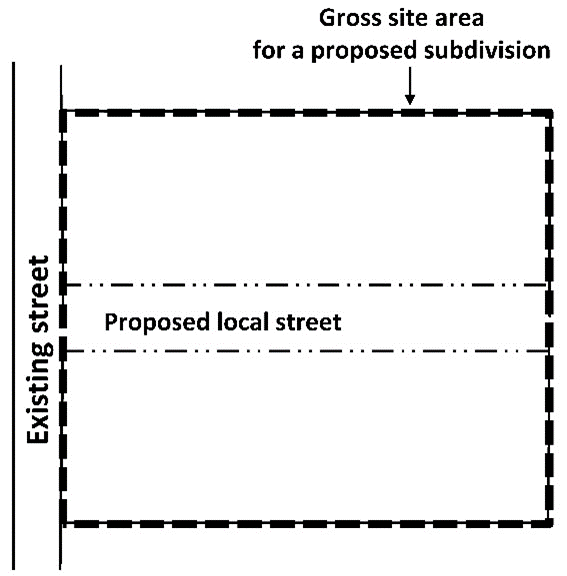 | 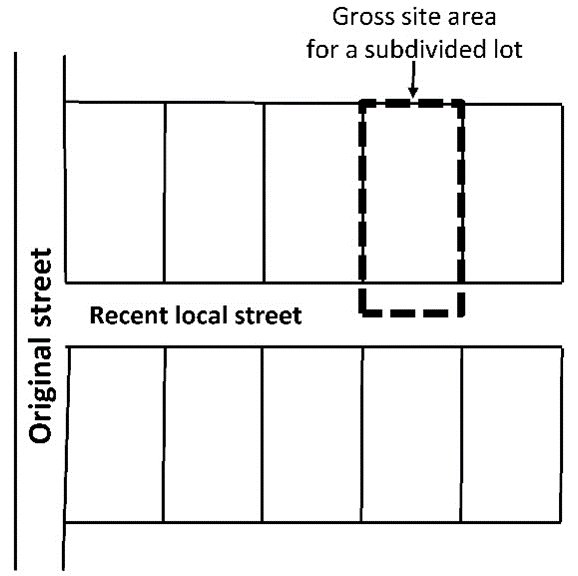 Figure 27-242-1 Figure 27-242-1 |
(c)
R-3 zoning district. These density calculations apply to new development on R-3 lots that have been consolidated from the original plats. An owner of a lot whose size is consistent with the original plats may construct, reconstruct, or replace one (1) single-family residence on that lot; lots averaged fifty (50) feet wide and one hundred ten (110) feet deep in the original plats for Merimar (1923) and Jacksonville Beach Park (1925).
(d)
R-4 zoning district. These density calculations do not apply to individual lots in R-4 that were lawfully platted and recorded prior to January 1, 1991, in the Office of the Clerk of the Circuit Court of Duval County, Florida. New developments and redevelopments will need to meet density requirements regardless of the platted date of the land.
(e)
R-5 zoning district. These density calculations apply when multi-family residences are constructed on parcels that are not subdivided into one (1) lot for each residence.
(f)
RC overlay. These density calculations apply to new development on R-4 lots in the RC overlay that have been consolidated from the original plats.
(1)
Existing two-family (duplex) residences on lots five thousand (5,000) square feet or greater shall be deemed conforming as to density provided, they comply with impervious surface reductions and other retrofit requirements set forth in section 27-243 or they are reconstructed or replaced with a new duplex that meets all requirement in this Code other than minimum lot size and density.
(2)
Existing two-family (duplex) residences on lots less than five thousand (5,000) square feet may not be physically expanded in any manner that would increase the nonconformity or violate any additional physical standards in this Code. Physical expansion includes the creation of off-street parking areas.
(Ord. No. 2022-03, § 1(Exh. A), 8-1-22)
Sec. 27-243. - Special requirements in the RC overlay.
The standards in this section apply to land in the residential conservation (RC) overlay to acknowledge its historic development pattern and to ensure that renovated and new residential buildings in this overlay will support safe pedestrian, transit, bicycle, and vehicular circulation and allow for infill development that is sensitive to the character and history of the surrounding neighborhood.
(1)
Residential frontage standards. New single-family and duplex homes shall comply with the required frontage types and associated standards detailed in section 27-236.
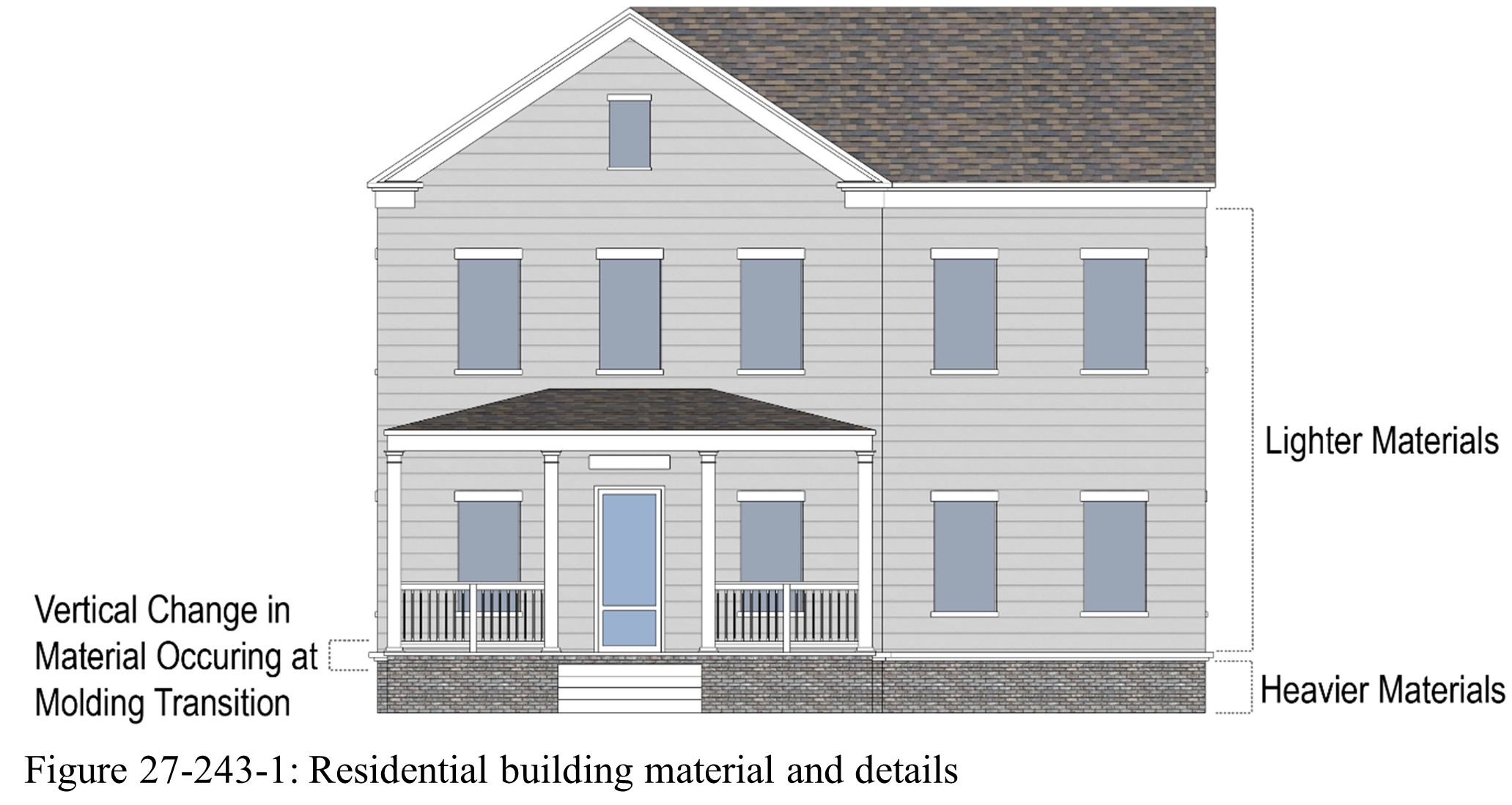
(2)
Residential building design standards.
a.
Building materials and details. Building wall materials shall be combined on each facade only horizontally, unless the building is broken vertically by a change of plane, or a vertical architectural element. Heavier materials, such as masonry and stucco, shall be located below lighter materials, such as cement fiber or wood siding (Figure 27-243-1).
1.
Changes in material or color along the vertical direction should occur at hard-edge "bump-out" transitions, which gives materials a surface to terminate into (Figure 27-243-1).
2.
Façades with an overabundance of different materials or colors are discouraged.
b.
Architectural elements.
1.
Front porches and entry areas.
i.
New front porches added to an existing structure should be appropriate for the architectural style or neighborhood context.
ii.
Porches may be screened but cannot be permanently enclosed if they are to benefit from any permitted yard encroachments per section 27-235 (Figure 27-243-2). If a porch is to be permanently enclosed it will be considered a part of the building façade and will be subject to all front, side, and rear yard setback requirements.
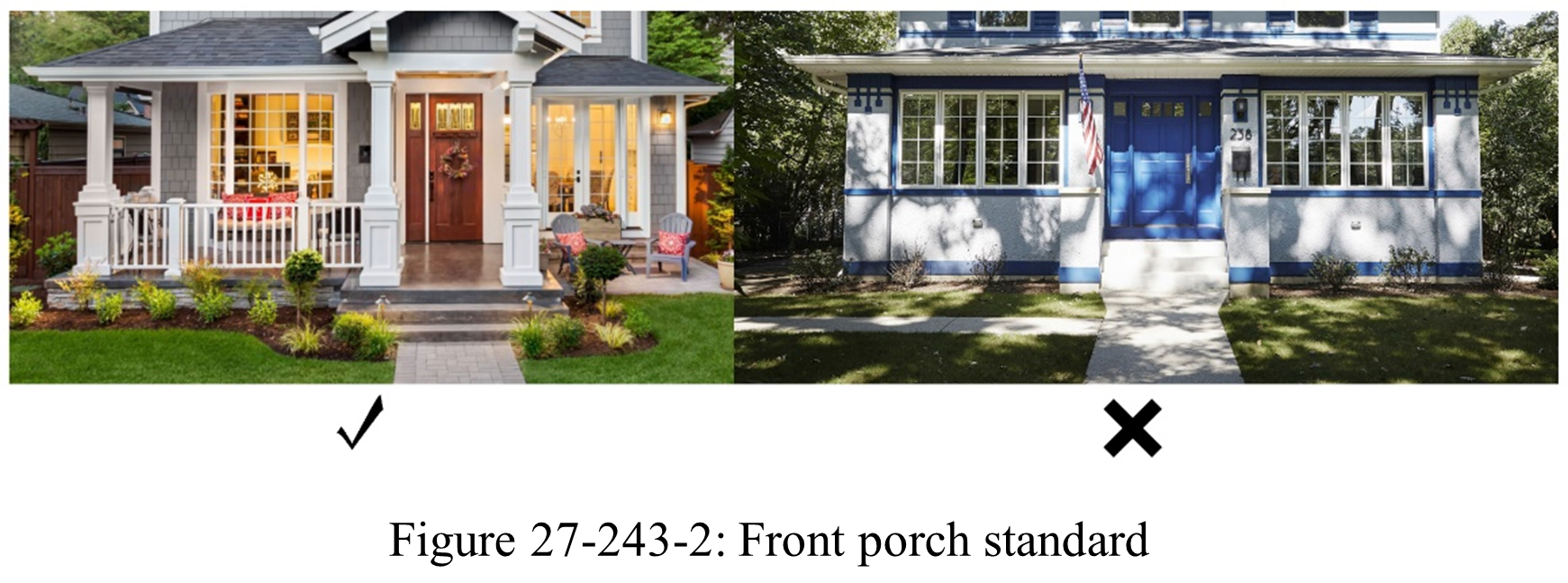
2.
Balconies and railings.
i.
Brackets typically extend the full depth of the balcony. The thickness and number of brackets should reflect the scale and design of the balcony being supported.
ii.
Balconies shall project at least two (2) feet to create a standing or "Juliet" balcony, and no more than four (4) feet from the building wall.
iii.
Balconies shall be deeper than six (6) feet only if it is partially or wholly inset within the main body of the building.
iv.
Balconies shall be visually supported from below, if projecting more than two (2) feet, by brackets or another structurally implicit mechanism, which must extend a minimum of eighty-five (85) percent of the depth of the balcony, or else be supported by adjacent side walls (Figure 27-243-3). Exceptions may apply for the mid-century modern and masonry modern architectural styles.
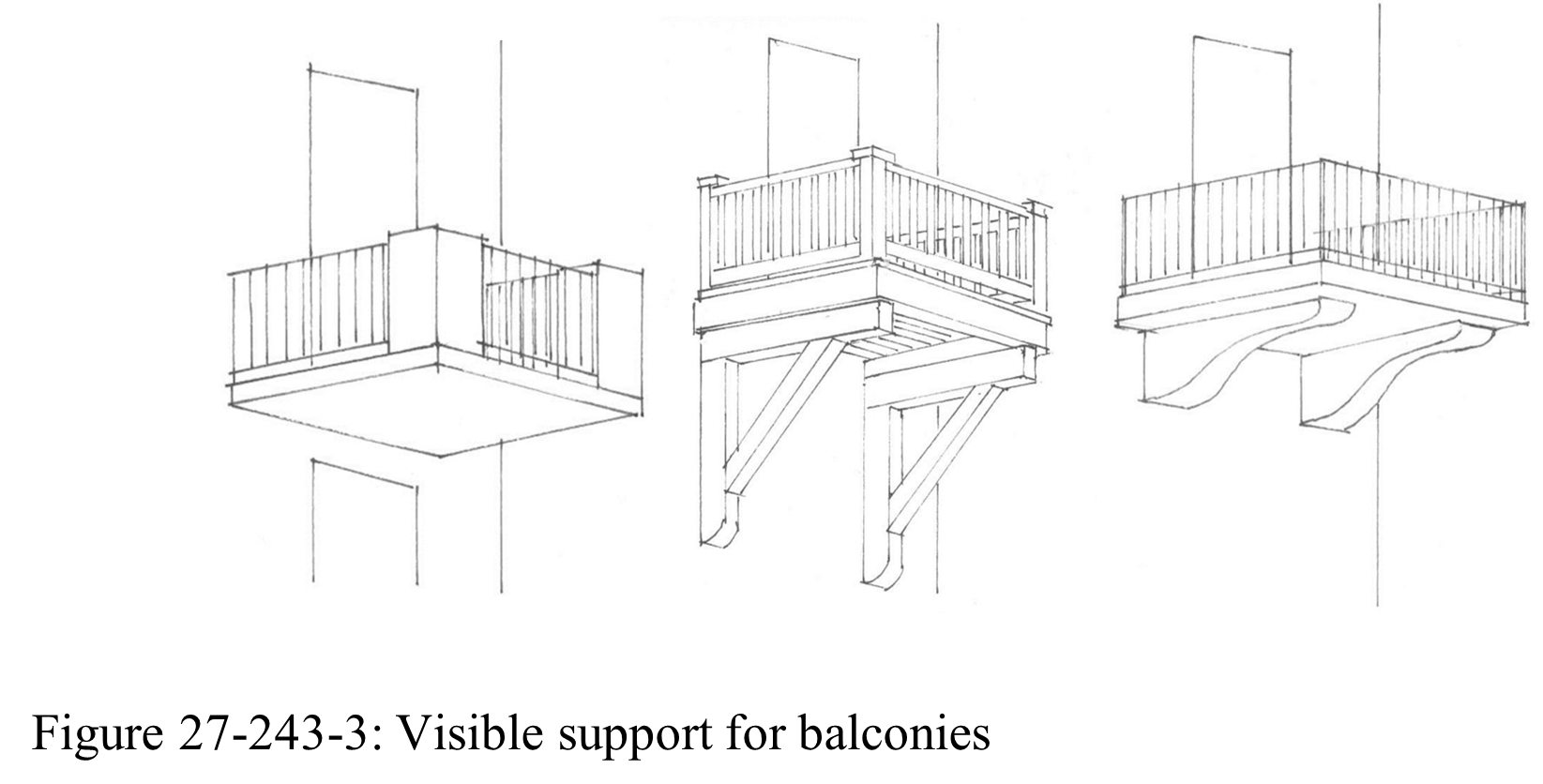
v.
Balconies shall have a minimum underside clearance of eight (8) feet.
vi.
Decorative railings should be used on building facades when they serve a function such as on an occupiable balcony, enclosing planting areas, or as a safety measure for large windows in upper stories. Like typical balcony railings, they must be designed to support ladders for emergency egress. Grills should be applied to facades without serving a true function (left) (Figure 27-243-4).
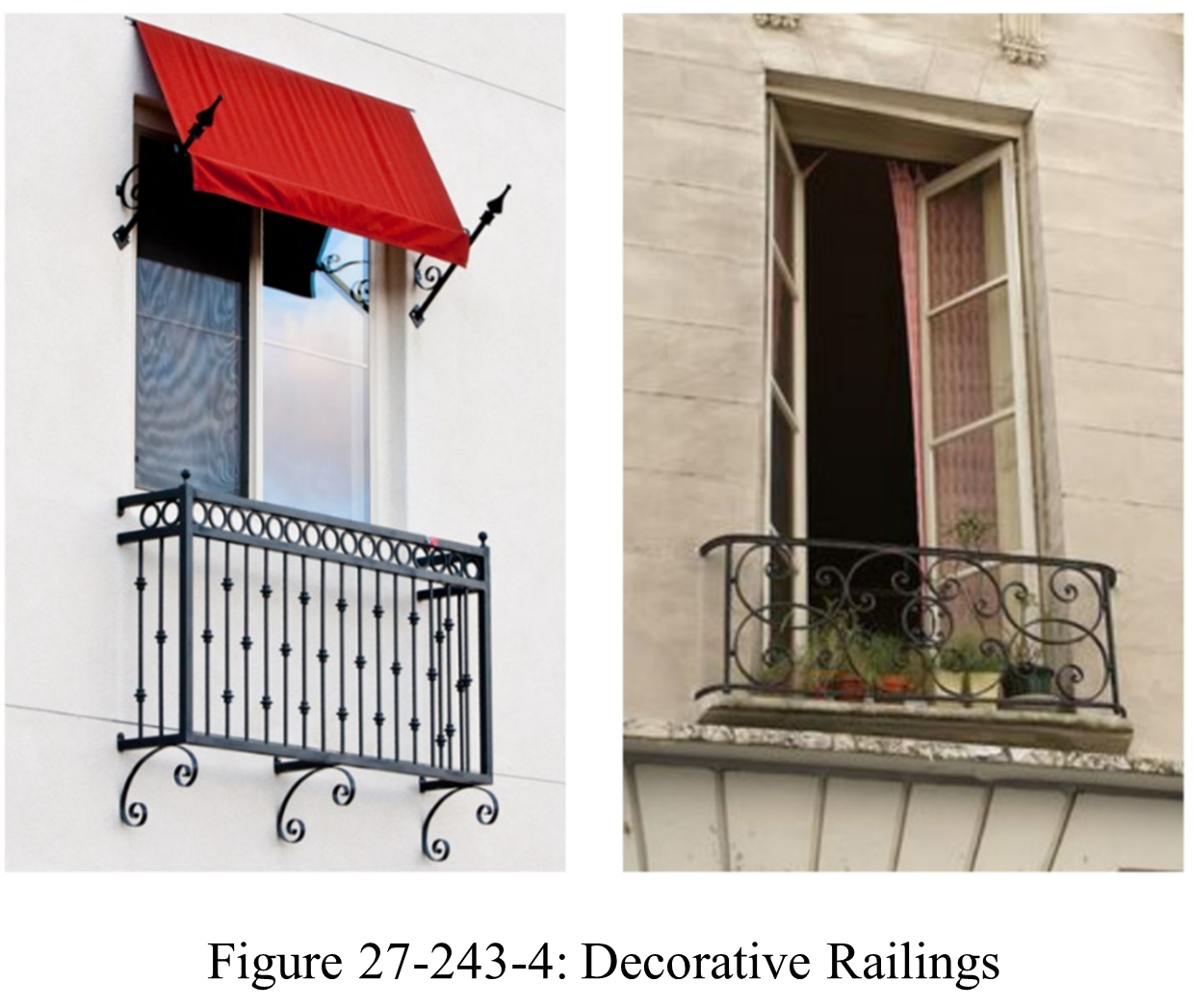
3.
Columns, pillars, and posts.
i.
Shall be spaced at regular intervals not exceeding twenty-four (24) feet from centerline to centerline, creating openings with a height to width or width to height ratio of 1:1, 2:1, or 2:3.
ii.
Always support a structural spanning element, such as a beam, arch, or entablature and shall always be positioned so that the outside edge of the beam, arch, or entablature spanning element above aligns with the neck of the column.
4.
Bay windows.
i.
Shall provide habitable interior space and include at least three (3) windows.
ii.
Shall not project more than three (3) feet from the building façade, nor exceed ten (10) feet in width.
iii.
Shall fit in with the overall character and architectural style of the building.
iv.
Are limited to front and rear yards, side yards are excluded
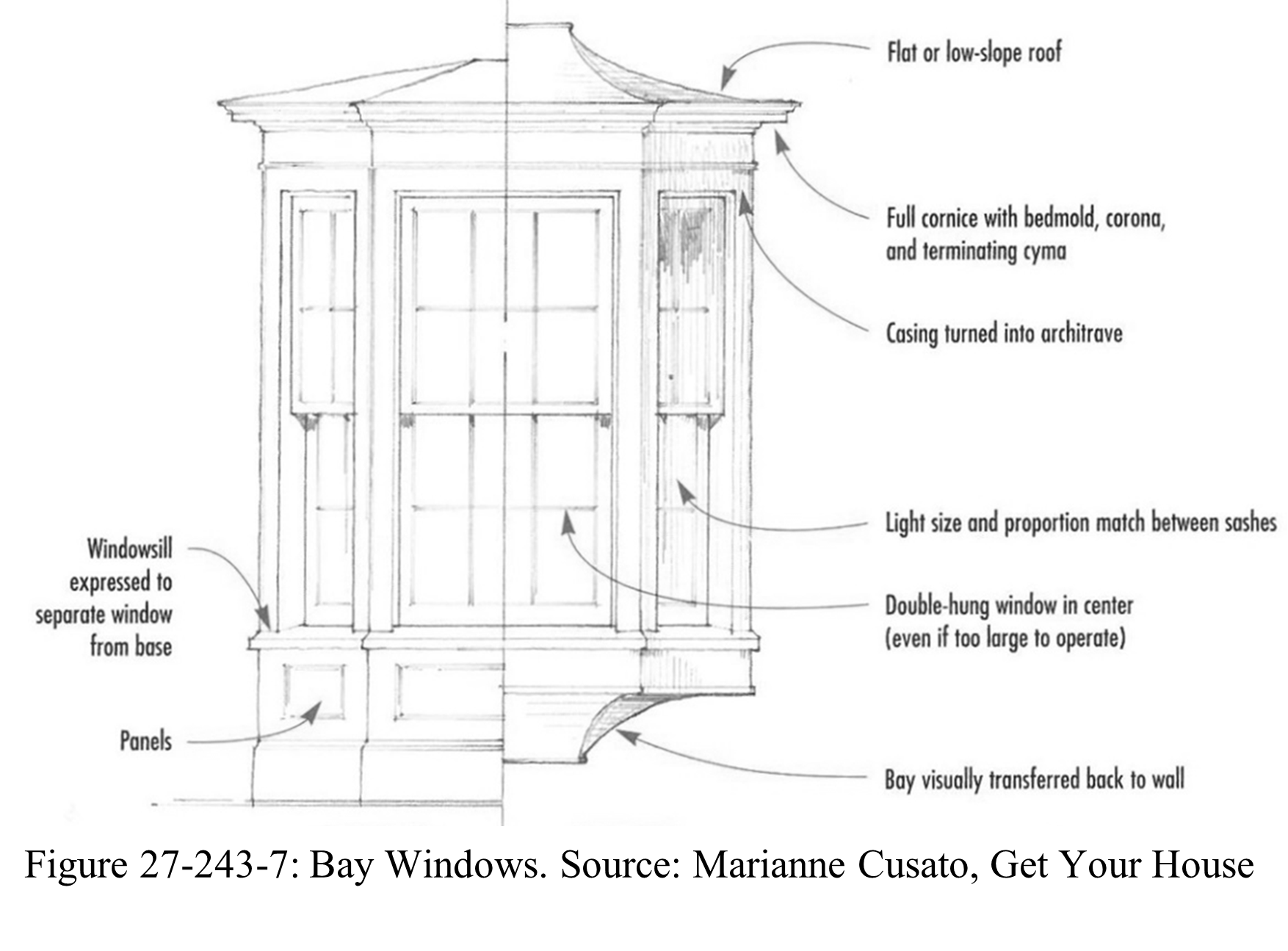
5.
Garages and parking.
i.
To ensure that they do not dominate the street-facing building façades or overshadow pedestrian entryways, attached and detached garages shall be subordinate in height, footprint, and proportion to the primary structure on the site, and shall be compatible with the principal structure in terms of roof form, materials, and color (Figure 27-243-8).
ii.
Detached garages should be located behind the primary building in the rear yard (Figure 27-243-8, label G).
iii.
Garages shall be architecturally like the residence (Figure 27-243-8). The openings of the garage shall be designed in a manner that obscures parked vehicles.
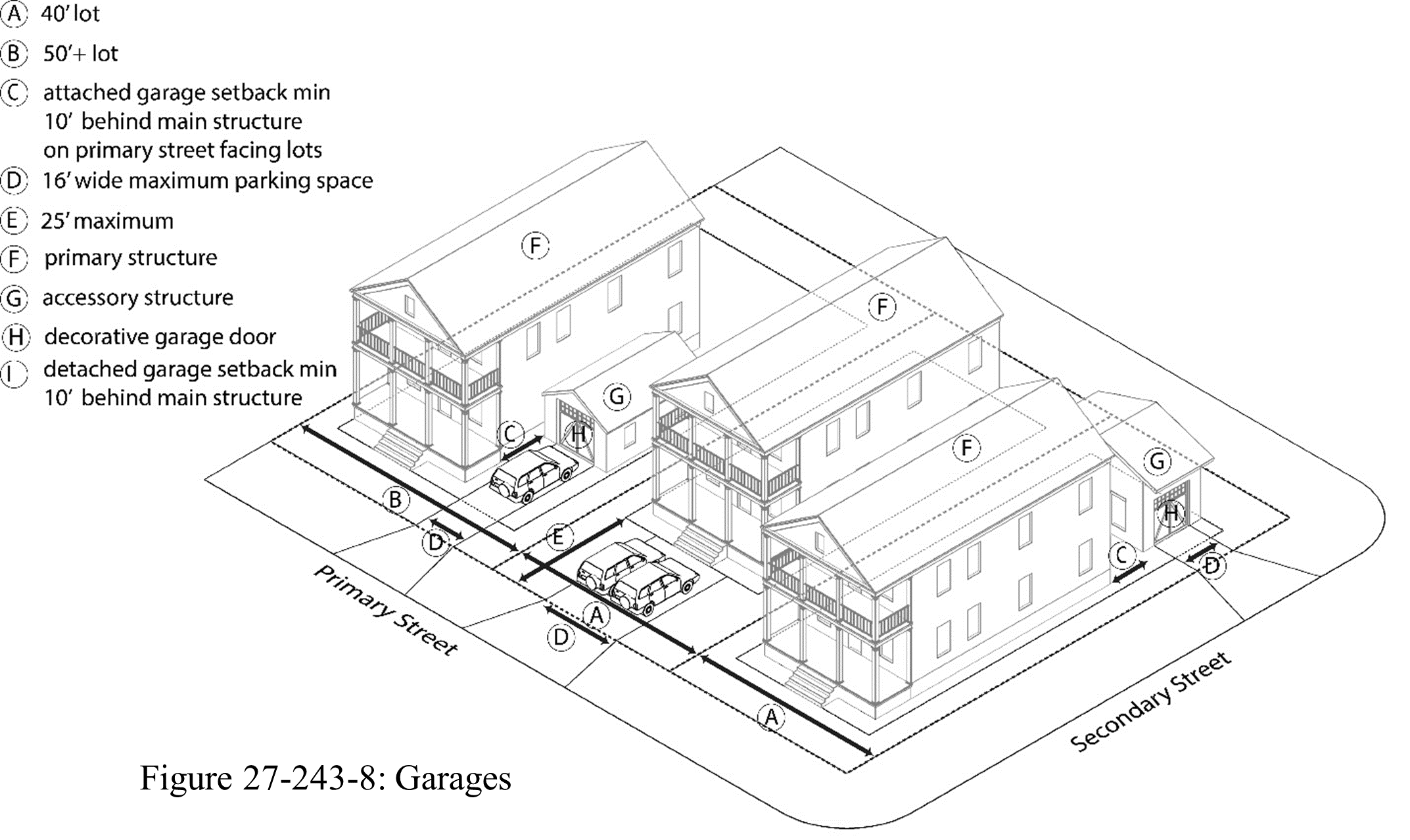
iv.
The combined width of all driveways in the front yard setback may not exceed thirty (30) percent of the width of the lot or eighteen (18) feet, whichever is larger. For corner lots, the combined width of all driveways in the street-facing side yard setback may not exceed twenty-five (25) percent of the depth of the lot or twenty (20) feet, whichever is greater.
6.
Roof type and pitch.
i.
Permitted roof forms for primary and accessory structures include gabled, hipped, shed, flat, and mono pitch, though the selected roof form must be consistent with the architectural style of the building. Applied and partial (less than three (3) sides) (Figure 27-243-9).
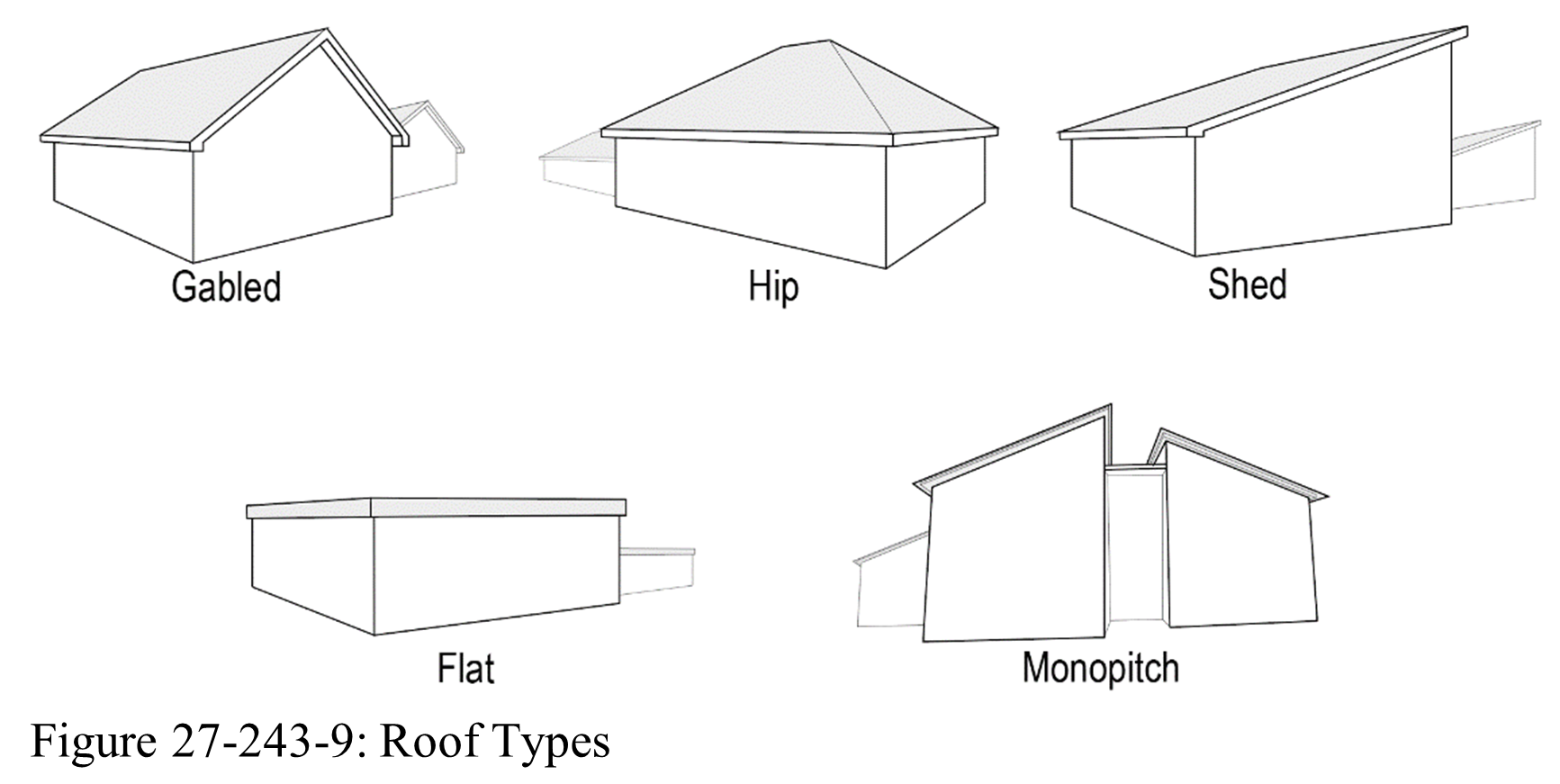
(Ord. No. Ord. No. 2022-03, § 1(Exh. A), 8-1-22)
Sec. 27-244. - Open space requirements in the R-5 zoning district.
(a)
All developments larger than two (2) acres in the R-5 residential district shall provide for the following:
(1)
Minimum open space: Seventy-five (75) percent of gross site area;
(2)
Minimum outdoor living space: Fifty (50) percent of gross site area; and
(3)
Minimum outdoor recreation space: Five (5) percent of gross site area.
(b)
Terms used in subsection (a) have the following meanings:
(1)
Open space means the total amount of open space between and around structures including necessary outdoor living space, outdoor recreation space, outdoor parking space, and streets in the project other than existing arterial streets.
(2)
Outdoor living space means the total outdoor area including required outdoor recreation space, but excluding buildings, garages, carports, driveways, roadways, or parking areas. The outdoor living space is part of the required open space.
(3)
Outdoor recreation space means the total amount of usable area permanently set aside of designed specifically for recreation space for the development.
(4)
Gross site area means:
a.
For new development and significant redevelopment (fifty (50) percent or more of any structure on the property), gross site area means the entire site area, including land that will become streets and open spaces, but excluding any existing public right-of-way.
b.
For buildings on lots that have already been subdivided and streets have already been created, gross area means the entire lot area without inclusion of the adjoining local public right-of-way. Notwithstanding the preceding sentence, one-half the width of the adjoining local public right-of-way shall be included in the calculation of gross area for any lot on which a residential building existed at the time of this ordinance if:
1.
Calculation of the gross area of the lot without inclusion of one-half the width of the adjoining local public right-of-way would result in such lot not meeting the minimum calculation required to permit a single residential unit on the lot; and
2.
Calculation of the gross area of the lot with inclusion of one-half the width of the adjoining local public right-of-way would result in such lot meeting the minimum calculation required to permit a single residential unit on the lot.
(Ord. No. 2004-10, § 1, 10-4-04; Ord. No. 2022-03, § 1(Exh. A), 8-1-22)
Editor's note— Formerly codified as § 27-242 which was renumbered with the inclusion of Ord. No. 2022-03.
Sec. 27-244.1. - Reserved.
Editor's note— Ord. No. 2022-03, § 1(Exh. A), adopted Aug. 1, 2022, deleted § 27-244.1 entitled "Temporary moratorium on permitting planned unit developments (PUD)," which derived from: Ord. No. 2019-03, adopted Mar. 4, 2019; Ord. No. 2020-01, adopted Apr. 20, 2020; Ord. No. 2020-13, adopted Nov. 2, 2020; and Ord. No. 2021-10, adopted Nov. 1, 2021.
Sec. 27-245. - Planned unit development (PUD)—Special regulations.
(a)
Intent. The intent of a planned unit developments (PUD) is to provide for more flexible land use controls than provided by the remainder of chapter 27, while maintaining general safety and welfare for the public. as determined by the city council. The development must provide a public benefit as determined by the city council and must be in harmony with the general purpose and intent of chapter 27 and with the city's general planning program and such comprehensive plans as may from time to time be adopted by the city council; but the development may differ in one (1) or more respects from the usual application of provisions of this chapter.
(b)
Definition. For the purpose of this chapter, a planned unit development (PUD) shall mean the development of land under unified control which is planned and developed as a whole in a single or programmed series of operations with uses and structures substantially related to the character of the entire development.
(c)
The planned unit development will be encouraged to thoughtfully integrate multiple business uses and/or community facilities that are determined to be acceptable by the community development board and city council. A planned unit development in Neptune Beach shall not include residential uses including, but not limited to, non-transient lodging facilities.
(d)
Only uses or combination of uses, which are permitted by right or by special exception in the zoning district in which the PUD is to be located shall be included in the application for a PUD; For clarification, no PUD within a zoning district may include uses not permitted by right or special exception within that zoning district, even if such uses are permissible in other zoning districts. If a PUD is proposed for multiple parcels spanning more than one (1) zoning district, then such PUD may only include uses or combinations of uses permitted by right or special exception in all such districts unless approved by a supermajority of eighty (80) percent of the city council. In all such circumstances, in addition to including only such permissible uses, the development plan must also be consistent with the applicable adopted future land use map designation and other provisions of the comprehensive plan and other provisions of this Code, as determined in the opinion of the city council.
(e)
Applications will only be reviewed for PUD's proposed in the C-1, C-2, and C-3 zoning districts. A PUD will be provided with its own zoning overlay regulations as part of the development process provided it does not increase the intensity of commercial uses when in proximity to residential uses. An increase in intensity in this context means any of the following being placed within one hundred (100) feet of the perimeter of any land zoned for residential uses:
(1)
Any portion of a building that is more than ten (10) feet taller than would be allowed on the abutting residential land.
(2)
Site design that would provide drive-thru facilities or loading facilities abutting residential land.
(f)
Application for a PUD. The application for a PUD shall include a development order application and subdivision application as outlined in article II; and, in addition to the information required for such development application the PUD shall be required to submit the following:
(1)
Plat with a legal description of the area within the PUD.
(2)
The name and address of the owner(s) and, if applicable, evidence of the assignment of an agent who represents the owner(s).
(3)
Evidence of unified control of the entire area within the PUD with all owner(s) within the area of same identified.
(4)
An agreement by all owners within the PUD which includes their commitment to:
a.
Proceed with the proposed development in accordance with a newly recreated PUD ordinance for each development and such safeguards as may be set by the city council; and
b.
Provide a written statement of a proposal for completion of such development according to approved plans and for continuation of operating and maintenance to such areas, functions, and facilities as are not to be provided, operated, or maintained by the city pursuant to written agreement; and
c.
To bind their successors in title to any commitments made in their application.
(5)
A PUD site plan that identifies where on the site any requested code modifications would apply, including a detailed and complete listing of each proposed modification of standards in chapter 27.
(6)
The PUD site plan must also identify any additional requested uses, and where on the site those uses would take place (see subsection (e) above).
(7)
Any proposed public benefits.
(8)
The city council may decide to approve, deny, or partially approve the requested PUD and/or any specific request for code modifications or additional uses on the site. The city council may impose special conditions on the approval of the PUD to mitigate potential effects of the proposed PUD. Approval or partial approval of any PUD requires a supermajority vote of eighty (80) percent of the city council.
(g)
Expiration of time limits provided for creating PUD. If the PUD, has not started construction within twelve (12) months from the date of approval by the city council, the approval shall expire. An extension up to an additional twelve (12) months may be granted by the city manager, or designee, after review of a formal request in writing with supporting documentation and receipt of any applicable fees.
(h)
Deviation from approved PUD. In order to facilitate minor adjustments to the plans approved, the city manager or designee may approve minor deviations to the approved plans provided the buildings have the same or less number of stories, and/or floors; there are the same or fewer square feet of floor area; the open space is in the same general amount, or greater amount; or, the roads and drives follow approximately the same course and have the same public or private rights therein.
(Ord. No. 2011-12, § 1, 7-11-11; Ord. No. 2022-03, § 1(Exh. A), 8-1-22)
Editor's note— Formerly codified as § 27-244, which was renumbered with the inclusion of Ord. No. 2022-03.
Sec. 27-246. - Central business district (CBD) zoning district—Special regulations.
The standards in this chapter are intended to promote orderly community growth which will both protect and enhance property values for the community. These standards will ensure that new commercial buildings will support and define safe pedestrian, transit, bicycle, and vehicular circulation and allow for infill development that is sensitive to the character and history of the surrounding neighborhood. Existing structures that do not meet these regulations are considered legal non-conforming structures.
(1)
Residential building design standards. Residential development within the central business district, which is permitted by special exception, shall comply with the design standards outlined in section 27-243.
(2)
Commercial building frontage standards. New commercial development shall comply with the required frontage types and associated standards detailed in section 27-236.
(3)
Commercial building design standards.
a.
Storefront design. The storefront is a frontage type along sidewalk level of the ground story, typically associated with commercial uses. Storefronts are required for the ground floor of all buildings located on streets designated with required retail frontage and may be incorporated on any building in the central business district (CBD), neighborhood center overlay (NC), and C-1 districts. Storefronts are frequently shaded by awnings. Storefronts shall be directly accessible from sidewalks; storefront doors may be recessed up to ten (10) feet (Figure 27-246-1).
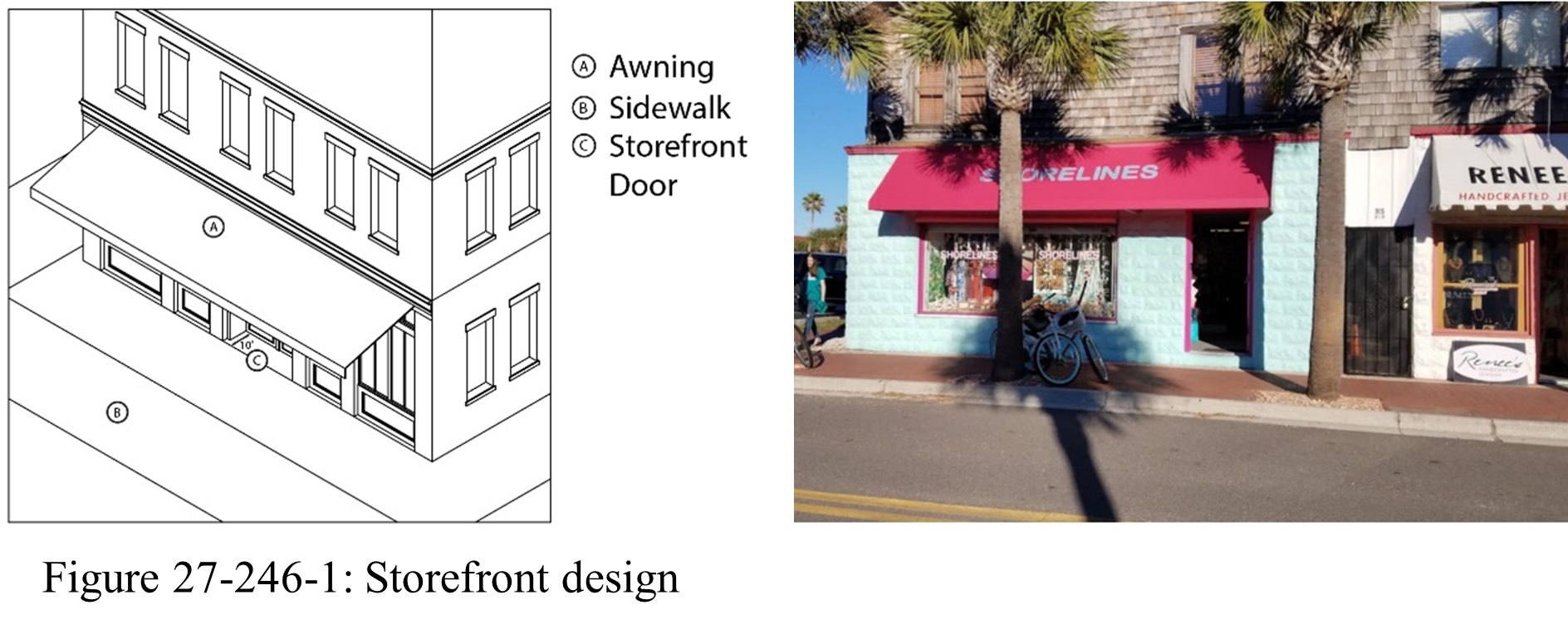
b.
Entrances and access. All new buildings should have the main entrance oriented to and in full view from a street or public open space. Main entrances shall have design details that enhance the appearance and prominence of the entrance so that it is recognizable from the street and parking areas. Building on corner lots shall use design elements that emphasize the importance of both streets (Figure 27-246-2).
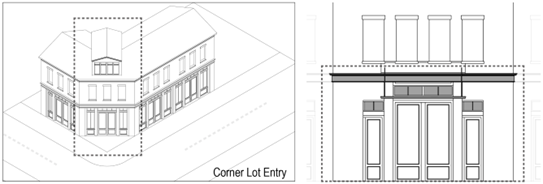
Figure 27-246-2: Primary Entry Examples
c.
Transparency. All building façades which face onto a street or public open space, shall meet the following minimum transparency requirements:
1.
Buildings with shopfronts (Figure 27-246-3):
i.
Minimum building façade transparency for ground story: Seventy (70) percent and should allow a view of at least five (5) feet of interior space.
ii.
Minimum building façade transparency for upper stories: Forty (40) percent.
2.
Building without shopfronts (Figure 27-246-4):
i.
Minimum building façade transparency for ground story: Thirty (30) percent.
ii.
Minimum building façade transparency for upper stories: Twenty-five (25) percent.
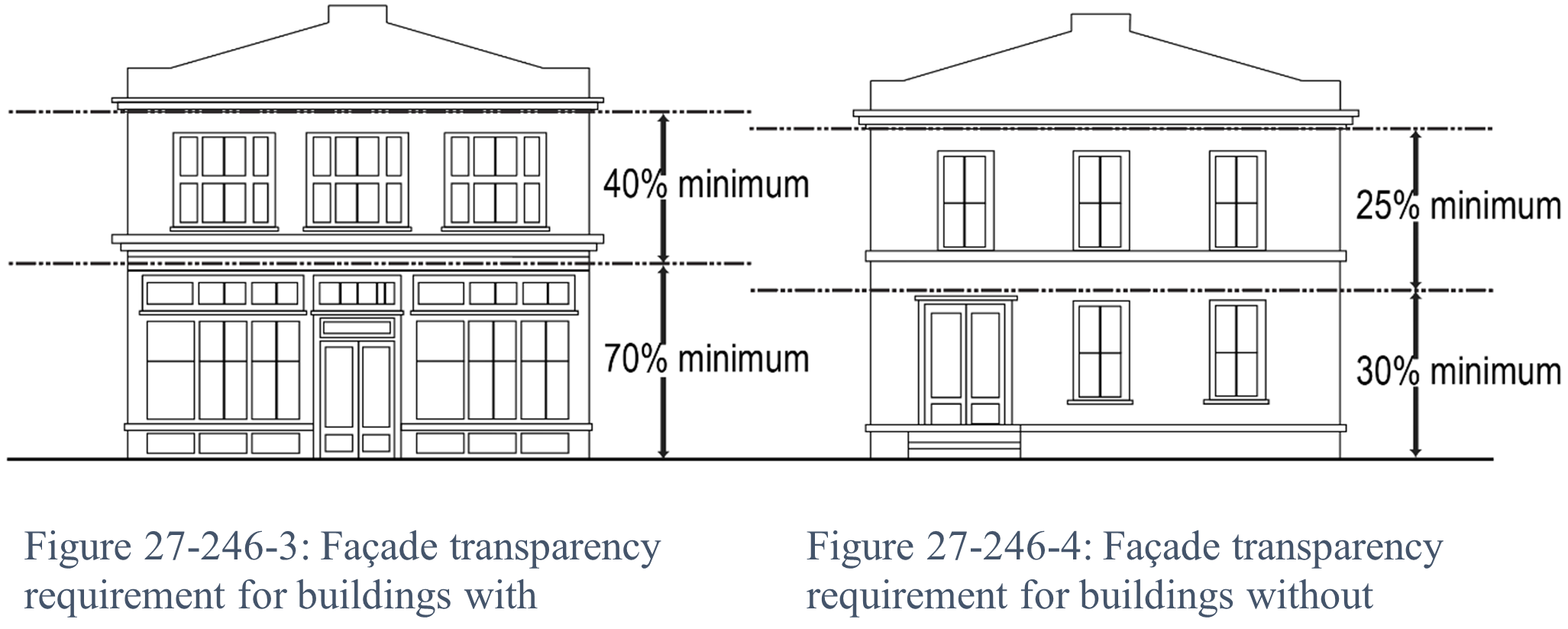
d.
Door and window placements. Door and window openings shall extend along at least eighty (80) percent of the width of the facade of the commercial space, measured by the sum of the widths of the rough openings. Storefront windows shall have a base nine (9) inches to three (3) feet high. Transparent glazed windows shall extend from the base to at least eight (8) feet in height as measured from sidewalk grade. Transparent means non-solar, non-mirrored, glass with a light transmission reduction of no more than twenty (20) percent.
1.
All windows shall be vertically proportioned. Window openings may be horizontally proportioned, but only if composed of vertically proportioned windows.
2.
Windows shall be located no closer to the corner of a building than a dimension equal to the width of the window.
e.
Roof types and pitch. Permitted roof forms include gabled, hipped, shed, barrel vaulted, flat, mono-pitch, and domes, though the selected. Roof form must be consistent with the architectural style of the building. Applied and partial (less than three (3) sides) gambrel roofs are not typically permitted but may be allowed at the discretion of the administrator or community development board based on compatibility with the surrounding context (Figure 27-246-5).
1.
Flat roofs shall be screened from adjacent properties and streets with decorative parapets. The maximum height of the parapet wall shall be five (5) feet in height or sufficient height to screen all roof-mounted equipment, whichever is greater, measured from the top of the roof deck to the top of the parapet wall.
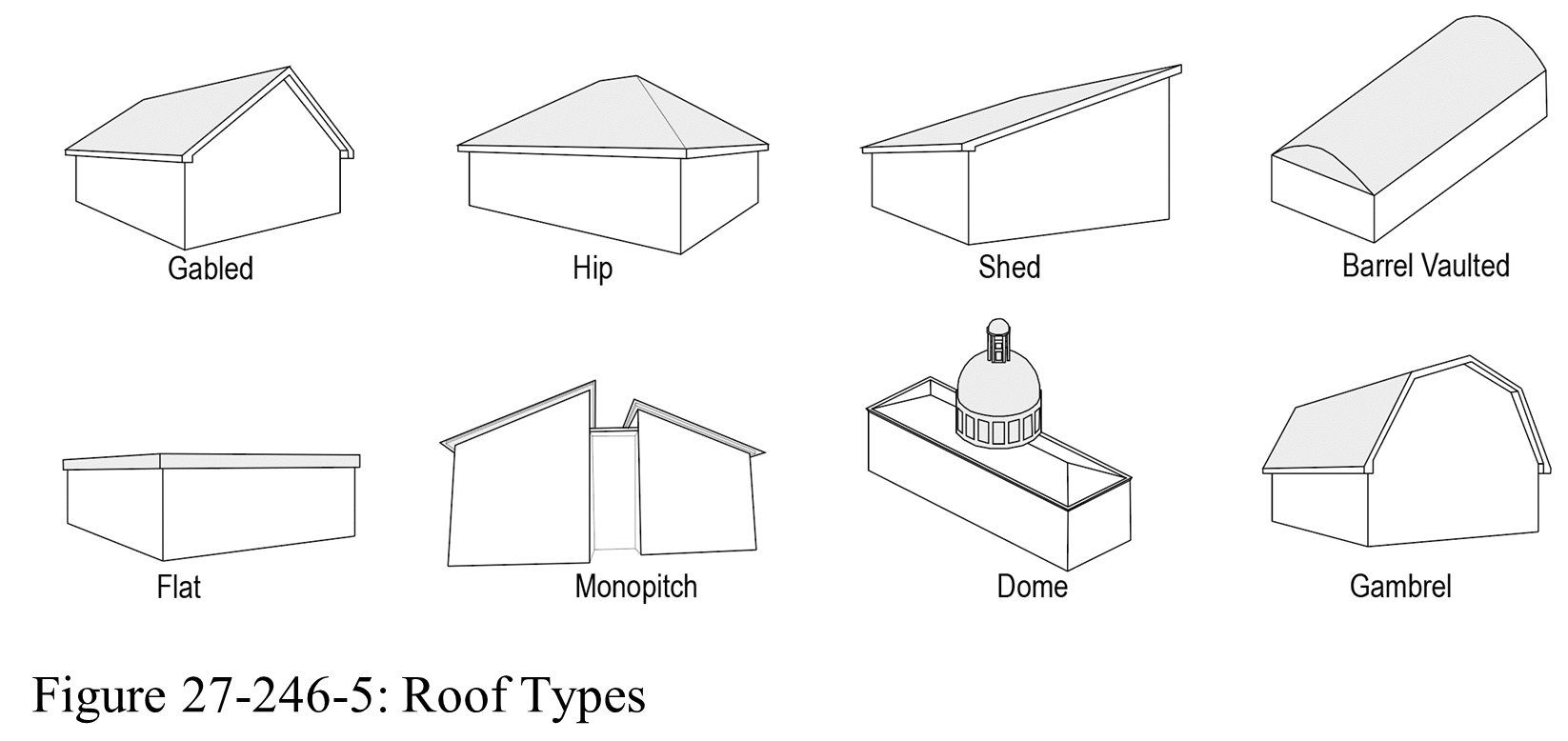
f.
Building materials. Building wall materials shall be combined on each facade only horizontally, unless the building is broken vertically by a change of plane, or a vertical architectural element. Heavier materials, such as masonry and stucco, shall be located below lighter materials, such as cement fiber or wood siding (Figure 27-246-6).
1.
Changes in material or color along the vertical direction should occur at hard-edge "bump-out" transitions, which gives materials a surface to terminate into.
2.
Façades with an overabundance of different materials or colors are discouraged.
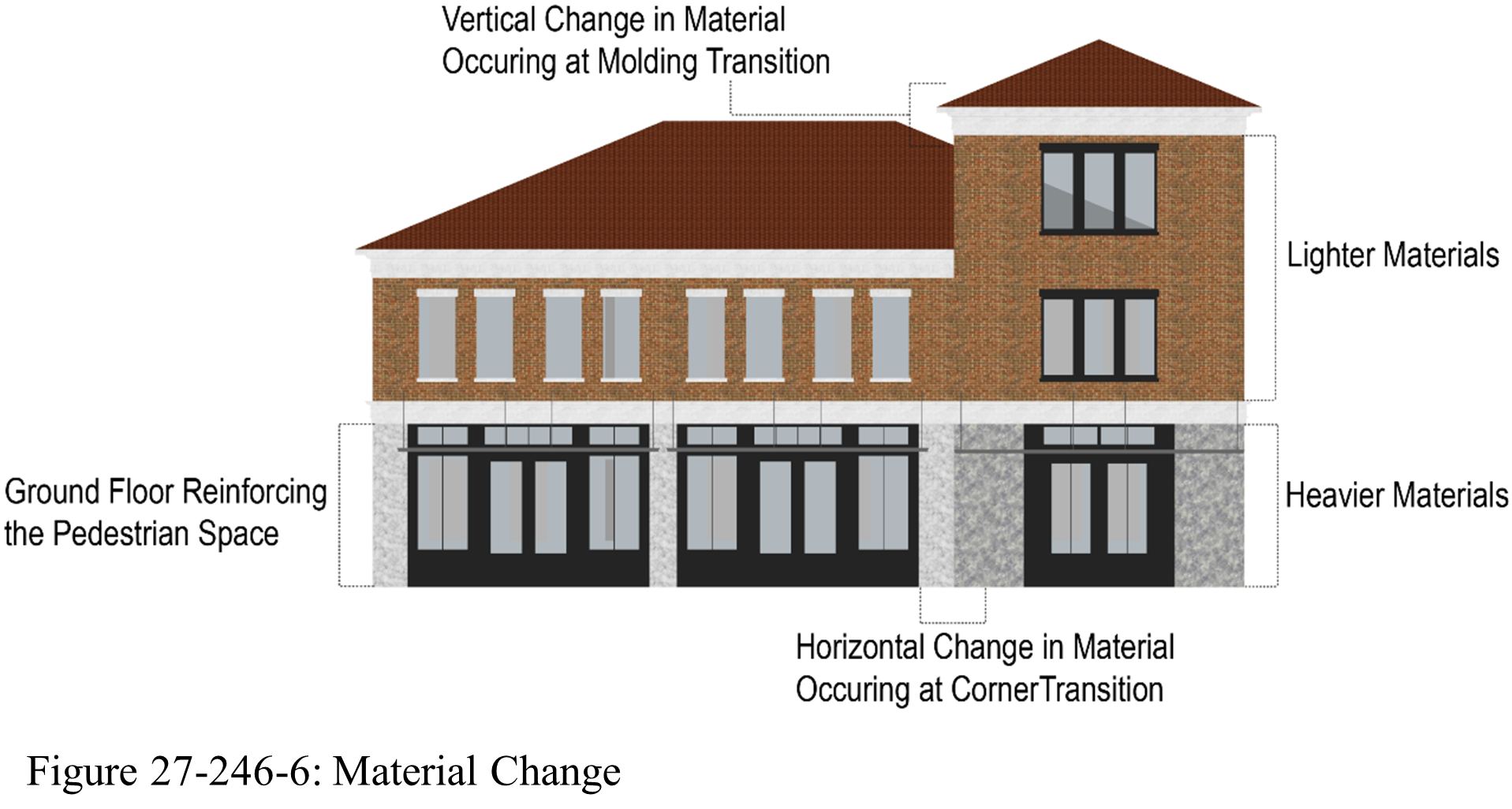
g.
Architectural elements.
1.
Awnings. Awnings shall project a minimum of three (3) feet from the building facade. Awnings shall be consistent with the building's architecture and proportionate to the façade opening shape and size.
2.
Cornices. A projecting cornice may be used to visually establish a top for a building facade (Figure 27-246-8).
i.
The top of each primary and secondary mass should be emphasized with a projecting cornice. This cornice should feature a deeper projection and therefore a stronger shadow line than any other expression line on a façade (Figure 27-246-8).
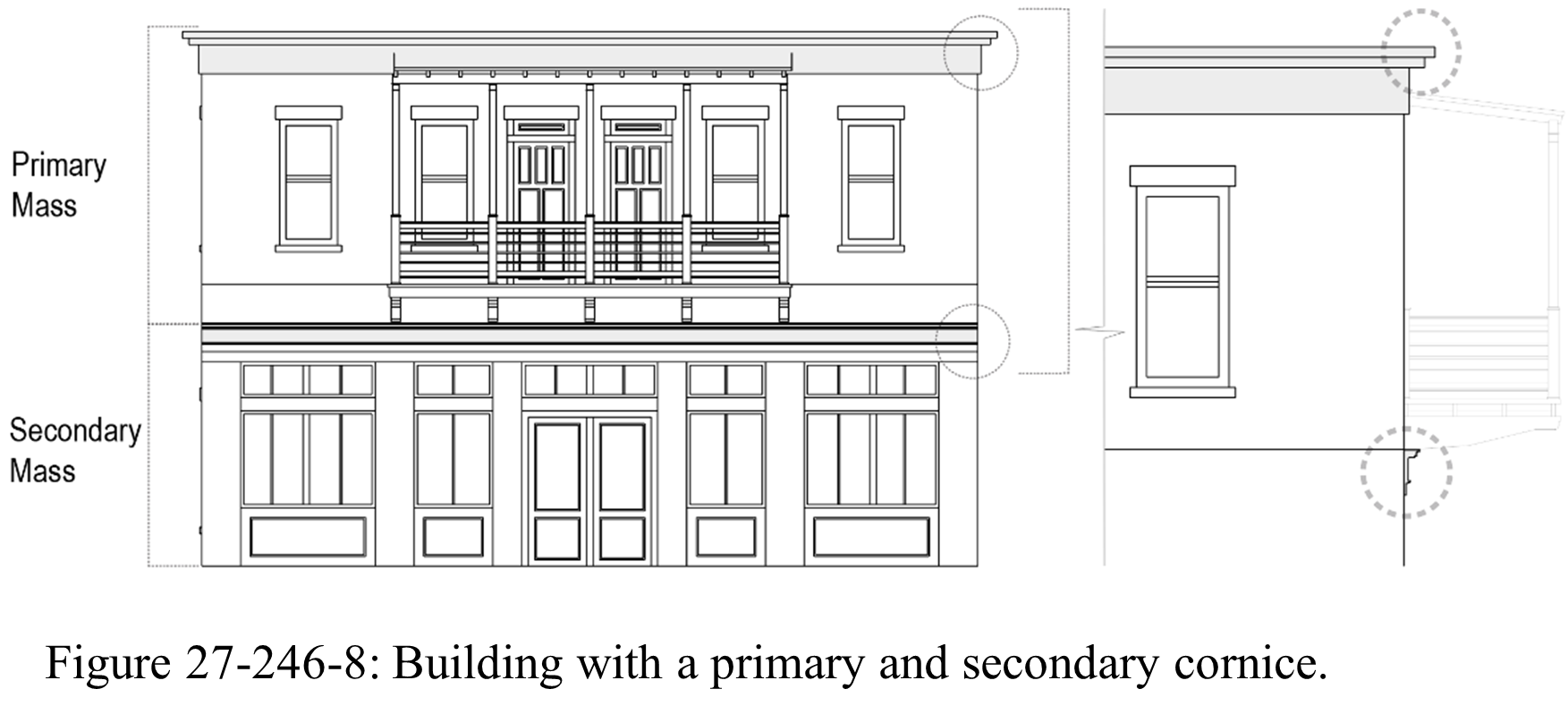
ii.
A cornice may be used to visually support a pitched roof (Figure 27-246-9).
iii.
Cornices shall project a minimum of six (6) inches from the building face.
iv.
A wall plane may extend above a cornice to form a parapet (Figure 27-246-10).
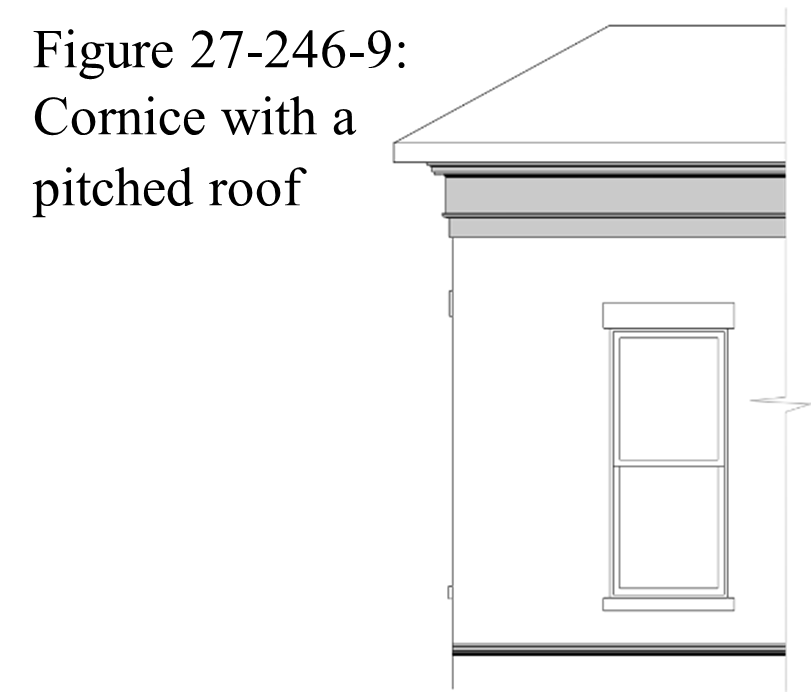 | 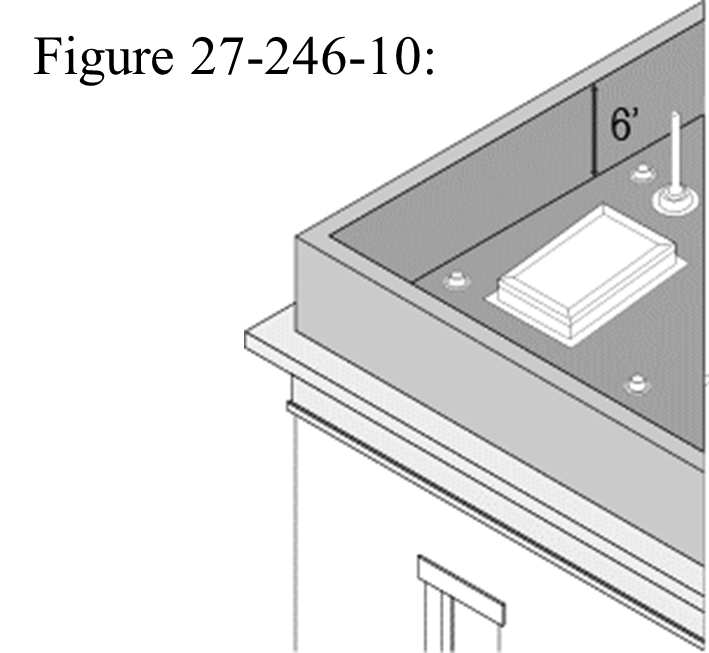 |
3.
Decorative railings. Decorative railings should be used on building façades when they serve a function such as enclosing planting areas, or as a safety measure for large windows in upper stories. Like typical balcony railings, they must be designed to support ladders for emergency egress. Grills should not be applied to façades without serving a true function (left) (Figure 27-246-11).
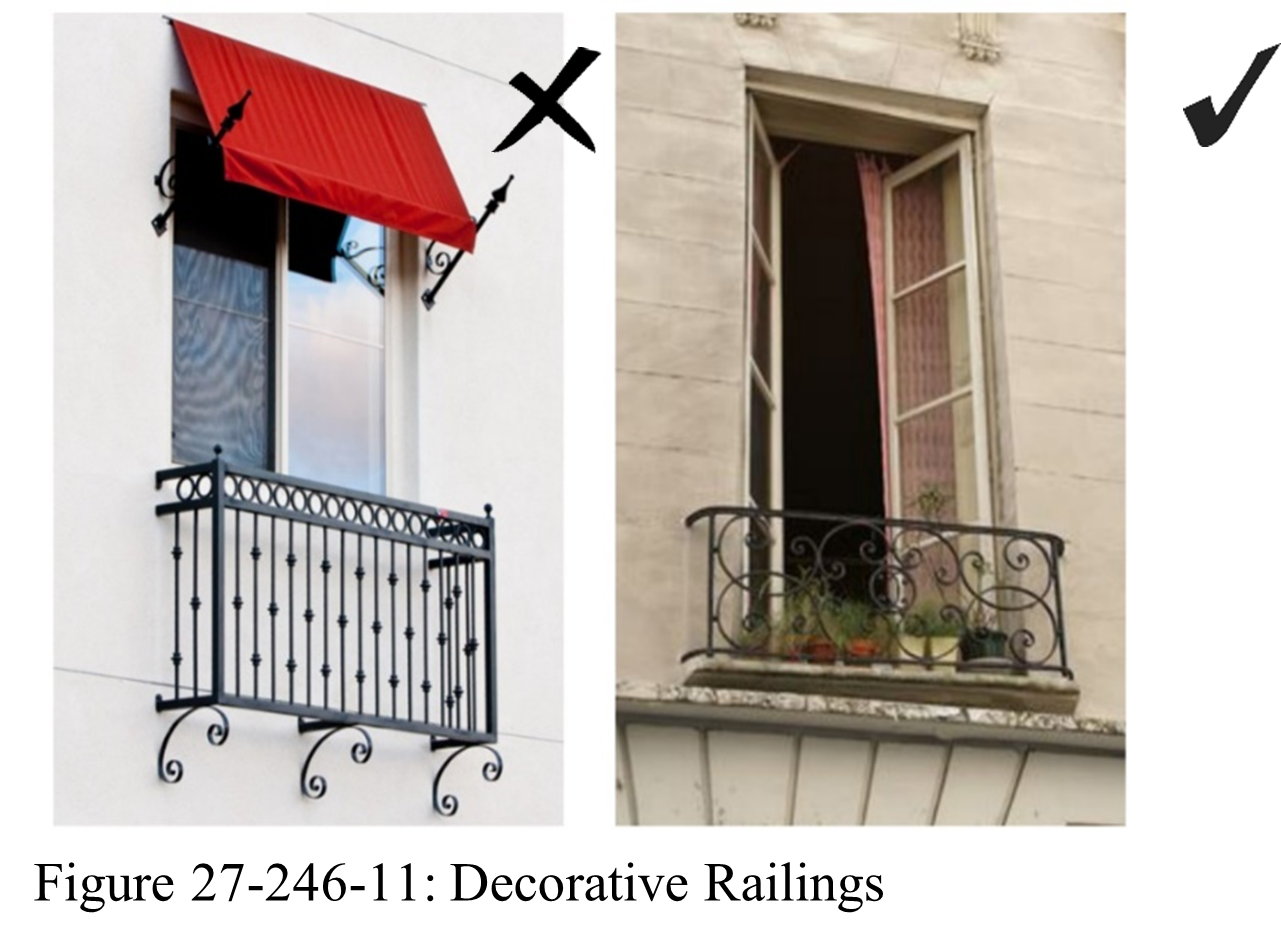
4.
Bay windows.
i.
Shall provide habitable interior space and include at least three (3) windows (Figure 27-246-12).
ii.
Shall not project more than three (3) feet from the building façade and shall not encroach onto any public right-of-way. See subsection 27-235(a)(2) regarding encroachments.
iii.
May not exceed ten (10) feet in width (Figure 27-246-12).
iv.
Fit in with the overall character and architectural style of the building.
5.
Columns, pillars, and posts.
i.
Shall be spaced at regular intervals not exceeding twenty-four (24) feet from centerline to centerline, creating openings with a height to width or width to height ratio of 1:1, 2:1, or 2:3.
ii.
Shall always support a structural spanning element, such as a beam, arch, or entablature and be positioned so that the outside edge of the beam, arch, or entablature of the spanning element above aligns with the neck of the column.
(Ord. No. 2022-03, § 1(Exh. A), 8-1-22)
Sec. 27-247. - Neighborhood center (NC) overlay district—Special regulations.
These regulations will ensure that new commercial buildings will support and define safe pedestrian, transit, bicycle, and vehicular circulation and allow for infill development that is sensitive to the character and history of the surrounding neighborhood.
(1)
Commercial building frontage standards. New commercial development shall comply with the required frontage types and associated standards detailed in Table 27-239, section 27-236, and Table 27-236.
(2)
Commercial building design standards along Florida Boulevard. All new commercial development in this overlay district that fronts along Florida Boulevard shall comply with the building design standards detailed for the CBD in section 27-246.
(Ord. No. 2022-03, § 1(Exh. A), 8-1-22)

