
New Haven City Zoning Code
ARTICLE I
DEFINITIONS
Section 1. - Definitions.
The following definitions shall apply to all parts of the zoning ordinance. Words not defined in this ordinance shall be as defined in the most current edition of Webster's New World Dictionary, College Edition. Words in boldface italic in this ordinance are defined in this Article I or in an applicable section if their use is limited.
ACCESS CORRIDOR: A portion of the site providing access from a street and having a minimum dimension less than the required lot width, except that no portion of a site having side lot lines radial to the center of curvature of a street from the street property line to the rear lot line shall be deemed an access corridor. The area of an access corridor shall not be included in determining the lot area.
ACCESSORY BUILDING: See BUILDING, ACCESSORY.
ACCESSORY RESIDENTIAL BUILDING, STRUCTURE OR USE: See RESIDENTIAL ACCESSORY BUILDING, STRUCTURE OR USE.
ACCESSORY USE: See USE, ACCESSORY.
ADAPTIVE REUSE: means the process of taking an existing structure and updating or adapting it for a new use or purpose.
ADULT CABARET: An establishment that regularly features topless dancers, go-go dancers, exotic dancers, nude dancers, male or female impersonators, or similar entertainers.
ADVERTISING SIGN: See SIGN, ADVERTISING.
AFFORDABLE HOUSING: The term "affordable housing," "affordable rental housing" or "housing affordable to rental households" is housing that costs no more than 30 percent of household income for rent and utilities, for households earning 60% or less of area median income. Unless otherwise specified by funding sources, or other agreement made with the City of New Haven, deed restricted units shall remain affordable for a period of 40 years after following issuance of the last certificate of occupancy for the qualifying development. In multi-phased qualifying developments, the period of affordability may begin upon issuance of the last certificate of occupancy for each phase, at the discretion of the Affordable Housing Commission.
AREA: See LOT AREA.
AREA MEDIAN INCOME: The term "area median income or "AMI" is the household income for the median household, according to the U.S. Department of Housing and Urban Development (HUD), calculated annually for the City of New Haven.
AREA OF SIGN: See SIGN, AREA OF.
AREA PER DWELLING UNIT: See LOT AREA PER DWELLING UNIT.
AREA PER SLEEPING ROOM: See LOT AREA PER SLEEPING ROOM.
ARTISAN MANUFACTURING means small-scale businesses that produce artisan goods such as artisan leather, glass, wood, paper, ceramic, textile, or yarn products; specialty foods; or baked goods, primarily for direct sales to consumers. This land use includes the design, processing, fabrication, assembly, treatment, and packaging of products as well as the incidental storage, sales, and distribution of such products.
ASSISTED LIVING FACILITY: A facility consisting of private residential units which provides a managed group living environment, including the provision of assisted living services as described in Regs., Conn. State Agencies § 17b-342-2(c)(1).
ATTACHED DWELLING: See DWELLING, ATTACHED.
AUTOMATIC TELLER MACHINE: Any electronic machine that enables customers to withdraw paper money or carry out other banking transactions on insertion of an encoded plastic card.
AVERAGE HEIGHT (OF A BUILDING): See HEIGHT, AVERAGE.
AVERAGE LOT WIDTH: See LOT WIDTH, AVERAGE.
BELT SIGN: See SIGN, BELT.
BOARDER: See ROOMER, BOARDER OR LODGER.
BOARDING HOUSE: See ROOMING, BOARDING OR LODGING HOUSE.
BRIGHT COLOR means bold and intense in nature, and typically visually striking and noticeable due to their hue and saturation.
BUFFERING means protecting or separating an area of land from the visual effects of another area by way of physical means, which may include trees, shrubs, walls, fences, berms/mounds, space or related landscaping features required under this ordinance for buffering lots or parcels from adjacent properties or rights-of-way for the purpose of increasing visual shielding or other aspects of privacy or aesthetics.
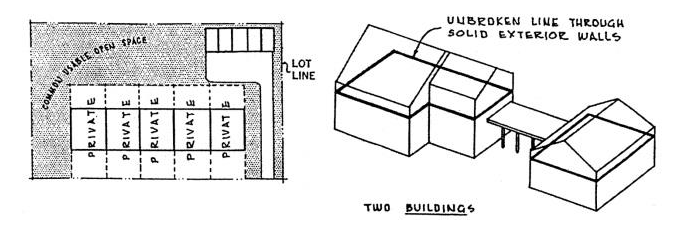
BUILDING: A structure which is completely enclosed by a roof and by solid exterior walls along whose outside faces can be traced an unbroken line for the complete circumference of the structure, which is permanently affixed to a lot or lots, and used or intended for the shelter, support of enclosure of persons, animals or property of any kind.
The connection of two buildings by means of an open porch, breezeway, passageway, carport or other such open structure, with or without a roof, shall not be deemed to make them one building. A building may occupy more than one lot, but in the case of a series of two or more attached and/or semi-detached dwellings, the building which such dwellings comprise shall be considered to occupy a single lot, regardless of ownership, for purposes of determining lot area, average lot width, lot area per dwelling unit, floor area ratio, the number of parking spaces and other pertinent requirements, if the resulting parking spaces are usable open space are and will continue to be available in the same proportion to all occupants of the building or buildings on the lot; otherwise, each such dwelling shall be considered to occupy a separate lot.
BUILDING, ACCESSORY: A building located on the same lot as a principal building and devoted or intended to be devoted to an accessory use. Any portion of a principal building devoted or intended to be devoted to an accessory use is not an accessory building.
BUILDING, NONRESIDENTIAL: A building that is devoted to one or more of the commercial or industrial uses listed in section; 42B.—T. and/or the nonresidential uses permitted in residential districts, which is not a mixed-use building.
BUILDING, PRINCIPAL: A building in which is conducted, or is intended to be conducted, the principal use of the lot on which it is located.
BUILDING COVERAGE means the proportion of the lot area, expressed as a percent, that is covered by the maximum horizontal cross section of a building or buildings. Structures which are below the finished lot grade, including shelters for nuclear fall-out, shall not be included in building coverage.
BUILDING FOUNDATION WALL means a wall of the foundation upon which a building rests.
BUILDING FRONTAGE means the length of an outside building wall along a dedicated public or private street.
BUSINESS SIGN: See SIGN, BUSINESS.
CARSHARING PARKING SPACE means a parking space that is reserved for the parking of a vehicle that is available to multiple users.
CAT CAFÉ means any premises used to house or contain homeless, orphaned, or unwanted cats and that is owned, operated, or maintained by an organization that is licensed by the State as an animal shelter and devoted to the welfare, protection, and humane treatment of animals for the purpose of adoption, and which incorporates retail sales to support the interaction of patrons with cats, such as a café, bookshop, or other permitted use.
CHILD DAYCARE CENTER: See DAYCARE.
COASTAL JURISDICTION LINE (CJL) means that defined in Connecticut General Statutes § 22a-359 as amended.
COMMON AMENITY SPACE:
(1)
Common amenity interior space that is available to all residents of a residential principal building or a mixed-use building for their use and enjoyment, such as bicycle rooms, business centers, gyms, laundry rooms, common restrooms, lobbies, party rooms, indoor pools, shared overnight guest quarters, theaters, libraries, game rooms, common recreational/function rooms, conference rooms, but not including utility or similar rooms, corridors, or in a mixed-use building, commercial space;
(2)
Storage space not located within a dwelling unit but which is assigned to an individual dwelling unit; and
(3)
Usable open space that is provided in addition to the usable open space that is required to be provided under this ordinance.
COMPACT PARKING SPACE: A parking space that measures 7.5 feet x 15 feet.
CONFERENCE CENTER: A building or group of buildings used for business and professional conferences and seminars accommodating up to 500 people along with associated accessory functions, such as lodging and facilities for eating and recreation designed to be used primarily for conference attendees. The provision of rooms for rent and meals generally available to the public shall not be considered associated accessory uses.
CONSTRUCTION STAGING AREA means the use of a structure or lot, in whole or in part, for the storage of materials and supplies associated with an off-site transportation, public works and/or private sector construction project.
CONVENIENCE STORE means any retail establishment offering for sale prepackaged food products, household items, and other goods commonly associated with the same and having a gross floor area of less than 5,000 square feet.
CONVENTION CENTER means a building or group of buildings designed to accommodate 300 or more people used for business or professional conventions, conferences, seminars, product displays, trade shows, special events, recreational activities, and entertainment or athletic functions, along with accessory functions, including temporary outdoor displays, and food and beverage preparation and service for on-premises consumption, excluding the provision of rooms for rent.
CORNER LOT: See LOT, CORNER.
COURT means a horizontal open space between the exterior walls of a single building that face one another on an angle of less than 60 degrees, excluding shafts designed solely for ventilation.
COVERAGE: See BUILDING COVERAGE.
CUSTODIAL CARE FACILITY means a facility which provides custodial care and treatment in a protective living environment for persons accused or convicted of a misdemeanor or a non-violent felony and residing voluntarily or by court placement, including, without limitation, correctional and post correctional facilities, halfway houses, transitional housing, juvenile detention facilities and temporary detention facilities, such as alternative to incarceration programs approved by the Chief Court Administrator in accord with the Connecticut General Statutes Sec. 53a-39a. This provision is not intended to address disabled individuals pursuant to the Fair Housing Act.
DATA PROCESSING CENTER OR SERVICES means establishments primarily involved in the compiling, storage, and maintenance of documents, records, and other types of information in digital form utilizing a main frame computer.
DAYCARE means the term daycare includes any of the three specifically defined daycare uses listed below. The following definitions conform to the daycare permit categories defined by Public Act 82-35.
(1)
Child daycare center. Any premises used for care of more than 12 children and meeting all standards of the Connecticut Department of Health Services.
(2)
Group daycare home. Any premises used for the care of not less than seven nor more than 12 related or unrelated children and meeting all standards of the Connecticut Department of Health Services.
(3)
Family daycare home. A private family home caring for not more than six children, including the provider's own children not at school full time, and meeting all standards of the Connecticut Department of Health Services.
(4)
Special workplace daycare. Any of the above-described uses primarily serving employees of the immediate zoning district in which the workplace is located.
DETACHED DWELLINGS: See DWELLING, DETACHED.
DIRECTLY ILLUMINATED SIGN: See SIGN, DIRECTLY ILLUMINATED.
DORMITORY: A building or part of a building operated by an institution containing a room or rooms forming one or more habitable units which are used or intended to be used by residents of the institution for living and sleeping, but not for cooking or eating purposes.
DRUG PARAPHERNALIA means all equipment, products and materials of any kind which are used, intended for use or designed for use in planting, propagating, cultivating, growing, harvesting, manufacturing, compounding, converting, producing, processing, preparing, testing, analyzing, packaging, repackaging, storing, containing, concealing, injecting, ingesting, inhaling, or otherwise introducing into the human body a controlled substance in violation of the laws of the State of Connecticut or of the United States. The term includes, but it not limited to:
(1)
Kits used, intended for use or designed for use in planting, propagating, cultivating, growing or harvesting of any species of plant which is a controlled substance or from which a controlled substance can be derived;
(2)
Kits used, intended for use, or designed for use in manufacturing, compounding, converting, producing, processing or preparing controlled substances;
(3)
Isomerization devices used, intended for use, or designed for use in increasing the potency of any species of plant which is a controlled substance;
(4)
Testing equipment used, intended for use or designed for use in identifying, or in analyzing the strength, effectiveness or purity of controlled substances;
(5)
Scales and balances used, intended for use or designed for use in identifying, or in analyzing the strength, effectiveness or purity of controlled substances;
(6)
Diluents and adulterants, such a quinine hydrochloride, mannitol, mannite, dextrose and lactose, used, intended for use or designed for use in cutting controlled substances;
(7)
Separation gins and sifters used, intended for use or designed for use in removing twigs and seeds from, or in otherwise cleaning or refining marijuana;
(8)
Blenders, bowls, containers, spoons and mixing devices used, intended for use or designed for use in compounding controlled substances;
(9)
Capsules, balloons, envelopes and other containers used, intended for use or designed for use in packaging small quantities of controlled substances;
(10)
Containers and other objects used, intended for use or designed for use in storing or concealing controlled substances;
(11)
Hypodermic syringes, needles and other objects used, intended for use, or designed for use in parenterally injecting controlled substances into the human body;
(12)
Objects used, intended for use or designed for use in ingesting, inhaling, or otherwise introducing marijuana, cocaine, hashish, or hashish oil into the human body, such as:
a.
Metal, wooden, acrylic, glass, stone, plastic or ceramic pipes with or without screens, permanent screens, hashish heads, or punctured metal bowls;
b.
Water pipes;
c.
Carburetion tubes and devices;
d.
Smoking and carburetion masks;
e.
Roach clips, meaning objects used in holding burning material, such as a marijuana cigarette, that has become too small or too short to be held in the hand;
f.
Miniature cocaine spoons, and cocaine vials;
g.
Chamber pipes;
h.
Carburetor pipes;
i.
Electric pipes;
j.
Air-driven pipes;
k.
Chillums;
l.
Bongs; and
m.
Ice pipes or chillers.
In determining whether an object is drug paraphernalia, a court, zoning officer, zoning board, building department, or other authority should consider, in addition to all other logically relevant factors, the following:
1.
Statements by an owner or by anyone in control of the object concerning its use;
2.
Prior convictions, if any, of an owner, or of anyone in control of the object, under a state or federal law relating to any controlled substance;
3.
The proximity of the object, in time and space, to a direct violation of such law;
4.
The proximity of the object to controlled substances;
5.
The existence of any residue of controlled substances on the object;
6.
Direct or circumstantial evidence of the intent of an owner, of anyone control of the object, to deliver it to persons whom it knows, or should reasonably know, intend to use the object to facilitate a violation of any law of the State of Connecticut or of the United States; the innocence of the owner, or of anyone in control of the object, as to a direct violation of such law shall not prevent a finding the object is intended for use, or designed for use as drug paraphernalia;
7.
Instructions, oral or written, provided with the object concerning its use;
8.
Descriptive materials accompanying any object which explain or depict its use;
9.
National or local advertising concerning its use;
10.
The manner in which the object is displayed for sale;
11.
Whether the owner, or anyone in control of the object, is a legitimate supplier of like or related items to the community, such as a licensed distributor or dealer of tobacco products;
12.
Direct or circumstantial evidence of the ratio of sales of the object(s) to the total sales of the business enterprise;
13.
The existence and scope of legitimate uses for the object in the community; and
14.
Expert testimony concerning its use.
DRUG PARAPHERNALIA CENTER means any store, restaurant, bar, premises or other establishment which, in addition to any other trade, business or service conducted therein, includes a significant amount of drug paraphernalia. For the purposes of this zoning ordinance, an amount of drug paraphernalia shall be deemed significant as to any store, restaurant, bar, premises or other establishment if:
(1)
Ten percent or more of the square footage or active display area of such store, restaurant, bar, social club, premises or other establishment is devoted to or occupied by drug paraphernalia; or
(2)
Ten percent or more of the monthly gross revenue of such store, restaurant, bar, social club, premises or other establishment is or can reasonably be expected to be attributable to the sale or rental of drug paraphernalia; or
(3)
Ten percent or more of the value of the inventory and equipment or of such store, restaurant, bar, social club, premises, or other establishment consists of drug paraphernalia.
Any amount above such a threshold shall be deemed a separate use, subject to the provisions of the New Haven Zoning Ordinance.
DWELLING means a building containing one or more dwelling units; but in the case of a building having two or more portions divided by one or more party walls forming a complete separation, each such portion shall be considered a separate building.
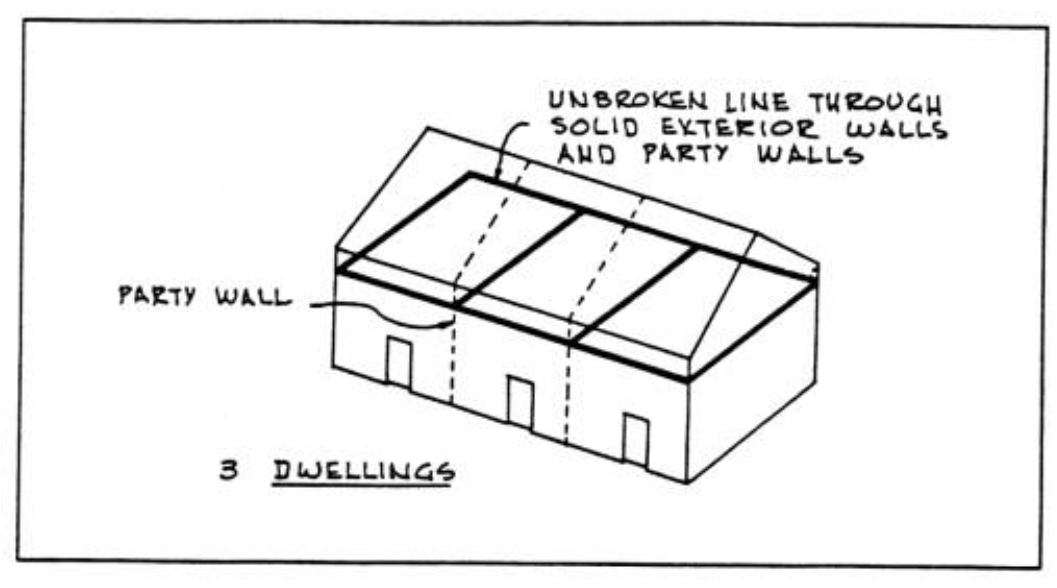
DWELLING, ATTACHED: A dwelling having any portion of each of two walls in common with adjoining dwellings.
DWELLING, DETACHED: A dwelling having open space on all sides.
DWELLING, MULTI-FAMILY means a dwelling having three or more dwelling units.
DWELLING, SEMI-DETACHED means a dwelling having any portion of one wall in common with an adjoining dwelling.
DWELLING, SINGLE-FAMILY means a dwelling having only one dwelling unit from ground to roof and having independent outside access.
DWELLING, TWO-FAMILY: A dwelling having two dwelling units, one above the other.
DWELLING UNIT means any room or group of rooms located within a residential building and forming a single habitable unit with facilities which are used or intended to be used for living, sleeping, cooking and eating by one family.
ECO ROOF (also known as a green roof, living or vegetated roof) means an Eco roof is the area atop a roof surface on a building or a parking structure, open to the sky and air, which is surfaced with soil and living plant materials for the purpose of retaining rainwater and absorbing heat from sunlight. An Eco roof is planted over a roofing system with waterproofed membrane and provision for drainage and is created by adding layers of growing medium and plants. Extensive Eco roofs generally have a soil depth of less than six inches. Intensive Eco roofs typically have a soil depth of more than six inches. An Eco roof may be accessible only for maintenance or may be accessible to public. At-grade or partially at grade green spaces over subsurface structures such as tunnels, parking structures, and basements may be considered as an Eco roof for bonuses if constructed and performing in the same manner as an Intensive Eco roof, and approved by the City Plan Commission taking into consideration advice of the City Plan Department and the Department of Engineering, or by the City Plan Department, taking into consideration the advice of the Department of Engineering, where only administrative site plan review is required. Eco roofs must be installed by an accredited Green Roof Professional (GRP).
EFFICIENCY UNIT means a dwelling unit having only one room exclusive of bathroom, water closet compartment, kitchen, laundry, pantry, foyer, communicating corridor, closets or any dining alcove with less than 70 square feet of floor space. In no event shall the gross floor area of the efficiency unit (the one room plus all other elements designated above) exceed 500 square feet.
ELDERLY HOUSING UNIT means a dwelling unit specifically designed for the needs of an elderly person or persons and conforming to the requirements of state and/or federal programs providing for housing for the elderly.
ELECTRIC VEHICLE SUPPLY EQUIPMENT means any level or capacity of supply equipment installed specifically for the purpose of transferring energy between the premises wiring and the electric vehicle.
ELECTRIC VEHICLE CHARGING SPACE means a space designated by the City for charging electric vehicles.
ELEVATED BUILDING means a non-basement building that has its lowest elevated floor raised above ground level by foundation walls, shear walls, posts, piers, pilings, or columns.
ENCLOSURE means an area that is enclosed on all sides by walls. Enclosed areas are permitted below the lowest floor provided the enclosed areas meet certain use restrictions (used only for parking of vehicles, building access, or storage) and construction requirements related to flood resistance, including use of flood damage-resistant materials and installation of openings to allow for automatic entry and exit of floodwater.
ENTRANCE, PRINCIPAL means a point of access for pedestrians to a building, which entrance faces a street and determines a property address for the building. A building may have more than one principal entrance.
FAMILY means a person living alone, or any of the following groups living together, with any domestic servants or gratuitous guests thereof, as a single non-profit housekeeping unit and sharing common, bathing, sleeping, cooking and eating facilities, sharing at least one common living room space:
(1)
Any number of people related by blood, marriage, adoption or legally recognized foster relationship;
(2)
A group of up to four people who need not be so related with up to an additional four people related to a person in the group by blood, marriage, adoption or legally recognized foster relationship;
(3)
Not more than eight people who are disabled as defined in the Fair Housing Act, 42 U.S.C. § 3602 (h) and this ordinance as well as one facility manager. This definition does not include those persons currently illegally using a "controlled substance" as defined in the Controlled Substances Act, 21 U.S.C. § 802(6) or those persons claiming to be disabled solely on the basis of having been adjudicated a juvenile delinquent, having a criminal record or being a sex offender.
Exceptions: "Family" does not include and shall not be interpreted to include the following facilities addressed in this and other sections of this ordinance: Convalescent Homes (including hospices), Rest Homes, Nursing Homes and Sanitariums, Rectories, Convents, Rooming, Boarding or Lodging Houses, Fraternities, Sororities, Custodial Care Facilities or Dormitories.
Note: For the purposes of this Ordinance, the term "disabled" shall have the same meaning as the term "handicapped" as contained in the Fair Housing Act.
Note: Occupancy limits established under the Housing Code may further limit the number of people living in one dwelling unit.
FAMILY DAYCARE HOME: See DAYCARE.
FINISHED LOT GRADE: See LOT GRADE, FINISHED.
FLOOR AREA, GROSS means the sum of the gross horizontal areas of the several floors of a building, measured from the exterior faces of exterior walls (and from the center lines of party walls if the portions of the building separated by such party walls are to be treated separately), including:
(1)
Basement space where more than one-half the basement height is above the finished lot grade average along the exterior walls of the building;
(2)
Elevators and stairwells at each floor;
(3)
Attic space, whether or not a floor has been laid, over which there is structural headroom of seven foot or more; and
(4)
Enclosed porches, interior balconies and mezzanines, and penthouses; and excluding floor space permanently devoted to mechanical equipment used in the operation and maintenance of the building, and floor space permanently devoted to a parking space or parking spaces.
FLOOR AREA, NET means the total floor area within a building devoted or intended to be devoted to a particular use, with structural headroom of seven feet or more, whether above or below the finished lot grade, excluding (a) elevators, stairwells, hallways, walls and partitions, and (b) floor space permanently devoted to a parking space or parking spaces, mechanical equipment, closets, washrooms, or other items permanently preventing the floor space from being occupied by persons while engaged in the use.
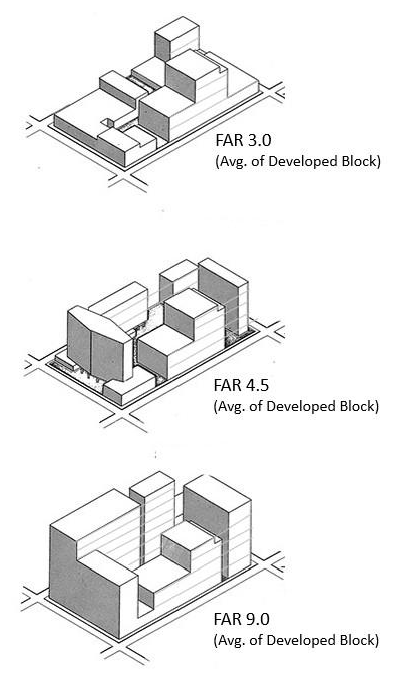
FLOOR AREA RATIO means the ratio of the gross floor area to the principal building or principal buildings on a lot to the total lot area.
FOUNDATION WALL: See BUILDING FOUNDATION WALL.
FRONT LOT LINE: See LOT LINE, FRONT.
FRONT YARD: See YARD, FRONT.
GAME MACHINE means any machine or device operated by the insertion of a coin, token or similar object, or other means of payment for the purpose of amusement, recreation skill, or chance, such as electronic game machines, video games, pin ball, pool tables or other similar devices. The term game machine shall not include a bowling alley or juke box.
GAME ROOM means a building or portion thereof whose principal use or intended use is for operation of three or more game machines for the use by the general public or specific invitees.
GREEN STORMWATER INFRASTRUCTURE means infrastructure including a range of soil-water-plant systems that intercept stormwater, infiltrate a portion of it into the ground, and/or transfer a portion of it into the air through evapotranspiration.
GROSS FLOOR AREA: See FLOOR AREA, GROSS.
GROUND SIGN: See SIGN, GROUND.
GROUP DAYCARE HOME: See DAYCARE.
HEALTH CARE CLINIC means an outpatient clinic licensed by the Connecticut Department of Public Health pursuant to Regs., Conn. State Agencies § 19-13-D45 or an outpatient clinic that provides the services described in said regulation which is operated by a partnership or an individual and licensed by the Connecticut Department of Public Health, an outpatient hospital clinic, a medical walk-in clinic, a physical therapy office, an occupational therapy office, an outpatient chronic dialysis center, a community health center, a public health center, an industrial health facility as that term is defined in Regs., Conn. State Agencies § 19-13-D1.(b)(3)(F), an occupational health clinic, a clinic operated by a union exclusively for its members and their dependents, a family planning and reproductive health service center, a primary care clinic, a clinical or diagnostic laboratory, a sports medicine clinic, an emergency services clinic, a wellness center, a dental clinic, an imaging center, and/or a mental health center, but not including an Outpatient Surgical Center listed in Section 42, Use Regulations for Business and Industrial Districts.
HEALTH PRACTITIONER'S OFFICE means an office of a physician, osteopath, dentist, audiologist, naturopath, optometrist, psychologist, social worker, chiropractor, and/or nurse practitioner but not including an office which is defined as a Health Care Clinic or an Outpatient Surgical Center listed in Section 42, Use Regulations for Business and Industrial Districts.
HEIGHT means the vertical distance from the average elevation of the finished lot grade to the highest point of the ceiling of the top story of a building or structure in the case of a flat roof, to the deck line of a mansard roof, and the average height between the eaves and ridge of a gable, hip or gambrel roof.
HEIGHT, AVERAGE means the total volume of a building or structure (enclosed by the outer faces of building or structure walls, the outer faces of roofs, and the finished lot grade), divided by the area of the maximum horizontal cross-section of the building or structure. Average height for a portion of a building or structure is measured in an equivalent manner as to that portion.
HIGH-RISE BUILDING means a freestanding structure with a minimum height of ten stories.
HIGH TECHNOLOGY EQUIPMENT DESIGN AND FABRICATION means a use which has as its principal function the research, development, engineering, design, assembly, fabrication, machining and/or light manufacturing of high technology equipment used in high technology uses, instrumentation and computer software and the associated warehousing of such equipment.
HIGH TECHNOLOGY USES means a use, including a research and/or development laboratory, which has as its principal function the research, development, engineering, design, assembly, fabrication, or machining and/or light manufacturing of high technology uses, including but not limited to uses associated with agricultural technology, biological or pharmaceutical technology, software technology, telecommunications, biomedical technology, defense and aerospace technologies or other technology oriented or emerging industrial or business activity and the associated warehousing of such products as permitted by applicable state and/or federal law.
HIGH TECHNOLOGY SERVICES means a use which has as its principal function the providing of services to high technology uses, including but not limited to computer information transfer, communication, distribution, management, processing, administrative, experimental, developmental, technical, or testing services.
INDIRECTLY ILLUMINATED SIGN: See SIGN, INDIRECTLY ILLUMINATED.
LEED means the series of Leadership in Energy and Environmental Design (LEED) rating systems developed by the Green Building Council.
LEED ACCREDITED PROFESSIONAL means any person who has passed the LEED Professional Accreditation Exam administered by the Green Building Council.
LEED CERTIFIED-LEVEL means the lowest level of the LEED rating systems.
LEED GOLD RATING means the second highest level of the LEED rating systems.
LEED PLATINUM RATING means the highest level of the LEED rating systems.
LEED RATING SYSTEM means the particular LEED rating system that applies to a building.
LEED SCORECARD means the checklist developed by the Green Building Council for the purpose of calculating a score on the LEED rating system.
LEED SILVER RATING means the second lowest level of the LEED rating systems.
LETTER OF MAP AMENDMENT (LOMA) is an official amendment, by letter, to an effective National Flood Insurance Program (NFIP) map. A LOMA establishes a property's location in relation to the Special Flood Hazard Area (SFHA).
LETTER OF MAP CHANGE (LOMC) means a general term used to refer to the several types of revisions and amendments to the Federal Emergency Management Agency's (FEMA) maps that can be accomplished by letter. They include Letter of Map Amendment (LOMA), Letter of Map Revision (LOMR), and Letter of Map Revision based on Fill (LOMR-F).
LETTER OF MAP REVISION (LOMR) means the FEMA official modification to an effective Flood Insurance Rate Map (FIRM), or Flood Boundary and Floodway Map (FBFM), or both.
LETTER OF MAP REVISION BASED ON FILL (LOMR-F) means FEMA's modification of the Special Flood Hazard Area (SFHA) shown on the Flood Insurance Rate Map (FIRM) based on the placement of fill outside the existing regulatory floodway.
LIVE-WORK CONVERSION AND LIVE-WORK UNIT means a unit that contains both a residential use and a commercial/work activity including but not limited to Home Occupations and residences with a professional office described in Subsection 13(b)(2)a as well as other commercial and fabrication uses subject to the requirements of Section 18A, Live-Work Loft Conversions, and Section 18B, Live-Work Units (post 1963 and new structures).
LOADING SPACE means an off-street space available for the standing, loading or unloading of one truck, excluding adequate maneuvering area.
LOBBY means a space designed to provide separation and control access between public spaces and commercial or residential spaces, including access to dwelling units. The term includes vestibules, foyers, and spaces or areas that provide access to elevators.
LODGER: See ROOMER, BOARDER OR LODGER.
LODGING HOUSE: See ROOMING, BOARDING OR LODGING HOUSE.
LOT means a parcel of land in the same ownership, or any part thereof designated by its owner or owners as a separate lot having a frontage on a street. The lot shall have access on an accepted street that is determined by the city engineer, police, public works, fire and traffic and parking departments to be adequate for the needs of the departments. The beneficiaries of a private easement cannot consider the area of the easement for calculation of lot area for purposed of this ordinance. For purposes of this ordinance, a lot may or may not have boundaries identical with those shown on New Haven Land Records.
Notwithstanding the provisions of this ordinance, the following shall be deemed to constitute a lot: any parcel of land subject to a declaration recorded prior to the enactment of this amendment under the Common Interest Ownership Act as delineated in the General Statutes of the State of Connecticut, as amended from time to time, to which the declarant rights are retained by the declarant or its successor to any lands or real property described in said declaration, surveys or schedules attached thereto and which has, in whole or part, been subject to previously approved or permits for development and use including, but not limited to, building permits or certificates of occupancy for any portion of the land or real property subject to said declaration, either in the text, description or maps attached thereto.
Contiguous parcels occupied or proposed to be occupied entirely by public or institutional uses may be considered to make up a single lot whether under the same ownership or not, if joint application for building permits is made by all the owners of such parcels.
A series of two or more attached and/or semi-detached dwellings may under certain conditions be considered to occupy a single lot regardless of ownership (see BUILDING definition).
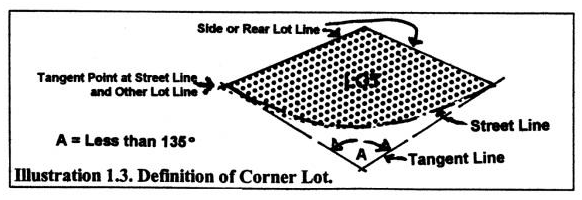
Corner Lot
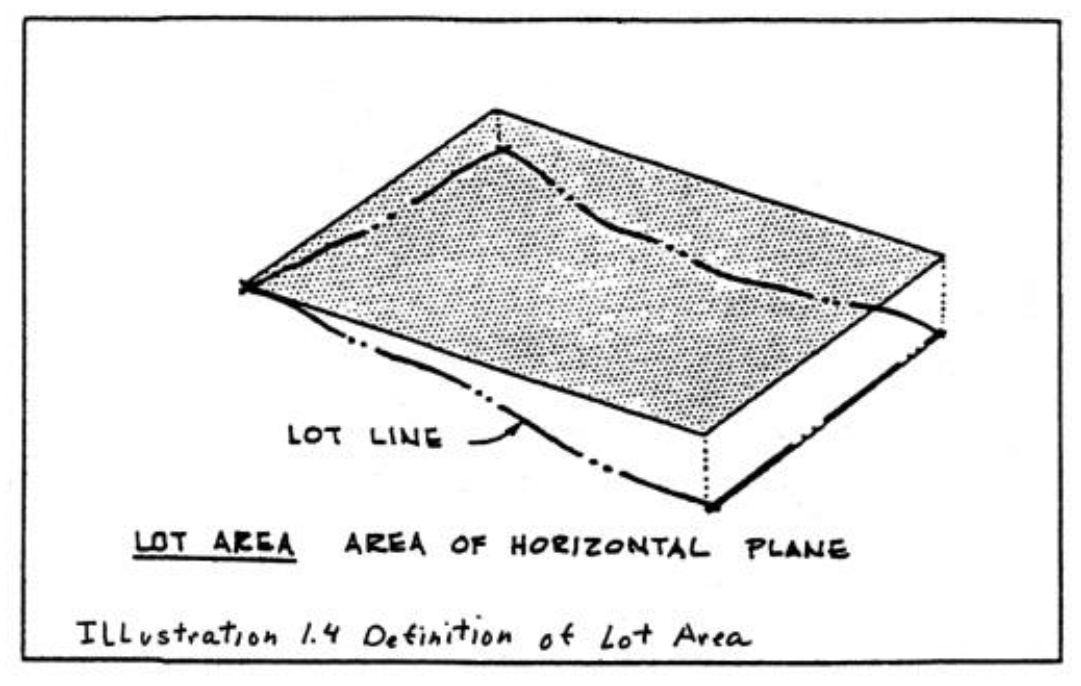
Lot Area
Note—A series of two or more attached and/or semi-detached dwellings may under certain conditions be considered to occupy a single lot regardless of ownership (see definition of BUILDING).
Note—Lot area as used in all sections of this ordinance shall not include the following categories of land area:
1.
State-designated tidal wetlands defined and mapped under Sections 22a-29(a)(2) and 22a-30 of the Connecticut General Statutes (CGS).
2.
Wetlands and water courses defined under Sections 22a-38(15) and (16) of the CGS and appearing on the U.S.D.A. Soil Conservation Service Soil Survey of New Haven County.
3.
Any land below the mean high-water mark.
LOT AREA PER DWELLING UNIT means the amount of lot area, whether occupied by structures or not, that exists for each dwelling unit located on the lot.
LOT AREA PER SLEEPING ROOM (ROOMING, BOARDING OR LODGING HOUSE) means the amount of lot area, whether occupied by structures or not, that exists for each sleeping room located on the lot.
LOT, DOUBLE FRONTAGE means an interior lot having a frontage on more than one street.
LOT, FLAG OR CORRIDOR means a lot connected to a street by an access corridor having a width of not less than 16 feet or more than 25 feet and having a length not exceeding 250 feet.
LOT GRADE, FINISHED means the lot surface as graded and prepared for building, and such surface if imagined to be extended through any structure on the lot.
LOT LINE means any boundary of a lot, except where a lot contains a body of water or inland or tidal wetlands the lot line shall be the mean high-water mark or the boundary of the inland or tidal wetland.
LOT LINE, FRONT means a street line, or in the case of a flag or corridor lot the lot line closest to the street shall be considered the front lot line.
LOT LINE, REAR means any lot line which is parallel to or within 45 degrees of being parallel to a street line, except for a lot line that is itself a street line, and except that in the case of a corner lot the owner shall have the option of choosing which of the two lot lines that are not street lines is to be considered a rear lot line. In the case of a lot having no street frontage or a lot of odd shape, only the one lot line furthest from any street shall be considered a rear lot line.
LOT LINE, SIDE means any lot line which is not a street line or a rear lot line.
MEAT PROCESSING means establishments primarily engaged in processing, preserving, cutting and packaging meat and meat byproducts. Meat processing excludes slaughtering and rendering.
MICRO-BREWERY means an establishment engaged in on-site brewing of beer and sales of beer by the glass for on-premise consumption. These establishments are primarily used to produce beer and ale and may include retail and food service as an accessory use. The brewing operation processes the ingredients to make beer and ale by mashing, cooking, and fermenting. The brewing operation does not include the production of any other alcoholic beverage.
MICRO-DISTILLERY means an establishment primarily engaged in on-site distillation of spirits and may include retail and food service as an accessory use. The distillery operation processes the ingredients to make spirits by mashing, cooking, fermenting and distilling. The micro-distillery operation does not include the production of any other alcoholic beverage.
MICRO-MANUFACTURING means the manufacturing of products in small quantities using small manufacturing facilities.
MID-RISE BUILDING means a freestanding structure ranging from five to nine stories.
MIXED USE means a land use where more than one classification of land use (for example, commercial office, retail and service, public, institutional, medical) permitted within a zoning district is combined on a lot or within a structure.
MIXED-USE BUILDING means a building that incorporates two or more use types within a single building, provided each use type is permitted within the applicable zoning district in the building.
MIXED-USE DEVELOPMENT means a tract of land or structure developed for two or more different uses, such as, but not limited to, residential, office, retail, institutional, public, or entertainment. Such uses are functionally integrated and share vehicular use areas, ingress/egress, and pedestrian access.
MULTI-FAMILY DWELLING: See DWELLING, MULTI-FAMILY.
MULTI-LOT RESIDENTIAL DEVELOPMENT means a residential or mixed-use development located in a RM-1, RM-2, RH-1, RH-2, or RO District, on more than one lot, which is to be developed, operated and maintained as a single development and which contains at least one of the following: (i) one or more residential accessory buildings, structures or use(s) that are available to all residents of the development or (ii) common usable open space within the development which is available to all residents of the development or (iii) parking spaces on a lot in the development which are available to residents of another lot in the development. A multi-lot residential development may be developed in phases.
NEIGHBORHOOD PLANNING AGENCY means any incorporated neighborhood-based organization (a) having the staff capability to do comprehensive neighborhood planning and to make reports; and (b) having applied for and received official "neighborhood planning agency" designation from the Board of Alders. Such designations shall be granted only to organizations which identify in the application with specificity the geographic area they represent and show they are representative of community residents or have a process for including community participation and demonstrate objectivity in their approach to neighborhood matters and any other relevant facts. Such designation shall be effective for two-year periods and organizations may apply for redesignation.
NET ZERO means zero net energy consumption, meaning the total amount of energy used by a building(s) on an annual basis is roughly equal to the amount of renewable energy created on the site.
NONCONFORMING USE: See USE, NONCONFORMING.
NON-ILLUMINATING SIGN: See SIGN, NON-ILLUMINATED.
NON-RESIDENTIAL BUILDING means a building that has a commercial or other non-residential use. This excludes residential uses.
NURSERY: See DAYCARE.
OPEN SPACE, USABLE means space on a lot or on or attached to a building or located in a multi-lot residential development which is unoccupied by principal or accessory buildings and is not devoted to a parking structure, a parking lot (although landscaped islands in a parking lot can be counted toward satisfying usable open space requirements) or service driveways. Usable open space includes but is not limited to parks, lawns, running trails, wildlife viewing areas, ponds, balconies, patios, courtyards, gardens, private yards, plazas, greens, squares, paths and walkways, rooftop green spaces and patios, terraces, playgrounds, swimming pools, tennis courts, and other outdoor spaces devoted to recreation, relaxation or gathering opportunities and which meet the following minimum standards:
(1)
Common usable open space shall be so located and designed to emphasize convenience of tenant access and ease of use.
(2)
All common grade level usable open space shall be landscaped and otherwise developed to maximize recreational utility. Landscape improvements shall include trees, shrubs, ground cover and, wherever possible, the retention of existing landscape features.
(3)
Any usable open space provided above grade level, either in the form of a roof terrace or deck, shall include as improvements at least the following: a wearing surface in addition to a standard rooftop finish, safety railings or walls, passive recreational facilities such as benches, sheltered arbors and vegetative landscaping, and lighting.
PARKING, SHARED means an arrangement in which two or more uses or structures with different peak parking demands use the same off-street parking spaces to meet off-street parking requirements. Publicly shared parking is an arrangement where at least 50 percent of the off-street parking provided for a building is available for public use, in terms of allocation of time when the parking spaces are available to the public. Privately shared parking is an arrangement where two or more uses and/or structures agree to share the same parking spaces.
PARKING STRUCTURE means a structure designed to accommodate parking spaces that are fully or partially enclosed or located on the deck surface of a building. The phrase includes parking garages, deck parking, and underground or under-building parking areas.
PARKING SPACE means an off-street space available for the parking of one automobile (excluding adequate driveways and aisles) and meeting the ordinance requirements of the appropriate district in which such parking space is located. The term parking space shall include garages, carports, and other enclosed and semi-enclosed spaces for the parking of automobiles.
PEDESTRIAN PRIORITY AREA means the area between streets and buildings and other improvements designed for the use of pedestrians.
PERMEABLE or PERVIOUS means surfaces which allow for the percolation of water into the underlying soil. Permeable surfaces include but are not limited to grass, mulched groundcover, planted areas, permeable paving as well as porches and decks erected on pier foundations that maintain the covered lot surface's water permeability. Pervious surfaces do not include any structure or building, any porch or deck that limits the covered lot surface from absorbing water, or any outdoor stairs, on-grade surface sports court, swimming pool, artificial turf, sidewalk or patio constructed of concrete, asphalt, brick, compacted gravel or other material that impedes the infiltration of water directly into the subsurface of the lot.
PODIUM CONSTRUCTION means a construction method that divides a building into lower and upper portions for which the lower portion, the "podium", is one or two stories that are built of a robust structural system, such as steel or reinforced concrete. The upper portion, which may be a maximum of five residential stories or six business stories, according to the International Building Code (IBC), is built of a more economical structural system, such as wood light frame construction (WLFC). The horizontal separation created by the podium is deemed to be "grade" for the purposes of determining the number of stories that can be built above the podium.
POLE SIGN: See SIGN, POLE.
POLLUTION REDUCTION FACILITIES mean any structure or drainage device that is designed, constructed, and maintained to collect and filter surface water runoff during and after a storm event for the purpose of protecting, maintaining, or improving surface and/or groundwater quality.
PRINCIPAL BUILDING: See BUILDING, PRINCIPAL.
PRINCIPAL USE: See USE, PRINCIPAL.
PROJECTION means any structure attached to a principal or accessory building and extending beyond the face of a building foundation wall, including roofs, cornices, chimneys, bay windows, shading devices, shelters, carports, balconies, outside stairways, fire escapes, steps and open porches, but excluding fences, flag poles, latticework, drying and recreational equipment, and landscape planting.
REAR LOT LINE: See LOT LINE, REAR.
REAR YARD: See YARD, REAR.
RESIDENTIAL ACCESSORY BUILDING, STRUCTURE OR USE means a building, structure or use clearly incidental or subordinate to, and customary in connection with the residential principal building(s) located either on the same lot with a residential principal building or in a residential neighborhood development including but not limited to:
(1)
Buildings such as storage sheds, pool houses, maintenance garages, and private greenhouses;
(2)
Structures such as fences, walls, private swimming pools, and permitted signs;
(3)
Parking spaces for the parking of passenger automobiles; but excluding parking of commercial vehicles other than vehicles not exceeding one-half ton loading capacity that are needed for travel to and from work by residents of the principal building, are completely enclosed within a building, and are without materials or equipment; and also excluding repairs, sale of gas, and other such commercial uses; and
(4)
The keeping of one roomer, boarder or lodger as an accessory use to any dwelling unit, if such roomer, boarder or lodger is within the residential principal building.
RESIDENTIAL ANCILLARY USES means use areas such as lobbies and/or offices used by building management, and mail rooms for residents, as well as common areas used by residents for non-residential purposes such as meeting rooms, swimming pools, and exercise facilities.
RESIDENTIAL BUILDING means a building designated for habitation. A residential building means a non-commercial building designed for habitation by one or more families or a mixed-use building that qualifies as a single-family, two-to-four family, or other residential building.
RESIDENTIAL MIXED-USE BUILDING means a building that incorporates residential and at least one other use type within a single building, provided each use type is permitted within the applicable zoning district in which the building is proposed. A residential mixed-use building commonly includes a nonresidential use on the lower floors and one or more stories of residential use on the upper floors.
RESIDENTIAL PRINCIPAL BUILDING means any building containing one or more dwelling units, excluding residential accessory buildings for domestic servants and caretakers employed on the premises and for occasional gratuitous guests.
RESTAURANT means a space in a suitable and permanent building kept, used maintained, advertised and held out to and known by the public as primarily a food service establishment where hot meals are regularly served. If alcoholic drink is served in any restaurant, it shall be as an adjunct function of serving food and operate under a Restaurant Liquor Permit as provided in C.G.S. Section 30-22, as amended, and comply with all Liquor Control Commission Regulations pertaining thereto. Restaurants shall be open during regularly posted hours which are clearly marked and shall have no regular and recurring unusual barriers to entry such as cover charges or age restrictions.
ROOMER, BOARDER OR LODGER means a person occupying any room or group of rooms forming a single habitable unit used or intended to be used for living and sleeping, but not for cooking or eating purposes, and paying compensation for lodging or board and lodging by prearrangement for a week or more at a time to an owner or operator who is not the husband or wife, son or daughter, mother or father, or sister or brother of such person. Any person occupying such room or rooms and paying such compensation without pre-arrangement or for less than a week at a time shall be classed for purposes of this ordinance not as a roomer, boarder or lodger, but as a guest of a commercial lodging establishment (tourist home, hotel or motel).
ROOMING, BOARDING OR LODGING HOUSE means a building, or any part of a building (other than an institutional building) occupied or intended to be occupied by four or more roomers, boarders, or lodgers. See also, RESIDENTIAL ACCESSORY BUILDING, STRUCTURE OR USE.
SEMI-DETACHED DWELLING: See DWELLING, SEMI-DETACHED.
SIDE LOT LINE: See LOT LINE, SIDE.
SIDE YARD: See YARD, SIDE.
SIGN means any structure, part thereof, or device or inscription attached thereto or painted or represented thereon, which is located upon any land, or any building, or on the outside or inside of a window, and which displays or includes any numeral, letter, word, model, banner, emblem, insignia, device, trademark, or other representation used as, or in the nature of, an announcement, advertisement, direction, warning, or designation of any person, firm, group, organization, place, commodity, product, service, business, profession, enterprise, or industry.
But this definition shall not include the flag, emblem, insignia, poster or other display of any nation or political subdivision including traffic or similar regulatory devices; or legal notices, warnings at railroad crossings, signs or tablets which are primarily memorials, or emblems of religious institutions that are attached to buildings.
SIGN, AREA OF means the entire area within a single continuous perimeter enclosing the extreme limits of writing, representation, emblem, or any figure of similar character, together with any material or color forming an integral part of the display or used to differentiate such sign from the background against which it is placed; excluding the supports or uprights on which such sign is placed. Where a sign has two or more faces, the area of all such faces shall be included in determining the sign area, except that where two such faces are placed back-to-back and are at no point more than two feet from one another, the area of the sign shall be taken as the area of the larger of the two faces.
SIGN, BELT means a sign placed flat against the front wall of a building.
SIGN, BUSINESS means a sign which directs attention to a business, commodity, service, industry or other activity which is sold, offered, or conducted, other than incidentally, on the premises upon which such sign is located, or to which it is affixed.
SIGN, DIRECTLY ILLUMINATED means a sign designed to give forth artificial light directly (or through transparent or translucent material) from a source of light within such sign including, but not limited to, neon and exposed lamp signs.
SIGN, GROUND means a free-standing sign resting upon the ground or attached to it by means of two or more poles or standards.
SIGN, INDIRECTLY ILLUMINATED means a sign illuminated with a light so shielded that no direct rays therefrom are visible elsewhere than on the lot where said illumination occurs. If such shielding device is defective, such sign shall be deemed to be a directly illuminated sign.
SIGN, NON-ILLUMINATED means a sign which is not illuminated, either directly or indirectly.
SIGN, POLE means a free-standing sign attached to the ground by means of a single pole or standard.
SIGN, PROJECTING or BLADE means a sign attached to and projecting out from a building face or wall, generally at right angles to the building, including signs that project into the right-of-way.
SINGLE-FAMILY DWELLING: See DWELLING, SINGLE-FAMILY.
SLEEPING ROOM means any room used or intended to be used for sleeping purposes.
STORY means that part of a building which is between the surface of a floor and the ceiling immediately above and has structural headroom of seven feet or more, excluding any such space which is contained in a cellar that is not more than one-half above the finished lot grade averaged along the building's exterior walls, and also excluding any such space that is not suitable for human habitation but devoted permanently to mechanical equipment used in the building's operation and maintenance.
STREET means a right-of-way for pedestrian, vehicular and bicycle traffic, whether designated as a sidewalk, path, street, highway, thoroughfare, parkway, throughway, road, avenue, boulevard, lane, place or otherwise designated which has been dedicated or acquired for public uses and has been accepted by the Board of Alders as a public right-of-way.
STREET LINE means the line separating private property from a street or alley existing or dedicated in public ownership.
STRUCTURE means anything constructed or erected, including a building, which has a permanent location on the ground, or anything attached to something having a permanent location on the ground.
STRUCTURED PARKING - See Parking Structure.
SUBSTANTIAL IMPROVEMENT means any reconstruction, rehabilitation, addition, or other improvement of a structure, the cost of which equals or exceeds 50 percent of the value as appraised by the City of New Haven's Assessor's office before the start of construction of the improvement.
SURFACE PARKING means any portion of a lot used for at-grade transient parking of operable motor vehicles, which is connected with a street or alley by a driveway which affords ingress and egress for motor vehicles.
TRANSPARENCY means the percentage of a street-facing building façade, measured between three and eight feet above the ground surface, that is covered by transparent elements (e.g., transparent windows and doors).
TRANSPORTATION STUDY (TS) or a Multi-Modal Transportation Analysis means a document inclusive of illustrations and narrative that is prepared by a qualified traffic engineering firm to assess the potential effects of a proposed development on the surrounding roadway, transit and pedestrian networks. The analysis is conducted to preserve the operational capacity and function of transportation infrastructure and to ensure that proposed development will support and make provisions for the safe travel of all road users, and to identify any necessary mitigation measures, (e.g., dedication of additional right-of-way, construction of turning lanes, or construction of traffic control facilities, etc.). In some cases, a TS may also be used to assess the potential impacts of an existing development that is experiencing significant changes in motorized traffic patterns. A TS shall consider applicable factors including, but not limited to, existing and forecasted traffic counts, intersection level of service, trip generation, impacts on major intersections, turning movements, traffic control, roadway capacity, sight distance and site ingress/egress and circulation.
TWO-FAMILY DWELLINGS: See DWELLING, TWO-FAMILY.
USABLE OPEN SPACE: See OPEN SPACE, USABLE.
USE means any activity, occupation, business or operation carried on, or intended to be carried on, in a building or other structure or on a tract of land.
USE, ACCESSORY means a use that is clearly incidental or subordinate to, and customary in connection with the principal use and is either located on the same lot with a principal use or in a multi-lot residential development.
USE, ACCESSORY, RESIDENTIAL: See RESIDENTIAL ACCESSORY BUILDING, STRUCTURE OR USE.
USE, NONCONFORMING means a use, structure or lot which existed lawfully, whether by variance or otherwise, on the date this Zoning Ordinance or any amendment thereto became effective, and which fails to conform to one or more of the applicable regulations in the zoning ordinance or such amendment thereto.
USE, PRINCIPAL means the main use on a lot.
UTILITY means public or private infrastructure serving a limited area with no on-site personnel, including on-site stormwater retention or detention facility, neighborhood serving telephone exchange/switching center, gas/ electric/telephone/cable transmission lines, water and wastewater pump station or lift station, gas gates, reservoir, control structure, drainage well, water supply water well, utility and public service uses.
VEHICLE FLEET MANAGEMENT OPERATION means the processes that go into transporting items, using resources such as vehicles, drivers, fuel, spare parts, and so on. Fleet management means organizing and coordinating these resources and the operations. It helps streamline processes involved in the logistics of goods.
WALK-UP SERVICE means a facility used to provide goods and services to customers on foot (as opposed to a drive-in or drive-through) through windows or stations arranged and oriented to allow service and provision of goods without requiring customers to enter a building.
WALKING DISTANCE means the distance between an outside entrance to a building or part thereof or to an outdoor use, and a parking space assigned to such building, part thereof or outdoor use, along the shortest, most convenient pedestrian walkway open to the user or users of such parking space.
WASTE PROCESSING AND TRANSFER means uses that receive solid or liquid wastes for processing, storage, treatment or disposal on-site or for transfer to another location; uses that collect sanitary wastes; uses that treat contaminated materials; uses that process materials for recycling; and uses that manufacture or produce goods or energy from the composting of organic material. Examples of such uses include energy recover plants, portable sanitary collection equipment, storage and pumping, recycling operations, sewer treatment plants, waste composting, waste incineration, transfer stations for solid, bulk, medical or biomedical waste.
Accessory uses include offices, recycling of materials, and repacking and transportation of byproducts, but exclude motor vehicle junkyards and collection facilities for ties and oil within gas stations and repairers.
WATER-DEPENDENT USE means those uses that require, for their primary purpose, location on submerged lands or that require direct access to, or location in, coastal or inland waters and which cannot be located away from these waters.
YARD means an open space unobstructed from the ground up, on the same lot, with a principal building, extending along a lot line or street line and inward to the principal building. The size of a required yard shall be measured as the shortest distance between the outer face of the building foundation wall and a lot grade, including shelters for nuclear fall-out, shall not be deemed to occupy required yards.
YARD, FRONT means a yard between a principal building and a street line and extending the entire length of the street line.
In the case of a corner lot, the yards extending along all streets are front yards. In the case of a lot other than a corner lot that fronts on more than one street, the yards extending along all streets are front yards. In any case where a building line requirement has been established by the Building Lines Commission which is different from the front yard requirement, the stricter of the two requirements shall control.
YARD, REAR means a yard between a principal building and a rear lot line and extending the entire length of the rear lot line.
YARD, SIDE means a yard between a principal building and a side lot line, extending from the front yard to the rear yard. In the case of a lot having no street frontage or a lot of odd shape, any yard that is not a front yard or a rear yard shall be considered a side yard. Where there are three or more side yards on the same lot and two different side yard requirements exist in the District Regulations, only one such yard must meet the larger of the two requirements.
ZERO LOT LINE DEVELOPMENT means three or more single family dwellings that are attached dwellings, with one common side yard of zero feet for end dwelling units and two common side yards of zero feet each, for interior dwelling units, located on individual lots.
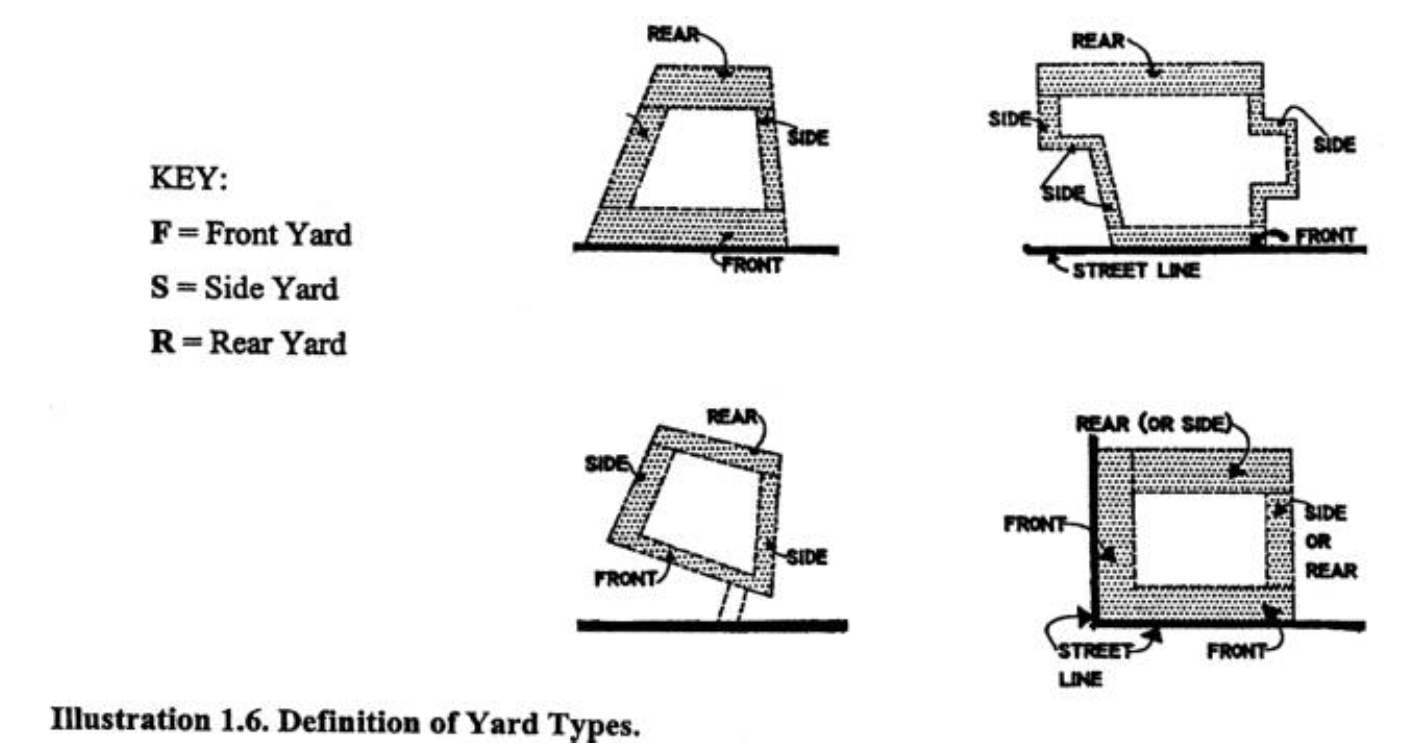
Definition of Yard Types
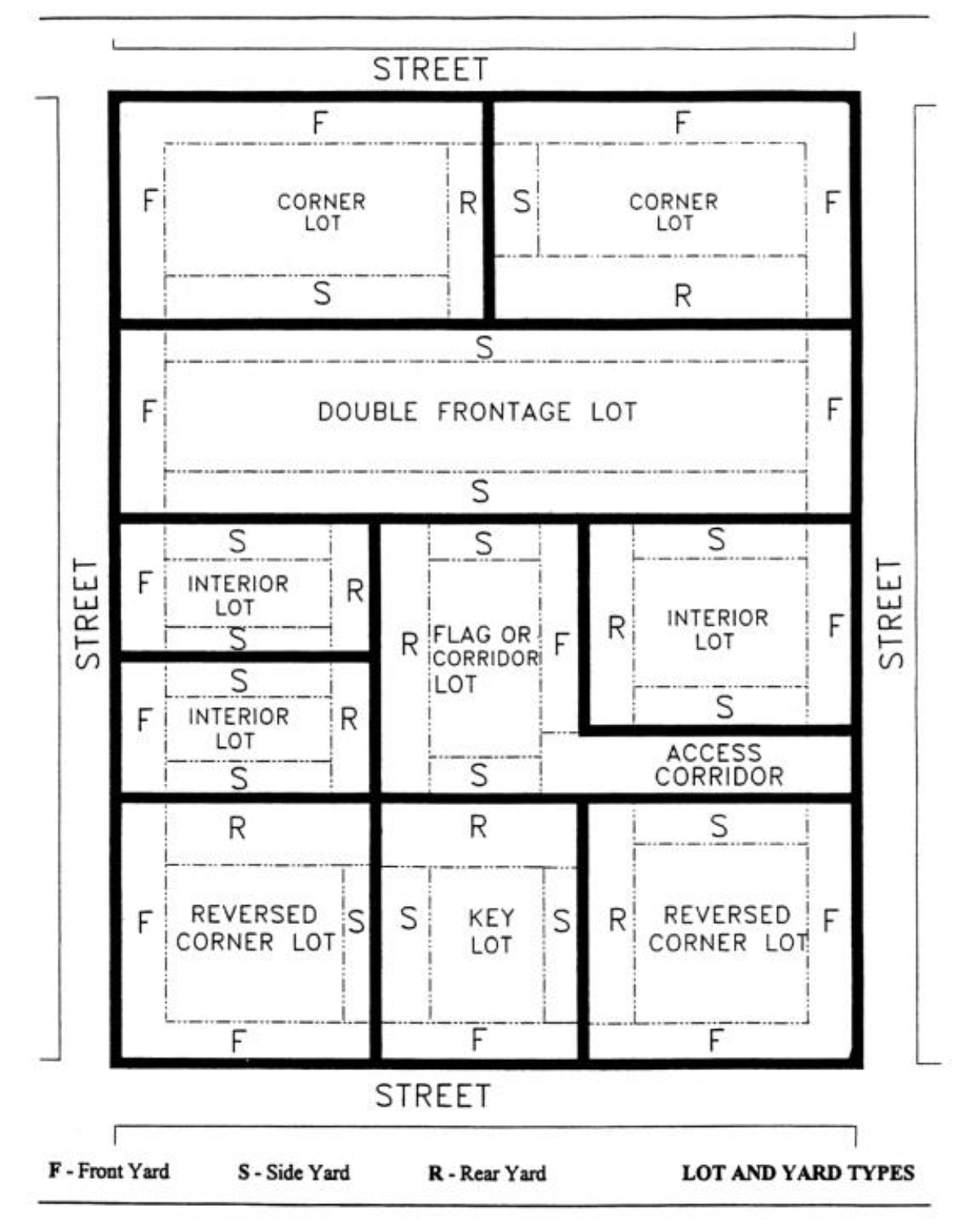
Lot and Yard Types
(Ord. No. 1367, § 1, 12-6-04; Ord. No. 1368, §§ 1, 2, 2-7-05; Ord. No. 1614, § 1, 3-1-10; Ord. No. 1665, 10-3-11; Ord. No. 1685, Sched. D, 8-6-12; Ord. No. 1726, Sched. A, 12-2-13; Ord. No. 1751, Sched. A, § 1, 8-6-14; Ord. No. 1820, Sched. B, 6-5-17; Ord. No. 1857, Sched. A, 4-15-19; Ord. No. 1886, Sched. C, 1-17-20; Ord. No. 1899, Sched. A, 7-6-20; Ord. No. 1918, Sched. A, 10-4-21; Ord. No. 1927, 1-18-22; Ord. No. 1931, 5-3-22; Ord. No. 1940, 8-1-22; Ord. No. 1944, 9-19-22; Ord. No. 1969, 6-5-23; Ord. No. 1975, 9-19-23)

