
New Haven City Zoning Code
ARTICLE IV
RESIDENCE DISTRICTS: GENERAL PROVISIONS
In addition to the requirements contained elsewhere in this ordinance, the following provisions shall apply to all areas of the city contained within any residence district.
Section 21. - Conversion to a greater number of dwelling units and/or rooming units.
No existing building shall be converted to a greater number of dwelling units and/or rooming units unless in compliance with the requirements contained in the District Regulations for lot area per dwelling unit, lot area per sleeping room, lot area per square foot of gross floor area, and usable open space, and unless in addition:
(a)
One additional off-street parking space is provided for each dwelling unit in the building added by conversion (except that only one parking space shall be required for each two elderly housing units) and one off-street parking space is provided for each three beds in the building after conversion in the case of a rooming, boarding or lodging house. Such off-street parking spaces shall be provided on the same lot as the building being converted or (except in RS Districts) within 300 feet walking distance of an outside entrance to the dwelling unit or rooming units to which such parking space is assigned.
(b)
Stairways leading to the second or any higher floor are located within the walls of the building wherever practicable, and stairways and fire escapes are otherwise located on the rear wall in preference to either side wall and in no case on a front wall or side wall facing a street.
(Ord. No. 1918, Sched. A, 10-4-21)
Section 22. - Accessory Dwelling Units.
Accessory Dwelling Units are permitted within the RS-1, RS-2, RM-1, and RM-2 Zoning Districts and subject to the regulations of this Section and the bulk regulations of the subject zone if not expressly modified by this section.
A.
PURPOSE AND INTENT.
a.
Create new housing units while respecting the look and scale of neighborhood patterns of development.
b.
Increase affordable housing choices especially for very low-income residents.
c.
Support more efficient use of existing housing stock and infrastructure.
d.
Offer environmentally friendly housing choices with less average space per person and smaller associated carbon footprints.
e.
Provide housing that responds to changing family needs, smaller households, and increasing housing costs; and
f.
Provide accessible housing for seniors and persons with disabilities.
B.
APPLICABILITY. Accessory dwelling units are allowed in the following zone districts: (RM-1, RM-2, RS-1, and RS-2, subject to the provisions of this section.
C.
UNDERLYING ZONING AND DENSITY. Unless specifically addressed in this section, accessory dwelling units (ADUs) are subject to the regulations for a principal building and accessory buildings of the underlying zone district with regard to lot and bulk standards (e.g., height, setback/yard requirements, building coverage).
1.
Where permitted pursuant to this Section 22, one accessory dwelling unit may be permitted on a lot in addition to the principal single-family or multi-family dwelling. Other permitted accessory buildings or uses, as defined herein, may be allowed in addition to the principal single-family or multi-family dwelling. If, with the addition of an ADU, the total number of residential dwelling units exceeds four a special exception is required.
2.
Accessory dwelling units shall be subject to the same zone district height limitations and setbacks as applicable to the principal dwelling on the property. An existing accessory structure whose height or setback(s) does not meet the requirements for a dwelling in the zone district may be converted into an accessory dwelling unit, but the structure may not be altered in any manner that would increase the degree of non-compliance.
3.
If an existing accessory structure is deemed inappropriate for conversion, a new accessory dwelling unit may be constructed within the Building Envelope Dimensions of the existing structure. The Delay of Demolition Ordinance applies for contributing historic structures.
4.
Accessory dwelling units shall not be considered a unit of density and therefore are not included in the density calculation for a single-family residential property.
5.
There shall be no minimum required off street parking for an ADU.
D.
METHODS OF CREATION.
1.
An ADU may be created within an existing principal structure or in an accessory structure or within the Building Envelope Dimensions thereof. An ADU shall confirm to Design Standard in Paragraph D below and all other requirements of Section 22.
E.
DESIGN STANDARDS.
1.
Lot Standards: The minimum lot size for a lot that has both a primary dwelling unit and an accessory dwelling unit is 4,000 square feet.
2.
Lot Coverage: Any Property with an ADU shall comply with all Building coverage standards applicable to the Zoning District in which the Property is located.
3.
Floor Area: the ADU shall always be smaller or equal to than a primary dwelling unit located within the principal structure:
4.
Living Area: an ADU shall have a minimum livable area of area of not less than 400 square feet. An ADU shall have a maximum gross floor area of not more than 1,200 square feet or size of principal dwelling, whichever is smaller.
5.
Height Internal ADUs shall not exceed the existing height of the principal structure. If dormers or roof alteration are required for making an attic space comply with building code, the alterations shall comply with underlying zoning or seek a variance.
6.
Detached ADUS will not exceed the height of an existing accessory structure or that structures Building Envelope Dimensions. If raising the roof height is necessary to make an accessory structure habitable, the alterations shall comply with underlying zone or seek a variance.
7.
Setbacks: All applicable setbacks of the Zoning District in which the property is located shall apply.
8.
Compliance with requirements of a Local Historic District: For any Property located in a Local Historic District; a certificate of Appropriateness for any ADU visible from any public road or way, issued by the Historic District Commission is required.
F.
ADMINISTRATION AND APPROVAL.
1.
Application Information. Prior to constructing an ADU, an owner shall file an application in a form approved by the City of New Haven Building Department. The information required on the applications for creating or legalizing an ADU shall be the same information that is required to construct a single-family dwelling unit. The application shall demonstrate that the proposed ADU:
a.
Complies with all development and design standards of this section.
b.
Complies with applicable Building and Fire Safety Codes.
c.
Does not have current Housing Code violations.
d.
Water supply and sewage disposal facilities are adequate for the projected number of residents.
2.
Occupancy and Use. Occupancy and use standards for an ADU shall be the same as those applicable to a primary dwelling on the same site.
3.
Approvals the Building Official, City Plan, and Engineering Departments shall evaluate the application for the proposed ADU for compliance with the standards of this subsection.
4.
City Plan Site Plan review exemption. An ADU, in accordance with Section 22, shall not require Site Plan review.
G.
PROPERTY OWNERSHIP AND OCCUPANCY.
1.
Accessory dwelling units shall only be permitted when the property owner lives on the property, within either the principal dwelling or accessory dwelling unit. Before issuance of an approved permit or certificate of occupancy, the owner shall submit a notarized letter stating that he/she will occupy one of the dwelling units on the premises as a primary residence except for:
2.
A bona fide, temporary absence of three years or less for activities such as temporary job assignments, sabbaticals, or voluntary service (indefinite periods of absence from the dwelling shall not qualify for this exception); or
3.
Admittance to a hospital, nursing home, assisted living facility or other similar facility.
H.
DEED RESTRICTION. Before obtaining a building permit for an accessory dwelling unit, the property owner shall file with the New Haven City Clerk's office in a form acceptable to the New Haven City Clerk, a declaration of restrictions in reference to the deed under which the property was acquired by the present owner stating:
1.
That either the principal or accessory dwelling unit on the property shall be occupied by the owner of the property.
2.
The accessory dwelling unit shall not be sold separately from the principal dwelling unit, nor shall the lot be subdivided to provide a separate lot for the accessory dwelling unit.
3.
The above restrictions shall run with the land and are binding upon any successor owner of the property.
4.
The deed restrictions shall lapse upon removal of the accessory dwelling unit. Upon verification of such removal, the City Clerk shall record appropriate documentation releasing such encumbrance. Any fees associated with such release shall be borne by the property owner.
(Ord. No. 1918, Sched. A, 10-4-21)
Editor's note— Ord. No. 1726, Sched. A, adopted Dec. 2, 2013, repealed former § 22 in its entirety which pertained to garden apartment buildings and derived from the 2003 republication of the zoning ordinance.
Section 23. - Residential principal buildings and rooming, boarding and lodging houses; size of courts and distance between buildings.
The following requirements shall apply to any one or more of such buildings constructed after the effective date of these regulations.
(a)
Minimum horizontal distance between facing walls of acourt:
(1)
Where both facing walls contain a window or windows; such distance shall be no less than 1.5 feet for each foot of average height, above the lower horizontal surface of the court, of the facing wall having the greater average height.
(2)
Where only one of the facing walls contains a window or windows: such distance shall be no less than one foot for each foot of average height, above the lower horizontal surface of the court, of the facing wall that has no windows.
(3)
Where neither of the facing walls contains a window or windows: such distance shall be no less than five feet.
(b)
Minimum horizontal distance between two unattached buildingsin single ownership located on a single lot: where any exterior wall of one building lies such that it can be intersected by a line drawn perpendicular to an exterior wall of the other building, such distance shall be 0.5 ft. for each foot of average building height of the taller of the twobuildings up to a maximum distance of 35 ft.
(Ord. No. 1726, Sched. A, 12-2-13)
Section 24. - Accessory buildings.
(a)
All accessory buildings shall be subject to the provisions of section 25 with regard to location within required yards and to the District Regulations with regard to buildingcoverage.
(b)
No accessorybuilding shall have an average height of more than 12 feet for any portion of such accessory building that is located within a required yard. Any portion of an accessorybuilding that is not located within a required yard may have such greater height as is permitted by the District Regulations. See illustration at end of this section.
Section 25. - Structures within required yards utility meter, transformer or similar device placement.
(a)
No wall of a building shall extend beyond the outer face of a building foundation wall into a required yard for more than six inches.
(b)
A projection from a building may extend into a required yard for not more than one-third of the width of such required yard, but in no case more than five feet into such required yard for fire escapes, one-story open porches and steps leading up to the ground floor, or three feet into such required yard for all other projections, and in no case to within five feet of any lot line.
(c)
Fences and enclosure walls located in required yards shall not exceed eight feet in height.
(d)
No accessorybuilding shall be located within any required frontyard, except as provided in subsection 29(c) An accessorybuilding may be located within any required sideyard or rearyard, provided that no part of such accessorybuilding shall extend within five feet of any side lotline if located within a required sideyard, or within five feet of any required sideyard located on an adjoining lot, and in no case shall any accessorybuilding be closer than two feet to any lotline unless it is built directly on such lotline. (The Building Code should also be consulted on distance of structures from lotlines.) A one-story garage for storage of passenger cars that is on its own lot in an RM, RH or RO District may be located within required yards according to the standards of this subsection (d).
(e)
No utility meter, electric transformer, or other similar device shall be placed on the street facade of any residential structure, or within any frontyard in any residential district, except by variance from the board of zoning appeals, which shall make a written finding that a street facade of a structure or front yard is the only physically practicable location, and that the proposed installation is architecturally integrated with the structure or is so landscaped as to harmonize with the surroundings.
Upon a written determination by the zoning enforcement officer that the meter or device
is provided with evergreen landscaping, fencing, or other means of buffering so that
the proposed installation is architecturally integrated with the structure or is so landscaped as to harmonize with the surroundings, a single structure with
one to four dwelling units and not part of a larger development shall not be subject to this requirement. See
illustration at end of this section.
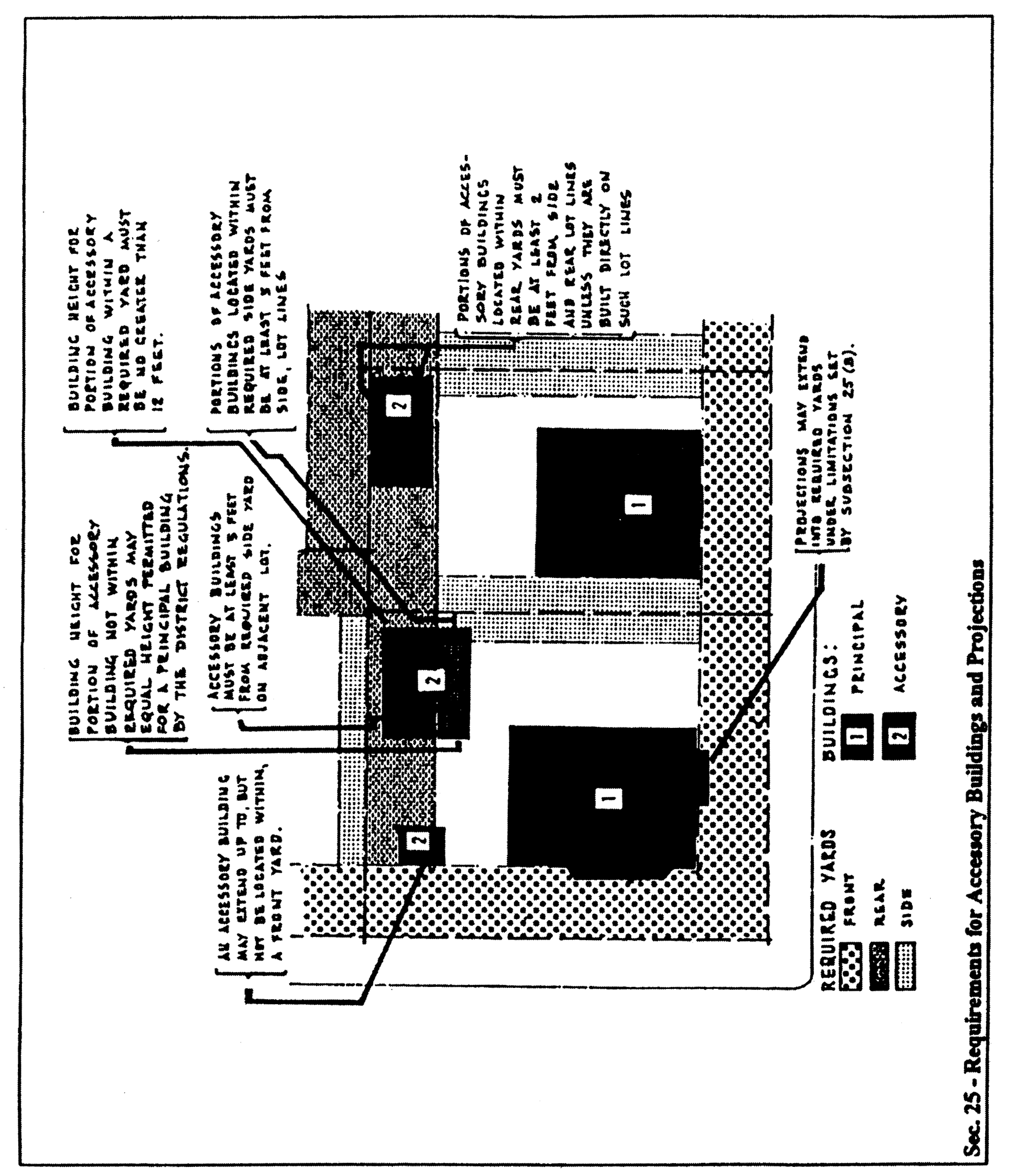
Requirements for Accessory buildings and Projections
Section 26. - Fences and enclosure walls.
Fences and enclosure walls shall be subject to the provisions of section 25 if located within a required yard, and to the provisions of section 28 relating to corner visibility.
Section 27. - Reserved.
Editor's note— Ord. No. 1871, adopted September 3, 2019, repealed § 27, which pertained to signs and derived from original Code material. Similar provisions can be found in section 60.3.
Section 28. - Corner visibility.
On a corner lot in any residence district, other than the RH-2 District, no planting
shall be placed or maintained, and no fence, building, wall or other structure other
than necessary retaining walls shall be constructed after the effective date of these
regulations, if such planting or structure thereby obstructs vision at any point between
a height of two and one-half feet and a height of ten feet above the upper face of
the nearest curb and within the triangular area bounded on two sides by two street
lines, or by projection of such lines to their point of intersection, and on the third
side by a straight line connecting points of such street lines (or their projections)
each of which points is 25 feet distant from the point of intersection of the two
street lines. Poles, posts, and guys for street lights and for other utility services,
and tree trunks exclusive of leaves and branches, shall not be considered obstructions
to vision within the meaning of this provision.
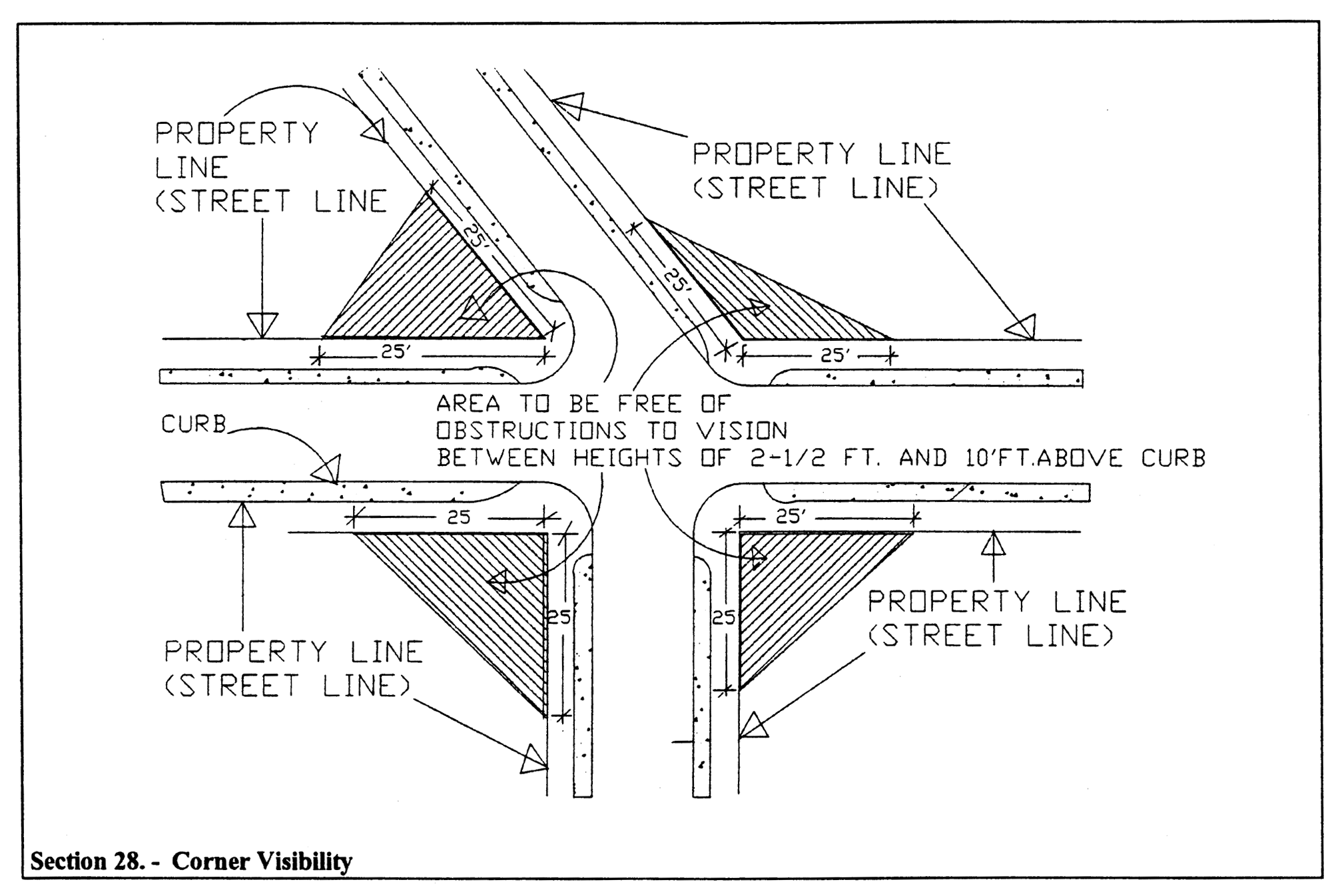
Corner Visibility
(Ord. No. 1726, Sched. A, 12-2-13)
Section 29. - Parking.
(a)
In any residence district parking spaces and bicycles spaces shall be provided in the amount and location specified by the regulations of that district. Where parking requirements are expressed as a ratio to beds, employees, floor area, etc., any fraction of the stated amount of beds, employees, floor area, etc., shall require one parking space or bicycle space, but after the first such parking space or bicycle space, only a fraction of ½ or greater shall require an additional parking space or bicycle space.
(b)
All parking spaces shall be 9 feet × 18 feet exclusive of adequate driveways and aisles, except, thirty (30%) of all parking spaces may be compact car spaces if located in a parking lot or structure that contains 20 or more parking spaces. All parking spaces shall have direct access to a circulation aisle, alley or street, be suitably surfaced and drained and be provided with bumper or wheel guards where needed. All parking areas containing three or more parking spaces shall include a turnaround designed and located so that vehicles can enter and exit the area without backing into the public right-of-way.
(c)
No parking space shall be located within any required front yard, except that: parking spaces (whether enclosed or not) may be permitted to be located within a required front yard by special exception under subsection 63(d) of this ordinance upon finding, among other things, that such parking spaces are necessary to the use with which they are connected, that they cannot be practically located elsewhere on the lot, that their location within a required front yard will not depreciate property values or cause vehicular or pedestrian traffic hazards or substantially decrease the open aspect of the street, and that such parking spaces are properly screened and otherwise arranged in accordance with the requirements of this ordinance.
A parking space or bicycle space may be located within a required side yard or rear yard, provided that no such parking space or bicycle space shall extend within two feet of any side of any side lot line or rear lot line; but a parking space or bicycle space within an accessory building shall follow the requirements of section 25 as to location within required side and rear yards.
(d)
A site shall provide two bicycle spaces for the first ten required or proposed parking spaces and one additional bicycle space for each additional ten required or proposed motor vehicle parking spaces or fraction thereof.
In any case of a use in a residence district for which ten or more motor vehicle parking spaces are required one bicycle parking space may be substituted for one motor vehicle parking space per each ten required motor vehicle parking spaces or fraction thereof.
(e)
Bicycle parking spaces shall comply with designs approved by the City of New Haven Department of Transportation, Traffic and Parking and at a minimum must provide a bicycle rack that permits the locking of a bicycle frame and one wheel while supporting the bicycle in a stable position that will not damage the bicycle or its components or interfere with pedestrian access to the sidewalk and ingress and egress to buildings or facilities. Required bicycle parking spaces are also subject to the additional following standards:
(1)
Short-term bicycle parking is intended to encourage bicycle use for shoppers, customers and visitors by providing convenient bicycle parking located adjacent to main entrances of buildings. It should be located within 50 feet of each main building entrance as measured by the most direct pedestrian access route.
(2)
Long-term bicycle parking provides safe and weather protected places for users requiring longer periods of bicycle storage such as residents, employees and students. Specific requirements include:
a.
Long-term bicycle must be located on or within 100 feet of the site.
b.
At least 50 percent of required spaces must be covered.
c.
The area must be locked or secured.
(3)
Short and long range parking by use.
a.
Multi-family residential: Short term—10%, long term—90%
b.
Retail, restaurant: Short term—66%, long term —33%
c.
Office: Short term—20%, long term—80%
d.
Manufacturing and warehouse: Long term—100%
e.
Medical uses: Short term—66%, Long term—33%
f.
Other uses: To be determined by City Plan Commission
(f)
In the case of any use in a residence district for which three or more parking spaces are required, all parking spaces not within a building shall be provided with a suitable fence, wall or evergreen planting at least five feet in height, designed to screen noise, odors, visibility and headlight glare, and located between such parking spaces and any other lot in a residence district that abuts directly or across a street or alley. This requirement shall not apply to parking spaces located on a lot owned by a public housing authority.
(g)
All artificial lighting used to illuminate any parking space or spaces shall be so arranged that all direct rays from such lighting fall entirely within such parking space or spaces and shall comply with the requirements of Section 60.1 of these regulations regarding exterior lighting.
(h)
No sales or servicing or dead storage of automobiles or automotive equipment shall be carried on in any parking space.
(i)
The Board of Zoning Appeals shall have the power to lessen the requirements of this ordinance as to the number of parking spaces required and/or increase the maximum allowable walking distance to such parking spaces, but only upon a finding that either particular circumstance or mitigative measures qualify such action. Particular circumstance may include, but not be limited to availability of public parking, proximity to public transit or significant levels of pedestrian access. Mitigative measures may include, but not be limited to van and/or car pooling, public parking validation programs, flexible work schedules or other transportation demand management measures. All deviations from normal requirements by means of this paragraph shall be considered as special exceptions under subsection 63(d) of this ordinance. In the case of any religious or educational institution or any hospital, which has an overall parking plan for all of its facilities which has been approved by the Board of Zoning Appeals, the limit of 300 feet walking distance shall not apply. Amendments to a parking plan that covers an area which include a planned development must be submitted for approval per section 65 of this ordinance. All deviations from normal requirements by means of this subsection 29(i) shall be considered special exceptions under subsection 63(d) of this ordinance, and the Board of Zoning Appeals may impose time limits where it finds that the continued adequacy of such other parking standards cannot be fairly predicted.
(j)
Where it is proposed that two or more uses for which a parking space or spaces are required make joint use of the same parking space or spaces, such joint use shall not be permitted unless:
(1)
A special exception is granted under the provisions of subsection 63(d), upon a finding, among other things, that the proposed joint use of parking will meet the requirements of this ordinance for the two or more uses involved at the time when such uses are in operation.
(k)
Two parking spaces may be subtracted from the quantity of parking spaces required for a use or a structure for each carsharing parking space provided in a parking lot or structure containing 50 or fewer parking spaces serving such use or structure, provided, however, that in no event shall the number of parking spaces provided for a use or a structure (excluding carsharing parking spaces) be reduced by more than five percent of the parking spaces required for such use or structure. Five parking spaces may be subtracted from the quantity of parking spaces required for a use or a structure for each carsharing parking space provided in such parking lot or structure containing in excess of 50 parking spaces, provided, however, that in no event shall the number of parking spaces provided for a use or a structure (excluding carsharing parking spaces) be reduced by more than ten percent of the parking spaces required for such use or structure. Fifty percent of carsharing parking spaces at the same location may be compact parking spaces.
(l)
Once any required parking space has been established within the provisions of this section 29, whether on the same lot as the structure or use to which it is assigned or on a separate lot, such parking space shall not be discontinued if the result would be a reduction below the amount of parking required by this ordinance. Any such discontinuation of a parking space shall constitute a violation of this ordinance, and any existing building permit or certificate of occupancy that could not have been issued without the assignment of such parking space to the structure or use for which it was issued shall become null and void.
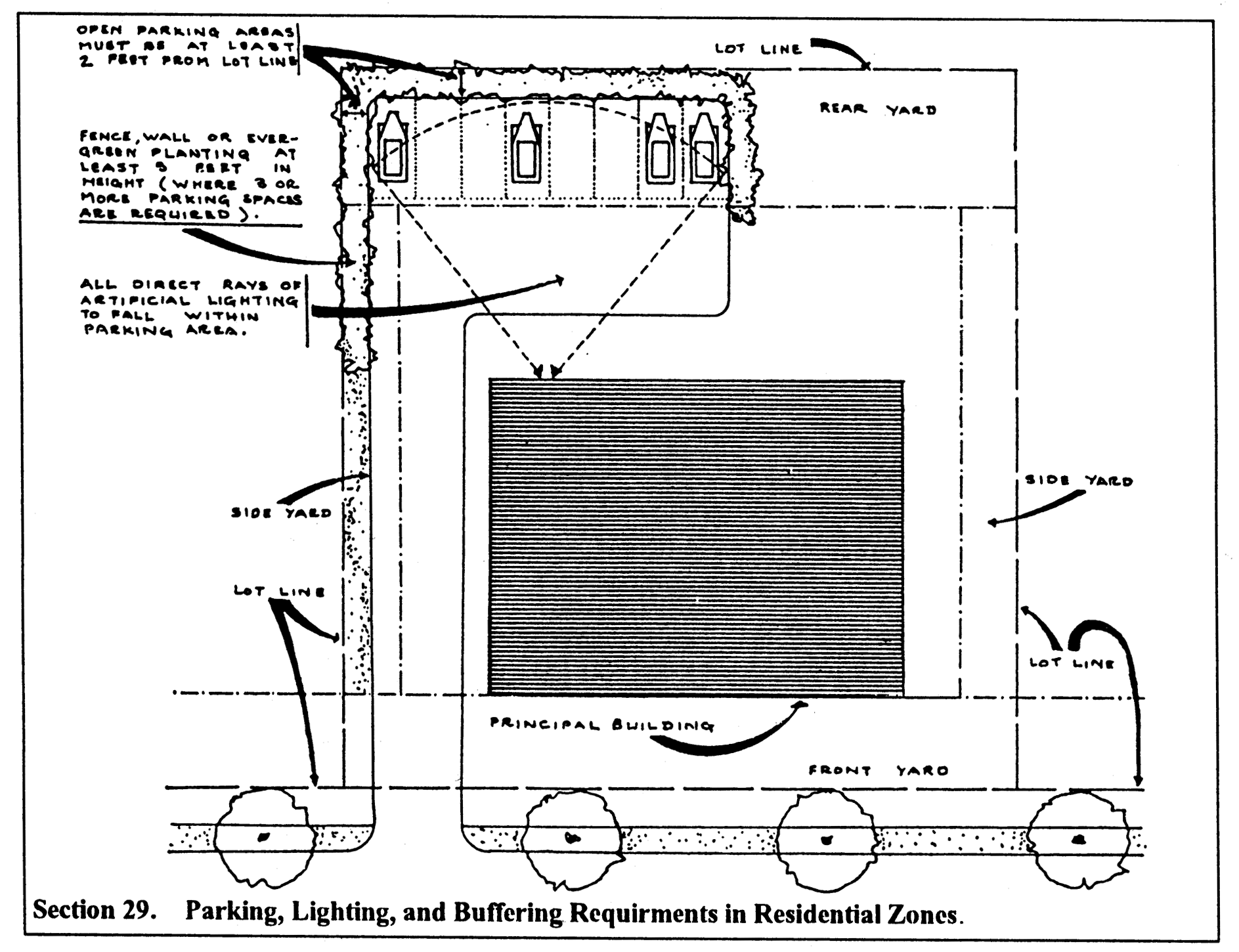
Parking, Etc., Requirements in Residential Zones
(Ord. No. 1357, § 3, 9-7-04; 1662, 9-19-11; Ord. No. 1685, Sched. D, 8-6-12; Ord. No. 1726, Sched. A, 12-2-13)
Section 30. - Parking trucks in residential zones.
No person having the custody and control of a vehicle or vehicles with capacities of more than half-a-ton, shall be permitted to park on any street in any residential zone at any time of the day or night. However, such vehicles shall be permitted in residential zones when in the conduct of a service being simultaneously performed.
Any operator or person operating such vehicle or vehicles in violation of the above provisions shall be subject to a penalty as set forth in section 30, herein.
(Ord. of 1-6-75; Ord. of 3-7-88, § 12)
Section 31. - Special provision for convenience goods and services in residence districts.
(a)
Statement of purpose. This provision exists to provide for the continued availability in certain residential neighborhoods of convenience goods and services to meet the daily needs of neighborhood residents within a short distance of their homes. It is intended that the uses allowed be limited to those which are both necessary to the neighborhood and so arranged that they will cause minimum conflict with the residential character of the area.
(b)
Uses provided for. Where provided for in the District Regulations, the supplying of any of the following convenience goods and services, entirely at retail, shall be considered a use which may be permitted by special exception under the conditions of this Section 31:
(1)
Convenience stores, groceries and related goods, including incidental seating for a maximum of six people. No additional parking shall be required for incidental seating.
(2)
Baked goods, including incidental seating for a maximum of six people. No additional parking shall be required for incidental seating.
(3)
Package liquor, subject to section 42.1 of this zoning ordinance.
(4)
Drugs or cosmetics, with or without an incidental soda fountain or lunch counter.
(5)
Barbering.
(6)
Beautician services.
(7)
Laundering, cleaning, dyeing, with all business at retail on the premises, including pick-up station and any self-service laundromat.
(8)
Tailoring.
(9)
Shoe repair.
(10)
News.
(11)
Accessory uses, customarily incidental to the above permitted uses, occupying no more than 25 percent of the gross floor area of the establishment.
(12)
One or two game machines as an accessory use provided the hours of operation shall not exceed those of the principal use, and meeting the general standards of subsection 42.2(b) of this zoning ordinance.
(13)
Seasonal outdoor seating for a maximum of 15 seats may be provided on private property as an accessory use to shops selling baked goods, and groceries and related goods, and convenience stores. A maximum of 15 indoor and outdoor seats is permitted and no additional parking shall be required for seasonal outdoor seating. The City Plan Commission may adopt administrative regulations regarding the placement, spacing and storage of tables and chairs and other operational limits as it deems necessary. Special consideration shall be given to the placement, spacing and storage of tables and chairs and other operational limits on outdoor seating that is proposed to extend into the public right-of-way.
(c)
Existing uses of the above types may continue, but:
(1)
The rules of subparagraph 67(c)(6).b of this ordinance shall determine whether any use has been abandoned, and any such use that has been abandoned shall not be reestablished except as a new use under subsection (d) below.
(2)
Conversion from one of the above permitted uses to another such use shall be considered the establishment of a new use under subsection (d) below.
(3)
No alteration of a structure or of the remainder of the premises shall be made which creates or increases any nonconformity under the provisions of this ordinance.
(4)
Any expansion of the amount of floor area and/or lot area occupied by the use or by functions incidental to it (such as parking and loading) shall be subject to the provisions of subsection (d) below.
(d)
New uses of the above types may be established, and existing uses expanded, only by special exception under subsection 63(d) of this ordinance, subject to the following standards in addition to others which may be applicable:
(1)
There must be a finding by the City Plan Commission that space for such a use is not available in nearby areas which are zoned for business, and that such new use or expansion of an existing use is necessary to serve the immediate neighborhood adequately with convenience goods or services, giving due consideration, among other things, to the character of the neighborhood, the density of development, the shopping habits of neighborhood residents, and the availability of public and private transportation. The clustering of two or more uses of diverse types, rather than scattering of such uses, shall generally be regarded as an advantage, but the existence nearby of a use of the same type as one which is proposed shall require a more extensive showing of necessity for the proposed use. As a general rule, clustering of uses shall not exceed 10,000 square feet of net floor area for all uses in a cluster.
(2)
The net floor area used for sales or other business purposes in any establishment (excluding space used for storage and similar purposes) shall not exceed 1,500 square feet.
(3)
In the case of new construction and additions and alterations, the yard requirements and other applicable Building Requirements in the District Regulations shall control.
(4)
If the City Plan Commission determines that off-street parking is necessary, such parking shall be supplied in the quantity specified by the City Plan Commission, complying with the standards of section 29 of this zoning ordinance.
(5)
No business shall be conducted, and no goods, materials or equipment shall be stored, except in a fully enclosed building.
(6)
Establishments of the "drive-in" type, offering goods or services directly to customers waiting in parked vehicles, shall not be permitted.
(7)
The exterior presentation and design of storefront(s) shall be submitted as part of the special exception review. The following shall not be allowed on the exterior of a building or grounds: telephones, on-premises or off-premises signs, banners, or temporary advertising materials except those permitted pursuant to section 29(a)(9) [these regulations]; security gates covering window and door openings; and vending machines.
(8)
The ground-floor storefront shall consist, at a minimum, 50% non-opaque visible windows.
(9)
The establishment shall maintain the property free of trash and debris, shall provide a regular maintenance schedule.
(e)
All uses permitted by this section shall comply with the requirements for signs in section 27 of this zoning ordinance.
(Ord. No. 2024-0034, 3-17-25)
Section 32. - Standards for flag or corridor lots in RS-1 and RS-2 Residence Districts.
(a)
Supplemental statement of purpose.This provision exists to protect the character, privacy and fabric of established single family residential neighborhoods in the City of New Haven, and recognizes that the effects of development of residences on flag or corridor lots poses unique problems which require additional standards to assure compatibility with existing surrounding uses.
These additional standards for review exist in order to protect neighborhoods, to minimize conflicts with adjacent uses and the surrounding area, to assure the health and safety of the public by providing adequate buffering and parking on site, to provide adequate circulation within and egress from the premises, and to assure compatibility with surrounding uses by incorporating building massing, design, and materials which are compatible with surrounding structures.
(b)
Usesprovided for. The development of flag or corridorlots shall be permitted by special exception under the standards of subsection 63 and the additional standards of this section 32.
(c)
Additional standards for review of flag or corridor lots.
(1)
The effect of interior and exterior noise on immediate neighbors and other nearby uses.
(2)
Architectural compatibility with existing area structures in terms of scale, massing and materials.
(3)
The adequacy of on-site parking and potential impacts on adjacent or nearby residential uses.
(4)
The placement and adequacy of landscaping, fencing, lighting and other exterior features which may affect the privacy of the subject property and abutting land uses.
(d)
Building requirements.
Minimum lotarea: 7,500 sq. ft.
Minimum averagelotwidth: 60 feet.
Maximum buildingcoverage: 30%, including accessory structures.
Maximum buildingheight: Such height shall not exceed three stories or an average height of 35 feet.
Minimum distance between principalbuildings: There shall be a minimum distance of 50 feet from an abutting pre-existing residential principal structure regardless of property lines.
Yards:
Front and rearyards: 25 feet.
Sideyards: 15 feet.
Minimum buildable area: A rectangle, excluding required yards, having a minimum dimension of not less than 30 feet by 75 feet.
Maximum impervious surface coverage: Total building and paved area (parking and walk-ways) shall not exceed 70% of the lot area.
(e)
Access and parking.
(1)
Parking: One parking space for the first bedroom, and ½ parking spaces for each additional bedroom, rounded to the next higher number if a fraction. All parking spaces shall be located on the same lot, a minimum distance of two feet away from any adjacent residential property, and shall conform to section 29 and the remainder of the General Provisions for Residence Districts in Article IV.
(2)
Access corridor: A flag or corridorlot shall be connected to a street by an access corridor having a width of not less than 16 feet nor more than 25 feet, and a length not more than 250 feet. The area of the access corridor shall not be included in determining the lot area.
(f)
Buffering and landscaping.
(1)
Buffer: Any parking area with three or more cars shall be provided with a planting screen and suitable fence providing year round screening to shield cars from view from surrounding properties, and shall be maintained in good condition. The space between parking and any such planting screen or fence shall be landscaped with grass, shrubs or evergreen ground cover and maintained in good condition.
(2)
Site perimeter: If residential uses abut the site, any lotline between the residential uses shall be provided with a planting screen and suitable fence providing year round screening, and shall be maintained in good condition.
Section 33. - Wireless communications in residence districts.
Regulation of wireless communications in residence districts shall be subject to the policies and standards of section 49 of this ordinance.
Section 34. - Keeping of hens.
(a)
Statement of purpose. This regulation is intended to make provision for the limited keeping of female chickens, henceforth referred to as hens, on certain residential properties for the health, convenience and personal enjoyment benefits afforded by such use, in a manner which preserves the quality of life of the surrounding neighborhood.
(b)
No more than six (6) hens may be kept on any property located in the following residence zoning districts as a non-commercial accessory use:
RM-2
RS-1
RS-2
RM-1
(c)
The use shall be confined to a fenced enclosure of no more than 200 square feet in area, located in a rear yard. The fenced enclosure shall be at least 25 feet from any street line, at least 15 feet from any residential dwelling and at least five feet from any property line. In the instance that more than one distance requirement shall apply, the greater distance requirements shall apply.
(d)
Any portion of the enclosure located closer than ten feet to a property boundary or directly visible from a street line at any distance shall be screened by either a fence or a landscaped buffer of at least four feet in height.
(e)
A building shall be required for the hens. Any building used for this purpose shall be located at least ten feet from any lot line. All such buildings shall be constructed and all food products kept so as to prevent offensive odors and the presence of pests and predators.
(f)
No hens may be kept inside any structure used for residential purposes.
(g)
No rooster shall be kept on any property.
(h)
The keeping of hens shall be conducted in a manner consistent with and in compliance with the Health Code of the City of New Haven.
(Ord. No. 1598, § 1, 9-8-09)

