
New Haven City Zoning Code
ARTICLE III
RESIDENCE DISTRICTS: DISTRICT REGULATIONS
Section 11. - RS-1 Districts: Special Single-Family.
Description and purpose. These districts exist for the protection of certain fully developed single-family areas of relatively small total size but of unique and irreplaceable value to the community as a whole. The specific purpose of these districts is to stabilize and preserve the low-density residential character of these areas to the maximum possible extent. To this end the use of land and buildings within these areas is limited primarily to single-family homes. The particular character, size and surroundings of these areas create little need for the location within their boundaries of further such non-residential uses as generally support a low-density residential area, and the location of any further such uses within these areas would undesirably limit or diminish the number of homes in them. It is hereby found and declared that these regulations are necessary for the protection of these areas and that their protection is essential to the maintenance of a balanced community of sound residential areas of diverse types.
All RS-2 Districts are subject to the general provisions for residence districts set forth in Article IV as well as to all other provisions of this ordinance.
Uses permitted. In an RS-1 District, a building or other structure may be erected, altered, arranged, designed or used, and a lot or structure may be used for any of the following purposes and no other:
(a)
Residential uses as follows. The General Provisions for Residence Districts in Article IV shall also apply.
(1)
Single-family detached dwellings. There shall be only one principal building on a lot. Building requirements:
a.
Minimumlot area: 4,000 sq. ft.
b.
Minimumaverage lot width: 50 ft., except for nonconforming lots under subsection 67(e).
c.
Maximumbuilding coverage: Total coverage of principal and accessory buildings not to exceed 30% of lot area.
d.
Maximumbuilding height: Such height shall not exceed either three stories or an average height of 35 feet.
Provided that, no point on a side or rear building wall shall be so located that it is closer to a side or rear lot line than one foot for each two feet that such point is above the average finished lot grade along such side or rear building wall.
e.
Minimumyards:
Front—25 ft., except that where 75% or more of the entire street frontage (in feet) on the same side of the same street between the nearest two intersecting streets has been developed with buildings with front yards smaller than 25 feet, the required front yard shall be the same as the yard presently followed by existing buildings along the greatest quantity of street frontage (in feet).
Rear—25 ft.
Side—One at least eight ft. and the other at least twelve ft.; in the case of a corner lot, at least eight ft. for the one side yard.
f.
Minimum parking: One parking space for the first bedroom, and one-half parking space for each additional bedroom, rounded to the next higher number if a fraction. All parking spaces shall be located on the same lot, and shall conform to section 29 and the remainder of the General Provisions for Residence Districts in Article IV.
g.
Maximum impervious surface coverage: Total coverage of building(s) and paved area (parking and walkways) shall not exceed 70% of the lot area.
(2)
Residential accessory buildings, structures and uses, as regulated by Section 22 above and by the General Provisions for Residence Districts.
(3)
Notwithstanding the foregoing, Section 22 applies to RS-1. Conversion of an existing building to a greater number of dwelling units by variance as follows:
Supplemental statement of purpose: Preservation of the unique residential character of RS-1 District areas requires that variances for uses not allowed in these districts be granted only where absolutely necessary and only for the least possible departure from the provisions of these districts. Any other provision of this ordinance to the contrary notwithstanding, no variance shall be granted from the use regulations of these districts except for conversion of existing buildings to a greater number of dwelling units in accordance with the standards of this section. These standards are hereby found and declared to be minimum standards for stabilizing and preserving the character of RS-1 District areas and their value to the community as a whole, and any variance of the use regulations of these districts other than in accordance with these standards is hereby declared to violate the spirit of this ordinance and the general purpose and intent of these regulations.
A variance for conversion of an existing building to a greater number of dwelling units may be granted only in accordance with the following standards:
a.
It must be clearly demonstrated that continued use of the building with its existing number of dwelling units would create such hardship as would practically destroy or greatly decrease its value, provided that:
1.
The evidence offered to demonstrate such hardship shall not relate to such deterioration of the building as would suggest its removal and reuse of the land for single-family detached dwellings in accordance with the provisions of these districts; and
2.
Before granting a variance for conversion of a principal building, the Board shall find that such hardship cannot be sufficiently mitigated by subdivision of the lot for one or more additional lots conforming to the standards of these districts for single-family detached dwellings or by conversion of an existing accessory building to a single-family detached dwelling where such subdivision or such conversion would have a lesser impact upon the surrounding area than would conversion of the principal building to a greater number of dwelling units in accordance with the standards of this paragraph (3).
b.
The building shall have been erected more than 30 years before conversion, and any increase of its gross floor area beyond 20% during the ten years immediately preceding conversion shall not be deemed to contribute to hardship under subparagraph 11(a)(3)a. or be considered in determining the maximum number of allowable dwelling units under subparagraph 11(a)(3)c. of this paragraph 11(a)(3).
c.
Notwithstanding the foregoing, Section 22 allows one ADU in accordance with Section 22 with no impact on density requirement. Any variance granted for conversion of a building to a greater number of dwelling units shall be for the minimum number of dwelling units necessary to mitigate the hardship and in no case for more dwelling units than are allowable under the requirement that the building and lot in question contain an average of:
1,500 sq. ft. of gross floor area;
7,500 sq. ft. of lot area; and
60 ft. of average lot width
per dwelling unit after conversion. (In the case of a corner lot, the width of the lot for purposes of this subparagraph 11.A.3.c shall be deemed to be the average of its two street frontages.)
d.
Off-street parking spaces shall be provided on the same lot as the building being converted equal to the number of dwelling units on the lot after conversion.
e.
Stairways leading to the second or any higher floor shall be located within the walls of the building wherever practicable, and stairways and fire escapes shall otherwise be located on the rear wall in preference to either side wall and in no case on a front wall or side wall facing a street.
f.
Except for the provision of stairways and fire escapes in accordance with the preceding subparagraph, there shall be no major structural change in the exterior of the building in connection with the conversion, and after conversion the building shall retain substantially the appearance it had before such conversion.
(b)
Non-residential uses as follows: The standards in paragraph 11(a)(1) above relating to minimum lot area, minimum average lot width, building coverage, minimum building height, and minimum yards shall apply to non-residential uses except as indicated below.
Accessory uses customarily incidental to the following uses are permitted in connection with such uses.
Parking spaces required by this ordinance for the following uses may be located (by special exception under subsection 63(d) of this ordinance) on a separate lot in any district in which the principal use is permitted, provided the standards of section 29 are met.
Section 29 relating to parking and all other pertinent sections of the general provisions for residence districts in Article IV shall apply to all such uses.
(1)
As of right:
a.
Parks and other facilities for passive recreation, and public playgrounds.
b.
Reservoirs, dams, public utility substations and pumping stations, telephone exchanges, police stations, fire stations and post offices, with no industrial activities or outside storage.
c.
Family daycare home, Group daycare home, Child daycare center
Child daycare centers meeting all licensing standards of the State Department of Health Services must provide one passenger drop-off/pick-up loading space for each 24 children or fraction thereof and one off-street parking space for each three employees.
All noise and other disturbing aspects of such uses shall be enclosed, screened, or otherwise controlled.
(2)
Where permitted by special exception under subsection 63(d) of this ordinance:
a.
Temporary uses and structures such as rental offices, booths for charitable purposes and parking for special events, with a time limit of not more than six (6) months.
b.
Peripheral expansion of existing institutions as follows:
Any of the following uses of land and/or buildings:
1.
Religious institutions;
2.
Public and private elementary and secondary schools meeting all requirements of the compulsory education laws of the State of Connecticut;
3.
Private and public colleges and universities (excluding trade and/or business schools); and
4.
Pre-school (nursery and day care center) programs when provided as part of the broader programs of such religious and educational institutions; and noise and all other possible disturbance aspects connected with the operation of such uses shall be enclosed, screened, or otherwise controlled to the extent that the operation of any such use shall not unduly interfere with the use and enjoyment of properties and streets in the surrounding area.
c.
When in existence on the effective date of the RS-1 District provisions, items in subsection 11.(b)(2)b. may be further developed and expanded as follows:
1.
Property owned by such an institution in an area designated as an RS-1 District on the effective date of such designation may be used and further developed by the institution owning it for its own religious or educational purposes, as of right, regardless of any other provision of this section 11. By special exception, such property may be used and developed by another religious or educational institution as described above, provided that such other institution shall not be allowed to expanded under clauses 2. and 3. below.
2.
Such an institution either (1) owning property in the RS-1 part of a block designated in whole or in part as an RS-1 District on the effective date of such designation, or (2) owning property in the non-RS-1 part of a block designated in part as an RS-1 District and acquired by the institution in accordance with the zoning regulations applicable to that non-RS-1 part of the block, may expand peripherally into and within the RS-1 part of that block by acquisition and use for its religious or educational purposes of any property that adjoins property owned by it under 11(b)(1) or 11(b)(2) above or acquired in accordance with this peripheral expansion provision.
3.
Such an institution may expand across a street in or into an RS-1 District as follows: once 50% of the land area in the block from which it is expanding (herein called the base block), as well as 75% of the linear frontage of the base block that abuts a particular adjoining block, is used for religious or educational purposes by one or more such institutions, then any one of such institutions owning and using for its religious or educational purposes 100,000 square feet of land in the base block and 100 feet of its linear frontage abutting the adjoining block may expand across the street into said adjoining block once it acquires and uses for its religious or educational purposes therein (1) as much of the linear frontage of said adjoining block that abuts upon the base block as necessary, when added to any of that frontage already being used by one or more such institutions for religious or educational purposes, to constitute 75% of that frontage, plus (2) as much additional and adjoining property in said adjoining block, when added to the frontage of the property acquired by the expanding institution, to constitute 100,000 square feet of land.
4.
Any property further developed or acquired by a religious or educational institution under the provisions of this sub-paragraph (c) may be used for religious or educational purposes only if the off-street parking requirements for such institution stated in the district regulations for RS-2 Districts are met.
5.
Nothing contained in this subparagraph shall be construed to prevent the use of property anywhere within an RS-1 District by a religious or educational institution as a single-family detached dwelling within the provisions of paragraph (a)(1) of this section; provided, however, that property so used shall not later be used for other purposes nor be used as a basis for expansion by that institution under clause 11(b)(2).c.2 of this subparagraph 11(b)(2)c.
RS-1 Special Single-Family
RS-2 General Single-Family
The two illustrations show typical construction in these districts, both in perspective
and in plan. Property lines are indicated by heavy dotted lines, and required yards
by dashed lines. The numbers on the plan refer to the various restrictions on size
and placement of structures. All these restrictions are the same for both districts.
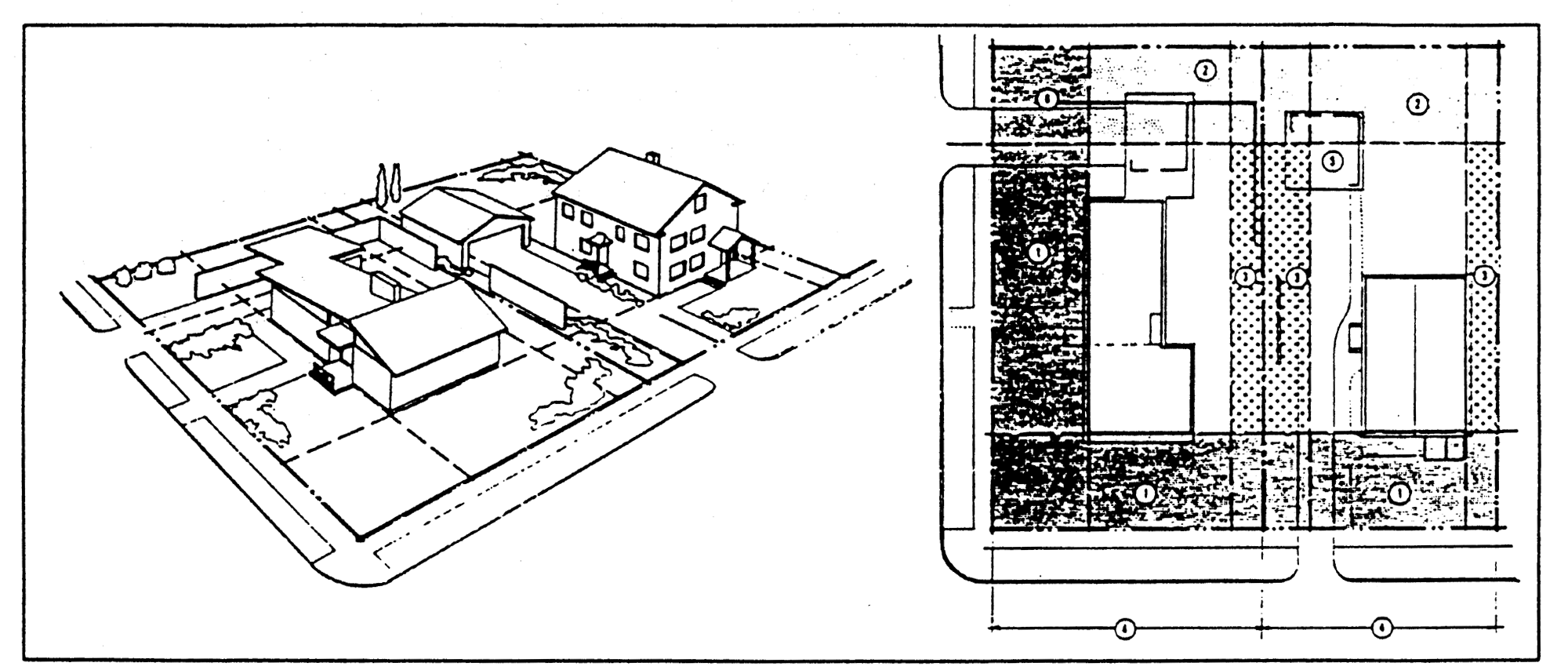
Special & General Single-Family
1 Minimum front yards: 25 feet.
2 Minimum rear yards: 25 feet.
3 Minimum side yards: one eight and one 12 feet. In the case of corner lots, at least eight feet for the one side yard.) Size of side yard is also related to height of building walls (see text of each district).
4 Minimum average lot width: 50 feet.
5 Accessory buildings may extend into side and rear yards (See General Provision for Residence Districts).
6 Fences may extend into all yards (See General Provisions for Residence Districts).
Other Requirements:
Minimum lot area: 4,000 square feet.
Maximum buildingcoverage (all buildings): 30% of lot area.
Maximum buildingheight: Three stories or an average height of 35 feet.
Minimum parking: One parking space for the first bedroom, and one-half parking space for each additional bedroom, rounded to the next higher number if a fraction. All parking spaces shall be located on the same lot.
Note— These pages are for illustration only. For greater detail, and for non-residential construction, refer to text of each district and to the General Provisions for Residence Districts.
(Ord. No. 1726, Sched. A, 12-2-13; Ord. No. 2024-0020, 12-2-24)
Section 12. - RS-2 Districts: General Single-Family.
Description and purpose. These districts exist for the protection of areas, most of them large in size, that have been and are being developed predominantly for single-family dwellings. Accordingly, the use of land and buildings within such areas is limited to single-family detached dwellings, and to such non-residential uses as generally support and harmonize with a low-density residential area. The non-residential uses permitted in RS-2 Districts, subject to adequate conditions and safeguards, are hereby found and declared to be the only appropriate such uses for such areas. It is hereby found and declared, further, that these regulations are necessary to the protection of these areas and that their protection is essential to the maintenance of a balanced community of sound residential areas of diverse types.
All RS-2 Districts are subject to the general provisions for residence districts set forth in Article IV as well as to all other provisions of this ordinance.
Uses permitted. In an RS-2 District a building or other structure may be erected, altered, arranged, designed or used, and a lot or structure may be used for any of the following purposes and no other:
(a)
Residential uses as follows. The General Provisions for Residence Districts in Article IV shall also apply.
(1)
Single-family detached dwellings. There shall be only one principal structure on a lot.
Building requirements:
a.
Minimum lot area: 4,000 sq. ft.
b.
Minimum average lot width: 50 ft., except for nonconforming lots under subsection 67(e).
c.
Maximum building coverage: Total coverage of principal and accessory buildings not to exceed 30% of lot area.
d.
Maximum building height: Such height shall not exceed either three stories or an average height of 35 feet. Provided that no point on a side or rear building wall shall be so located that it is closer to a side or rear lot line than one foot for each two feet that such point is above the average finished lot grade along such side or rear building wall.
e.
Minimum yards:
Front-25 ft., except that where 75 percent or more of the entire street frontage (in feet) on the same side of the same street between the nearest two intersecting streets has been developed with buildings with front yards smaller than 25 feet, the required front yard shall be the same as the yard presently followed by existing buildings along the greatest quantity of street frontage (in feet).
Rear-25 ft.
Side-one at least eight ft. and the other at least 12 ft.; in the case of a corner lot, at least eight ft. for the one side yard.
f.
Minimum parking: One parking space for the first bedroom, and one-half parking space for each additional bedroom, rounded to the next higher number if a fraction. All parking spaces shall be located on the same lot and shall conform to section 29 and the remainder of the General Provisions for Residence Districts in Article IV.
g.
Maximum impervious surface coverage: Total coverage of building(s) and paved area (parking and walkways) shall not exceed 70 percent of the lot area.
(2)
Residential accessory buildings, structures and uses, as regulated by Section 22 above and by the General Provisions for Residence Districts.
(3)
Notwithstanding the foregoing, Section 22 applies to RS-2 Conversion of an existing building to a greater number of dwelling units by a variance as follows:
Any other provisions of this ordinance to the contrary notwithstanding, no variance shall be granted from the use regulations of these districts for conversion of an existing building to a greater number of dwelling units except in accordance with the following standards:
a.
It must be clearly demonstrated that continued use of the building with its existing number of dwelling units would create such hardship as would practically destroy or greatly decrease its value, provided that:
1.
The evidence offered to demonstrate such hardship shall not relate to such deterioration of the building as would suggest its removal and reuse of the land for single-family detached dwellings in accordance with the provisions of these districts; and,
2.
Before granting a variance for conversion of a principal building, the Board shall find that such hardship cannot be sufficiently mitigated by subdivision of the lot for one or more additional lots conforming to the standards of these districts for single-family detached dwellings or by conversion of an existing accessory building to a single-family detached dwelling where such subdivision or such conversion would have a lesser impact upon the surrounding area than would conversion of the principal building to a greater number of dwelling units in accordance with the standards of this paragraph (3).
b.
The building shall have been erected more than 30 years before conversion, and any increase of its gross floor area beyond 20% during the ten years immediately preceding conversion shall not be deemed to contribute to hardship under subparagraph a of this paragraph (3).
c.
Any variance granted for conversion of a building to a greater number of dwelling units shall be for the minimum number of dwelling units necessary to mitigate the hardship and in no case for more dwelling units than are allowable under the requirement that the lot in question contain an average of 7,500 sq. ft. of lot area per dwelling unit after conversion.
d.
Off-street parking spaces shall be provided on the same lot as the building being converted equal to the number of dwelling units on the lot after conversion.
e.
Stairways leading to the second or any higher floor shall be located within the walls of the building wherever practicable, and stairways and fire escapes shall otherwise be located on the rear wall in preference to either side wall and in no case on a front wall or side wall facing a street.
f.
Except for the provision of stairways and fire escapes in accordance with the preceding paragraphs, there shall be no major structural change in the exterior of the building in connection with the conversion, and after conversion the building shall retain substantially the appearance it had before such conversion.
(b)
Non-residential uses as follows: The standards in paragraph (a)(1) above relating to minimum lot area, minimum average lot width, maximum building coverage, maximum building height, and minimum yards shall apply to non-residential uses.
Accessory uses customarily incidental to the following uses are permitted in connection with such uses.
Parking spaces required by this ordinance for the following uses may be located (by special exception under subsection 63(d) of this ordinance) on a separate lot in any district in which the principal use is permitted, provided the standards of section 29 are met.
Section 29 relating to parking and all other pertinent sections of the General Provisions for Residence Districts in Article IV shall apply to all such uses.
(1)
As of right:
a.
Parks and other facilities for passive recreation, and public playgrounds.
b.
Reservoirs, dams, public utility substations and pumping stations, telephone exchanges, police stations, fire stations and post offices, with no industrial activities or outside storage.
c.
Agriculture, including tilling of the soil and orchards, but excluding the keeping of livestock and commercial greenhouses and nurseries except for the keeping of hens per section 34 of this ordinance. No substance producing odor or dust shall be stored within 200 feet of any lot line unless completely enclosed.
d.
Religious institutions, including parish houses, rectories, convents, and other facilities normally incidental to places of worship but excluding funeral homes and cemeteries.
Minimum parking: One parking space for each eight seats in the largest place of assembly of such institution, based upon the maximum occupancy of both fixed and movable seats, located on the same lot or within 300 feet walking distance.
e.
Cultural activities not carried on as a gainful business, including art galleries, libraries and museums.
Minimum parking: One parking space for each three employees, plus one parking space for each four seats in each place of assembly based upon the maximum occupancy of both fixed and movable seats, plus one parking space for each 1,000 square feet of gross floor area excluding any place of assembly, located on the same lot or within 300 feet walking distance.
f.
Public and private elementary and secondary schools meeting all requirements of the compulsory education laws of the State of Connecticut, and adult education facilities connected with such schools, including dormitories connected with such schools but excluding fraternities and sororities. Noise, odors, lights, smoke, dirt, and all other possible disturbing aspects connected with the operation of such uses shall be enclosed, screened or otherwise controlled to the extent that the operation of any such use shall not unduly interfere with the use and enjoyment of properties or streets in the surrounding area.
Minimum parking: One parking space for each four seats in each place of assembly commonly having events open to the public, based upon the maximum occupancy of both fixed and movable seats, located on the same lot or within 300 feet walking distance.
g.
Public and private colleges and universities, including dormitories connected with such institutions but excluding: fraternities and sororities, trade/or business schools and colleges, and schools and colleges operated as commercial enterprises. Noise, odors, lights, smoke, dirt, electrical disturbance, radioactive particles and rays, and all other possible disturbing aspects connected with the operation of such uses shall be enclosed, screened or otherwise controlled to the extent that the operation of any such use shall not unduly interfere with the use and enjoyment of properties or streets beyond the boundaries of such college or university.
Minimum parking: One parking space for each two full-time faculty members or the equivalent (two part-time members equaling one full-time member), plus one parking space for each three employees, plus one parking space for each three non-resident students, plus one parking space for each six beds if residents are allowed to keep automobiles, plus one parking space for each eight seats in each place of assembly (other than classrooms) commonly having one-half or more of its attendance made up of students (and otherwise having one parking space for each four seats) based on the maximum occupancy of both fixed and movable seats, located on the same lot or within 300 feet walking distance.
h.
General and special inpatient hospitals, and health care clinics; excluding private offices for doctors, convalescent homes, rest homes, nursing homes, sanitariums, homes for the aged and handicapped, and orphanages. Noise, odors, electrical disturbance, radioactive particles and rays, and all possible disturbing aspects connected with the operation of such uses shall be enclosed, screened or otherwise controlled to the extent that the operation of any such use shall not unduly interfere with the use and enjoyment of properties or streets in the surrounding area.
Minimum parking: One parking space for each four patient beds (excluding bassinets), plus one parking space for each staff or visiting doctor (based on the average number of such doctors at the hospital or health care clinic at peak times), plus one parking space for each four employees in the largest shift including nurses; plus, in the case of health care clinics, a number of parking spaces for patients equal to twice the number of parking spaces required for doctors; all of which parking spaces are to be located on the same lot or within 300 feet walking distance except in the BD-3 District.
i.
Family daycare home, Group daycare home, Child daycare center. Child daycare centers meeting all licensing standards of the State Department of Health Services must provide one passenger drop-off/pick-up loading space for each 24 children or fraction thereof and one off-street parking space for each three employees.
All noise and other disturbing aspects of such uses shall be enclosed, screened, or otherwise controlled.
(2)
Where permitted by special exception under subsection 63(d) of this ordinance:
a.
Temporary uses and structures such as rental offices, booths for charitable purposes and parking for special events, with a time limit of not more than six months.
b.
Recreation facilities and athletic clubs; and community centers and clubs drawing a substantial number of users from the immediate neighborhood in which they are located; excluding residential accommodations and any activity carried on as a gainful business other than incidental concessions. Noise, odors, lights, signs and all other possible disturbing aspects connected with the operation of such uses shall be enclosed, screened or otherwise controlled to the extent that the operation of any such use shall not unduly interfere with the use and enjoyment of properties or streets in the surrounding area.
Minimum parking: One parking space for each four persons present at such facilities when they are filled to capacity, located on the same lot or within 300 feet walking distance.
c.
Railroad and other rights-of-way.
d.
Establishments providing convenience goods and services, as described and regulated by section 31 of this ordinance.
(Ord. No. 1368, §§ 3, 4, 2-7-05; Ord. No. 1598, § 2, 9-8-09; Ord. No. 1685, Sched. D, 8-6-12; Ord. No. 1726, Sched. A, 12-2-13; Ord. No. 1944, 9-19-22; Ord. No. 2024-0020, 12-2-24)
Section 12.5. - RS-3 Districts: Special Heritage Mixed Use.
Description and purpose. These districts exist for the protection of areas of large size that have historically been used to support single-family dwellings and agricultural uses and that are now being developed to combine single-family dwellings, agricultural uses, historic preservation and limited hospitality uses as well as to further and support the rehabilitation, restoration and/or adaptive reuse of Historic Residential and Accessory Structures as defined herein. Accordingly, the use of land and buildings within such areas is limited to single-family dwellings, multi-family dwellings, agricultural uses, and to such non-residential uses as support and harmonize with a medium-density residential area of historic and cultural significance. The non-residential uses permitted in the RS-3 District, subject to adequate conditions and safeguards, are hereby found and declared to be the only appropriate uses for such areas. It is hereby found and declared, further, that these regulations are necessary to the protection of these areas and that their protection is essential to the maintenance of a balanced community of sound residential areas of diverse types.
For purposes of this Section "Historic Residential and Accessory Structures" means a property or group of buildings listed or eligible for listing on the National or State Register of Historic Places.
Except as set forth herein, all RS-3 Districts are subject to the general provisions for residence districts set forth in Article IV as well as to all other provisions of this ordinance.
Uses permitted. In an RS-3 District a building or other structure may be erected, altered, arranged, designed or used, and a lot or structure may be used for any of the following purposes and no other:
(a)
Residential uses as follows. The General Provisions for Residence Districts in Article IV shall also apply.
(1)
Single-family and two-family dwellings on individual lots or within a common interest ownership or planned community with private internal public or private roadways (individual lot lines shall not be required). Building requirements:
a.
Minimum lot area: 4,000 sq. ft.
b.
Minimum average lot width: 50 ft.
c.
Minimum lot area per dwelling unit: 4,000 sq. ft, except 3,000 sq. ft. in the case of an efficiency unit and 2,250 sq. ft. in the case of an elderly housing unit
d.
Maximum building coverage: Total coverage of principal and accessory buildings not to exceed 50% of lot area.
e.
Maximum building height: Such height shall not exceed either three stories or an average height of 40 feet.
f.
Minimum yards:
Front-20 ft., from edge of road (private or public)
Rear-15 ft.
Side- 6 ft.; in the case of a corner lot, at least 6. for the one side yard.
g.
Minimum parking: One parking space for the first bedroom, and one-half parking space for each additional bedroom, rounded to the next higher number if a fraction. All parking spaces shall be located on the same lot and shall conform to section 29 and the remainder of the General Provisions for Residence Districts in Article IV.
h.
Maximum impervious surface coverage: Total coverage of building(s) and paved area (parking and walkways) shall not exceed 70 percent of the lot area.
(2)
Multi-family Dwellings on individual lots or within a common interest ownership or planned community with private internal public or private roadways (individual lot lines shall not be required). Building requirements as set forth in Section 12.5 (a)(1).
(3)
Residential accessory buildings, structures and uses, as regulated by paragraph 1 above and by the General Provisions for Residence Districts.
(b)
Non-residential uses as follows: The standards in paragraph (a)(1) above relating to minimum lot area, minimum average lot width, maximum building coverage, maximum building height, and minimum yards shall apply to non-residential uses except for pre-existing non-conforming structures.
Accessory uses customarily incidental to the following uses are permitted in connection with such uses.
Parking spaces required by this ordinance for the following uses may be located (by special exception under subsection 63(d) of this ordinance) on a separate lot in any district in which the principal use is permitted, provided the standards of section 29 are met.
Section 29 relating to parking and all other pertinent sections of the General Provisions for Residence Districts in Article IV shall apply to all such uses.
(1)
As of right:
a.
Home Occupations customarily and traditionally conducted in a dwelling unit as an incidental use, provided no such home occupation shall involve:
1.
Any employee not resident in the dwelling unit;
2.
Storage of a stock in trade or sale of commodities on the premises;
3.
Use of more than 25% of the net floor area of the dwelling unit, or any space outside the dwelling unit;
4.
External evidence of the use other than signs permitted by section 27;
5.
Emission of offensive smoke, dirt, dust, vibration, odor, light, heat, glare, noise, electrical disturbance, or radioactive particles or rays.
b.
Agriculture, including tilling of the soil and orchards, greenhouses, nurseries, and vineyards, but excluding the keeping of livestock except for the keeping of hens per section 34 of this ordinance. No substance producing odor or dust shall be stored within 200 feet of any lot line unless completely enclosed. Accessory uses shall include but not be limited to events of limited duration that are open to the general public including harvest festivals and similar activities. See Section 12.5 b.(2)(c) below for agricultural and non-agricultural accessory uses permitted by special exception.
As permitted As of Right in Residence Districts in this Ordinance:
c.
Parks and other facilities for passive recreation as provided for in Residential Districts.
d.
Reservoirs, dams, public utility substations and pumping stations, telephone exchanges, police stations, fire stations and post offices, with no industrial activities or outside storage.
e.
Religious institutions, including parish houses, rectories, convents, and other facilities normally incidental to places of worship but excluding funeral homes and cemeteries.
Minimum parking: One parking space for each eight seats in the largest place of assembly of such institution, based upon the maximum occupancy of both fixed and movable seats, located on the same lot or within 300 feet walking distance.
f.
Cultural activities, including art galleries, libraries and museums.
Minimum parking: One parking space for each three employees, plus one parking space for each four seats in each place of assembly based upon the maximum occupancy of both fixed and movable seats, plus one parking space for each 1,000 square feet of gross floor area excluding any place of assembly, located on the same lot or within 300 feet walking distance.
g.
Public and private elementary and secondary schools meeting all requirements of the compulsory education laws of the State of Connecticut, and adult education facilities connected with such schools, including dormitories connected with such schools but excluding fraternities and sororities. Noise, odors, lights, smoke, dirt, and all other possible disturbing aspects connected with the operation of such uses shall be enclosed, screened or otherwise controlled to the extent that the operation of any such use shall not unduly interfere with the use and enjoyment of properties or streets in the surrounding area.
Minimum parking: One parking space for each four seats in each place of assembly commonly having events open to the public, based upon the maximum occupancy of both fixed and movable seats, located on the same lot or within 300 feet walking distance.
h.
Public and private colleges and universities, including dormitories connected with such institutions but excluding: fraternities and sororities, trade/or business schools and colleges, and schools and colleges operated as commercial enterprises. Noise, odors, lights, smoke, dirt, electrical disturbance, radioactive particles and rays, and all other possible disturbing aspects connected with the operation of such uses shall be enclosed, screened or otherwise controlled to the extent that the operation of any such use shall not unduly interfere with the use and enjoyment of properties or streets beyond the boundaries of such college or university.
Minimum parking: One parking space for each two full-time faculty members or the equivalent (two part-time members equaling one full-time member), plus one parking space for each three employees, plus one parking space for each three non-resident students, plus one parking space for each six beds if residents are allowed to keep automobiles, plus one parking space for each eight seats in each place of assembly (other than classrooms) commonly having one-half or more of its attendance made up of students (and otherwise having one parking space for each four seats) based on the maximum occupancy of both fixed and movable seats, located on the same lot or within 300 feet walking distance.
i.
Family daycare home, Group daycare home, Child daycare center. Child daycare centers meeting all licensing standards of the State Department of Health Services must provide one passenger drop-off/pick-up loading space for each 24 children or fraction thereof and one off-street parking space for each three employees.
All noise and other disturbing aspects of such uses shall be enclosed, screened, or otherwise controlled.
(2)
Where permitted by special exception under subsection 63(d) of this ordinance:
a.
Temporary uses and structures such as rental offices, tents for weddings and other celebrations and assemblies, booths for charitable purposes and parking for special events.
b.
Event facility in a Historic Residential or Accessory Structure hosting meetings, social events including, without limitation, weddings, banquets, workshops, corporate gatherings, education or training and similar gatherings. Outdoor events shall end no later than 11:00 p.m.; any amplified music at outdoor events shall end no later than 10:00 p.m. Events may be held outdoors on the grounds of the Historic Residential Structure between March and November.
c.
Non-Agricultural Accessory Uses complementing agricultural activities, including a tasting room, a gift shop, a Restaurant, including seasonal outdoor seating, and the retail sale of wine and wine-related products shall be accessory uses permitted by special exception.
(Ord. No. 1960, 3-7-23; Ord. No. 2024-0020, 12-2-24)
Section 13. - RM-1 Districts: Low-Middle Density.
Description and purpose. These districts exist for the protection of areas that have been and are being developed predominantly for low-middle density dwellings of various types. Accordingly, the use of land and buildings within these areas is limited in general to dwellings at a density of about 12 dwelling units per acre, and to such non-residential uses as generally support and harmonize with a middle density area. The non-residential uses permitted in RM-1 Districts, subject to adequate conditions and safeguards, are hereby found and declared to be the only appropriate such uses for such areas. It is hereby found and declared, further, that these regulations are necessary for the protection of these areas and that their protection is essential to the maintenance of a balanced community of sound residential areas of diverse types.
All RM-1 Districts are subject to the general provisions for residence districts set forth in Article IV as well as to all other provisions of this ordinance.
Uses permitted. In an RM-1 District a building or other structure may be erected, altered, arranged, designed or used, and a lot or structure may be used for any of the following purposes and no other:
(a)
Residential uses as follows. The General Provisions for Residence Districts in Article IV shall also apply.
(1)
Dwellings: Single-family, two-family and multi-family.
Building requirements:
a.
Minimumlot area: 4,000 sq. ft.
b.
Minimumaverage lot width: 50 ft., except for nonconforming lots under subsection 67(e).
c.
Notwithstanding the foregoing, Section 22 allows one ADU in accordance with Section 22 with no impact on density requirement. Minimumlot area per dwelling unit: 3,500 sq. ft., except 2,500 sq. ft. in the case of an efficiency unit and 1,750 sq. ft. in the case of an elderly housing unit; except, further, that in any case of a dwelling existing on the effective date of the application of these regulations thereto, there may be located therein by conversion an average of one dwelling unit per 1,000 sq. ft. of gross floor area in the dwelling on said effective date, whether or not the standards of lot area per dwelling unit are met, provided that an increase in dwelling units by conversion which would result in an excess of three dwelling units within the same structure shall be permitted only by special exception under subsection 63(d) of this ordinance.
d.
Maximumbuildingcoverage: Total coverage of principal and accessorybuildings not to exceed 30% of lot area.
e.
Maximumbuilding height: such height shall not exceed either three stories or an average height of 35 feet.
Provided that no point on a side or rear building wall shall be so located that it is closer to a side or rear lotline than one foot for each two feet that such point is above the average finished lot grade along such side or rear building wall.
f.
Minimumyards:
Front—20 ft., except that where 75% or more of the entire street frontage (in feet) on the same side of the same street between the nearest two intersecting streets has been developed with buildings with front yards smaller than 20 feet, the required front yard shall be the same as the yard presently followed by existing buildings along the greatest quantity of street frontage (in feet).
Rear—25 ft.
Side—One at least eight ft. and the other at least 12 ft.; in the case of a corner lot, at least eight ft. for the one side yard.
g.
Minimum parking: One parking space per dwelling unit (except that only one parking space shall be required for each two elderly housing units) located either on the same lot as the principal building or within 300 feet walking distance of an outside entrance to the dwelling unit to which such parking space is assigned, and conforming to section 29 and the remainder of the General Provisions for Residence Districts in Article IV.
(2)
Residential accessorybuildings, structures and uses, as regulated by Section 22 and by the General Provisions for Residence Districts.
(3)
Parking spaces required by this ordinance for the permitted residential uses may be located on a separate lot without a special exception in a multi-lot residential development and by special exception under subsection 63(d) of this ordinance in all other instances in any district in which the principal use is permitted, provided the standards of section 29 (residential parking) are met.
(b)
Non-residential uses as follows: The standards in paragraph (a)(1) above relating to minimum lot area, minimum average lot width, maximum building coverage, maximum building height, and minimum yards shall apply to non-residential uses.
Accessory uses customarily incidental to the following uses are permitted in connection with such uses.
Parking spaces required by this ordinance for the following uses may be located (by Special Exception under subsection 63(d) of this ordinance) on a separate lot in any district in which the principal use is permitted, provided the standards of section 29 are met.
Section 29 relating to parking and all other pertinent sections of the general provisions for residence districts in Article IV shall also apply to all such uses.
(1)
Such non-residential uses as are permitted, and in the same manner, as in RS-2 Districts.
(2)
As of right:
a.
Home Occupations customarily and traditionally conducted in a dwelling unit as an incidental use, such as dressmaking and watchmaking, provided no such home occupation shall involve:
1.
Any employee not resident in the dwelling unit;
2.
Storage of a stock in trade or sale of commodities on the premises;
3.
Use of more than 25% of the net floor area of the dwelling unit, or any space outside the dwelling unit;
4.
External evidence of the use other than signs permitted by section 27;
5.
Emission of offensive smoke, dirt, dust, vibration, odor, light, heat, glare, noise, electrical disturbance, or radioactive particles or rays.
b.
Offices and studios of doctors, dentists, architects, artists, designers, accountants, lawyers, engineers, tutors, real estate and insurance agents, brokers, and members of other recognized professions residing in the same dwelling unit, incidental to the main purpose of a residence (excluding veterinarians, dancing and music studios having more than one student at a time, barber shops, beauty parlors, and other similar uses), together with incidental laboratory and mechanical equipment, provided no such office shall involve:
1.
More than one employee not resident in the dwelling unit, or use by any outside colleague or associate;
2.
Storage of a stock in trade or sale of commodities on the premises;
3.
Use of more than 25% of the net floor area of the dwelling unit, or any space outside the dwelling unit;
4.
External evidence of the use other than signs permitted by section 27;
5.
Emission of offensive smoke, dirt, dust, vibration, odor, light, heat, glare, noise, electrical disturbance, or radioactive particles or rays.
Minimum parking: For each such office, one parking space for the one permitted outside employee, plus two parking spaces for visitors, located on the same lot.
c.
Peripheral expansion of family, group, or child daycare when provided as part of the broader program of a religious or educational institution.
d.
Family daycare home, Group daycare home, Child daycare center.
Child daycare centers meeting all licensing standards of the State Department of Health Services must provide one passenger drop-off/pick-up loading space for each 24 children or fraction thereof and one off-street parking space for each three employees.
All noise and other disturbing aspects of such uses shall be enclosed, screened, or otherwise controlled.
(3)
Where permitted by special exception under subsection 63.(d) of this ordinance:
a.
Fraternities and sororities (whether or not residential in whole or in part), when located on land owned by an elementary or secondary school meeting all requirements of the compulsory educational laws of the State of Connecticut or land owned by a college or university other than a trade and/or business college and other than a school or college operated as a commercial enterprise. Noise, odors, lights, signs and all other possible disturbing aspects connected with the operation of such uses shall be enclosed, screened or otherwise controlled to the extent that the operation of any such use shall not unduly interfere with the use and enjoyment of properties or streets in the surrounding area.
Minimum parking: One parking space for each three beds if residents are permitted to keep automobiles, plus one parking space for each four seats in each place of assembly based upon the maximum occupancy of both fixed and movable seats, located on the same lot or within 300 feet walking distance.
b.
Convalescent homes, rest homes, nursing homes, sanitariums, homes for the aged and disabled (not to include elderly), and orphanages. Noise, odors, electrical disturbance, radioactive particles and rays, and all other possible disturbing aspects connected with the operation of such uses shall be enclosed, screened or otherwise controlled to the extent that the operation of any such use shall not unduly interfere with the use and enjoyment of properties or streets in the surrounding area. Minimum parking: one parking space for each six beds, plus one parking space for each staff or visiting doctor (based upon the average number of such doctors at such institutions at peak times), plus one parking space for each four employees in the largest shift including nurses, located on the same lot or within 300 feet walking distance.
c.
Transition parking as follows: In any case in which a business, industrial or residence-office district or districts abut directly upon a residence district and adequate property for off-street parking is not available in such business, industrial or residence-office district, the use of property in such residence district up to a distance of 150 feet from a business, industrial or residence-office district may be permitted for parking of passenger automobiles of employees, visitors and/or customers in connection with uses in such business, industrial or residence-office district or districts, provided that, in addition to such other conditions and safeguards as are found appropriate under subsection 63.(d) of this ordinance:
1.
Such property abuts directly on the lot or lots occupied by the business, industrial or office use or uses with which such parking is connected, for at least 75 feet unless it is found that a lesser distance would be consistent with the purposes of this provision for transition parking.
2.
No structures are erected or used for parking of automobiles on more than one level; no automobile sales, service, dead storage, or other such commercial enterprise is conducted upon such property; and no signs are erected thereon except signs complying with section 27 which are necessary to state the condition of use and to regulate traffic and parking.
3.
The area on such property used for parking is suitably paved and drained, provided with bumper or wheel guards where needed, and arranged so that the flow of automobiles to and from streets and alleys will cause minimum interference with vehicular and pedestrian traffic.
4.
The surrounding residential areas are adequately protected by:
(a)
Location of entrances and exits when practicable in Business, Industrial and Residence-Office Districts and in no event within 20 feet of any other residentially-zoned property.
(b)
Provision of standard residential front yards as required by the applicable district regulations, suitably landscaped, between the paved parking area and all street lines in residence districts, unless it is found that a lessening of the front yard requirement can be permitted under subsection 29(c) of this ordinance.
(c)
Provision of a buffer strip of land at least five feet in width, located on such property between the paved parking area and all residentially-zoned land on which such property abuts directly, unless it is found that the purposes of this provision for transition parking can be accomplished by reducing the buffer strip to some other width which is no less than two feet.
(d)
Provision of a suitable fence, wall or evergreen planting at least five feet in height, designed to screen noise, odors, visibility and headlight glare between the paved parking area and all residentially-zoned property on which such property abuts either directly or across a street or alley.
(e)
Arrangement of such artificial lighting as is used for the parking area so that all direct rays fall entirely within the paved parking area or within areas used for business, industrial or office purposes.
RM-1 Low Middle Density
The two illustrations show typical construction in this district, both in perspective
and in plan. Property lines are indicated by heavy dotted lines, and required yards
by dashed lines. The numbers on the plan refer to the various restrictions on size
and placement of structures.
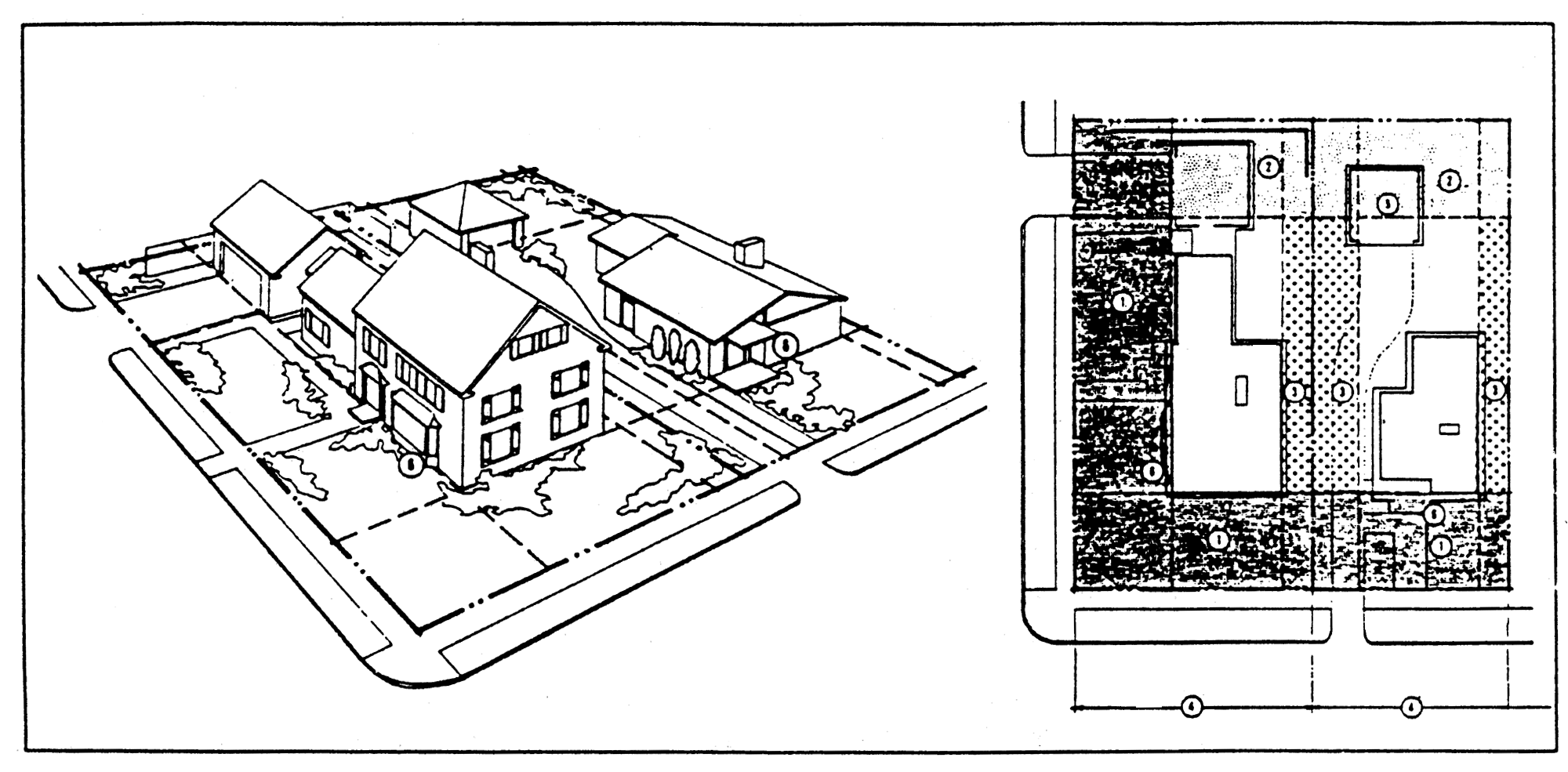
RM-1 Low Middle Density
1 Minimum front yards: 20 feet.
2 Minimum rear yards: 25 feet.
3 Minimum side yards: one eight and one 12 feet. (In the case of corner lots, at least eight feet for the one side yard.) Size of side yard is also related to height of building walls (see text of each district).
4 Minimum average lot width: 50 feet.
5 Accessorybuildings may extend into side and rear yards. (See General Provisions for Residence Districts).
6 For projections into required yards see General Provisions for Residence Districts.
Other requirements:
Minimum lot area: 4,000 square feet.
Maximum lot area per dwelling unit: 3,500 sq. ft.; 2,500 sq. ft. per efficiency unit; 1,750 sq. ft. per elderly housing unit.
Maximum buildingcoverage (all buildings): 30% of lot area.
Maximum building height: Three stories or an average height of 35 feet.
Minimum parking: One parking space per dwelling unit, located either on the same lot or within 300 feet walking distance.
Note— These pages are for illustration only. For greater detail, and for non-residential construction, refer to text of each district and to the General Provisions for Residence Districts.
(Ord. No. 1368, § 5, 2-7-05; Ord. No. 1726, Sched. A, 12-2-13; Ord. No. 2024-0020, 12-2-24)
Section 14. - RM-2 Districts: High-Middle Density.
Description and purpose. These districts exist for the protection of areas that have been and are being developed predominantly for high-middle density dwellings of various types. Accordingly, the use of land and buildings within these areas is limited in general to dwellings at a density of about 22 dwelling units per acre, and to such non-residential uses as generally support and harmonize with a middle density area. The non-residential uses permitted in RM-2 Districts, subject to adequate conditions and safeguards, are hereby found and declared to be the only appropriate such uses for such areas. It is hereby found and declared, further, that these regulations are necessary to the protection of these areas and that their protection is essential to the maintenance of a balanced community of sound residential areas of diverse types.
All RM-2 Districts are subject to the general provisions for residence districts set forth in Article IV as well as to all other provisions of this ordinance.
Uses permitted. In an RM-2 District a building or other structure may be erected, altered, arranged, designed or used, and a lot or structure may be used for any of the following purposes and no other:
(a)
Residential uses as follows: The General Provisions for Residence Districts in Article IV shall also apply.
Building requirements:
(1)
Dwellings-single-family, two-family and multi-family.
a.
Minimumlot area: 4,000 sq. ft.
b.
Minimumaverage lot width: 50 ft., except for nonconforming lots under subsection 67(e).
c.
Notwithstanding the foregoing, Section 22 allows one ADU in accordance with Section 22 with no impact on density requirement. Minimumlot area per dwelling unit: 2,000 sq. ft., except 1,400 sq. ft. in the case of an efficiency unit and 1,000 sq. ft. in the case of an elderly housing unit; except, further, that in any case of a dwelling existing on the effective date of the application of these regulations thereto, there may be located therein by conversion an average of one dwelling unit per 1,000 sq. ft. of gross floor area in the dwelling on said effective date, whether or not the standards of lot area per dwelling unit are met.
d.
Maximumbuildingcoverage: Total coverage of principal and accessorybuildings not to exceed 30% of lot area.
e.
Maximum building height: Such height shall not exceed either four stories or an average height of 45 feet.
Provided that no point on a side or rear building wall shall be so located that it is closer to a side or rear lot line than one foot for each two feet that such point is above the average finished lot grade along such side or rear building wall.
f.
Minimumyards:
Front—17 ft., except that where 75% or more of the entire street frontage (in feet) on the same side of the same street between the nearest two intersecting streets has been developed with buildings with front yards smaller than 17 feet, the required front yard shall be the same as the yard presently followed by existing buildings along the greatest quantity of street frontage (in feet).
Rear—25 ft.
Side—one at least eight ft. and the other at least 10 ft.; in the case of a corner lot, at least eight ft. for the one side yard.
g.
Minimum parking: One parking space per dwelling unit (except that only one parking space shall be required for each two elderly housing units) located either on the same lot as the principalbuilding or within 300 feet walking distance of an outside entrance to the dwelling unit to which such parking space is assigned, and conforming to section 29 and the remainder of the General Provisions for Residence Districts in Article IV.
(2)
Residential accessorybuildings, structures and uses, as regulated by Section 22 and by the General Provisions for Residence Districts.
(3)
Parking spaces required by this ordinance for the foregoing residential uses may be located on a separate lot without a special exception in a multi-lot residential development and by special exception under subsection 63(d) of this ordinance in all other instances in any district in which the principal use is permitted, provided the standards of section 29 (residential parking) are met.
(b)
Non-residentialusesas follows: The standards in paragraph (a)(1) above relating to minimum lot area, minimum average lot width, maximum buildingcoverage, maximum buildingheight, and minimum yards shall apply to non-residential uses.
Accessory use customarily incidental to the following uses are permitted in connection with such uses.
Parking spaces required by this ordinance for the following uses may be located (by special exception under subsection 63(d) of this ordinance) on a separate lot in any district in which the principal use is permitted, provided the standards of section 29 are met.
Section 29 relating to parking and all other pertinent sections of the general provisions for residence districts in Article IV shall apply to all such uses.
(1)
Such non-residential uses as are permitted, and in the same manner, as in RM-1 Districts.
RM-2 High Middle Density
The two illustrations show typical construction in this district, both in perspective
and in plan. Property lines are indicated by heavy dotted lines, and required yards
by dashed lines. The numbers on the plan refer to the various restrictions on size
and placement of structures.
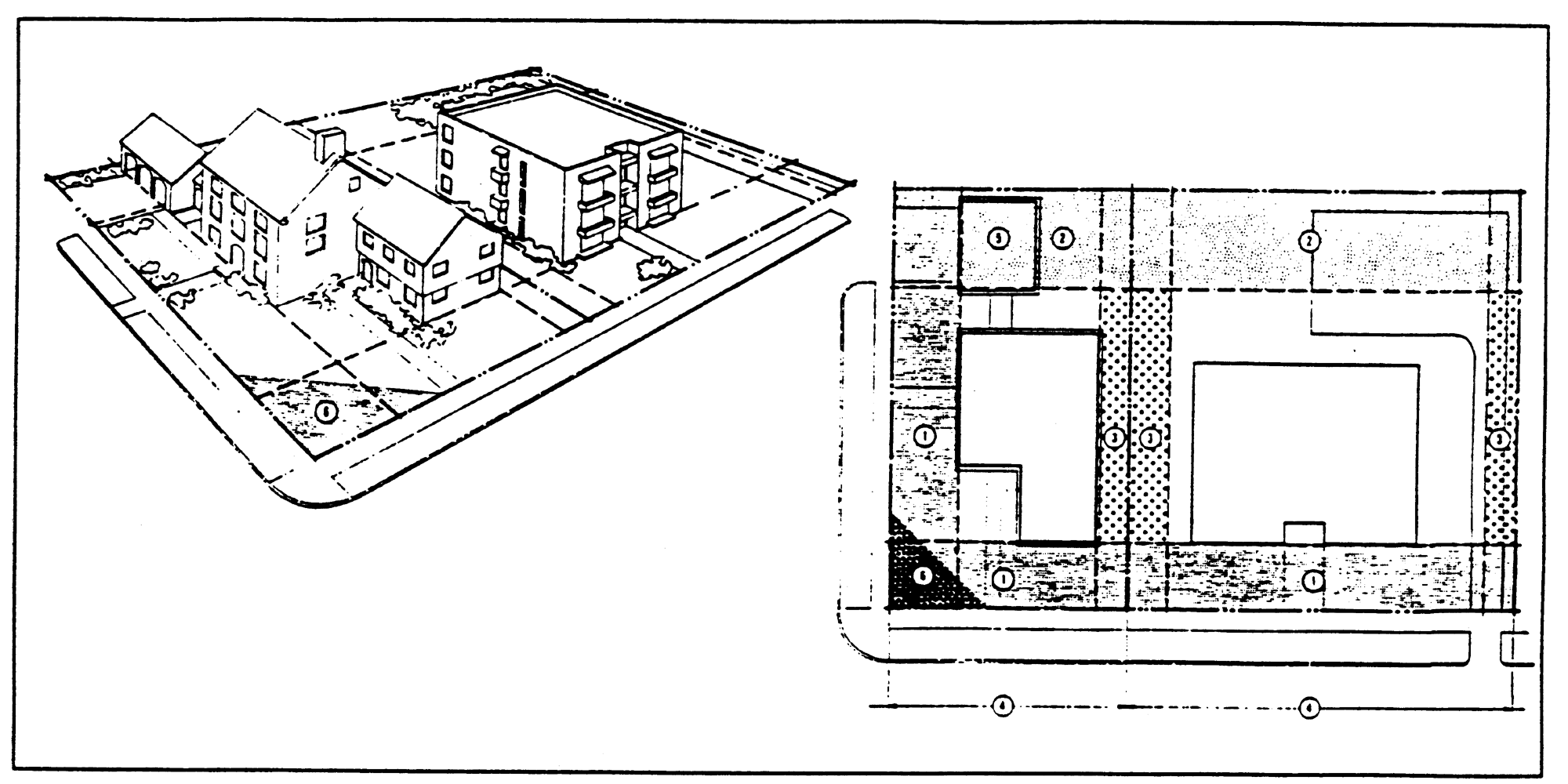
RM-2 High Middle Density
1 Minimum front yards: 17 feet.
2 Minimum rear yards: 25 feet.
3 Minimum side yards: one eight and one 10 feet. (In the case of corner lots, at least eight feet for the one side yard.) Size of side yard is also related to height of building walls (see text of each district).
4 Minimum average lot width: 50 feet.
5 Accessorybuildings may extend into side and rear yards. (See General Provisions for Residence Districts).
6 For projections into required yards see General Provisions for Residence Districts.
Other Requirements:
Minimum lot area: 4,000 square feet.
Maximum lot area per dwelling unit: 2,000 sq. ft.; 1,400 sq. ft. per efficiency unit; 1,000 sq. ft, per elderly housing unit.
Maximum buildingcoverage (all buildings): 30% of lot area.
Maximum building height: Four stories or an average height of 45 feet.
Minimum parking: One parking space per dwelling unit, located on the same lot, within 300 feet walking distance or in a multi-lot residential development.
Note— These pages are for illustration only. For greater detail, and for non-residential construction, refer to text of each district and to the General Provisions for Residence Districts.
(Ord. No. 1726, Sched. A, 12-2-13)
Section 15. - RH-1 Districts: Special high density.
Description and purpose. These districts exist for the protection of certain multi-family areas of relatively small total size but of unique and irreplaceable value to the community as a whole. The specific purpose of these districts is to stabilize and preserve the existing residential character of these areas to the maximum possible extent. To this end, the use of land and buildings within these areas is limited primarily to relatively high density residential uses, as the particular character, size and surroundings of these areas create little need for the location within their boundaries of further other such non-residential uses as generally support a residential area. Moreover, these areas are found especially along major streets traversing large residential sections of the city, and the outward movement of office or other commercial uses along these streets would constitute a serious threat to the residential quality of the areas to either side of them. Encroachment of office or other commercial uses along these streets would violate the spirit of this ordinance and its general purpose and intent and, any other provision of this ordinance to the contrary notwithstanding, no variance shall be granted for such uses in these districts. It is hereby found and declared that these regulations are necessary to the protection of these areas and that their protection is essential to the maintenance of a balanced community of sound residential areas of diverse types.
All RH-1 Districts are subject to the General Provisions for Residence Districts set forth in Article IV as well as to all provisions of this ordinance.
Uses permitted. In an RH-1 District a building or other structure may be erected, altered, arranged, designed or used, and a lot or structure may be used for any of the following purposes and no other:
(a)
Residential uses as follows. The General Provisions for Residence Districts in Article IV shall also apply.
(1)
Dwellings—single-family, two-family and multi-family.
Building requirements:
a.
Minimum lot area: 4,000 sq. ft.
b.
Minimumaverage lotwidth: 50 ft., except for nonconforming lots under subsection 67(e).
c.
Maximum buildingcoverage for principalbuilding or principalbuildings: 25% of lot area.
d.
Maximumbuildingheight: No direct limit.
Provided that no point on a side or rear building wall shall be so located that it is closer to a side or rear lot line than one foot for each two feet that such point is above the average finished lot grade along such side or rear building wall.
e.
Minimumyards:
Front—25 ft., except that where 75% or more of the entire street frontage (in feet) on the same side of the same street between the nearest two intersecting streets has been developed with buildings with front yards smaller than 25 feet, the required front yard shall be the same as the yard presently followed by existing buildings along the greatest quantity of street frontage (in feet). Provided that, the front yard shall in any case be increased if necessary to maintain a ratio of one foot between the front building wall and the center line of the street to two feet of average height measured along the front building wall, except as provided in subsection 30(b).
Rear—25 ft.
Side—10 ft. for each side yard.
f.
Maximumgross floor area: No such building or buildings shall have a gross floor area greater than 0.5 times the lot area; except that this floor area may be increased by 0.1 times the lot area (up to a maximum of 1.7 times the lot area) for each 1% of lot area by which the buildingcoverage of the principal building or buildings is reduced below the maximum of 25% of lot area set by subparagraph (c) above. The maximum floor area ratio allowable at each percent of buildingcoverage under this formula is as follows:
In any case of a building existing on the effective date of the application of these regulations thereto, which building then becomes nonconforming in buildingcoverage and/or floor area ratio under the above formula, there may be located therein by conversion no more than an average of one dwelling unit per 1,000 square feet of gross floor area in the building on said effective date.
Where a lot contains more than one principalbuilding in the same ownership, all such buildings shall be considered together in determining the floor area ratio.
g.
Minimumusable open space: 125 square feet per dwelling unit, except 100 square feet in the case of elderly housing units by special exception under subparagraph 63.(d) of this ordinance, provided that in the event that a minimum of 50 square feet of private usable open space in the form of balconies, patios, decks, porches or private courts that are attached or are located immediately adjacent to the dwelling unit that they serve is provided, then the balance of the usable open space required under this subsection for such dwelling unit shall be reduced by one-quarter. All usable open space shall be subject to the following minimum standards in addition to others which may be applicable.
1.
Common usable open space shall be so located and designed as to emphasize convenience of tenant access and ease of use.
2.
All common grade level usable open space shall be landscaped and otherwise developed to maximize recreational utility. Landscape improvements shall include trees, shrubs, ground cover and, wherever possible, the retention of existing landscape features.
3.
Any usable open space provided above grade level, either in the form of a roof terrace or deck, shall include as improvements at least the following: a wearing surface in addition to a standard rooftop finish, safety railings or walls, passive recreational facilities such as benches, sheltered arbors vegetative landscaping, and lighting.
h.
Minimum parking: One parking space per dwelling unit (except that only one parking space shall be required for each two elderly housing units) located either on the same lot as the principal building, within 300 feet walking distance of an outside entrance to the dwelling unit to which such parking space is assigned or within a multi-lot residential development, and conforming to section 29 (residential parking) and the remainder of the General Provisions for Residence Districts in Article IV.
(2)
Residential accessorybuildings, structures and uses, as regulated by paragraph (1) above and by the General Provisions for Residence Districts, having a buildingcoverage of no more than 10% of the lot area and an average height not exceeding 20 feet.
(3)
Parking spaces required by this ordinance for the foregoing residential uses not meeting the standards of subsection 15(a)(1)h may be permitted by special exception under subsections 29(i) and 63(d) of this ordinance.
(b)
Non-residentialusesas follows: The standards in paragraph (a)(1) above relating to minimum lot area, minimum average lot width, maximum buildingcoverage, maximum buildingheight, minimum yards, and maximum gross floor area shall apply to non-residential uses except as indicated below.
Accessory uses customarily incidental to the following uses are permitted in connection with such uses.
Parking spaces required by this ordinance for the following uses may be located in any district in which the principal use is permitted, provided the standards of section 29 (residential parking) are met.
Section 29 relating to parking and all other pertinent sections of the General Provisions for Residence Districts in Article IV shall also apply to all such uses.
(1)
Such non-residential uses as are permitted, and in the same manner, as in RS-1 Districts.
(2)
On lots in use for any of the uses described in section 11(b)(2)b. on or before October 15, 2003, any of the uses described in section 11(b)(2)b.1., 2. or 4. excluding dormitories, fraternities and sororities.
Building requirements:
a.
Minimumlot area: One acre;
b.
Minimumside yard: One at least ten feet and the other at least 12 feet, notwithstanding the requirements of section 15(a)(1)(d);
c.
Maximumbuilding height: Such height shall not exceed either four stories or an average height of 50 feet;
d.
Maximumbuilding coverage: Total building coverage for principal building or buildings not to exceed 30 percent of lot area;
e.
Maximumgross floor area: No building or buildings shall have a gross floor area greater than 0.6 times the lot area equivalent to a maximum floor area ratio of 0.6; and
f.
Minimumparking: The greater of one parking space for each eight seats in the largest place of assembly commonly having events open to the public, based upon the maximum occupancy of both fixed and movable seats; or one parking space for each full-time equivalent staff person, located on the same lot or within 300 feet walking distance on a separate lot in the district, shall be provided.
(Ord. No. 1377, § 1, 5-16-05; Ord. No. 1726, Sched. A, 12-2-13)
Section 16. - RH-2 Districts: General High Density.
Description and purpose. These districts exist for the protection of areas that have been and are being developed predominately for high density dwellings, commonly apartment houses and other dwellings with a high ratio of floor area to land area. Accordingly, the use of land and buildings within these areas is limited to dwellings meeting a Floor Area Ratio designed for a density ranging from 22 to 74 dwellings units per acre and to such non-residential uses as generally support and harmonize with a high density area. The non-residential uses permitted in RH-2 Districts, subject to adequate conditions and safeguards, are hereby found and declared to be the only appropriate such uses for such areas. It is hereby found and declared, further, that these regulations are necessary to the protection of these areas and that their protection is essential to the maintenance of a balanced community of sound residential areas of diverse types.
All RH-2 Districts are subject to the General Provisions for Residence Districts set forth in Article IV except for Section 28 as well as to all other provisions of this ordinance.
Uses permitted. In an RH-2 District a building or other structure may be erected, altered, arranged, designed or used, and a lot or structure may be used for any of the following purposes and no other:
(a)
Residentialusesas follows. The General Provisions for Residence Districts in Article IV shall also apply.
(1)
Dwellings—Single-family (except zero lot line developments per subsection 16(a)(2)),two-family and multi-family.
Building requirements:
a.
Minimumlot area: 4,000 sq. ft.
b.
Minimumaverage lot width: 40 ft.
c.
Maximum building coverage for principalbuilding or principalbuildings: 50% of lot area except that in the Downtown for All Overlay District, this limit shall not apply, and the applicable rules for the BD district shall apply.
d.
Maximumbuildingheight: No direct limit.
Provided that, no point on a side or rear building wall shall be so located that it is closer to a side or rear lot line than one foot for each two feet that such point is above the average finished lot grade along such side or rear building wall.
e.
Minimumyards:
Front—Five ft,, except that where 75% or more of the entire street frontage (in feet) on the same side of the same street between the nearest two intersecting streets has been developed with buildings with front yards smaller than five feet, the required front yard may be the same as the yard presently followed by existing buildings along the greatest quantity of street frontage (in feet). Provided that in the case of any building or structure which has an average height in excess of 60 ft.,the front yard shall be increased proportionally (up to a maximum of 25 feet of required front yard) if necessary to maintain a ratio of one foot between the front building wall and the center line of the street to two feet of average height measured along the front building wall.
Rear—20 ft.
f.
Maximum gross floor area: No such building or buildings shall have gross floor area greater than 2.0 times the lot area.
In any case of a building existing on the effective date of this section, which building then becomes nonconforming in buildingcoverage and/or floor area ratio, there may be located therein by conversion no more than an average of one dwelling unit per 1,000 square feet of gross floor area in the building on said effective date.
Where a lot contains more than one principal building in the same ownership, all such buildings shall be considered together in determining the floor area ratio.
g.
Minimumusable open space: 125 square feet per dwelling unit, except 100 square feet in the case of elderly housing units, only by special exception, provided that in the event that a minimum of 50 square feet of private usable open space in the form of balconies, patios, decks, porches or private courts that are attached or are located immediately adjacent to the dwelling unit that they serve is provided, then the balance of the usable open space required under this subsection for such dwelling unit shall be reduced by one-quarter, except that in the Downtown for All Overlay District the open space requirements applicable to the BD District shall apply. All usable open space shall be subject to standards enumerated in subsection (a)(1)g. of section 15 of this ordinance.
h.
Minimum parking:.75parking space per dwelling unit (three parking spaces for each four dwelling units), except that only .33 parking space (one parking space for each three elderlyhousing units) shall be required for each elderly housing unit, and only .50 parking space per dwelling unit (one parking space for each twodwelling units) shall be required for each dwelling unit located on alot owned by a public housing authority (such as the Housing Authority of the City of New Haven). All parking spaces required under this section shall be located on the same lot as the principal building, within 300 feet walking distance of an outside entrance to the dwelling unit to which such parking space is assigned or in a multi-lot residential development. Such parking spaces shall conform to section 29 (residential parking) and the remainder of the General Provisions for Residence Districts in Article IV.
(2)
Zero Lot Line developments.
Building requirements:
a.
Minimumlot area: 2,000 sq. ft. for interior lots and 3,500 sq. ft. for end and corner lots;
b.
Minimumaverage lot width: 18 ft. for interior lots and 35 ft. for end and corner lots;
c.
Maximumbuilding coverage for principal building and accessory buildings combined not to exceed 60% of lot area for interior lots and 50% of lotarea on end and corner lots.
d.
Maximumbuilding height:Average height of 45 ft.
Provided that, no point on a side or rear building wall shall be so located that it is closer to a side or rear lot line than one foot for each two feet that such point is above the average finished lot grade along a rear or side building wall, excepting side yards for connecting buildings on adjoining lots.
e.
Minimumyards:
Front—The lesser of five ft. or the existing average front yards (excluding projections), measured in feet, between the nearest two intersections on the same side of the street on which the zero lot line development is to be located (excluding any structure or building to be removed in connection with the proposed zero lot line development).
Rear—20ft. for interior, end and corner lots that are also end lots; zero ft. for corner lots that are not end lots.
Side—All side yards of zero ft. must be located adjacent to a common zero-foot side yard located on a lot that is part of the zero lot line development.
f.
Minimumusable open space: 125 square feet per dwelling unit, except 100 square feet in the case of elderly housing units, only by special exception, provided that in the event that a minimum of 50 square feet of private usable open space, either in the form of balconies, patios, decks, porches or private courts that are attached or are located immediately adjacent to the dwelling unit which they serve is provided, then the balance of the usable open space required for such dwelling unit shall be reduced by on one-quarter. All usable open space shall be subject to standards enumerated in subsection(a)(1)g. of section 15 of this ordinance.
g.
Minimum parking: .75 parking space per dwelling unit (three parking spaces for each four dwelling units), except that only .33 parking space (one space for each three elderlyhousing units) shall be required for each elderly housing unit. All parking spaces required under this section shall be located on the same lot as the principal building, within 300 feet walking distance of an outside entrance to the dwelling unit to which such parking space is assigned or in a multi-lot residential development. Such parking spaces shall conform to section 29 (residential parking) and the remainder of the General Provisions for Residence Districts in Article IV. A maximum of two curb cuts shall be permitted for anyzero lot line development.
h.
In connection with an application for site plan approval for a zero lot line development, the applicant shall submit a deed, agreement, easement, or similar instrument and/or a homeowners' association's operating documents (such as articles of association, articles of organization, articles of incorporation, operating agreement, bylaws, and/or rules and regulations) for approval by the City Plan Commission with respect to the allocation of responsibility for the maintenance, repair and replacement of shared walls, driveways, parking areas, open space, and any other shared facilities, which approved instrument or documents shall be filed in the New Haven land records prior to the issuance of a building permit for the construction of the zero lot line development.
(3)
Residential accessorybuildings, structures and uses, as regulated by paragraph (1) above and by the General Provisions for Residence Districts.
(4)
Rooming, boarding and lodging houses (excluding hotels, motels and tourist homes), as well as the keeping of only one or two roomers, boarders or lodgers, where renting of rooms is not subordinate to some other enterprise. Such rooming, boarding and lodging houses shall be regulated by the standards in paragraph (1) above, except that minimum parking shall be one parking space for each three beds, located either on the same lot as the rooming, boarding or lodging house or within 300 feet walking distance of an outside entrance to the rooming, boarding or lodging house; and in addition minimum lot area per sleeping room shall be 500 square feet.
(5)
Parking spaces required by this ordinance for the foregoing residential uses may be located on a separate lot in any district in which the principal use is permitted, provided the standards of section 29 (residential parking) are met.
(6)
Automobile trailer camps, in accordance with the provisions of the Automobile Trailer Camp Ordinance, when located on a tract of not less than ten acres and permitted by special exception under subsection 63(d) of this ordinance with a time limit of not more than five years.
(b)
Non-residentialusesas follows: The standards in paragraph (a)(1) above relating to minimum lot area, minimum average lot width, maximum buildingcoverage, maximum buildingheight, minimum yards, and maximum gross floor area shall apply to non-residential uses.
Accessory uses customarily incidental to the following uses are permitted in connection with such uses.
Parking spaces required by this ordinance for the following uses may be located on a separate lot in any district in which the principal use is permitted, provided the standards of section 29 (residential parking) are met. Section 29 relating to parking and all other pertinent sections of the General Provisions For Residence Districts in Article IV shall also apply to all such uses.
(1)
Such non-residential uses as are permitted, and in the manner, as in RM-2 Districts.
(2)
As of right:
a.
Charitable and philanthropic organizations, provided no more than 50% of the gross floor area of any building is occupied by offices of such organizations.
Minimum parking: One parking space for each 500 square feet of gross floor area of the building located on the same lot, within 300 feet walking distance or in a multi-lot residential development.
b.
Professional offices of the types specified in the regulations for RO Districts (other than charitable and philanthropic organizations) located in the basement, ground floor level or second floor of a building that fronts on an Urban Principal Arterial or an Urban Minor Arterial, as classified by the State of Connecticut Department of Transportation, with an aggregate gross floor area no greater than 15% of the total gross floor area of the building in which such offices are located.
c.
Retail uses located at the basement and/or ground floor level of a building that fronts on an Urban Principal Arterial or an Urban Minor Arterial, as classified by the State of Connecticut Department of Transportation, as follows: (i) uses listed in subsections 31(b)(1) through (10) and (13) (but not subject to the conditions of section 31); section 42C (but not including Package Alcoholic liquor); section 42D (but not including a Funeral home, gun and weapons repair, firearms training, firing range, shop or a swap shop); section 42G; section 42H (but not including gun shops); section 42I; and (ii) a Restaurant, caterer, music, or dancing school. The aggregate gross floor area of the foregoing uses shall not exceed 15% of the total gross floor area of the building in which they are located.
Where both professional offices and retail uses are located in the same building, the combined gross floor area of the professional offices and retail uses shall be no greater than 15% of the total gross floor area of the building in which they are located. In addition, no parking spaces shall be required for the professional offices and retail uses permitted under this subsection.
(3)
Where permitted by special exception under subsection 63(d) of this ordinance.
a.
Fraternities and sororities (whether or not residential in whole or in part), whether or not located on land owned by an educational institution. Noise, odors, lights, signs and all other possible disturbing aspects connected with the operation of such uses shall be enclosed, screened or otherwise controlled to the extent that the operation of any such use shall not unduly interfere with the use and enjoyment of properties or streets in the surrounding area.
Minimum parking: One parking space for each three beds if residents are permitted to keep automobiles, plus one parking space for each four seats in each place of assembly based upon the maximum occupancy of both fixed and movable seats, located on the same lot or within 300 feet walking distance.
b.
Other social organizations, including clubs, lodgings, veterans' and fraternal organizations (whether or not residential in whole or in part); but excluding any activity carried on as a gainful business other than incidental concessions. Noise, odors, lights, signs and all other possible disturbing aspects connected with the operation of such uses shall be enclosed, screened or otherwise controlled to the extent that the operation of any such use shall not unduly interfere with the use and enjoyment of properties or streets in the surrounding area.
Minimum parking: One parking space for each three employees, plus one parking space for each three beds plus one parking space for each four seats in each place of assembly based upon the maximum occupancy of both fixed and movable seats, located on the same lot or within 300 feet walking distance.
c.
Professional offices of the types specified in the regulations for RO Districts (other than charitable and philanthropic organizations) located in the basement, ground floor level or second floor of a building that does not front on an Urban Principal Arterial or an Urban Minor Arterial, as classified by the State of Connecticut Department of Transportation, with an aggregate gross floor area no greater than 15% of the total gross floor area of the building in which the offices are located.
d.
Retail uses located at the basement and/or ground floor level of a building thatdoes notfront on an Urban Principal Arterial or an Urban Minor Arterial, as classified by the State of Connecticut Department of Transportation, as follows: (i) uses listed in subsections 31(b)(1) through (10) and (13) (but not subject to the conditions of section 31), section 42C (but not including Package Alcoholic liquor), section 42D (but not including a Funeral home, gun and weapons repair, firearms training, firing range, shop or a swap shop), section 42G, section 42H (but not including gun shops), section 42I and (ii) a Restaurant, caterer, music, or dancing school, The aggregate gross floor area of the foregoing uses shall not exceed 15% of the total gross floor area of the building in which they are located.
Where both professional offices and retail uses are located in the same building, the combined gross floor area of the professional offices and retail uses shall be no greater than 15% of the total gross floor area of the building in which they are located. In addition, no parking spaces shall be required for the professional offices and retail uses permitted under this subsection.
(Ord. No. 1726, Sched. A, 12-2-13; Ord. No. 1820, Sched. B, 6-5-17; Ord. No. 2025-0028, 12-1-25)
Section 17. - RO Districts: Residence-Office.
Description and purpose. These districts exist in order to set aside and protect certain areas for development of professional and service offices in addition to high density dwellings. Accordingly, the use of land and buildings within these areas is limited to dwellings meeting a flexible floor area ratio formula designed for a density ranging from 22 to 74 dwelling units per acre depending upon building height and coverage, to professional and service offices, and to such other non-residential uses as generally support and harmonize with a high density area of this type. The non-residential uses permitted in RO Districts, subject to adequate conditions and safeguards, are hereby found and declared to be the only appropriate such uses for such areas. It is hereby found and declared, further, that these regulations are necessary to the protection of these areas and that their protection is essential to the maintenance of a balanced community of sound residential areas of diverse types.
All RO Districts are subject to the General Provisions for Residence Districts set forth in Article IV as well as to all other provisions of this ordinance.
Uses permitted. In an RO District a building or other structure may be erected, altered, arranged, designed or used, and a lot or structure may be used for any of the following purposes and no other:
(a)
Residential uses as follows. The General Provisions for Residence Districts in Article IV shall also apply.
(1)
Such residential uses as are permitted, with such standards as are required for them, in RH-1 Districts.
(b)
Non-residential uses as follows. The standards in paragraph (a)(1) above relating to minimum lot area, minimum average lot width, maximum buildingcoverage, maximum buildingheight, minimum yards and maximum gross floor area shall apply to non-residential uses.
Accessory uses customarily incidental to the following uses are permitted in connection with such uses.
Parking spaces required by this ordinance for the following uses may be located (by special exception under subsection 63(d) of this ordinance) on a separate lot in any district in which the principal use is permitted, provided the standards of section 29 are met.
Section 29 relating to parking and all other pertinent sections of the general provisions for residence districts in Article IV shall also apply to all such uses.
(1)
Such non-residential uses as are permitted, and in the same manner, as in RM-2 Districts.
(2)
As of right:
a.
Offices and studios of doctors, dentists, architects, artists, designers, accountants, lawyers, engineers, tutors, real estate and insurance agents, brokers, and members of other recognized professions (excluding veterinarians, dancing and music studios having more than one student at a time, barber shops, beauty parlors, and other similar uses), together with incidental laboratory and mechanical equipment; government offices; and offices of insurance companies, charitable and philanthropic organizations and other similar service enterprises and organizations. All such offices shall meet the following standards:
1.
No storage of a stock in trade or sale of commodities on the premises;
2.
No visits by the general public as purchasers of goods or as customers as distinguished from patients or clients;
3.
No offensive emission of smoke, dirt, dust, vibration, odor, light, heat, glare, noise, electrical disturbance, or radioactive particles or rays;
4.
Maximum coverage for accessorybuildings: 10% of lot area;
5.
Minimum parking: Three parking spaces per practitioner in the case of doctors and dentists, and one parking space for each 600 square feet of net floor area used or intended to be used for offices in all other cases, located on the same lot or within 300 feet walking distance.
RH-1 Special High Density
RH-2 General High Density
RO Residence-Office
The two illustrations show typical construction in the RH-1 and RO districts, both
in perspective and in plan. Property lines are indicated by heavy dotted lines, and
required yards by dashed lines. The numbers on the plan refer to the various restrictions
on size and placement of structures.
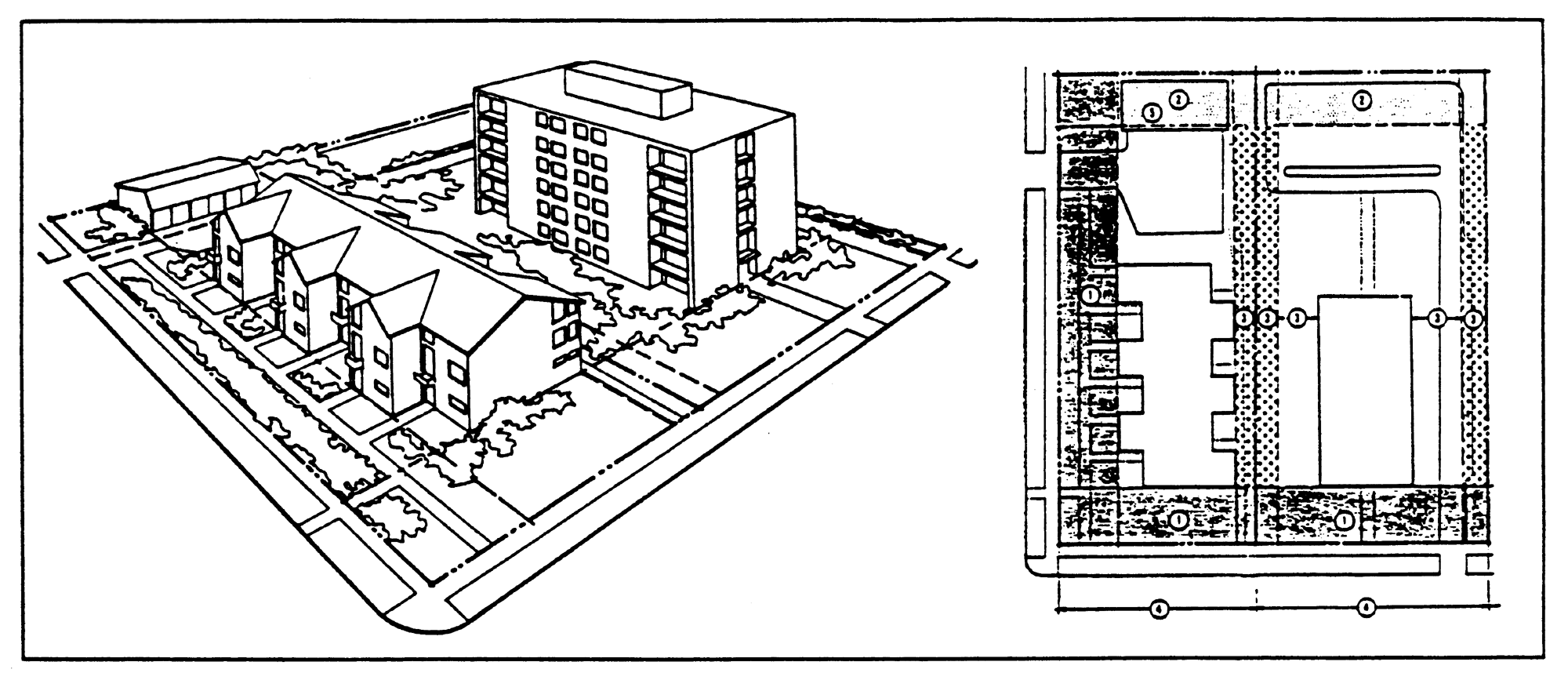
RH-1, RH-2 & RO
1 Minimum front yards: 25 feet for RH-1 and RO; 5 feet for RH-2. Size is also related to height of building wall (see text for each district).
2 Minimum rear yards: 25 feet for RH-1 and RO; 20 feet for RH-2. Size is also related to height of building wall (see text for each district).
3 Minimum side yards: 10 feet for each side in RH-1 and RO; zero feet in RH-2. Distance is also related to height of buildingwall (see text for each district).
4 Minimum average lot width: 60 feet for RH-1 and RO; 40 feet for RH-2.
5 Accessory buildings may extend into side and rear yards. (See General Provisions for Residence Districts).
Other Requirements:
Minimum lot area: 4,000 square feet for RH-1 and RO; 4,000 square feet for RH-2.
Maximum floor area ratio (F.A.R.): 0.5 to 1.7, depending upon buildingcoverage (see text), except for RH-2 where F.A.R. is 2.0.
Maximum buildingcoverage: principal building(s) 25% or less for the RH-1 and RO, (see text), 50% for the RH-2, accessory building, 10%.
Maximum building height: no direct limit, except for zero lot line developments.
Minimum usable open space: 125 sq. ft. per dwelling unit.
Minimum parking: For the RH-1 and RO districts, one parking space perdwelling unit. For the RH-2 district, .75 parking space per dwelling unit, located on the same lot, within 300 feet walking distance or in a multi-lot residential development; also for RO, one parking space for each 600 square feet of net floor area of office space; and for RH-2 one parking space for each 500 square feet of gross floor area of space used for charitable or philanthropic uses located on the same lot, within 300 feet walking distance or in a multi-lot residential development.
Note— These pages are for illustration only. For greater detail, and for other non-residential construction, refer to text of each district and to the general provisions for residence districts.
(Ord. No. 1726, Sched. A, 12-2-13)
Sec. 18A. - Live-work loft conversions.
The purpose of this provision is to encourage adaptive reuse of existing older loft style multi-level commercial and industrial structures existing in 1963 to limited work and residence use by Special Permit in all residential districts and in business and industrial districts as set forth in Section 42, as follows:
(a)
General standards.
(1)
Disturbing aspects. Noise, odors, lights, signs and all other possible disturbing aspects connected with the operation of such uses shall be enclosed, screened or otherwise controlled to the extent that the operation of any such use shall not unduly interfere with the use and enjoyment of other properties or streets in the surrounding area.
(2)
Signs. All uses permitted by this section shall comply with the requirements for signs in section 27 of this ordinance.
(3)
Parking shall be subject to the standards of section 29 and section 45. Each work-live unit will require one parking space in addition to the required parking for the existing business/industrial uses on the site.
(b)
Conversion standards for loft industrial structures to live-work lofts meeting the general standards above and the specific standards below shall be allowed by special permit as follows:
(1)
Live-work loft gross floor area per unit:
Minimum—700 sq. ft.
Structure average—1,000 sq. ft.
(2)
Each live-work unit shall be structurally separate, spatially contiguous, integrated living and working space utilized by a single housekeeping unit.
(3)
Full-time workers of the live-work unit shall reside in the unit.
(4)
The residential area of the unit may not be rented separately from the working space.
(5)
Retail sale of merchandise is limited to items produced in the live-work unit.
(c)
Review standards for live-work lofts. In addition to section 64 standards the commission shall determine whether the specific proposal meets the following additional standards:
(1)
The specific location and proposed physical configuration will be compatible with existing surrounding industrial and commercial uses.
(2)
The proposal will not preclude development of permitted industrial and commercial uses on adjacent parcels.
(3)
The site can reasonably accommodate live-work lofts with minimum conflict with existing commercial and industrial tenants.
(4)
The site can reasonably accommodate parking and loading needs for work-live lofts and commercial and industrial use on the parcel.
(d)
Residential development internal amenities.
(1)
All conversions yielding 20 or more units shall have in-unit washer/dryer hookups or common laundry facilities.
(2)
All conversions of 20 or more units shall provide secure indoor bicycle storage facilities.
(3)
All conversions over 50 units shall provide an indoor activity or exercise room available to residents.
(4)
All conversions of over 100 or more units shall provide, in addition to an exercise room, a function room available to all residents.
(Ord. No. 565, 4-7 08; Ord. No. 1685, Sched. D, 8-6-12)
(Ord. No. 1565, 4-7-08; Ord. No. 1685, Sched. D, 8-6-12; Ord. No. 1752, Sched. A, 11-6-14)
Section 18B. - Live-work units (post 1963 and new structures).
(a)
Live-work units other than live-work loft conversions described in Section 18A shall be allowed by special permit in the Business D-3 District.
(b)
Live-work units shall comply with the following requirements:
(1)
Noise, odor, light, dust, dirt, fumes, or other environmental impacts from work conducted in the live-work unit will be so enclosed, screened or otherwise contained so as not to adversely affect the use and enjoyment of the other properties in the surrounding area.
(2)
The proprietor of the business located in the live-work unit shall live in the live-work unit, and up to two persons who do not reside in the live-work unit may work in the unit.
(3)
No portion of the live-work unit may be separately leased or sold.
(4)
At least 30 percent of the total square footage of the live-work unit shall be allocated to the residential use.
(5)
The display and sale of products in the live-work unit shall be limited to the products created in the live-work unit.
(Ord. No. 1685, Sched. D, 8-6-12; Ord. No. 1752, Sched. A, 11-6-14)
Section 19. - Custodial care facilities.
Description and purpose. These provisions exist in recognition of state law, which make allowances for custodial care alternatives to traditional prison settings. These provisions are further intended to provide opportunities for custodial care facilities to locate and operate in New Haven in a manner which (1) is of a size and scale that is appropriate for the structure; (2) is of a size and scale that is consistent with residential uses in the surrounding area; (3) avoids undue concentration of such facilities; (4) avoids undue conflict with other social needs programs; and (5) avoids undue conflict with youth populations, by restricting siting near schools, parks and day care centers.
(a)
Definition. CUSTODIAL CARE FACILITY. A facility which provides custodial care and treatment in a protective living environment for persons accused or convicted of a misdemeanor or a non-violent felony and residing voluntarily or by court placement, including, without limitation, correctional and post correctional facilities, halfway houses, transitional housing, juvenile detention facilities and temporary detention facilities, such as alternative to incarceration programs approved by the Chief Court Administrator in accord with the Connecticut General Statutes Sec. 53a-39a. This provision is not intended to address disabled individuals pursuant to the Fair Housing Act.
(b)
Development standards. The following standards shall apply:
(1)
General standards. A custodial care facility shall comply with the standards relating to minimum lot area, average lot width, building coverage, maximum impervious surface coverage, maximum building height, and minimum yards for the underlying zoning district.
(2)
Residential development standard. A custodial care facility shall be developed in a manner consistent with that of a residential structure and is, therefore, subject to the following regulations regardless of the underlying zoning district: Structures within required yards (section 25); Fences and enclosure walls (section 26); Signs (section 27); and Corner visibility (section 28). See 19.B.11 for parking standard.
(3)
Permitted locations. A custodial care facility shall be permitted only by special exception in the following locations and no other:
a.
A custodial care facility, with up to six or less residents, shall be allowed only by Special Exception in the following districts: RM-1 and RM-2; and
b.
A custodial care facility, with up to 30 residents shall be allowed only by special exception in the following districts: BA, BA-1 BD, and BD-1. In a BA-1 district residential portions of custodial care facilities are limited to above ground floor occupancy.
(4)
Prohibited Locations. Custodial care facilities are prohibited in the following zoning districts:
a.
Residential: RS-1, RS-2, RH-1, RH-2 and RO;
b.
Business: BB, BC, BD-3 and BE; and
c.
Industrial: IL, IM and IH.
(5)
Minimum lot area. A Custodial Care Facility shall have a minimum lot area of:
a.
6,000 s.f. in RM-1 districts; and
b.
5,400 s.f. in RM-2, BA, BA-1, BD and BD-1 districts.
(6)
Minimum lot area per resident. There shall be a minimum of 500 s.f. of lot area for each of the first 20 residents. For facilities with more than 20 residents, there shall be a minimum of 500 s.f. of lot area for each of the first 20 residents and 1,000 s.f. for everyone (1) resident above the first 20 residents.
(7)
Location restriction. A custodial care facility shall not be located within 1,500 linear feet of a lawfully existing custodial care and/or alternative incarceration facility. The distance shall be measured in linear feet from the edge of the property line of the proposed custodial care facility to the edge of the property line of the use(s) listed above.
(8)
Minimum exterior usable open space. There shall be a minimum amount of usable open space as follows:
a.
100 s.f. per resident in a Residence District; and
b.
75 s.f. per resident in a Business District. The area of front and side yards shall not be included to meet this requirement.
(9)
Minimum interior recreational space. There shall be a minimum of 50 s.f. per resident useable interior recreation space.
(10)
Staff. There shall be at least one (1) resident caretaker and at least one (1) staff person per 20 residents or portion thereof, on premises at all times.
(11)
Parking standard. Custodial care facilities are to be developed in a manner consistent with that of a residential structure and are therefore subject to parking standards pursuant to Section 29. The parking requirement shall be as follows:
a.
Resident caretaker. One (1) off-street parking space for the resident caretaker;
b.
Staff. One (1) off-street parking space for each daytime full or part-time staff person at peak staff requirement time;
c.
Resident. One (1) parking space per resident owning a motor vehicle; and
d.
Visitor. One (1) parking space for each six (6) residents or portion thereof.
(c)
Standards for review. Special exceptions for custodial care facilities shall be granted only where the Board of Zoning Appeals finds that the proposed facility is in accord with the public convenience and welfare after taking into account the standards for review found in section 63.(d); compliance with the development standards found in section 19.(b); demonstration of need in the community and degree to which the applicant considered a number of in-city and regional locations; consistency with the comprehensive plan of development; the proximity and potential for adverse impact on public and private schools, emergency shelter facilities, and licensed day care centers.
(Ord. No. 1368, § 4, 2-7-05; Ord. No. 1614, § 1, 3-1-10; Ord. No. 1685, Sched. D, 8-6-12; Ord. No. 1944, 9-19-22)
Section 20. - Summary of Uses & Bulk Regulations for Residential Districts.
TABLE 1. SUMMARY SCHEDULE OF PERMITTED USES IN RESIDENCE DISTRICTS
Note—This summary schedule is for convenience in use of the ordinance.
In case of conflict, the District Regulations shall prevail.
Key: R: As-of-Right SP: Special Permit SE: Special Exception X: Not Permitted
1 Retail located in a building that fronts on an arterial is permitted as of right. Retail located in all other buildings in the RH-2 District is permitted by special exception.
2 If a building has both retail and professional offices, the total square feet of both is limited to 15% of the gross floor area.
3 Professional offices located in a building that fronts on an arterial are permitted as of right. Professional offices located in other buildings are permitted by special exception.
TABLE 2. SUMMARY OF DENSITY, BULK, PARKING AND LOADING REGULATIONS
Note—This Summary Schedule is for convenience in use of the ordinance. In case of conflict, the District Regulations shall prevail. Terms in boldface italics are defined in Section 1 of this Ordinance.
Notes:
1 See Ordinance text for standard for developed blockfronts with lesser setbacks.
2 Corner lot: Any yard facing a street is a front yard. Rear and side yards are by owner choice.
3 Variable. Lower building coverage permits a higher floor area ratio (FAR), which is a ratio of gross building area to land area.
4 See subsection 15(b)(2) for expansion of certain institutional uses.
5 For single family dwellings that are detached dwellings in the RS1 and RS2 Districts, one parking space for the first bedroom and ½ parking space for each additional bedroom, rounded to the next higher whole number if a fraction. All parking spaces shall be located on the same lot. For an efficiency unit, one parking space.
6 For stores less than 5,000 square feet. One parking space per 100 square feet sales or service area is required for space over 5,000 square feet.
7 See section 15(b)(2) for expansion of certain institutional uses.
8 Ten-foot height bonus available under § 43(c)(2).
9 When a rear or side lot line in a BD-2 District abuts a residential district, FAR shall not exceed 2.5.
10 See section 45(a), section 45(a)(7) and section 12(b)(1)h.
(Ord. No. 1368, § 7, 2-7-05; Ord. No. 1377, 5-16-05; Ord. No. 1412 (Rev. Sched. A, § 2), 5-1-06; Ord. No. 1685, Sched. D, 8-6-12; Ord. No. 1726, Sched. A, 12-2-13; Ord. No. 1944, 9-19-22; Ord. No. 2024-0025, 12-2-2024)

