
New Haven City Zoning Code
ARTICLE V
BUSINESS AND INDUSTRIAL DISTRICTS
Section 41. - Description and purpose of business and industrial districts.
The Business and Industrial districts contained in this zoning ordinance are established to provide for the most rational and orderly separation of land uses according to their function in the city, and to fulfill the other purposes of zoning. The regulations herein adopted are hereby found and declared to be appropriate to New Haven and in accordance with a comprehensive plan designed for the continued vitality and development of the city. The following statements of description and purpose outline the main functions of these districts in the zoning plan.
Business A Districts—General Business. These districts serve several functions. They provide central concentrations of convenience goods and services for one or more neighborhoods, supplemented by more scattered stores for such goods and services within the neighborhoods provided for under a special provision of the regulations for residence districts. They provide comparison shopper's goods, specialty goods, amusements and numerous services for less than a citywide market. And they also provide locations for small businessmen with a city-wide market who cannot operate in the downtown area. The predominant purpose of all these functions is retail trade.
Business A-1 Districts—Neighborhood Center Mixed Use. These districts serve as the commercial heart of their neighborhood, are of modest scale and pedestrian orientation, and seek to preserve and restore the historic architecture and urban pattern of the city. The emphasis is on neighborhood goods and services rather than comparison shopping, with a preference for smaller pedestrian-oriented, storefront retail, dinning, and other appropriate uses. They are intended as mixed-use districts with a mixture of ground floor retail, small offices, and upper story residential dwellings. Buildings are oriented to the street, parking requirements are reduced and parking maximums established to encourage walkability and community over automotive-related sprawl. New development is required by form requirements and design guidelines to conform to the neighborhood context, to improve the retail character of the street as a neighborhood center, and to promote the health, safety and wellbeing of residents by reducing sources of public nuisance and encouraging physical activity and community interaction and involvement.
Business A-2 Districts—Village Center Mixed Use. These districts serve distinct mixed-use communities woven into the larger tapestry of New Haven. Parking is reduced and density is increased to encourage development of neglected or vacant buildings into pedestrian-oriented storefront retail, dining, and other appropriate uses. Upper story residential dwellings are encouraged along commercial strips and ground floor residential dwellings are encouraged on side streets. Height limits are maintained to prevent over-development, but the district otherwise does not restrict property owners' ability to employ a range of architectural styles.
Business B Districts—Automotive Sales. These districts follow a deliberate policy which recognizes the importance of automotive sales to the city and further recognizes that such sales can perform their function in the best and most integrated manner by concentration in certain areas of the city. Establishments for the sale of new vehicles, and for the sale of large numbers of used vehicles, are concentrated in these areas, from which non-related uses are excluded to assure the maximum development of automobile sales and related uses.
Business C Districts—Marine. These districts exist to separate out certain waterfront areas which have—and are encouraged to be—a mix of water-dependent public access, recreational boating, public and private marinas, commercial and recreational fishing, community based, water related activities and waterfront residential environments.
Business D District—Central Business. This district comprises the main downtown section of the city, known in planning terms as the Central Business District (CBD). Here are concentrated activities that have primarily a citywide and regional function: large stores offering comparison shopper's goods, specialty stores, business services, banks, offices, theaters, hotels and government buildings. Land use is intensive, and this intensity of uses is one of the main determinants of the vitality of the Central Business District. It is the purpose of these regulations to encourage such intensity of use and to exclude activities which have a negative effect upon the proper functioning of the downtown area.
Business D-1 Districts—Central Business/Residential. These districts include appropriate downtown areas which have concentrations of historic structures suitable for both residential and commercial use. This district concentrates residential uses at high density mixed with activities that have both a city-wide and district-wide function: small stores offering comparison shopper's goods, specialty stores, business services, offices and entertainment uses. The use of land is intensive but respects the historic character of existing historic structures. It is the purpose of these regulations to encourage preservation of existing historic structures, conversion of existing structures to residential use, high intensity of use, and to exclude activities that have a negative effect upon the proper functioning of National Register Historic Districts or of the larger downtown.
Business D-2 Districts—Central Business/Medical. This district Includes appropriate areas in and around the city's hospitals and medical centers having high density medical institutional uses including hospitals, clinical, laboratory or bioscience research space, patient care medical offices, and supportive accessory uses, with pedestrian-friendly ground floor retail uses in some buildings. The district allows intensive use of land for such uses subject to site plan approval to further the city's policy of encouraging dense development of institutional uses within concentrated areas in and around the Central Business District while maintaining a human-scale streetscape. It is the purpose of these regulations to allow such intensity of hospital, medical, research and medical institutional uses in combination with street-level retail uses encouraging pedestrian connections between the medical areas and adjacent neighborhoods and business districts, and to exclude uses which are incompatible with or would have a negative effect upon the functioning of hospital, medical and research and medical institutional uses.
Business D-3 Districts—Central Business/Mixed-Use. These districts in the urban core are reserved for intensive development, including multi-story and mid- and high-rise buildings. They provide for mixed uses, including hospital outpatient clinics, other medical clinics, biotechnology research centers, high and medium density residences, offices, and commercial uses, including retail shops and restaurants. These districts also connect the city's central business and medical and educational districts with each other and with the city's transportation center at Union Station. The Central Business/Mixed-Use Districts are pedestrian, bicycle and transit friendly. Uses on the ground floors of nonresidential and mixed-use buildings that face public rights-of-way in these districts should include retail and active uses that are in part or in whole transparent from sidewalks and streets.
Business E Districts—Wholesale and Distribution. These districts furnish goods and services that are mainly used in support of retail trade for the city and the region. The principal activities located here are wholesaling, warehousing, transportation, heavy business services, distribution, and some incidental processing. Such functions are generally located in such a position that they can support the Central Business Districts and at the same time concentrate their heavy traffic requirements near the main arteries for movement of goods and services.
Mixed-Use Long Wharf (MULW) District. The purpose of the Mixed-Use Long Wharf (MULW) District is to provide for a mixture of residential, public, institutional, commercial office, retail and service-related uses in both horizontal and vertical building formats. The development pattern is urban in nature characterized by buildings that form an edge along each side of the street and designed to include pedestrian walkways, and plazas, planting areas, public art, active streetscapes and amenities. Parking is located along streets, in multi-level parking structures or in centralized off-site facilities. In established areas, existing business may remain as conforming uses, legal non-conforming uses, or a combination thereof. Buildings may be adaptively reused and rehabilitated, sites may be razed and redeveloped, or new buildings may be infilled on vacant or underutilized land. Streets are commonly organized in blocks to facilitate short walking distances between buildings, parking and public spaces. Design of the built and natural environments is essential to establish quality aesthetics; create highly usable, accessible and equitable public spaces; and to integrate best practices for stormwater management, flood control, and resilience to coastal hazards. The MULW includes the Light Industrial Coastal Overlay with the purpose of enabling the ongoing use of existing businesses while providing for complementary infill development.
Commercial Gateway Districts. The purpose of the Commercial Gateway District (CGD) is to encourage the development of a complementary mixture of appropriately intensive commercial and higher-density residential land uses that serve as strong gateways to Downtown. CGDs are intended to be pedestrian-friendly, livable, urban neighborhoods that link to Downtown and provide a transition to surrounding lower-density residential uses. Specifically, regulations for CGDs seek to foster the revitalization of historic commercial corridors; encourage private investment; encourage the development of safe, efficient, user-friendly pedestrian, bike and transit systems; and improve the functional and visual quality of development.
CGDs are intended to spur innovative and sustainable development of complementary, transit-supportive residential and commercial uses. The scale and density enable housing for households with diverse incomes, and employment opportunities. New development will be designed to foster street-level activity through land use, site and building layout, and the provision of pedestrian amenities and improvements that create an inviting, safe and vibrant sense of place. Parking will be sufficient to accommodate residents and employers but will not detract from transit use or the pedestrian realm.
The following sub-district of the CGD zone is established to enable unique design standards within this distinct CGD zone.
CGD—Whalley Ave. This sub-district extends from the intersection of Howe Street and Whalley Avenue north along Whalley Avenue to the intersection of Pendleton Street and Whalley Avenue. It includes all parcels in the specified corridor that abut Whalley Avenue and those between Whalley Avenue and Goffe Street as shown on the Zoning Map. In 2019, Whalley Ave, is a wide boulevard dominated by automobiles and automobile-centric uses. It is the intent and vision of this sub-district to create a continuous building wall with diverse uses, and to improve the public realm for pedestrians, bike and transit users through redevelopment and infill.
Industry L Districts—Light Industry. These districts, in common with other business and industrial districts, are regulated by a set of performance standards prescribing upper limits for nuisance factors such as noise and smoke. Industries are permitted which keep within those limits, as well as business uses which generally support and are integrated with other uses in such districts. Further development of residences is prohibited from these districts and from Industry H and Business E Districts, to conserve the supply of heavy commercial and industrial land and to prevent residences from being established under strongly adverse conditions. Industry L Districts are characterized in general by less intensive development and fewer outdoor uses than Industry H Districts.
Industry M Districts—Light Industry/Marine. These districts are regulated by a series of land use controls and performance measures in areas of the city with both waterfront and industrial characteristics with limited freight transportation connections and/or located near a residential neighborhood. Uses allowed within the district are both marine and light industrial in nature.
Industry H Districts—Heavy Industry. These districts have many regulations similar to those in Industry L Districts. They are apt. however, to be more intensively developed and to contain older and heavier industries. These districts also contain vacant industrial land with a high potential for development. Fewer business uses are contained in these districts than in Industry L Districts. Less restriction is placed upon outdoor uses, although such uses must conform to the performance standards which apply to other industries. Certain uses, with established functions in the economy but having a well-known nuisance potential, are permitted only in Industry H Districts and there only by special exception.
(Ord. No. 1410, § 1, 3-20-06; Ord. No. 1412 (Rev. Sched. A, § 3), 5-1-06; Ord. No. 1614, § 1, 3-1-10; Ord. No. 1685, Sched. D, 8-6-12; Ord. No. 1842, Sched. B, 6-4-18; Ord. No. 1886, Sched. C, 1-17-20; Ord. No. 1975, 9-19-23)
Section 42. - Use regulations for business and industrial districts.
The following table describes the uses permitted in each business or industrial district.
In any case where a use is not specifically referred to by the following table, its status under this section shall be determined by the zoning enforcement officer, by reference to a clearly analogous use or uses that are specifically referred to by the table. When the status of a use has been so determined by the zoning enforcement officer, such determination shall thereafter have general applicability to all uses of the same type. For uses that are not specified and are not clearly analogous to uses specifically referred to in the following table, an application must be made either for an amendment to the zoning ordinance or for a use variance with the Board of Zoning Appeals.
Accessory uses customarily incidental to uses in the table are permitted in connection with such uses. Such accessory uses may include residences of caretakers and other such persons who must live in the area for the convenience of business or industry, and their dependents.
Matters closely related to use are regulated by:
(1)
Bulk and yards .....§ 43 and § 47
(2)
Signs .....§ 60.3
(3)
Parking and loading .....§ 45
(4)
Automotive and drive-in establishments .....§ 45
(5)
Outdoor activities and storage .....§ 46
(6)
Performance standards .....§ 48
Notes:
1. In the BA-2, first floor dwelling units are permitted by Special Permit along Whalley Avenue between Fitch Street and Harrison Avenue. First floor dwelling units are permitted as of Right in other locations.
2. Parking lots and structures located entirely on parcels subject to a development agreement with the City of New Haven entered into prior to June 1, 2007 require only site plan approval.
3. Only where part of a mixed-use development of 500,000 or more square feet.
4. In the Downtown for All Overlay District where the BE District is the underlying zone, dwelling units in multi-family dwellings that are located above the first stories of structures shall be permitted as-of-right.
5. In the Downtown for All Overlay District where the IL District is the underlying zone, dwelling units in multi-family dwellings that are located above the first stories of structures shall be permitted by Special Permit.
6. In the Downtown for All Overlay District where the BE District is the underlying zone, dwelling units in multi-family dwellings that are located on the first stories of structures shall be permitted by Special Permit.
7. In the Downtown for All Overlay District where the IL District is the underlying zone, dwelling units in the multi-family dwellings that are located on the first stories of structures shall be permitted by Special Permit.
8. Permitted by Special Permit in the Downtown for All Overlay District.
9. In the TOC, first floor dwelling units are permitted As-of-Right along Church Street South between Union Avenue and Columbus Avenue, along Columbus Avenue between Church Street South and Union Avenue, along South Orange Street between Columbus Avenue and West Water Street, along the portion of Portsea Street to be established between Columbus Avenue and Church Street South, and along the portion of Portsea Street to be established between Columbus Avenue and South Orange Street. First floor dwelling units are permitted by Special Permit in all other locations.
* This Use is "R - Permitted as of right" in the MULW Light Industrial Coastal Overlay.
(Ord. No. 1368, § 8, 2-7-05; Ord. No. 1410, § 2, 3-20-06; Ord. No. 1412 (Rev. Sched. A, § 5), 5-1-06; Ord. No. 1553, 6-4-07; Ord. No. 1563, 12-17-07; Ord. No. 1565, 4-7-08; Ord. No. 1614, § 1, 3-1-10; Ord. No. 1665, 10-3-11; Ord. No. 1685, Sched. D, 8-6-12; Ord. No. 1696, Sched. A, 5-6-13; Ord. No. 1790, Sched. C, 4-4-16; Ord. No. 1804, Attach. C, 8-1-16; Ord. No. 1805, 8-1-16; Ord. No. 1820, Sched. B, 6-5-17; Ord. No. 1842, Sched. B, 6-4-18; Ord. No. 1858, Sched. A, 4-15-19; Ord. No. 1886, Sched. C, 1-17-20; Ord. No. 1899, Sched. A, 7-6-20; Ord. No. 1940, 8-1-22; Ord. No. 1969, 6-5-23; Ord. No. 1975, 9-19-23; Ord. No. 2023-0024, 5-6-24; Ord. No. 2024-0020, 12-2-24; Ord. No. 2024-0034, 3-17-25; Ord. No. 2025-0028, 12-1-25; Ord. No. 2026-0003, 3-16-26)
Section 42.1. - Restriction on sale of alcoholic liquor.
(a)
Definitions. As used in this section, the following definitions shall apply:
ALCOHOLIC LIQUOR: The term shall have the same definition as that term has in the Liquor Control Act of the State of Connecticut, as said Act may be amended from time to time. Said definition at present appears in Section 30-1(3) of the General Statutes of Connecticut. The definition of alcoholic liquor shall in any event always include alcohol, beer, spirits, and wine.
PACKAGE PERMIT: The term shall include a package store permit, a package store beer permit, a grocery store beer permit, a druggist liquor permit, or any combination of same, as issued or to be issued from time to time by the State Department of Liquor Control. For the purposes of clarity, the permits referenced herein are at present defined and found in Sections 30-20(a), (b) and 30-36, respectively, of the Connecticut General Statutes. In addition, the term package permit shall include any other permit which shall from time to time be authorized by the Connecticut General Statutes and issued by the State Department of Liquor Control, which permit shall be for the purpose of permitting the sale of any type of alcoholic liquor in sealed containers at retail for consumption off the premises.
(b)
Measurement of distance between package permits. The distance between package permits shall be measured from outside entrance to outside entrance. However, where a package permit is located within a structure of more than 50,000 square feet, the outside entrance of such location shall be the outer perimeter of the selling area under the permit, as shown on the approved floor plan signed by the Zoning Enforcement Officer.
(c)
Distance restrictions.
(1)
Distance limit to school. No package permit shall be permitted to locate, relocate or remove to any location where the outside entrance of such location is within 500 feet from the property line of any public or private elementary or secondary school.
(2)
Distance limit between package permits. No package permit shall be permitted to locate within 1,500 feet of another package permit, except as provided in section 42.1.(d)
(d)
Relocation or removal of permits. Except as prohibited by the distance restrictions to a school in subsection 42.1(c)(1) above, a package permit may be relocated or removed as follows:
(1)
Permit relocation limit. A permittee may relocate a package permit within a five hundred (500) foot radius, provided said relocation shall be in accordance with the said Liquor Control Act and the rules and regulations of the State Department of Liquor Control.
(2)
Removal due to condemnation for public or semi-public use. The relocation distance of a package permit that is removed from such use for a public or semi-public use by condemnation proceedings may be increased to a radius of 750 feet from the present site provided said removal shall be in accordance with the Liquor Control Act and the rules and regulations of the State Department of Liquor Control.
However, where there are practical difficulties or unnecessary hardships in the way of carrying out the provisions of this subsection 42.1.(d)(2) concerning the removal of any package permit only as a result of condemnation proceedings for public or semi-public use, the Board of Zoning Appeals may, after public notice and hearing in a specific case, waive said provisions provided that the requirements set forth below are met:
a.
The proposed location shall not be within a radius of 500 feet of another package permit; and
b.
Sufficient evidence shall be presented to prove that no suitable location is available within a radius of 750 feet of the original location; and
c.
Said removal shall be in accordance with the said Liquor Control Act and the rules and regulations of the Liquor Control Commission.
(e)
Renewal of nonconforming package permit allowed. A permittee holding a package permit as a nonconforming use within the aforesaid 1,500-foot radius may continue the nonconforming use (at that location only) when the permit expires and application is made and granted for renewal of the same exact type of permit.
(f)
Change of permit type prohibited. Any change from one type of package permit to another type of package permit shall not be permitted except in conformance with the distance restrictions of section 42.1.(c).
(Ord. No. 1780, 8-3-15))
Section 42.2. - Game machines and game rooms in business and industrial districts.
These provisions exist in order to protect neighborhoods, minimize conflict with adjacent uses and the surrounding area, to assure the health and safety of the general public by providing adequate space for patrons and onlookers, and to provide adequate circulation within and egress from the premises.
(a)
Definitions.
GAME MACHINE: Any machine or device operated by the insertion of a coin, token or similar object, or other means of payment for the purpose of amusement, recreation skill, or chance, such as electronic game machines, video games, pin ball, pool tables or other similar devices. The term game machine shall not include a bowling alley or juke box.
GAME ROOM: A building or portion thereof whose principal use or intended use is for operation of three or more game machines for use by the general public or specific invitees.
(b)
General standards: All game machines and game rooms shall be subject to the following standards:
(1)
A zoning permit shall be obtained from the zoning enforcement officer. The applicant shall submit a copy of the application for a police department game machine or game room license when applying for a zoning permit.
(2)
The police department license for each game machine shall be posted over or attached to the front of each machine.
(3)
An attendant, responsible for orderly conduct within the business establishment, shall be present during all hours of operation of the game machine(s). Any establishment having 10 or more games shall have one attendant over 21 years of age for each 15 games or portion thereof on the premises, present during all hours of operation of the game machines.
(4)
Any establishment with three or more game machines shall provide a minimum of three feet clear space from the side of each machine and eight feet clear space from the front of each machine.
(5)
Permission for any game machine(s) or game room may be revoked after a hearing by the board of zoning appeals, upon a finding by the board that the use generates excessive noise, loitering, littering, or traffic hazards, violates any standards of the zoning ordinance, or a condition of approval of a special exception. The zoning enforcement officer shall request a full hearing by the board if it is determined that any of the foregoing have occurred, after inspection of an establishment, or subsequent to a complaint.
(6)
Permission to operate game machines as a fundraising activity by any religious, social, fraternal, or government unit for a limited permit, not to exceed seven days by any organization in any year, may be allowed by the zoning enforcement officer in any zoning district.
(7)
Game rooms shall meet the following additional minimum standards to assure adequate space for patrons and onlookers, circulation within and egress from the premises, and parking for cars and bicycles:
a.
A minimum net floor area of 1,000 square feet per establishment is required.
b.
One game machine shall be permitted for each 100 square feet of net floor area of the game room.
c.
One parking space shall be required for each two game machines, except in the BD District.
d.
One off-street locking bicycle stall shall be provided for each four game machines either within the establishment or on the same lot, except in the BD District.
e.
Any game room with ten or more game machines shall have two lavatories open to its customers during all hours of operation.
(c)
Uses permitted.Game machines meeting the general standards of section 42.2(b) having hours of operation not exceeding those of the principal use, no separate street or outside entrance, and no exterior sign or advertising noting their presence, shall be a permitted accessory use as follows:
(1)
Accessory use, except within eating and drinking places, shall be limited to two machines in any establishment with less than 1,500 square feet net floor area. Any establishment within 1,500 square feet or larger net floor area may have one game machine per 1,000 square feet gross floor area in the establishment.
(2)
Accessory use within eating and drinking places shall be limited to two game machines in any establishment with 50 seats or less. Any establishment with 51 or more seats shall be permitted to have one (1) additional game machine for each 50 seats additional capacity.
Table type game machines which provide no additional seating capacity shall be permitted without limit as to number, and not subject to subsection 42.2(b)(4) of this ordinance.
(3)
Game rooms meeting the general standards of subsection 42.2(b) shall be permitted as follows:
a.
A game room in the BE, IL and IH Districts provided no residential use is within a 500 foot radius of the establishment, shall be a permitted use.
b.
A game room in the BA, BB and BD Districts (or within 500 feet of a residence in the BE, IL and IH Districts) meeting the general standards of subsection 42.2.B and the following additional standards, may be permitted by special exception under subsection 63(d) of this ordinance.
1.
The board shall determine whether the proximity of the game room to schools, public facilities, places of worship, commercial or residential uses would negatively affect the neighborhood; and
2.
Adequacy of sidewalk width to accommodate anticipated pedestrian traffic; and
3.
The safety of pedestrian access to and from the proposed game room, considering the age group of its potential clientele, whether the services are within ten minutes walking distance to the facility, the presence of sidewalks along major thoroughfares along probable access routes, conflict with incompatible uses such as truck traffic, and
4.
The probability of occurrence of loitering given the character of the surrounding uses, and past history in the immediate area.
Section 42.3. - Adult businesses.
These provisions exist in order to protect neighborhoods, minimize conflict with adjacent uses and the surrounding area, and to assure the health and safety of the public. It is recognized that some uses because of their nature have serious objectionable operating characteristics, particularly when several of these uses are concentrated under certain circumstances, thereby having a deleterious effect on the use and enjoyment of adjacent areas. Special regulation of these uses is necessary to ensure that these adverse effects will not contribute to the blighting or deterioration of the surrounding neighborhood. These special regulations are itemized in this section. The primary control or regulation is for the purpose of preventing a concentration of these uses in any one area. Adult business uses subject to these controls are as follows:Adult bookstores, adult theaters, adult entertainment centers, massage parlors, rap parlors, and saunas.
(a)
Definitions.Whenever used in this section, the following words or phrases shall have the meaning defined below:
ADULT BUSINESS: Any premises to which the public, patrons or members are invited or admitted and which are so physically arranged as to provide booths, cubicles, rooms, compartments or stalls separate from the common areas of the premises for the purpose of viewing adult materials specified in the definitions in this section. An adult business further includes, without being limited to, adult bookstores, adult entertainment centers, adult theaters, massage parlors, rap parlors, or terms of like import.
ADULT BOOKSTORE: An establishment having a substantial or significant portion of its stock in trade, books, magazines, films, video-tapes, compact discs or other mechanical or electronic storage devices for sale or viewing on premises by use of motion picture devices, video tape, coin-operated or electronically controlled means, and other periodicals which are distinguished or characterized by their principal emphasis on matters depicting, describing or relating to nudity, sexual conduct, sexual excitement or sadomasochistic abuse, as defined below, or an establishment with a segment or section devoted to the sale or display of such material, for sale to patrons therein.
ADULT ENTERTAINMENT CENTER: An enclosed building or part of an enclosed building, no portion of which is licensed to sell liquor, which contains one or more coin-operated or electronically controlled means which when activated permit a customer to view a live person unclothed or in such attire, costume or clothing as to expose to view any portion of the female breast below the top of the areola, or any portion of the pubic hair, anus, cleft of the buttocks, vulva or genitals, or the charging of any admission or fee for the viewing of such activity.
ADULT THEATER: An enclosed building used regularly and routinely for presenting programs, material distinguished or characterized by an emphasis on matters depicting, describing or relating to nudity, sexual conduct, sexual excitement or sado-masochistic abuse, as defined below, or an establishment with a segment or section devoted to the sale or display of such material, for observation by patrons therein.
MASSAGE PARLOR: An establishment or place primarily in the business of providing massage services. The term shall not include a licensed provider of massage therapy services as defined and licensed under the provision of § 20-206 C.G.S.
NUDITY: The showing of the human male or female genitals, pubic area or buttocks with less than a fully opaque covering, or the showing of the female breast with less than a fully opaque covering of any portion thereof below the top of the nipple, or the depiction of covered male genitals in a discernibly turgid state.
RAP PARLOR: An establishment or place primarily in the business of providing nonprofessional conversation or similar services for adults.
SADOMASOCHISTIC ABUSE: Flagellation or torture by or upon a person nude, clad in undergarments, a mask or bizarre costume, or the condition of being fettered, bound or otherwise physically restrained on the part of one so clothed.
SAUNA: An establishment or place primarily in the business of providing (i) a steam bath and (ii) massage services.
SEXUAL CONDUCT: Acts of masturbation, sexual intercourse, or physical contact with a person's unclothed genitals, pubic area, buttocks or, if such person be a female, her breast.
SEXUAL EXCITEMENT: The condition of human male or female genitals when in a state of sexual stimulation or arousal.
(b)
Location restrictions.
(1)
Adult bookstores, adult theaters, and adult entertainment centers shall not be operated or maintained within 150 feet of a preexisting:
a.
Place of worship that has a certificate of occupancy.
b.
Public or private educational facility which serve persons age seventeen or younger.
c.
Park.
d.
Residential district as defined by the Zoning Ordinance of the City of New Haven (RS-1, RS-2, RM-1, RM-2, RH-1, RH-2, RO) and predominantly residential Planned Developments).
(2)
No adult business may be located within 1,500 feet of another adult business.
(3)
Only one adult business is permitted in a structure.
(4)
No adult business may be located within a structure containing a bar.
(5)
Measurement. The distance restrictions shall be measured in a straight line from the main public entrance of said premises to the lot lines of properties in residentially zoned districts without regard to intervening structures or objects, or in the instance of two adult businesses the distance between the main public entrances of each premises without regard to intervening structures or objects.
(6)
Exterior display. Any regulated use existing on October 1, 1996 and all new regulated uses shall comply with the sign requirements herein. No merchandise or pictures of the products or entertainment on the premises shall be displayed in window areas or any area where they can be viewed from the sidewalk in front of the building. Window treatments shall conform to existing development pattern of the immediate area.
(c)
Amortization of existing adult businesses. Any adult business lawfully operating on the effective date of this ordinance that is in violation of subsection 42.3(b)(1) shall be deemed a nonconforming use. A nonconforming use shall be permitted to continue for a period not to exceed three years, unless sooner terminated for any reason or voluntarily discontinued for a period of 30 days or more. Such nonconforming uses shall not be increased, enlarged, or extended or altered except that the use may be changed to a conforming use. The provisions of this section may have limited enforceability within the parameters of existing state law.
(d)
Determining nonconformity. If two or more adult business uses are within 1,500 feet of one another and otherwise in a permissible location, only the adult business which was first established and continually operating at a particular location is deemed the nonconforming the conforming use and the later-established adult business(es) is (are) non conforming.
(e)
Waiver of location restriction. The Board of Zoning Appeals may grant a special exception to waive the location restrictions if the following findings are made:
(1)
That the proposed use will not be contrary to the public interest or injurious to nearby properties, and that the spirit and intent of this section (42.3.) will be observed.
(2)
That the proposed use will not enlarge or encourage the development of a "combat zone".
(3)
That the establishment of an additional regulated use in the area will not be contrary to any program of neighborhood conservation or commercial revitalization, nor will it interfere with any program of urban renewal.
(4)
That all applicable regulations of this section of the Zoning Ordinance will be observed.
(f)
All ordinances or parts of ordinances conflicting with any of the provisions of this ordinance amendment for the purpose of governance of adult businesses shall be repealed.
Section 42.4. - Regulation of gun shops and associated goods sales.
(a)
Definitions.
GUN SHOP: Any establishment or portion of an establishment which sells guns, firearms or associated goods including ammunition and gun sights.
(b)
Uses permitted. These provisions exist in order to protect neighborhoods, minimize conflict with adjacent uses and the surrounding area, and to assure the health and safety of the general public by providing additional standards for review of a proposed location of a gun shop and to prevent a concentration of such uses.
Gun shops shall be permitted in the BD, BD-1, BE, IL and IH districts by special exception subject to the review standards of § 63(d), and distance restrictions, supplementary review standards and conditions of approval of this § 42.4.
(c)
Distance restrictions.
(1)
Distance limit to schools. No establishment for sale of guns, firearms and associated goods including ammunition and gun sights shall be permitted to locate, relocate or remove to any location where the property line of such location is within 500 feet from the property line of any public or private elementary or secondary school as delineated in § 42.4(c).
(2)
Distance limit to residential districts. No sale of guns, firearms and associated goods including ammunition and gun sights shall be permitted within 500 feet of a residential district (RS-1, RS-2, RM-1, RM-2, RH-1, RH-2, RO and predominantly residential Planned Developments) as delineated in §42.4(c).
(3)
Distance limit between gun shops. No gun shop shall be permitted within 1,500 feet of another such use.
(d)
Measurement of distances. The distance between gun shops shall be measured from property line to property line. However, where a gun shop is located within a structure of more than 50,000 square feet, the distance shall be measured from the outside entrance of such location, as shown on the approved floor plan signed by the Zoning Enforcement Officer, to the gun shop, property line of the public or private elementary or secondary school, or boundary of the residential district.
(e)
Supplementary review standards. Sale of guns, firearms and accessory goods including ammunition has a greater potential impact on surrounding uses and the surrounding area, compared for the public need for them at particular locations. For this reason the supplementary standards herein shall be taken into account, where appropriate, in addition to the standards of § 63(d) of this ordinance.
(1)
The presence or physical concentration of pawn shops, second hand goods stores, bars, package permits, adult businesses or other such uses.
(2)
Known locations where loitering, drug sales, violent crime or prostitution have regularly occurred over substantial time periods as documented by the department of police services or other governmental agencies.
(f)
Additional conditions of approval. Because of the unique safety and security needs of gun shops and the potential impact on surrounding uses and the surrounding area compared for the public need for a gun shop at a particular location, the board of zoning appeals may require any of the following as additional conditions of approval.
(1)
Secure storage and display areas, including a security system.
(2)
Security door or window grates.
(3)
Exterior lighting or site fencing.
(4)
Limited site access during non-business hours by means of fences, chains or means specified by the board.
The decision may also incorporate the following provisions of federal and/or state law:
(5)
No assault weapon as defined in P.L. 93-306 (or latest version) may be sold, bartered or transferred.
(6)
No guns, firearms and associated goods including ammunition and gun sights shall be permitted to be sold, bartered or transferred to anyone under twenty-one years of age in accordance with C.G.S. §29-34.
(7)
Each firearm sold, bartered or transferred shall be accompanied by a gun locking device and warning at the time of sale in accordance C.G.S. § 29-37b.
Section 42.5. - Special provisions for certain uses operating between 11:00 p.m. and 6:00 a.m.
These provisions exist to minimize conflict of businesses with adjacent residential uses and the surrounding area, and to assure the peace, tranquility, health and safety of the public. It is recognized that some uses because of their nature have serious objectionable operating characteristics, particularly when close to residential uses, thereby having a deleterious effect on the use and enjoyment of adjacent areas. Special regulation of these uses is necessary to ensure that these adverse effects will not contribute to the blighting or deterioration of the surrounding neighborhood. These special regulations are itemized in this section. The primary control or regulation is for the purpose of preventing or limiting late night traffic, noise, loitering, littering and crime in business places which are located adjacent to residential uses.
(a)
Applicability. The standards contained herein shall be applied to certain uses found in Section 42, Use regulations for business and industrial districts, except if located in a Business D or Business D-1 District:
(1)
All uses found in section 42.C: Sale of food, drink and pharmaceuticals.
(2)
Pawn shop or swap shop.
(3)
All uses found in section 42.B: Transient lodging.
(4)
Adult entertainment establishments.
(5)
Gun shops and accessory goods sales.
(6)
All uses found in section 42.L: Amusements
(7)
All uses found in section 42.M: Automotive
(8)
All Retailers of Tobacco or Vapor Products, Smoke Shops, or Smoking Places
(b)
General standards and review of uses to operate between 11:00 p.m. and 6:00 a.m. A use listed in section 42.5.(a) shall be closed between the hours of 11:00 p.m. and 6:00 a.m. unless located in a Business D or Business D-1 District or granted a special exception by the Board of Zoning Appeals pursuant to section 63(d). Application for a special exception may be made by a current or proposed operator only with written consent of the owner of the property. The special exception, if granted, is not transferable and may only be granted for a maximum of three (3) years.
(1)
Specific standards:
a.
The applicant must demonstrate the need to service the community between the hours of 11:00 p.m. and 6:00 a.m.;
b.
The applicant must demonstrate that the proposed hours of operation will not contribute to illegal activity at or near the proposed use. The Board of Zoning Appeals shall consider the presence of loiterers, drugs sales or prostitution or other criminal activities and/or nuisances in close proximity to the location proposed, given the character of surrounding uses and past history in the immediate area as may be presented by the Department of Police Services, neighborhood organizations and area residents and business people;
c.
The applicant must demonstrate that the proposed hours of operation will not have an adverse effect on abutting or proximate uses, including places of worship, parks, playgrounds, youth services facilities, or residences; and
d.
The applicant must identify all other uses within 200 feet of the proposed location which are operating between the hours of 11:00 a.m. and 6:00 p.m. The Board shall consider the potential clustering of uses in a manner that may be inconsistent or inappropriate for the surrounding area.
(c)
Special conditions of approval. The Board may impose conditions of approval including but not limited to special lighting, fencing, landscaping, signage, supervised parking, trash receptacles, or outside staff/official and unofficial security for some or all hours of late night operation.
(Ord. No. 2024-0034, 3-17-25)
Section 42.6. - Cannabis Establishments.
A.
Purpose. It is the purpose of this Section 42.6 is to establish reasonable and uniform regulation of Cannabis Establishments within the City of New Haven in order to protect the health, safety, and general welfare; to ensure that due process is done and to promote social equity as directed by the RERACA, and to ensure harmony with the general purpose of this ordinance and compatibility with the City's Comprehensive Plan and Connecticut General Statutes by:
1.
Creating a system for evaluating and siting permitted cannabis establishments in appropriate locations within the City; and
2.
Protecting environmental, cultural, residential and/or other sensitive areas, institutions, features, structures and/or sites from potential negative externalities from cannabis establishments.
B.
Definitions. For the purposes of this Section 42.6, the following definitions apply:
CANNABIS: Marijuana, as defined in section 21a-240 of the general statutes in accordance with pursuant to the Responsible and Equitable Regulation of Adult-Use Cannabis Act (RERACA) Con. Pub. Act 21-1 (2021), as may be amended from time to time.
CANNABIS CONCENTRATE: Any form of concentration, including, but not limited to, extracts, oils, tinctures, shatter and waxes, that is extracted from cannabis pursuant to the Responsible and Equitable Regulation of Adult-Use Cannabis Act (RERACA) Con. Pub. Act 21-1 (2021), as may be amended from time to time.
CANNABIS ESTABLISHMENT: A producer, dispensary facility, cultivator, micro-cultivator, retailer, hybrid retailer, food and beverage manufacturer, product manufacturer, product packager, delivery service or transporter pursuant to the Responsible and Equitable Regulation of Adult-Use Cannabis Act (RERACA) Con. Pub. Act 21-1 (2021), as may be amended from time to time. (RERACA Defined shorten)
CANNABIS PRODUCT: Cannabis that is in the form of a cannabis concentrate or a product that contains cannabis, which may be combined with other ingredients, and is intended for use or consumption. "Cannabis product" does not include the raw cannabis plant pursuant to the Responsible and Equitable Regulation of Adult-Use Cannabis Act (RERACA) Con. Pub. Act 21-1 (2021), as may be amended from time to time.
CANNABIS-TYPE SUBSTANCES: Have the same meaning as "marijuana", as defined in section 21a-240 of the general statutes pursuant to the Responsible and Equitable Regulation of Adult-Use Cannabis Act (RERACA) Con. Pub. Act 21-1 (2021), as may be amended from time to time.
CONSUMER: An individual who is twenty-one years of age or older pursuant to the Responsible and Equitable Regulation of Adult-Use Cannabis Act (RERACA) Con. Pub. Act 21-1 (2021), as may be amended from time to time.
CULTIVATION: has the same meaning as provided in section 21a-408 of the general statutes pursuant to the Responsible and Equitable Regulation of Adult-Use Cannabis Act (RERACA) Con. Pub. Act 21-1 (2021), as may be amended from time to time.
CULTIVATOR: A person that is licensed to engage in the cultivation, growing and propagation of the cannabis plant at an establishment with not less than fifteen thousand square feet of grow space pursuant to the Responsible and Equitable Regulation of Adult-Use Cannabis Act (RERACA) Con. Pub. Act 21-1 (2021), as may be amended from time to time.
DELIVERY SERVICE: Pursuant to the Responsible and Equitable Regulation of Adult-Use Cannabis Act (RERACA) Con. Pub. Act 21-1 (2021), as may be amended from time to time, a person that is licensed to deliver cannabis from:
(A)
Micro-cultivators, retailers and hybrid retailers to consumers and research program subjects; and
(B)
Hybrid retailers and dispensary facilities to qualifying patients, caregivers and research program subjects, as defined in section 21a-408 of the general statutes, or to hospices or other inpatient care facilities licensed by the Department of Public Health pursuant to chapter 368v of the general statutes that have a protocol for the handling and distribution of cannabis that has been approved by the department, or a combination thereof.
DISPENSARY FACILITY: A place of business where cannabis may be dispensed, sold or distributed in accordance with chapter 420f of the general statutes and any regulations adopted thereunder, to qualifying patients and caregivers, and to which the department has issued a dispensary facility license under chapter 420f of the general statutes and any regulations adopted thereunder pursuant to the Responsible and Equitable Regulation of Adult-Use Cannabis Act (RERACA) Con. Pub. Act 21-1 (2021), as may be amended from time to time.
EXTRACT: The preparation, compounding, conversion or processing of cannabis, either directly or indirectly by extraction or independently by means of chemical synthesis, or by a combination of extraction and chemical synthesis to produce a cannabis concentrate pursuant to the Responsible and Equitable Regulation of Adult- Use Cannabis Act (RERACA) Con. Pub. Act 21-1 (2021), as may be amended from time to time.
FOOD AND BEVERAGE MANUFACTURER: A person that is licensed to own and operate a place of business that acquires cannabis and creates food and beverages pursuant to the Responsible and Equitable Regulation of Adult-Use Cannabis Act (RERACA) Con. Pub. Act 21-1 (2021), as may be amended from time to time.
GROW SPACE: The portion of a premises owned and controlled by a producer, cultivator or micro-cultivator that is utilized for the cultivation, growing or propagation of the cannabis plant, and contains cannabis plants in an active stage of growth, measured starting from the outermost wall of the room containing cannabis plants and continuing around the outside of the room pursuant to the Responsible and Equitable Regulation of Adult- Use Cannabis Act (RERACA) Con. Pub. Act 21-1 (2021), as may be amended from time to time. "Grow space" does not include space used to cure, process, store harvested cannabis or manufacture cannabis once the cannabis has been harvested.
HYBRID RETAILER: A person that is licensed to purchase cannabis and sell cannabis and medical marijuana products pursuant to the Responsible and Equitable Regulation of Adult-Use Cannabis Act (RERACA) Con. Pub. Act 21-1 (2021), as may be amended from time to time.
INDOOR PUBLIC PLACE: An enclosed area to which the public is invited or in which the public is permitted, including, but not limited to: Aquariums, galleries, libraries, and museums; (2) Areas available to and customarily used by the general public in businesses ; (3) Bars; (4) Bingo facilities ; (5) Child care and adult day care facilities ; (6) Convention facilities; (7) Educational facilities, both public and private ; (8) Elevators; (9) Gaming facilities; (10) Governmental facilities, including buildings and vehicles; (11) Health care facilities ; (12) Hotels and motels; (13) Lobbies, hallways, and other common areas in apartment buildings, condominiums, retirement facilities, nursing homes, and other multiple-unit residential facilities; (14) Polling places; (15) Pool and billiard halls; (16) Public transportation facilities, including buses and taxicabs, and ticket, boarding, and waiting areas of public transit depots; (17) Restaurants; (18) Restrooms, lobbies, reception areas, hallways, and other common-use areas; (19) Retail establishments ; (20) Service lines; (21) Shopping malls ; (22) Sports arenas; and (23) Theaters and other facilities primarily used for exhibiting motion pictures, stage dramas, lectures, musical recitals, or other similar performances. A private residence is not a 'public place' unless used as a child-care, adult day care, or health care facility.
MARIJUANA: means CANNABIS, as defined in section 21a-240 of the general statutes in accordance with pursuant to the Responsible and Equitable Regulation of Adult-Use Cannabis Act (RERACA) Con. Pub. Act 21-1 (2021), as may be amended from time to time. See, CANNABIS above.
MEDICAL MARIJUANA PRODUCT: Cannabis that may be exclusively sold to qualifying patients and caregivers by dispensary facilities and hybrid retailers and which are designated by the Commissioner of Consumer Protection of the State of Connecticut as reserved for sale to qualifying patients and caregivers and published on the department's Internet web site pursuant to the Responsible and Equitable Regulation of Adult-Use Cannabis Act (RERACA) Con. Pub. Act 21-1 (2021), as may be amended from time to time.
MICRO-CULTIVATOR: A person licensed to engage in the cultivation, growing and propagation of the cannabis plant at an establishment containing not less than two thousand square feet and not more than ten thousand square feet of grow space, prior to any expansion authorized by the commissioner of consumer protection pursuant to the Responsible and Equitable Regulation of Adult-Use Cannabis Act (RERACA) Con. Pub. Act 21-1 (2021), as may be amended from time to time.
PERSON: An individual, partnership, limited liability company, society, association, joint stock company, corporation, estate, receiver, trustee, assignee, referee or any other legal entity and any other person acting in a fiduciary or representative capacity, whether appointed by a court or otherwise, and any combination thereof pursuant to the Responsible and Equitable Regulation of Adult-Use Cannabis Act (RERACA) Con. Pub. Act 21-1 (2021), as may be amended from time to time.
PRODUCER: A person that is licensed as a producer pursuant to section 21a-408i of the general statutes and any regulations adopted thereunder pursuant to the Responsible and Equitable Regulation of Adult-Use Cannabis Act (RERACA) Con. Pub. Act 21-1 (2021), as may be amended from time to time.
PRODUCT MANUFACTURER: A person that is licensed to obtain cannabis, extract and manufacture products exclusive to such license pursuant to the Responsible and Equitable Regulation of Adult-Use Cannabis Act (RERACA) Con. Pub. Act 21-1 (2021), as may be amended from time to time.
PRODUCT PACKAGER: A person that is licensed to package and label cannabis pursuant to the Responsible and Equitable Regulation of Adult-Use Cannabis Act (RERACA) Con. Pub. Act 21-1 (2021), as may be amended from time to time.
QUALIFYING PATIENT: Has the same meaning as provided in section 21a-408 of the general statutes pursuant to the Responsible and Equitable Regulation of Adult-Use Cannabis Act (RERACA) Con. Pub. Act 21-1 (2021), as may be amended from time to time.
RESPONSIBLE AND EQUITABLE REGULATION OF ADULT-USE CANNABIS ACT (RERACA): Pursuant to Section 24 of the Responsible and Equitable Regulation of Adult-Use Cannabis Act (RERACA) Con. Pub. Act 21-1 (2021), as may be amended from time to time.
RETAILER: A person, excluding a dispensary facility and hybrid retailer, that is licensed to purchase cannabis from producers, cultivators, micro-cultivators, product manufacturers and food and beverage manufacturers and to sell cannabis to consumers and research programs pursuant to the Responsible and Equitable Regulation of Adult-Use Cannabis Act (RERACA) Con. Pub. Act 21-1 (2021, as may be amended from time to time.
SALE or SELL: Has the same meaning as provided in section 21a-240 of the general statutes pursuant to the Responsible and Equitable Regulation of Adult-Use Cannabis Act (RERACA) Con. Pub. Act 21-1 (2021), as may be amended from time to time.
TOBACCO/CANNABIS BAR: A bar in which the on-site sales or rentals of tobacco/cannabis products and smoking accessories for consumption or use on the premises exceeds 20% of gross revenues and into which entry is restricted to individuals 18 years of age and above.
TRANSPORT: To physically move from one place to another pursuant to the Responsible and Equitable Regulation of Adult-Use Cannabis Act (RERACA) Con. Pub. Act 21-1 (2021), as may be amended from time to time.
TRANSPORTER: A person licensed to transport cannabis between cannabis establishments, laboratories and research programs pursuant to the Responsible and Equitable Regulation of Adult-Use Cannabis Act (RERACA) Con. Pub. Act 21-1 (2021).
C.
Eligibility and Permitted Locations.
1.
Except as provided in Section 42.6.E below, the following types of Cannabis Establishment uses shall be allowed as of right in the BA, BA-1, BA-2, , BB, BC, BD, BD-1, BD-2, BD-3, BE, CGD, IL or IH zones: Delivery Service or Transporter.
2.
Except as provided in Section 42.6.E below, the following types of Cannabis Establishment uses shall be allowed by Special Permit in the BA, BA-1, BA-2, , BB, BC, BD, BD-1, BD-2, BD-3, BE, CGD, IL or IH zones: Producer, Dispensary Facility, Cultivator, Micro-Cultivator, Retailer, Hybrid Retailer, Food and Beverage Manufacturer, or Product Packager.
In evaluating an application for Special Permit under this section 42.6, the City Plan Commission shall take into consideration:
a.
All criteria for evaluating a Special Permit under section 64(e); and
b.
The health safety and welfare of the public, in general, and the neighborhood in particular; and
c.
The following suitability criteria:
i.
Proximity to sensitive receptors including but not limited to schools, parks, playgrounds, and community gardens;
ii.
The location, the size the nature and the intensity of the proposed Cannabis Establishment and the operations involved in or conducted in connection with it;
iii.
Provisions for odor control, security, noise and lighting as may be appropriate as well as other externalities which may create a nuisance.
3.
In the case of a Retailer only, there shall not be more than one licensed Retailer per each 25,000.
[4.]
In the case of a Retailer only, there shall not be more than one licensed Retailer per each 25,000 residents of the City, as measured by the most recent decennial census or American Community Survey data issued by the United States Census Bureau, whichever is the more recent, at any one time.
D.
Standards. The following additional standards are hereby established for Cannabis Establishment uses.
1.
Requirements.
a.
Distance Requirement.
i.
No Cannabis Establishment use shall be permitted to locate, relocate, move and/or operate within any premises where the property boundary of such premises is within 500' from the property line of any public, parochial, or private elementary or secondary school.
ii.
The following Cannabis Establishment uses shall not be permitted to locate, relocate, move and/or operate within any premises where the property boundary of such premises is within 1,500 feet of another Cannabis Establishment: Dispensary Facility, Retailer, Hybrid Retailer or Tobacco/Cannabis Bar.
iii.
The distance shall be measured from the property boundary of the proposed site, establishment and/or premises to the nearest property line encountered. However, where a Cannabis Establishment is located within a structure of more than 50,000 square feet, the point of measurement shall be the main public entrance of such location, premises, or site.
b.
Development Concept Plan. Where Special Permit is required, the applicant shall submit a preliminary Development Concept Plan of the proposed development showing all proposed and existing buildings and uses on the lot, proposed grow spaces, retail floor areas, storage areas, yard setbacks, the proposed location and design of all signage, driveways, parking lots, number of parking spaces, screening, landscaping, open space.
c.
[Reserved].
d.
All Cannabis Establishment uses shall occur within a fully enclosed structure.
e.
All Cannabis Establishments shall comply with state law regarding concealed design standards.
E.
Prohibitions.
1.
Cannabis Establishments are prohibited in all residence districts, as well as the, "IM", "Park", "Cemetery" and "Airport" Zoning Districts.
2.
Cannabis Establishments are prohibited in the following districts which shall be considered overlay districts to the New Haven Zoning Ordinance:
a.
River Street Municipal Development Plan;
b.
Port District; and
c.
Hill to Downtown Plan
3.
Temporary Cannabis events, including but not limited to private marijuana vending events, cannabis trade shows or public cannabis events are prohibited unless authorized by state law.
4.
Smoking, ingestion, or use of Cannabis, shall be prohibited in all Indoor Public Places, as defined in RERACA, S.B. 1201, Conn. Pub. Act 21, where smoking or consumption of tobacco or tobacco products is prohibited by state law, unless specifically permitted by this ordinance, or other ordinance of the City of New Haven.
F.
Conflicting Provisions.
1.
If any standards, objectives, land uses, provisions, controls, permitted uses and other restrictions and requirements stated in this Section 42.6 of the Ordinance materially conflict with the provisions in other section(s) of the Zoning Ordinance, unless otherwise specified, this section of the Ordinance shall prevail. Notwithstanding the foregoing, all reasonable efforts shall be made to harmonize interpretations of this section 42.6 with the other provisions of the Ordinance.
2.
Nothing in this Section 42.6 shall be construed to allow the use of Cannabis or allow any activity relating to the cultivation or consumption of Cannabis that is otherwise not expressly allowed in the New Haven Zoning Ordinance or is illegal under State law.
G.
Severability. Should any section, subsection, paragraph, sentence, clause, provision or phrase of this Section 42.6 be declared by any court of competent jurisdiction to be unconstitutional or invalid, such decision shall not affect any other portion of this Section.
(Ord. No. 1940, 8-1-22; Ord. No. 1969, 6-5-23)
Section 42.7. - Restriction on sale of tobacco, vapor products, and smoking paraphernalia.
(a)
Definitions. As used in this section, the following definitions shall apply:
Retailer of Tobacco or Vapor Products: A Retailers of Tobacco or Vapor products shall be defined as any retailer whose business involves the sale of smoking products and paraphernalia. Such retailers include businesses that hold a Cigarette Dealers license or Dealer of Electronic Nicotine Delivery System or Vapor Product license.
Smoke Shop: A smoke shop shall be defined as a retailer dedicated to the sale of smoking products and paraphernalia. Examples of such products include but are not limited to: Tobacco, cigarettes, cigars, smokeless tobacco (such as dip and chewing tobacco), rolling papers, smoking pipes, bongs, hookahs, e-cigarettes, and vaping devices.
Smoking Place: A smoking place shall be defined as any establishment that offers the sale of smoking products for on-site consumption. Examples of such uses include hookah lounges and cigar lounges.
All Retailers of Tobacco or Vapor Products, Smoke Shops, and Smoking Places as defined in these regulations shall be required to obtain a tobacco retailers license through the New Haven Health Department, once effective. Such retailers must also maintain all relevant State Licenses required by the Department of Revenue Services and the Department of Consumer Protection.
(b)
Measurement of distance between retailers of tobacco, vapor products, and smoking paraphernalia. The distance between retailers of tobacco or vapor products shall be measured from outside entrance to outside entrance. However, where a retailer of tobacco or vapor products is located within a structure of more than 50,000 square feet, the outside entrance of such location shall be the outer perimeter of the selling area under the permit, as shown on the approved floor plan signed by the Zoning Enforcement Officer.
(c)
Distance restrictions.
(1)
Distance limit to school, religious institution, public park. No retailer of tobacco or vapor products shall be permitted to locate, relocate, or remove to any location where the outside entrance of such location is within 1,000 feet from the property line of any public or private elementary or secondary school, house of worship, or public park.
(2)
Distance limit between tobacco license or smoke shops. No retailer of tobacco or vapor products shall be permitted to locate within 3,000 feet of another retailer of tobacco or vapor products, except as provided in Section 42.7(e).
(d)
Storefront and Signage requirements. In addition to the sign regulations set forth in Section 60.3 and exterior lighting regulations set forth in Section 60.1, the uses defined in this section must comply with the following.
(1)
Window Signs on the inside or outside of windows cannot be greater than 50 percent of the area of the window it occupies. No more than 20 percent of continuous windows may be covered with signs. De minimus signage displaying the hours of operation, and whether open or closed, does not count toward the computation.
(2)
Lights that flash, shimmer, glitter, or lights that give the appearance of flashing, shimmering or glittering are prohibited. Window signs may be Directly Illuminated.
(3)
Merchandise being sold within the establishment must be located in a way as to not be seen from the public right of way.
(e)
Relocation or removal of permits. Except as prohibited by the distance restrictions to a school, religious institution, or public park in subsection 42.7(c)(1) above, a tobacco license or smoke shop may be relocated or removed as follows:
(1)
Permit relocation limit. A permittee may relocate a retailer of tobacco or vapor products within a five hundred (500) foot radius, provided said relocation shall be in accordance with all relevant State Licenses, rules, and regulations required by the Department of Revenue Services or Department of Consumer Protection.
(2)
Removal due to condemnation for public or semi-public use. The relocation distance of a retailer of tobacco or vapor products that is removed from such use for a public or semi-public use by condemnation proceedings may be increased to a radius of 750 feet from the present site provided said removal shall be in accordance with all relevant State Licenses, rules, and regulations required by the Department of Revenue Services or Department of Consumer Protection.
However, where there are practical difficulties or unnecessary hardships in the way of carrying out the provisions of this subsection 42.7(e)(2) concerning the removal of any retailer of tobacco or vapor products only as a result of condemnation proceedings for public or semi-public use, the Board of Zoning Appeals may, after public notice and hearing in a specific case, waive said provisions provided that the requirements set forth below are met:
a.
The proposed location shall not be within a radius of 500 feet of another retailer of tobacco or vapor products; and
b.
Sufficient evidence shall be presented to prove that no suitable location is available within a radius of 750 feet of the original location; and
c.
Said removal shall be in accordance with all relevant State Licenses, rules, and regulations required by the Department of Revenue Services.
(f)
Renewal of nonconforming licensed retailer of tobacco or vapor products allowed. A permittee holding a tobacco or vapor products license as a nonconforming use within the aforesaid 3,000-foot radius may continue the nonconforming use (at that location only) when the permit expires, and application is made and granted for renewal of the same exact type of permit.
(g)
Expiration, lapse, removal, revocation of license. If an establishment operating with a tobacco or vapor products license fails to maintain their license by way of expiration or lapse of previous license or if the license is revoked or removed by any local, state, or federal agencies; the regulations set forth in this section, including the distance restrictions, need to be satisfied for the issuance of a new license.
(Ord. No. 2024-0034, 3-17-25)
Section 43. - Bulk, yard and density regulations for business and industrial districts.
(a)
Definitions. Reserved.
(b)
Maximum FAR.
(1)
[Table.] The maximum FAR and density permitted in the district(s) specified shall not exceed those set out in Table 43.1, FAR and Density Standards by District, unless the use qualifies for a bonus as set out in this section:
1. In the CGD, the maximum permitted FAR can be increased to 4.5 by utilizing strategies to improve sustainability. See Sec. 43(b)(2)
2. Where a lot in a BD-1 District abuts an RS-1, RS-2, RM-1 or RM-2 Residence District, the maximum permitted FAR is 3.0.
3. Where a lot in a BD-2 District abuts a residence district along a rear or side lot line, the maximum permitted FAR is 2.5.
4. In the BD-3, the maximum permitted FAR for sites where the primary use is commercial (non-residential) can be increased to 8 by utilizing strategies to improve site sustainability and/or by providing public plazas subject to the requirements of section 43.1. Subject to the FAR bonus in Sec. 43(2) or density bonus in Sec. 43(3).
5. In the Light Industrial Coastal Overlay, the maximum density permitted shall be 100 units per acre subject to the density bonuses permitted under Sec. 43(3).
6. Within the Downtown for All Overlay District Inner Core, the maximum FAR allowed for developments that include a Hotel, Bed Breakfast, Motel, or Tourist Home use shall be 6.0.
(2)
FAR Bonuses in CGD, TOC, and BD-3.
a.
Because these corridors have great development potential and the capacity for larger buildings and commercial enterprises, they are eligible for FAR bonuses. However, because larger buildings have a greater environmental impact and because the City of New Haven prioritizes sustainability and resiliency measures, the FAR bonus is available to those projects that mitigate these impacts with sustainability measures in the table below.
b.
In the CGD, the maximum permitted FAR can be increased up to 4.5 through incorporation of strategies to improve site sustainability. Developments in the CGD District may implement any strategies in the chart below in Sections 1—4 and 6. The following sustainability strategies can be converted into points, with each point worth a 0.1 increase in FAR. A memo detailing what strategies are employed shall be included in the site plan submission.
c.
In the BD-3, the maximum permitted FAR can be increased up to 8.0 for all sites where the primary use is commercial (non-residential). The following sustainability strategies (except 6a.) and provision of public plazas can be converted into points, with each point worth a 0.2 increase in FAR. A memo detailing what strategies are employed shall be included in the site plan submission.
d.
In the TOC zone, the maximum permitted FAR can be increased up to 12.0 through incorporation of strategies to improve site sustainability and provision of public plazas. The following sustainability strategies (except 6a.) and provision of public plazas can be converted into points, with each point worth a 0.2 increase in FAR. A memo detailing what strategies are employed shall be included in the site plan submission.
(3)
Density Bonuses in MULW.
a.
Purpose. A mixed-use district may take many forms. To ensure development reflects the intentions visualized in the Long Wharf Responsible Growth Plan, density bonuses are available for development plans that demonstrate adherence to the criteria set out below.
b.
Criteria. When all the following criteria are clearly demonstrated on plans submitted for approval to the City Plan Commission, the density may increase as follows:
1.
Increase to 185 dwelling units per acre).
(i)
The site is laid out in blocks with a maximum dimension of 350 feet or are designed with mid-block pedestrian passageways to provide access within and between blocks, buildings, parking areas and public amenities. Alternately, the site layout and design demonstrate walkability by way of shorter block lengths, pedestrian and access ways between buildings, parking areas and structures, and usable open spaces;
(ii)
Street cross-sections consistent with those set out in this section provide for on-street parking, mid-block and intersection bump-outs and pedestrian crosswalks, minimum 10-foot-wide sidewalks, and a minimum three foot wide median if there are more than two travel lanes;
(iii)
A minimum of 85 percent of parking is located on-street and in a parking structure;
(iv)
The building is vertically integrated with residential and no less than one other separate and independent land use;
(v)
Development constructed for residential use shall be a mid or high-rise building;
(vi)
A usable open space complying with the standards set out below in this Section is located within 500 feet of the entrance of each building within the development; and
(vii)
The development achieves a sustainability score of at least 8.0 based on the strategies outlined in Table 43.2, Sustainability Strategies, below.
2.
Increase to 265 dwelling units per acre. In addition to the above criteria:
(i)
A pedestrian circulation plan demonstrates clear paths between buildings, parking areas and structures, open spaces and both along and across streets;
(ii)
A bicycle circulation plan is provided to connect to/from existing or planned bikeway or lane improvements to and through the proposed development.
(iii)
Parking is located on-street and in a parking structure and wrapped by at least two stories of street-level uses and stepped back from the facade a distance of five feet per story;
(iv)
The building is vertically integrated with residential and no less than two other separate and independent land uses;
(v)
The maximum gross floor area of the ground floor of any individual use is 25,000 square feet;
(vi)
Development constructed for residential use shall be a mid or high-rise building;
(vii)
Usable open space complying with the standards set out below in this Section includes one central and two secondary improvements that are within 500 feet of the entrance of each building within the development; and
(viii)
The development achieves a sustainability score of at least 12.0 based on the strategies outlined in the table below.
(4)
Reserved.
(c)
MULW, Mixed Residential Density.
(1)
The minimum base density in an MULW district is 100 dwelling units per acre, which may increase to 185 and 265 dwelling units per acre, respectively, commensurate with the criteria set out above in Subsection (b)(3).
(2)
Development within the MULW district shall have no fewer than 100 dwelling units arranged contiguously in one or more buildings.
(3)
MULW districts are subject to the Inclusionary Zoning Ordinance, Article VI, Sec. 50 (Inclusionary Zoning Overlay Zone), thereby requiring a minimum percentage of IZ affordable units. If the total number of dwelling units permitted exceeds the otherwise allowable density maximum, the unit total given application of the IZ ordinance shall prevail.
(d)
CGD Residential Density. The following residential density requirements apply only to CGD zones and supersede those requirements specified in Section 42.
(1)
For mixed-use or residential developments, a minimum total residential density of 35 units per acre must be achieved for sites wholly or partially located within a ¼ mile radius of a designated, fixed route transit stop under the 2019 Move New Haven Plan. For all other mixed-use developments within a CGD, a minimum residential density of 25 units per acre must be achieved.
(2)
Reserved.
(e)
Maximum building height.
(1)
Except as provided in subsections 43(e)(2)—(10) there shall be no direct limit on building height in any business, or industrial district (although indirect limits may be produced by floor area ratio and other requirements).
(2)
In the Business C zone, the maximum average building height shall be 35 feet.
(3)
No building in a Business D-2 District shall exceed 200 feet above average finished lot grade provided a building shall be entitled ten feet of additional height if such building is registered as a Leadership in Energy and Environmental Design (LEED)-certified building for new commercial construction and major renovation projects, as established by the United States Green Building Council, or an equivalent standard, and the owner or applicant certifies its good faith intent to achieve such standard.
(4)
In the BA-1, the maximum building height shall be 45 feet. Buildings shall also have a minimum of two stories and a minimum building height of 25 feet.
(5)
In the BA-2, buildings shall have a maximum of four stories and a maximum building height of 50 feet. Buildings shall also have a minimum of two stories and a minimum building height of 25 feet, provided that the enlargement, expansion or extension of an existing one-story structure shall not be considered an increase in non-conformity for the purposes of Section 67(d).
(6)
In the CGDs, primary buildings shall have a minimum of two stories and a minimum building height of 25 feet, provided however, that the following shall not be considered an increase in non-conformity for the purposes of Section 67(d): (a) The enlargement, expansion or extension of an existing one-story structure; and (b) Additions that are less than 25% of the existing floor area of the structure.
(7)
In the BD-3 District and TOC Districts, if the average height of a principal building exceeds 100 feet above average finished lot grade and if any portion of the principal building has frontage on College, Temple, Church, or Orange Streets or on Church Street South (between Columbus Avenue and South Frontage Road) Lafayette Street, Washington Avenue, Union Avenue, or Congress Avenue, then one 15-foot stepback of the upper levels of the building shall be required on the façade that fronts on such street, commencing no later than the point at which the height of the building is the same as the total of the width of the street that the building fronts on. The depth of the stepback need not be uniform, provided that at one point, the stepback is 15 feet from the front of the building façade at the floor immediately below the floor at which the stepback begins, and provided further, that the depth of the stepback area on the roof of the floor below the floor at which the stepback begins must be at least 250 square feet. If the principal building fronts on more than one such street, then only one stepback shall be required. (See Figure 43.1)
(8)
Where a lot in a BD-1 District abuts property in an RS-1, RS-2, RM-1 or RM-2 Residential District, a maximum building or structure height of 70 feet is permitted.
(9)
In the CGD, the maximum building height shall be 75 feet. Building heights greater than 75 feet are permitted by Special Permit.
(10)
On any lot located in a BD-3 District located south of South Frontage Road, Rte. 34, except for lots:
a.
Directly abutting South Frontage Road. Rte. 34; or
b.
Directly abutting Church Street South between Columbus Avenue and South Frontage Road, or
c.
Directly abutting Lafayette Street, or
d.
Directly abutting Washington Avenue, Union Avenue, or Congress Avenue between Lafayette and Liberty Streets:
A maximum building height of 70 feet is permitted.
Figure 43.1 BD-3 Stepback Requirements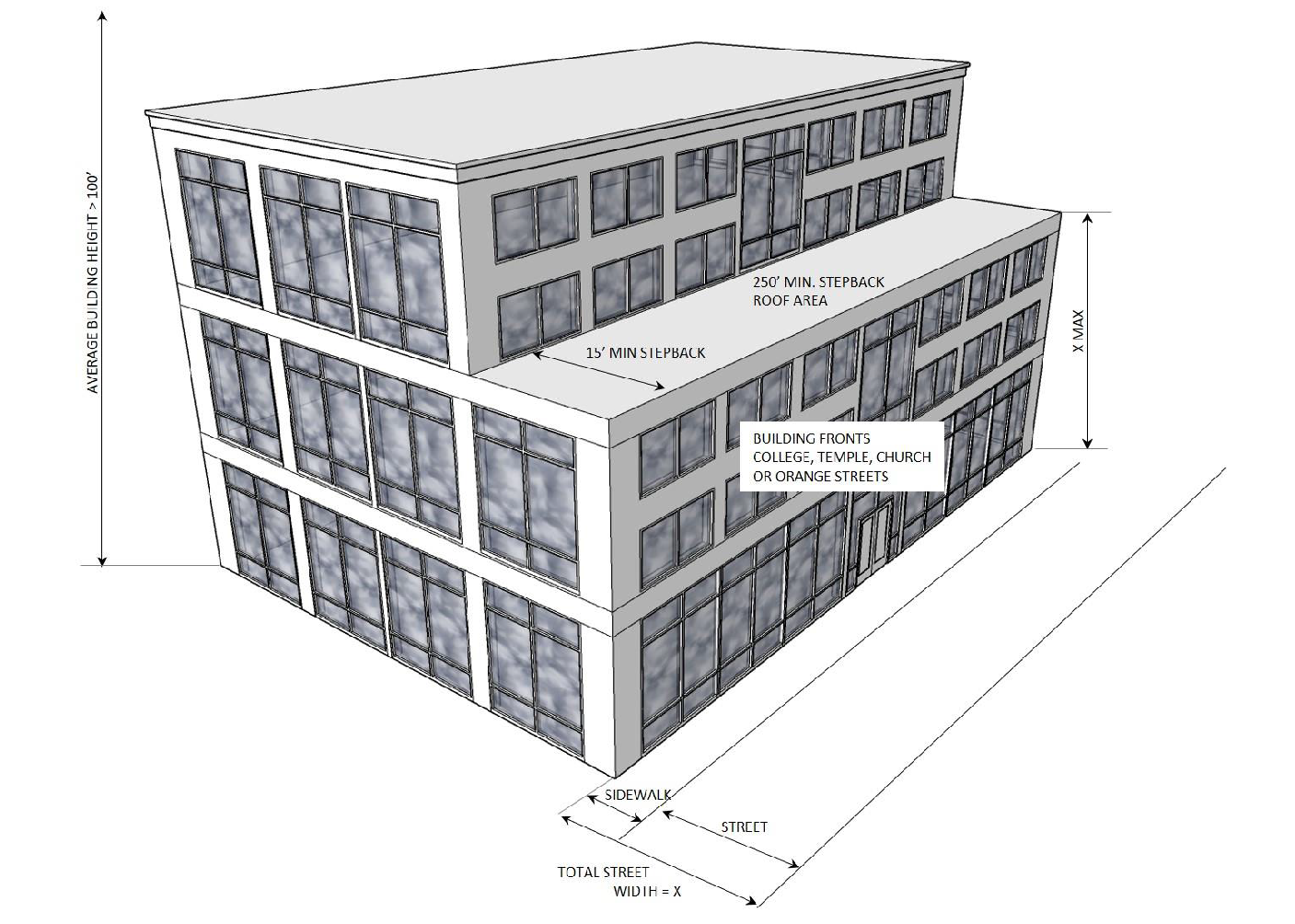
(12)
Exceptions. Ecoroofs, roof decks, roof gardens, roof accesses, mechanical floors, and related structures shall not be counted in building height limits.
(f)
Maximum building coverage.
(1)
Business and Industrial Districts. Except for the Mixed-Use (MULW) Long Wharf District, there shall be no direct limit on building coverage.
(2)
Mixed-Use Long Wharf (MULW) District. The maximum building coverage for an individual development shall not exceed 85 percent of the site area, with the remaining site area devoted to usable open space(s). Building coverage may be 100 percent if the usable open space is centralized and shown cumulatively on a master site plan for a multi-phase project.
(g)
Maximum size of courts. Except for the Business D-3 District, the horizontal distance between facing walls of any court in any business or industrial district shall not be less than five feet where neither facing wall has an average height greater than 20 feet, and not less than one foot for each four feet of average height of the two facing walls averaged together where either facing wall has an average height greater than 20 feet. In the BD-3 District, there shall be no required distances between the facing walls of any court for any nonresidential building. For mixed-use buildings and residential principal buildings, the horizontal distance between facing walls of a court shall not be less than 20 feet if neither facing wall has an average height greater than 30 feet and not less than one foot for each four feet of average height of the two facing walls averaged together where either facing wall has an average height greater than 30 feet.
(h)
Yard Regulations. The following requirements shall apply in all business or industrial districts except for the BD, BD-1, BD-3, and TOC Districts (see subsection 43(h)(4)), CGD (see subsection 43(i)), and MULW District (see subsection 43(i)), the BA-1 District (see subsection 43(o)), the BA-2 District (see subsection 43(o)), the Downtown for All Overlay District (where the requirements applicable to the BD zone shall apply), and except where a business or industrial district abuts a residence district (see § 47). These requirements shall apply to both principal and accessory buildings.
(1)
Front yards. There shall be no front yard required in any business or industrial district.
(2)
Side yards. There shall be no side yard required in any business or industrial district, except that in any case where a side yard is actually provided such side yard shall be required to be not less than five feet for a building wall having an average height of 20 feet or less, and not less than one foot for each four feet of average height for a building wall having an average height of more than 20 feet.
(3)
Rear yards. There shall be a rear yard in all business and industrial districts of not less than ten feet for a building wall having an average height of 30 feet or less and not less than one foot for each three feet of average height for a building wall having an average height of more than 30 feet.
(4)
Exceptions. There shall be no minimum yard requirements in the BD, BD-1, TOC, or the BD-3 Districts except that in the BD-3 District there shall be a minimum of 15 feet, and in the TOC a minimum of 20 feet, of unobstructed land from the ground up on which no structures shall be located between the outer face of a building foundation wall at grade of a principal building that fronts on a street and the curb of such street in order to provide for sidewalks, streetlights and landscaped areas between the sidewalk and the curb, provided, however, that overhead pedestrian walkways and the footings, foundations, piers, and/or supports for such walkways may be located in the above described 15 or 20 foot area. Additionally, in the BD-3 District, when a mixed use or a residential principal building which is four stories or less, contains one or more windows that face a nonresidential building on the same lot, there shall be a minimum of ten feet of unobstructed land from the ground up between the nonresidential building and the residential principal building or mixed-use building. If such residential principal building or such mixed-use building faces a nonresidential building on an adjacent lot or faces an adjacent vacant lot, then there shall be a minimum ten-foot side or rear yard (as the case may be) on the lot on which such residential principal building or mixed-use building is located facing the adjacent lot.
(i)
CGD Yard Regulations. The requirements in the CGDs are set out in Table 43.3, CGD Yard Regulations:
(1)
In CGDs, the minimum and maximum yard requirements for frontages on the three main corridors are:
Where the parcel abuts side streets that are not Whalley, the front yard minimum is zero and the front yard maximum is 20 feet. The front yard provided should be demonstrably consistent with the front yards of the relevant side street.
(2)
Because larger development sites are often phased for financing and lease purposes, contiguous sites in the CGD zone that are being developed together may be considered as a single lot for purposes of setbacks and other dimensional requirements (e.g. FAR, POPS) regardless of ownership.
Table Notes:
[1] The setback is measured from the edge of right-of-way (public) or street easement, lot or tract (private), which is also the near edge of the sidewalk.
[2] The street frontage requirements apply to the greater height of a building or step back.
[3] The building step back for the stories above the maximum allowed at the front setback shall be no less than five feet and no greater than 20 feet.
Figure 43.2 MULW Public Street Illustration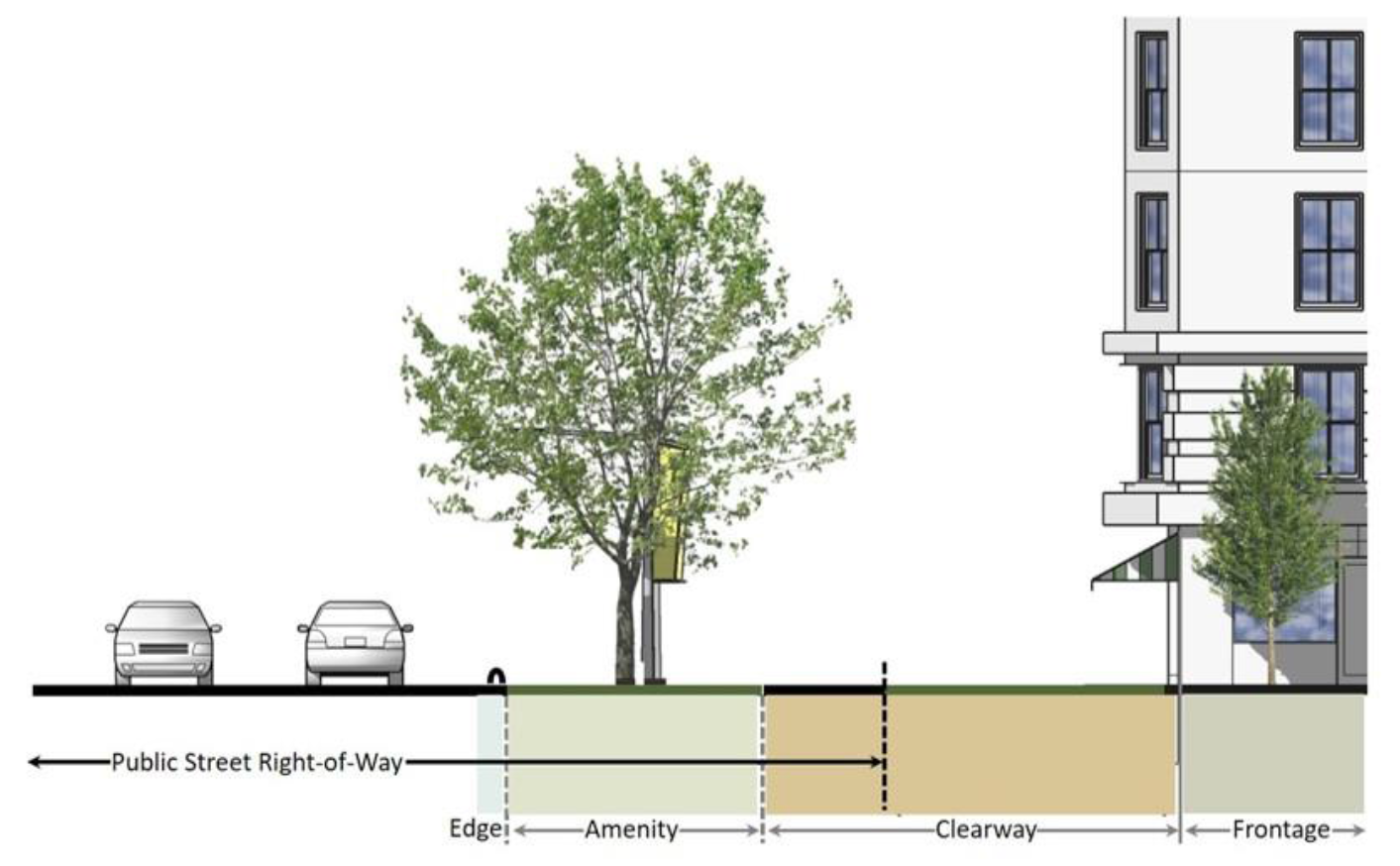
Figure 43.3 MULW Private Street Illustration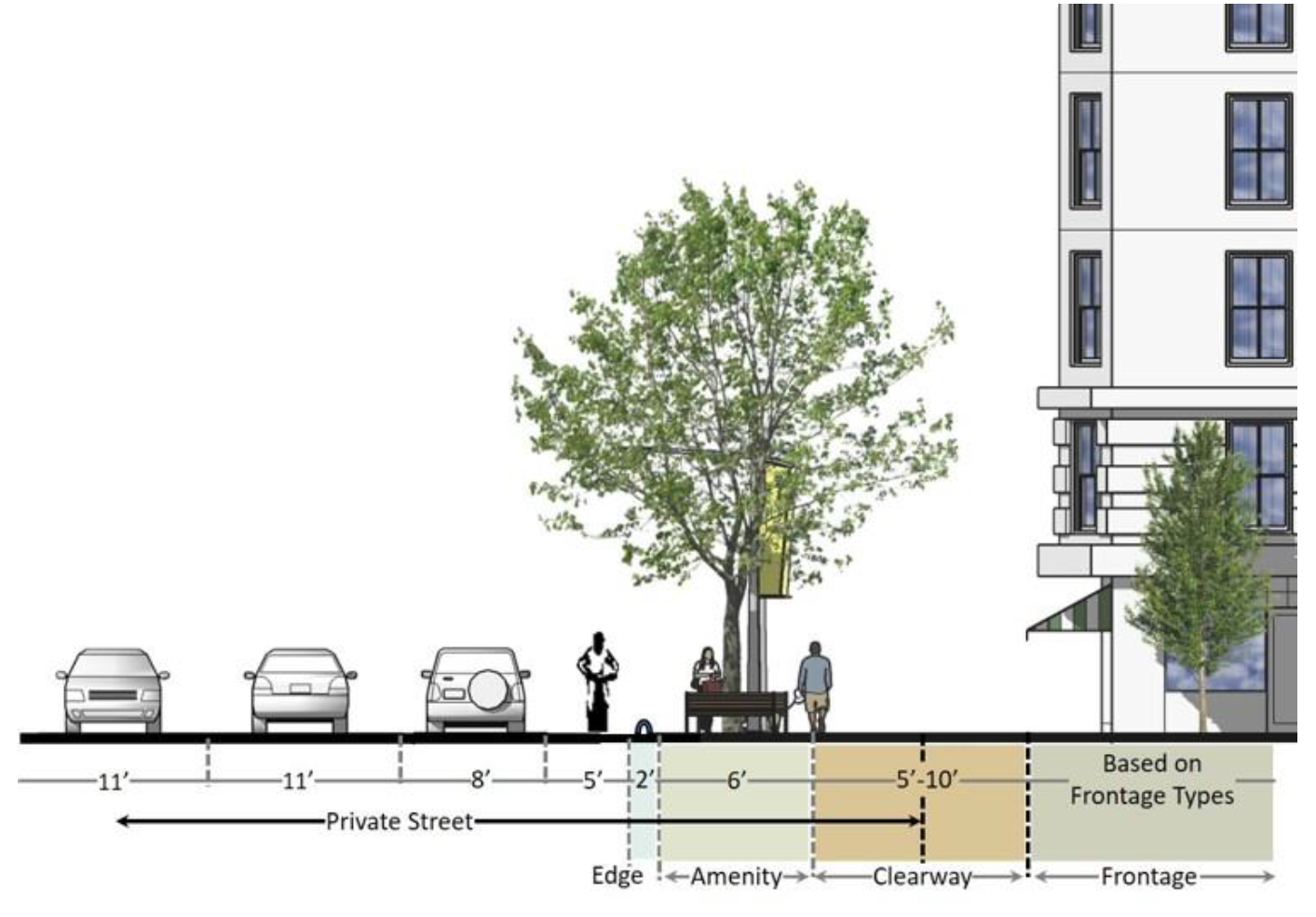
Figure 43.4 MULW Building Frontage Types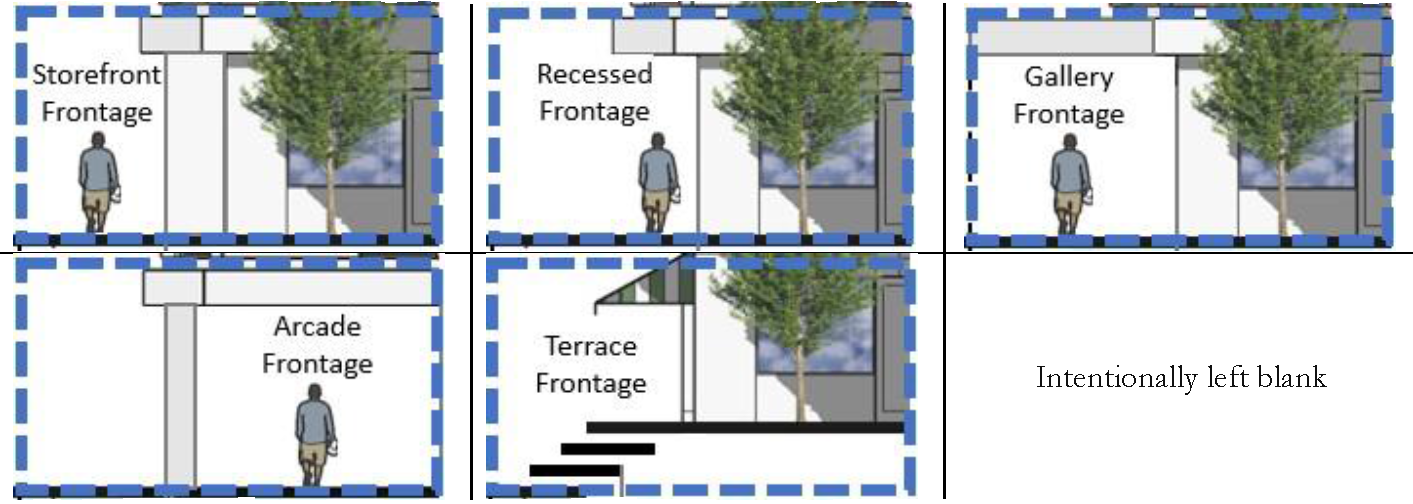
Figure 43.5 MULW Alley Illustration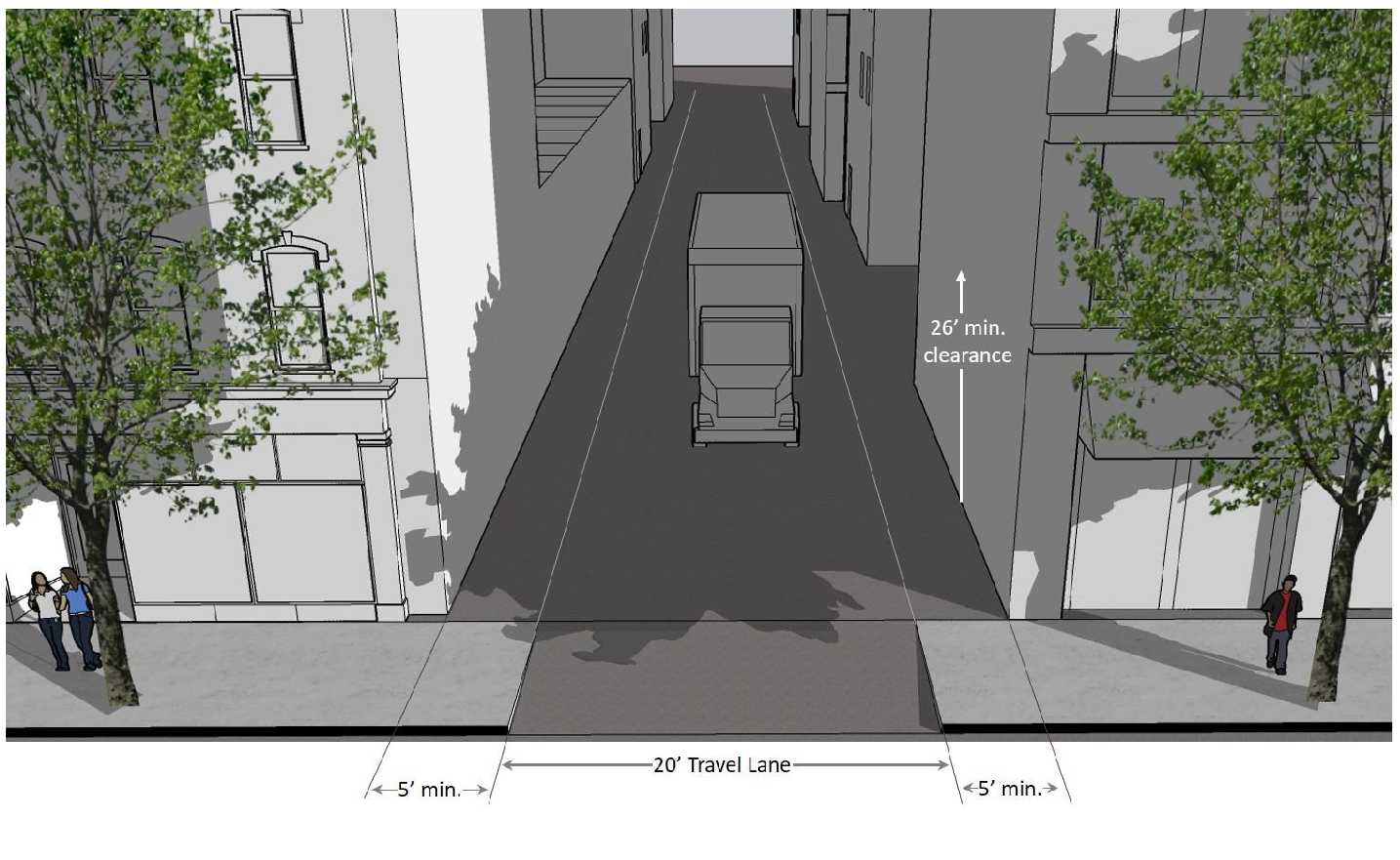
(j)
Coastal Environmental Protection and Safety Standards. Any project proposed to be in the Harbor Subdistrict of the Mixed-Use Long Wharf (MULW) District shall conform to the environmental protection and safety standards established below:
(1)
Area for Recyclable Materials. Any proposed project with a gross floor area of 50,000 or more square feet shall include an interior area for the separation, temporary storage, and collection of recyclable materials. Such area shall be located in the vicinity of an off-street loading facility.
(2)
Trash Disposal Standards. Any such proposed project with a gross floor area of 50,000 or more square feet shall include a trash compactor in an interior location for garbage and trash disposal and shall provide for the maintenance and cleanliness of such compactor.
(k)
Structures within required yards. The following rules shall apply to yards provided under § 43(f).
(1)
No wall of a building shall extend beyond the outer face of a building foundation wall into such a yard for more than six inches.
(2)
A projection from a building may extend into such a yard for not more than one-half the width of such yard, but in no case more than five feet into such yard for fire escapes, one-story open porches, ramps, loading docks, and steps leading up to the ground floor, or three feet into such yard for all other projections, and in no case to within two feet of any lot line.
(l)
Usable Open Space for the BC, BD, BD-1, BD-2, BD-3, TOC, MULW, CGD, IL, and Downtown for All Overlay Districts.
(1)
In the BD-3 and TOC Districts, for all nonresidential buildings more than 10,000 square feet of gross floor area, a minimum of 25 square feet of usable open space per 1,000 square feet of gross floor area up to a maximum of 10,000 square feet of usable open space shall be provided on the same lot on which the nonresidential building is located. If any point on such lot is located within a 1,000-foot radius of publicly accessible open space, then a minimum of 13 square feet of usable open space per 1,000 square feet of gross floor area shall be required on such lot up to a maximum of 10,000 square feet of usable open space.
(2)
In the BC, BD, BD-1, BD-2, BD-3, TOC, CGD and IL Districts, for all mixed-use buildings and residential principal buildings both existing and proposed, a minimum of 50 square feet per dwelling unit of usable open space shall be provided on the same lot on which such building is located. If any point on the lot upon which the mixed-use building or the residential principal building is situated is located within a 1,000-foot radius of publicly accessible usable open space, then a minimum of 25 square feet of usable open space per dwelling unit shall be required.
(3)
In the BC, BD, BD-1, BD-2, BD-3, TOC, CGD and IL Districts, mixed-use buildings and residential principal buildings both existing and proposed with six or more dwelling units shall provide 50 square feet of common amenity space per dwelling unit in addition to the usable open space required under subsection (2) above.
a.
In the MULW District, a minimum of 15 percent of the total site area shall be preserved as usable ground level open space. Up to but not exceeding three percent of the total site area may receive credit for a rooftop terrace, balconies and other such above-ground spaces. The open space shall be calculated and shown for each building site or may be centralized and shown cumulatively on a master site plan for a multi-phase project. Such open space shall be constructed concurrent and proportionate with each phase of development, or upon approval of the Board of Alders, may be dedicated for construction during a later phase provided a legal instrument, approved as to form by Corporation Counsel, is filed of record with the City Clerk. To quality as usable open space: All buildings shall be located within a 500-foot radius of a ground level open space with an area no less than 3,000 square feet.
b.
The ground level space shall be constructed as one contiguous open area or, with approval of the City Plan Commission, no more than 40 percent of the ground level area may be arranged linearly or as separate areas provided no area is less than 500 square feet;
c.
No more than two-thirds of the perimeter of a ground level open space may be surrounded by walls;
d.
No portion of an outdoor open space can have a clear height of less than eight feet;
e.
An open space that is roofed shall have a minimum clear height of 1.5 times the greatest dimension of the roofed area;
f.
Fully enclosed and roofed accessory structures are permitted within an open space provided they cover a cumulative area no greater than 15 percent of the total required ground level amenity area; and
g.
A minimum of 20 percent of the total required ground-level open space shall be for planting areas provided no horizontal dimension is less than three feet and each planting area has a minimum plant coverage of 75 percent.
(4)
In the Downtown for All Overlay District, mixed-use buildings and residential principal buildings, both existing and proposed, with six or more dwelling units shall provide a minimum of 25 square feet of common amenity space per dwelling unit.
(5)
In the MULW District, the following areas shall not be deemed "usable open space":
a.
Any area occupied by a building not exceeding a height of 15 feet and a gross floor area of 400 square feet and reserved exclusively as a water-dependent use or a recreational use permitted by Section 42, Use regulations for business and industrial districts;
b.
Any area occupied by a street or private way open only to pedestrians and emergency vehicles; and any area, at grade, that is covered by a pedestrian skywalk or skybridge; and
c.
Areas above ground-level that exceed three percent of the total site area.
Figure 43.6 MULW Open Space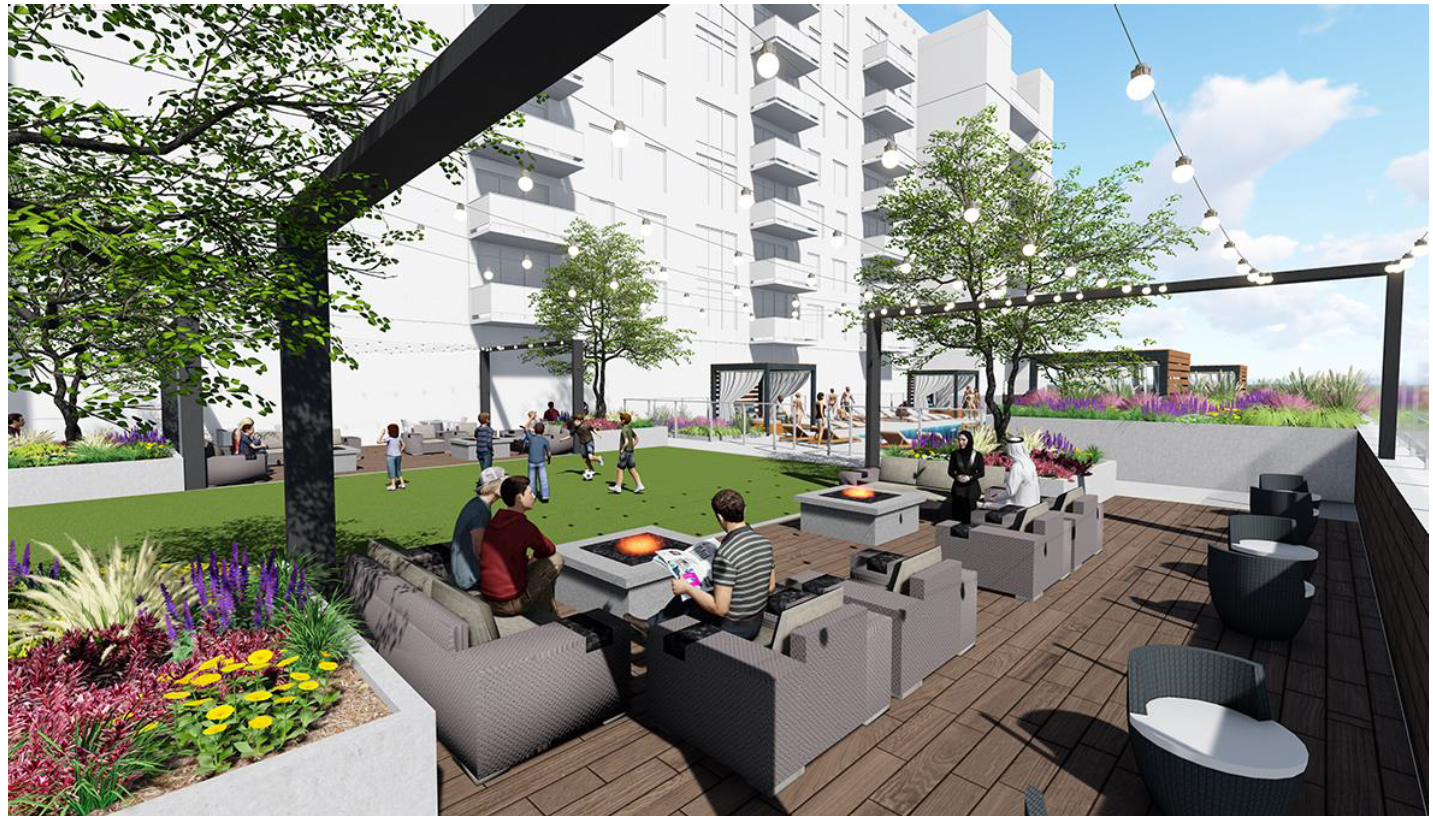
(m)
Principal entrances.
(1)
BD-3 and TOC Districts. Buildings facing College Street, Orange Street, Temple Street, Church Street South (between Columbus Avenue and South Frontage Road), Lafayette Street, Washington Avenue, Union Avenue, or Congress Avenue shall have a principal entrance facing such streets or on the corner of any of the above listed streets and another street.
(2)
MULW District. All buildings facing a public street shall provide at least one principal entrance to such street. Buildings that front, in whole or in part, on an open space shall provide at least one principal entrance to such space.
(n)
Transparent and active uses.
(1)
BD-3 and TOC District.
a.
Every nonresidential building and every mixed-use building that faces College Street, Orange Street, Temple Street, or Church Street, Washington Avenue, Congress Avenue, Union Avenue, Lafayette Street or Church Street South (between Columbus Avenue and South Frontage Road) in whole or in part shall have, at minimum, 60 percent of the first floor façade between two feet and eight feet in height facing such street comprised of clear windows and/or doors that allow views of indoor space and/or product display areas.
b.
The first floor of the façade of every nonresidential building and every mixed use building that faces College Street, Orange Street, Temple Street, or Church Street, Washington Avenue, Union Avenue, Congress Avenue, Lafayette Street or Church Street South (between Columbus Avenue and South Frontage Road) shall contain uses which are active and involve the movement of persons in such spaces, including but not limited to restaurants, retail stores, art galleries, fitness centers, yoga studios, lobbies, dance or music studios, and personal services businesses.
c.
Every nonresidential building and every mixed-use building which faces Martin Luther King Boulevard or Legion Avenue/South Frontage Road in whole or in part shall have, at minimum, 30 percent of the first-floor façade between two feet and eight feet in height facing such street comprised of clear windows and/or doors that allow views of indoor space and/or product display areas.
(2)
MULW District. Building facades that face a street or open space shall maintain a minimum level of transparency on the ground and upper stories. Only those windows and door areas arranged so that active uses within the building are visible from or accessible to the street shall be counted toward meeting transparency requirements. Enclosed product display windows and other similar elements that do not permit clear visibility into the interior of the building shall be omitted from transparency calculations.
a.
All windows must be transparent, non-reflective glass.
b.
Solid walls on the ground floor facing a street are prohibited.
c.
A minimum of six square feet of clear window area for every 40 linear feet, or portion thereof, of the walls of a building that faces a parking area shall be required. The window shall be placed so that the parking area may be readily viewed from inside the building.
d.
Transparency requirements do not apply to portions of structures in the assembly area of theaters, auditoriums, religious institutions, and similar uses, provided that the building wall is enhanced by architectural detailing, artwork, landscaping or similar features.
e.
The building transparency requirement may be reduced or waived through design review upon finding that:
1.
The proposed use has unique operational characteristics with which the provision of the required windows and openings is incompatible, such as in the case of a historic building; and Street-facing building walls will exhibit architectural relief and detail, or will be screened with attractive landscaping, in such a way as to create visual interest at the pedestrian level.
Figure 43.7 MULW Facade Transparency Requirements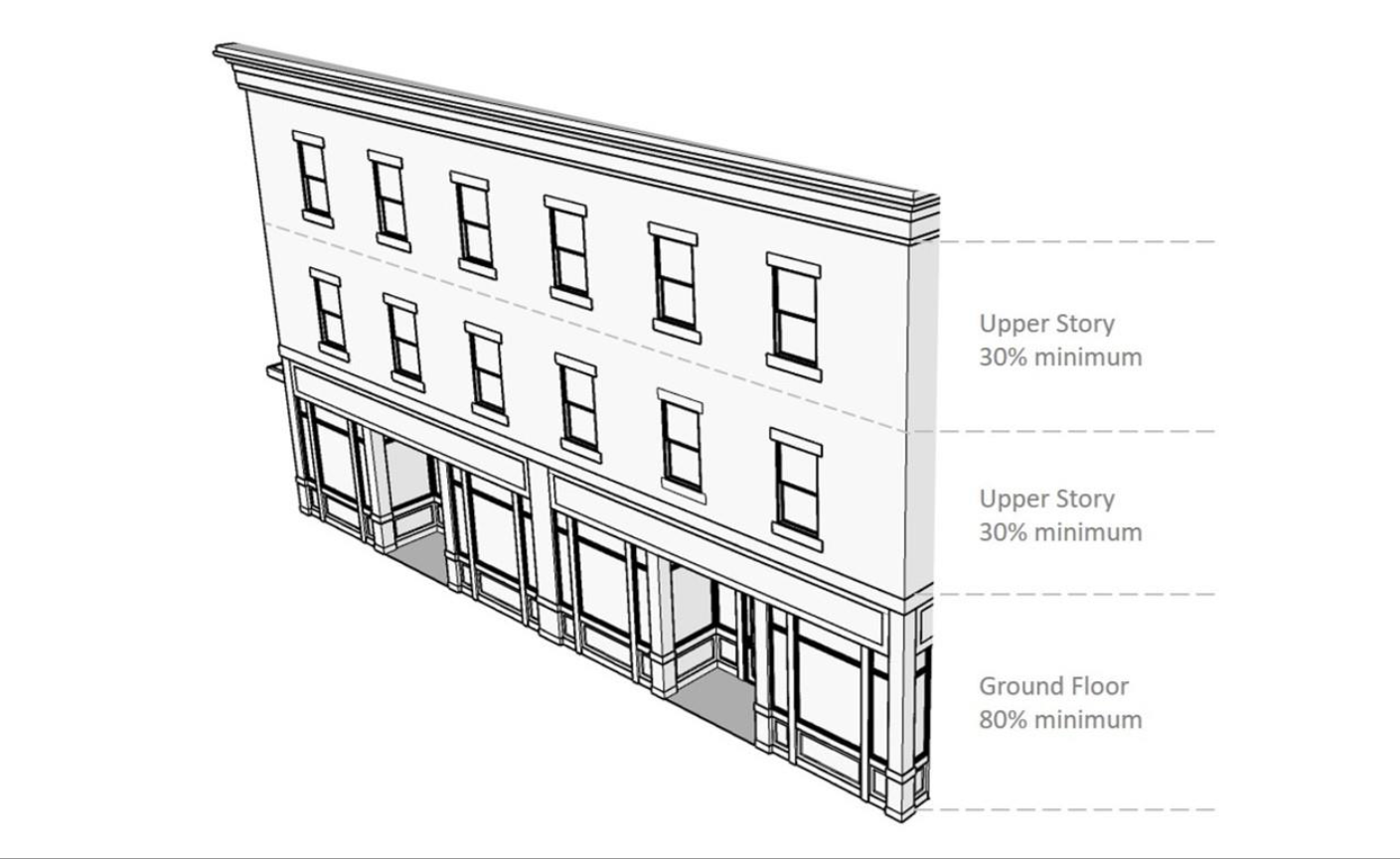
(o)
Additional requirements for buildings in BA-1, BA-2, and CGD Districts.
(1)
Yards facing the public right-of-way. In BA-1 and BA-2 Districts, building façades must abut or be located within ten feet of at least 75 percent of the property line abutting the public street (see figure 43.1 below). Building façades in CGDs must be located within the distance specified in Section 43(i).
(2)
Side yards. No minimum side yards are required. For CGD Districts, maximum side yards are specified in Section 43(i).
(3)
Rear yards. Minimum ten-foot rear yard. In CGD Districts, minimum rear yards are specified in Section 43(i).
(4)
Street frontage. In CGD Districts only, buildings must occupy 100% of street frontage for lots with less than 250 feet of street frontage or access driveways no greater than 20 feet wide. A special exception may be sought to devote frontage to Privately Owned Pedestrian Space.
a.
Privately Owned Pedestrian Space (POPS). Up to 20% of street frontage on Whalley in CGD Districts can be occupied by POPS, within the constraints of the maximum permitted side yards. POPS are pedestrian friendly areas, which are owned and maintained by private property owners. POPS count toward usable open space requirements, specified in Section 43(l). POPS are intended to produce active and safe spaces. They include human-scale elements such as lighting, windows, art, and landscaping. Commercial activities, including food service and sales may occupy POPS. To the extent possible, it is strongly encouraged for POPS to be plazas, community gardens, or pedestrian arcades providing safe opportunities for the public to walk, sit, recreate, and congregate.
b.
For lots with 250 feet or more of street frontage, at least 75% of the street frontage not occupied by building façade or access driveway no greater than 20 feet wide, shall be occupied by POPS, as described in subsection a. above.
c.
An exterior lighting plan must be included with site plans for POPS.
(5)
Corner lots. Are exempt from rear yard requirements for the first 50 feet from the street.
(6)
Doors and Entrances. Buildings must have a primary entrance facing a public sidewalk. Entrances at building corners may be used to satisfy this requirement. Building entrances may include doors to individual shops or businesses, lobby entrances, entrances to pedestrian-oriented plazas, or courtyard entrances to a cluster of shops or businesses.
(7)
Transparency. In new buildings, except for buildings or portions of buildings containing residential or religious uses or health care facilities on the first floor, a minimum of 75 percent of the street-facing first floor building façade between two feet and eight feet in height must comprise clear windows that allow views of indoor space or product display areas. The bottom of any window or product display window used to satisfy this standard may not be more than three feet above the adjacent sidewalk.
(8)
Security bars and Gates. Solid metal security gates, bars, or solid roll-down metal windows shall not be permitted. Link or grill type security devices shall be permitted. If installed on the outside, the coil boss shall be recessed and concealed behind the building wall.
(9)
Landscaping. All parts of the property visible from the public right-of-way or from residential units contained on the property or adjoining properties shall be adequately landscaped to maximize recreational utility and aesthetic views. Landscape improvements may include pavers or paved surfaces, gravel, trees, shrubs, ground cover, and wherever possible, the retention of existing landscape features.
(10)
Fencing. Rear yard property lines must be fenced where they abut residential zones as practicable. Alleyways should have decoratively designed gates or fences. Fences in front or side yards should not obscure sight lines to increase public safety. Chain link fences are prohibited except for temporary fences for construction.
(11)
Screening. All trash receptacles, dumpsters, or bins placed outside the building must be screened from view from the public right-of-way and constructed and maintained to prevent noxious sights, odors, vermin, or other nuisances.
Figure 43.8 BA-1 Yard Requirements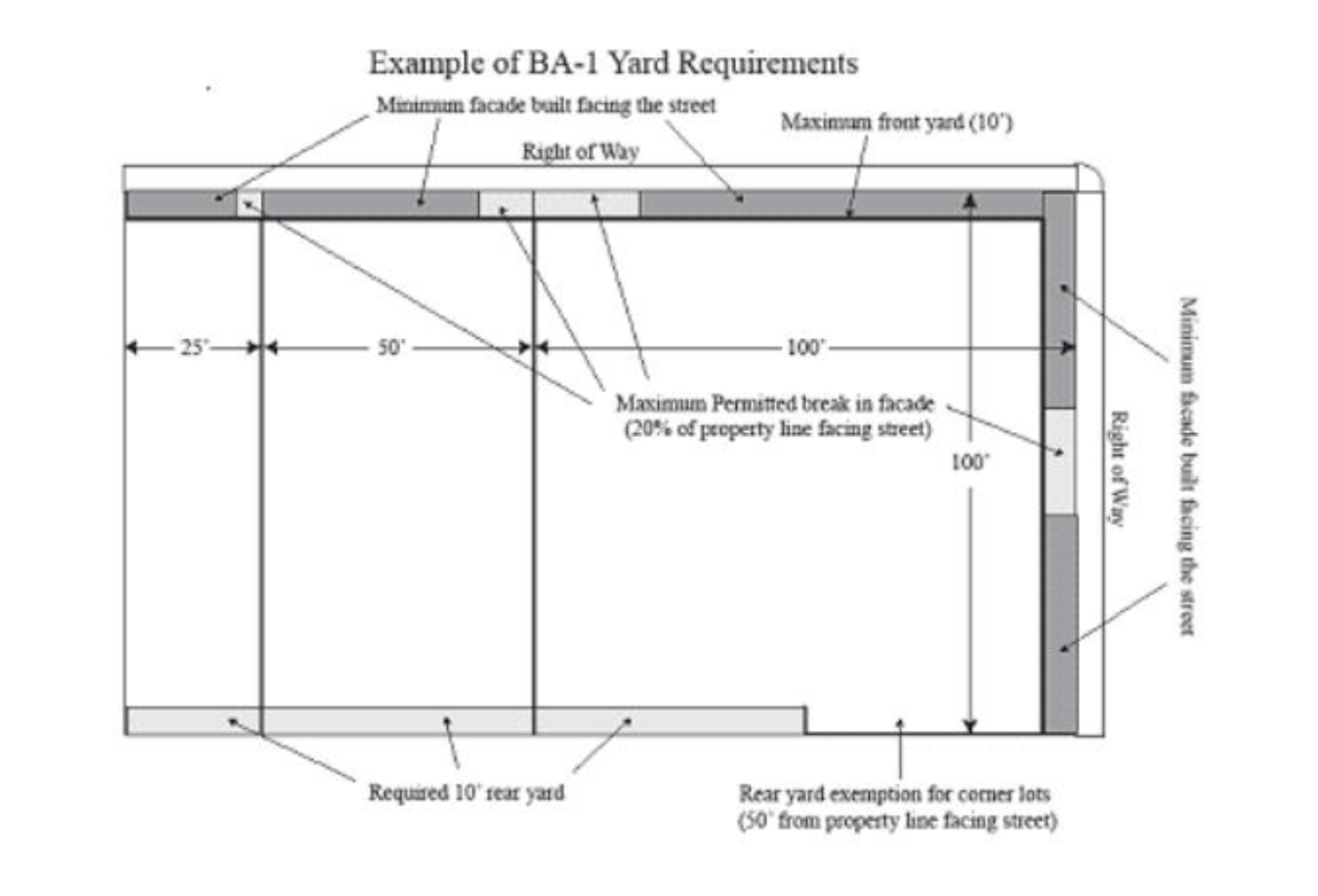
(12)
Design guidelines. The following design guidelines apply to all buildings in a BA-1 or CGD District only. They should to the greatest extent possible, be incorporated into the design of new buildings and the renovation of existing structures. Compliance with these guidelines shall apply when (i) there are proposed modifications to a building façade to include replacement of windows, replacement of façade materials, or additions to or extensions of a façade; (ii) there is an addition or modification to an existing structure that is subject to site plan review under Section 64(f); and (iii) for all new construction.
a.
General design principles. Emphasis is placed on the pedestrian-scaled environment. Buildings should harmoniously blend with the existing neighborhood fabric. All materials and architectural details used on the exterior of a building should be compatible with the building style, and with each other. A building designed of an architectural style that normally includes certain integral materials and/or details should incorporate such into its design. Plans should reflect an attention to detail, the use of quality materials, and good craftsmanship.
b.
Scale, mass and continuity. Buildings should generally relate in scale and design to the surrounding buildings where such buildings represent quality construction and design associated with historical development of the area. Buildings should reflect a continuity of treatment in the following ways:
1.
Maintain, when appropriate, the building mass and scale of adjacent buildings.
2.
Maintain front yard build-to lines.
3.
Maintain cornice and transition lines in buildings of the same height.
4.
Primary horizontal and vertical lines in the architectural composition should remain visible or be incorporated into the design.
c.
Building entrances. All entrances to a building should be defined and articulated by architectural elements of the building. Any such element utilized should be architecturally compatible with the style, materials, and details of the building as a whole.
d.
Fenestration. The arrangement and design of windows and doors in a building should be architecturally compatible with the style, materials, and details of the building. Windows should be vertically proportioned wherever possible. To the extent possible, upper story windows should be vertically aligned with the location of windows and doors on the ground level, including storefront or display windows. All windows should be stylistically consistent with the building and energy efficient.
e.
Roofs. Roof types should be appropriate to a building's architectural type. Repairs to existing construction should conform to the building vernacular.
f.
Buildings on corner lots. Buildings on corner lots should be considered important structures because they contain more than one façade that is exposed to the street. These buildings should be enhanced with appropriate architectural embellishments.
g.
Façades. The architectural treatment of the front façade should be continued, in its major features, around all visibly exposed sides of a building. All sides of a building should be architecturally designed to be consistent regarding style, materials, and details. Deteriorated materials should be restored to actual function if possible, and if not possible, should be replaced with similar materials that have the same form and surface characteristics without visually changing the façade's character. New buildings should, at street level, have clear glass windows sufficiently transparent to provide views into the interior of the building.
h.
Storefront façades. Storefronts should be integrally designed as part of the entire façade. Buildings with multiple storefronts should be architecturally uniform throughout using architecturally compatible materials, details, awnings, canopies and marquees.
i.
Signage and lighting fixtures. Attachments and/or fixtures should complement the architectural design of the façade and should be appropriate in scale to the ornamentation and the design elements of the building. Fixtures and attachments should not obscure historically significant materials, architectural features or decorative details.
j.
Signage. Signage should be architecturally compatible with style, materials, and details of the building and neighborhood.
k.
Awnings, canopies and marquees. Awnings, canopies and marquees are permitted at ground level. Such treatments should be designed to complement the building and should be compatible with the materials and details of the building and neighborhood. In buildings with multiple storefronts compatible awnings, canopies and marquees should be used to unify the building. Solid, lighted awnings and canopies are not permitted. Vinyl awnings are not permitted.
(13)
Special permit. All proposed uses of greater than 5,000 net square feet, whether located in new or existing structures, shall require a Special Permit to ensure that such relatively large proposals are compatible with and meet the general criteria and standards of the Business A-1 and Business A-2 Districts as described and defined in Section 41. Uses within CGDs are exempt from this provision.
(p)
Light Industrial Coastal Overlay. Except for Section 43.2 ("Required Public Access: Coastal Access Easements") and Section 43.3 ("Special Provisions for the MULW District"), the provisions of Section 43 applicable to the MULW District, including Table 43.4 MULW Building Regulations, shall not apply to parcels in the Light Industrial Coastal Overlay boundary area of the MULW District. Notwithstanding any other provision of the Zoning Ordinance to the contrary, parcels in the Light Industrial Coastal Overlay boundary area shall comply with the provisions of Section 43 applicable to the IL District.
(Ord. No. 1410, § 3, 3-20-06; Ord. No. 1412 (Rev. Sched. A, §§ 6, 7), 5-1-06; Ord. No. 1614, § 1, 3-1-10; Ord. No. 1685, Sched. D, 8-6-12; Ord. No. 1696, Sched. A, 5-6-13; Ord. No. 1726, Sched. A, 12-2-13; Ord. No. 1751, Sched. A, § 2, 8-6-14; Ord. No. 1804, Attach. C, 8-1-16; Ord. No. 1807, Attach. C, 8-1-16; Ord. No. 1820, Sched. B, 6-5-17; Ord. No. 1842, Sched. B, 6-4-18; Ord. No. 1886, Sched. C, 1-17-20; Ord. No. 1899, Sched. A, 7-6-20; Ord. No. 1975, 9-19-23; Ord. No. 2023-0024, 5-6-24; Ord. No. 2025-0028, 12-1-25)
Section 43.1 - Design Standards for Public Plazas in the BD-3 and TOC Zones.
43.1-01
Purpose. Public plazas are privately operated open areas on a Lot intended for public use and enjoyment. Public plazas are intended to serve the following specific purposes:
(1)
to serve a variety of users of the public plaza;
(2)
to provide spaces for solitary users while at the same time providing opportunities for social interaction;
(3)
to provide safe spaces, with maximum visibility from the Street and adjacent Buildings and with multiple avenues for ingress and egress;
(4)
to mitigate the impact of Urban Heat Island by incorporating planting;
(5)
to maintain the use of the public plaza as publicly accessible space throughout the life of the Building for which a bonus FAR is provided due to the inclusion of a public plaza on the Lot on which the Building is located; and
(6)
to ensure that the provision of a FAR bonus for a Building due to the inclusion of a public plaza on the Lot on which the Building is located is based upon consistently applied standards.
(7)
to create spaces which are pleasing to the senses, and suitably control any above-ground utility-like appurtenances which may be visually, audibly, and odorously offensive.
(8)
to create spaces which are architecturally compatible and harmonious with surroundings.
43.1-02
Definitions.
Corner public plaza: A "corner public plaza" is a public plaza that is located on an intersection of two or more Streets.
Through block public plaza: A "through block public plaza" is a public plaza or portion of a public plaza that connects two Streets at mid-block.
43.1-03
Area dimensions.
A public plaza shall contain an area of not less than 3,000 square feet. In no case, shall spaces between existing Buildings on a Lot qualify as public plazas for purposes calculating a zoning bonus. Only the areas of a public plaza that meets the Standards shall count towards qualifying area for purposes of calculating a zoning bonus.
43.1-04
Orientation. The orientation of the public plaza shall maximize access to sunlight and air. A primary frontage of the public plaza shall be south facing where possible and adequate shade shall be provided for user comfort. Prevailing wind patterns and down drafts shall be considered with adequate protections for user comfort.
43.1-05
Requirements for major portions of public plazas. All contiguous public plaza areas meeting these standards for public plazas on one Lot shall be considered one public plaza, as follows:
(1)
The major portion of a public plaza is the largest area of the public plaza and the area of primary use.
(2)
Major portions shall be generally regular in shape, easily and directly accessible from adjoining Buildings and public spaces, and continuously visible from within all portions of the public plaza.
(3)
The major portion of a public plaza shall have a minimum average width and depth of 40 feet.
(4)
Where a public plaza has an irregular shape, minor portions of the public plaza shall be directly adjacent to the major portion and have a minimum depth of 15 feet.
43.1-06
Regulations for through block public plazas. Through block plazas shall meet the following standards:
(1)
Through block public plazas shall be treated as two public plazas separated at a line drawn within 25 feet of the midblock line.
(2)
Where any Building wall or walls adjoin a through block public plaza or a through block portion of a public plaza and where such wall or walls exceed 120 feet in aggregate length, a minimum ten-foot setback at a height between 60 and 90 feet is required for the full length of the Building wall.
(3)
Through block public plazas shall contain a circulation path at least ten feet in width, connecting the two Streets on which the public plaza fronts.
43.1-07
Paving. The paving of the public plaza shall be of non-skid durable materials that are decorative and compatible in color and pattern with other design features of the public plaza. To reduce urban heat island:
(1)
Paving materials shall be of high-reflective material and/or pervious pavers or vegetated pavers.
(2)
Urban landscape, trees and vegetation shall be used to reduce direct sunlight on pavement surfaces.
43.1-08
Access and Circulation.
(a)
At least 30 percent of public plaza Street frontage shall be free of obstructions.
(b)
The level of a public plaza, inclusive of major and minor portions, shall be at the average elevation of the level of the curb of adjacent Street frontage.
(c)
Clear sightlines shall be maintained into main areas of the public plaza from adjacent sidewalks.
(d)
Notwithstanding the foregoing. If the grade of the public plaza is different from the grade of an adjacent Street, there must be a visible means of access from the adjacent Street onto the public plaza as well as signage, artwork, planted walls or other visual cues that connect the adjacent Street to the public plaza.
(e)
Where the elevation of the public plaza is more than four feet above or below the curb level of an adjoining Street, access to the public plaza shall be provided by ADA compliant stairs, via a through block connection (a connection between two Streets) or via a publicly accessible arcade or enclosed passage that is open to public and ADA accessible.
(f)
Circulation paths within public plazas shall provide for unobstructed pedestrian circulation throughout the minor and major portions of the public plaza at a minimum width of five feet. At least one circulation path should be at an average eight in width.
43.1-09
Permitted obstructions. Public plazas shall be open to the sky and unobstructed except for the following features:
(1)
Equipment and appurtenances normally found in public parks and playgrounds: water features, art; seating; trees, planters, planting beds, arbors or trellises; litter receptacles; bicycle racks; tables and other outdoor furniture: lights, public restrooms; permitted temporary exhibitions; permitted canopies; permitted freestanding signs; play equipment; kiosks and open-air cafes; stages.
(2)
No obstructions shall impede sightlines in the public plaza so as to create a public safety issue.
(3)
Permitted obstructions may occupy a maximum percentage of the area of a public plaza, as follows:
For public plazas less than 10,000 square feet in area: 40 percent
For public plazas 10,000 square feet or more in area: 50 percent
(4)
The area of permitted obstructions shall be measured by outside dimensions at ground level. Obstructions that are non-permanent or moveable, such as moveable chairs, open air cafes, or temporary exhibitions are exempt.
(5)
Trees planted flush-to-grade in accordance with the provisions of Section 43.1-13b (Planting and Trees) and tree canopies as well as raised planted areas that are bounded by seating do not count as obstructions for the purpose of calculating total area occupied by permitted obstructions.
(6)
The following are prohibited in public plazas: garage entrances, driveways, parking spaces, passenger drop offs, loading berths, exhaust vents, mechanical equipment and building trash storage facilities. Vents may be permitted in adjacent walls if they are more than 15 feet above the level of plaza with visual and auditory mitigation. Vents in public plazas must be concealed from view by planting or other features.
43.1-10
Hours of access. All public plazas shall always be accessible to the public, except for anticipated temporarily closures for maintenance of the public plaza or for public safety as documented by the applicant.
43.1-11
Standards of accessibility for persons with disabilities. All public plazas shall conform to applicable laws pertaining to access for persons with disabilities regardless of whether the Building associated with the public plaza is existing or new.
43.1-12
Kiosks, Food Carts and Open-Air Cafes. Kiosks, food carts and open-air cafes may be placed within a public plaza which are licensed in accordance with City regulations. Such features shall be treated as permitted obstructions.
43.1-13
Amenities. All public plazas shall provide amenities, as listed below. All required amenities shall be considered permitted obstructions within the public plaza.
43.1-13a
Seating. Standards for seating within public plazas are intended to facilitate the provision of abundant, comfortable and accessible seating throughout the public plaza, to provide a broad variety of seating types and configurations; to accommodate individual users engaged in solitary activities as well as groups engaged in social activities; to provide comfortable and safe seating surfaces; to incorporate, to the maximum extent possible, a combination of fixed benches, moveable chairs, seating with backs, seat walls and ledges, and seating steps; as follows:
A minimum of one linear foot of seating shall be provided for each 75 square feet of public plaza area. Moveable seats can be credited as two linear feet.
43.1-13b
Planting and Trees. The provisions of this Section are intended to facilitate a combination of landscaping elements in order to provide comfort, shade and textural variety.
(1)
At least 15 percent of the area of a public plaza shall be comprised of planting beds with a minimum plan dimension of two feet, exclusive of any bounding walls.
(2)
All public plazas shall provide a minimum of four trees with a minimum of three-inch diameter at breast height (DBH).
(3)
For a public plaza greater than 10,000 square feet in area, additional trees that measures at least three inches DBH or multi-stemmed equivalents must be provided for each additional 1,200 square feet of public plaza area.
(4)
For all public plazas, at least 50 percent of required trees shall be planted flush-to-grade or planted at grade within planting beds with no raised curbs or railings. Trees planted flush-to-grade shall be surrounded by a porous surface (such as grating or open-joint paving) that allows water to penetrate into the soil for 75 square feet around trunk.
(5)
Planting beds shall have a soil depth of at least 18 inches for grass or other ground cover, three feet for trees and shrubs. Any planting bed containing required trees shall have a continuous area of at least 75 square feet for each tree exclusive of bounding walls. Each tree should have access to 1,000 cubic feet (cf) of soil. If trees are planted in a continuous planting bed, a minimum of 600 cubic feet of soil per tree should be allocated.
(6)
All plantings shall be appropriate to local climate and conditions with a 90 percent survival rate expectancy in first two years. Native species shall be prioritized in plant selections.
(7)
Planted areas on the roof of a subsurface structure may qualify as ECO roofs (see ECO roof definition). The requirements for soil depth and heights of planting beds above subsurface structures shall not apply if planting depths are not achievable due to structural or similar constraints and an alternative design such as intensive eco-roof application is provided.
(8)
Street trees are required to be planted at minimum 30 feet on center in the sidewalk area adjacent to a Lot on which a Building is located which has received a FAR bonus due to the presence of a public plaza on the Lot. Street trees are required to be approved by the City Tree Warden through the Site Plan Review process.
43.1-14
Lighting and electrical power. Public plazas shall be illuminated to provide for safe use and enjoyment of all areas of the public plaza. Steps and other changes in elevation and areas under tree canopies and permitted canopies within the public plaza shall be adequately lit. Electrical service shall be provided for public programming. All lighting sources that illuminate the public plaza and are mounted on or located within the Buildings adjacent to the public plaza on the Lot on which the public plaza is located shall be shielded from direct view. In addition, all lighting within the public plaza area shall be shielded to minimize any adverse effect on surrounding residences. All lighting must be Dark Sky Friendly to reduce light pollution.
43.1-15
Litter and recycling receptacles. Litter and recycling receptacle shall be provided in adequate numbers in accordance with use and programming of the public plaza.
43.1-16
Bicycle parking. In addition to the requirements for bicycle parking in Section 45 for the Building on the Lot on which the public plaza is located, public plazas greater than 10,000 square feet in size must provide parking for at least eight bicycles. Bike racks must be provided directly adjacent to the sidewalk that borders a public plaza and conform with any applicable City standards.
43.1-17
Additional amenities. Public plazas between 5,000 and 10,000 square feet in area must provide one of the following additional amenities and public plazas greater than 10,000 square feet in area must provide at least three of the following additional amenities. All additional amenities shall be considered permitted obstructions within the public plaza.
(1)
Artwork. The applicant shall consult with City's Director of Arts, Culture and Tourism with respect to the selection of artwork prior to submitting its Site Plan application.
(2)
Moveable tables and chairs.
(3)
Water features.
(4)
Children's play area in accordance with relevant safety standards.
(5)
Game tables and associated seating; or
(6)
Food service, including: food service in a retail space directly accessible from the major portion of the public, plaza; or an open-air cafe or kiosk. Public plazas greater than 10,000 square feet in area must include a food service as one of the three additional required amenities.
43.1-18
Mandatory Allocation of Frontages for Permitted Uses. At least 50 percent of the total frontage of all new Building walls fronting on a public plaza shall contain active uses on the ground floor level of the Building wall fronting the public plaza. All such uses shall include and comply with the following:
(1)
A public entrance that is directly accessible from the major portion of the public plaza;
(2)
A minimum depth of 15 feet, measured perpendicular to the wall adjoining the public plaza;
(3)
Continuation of the occupancy of such frontage for the life of the Building that has received a FAR bonus due to the presence of the public plaza on the Lot on which the Building is located (but not necessarily the same active use); and
(4)
For all new Building walls fronting on the major and minor portions of the public plaza, such Building walls shall be treated with clear, un-tinted transparent material for 50 percent of the Building wall fronting on the public plaza to a minimum height of 14 feet above the public plaza. Any non-transparent area of a new or existing Building wall fronting on the major or minor portion of a public plaza shall be treated with a decorative element or material or shall be screened with planting to a minimum height of 14 feet above the public plaza.
43.1-19
Maintenance. The public plaza, including, but not limited to, the permitted obstructions pursuant to Section 43.1-09, shall be maintained including litter control, management of pigeons and rodents, maintenance of required lighting levels, and the care and replacement of furnishings and vegetation and trees within the Lot as well as snow and ice removal, as needed.
43.1-20
Programming. Opportunities and permissions for pop-up seasonal events, temporary art installations, performances, educational events on the public plaza shall be provided in consultation with the City, the City's Art, Culture and Tourism Director and any applicable Special Services District. Access to power for public programming on the public plaza will be provided. A schedule of events shall be publicly available.
43.1-21
Compliance. As part of its Site Plan application, an applicant seeking a FAR bonus based upon the provision of a public plaza shall include a site plan indicating the area and dimensions of the proposed public plaza, the location of all existing Buildings and Structures occupying the Lot; all proposed Buildings and Structures, computations of proposed FAR, including bonus FAR, and detailed plans prepared by a registered landscape architect, including but not limited to a furnishing plan, a planting plan, a signage plan, a lighting/photometric plan, and sections and elevations of the public plaza.
(Ord. No. 1899, Sched. A, 7-6-20; Ord. No. 2023-0024, 5-6-24)
Section 43.2. - Required Public Access: Coastal Access Easements.
(a)
Required public access.
(1)
Requirements for public access apply only to land within the jurisdiction of the city.
(2)
Development that is not a water dependent use as defined by the State of Connecticut and is located adjacent to the coastal jurisdiction line shall provide public access to the shoreline via a coastal access easement. Said easement and access need not provide direct access into the water.
(3)
All coastal access easements shall be located, surveyed, dedicated to the public by permanent easement, approved as to form by Corporation Counsel, and filed in the land records prior to approval or issuance of a building permit.
(4)
Coastal access specifications.
a.
Coastal access easements shall be a minimum of 20 feet wide and shall be contiguous and parallel to the coastal jurisdiction line. Easements shall run along the entirety of the length of the coastal interface. Such easements shall be permanent, recorded in the office of the City Clerk, in survey form and by written agreement in a form approved by the Corporation Counsel.
b.
An improved walking surface with a minimum width of 15 feet and ADA-compliant shall be provided within the access easement. Approved details for surface treatment and construction can be found in the Mill River Trail Standards (2018) and as filed by the City Plan Department.
c.
Each easement shall be directly accessible to and connected to a public street or sidewalk and shall be signed appropriately at the public access points. Should a new coastal access easement be constructed adjacent to an existing coastal access easement, the two easements shall be joined and made passable at the property lines.
d.
Plans for the coastal access easements shall be submitted to the City as part of site plan approval.
(5)
Maintenance.
a.
Maintenance of coastal access easements shall be the responsibility of the property owner in perpetuity.
b.
Should a coastal access easement be dedicated to and accepted by the City, the access easement shall thereafter be open to the public and maintained by the City.
(Ord. No. 1975, 9-19-23)
Section 43.3. - Special Provisions for the MULW and TOC Districts.
Where a use is permitted by Special Permit in accordance with the Use Table (Section 42), such use shall comply with Section 64(d) of this ordinance and shall comply with the following additional standards:
(1)
Flood Safety. Buildings proposed for construction within a special flood hazard area (SFHA) shall demonstrate strict adherence to one of the following (43.3(a)(1) or 43.3(a)(2) and (a)(3):
a.
Present evidence in the form of written documentation, certified by a licensed engineer in the state, clearly confirming that a proposed project shall meet all applicable local, state and federal approval or permit requirements; and
b.
Produce a letter of map amendment (LOMA) to a National Flood Insurance Program (NFIP) map showing the building site has been raised out of the SFHA; or
c.
Produce a letter of map revision (LOMR), Conditional Letter of Map Revision (CLOMR) or a Letter of Map Revision-Based on Fill (LOMR-F) to a Flood Insurance Rate Map (FIRM) showing the building site has been raised out of the SFHA.
(2)
Residential or Mixed-Use Building. A residential building or a residential mixed-use building with upper floor residential use that is proposed for construction within a special flood hazard area (SFHA) shall demonstrate:
a.
Residential ancillary uses that support the dwelling units shall be located a minimum of two feet above the base flood elevation (BFE);
b.
Where applicable, easements shall be granted through the property proposed for construction to allow for lateral and vertical public access to an area outside of the special flood hazard area (SFHA) that is a minimum of two feet above the base flood elevation;
c.
The increase in hurricane shelter space demand will be mitigated to the satisfaction of the City Plan Commission;
d.
Dry egress shall be provided at a minimum width of five feet wide, at a minimum elevation of BFE+2 feet, constructed of materials designed for use of a wheelchair for its entire length, and ADA-compliant. Dry egress shall lead continuously from any residential or mixed-use building on the parcel to a location that is a contiguously connected area outside of a mapped SFHA that provides safe refuge and accessible ground transportation. The pathway shall be kept free of obstructions and adequately maintained. Easements as necessary to cross adjacent private or public property shall be negotiated and recorded prior to Site Plan approval by the City Plan Commission.
e.
Flood emergency vehicular access and egress shall be required for all new construction and shall be constructed at or above the base flood elevation and which always shall remain passable for emergency, service and passenger vehicles.
f.
Official submission of a Flood Emergency Operations Plan, prepared by a design professional, providing for:
1.
Clearly defined chain of command and leadership responsibilities;
2.
Procedures for notification when flood warnings are issued;
3.
An evacuation plan for all personnel and residents including identification of all ingress and egress routes; and
(i)
Training drills coordinated with city officials no less than once annually.
(Ord. No. 1975, 9-19-23; Ord. No. 2023-0024, 5-6-24)
Section 44. - Reserved.
Editor's note— Ord. No. 1871, adopted September 3, 2019, repealed § 44, which pertained to on premises signs and derived from Ord. No. 1412 (Rev. Sched. A, § 8), adopted May 1, 2006; and Ord. No. 1685 Sched. D, adopted August 6, 2012. Similar provisions can be found in section 60.3.
Section 44.1. - Reserved.
Editor's note— Ord. No. 1871, adopted September 3, 2019, repealed § 44.1, which pertained to off premises signs and derived from Ord. No. 1412 (Rev. Sched. A, § 9), adopted May 1, 2006; Ord. No. 1614, § 1, adopted March 1, 2010; Ord. No. 1685, Sched. D, adopted August 6, 2012; and Ord. No. 1847, adopted March 13, 2018. Similar provisions can be found in section 60.3.
Section 45. - Regulations for parking, loading, automotive and drive-in establishments.
The following regulations shall apply to all uses and zone districts described in section 42 of this ordinance.
In any case where provisions of this section 45 are applicable, the plans submitted shall be sufficient in scope and character to determine that all relevant requirements of this section are adhered to.
In any case in which the zoning enforcement officer is uncertain as to the applicability of standards or the adequacy of facilities, such questions shall be referred to the department of traffic and parking for an opinion. Where further refinement of the provisions of this section 45 is necessary, reference shall be made to The Traffic Engineering Handbook, Institute of Traffic Engineers, in its latest edition, or to A Policy on Arterial Highways in Urban Areas, American Association of State Highway Officials, in its latest edition.
(a)
Parking and loading.
(1)
Off-street parking and off-street loading spaces shall be furnished in the following quantities for new uses and expansion of existing uses except where otherwise indicated in Section 45.
a.
Quantity of parking spaces. The quantity furnished shall be in accordance with the following table. For the sake of clarity, the appropriate key letter in the first column below appears with each use in the Table of Use Regulations in section 42.
1.
Exceptions.
A.
BA-1 and BA-2 Exceptions. In the business A-1 and A-2 zone the following parking standards shall apply to all properties and buildings:
1.
All residential uses—In the BA-1 zone, one space per unit. In the BA-2 zone, one half (.5) spaces per dwelling unit.
2.
In the BA-1 and BA-2 zone, nonresidential uses of 2,000 square feet or less gross floor area—No requirement.
3.
In the BA-1 and BA-2 zone, nonresidential uses of greater than 2,000 square feet gross floor area—Two spaces per 1,000 square feet.
4.
In all cases, the off-street parking provided on a lot for non-residential uses may not exceed three spaces per 1,000 square feet gross floor area.
5.
Mixed-use buildings may share parking requirement between residential and non-residential uses. Up to half the residential parking requirement may be counted toward daytime non-residential parking requirements so long as there is reasonable evidence that such uses will not adversely affect residential tenants.
6.
Off-street parking shall be located to the rear of the principle building and otherwise attractively screened to not negatively impact on the view from the public right-of-way. There shall be no front yard parking.
7.
Sidewalk curb-cuts should be minimized. Where possible, adjacent lots should share parking access from the public right-of-way. If new curb cuts are required for a development project, pre-existing disused curb cuts must be restored per city standards.
8.
Drive-in or drive-through establishments are prohibited.
B.
BD, BD-1, BD-2, and BD-3 Exceptions. In the Business D, D-1, D-2 and BD-3 Districts subsection 45(a)(1)a shall not apply to any except the following uses:
a.
General and Special and Hospitals.
b.
Health Care Clinics, Nursing Home or Recovery Care Center.
c.
Dwellings (including elderly and assisted living and live/work lofts).
d.
Establishment not meeting the definition of "Restaurant" under Article I, Section 1 of these regulations and selling or serving alcoholic beverages for immediate consumption on or off premises, including accessory entertainment, or permitting immediate consumption of alcoholic beverages on or off premises, including accessory entertainment. (BD and BD-1 Districts only).
C.
MULW, CGD, and TOC Exceptions. In the MULW, CGD, and TOC zones (but not including parcels in the Light Industrial Coastal Overlay), the following parking standards shall apply:
(1)
All off-street parking spaces must be located to the rear of principle buildings. (CGD only).
(2)
Parking requirements are as follows:
a.
Shared parking arrangements are encouraged, see section 45(a)(6). Designation of spaces for electric vehicles and/or shared vehicles is strongly encouraged.
(3)
For any development proposing more than the maximum off-street, car parking spaces, a travel demand management study must be submitted. When more than the maximum spaces are proposed, at least one space per every 25 spaces provided must be designated for electric vehicle charging; and one space must be designated for shared vehicles, or a shared vehicle passenger loading space must be provided within 50 feet of a public entrance to the building.
(4)
New buildings larger than 50,000 sq. ft. or exceeding 50 residential units, that are further than 1,000 feet from a transit stop, are required to provide at least one space for passenger loading for shared and/or autonomous vehicles within 100 feet of a public entrance to the building.
(5)
Secure (covered and enclosed) bicycle parking is required for residential uses. One bicycle parking space per ten car parking spaces or 0.25 bicycle parking spaces per residential unit, whichever is greater.
(6)
Temporary bicycle parking is required and shall be provided in publicly accessible areas. Temporary bicycle parking requirements are as follows:
D.
TOC Exceptions. To promote public transit and alleviate automobile congestion, parking spaces in the TOC zone are limited and subject to the following standards:
(1)
Eighty-five (85) parking spaces per (1) acre of land shall be permitted as of right;
(2)
Any parking spaces in excess of eighty-five (85) per acre shall require a special permit.
2.
In the ratios above, any fraction of the stated amount of floor area, seats, etc., shall require one parking space, but after the first such parking space, only a fraction of one-half or greater shall require an additional parking space.
3.
Where one building has two or more distinct uses, such uses shall be measured separately for the purpose of determining the quantity of spaces required.
4.
To be credited to the quantity of parking spaces required for a use, any parking space not on the same lot as such use shall be within 1,000 feet walking distance of such use, except that in the BA and BA-1 Districts such spaces must be within 300 feet of the subject lot. In the BA-2 District, such spaces must be within 650 feet walking distance of the subject lot. All such arrangements shall comply with paragraph 45(a)(5) below.
5.
The quantity of parking required may be satisfied in whole or in part by transition parking described in subparagraph 13(b)(3)c, if permitted by special exception.
6.
To be credited to the quantity of spaces required, each parking space shall have an area of not less than nine feet by 18 feet in the case of self-service parking, or eight feet by 18 feet in the case of garage or attendant parking, exclusive of adequate driveways and aisles except that in all districts up to 30 percent of required parking spaces may be compact parking spaces. No area shall be credited as a parking space which is in any part also credited or used as a loading space.
7.
In all districts two required parking spaces may be subtracted from the quantity of parking spaces required for a use or a structure for each carsharing parking space provided in a parking lot or structure containing 50 or fewer parking spaces serving such use or structure, provided, however, that in no event shall the number of parking spaces provided for a use or a structure (excluding carsharing parking spaces) be reduced by more than five percent of the required parking spaces for such use or structure. Five required parking spaces may be subtracted from the quantity of parking spaces required for a use or a structure for each carsharing parking space provided in a parking lot or structure containing more than 50 parking spaces, provided, however, that in no event shall the number of parking spaces provided for a use or structure (excluding carsharing parking spaces) be reduced by more than ten percent of the required parking spaces. Fifty percent of carsharing parking spaces at the same location may be compact parking spaces.
8.
In all districts, for any nonresidential use and residential uses in BA, BA-1, and BA-2 districts the site shall provide two bicycle spaces for the first ten required parking spaces and one additional bicycle space for each additional ten required motor vehicle parking spaces or fraction thereof per Table 45(a)(1)a, exceptions in subsection 45(a)(1)a(1) notwithstanding. For any residential use in other nonresidential districts the site shall provide four bicycle spaces for the first ten required parking spaces and one additional bicycle space for each additional ten required motor vehicle parking spaces or fraction thereof per Table 45(a)(1)a, and in any case of a use for which ten or more motor vehicle parking spaces are required, one bicycle parking space may be substituted for one motor vehicle parking per each ten required motor vehicle parking spaces or fraction thereof.
A.
Bicycle parking spaces shall comply with designs approved by the City of New Haven Department of Transportation, Traffic and Parking and at a minimum must provide a bicycle rack that permits the locking of a bicycle frame and one wheel while supporting the bicycle in a stable position that will not damage the bicycle or its components or interfere with pedestrian access to the sidewalk and ingress and egress to buildings or facilities. Required bicycle parking spaces are also subject to the additional following standards:
1.
Short-term bicycle parking is intended to encourage bicycling for shoppers, customers and visitors by providing convenient bicycle parking located adjacent to main entrances of buildings. It should be located within 50 feet of each main building entrance as measured by the most direct pedestrian access route.
2.
Long term bicycle parking provides safe and weather protected places for users requiring longer periods of bicycle storage such as residents, employees and students. Specific requirements include:
a.
Long term bicycle parking must be located on or within 100 feet of the site.
b.
At least 50 percent of required spaces must be covered.
c.
The area must be locked or secured.
3.
Short- and long-range parking by use.
a.
Multi-family residential: short term—10%, long term—90%.
b.
Retail, Restaurant: short term—66%, long term—33%.
c.
Office: short term—20%, long term—80%.
d.
Manufacturing and warehouse: long term—100%.
e.
Medical uses: short term—66%, long term—33%.
f.
Other uses to be determined by City Plan Commission.
b.
Quantity of loading spaces. The quantity furnished shall be in accordance with the following table, provided, however, that the requirements of this paragraph shall not apply to any establishment within the Business D-3 District or to any establishment within the Business D-1 District having a gross floor area of less than 10,000 square feet. Any such establishment within the Business D-1 and D-3 Districts having a gross floor area of less than 10,000 square feet shall have available to it adequate off-street loading spaces, with centralized joint use of loading spaces permitted. In the Business D-3 District, a nonresidential building or a mixed-use building with a gross floor area of 10,001—200,000 square feet will require one loading space. For each additional 200,000 square feet of gross floor area of a nonresidential building or the ground floor of a mixed-use building more than 200,000 square feet, an additional loading space will be required in the Business D-3 District, provided however that no more than four loading spaces shall be required for any nonresidential building or mixed-use building in the Business D-3 District. In the Business D-3 District, a centralized shared loading space system shall be established for each nonresidential building and for the nonresidential uses in each mixed-use building. For the sake of clarity, the appropriate key letter in the first column below appears with each use in the Table of Use Regulations in section 42.
1.
Except in the Business D-3 District, where one establishment has two or more distinct uses, such uses shall be measured separately for the purpose of determining the quantity of spaces required.
2.
In order to be credited to the quantity of loading spaces required for a use, any loading space not on the same lot as such use shall be in an area immediately adjacent to such lot or (1) connected to it by underground tunnel of sufficient size to accommodate the types of materials intended for loading and unloading and (2) part of a centralized loading space system to provide the regular loading space service to such use.
3.
Each loading space shall be sufficient in size and arrangement to accommodate trucks of the type servicing the establishment. Aisles in off-street parking areas may be used as loading spaces or maneuver area for entry into loading spaces if the efficient operation of the off-street parking area is not affected thereby.
4.
In any case where an off-street loading space or spaces have been established, loading shall thereafter take place in such space or spaces in preference to any public street or sidewalk.
(2)
All parking and loading areas shall have adequate access to a street or alley, be suitably surfaced and drained, and be provided with bumper or wheel guards where necessary to prevent encroachment of vehicles beyond property lines. Sufficient off-street maneuvering area shall be provided. Required yards may be used for parking, provided all other requirements of this ordinance are adhered to.
(3)
Except in the Business D-3 District, where property in a business or industrial district abuts a residence district, either directly or across a street or alley, the following requirements shall apply to parking and loading areas on such property in such business or industrial district:
a.
There shall be a buffer strip of land at least five feet in width within such business or industrial district, between the parking or loading area and such residence district.
b.
There shall be a suitable fence, wall or evergreen planting at least five feet in height, designed to screen noise, odors, visibility and headlight glare, between the parking or loading area and such residence district (except that such fence, wall or planting shall conform to the sight distance requirement in subparagraph (4)c below).
(4)
Free flow of traffic and protection of pedestrian areas:
a.
Access and egress shall be always arranged for the free flow of vehicles, to prevent the blocking or endangering of vehicular or pedestrian traffic through the stopping or standing of vehicles on sidewalks or streets. If a reservoir of vehicle standing area on the property is necessary to prevent such blocking of traffic, an adequate reservoir shall be provided.
b.
Facilities shall be so arranged that no vehicle is allowed to stand or be parked on any sidewalk or other area between the curb and the street line, or on any other area which is privately owned but used by the public as a sidewalk.
c.
Adequate sight distances shall be maintained for vehicles and pedestrians.
d.
No access or egress shall be so arranged that vehicles can enter or leave the area only by backing on or across any sidewalk or to or from any street.
e.
An access or egress driveway shall cross a sidewalk only in such a way that its width at the inner edge of the sidewalk is no greater than its width at the curb (excluding any curved or tapered section known as "curb return"). Any portion of a parking or loading area (or other area for maneuvering or standing of vehicles) abutting a sidewalk at a point other than a permitted driveway shall be provided with suitable copings, wheel stops, bumper guards or other devices to prevent encroachment of parked, standing or moving vehicles upon any sidewalk area not contained within a permitted driveway.
f.
The construction specifications for curb cuts for driveways (such as line and grade materials) shall be determined by reasonable standards established by the Department of Public Works, and by the City of New Haven Ordinance entitled An Ordinance to Regulate the Laying of Walks, Curbs, Combined Curbs and Gutters, and any amendments thereto. The number, location and length of curb cuts for driveways shall be determined by reasonable standards established by the department of traffic and parking.
(5)
Any parking or loading space not located on the same lot as the structure or use to which it is assigned, to be credited to the quantity of parking or loading spaces required for such structure or use, must be either:
a.
Owned by or under long-term lease to the owner of such structure or use, with appropriate deed restrictions and long-term leases recorded on the New Haven Land Records; or
b.
Made available on a long-term basis by a public agency or agencies, with written certification from such public agency or agencies as to such availability.
(6)
Shared Parking. Where it is proposed that two or more uses for which a parking or loading space or spaces are required make joint use of the same parking or loading space or spaces, such joint use shall not be permitted unless:
a.
An appropriate contract between the parties concerned, providing for long-term joint use of such parking or loading, is recorded on the New Haven Land Records; and
b.
A special exception is granted under the provisions of subsection 63(d), upon a finding, among other things, that the proposed joint use of parking or loading will meet the requirements of this ordinance for the two or more uses involved at the time when such uses are in operation.
c.
In addition to the circumstances set forth in subsections a and b, in the Business D-3 and Mixed-Use Long Wharf (MULW) Districts, shared parking will be allowed as follows:
1.
The building is a mixed-use building, and there is evidence established to the reasonable satisfaction of the Department of Transportation, Traffic and Parking, which shall provide a report to the City Plan Commission in connection with a site plan application for the building that one-half of the residential requirement for such building, if counted toward the non-residential parking requirements of the building, will not adversely affect the residential use in the building.
2.
The on-site parking provided for a nonresidential building is publicly shared parking, in which case the parking requirements for the uses in the nonresidential building shall be reduced by 15 percent.
3.
Two or more uses and/or structures agree to shared parking, an agreement providing for the shared use of parking executed by the parties involved is filed on the land records of the City of New Haven, and the parking for such uses or structures occur at alternating time periods, which shall be established to the reasonable satisfaction of the Department of Transportation, Traffic and Parking which shall provide a report to the City Plan Commission in connection with the site plan applications for such uses and/or structures. In such case, the number of parking spaces required for each use or structure shall be reduced by 25 percent.
(7)
Parking in the MULW, Mixed-Use Long Wharf District.
a.
Parking located beneath a building shall be screened by an architectural treatment to provide no less than 70 percent opacity.
(8)
Electric Vehicle Parking.
a.
A parking space served by electric vehicle supply equipment or a parking space designated as a future electric vehicle charging space shall count as one standard parking space for the purpose of complying with minimum parking space requirements of this Section.
b.
An accessible parking space with an access aisle served by electric vehicle supply equipment or an accessible parking space with an aisle designated as a future electric vehicle charging space shall count as two standard parking spaces for the purpose of complying with minimum parking space requirements of this Section.
(9)
The Board of Zoning Appeals shall have the power to lessen the requirements of this ordinance as to the number of parking or loading spaces required and/or increase the maximum allowable walking distance to such parking spaces, but only upon a finding that either particular circumstance or mitigative measures qualify such action. Particular circumstance may include, but not be limited to availability of public parking, proximity to public transit or significant levels of pedestrian access. Mitigative measures may include, but not be limited to van and/or carpooling, public parking validation programs, flexible work schedules or other transportation demand management measures. All deviations from normal requirements by means of this paragraph (7) shall be considered as special exceptions under subsection 63(d) of this ordinance. In the case of any religious, educational or medical institution which has an overall parking plan for all of its facilities which has been approved by the Board of Zoning Appeals the 300- or 1,000-foot parking distance set forth in this ordinance, including this Section 45, shall not apply.
(10)
Once any required parking or loading space has been established within the provisions of paragraph (1) above, whether on the same lot as the structure or use to which it is assigned or on a separate lot, such parking or loading space shall not be discontinued if the result would be a reduction below the amount of parking or loading required by this ordinance. Any such discontinuance of a parking or loading space shall constitute a violation of this ordinance, and any existing building permit or certificate of occupancy that could not have been issued without the assignment of such parking or loading space to the structure or use for which it was issued shall become null and void.
(b)
Automotive establishments. The following requirements shall apply to automotive establishments as indicated regardless of the district in which they are located. Where requirements of State Statutes, the Connecticut Motor Vehicle Commissioner, the Board of Zoning Appeals or some other authority also apply, the strictest of the requirements shall control.
(1)
Gasoline stations.
a.
All pump islands shall be located at least 13 feet from any street line.
b.
The provisions for free flow of traffic and protection of pedestrian areas in paragraph 45(a)(4) above shall apply. Sight distances shall not be obstructed by temporary or permanent signs, racks, displays or other materials or equipment.
c.
Facilities shall be so arranged that no servicing of any vehicle shall take place on any public street or sidewalk, and no storage of any vehicle shall take place on any sidewalk. Adequate area for parking, storage and servicing of vehicles shall be provided on private property.
d.
Servicing other than retail sale of gasoline and oil, and minor services customarily incidental thereto, shall be conducted within a building.
(2)
Repair and limited repair of vehicles.
a.
The provisions for free flow of traffic and protection of pedestrian areas in paragraph 45(a)(4) above shall apply.
b.
Facilities shall be so arranged that no servicing or repair of any vehicle shall take place on any public street or sidewalk, and no storage of any vehicle shall take place on any sidewalk. Adequate area for parking, storage and servicing and repair of vehicles shall be provided on private property.
c.
All repairs other than minor emergency repairs, and all servicing other than customary outdoor services such as tire and chain work shall be conducted within a building. All vehicles which are inoperable by reason of collision shall be stored within a building or be screened in such a manner as to be hidden from view from streets and surrounding properties.
(3)
Sale of new or used vehicles.
a.
The provisions for free flow of traffic and protection of pedestrian areas in paragraph 45(a)(4) above shall apply.
b.
Adequate area for storage of vehicles and for parking of employee and customer automobiles shall be provided on private property.
c.
Any repairing of vehicles shall conform to paragraph 45(b)(2) above.
(4)
Car or truck wash (a/k/a Auto laundries).
a.
The provisions for free flow of traffic and protection of pedestrian areas in paragraph 45(a)(4) above shall apply. Compliance with such provisions shall be assured by adequate design of the establishment, including a reservoir of vehicle storage and standing area on the property, outside the car or truck wash, of at least one-fifth the hourly capacity in vehicles of such facilities.
b.
Drive-in establishments. The following requirements shall apply to drive-in restaurants, drive-in banks, drive-in laundries, customer pick-ups, drive-in vending machines, and other facilities serving customers either sitting in their vehicles or stepping out briefly to pick up or deliver goods or conduct other business.
The provisions for free flow of traffic and protection of pedestrian areas in paragraph 45(a)(4) above shall apply. Compliance with such provisions shall be assured by adequate design of the establishment, with particular attention to provision of sufficient vehicle stacking capacity.
(Ord. No. 1412 (Rev. Sched. A, § 12), 5-1-06; Ord. No. 1553, 6-4-07; Ord. No. 1614, § 1, 3-1-10; Ord. No. 1662, 9-19-11; Ord. No. 1665, 10-3-11; Ord. No. 1685, Sched. D, 8-6-12; Ord. No. 1696, Sched. A, 5-6-13; Ord. No. 1751, Sched. A, § 3, 8-6-14; Ord. No. 2016-0022, Attach. C, 8-1-16; Ord. No. 1820, Sched. B, 6-5-17; Ord. No. 1842, Sched. B, 6-4-18; Ord. No. 1886, Sched. C, 1-17-20; Ord. No. 1975, 9-19-23; Ord. No. 2023-0024, 5-6-24)
Section 46. - Outdoor activities and storage, waste, dumping, and quarries.
(a)
General and related standards. Activities and storage in outdoor areas in business and industrial districts also are subject to the standards of the sections of this zoning ordinance specified below:
(1)
General standards.
a.
Each application for activities and storage in outdoor areas in business and industrial districts shall be accompanied by a scaled site plan on an A-2 survey base showing storage areas, including locations and types of containers for all volatiles, traffic aisles, and parking for the establishment.
b.
Additional screening may be required in the granting of a special exception or special permit.
(2)
Related standards.
a.
Use Regulations .....§ 42
b.
Signs .....§ 60.3
c.
Parking, Loading and Access .....§ 45
d.
Automotive & Drive-In Establishments .....§ 45
e.
Uses abutting Residential Districts .....§ 47
f.
Performance .....§ 48
(b)
Outdoor display of merchandise. Display of new or used merchandise for sale at retail (other than motor vehicles) shall be permitted outdoors during business hours only, and such merchandise shall be completely enclosed within a building or other structure at all other times.
(c)
Outdoor display and consumption of food. Outdoor sale and consumption of food shall be permitted if allowed by applicable health regulations.
(d)
Junk yards, automobile recycling facilities, and scrap metal processing facilities.Junk yards, automobile recycling facilities and scrap metal processing facilities may be allowed in the IH District by special permit for a maximum of five years. Such facilities are subject to the standards of section 64, the general and related standards of section 46(a) and as specified in this section 46(d).
(1)
Statement of purpose. This ordinance [Ord. No. 1394, enacted 10-20-05] is enacted for the purpose of establishing minimum health and safety standards for junk yards, automobile recycling facilities and scrap metal processing facilities in the City of New Haven. It is further intended to control their location so as to limit incompatibility with other activities. A clean, wholesome, attractive environment is declared to be important to the health, welfare, and safety of the citizens of New Haven.
This ordinance shall apply to all junk yards, automobile recycling facilities and scrap metal processing facilities (also referred to as "facilities") now existing or hereafter proposed in the City of New Haven. No such facility shall be created except in conformance with the standards herein, and all such facilities shall be required to conform to these standards or be removed at the owner's expense.
(2)
Definitions and scope.
a.
JUNK YARD. The term "junk yard" means any land, structure or land and structure in combination, used for the storage, baling, packing, sorting, handling, disassembling, purchase, or sale of any material or materials that are used, salvaged, scrapped, or reclaimed but are capable of being reused in some form, including but not limited to, metals, boxes, crates, lumber, machinery, appliances, fixtures, tools, tires, motor vehicles and motor vehicle parts.
b.
AUTOMOBILE RECYCLING FACILITY. The term "automobile recycling facility" means any place where two or more old, secondhand, abandoned, partially disassembled, dilapidated or unlicensed vehicles or parts of vehicles, no longer intended or in condition for legal operation on the public highways, are regularly stored outside for any purpose for a period of six months or more. "Automobile recycling facility" shall also mean any place at which the acquisition or storage of used parts of motor vehicles or old iron, metal, plastic, glass, paper, fiberglass, cordage, or other waste or discarded or secondhand material which has been a part, or intended to be a part, of any motor vehicle, the sum of which parts or material shall be equal in bulk to two or more motor vehicles regularly takes place. Such terms shall also include any place of business or storage or deposit of motor vehicles purchased for the purpose of dismantling the vehicles for parts or for use of the metal for scrap and where it is intended to cut up the parts thereof.
c.
SCRAP METAL PROCESSING FACILITY. The term "scrap metal processing facility" shall include any place of business and any place of deposit which has facilities for preparing and processing iron, steel, and nonferrous metals into a form suitable for remelting by a foundry, steel mill or other remelter, and which does not buy or receive motor vehicles from any person, firm, or corporation, with the exceptions set forth in General Statutes § 14-67w.
d.
A facility shall be categorized as a junk yard, automobile recycling facility, or scrap metal processing facility based on the primary activity carried on at the facility and no facility shall be required to obtain more than one permit under this section 46(d) for a single facility.
e.
The existence or holding of a state license to establish or continue a junk yard, automobile recycling facility, or scrap metal processing facility shall not supercede the requirement for a special permit within the City of New Haven in order to engage in the activities regulated by this section 46(d).
(3)
General standards.
a.
No person shall establish, maintain, use, or operate a junk yard, motor vehicle junk yard, or scrap metal processing facility without first obtaining a special permit approved pursuant to this section 46(d) and section 64(e) hereof governing special permits and applicable state law.
b.
No facility or use regulated by this section 46(d) shall be expanded, altered, restored, moved, modified, or replaced, nor shall any existing special permit granted under this section 46(d) be renewed upon expiration, without the prior approval of the City Plan Commission.
c.
The application shall contain all information required by section 64(e) hereof governing special permits. The applicant shall provide credible evidence to the Commission to demonstrate the ability of the facility and its ancillary elements to comply with all applicable regulations. The evidence shall include, but not be limited to, the following:
1.
A site-location map;
2.
A site plan complying with section 64(f) governing site plans and site plan review guidelines promulgated thereunder and adopted by the City Plan Commission;
3.
An operating plan indicating types of materials to be accepted at the facility and estimates of the volume and number of trips of incoming and outgoing materials daily and during peak periods;
4.
A plan for preventing and controlling offensive noises, odors, and rodents and other disease vectors;
5.
A plan for preventing and controlling fire and explosions occurring at the site;
6.
A plan and for keeping the area immediately around the facility free and clear of debris;
7.
A plan for managing dust and debris, and a stormwater runoff plan in compliance with state and/or federal standards.
d.
No material shall be received at the facility that is not permitted for the facility by special permit as provided in this ordinance or by state statute.
e.
All materials and activities not within fully enclosed buildings shall be surrounded (except along a wharf used by the facility) by an opaque fence of uniform color, at least eight feet in height, surfaced so as to be resistant to damage from the elements, and maintained in good condition. Any gate in such fence shall be similarly constructed and maintained (except that a view hole may be left in each such gate) and shall be kept locked at all times when the facility is not in operation.
f.
All materials shall be stored in such a manner as to prevent the breeding or harboring of rats, insects or other vermin. Where necessary, this shall be accomplished by enclosure in containers, raising of materials above the ground, separation of types of materials, preventing the collection of stagnant water, extermination procedures, or other means.
g.
No facility shall be used as a dumping or transfer area for refuse or as a place for the burning or disposal of trash.
h.
A cleared fire lane shall be maintained to facilitate access by firefighting equipment, as approved by the Fire Department.
i.
Vehicles shall not be stacked more than two high, or, if crushed, no more than 12 feet high; scrap piles shall be limited to the height specified in the facility's special permit, or in the absence of such permit specifications, to a limit of 15 feet. Facilities holding a special permit on the effective date of this ordinance [ Ord. No. 1394] shall be entitled to continue to maintain vehicles or scrap piles at the heights specified in their existing special permit; and such facilities shall not have their permitted pile heights reduced upon permit renewal unless the commission determines that the previously-approved limitations create a public nuisance or cause a threat to public health and safety.
j.
Batteries shall be removed, and all fuel and other liquids shall be drained from any vehicle prior to storage or disposal. No more than ten gallons of waste oil or fuel shall be stored on site except in approved containers meeting fire standards. Notice shall be provided to the Fire Department of the existence of such substances stored on the site, and their location.
k.
The facility shall comply with performance standards set forth in section 48 hereof.
l.
Nothing in this section shall preclude the Commission from imposing additional or more strict conditions pertaining to design, screening, buffering, lighting, soundproofing, signs, or any matter necessary to protect adjacent property, provided that all such conditions are imposed only after the notice and hearing requirements specified in the New Haven Zoning Ordinance have been satisfied.
m.
The property owner or operator shall at all times assume full responsibility for the use of the property, and shall provide the Zoning Enforcement Officer with the names and addresses of the agent for service of notice as required by law.
n.
The Commission shall hold a public hearing on the application for a special permit in compliance with section 64(e).
o.
The Commission may, after a public hearing, grant a special permit for a period not to exceed five years.
(4)
Specific standards—New facilities. All new junk yards,motor vehicle junk yards, and scrap metal processing facilities shall conform to the general standards set forth in this section 46(d)(3) and to the following standards:
a.
New facilities shall be located no closer than five-hundred feet to an existing public right-of-way, or five-hundred feet to any adjoining property. Locations abutting state highways shall be subject to the provisions of General Statutes § 13a-123e, as amended from time to time.
b.
New facilities shall not be located within 200 feet from a designated inland wetland or watercourse.
c.
No new facility or portion of a facility shall be located on a slope exceeding twelve percent in grade, or so situated on a bluff as to be visible from an adjacent public highway or residence located above or below the level of the facility.
d.
In evaluating an application for special permit for a new facility under this section, the Commission shall take into consideration the health, safety and welfare of the public, in general, and the neighborhood, in particular. If the Commission concludes that the proposed use meets the threshold requirement of compatibility, the Commission may grant a special permit with conditions attached thereto for the purpose of assuring compatibility with the neighborhood and protection of the health, safety, and welfare of the public in general. In so determining, the Commission shall consider the following site suitability criteria:
1.
Traffic and access to the site;
2.
Potential air and water quality impact;
3.
Potential for creating a nuisance;
4.
Facility size;
5.
Proximity to sensitive receptors including but not limited to schools, community gardens, parks, playgrounds, day care facilities, health care facilities, nursing homes, and residences;
6.
The effectiveness of screening available or to be provided, visibility from the highway, and the extent to which the operator's plans address health, safety and aesthetic concerns;
7.
Whether or not vehicles awaiting dismantling or retained for sale or use intact are or will be stored in improved parking areas specifically designated for this use;
8.
Presence of other potential nuisance sources and evaluation of the cumulative impacts on public health and safety;
9.
Criteria set forth in Section 64(e), as appropriate.
e.
The Commission may deny a special permit where the proposed facility would be of such location, size and character that it will not be in harmony with the appropriate and orderly development of the zone or district in which it would be situated, and would be detrimental to the orderly development of adjacent properties in accordance with the zoning classification of such properties; or if the proposed facility does not meet the threshold requirements of compatibility with the neighborhood and protection of the health, safety, and welfare of the public in general, based on criteria set forth in sections 46(d) and 64(e) hereof.
(5)
Specific standards—Existing permitted facilities.
a.
Existing facilities holding special permits on the effective date of this ordinance shall continue to operate pursuant to such permit and shall re-apply for a special permit upon expiration of the current permit.
b.
Applications for a special permit to renew existing permits upon expiration, shall include a professionally-prepared site plan as provided by section 64(f) hereof and by the site plan review guidelines promulgated thereunder, and depicting the existing operation and any planned improvements as may be required by this ordinance.
c.
The plan shall comply with the general standards for operation set forth in section 46(d)(3) hereof, to the maximum extent practical.
d.
In evaluating an application for special permit for an existing permitted facility under this section, the Commission shall take into consideration the health, safety and welfare of the public, in general, and the neighborhood, in particular. If the commission concludes that the proposed use meets the threshold requirement of compatibility, the Commission may grant a special permit with conditions attached thereto for the purpose of assuring compatibility with the neighborhood and protection of the health, safety, and welfare of the public in general. In so determining, the Commission shall consider the following site suitability criteria:
1.
Traffic and access to the site;
2.
Potential air and water quality impact;
3.
Potential for creating a nuisance;
4.
Facility size;
5.
Proximity to sensitive receptors including but not limited to schools, community gardens, parks, playgrounds, day care facilities, health care facilities, nursing homes, and residences;
6.
The effectiveness of screening available or to be provided, visibility from the highway, and the extent to which the operator's plans address health, safety and aesthetic concerns;
7.
Whether or not vehicles awaiting dismantling or retained for sale or use intact are or will be stored in improved parking areas specifically designated for this use;
8.
Presence of other potential nuisance sources and evaluation of the cumulative impacts on public health and safety;
9.
Criteria set forth in section 64(e), as appropriate;
10.
Whether the existing facility at the time of issuance with its most recently-issued special permit was substantially compatible with the surrounding neighborhood;
11.
The length of time the existing facility has been operating at the site and its history of compliance with its most recently-issued special permit.
e.
If, in the opinion of the Commission, circumstances have changed sufficiently to warrant a change in the prior decision, the application for renewal may be denied.
(6)
Specific standards—Existing nonconforming facilities.
a.
Applications for permission to continue existing nonconforming facilities operating without a special permit shall, unless the owners thereof have indicated in writing their intention to discontinue operations, be made within six months following the effective date of this ordinance.
b.
Applications for a special permit to continue operation of existing nonconforming facilities shall include a professionally-prepared site plan as provided by section 64(f) hereof and by the site plan review guidelines promulgated thereunder, and depicting the existing operation and any planned improvements as may be required by this ordinance.
c.
The plan shall comply with the general standards for operation set forth in section 46(d)(3) hereof, to the maximum extent practical.
d.
In evaluating an application made under this section for a special permit to continue the operation of an existing, nonconforming facility, the Commission shall take into consideration the health, safety and welfare of the public, in general, and the neighborhood, in particular. The Commission may grant a special permit with conditions attached thereto for the purpose of assuring compatibility with the neighborhood and protection of the health, safety, and welfare of the public in general. In so determining, the Commission shall consider the following operational criteria:
1.
Traffic and access to the site;
2.
Potential air and water quality impact;
3.
Potential for creating a nuisance;
4.
Facility size;
5.
Proximity to sensitive receptors including but not limited to schools, community gardens, parks, playgrounds, day care facilities, health care facilities, nursing homes, and residences;
6.
The effectiveness of screening available or to be provided, visibility from the highway, and the extent to which the operator's plans address health, safety and aesthetic concerns;
7.
Whether or not vehicles awaiting dismantling or retained for sale or use intact are or will be stored in improved parking areas specifically designated for this use;
8.
Presence of other potential nuisance sources and evaluation of the cumulative impacts on public health and safety;
9.
Criteria set forth in section 64(e), as appropriate;
10.
The degree to which the use can economically be made to comply with the requirements set forth in section 46(d)(3) hereof;
e.
An existing, nonconforming facility seeking a special permit hereunder may provide evidence regarding the degree to which the use can economically be made to comply with the standards set forth herein. The Commission may allow the applicant additional time, up to three years, to comply with the regulations, provided a specific schedule for the same has been approved by the Commission and met by the applicant. In situations where compliance with some of the enumerated standards is impossible, economically impractical, or otherwise unduly burdensome due to physical features of the site or other conditions beyond the control of the applicant, the Commission may waive compliance. However, the additional time or waiver may be granted only if there is no substantial detriment to the public health and safety and without nullifying or substantially derogating from the intent or purpose of these regulations.
(7)
Right of entry. To the extent permitted by law, owners or operators shall authorize agents and employees of the City of New Haven to enter, examine, or survey the premises at any reasonable time for the purpose of compliance inspections, whether or not there is prior evidence of non-compliance. City agents and employees may examine any records related to the installation, maintenance, operation and testing of the facility.
(8)
Closure. A facility planning to cease operations must submit and receive approval for an operation and closure plan at least six months prior to the date the facility will stop accepting materials; in the case of an unplanned closure with less than six months notice, the facility must immediately stop accepting materials and submit a closure plan within ten days.
(9)
Permit continuance. Provided that all local notice and hearing requirements are satisfied, the grounds on which the City Plan Commission may deny, revoke, suspend, or modify any permit issued pursuant to this ordinance include, but are not limited to:
a.
Refusal to permit an agent of the City of New Haven or other government official to reasonably inspect the facility or any records pertaining to the operation of the facility;
b.
Interference with an agent of the City of New Haven or other government official in the performance of his or her duty, directly or indirectly related to these regulations;
c.
A criminal conviction of the permit holder relating to the operation of the facility;
d.
Failure of the permit holder to submit any required documents within the time specified;
e.
Failure to pay the required permit fees or assessed fines or penalties;
f.
A determination that the facility presents a nuisance or may cause an adverse impact on the public health or safety;
g.
The owner and/or operator's substantial failure to comply with these regulations, or otherwise constructing or operating the facility so as to cause a threat to the public health or safety.
Such action by the Commission may include ordering other appropriate relief, including but not limited to ordering submission of a closure plan.
(e)
Dumping. Dumping, as defined below and subject to the following regulations (whether inside or outside a building) shall be permitted only by special exception for a maximum period of two years.
(1)
DUMPING: The discarding or depositing of any waste, or any material incapable of being reused in some form, other than clean fill such as sand, soil, gravel, rock or clay.
(2)
All dumping shall be carried on in such a manner as to prevent the breeding or harboring of rats, insects, or other vermin.
(3)
The dumping area shall be periodically bull-dozed or otherwise treated to cover dumped materials with soil or other such substance.
(4)
Fire hazards shall be prevented by all necessary measures.
(5)
No burning shall be carried on in any dumping area except at appropriate locations and times, with proper wind direction and Department of Fire Service written permission.
(f)
Quarries.Quarries, subject to the § 64. general and related standards and § 46(a) Specific standards may be permitted by special exception for a maximum period of five years.
(1)
QUARRY: Any property from which stone, gravel, sand, soil, loam or any mineral or similar substance is removed or excavated with the use of power equipment, for the purpose of disposition away from the immediate premises at the present or any future time, with the exception of excavation for construction of a building for which a building permit has been duly issued.
(2)
Necessary precautions, through fencing or otherwise, shall be taken to prevent injury to the public.
(3)
At the conclusion of quarrying operations on any part of the property, the operator of such quarry shall re-establish a uniform contour of the ground level and shall provide a suitable ground cover. A bond satisfactory to the zoning enforcement officer and the corporation counsel may be required to assure compliance with this paragraph (3).
(g)
Household hazardous waste collection centers.Household hazardous waste collection centers shall be subject to the following regulations:
(1)
HOUSEHOLD HAZARDOUS WASTE COLLECTION CENTER: Any land or structure used for the collection, packing, consolidation, storage, and transfer of any waste materials generated from homes or similar sources that are defined as household hazardous waste by the U.S. Environmental Protection Agency, including materials that are either hazardous wastes as listed in 40 CFR, Parts 261.33(e) or (f), or wastes that exhibit any of the following characteristics as defined in 40 CFR Parts 261.21—261.24: ignitability, corrosivity, reactivity, and EP toxicity.
(2)
A household hazardous waste collection center must meet all applicable requirements of the Connecticut Department of Environmental Protection (DEP) and may be constructed and operated only with valid permits as required by the DEP solid waste and hazardous materials units and subject to DEP management and monitoring requirements.
(3)
All discarded and waste materials at a household hazardous waste collection center must be stored within structures, storage tanks, or containers that provide protection from weather, vermin and vandalism. All hazardous waste materials must be stored within enclosed structures which meet all applicable requirements of the department of fire service and the Connecticut DEP for segregation of combustible and incompatible materials, fire rating, containment of leaks and spills, and other safety measures necessary to protect site personnel, surrounding structures, public health, and the environment.
(h)
Solid waste. Solid waste facilities as defined herein may be allowed in the IH District by special permit for a maximum of five years. Such facilities are subject to the following regulations (whether operations occur inside or outside a building):
(1)
Statement of purpose. In order to promote, protect and preserve the health, safety and general welfare of the people of the City of New Haven, it is hereby declared to be in the public interest that the accumulation, collection, transportation, processing, and disposal of solid waste be regulated. The City of New Haven is authorized by General Statutes § 22a-208a to regulate, through zoning, land usage for solid waste disposal.
Solid waste facilities are disproportionately concentrated in New Haven, particularly in the IH district, adjacent to residential neighborhoods, public recreation areas, food establishments, and small businesses. Concentrations of waste facilities can attract and generate many problems for communities, including objectionable noise, odor, litter and traffic. Diesel fumes and dust can degrade air quality and aggravate allergies and other health problems existing in the affected communities. The problem is compounded by the increasingly-regional nature of these facilities, and the trend towards larger and larger facilities. Accordingly, it is the policy of the City that the burden of fulfilling the need for solid waste facilities shall not fall disproportionately on any community and that the construction of new solid waste facilities as defined in section 46(h)(2) a through i hereof shall not be permitted within the limits of the City of New Haven.
(2)
Definitions.
a.
SOLID WASTE. The term "solid waste" means unwanted or discarded solid, liquid, semisolid or contained gaseous material, including, but not limited to, demolition debris, tires, material burned or otherwise processed at a resources recovery facility or incinerator, material processed at a recycling facility, and sludges or other residue from a water pollution abatement facility, water supply treatment plant, or air pollution control facility.
b.
MUNICIPAL SOLID WASTE. The term "municipal solid waste" means solid waste from residential, commercial and industrial sources, excluding solid waste consisting of significant quantities of hazardous waste as defined herein, land-clearing debris, demolition debris, biomedical waste, sewage sludge and scrap metal.
c.
SOLID WASTE FACILITY. The term "solid waste facility" means any solid waste disposal area, volume reduction plant, transfer station, woodburning facility, or biomedical waste treatment facility.
d.
VOLUME REDUCTION PLANT. The term "volume reduction plant" means any location or structure, whether located on land or water, where more than 2,000 pounds per hour of solid waste generated elsewhere may be reduced in volume, including but not limited to, resource recovery facilities and other incinerators, recycling facilities, pulverizers, compactors, shredders, balers and composting facilities.
e.
SOLID WASTE DISPOSAL AREA. The term "solid waste disposal area" means any location, including a landfill or other disposal site, used for the disposal of more than ten cubic yards of solid waste, and as further defined in Chapter 446d of the General Statutes.
f.
TRANSFER STATION. The term "transfer station" means any location or structure, whether located on land or water, where more than ten cubic yards of solid waste, generated elsewhere, may be stored for transfer or transferred from transportation units and placed in other transportation units for movement to another location, whether or not such waste is stored at the location prior to transfer.
g.
HAZARDOUS WASTE. The term "hazardous waste" means any waste material that may present a present or potential hazard to human health or the environment when improperly disposed of, treated, stored, transported or otherwise managed, and as further defined in General Statutes § 22a-115, as amended from time to time.
h.
BIOMEDICAL WASTE. The term "biomedical waste" means infectious waste, pathological waste and chemotherapy waste generated during the administration of medical care or the performance of medical research involving humans or animals and which, because of its quantity, character or composition, has been determined by the Commissioner of the Department of Environmental Protection to require special handling, but excluding hazardous wastes, or radioactive materials regulated by the General Statutes.
i.
BIOMEDICAL WASTE TREATMENT FACILITY. The term "biomedical waste treatment facility" means a solid waste facility capable of storing, treating or disposing of any amount of biomedical waste, excluding any facility where the only biomedical waste treated, stored or disposed of is biomedical waste generated at the site.
k.
The facilities and operations of the Greater New Haven Water Pollution Control Authority, organized under Conn. Gen. Stat. § 22a-500 et seq., are expressly exempted from the provisions of this section 46(h).
(3)
General standards.
a.
Any use not specified in section 46(h)(2) hereof shall be prohibited. Disposal, treatment, storage, transfer or other management of waste by waterborne transportation is not permitted outside of the Port district as defined by Article 2 §15-31.
b.
No new facilities as defined in section 46(h)(2)a—i hereof shall be permitted within the limits of the City of New Haven, except that the City of New Haven may establish, maintain, and operate solid waste facilities for its own public purposes.
c.
No person shall maintain, use, or operate a solid waste facility without valid permits issued pursuant to this section 46(h) and applicable state law. Applications for permission to continue operating existing facilities shall, unless the owners thereof have indicated in writing their intention to discontinue operations, be made within six months following the effective date of this ordinance [Ord. No. 1394].
d.
No facility or use regulated by this section 46(h) shall be expanded, altered, restored, moved, modified or replaced, nor shall any existing special permit granted under this section 46(h) be renewed upon expiration, without the prior approval of the City Plan Commission.
e.
An applicant proposing to expand, alter, restore, move, modify, or replace an existing facility or use regulated by this section 46(h), or to renew an existing special permit, shall make application to the City Plan Commission. The application shall contain all information required by Section 64(e) hereof governing special permits. The applicant shall provide credible evidence to the commission to demonstrate the ability of the facility and its ancillary elements to comply with all applicable regulations. The evidence shall include, but not be limited to, the following:
1.
A site-location map;
2.
A site plan complying with section 64(f) governing site plans and site plan review guidelines promulgated thereunder and adopted by the City Plan Commission;
3.
An operating plan indicating types of waste to be accepted at the facility and estimates of the volume and number of trips of incoming and outgoing materials daily and during peak periods;
4.
A plan for preventing and controlling offensive noises, odors, and rodents and other disease vectors;
5.
A plan for preventing and controlling fire and explosions occurring at the site;
6.
A plan for diverting unrestricted waste;
7.
A plan for managing dust, debris, and stormwater runoff;
8.
A traffic study that indicates truck routes to and from the facility on streets, to the extent possible, that are major arterials and highways that do not abut residential neighborhoods along the way, with the objective of minimizing potential adverse impacts on adjacent neighborhoods.
e.
No material shall be received at the facility that is not permitted for the facility by the Connecticut Department of Environmental Protection, and by special permit as provided in this ordinance.
f.
The Commission shall hold a public hearing on the application in compliance with Section 64(e).
g.
The Commission may, after a public hearing, grant a special permit to expand, alter, restore, move, modify, or replace an existing facility or use regulated by this section 46(h), or to renew an existing permit, for a period not to exceed five years.
h.
In evaluating an application for special permit under this section, the Commission shall take into consideration the health, safety and welfare of the public, in general, and the neighborhood, in particular. If the Commission concludes that the proposed use meets the threshold requirement of compatibility, the Commission may grant or renew a special permit with conditions attached thereto for the purpose of assuring compatibility with the neighborhood and protection of the health, safety, and welfare of the public in general. In so determining, the commission shall consider the following site suitability criteria:
1.
Traffic and access to the site;
2.
Potential air and water quality impact;
3.
Potential for creating a nuisance;
4.
Facility size and existing capacity of other solid waste facilities in the region;
5.
Proximity to sensitive receptors including but not limited to schools, community gardens, parks, playgrounds, day care facilities, health care facilities, nursing homes, and residences;
6.
Presence of other potential nuisance sources and evaluation of the cumulative impacts on public health and safety;
7.
Criteria set forth in section 64(e), as appropriate.
i.
The Commission may deny a special permit to expand, alter, restore, move, modify, or replace an existing facility or use where the facility is of such location, size and character that it will not be in harmony with the appropriate and orderly development of the zone or district in which it is situated, and will be detrimental to the orderly development of adjacent properties in accordance with the zoning classification of such properties; or if the proposed facility does not meet the threshold requirements of compatibility with the neighborhood and protection of the health, safety, and welfare of the public in general, based on criteria set forth in sections 46(h) and 64(e) hereof.
j.
In considering an application to renew an existing special permit, the commission may consider whether the facility and/or use belongs at the site, in light of circumstances existing at the time the most recent permit was granted. If, in the opinion of the Commission, circumstances have changed sufficiently to warrant a change in the prior decision, the application for renewal may be denied.
k.
An applicant seeking a special permit hereunder may provide evidence regarding the degree to which the use can economically be made to comply with the standards set forth herein. The Commission may allow the applicant additional time, up to three years, to comply with the regulations, provided a specific schedule for the same has been approved by the Commission and met by the applicant. In situations where compliance with some of the enumerated standards is impossible due to physical features of the site or other conditions beyond the control of the applicant, the Commission may waive compliance. However, the additional time or waiver may be granted only if there is no substantial detriment to the public health and safety and without nullifying or substantially derogating from the intent or purpose of these regulations.
(4)
Specific standards.
a.
Lot area: Each facility permitted under this section shall have a minimum lot size as set forth in sections 43 and 47 hereof. The site shall be of sufficient size so as to permit the avoidance or reduction of adverse impacts on the character of the neighborhood due to noise, traffic, parking, odors, rodents and other disease vectors, dust, litter, fire hazards, decomposition gases, vehicle and other pollution, or other hazards or objectionable conditions. The Commission may require a lot size larger than the minimum set forth herein, if the Commission shall find on sufficient evidence that such an increase is necessary to protect the health, safety, and welfare of the public in general, and the neighborhood in particular, giving due regard to the nature of the abutting and/or adjoining uses and the materials permitted to be deposited at the facility.
b.
Setback: No portion of the facility, including any structure, loading docks and truck bays, storage, transfer equipment, truck parking, or other similar processing equipment and operations, shall be located within 200 feet of a residential property line;
c.
Bulk regulations set forth in section 43 shall apply.
d.
Landscaping/buffer area: The facility shall be enclosed on all sides by a fence or wall at least eight feet high. The public view side or the side of the facility facing Residence Districts shall be landscaped and have an opaque screen, fence or wall not less than eight feet high. The site shall be maintained free of litter, trash, and debris.
e.
Access to site:
1.
The site shall be secured from unauthorized entry and removal of materials when attendants are not present.
2.
Facilities permitted under this section shall be restricted to areas that have public access roads of sufficient width and capacity to carry maximum projected volumes and loads.
3.
There shall be no truck access or queuing to the site from residential streets.
4.
On-site roads shall be constructed to handle maximum projected loads, shall have an all-weather surface and shall be maintained so as to be passable by all vehicles accessing the area.
f.
Parking: All applicable provisions of section 45 shall apply. In addition, the facility shall provide on-site parking and queuing, as follows:
1.
Space shall be provided on-site to park each commercial vehicle operated by the facility;
2.
One employee parking space shall be provided for each commercial vehicle operated by the facility;
3.
If the facility serves the public, all parking and queuing space shall be provided on-site to accommodate projected peak demand;
4.
No parking, queuing, or standing of trucks will be permitted on residential streets.
g.
The property owner shall at all times assume full responsibility for the use of the property, and shall provide the Zoning Enforcement Officer with the names and addresses of the agent for service of notice as required by law.
(5)
Operating conditions.
a.
An operator certified by the Commissioner of the CTDEP shall be present at the facility at all times during operating hours.
b.
A sign shall be posted at the entrance to the site stating, at a minimum, the name of the permittee and hours of operation, the authorized users, and required safety precautions.
c.
A building roofed and enclosed on all sides, or otherwise enclosed to satisfactorily control dust and litter shall be provided for all solid waste other than bulky waste or recyclable materials.
d.
All solid waste handling activities, including depositing, processing, separation and loading shall be within a fully enclosed building to minimize the adverse impacts due to noise, traffic, parking, odors, rodents and other disease vectors, dust, litter, fire hazards, decomposition gases, wastewater, vehicle and other pollution, and other hazards or objectionable conditions. Scavenging shall be prohibited at the unloading area.
e.
No solid waste shall be stored within the property boundary for more than 48 hours, unless authorized by the Connecticut Department of Environmental Protection and City Plan Commission. All solid waste shall be stored indoors, except that bulky waste or recyclable materials may be otherwise stored outside.
f.
All storage of waste or recycled materials shall be in sturdy containers or enclosures that are fully covered, secured, and maintained in good condition. Storage containers for waste or recycled flammable materials shall be approved by the Fire Department. No storage containers outside the facility structures shall be visible above the height of a required fence or wall. Outside storage shall only be permitted for a reasonable period of time and in reasonable quantities to allow for separation, conversion, baling, processing, and shipment of processed and nonprocessed materials;
g.
Equipment shall be maintained on site by the operator to control fires and explosions and arrangements made with the City Fire Department to immediately acquire services when needed.
h.
If for any reason the facility is rendered inoperable, an alternative method approved by the Commissioner of the Connecticut Department of Environmental Protection shall be available for processing or transfer and disposal of solid waste. A copy of the alternative plan, as approved, shall be provided to the Commission.
i.
If the facility is located within 500 feet of a Residential District, it shall not operate between 11:00 p.m. and 6:00 a.m. Hours of operation shall include the arrival and departure of trucks and delivery and removal of materials and equipment.
j.
The facility shall not operate on Sunday.
k.
The facility shall comply with performance standards set forth in section 48 hereof.
l.
Nothing in this section shall preclude the Commission from imposing additional or more strict conditions pertaining to design, screening, buffering, lighting, soundproofing, signs, or any matter necessary to protect adjacent property, and special consideration will be given to protecting residential property from excessive noise and traffic.
(6)
Right of entry. To the extent permitted by law, owners or operators shall authorize agents and employees of the City of New Haven to enter, examine, or survey the premises at any reasonable time for the purpose of compliance inspections, whether or not there is prior evidence of non-compliance. City agents and employees may examine any records related to the installation, maintenance, operation and testing of the facility.
(7)
Closure. A facility planning to cease operations must submit and receive approval for an operation and closure plan at least six months prior to the date the facility will stop accepting materials; in the case of an unplanned closure with less than six months notice, the facility must immediately stop accepting materials and submit a closure plan within ten days.
(8)
Permit continuance. The grounds on which the City Plan Commission may deny renewal, revoke, suspend, or modify any permit issued pursuant to this Ordinance include, but are not limited to:
a.
Refusal to permit an agent of the City of New Haven or other government official to reasonably inspect the facility or any records pertaining to the operation of the facility;
b.
Interference with an agent of the City of New Haven or other government official in the performance of his or her duty, directly or indirectly related to these regulations;
c.
A criminal conviction of the permit holder relating to the operation of the facility;
d.
Failure of the permit holder to submit any required documents within the time specified;
e.
Failure to pay the required permit fees or assessed fines or penalties;
f.
A determination that the facility presents a nuisance or may cause an adverse impact on the public health or safety;
g.
The owner and/or operator's substantial failure to comply with these regulations, or otherwise constructing or operating the facility so as to cause a threat to the public health or safety.
Such action by the Commission may include ordering other appropriate relief, including but not limited to ordering submission of a closure plan.
(Ord. No. 1394, 10-20-05)
Section 47. - Provisions for transition where business and industrial districts abut residence districts.
Where a business or industrial district abuts a residence district, the following regulations shall apply:
(a)
Yard requirements.
(1)
Front yards. Same as in section 43, with the following exception:
a.
Where any lot in an industrial district abuts a residence district across a street or alley, all of the regulations of such residence district for front yards shall apply to such lot along that portion of such street or alley across which such lot abuts such residence district.
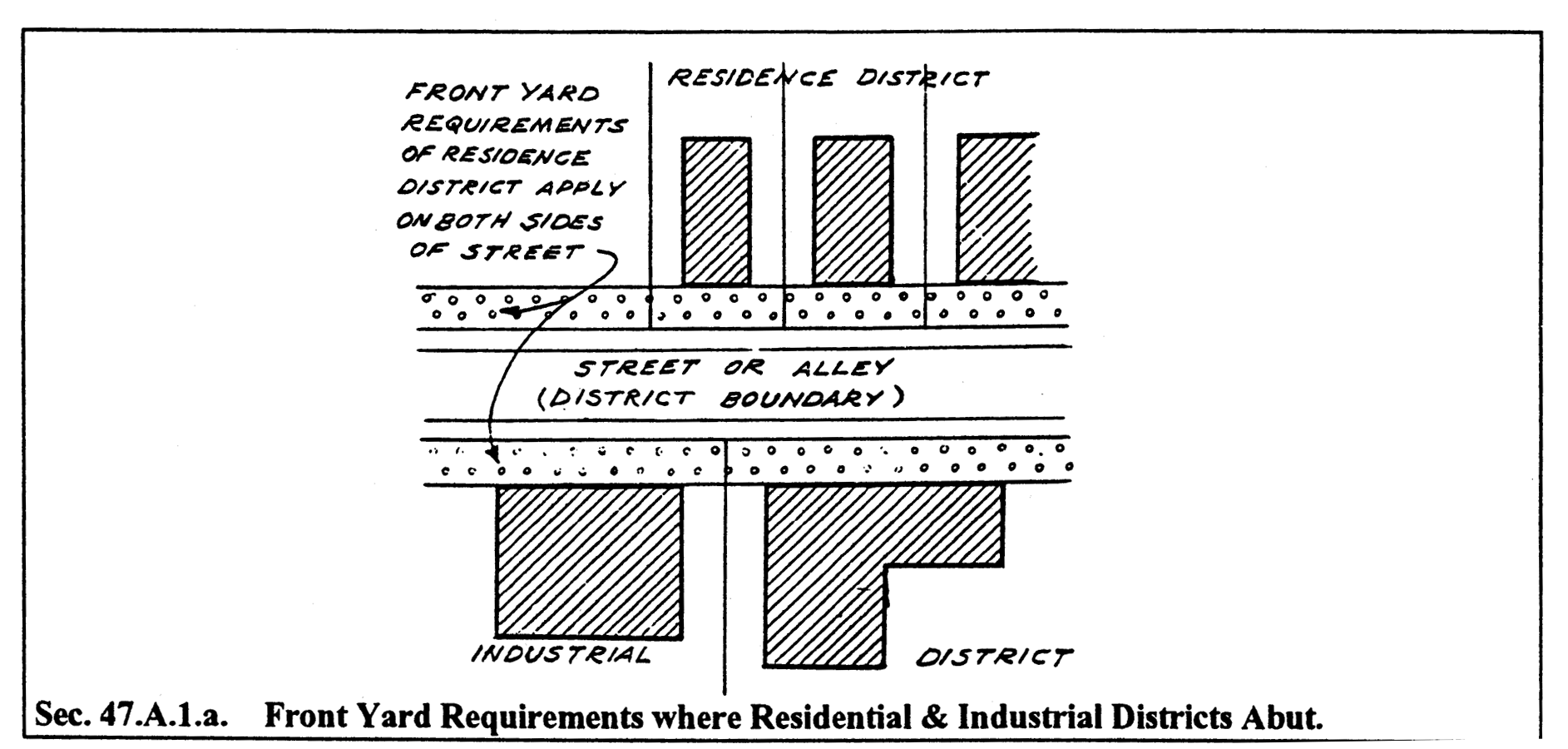
Front Yard Requirements Where R and I Districts abut
(2)
Side yards. Same as in section 43, with the following exception:
a.
Where a lot in a business district or industrial district abuts a residence district along a side lot line of such lot, all the regulations of such residence district for side yards shall apply to such lot along such side lot line.
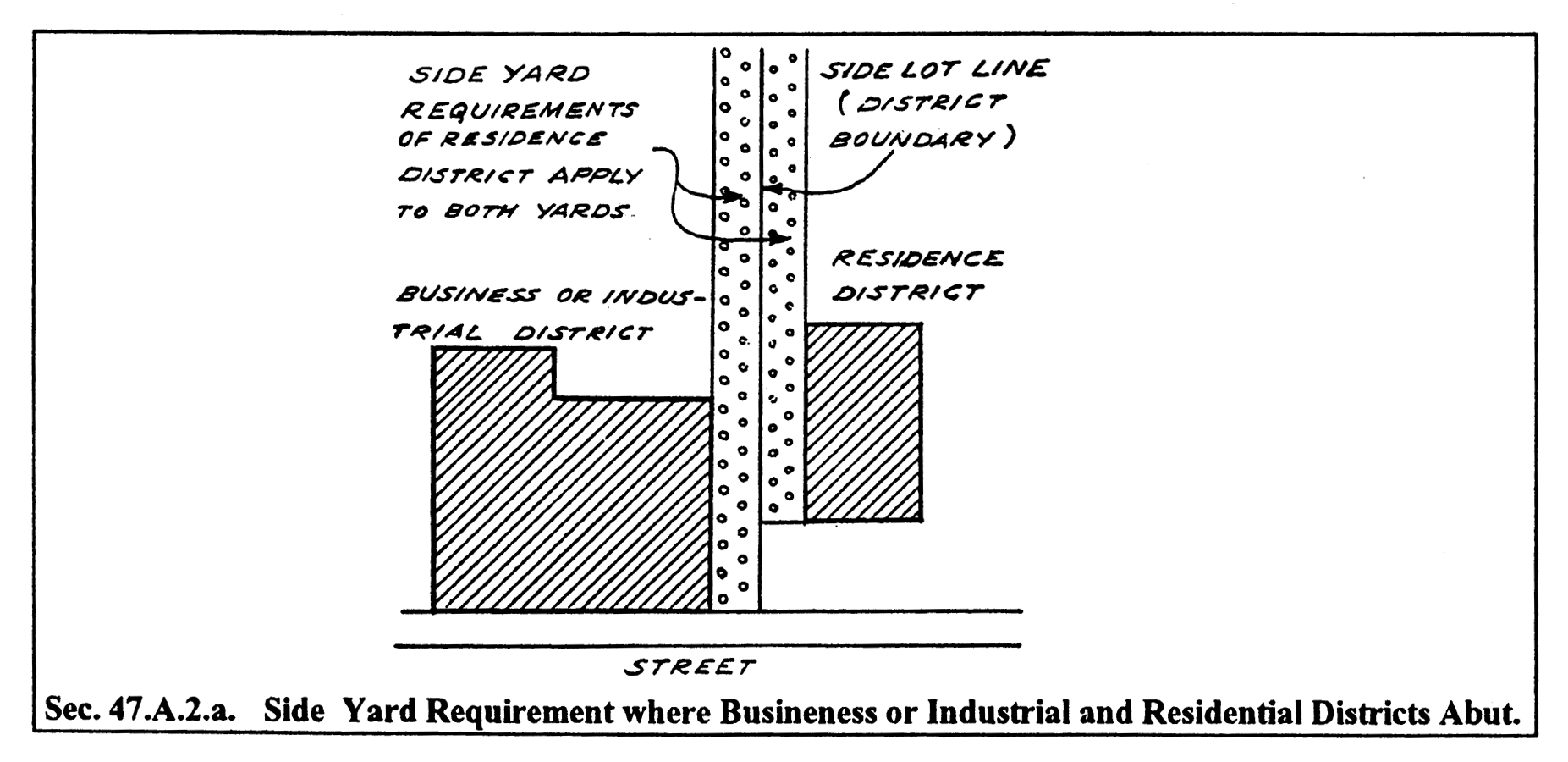
Side Yard Requirements Where R and I/B Districts abut
(3)
Rear yards. Same as in section 43, with the following exception:
a.
Where a lot in an industrial district abuts a residence district along a rear lot line of such lot, all of the regulations of such residence district for rear yards shall apply to such lot along such rear lot line.
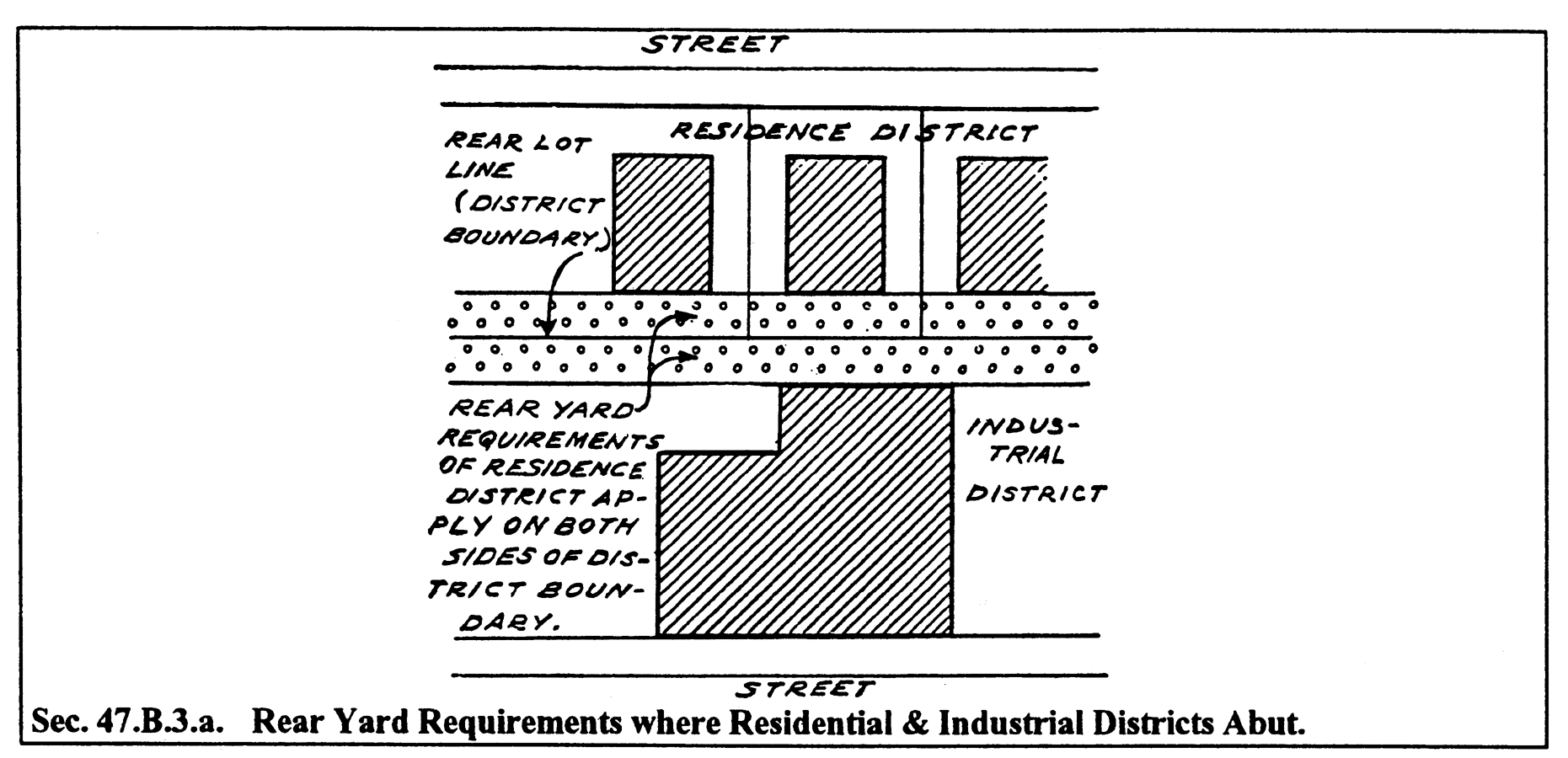
Rear Yard Requirements Where R and I Districts abut
b.
Parking and loading areas shall be arranged and screened as provided in paragraph 45(a)(3) of this ordinance.
c.
No goods, materials or equipment shall be stored out of doors on any lot in a business or industrial district within five feet of any lot line along which such lot district, either directly or across a street or alley. Any goods, materials or equipment stored out of doors on such lot shall be effectively screened from view from such residence district by means of a suitable fence, wall or evergreen planting at least five feet in height.
d.
No sign (other than permitted signs solely for the control of traffic and parking) shall be placed at the side or rear of a lot in a business or industrial district at a point where such lot directly abuts a residence district, or on a wall of a building on such a lot (other than a wall facing a street), if the face of such sign is visible from the residence district on which such lot abuts directly.
e.
The provisions of this section 47 shall not apply to the Business D-3 District.
(b)
Buffer requirements.
(1)
If a residential use shares a property line with a Mixed-Use Long Wharf (MULW) District, such residential use shall be buffered as follows (calculated per 100 linear feet, or portion thereof) except where multiple parcels fall under common ownership:
a.
Buffer Width.
1.
Fence: 10 feet.
2.
No fence: 18 feet.
b.
Deciduous Trees.
1.
Fence: 3 trees.
2.
No Fence: 4 trees.
c.
Evergreen Trees.
1.
Fence: 3 trees.
2.
No fence: 4 trees.
d.
Shrubs.
1.
Fence: 5 shrubs.
2.
No fence: 20 shrubs.
(2)
Buffers without a fence shall be used between the Parkway, Market, Innovation and Gateway vision plan districts.
(3)
Buffers must be established on individual lots or parcels, unless a property owners', condominium or homeowners' association is established, in which case buffers shall be within the required common open space. Properties separated by the public street right-of-way are not considered adjoining for the purposes of this Subsection.
(4)
No buffer is required for that portion of a parcel proposed for development that adjoins common open space.
(5)
Refer to Article VII: Site Requirements for standards regarding minimum plant sizes, maintenance and other such requirements.
(c)
Fence material.
(1)
A person shall construct a fence using the following materials:
a.
Wood;
b.
Wrought iron;
c.
Exposed aggregate tilt wall;
d.
Fired masonry;
e.
Approved wood rail construction; or
f.
Other material approved by the building official or designee.
(2)
Wood fences may have metal framing.
(3)
A person erecting a fence shall ensure that the smooth side faces adjoining streets, and all posts and rails face the interior of the lot.
(d)
Fence maintenance. All fences constructed under the provisions of this section shall be maintained by the property owner to always comply with the requirements of this section. Such requirements include, but are not necessarily limited to, the following maintenance standards:
(1)
The fence shall not be out of vertical alignment more than one foot from the vertical measured at the top of the fence. Except, however, for fencing four feet or less in height, the vertical alignment shall not be more than six inches from the vertical measured at the top of the fence.
(2)
All broken, loose, damaged, insect damaged, or missing parts (i.e., slats, posts, wood rails, bricks, panels) having a combined total area of 20 square feet or more of said fences shall be replaced or repaired within 60 days of notification of non-compliance. Fences enclosing swimming pools or spas must be repaired immediately.
(3)
Repairs of any nature shall be made with materials of comparable composition, color, size, shape, and quality of the original fence to which the repair is being made. Products manufactured for other uses such as plywood, corrugated steel, or fiberglass panels are prohibited as fencing materials. Nothing herein shall be construed to prohibit the complete removal of a fence unless such fence encloses a swimming pool or spa.
(4)
No fencing material and/or supports shall be located within a street or alley right-of-way.
(Ord. No. 1685, Sched. D, 8-6-12; Ord. No. 1975, 9-19-23)
Section 48. - Performance standards for business and industrial uses.
(a)
Nature and administration.
(1)
The following performance standards establish maximum levels for various nuisance factors. They shall apply to all business and industrial uses, whether located in a business or industrial district or located in a residence district as a nonconforming use or special exception.
(2)
Measurements to determine present compliance and estimates to determine future compliance may be made by the zoning enforcement officer, or any other public or private agency, firm or person competent to make such measurements or estimates in appropriate cases. The zoning enforcement officer may require the owner or user of the property to furnish such measurements or estimates in appropriate cases.
(3)
New construction, new facilities and new activities shall not be permitted except in compliance with these standards.
(4)
Existing uses shall not be required to reconstruct or rearrange their facilities and activities to provide compliance with these standards unless the same can be accomplished without undue cost (relative to the scale of operations concerned) as determined by the zoning enforcement officer, or unless such reconstruction or rearrangement is required through some regulation other than the zoning ordinance. Where existing uses do comply with these standards they shall not be altered so as not to comply, and where existing uses do not comply with the standards they shall not be altered to increase any noncompliance. Any existing machine, structure or other facility which does not comply with these standards shall not be replaced with a similar noncomplying facility unless:
a.
The facility is essential to the operation of the business or industry; and
b.
The zoning enforcement officer determines that replacement with a complying facility would be impractical.
(b)
Standards.
(1)
Noise. The sound pressure level of any operation (other than the operation of motor vehicles or other transportation facilities, or operations involved in the construction or demolition of structures, or time signals) shall not exceed the decibel levels as stated below. The sound pressure level shall be measured with a sound level meter and an octave band analyzer that conform to specifications published by the American Standards Association (American Standard Sound Level Meters for Measurement of Noise and Other Sounds, Z24.3-1944, American Standards Association, Inc. New York, New York and American Standard Specification for an Octave-Band Filter Set for the Analysis of Noise and Other Sounds, Z24.10-1953, American Standards Association, Inc., New York, New York shall be used.)
TABLE I
The maximum permissible sound-pressure levels between the hours of 7:00 a.m. and 10:00 p.m. for smooth and continuous noise shall be as follows (all of the decibel levels stated below shall apply in each case):
If the noise is not smooth and continuous or is radiated during sleeping hours, one or more of the corrections in Table II below shall be added to or subtracted from each of the decibel levels given above in Table I.
TABLE II
(2)
Vibration. Vibration in the form of earth-borne oscillations shall not cause displacement at any lot line exceeding the limits stated in Table III. These limits shall not apply to operations involved in the construction or demolition of structures.
TABLE III
*Continuous vibration. Discrete pulses occurring at more than 30 per minute shall be considered steady-state vibration.
**Discrete pulses occurring at or less than 30 per minute.
_____
(3)
Glare and heat. The use shall be so arranged that any glare or radiant heat produced is shielded so as not to be perceptible at or beyond any property line.
(4)
Air pollution. Air pollutants shall not exceed the limits prescribed by the City of New Haven ordinance entitled An Ordinance Providing for the Regulation and Control of the Emission into the Open Air of Smoke, Dust and Odor, or any amendment thereto, or any other applicable regulation.
(5)
Sewage. The use and discharge of substances into public sewers shall not violate the provisions of the City of New Haven ordinance entitled An Ordinance Regulating the Use of and the Discharge of Substances into the Public Sewer System of the City of New Haven, or any amendment thereto, or any other applicable regulation. The discharge of substances into rivers and into the ocean shall be subject to regulations of the Connecticut State Water Resources Commission, and to any other applicable regulation.
(6)
Fire and explosion hazards. The use shall conform to the Fire Safety Code of the State of Connecticut, the regulations of the Department of Fire Service of the City of New Haven, and any other applicable regulation.
(7)
Ionizing radiation and radioactive materials. the use shall conform to the regulations of the Sanitary Code of the State of Connecticut with regard to sources of ionizing radiation and radioactive materials, and to any other applicable regulation.
(8)
Electromagnetic Interference. The use shall conform to the regulations of the Federal Communications Commission with regard to electromagnetic radiation and interference, and to any other applicable regulation.
Section 49. - Regulation of wireless communications.
Description and purpose. These regulations exist to protect neighborhoods, minimize conflict with adjacent uses and the surrounding area, and to assure the health and safety of the public. The city recognizes the quasi-public nature of wireless communications systems and finds that these regulations are necessary to protect the ecological, scenic, historical and recreational values of the city and to ensure that adverse visual and operational effects will not contribute to blighting or deterioration of the surrounding neighborhood. More specifically, the purposes are:
•
To accommodate the need for wireless communications antennas while regulating their location and number.
•
To minimize adverse visual effects of wireless communications antennas and antennas or wireless site towers through proper design, siting and vegetative screening.
•
To avoid potential damage to adjacent properties from antennas or wireless site towers and falling ice through their proper siting and engineering.
•
To encourage the joint use of any new antennas or wireless site tower.
•
To reduce the number of antennas or wireless site towers needed in the future.
(a)
Definitions. When used in this section, the following words or phrases shall have the meaning defined below:
ANTENNA: A device used to collect or transmit telecommunications or radio signals. Examples include panels, microwave dishes and single pole devices known as whips.
ANTENNA HEIGHT: The vertical distance measured from the base of the antenna support structure at grade to the highest point of the structure. If the support structure is on a sloped grade, then the average between the highest and lowest grades shall be used in calculating the antenna height.
WIRELESS SITE: The equipment and structures involved in receiving or transmitting telecommunications or radio signals from a mobile radio communications source and transmitting those signals to another wireless site, another communications source or receiver, or to a central switching computer which connects the mobile unit with land-based telephone lines.
TOWER: A structure that is intended to support equipment used to transmit and/or receive telecommunications or radio signals. Examples of such structures include monopoles and lattice construction steel structures.
(b)
Site selection policies.Wireless sites shall be located in the following order of preference:
(1)
On existing structures such as buildings, communications towers and smokestacks.
(2)
In locations where the existing topography, vegetation, buildings or other structures provide the greatest amount of screening.
On new towers on bare ground in business and industrial districts:
(3)
With visual mitigation.
(4)
Without visual mitigation in business and industrial districts.
In residential districts:
(5)
On government or institutional structures.
(6)
On new towers with visual mitigation.
(7)
On new towers without visual mitigation.
(c)
Use regulations.
(1)
Application required. All applications for wireless sites and antennas shall be filed with the City of New Haven and concurrently with the Connecticut Siting Council filing if it is required.
(2)
The filing shall include a map showing the extent of planned coverage within the City of New Haven, approved locations of the applicant's other wireless sites in the city, and the location and service area of the proposed wireless site.
(3)
If the antenna is to be mounted on an existing structure and all associated equipment is contained within the structure or on its roof, a full site plan shall not be required.
(d)
Location constraints.
(1)
As-of-right. Any antenna that is attached to an existing communications tower, smoke stack, water tower, government or institutional building, or other tall structure is permitted in all zoning districts, subject to the following maximum height and other provisions:
a.
Omnidirectional or whip antennas shall not exceed 20 feet in height or seven inches in diameter.
b.
Directional or panel antennas shall not exceed six feet in height or two feet in width.
c.
Satellite and microwave dish antennas shall not exceed six feet in diameter and when building or rooftop mounted shall be located or screened so as not to be visible from abutting public streets.
d.
Materials and colors shall match the exterior of the building or structure, as may be determined by city staff.
(2)
An antenna may not be located on a building or structure that is listed on an historic register or is within an historic district, except by special permit from the City Plan Commission.
(3)
Special permit. An antenna that is not mounted on an existing structure or a new antenna or tower is permitted by special permit from the city plan commission in all districts, subject to the general standards of § 49(e) and review criteria of § 49(f).
(e)
General standards. The application shall include the following:
(1)
Site justification statement, including a description of the narrowing process that eliminated other potential sites.
a.
If a proposed antenna tower exceeds 200 feet height or is within 20,000 feet of Tweed-New Haven Airport, proof is required that the applicant has filed a notice of proposed construction with the Federal Aviation Administration.
(2)
Antenna height. The applicant shall demonstrate that the antenna is the minimum height required to function satisfactorily. No antenna that is taller than this minimum height shall be approved.
(3)
Antenna towersetback. If a new tower is constructed (as opposed to mounting the antenna on an existing structure, the minimum distance between the base of the tower and any guy wire anchors or any property line shall be the largest of the following:
a.
30% of antenna height.
b.
The minimum setback in the underlying zoning district.
c.
40 feet.
(4)
Roof mounted antenna. If the equipment is located on the roof of a building, the area of the equipment building and other equipment structures shall not occupy more than 25% of the roof area. Setbacks from roof edge shall be 10 feet, or 10% of roof depth (measured from edge facing public street to opposite edge of roof), whichever is greater.
(5)
Antenna tower safety. The antenna tower shall be designed and constructed to all applicable standards of the American National Standards Institute, ANSI/EIA-222-E manual, as amended.
(6)
Site soil report. A soil report complying with Appendix I: Geotechnical Investigations, ANSI/EIA-222-E manual standards, as amended, shall be submitted to verify the design specifications of the foundation for the tower and anchors for the guy wires, if used.
(7)
Fencing. Unless the antenna is mounted on an existing structure, a fence with a maximum height of eight feet shall be required around the tower and other equipment.
(8)
Landscaping. To soften the appearance of a wireless site and screen as much of the tower as possible, a fence surrounding the tower and other ground level features such as a building, ground landscaping shall be required.
(9)
Any combination of existing vegetation, topography, walls, decorative fences or other features instead of landscaping may be permitted if the same degree of screening as the required landscaping is achieved, as determined by the executive director (or designee) of the City Plan Department.
a.
An evergreen screen shall be required to surround the site. The screen can be either a hedge (planted three feet on center maximum) or a row of evergreen trees (planted ten feet on center maximum). The evergreen screen shall be a minimum height of six feet at planting and shall grow to a minimum of 15 feet at maturity.
b.
Existing vegetation on and around the site shall be preserved to the greatest extent possible.
(10)
Commercial advertising shall not be allowed on an antenna or antenna tower.
(11)
Signal lights or illumination shall not be permitted unless required by the Federal Communications Commission (FCC) the Federal Aviation Administration (FAA) or the Connecticut Siting Council.
(12)
All other uses ancillary to the antenna and associated equipment (including a business office, maintenance depot, vehicle storage, etc.) are prohibited.
(13)
Joint use accommodated. To minimize the number of antenna or wireless site towers in the community in the future, the proposed support structure shall be required to accommodate other users, including other wireless communication companies and local police, fire and ambulance companies unless it is determined to be technically unfeasible based on information submitted by the applicant. The city may require independent outside evaluation of such materials at the applicant's expense.
(14)
The related unmanned equipment and/or building(s) shall not contain more than 750 square feet of gross floor area or be more than twelve feet in height.
(f)
Standards for special permit approval.
(1)
Using technological evidence the applicant must demonstrate that the proposed location is necessary to satisfy its function in the company's grid system. Specific locations will be evaluated using the following criteria (not listed in any order of priority).
•
Availability of suitable structures for antenna mounting.
•
Topography as it relates to line of sight transmission for optimum service efficiency.
•
Leasable lands and willing landlords.
•
Screening potential of existing vegetation, structures and topographic features.
•
Compatibility with adjacent land uses.
•
Least number of sites to cover desired area.
•
Greatest coverage consistent with physical requirements.
•
Opportunities to mitigate possible visual impact.
•
Availability of sites not within an established single-family community.
•
Preservation of view corridors, vistas.
•
Potential for preservation of pre-existing character of site.
•
Minimal impact on residential areas surrounding commercial or industrial zoned sites.
•
Selection of sites which lend themselves to visual mitigation.
•
Availability of road access.
•
Availability of electric power.
•
Availability of land based telephone lines or microwave link capability.
If a tower is proposed the application shall include support materials that show the location of tall structures within one quarter mile radius of the site proposed, that the owners of those locations have been contacted and asked for permission to install the antenna on those structures and denied for other than economic reasons. This would include smoke stacks, water towers, tall buildings, antennas or towers of other wireless communications companies, other communication towers (fire, police, etc.) and other tall structures.
The City Plan Commission may deny an application to construct a newtowerif it is determined that the applicant has not made a good faith effort to mount theantennaon an existing structure.
(g)
Certificate of continued use. The owner of the subject property shall submit to the zoning administrator annually during the month of January an affidavit that the facility is in active use as a wireless site and the owner or operator shall certify that such use will continue for the coming calendar year.
(h)
Abandonment. A wireless site not in use for six (6) months shall be removed by the service facility owner. This removal shall occur within 90 days of the end of such six-month period. Upon removal the site shall be restored to its previous appearance and, where appropriate, revegetated to blend with the surrounding area.

