
New Haven City Zoning Code
ARTICLE VI
OTHER DISTRICTS
Section 50. - Inclusionary Zoning Overlay Zone.
(a)
Purpose, Overlay Area, and Effective Date.
(1)
Purpose. The purpose of this ordinance is to create mixed-income housing through new construction, conversion, or renovation that assists the City in promoting the creation of Inclusionary Developments and Affordable Housing as the City grows and attracts new market-rate residential development. By linking the production of affordable housing to private market development, this inclusionary zoning policy aims to expand the supply of affordable housing. The effect is to foster mixed-income communities and create housing choice in high-opportunity areas. This policy will support the provision of safe and affordable housing options in areas of opportunity, especially for communities that have been historically marginalized, including low-income and communities of color.
(2)
Enactment and Mapped area. There is hereby created an Inclusionary Zoning Overlay District (IZO), the boundaries of the IZO and its tiered areas are established on the map entitled "INCLUSIONARY ZONING: Overlay District and Markets" (the "Map"). In order to accurately reflect changes in housing market conditions, the City Plan Commission shall prepare and adopt updates to the Map every three years. In addition, every calendar year, no later than February 1, the Commission shall, submit to the Mayor any recommended amendments to the in-lieu fee schedule, which subject to final adoption by the Board of Alders, shall take effect no later than July 1 of the calendar year. The Map is available in the New Haven Affordable Housing Manual and is on file and available for public inspection with the City Plan Department and the Livable City Initiative (as staff to the Affordable Housing Commission). The IZO is comprised of two sub-districts:
Core Market. The Core Market represents locations where the majority of new market-rate development is occurring as of the effective date, rents are highest, and where the majority of new market-rate development is anticipated.
Strong Market. The Strong Market represents areas that have potential to support new market-rate development today and in the immediate future.
(3)
The Effective Date shall be the published notice of this Section's passage.
(b)
Definitions for Inclusionary Zone Overlay Zone. For the purposes of this § 50 "Inclusionary Zoning Overlay Zone," the following definitions apply:
APPLICABLE DEVELOPMENT means any plan or application for construction, development, or rehabilitation of real property for which the development application to the City agency with appropriate jurisdiction, including but not limited the Board of Alders, City Plan Commission, Board of Zoning Appeals, or Office of Building Inspection and Enforcement, was submitted on or after February 18, 2022 and is (a) new construction; or (b) constitutes rehabilitation, conversion, or renovation of any existing buildings if the value of such rehabilitation, conversion, or renovation is greater than 50 percent of the existing assessed value of the property; and (c) is a (i) Mandatory Market-Driven Inclusionary Development; (ii) Large-Scale Inclusionary Development; (iii) Voluntary Inclusionary Development; or (iv) an Applicable PDU/PDD Development, as defined in Section 50(b) below.
For the purposes of the applicability of Article VI, § 50, Applicable Development does not include any Prior Approved Development, Prior Submitted Development, or any development application subject to a Restricted Housing Agreement.
AVERAGE GROSS FLOOR AREA PER DWELLING UNIT means the gross floor area of the principal building or buildings divided by the total number of housing units in the inclusionary development.
INCLUSIONARY DEVELOPMENT means a development containing both affordable and market-rate units.
IZ Affordable Unit means a residential dwelling unit, which is a required or voluntarily set aside unit under this Section 50 and which is restricted for occupancy by households that have a combined total annual income for all members that does not exceed 50 percent of the New Haven Area Median Income as defined by HUD at the time of initial occupancy; and for which the costs for rent and utilities do not exceed 30 percent of household income.
IZO means Inclusionary Zoning Overlay District.
LARGE-SCALE INCLUSIONARY DEVELOPMENT means a development anywhere in the City that proposes 75 or more residential dwelling units, which is required to be an Inclusionary Development under the Inclusionary Zoning policy.
LOW-INCOME HOUSEHOLD means a household in which the combined total annual income for all members of a household does not exceed 50 percent of the area median income. These income limits are adjusted by household size based on multipliers used by HUD to adjust area median income by household size.
MARKET-RATE UNITS means housing not restricted to low-income households that may sell or rent at any price that the market may bear.
PRIOR APPROVED DEVELOPMENT means an otherwise Applicable Development for the construction, development, or rehabilitation of real property for which the development application to the City agency with appropriate jurisdiction, including but not limited the Board of Alders, City Plan Commission, Board of Zoning Appeals, or Office of Building Inspection and Enforcement, was submitted prior to February 18, 2022, and which has received the required approval of one or more of the City agencies with appropriate jurisdiction, but which requires the approval of one or more additional City agencies, and for which the application to such agency is submitted on or after February 18, 2022.
PRIOR SUBMITTED DEVELOPMENT means an otherwise Applicable Development for the construction, development, or rehabilitation of real property for which the development application to the City agency with appropriate jurisdiction, including but not limited the Board of Alders, City Plan Commission, Board of Zoning Appeals, or Office of Building Inspection and Enforcement, was submitted prior to February 18, 2022.
RESTRICTED HOUSING AGREEMENT means an agreement or a commitment to enter into an agreement existing and in force on the Effective Date between an owner of property, a developer of property, or a lessee of property with (I) the City of New Haven, including but not limited to a Development and Land Disposition Agreement, a grant agreement, a loan agreement, and/or a tax abatement agreement, (ii) another governmental entity, including but not limited to the State of Connecticut Department of Housing or the Connecticut Housing Finance Authority, or (iii) a third party for low-income tax credits which requires a property, project, and/or a development to provide Restricted Units (whether or not such Restricted Units meet the definition of Affordable Units and/or such agreement complies with the Inclusionary Housing Set-Aside requirements of Section 50(c)(3)).
RESTRICTED UNIT means a dwelling unit, whether a rental unit or ownership unit, that is subject to affordability controls.
(c)
Set-Aside of IZ Affordable Units.
(1)
Applicability. The requirements and incentives in this Section 50 shall apply to all Applicable Developments which include any new construction and any rehabilitation, conversion, or renovation of existing buildings that is valued greater than 50 percent of the existing assessed value of the property and which is a:
a.
Mandatory Market-Driven Inclusionary Developments. After the Effective Date of this Section, compliance with this Section is required for all properties or developments with a residential component that are proposing ten or more dwelling units that are located within the IZO; or
b.
Large-Scale Inclusionary Developments. After the Effective Date of this Section, compliance with this Section is required for all properties or developments proposing 75 dwelling units or more (herein referred to as "Large-Scale Residential Developments"), outside of the IZO; or
c.
Voluntary Inclusionary Developments. After the Effective Date of this Section, compliance with this Section is optional for all properties or developments with a Residential component of (I) less than 75 dwelling units outside the IZO and (ii) less than ten dwelling units within the IZO that elect to construct IZ Affordable Units, consistent with this Section. Such Voluntary Inclusionary Developments shall be eligible for certain zoning bonuses as outlined herein; or
d.
Applicable PDU/PDD Developments. Except as provided in §50(c)(2)(d) below, otherwise Applicable Developments meeting the definitions of this Section 50(c)(1), within an existing PDD or a PDU are subject to this policy. A new PDD or PDU may not create an exemption from this policy.
(2)
Exemptions. The following development projects are exempt from the requirements of this §50(c):
a.
Any project which is to be undertaken by the New Haven Housing Authority.
b.
Any project that proposes, Student Housing, a Dormitory, or Rooming, Boarding, or Lodging Houses.
c.
Any development project which is a Prior Approved Development, a Prior Submitted Development, or any development application subject to a Restricted Housing Agreement.
d.
Any PDD or PDU existing on the Effective date which contains a requirement concerning Restricted Units or Affordable Housing.
e.
Minor changes to approved site plan approvals which may be granted by the City Plan Staff under Section 64(f)(7)f.
(3)
Inclusionary Housing Set-Aside.
a.
In the Core Market of the IZO, Applicable Developments shall set aside not less than ten percent of the total number of dwelling units as IZ Affordable Units. IZO applicable developments shall prioritize an additional five percent of the total number of dwelling units for persons or families with Housing Choice (Section 8) vouchers. Such Housing Choice Voucher units shall be offered such that the cost for rent and utilities do not exceed fair market rents as determined by HUD. If tenants with Housing Choice vouchers are not able to be placed and proper documentation is approved by the City, a unit with Housing Choice priority may be rented to a tenant with a household income no more than 80 percent of AMI until vacancies occur, at which time. Housing Choice tenants will be re-prioritized.
b.
In the Strong Market of the IZO, Applicable Developments shall set aside not less than five percent of the total number of dwelling units as IZ Affordable Units.
c.
City-Wide Inclusionary Housing Set-Aside. Outside of the IZO, Large-Scale Inclusionary Developments shall set aside not less than five percent of the total number of dwelling units as IZ Affordable Units.
d.
Voluntary Inclusionary Set-Aside.
i.
Outside of the IZO, a development of less than 75 dwelling units may set aside five percent of the total number of dwelling units as IZ Affordable Units on a voluntary basis. A development that opts in will be required to comply with all of the provisions of this Section.
ii.
Within the IZO, any project involving ten dwelling units or less may opt into this policy by setting aside the number of units required in a. and b. above, as applicable as IZ Affordable Units. If the calculation results in a partial unit, it is rounded up to the nearest whole unit for the purposes of calculating the units to be provided on site. If the calculation results in less than one-half units, then one affordable unit will be required to opt into this policy and receive the incentives. For a payment in-lieu of constructing a unit, the developer pays an in-lieu fee based on the share of total units required under a. and b. above, as applicable. If the calculation results in a partial unit, the in-lieu fee is calculated based on the partial unit (e.g., if the unit calculation requires one-half dwelling units, the developer pays 50 percent of the established in-lieu fee).
e.
This Inclusionary Housing Set-Aside applies to rental units. All IZ Affordable Units must be constructed and maintained in a manner consistent with market-rate units provided as part of the Inclusionary Development.
f.
The Director of the City Plan Department or his/her designee shall review all Applicable Developments at the time of application for site plan review to verify compliance with income and rental limits as required for the IZ Affordable Units.
g.
The Director of the Livable City Initiative or his/her designee shall review leasing plans and rent rolls to verify ongoing compliance with income and rental limits of the IZ Affordable Units.
h.
The set-aside IZ Affordable Units shall be deed-restricted to ensure the units have rent limits and income limits to ensure the units are set aside and occupied as IZ Affordable Units for a minimum of 99 years. The deed restriction shall be recorded on the New Haven Land Records in advance of final Certificate of Occupancy.
i.
Rounding. When any calculation of the mandatory set aside results in a fractional income restricted unit, the fraction is rounded to the nearest whole unit. If the calculation results in less than one-half units total (which would be rounded to zero under this subsection), then one IZ Affordable Unit will be required.
j.
IZ Affordable Unit requirements.
i.
IZ Affordable Units must be evenly distributed throughout the Inclusionary Development, including across project phases.
ii.
IZ Affordable Units must be a mix of unit types and sizes that matches the overall mix of unit types and sizes in the Inclusionary Development.
iii.
IZ Affordable Units must have comparable finishes and access to amenities to Market-Rate Units in the Inclusionary Development.
iv.
IZ Affordable Units IZ Affordable Units shall reflect the composition of the overall development in terms of accessible design (ANSI Type A and Type B).
k.
A payment may be made in lieu of on-site construction, in accordance with Subsection 50(e) below.
(4)
Approving Authority. All Applicable Developments must be reviewed and approved by the City Plan Commission as part of Site Plan Review or Detailed Site Plan Review in accordance with Section 64 and Section 50(f) below.
(d)
Incentives for the Development of IZ Affordable Units. All applicable Inclusionary Developments, whether mandatory or voluntary, are eligible for the following incentives, the purpose of which is to offset the cost burden of constructing and maintaining affordable units.
(1)
FAR Bonus. The Inclusionary Development is entitled to a bonus in FAR of up to 25 percent over the permitted FAR in the underlying zone in which the property is located, but may be otherwise limited by height restrictions and other bulk area requirements of the underlying zone.
(2)
Waived Parking Minimums. The Inclusionary Development does not have a minimum amount of automobile parking required for Residential uses, but may elect to include parking as part of the development. Sections 29 and 45 of the Zoning Ordinance, as they relate to motor vehicle parking for Residential uses, are waived.
Notwithstanding the foregoing, the Inclusionary Development shall comply with bicycle parking requirements. As part of its review, the City Plan Commission may require additional bicycle parking as a condition of approval.
Where the Inclusionary Development is mixed-use with a commercial component or parking is provided voluntarily, the Inclusionary Development must also include loading spaces in accordance with Section 45(a)(1)b. Notwithstanding the criteria of §2½-25 of the New Haven Code of General Ordinances, an Inclusionary Zoning application to the City Plan Commission shall include a Traffic Impact and Multi Modal Transport Safety Study as part of the development application for any development project under the Inclusionary Zoning overlay involving new construction of more than 75 residential units, more than 50,000 gross square feet of floor area in one structure, or the addition of 200 or more parking spaces. The study shall show the amount and direction of traffic to be generated by the proposed development and shall estimate its effect on the roadway capacity as well the safety with regards to pedestrian, bicycle, and transit patterns. Furthermore, the traffic study shall provide an analysis of pedestrian, bicycle and transit infrastructure within one-quarter mile radius, and include best practices in site plan design to connect safely to and to enhance multi modal transportation options.
(3)
Density Bonus. Irrespective of density limitations in the underlying zone, the Inclusionary Development is entitled to a density of 600 square feet for the average gross floor area per dwelling unit. This reduction is applicable to all structures, regardless of age and lot size, whether conforming or nonconforming, so long as they are permissible under applicable building codes.
(e)
Payment In Lieu of Developing IZ Affordable Units. For projects meeting Section 50(b)(1)(a) or 50(b)(1)(b), the property owner/developer may pay a fee in lieu of building on-site IZ Affordable Units for some or all the obligation in accordance with the following:
(1)
A developer may provide a payment in lieu of constructing the IZ Affordable Units obligation to the City of New Haven deposited in a special fund designated for such purpose. A developer may build a portion of the required IZ Affordable Units and provide a payment in lieu of the remainder of the required IZ Affordable Units. However, the policy of this Section favors construction of on-site affordable units.
(2)
Payment in-lieu fee. The amount of the payment-in-lieu figure is based upon a tiered payment in-lieu system that will be reassessed every three (3) years from the effective date of this Section's adoption. The fees and any assessed premium is available in the New Haven Affordable Housing Manual and is on file with City Plan Department and the Livable City Initiative.
(3)
Condition of Approval. In advance of Site Plan Approvals by the City Plan Commission, the developer shall enter into an IZ Affordable Unit Agreement, deed restriction or Payment in Lieu of Agreement with the City of New Haven.
(f)
Performance and compliance.
(1)
Inclusionary Developments containing one or more IZ Affordable Unit(s) must meet all applicable requirements under the laws of the State of Connecticut.
(2)
All Inclusionary Zoning applications will be formalized with an IZ Affordable Unit Agreement. The IZ Affordable Unit Agreement is required for all Applicable Projects. The IZ Affordable Unit Agreement must be to the satisfaction of the Director of the Livable City Initiative before the project's Site Plan Review or Detailed Site Plan Review application is reviewed by the City Plan Department.
(3)
All Inclusionary Developments will comply with tenant screening processes for available affordable units as described in the New Haven Affordable Housing Manual on file with City Plan Department and the Livable City Initiative.
(4)
All Inclusionary Developments will be required annually to certify compliance, including certification of incomes of tenants in affordable units and submit a Compliance Report to the Director of the Livable City Initiative. Information on income certification processes and tenant eligibility is provided in the New Haven Affordable Housing Manual and is on file with City Plan Department and the Livable City Initiative.
(g)
Violation, default and remedies. Upon a violation of any of the provisions of the affordable housing agreement, the Zoning Enforcement Officer will give written notice to the developer or property owner specifying the nature of the violation and require corrective action within a reasonable period of time. If the developer or property owner does not reply or correct the violation within the time specified, they will, for each and every violation, be fined up $100.00, or the maximum allowed by state statutes for each day that such violation continues after such notice.
(h)
Severability. If any Section, Subsection, sentence, clause, phrase, or portion of this Article is for any reason held invalid or unconstitutional by any court of competent jurisdiction, such portion is deemed a separate, distinct, and independent provision, and such holding does not affect the validity of the remaining portions thereof.
(i)
Fixing of Assessments for Inclusionary Development Property. Pursuant to Section 12-65b of the Connecticut General Statutes, any owner of real property proposing an Inclusionary Development of not less than four residential units and which Inclusionary Development complies the IZ Affordable Unit set aside requirement of Section 50(c) of this ordinance shall, in addition to incentives identified in Section 50(d), be eligible to enter into an agreement with the City fixing the assessment on such Inclusionary Development property fixing the assessment at the amount equal to 70 percent of the otherwise applicable assessment on any property within the Core Market as identified in the Inclusionary Zoning Monitoring and Procedures Manual, or 95 percent of the otherwise applicable assessment on any property outside of the Core Market, for a period of ten years.
(j)
Development Incentives May Be Aggregated. Notwithstanding the limitation of any other section of this Zoning Ordinances or the New Haven Code of Ordinances, or other City regulation to the contrary, an Inclusionary Development that qualifies for one or more benefits or incentives under this § 50 may receive any other development incentive or benefit for which the development would otherwise qualify.
(k)
City Plan Commission to Promulgate Regulations; Recommend Fees. The City Plan Commission shall promulgate regulations to implement the intent and purposes of this Section 50. Such regulations shall be compiled in a document to be entitled "Inclusionary Zoning Monitoring and Procedures Manual," and shall include, but not be limited to (1) Inclusionary Zoning Policy & Development Guidelines, (2) Permitting and Approvals, (3) Tenant Selection and Protections, (4) Monitoring and Enforcement; (5) rental and income limits to ensure set aside units are maintained as IZ Affordable Units; (6) a recommended schedule of administrative fees including but not limited to application fees, In-Lieu payment fees and fines for non-compliance with the requirements of this Ordinance and the Inclusionary Zoning Monitoring and Procedures Manual to be included in the Mayor's budget subject to approval by the Board of Alders in a manner consistent with the annual amendment of Chapter 17 of the Code of General Ordinances; and (7) such other regulations, consistent with this Section 50, as may be necessary to effect the purposes of this ordinance. The City Plan Commission shall approve such regulations after public notice and a public hearing of the Commission.
(l)
Right of Appeal.
(1)
Appeals of Administrative Orders. An appeal from an administrative order of the Zoning Enforcement Officer (ZEO) or other City staff charged with enforcing this Section 50 may be taken to the Board of Zoning Appeals as provided in section 63.
(2)
IZ Land Use Permitting or Site Plan. Any person aggrieved by any decision of a board pursuant to this Section 50, including a decision to approve or deny a site plan, may take an appeal to the Superior Court pursuant to the procedures for such appeal in Connecticut General Statutes §8-8.
(3)
Non-Compliance With Operation or Maintenance of IZ Affordable Units. All violations order issued pursuant to §50(g) shall be issued and enforced and shall have the same right and procedures for appeal as violations under Section 9-51 (I)-(l) of the Code of General Ordinances.
(Ord. No. 1927, 1-18-22; Ord. No. 1931, 5-3-22)
Section 51. - Park Districts.
Description and purpose. These districts exist to set aside and protect areas that are publicly or semi-publicly owned and are designated as public parks and open spaces.
Uses; permitted. In a Park District a building or other structure may be erected, altered, arranged, designed or used, and a lot or structure may be used for any of the following purposes and no other:
(a)
Public parks, playgrounds and open spaces and uses incidental thereto.
(b)
Other public and semi-public uses.
Section 52. - Cemetery Districts.
Description and purpose. These districts exist to set aside and protect areas that have been and are being developed predominantly for cemeteries, which constitute a distinct and unique land use. In instances where land in a Cemetery District is not developed for cemetery purposes, it may be devoted to residences at a low-middle density of 12 dwelling units per acre, or to certain non-residential uses.
Uses permitted. In a Cemetery District a building or other structure may be erected, altered, arranged, designed or used, and a lot or structure may be used, for any of the following purposes and no other:
(a)
Residential uses as follows.
(1)
Such residential uses as are permitted, and in the same manner, as in RM-1 Districts.
(b)
Non-residentialusesas follows.
(1)
Such non-residential uses as are permitted, and in the same manner, as in RM-1 Districts.
(2)
As of right:
a.
Cemeteries, including cemetery chapels, crematories and other accessory structures but excluding funeral homes.
Section 53. - Airport District.
Description and purpose: This district exists for the purpose of designating that area which has been and is being developed by the Tweed-New Haven Airport. The airport represents a distinct land use; not easily classified in any other district, having unique needs for development as an integrated unit to serve the city and the region.
Uses permitted. In the Airport District a building or other structure may be erected, altered, arranged, designed or usedd, and a lot or structure may be used for any of the following purposes and no other:
(a)
A municipal airport, and uses incidental thereto.
(See also a City of New Haven Ordinance entitled Ordinance Concerning Airport Approach Zones, and a map of approach zones prepared by the New Haven Airport Commission and filed with the City Clerk, regulating the height of structures and trees in approaches to the municipal airport.)
Section 54. - Historic District.
Description and purposes. These districts exist to distinguish and preserve areas of the city which are unique for their historical and architectural values and which therefore promote the educational, cultural, and general welfare of the public through their continued existence. Towards this end, a historic district commission has been established to regulate the manner in which a building or structure may be erected, altered, arranged, restored, moved or demolished within an historic district. Any such action requires the approval of said commission. (See City of New Haven ordinance entitled An Ordinance to Establish an Historic District and an Historic District Commission for the City of New Haven, effective June 11, 1970.) Such values as are present in so designated areas are not readily classified within existing district regulations and are accordingly given a distinct classification in addition to the existing district classifications so as best to serve the interests of the city and the region.
Intent. It is the intent of this ordinance to safeguard the heritage of the city, to stabilize and improve property values in such districts, foster civic beauty, promote the educational, cultural, economic, and general welfare of the City of New Haven through the preservation and protection of the distinctive characteristics of buildings, places, and districts, associated with the history of or indicative of a period or style of architecture of historic interest within the City of New Haven, and to provide that modification shall remain in harmony with the general purpose and intent of the ordinances. Unless otherwise provided, all definitions of terms shall have the meaning set forth in sections 7-147a to 7-147k, inclusive as amended, of the General Statutes of Connecticut.
Establishment. Pursuant to the provisions of sections 7-147a to 7-147k, inclusive as amended, of the General Statutes of Connecticut, there is established an historic district(s) within the City of New Haven and an Historic District Commission, which Commission shall be empowered to exercise all the powers, duties, and functions enumerated in said sections 7-147a to 7-147k, inclusive as amended, of the General Statutes of Connecticut.
Uses permitted. In an Historic District, uses are governed by the underlying zoning classification. (See Official Zoning Maps, City of New Haven.) Accordingly, the following uses are considered appropriate and no others:
(a)
Residential uses as follows: Such residential uses as are permitted and in the same manner as in the underlying zone, within the restrictions of An Ordinance to Establish an Historic District and an Historic District Commission for the City of New Haven.
(b)
Non-residential uses; as follows: Such non-residential uses as are permitted and in the same manner as in the underlying zone, within the restrictions of An Ordinance to Establish an Historic District and an Historic District Commission for the City of New Haven.
(c)
Administration, expansion and new districts. The Historic District Commission shall administer the provisions of said sections 7-147a to 7-147k, inclusive as amended, of the General Statutes of Connecticut, as implemented by this ordinance. Under the same authority, the commission shall perform all of the functions of the historic district study committee relative to the expansion of existing districts and the establishment of new ones.
(d)
Land use. Nothing contained herein shall supersede the powers of other local legislative or regulatory bodies or relieve any property owner of complying with the requirements of any other state statutes or municipal ordinances or regulations.
(e)
Historic District Commission.
(1)
Historic District Commission created. There is hereby created a commission to be called the historic District Commission in order to execute the intent of this ordinance.
(2)
Membership of commission.
a.
There shall be appointed by the mayor of the City of New Haven, within 30 days after the effective date of this ordinance, an Historic District Commission consisting of five members and up to five alternate members, who shall be electors of the City of New Haven holding no salaried municipal office. At least one member of the commission shall be an architect or an architectural historian, one member shall be selected from a list submitted by the New Haven Preservation Trust, and one member shall be a resident or owner within the historic district. As each new historic district, if any, is approved, the mayor shall designate a new member or alternate, as the case may be, who shall be an owner or resident thereof.
b.
The membership permitted to vote on a particular application for a certificate of appropriateness must include a member or alternate from the applicable district unless said member or alternate is unable to vote because of illness or disability or because of conflict of interest or other good cause as stated on the record. In such circumstances a member or alternate from another district may have to be temporarily disqualified, if necessary, in order not to exceed a maximum of five votes on a particular application.
c.
The mayor shall designate one member to serve until January 1, 1971, one member to serve until January 1, 1972, one member to serve until January 1, 1973, one member to serve until January 1, 1974, and one member to serve until January 1, 1975, thereafter each member and each alternate member appointed to fill a vacancy shall be appointed by the mayor in a like manner for terms of five years.
Any vacancy created by any reason other than by expiration of a term shall be filled for the unfilled portion of that term in the same manner as the original appointment.
d.
All members of the Historic District Commission shall serve without compensation.
(3)
Rules. Within 30 days after the Historic District Commission is appointed, it shall adopt rules of procedure, regulations, forms and orders, not inconsistent with sections 7-147a to 7-147k, General Statutes, inclusive as amended, which it deems necessary to carry out the intent of this ordinance.
(4)
Officers. The commission shall elect annually a chairman, a vice-chairman, and a clerk from its own members. In case of inability to act, because of absence, sickness or self-interest, on the part of any member of the commission, his/her place shall be taken by an alternate member designated by the chairman.
(f)
Duties and powers of the commission.
(1)
Certificate of appropriateness. No building or structure shall be erected, altered, restored, moved or demolished within an historic district until after an application for a certificate of appropriateness as to exterior architectural features has been submitted to the commission and approved by said commission.
(2)
Exterior architectural features. For the purpose of this ordinance, exterior architectural features shall include such portion of the exterior of a building or structure as is open to view from a public street, way or place.
(3)
Outdoor advertising. The style, material, size and location of outdoor business or advertising signs and bill posters within an historic district shall also be under the control of the commission.
(g)
Considerations in determining appropriateness. If the Commission determines that the proposed erection, construction, restoration, alteration, or razing will be appropriate, it shall issue a certificate of appropriateness. In passing upon appropriateness the Commission shall consider, in addition to any other pertinent factors, the type and style of exterior windows, doors, light fixtures, signs, above-ground utility structures, mechanical appurtenances and the type and texture of building materials. In passing upon appropriateness as to exterior architectural features the Commission shall also consider the historical and architectural value and significance, architectural style, general design, arrangement, texture and materials of the architectural features involved and the relationship thereof to the exterior architectural style and pertinent features of other structures in the immediate neighborhood. A certificate of appropriateness may be refused when its issuance, in the opinion of the Commission, would be detrimental to the interest of the historic district.
(h)
Variations; when permissible.
(1)
Where, by reason of topographical conditions, district borderline situations, immediately adjoining existing developments or because of other unusual circumstances, the strict application of any provision of sections 7-147a to 7-147k, inclusive as amended, would result in exceptional practical difficulty or undue hardship upon the owner of any specific property, the commission in passing upon applications shall have the power to vary or modify strict adherence to said sections or to interpret the meaning of said sections so as to relieve such difficulty or hardship; provided such variance, modification or interpretation shall remain in harmony with the general purpose and intent of said sections so that the general character of the district shall be conserved and substantial justice done.
(2)
In granting variations, the commission may impose such reasonable and additional stipulations and conditions as will, in its judgement, better fulfill the purposes of said sections.
(i)
Exempted acts. Nothing in this ordinance shall be construed to prevent the ordinary maintenance or repair of any exterior feature in the historic district which does not involve a change of appearance or design thereof; nor to control the interior arrangement or use of structures; nor to prevent the construction, reconstruction, alteration or demolition of any such feature which the building inspector certifies is required by the public safety because of an unsafe or dangerous condition; nor to prevent the construction, reconstruction, alteration or demolition of any such feature under a permit issued by the building inspector prior to the effective date of establishment of such historic district.
(j)
Limits of appropriation. The commission may, subject to the limits of appropriation made by the City of New Haven, employ or utilize clerical and technical assistance or consultants and may accept money, gifts, and expend the same for such purposes. Responsibility of providing such staff assistance shall be made by the building inspector, unless otherwise designated by the commission.
(k)
Procedures. Application for certificate; hearing, approval.
(1)
The Commission shall hold a public hearing upon each application for a certificate of appropriateness. Notice of the time and place of such hearing shall be given by publication in the form of a legal advertisement appearing in a newspaper having a substantial circulation in the city not less than seven nor more than 15 days before such hearing.
(2)
Within not more than 65 days after the filing of an application as required by subsection 54.(k)(1), the Commission shall pass upon such application and shall give written notice of its decision to the applicant. Evidence of approval shall be by certificate of appropriateness issued by the Commission. Failure of the Commission to act within 65 days shall constitute approval and no other evidence of approval shall be needed.
(3)
The commission shall keep a record of all applications for certificate of appropriateness and all of its doings under §7-147a to 7-147k, inclusive as amended, of the General Statutes. Such a record shall be deposited with the building inspector, who shall insure that it will be open for public inspection at reasonable times.
(l)
Action by commission to prevent illegal acts.
(1)
If any action or ruling taken by the commission pursuant to this ordinance, any bylaw adopted hereunder, or the provisions of sections 7-147a to 7-147k, inclusive as amended, of the General Statutes, has been violated, the commission may, in addition to other remedies, institute an action or proceeding to prevent such unlawful erection, construction, reconstruction, alteration, razing, maintenance or use or to restrain, correct or abate such violation or to prevent the occupancy of such building, structure, or land, or to prevent any illegal act, conduct, business or use in or about such premises.
(2)
Regulations and orders of the commission issued pursuant to this ordinance shall be enforced by the zoning enforcement officer under the powers granted by law, and who shall be considered an officer of the historic district commission for the purposes of appealing orders by said zoning enforcement officer made pursuant to this subsection.
(3)
The owner or agent of any building or premises where a violation of any provision of this ordinance or any bylaw adopted hereunder has been committed or exists, or the owner, agent, lessee or tenant of any part of the building or premises in which such violation has been committed or exists, or the agent, architect, builder, contractor, or any other person who commits, takes part, or assists in any such violation or who maintains any building or premises in which any such violation exists, shall be fined not less than $10.00 nor more than $100.00 for each day that such violation continues; but if the offense is willful, the person convicted thereof shall be fined not less than $100.00 nor more than $250.00 for each day that such violation continues.
(m)
Appeals. Any person or persons severally or jointly aggrieved by any decision of the Historic District Commission or any officer thereof may, within 15 days from the date when such decision was rendered, take an appeal to the Superior Court for the judicial district of New Haven, which appeal shall be made returnable to such court in the same manner as that prescribed for other civil actions brought to such court. Notice of such appeal shall be given by leaving a true and attested copy thereof in the hands of or at the usual place of abode of the Chairman or Clerk of the Commission within 12 days before the return day to which such appeal has been taken. Procedures upon such appeal, shall be the same as that defined in section 8-8 of the General Statutes of Connecticut.
(n)
District boundaries.
(1)
The boundaries of the city's first historic district, known as Wooster Square, include the entire area within the perimeter described in Appendix 54.1.
(2)
The city's second historic district, known as Quinnipiac River, lies in Fair Haven on both sides of the river between the Grand Avenue and Ferry Street bridges. The boundaries include the entire area within the perimeter described in Appendix 54.2.
(3)
City Point, which lies in the southwestern section of the City, south of Interstate 95. The boundaries include the entire area within the perimeter described in Appendix 54.3
APPENDIX 54.1 WOOSTER SQUARE LOCAL HISTORIC DISTRICT BOUNDARY
A line beginning at the midpoint of the intersection of Chapel and Olive Streets; thence running northeasterly along the middle of Olive Street 815 feet, more or less; thence easterly 122 feet, more or less, along side property line of property known as 109-115 Olive Street, thence northerly 33 feet, more or less, along side property line of 351 Greene Street; thence easterly 29 feet, more or less, along rear property line of property known as 351 Greene Street; thence northerly 41 feet, more or less, along side property line of property known as 347-345 Greene Street; thence easterly 55 feet, more or less, along rear property line of property known as 347-345 Greene Street; thence northerly 71 feet, more or less, through land of St. Casimir's R.C. Church to rear property line known as 329 Greene Street; thence easterly 52 feet, more or less, along rear property line of property known as 339 Greene Street; thence southerly 16 feet, more or less, along side property line of property known as 329 Greene Street; thence easterly 72 feet, more or less, along rear property line of property known as 329 Greene Street; thence northerly 152 feet, more or less, along rear property line of property known as 8-10 Hughes Place; thence easterly 156 feet, more or less, along side property line of property known as 8-10 Hughes Place to the middle of Hughes Place; thence southerly 125 feet, more or less, along middle of Hughes Place; thence easterly 155 feet, more or less, along rear property line of property known as 285 Greene Street; thence northerly 123 feet, more or less, along side property line of property known as 285 Greene Street; thence easterly 50 feet, more or less, along rear property line of 285 Greene Street; thence southerly 134 feet, more or less, along side property line of property known as 285 Greene Street; thence easterly 123 feet, more or less, along rear property line of property known as 285 Greene Street; thence southerly 33 feet along side property line of property known as 285 Greene Street; thence easterly 129 feet, more or less, along rear property lines of properties known as 257, 251, 245 Greene Street; thence southerly 3 feet, more or less, along side property line of property known as 245 Greene Street; thence easterly 21 feet, more or less, along rear property line of property known as 245 Greene Street; thence southerly 50 feet, more or less, along side property line of property known as 245 Greene Street; thence easterly 103 feet, more or less, along rear property lines of properties known as 237 and 231 Greene Street to the middle of Chestnut Street; thence southerly 146 feet, more or less, along the middle of Chestnut Street to the middle of the intersection of Chestnut and Greene Streets; thence easterly 293 feet, more or less, along the middle of Greene Street; thence southeasterly 544 feet, more or less, along rear property line of Harry A. Conti School; thence southwesterly 154 feet, more or less, along rear property line of Conti School playground to the middle of Chapel Street; thence westerly 315 feet, more or less, along the middle of Chapel Street to the midpoint of the intersection of Chapel and Chestnut Streets; thence southerly 170 feet, more or less, along the middle of Chestnut Street; thence westerly 428 feet, more or less, along side property line of property known as 82 Chestnut Street and the rear property line of property known as 524, 526-528, 532, 538, 542, 546, 548, 552 and 554 Chapel Street; thence southerly 3 feet, more or less, along side property line of property known as 556 Chapel Street; thence westerly 89 feet, more or less, along rear property lines of properties known as 556, 558, 560 and 562 Chapel Street; thence southerly 143 feet, more or less, along side property line of Paul Russo Park; thence westerly 117 feet, more or less, along property line of Paul Russo Park on Wooster Street to the middle of Brewery Street, then northerly 115 feet, more or less, along the middle of Brewery Street; thence southwesterly 50 feet, more or less, along rear property line known as 576 Chapel Street; thence westerly 41 feet, more or less, along rear property line of property known as 576 Chapel Street; thence northerly 4 feet, more or less, along side property line of property known as 576 Chapel Street, thence westerly 75 feet, more or less, along rear property line of property known as 584 Chapel Street; thence southerly 119 feet, more or less, along side property line of property known as 592 Chapel Street; thence westerly 48 feet, more or less, along rear property line of property known as 592 Chapel Street; thence northerly 155 feet, more or less, along side property lines of property known as 592 Chapel Street, thence westerly 100 feet, more or less, along rear property lines of property known as 600 and 604 Chapel Street; thence southerly 6 feet, more or less, along side property line of property known as 604 Chapel Street; thence westerly 74 feet, more or less, along rear property line of property known as 604 Chapel Street; thence southerly 35 feet, more or less, along side property line of property known as St. Paul's Church; thence westerly 146 feet, more or less, along the side property line of property of St. Paul's Church, thence southerly 31 feet, more or less, along side of property line of property of St. Paul's Church; thence westerly 94 feet, more or less, along side property line of property of St. Paul's Church to middle of Olive Street; thence northeasterly 213 feet, more or less, along middle of Olive Street to starting point.
Ord. of 06-11-70: Map on file at the Offices of the City Plan Department
APPENDIX 54.2 QUINNIPIAC RIVER LOCAL HISTORIC DISTRICT BOUNDARY
A line beginning at the southern boundary of the Benjamin Jepson School; thence running westerly across Quinnipiac Avenue to the northwest corner of Ferry Street and Quinnipiac Avenue; thence running westerly 95 feet on the north curb of Ferry Street; thence northerly 166 feet along the east side property of 11-29 Ferry Street; thence westerly 131.5 feet and northerly 147 feet along the southerly property line and the west property line of 376 Quinnipiac Avenue; westerly 26 feet and northerly 98 feet plus or minus and 220 feet plus or minus along the southerly boundary of 392 Quinnipiac Avenue; thence westerly 210 feet plus or minus along the edge of the Quinnipiac River to the Ferry Street bridge; thence 800 feet plus or minus along the north side of the Ferry Street bridge to the intersection of River Street; thence crossing River Street and proceeding along the westerly curb line of Ferry Street crossing Houston Street and continuing along the westerly curb of Ferry Street to the center of Chapel Street; thence easterly along the center of Chapel Street to a point opposite the western side property line of 24-26 and 28-30 East Pearl Street; thence along the rear property lines of 32-34, 42, 44, 48, and 54 East Pearl Street; thence crossing Chambers Street to the rear property lines of 58, 60, 62-64, 68, 70, 72, 76, 80, 82, and 88 East Pearl Street; thence crossing Pierpont Street to the rear property lines of 92, 94, and 100 East Pearl Street; thence crossing Exchange Street and continuing along the rear property lines of 102, 108, 112, 116 and 120 East Pearl Street; thence easterly along the north side property line of 120 East Pearl Street crossing East Pearl Street and continuing easterly to join the northerly property line of 113 East Pearl Street; thence along the rear property line of 113 East Pearl Street to a point 30 feet along the rear property line of 109 East Pearl Street; thence easterly along the rear property line of 45, 39 and 29 Exchange Street and on along the southern curb of what was known as Talmadge Street to a point in the center of South Front Street; thence northerly along the center line of South Front Street to the southerly property boundary of 14-20 Grand Avenue; thence 40 feet plus or minus, thence 140 feet plus or minus northerly approximately 15 feet parallel to the westerly property line of 14-20 Grand Avenue; thence along the southerly curb of Grand Avenue crossing South Front Street and continuing along the southern edge of the Grand Avenue bridge, crossing the Quinnipiac River to a point at the eastern side on the Quinnipiac River; thence crossing East Grand Avenue and continuing north along the Quinnipiac River approximately 218 feet plus or minus to the rear property line of 4 East Grand Avenue; thence continuing easterly along the rear property lines of 4, 12, 14-22, 28-30 and 34-36 East Grand Avenue; thence crossing Quinnipiac Avenue to the eastern curb of Quinnipiac Avenue; thence northerly to the southerly property line of 701 Quinnipiac Avenue; thence along the rear property lines of 356-358 Lenox Street and westerly along the southerly property line; thence southerly along the rear property line of 350 Lenox Street and easterly along the southern property line to the center of Lenox Street; thence southerly to a point opposite the southerly boundary of the Pilgrim Congregational Church and 61 East Grand Avenue; thence southerly along the rear property lines of 645, 641, 635 and 629 Quinnipiac Avenue, crossing Welcome Street and continuing along the rear property lines of 621, 609, 603, 595, 591-589, 583-585, 577-579, 571, 565, and 561 Quinnipiac Avenue and continuing across Aner Street; thence continuing along the rear property lines of 553, 547, 543, 539, 537, 535, 533, 529, 525, 517-519, 515, 505-507 and 501 Quinnipiac Avenue; thence crossing Oxford Street to the rear property lines of 489-499, 483-485, 479-481, 475, 467, 453, 431, 425-427, 415, 407, 399 and the Jepson School.
Ord. of 05-04-70, rev. to 02-02-89: Map on File at the Offices of the City Plan Department
APPENDIX 54.3 CITY POINT LOCAL HISTORIC DISTRICT BOUNDARY
A line beginning at the centerline of Howard Avenue and the southerly highway right-of-way line of Interstate 95; thence running easterly 39 feet, more of less, on the easterly street line of Howard Avenue, to a point; thence continuing easterly 362 feet, more or less, along 1-95 highway line and north property line of 19 Hallock Avenue, to a point; thence continuing easterly 166 feet, more or less, along 1-95 highway line and north property line of 15 Hallock Avenue, to a point; thence continuing easterly 198 feet, more or less, along said highway line and north property line of 19 Sea Street, to a point; thence turning southerly 118 feet, more or less, along 19 Sea Street, to a point; thence continuing southwesterly 39 feet, more or less, along 19 Sea Street, to a point; thence continuing southerly 227 feet, more or less, along 15 Hallock Avenue, to a point; thence continuing southerly 25 feet more or less, along 15 Hallock Avenue, to a point; thence turning easterly 45 feet, more or less, on the northerly end of South Water Street, to a point; thence continuing easterly 276 feet, more or less, along 17 Sea Street, to a point; thence turning southerly 190 feet, more or less, along 17 Sea Street, to a point; thence continuing southerly 61 feet, more or less, along 17 Sea Street, to a point; thence continuing southerly 30 feet, more or less, along 17 Sea Street, to a point; thence turning southwesterly 62 feet, more or less, along 17 Sea Street, to a point; thence continuing 17 feet, more or less, heading southwesterly along 17 Sea Street, to a point; thence turning easterly 250 feet, more or less, on the New Haven Harbor line, to a point; thence turning southwesterly 92 feet, more or less, along 24 South Water Street, and the Harbor line, to a point; thence continuing southwesterly along 24 South Water Street and the harbor line, 1220 feet, more or less, to a point; thence continuing southwesterly along the Harbor line 99 feet, more or less crossing the end of Howard Avenue to a point; thence continuing 182 feet, more or less along the Harbor line and 98, 100, 108 and a portion of 110 South Water Street, to a point; thence continuing westerly 206 feet, more or less along the Harbor line and 120 South Water Street, to a point; thence turning northerly 432 feet, more or less, along the westerly line of 120 South Water on the southerly street line of South Water Street, to a point; thence turning easterly along the southerly street line of South Water Street and 120 South Water Street, 35 feet, more or less, to a point; thence turning northerly across South Water Street 29 feet, more or less, to a point; thence continuing northerly across South Water Street 25 feet, more or less, to a point, said point being the southwest corner of 123 South Water Street; thence continuing northerly 106 feet, more or less, along 123 South Water Street, to a point; thence turning easterly 37 feet, more or less, along 123 and 121 South Water Street, to a point; thence continuing easterly 39 feet, more or less, along 119 South Water Street to a point; thence turning northeasterly 54 feet, more or less, along 115 South Water Street, to a point; thence turning northerly 40 feet, more or less, along 109-111 South Water Street, to a point; thence turning easterly 45 feet, more or less, along 109-111 South Water Street, to a point; thence turning northerly 100 feet, more or less, along 24-26 and 28 Howard Avenue, to a point; thence turning easterly 40 feet, more or less, along 28 Howard Avenue, to a point; thence turning northerly 60 feet, more or less, along 32 Howard Avenue, to a point; thence turning westerly 40 feet, more or less, along 36-38 Howard Avenue, to a point; thence turning northerly 40 feet, more or less, along 36-38 Howard Avenue, to a point; thence turning westerly 22 feet, more or less along 110 Sea Street Rear, to a point; thence turning northerly 50 feet, more or less, along 110 Sea Street Rear, to a point; thence turning westerly 100 feet, more or less along 116 Sea Street, to a point; thence turning northerly 98 feet, more or less, along 116 Sea Street, to a point; thence turning westerly 6 feet, more or less, along the southerly street line of Sea Street, to a point; thence turning northerly crossing Sea Street, 25 feet, more or less, to a point; thence continuing northerly crossing Sea Street 23 feet, more or less, to a point, said point being the southwesterly corner of 115-117 Sea Street; thence turning westerly across Greenwich Avenue, 28 feet, more or less, to a point on the center line of Greenwich Avenue; thence turning northerly along the center line of Greenwich Avenue, 34 feet, more or less, to a point; thence turning westerly across Greenwich Avenue, 27 feet, more or less, to a point on the westerly street line of Greenwich Avenue and the southwesterly corner of 88 Greenwich Avenue; thence continuing in a northwesterly direction along an Arc 86 feet, more or less, along 88 Greenwich Avenue, to a point; thence continuing northwesterly 152 feet, more or less, along 88, 94, and 100 Greenwich Avenue and a portion of 106 Greenwich Avenue, to a point; thence turning northerly 71 feet, more or less, along 106 and 110 Greenwich Avenue, to a point, thence turning westerly 41 feet, more or less, along 116 Greenwich Avenue, to a point; thence continuing northwesterly 75 feet, more or less, along 116 and 120 Greenwich Avenue, to a point; thence turning easterly 129 feet, more or less, along 120 Greenwich Avenue, to a point; thence turning northerly, 68 feet, more or less, along 124 and 128-130 Greenwich Avenue, to a point; thence turning westerly 4 feet, more or less, along 134 Greenwich Avenue, to a point; thence turning northerly 60 feet, more or less, along 134 and 138 Greenwich Avenue, to a point; thence turning westerly 50 feet, more or less, along 142 Greenwich Avenue to a point; thence turning northerly 102 feet, more or less, along 142, 146 and 148-150 Greenwich Avenue, to a point on the southerly right-of-way line of Interstate 95; thence turning easterly 151 feet, more or less, along the I-95 Highway line and 148-150 Greenwich Avenue, to a point; thence continuing easterly 57 feet, more or less, across the northerly street line of Greenwich Avenue, to a point; thence continuing easterly 300 feet, more or less along the I-95 Highway line and 149 Greenwich Avenue and 108-110 Howard Avenue, to a point on the westerly street line of Howard Avenue; thence continuing easterly to the centerline of Howard Avenue, 39 feet, more or less, along I-95 Highway line to a point and place of beginning.
Ord. of 02-21-01: Map on file at the Offices of the City Plan Department
Section 55. - Coastal Management District.
Description and purpose. The coastal management district exists to ensure that the development, preservation or use of the land and water resources of the coastal area proceeds in a manner consistent with the capability of the land and water resources to support development, preservation or use without disrupting either the natural environment or sound economic growth and to ensure public access along the city's waterfront and the preservation of a natural viewpoints and vistas. These values are not readily classified within existing district regulations and are accordingly given a distinct classification in addition to existing district classifications so as to best serve the interest of the city and the region.
Summary of review process. A coastal site plan review shall be conducted in accordance with this section for all buildings,structures,uses or activities to be located within the coastal management district. The review shall determine whether or not the potential adverse impacts of the proposed activity on coastal resources and future water-dependent development activities are acceptable under the Connecticut Coastal Management Act, Chapter 444 of the Connecticut General Statutes, as amended.
Statutory authority. The Connecticut Coastal Management Act, also know as Sections 22a-90 to 22a-112 of the Connecticut General Statutes, as amended from time to time, establishes the Connecticut coastal boundary, defines coastal resources, coastal site plans, adverse impacts on coastal resources and water-dependent uses and specifies the requirements and procedures for municipalities to follow in preparing coastal programs and conducting coastal site plan reviews.
(a)
Uses permitted. The coastal management district permits such residential and non-residential uses as are permitted and in the same manner as in the underlying zone, provided the coastal site plan review, if required, determines that the potential adverse impacts of the proposed use on both coastal resources and future water-dependent development activities are acceptable within the meaning of the Connecticut Coastal Management Act, as amended.
(b)
Administration of coastal site plan review:
(1)
Written certification required: No building permit shall be issued for a building, use or structure located within the coastal management district unless the zoning enforcement officer certifies in writing that such building, use or structure has been reviewed and approved in accordance with the Connecticut Coastal Management Act, as amended, or is a use exempt from such review as provided in this section.
State Law reference— Sec. 15(f) Ch. 444 CGS.
(2)
Application for coastal site plan review: Whenever a nonexempt building, structure,use or activity is to be located within this district, the application for a building permit submitted pursuant to the State Building Code, the application for a variance or special exception submitted pursuant to subsections 63.C and D of this zoning ordinance, and application and general plan and detail plans of planned development districts pursuant to section 65 of the zoning ordinance, shall be accompanied by an application for coastal site plan review upon the forms provided by the zoning enforcement officer. The application shall include:
a.
A plan in accordance with subsections 11(c) and 12(b) of the Connecticut Coastal Management Act, as amended, showing the location and spatial relationship of the coastal resources on and contiguous to the site;
b.
A description of the entire project with appropriate plans, indicating project location, design, timing and method of construction;
c.
An assessment of the capability of the resources to accommodate the proposed use;
d.
An assessment of the suitability of the project for the proposed site;
e.
An evaluation of the potential beneficial and adverse impacts of the project; and
f.
A description of the proposed methods to mitigate adverse effects on coastal resources.
The applicant shall demonstrate that the adverse impacts of the proposed building, structure, use or activity are acceptable and consistent with the goals and policies of the Connecticut Coastal Management Act, as amended.
(3)
Review. The board or official receiving the application for coastal site plan review shall refer the application to the city plan commission for a written report. The commission shall review the application in accordance with the Connecticut Coastal Management Act, as amended, to determine whether the potential adverse impacts of the proposed activity on both coastal resources and future water-dependent development activities are acceptable. The review shall:
a.
Consider the characteristics of the site, including location and condition of any coastal resources;
b.
Consider the potential effects, both beneficial and adverse, of the proposed activity on coastal resources, and future water-dependent development opportunities;
c.
Follow the goals and policies of the Connecticut Coastal Management Act, as amended, and identify conflicts between the proposed use and any goal or policy of the act;
d.
Applications for development on waterfront parcels shall also consider the following additional standards:
1.
Protection of the shoreline where there is erosion or the development is likely to cause erosion.
2.
Degree of water dependency. Projects composed of several elements, some of which are not water dependent and projects not strictly water dependent but enhanced by a waterfront location may be acceptable.
3.
Preservation of significant natural vistas and points or avenues of views of the waterfront.
4.
Provision of meaningful public access.
5.
Insurance of outstanding quality of design and construction to produce an environment that enhances its waterfront location.
6.
Consistency with the New Haven Coastal Program adopted June 21, 2006 by the City Plan Commission, as amended from time to time.
(4)
Public hearing. The commission may, at its discretion, hold a public hearing on the application. The written report shall contain the commission's findings, its recommendation and reasons therefor as to approving, modifying, conditioning or denying the building, use or structure proposed in the application. In the event the report recommends approving the building, use or structure proposed in the site plans, the report shall include a finding that the site plan with its recommended modifications and conditions is consistent with the goals and policies of the Connecticut Coastal Management Act, as amended, and incorporates as conditions or modifications all reasonable measures which would mitigate the adverse impacts on both coastal resources and future water-dependent development activities. Upon receipt of the written report by the appropriate board or official, said board or official shall adopt written findings and recommendations, stating its reasons therefor, in accordance with the Connecticut Coastal Management Act, as amended. Upon receipt of the written findings of the final adopting board or commission, the building official shall make the findings a condition of any building permits issued.
(c)
(1)
Time provisions.
a.
On any application on which a hearing is required, such hearing shall commence within 65 days of submission of such application and shall be completed within 35 days after such hearing commences. All decisions on such applications shall be rendered within 65 days after completion of such hearing. The applicant may consent to one or more extensions of any period specified above, provided the total period of such extension or extensions shall not exceed 65 days. When no hearing is required, a decision shall be rendered within 65 days. The applicant may consent to extensions provided the total period of such extension shall not exceed 65 days.
b.
All applicants shall be notified of the coastal site plan review decision by certified mail.
c.
Pursuant to the bylaws of the City Plan Commission, the applicant may withdraw any submission or site plan at any time.
(2)
Duration of approval; lapse of approval; renewal; transferability; and revocation.
a.
Duration of approval. Pursuant to Section 8-3(i) of the Connecticut general statutes, any site plan approved after June 30, 2011 is valid for a period of five (5) years after the date of decision. Upon petition of the applicant, the Commission may, at its discretion, grant extensions totaling no more than an additional five (5) years to complete all work connected to the original approval. Pursuant to Section 8-3(m) of the Connecticut General Statutes, any site plan approved prior to July 1, 2011 and that has not already expired prior to May 9, 2011 is valid for a period of nine (9) years after the date of decision. Upon petition of the applicant, the Commission may, at its discretion, grant extensions totaling no more than an additional five (5) years to complete all work connected to the original approval.
b.
Applications for extensions shall be made in writing between not less than thirty (30) nor more than sixty (60) days prior to the lapse of the original approval.
c.
Lapse of approval. Consistent with Section 62, the zoning enforcement officer shall determine the status of an approval and make a determination if the approval is valid or if approval has lapsed.
d.
Transferability. The validity of an approval shall not be affected by changes in ownership.
e.
Revocation. Pursuant to section 62, the zoning enforcement officer may revoke a plan approval and/or any permit(s) associated with an approved plan that is exercised in violation of said approval.
(d)
Fees. Each application for coastal site plan review shall be accompanied by a fee of in accordance with the provisions of section 17-22 of the New Haven Code of Ordinances.
(e)
Appeals. Any person or persons severally or jointly aggrieved by any decision of the board or commission on a coastal site plan review may, within 15 days from the date of such decision, take an appeal to the Superior Court, Judicial District of New Haven at New Haven.
(f)
Exemptions. The following buildings, structures,uses, or activities are exempt from the coastal site plan review requirements.
(1)
Minor additions to or modifications of existing buildings or detached accessorybuildings, such as garages and utility sheds;
(2)
Construction of new or modification of existing structures incidental to the enjoyment and maintenance of residential property including, but not limited to, walks, terraces, driveways, swimming pools, tennis courts and detached accessorybuildings;
(3)
Construction of new or modification of existing on-premise fences, walls, pedestrian walks and terraces, underground utility connections, essential electric, gas, telephone, water and sewer service lines, business signs under 30 feet in height and such other minor structures as will not substantially alter the natural character of coastal resources or restrict access along the public waterfront;
(4)
Construction of an individual conforming single-family residential structure except in or within 100 feet of the following coastal resources areas: tidal wetlands, coastal bluffs and escarpments and beaches and dunes;
(5)
Activities conducted for the specific purpose of conserving or preserving soil, vegetation, water, fish, shellfish, wildlife and other coastal land and water resources so long as such activities will not substantially alter the natural character of the coastal resources or restrict access along the public beach;
(6)
Gardening, grazing and harvesting of crops;
(7)
Interior modifications to buildings;
(8)
Minor changes in use of buildings, structures or properties which are not on property adjacent to or abutting coastal waters;
(9)
Applications or site plans submitted to the Board of Aldermen, City Plan Commission or Board of Zoning Appeals for permission to construct or conduct any exempt building or activity.
It is further ordered by the Board of Aldermen of the City of New Haven that on the effective date of these amendments, the order of the Board of Aldermen exempting certain activities within the designated coastal boundary from site plan review as provided by the Coastal Management Act of 1979, approved January 7, 1980, shall be and hereby is repealed.
(Ord. No. 1355, §§ 1, 2, 6-7-04; Ord. No. 1431, 12-18-06; Ord. No. 1662, 9-19-11)
Section 56. - Flood Damage Prevention District.
(a)
Purpose. These districts exist to minimize the public and private losses due to flood conditions by controlling the uses, methods of construction, alteration of natural waterways and barriers, topographical features of land and erection of flood barriers.
(b)
Authority. Section 7-148 of the Connecticut General Statutes, as amended.
(c)
Flood Damage Prevention District maps. The Flood Damage Prevention District is an area of special flood hazard identified by the Federal Emergency Management Agency (FEMA) in its Flood Insurance Study (FIS) for New Haven County, Connecticut, dated July 8, 2013, and accompanying Flood Insurance Rate Maps (FIRM), dated July 8, 2013 (Panels 09009C0429J, 09009C0433J, 09009C0434J, 09009C0437J, 09009C0439J, 09009C0441J, 09009C0442J, 09009C0443J, 09009C0444J, 09009C0453J, 09009C0557J), and December 17, 2010 (Panels 09009C0426H, 09009C0427H, 09009C0428H, 09009C0436H, 09009C0461H, 09009C0556H) and other supporting data applicable to the City of New Haven, and any subsequent revisions thereto, are adopted by reference and declared to be a part of this ordinance. Since mapping is legally adopted by reference into this ordinance it must take precedence until such time as a map amendment or map revision is obtained from FEMA. The area of special flood hazard includes any area shown on the FIRM as Zones A, AE, and VE, including areas designated as a floodway on a FIRM. Zone VE is also identified as a Coastal High Hazard Area. Areas of special flood hazard are determined utilizing the base flood elevations (BFE) provided on the flood profiles in the FIS. BFEs provided on a FIRM are only approximate (rounded up or down) and should be verified with the BFEs published in the FIS for a specific location. The FIS and FIRM are on file with the City/Town Clerk.
(d)
Subject activities. No zoning, building or other permit shall be issued for a building, use, structure, or development in the Flood Damage Prevention District unless a floodplain development permit has been issued in accordance with the provisions of the Flood Damage Prevention Ordinance of the City of New Haven, Connecticut.
(e)
Uses permitted. Such uses as are allowed and in the same manner as the underlying zone shall be permitted in the Flood Damage Prevention District, within the restrictions of the Flood Damage Prevention Ordinance of the City of New Haven.
(f)
Permit procedures. Application for a floodplain development permit shall be made to the Building Inspector, in accordance with the provisions of the New Haven Flood Damage Prevention Ordinance. Application shall be accompanied by a FEMA Elevation Certificate.
(g)
Variances. The New Haven City Plan Commission (hereafter "Commission") shall hear and decide appeals and requests for a waiver from the requirements, in accordance with the standards of the New Haven Flood Damage Prevention Ordinance.
(h)
Enforcement. The Commission or a designated agent thereof shall have the power to enforce this provision.
(i)
Fees. Each application submitted to the Commission for a Flood Damage Prevention variance shall be accompanied by a fee payable to the City of New Haven in accordance with section 17-22 of the Code of Ordinances of the City of New Haven.
(Ord. No. 1641, 10-14-10; Ord. No. 1712, 7-1-13)
Section 57. - Inland wetlands and watercourses.
Purpose. Inland wetlands and watercourses are an indispensable and irreplaceable but fragile natural resource. The wetlands and watercourses are essential to an adequate supply of surface and underground water; to hydrological stability and control of flooding and erosion; to recharging and purification of ground water; and to the existence of many forms of animal, aquatic and plant life.
It is therefore the purpose of the City's regulations for the protection and preservation of inland wetlands and watercourses (hereafter regulations) to protect the citizens of New Haven by making provisions for the preservation, protection, maintenance, and use of the inland wetlands and watercourses within the City.
Statutory authority. The City Plan Commission is the designated Conservation Commission of the City of New Haven by ordinance enacted on June 3, 1974, in accordance with Sections 22a-36 to 22a-45 of the Connecticut General Statutes, as amended. The Commission is authorized and empowered to adopt and to implement and enforce the purposes and provisions of the City's regulations regarding inland wetlands and watercourses within the City.
(a)
Map of inland wetlands and watercourses. An Inland Wetlands and Watercourses Map, New Haven, Connecticut (hereafter Map) accompanies and is part of the regulations. The official map is on file in the office of the city clerk and the city plan department and designates known wetlands.
Although official, the map is illustrative only; actual field conditions shall determine wetlands status.
(b)
Regulations. All activities in or adjacent to (within 50 feet of) inland wetlands or watercourses shall be in accordance with the Regulations for the Protection and Preservation of Inland Wetlands and Watercourses. A copy of the regulations may be obtained at the offices of the City Plan Department.
(c)
Enforcement. The zoning enforcement officer shall enforce these regulations and the findings and actions of the City Plan Commission pertinent thereto.
(d)
Who shall apply. All persons proposing activities or uses classified as Permitted or Regulated Activities in or adjacent to within 50 feet of inland wetlands or watercourses involving deposition or removal of material, filling, excavation, dredging, clear cutting, grading, or any other alteration or use not specifically permitted by the Regulations shall require a permit from the Commission.
(e)
Where to apply. Applications may be secured at the offices of the City Plan Department or the Livable City Initiative Building Division.
(f)
Where to file; fee. All applications shall be filed with the City Plan Department. Applications shall be accompanied by such fee as is stipulated in section 17-22 of the Code of Ordinances, payable to the City of New Haven.
(g)
Appeal. This section is not subject to appeal before the Board of Zoning Appeals. Any appeal shall be taken in accord with Section 22a-43 or other relevant sections of the Connecticut General Statutes.
Section 58. - Soil erosion and sediment control.
(a)
Purpose: The purpose of soil erosion and sediment control is to minimize land form change that occurs as a result of development, to preserve the nature of a site, to sustain aesthetic, recreational and fish and wildlife habitat and values, to maintain the capability of soil to support vegetation, to reduce sediment entering water bodies and sewers, and to conserve and protect the water, land, air, and other environmental resources of the City.
(b)
Authority: The provisions of Public Act 83-388, entitled "An Act Concerning Soil Erosion and Sediment Control", and Sections 8-2 and 8-25 of the Connecticut General Statutes, as amended.
(c)
Definitions: For the purposes of this Section, certain words, terms, and phrases shall have the meanings presented in this subsection. All words used in the present tense include the future tense, and the word "used" shall be deemed to include "designed, intended, or arranged to be used". Words not defined in this Section shall be as defined in the most current edition of Webster's New World Dictionary, College Edition.
Agricultural activities: Cultivation of the soil, dairying, forestry, raising or harvesting any agricultural or horticultural commodity, including livestock, or the operation, management, conservation, improvement, or maintenance of a farm and its buildings, tool, and equipment.
Approval: A signed, written document constituting a finding by the City Plan Commission that a Soil Erosion and Sediment Control (SESC) plan complies with the applicable requirements of this Section.
Commission: The City Plan Commission of New Haven, Connecticut, or its designated agent.
County Soil and Water Conservation District: The New Haven County Soil and Water Conservation District established under Section 22A-315(A) of the General Statutes of the State of Connecticut.
Date of receipt: The day of the next regularly scheduled meeting of the Commission immediately following the day of submission of an application to the Commission, provided such meeting is no earlier than three (3) business days after submission, or thirty-five (35) calendar days after such submission, whichever is sooner.
Development: Includes, but shall not be limited to, any construction or grading activities to improved or unimproved real property.
Disturbed area: An area where the ground cover is destroyed or removed leaving the land subject to accelerated erosion.
Erosion: The detachment and movement of soil or rock fragments by water, wind, ice, or gravity.
Forestry: An on-going commercial forestry operation.
Grading: Any excavating, grubbing, filling (including hydraulic fill), removal, or stockpiling of earth materials or any combination thereof including the land in its excavated or filled condition.
Inspection: The periodic review of sediment and erosion control measures required by the approved SESC plan.
Sediment: Solid material, either mineral or organic, that is in suspension, is transported, or has been moved from its site of origin by erosion.
Soil: Any unconsolidated mineral or organic material of any origin.
Soil erosion and sediment control (SESC) plan: A clear delineation of specific measures that minimize or eliminate soil erosion and sedimentation resulting from development. Such plan shall include, but is not limited to, an application form, a narrative, and a map or maps. The narrative shall describe the project, the schedule of major activities on the land, the application of conservation practices, design criteria, construction details and the maintenance program for any erosion and sediment control facilities that are installed. The map(s) shall show topography, cleared and graded areas, proposed area alterations map(s) and the location of and detailed information concerning erosion and sediment measures and facilities.
(d)
When an application is required:
(1)
No SESC permit shall be issued for a building, sue or structure unless the building, use or structure is exempted in accord with the provisions of subsection (e) of this section, or has been reviewed and approved in writing by the Commission in accordance with the provisions of this section. Projects that do not require a SESC plan or are exempt under subsection (d) below must still conduct soil and erosion control measures consistent with the Connecticut Guidelines For Soil Erosion And Sediment Control (2002 or latest edition).
(2)
A soil erosion and sediment control plan (hereinafter SESC plan shall be submitted with any application for development when (I) the site of such development is one-half acre or more, unless exempted in subsection 58(e) below; or (II) more than 30% the total lot area will be regarded by more than two feet; or (III) more than 800 cubic yards of soil and/or rock will be moved, removed or added; or (IV) the site contains slopes of greater than 15 percent; or (V) the application pertains to any site within the coastal boundary as defined in Section 22A-94 of the General Statutes.
(e)
Exempt activities:
(1)
Single family dwelling exempt. Construction of a single family detached dwelling that is not part of a subdivision or larger development of land shall be exempt, provided that there is no grading or excavation on the lot more than four feet beyond the perimeter of the dwelling itself and the site does not contain slopes of greater than 15 percent within 50 feet of the disturbed area. It is the intent of this ordinance not to allow a fragmented parcel-by-parcel development of a subdivision without required erosion and sediment control provisions.
(2)
Existing activities exempt. Any regulated activity legally existing as of the effective date of this section shall be exempt therefrom and permitted to continue within any time limits previously established provided that no new or additional regulated activity requiring approval under is conducted after the effective date without such approval. If originally approved time limits expire before completion (not including any extensions of such time limits), approval shall be required for remaining work unless such extensions were approved prior to the effective date.
(3)
Defined agricultural activities exempt. The following agricultural activities are exempt from this section: (i) cultivation of the soil, dairying, forestry, raising or harvesting any agricultural or horticultural commodity, including livestock; or (ii) operation, maintenance, conservation, improvement, or management of a farm and its buildings, tools, and equipment.
The Commission which has jurisdiction or a designated agent thereof shall have the power to determine if an activity is exempt from this section. Such determination shall be in writing and a file of exemptions shall be maintained. For the convenience of an applicant, lender, seller, buyer, or other interested party, a written determination of exempt activity may be requested. Such written request shall be accompanied by a fee payable to the City of New Haven in accord with Section 17-22 of the Code of Ordinances.
(f)
SESC plan requirements:
(1)
SESC plan. When any person intends to conduct an activity that is not specifically exempted in these regulations a SESC Plan shall be filed. The SESC plan shall include an application form, a narrative, and a map, as described below.
(2)
Classification and filing fees. Each SESC plan submitted to the Commission for Approval shall be accompanied by a filing fee payable to the city in accord with section 17-22 of the Code of Ordinances of the City of New Haven. Staff shall determine the filing fee based on the anticipated level of disturbance from a preliminary review of submitted materials. A SESC plan shall be classified as:
Class A (minimal impact)
Class B (significant impact)
Class C (significant public effect, public hearing required)
The applicant may appeal the classification to the commission, which shall make a final determination as it may deem appropriate upon a review of the submitted materials, and may adjust the fee in accord with the Schedule of Fees of Section 17-22 of the Code of Ordinances.
(3)
Application form. The application for SESC plan review shall be on a form provided by the Commission. The Commission may prescribe such forms, contents, and rules as it deems necessary for the filing of SESC plans and other matters not specified in this section. All application forms shall include the following information:
a.
The applicant's name, address and telephone number; and
b.
The owner's name (if applicant is not property owner), home and business address, telephone number(s) and written consent to the proposed activity set forth in the application; and
c.
Applicant's legal interest in the land (i.e., owner, option holder); and
d.
The geographical location of the property which is to be affected by the proposed activity (Tax Assessor's Map(s), Block(s) and Parcel number(s) of the subject property or properties).
e.
Certification that the applicant is familiar with all the information provided in the application and is aware of the penalties for obtaining a permit through deception or through inaccurate or misleading information;
f.
Authorization for the members and agents of the Commission, the City Engineer and the Building Department to inspect the property at reasonable times, both before and after a finding has been issued.
(4)
Narrative. A narrative shall be filed which describes provisions to adequately control erosion and sedimentation and reduce the danger from stormwater runoff, both on and off site during and after construction based on the best available technology. Such principles, methods and practices necessary for approval are found in the Connecticut Guidelines for Soil Erosion and Sediment Control (2002 or latest edition). Alternative principles, methods and practices may be used with prior Commission approval, if recommended by the City Engineer. Emphasis shall be placed on prevention of erosion and vegetative or non-structural control measures. The narrative may be included on the site plan map(s), and shall describe the development, including the schedule for grading and construction activities, with:
a.
Start and completion dates; and
b.
Sequence of grading and construction activities; and
c.
Phasing of project, if applicable; and
d.
Sequence for installation and/or application of SESC measures; and
e.
Sequence for final stabilization of the project site.
f.
The construction details for proposed SESC measures and storm water management facilities.
g.
The installation and/or application procedures for proposed SESC measures and stormwater management facilities.
h.
The operations and daily maintenance program for proposed SESC measures and stormwater management facilities.
i.
The individual responsible for monitoring control measures, with office address and telephone number(s) for 24 hour a day contact.
j.
Provisions for contingency plans if unforeseen erosion or sedimentation problems arise, including emergency situations caused by storms.
k.
Any features of the site which may be particularly vulnerable to erosion, such as ridge tops, swales, and soil types and control measures specific to these features shall be noted (soil types may be found in the Soil Survey of New Haven County).
(5)
Map. A map or maps shall be filed to accompany the application required in the SESC Regulations. No map shall be deemed complete unless it shall be in such form and contain such information as the Commission deems necessary for a fair and full determination of the issues. A site visit and field report may be deemed necessary. The map(s) shall include, at a minimum, the following information:
a.
A site plan map(s). The suggested scale of the map is 1 inch = 40 feet with one-foot contour intervals, but may be more or less detailed to meet specific site needs.
b.
A north arrow, street names, scale, date prepared, and name of preparer.
c.
Location of the proposed development and adjacent properties, including all buildings within 25 feet of the property line.
d.
Existing and proposed topography showing one-foot contours, including flood zones, wetlands, watercourses, water bodies, and soil types if pertinent.
e.
Existing vegetation and natural resources on the site including major trees and proposed changes.
f.
Existing structures on the project site, including but not limited to paving, fencing, buildings, and archaeological sites.
g.
Proposed alterations including cleared, excavated, filled or graded areas and proposed structures, utilities, roads and, if applicable, new property lines.
h.
Location of and design details for all proposed SESC measures and storm water management facilities over the period of construction.
i.
The construction details for proposed SESC measures and storm water management facilities.
j.
The Commission may require map preparation by a Connecticut licensed engineer.
(6)
A-2 survey may be required. The Commission may require a Type A-2 survey.
(7)
Additional information may be required. Any other information deemed necessary and appropriate by the applicant or requested by the Commission or its designated agent shall be included in the SESC plan.
(8)
Information binding. All information submitted for review in the SESC plan shall be considered factual, or in the case of an anticipated activity, binding. A failure of the applicant or any agents thereof to provide correct information or to conduct development activities within the levels anticipated in the approved SESC plan shall be sufficient grounds for penalties to be imposed. Each day of violation or deception shall be considered as a separate offense.
(g)
Minimum acceptable control standards.
(1)
Minimum standards for individual control measures. The Connecticut Guidelines for Soil Erosion and Sediment Control (2002 or latest edition) shall be the standard. The Commission may grant exceptions when requested by the applicant, if the City Engineer presents and recommends technically sound reasons. SESC plans shall result in a development that minimizes erosion and sedimentation during construction; is stabilized and protected from erosion when completed; and does not cause off-site erosion and/or sedimentation.
(2)
Determination of peak flow rates and volumes of runoff. The appropriate method from the Connecticut Guidelines for Soil Erosion and Sediment Control (2002 or latest edition) shall be used unless an alternative method is approved by the Commission, following the favorable recommendation of the City Engineer.
(h)
Issuance of finding.
(1)
Issuance of finding required. The Commission which has jurisdiction shall make a finding of approval if the SESC plan as filed, or with conditions of approval it may impose, complies with the requirements and objectives of this section, or denial if the development proposal does not comply with this section. A finding of approval, approval with conditions, or denial shall be made in writing within sixty-five (65) days of the date of Commission receipt of the completed SESC Plan or within 65 days of the close of the public hearing if one is held.
(2)
Extension of time for approval. The applicant may consent to one or more extensions of any period specified herein, provided that the total extension of all such periods shall not be for longer than 65 days, or may withdraw the application.
(3)
Referral to County Soil And Water Conservation District. Following receipt of an application a copy of any SESC plan submitted to the municipality may be referred to the County Soil and Water Conservation District for review. The District may make recommendations concerning such plan, provided such review shall be completed within 15 days of the receipt of the plan.
(4)
Referral to city engineer. Following receipt of an application a copy of the SESC plan may be referred to the city engineer, who may return comments on the plan to the Commission within 15 days of receipt of the plan. Such comments shall be advisory only.
(5)
Optional referrals. The commission may forward a copy of the development proposal to any other commission or review agency or consultant for review and comment.
(6)
Public hearing may be required. The Commission may, at its discretion, hold public hearings.
(7)
Notice if public hearing required. Notice of a public hearing shall be published at intervals of not less than two days, the first not more than 15 days and not fewer than ten days, and the last not less than two days before the date set for the hearing in a newspaper having a substantial circulation in the City of New Haven. Notices of hearings shall be sent to the applicant at the address provided.
(8)
Notices by applicant if public hearing required. The Commission shall give written notice to adjacent owners of record within 200 feet, not less than seven work days prior to the public hearing. A copy of the mailing list and notice shall be filed with the City Plan Department.
(9)
Public inspection of documents. All applications, maps, and documents relating to a public hearing shall be open for public inspection in the City Plan Department not less than 15 days prior to the day of the public hearing.
(10)
Hearing continuation. Where possible, public hearings shall be completed in a single session. However, the public hearing may, consistent with the legal deadlines for conducting a hearing, be continued (to a date certain) where necessary for the full development of the evidence, or for the full and adequate participation of the parties, or for such other substantial purposes. In no case shall continuances be used as a device for delay.
(11)
Completion of hearing. The public hearing must be scheduled within 65 days of receipt of the application and shall be completed within 35 days of its commencement. Action shall be taken on applications within 65 days after completion of the public hearing.
(i)
Conditions of plan approval.
(1)
Standard and optional conditions of approval. The Commission with jurisdiction may establish such conditions of approval as binding requirements for an SESC plan as it deems necessary to fulfill the purposes of this ordinance. In addition the following conditions shall apply to all approved SESC plans.
a.
Performance sureties. The Commission may require a performance bond with sureties or other binding financial instrument in an amount and in a form approved by the Commission as a condition of approval of the Plan, and may cover corrective measures, if required. The bond and sureties shall be conditioned on compliance with all provisions of this ordinance and conditions of approval of the Plan.
b.
Public liability insurance certification. The applicant may be required to certify that he or she has public insurance against liability which might result from the proposed operation or use covering any and all damages which might occur within one year of completion of such operations, in an amount to be determined by the Commission commensurate with projected operation and the potential for damage on or off site.
c.
City held harmless. The applicant shall hold the City of New Haven harmless from damages arising out of the regulated activities.
d.
Start of work. Site development shall not begin unless the SESC plan is approved and those control measures and facilities in the SESC plan scheduled for installation prior to site development are installed and any required bond is posted.
e.
Contractors to be informed. The approved SESC plan soil erosion and sediment control measures and facilities shall be installed as scheduled and all contractors shall be made aware of the requirements of the approved SESC plan and shall work in accordance with its provisions.
f.
Measures required to be maintained. All control measures and facilities shall be maintained in effective condition to ensure compliance with the approved SESC plan.
(j)
Inspections.
(1)
Site inspection may be required for approved SESC plan. Site inspections may be made by the Commission during development to ensure compliance with the approved SESC plan. A site inspector shall determine that control measures and facilities are properly performed or installed and maintained throughout the construction period. The applicant, or an agent thereof, shall have the approved SESC plan document readily available at the job site and shall make the document available for inspection upon request.
(2)
Applicant report. The commission may require the applicant to verify through progress reports that soil erosion and sediment control measures and facilities have been performed or installed according to the approved SESC plan and are being operated and maintained.
(3)
Additional control measures. If, upon inspection of the site, the site inspector determines that the control measures in place are not adequate to control erosion, additional measures may be required to be immediately installed by the inspector. Any such request for additional control measures shall be made in writing and shall be brought to the attention of the Commission within five working days of the inspection.
(k)
Enforcement.
(1)
Delegation of enforcement. The Commission or a designated agent thereof, such as the Zoning Enforcement Officer or staff of the City Plan Department or City Engineer, shall have the power to enforce these Regulations.
(2)
Violation if plan not filed. Any person engaged in development activities who fails to file a SESC plan in accordance with this section, or who conducts a development activity except in accordance with provisions of an approved SESC plan shall be deemed in violation of this section.
(3)
Violation penalties. Should any person be found to be in violation of this section, a written order may be issued by certified mail to that person to immediately correct the condition causing the violation. The Superior Court of the State of Connecticut, in any action brought by the Commission, the City of New Haven, or any person, shall have jurisdiction to restrain a continuing violation of this section or to issue orders directing that the violation be corrected or removed.
(l)
Duration of approval; lapse of approval; renewal; transferability; revocation.
(1)
Duration of approval. Pursuant to Section 8-3(i) of the Connecticut General Statutes, any site plan approved after June 30, 2011 is valid for a period of five years after the date of decision. Upon petition of the applicant, the Commission may, at its discretion, grant extensions totaling no more than an additional five years to complete all work connected to the original approval. Pursuant to Section 8-3(m) of the Connecticut General Statutes, any site plan approved prior to July 1, 2011 and that has not already expired prior to May 9, 2011 is valid for a period of nine years after the date of decision. Upon petition of the applicant, the Commission may, at its discretion, grant extensions totaling no more than an additional five (5) years to complete all work connected to the original approval.
(2)
Lapse of approval. Consistent with Section 62, the Zoning Enforcement Officer shall determine the status of an approval and make a determination if the approval is valid or if the approval has lapsed.
(3)
Transferability. The validity of an approval shall not be affected by changes in ownership.
(Ord. No. 1662, 9-19-11; Ord. No. 1662, 9-19-11)
Section 59. - Downtown for All Overlay District.
(a)
Purpose, Overlay Area, and Effective Date.
(1)
Purpose. The purpose of the creation of this Overlay District is to address challenges associated with the housing supply shortage and affordability in New Haven by reducing regulatory barriers to development in the Downtown. Limitations presented by Zoning including FAR limits, density, open space and amenity requirements create regulatory hurdles that restrict development. Incentivizing new and higher density construction in areas with existing transit infrastructure will increase housing opportunities, drive down costs, and increase Downton vibrancy.
(2)
Enactment and Mapped area. There is hereby created a Downtown for All Overlay District (DFA). The boundaries of the DFA and its tiered areas are established on the map entitled "Downtown for All Overlay District" (the "Map"). The Map is available below and is on file and available for public inspection with the City Plan Development.
The DFA is comprised of two areas:
Inner Core. Represents locations in the core of the Downtown area.
Outer Core. Represents areas Downtown that are primarily adjacent to residential zones.
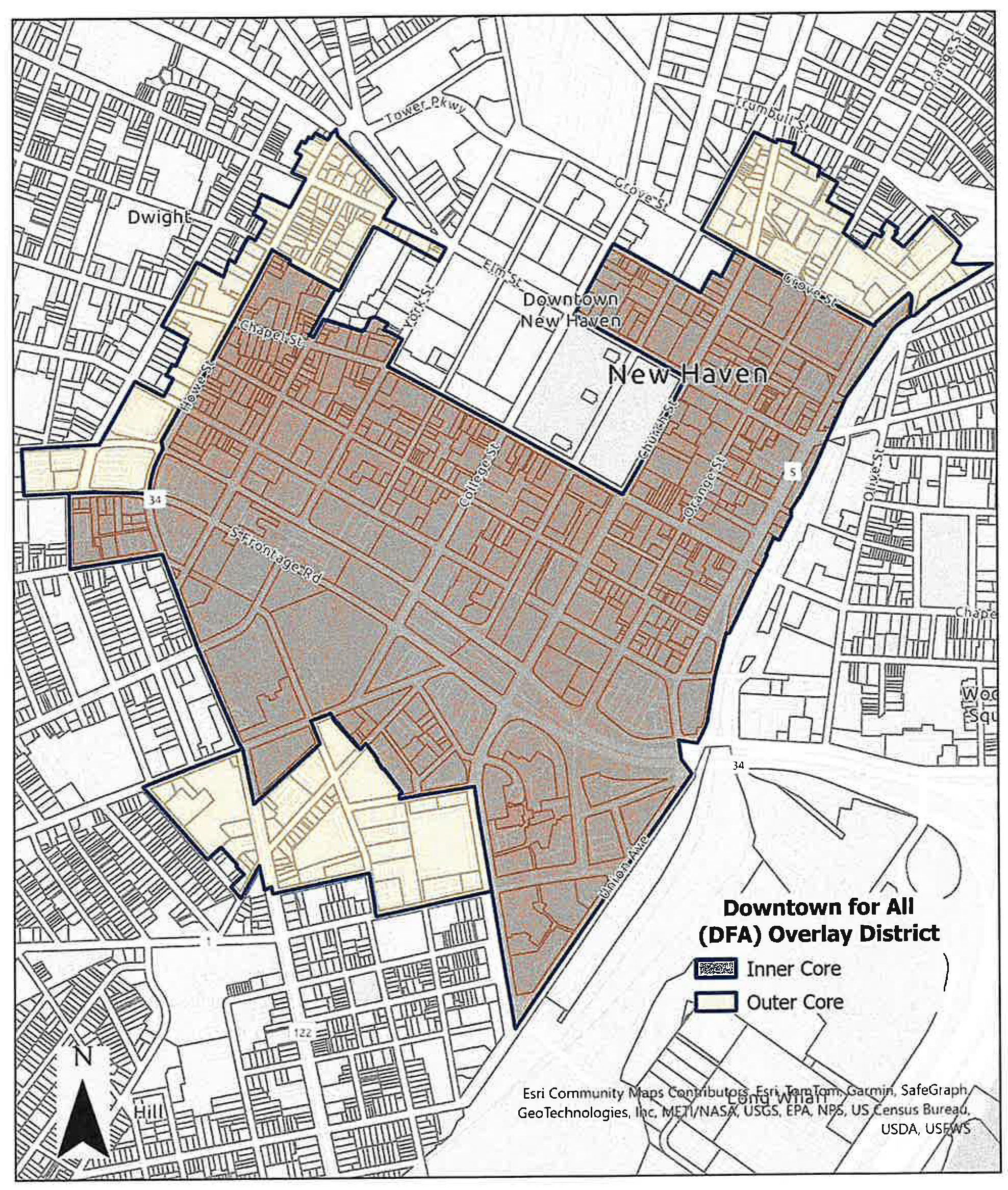
(3)
Effective Date. The Effective Date shall be the published notice of this Section's passage.
(Ord. No. 2025-0028, 12-1-25)
Editor's note— Ord. No. 1886, Sched. C, adopted January 7, 2020, repealed former § 59, which pertained to the Whalley Avenue Overlay District and derived from Ord. No. 1420, adopted June 5, 2006.

