
New Ulm City Zoning Code
CHAPTER 10
DEVELOPMENT STANDARDS
10.1 GENERAL PURPOSE
These standards are established to:
- Control and limit the impacts generated by, or inherent in, uses of land and buildings.
- Encourage a high quality of development that will be compatible with neighboring land uses.
- Prevent and eliminate those conditions that cause blight or are detrimental to the environment.
10.2 LANDSCAPING AND SCREENING
- Purpose. The purpose of this Section is to promote and protect the public health, safety and general welfare by providing standards for general and required landscaping and screening applicable to all zoning districts. The objectives of this Section are to:
- Establish and maintain forestation of the City;
- Provide appropriate groundcover, helping to control or reduce soil erosion, sedimentation and storm water run-off;
- Improve air quality;
- Enhance energy conservation through natural insulation and shading;
- Reduce noise pollution;
- Enhance the natural environment, particularly where the natural environment is disturbed during the course of site development;
- Increase and maintain property values;
- Assure compatibility of land uses; and
- Generally enhance the quality and appearance of development within the City.
- Landscape and Screening Plan Required.
- A landscape and screening plan shall be required in support of a site plan or building permit in the following situations:
- For commercial, industrial, institutional, public, semi-public, mixed use or multi-family residential use projects unless otherwise specified in this Section. These regulations do not apply to single and two-family residential development.
- For the following activities:
- All new construction.
- Building additions, expansions and new construction greater than twenty-five (25%) percent of the existing building footprint area.
- The addition of more than ten (10) parking spaces.
- Landscape requirements for activities described in Section 10.2 B shall be proportional to the existing building or parking lot areas.
- Compliance by existing uses shall not be required if the City determines either that because of the unique character of the existing use compliance is not needed or that compliance is not reasonably possible because of the existing development.
- No building permit shall be issued for development of property for which a landscaping and screening plan is required until such a plan is submitted to and approved by the Community Development Department.
- All requirements in this Section are minimum requirements. Landscaping in excess of these requirements is encouraged and may be required when necessary to achieve the purpose of these regulations.
- A landscaping and screening plan must illustrate planned development on the site.
- The landscaping and screening plan shall be produced on a separate sheet or sheets from other required plans.
- Review. The Community Development Department shall review all landscape plans for compliance with the landscaping and screening requirements outlined within this Section.
- Plan Contents. All landscape plans submitted for approval shall contain, at a minimum, the following information:
- North arrow and scale.
- The boundary lines of the property with accurate dimensions.
- The location of all driveways, parking areas, sidewalks, structures, utilities or other features, existing or proposed, affecting the landscaping and screening of the site.
- The location, size and identification of all existing trees, shrubs and other vegetation intended for use in meeting the landscape requirements of this Section.
- The location, common name, size and quantity of all proposed landscape materials.
- Proposed seeding or sodding plans for all disturbed areas, including the type of groundcover and method of application.
- The location and height of any proposed earth berms, fences or other measures used to satisfy the screening requirements of this Section.
- Plan Emphasis.
- The landscape plan will be developed with an emphasis upon the following site areas.
- The boundary or perimeter of the proposed site, especially street frontages.
- The immediate perimeter of the structure.
- The perimeter of parking and loading areas.
- The landscape plan will be developed with an emphasis upon the following site areas.
- Plan Schedule. The landscape plan shall be implemented and installed in accordance with the timetable approved for such plan.
- A landscape and screening plan shall be required in support of a site plan or building permit in the following situations:
- Landscape Requirements.
- General Landscape Standards.
- Design Standards.
- The overall composition and location of landscaped areas should complement the scale of the development and its surroundings.
- Plant materials should be selected and arranged to prevent blocking or obscuring of required site lighting during all stages of plant growth.
- Plantings at intersections or driveway entrances shall be arranged to allow a permanently clear, safe sight distance.
- Trees or shrubs shall not be planted under existing or proposed utility lines when their ultimate height may interfere with the lowest lines.
- Trees and shrubs shall not be placed over underground drainage systems and shall maintain adequate distance from storm sewers, sanitary sewers and water lines to prevent roots from entering such facilities.
- Landscaped areas should be of adequate size to promote proper plant growth and to protect plantings from pedestrian traffic, vehicle traffic and other types of concentrated activity.
- Landscaped areas and plantings should be located in a manner to prevent spread onto adjacent properties or right-of-way and to allow adequate room for proper maintenance.
- All landscaped areas must have access to a building water spigot in locations adequate for providing landscape maintenance.
- Light from vehicular traffic headlights and other sources shall be screened whenever it may be directed onto adjacent residential windows.
- Unless otherwise directed by the Community Development Department, all plantings shall be placed on the private property on which the development is taking place.
- Vegetation that is planted on the property shall be designed to provide a variety of colors and screening during all seasons.
- Location Standards.
- All open areas of a lot not used or occupied by building, off-street parking, loading and driving areas, sidewalks, patios, storage, gardens and similar uses, shall be landscaped with a combination of grass or groundcover materials including trees, shrubs or other ornamental landscape material. Undisturbed areas containing existing viable natural vegetation may be left in its natural state but shall be kept free of litter, debris and noxious, invasive or unsightly plants.
- No area comprised of required landscaping or screening materials shall be concurrently used for the parking of vehicles, the storage or display of materials, supplies or merchandise or for the placement of permanent or temporary signs for which no permit has been secured from the City.
- Existing Vegetation.
- It is the policy of the City of New Ulm to preserve the natural forest and woodland areas throughout the City; and with respect to specific site development, to retain, as far as practicable, substantial tree stands located on the project site.
- Existing healthy, well-formed overstory and understory trees shall be credited toward the requirements of this Section. See Section 10.1(C)(3)(e) for further information on credits.
- All new site work performed on an existing developed site shall comply with appropriate landscape requirements.
- It is the intent of the City of New Ulm, to where possible, remove invasive species from exiting natural areas.
- Stabilization.
- All required landscape planting areas shall be stabilized and maintained with lawn, groundcovers, mulches or other approved materials to prevent soil erosion and allow rainwater infiltration.
- The standards for vegetation and stabilization in Section 8.4, Bluffland Protection District, shall apply to any landscaping proposed in the Bluffland Protection District.
- Slopes and Berms.
- Final grades with a slope ratio of greater than 3:1 will not be permitted without special approval of the Community Development Department.
- All berms, regardless of size, shall be stabilized with groundcover or other suitable vegetation.
- Berms proposed to be placed along street right-of-way shall be designed and constructed to provide adequate sight distances at intersections and shall not impair safe operation of vehicles.
- Berms shall in no case damage the roots or trunks of existing healthy vegetation designated for preservation.
- Easements, Utility Facilities, Right-of-Way and Property Lines.
- Nothing except groundcover, as described in Section 10.1(C)(1)(h), shall be planted or installed within any underground or overhead public utility or drainage easement; or within three (3’) feet of a fire protection system, or electric transformer; without the consent of the utility provider, easement holder or the City as may be appropriate. Landscape plantings shall not obstruct required access to utility and fire safety facilities.
- Plants or planting materials shall not be placed within a public right-of-way unless specifically authorized by the Community Development Department and, if permitted, shall conform to the standards established in the City of New Ulm Boulevard, Tree and Shrub Policy, as may be amended.
- The center of plants or planting materials shall not be located closer than three (3’) feet from a fence line or property line unless otherwise approved by the Community Development Department and shall not be planted in a manner that would conflict with public plantings.
- Fences, trees, shrubs and any other landscape planting or element placed upon easements are subject to removal at owner’s expense if required for maintenance or improvement of the appropriate utility system. The City shall not be required to pay for the items removed from a utility or access easement area.
- Street boulevard areas, exclusive of sidewalks or driveways, shall not be covered with an impervious surface material or filled with inorganic materials.
- Spacing.
- The spacing of trees shall be appropriate to the type of tree species provided. Where massing of plants or screening is intended, large deciduous shrubs shall not be planted more than four (4’) feet on center, and/or evergreen shrubs shall not be planted more than four (4’) feet on center, unless otherwise approved by the Community Development Department.
- Plants or planting materials should be placed intermittently against long expanses of building walls, fences and other barriers to create a softening effect.
- Sodding and Groundcover.
- All yard areas not otherwise improved shall be perennial living ground cover.
- Sodding may be required in areas where the Community Development Department determines that certain site characteristics require its use.
- Storm Water Management Basins.
- Storm water management basins and ponds shall be landscaped.
- Basins and ponds shall maintain a natural shape and configuration. The location of basins and ponds shall be reviewed and approved by the Community Development Department.
- Design Standards.
- Planting Material Standards.
- Minimum Plant Size and Planting Units.
- The term “landscape plantings” refers to all overstory and understory trees and shrubs, evergreens, perennials and ornamental grasses.
- All trees, shrubs and other plantings must meet or exceed the following minimum sizes and will be assigned the following plant unit values to determine its equivalency value and compliance with the required amount of landscape plantings. See Table 11-1.
- The term understory trees and shrubs includes understory or ornamental trees, evergreens, all shrubs, perennials and ornamental grasses.
- Tree caliper is measured six (6”) inches above the ground.
- Subject to the approval of the Community Development Department, trees may be substituted for understory trees and shrubs using the listed plant unit values.
TABLE 10-1: PLANT UNIT VALUES Plant Type Minimum Size Planting Unit Value TREES Deciduous Overstory Trees 1 3/4 inch caliper 10 Deciduous Understory Trees 1 inch caliper 5 Evergreen Overstory Trees 5 feet high 10 UNDERSTORY TREES/SHRUBS (UTS) Evergreen and Large Shrubs 36 inches high 2 Spreading Evergreens 18 inches 1 Small Shrubs 18 inches high .5 Perennials and Ornamental Grasses -- .25
- Trees.
- Landscaping and screening requirements will be calculated as plant units using the formula identified for trees in Section 10.1.C.3.
- Tree Percentages by Type. The compliment of trees fulfilling the requirements of this Section shall not be less than twenty-five (25%) percent overstory deciduous and not less than twenty-five (25%) percent evergreen.
- Tree Percentages by Species.
- If more than zero (0) but fewer than eight (8) trees are required to be planted on the site, at least two (2) species shall be used.
- If more than eight (8) trees but fewer than fifteen (15) trees are required to be planted on the site, at least three (3) species shall be used.
- When more than fifteen (15) trees but fewer than thirty (30) trees are required to be planted on site, at least four (4) different species shall be utilized, in roughly equal proportions.
- When thirty (30) or more trees are required on a site, at least five (5) different species shall be utilized, in roughly equal proportions.
- Nothing in this Section shall be construed as to prevent the utilization of a larger number of different species than specified above.
- Understory Trees and Shrubs (UTS).
- Landscaping and screening requirements will be calculated as plant units using the appropriate formula identified in Section 10.1.C.3.
- To ensure plant diversity, not more than one-third (1/3) of the required UTS shall be comprised of any one species.
- A minimum of one-third (1/3) of the required UTS plantings shall be evergreen.
- Prohibited Trees.
TABLE 10-2: PROHIBITED TREES Botanical Name Common Name Acer grinnala Amur Maple Fraxinus species Ash (white, green and black ash prohibited) Robinia pseudoacacia Black Locust Acer negundo Box Elder Crataegus crus-galli Cockspur Hawthorn (thornless permitted) Rhamnus cathartica Common Buckthorn Frangula alnus Glossy Buckthorn Pumila Siberian Elm Ginkgo biloba Ginkgo (female prohibited, male permitted) Gleditsia triacanthos Honey Locust (thornless and seedless permitted) Morus alba Mulberry Populus species Poplars, Cottonwoods Elaeagnus angustifolia Russian Olive Acer saccharinum Silver Maple (River Maple) - Allowed Plants and Planting Materials.
- All plant materials must meet the standards set by the American Horticulture Industry Association d/b/a AmericanHort (as amended) and be of a variety that is indigenous to hardiness Zone 4 (or less), in which New Ulm is located, as well as the physical characteristics of the site.
- Planting Method. All trees shall be planted in a method, and pursuant to specifications, as prescribed by the current American Horticultural Industry Association standards.
- Annuals do not qualify as plantings.
- All plant materials shall be living plants; artificial plants are prohibited.
- For purposes of this Section, all calculations resulting in a fraction of a planting shall be rounded to the nearest whole number.
- Minimum Plant Size and Planting Units.
- Required Landscaping.
- Requirements – Residential.
- Single and Two-Family Residential Uses.
- Only sodding and groundcover requirements shall apply to single and two-family detached residential units.
- Medium and High-Density Residential Uses (three or more residential units).
- Ten (10) tree plant units for every one hundred (100’) feet of site perimeter or ten (10) tree plant units for every one thousand (1,000’) square feet of first floor building area, whichever is greater.
- Ten (10) UTS plant units for every twelve (12’) feet of site perimeter or ten (10) UTS plant units for every one hundred seventy-five (175’) square feet of first floor building area, whichever is greater.
- Single and Two-Family Residential Uses.
- Requirements – Commercial, Public, Semi-Public and Institutional.
- Ten (10) tree plant units for every one hundred (100’) feet of site perimeter or ten (10) tree plant units for every three thousand (3,000’) square feet of first floor building area, whichever is greater.
- Ten (10) UTS plant units for every twelve (12’) feet of site perimeter or ten (10) UTS plant units for every four hundred (400’) square feet of first floor building area, whichever is greater.
- Requirements – Industrial.
- Within the I-1 District (Planned Industrial).
- Ten (10) tree plant units for every fifty (50’) feet of street frontage on the longest street segment if the site has multiple street frontages, or ten (10) tree plant units for every one hundred fifty (150’) feet of site perimeter, whichever is greater.
- Ten (10) UTS plant units for every ten (10’) feet of street frontage on the longest street segment if the site has multiple street frontages.
- Within the I-2 District (General Industrial) and I-3 District (Limited Industrial).
- Ten (10) tree plant units for every one hundred (100’) feet of street frontage on the longest street segment if the site has multiple street frontages, or ten (10) tree plant units for every three hundred (300’) feet of site perimeter, whichever is greater.
- Ten (10) UTS plant units for every fifteen (15’) feet of street frontage on the longest street segment if the site has multiple street frontages, or ten (10) UTS plant units for every forty (40’) feet of site perimeter, whichever is greater.
- Within the I-1 District (Planned Industrial).
- Requirements/Adjustments.
- Planting requirement reductions may be proposed for buildings in excess of one hundred thousand (100,000’) square feet in size or sites with a disproportionate amount of undisturbed, undeveloped or planned expansion area.
- Planting requirements may be reduced if the landscape plan shows an adequate number of trees and understory trees and shrubs to enhance the site as determined by the Community Development Department.
- Credits.
- Existing Trees.
- The total number of required new overstory trees may be reduced by the retention of existing overstory trees, provided that the following conditions are met:
- Size and Species: Such trees fulfill the minimum requirements of this Section as to condition, size and species. City staff shall decide the amount of the credit for such existing trees based upon their condition, location and distribution on the lot and consistency with the intent of this Section.
- Protection During Development: Proper precautions to protect trees during development shall be indicated on the grading plans submitted for construction.
- These credit provisions shall only apply to trees and not to understory trees and shrubs.
- The total number of required new overstory trees may be reduced by the retention of existing overstory trees, provided that the following conditions are met:
- Storm Water Management Basins. Rain Garden, Bio-Retention Cell, Infiltration and Filtration Pond Discount: A discount may be allowed for a rain garden, bio-retention cell, infiltration and filtration pond due to their ability to enhance the landscaped environment. A properly installed pond provides numerous plantings that are not considered trees or shrubs but add to the landscaped environment. A discount may be provided based on the square footage of the pond as stated below:The discount amount will be reduced from the total number of required UTS planting units.
0 – 5,000 total square feet 10% discount 5,001 – 10,000 total square feet 20% discount 10,001+ total square feet 30% discount - Preservation of Natural Areas. At the City’s discretion, existing natural areas to be retained in their current condition may be removed from the property and not used in the calculation of landscaping requirements. “Natural areas” shall be defined as wetlands, natural grasses, wooded and forest areas, steep slopes, ponds and other “natural areas” so deemed by the Community Development Department.
- The maximum credit for any one site or project shall not exceed thirty (30%) percent from the required number of tree and UTS planting units.
- Existing Trees.
- Tree Removal.
- All trees removed from a public right-of-way by action of the adjoining property owner shall be replaced by that owner on a one for one basis.
- This action will be accomplished in compliance with the requirements of this Section.
- This requirement shall apply to construction activities, including but not limited to, the installation of new curb cuts and utility services.
- Trees removed by another public or quasi-public entity from a public right-of-way shall either be replaced or relocated.
- All trees removed from a public right-of-way by action of the adjoining property owner shall be replaced by that owner on a one for one basis.
- Planting Relocation.
- If landscape plantings cannot be placed on site, the Community Development Department may require the plantings to be placed in a City park or City right-of-way.
- All ground-based, monument or pylon signs shall have flower beds with small shrubs.
- Requirements – Residential.
- General Landscape Standards.
- Screening Requirements.
- General Screening Standards. In addition to the other forms of required landscaping, screening shall be installed to improve the appearance of vehicular use areas and property abutting public rights-of way, to require buffering between noncompatible land uses, and to promote public health and safety through the reduction of noise pollution, air pollution and visual impacts. Such areas shall be screened at all times, unless otherwise specified, regardless of adjacent uses, districts or other proximate landscaping material.
- Uses to Be Screened. The following use areas shall be screened in accordance with this Section:
- Anything specifically identified in this Chapter as requiring screening;
- Non-residential uses in residential zoning districts;
- Loading and service areas;
- Outdoor storage areas;
- Trash or recycling collection areas;
- Mechanical equipment;
- Different residential densities;
- Drive-through uses;
- Tower and antenna compounds; and
- Essential service structures.
- Permitted Screening Materials and Standards.
- The following standards apply to the establishment of screening:
- Screening shall consist of earthen berms, walls, fences, plants, chain-link fence with slats or other landscape materials. More than one method may be used on a lot or site.
- If the topography, existing vegetation, permanent structures or other features create a barrier which meets the screening requirements, they may be substituted, subject to the approval of the Community Development Department.
- The screen shall be designed to provide an effective visual barrier during all seasons as specified in this Section.
- The following standards apply to the listed screening materials:
- Planting Screens.
- A planting screen shall consist of healthy, fully hardy plant materials and shall be designed to provide a minimum year-round opaqueness of eighty (80%) percent, unless a different percentage standard is provided, at the time of maturity. The plant material shall be of sufficient height to achieve the required screening.
- Planting screens shall be maintained in a neat and healthy condition. Plants which have died shall be promptly replaced.
- A planting screen shall be placed around the perimeter of the site feature to be screened in a manner that screens the site feature from all off-site views.
- The plantings shall be capable of reaching their required height within three (3) years of planting.
- The plantings shall be spaced to achieve the required screening within three (3) years of the planting date.
- The height of planting materials required under this Section shall be measured at the time of installation.
- Screening Fence or Wall.
- The fence or wall shall be consistent with the standards found in Section 10.3, Fences and Walls.
- The fence or wall shall be constructed of attractive, permanent finished materials including natural stone, masonry, brick, wood or ornamental metal.
- The fence or wall shall provide a solid screening effect and not exceed the maximum height allowed for fences or walls in the underlying zoning district or be less than six (6’) feet in height.
- The design and materials used in constructing a required screening fence shall be subject to approval of the Community Development Department.
- All walls and fences shall be architecturally harmonious with the principal building.
- A fence or wall may be used for screening when plant materials are provided along the outside of the fence or wall for aesthetic appeal. Exposed fences shall run a maximum length of fifty (50’) feet between landscaping areas or clusters.
- Planting Screens.
- The following standards apply to the establishment of screening:
- Location Standards.
- All required screening shall be located on the lot occupied by the use, building, facility or structure to be screened unless the Community Development Department authorizes the location of screening in an adjoining public right-of-way.
- Unless authorized by the Community Development Department, no required landscape screening shall be located on any public right-of-way or within eight (8’) feet of the traveled portion of any street or highway.
- No landscape screening shall be located in a manner which obstructs visual sightlines on adjacent right-of-way as determined by the Community Development Department.
- Uses to Be Screened. The following use areas shall be screened in accordance with this Section:
- Specific Use-Based Screening Standards. The following uses shall adhere to additional standards for screening as outlined herein:
- Non-Residential Uses. Structures, parking or storage directly abutting land zoned for residential use shall provide the following screening along the boundary of the residential property:
- A six (6’) foot high fence or landscaped screen, providing eighty (80%) percent year around opacity.
- Berms may be used as part of the six (6’) foot screen height, but shall not be used to achieve more than three (3’) feet of the required height.
- Loading and Unloading Areas.
- Loading docks and garage entrances and exits shall be prohibited in the front yard unless authorized by the Community Development Department.
- When allowed in a front yard, they shall be screened to minimize visibility from any public street, from adjacent building structures and away from residentially zoned areas.
- Loading and unloading areas shall be screened by the use of berms, fences or walls to provide one hundred (100%) percent opacity to a height of eight (8’) feet.
- Outdoor Storage Areas.
- No storage trailers are allowed.
- All storage areas shall be screened from all public streets and shall be designed to be compatible with the architectural treatment of the principal building.
- These requirements will not apply to properties located in the I-2 zoning district.
- Trash or Recycling Collection Areas. Following the effective date of this Ordinance, all newly constructed or remodeled buildings shall adhere to the following regulations:
- All refuse and recyclable material containers shall be fully enclosed by a gated opaque fence or wall of a sufficient height to completely screen such containers from view by all adjoining properties and all streets.
- The fence or wall used for screening such containers shall have an exterior finish that is similar to the material found on the exterior walls of the main building on the property or other approved materials as determined by the Community Development Department.
- The provisions of this Section shall not apply to:
- Containers used by a single or two-family dwelling in connection with a municipal authorized refuse collection service.
- Containers used on a temporary basis for a construction or disposal activity.
- Containers designated and intended for use by the public.
- Any changes to trash handling facilities once the building is constructed shall comply with appropriate City Code requirements.
- Trash and recycling collection areas cannot be located in a public right-of-way.
- Mechanical Equipment Areas. All mechanical equipment installed on or adjacent to a structure shall be arranged so as to minimize their visual impact and mitigate noise impacting residentially zoned districts.
- Mechanical equipment shall be designed, including exterior color, and located so as to be aesthetically consistent and compatible with the structure.
- All equipment shall be painted or color clad to match the building or screened from view with secured fencing or parapets in a compatible color.
- Screening of and landscaping around equipment may be required where the design, color and location of the equipment are found to not effectively buffer noise or provide the requested design impacts.
- Screening shall be constructed of durable materials which are aesthetically compatible with the structure and which may be an integral part of the structure.
- Applicable requirements for access to the equipment shall be observed in the design and construction of the screening.
- All mechanical equipment shall be completely screened from all public roads and adjacent properties and shall be designed to be compatible with the architectural treatment of the principal building.
- Exceptions. The following mechanical equipment shall be exempt from the screening requirements of this Section:
- Minor equipment not exceeding three (3’) feet in height.
- Mechanical equipment accessory to a single or two-family dwelling.
- Mechanical equipment located in an industrial district not less than three hundred (300’) feet from a residence or residential zoning district.
- Methods of screening shall be approved by utility providers.
- Off-Street Parking Lots. Following the effective date of this Ordinance, all newly constructed parking areas shall adhere to the following regulations:
- In General.
- No landscaping or screening shall interfere with driver or pedestrian visibility or vehicles entering, circulating or exiting a premises.
- Screening requirements may be adjusted when there is a demonstrated concern regarding security and safety.
- Perimeter Standards for Parking Lot.
- All exposed parking areas of ten (10) or more required spaces in a front and side street yard, abutting or facing any property located in a residential zoning district, shall be screened with landscaping not less than three (3’) feet or more than four (4’) feet in height.
- The landscaping shall maintain a year-round fifty (50%) percent opacity.
- The landscaping abutting any other property shall maintain a year-round seventy-five (75%) percent opacity.
- When a parking lot is adjacent to a residentially zoned district, the required screen height shall be increased to six (6’) feet or the fence height permitted by Section 10.3.
- A berm may be used as part of the screening for off-street parking in which case the berm shall be no more than two (2) feet in height. Landscaping on a berm shall maintain a fifty (50%) percent year round opacity not less than three (3’) or more than four (4’) feet in height.
- A four (4’) foot high wall or fence constructed of masonry, brick, wood or vinyl may be used for required screening. The area between the parking lot and a wall or fence shall be planted with grass or established with landscape material.
- Areas not planted with shrubs, trees or other appropriate screening devices shall be maintained with living groundcover or planting beds with acceptable mulch.
- All exposed parking areas of ten (10) or more required spaces in a front and side street yard, abutting or facing any property located in a residential zoning district, shall be screened with landscaping not less than three (3’) feet or more than four (4’) feet in height.
- Interior Landscaping Standards for Parking Lots.
- All parking lots that contain more than fifty (50) parking spaces shall provide interior landscaping as follows:
- A minimum area equal to seven (7%) percent of the parking lot shall be designed with landscaping islands.
- The minimum area permitted for landscape islands shall be two hundred (200’) square feet with a ten (10’) foot minimum width. A minimum distance of four (4’) feet shall be maintained from the edge of the pavement to all trees.
- In order to encourage the required landscape areas to be properly dispersed, a minimum of one (1) peninsula, island or boulevard type landscaped area shall be located within each six thousand (6,000’) square feet of the parking lot.
- The landscape islands shall be sized and designed to support plant health. It is strongly encouraged to use these areas for storm water infiltration purposes.
- Islands shall be bounded by concrete curbing.
- Each such island shall be planted with at least one (1) overstory tree. The remainder of the landscaped area shall be covered with turf grass, native grasses, mulch material or other perennial flowering plants, vines, shrubs or trees.
- Interior landscaping requirements shall be accomplished with the use of either planting islands or vegetative medians, or both.
- Vegetative medians, which are typically used to divide sections of parking, shall have a minimum width of six (6’) feet, so that trees and plantings located within the median will not be contacted by the front overhang of any vehicle.
- As part of a building plan review, interior landscaping may be required for off-street parking lots containing less than fifty (50) spaces.
- It is not the intent of this Section to relieve a project from the installation of islands or peninsulas that are necessary to promote the safe and efficient flow of traffic, regardless of parking lot size.
- All parking lots that contain more than fifty (50) parking spaces shall provide interior landscaping as follows:
- In General.
- Light Encroachment. Lighting locations should provide for security and visual interest while limiting impact on adjacent properties.
- All light sources abutting residential properties shall be shielded from view with illumination directed in a manner to prevent bleeding and glare onto abutting properties and public rights-of-way.
- Parking and loading areas should be located in such a manner to minimize the chance of vehicle headlights and other sources from shining into residential windows.
- Performance standards related to glare and lighting are further specified in Section 10.3.
- Different Residential Densities. Where multi-family buildings of four (4) or more units abut property zoned or developed with a less dense residential use, the higher density residential use shall provide screening along all off-street parking and formal outdoor recreational activity areas or between multi-family and single-family units to mitigate possible adverse impacts.
- Drive-Through Uses. All elements of the drive-through service area, including but not limited to menu boards, order stations, teller windows and vehicle lights from stacking lanes, shall be screened from adjacent residentially zoned property.
- Essential Service Structures. All newly constructed or remodeled buildings that are enclosed on all four sides by opaque building materials, essential service structures shall be screened from all sides adjacent to a residentially zoned area by a wall, fencing, berm or landscaping to create an all-seasons screen that is ninety (90%) percent opaque to a height sufficient to completely screen such areas from view of said property or ten (10’) feet, whichever is less, subject to openings allowing access to the structures.
- Antennas and Support Structures.
- All newly constructed or remodeled tower and antenna facilities shall be screened from the view of residential zoned property and from public rights-of-way. Existing mature tree growth and natural landforms shall be preserved to the maximum extent possible to screen these facilities.
- Ground-mounted antennas and antenna support structures shall be screened by a fence or evergreen hedge of not less than six (6’) feet in height.
- All such screenings shall be provided between ground-mounted antennas and/or support structures and each lot line of the property on which the antenna or antenna support structure is located.
- Non-Residential Uses. Structures, parking or storage directly abutting land zoned for residential use shall provide the following screening along the boundary of the residential property:
- General Screening Standards. In addition to the other forms of required landscaping, screening shall be installed to improve the appearance of vehicular use areas and property abutting public rights-of way, to require buffering between noncompatible land uses, and to promote public health and safety through the reduction of noise pollution, air pollution and visual impacts. Such areas shall be screened at all times, unless otherwise specified, regardless of adjacent uses, districts or other proximate landscaping material.
- Installation and Maintenance Standards.
- In General. All landscaping materials depicted on plans approved by the City shall be considered as required elements of the project.
- Installation Requirements. All landscaping or required screening shall be installed prior to issuance of a final Certificate of Occupancy. A temporary certificate of occupancy may be issued without the installation, provided a financial security shall be submitted, in an amount established by the City Council, to ensure the remaining improvements are completed. The remaining improvements shall be installed when weather conditions are favorable.
- Maintenance and Care. The landowner shall be responsible for the continued maintenance of plants and landscape materials to remain in compliance with all requirements of this Chapter. Plants or plant material that exhibits evidence of insect pests, disease, or damage shall be appropriately treated and dead plants promptly removed and replaced within the next planting season.
- Inspection. All landscaping shall be subject to periodic inspection by the Community Development Department. Landscaping that is not installed, maintained, or replaced as needed to comply with the approved landscape plan shall be considered in violation of the terms of the Site Plan or Building Permit. The landowner shall receive notice of such violation in accordance with code enforcement requirements as specified in Chapter 12.
- Permitted Adjustments. A landscaping and screening plan that conforms to the purpose of this Section, but that varies in specific detail from the strict requirements of this Section, may be approved by the Community Development Department upon a showing that the proposed plan meets the purposes and intent of this Section and addresses the unique characteristics of the proposed development and surrounding areas.
The City may also waive provisions of this Section for developments in the B-4 Zoning District, where existing site limitations do not provide adequate areas for landscaping.
10.3 FENCES AND WALLS
- Purpose. The purpose of this Section is to regulate the materials, location, height, and maintenance of fences and walls to ensure a compatible relationship between abutting properties, from protect adjacent properties from the indiscriminate placement and unsightliness of fences and walls and the community at large, and to safeguard public health, safety, and welfare.
- Applicability.
- In general, unless exempted in accordance with 10.3.B.2, the provisions of this Section shall apply to the construction, reconstruction, or replacement of all fences located within the City.
- Exemptions. The following are exempted from the requirements of this Section:
- Fences constructed before January 1, 1997. A nonconforming fence that existed as of January 1, 1997, may be continued, including through repair, replacement, restoration, maintenance, or improvement, but not including expansion, and shall be subject to the conditions and provisions of Minnesota Statutes 462.357, Subd.1.e.
- Fences that are located entirely outside of a setback area.
- Fences that are less than thirty (30”) inches in height and less than twenty (20’) feet in length.
- Fences that are a part of a permitted tennis court, athletic field or other recreational facility and do not exceed ninety-six (96) inches in height with a thirty (30’) foot front yard setback on all street frontages and a ten (10’) foot setback on all other property lines.
- Temporary Fencing.
- Established around construction sites, demolitions or other site conditions unsafe for pedestrians or vehicles, provided it is consistent with the building code.
- To protect existing trees, limit sedimentation or control erosion.
- Within the A-OS (Agricultural-Open Space) zoning district only, fences that are ninety (90%) percent open (barb wire, chain link, woven wire and other similar type fences) and are used to contain non-domestic animals.
- Permit Required.
- A Fence Permit issued by the City is required prior to erection, construction, or replacement of any fence, other than a fence exempted in Section 10.3.B.2.
- All applications for a fence or wall shall be in accordance with Section 2.3, General Review Procedures and Requirements; and shall be accompanied by a site plan providing lot dimensions; the location of existing buildings, structures, and easements on the lot; and the location of the proposed fence or wall.
- General Fence Requirements.
- Materials. All fences shall be built, maintained, and repaired in a professional manner and be constructed of materials reasonably suitable for the purpose for which the fence is intended. The materials and design shall be compatible with other structures in the area in which the fence is located. Property owners shall maintain fences regularly and shall not allow a fence to reach a condition of disrepair or to constitute a nuisance.
- Location.
- The owner of property upon which any fence is proposed to be erected shall be solely responsible for:
- Determining property lines and property corner locations.
- Conformance of the proposed fence with the terms of this Section.
- The owner of property upon which any fence is proposed to be erected shall be solely responsible for:
- Prior to the issuance of a Fence Permit, the City may require that the applicant secure a survey by a registered land surveyor of the property upon which the fence is to be erected, such survey to be paid for by the applicant. Such a survey shall be required if the fence is proposed to be located within twelve (12) inches of an adjoining property or right-of-way. Provided, however, that no such survey shall be required if the owners of the property upon which such fence is to be located and the owners of the adjoining property or right-of-way have entered into a written agreement approving the proposed location of the fence, and such agreement has been recorded in the Office of the Brown County Recorder.
- No fence shall be installed so as to block or divert a natural drainage flow onto or off of any other land.
- Fences within areas in which the City holds an easement are subject to removal without compensation to the property owner if the City determines that access to the area is needed for any purpose for which the easement was granted or reserved.
- Chain link fences must have a top rail, and barbed ends must be placed at the bottom of the fence.
- The finished side of all fences shall face the adjoining property or right-of-way.
- Electric, barbed or razor wire, special purpose fences, and fences taller than the height limitations established in this Section shall be permitted only with a Conditional Use Permit.
- In all cases, heights are measured from the finished grade of the proposed location of the fence at each post point.
- Retaining Walls. Solid walls, including retaining walls in excess of forty-eight (48”) inches in height require a building permit.
- All fencing or wall segments located along a single lot side shall be composed of a uniform style and colors compatible with other parts of the fence and with associated buildings.
- Requirements for Fences by Zoning District.
- All Zoning Districts.
- Fencing specifically erected for public safety purposes or to enclose major utilities, wireless communications towers, and government facilities; may be constructed up to ninety-six (96”) inches in height within front, side, or rear yards.
- For all other purposes, a fence not exceeding forty-eight (48”) inches in height may be located within a front yard setback area subject to the following:
- A fence located within a front yard of a corner lot shall not exceed twenty-four (24”) inches in height within a triangle formed by the two (2) lot lines fronting on the intersecting streets, and a third line passing through points located forty (40’) feet from the intersection point of the lot lines (see Figure 10-1). This requirement shall not apply to a split rail fence.
- A fence with less than fifty (50%) percent transparency, if located within a front yard setback area, shall be placed a minimum of twenty-five (25’) feet from any parallel public right-of-way or private driveway.
- Subject to other restrictions which may apply, a fence located within a front yard may extend into a public right-of-way up to twelve (12”) inches from the edge of a constructed sidewalk located between the front property line and the street.
- No fence in a rear yard area shall be located closer than five (5’) feet to an alley right-of-way.
FIGURE 10-1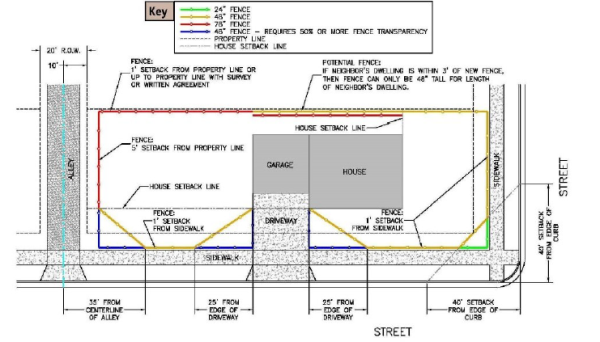
- Residential Zoning Districts.
- A fence located within a side or rear yard setback area may not exceed seventy-eight (78”) inches in height.
- A fence within a side or rear yard setback area may not exceed forty-eight (48”) inches in height if:
- It is located closer than three (3’) feet to an existing permanent dwelling structure on an adjoining lot;
- The fence will be constructed parallel to, or substantially parallel to, the property line; and
- This provision shall not apply to a fence to be constructed perpendicular to, or substantially perpendicular to, the property line.
- Notwithstanding the above provisions, a fence not exceeding ninety-six (96”) inches in height may be located along a property line directly abutting a commercial or industrial use or zoning district, but not in a front yard setback area.
- Temporary plastic fencing (i.e., snow fencing) is prohibited on residentially zoned lots between April 1 and October 31 of each year.
- Business Zoning Districts. A fence located within a side or rear yard setback area may not exceed seventy-eight (78”) inches in height.
- Industrial Zoning Districts. A fence not exceeding ninety-six (96”) inches in height may be located in the rear yard area and in the side yard setback area, so long as such fence does not extend further toward the front yard area than the majority of the building front located on such property.
- All Zoning Districts.
- Recreational Facility. A hard surfaced outdoor recreation area exceeding twenty (20’) feet by thirty (30’) feet including, but not limited to, tennis courts, hockey rinks, sports courts and handball/racquetball courts that may be enclosed by a fence or include exterior lighting but excluding pools and driveways used exclusively for access to a garage.
- Purpose. Regulate the development of a recreational facility in all residential zoning districts.
- Permit Required. No recreational facility shall be constructed, erected or otherwise created in a residential zoning district without the issuance of a Conditional Use Permit.
- Requirements. An application for a building permit shall include a site plan showing the following along with all other required information:
- The size, shape, pavement and sub-pavement materials.
- The location of the court.
- The location of the house, garage, fencing and any other structural improvements on the lot.
- The location of structures on all adjacent lots.
- A grading plan showing all revised drainage patterns and finished elevations at the four corners of the court.
- Location of existing and proposed wiring and lighting facilities.
- The facility shall not be located closer than ten (10’) feet to any side and rear lot line. The facility shall not be located within any required front yard or street side yard.
- The facility shall not be located over underground utility lines of any type, nor shall any court be located within any private or public utility, walkway, drainage or other easement.
- Solid facility practice walls shall not exceed ten (10’) feet in height. A building permit shall be required for said walls. Said walls shall be set back a minimum of thirty (30’) feet from any lot line.
- Chain link fencing surrounding a facility may extend up to twelve (12’) feet in height above the recreational facility surface elevation. The fence must not exceed twenty-five (25%) percent opacity.
- Lighting for the facility shall be directed toward the facility and not toward adjacent property. Lighting shall meet the requirements of Section 10.4.
- Public Health and Safety. Notwithstanding any other provision in this Section, upon a determination by the City’s Safety Commission that a fence, screening or landscape plantings constitute a potential threat to public health or safety, and after notice to and opportunity for the owner of property upon which such fence is located to be heard, the City Council may order the removal or modification of such fence, screening or landscape plantings at the expense of the property owner. Such a determination and order may be made without regard to whether the fence was in existence prior to January 1, 1997.
10.4 EXTERIOR LIGHTING
- Purpose. The purpose of this Section is to encourage the use of lighting systems that will reduce light pollution and promote energy conservation while increasing night time safety, utility, security and productivity. More specifically, this Section is intended to:
- Regulate exterior lighting to ensure that excessive light spillage and glare are not directed at adjacent properties, neighboring areas, and motorists;
- Ensure that all site lighting is designed and installed to maintain adequate lighting levels on site while limiting negative lighting impacts on adjacent lands; and
- Provide security for persons and land.
- Applicability. In general, the provisions of this Section shall apply to all newly constructed or installed exterior lighting in the City unless exempted in accordance with Section 10.4.C.
- Exemptions.
- The following is exempted from the exterior lighting standards of this Section:
- Single and two family detached dwellings;
- Lighting required by a government agency for the safe operation of airplanes, or security lighting required on government buildings or structures;
- Publicly controlled or maintained street lighting, warning and emergency lighting or traffic signals; and
- Lighting affiliated with public monuments, places of worship, or similar uses.
- The following is exempted from the exterior lighting standards of this Section:
- Nonconforming Uses.
- Existing Fixtures. All outdoor lighting fixtures existing and installed prior to the effective date of this Ordinance are exempt from regulations of this Section except that the light source shall be controlled to minimize light trespass onto adjacent property. Light trespass shall not exceed one (1’) foot candle at the center line of a street or four-tenths (0.4’) foot candles at the property line of adjacent residential property.
- New Fixtures. Whenever a light fixture existing on the effective date of this Ordinance is replaced by a new outdoor light fixture, the provisions of this Section shall be satisfied.
- Lighting Plan Requirements. Site plans indicating the location of all lighting devices shall provide the following information:
- Description of the lighting devices, fixtures, lamps, supports and reflectors. The description shall include, but is not limited to, catalog cuts by manufacturers and drawings.
- Photometric plans showing the location of each light source and the level of light (measured in foot candles) every twenty (20’) feet.
- All zoning and building applications that include outdoor lighting shall submit the information required in Section 10.4 in addition other information required by the City.
- General Standards for Exterior Lighting.
- Hours of Illumination. Public and institutional uses, commercial uses, and industrial uses (see Table 10-3) that are adjacent to existing residential development or vacant property in residential districts shall turn off all exterior lighting—except lighting necessary for security or emergency purposes—within one (1) hour of closing.
- For the purposes of this Section, lighting “necessary for security or emergency purposes” shall be construed to mean the minimum amount of exterior lighting necessary to illuminate possible points of entry or exit into a structure, to illuminate exterior walkways, or to illuminate outdoor storage areas. Such lighting may be activated by motion sensor devices.
- Illumination Direction. In all zoning districts, lighting shall be directed downward. Lighting shall not be directed upon the public right-of-way and nearby or adjacent properties. In addition, upwardly-directed lighting shall not be used to illuminate structures, except for low-wattage architectural lighting or lighting for the American flag.
- All lighting shall be Underwriters Laboratory (UL) approved and installed per National Electric Standards (NEC) requirements.
- Hours of Illumination. Public and institutional uses, commercial uses, and industrial uses (see Table 10-3) that are adjacent to existing residential development or vacant property in residential districts shall turn off all exterior lighting—except lighting necessary for security or emergency purposes—within one (1) hour of closing.
- Design Standards for Exterior Lighting.
- Maximum Lighting Height. Except for outdoor sports fields or performance areas, the height of outdoor lighting, whether mounted on poles or walls or by other means, shall be no greater than sixteen (16’) feet in residential districts and no greater than twenty-five (25) feet in business, industrial, Mixed-Use Turner and Mixed Use-Emmerson districts.
- Shielding.
- Exterior. All exterior lighting that emits more than 900 lumens, shall be concealed or shielded with a full cut-off style fixture with an angle not exceeding ninety (90o) degrees, with ninety (90%) percent of the light below eighty (80o) degrees. Exterior lighting shall be designed, constructed, and maintained in a manner that minimizes off-site glare, light trespass on adjacent property, and traffic hazards for pedestrians and motorists.
- Interior. No interior light source shall be positioned, aimed, or configured so as to result in the light source being visible from property occupied by existing residential development.
- Canopies. No light source in a canopy structure shall extend downward further than the lowest edge of the canopy ceiling.
- Awnings. Awnings or canopies used for building accents over doors, windows, etc., shall not be internally illuminated (i.e., from underneath or behind the awning).
- Maximum Illumination Levels. All outdoor lighting and indoor lighting visible from outside shall be designed and located so that the maximum illumination measured in footcandles at ground level at a property line or right-of-way center line shall not exceed the standards in Table 10-3, Maximum Illumination Levels. Cut-off lighting shall be designed to direct light downward (e.g., shoe box style).
TABLE 10-3: MAXIMUM ILLUMINATION LEVELS Type of Use [1] Maximum Illumination (Footcandles) All Uses 0.5 at all ROW center lines Residential or Civic & Institutional Use 0.5 at Property Line Commercial or Industrial Use [2] 1.0 at Property Line Parking Lots 1.0 at Property Line [1]: See Table 9-1: Comprehensive Use Table
[2]: The minimum illumination level at the property line shall be 0.2 footcandle.
- Wall Pack Lights. Wall packs on buildings may be used at entrances and other areas with inadequate lighting. Wall packs on the exterior of the building shall be fully shielded (e.g., true cut-off type bulb or light source not visible from off-site) to direct the light vertically downward and be of low wattage. Wall pack light sources visible from any location off the site are prohibited.
- Illumination of Outdoor Sports Fields and Performance Areas. Lighting of outdoor sports fields and performance areas shall comply with the following standards:
- All lighting fixtures shall be equipped with an existing glare control package (e.g., louvers, shields, or similar devices) and aimed so that their beams are directed and fall within the primary playing or performance area.
- The lighting system for any game or event shall be extinguished after the end of the game or event.
- Sign Lighting. Lighting fixtures used to illuminate signs shall comply with the standards of this Section, and exterior light sources shall be aimed and shielded so that direct illumination is focused exclusively on the sign face and the light source is not visible from off-site areas.
10.5 SIGNS
- Findings, Purpose, and Effect.
- Findings.
- Exterior signs have a substantial impact on the character and quality of the environment.
- Signs provide an important medium through which individuals may convey a variety of messages.
- Signs can create traffic hazards, aesthetic concerns and detriments to property values, thereby threatening the public health, safety and welfare.
- The City’s zoning regulations have historically included the regulation of signs to provide adequate means of expression and to promote the economic viability of the business community while simultaneously protecting the City and its citizens from a proliferation of signs of a type, size, location and character that would adversely impact upon the aesthetics of the community and threaten the health, safety and welfare of the citizenry.
- The regulation of the physical characteristics of signs within the City has had a positive impact on traffic safety and the appearance of the community.
- Signs can be used to identify and promote business and industry in the City.
- Purpose and Intent.
- It is not the purpose or intent of this Section to regulate:
- The message displayed on any sign;
- Any building design or any display not defined as a sign; or
- Any sign which cannot be viewed from outside a building.
- It is the purpose and intent of this Section to:
- Regulate the number, location, size, type, illumination and other physical characteristics of signs within the City in order to promote the public health, safety and welfare.
- Maintain, enhance and improve the aesthetic environment of the City by preventing visual clutter that is harmful to the appearance of the community.
- Improve the visual appearance of the City while providing for effective means of communication, consistent with constitutional guarantees and the City’s goals of public safety and aesthetics.
- Provide for fair and consistent enforcement of the sign regulations set for herein under the zoning authority of the City.
- Provide for the safety of the traveling public by limiting distractions, hazards, and obstructions.
- It is not the purpose or intent of this Section to regulate:
- Effect. A sign may be erected, mounted, displayed or maintained in the City if it is in conformance with the provisions of this Section. The effect of this Section is to:
- Allow a wide variety of sign types in business zones, and a more limited variety of signs in other zoning districts subject to the standards set forth in this Section.
- Allow certain small, unobtrusive signs incidental to the principal use of a site in all zoning districts when in compliance with the requirements of this Section.
- Prohibit signs whose location, size, type, illumination or other physical characteristics negatively affect the environment and where the communication can be accomplished by means having a lesser impact on the environment and the public health, safety and welfare.
- Provide for the enforcement of the provisions of this Section.
- Severability. If any section, subsection, sentence, clause, or phrase of Section 10.5 is for any reason held to be invalid, such decision shall not affect the validity of the remaining portions of this Section. The City Council hereby declares that it would have adopted the Section in each section, subsection, sentence, or phrase thereof, irrespective of the fact that any one or more sections, subsections, sentences, clauses, or phrases be declared invalid.
- Findings.
- Administration and Enforcement.
- Permit Required.
- No sign shall be erected, altered, reconstructed, maintained or moved in the City without first securing a permit from the City except as otherwise permitted in this Ordinance. The content of the message or speech displayed on the sign shall not be reviewed or considered in determining whether to approve or deny a sign permit.
- Signage will serve as an accessory use to a permitted use located in an established zoning district.
- Permanent Signs. To apply for a permanent sign permit, a complete application shall be submitted to the City containing the following:
- Names and addresses of the owner(s) of the property, the applicant(s) and owner(s) of the sign;
- The address at which the sign(s) are to be erected;
- The legal description of the property on which the sign(s) are to be erected and the street on which they are to front;
- A complete set of scaled plans showing the sign dimensions, area, height, ground elevations, applicable setbacks, and other details to fully and clearly represent the safe construction and placement of the proposed sign(s);
- The cost of the sign;
- Type of sign(s) being requested (i.e., wall sign, monument sign, etc.);
- Payment of permit fee;
- The following if applicable:
- Written authorization from the property owner upon whose land the sign is to be erected.
- A sign plan showing signs for all businesses if the sign is located on a building with more than one business.
- Photographs of the building face if the sign is being placed on an existing structure.
- Temporary Signs. To apply for a permit to allow a temporary sign, a complete application shall be submitted to the City containing the following:
- Names and addresses of the owner(s) of the property, the applicant(s), owner(s) of the sign, and legal description of the subject property;
- The address at which the sign(s) are to be erected;
- A generalized plan set showing the sign dimensions and height, and a notation of the materials to be used;
- A scaled site plan which clearly represents the placement of the proposed sign(s) on the applicable property;
- The proposed timeframe(s) over which the sign(s) will be posted;
- Payment of the permit fee; and
- Temporary Sign Renewal. A temporary sign permit issued by the City may be renewed provided the sign design, size, location, or other previously approved details are not proposed to change. A sign renewal application shall include the following:
- Names and addresses of the owner(s) of the property, the applicant(s), owner(s) of the sign, and legal description of the property;
- The address at which the sign(s) are to be erected or remain;
- The date of issuance of the permit being renewed;
- The proposed timeframe(s)over which the sign(s) will be posted; and
- The payment of the permit renewal fee.
- Review. The Community Development Department shall approve or deny a completed sign permit application. If the permit is denied, the Community Development Department will send a written notice of denial to the applicant. The written notice will indicate the reason(s) for denial and a description of the applicant’s appeal rights.
- Exemptions. These exemptions shall not be construed as relieving the owner of the sign from the responsibility of its erection, maintenance, and compliance with the provisions of this Section or any other law or ordinance regulating the same. The following signs shall not require a permit:
- The changing of the display surface on a previously approved sign.
- Signs six (6’) square feet or less in size.
- Window signage that does not cover more than one-third (1/3) of the total area of the window in which the sign is displayed.
- Directional signage.
- Privately owned banners that may be installed by the City of New Ulm on street lights within a public right-of-way provided prior approval is granted by the New Ulm City Council.
- Governmental signage.
- Fees. The fee for a sign permit is established yearly in the City’s adopted fee schedule.
- Construction, Maintenance and Repairs.
- The construction of all signs, unless otherwise stated herein, shall be in conformance with the provisions of all applicable codes and regulations as may be amended, which is hereby adopted by reference and made a part of this Section.
- All signs and structures shall be properly maintained and shall be constructed of sufficiently permanent material so that they shall not succumb to deterioration from weathering.
- The owner, lessee, or manager of a sign which is close to the ground shall keep grass and other vegetative growth cut and maintained surrounding the sign.
- Any sign or sign structure which becomes structurally unsafe or endangers the safety of a building or premises or endangers the public safety shall be repaired, replaced, or removed if repair is not feasible within 10 days after written notification from the Community Development Department. Sign maintenance shall be the responsibility of the underlying fee owner.
- Removal.
- The City reserves the right to require the removal, at the owner's expense, of any sign when the requirements of this Section are not completely followed and adhered to, or if the sign is not properly maintained or falls into a state of disrepair.
- The City shall not have any obligation or liability to replace any sign or nearby landscaping if the responsible party fails to maintain or remove the sign, and it must be removed by the City.
- The City may cause any sign or structure which is an immediate public hazard to be removed summarily after a reasonable attempt has been made to have the property owner remove the sign.
- Violations. Violation of this Section is a misdemeanor. Each day that the violation continues is a separate offense.
- Permit Required.
- General Provisions.
- General Sign Standards.
- Total site signage means the maximum permitted combined area of all freestanding, wall identification, or other types of regulated signs allowed on a property.
- Interior sign means a sign which is located within the interior of any building that is visible from the property line or the public right-of-way. An interior sign is subject to the requirements of this Section.
- Directional signage means an on-site sign designed to guide vehicular or pedestrian traffic that does not promote or advertise a business, property, or product. This signage installed on the property shall not be considered as part of the total sign area calculations for the site.
- The base or support elements of freestanding signs shall be constructed of similar building materials as the principal structure. Landscaping shall be required at the base to enhance such signs.
- Murals are permitted in the B-4 Downtown zoning district with the approval of a Conditional Use Permit. Murals containing only noncommercial speech will not be considered as part of the total site signage.
- Flags may be displayed upon a lot. However, the total square footage area of any flags used as advertising or attention getting devices for commercial purposes shall be considered as permanent signage and will count towards the total allowable signage. Flag height is limited to twenty-five (25’) feet. No more than three (3) flags shall be displayed at one time.
- A sign permit shall become null and void if the work for which the permit was issued has not been completed within a period of one-hundred-eighty (180) days after the date of the permit approval. A permit may be renewed one (1) time for an additional 180 days and no additional fee shall be collected for the renewal. This clause does not apply to temporary or conditional use permits.
- A sign displayed for a special event or promotion and shall not be in place for more than a total of thirty (30) days. Only one type of temporary sign can be displayed per zoning lot or property under separate management or control at any given time.
- Comprehensive Sign Plan.
- Buildings with multiple tenants, properties with multiple buildings, and unified developments with multiple lots shall be required to submit a comprehensive sign plan to the Community Development Department for approval.
- A comprehensive sign plan shall be of sufficient detail to allow determination that all signs within the development will meet the requirements of this Ordinance.
- No sign permit shall be issued for an individual sign except upon determination that such sign is consistent with the comprehensive sign plan for the development and the provisions of this Ordinance.
- The comprehensive sign plan is intended to control sign area and sign placement to help eliminate incongruities as tenants/occupants change.
- For property located in a PUD District, signs shall be permitted and regulated according to the final PUD plan and related documents.
- Computations.
- Sign Area Measurement.
- The area of a sign face shall be based on the outer dimensions of the sign elements. Where the sign is not in the shape of a rectangle, square, triangle, or circle, the sign face area shall be determined by calculating the area of an imaginary rectangle drawn around the sign.
- When the faces of a back-to-back sign are parallel or within thirty-five (35o) degrees of parallel, the sign face area shall be determined on the basis of only one (1) side of such sign. If the sign faces are not within thirty-five (35o) degrees of parallel, the sign face area shall be determined on the basis of the sum of the areas of each sign face.
- Poles, bases, and other supports shall not be included in the sign area calculation.
- See Figure 10-3 for examples of Sign Area Measurements.
- Sign Area Measurement.
- Sign Height Measurement. The height of a sign shall be computed as the vertical distance measured from the average grade at the base of the sign to the top of the highest attached component of the sign.
Figure 10-2: Sign Height Measurement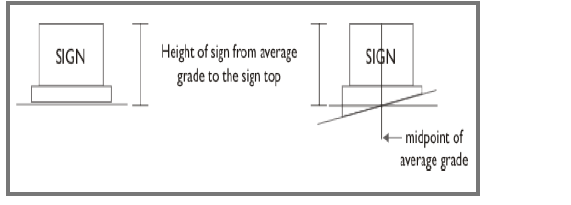
- Total Sign Area Calculation. The total square footage of all sign surfaces shall be computed by adding together the sign areas of all signs on a property.
Figure 10-3 Total Sign Area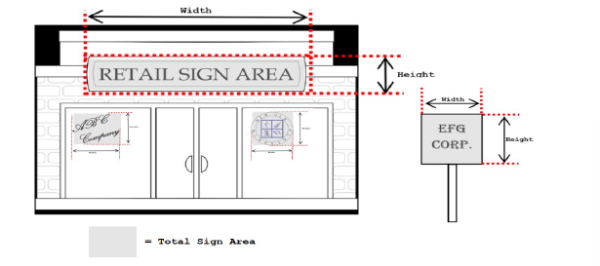
- Canopies, Marquees and Fixed Awnings.
- Canopies, marquees and fixed awnings are allowed in the Business and Industrial zoning districts if they meet the following requirements and the applicable square footage requirements.
- An awning, canopy or marquee may not project more than six (6’) feet into the public right-of-way;
- Awnings, canopies or marquees may have no part of the structure, other than supports, nearer the ground surface than eight (8’) feet;
- The architectural style of the awning, canopy or marquee shall be consistent with the building being served;
- The erection and maintenance of signs, either illuminated or unilluminated, which are on the sides of a marquee which is firmly attached to and a part of a theatre or other building, providing such signs are an integral part of the marquee and do not project above or below the marquee.
- Canopies, marquees and fixed awnings are allowed in the Business and Industrial zoning districts if they meet the following requirements and the applicable square footage requirements.
- Projections.
- In General.
- In the B-4 Downtown zoning district, no sign shall project more than three (3’) feet over a public sidewalk, except allowed signs on an awning, canopy, or marquee; and all such signs shall be a minimum of eight (8’) feet from the underlying sidewalk grade.
- No wall sign which is erected or maintained flat against any building or structure shall extend or project more than twelve (12”) inches from the face of the building.
- No sign, either illuminated or non-illuminated, may project below a marquee.
- In General.
- Location.
- Unless otherwise specified in this Ordinance, all signs not affixed to a building shall be located in front yards and are prohibited in side and rear yards.
- Signs shall not be located within public rights-of-way or easement areas, except as authorized by the City Council.
- Electronic Signs. The following requirements shall apply to electronic signs:
- Electronic signs include electronic display screens, electronic message signs and other similar sign types.
- Only one (1) electronic sign is allowed per parcel.
- Electronic signs shall not be used for off-premise advertising purposes.
- Each message or image displayed on the electronic sign must be static or depicted for a minimum of eight (8) seconds.
- No text messages or displays may blink, fade, dissolve, flash or mimic strobe-lighting effects nor shall they simulate motion in any way. Animation or video displays are prohibited.
- An Electronic Sign is not permitted in any Residential, B-1, I-3, A-OS and MU-E and MU-T zoning district.
- The sign shall be a minimum distance of one-hundred (100’) feet radially from a residential zoning district or use. An electronic sign shall not cast light on adjacent properties residential properties, regardless of zoning.
- With the exception of an electronic sign in a business zoning district the sign may only be used to promote activities, products or services pertaining to the subject property; time and temperature; or other public service oriented messages.
- Electronic Signs are not permitted on fuel pump canopies.
- No Electronic Sign may be installed that, by reason of location, position, shape, movement or color interferes with the proper functioning of a traffic sign, signal or which otherwise constitutes a traffic hazard.
- In business and industrial zoning districts, electronic signs must not exceed a maximum illumination of five-thousand (5,000) nits during daylight hours, and a maximum illumination of five-hundred (500) nits between dusk to dawn, as measured from the sign’s face at maximum brightness.
- To promote traffic and pedestrian safety, a protected area is established on corner lots with two abutting streets experiencing traffic volumes in excess of three thousand five-hundred (3,500) vehicles per day as determined by the Minnesota Department of Transportation. Electronic signs are not allowed within an area defined by a triangle formed by the two (2) corner lot lines fronting on the intersecting streets and a third imaginary line passing through points located one hundred (100’) feet from the intersection point of the two lot lines (see figure 10-1 Corner Visibility for an example of how the triangle is formed)and an imaginary line between the corner lot line measured from the corner on each property line a distance of one hundred (100’) feet.
- Electronic Signs shall not exceed a maximum sign area of seventy-five (75’) square feet.
- The electronic portion of any sign shall not exceed eighty (80%) percent of the total allowable area of the sign. The remainder of the sign must not have the capability to have an electronic sign even if it is not being used. Only one contiguous sign area is allowed on a sign face.
- All electronic sign applications shall include a certification from the sign’s manufacturer that the sign has been preset to conform to the luminance levels noted in this Section and those settings are protected from end user’s manipulation by password protected software.
- Electronic signs shall be designed to freeze the display in the event of a malfunction, and the owner shall discontinue the display immediately upon malfunction, or upon notice from the City that the display violates the City’s regulations.
- Electronic signs shall have automatic dimmer controls that automatically adjust the sign’s brightness in direct correlation with the natural ambient light conditions.
- Electronic signs may use multiple colors with the display but the use of the color shall not create distraction or a hazard to the public health, safety or welfare.
- Prohibited Signs.
- The following signs are prohibited in the City of New Ulm:
- Signs obstructing vision. Any sign which obstructs the vision of drivers or pedestrians or detracts from the visibility of any official traffic-control device. This includes interior signs that are visible from public streets.
- Signs in a public right-of-way. All signs are prohibited on or over a public right-of-way and right of way easement, unless permitted by the New Ulm City Council, the appropriate governing roadway jurisdiction or by this Ordinance. Any unauthorized signage placed in a public right-of-way will be immediately removed by the City of New Ulm.
- Signs obstructing ingress or egress. Any sign which obstructs any door, fire escape, stairway, or opening intended to provide light, air, ingress, or egress for any building or structure.
- Unofficial traffic signs or signals. Any sign which contains or imitates an official traffic sign or signal, except for private, on-premises directional signs which do not interfere with traffic flows on public roads.
- Signs with moving parts, moving lighting, or animation. No sign shall display any moving parts, be illuminated with any flashing or intermittent lights, use changing light intensity, utilize spotlights giving off an intermittent or rotating beam existing as a collection or concentration of rays of light (including but not limited to revolving beacons, beamed lights, or similar devices), or be animated. The only exceptions to this provision include allowable changeable copy signs; barbershop poles; and static time, temperature, and price information changing only when necessary and authorized electronic signs.
- Roof signs.
- Ribbons, streamers, etc. No sign which contains or consists of ribbons, streamers, string of light bulbs, spinners, or similar devices; except when used for noncommercial purposes, as a governmental sign, or as part of an approved master sign program or special event temporary sign permit.
- Portable signs. Including but not limited to:
- Signs with or without wheels removed, attached temporarily or permanently to the ground, structure or other signs.
- Signage that is mounted on a vehicle or trailers for the primary purpose of displaying said sign, parked and visible from the public right-of-way.
- Hot air or gas filled balloons.
- This prohibition shall not include business vehicle identification signs when the vehicle is being used for the normal day-to-day operations of a permitted business.
- Signs supported by a guy wire.
- Billboards.
- Signs on natural surfaces. No sign shall be painted, attached or in any other manner affixed to trees, rocks, or similar naturally occurring surfaces within the City of New Ulm. This shall not prohibit the use of natural building materials (e.g., boulders) in the construction of a legally permitted sign.
- The following signs are not permitted in Residential Zoning Districts:
- Awning signs
- Canopy signs
- Flashing signs
- Electronic signs
- Marquee signs
- Pole signs
- Pylon signs
- Shimmering signs
- The following signs are prohibited in the City of New Ulm:
- Setbacks. Unless otherwise specified in this Ordinance, all signs shall adhere to the minimum setback standards outlined in Table 10-4.
TABLE 10-4: SIGN SETBACKS BY ZONING DISTRICT Setback Regulations Residential Commercial / Special Purpose Industrial Setbacks AOS B-3 I-3 No sign shall be located within one (1) foot of a property line R-1 B-4 R-1A INS R-2 CM RT-1 MU-E/MU-T RT-2 INS-E R-3 INS-M R-4 INS-O MH Setback Regulations District Front Side Rear B-1 20 20 20 B-2 [1] 15 15 15 I-1 [2] 15 15 15 I-2 [1] 15 15 15 [1]: The listed specialized setbacks only apply if the property is adjoining a residential zoning district.
[2]: Signs in the I-1 district are prohibited in any yard adjacent to a residential zoning district. - Illumination.
- Signs located in residential zoning districts may not be illuminated.
- External illumination for signs shall be so constructed and maintained that the source of light is not visible from the public right-of-way or a residential property except in the New Ulm Local Commercial Historical District.
- Height.
- Unless otherwise specified in this Ordinance, the top of a sign, including its superstructure (if any), shall be no higher than the roof of the building to which such sign may be attached, or thirty (30’) feet above ground level, whichever height is less.
- Pylon or monument signs, including any superstructure standing or erected free of any building or other structure, shall not exceed an overall height of thirty (30’) feet from ground level.
- Signs for institutional sites located in a residential zoning district shall not exceed eight (8’) feet above grade. All other signs in residential zoning districts shall not exceed four (4’) feet in height.
- The following uses in a residential zoning district shall not exceed one identification sign, not to exceed sixty (60’) square feet in area, for the following uses: church, school, university or college, club, library, apartment building and/or complex or similar uses.
- The maximum area of a single sign shall not exceed thirty (30’) square feet.
- Noncommercial Speech. Subject to Minnesota State Statute Section 211B.045, as amended, notwithstanding any other provisions of Section 10.5, all signs of any size containing Noncommercial Speech may be posted from August 1 in any general election year until ten (10) days following the general election, and thirteen (13) weeks prior to any special election until ten (10) days following the special election.
- General Sign Standards.
- Specific Regulations by Zoning District.
- Base Sign Allowances. Within each zoning district, signs up to the following limits are permitted unless otherwise stated in this Ordinance.
TABLE 10-5: SIGN ALLOWANCES BY DISTRICT Residential Districts District(s) Maximum Area of a Single Sign Maximum Area of All Signs R-1 6 square feet 6 square feet R-1S R-2 RT-1 RT-2 R-3 30 square feet 60 square feet R-4 Business Districts [1] District(s) Maximum Area of a Single Sign Maximum Area of All Signs B-1, MUE, MUT, A-OS, & MH [1] [2] 30 square feet per surface 60 square feet B-2, B-3, & B-4 [3] 75 square feet Whichever is greater of the following:
-2 square feet per lineal foot of lot frontage for that narrowest portion of the lot abutting a public street;
-10% of the building facing area; or
-75 square feet.[1]: All signs in business districts may be illuminated.
[2]: No sign in the B-1 district shall project higher than the height of the building or 24 feet above average grade at the building line, whichever is less.
[3]: If feasible, all pylon signs in the B-2, B-3, and B-4 districts shall be located a minimum of 100 feet from any abutting residential zoning district.Industrial Districts District(s) Maximum Area of a Single Sign Maximum Area of All Signs I-1, I-2, I-3, CM 250 square feet Whichever is greater of the following: -Two (2) square feet per lineal feet of lot frontage; - 10% of the building facing area; or - 250 square feet in area. Special Purpose Districts District(s) Maximum Area of a Single Sign Maximum Area of All Signs INS (Institutional Districts) 60 square feet 120 square feet - Temporary Signage.
- In all zoning districts, one (1) extra sign of up to twelve (12’) square feet shall be allowed over base sign allowances when the subject property is for sale or rent; such signs shall not be illuminated and may be located in any yard.
- In all zoning districts, an extra sign of up to twelve (12) square feet shall be allowed over base sign allowances when the subject property is subject to an active building permit, and construction activity is ongoing in accordance with the issued permit. Such signs shall:
- Not be illuminated, and
- Shall be removed when construction activity is substantially complete or has ceased for more than one (1) week.
- In all residential zoning districts, extra signs meeting the following standards shall be allowed over base sign allowances for a group of properties created through a final plat process:
- One sign not to exceed sixty-four (64) square feet in surface area shall be allowed provided it is no more than eight (8) feet in height nor less than two (2) feet above grade;
- Sandwich Board Signs.
- Within business zoning districts, sandwich board signs are permitted upon the sidewalks subject to the following:
- The sign is displayed on-premises, well-maintained, and is secured in such a manner to prevent being blown uncontrollably by the wind.
- The signs are permitted only during the hours the business is open to the public and must be removed at the conclusion of business hours.
- In the B-4 Downtown zoning district there shall be a minimum of five (5’) feet in width on a sidewalk to provide for pedestrian traffic.
- The signs shall be no more than eight (8’) square feet in area on each side, no more than four (4) feet in height and no more than three (3’) feet in width.
- There shall be no electrical service to the sign.
- All signs must be removed for snow removal and are not allowed to be frozen to the ground.
- Within business zoning districts, sandwich board signs are permitted upon the sidewalks subject to the following:
- Banners.
- Banners are permitted when securely fastened to the building on all four (4) corners with wall anchors. Banners are also allowed on ground level, secured so that the banner is not waving or moving. The surface area of the banner shall be included in the total site signage for the parcel.
- Ground level flag or banner signs are to be displayed on-premises, well-maintained, and secured in a manner to prevent being blown uncontrollably by the wind.
- Banners are permitted when securely fastened to the building on all four (4) corners with wall anchors. Banners are also allowed on ground level, secured so that the banner is not waving or moving. The surface area of the banner shall be included in the total site signage for the parcel.
- Base Sign Allowances. Within each zoning district, signs up to the following limits are permitted unless otherwise stated in this Ordinance.
- Nonconforming Signs. It is recognized that signs exist within the zoning districts which were lawful before this Section was enacted, which would be prohibited, regulated or restricted under the terms of this Ordinance or future amendments. It is the intent of this Section that nonconforming signs shall not be enlarged upon, expanded or extended, nor be used as grounds for adding other signs or uses prohibited elsewhere in the same zoning district. It is further the intent of this Section to permit legal nonconforming signs existing on the effective date of this Section, or amendments thereto, to continue as legal nonconforming signs provided such signs are safe, are maintained so as not to be unsightly, and have not been abandoned or removed subject to the following provisions:
- Should such sign or sign structure be moved for any reason for any distance whatsoever, it shall thereafter conform to the regulations for the zoning district in which it is located after it is moved.
- When a structure loses its nonconforming status all signs devoted to the structure shall be removed.
- Noncommercial Speech – Substitution Clause. The owner of any sign which is otherwise allowed by this Section may substitute noncommercial copy in lieu of any other commercial or noncommercial copy. This substitution of copy may be made without any additional approval or permitting. The purpose of this provision is to prevent any inadvertent favoring of commercial speech over noncommercial speech, or favoring of any particular noncommercial message over any other noncommercial message. This provision prevails over any more specific provision to the contrary in this Ordinance.
FIGURE 10-4 SIGN AREA MEASUREMENTS
MONUMENT SIGNS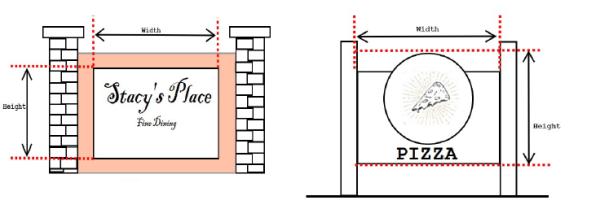
POLE AND PYLON SIGNS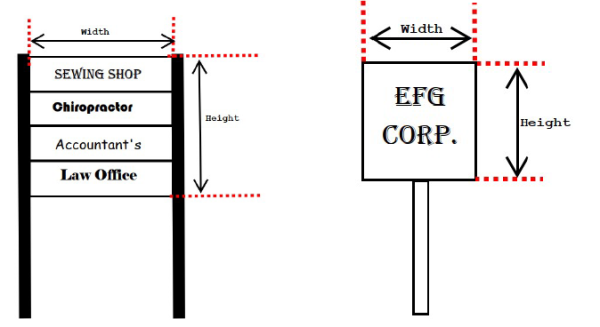
WALL SIGNS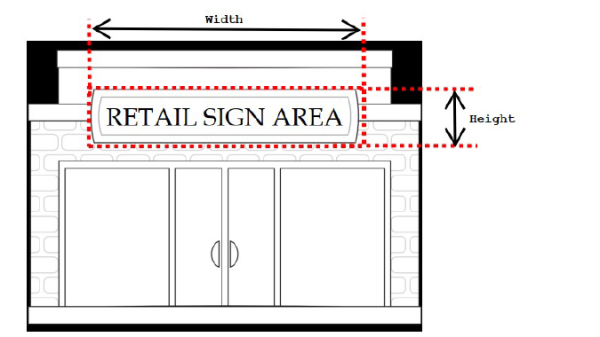
WALL SIGNS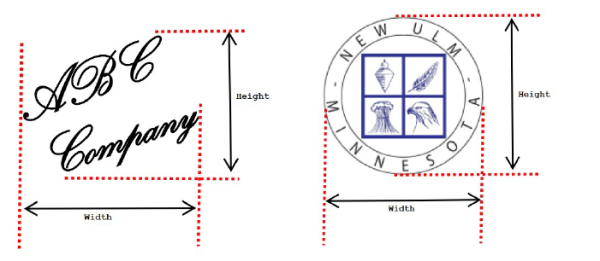
PROJECTING SIGNS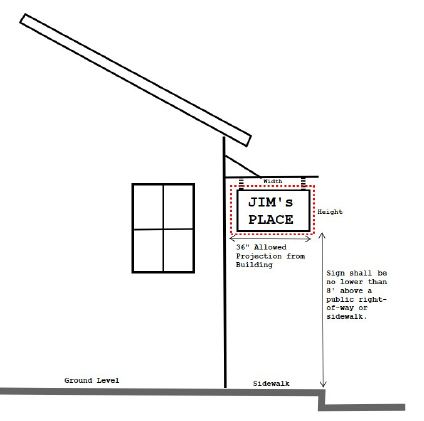
10.6 UNDERGROUND UTILITIES
- Required. All utilities, including but not limited to, cable television, electrical (excluding transformers), gas, sewer, telephone, internet and water lines or other similar services which are meant to serve newly developing areas, vacant parcels in previously developed areas and appropriate off-site lines constructed as a result of new development shall be placed underground in accordance with City and Public Utilities Commission standards.
- Option to Require Assessment of Cost Difference. In the event that the City elects to install underground utilities along or adjoining any street at its own expense, and upon the future subdivision of the property in question, the City through its subdivision regulations, may require as a condition of plat approval the payment of an assessment by the property owner representing the additional cost to the City for placing the service underground.
10.7 OFF-STREET PARKING
- Purpose and Intent. It is the purpose of this Section to alleviate or prevent congestion in the public right-of-way, to provide for the parking needs of land uses, to minimize any detrimental effects on adjacent lands, to promote the safety and general welfare of the public, to prevent the establishment of excessive amounts of off-street surface parking, and to provide accessible, attractive, secure and well-maintained off-street parking throughout the City. Off-street parking areas for each land use shall be provided in accordance with the requirements and standards established in this Section.
- Applicability.
- General. The off-street parking standards of this Section shall apply to all new development and redevelopment in the City and apply to all buildings and uses of land established after the effective date of this Ordinance.
- Expansions and Alterations.
- The off-street parking standards of this Section shall apply when an existing structure or use is expanded, enlarged, or otherwise increased in capacity, or where there is a change in use, and such expansion or change in use will result in increased vehicle trips.
- Whenever a building or use or part thereof is changed, such that the new use requires more parking than the old, the extent to which the use is changed shall be required to comply fully with all the provisions of this Chapter.
- All new parking lots and improvements and extensions to existing lots shall comply fully with all of the requirements of this Chapter.
- Nothing in this Section is deemed to prevent the voluntary establishment of off-street parking facilities, provided that all regulations governing the location, design and control of such facilities must be in accordance with this Section.
- Space Reduction. Existing off-street parking spaces upon the effective date of this Ordinance shall not be reduced in number unless said number exceeds the requirements set forth herein for a similar new use or until equal facilities as required by this Section are provided elsewhere.
- Damage or Destruction. When a building is reconstructed or repaired after being damaged or destroyed, off-street parking facilities must be restored or maintained in an amount equivalent to that at the time of such damage or destruction. However, it is not necessary to restore or maintain parking facilities in excess of the applicable requirements of this Section.
- Existing Uses. Existing off-street parking areas which do not conform to the requirements of this Section, but were in conformance with the requirements of the City Code at the time the parking facilities were established, are permitted to continue as a legal nonconforming structure.
- Change in Use or Occupancy of a Building.
- Any change of use in the occupancy of any building or buildings, including additions thereto, requiring more parking area shall not be permitted until there is furnished such additional parking spaces as required by this Ordinance.
- When the intensity of use of any building, structure or parcel of land is decreased, the number of parking spaces may be reduced so long as the parking requirements of this Section are met for the entire building, structure or parcel of land as modified.
- Parking Plan Required.
- A permit shall be required for parking lot construction in all zoning districts except for single-family and two-family residences. The completed plan shall include the location and number of off-street parking stalls, driveways, curb cuts, type of surfacing, screening and drainage patterns for the site.
- If applicable, such plan will be a part of the building permit application, and no certificate of occupancy will be issued until all items shown on the parking plan have been completed.
- Design of parking facilities, in addition to requirements in this Section, is also subject to the standards identified in Section 2.4.F, Site Plan.
- Required off-street parking shall be a permitted accessory use in all zoning districts.
- Off-street parking shall only occur in areas designed and constructed for parking in accordance with this Chapter.
- Plans for off-street parking areas shall be reviewed and approved by the Community Development Department prior to the issuance of a building permit.
- Computation Standards.
- The total number of required parking spaces is based upon the requirements for the principal use(s) of the site. All off-street parking facilities must be completed before occupancy of the building or structure served.
- In computing the number of off-street parking spaces required by this Section, the following standards for computation apply:
- Space allocated to any off-street loading space cannot be used to satisfy the requirement for any off-street parking space or access aisle, or portion thereof. Conversely, the areas allocated to any off-street parking space must not be used to satisfy the replacement for any off-street loading space or portion thereof.
- A fraction of less than one-half (1/2) may be disregarded and a fraction of one-half (1/2) or more is counted as one (1) parking space.
- Except as otherwise specified, parking spaces required for employees are based on the maximum number of employees normally present on the premises at any one time. When the determination of the number of parking spaces is based on the number of employees, the owner and/or manager is counted as an employee(s).
- For the purpose of calculating the number of off-street parking spaces required, it shall be determined on the basis of the exterior floor area dimensions of the buildings, structure or use times the number of floors, minus ten (10%) percent, except when floor plans are submitted that identify net usable floor area of the building, exclusive of ancillary floor areas that do not generate parking demand (e.g., stair wells, hallways, restrooms, closets, utility rooms).
- In cases where parking requirements are based on “capacity” of persons, capacity shall be based on the maximum number of persons that may occupy a place, as determined by the Minnesota Building Code. Maximum capacity shall be posted within the establishment. Both indoor and outdoor seating is included in maximum capacity.
- In churches, gymnasiums and other places of public assembly in which patrons or spectators occupy benches, pews, or other similar seating facilities, each twenty-four (24”) inches of such seating shall be counted as one seat for the purpose of this Chapter.
- Except in shopping centers or where joint parking requirements have been approved, if a structure or site contains two or more uses, each use shall be calculated separately in determining the total off-street parking spaces required.
- Any off-street loading area provided within or attached to a principal structure shall not be considered part of the gross floor area of the principal structure for the purposes of calculating the number of off-street parking spaces required.
- The square footage of any permanent outdoor merchandise display area shall be included as part of the gross floor area of the principal structure for the purpose of calculating the number of off-street parking spaces required.
- In cases where future potential uses of a building may generate additional parking demand, the City may require a proof of parking plan for the site, showing how the anticipated parking demand will be met. The City may permit the additional land area that would be required for anticipated parking to be placed in reserve as landscaped open space until needed.
- The off-street parking requirements may be met by providing a space so designed within the principal building or a structure attached thereto.
- Shared Parking Standards.
- An off-street parking facility may be shared between two (2) or more uses, provided that use of such facility by each user does not occur at the same time. No shared use of parking spaces are permitted unless:
- The users of the shared parking facility sign an agreement, approved by the City Attorney, expressing the intent to share parking facilities and file this agreement with the City.
- The location and design requirements of this Section are met.
- Any subsequent change in use requires proof that the minimum parking requirements, per this Section, have been met for each use. The owner of a building or use has one hundred eighty (180) days after the change in use has been made, to accommodate all required off-street parking or to apply for a variance. As an alternative to a variance, a new shared parking agreement may be arranged in accordance with this Section.
- An off-street parking facility may be shared between two (2) or more uses, provided that use of such facility by each user does not occur at the same time. No shared use of parking spaces are permitted unless:
- Joint Use Parking.
- Off-street parking spaces for separate uses may be provided collectively if the aggregate number of spaces provided is not less than the sum of the spaces required for each use separately. No parking space may serve as the required space for more than one (1) use with the exception of the shared parking arrangement described in Item (E) above.
- A legally binding instrument, executed by the parties concerned, for the joint use of off-street parking facilities, shall be approved by the City Attorney and filed with the Brown County Recorder’s Office and the Community Development Department within sixty (60) days after approval of the joint parking use.
- Land Reserved for Future Parking. The Community Development Department may permit a reduction in the amount of required parking spaces provided sufficient land is reserved to accommodate the parking at some future date.
- Eligible Land Use Locations.
- All industrial zoning districts;
- Up to a twenty-five (25%) percent reduction in other zoning districts.
- Conditions.
- Sufficient evidence must be provided in documented form by the applicant that supports the reduced parking need.
- The applicant must show future parking sufficient in quantity to meet the zoning requirement on the approved site plan and it shall be marked as “Reserved Land – Future Parking.”
- The area proposed for land banking of parking spaces must be an area suitable for parking at a future time.
- The City may require the additional land that is necessary to meet the required standards to be placed in reserve for parking development should the use change or parking provided is determined to be inadequate.
- If at any time the City determines parking is inadequate, the City may require construction of all or part of the additional parking area held in reserve. The reserved land must be converted within one hundred eighty (180) days of receipt of the Community Development Department’s written order.
- The Community Development Department may require landscaping of the reserved area.
- Eligible Land Use Locations.
- General Standards.
- Exemption from Off-Street Parking Regulations.
- In any commercial or industrial district, establishments that pay an assessment or tax for the development, maintenance, repair or operation of off-street City facilities parking shall be exempt from the provisions of this Section that refer to off-street parking; however, any parking facilities installed in such zoning district shall meet the design standards of Section 10.7.J.
- All commercial, industrial or institutional uses located within the B-4 Downtown zoning district shall be exempt from the minimum off-street parking requirements of Section 10.8 so long as municipal off-street parking is provided to serve the area. Any parking facilities installed in the B-4 District shall meet the design standards of Section 10.7.J.
- Ownership. Required off-street parking shall be on the same lot under the same ownership as the principal use being served, except under the provisions of Sections 10.7.E.-F.
- Use of Parking Area. Required parking spaces and the driveways providing access to them in any zoning district shall not be utilized for the following or other similar uses:
- Open storage, display, sale, or rental of goods or materials.
- Commercial repair work or service of any kind.
- Storage of new, used, or inoperable vehicles which are not for the use of the occupant, employees, or patrons.
- Except for temporary uses as permitted by Section 9.4 and trailers parking in a designated loading area, no vehicle may be parked and used for the storage of items in any zoning district.
- A temporary use.
- Accessible Parking. The designated number of accessible parking spaces must be included in the total number of required parking spaces. The number of accessible spaces must comply with the applicable requirements of the Americans with Disabilities Act of 1990 and the Minnesota State Accessibility Code, as amended from time to time, and all additional governing codes and applicable laws.
- Exemption from Off-Street Parking Regulations.
- Location Standards.
- Required parking spaces shall be located on the same lot or development site as the use served, except under the following provisions:
- Off-site parking for multiple-family dwellings shall be located no more than five hundred (500’) feet from any normally used entrance of the principal use structure being served.
- Off-site parking for non-residential uses shall be located no more than five hundred (500’) feet from the main entrance of the principal use being served. No more than one (1) main entrance shall be recognized for each principal building.
- Off-site parking shall comply with the following requirements:
- Reasonable and improved public access from off-site parking facilities to the use being served shall be provided.
- The site used for off-site parking shall be:
- Under the same ownership as the principal use or owner of the property being served;
- Under public ownership; or
- If used by a non-owner of the site, the use of the parking facilities shall be established by a recorded agreement approved by the City Attorney and provided to the City. If the use of the parking facility provided for in the agreement terminates and no sufficient subsequent parking is provided for, the use shall terminate.
- Any use which depends upon off-site parking to meet the requirements of this Section shall maintain ownership and parking utilization of the offsite location until such time as on-site parking is provided or a site in closer proximity to the principal use is acquired and developed for parking.
- Off-site parking shall be developed and maintained in compliance with all requirements and standards of this Chapter.
- Off-site parking shall be located in the same zoning district as the use it is intended to serve.
- Required parking spaces shall be located on the same lot or development site as the use served, except under the following provisions:
- Design Standards. All off-street parking facilities must comply with the following standards:
- Parking Spaces.
- Each parking space shall be not less than nine (9’) feet wide and twenty (20’) feet in length and each space shall be served adequately by access aisles.
- Minimum parking space dimensions are exclusive of access drives for aisles, ramps or columns.
- In no case shall any part of the public right-of-way contribute towards required stall size.
- In areas where the parking space may accommodate the overhang of the front or rear bumper of a vehicle, such as the perimeter of the parking lot, the parking space may be a minimum of nine (9’) feet by eighteen (18’) feet. If parking stalls are designed to use the bumper overhang projecting over a private sidewalk, the sidewalk must be six (6’) or more feet in width to allow for the overhang.
- Tapers are recommended for hard surfaced open parking spaces.
- Except in the case of single-family, two-family, and townhouse dwellings, parking areas and aisles shall be developed in compliance with these standards:
TABLE 10-6: OFF-STREET PARKING DESIGN STANDARDS Angle of Parking Stall Width Curb Length Per Car Stall Length Stall Depth Wall to Aisle Stall Depth Interlock to Aisle Aisle One Way Aisle Width Two Way 90° 9’ 0” 9’ 0” 18’ 0” 18’ 0” 18’ 0” 24’ 0” 24’ 0” 75° 9’ 0” 9’ 6” 18’ 0” 20’ 8” 19’ 10” 21’ 6” 23’ 0” 60° 9’ 0” 10’ 5” 18’ 0” 21’ 0” 19’ 10” 18’ 0” 22’ 0” 45° 9’ 0” 12’ 9” 18’ 0” 19’ 10” 17’ 10” 15’ 0” 22’ 0” 0° 9’ 0” 22’ 0” 22’ 0” 9’ 0” 9’ 0” 12’ 0” 24’ 0”
- Parking Area Surfacing. All new or enlarged off-street, parking spaces, together with driveways, aisles, other circulation areas and all other areas upon which motor vehicles may be located, except as otherwise stated below, shall be improved in such a way as to provide a durable, dust-free hard surface.
- Agricultural Uses.
- Parking facilities for agricultural uses in the A-OS zoning district shall be exempt from the surfacing requirements of this Section.
- Single-Family and Two-Family Residential Uses.
- An appropriate, improved parking surface for single-family and two-family residential uses that do not have alley or rear yard access, shall be required in a front, street side or side yard in residential zoning districts. Improved parking surfaces shall include concrete, Class V gravel, bituminous (pervious or impervious), pavers (pervious or impervious), interlocking brick or mortared stone or brick.
- Parking surfaces accessible from an alley to a rear yard may also use an unimproved surface such as Class V gravel, pea gravel, stone, rock and grass.
- Parking along the side of a house or garage is only permitted on an improved surface.
- There shall be no vehicle parking in the front yard or side yard setback area unless on an improved surface.
- The maximum width of any driveway at the front property line shall not exceed twenty-four (24’) feet. That portion of the driveway located between the property line and the building or setback line may be widened to a maximum of forty (40’) feet or forty (40%) percent of the lot width measured at the front yard setback line, whichever is less. The driveway associated with such a curb cut may increase in width behind the sidewalk at an angle of not greater than forty-five (45o) degrees into the property. The remaining portion of the front yard shall be maintained as lawn or landscaped areas with the exception that up to ten (10%) percent of the front yard setback area can be used for service walkways, patios or similar uses.
- Multi-Family and Business Uses.
- All areas intended to be utilized for parking space and driveways shall be surfaced with any of the following: concrete, bituminous, and pavers/brick or similar materials installed and maintained per industry standards. The City may allow up to twenty-five (25%) percent of required parking stalls and/or one hundred (100%) percent of seasonal or over flow parking in excess of that required, to be provided as green parking with a turf surface, which is supported by a parking lot sub-base and turf guard fabric approved by the Community Development Department.
- Use of these materials shall only occur if approved by the Community Development Department subject to the following requirements:
- Submittal of a site plan identifying the surfacing material and location along with the product manufacturer’s specifications for use and installation or engineered drawings showing how the system will work. The pervious surfacing material must have similar structural characteristics to asphalt or concrete and be capable of withstanding normal wear and tear associated with parking and maneuvering of vehicles.
- Where possible, the materials will be used in areas proximate to and in combination with new or existing on-site storm water control devices.
- Industrial Uses.
- All areas intended to be utilized for parking space and driveways shall be surfaced with any of the following: concrete, bituminous, Class V gravel and brick/pavers or similar materials installed and maintained per industry standards.
- Access drives that serve parking and loading areas shall be hard surfaced with either bituminous or concrete within the required front or street side building setback. A dust control plan shall be submitted and approved by the City for all Class II one hundred (100%) percent crushed aggregate and Class V gravel parking areas.
- All internal yard areas are allowed to have a Class II one hundred (100%) percent crushed aggregate surface. Such internal yard areas shall be located to the side or rear of the principal building. The internal yard area shall be clearly separated from public areas by fencing or other acceptable means.
- General.
- All high-volume traffic areas, as determined by the Community Development Department, shall have a hard surface.
- Crushed rock shall not be considered an acceptable surfacing material on any public, employee, or resident off-street parking areas, or access drives leading to such parking areas or garages, except as provided elsewhere in this Section.
- Agricultural Uses.
- Buffers, Fences, and Planting Screens. Off-street parking areas shall be screened and landscaped in accordance with Section 10.2.D.
- Striping. With the exception of Class II one hundred (100%) percent crushed aggregate and Class V gravel, all non-residential and multi-family off-street parking areas where four (4) or more spaces are required must be marked on the pavement, using a durable painted stripe. Such markings shall be maintained in a clearly legible condition.
- Lighting. Lighting shall comply with the requirements of Section 11.3, be downward directional, and be reflected away from the public right-of-way and nearby or adjacent residence zoning districts.
- Construction.
- Grade Elevation. Excepting driveways for single and two-family dwellings, the grade elevation of a parking area shall not exceed five (5%) percent.
- Curbing. Except for single and two-family residential and agricultural uses, institutional, all public, employee, or multi-family residential off-street parking areas, all access drives leading to such parking areas, landscaped islands, and all other areas upon which motor vehicles may be located shall have:
- Curb and gutter or other suitable parking bumpers or barriers to channelize the flow of traffic, clearly define parking spaces in the interest of efficient lot utilization, conflict minimization, and prevent the encroachment of motor vehicles and other parking lot area users onto adjoining property.
- Continuous concrete curbing shall be installed around the exterior perimeter of a hard-surfaced parking lot except for curb cuts associated with storm water runoff from impervious surfaces.
- Following a review by City staff, curbing requirements may be waived if any of the following conditions are met:
- The City Engineer has determined that sheet drainage over ground would improve storm water quality.
- Where an adjacent future development phase excluding future parking would be built that would result in the removal of the curbing.
- The parking lot will be porous pavement, along with the installation and maintenance of rain gardens or infiltration features.
- Within all Industrial Zoning Districts:
- Loading areas shall not be required to have a continuous, poured concrete curb.
- Access drives that serve loading areas and are not located within the required front or street side building setback shall have a continuous, poured concrete curbing.
- Internal yard areas are not required to provide a continuous, poured concrete curb.
- Drainage.
- Parking lots shall be designed to convey all stormwater generated from the site to approved stormwater outlets or retention areas.
- All off-street parking areas shall provide for proper drainage of surface water to prevent the drainage of such water onto adjacent properties or walkways. The drainage system shall be approved by the City Engineering Department.
- Access Standards.
- General. The City Engineer shall approve the appropriate location, size and design of each access drive in the City of New Ulm and may limit the number and location of access drives in the interest of public safety and efficient traffic flow.
- Arterial or Collector Street Access. Access to any street shown as a arterial or collector street on the City’s Comprehensive Plan shall require review and comment by the appropriate governmental body and the City. This review shall be required prior to the issuance of any building permit or approval of a parking plan.
- Street/Alley Access. Except in the case of single-family, two-family and townhouse dwellings, parking areas shall be designed so that circulation between parking bays or aisles occurs within the designated parking lot and does not depend upon a public street or alley. If deemed necessary for traffic safety, turn around areas may be required.
- MnDOT Highway Access. A MnDOT permit is required to create, modify or to change an access to a State Highway.
- Curb Cut Requirements. Requirements for curb cut openings are shown in Table 10-7. For the purpose of measuring distance between curb cuts and between curb cuts and street intersections, such distance is determined based on where the curb lines intersect.
- Increased Curb Cut Width. Upon written approval of the City Engineer, curb cut width may be increased up to fifty (50') feet in cases where it is necessary to facilitate vehicle maneuvering onto and off the site, provided that the overall driveway width does not exceed forty (40%) percent of the lot width.
Use Residential Commercial Industrial Other Uses Curb Cuts Maximum width 24 feet 32 feet 32 feet 32 feet Minimum distance between curb openings 25 feet 25 feet 50 feet 25 feet Minimum distance from intersection 30 feet or 2/3 lot width 50 feet 100 feet 50 feet Minimum distance from alley intersection 5 feet 10 feet 10 feet 10 feet - Number of Curb Cuts. There shall be a maximum of one (1) curb cut for each parcel unless otherwise authorized by the City Engineer.
- Curb Cut/Driveway Access Location.
- Street functional classifications shall be defined by the City’s Comprehensive Plan.
- The setback distance shall be measured as stipulated in Section 10.7.J.p.
- Driveways onto arterials and collectors shall be prohibited where alternative street access is available. For existing lots of record, where alternative access is not available, direct access onto arterial and collectors may be permitted, provided a site plan is submitted for review and approval by the City Engineer. Approval is also subject to the provisions of this Chapter.
- Access to Parking Spaces. Each required off-street parking space shall open directly to an aisle or driveway of such width and design as to provide safe and efficient means of vehicular access to the parking space, as shown in Figure 10-6.
- Maneuvering Lanes. All maneuvering lanes shall permit only one-way traffic movements with the exception of the ninety (90°) degree pattern where two-way traffic may be permitted. Each parking space shall have direct unimpeded access to a maneuvering lane and dead end maneuvering lanes shall only be permitted with two-way ninety (90) degree pattern in parking bays with fewer than ten (10) spaces, unless a turnaround is provided as approved by the Community Development Department. Maneuvering lanes through parking lots must be designed with minimal access to a public street. A maximum of two (2) entrances per lot is preferred. Maneuvering lanes are subject to City Engineer and Community Development Department review and approval.
- Street/Alley Access.
- In all Business Zoning Districts, direct access to each site shall be provided by a street.
- Private vehicular access drives for commercial or industrial uses shall not cross over residentially zoned property.
- Shared Driveway. To further the access management policies of the City, shared driveways located upon mutual property lines may be required. Said shared drive shall be appropriately maintained and controlled through a joint, written easement agreement established by the benefiting property owner(s), approved by the City Attorney, and filed with the Brown County Recorder.
- Layout Features.
- One-way driveways must be clearly marked with appropriate entrance and exit signs and/or pavement marking. If traffic conditions warrant the restriction of turning movements or access, additional signs and access/circulation modifications may be necessary. The Engineering Department and the Community Development Department may also impose additional restrictions based upon state and/or federal requirements or good engineering practices.
- The City may require driveways designed to prohibit left turns in and out. Such driveways must have a channelizing island, as shown in Figure 10-5. Limited turn driveways are subject to the following requirements:
- Channelizing island width, measured parallel to the street: Forty (40’) feet
- Channelizing island length: Twenty-five (25') feet
- Channelizing island offset: Five (5’) feet
- Driveway width: Thirty (30’) feet
FIGURE 10-5 Channelizing Island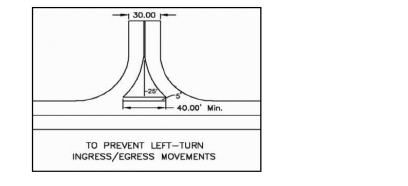
- A unified access and circulation plan for coordinated or shared parking areas.
FIGURE 10-6 Parking Lot Layout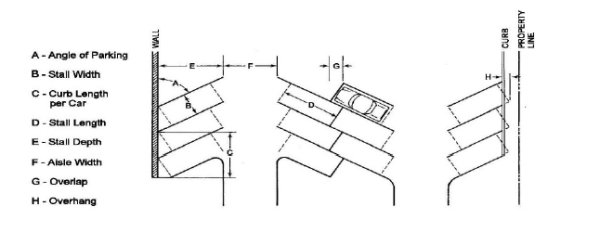
- Setbacks. Required setbacks for parking and driving areas are provided in Table 10-8.
TABLE 10-8 RESIDENTIAL DISTRICT PARKING SETBACKSYARD AREA ZONING DISTRICT R-1 R-1S R-2 RT-1 RT-2 R-3 R-4 R-1, R-1S, R-2, RT-1, RT-2 USES Front 30’ 30’ 30’ 30’ 30’ 30’ 30’ Interior side 5’ 5’ 5’ 5’ 5’ 5’ 5’ Street side 30’ 30’ 30’ 10’ 10’ 30’ 30’ Rear – with alley 0’ 0’ 0’ 0’ 0’ 0’ 0’ Rear – no alley 10’ 10’ 10’ 5’ 5’ 10’ 10’ R-3, R-4 USES Front -- -- -- -- -- 30’ 30’ Interior side -- -- -- -- -- 5’ 5’ Street side -- -- -- -- -- 30’ 30’ Rear – with alley -- -- -- -- -- 5’ 5’ Rear – no alley -- -- -- -- -- 10’ 10’ OTHER USES Front 30’ 30’ 30’ 30’ 30’ 30’ 30’ Interior side 10’ 10’ 10’ 10’ 10’ 10’ 10’ Street side 30’ 30’ 30’ 30’ 30’ 30’ 30’ Rear – with alley 0’ 0’ 0’ 0’ 0’ 0’ 0’ Rear – no alley 10’ 10’ 10’ 10’ 10’ 10’ 10’ Table Key:
R-1 (Single Family Residence District)
R-1S (Single Family Residence District, Small Lot)
R-2 (Single and Two Family Residence District)
RT-1 (Traditional Neighborhood – Single Family Residence District)
RT-2 (Traditional Neighborhood – Single and Two Family Residence District)
R-3 (Medium Density Residence District)
R-4 (High Density Residence District)
MH (Manufactured Home District)
TABLE 10-8 BUSINESS ZONING DISTRICT PARKING SETBACKSYARD AREA ZONING DISTRICT B-1 B-2 B-3 B-4 Front 5’ 5’ 5’ 5’ Front across the street from residential district 5’ 5’ 5’ 5’ Interior side 5’ 5’ 5’ 5’ Interior side adjacent to a residential district 10’ 5’ 5’ 5’ Street side 10’ 5’ 5’ 3’ Rear – with alley 0’ 0’ 0’ 0’ Rear – no alley 5’ 5’ 5’ 5’ Rear adjacent to a residential district 10’ 10’ 10’ 5’ Table Key:
B-1 (Limited Business District)
B-2 (General Business District)
B-3 (Community Business District)
B-4 (Central Business District)
TABLE 10-8 INDUSTRIAL ZONING DISTRICT PARKING SETBACKSYARD AREA ZONING DISTRICT I-1 I-2 I-3 Front 5’ 5’ 5’ Front across the street from residential district 5’ 5’ 5’ Interior side 5’ 5’ 5’ Interior side adjacent to a residential district 5’ 5’ 5’ Street side 5’ 5’ 5’ Rear – with alley 0' 0' 0' Rear – no alley 5’ 5’ 5’ Rear adjacent to a residential district 10’ 10’ 10’ Table Key:
I-1 (Planned Industrial District)
I-2 (General Industrial District)
I-3 (Limited Industrial District)
TABLE 10-8 SPECIAL PURPOSE DISTRICT SETBACKSYARD AREA ZONING DISTRICT A-OS INS-E INS-M INS-O CM MU-E MU-T Front 15’ 15’ 15’ 15’ 10’ 3’ 5’ Front across the street from residential district 15’ 15’ 15’ 15’ 15’ 3’ 5’ Interior side 15’ 15’ 15’ 10’ 10’ 3’ 5’ Interior side adjacent to a residential district 20’ 15’ 15’ 15’ 10’ 3’ 5’ Street side 15’ 15’ 15’ 15’ 10’ 3’ 5’ Street side across from a residential district 15’ 15’ 15’ 15’ 10’ 3’ 5’ Rear – with alley 5’ 0’ 0’ 0’ 0’ -- -- Rear – no alley 5’ 5’ 5’ 5’ 5’ -- -- Rear adjacent to a residential district 10’ 10’ 10’ 10’ 10’ -- -- Table Key:
A-OS (Agricultural - Open Space District)
INS-E (Institutional – Educational District)
INS-M (Institutional – Medical District)
INS-O (Institutional – Other District)
CM (Commercial Manufacturing District)
MU-E (Mixed Use - Emerson Union District)
MU-T (Mixed Use – Turner District)
- Parking Spaces.
- Signs. No sign shall be so located as to restrict the sight lines and orderly operation and traffic movement within or adjoining any parking lot.
- Existing Conditions.
- Existing improved (asphalt or concrete) parking lots that do not conform to the requirements of this Section that are resurfaced shall comply with the requirements in this Section as determined by the City Engineer and Community Development Department after reviewing drainage, traffic operations, safety and other site conditions.
- Existing parking lots directly abutting a public sidewalk area shall be required to maintain the required setback at the time of reconstruction or resurfacing.
- Boulevard areas between the street and designated sidewalk area shall not be paved without the approval of the City Council.
- Maintenance. It shall be the joint responsibility of the operator, owner or tenant of the principal uses and/or buildings to maintain the parking lots, driveways, landscaping and required screening.
- Stacking Spaces for Drive-Through Facilities.
- Design.
- Drive-in and drive-through lanes shall be designed to protect buildings and to avoid disruption of pedestrian and vehicular traffic flow, both on and off-site.
- No part of a public street, alley or boulevard may be used for a drive-through lane.
- Service provided by the drive-through is accessory to an interior on-site service within the same building or property.
- Stacking spaces shall be provided on site and shall require a minimum pavement width of ten (10’) feet and a length of twenty (20’) feet per vehicle.
- The width of the stacking lane shall be measured at the outermost point of any service window to the edge of the driveway.
- Stacking spaces include the vehicle area at the service window.
- All stacking spaces shall comply with the setbacks required for parking spaces.
- Drive-through lanes shall not be located between the principal entrance and customer parking spaces whenever possible.
- Voice amplifiers used in conjunction with drive-through services shall not be audible to adjoining residential uses.
- The stacking lane, order board intercom, and window placement shall be designed and located in such a manner as to minimize glare to adjacent premises, particularly residential areas, and to maximize maneuverability of vehicles on the site.
- The drive-up window and its stacking lanes shall be screened from the view of adjoining residential zoning districts and public street rights-of-way.
- A lighting and photometric plan will be required that illustrates the drive-up service lane lighting and this plan shall comply with Section 10.4.
- Required Spaces.
- Minimum stacking spaces shall be provided per the requirements of Table 10-9.
TABLE 10-9: REQUIRED STACKING SPACES FOR DRIVE THROUGHS Use or Activity [1] Minimum # of Stacking Spaces (per lane) Measured From [2] Automated Teller Machines (ATMs) 3 Teller machine Financial Institution 4 Teller machine Car wash – self service 4 Entrance 1 Exit Car wash – automatic 3 Entrance 1 Exit Drive-through restaurant 4 Menu board 4 Pick-up window Personal Services (e.g. dry cleaners) 3 Window Retail Commercial Uses (e.g. pharmacy) 3 Window Gas Pump Island 2 Pump Other Uses not specifically listed shall have their stacking space minimums determined by the Community Development Department based on standards for comparable uses listed above. [1] See Table 9-1: Comprehensive Use Table, and/or Table 9-5: Accessory Uses by Zoning District
[2] Distance shall be measured from window where products are delivered when more than one window is used for the drive through service.
- Minimum stacking spaces shall be provided per the requirements of Table 10-9.
- Reduction of Required Stacking Spaces. The number of required stacking spaces may be reduced by the Community Development Department if the petitioner presents a study done by a traffic engineer with quantifiable evidence (e.g., comparable information) which demonstrates that a different requirement should be imposed. The approval of a reduced number of stacking spaces applies only to the specific business for which the study was conducted.
- Design.
- Specific Off-Street Parking Requirements.
- Standards Applicable in All Zoning Districts.
- In all zoning districts, vehicle parking shall not be permitted within any residential use’s front yard or side yard that abuts a street, except upon a properly surfaced driveway or open space parking area.
- All motor vehicles and trailers parked or stored outdoors shall be licensed, registered and operable with the exceptions noted in Section 8.63 of the City Code
- Motor vehicles parked or stored in any zoning district shall comply with the following requirements:
- Not encroach or block any public sidewalk, pathway or trail.
- Not be parked in such a manner that blocks any traffic view or site triangles.
- Any encroachment within a drainage and utility easement shall require approval by the City Engineer.
- Standards Applicable to Residential Parking Uses.
- The intent of these regulations is to provide for off-street residential parking, but also to limit the amount of driveway and parking surface in relation to the front yard area in order to preserve open space and neighborhood attractiveness.
- Parking and/or storage of motor vehicles shall conform to the requirements of Section 10.7.
- The purpose of a driveway is to provide vehicular access directly to a garage or open hard surfaced parking space.
- In all residential zoning districts, a vacant lot or parcel shall not be used for storage or parking unless the lot or parcel is owned by the adjoining property owner. A maximum of four (4) vehicles may be allowed on the rear 1/2 of a vacant lot or parcel.
- Parking facilities accessory to residential structures shall not be used for the storage of large commercial vehicles, semi-trailers or equipment.
- Vehicles must be parked or stored on a parcel which contains a permitted principal use.
- No repair or servicing of vehicles shall be performed unless the vehicles are owed by the resident.
- The location of open hard surfaced parking spaces, if possible, will be away from the principal use.
- A property, with a residence and without a garage, may have no more than two (2) hard surfaced open parking spaces for a single family or two-family dwelling.
- Increases in the maximum amount of allowable parking may be approved by the Community Development Department, if necessary, to provide safe ingress or egress for the site.
- No exterior storage of car parts is allowed at any time on exposed parking facilities.
- Requests to place driveways and open parking spaces in a front or street side setback will be reviewed and approved by the Community Development Department.
- Standards Applicable to Recreational and Commercial Vehicles in All Zoning Districts.
- The following provisions apply to the storage and parking of commercial vehicles and recreational vehicles and equipment in all zoning districts:
- Tents, boats and recreational vehicles shall not be used for residential dwelling purposes. No such items shall at any time be used as living quarters, temporary or permanently, except as my be approved in emergency cases by the Community Development Department. Vehicles shall not be used for commercial storage or other non-residential purposes.
- Nonpaying guests of the owner of the property may occupy a camper or recreational vehicle. Such vehicle shall be parked subject to the provisions of this Section and used for sleeping purposes for a period not to exceed seven (7) consecutive days at one time in one (1) month or no more than fourteen (14) days in total in one (1) calendar year. No nuisances, including noise, light and odor, created by such guest parking are permitted.
- Except on properties which are valid motor vehicle dealers, vehicles shall have a current license and registration.
- Tents, boats and recreational vehicles shall not be used for residential dwelling purposes. No such items shall at any time be used as living quarters, temporary or permanently, except as my be approved in emergency cases by the Community Development Department. Vehicles shall not be used for commercial storage or other non-residential purposes.
- The following provisions apply to the storage and parking of commercial vehicles and recreational vehicles and equipment in all zoning districts:
- Standards Applicable to Recreational, Commercial and Sport Vehicles in Residential Zoning Districts.
- The following vehicles are allowed to park or be stored on a single-family or two-family zoned parcel:
- One (1) commercial vehicle or one (1) recreational vehicle as described below.
- Two (2) sport vehicles as described below.
- Description of Permitted Commercial Vehicles.
- Size and type:
- Only small commercial vehicles, as defined in Chapter 13 of this Ordinance, shall be permitted to be parked outside a building in a residential district unless the vehicle is actively being used on the property for commercial purposes.
- Size and type:
- Description of Permitted Recreational Vehicles.
- Number: The maximum number of recreational vehicles permitted to be parked outside of a building in a residential district will be one (1).
- Size:
- No recreational vehicle greater than forty-five (45) feet in length.
- No recreational vehicle may be more than twelve (12) feet in height.
- The standards identified above may be increased with an interim use permit.
- Description of Permitted Sport Vehicles. A sport vehicle includes snowmobiles and snowmobile trailers, boats and boat trailers, utility trailers, jet skis, all-terrain vehicles and their trailers and other vehicles used for sporting purposes. For the purpose of this Section, a boat, snowmobile(s) or other recreational vehicle when stored or kept on a trailer shall be considered as one (1) sport vehicle.
- Use Restriction Requirements.
- No recreational or commercial vehicle may be used as an office or business and shall not be used for storage of items in conjunction with a residential, business, commercial or industrial enterprise.
- A trailer on a regular basis shall not be used in support of a commercial or industrial operation.
- Recreational vehicles and trailers shall not be utilized for storage of goods, materials or equipment other than those items considered to be part of the unit or essential for its immediate use.
- Operational Requirements.
- Engines of commercial vehicles may not run continuously. A thirty (30) minute engine warm-up time shall be permitted immediately prior to the commercial vehicle and/or any other motorized equipment leaving the premises. The warm-up period shall begin no earlier than 6:00 a.m. and end not later than 10:00 p.m.
- Except for routine maintenance or during emergency conditions when power supply is disrupted, the operation of a power generator plant shall not be permitted in residential districts.
- Location Requirements.
- Vehicles stored in the rear yard may be located on a hard surfaced area, including a maintained Class V gravel surface.
- Vehicles located in the front or side yard abutting a street must not be located in a public right-of-way or placed at least five (5’) feet from the back of the sidewalk, whichever is greater.
- The designated parking or storage area shall maintain at least a five (5) foot setback from side or rear property lines that are not located on an alley.
- In any yard, vehicles may not be placed within ten (10) feet of the living quarters of the principal building on the adjacent lot.
- No commercially licensed trailer shall be parked or stored in a residential district or on a public street except when loading, unloading or rendering a service unless authorized through the issuance of a right-of-way permit.
- A vehicle cannot be placed between the principal building and a public right-of-way in the front yard setback area except as otherwise permitted in this Section.
- No major mechanical overhaul, repair, refurbishing or reconstruction shall be performed on vehicles unless conducted within a completely enclosed building.
- General Requirements.
- Vehicles must be the property of the residential lot owner or tenant except as authorized under Section 10.7.O.3.a.(1).
- Recreational vehicles shall be mobile and shall not be permanently affixed in the ground in a manner that would prevent removal.
- The following vehicles are allowed to park or be stored on a single-family or two-family zoned parcel:
- Standards Applicable to Multi-Family Uses and Non-residential Uses.
- The Community Development Department may allow an exception to the required setbacks in Table 10-8 for the following reasons:
- To accommodate a shared driveway along a common property line as described in Section 10.7 (J).
- To accommodate railroad loading areas, which may have a setback of zero (0) feet, in an I-1, I-2, and I-3 Industrial District. All such facilities must be built in a manner to adequately accommodate loading from railroad facilities.
- In multi-family zoning districts, recreational, commercial and sport vehicles may be stored on site only if stored in an area that is completely screened from adjacent residential properties and public streets.
- The Community Development Department may allow an exception to the required setbacks in Table 10-8 for the following reasons:
- Prohibited Vehicles in Residential Districts.
- The following vehicles and/or equipment shall not be permitted to be stored or parked in any residentially zoned area subject to the exemptions in this Section:
- Vehicle in excess of twelve thousand (12,000) gross vehicle weight rating.
- Vehicles regardless of weight described as buses, boom trucks, dump trucks, tank trucks, truck-tractor semi-trailer combinations and any other such similar equipment/vehicles.
- Commercial vehicles or equipment such as race cars, farm tractors and equipment, backhoes, bobcats, drilling and/or landscaping equipment and any other such similar equipment/vehicles.
- Oversized military vehicles.
- The following vehicles and/or equipment shall not be permitted to be stored or parked in any residentially zoned area subject to the exemptions in this Section:
- Oversized Vehicles Allowed in Residential Districts. Any licensed prohibited vehicle being used in conjunction with a legitimate service being provided to the residential property during the period of service.
- Standards Applicable in All Zoning Districts.
- Required Parking Spaces.
- Minimum Off-Street Parking Standards. The minimum number of off-street parking spaces by type of use shall be required in accordance with the following table:
TABLE 10-10: MINIMUM OFF-STREET PARKING STANDARDS
Use Type
Minimum # of Spaces
Additional Requirements
Agricultural Uses
Agriculture
No Minimum
Agriculture Sales
Community Garden
Wildlife and Game Refuge
Residential Uses
Single-Family, Detached (one unit)
2 per unit
Single-Family, Attached (two units)
2 per unit
Duplex
2 per unit
Single-Family, Attached (three to eight units per acre)
2 per unit
Multi-Family Dwelling (three to eight units per acre)
2 per unit
Multi-Family (nine or more units per acre)
2 per unit
Residential Care Facility (six or fewer persons)
1 per 6 residents and
1 per employee on major shift
Residential Care Facility (16 or fewer persons)
1 per 6 residents and
1 per employee on major shift
Residential, Upper Floor
2 per unit
Residential, Street Level
2 per unit
Senior Housing
1/2 per unit plus reservation of area equal to
1 per unitManufactured Home Park
2 per unit
B-4 Zoning District
1 per residential unit
Public & Institutional Uses
Active Park Facilities (public & private)
Determined by CDD based on A Parking Study
Armory
Determined by CDD based on A
Parking Study
Assisted Living Facility
1/2 per unit
Cemetery
No Minimum
Club
1 per 4 seats
Seating shall be based on the design capacity of the building.
Clinics/Medical Services
1 per 250 square feet
Communications Facility
Determined by CDD based on A Parking Study
Convent/Monastery
1 per 4 beds
Beds shall be based on the design capacity of the facility.
Event Center
1 per 4 seats
Seating shall be based on the design capacity of the building
Essential Services
Determined by CDD based on A Parking Study
Hospital
1 space for each 2 hospital beds,
and 1 space for each employee on the major shift
Nursing/Convalescent Home
1 per 4 beds
Beds shall be based on the design capacity of the facility
Passive Parks/Open Space
Determined by CDD based on A Parking Study
Place of Public Assembly
1 per 4 seats
Seating shall be based on the design capacity of the facility
Public Building/Uses
Determined by CDD based on A Parking Study
Public Utility Building/Structure
Determined by CDD based on A
Parking Study
Schools - PreK to Junior High
1 per employee and 1 per three classrooms
Auditorium/event space shall be subject to separate, additional calculations.
Schools - Senior High School
1 per employee and 1 per five students based on building design capacity
Auditorium/event space shall be subject to separate, additional calculations.
Schools - Higher Education
Determined by CDD based on A Parking Study
Utilities, Major
Determined by CDD based on A
Parking Study
Commercial Uses
Ambulance Services
1 per 300 square feet net floor area
Auto Repair - Minor
3 per service bay and 1 per employee
Service parking spaces shall be in addition to temporary parking space required for gas pumping areas
Automotive Wash Facilities
Drive Through: 1 per employee on major shift
Self Service: 2 per facility
Bar, Liquor Establishment
1 per 100 square feet of GFA
Bed & Breakfast
1 per guest room in addition to required residential off-street parking
Building Material Sales/Storage
1 per employee plus 1 per 500
square feet of GFA
Bus Garage/Maintenance Facility
1 per employee and 3 per service bay
Business Support Services
1 per 300 square feet of GFA
Child Care Center
1 per employee on major shift and
1 per 10 enrollees based on maximum capacity
Communications/Broadcasting
Determined by CDD based on A Parking Study
Commercial Lodging
1 per room plus 1 per employee on major shift plus 50% of additional space for accessory uses
Convenience Store
1 per 200 square feet of GFA
Country Club
4 per hole plus 50% of the requirements for any other use
Distillery, Micro
1 per 200 square feet of GFA
Educational Services
1 per 300 square feet of GFA
Entertainment/Recreation Indoor Commercial
1 per 400 square feet of GFA
Seating shall be based on the design capacity of the main assembly hall; facilities as may be provided in conjunction with such buildings or uses shall be subject to additional requirements imposed by this Ordinance
- Bowling Center
5 per bowling lane
Square footage of additional uses (restaurant, bar, etc.) shall be in addition
- Theater
1 per 4 seats
Entertainment/Recreation Outdoor Commercial
10 spaces plus 1 space for each 200 square feet of activity area over the first 1,000 square feet
Financial Institution
1 per 250 square feet of GFA
Firearm Range, Indoor
1 per 200 square feet of GFA plus 2
per classroom
Funeral Home/Service
1 per 5 seats and 1 per 250 square feet of GFA of non-seating area
Seating shall be based on the design capacity of the building.
General Retail Sales/Services
1 per 300 square feet of GFA plus 1 per 1000 square feet of outside sales/display area
When 50% or more of the gross floor area is devoted to storage, warehouse, and/or industry purposes - the number of spaces shall be determined as follows:
1 per 200 square feet devoted to public sales or service plus 1 per 500 feet of storage area
Kennel, Commercial
4 plus 1 per 500 square feet over 1000 square feet
Landscaping / Nursery Business
1 per 300 square feet of GFA and 1 per 1,000 square feet of GFA of outside sales/display area
Office
1 per 300 square feet of GFA
Performing, Visual, Exercise, Vocational or Martial Arts School
1 per 3 students plus 1 per classroom
Number of students shall be based on the design capacity of the school
Personal Services
1 per 300 square feet of GFA
Repair Establishment
1 per 400 square feet of GFA
Restaurant
1 space per 40 square feet of GFA of dining/bar area, plus 1 space for each 80 square feet of kitchen area
Sexually Oriented Uses
1 per 300 square feet of GFA
Shopping Center
1 per 250 square feet of gross leasable floor area (exclusive of common areas)
Sign Sales/Service
1 per 400 square feet of GFA
Sports/Health Facility
1 per 250 square feet of GFA
Transportation Services
Determined by CDD based on A Parking Study
Vehicle Sales/Rental
6 plus 1 per 500 square feet over 1000 square feet of GFA
Vehicle Service Station
4 plus 2 per service bay stall
Veterinary Services
1 per 250 square feet of GFA
Wholesale Sales
1 per 300 square feet office or sales plus 1 per 2000 square feet storage of GFA
Industrial Uses
Airport
Determined by CDD based on A Parking Study
Auto Repair - Major
1 per employee plus 2 per service bay
Service parking spaces shall be in addition to temporary parking space required for gas pumping areas
Brewery
Determined by CDD based on A Parking Study
Bulk Fuel Sales/Storage
Determined by CDD based on A Parking Study
Cleaning Services & Laundry
1 per 300 square feet of GFA
Cold Storage
1 per employee on major shift
Concrete, Asphalt & Rock Crushing Facility
2 per 3 employees
Contractor Office & Yard
1 per 1,000 square feet of GFA of shop area or warehousing, plus 1 per 300 square feet of GFA of office space
Distillery
Determined by CDD based on A Parking Study
Extraction of Materials
1 per employee on major shift
Food Processing
1 per employee on major shift
Grain Elevator & Storage
1 per employee on major shift
Grain Milling & Distribution
1 per employee on major shift
Greenhouse, Wholesale
1 per employee on major shift
Industrial Services
1 per employee on major shift
Land Reclamation
2 per 3 employees
Machine Shop
1 per 300 square feet of GFA of office and 1 per 1,000 square feet of GFA of service area
Machinery/Truck Repair & Sales
1 per employee, 3 per service bay, and 1 per 300 square feet of GFA of office
Manufacturing, Major
1 per employee on major shift
Manufacturing, Minor
1 per employee on major shift
Print Shop
1 per 500 square feet of use area
Recycling Facility
2 per 3 employees
Research, Development/Testing Laboratory
2 per 3 employees
Scrap/Salvage Yard, Metal Milling Facility
2 per 3 employees
Self-Storage Facility (External Access)
1 parking stall for each 2 storage units
Self-Storage Facility (Internal Access)
1 per 200 square feet of office area and 1 per 50 storage units or 1 per 10,000 square feet of storage area whichever is greater or a minimum of 3 spaces
Transportation Facility
1 per 1,000 square feet of shop area or warehousing, plus 1 per 300 square feet of office space
Waste Hauler
2 per 3 employees
Wholesaling, Warehousing & Distribution
1 per 1,000 square feet of shop area or warehousing, plus 1 per 300 square feet of office space
"GFA" = Gross Floor Area
"CDD" = Community Development Department
- Parking Options. In those instances when options are provided to determine the number of required parking stalls, the occupant or owner may propose the option to be used. The selected option will be subject to the approval of the Community Development Department. Denial by the Community Development Department of the selected parking stall options may be appealed following the procedures outlined in Section 2.4 of this Ordinance.
- Special Consideration for Parking Requirements. Certain types of uses, due to their unique characteristics, require that additional consideration be made in determining parking requirements, as follows:
- Senior housing. When senior housing may convert to general housing at some point in time, proof of additional parking shall be required.
- Residential care facilities. For facilities that serve six (6) or fewer residents, and have no employees, the single-family dwelling parking requirement of two (2) spaces shall be required. For facilities that allow residents to own/operate vehicles, an additional one (1) space per two (2) residents shall be required.
- Preschools and day care facilities. On-street drop-off spaces may be utilized to meet requirements subject to approval by the City Engineer.
- Auto repair and service facilities. Service bays shall not contribute to the satisfaction of required parking.
- Employee counts. When parking requirements are to be determined by employee counts, such calculation shall be based on the maximum number of employees on the premises at any one time.
- Government and public uses. Parking requirements for governmental and other similar public uses shall be based on the type of use and the requirements established for such use.
- Ambulance facilities. For the purposes of this use, Net Floor Area shall be the total floor area of the facility minus the garage/storage area of the facility. In addition to the off-street parking requirements, all ambulance facilities shall provide one indoor and one outdoor parking space for each commercial vehicle used in the operation of the facility.
- Parking plan required. When a study is necessary to determine required parking needs for a particular use, City staff may require the developer or applicant to submit a parking study.
- Business vehicles. In addition to the requirements in Table 10-10, one (1) parking space shall be provided for each commercial vehicle or vehicle necessary for the operation of the use that is maintained on the premises.
- Minimum Off-Street Parking Standards. The minimum number of off-street parking spaces by type of use shall be required in accordance with the following table:
- Parking Deferment.
- The Planning Commission may allow a reduction in the number of required parking stalls for commercial, industrial, and institutional uses provided that:
- The applicant demonstrates that the proposed use will have a peak parking demand less than the required parking under Section 10.7.P. Factors to be considered when reviewing the proposed parking demand shall include, but not be limited to:
- Size of building
- Type of use
- Number of employees
- Projected volume and turnover of customer traffic
- Projected frequency and volume of delivery or service vehicles
- Number of company-owned vehicles
- Storage of vehicles on-site
- In no case shall the amount of parking provided be less than one-half (1/2) of the amount of parking required by this Section.
- The site has sufficient property under the same ownership to accommodate the expansion of the parking facilities to meet the minimum requirements of this Section if the parking demand exceeds on site supply. A proof of parking plan shall be submitted for City approval that meets the following conditions:
- A parking plan drawn to scale for the property is submitted with the site plan and indicates the following requirements of this Section:
- The site complies with the number of total parking spaces; and
- Parking lot design standards.
- The proof of parking area is defined as that portion of the site which is not paved, but is suitably landscaped and is capable of containing the amount of parking equal to the difference between the total amount of required parking and the amount of parking required to be paved to meet the requirements of this Section.
- The proof of parking area shall be clearly delineated on the parking plan for the site.
- The paved portion of the parking area shall comply with the pertinent section of this Section.
- The proof of parking area is not used to satisfy any other landscaping, setback, or other requirement of this Section and is not located in an area occupied by a building or an easement.
- A parking plan drawn to scale for the property is submitted with the site plan and indicates the following requirements of this Section:
- On-site parking shall only occur in areas designed and constructed for parking in accordance with this Section.
- The applicant and City enter into a development agreement, to be recorded against the subject property, which includes a clause requiring the owner to install the additional parking stalls, upon a finding of the City that such additional parking stalls are necessary to accommodate the use.
- A change of use will necessitate compliance with the applicable Section standard for parking.
- The applicant demonstrates that the proposed use will have a peak parking demand less than the required parking under Section 10.7.P. Factors to be considered when reviewing the proposed parking demand shall include, but not be limited to:
- The Planning Commission may allow a reduction in the number of required parking stalls for commercial, industrial, and institutional uses provided that:
10.8 OFF-STREET LOADING
- Purpose. It is the purpose of this Section to alleviate or prevent congestion of the public right-of-way so as to promote the safety and welfare of the public by establishing minimum requirements for off-street loading and unloading from motor vehicles in accordance with the appropriate utilization of various parcels of land or structures.
- Application. All loading spaces shall be sufficient to meet the requirements of each use and shall provide adequate space for storage and maneuvering of the vehicles its designed to serve.
- Location.
- All required loading berths shall be off-street and located on the same lot as the building or use to be served.
- The location of required loading areas shall be such that:
- Circulation occurs within the designated site or property.
- Has appropriate means of vehicular access to a street or public alley in a manner which will cause the least interference with traffic both on- and off-site.
- A loading area and its curb cut(s) shall be located at a minimum fifty (50’) feet from the intersection of two (2) or more street rights-of-way. This distance shall be measured from the property line.
- No loading berth shall be located closer than fifty (50’) feet from a residential district unless within a structure.
- The loading area shall be separate from any required off-street parking area, and access to it shall not conflict with automobile or pedestrian circulation within the site.
- Loading areas shall not occupy property within the required front yard setbacks.
- Loading areas located at the front side of a building on a corner lot shall meet the following conditions:
- Loading areas shall not conflict with pedestrian movement.
- Loading areas shall not obstruct the view of the public right-of-way from off-street parking areas.
- Loading areas shall comply with all other requirements of this Chapter.
- All loading spaces shall be provided in a location where it is not necessary to utilize the public right-of-way for access to such space.
- Surfacing. All loading areas and accessways shall be improved with a bituminous surface or equally durable material to control the dust and drainage according to a plan submitted to and subject to the approval of the Community Development Department.
- Accessory Use, Parking and Storage. Any space allocated as a loading area or access area so as to comply with the terms of this Chapter shall not be used for the storage of goods, inoperable vehicles or snow, or be included as part of an area necessary to meet the off-street parking area requirements.
- Screening. All loading areas shall be screened and landscaped from abutting and surrounding residential uses and the public right-of-way in compliance with Section 10.2.D. of this Chapter.
- Size.
- All loading areas shall have a vertical clearance of at least fourteen (14’) feet, exclusive of aisle and maneuvering space.
- Loading berth options, exclusive of aisle and maneuvering space, including the following:
- Not less than twelve (12’) feet in width, fifty-five (55’) feet in length.
- Not less than twelve (12’) in width, and thirty (30’) feet in length.
- The size and number of loading areas/berths shall be determined by the Community Development Department as necessary to accommodate anticipated truck and service vehicles. Truck maneuvering radius shall be demonstrated on the site plan.
- Number of Loading Berths. Off-street loading space shall be provided for any non-residential use which requires the receipt or distribution of materials or merchandise by trucks or similar vehicles, and which will have a gross floor area of five thousand (5,000) square feet or more, according to the following minimum standards:
- The off-street loading requirement for buildings with less than 20,000 square feet GFA may be satisfied by the designation of a loading zone area on the site. This loading zone area shall be separate from any required off-street parking area, and access to it shall not conflict with automobile or pedestrian circulation within the site.
- Twenty-thousand (20,000) square feet to one hundred thousand (100,000’), square feet of floor area, one (1) loading berth fifty-five (55) feet in length and one (1) additional berth.
- One (1) additional berth for each additional one hundred thousand (100,000’) square feet or fraction thereof.
- The off-street loading requirement for buildings with less than 20,000 square feet GFA may be satisfied by the designation of a loading zone area on the site. This loading zone area shall be separate from any required off-street parking area, and access to it shall not conflict with automobile or pedestrian circulation within the site.
10.9 WIND ENERGY CONVERSION SYSTEMS
- Purpose. Regulations governing wind energy conversion systems (WECS) are intended to provide for appropriate locations for WECS, to ensure compatibility with surrounding uses, to ensure safe, effective use of WECS, and to increase opportunities to generate renewable energy.
- Application. Wind energy conversion systems may be allowed as an accessory and conditional use subject to the regulations and requirements of this Section, provided the property upon which the system is to be located is zoned A-OS B-2, B-3, I-1 or I-2.
- Site Design Standards.
- General Siting Standards.
- WECS systems may only be located on institutional sites in any residential district.
- No WECS over 12’ in height shall be located within 2,500 feet of a residential dwelling unit that is not owned or occupied by the applicant for the wind energy conversion system.
- WECS shall abide by regulations set forth in Section 8.4 of this Ordinance.
- WECS shall comply with applicable regulations as established by the Federal Aviation Administration.
- No WECS shall be permitted to be located within Safety Zone A, Safety Zone B, or the vertical plane of Safety Zone C, as defined in Minnesota Rules 8800.2400 Airport Zoning Standards.
- WECS proposed for any local, state or federally designated historic structures or locally designated historic districts shall be permitted.
- General Siting Standards.
- Right-of-Way Encroachments. No part of any WECS shall extend across or over any part of a public right-of-way.
- Siting of Building Mounted Wind Energy Conversion Systems. Notwithstanding the height limitations of the appropriate zoning district, building-mounted wind energy conversion systems shall be subject to the following provisions:
TABLE 10-11 STANDARDS FOR BUILDING-MOUNTED WECS MAXIMUM WECS HEIGHT (STRUCTURE AND ROTORS) MINIMUM SETBACKS MAXIMUM NUMBER OF SYSTEMS PER BUILDING Residential Structures Less than four (4) stories and forty-five (45) feet in height. Prohibited Prohibited Prohibited Four (4) or more stories and at least forty-five (45) feet in height. 12’ 10’ from front, side, rear walls of structure upon which it would be mounted. 1 per 2,000 sf of roof area Non-Residential Structures Less than four (4) stories and forty-five (45) feet in height. 12’ 10’ from front, side, rear walls of structure upon which it would be mounted. 1 per 4,000 sf of roof area Four (4) or more stories and at least forty-five (45) feet in height. 12’ 1.5 x the height of the WECS 1 per 2,000 sf of roof area - Siting of Freestanding Wind Energy Conversion Systems.
TABLE 10-12 SPECIFIC STANDARDS FOR FREESTANDING WECS ZONING DISTRICT TOWER TYPE MAXIMUM HEIGHT MINIMUM SETBACK
(x tower height)MINIMUM LOT AREA PER TOWER A-OS Monopole, Self-Support / Lattice Guyed Tower 100’ 1.5 Five (5) acres B-2 Monopole 45’ 1.0 One (1) acre B-3 Monopole 45’ 1.0 One (1) acre I-1 Monopole, Self-Support / Lattice Guyed Tower 150’ 1.0 Five (5) acres I-2 Monopole, Self-Support / Lattice Guyed Tower 150’ 1.0 Five (5) acres - System Design Standards.
- Compatibility with Nearby Properties. WECS shall utilize building materials, colors and textures that are compatible with the existing principal structure and that effectively blend the system facilities into the surrounding setting and environment to the greatest extent possible. Rotor blades shall be nonmetallic to prevent communication signal interference. Metal towers shall be constructed of, or treated with, corrosive resistant material. Outside of the industrial districts, unpainted, galvanized metal, or similar towers shall be prohibited, unless a self-weathering tower is determined to be more compatible with the surrounding area.
- Controls and Brakes. All systems shall contain an internal governor or braking device which engages at wind speeds in excess of forty (40) miles per hour and minimizes the potential for wind damage to the equipment.
- Electrical Wires. All electrical wires associated with WECS shall be located within the tower and/or underground.
- Security. The tower shall be designed to discourage unauthorized climbing from ground level to 12' above ground level.
- Signage. Advertising or identification of any kind on WECS shall be prohibited, except for applicable warning and equipment information signage required by the manufacturer or by federal, state or local regulations.
- Lighting. WECS shall not be illuminated by artificial means, except where the illumination is specifically required by the Federal Aviation Administration or other federal, state or local regulations.
- Noise. Wind energy conversion systems shall not emit noise in excess of the limits established in Minnesota Rules 7030 governing noise and Section 8.08 of the New Ulm City Code, as applicable.
- Shadow Flicker. The facility owner and operator shall minimize shadow flicker to any occupied building on a nonparticipating landowner’s property.
- Structural Stability. The structure upon which the proposed wind energy conversion system is to be mounted shall have structural integrity to carry the weight and wind loads of the wind energy conversion systems and have minimal vibration impacts on the structure.
- Maintenance Required. All WECS shall be kept in good repair and free from rust, damaged supports, framework or other components.
- Abandoned or Unused WECS. All abandoned or unused wind energy conversion systems shall be removed within twelve (12) months of the cessation of operations unless an extension is approved by the City Council. If an extension is not approved, such wind energy conversion system shall be deemed a nuisance, and the City may act to abate such nuisance and require its removal at the property owner’s expense. After the wind energy conversion system is removed, the owner or operator of the site shall restore the site to its original, or to an improved condition.
- Review Process. All WECS require an approved conditional use permit granted by the City Council. The following shall be required to be submitted with the conditional use permit application:
- Scaled schematic drawings and photographic perspectives showing the structure and the placement of the WECS.
- A written certification from a licensed structural engineer that the structure has the structural integrity to carry the weight and wind loads of WECS and have minimal vibration impacts on the structure.
- An analysis from a licensed engineer showing how the wind energy conversion system shall be designed, constructed and operated in compliance with all applicable federal, state, and local laws, codes, standards and ordinances.
- A written certification from a licensed engineer confirming that the wind energy conversion system is designed to not cause electrical, radio frequency, television and other communication signal interference.
- Sufficient information demonstrating that the wind energy conversion system shall be used primarily to reduce on-site consumption of electricity, including but not limited to a complete listing of on-site electrical demands.
- Written evidence that an interconnection agreement with the New Ulm Public Utilities has been completed and approved, unless the applicant does not plan to connect the system to the electricity grid and declares so in the application.
10.10 TELECOMMUNICATION TOWERS AND ANTENNAS
- Purpose. The City of New Ulm acknowledges the legal right of telecommunication providers to locate within the City, and the need to accommodate and coordinate the communication needs of residents and businesses. However, the City wishes to implement its legal authority to adopt zoning requirements which are nondiscriminatory, not intended to prohibit telecommunications service, and not based on health effects of radio frequency emissions. In order to establish uniform, nondiscriminatory regulations that protect the public health, safety and general welfare of the City, these regulations are intended to:
- Minimize adverse visual effects of towers through careful design, landscaping, and siting standards.
- Avoid potential damage to adjacent properties from tower failure and weather related occurrences through structural standards and setback requirements.
- Maximize the use of existing and approved towers and buildings to accommodate new telecommunication antennas in order to reduce the number of towers needed to serve the community.
- Utilize business, industrial and public land, buildings and structures for telecommunications whenever possible and/or appropriate.
- Provide for the appropriate location and development of towers and antennas to accommodate the communication needs of the residents and businesses within the City of New Ulm.
- Private Amateur Radio. Private Amateur Radio, for the purposes of this Ordinance, shall mean equipment, including antennae, antennae support structures, and other related material, necessary to conduct Ham and Short Wave Radio reception and transmissions, only for use by those persons properly licensed by the Federal Communications Commission for such reception and transmissions, and who are in full compliance with all licensing requirements.
- One (1) antenna and associated antenna support structure shall be a permitted accessory use in all zoning districts, provided that:
- The owner/operator has current versions of all required licenses to operate said equipment.
- All equipment shall be installed in accordance with manufacturer’s specifications, and pursuant to valid building and electrical permits, and any other applicable permit requirements.
- Subject to Conditional Use Permit provisions in Section 10.10.B.1.d. of this Ordinance, no antenna or antenna support structure shall exceed the allowable height limits of the applicable zoning district in which it is located, plus twenty (20’) feet.
- By Conditional Use Permit, the height provisions of Section 10.10.B.1.c. of this Ordinance may be exceeded, up to a maximum height of seventy (70’) feet, upon a showing that the additional height is necessary for proper function of the equipment due to interference from terrain, vegetation, or adjoining buildings. Any such additional height shall require a setback from all property lines of no less than one-half (½') foot for every one (1’) foot above the limits established in Section 10.10.B.1.c.
- Except as allowed by Section 10.10.B.1.c-d. of this Ordinance, no freestanding antenna or antenna support structure shall be located within any required yard other than the rear yard of any parcel.
- An antenna and its support structure may be located within the buildable area of a lot if mounted directly to the principal structure.
- Any private amateur radio antenna or antenna support structure which is no longer in use, or for which the owner of property no longer has valid licenses, or which has fallen into disrepair to the extent that it can no longer serve its intended purpose, or which constitutes a hazard or nuisance, shall be considered a violation of this Ordinance, and shall be removed.
- One (1) antenna and associated antenna support structure shall be a permitted accessory use in all zoning districts, provided that:
- Private Receiving Antennae and Antenna Support Structures. Private Receiving Antennae and Antenna Support Structures, for the purposes of this Ordinance, shall mean television, satellite, dishes, and other electronic reception antennae for private use.
- Private antennae less than three (3) meters in width and related support structures shall be a permitted accessory use in all zoning districts, provided that:
- No antenna or antenna support structure shall exceed the allowable height limits of the applicable zoning district in which it is located, plus twenty (20’) feet.
- No freestanding antenna or antenna support structure shall be located within any required yard other than the rear yard of any parcel. The Community Development Department shall determine the location for antenna and antenna support structures if there is no rear yard on the lot.
- An antenna and its support structure may be located within the buildable area of a lot if mounted directly to the principal structure.
- Any private antenna or antenna support structure which is no longer in use, or which has fallen into disrepair to the extent that it can no longer serve its intended purpose, or which constitutes a hazard or nuisance, shall be considered a violation of this Ordinance, and shall be removed.
- Private antennae less than three (3) meters in width and related support structures shall be a permitted accessory use in all zoning districts, provided that:
- Commercial Transmission/Reception Antennae and Antenna Support Structures. Commercial transmission and reception antennae and antenna support structures, for the purposes of this Ordinance, shall mean commercial and industrial communications equipment accessory to business operations of one meter in width or greater, but not personal wireless telecommunication service equipment.
Commercial transmission/reception antennae and antenna support structures shall be allowed as accessory uses only by Conditional Use Permit following the provisions of Section 2.4(D) of this Ordinance, and shall comply with the following additional requirements:- Antennae and antenna support structures for commercial transmission/reception shall not occupy the front yard of any parcel.
- Antennae and antenna support structures allowed under this section shall be fully screened from adjoining residentially zoned lots or parcels.
- Antennae and antenna support structures allowed under this Section shall be fully screened from adjoining public right-of-way.
- Antennae and antenna support structures allowed under this Section shall be fully screened from adjoining business zoned property.
- Antennae and antenna support structures allowed under this Section shall meet all other zoning conditions related to the location of mechanical equipment, whether ground or roof-top mounted.
- Wireless Telecommunications Service Antennae and Antenna Support Structures. Wireless telecommunications service antennae and antenna support structures, for the purposes of this Ordinance, shall mean any equipment necessary to provide or support all types of wireless electronic communications, including, but not necessarily limited to, wireless “cellular” telephone, radio, and internet transmission and reception communications between mobile communications providers and users, including public safety communications. “Small cell” wireless antennae and antenna support structures, defined exclusively as those facilities that are fifty (50’) feet or less in height and located within the public right of way subject to the City’s Right-of-Way Ordinance, are generally excepted from these provisions. Such facilities are subject to the provisions of Section 4.13(E)(3).
- Wireless Telecommunications Service Antennae.
- Co-location of antennae for personal wireless services shall be a conditional use in all zoning districts on any existing conforming antenna support structure.
- Wireless Telecommunications Service Antennae Support Structures.
- Except as otherwise allowed by Section 4.13.E.2.b below, support structures for personal wireless service antennae shall be allowed as an accessory use only by Conditional Use Permit, subject to the following provisions:
- Antenna support structures for personal wireless services shall be no greater in height than the maximum height requirements of the zoning district in which the antenna support structure is located, unless otherwise allowed within this Section.
- Antenna support structures for personal wireless services A-OS zoning district, all residential zoning districts and the B-1 zoning district shall be required to be attached to, or mounted upon, the principal building, and shall match said building in color and other design features so as to minimize visibility.
- Antenna support structures for personal wireless services in the B-2, B-3 and B-4 zoning district shall be limited in height to forty-five (45’) feet as measured from the natural grade at the location of the structure.
- Antenna support structures for personal wireless services in the Industrial districts shall be limited in height to one hundred fifty (150’) feet as measured from the natural grade at the location of the structure.
- Any antenna support structure shall be designed to accommodate the co-location of other antenna arrays.
- Any freestanding antenna support structure shall be of monopole design.
- All freestanding antenna support structures for personal wireless services shall be painted a galvanized light-grey color.
- Support structures for personal wireless service antenna may be allowed as an accessory use by Conditional Use Permit on residentially zoned lots occupied by public uses, subject to the following provisions:
- The site upon which the antenna support structure is located is occupied by a principal structure.
- Any antenna support structure shall be designed to accommodate the co-location of other antenna arrays.
- Any freestanding antenna support structure shall be of monopole design.
- All freestanding antenna support structures for personal wireless services shall be finished with a galvanized light-grey color.
- The provisions of Section 4.13(F) of this Chapter are satisfied.
- Except as otherwise allowed by Section 4.13.E.2.b below, support structures for personal wireless service antennae shall be allowed as an accessory use only by Conditional Use Permit, subject to the following provisions:
- “Small Cell” Wireless Facilities.
- “Small cell” wireless service antennae and antenna support structures shall require a Conditional Use Permit when located in the right of way adjacent to any residentially zoned parcel and PUD (Planned Unit Development) zoned project which includes residential dwellings, other residential use, or any Heritage Preservation Landmark or District. The CUP shall be reviewed pursuant to the provisions of Section 2.4.A of this Ordinance, and any other relevant restrictions. No Conditional Use Permit shall be granted for any such facility that creates a substantial burden on the adjoining residential area or the public right of way in which it is located.
- No “Small Cell” support structure shall exceed fifty (50’) feet in height above the finished grade of the ground on which the structure is located.
- Notwithstanding Section 10.10.E.3.b., the City may approve “small cell” facilities taller than fifty (50’) feet by Conditional Use Permit in rights of way adjacent to non-residential property when the City finds that such approval will have specific and substantial public benefits, including, but not limited to, reduction in the overall number or visual impacts of such facilities in the public right-of-way.
- Small cell facilities proposed to be co-located on existing support structures on private property, such as parking lot light poles, may be allowed as permitted uses provided no portion of the existing support structure or proposed antenna will exceed the allowable height for such structures in the subject zoning district and that the property is not a residentially zoned parcel and PUD (Planned Unit Development) zoned project which includes residential dwellings, or other residential use, or any Historic Preservation Landmark or District.
- Any small cell wireless service antennae or new antenna support structures located outside of the public right of way, such as on private property, regardless of ownership, and which would exceed the allowable height for the support structure in the subject zoning district shall require a Conditional Use Permit and be subject to all other general requirements of this Ordinance, including this Section, as well as any other applicable zoning or City code restrictions.
- General Provisions for Wireless Telecommunications Service Antennae and Antenna Support Structures.
- No new freestanding antenna support structure shall be located within one (1) mile of any existing freestanding antenna support structure.
- Prerequisite. A proposal for a new telecommunications tower shall not be approved unless it can be documented by the applicant to the satisfaction of the City that the telecommunications equipment planned for the proposed tower cannot be accommodated on an existing or approved tower or structure within a one (1) mile radius of the proposed tower—transcending all municipal boundaries—due to one or more of the following reasons:
- The planned equipment would exceed the structural capacity of an existing or approved tower or building, as documented by a licensed professional engineer, and any existing or approved tower or structure cannot be reinforced, modified, or replaced to accommodate planned or equivalent equipment at a reasonable cost.
- The planned equipment would cause interference with other existing or planned equipment at the tower or structure.
- Existing or approved towers and structures within a one (1) mile radius cannot accommodate the planned equipment at a height necessary for reasonable function.
- The applicant has demonstrated that location of the antennas, as proposed is necessary to provide adequate coverage and capacity to areas which cannot be adequately served by locating the antennas in a less restrictive district or an existing structure. Information provided as part of the capacity analysis, that is a trade secret, pursuant to Minnesota Statutes, Section 13.37, shall be classified as non-public data.
- Other unforeseen reasons that make it unfeasible to locate the telecommunications equipment upon an existing or approved tower or building.
- Siting Provisions.
- Antennae shall be located on existing buildings and structures whenever possible.
- No part of any antenna or antenna support structure, nor any appurtenances to such structure or antenna, shall extend over any public-rights-of way or property line, nor be located within an public utility or drainage easement.
- Antenna support structures shall be designed to replicate materials and colors of similar structures in the area, such as lighting or utility poles.
- Setbacks.
- In all zoning districts, the antenna support structure and any appurtenant structures shall comply with the minimum setback requirements of the zoning district in which the proposed structure is to be located, or the distance determined as the fall zone of the structure by a licensed professional engineer, whichever is greater.
- In all zoning districts, no freestanding antenna support structure shall be located within two hundred fifty (250’) feet of an existing residence, or the proposed home location on an approved Preliminary Plat.
- All antenna support structures shall be located in the rear yard of a parcel whenever practical.
- Design and Construction.
- No advertising or identification of any kind that is intended to be visible from the ground or other structures is permitted on any antenna or antenna support structure, except applicable warning and equipment information signage required by the manufacturer or by federal, state, or local authorities.
- All antennae, antenna support structures, and accessory structures shall be in compliance with all City and State Building Codes, as applicable, and shall obtain all necessary permits.
- Structure design, mounting and installation of the antenna and antenna support structure shall be in compliance with the manufacture’s specifications, and installation plans shall be approved and certified by a licensed professional engineer.
- Antenna support structures and antennae shall be grounded for protection against a direct strike by lightning and shall comply, as to electrical wiring and connections, with all applicable provisions of all National Electric Standards.
- All transmitting, receiving and switching equipment shall be housed within a structure or cabinet whenever possible, and shall adhere to the following:
- If a new tower accessory building is necessary to house such equipment, it shall be architecturally designed to blend in with the surrounding environment, and shall be screened from view by landscaping as deemed necessary by the Community Development Department.
- Accessory equipment associated with a rooftop antenna, satellite dishes, or wall antenna shall be located within the building, cabinet, or within a roof or ground enclosure which is constructed of materials and color scheme compatible with the principal building.
- Lights and Attachments.
- No antenna or antenna support structure shall have lights, reflectors or other illuminating devices of any kind, unless required by a Federal or State regulatory authority.
- Lights attached to antenna support structures may be approved by the City as a part of a Conditional Use Permit when such lights are used to illuminate a parking lot or other use on the ground, provided such lights meet the exterior lighting requirements of this Ordinance.
- Site Landscaping. The site on which an antenna or antenna support structure is located shall be landscaped to control dust, weeds, drainage, and to improve aesthetics of the property.
- Non-interference. No antenna installation shall transmit signals in a way that causes interference with any other electronic device.
- Wireless Telecommunications Service Antennae.
- Application Process.
Submittal Requirements. All applications for a Conditional Use Permit for any antenna or antenna support structure shall be accompanied by the following materials:- Documentation, in the form of a signed lease or other adequate proof of property interest, demonstrating that the applicant has the authority to seek the requested permit from the owner or owners of the parcel in question.
- A statement describing the proposed project, together with written justification supporting the proposed installation.
- Proof of insurance against injury or property damage caused by structural failure of any element of the installation.
- The legal description of the property on which the improvements are to be located.
- A certified survey of the property showing all existing conditions, along with the proposed improvements.
- A coverage study prepared by a Radio Frequency Engineer showing alternative antenna support structure locations, co-location options, and whether such alternatives can accommodate the proposed antenna with reasonable coverage, including any known approved but unconstructed locations. Such plan shall include all existing towers, buildings, and other possible support structures.
- A landscaping and screening plan.
- A grading and drainage plan.
- Architectural drawings of all appurtenant structures planned for the site.
- A decommissioning plan outlining the means, process, and anticipated costs of removing all improvements at the end of their service life, or upon discontinued use.
- A security acceptable to the City adequate to ensure safe removal of all improvements upon decommissioning.
- A development agreement specifying the terms of the Conditional Use Permit, including improvements, decommissioning, financial security, and other elements.
- Other information specified by the Community Development Director and/or City Council necessary to support the application and permit adequate municipal review of the request.
- Outside Review. At the request of the Community Development Department, the City may seek and obtain the advice of outside experts to review technical materials submitted by the applicants, including the advice of structural experts, radio frequency engineers, or for any other related area of analysis. The applicant shall submit an escrow to cover the costs of such expertise.
- Removal of Abandoned or Unused Antennae, Antenna Support Structures, or Other Appurtenant Elements. Any tower and/or antenna which is not used for six (6) successive months shall be deemed abandoned and may be required to be removed from the property. All abandoned or unused towers and associated facilities shall be removed within twelve (12) months of the cessation of operations at the site unless a time extension is approved by the City Council. After the facilities are removed, the site shall be restored to its original or an improved condition. If a tower is not removed within twelve (12) months after the cessation of operations at a site, the tower and associated facilities may be removed by the City and the costs of removal assessed against the property. The owner of the tower and the owner of the property are both responsible for removal of the tower as required by this Section.
10.11 SOLAR ENERGY
- Purpose. It is the purpose of this Section to provide appropriate locations and to facilitate the development of solar energy systems. This Section also establishes performance standards in order to protect the public and surrounding properties from any adverse effects.
- Applicability. The provisions of this Section shall apply to the construction and reconstruction of all solar energy systems within the City.
- Residential Districts.
- Ground mounted solar energy systems are permitted as accessory uses in all residential zoning districts subject to the following standards.
- Location: rear yard only
- Setbacks:
- Must comply with applicable side and rear yard setbacks of the zoning district in which the system is located.
- Must be located a minimum of five (5) feet from any other principal or accessory structure.
- Must be located a minimum of 30’ from all buildings located on adjacent lots or parcels of property.
- Height:
- Shall not exceed fifteen (15) feet in height when oriented at maximum vertical tilt. A taller system may be allowed by Conditional Use Permit.
- The height of a ground mounted solar energy system shall be measured from the ground surface to the highest extent the system is capable of reaching.
- Coverage:
- The total surface area of all ground mounted solar energy systems on the lot shall not exceed 120 square feet.
- A system over 120 square feet in size may be permitted by conditional use permit.
- Square footage of the solar energy system shall be considered in determining the maximum amount of allowable square footage for accessory buildings and structures permitted on the lot.
- Roof or building mounted and building or architecturally integrated solar energy systems are permitted on principal or accessory buildings in all residential zoning districts subject to the following standards:
- Location: on principal or accessory buildings.
- If mounted to the wall of a building, the solar energy system may not extend beyond the exterior perimeter wall of the building.
- Shall be flush mounted on a pitched roof.
- Setback: all solar energy systems must have a three (3’) foot clearance around all roof edges to facilitate emergency responder access.
- Height: no part of the solar energy system shall project beyond the peak of the roof to which it is attached.
- Coverage: there is no percentage or square footage limitation.
- Flat Roof: Solar collectors may be bracket mounted on flat roofs no more than three (3’) feet above the surface of the flat roof, or extending to the height of the roof’s parapet without regard to projection and must maintain a setback of not less than three (3’) feet from all roof edges.
- Location: on principal or accessory buildings.
- Ground mounted solar energy systems are permitted as accessory uses in all residential zoning districts subject to the following standards.
- Business, Industrial, and Agricultural Residence Districts.
- Ground mounted solar energy systems are permitted as accessory uses in all business, industrial and agricultural residence zoning districts subject to the following standards.
- Location: rear yard only
- Setbacks:
- Must comply with applicable side and rear yard setbacks of the zoning district in which the system is located.
- Must be located a minimum of ten (10) feet from any other principal or accessory structure.
- Must be located a minimum of 30’ from all buildings located on adjacent lots or parcels of property.
- Height:
- Shall not exceed fifteen (15’) feet in height when oriented at maximum vertical tilt. A taller system may be allowed by Conditional Use Permit.
- The height of a ground mounted solar energy system shall be measured from the ground surface to the highest extent the system is capable of reaching.
- Coverage:
- The total surface area of all ground mounted solar energy systems on the lot shall not exceed 15% of the lot size or 1,000 square feet, whichever is less.
- Square footage of the solar energy system shall be considered in determining the maximum amount of allowable square footage for accessory buildings and structures permitted on the lot.
- Roof or building mounted and building or architecturally integrated solar energy systems are permitted on principal or accessory buildings in all business, industrial and special purpose zoning districts subject to the following standards:
- Location:
- If mounted to the wall of a building, the solar energy system may not extend beyond the exterior perimeter of the building.
- Shall be flush mounted on pitched roofs.
- Height: no part of the solar energy system shall project beyond the peak of the roof to which it is attached.
- Setback: all solar energy systems must have a three (3) foot clearance around all roof edges to facilitate emergency responder access.
- Coverage: there is no percentage or square footage limitation.
- Flat roof:
- Solar energy systems shall be set back as follows: at least one (1) foot from the exterior perimeter of the building on which the system is mounted, for every foot that the system extends above the height of the roof at its exterior perimeter.
- The maximum height of any component of the solar energy system shall be not greater than 10 feet.
- Location:
- Ground mounted solar energy systems are permitted as accessory uses in all business, industrial and agricultural residence zoning districts subject to the following standards.
- Other Applicable Standards for All Zoning Districts.
- Feeder lines. All power exterior electrical or other service lines must be buried below the surface of the ground.
- A visible exterior disconnect shall be provided per the National Electrical Code.
- The solar energy system must be anchored in such a manner as to withstand wind speeds and snow load as required of other rooftop mechanical equipment in the Minnesota Building Code.
- Exemption. Building integrated solar energy systems are exempt from the requirements of this Section and shall be regulated as any other building element.
- Compliance with Building Codes. All solar energy systems shall comply with the Minnesota Building Code.
- Compliance with Electric Code. All solar energy systems shall comply with the National Electrical Code.
- Compliance with Plumbing Code. All solar thermal systems shall comply with the Minnesota State Plumbing Code.
- No signs, other than public safety warning or equipment information, shall be affixed to any portion of the structure.
- Institutional uses may install solar energy systems in a side yard that does not have street frontage, provided the lot exceeds one (1) acre in size.
- The placement of transmitting, receiving, and switching equipment shall be integrated within the site, being located within an existing structure whenever possible. Any new accessory equipment structure shall be attached to the principal building, if possible, and be constructed of materials and a color scheme compatible with the principal structure and/or surrounding area, or within an equipment encasement not exceeding ten (10’) feet by ten (10’) feet in area and five (5’) feet in height.
- Accessory equipment or buildings associated with solar energy systems shall be screened from public rights-of-way or other public spaces.
- The City prohibits ground mounted solar energy systems in flood plain districts.
- No solar energy system shall violate Minnesota Pollution Control Agency noise standards, air quality standards or otherwise result in a nuisance source of noise.
- All solar energy systems shall be operable and maintained in good repair.
- All solar energy systems and building integrated solar energy systems are subject to any and all applicable federal, state, and local laws and regulations.
- Any solar energy system exceeding 40kW shall require a Conditional Use Permit.
- Any community solar or solar farm project must be located in an A-OS or industrial district and shall require a Conditional Use Permit.
- All solar energy systems shall comply with the height requirements in the applicable zoning district in which the system is placed.
- Approvals.
- Permits. The erection, alteration, improvement, reconstruction, and movement of a solar energy system requires a building permit and supplemental application from the City prior to installation of the system.
- Utility Notification. The owner of a solar energy system that will physically connect to a house or other building’s electrical system and/or electric utility grid shall provide the City of New Ulm with proof of an interconnection agreement with the City of New Ulm Public Utilities prior to the issuance of a building permit.
- Aesthetics.
- All solar energy systems shall use colors that blend with the color of the roof or other structure or be screened from routine view from public rights-of-way other than alleys as much as possible.
- Reflection angles from collector surfaces shall be oriented so as not to interfere with the use and enjoyment of other properties. Where necessary, screening may be required to address glare to the extent possible without impeding their function.
- Screening from routine view from the public right-of-way and immediate adjacent residences shall be required in an attempt to minimize the visual impact of ground mounted solar energy systems and any extensive or imposing perimeter security fencing that is proposed.
- The City may require additional landscaping or other means of screening to limit the visual impacts of the solar energy system.
- Easements.
- A property owner who has installed or intends to install a solar energy system shall be responsible for negotiating with other property owners in the vicinity for any solar easements and shall record the easements with the Brown County Recorder’s Office (per MN SS 500.30, as it may be amended from time to time). If no such easement is negotiated and recorded, the owner of the solar energy system shall have no right to prevent the construction of structures, planting of trees, or any other items that may affect the performance of the solar system permitted by this Ordinance on nearby properties on grounds that the construction would cast shadows on the solar energy system. The City does not assure access to sunlight.
- Solar energy systems shall not be located within any easement areas.
- Abandonment. All solar energy systems, unless it is an integral part of the structure, that remain nonfunctional or inoperative for a continuous period of twelve (12) months shall be deemed abandoned and shall constitute a public nuisance. The owner shall remove the abandoned system at their expense after a demolition permit has been obtained. Removal includes the entire structure, including but not limited to the foundation, transmission equipment, structure, and any associated accessory structures. Any owner that has not removed the system within twelve (12) months shall be notified by the City in writing and given thirty (30) days to comply with the removal. Upon failure to comply with the notice within the specified time period, the City is authorized to cause the removal of such system as a public nuisance and assign and specially assess any expenses incurred from the removal of the same to the property or the property owner.
- Heritage Preservation Landmarks or Districts.
- All roof and wall mounted solar energy systems located in any Historic Preservation District or any Landmark property shall be reviewed and approved by the Heritage Preservation Commission prior to the issuance of a building permit.
- Ground mounted solar energy systems shall not be permitted on a designated historical property.
10.12 GENERAL REGULATIONS
- Common Requirements.
- Building Within Public Easement Prohibited. No building or structure shall be placed within an easement dedicated for a public purpose unless expressly authorized by a variance issued in accordance with Section 2.4.C. or a license agreement approved by the City Council.
- Outlots. No building permit or grading permit can be issued for a parcel of land designated in a plat as an outlot unless specifically authorized by the City Council.
- Rounding. Rounding of whole numbers may be used in zoning measurements for length, width and height. A decimal ending with five (5) or greater may be rounded up to the next whole number, a decimal ending with four (4) or less may be rounded down to the next whole number.
- Mechanical Equipment.
- All mechanical equipment installed on or adjacent to structures shall be arranged so as to minimize its visual impact using one of the following methods:
- Screened by another structure. Mechanical equipment installed on or adjacent to a structure may be screened by a fence, wall, or similar structure. Such screening structure shall comply with the following standards:
- The required screening shall be permanently attached to the structure or the ground and shall conform to all applicable building code requirements.
- The required screening shall be constructed with materials that are architecturally compatible with the structure.
- Signs shall not be considered required screening.
- Screened by vegetation. Mechanical equipment installed adjacent to the structure served may be screened by hedges, bushes, or similar vegetation.
- Screened by the structure it serves. Mechanical equipment on, or adjacent to, a structure may be screened by a parapet or wall of sufficient height, built as an integral part of the structure.
- Designed as an integral part of the structure. If screening is impractical, mechanical equipment may be designed so that it is balanced and integrated with respect to the design of the building.
- Exceptions. The following mechanical equipment shall be exempt from the screening requirements of this Section:
- Minor equipment not exceeding one (1’) foot in height.
- Mechanical equipment accessory to a single or two-family dwelling.
- Mechanical equipment located in an industrial district not less than three hundred (300’) feet from a residence or residential zoning district.
- Screened by another structure. Mechanical equipment installed on or adjacent to a structure may be screened by a fence, wall, or similar structure. Such screening structure shall comply with the following standards:
- All mechanical equipment installed on or adjacent to structures shall be arranged so as to minimize its visual impact using one of the following methods:
- Screening of Trash Enclosures. Trash or recycling collection areas, when provided for any property other than one containing a single or two-family residential use, shall be enclosed on at least three (3) sides by opaque screening at least six (6’) feet in height. The open side of the enclosure shall not face any street or the front yard of any abutting property.
- Common Yard and Height Requirements (Lot Control).
- In General.
- Unless otherwise authorized by variance, or a PUD, no lot, yard, or other open space shall be reduced in area or dimension so as to make such lot, yard, or open space less than the minimum required by this Ordinance; and if the existing yard or other open space as existing is less than the minimum required, it shall not be further reduced.
- A yard or other open area required about a building shall not be included as part of a yard or other open space for another building.
- In determining the depth of the rear yard for any building where the rear yard opens onto an alley, if the door or any building or improvement opens towards an alley, it shall not be erected or established closer to the property line than a distance of five (5’) feet.
- Allowable Yard Encroachments.
- The following features may encroach into required yards:
- Cornices, canopies, or eaves may extend into the required front yard a distance not to exceed six (6’) feet.
- Fire escapes may extend into the required front or rear yard a distance not to exceed four feet, six inches (4’6”).
- A landing place or uncovered porch may extend into the required front or rear yard to a distance not to exceed six (6’) feet. An open railing no higher than three feet, six inches (3’6”) may be placed around such place.
- A landing place may extend into a required side yard to a distance of three (3’) feet provided its floor is no higher than the entrance of the building.
- Fences and walls that meet the standards in Section 4.3, may encroach into a required yard, but shall be subject to corner visibility requirements, and shall not be placed within easements unless specifically permitted by the easement.
- Walkways, patios, ramps, stairs, paved areas, and other accessory structures less than thirty (30”) inches above grade, and all landscape plantings are exempted from yard requirements except as may be specifically required by this Ordinance, but are subject to corner visibility requirements, and shall not be placed within easements unless specifically permitted by the easement.
- In rear and side yards: recreational and laundry drying equipment, arbors and trellises, balconies, decks, and air conditioning or heating equipment are subject to the following conditions:
- A side yard setback of six (6’) feet shall be maintained.
- A setback of twenty (20’) feet shall be maintained from property lines abutting public streets.
- A rear yard setback of six (6) feet shall be maintained.
- No encroachment shall be permitted within an existing or required easement.
- An existing building wall and area integral to the structure and located in a side yard setback area may be extended within the setback area subject to the following conditions:
- The extended structure shall maintain the same distance from the adjoining property line as does the existing structure.
- This request is subject to the approval of a Conditional Use Permit.
- Appurtenances:
- Appurtenances are permitted to encroach into a required front or rear yard setback up to six feet.
- Appurtenances are permitted to encroach into a required side yard setback up to three feet.
- Railings on landing places or porches extending into a required side yard shall not exceed 3 feet, 6 inches in height.
- Appurtenances shall not be located within existing or required easements.
- The following features may encroach into required yards:
- Corner Visibility (See Figure 3-1).
- Corner lots shall preserve areas necessary for corner visibility by limiting the height of fences, walls, and all other obstructions to a maximum of three feet above grade in the following areas:
- For lots with an interior corner lot angle of ninety (90o) degrees or more at a street or railway corner, the protected corner area is defined by a triangle created by the two corner lot lines and an imaginary line between the corner lot lines at twenty-five (25’) feet from the corner on each property lot line.
- For lots with an interior angle of less than ninety (90o) degrees at a street or railway corner, the protected corner area is defined by a triangle created by the two corner lot lines and drawing an imaginary line between the corner lot lines twenty-five (25’) feet from the corner on each property lot line plus one (1’) foot for every ten degrees or fraction thereof less than ninety (90o) degrees.
- The required front yard of a corner lot shall not contain any wall, fence or other structure, tree, shrub, or other growth that may cause danger to traffic on a street or public alley by obstructing the view.
- Corner visibility standards do not apply to United States mailboxes, police and fire alarm boxes, public utility poles, street name markers, official traffic signs and control devices, and fire hydrants.
Figure 10-7 Corner Visibility Triangles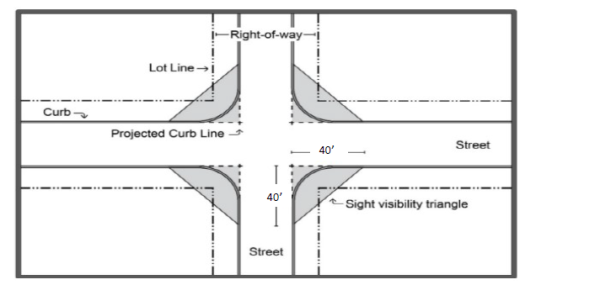
- Corner lots shall preserve areas necessary for corner visibility by limiting the height of fences, walls, and all other obstructions to a maximum of three feet above grade in the following areas:
- Height Requirements.
- In General. The total height of any structure shall not exceed the maximum height limit established for the applicable zoning district unless expressly stated otherwise in this Ordinance.
- Exceptions. Height limits shall not apply to chimneys, church spires, belfries, cooling towers, cupolas and domes which do not contain useable space, elevator penthouses, fire escapes or roof access stairways, flag poles, mechanical equipment required to operate and maintain the building, monuments, parapet walls extending not more than three (3’) feet above the limiting height of the building, rooftop dish antennas, skylights, water towers, wind electrical generators, telecommunication towers or similar appurtenances, provided:
- The appurtenance does not interfere with Federal Aviation Regulations, Part 77, Objects Affecting Navigable Airspace;
- The appurtenance does not extend more than twenty-five (25’) feet above the maximum permitted building height, except as specifically allowed by this Ordinance;
- The appurtenance is not constructed for the purpose of providing additional floor area in the building; and
- The appurtenance complies with the screening requirements for mechanical equipment and appurtenances in this Ordinance.
- In General.
- Purpose. Lot controls are established to provide for the orderly development and use of land, to minimize conflicts among land uses, and to provide adequate light, air, open space, and separation of uses.
- Zoning Lots. No part of an existing zoning lot shall be used as a separate zoning lot or for the use of another zoning lot, except as otherwise provided in this Ordinance.
- Minimum Lot Area. Lot area requirements shall be as specified in the applicable zoning district in which a zoning lot is located. No yard or lot existing at the time of passage of this Ordinance shall be reduced in size or area below the minimum requirements identified within this Ordinance.
- Division of Zoning Lot. No zoning lot shall be divided into two (2) or more zoning lots unless all zoning lots resulting from such division conform to all applicable regulations of this Ordinance.
- Street Frontage. Each lot shall have frontage on a public street at a width satisfying the requirements specified for each zoning district. In the case of a condominium, unified shopping center, or PUD, the entire site shall be considered one zoning lot.
- Limited Principal Buildings in Residential Districts. There shall be no more than one principal building on one zoning lot in any residential district except as part of a planned unit development. A detached accessory dwelling unit shall be considered an accessory building and not a principal building.
- Required Setbacks. Setback requirements shall be as specified in the applicable zoning district. Setbacks provided for an existing structure or use shall not be reduced below, or further reduced if already less than, the minimum requirements of this Ordinance for equivalent new construction.
- Setback Encroachments. All required setbacks shall remain open and unobstructed from ground level to the sky, subject to the following permitted obstructions. In no case, however, shall the identified permitted obstructions be located closer than one (1’) foot to a property line, except for fences.
- Cornices, canopies, eaves, and other ornamental features, provided they do not extend more than three (3’) feet into a yard.
- Chimneys, fire escapes, uncovered stairs, ramps and necessary landings, bay windows, balconies, uncovered decks or porches, provided they do not extend more than four (4’) feet into a yard.
- Vestibules, greenhouses, or structures for energy conservation, provided they do not extend more than four (4’) feet into a yard.
- Driveways and parking areas, subject to the provisions established in Section 10.7, Off-Street Parking.
- Recreational playground equipment.
- Fences in compliance with Section 10.3.
- Accessory buildings in compliance with Section 9.2, Accessory Uses.
- Air-conditioning, heating, ventilation, or other mechanical equipment, subject to the screening requirements specified in Section 10.2. In no case, however, shall such equipment be located in the front yard area or closer than five (5) feet to a side or rear property line.
- Containers for storage of household refuse, compost, or firewood.
- Signs in compliance with the provisions of Section 10.5, Signs.
- Corner Lots. On a corner lot, one of the lot lines that abuts the street shall be considered a front lot line and the other shall be considered a corner side lot line. A corner lot will have two front yards and two side yards.
- Double Frontage Lots. On a double frontage lot, both lot lines that abut the street shall be considered front lot lines. The required front setback shall be provided and maintained along each front lot line.
- Structure Height.
- In General. The building height limitations established in each separate zoning district shall apply to all buildings and structures, with the exception of the following:
- Church steeples, spires, or belfries.
- Chimneys or flues.
- Cupolas and domes which do not contain useable space.
- Flagpoles.
- Mechanical or electrical equipment.
- Monuments.
- Parapet walls extending not more than three (3’) feet above the limiting height of the building.
- Communication antennas and towers in accordance with the standards identified in Section 10.10.
- Towers, poles, or other structures for essential services.
- Water towers.
- Limits. No excluded roof equipment or structural element identified in Section 10.12.M.1. extending beyond the defined height of a building may occupy more than twenty-five (25%) percent of the roof area.
- In General. The building height limitations established in each separate zoning district shall apply to all buildings and structures, with the exception of the following:
- Protection of Natural Resources.
- In General. All developments shall be located so as to preserve the natural features of the site, to avoid areas of environmental sensitivity, to minimize the creation of impervious surface area, and to minimize negative impacts on the alteration of the natural environment. The following areas shall be preserved as undeveloped open space, to the extent consistent with the reasonable utilization of land, and in accordance with applicable federal, state, or local regulations:
- Wetlands. No development, grading or filling, alteration of the natural character of the land, or construction of buildings or structures shall occur within any vegetated wetland, except in compliance with the Minnesota Wetland Conservation Act of 1991.
- Buffer strips shall be required adjacent to all wetlands and shall be measured from the ordinary high water level of the wetland.
- Buffer strip dimensions and setbacks:
- Structure setbacks shall be measured from the outer edge of the wetland buffer strip to the structure.
- The required dimensions for all wetland buffer strips and structure setbacks shall be as follows:
Table 10-13. Wetland Buffers and SetbacksMinnesota Routine Assessment Method Wetland Classification High Quality Med Quality Low Quality Buffer strip width 40’ 25’ 15’ Structure setback from outer edge of wetland buffer 15’ 15’ 15’
FIGURE 10-8 Wetland Buffer Setbacks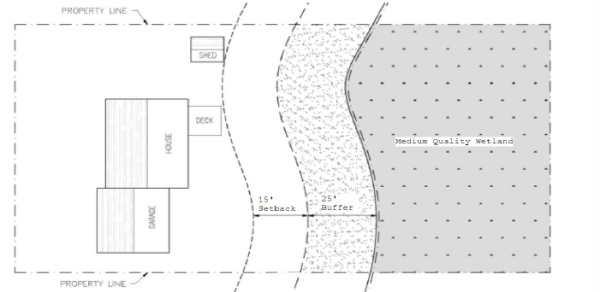
- Vegetated areas. Significant trees or plant communities, including remnant stands of native trees or prairie grasses, trees or plant communities that are rare to the area or of particular landscape significance.
- Steep slope areas. Development on slopes of fifteen (15%) percent or greater shall be prohibited. Where no practicable alternatives exist, development on steep slope areas shall be subject to the following conditions:
- The foundation and underlying material of any structure shall be adequate for the slope condition and soil type.
- The proposed development will not result in soil erosion, flooding, severe scarring, reduced water quality, inadequate drainage control, or other problems.
- The proposed development will preserve significant natural features by minimizing disturbance to existing topographical forms.
- The City may require that a property be rezoned and developed as a planned unit development to utilize flexible development standards to preserve steep slopes.
- The proposed development shall comply with all provisions of Chapter 28, Article VII related to stormwater pollution.
- Habitats of threatened or endangered wildlife as identified on federal or state lists, including the federal Endangered Species Act and the Minnesota County Biological Survey.
- Mitigation. Where preservation is not consistent with the reasonable utilization of land, the City may require mitigation through replacement of the resource or similar resource on the site, restoration of former natural amenities to the site, or other reasonable measures to protect or enhance the natural features of the land.
- Wetlands. No development, grading or filling, alteration of the natural character of the land, or construction of buildings or structures shall occur within any vegetated wetland, except in compliance with the Minnesota Wetland Conservation Act of 1991.
- In General. All developments shall be located so as to preserve the natural features of the site, to avoid areas of environmental sensitivity, to minimize the creation of impervious surface area, and to minimize negative impacts on the alteration of the natural environment. The following areas shall be preserved as undeveloped open space, to the extent consistent with the reasonable utilization of land, and in accordance with applicable federal, state, or local regulations:
- Removal of Footings and Foundations During Demolition
- When demolishing a structure the complete removal of a structure including all footings, foundations, accessory structures, and utilities serving the structure is required. Under New Ulm City Code Chapter 11, section 11.3, as it may be amended from time to time, permits are required for demolition work. A required condition when obtaining a permit to demolish a building or structure shall be that the subject property be restored to a condition that is not a nuisance or a danger to public safety, and that all footings and foundations are removed in their entirety.

