
New Ulm City Zoning Code
CHAPTER 6
INDUSTRIAL ZONING DISTRICTS
6.1 GENERAL PURPOSE
The industrial zoning districts established in this Chapter are intended to:
- Provide locations for the retention, expansion and creation of industrial businesses engaged in manufacturing, assembly, production, wholesaling, processing, warehousing, distribution and related businesses consistent with the Comprehensive Plan;
- Allow non-industrial support businesses in industrial areas;
- Strengthen the City’s economic base, and provide employment opportunities close to home for residents of the City;
- Attract new investment in desired locations;
- Create suitable environments for industrial uses, and protect them from the adverse effects of incompatible uses; and
- Minimize the impact of industrial development on residential and business zoning districts and uses.
6.2 I-1 PLANNED INDUSTRIAL DISTRICT
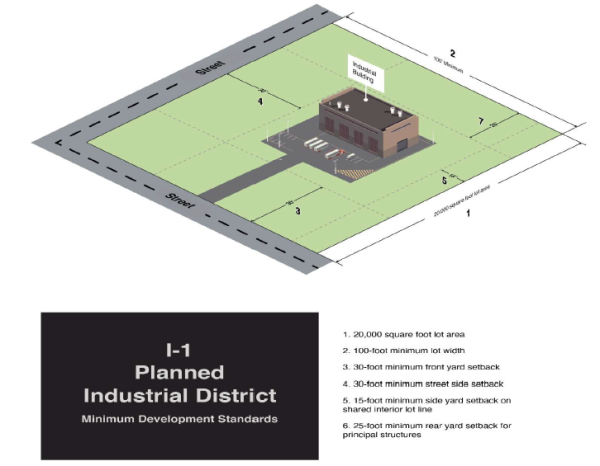
The purpose of the I-1, Planned Industrial District, is to provide for light industrial activities including manufacturing, fabricating, office, warehousing, distribution, and other permitted uses in a functional, attractive manner. The uses will generally be located in an enclosed structure whose external and physical effects are restricted to the area of the district and do not adversely impact surrounding uses.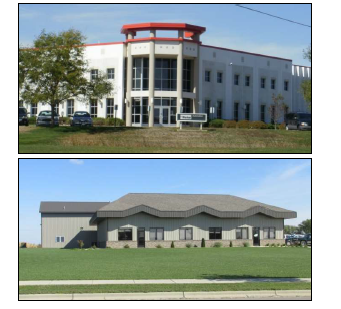
Typical I-1 Buildings
| TABLE 6-1: I-1 DEVELOPMENT STANDARDS | ||
| Grid (Lot and Pattern) | All Uses | |
| Minimum Lot Area | 12,000 - 19,999 sq. ft. | 20,000 sq. ft. |
| Minimum Lot Width | 75 ft. | 100 ft. |
| Minimum Lot Depth | - | – |
| Required Yard Setbacks | ||
| – Front | 30 ft. | 30 ft. |
| – Front Across the Street from a Residential District | 50 ft. | 50 ft. |
| – Interior Side | 15 ft. | 15 ft. |
| – Interior Side Abutting a Residential District | 25 ft. | 50 ft. |
| – Street Side | 15 ft. (Numbered) or 30 ft. (Named) | 30 ft. |
| – Rear | 15 ft. | 25 ft. |
| – Rear Yard Abutting a Residential District | 30 ft. | 50 ft. |
| Building Standards | ||
| – Maximum Height | 45 ft. | 45 ft. |
| – Minimum Floor Area | - | – |
| – Minimum Width | - | – |
| – Minimum Roof Pitch & Soffit (vertical rise / horizontal run) | - | – |
| Maximum Building Coverage | 50% | 50% |
| TABLE 6-1: I-1 DEVELOPMENT STANDARDS | |
| Other Regulations to Consult (not all inclusive) |
|
6.3 I-2 GENERAL INDUSTRIAL DISTRICT
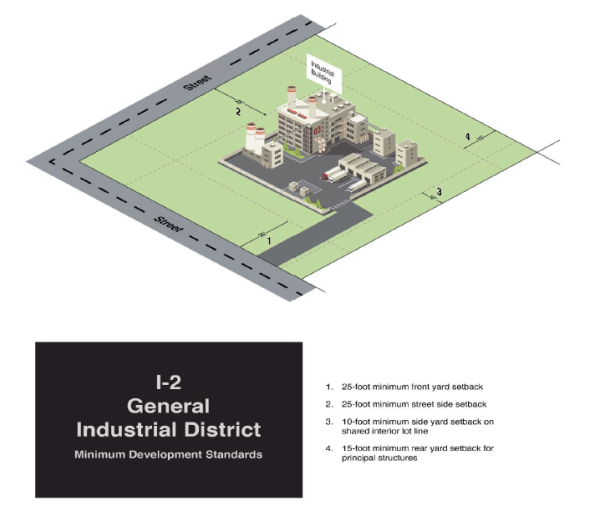
The purpose of the I-2, General Industrial District, is to provide locations for a wide variety of more intense manufacturing and industrial land uses which, because of the nature of the product or character of the activity, should be located in areas that will minimize their impact on neighboring and less intense residential, business, commercial and industrial land uses.
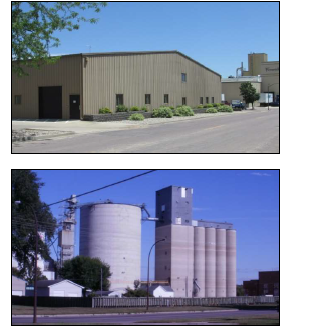
Typical I-2 Buildings
| TABLE 6-2: I-2 DEVELOPMENT STANDARDS | ||
| Small Parcels - All Uses | Large Parcels - All Uses | |
| Minimum Lot Area | 8,000 - 15,999 sq. ft. | 16,000 sq. ft. or larger |
| Minimum Lot Width | 50 ft. | 100 ft. |
| Minimum Lot Depth | - | – |
| Required Yard Setbacks | ||
| – Front | 10 ft. | 25 ft. |
| – Front Across the Street from a Residential District | 25 ft. | 35 ft. |
| – Interior Side | 5 ft. | 10 ft. |
| – Interior Side Abutting a Residential District | 25 ft. | 50 ft. |
| – Street Side | 10 ft. | 25 ft. |
| – Rear | 5 ft. | 15 ft. |
| – Rear Yard Abutting a Residential District | 30 ft. | 40 ft. |
| Building Standards | ||
| – Maximum Height | 45 ft. | 45 ft. |
| – Minimum Floor Area | - | – |
| – Minimum Width | - | – |
| – Minimum Roof Pitch & Soffit (vertical rise / horizontal run) | - | – |
| Maximum Building Coverage | 80% | 80% |
| TABLE 6-2: I-2 DEVELOPMENT STANDARDS | |
| Other Regulations to Consult (not all inclusive) |
|
6.4 I-3 LIMITED INDUSTRIAL DISTRICT
The purpose of the I-3, Limited Industrial District, is to provide for storage, warehousing, service and limited light industrial uses generally located in an enclosed structure whose external and physical effects do not impact adjoining residential properties.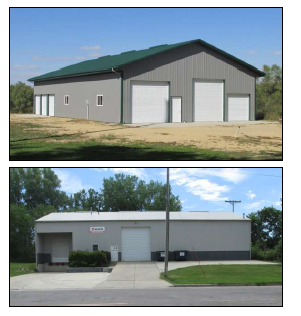
Typical I-3 Buildings
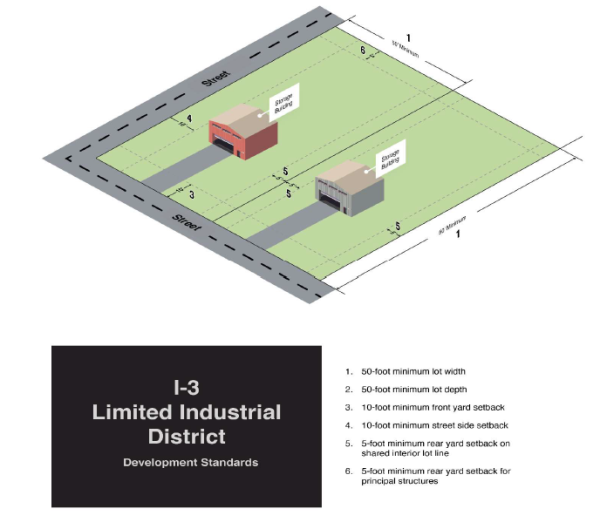
| TABLE 6-3: I-3 DEVELOPMENT STANDARDS | |
| All Uses | |
| Minimum Lot Area | – |
| Minimum Lot Width | 50 ft. |
| Minimum Lot Depth | 50 ft. |
| Required Yard Setbacks | |
| – Front | 10 ft. |
| – Front Across the Street from a Residential District | 25 ft. |
| – Interior Side | 5 ft. |
| – Interior Side Abutting a Residential District | 25 ft. |
| – Street Side | 10 ft. |
| – Rear | 10 ft. |
| – Rear Yard Abutting a Residential District | 30 ft. |
| Building Standards | |
| – Maximum Height | 35 ft. |
| – Minimum Floor Area | – |
| – Minimum Width | – |
| – Minimum Roof Pitch & Soffit (vertical rise / horizontal run) | – |
| Maximum Building Coverage | 75% |
| TABLE 6-3: I-3 DEVELOPMENT STANDARDS | |
| Other Regulations to Consult (not all inclusive) |
|
6.5 INDUSTRIAL USE TABLE
TABLE 6-4: USES BY INDUSTRIAL DISTRICT | ||||
Use Types "P" = Permitted | Base Zoning Districts | Additional Requirements | ||
I-1 Planned Industrial | I-2 General Industrial | I-3 Limited Industrial | ||
Agricultural Uses | ||||
Agriculture | P | P | P | |
Community Garden | P | P | P | |
Public & Institutional Uses | ||||
Active Park Facility (public) | P | P | P | |
Active Park Facility (private) | C | C | ||
Armory | C | C | ||
Club | C | C | ||
Communication Facility | P | P | ||
Event Center | C | C | ||
Essential Services | P | P | P | |
Passenger Terminal | C | C | ||
Passive Park/Open Space | P | P | P | |
Place of Public Assembly | C | C | ||
Public Building/Uses | P | P | P | |
Public Utility Building/Structure | P | P | P | |
Schools (PreK-12) | C | C | C | |
Schools (Higher Education) | C | C | C | |
Utilities (Major) | C | C | C | |
Commercial Uses | ||||
Ambulance Services | C | C | C | |
Auto Repair - Minor | P | P | C | |
Automotive Wash Facilities | P | P | ||
Building Material Sales/Storage | P | P | ||
Bus Garage & Maintenance Facility | P | P | ||
Business Support Services | P | P | C | |
Cannabis Retail | C | C | ||
Child Care Center | C | C | C | |
Communications/Broadcasting | P | P | C | |
Distillery, Micro | P | P | ||
Educational Services | C | C | C | |
Entertainment/Recreation, Indoor Commercial | C | C | ||
Entertainment/Recreation, Outdoor Commercial | C | C | ||
Firearm Range, Indoor | C | C | ||
Kennel (Commercial) | P | P | ||
Landscaping/Nursery Business | P | P | ||
Office | P | P | P | |
Performing, Visual, Exercise, Vocational or Martial Arts School | C | C | ||
Repair Establishment | P | P | C | |
Sports/Health Facility | P | P | C | |
Transportation Services | P | P | ||
Vehicle Service Station | P | P | C | |
Vehicle Sales & Rental | P | P | ||
Veterinary Services | P | P | ||
Wholesale Sales | P | P | ||
Industrial Uses | ||||
Auto Repair - Major | P | P | ||
Brewery | P | P | ||
Bulk Fuel Sales & Storage | C | C | ||
Cannabis Delivery | P | P | ||
Cannabis Manufacturer | P | P | ||
Cannabis Testing Facility | P | P | ||
Cannabis Transportation | P | P | ||
Cannabis Wholesale | P | P | ||
Cleaning Services & Laundry | P | P | ||
Cold Storage | P | P | C | |
Concrete, Asphalt & Rock Crushing Facility | C | |||
Contractor Office & Yard | P | P | P | |
Distillery | P | P | ||
Extraction of Materials | I | I | ||
Food Processing | C | C | ||
General Warehousing | P | P | C | |
Grain Elevator/Storage | P | |||
Grain Milling/Distillation | P | |||
Greenhouse, Wholesale | P | P | ||
Hemp Manufacturer | P | P | ||
Industrial Services | P | P | C | |
Land Reclamation | C | C | C | |
Machine Shop | P | P | C | |
Machinery/Truck Repair & Sales | P | P | ||
Manufacturing, Major | C | |||
Manufacturing, Minor | P | P | ||
Print Shop | P | P | C | |
Professional Trade Firm | P | P | P | |
Recycling Facility | C | C | ||
Research, Development/Testing Laboratory | P | P | ||
Scrap/Salvage Yard, Metal Milling Facility | C | |||
Self-Storage Facility | P | P | P | |
Sexually Oriented Uses | P | P | ||
Truck/Freight Terminal | P | P | ||
Waste Hauler | C | P | ||
Wholesaling, Warehousing/Distribution | P | P | ||
“I” = Interim Permitted *
The Community Development Department may, in its discretion, recommend to the applicant, the Planning Commission and City Council that any use designated in the Table as “C”= Conditionally Permitted be instead considered as an Interim Permitted Use.
Amended by Ord. 2025-098 on 3/4/2025
6.6 STANDARDS APPLICABLE TO INDUSTRIAL ZONING DISTRICTS
- Common Interest Community (Condominiums). Commercial lots of multiple-ownership structures may be divided for the purpose of common interest community ownership provided that the principal structure containing the units shall meet the setback distances of the applicable zoning district.
- Maximum Height.
- The height limitations of principal structures located in industrial districts may be increased by conditional use permit subject to the general CUP review criteria listed in Section 2.4(D). Additionally, the Planning Commission and City Council, shall consider, but not be limited to, the following factors when determining the maximum height:
- The building shall be at least 200 feet from any parcel that is zoned residential.
- The building shall not cast a shadow on residential structures between the hours of 9:00 a.m. and 3:00 p.m.
- The building or structure shall match the scale and character of surrounding uses.
- Preservation of views of landmark buildings, significant open spaces or water bodies, shall be mandated.
- The maximum height of all principal structures located in a industrial zoning district shall be as specified within each industrial district. Parapets not exceeding three (3) feet in height shall be exempt from such limitations.
- The height limitations of principal structures located in industrial districts may be increased by conditional use permit subject to the general CUP review criteria listed in Section 2.4(D). Additionally, the Planning Commission and City Council, shall consider, but not be limited to, the following factors when determining the maximum height:
- Building Design and Construction.
- All buildings and structures shall meet applicable Minnesota Building Code requirements. Additionally, the following standards are established to encourage architectural creativity and diversity, to create a lessened visual impact upon surrounding land uses, and to establish uniformity in acceptable exterior construction materials for industrial development.
- All building masonry must be designed with an architectural finish. The primary building materials being limited to the following:
- Modular masonry materials such as brick, block and stone.
- Precast concrete or aggregate panels.
- Stucco and stucco-like materials.
- Glass.
- Prefinished metal architectural panels, subject to the provisions indicated below:
- Exposed, untextured, uncolored, unaugmented concrete building types are expressly prohibited in an Industrial zoning district.
- The following building types and materials are expressly prohibited in the industrial districts:
- Wood as an exterior wall finish, except where used as accent material.
- Corrugated metal roofing or siding.
- Exposed, untextured, uncolored, unaugmented concrete.
- Railroad Properties. The rear or side yard setback of a property directly abutting a railroad track may reduce the required setback to zero (0’) feet subject to the following conditions:
- The property owner can provide proof of a contractual arrangement with the railroad owning the adjoining spur to provide service to the property;
- The appropriate building and/or property improvements are identified and their installation is guaranteed if the request is approved by the City.
- The City approves a conditional use permit allowing a zero (0’) foot setback, with appropriate conditions.
- Compliance. In order to assure compliance with the performance standards set forth in this Ordinance, the City Council may require the owner or operator of any permitted use to have made such investigations and tests as may be required to show compliance with these performance standards. Such investigations and tests as are required to be made may be carried out by an independent testing organization as may be agreed upon by all parties concerned, or if there is failure to agree, by such independent testing organization as may be selected by the City Council after 30 days’ notice. The costs incurred in having such investigations or tests conducted shall be the responsibility of the owner or operator. The procedure stated above does not preclude the City from making any tests and investigations if finds appropriate to determine compliance with these performance standards.

