
New Ulm City Zoning Code
CHAPTER 13
RULES AND DEFINITIONS
13.1 GENERAL RULES OF INTERPRETATION
The language in the text of this Ordinance shall be interpreted in accordance with the following rules of construction:
- Meanings and Intent. All provisions, terms, phrases, and expressions contained in this Ordinance shall be interpreted in accordance with the general purposes set forth in Section 1.3, Purpose and Intent, and the specific purpose statements set forth throughout this Ordinance. When a specific section of these regulations gives a different meaning than the general definition provided in this Chapter, the specific section's meaning and application of the term shall control.
- Headings, Illustrations, and Text. In the event of a conflict or inconsistency between the text of this Ordinance and any heading, caption, figure, illustration, table, or map, the text shall control. Graphics and other illustrations are provided for informational purposes only and should not be relied upon as a complete and accurate description of all applicable regulations or requirements.
- Lists and Examples. Unless otherwise specifically indicated, lists of items or examples that use terms such as “for example,” “including,” and “such as,” or similar language are intended to provide examples and are not exhaustive lists of all possibilities.
- Computation of Time. The time in which an act is to be done shall be computed by excluding the first day and including the last day. If a deadline or required date of action falls on a Saturday, Sunday, or holiday observed by the City, the deadline or required date of action shall be the next day that is not a Saturday, Sunday, or holiday observed by the City. References to days are calendar days unless otherwise stated.
- References to Other Regulations/Publications. Whenever reference is made to a resolution, ordinance, statute, regulation, or document, it shall be construed as a reference to the most recent edition of such regulation, resolution, ordinance, statute, regulation, or document, unless otherwise specifically stated.
- Delegation of Authority. Any act authorized by this Ordinance to be carried out by a specific official or department of the City may be carried out by a designee of such official or department.
- Technical and Non-Technical Terms. Words and phrases shall be construed according to the common and approved usage of the language, but technical words and phrases that may have acquired a particular and appropriate meaning in law or in a technical field shall be construed and understood according to such meaning.
- Public Officials and Agencies. All public officials, bodies, and agencies to which references are made are those of the City of New Ulm, unless otherwise indicated.
- Mandatory and Discretionary Terms. The words “shall,” “must,” and “will” are mandatory in nature, establishing an obligation or duty to comply with the particular provision. The words “may” and “should” are permissive in nature.
- Conjunctions. Unless the context clearly suggests the contrary, conjunctions shall be interpreted as follows:
- “And” indicates that all connected items, conditions, provisions or events apply; and
- “Or” indicates that one or more of the connected items, conditions, provisions, or events apply.
- Tenses, Plurals, and Gender.
- Words used in the present tense includes the past and future tenses, and the future tense includes the present.
- Words used in the singular number include the plural number and the plural number includes the singular number, unless the context of the particular usage clearly indicates otherwise.
- Rules of Interpretation for Use Definitions. Certain terms in this Ordinance are defined to be inclusive of many uses in order to eliminate overly detailed lists of uses in the zoning districts established by this Ordinance. These terms are referred to as “generic use” definitions. A use that is not specifically listed in a zoning district or does not fall within a generic use definition as defined in this Ordinance is prohibited. If a use is listed specifically, it cannot be considered part of a generic use definition.
- Terms Not Defined. If a term used in this Ordinance is not defined in Section 13.3, the Community Development Department shall have the authority to provide a definition based upon the definitions used in accepted sources including but not limited to: A Planners Dictionary; A Glossary of Zoning, Development, and Planning Terms; A Survey of Zoning Definitions; or any standard dictionary.
13.2 RULES
- Measurements, Generally.
- Purpose. The purpose of this Section is to clarify the rules of measurement and exemptions that apply to all uses of land or structures allowed in this Ordinance. These standards may be modified by other applicable sections of this Ordinance.
- Distance Measurements, Generally. Unless otherwise expressly stated, distances specified in this Ordinance are to be measured as the length of an imaginary straight line joining those points.
- Lots.
- Definitions/Measurements.
- Lot Area. The total land area within the lot lines.
FIGURE 13-1 LOT AREA MEASUREMENTS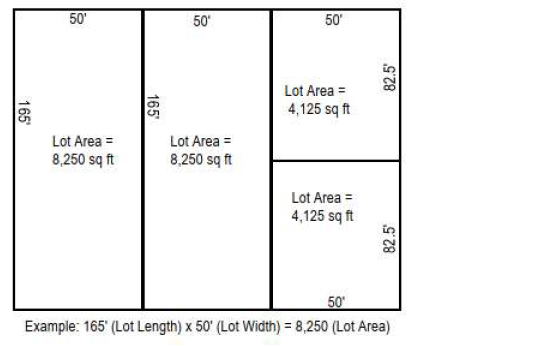
- Lot/Building Coverage. The area of a lot occupied by principal and accessory structures measured as a percentage of the total area of the lot. The amount of lot/building coverage area is based on contiguous portion of the lot that is suitable for development and excludes wetlands, floodplains, the neck portion of a flag lot, steep slopes that are unbuildable under this Ordinance, and other unbuildable areas.
FIGURE 13-2 Lot/Building Coverage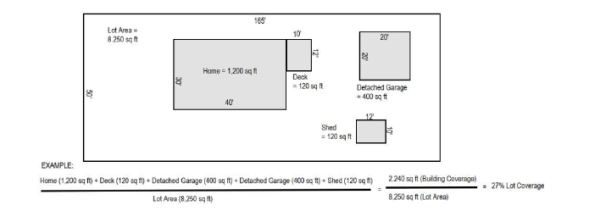
- Lot Depth. The mean horizontal distance between front and rear lot lines.
- Lot Width. The horizontal distance between points on the side lot line measured at right angles to the lot depth at the established front setback line.
FIGURE 13-3 LOT WIDTHS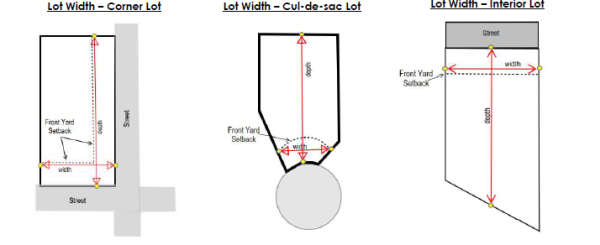
- Lot or Street Frontage
- In the case of a building lot abutting upon only one street, the frontage line is the lot line parallel to and common with the right-of-way.
- In the case of a corner lot, that part of the building lot having the narrowest frontage on any street shall be considered the frontage line. For the purpose of determining yard requirements on corner lots and double frontage lots, all sides of a lot adjacent to streets shall be considered frontage, and yards shall be provided as required in this Ordinance.
- Lot Lines. The lines bounding a lot are defined as follows:
- Lot Line, Zero. Means a condition where no yard is provided between two (2) or more distinct dwelling units sharing a common party wall (e.g., townhouse, rowhouse, twin home, single family attached dwellings, etc.).
FIGURE 13-4 ZERO LOT LINE
Zero Lot Line Single Family Attached Dwelling (Twin Home)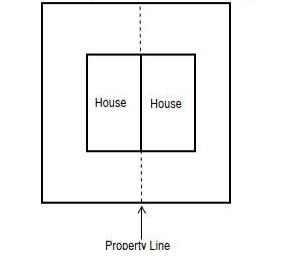 Zero Lot Line Single Family Attached Dwellings in R-3/R-4 Zoning Districts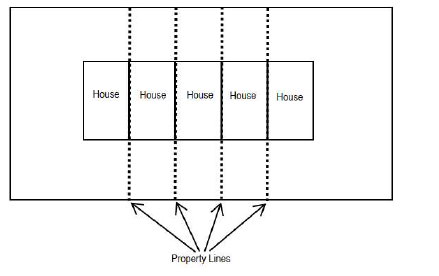
- Front Lot Line. The boundary of a lot abutting a street. On a corner lot, the shortest street lot line is the front lot line. (See Figure 13-8)
- Rear Lot Line. The rear lot line is the lot line or lot lines most nearly parallel to and most remote from the front lot line. (See Figure 13-8)
- Side Lot Line. A side lot line is the lot line connecting the front and rear lot lines. (See Figure 13-8)
- Exception. In the case where a lot has more than one front lot line, lot lines for the property that are not front lot lines shall be considered side lot lines.
FIGURE 13-5 CORNER LOTS
Exception: Full Corner Lot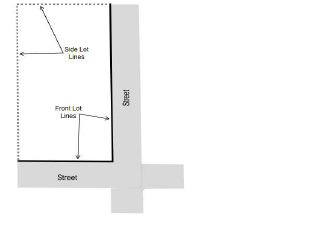
Exception: Split Corner Lot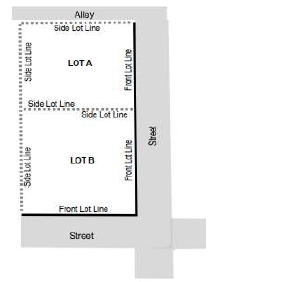
- Lot Line, Zero. Means a condition where no yard is provided between two (2) or more distinct dwelling units sharing a common party wall (e.g., townhouse, rowhouse, twin home, single family attached dwellings, etc.).
- Lot Types.
- Base Lot. A parcel of land in identical ownership throughout, bounded by other lots or streets, and used or set aside and available for use as the site of one or more buildings or other definite purposes.
- Corner Lot. A lot located at the intersection of two (2) or more streets (not alleys), regardless of whether or not such streets intersect at right angles.
- Cul-de-Sac Lot. A lot located on the head or turn around of a cul-de-sac with side lot lines on a tangent to the arc of the right-of-way.
- Double Frontage Lot. An interior lot having frontage on two (2) non-intersecting streets.
- Flag Lot. A lot with a narrow appendage for the purpose of providing frontage on a public or private right-of-way. Property line setbacks for a flag lot shall be determined by the Community Development Department.
- Grid Lot. A parcel of land within a legal subdivision composed of two sets of lines, each set drawn to a definite pattern and intersecting the other at right angles to form a grid.
- Grid Pattern. A type of City Plan in which a network composed of two sets of streets, each set drawn to a definite pattern consisting of uniformly spaced parallel streets, intersect the other at right angles. Also known as a grid plan, a grid street plan or gridiron plan. (For reference, in New Ulm, the grid pattern can generally be considered to be the area bounded by 20th South Street and its extension on the south side, South Payne Street on the west side, Center Street on the south side, North Garden Street on the west side, 20th North Street on the north side, North Water Street on the east side, 8th North Street on the North Side, North Front Street and South Front Street on the east side and ending at 20th South Street).
- Interior Lot. A lot other than a corner lot or double frontage lot.
- Unit Lot. A specialized lot created within a base lot simply for the purpose of defining ownership for certain multi-family dwelling types.
FIGURE 13-6 LOT TYPES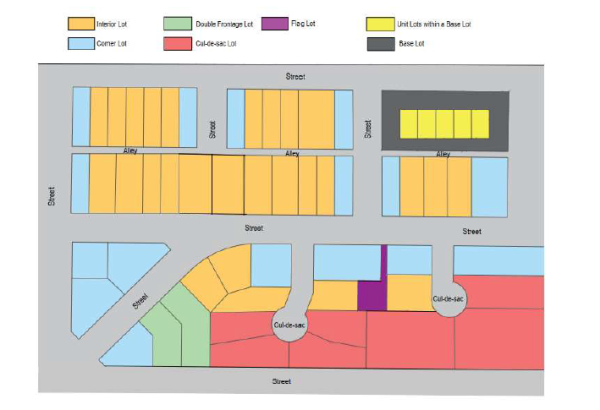
- Lot Area. The total land area within the lot lines.
- Definitions/Measurements.
- Required Yards.
- Definitions/Measurement.
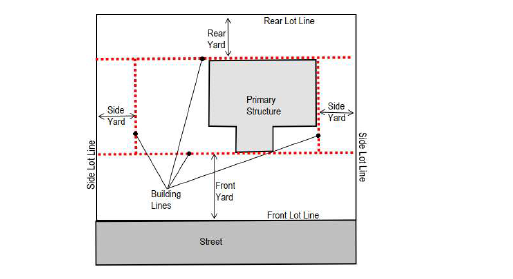
- Yard. An open space on the same lot with a building or structure, which yard is unoccupied and unobstructed from its lowest level to the sky, except as otherwise permitted by this Ordinance. (See Figure 13-8)
- Yard, Front. An open, unobstructed yard extending along the full width of the front lot line between side lot lines and extending from the abutting street right-of-way line to the depth required in the setback regulations for the zoning district in which such lot is located.
- Yard, Average Front.
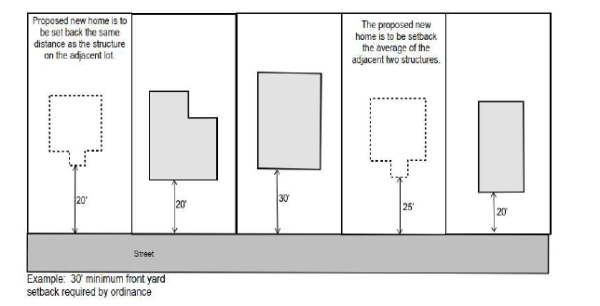
- In the R-1, R-1S, RT-1, R-2, RT-2, R-3, and R-4 Districts, where adjacent structures within the same block have front yard setbacks different from those required, the front yard minimum setback shall be the average of the adjacent structures.
- If there is only one (1) adjacent structure, the front yard minimum setback shall be the average of the required setback and the setback of the adjacent structure. In no case shall the minimum front yard setback exceed thirty (30) feet.
- On double frontage lots, the required front yard shall be provided on both streets.
FIGURE 13-7 FRONT YARD SETBACK AVERAGING
- Yard, Rear. An open, unobstructed yard on the same lot with a building between the nearest line of the building or allowed building line and rear property line extending for the full width of the lot.
- Yard, Side. An open, unobstructed yard extending along the side lot line between the front yard and rear yard to a depth or width required by setback requirements for the zoning district which such lot is located.
- Yard, Street Side. A side yard on a corner lot that is parallel to an abutting street or public right-of-way.
FIGURE 13-8 YARDS, LOT LINES AND BUILDING LINES (IN GENERAL)
- Definitions/Measurement.
- Building/Structures.
- Building. A structure having a roof supported by columns or walls and intended for shelter, housing, business, or enclosure.
- Principal Building. A building in which is conducted the principal use of the lot.
- Accessory Building. A building on the same lot with, and of a nature customarily incidental and subordinate to, the principal structure.
FIGURE 13-9 PRINCIPAL AND ACCESSORY BUILDINGS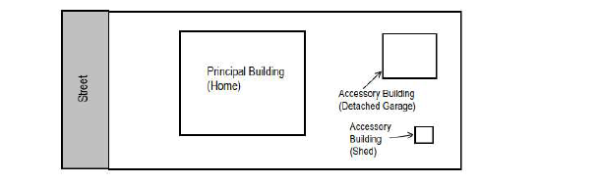
- Definitions/Measurements.
- Buildable Area. The space remaining on a lot after the minimum setback requirements of this Chapter have been met.
FIGURE 13-10 BUILDABLE AREA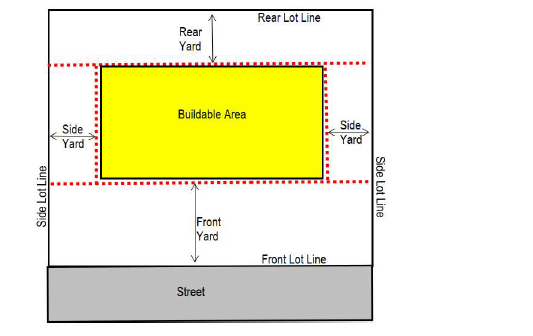
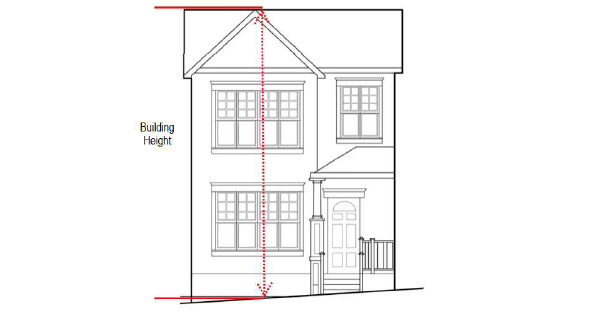
- Building Height. The vertical distance from the average of the highest and lowest point of that portion of the lot surface covered by the building to the highest point of the roof.
FIGURE 13-11 BUILDING HEIGHT
- Building Size. The total floor area measured from the exterior face of exterior walls and covered by a roof.
- Grade. Means the level of the finished ground surface immediately adjacent to the exterior walls of a building.
- Buildable Area. The space remaining on a lot after the minimum setback requirements of this Chapter have been met.
13.3 DEFINITIONS
The following words and terms, wherever they occur in this Ordinance, shall be interpreted as herein defined:
Abutting: Means the land, lot, property or parcel having a common border or boundary with, or being separated only by a street, alley or easement.
Accessory Building: [Section 13.2 (D)(3)]
Accessory Use: A use incidental or accessory to the principal use of a lot or a building located on the same lot as the accessory use.
Adjacent: Means located nearby, with or without contact.
Adjoin: Means having a common boundary or relationship at a common property line.
Agriculture: The use of land where such land is devoted to the production of plants or horticulture products, including but not limited to: field crop farming; pasture for hay; fruit growing; tree, plant, shrub, or flower nursery without building; and truck gardening. Agriculture shall not include use of land for recreational purposes, suburban residential acreages, rural home sites, or farm home sites and yard plots whose primary function is for residential or recreational purposes even though such properties may produce or maintain some of those plants or animals listed in the foregoing definition.
Agriculture Sales: shall mean the retail sale of fresh fruits, vegetables, flowers, herbs, trees, or other agricultural, floricultural, or horticultural products. The operation may be indoors or outdoors, include pick-your-own or cut-your-own opportunities, and may involve the ancillary sale of items considered accessory to the agricultural products being sold or accessory sales of unprocessed foodstuffs; home processed food products such as jams, jellies, pickles, sauces; or baked goods and home-made handicrafts. The floor area devoted to the sale of accessory items shall not exceed 25 percent of the total floor area. No commercially packaged handicrafts or commercially processed or packaged foodstuffs shall be sold as accessory items. No activities other than the sale of goods as outlined above shall be allowed as part of the agricultural sales business.
Agricultural Service Establishment: A use where the primary activity is to provide goods or services to general or industrial farm operations including, but not limited to, fertilizer, seed and feed supply companies, grain elevators, milling operations, implement dealerships, processing and packaging of agricultural products, cold storage plants, and livestock sales excluding slaughter houses.
Airport: A location with a landing area, runway or other facilities designed, used or intended to be used for the landing or taking off of aircraft, including all necessary taxiways, aircraft storage and tie-down areas, hangars, and other necessary buildings and open spaces.
Alley: A public right of way of not less than 20 feet nor more than 30 feet in width which provides secondary access to abutting property.
Ambulance Service: A public or privately-owned facility for the dispatch, storage, and maintenance of emergency medical care vehicles or related equipment. Includes offices, training facilities and bunking facilities for ambulance service personnel.
Antenna: Any structure or device used for the purpose of collecting or transmitting electromagnetic waves including, but not limited to, directional antennas, such as panels, microwave dishes, satellite dishes and omni-directional antennas, such as whip antennas.
Apartment: A part of a building consisting of a room or suite of rooms, which is designed for, intended for, or used as a residence for one family or an individual and is equipped with cooking facilities. An apartment is offered only as a rented or leased residence, as distinguished from condominiums and townhouses.
Apartment Building: Three or more apartments grouped in one building.
Appurtenances, Physical: The visible, functional, or ornamental objects accessory to, and part of a building such as chimneys, fire escapes, open decks, air conditioning units, stoops, steps, bay windows, roof overhangs, awnings, solar energy systems and similar features.
Armory: A building, training area, warehouse, vehicle storage compound, organizational or field maintenance shop or other facility and the lands appurtenant to them used by the National Guard for the storage and maintenance of arms and/or military equipment or the administration or training of National Guard personnel.
Assisted Living Facility: A facility that provides daily assistance and long-term residence for disabled or elderly individuals. This includes a combination of housing, supportive services, personalized assistance and health care designed to respond to the individual needs of those who need help with activities of daily living, such as dressing, grooming, bathing, etc.
Automobile Repair – Major: Engine rebuilding or major reconditioning of worn or damaged motor vehicles or trailers; collision services including body, frame or fender straitening or repairs; and overall painting of vehicles.
Automobile Repair – Minor: The replacement of any part or repair of any part which does not require the removal of the engine head or pan, engine transmission or differential, incidental body or fender work, minor painting and upholstering service when said service above stated is applied to passenger automobiles and trucks not in excess of nine thousand (9,000) pounds gross weight.
Automotive Wash Facility: An area or structure equipped with automatic or self-service facilities for primarily washing automobiles.
Bar, Liquor Establishment: An establishment where the principal business is the on-sale of alcoholic and non-alcoholic beverages. Accessory uses to a bar can include food service, dancing, theaters and amusement devices, subject to all other provisions of City regulations.
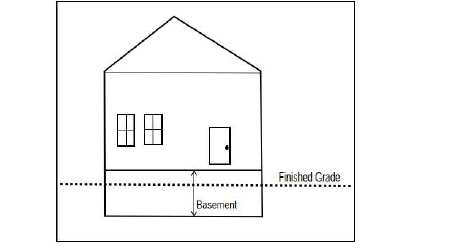
Basement: A story having more than fifty percent (50%) of its height below the average level of the adjoining finished grade.
FIGURE 13-12 BASEMENT
Bay Window: A window projection protruding from an exterior wall of a building, located at least two (2’) feet above the ground.
Bed & Breakfast Inn: An owner-occupied single-family dwelling where transient lodging in guest rooms and meals only are provided to the traveling public by the resident owner for compensation.
Berm: An earthen mound designed to provide visual interest on a site, screen undesirable views, reduce noise, or fulfill other such purposes.
Block: A tract of land bounded by streets, or a combination of streets and public parks, cemeteries, railroad rights-of-ways, shorelines, waterways or boundary lines of the corporate limits of the City.
Bluff: A natural topographic feature such as a hill, cliff, or embankment with an average slope of thirty (30) percent or greater and with a vertical rise of fifty (50) feet or greater.
Bluff, Toe of: The point of a bluff where there is, as visually observed, a clearly identifiable break in the slope from steeper to gentler slope above. If no break in the slope is apparent, the toe of the bluff shall be determined to be the lowest end of the lowest fifty (50) foot segment measured on the ground with an average slope exceeding eighteen (18) percent.
Bluff, Top of: The point of a bluff where there is, as visually observed, a clearly identifiable break in the slope from steeper to gentler slope above. If no break in the slope is apparent, the top of the bluff shall be determined to be the highest end of the highest fifty (50) foot segment measured on the ground with an average slope exceeding eighteen (18) percent.
Bluff Impact Zone: For any property abutting or adjoining Flandrau State Park, all land located between the toe and the top of the bluff and the land located within 20 feet measured horizontally from the highest point of the top of the bluff.
Boarder: Means a person who rents sleeping accommodations which have no individual cooking facilities, and who may be furnished with meals or other services as part of the consideration, but who is not a member of the family or household occupying the principal dwelling unit.
Body Art: Establishments that engage in providing "Body art" or "body art procedures" including physical body adornment using, but not limited to, tattooing and body piercing. Body art does not include practices and procedures that are performed by a licensed medical or dental professional if the procedure is within the professional's scope of practice.
Boulevard: The portion of a right-of-way that is located between the concrete curb and property line of adjacent private property, including the sidewalk or area reserved for a sidewalk.
Brew Pub: A brewer who also holds one or more retail on-sale licenses and who manufactures fewer than 3,500 barrels of malt liquor in a year, at any one licensed premises, the entire production of which is solely for consumption on tap on any licensed premises owned by the brewer, or for off-sale from those licensed premises as permitted in Minnesota State Statutes 340A, as amended.
Brewery/Winery: A business located in a building or establishment that manufactures beer, malt beverages, wine, or similar fermented products through the use of kegs, bottles or cans with the option to sell its own products on-site in a taproom. A brewery may also operate a restaurant on the premises.
Buffer Zone: A 10-foot strip of land measured horizontally from the top of bluff away from the bluff into the property.
Building: [Section 13.2 (D)]
Buildable Area: [Section 13.2 (E)]
Building Height: [Section 13.2 (E)(2)]
Building Materials Sales & Storage: Retail establishments that sell lumber and other large building materials, or other items such as including paint, wallpaper, glass, fixtures, nursery stock, lawn and garden, etc.
Building, Principal: [Section 13.2 (D)(2)]
Building Size: [Section 13.2 (E)(3)]
Bulk: The term used to indicate the size and setbacks of structures and their location.
Bulk Fuel Sales & Storage: The commercial storage of gasses and fuels in above-ground containers.
Business: Any establishment, occupation, employment, or enterprise where merchandise is manufactured, exhibited, or sold, or where services are offered for compensation.
Business Support Services: Establishments that engage primarily in rendering services to businesses including but not limited to copy shops, printing services, package and postal services, photo processing, janitorial services, and similar operations.
Cannabis Cultivation, Indoor: A cannabis business licensed or endorsed by the Minnesota Office of Cannabis Management for the planting, growing, harvesting, drying, curing, grading, or trimming of cannabis plants, cannabis flower, hemp plants, or hemp plant parts indoors.
Cannabis Cultivation, Outdoor: A cannabis business licensed or endorsed by the Minnesota Office of Cannabis Management for the planting, growing, harvesting, drying, curing, grading, or trimming of cannabis plants, cannabis flower, hemp plants, or hemp plant parts outdoors.
Cannabis Delivery: A fleet-based cannabis business licensed or endorsed by the Minnesota Office of Cannabis Management to purchase cannabis and hemp products from a cannabis retail business and deliver the products directly to customers.
Cannabis Manufacturer: A cannabis business licensed or endorsed by the Minnesota Office of Cannabis Management where raw, dried hemp, cannabis, and parts of the same are manufactured into other types of cannabis products for sale to other cannabis and hemp businesses.
Cannabis Retail: A cannabis business with a license or endorsement from the Minnesota Office of Cannabis Management authorizing the retail sale of cannabis and cannabis products directly to consumers.
Cannabis Testing Facility: A cannabis business with license or endorsement from the Minnesota Office of Cannabis Management for testing cannabis and hemp products obtained from other cannabis businesses.
Cannabis Transportation: A fleet-based cannabis business with a license or endorsement from the Minnesota Office of Cannabis Management for transportation of cannabis products from one licensed business to another.
Cannabis Wholesale: A cannabis business with a license from the Minnesota Office of Cannabis Management to purchase from a business growing or manufacturing cannabis or cannabis products and sell to a cannabis business engaged in retail.
Canopy: A roof-like cover, often of fabric, plastic, metal, or glass on a support, which provides shelter over a doorway.
Cemetery/Memorial Garden: Land used or dedicated to the burial of the dead, including crematoriums, mausoleums, and necessary sales and maintenance facilities. Mortuaries my be included when operated within the boundary of such cemetery.
Child Care Center: A service provided to the public in which children of school or preschool age are cared for during established business hours, and which does not qualify as a group residential facility.
Clinic/Medical Services: A structure intended for providing medical and dental examinations and services available to the public on an outpatient basis only.
Club: An association of persons forming a membership organization catering exclusively to members and their guests, and whose facilities area limited to meeting, eating, social, and/or recreational uses. And further whose activities are not conducted for monetary gain; including but not limited to civic, fraternal, charitable, religious, social and patriotic organizations.
Cocktail Room: A facility for the on-sale and consumption of distilled spirits by the public on or adjacent to premises owned by a micro distillery which produces distilled spirits.
Cold Storage: A climate-controlled building for the storage and preservation of material, commodities or goods through the use of ice, refrigerating machinery or other artificial means of cooling.
Combined Use: The combination of two principal uses.
Commercial Lodging: A building or group of buildings in which sleeping accommodations are offered to the public and intended primarily for rental for temporary occupation by persons on an overnight basis, not including bed and breakfast establishments or a rooming house. Such uses may include microwaves and refrigerators for each guest unit.
Common Plan of Development: A contiguous area where multiple separate and distinct land disturbing activities may be taking place at different times, on different schedules, but under one proposed plan. A plan is broadly defined to include design, permit application, advertisement or physical demarcation indicating that land disturbing activities may occur. The plan should be comprehensive, general and long-range.
Communications/Broadcasting: Establishments primarily engaged in the provision of broadcasting and other information relay services accomplished through the use of electronic and telephonic mechanisms. Antennas, antenna support structures and satellite dishes are included in this definition. Typical uses include television studios, telecommunication service centers, radio, internet/data storage, or film and sound recording facilities.
Communications Facility: A facility for the creation, transmission, emission, storage-retrieval or reception of signals, images, sounds, or intelligence of any nature, by wire, radio, television, optical or other means.
Community Development Department: Those departments assigned by the City Manager to oversee the various aspects of development within the City. Such departments may include but are not limited to planning, building safety, code enforcement, and engineering.
Community Garden: A public or private facility for cultivation of fruits, flowers, vegetables or ornamental plants by more than one (1) person or group.
Comprehensive Plan: A compilation of the goals, policy statements, standards, programs, maps and other explanatory materials, as adopted by the New Ulm City Council, including any part of such plan separately adopted and any amendments to such plan or parts thereof. This plan is intended to guide physical, social, and economic development, both public and private, of the City and its surrounding areas, and includes recommendations for plan implementation, documents in text, ordinances and maps.
Concrete, Asphalt & Rock Crushing Facility: A use in which the principal activity is performed in an open area where concrete, asphalt, rock, brick, cement, or other similar paving or building materials are crushed, ground, pulverized, bought, sold, exchanged, stored, mixed, packed, disassembled, or handled. Such facility does not include the use, on a public roadway construction or repair project approved by the City Engineer, of equipment which directly moves along the roadway surface and grinds, reconstitutes, or resurfaces the roadway, or the temporary on-site crushing, grinding, or pulverizing of a razed building, parking area, or structural materials.
Conditional Use: A permitted use that, because of special requirements or characteristics, may only be allowed in a particular zoning district after review by the City and granting of a conditional use permit which imposes conditions deemed necessary to make the use compatible with other uses permitted in the same zone or vicinity. Conditional uses that cannot be adequately controlled through conditions shall be prohibited. Approved conditional uses and their conditions run with the land and are not specific to property owners.
Condominium: A form of property ownership providing for individual ownership of space in a structure together with an individual interest in the land or other parts of the structure in common with other owners. Residential condominium dwelling units are subject to the provisions of the Uniform Condominium Act, Minnesota Statutes, Chapter 515A, as amended.
Construction Trailer: Trailers used as temporary offices to meet a short-term need while construction activities are taking place. A temporary use permit is required for such office trailers.
Contractor: The party who signs the permit, application, construction contract, or development agreement to construct a project. Where the construction project involves more than one contractor, the general contractor shall be the contractor that is responsible pursuant to the obligations set forth in this Ordinance.
Contractor Office & Yard: An establishment providing general contracting or building construction service and which involves outdoor storage of machinery, equipment or materials.
Convenience Store: A retailer offering automotive fuel and accessories in addition to convenience food items and personal goods, but not offering mechanical repair or services.
Convent or Monastery: A building or group of buildings used to house the staff of a religious institution or the members of a religious organization.
Cooperative Housing: A multiple family attached dwelling owned and maintained by the residents. The entire structure and real property is under common ownership as contrasted to a condominium dwelling where individual units are under separate individual occupant ownership.
Country Club: A membership club or business organized and operated primarily to provide recreational activities such as golf, swimming, tennis, and other outdoor recreation to its members and their guests which includes facilities such as a club house, banquet areas, locker rooms, and pro shop.
Crematory: A facility containing furnaces for the reduction of dead bodies to ashes by fire.
Curb Level: The level of the established curb in front of a building. Where no curb level has been established, the City Engineer may establish such curb level or its equivalent for the purposes of this Ordinance.
Day: Unless otherwise specifically indicated, when used in this Ordinance, “day” means one (1) calendar day.
Deck: A horizontal, unenclosed platform, with or without attached railings, seats, trellises or other features, attached or functionally related to a principal structure and, at any point, extended above grade. A deck is not roofed.
Development Standards: Criterion established to control and limit the impacts generated by, or inherent in, uses of land or buildings.
Distillery: An establishment licensed by the State of Minnesota for the manufacture of premium distilled spirits in total quantity exceeding 40,000 proof gallons in a calendar year.
Distillery, Micro: An establishment licensed by the State of Minnesota for the manufacture of distilled spirits in total quantity of 40,000 proof gallons or less in a calendar year.
Distribution: The storage, wholesale and distribution of manufactured products, supplies and equipment.
District: A section of the City for which the land use and zoning regulations are the same.
District Size: The minimum size, in acres, of a base or overlay zoning district, including streets, rights-of-way, and open space areas.
Donation Drop-Off Container: A receptacle designed with a door, slot, or other opening that is intended to accept and store donated items.
Drive-Through Facility: A facility which accommodates motor vehicles and from which the occupants of the motor vehicles may make purchases or transact business, including stacking spaces in which motor vehicles wait. Examples include, but are not limited to, drive-up windows, menu boards, order boards or boxes, drive-in restaurants and drive-up banks. Drive-thru facilities shall not include the direct refueling of motor vehicles.
Dry Cleaning Services & Laundry: A service establishment engaged primarily in high volume laundry and garment services, including: carpet and upholstery cleaners; diaper services; dry cleaning and garment pressing; commercial laundries; and linen supply. These facilities may include accessory customer pick-up facilities. These facilities do not include coin-operated or dry cleaning pick-up stores without dry cleaning equipment; see “Personal Services.”
Dwelling: A structure, or portion thereof, designed or used exclusively for residential occupancy, including single-family, two-family, townhouse and multi-family dwellings, but not including hotels/motels or dormitories.
Dwelling, Condominium: A multiple family dwelling in which the dwelling units are separated by a party wall and which dwelling units are designed and intended to be owned separately in fee under the condominium statutes of the state.
Dwelling, Duplex: A building designed as a single structure, containing two separate dwelling units, each of which is designed to be occupied as a separate permanent residence for one family.
Dwelling, Efficiency Unit: A part of a building consisting of a room or suite of rooms, which is designed for, intended for, or used as a residence for one family or an individual and is equipped with cooking facilities and is no less than 400 square feet in size.
Dwelling, Manufactured, Mobile Home: A structure, transportable in 1 or more sections, which in the traveling mode is 8 feet or more in width or 40 feet or more in length, or, when erected on site, it is 320 or more square feet, and which is built on a permanent chassis and designed to be used as a dwelling with or without a permanent foundation when connected to the required utilities, and includes the plumbing, heating, air conditioning, and electrical systems contained therein; except that the term includes any structure which meets all the requirements and with respect to which the manufacturer voluntarily files a certification required by the secretary and complies with the standards established under M.S. Ch. 327.31, as it may be amended from time to time, and which structure conforms to the requirements of the Manufactured Home Building Code. Any structure which is smaller than the above dimensional requirements shall be known as a “recreational camping vehicle” pursuant to the definitions of M.S. Ch. 327.14, Subd. 7, as it may be amended from time to time.
Dwelling, Manufactured, Modular: A housing unit that is basically fabricated at a factory and transported in sections to a building site where final assembly and installation of such components are completed to permanently affix the module to the site and thereby create a non-mobile housing unit conforming to the Minnesota State Building Code.
Dwelling, Manufactured, Prefabricated: A housing unit with the walls, floors and ceilings constructed at a factory and which are transported to a building site where final assembly and installation of such component is completed to permanently affix the unit to the site and thereby create a non-mobile housing unit conforming to the Minnesota State Building Code.
Dwelling, Multiple Family: A building designed with three (3) or more dwelling units exclusively for occupancy by three (3) or more families living independently of each other but sharing hallways and main entrances and exits.
Dwelling, Single Family Attached: A building containing one dwelling unit which is attached to another dwelling or building on one or more sides by a common party wall or walls, and which is located on its own lot. This definition includes twin homes.
Dwelling, Detached: A residential building containing not more than one (1) dwelling unit and entirely surrounded by open space and yard located on the same lot.
Dwelling, Street Level: A dwelling unit within a building situated in the B-4 zoning district, and located in the rear of the building with a non-residential use in the front of the building.
Dwelling, Townhouse: A group of three (3) or more single family residences, contiguous to each other only by the sharing of common party walls, and where each dwelling unit has separate and individual front and rear entrances and has open space on at least two sides of each unit. These dwellings may be one story or two (2) story buildings but each unit shall be designed and constructed to house one single family. Such structures shall be of the row or group house type. No single structure shall contain more than eight (8) dwelling units.
Dwelling Unit: One (1) or more rooms in a dwelling designed for occupancy by one (1) family for living purposes and having its own permanently installed kitchen and bathroom facilities.
Dwelling, Upper Floor: A dwelling unit within a multi-story building located above non-residential uses on the ground floor.
Easement: A right or interest given by the owner of real property to another party for present or future specific limited use of that real property, but which does not convey title to that real property. The easement may be for under, on, or above said real property. Such specified uses include but are not limited to transportation facilities, including streets or alleys, utilities, access, and stormwater drainage.
Educational Services: Establishments engaged in furnishing specialized academic or technical courses, normally on a fee basis, such as vocational or correspondence schools, barber college, data processing schools or secretarial schools, along with non degree granting school such as post-secondary colleges and universities, martial arts, exercise, music, art, ceramic, performing, visual, and dance instruction.
Entertainment, Indoor Commercial: An establishment providing completely enclosed recreation or entertainment activities. Accessory uses may include the preparation and serving of food or the sale of equipment related to the enclosed uses. Examples of indoor commercial entertainment businesses include bowling alleys, roller and ice-skating rinks, billiards halls, swimming pools, theaters, and similar amusements. Indoor commercial entertainment uses do not include event centers or adult uses.
Entertainment, Outdoor Commercial: An establishment providing recreation or entertainment activities primarily occurring outdoors. Accessory uses may include the preparation and serving of food, the sale of equipment related to the outdoor uses, and complementary indoor entertainment facilities. Examples of outdoor commercial entertainment businesses include, but are not limited to, golf driving ranges, sand volleyball courts, go-carts, and miniature golf courses. Outdoor commercial entertainment uses do not include projectile weapon ranges (archery or shooting), sports stadiums or drive-in movie theaters.
Essential Services: Public or private utility systems for gas, electricity, steam, sewer and water; voice, television, and digital communications systems; and waste disposal and recycling services. These services include underground, surface, and overhead systems and all accessories thereto such as poles, towers, wires, mains, drains, vaults, culverts, laterals, sewers, pipes, catch basins, water storage tanks, conduits, cables, fire alarm boxes, police call boxes, traffic signals, pumps, lift stations, hydrants, and other similar features necessary for the function of the essential service. Wireless radio telecommunication towers and antennas and support structures are not considered an essential service. Essential Services do not include buildings or uses that include human occupancy or activity beyond occasional service or maintenance.
Essential Service Structure: Structures and buildings necessary for the operation of essential services including, but not limited to, telephone buildings, gas regulating stations, substations, electrical stations, electric vehicle charging stations, water tanks and lift stations. Facilities that are staffed are not considered essential service structures. Essential service structures do not include wireless communication towers and their associated buildings.
Event Center: A multi-purpose commercial venue (public or privately-owned) used for the purposes of performances, trade shows, corporate functions, sporting events, private receptions or parties, holiday gatherings or similar attractions.
Accessory uses may include food preparation facilities, concessions, alcohol sales (when properly licensed), offices, museums, parks, athletic training or practice facilities, stores, restaurants, structured parking facilities, and patron transportation facilities. Event centers do not include sexually oriented uses.
Expansion: An increase in the physical land or structural area of use, the addition of equipment or machinery of a structural nature, and/or the adding of a substantially new or different product, service or activity to an existing use.
Extractive Use: The use of land for surface or subsurface removal of sand, gravel, rock, industrial minerals, other nonmetallic minerals, and peat not regulated under Minnesota Statutes, Sections 93.44 to 93.51, as amended.
Family: An individual or group that maintains a common household and use of common cooking and kitchen facilities and common entrances to a single dwelling unit, where the group consists of:
- Two (2) or more persons each related to the other by blood, marriage, domestic partnership, adoption, legal guardianship (including foster children); or,
- Not more than four (4) unrelated persons.
Farmers Market: An occasional or periodic market held in an open area or in a structure where groups of individual sellers offer for sale to the public such items as fresh produce, seasonal fruits, fresh flowers, arts and crafts items, and food and beverages (but not to include second-hand goods) dispensed from booths located on-site.
Final Grade: Excavation or fill of material to final plan elevation. Final grade is completed as part of individual site development.
Financial Institution: An establishment that provides retail banking services, mortgage lending, or similar financial services to individuals and businesses. Financial institutions include those establishments engaged in the on-site circulation of cash money and check-cashing facilities, but shall not include bail bond brokers. Financial institutions may also provide Automated Teller Machine (ATM) services, located within a fully enclosed space or building, along an exterior building wall intended to serve walk-up customers only, or in a City authorized drive-through lane.
Flag: Any fabric or similar lightweight material attached at one end of the material, usually to a staff or pole, so as to allow movement of the material by atmospheric changes and which contains distinctive colors, patterns, symbols, emblems, insignia, or other symbolic devices.
Firearm, Indoor Range: A totally enclosed facility designed to offer a totally controlled shooting environment that includes impenetrable walls, floor and ceiling, adequate ventilation and lighting systems, and acoustical treatment for sound attenuation suitable for the range’s approved use.
Fence: A structure, including any type of wall, constructed or erected upon real property to: (a) form a line of division of such property from other property; (b) provide privacy; (c) prohibit or regulate entry to or exit from property; or (d) otherwise enclose all or any portion of a parcel of real property.
Fence, Split Rail: A fence consisting of vertical posts not greater than thirty-six inches in height connected by not more than two horizontal rails that are not greater than six inches in width.
Floor Area: The sum of the gross horizontal area of the several floors of a building or buildings measured from inside the exterior walls. Floor area does not include basements or other subterranean areas not intended for human habitation or service to the public or any space where the floor-to-ceiling height is less than six feet.
Food Processing: The preparation, processing, or canning and packaging of food products.
Foot Candle: A unit of illumination intensity.
Frontage: Means all the property on one side of a street or place between two intersecting streets or places (crossing or terminating) measured along the line of the street or place or, if the street or place is dead ended, all the property abutting one side between an intersecting street or place and the dead end of the street or place, but not including the dead end of the street.
Funeral Services: An establishment that provides human funeral services, including embalming and memorial services. Crematories are accessory uses to funeral homes.
Garage, Private: An attached or detached accessory building designed or used for the storage of motor vehicles owned and used by the occupants of the building to which it is accessory.
Garage Sale: The sale of miscellaneous used items commonly associated with residential use. Garage sales shall not be for the sale of primarily a single commodity. The term “garage sale” includes “sidewalk sale,” “yard sale,” “basement sale,” and “estate sale.”
General Retail Sales & Services: A commercial enterprise that provides physical goods, products or merchandise directly to the customer, where such goods are typically delivered or available for immediate purchase and removal from the premises by the purchaser and are not otherwise specifically defined in this Ordinance. Retail commercial uses may include but are not limited to bookstores, antique stores, grocery stores and similar uses; but do not include sales from moveable motorized vehicles.
Grade: [Section 13.2 (E)(4)]
Grade, Street: The elevation of the established street in front of the building measured at the center of such front. Where no street grade has been established, the City Engineer will establish such street grade or its equivalent for the purpose of this Chapter.
Grain Elevator & Storage: A structure, group of related structures or an area whose primary purpose is, but not limited to, the receiving, selling, processing, storage, drying and transportation of bulk agricultural products.
Grain Milling & Distillation: A facility in which the initial processing of crop-based agricultural products takes place.
Greenhouse: A building or structure whose roof and sides are made largely of glass or other transparent or translucent material, in which temperature and humidity can be controlled for the cultivation or protection of plants.
Gross Floor Area (GFA): The sum of the gross horizontal area of the several floors of a building measured from the outside faces of walls or from the centerline of party walls separating two (2) buildings, but not including any interior parking spaces, loading spaces, any space where the floor to ceiling height is less than six (6) feet, any space devoted to mechanical equipment, terraces, breezeways, or screened porches, or basement or other subterranean area not intended for human habitation or service to the public. The floor area for enclosed space having a floor to ceiling height in excess of twenty (20) feet shall be computed on the basis that each fifteen (15) feet of height shall be equal to one floor.
Ground Cover: Grass (seeded or sod), organic mulch materials, small rocks or gavel and low growing masses of plants.
Group Residential Facility: A state-licensed facility, public or private, which regularly provides a planned combination of living conditions, services and resources for the treatment, rehabilitation, training, supervision or care of persons residing on the premises. The term does not include any type of residential or non-residential facility for persons convicted of crimes, or for persons accused of crimes who are diverted to the facility before conviction.
Group Residential Facility, Single Family: A state-licensed facility, public or private, which regularly provides a planned combination of living conditions, services, and resources for the treatment, rehabilitation, training, supervision, or care of persons residing on the premises which falls into one of the following categories: 1) a state licensed residential facility serving six or fewer persons; 2) registered housing with services establishment serving six or fewer persons; 3) a licensed day care facility serving 12 or fewer persons, or 4) a group family day care facility licensed to serve 14 or fewer children. This term does not include any type of residential or nonresidential facility for persons convicted of crimes, or for persons accused of crimes who are diverted to the facility before conviction; nor does it include a residential facility whose primary purpose is to treat juveniles who have violated criminal statutes relating to sex offenses or have been adjudicated delinquent on the basis of conduct in violation of criminal statutes relating to sex offenses.
Group Residential Facility, Multifamily: A state-licensed facility, public or private, which regularly provides a planned combination of living conditions, services, and resources for the treatment, rehabilitation, training, supervision, or care of persons residing on the premises which falls into one of the following categories: 1) a state licensed residential facility serving between seven (7) and sixteen (16) persons, or 2) a licensed day care facility serving between thirteen (13) and sixteen (16) persons. This term does not include any type of residential or non-residential facility for persons convicted of crimes, or for persons accused of crimes who are diverted to the facility before conviction; nor does it include a residential facility whose primary purpose is to treat juveniles who have violated criminal statutes relating to sex offenses or have been adjudicated delinquent on the basis of conduct in violation of criminal statutes relating to sex offenses.
Growler: A 64 fluid ounce (1.89 liter) container of beer that is made available for purchase at the brewery where it’s produced. Said container is available for off-sale consumption only.
Hedge: A boundary formed by a row or series of shrubs, bushes, trees or other vegetation that encloses, divides, or protects an area or that prevents a person from passing between any combination of individual shrubs, bushes, trees or other vegetation. A hedge may qualify and serve as a fence.
Heliport: Any area used or to be used for the landing or take-off of helicopters, or other steep gradient aircraft capable of hovering, but does not afford refueling, maintenance or repair facilities, and accommodates only a single helicopter.
Hemp Manufacturer: A facility with a license from the Minnesota Office of Cannabis Management where businesses convert hemp into lower-potency hemp edible products.
Heritage Preservation District: A contiguous collection or group of lands, parcels, sites, structures, buildings or objects that is determined to be historically, culturally or architecturally significant as a whole and has been locally designated as a heritage preservation district pursuant to Chapter 2 of this Ordinance.
Heritage Preservation Guidelines: The established criteria by which any proposed changes, including architectural or site modifications, shall be judged.
Heritage Preservation Landmark: Any individual property, parcel, place, building, structure, work of art or other object that has been determined to be historically, culturally or architecturally significant and has been locally designated as a heritage preservation landmark pursuant to Chapter 2 of this Ordinance.
Home Occupation: Any occupation of a service character which is clearly secondary to the main use of the premises as a dwelling, does not change the character thereof or have any exterior evidence of such secondary use, and does not utilize any accessory building. This occupation shall be carried on or conducted only by members of a family residing in the dwelling and in connection with only incidental sales of products related to the services provided.
Hoop/Tarp Building: A portable or permanently anchored structure defined mainly by a steel or rigid frame over which a cover made from plastic, tarp, or other similar type fabrics or materials is placed.
Hospital: A facility providing medical, psychiatric, or surgical services for sick or injured persons primarily on an inpatient basis, including ancillary facilities for outpatient and emergency treatment, diagnostic services, training, research, and administration, and services to patients, employees, or visitors.
Impervious Surface: A constructed hard surface that either prevents or retards the entry of surface water into the soil or causes water to run off the surface in greater quantities and at an increased rate of flow than prior to construction. Examples include rooftops, sidewalks, patios, driveways, parking lots, storage areas, and concrete, asphalt or gravel roads.
Independent Living Facility: A residential complex containing dwellings where the occupancy is limited to persons who are fifty-five (55) years of age or older; or, if two (2) persons occupy a unit, at least one (1) must be fifty-five (55) years or older. Such facilities may include common areas for meals and socializing, offer minimal convenience services, but exclude institutional care such as medical or nursing care.
Intensification: An increase in measure of or degree in the extent, quantity or volume of use.
Intermittent: Stopping and starting again at regular/irregular intervals.
Industrial Services (General): Businesses that are engaged in the repair, servicing or custom fabrication of industrial, business, or consumer machinery, equipment, products, or by-products; or providing other related services primarily for industrial businesses. Industrial service firms that service consumer goods do so by mainly providing centralized services for separate retail outlets. Also includes firms such as contractors and building maintenance services and similar establishments engaged in performance of services off-site. Few customers, especially the general public, come to the site. Accessory activities may include retail sales, offices, parking and storage.
Inoperable or Junk Vehicles: Means any motor vehicle including, but not limited to, any automobile, truck, trailer, marine craft, snowmobile, motorcycle, all-terrain vehicle or equipment for motorized transportation that: 1) has a missing or defective part that is necessary for the normal operation of the vehicle; or 2) is stored on blocks, jacks or other supports; or 3) is not currently licensed.
Institutional Use: The use of land, buildings or other structures by a non-profit, quasi-public or private organization that provides public benefit and community use of a governmental, educational, cultural, recreational, public service or healthcare nature.
Interim Use: A temporary use of property until a particular date, until the occurrence of a particular event, or until zoning regulations no longer permit it.
Kennel, Commercial: A facility conducted as a business and licensed by the City under Section 4.59 of the City Code for the boarding, breeding, raising, grooming, selling, training, or other animal husbandry activities for dogs, cats, or other household pets.
Land Reclamation: The reclaiming of land by the importation, depositing, or grading of soils in excess of 400 cubic yards so as to elevate the grade.
Landscaping/Nursery Business: A retail business devoted to: 1) the growth, display, and/or sale of plants, shrubs, trees and/or landscaping materials; or 2) landscaping services including the construction, installation and maintenance of lawns, trees, yards, shrubs, gardens, patios, walls, fences and other outdoor areas.
Loading Space: The portion of a lot or subdivision designed to serve the purpose of loading or unloading all types of vehicles.
Lot: A parcel of land designated by plat, metes and bounds, registered land survey, auditor’s plat or other accepted means, that is undeveloped, occupied or to be occupied by a building, and its accessory buildings, and including as a minimum such open spaces as are required under this Ordinance and having frontage on a public street.
Lot Area: [See Section 13.2.B.1.a]
Lot, Base: [See Section 13.2.B.1.g.(1)]
Lot, Corner: [See Section 13.2.B.1.g.(2)]
Lot, Cul-de-Sac: [See Section 13.2.B.1.g.(3)]
Lot, Double Frontage: [See Section 13.2.B.1.g.(4)]
Lot, Flag: [See Section 13.2.B.1.g.(5)]
Lot, Interior: [See Section 13.2.B.1.g.(6)]
Lot, Unit: [See Section 13.2.B.1.g.(7)]
Lot, Coverage/Building: [See Section 13.2.B.1.b]
Lot, Depth: [See Section 13.2.B.1.c]
Lot Lines: [See Section 13.2.B.1.f]
Lot Line, Zero Side: [See Section 13.2.B.1.f.(1)]
Lot Line, Front: [See Section 13.2.B.1.f.(2)]
Lot Line, Rear: [See Section 13.2.B.1.f.(3)]
Lot Line, Side: [See Section 13.2.B.1.f.(4)]
Lot of Record: A lot which is part of a subdivision or plat, the drawing of which has been recorded in the Office of the County Recorder, or a lot described by metes and bounds, the deed to which has been recorded in the Office of the Brown County Recorder at the time this Ordinance is passed.
Lot or Street Frontage: [See Section 13.2.B.1.e]
Lot, Unit: [See Section 13.2.B.1.g.(7)]
Lot Width: [See Section 13.2.B.1.d]
Machine Shop: A facility where material is processed or treated by machining, cutting, grinding, welding, or similar processes.
Machinery/Truck Repair: This business performs mechanical, electrical, structural, and cosmetic repairs to trucks and heavy equipment. Permitted business practices include: tune ups and adjustments, replacement of parts, rebuilding of parts or components when installation is available, body repair, collision service and painting, frame straightening and repair, steam cleaning and/or sandblasting, undercoating and rust proofing, radiator repair, tire repair, wheel alignment and balancing, washing, cleaning, and polishing.
Manufactured Home Park: A contiguous parcel of land which has been developed for the placement of manufactured homes and is owned by an individual, firm, trust, partnership, public or private association, or corporation.
Manufacturing, Major: The manufacture, compounding, processing, packaging, treatment or assembly of products and materials that may emit objectionable, hazardous and/or offensive influences; including but not limited to: odors, material/byproduct discharges, dust, glare, ash, smoke, vibration and noise beyond the lot on which the use is located.
Manufacturing, Minor: Uses which include the manufacture, compounding, processing, packaging, treatment or assembly of products and materials provided such use will not generate objectionable and/or offensive influences; including but not limited to: odors, material/byproduct discharges, dust, glare, ash, smoke, vibration and noise beyond the lot on which the use is located.
Marquee: A permanent, roof like structure attached to and supported by the building, typically projecting over public property.
Maximum Density: The number of dwelling units allowed per gross acre of land as controlled by an individual or joint ownership group.
Motor Home: A unit designed to provide temporary living quarters, built into as an integral part of, or permanently attached to, a self-propelled motor vehicle chassis or van. A motor home must contain permanently installed independent life support systems which meet the American National Standards Institute standard number A119.2 for recreational vehicles and provide at least four (4) of the following facilities, two (2) of which must be from the following systems: 1) cooking facility with liquid propane gas supply; 2) refrigerator; 3) self-contained toilet or a toilet connected to a plumbing system with connection for external water disposal; 4) heating or air conditioning separate from the vehicle engine; 5) a potable water supply system including a sink with faucet either self-contained or with connection for an external source; and 6) separate 110-125 volt electrical power supply. For purposes of this Ordinance, permanently installed means built into or attached as an integral part of a chassis or van, and designed not to be removed except for repair or replacement. A system that is readily removable or held in place by clamps or tie downs is not permanently installed.
Multiple-Tenant Site: Any site which has more than one (1) tenant, and each tenant has a separate ground level exterior public entrance.
Municipal Water and Sewer Systems: Utilities systems serving a group of buildings, lots or an area of the City, with the design and construction of such utilities systems as approved by the City Engineering Department, New Ulm Public Utilities Commission, Minnesota Department of Health, and/or Minnesota Pollution Control Agency.
National Pollutant Discharge Elimination System (NPDES): The program for issuing, modifying, revoking, reissuing, terminating, monitoring, and enforcing permits under the Clean Water Act (Sections 301, 318, 402, and 405) and United States Code of Federal Regulations Title 33, Sections 1317, 1328, 1342, and 1345 as amended.
National Register of Historic Places: The nation’s official list of properties worthy of preservation designated by the United States Department of the Interior, National Park Service. Nominations to this list of properties within Minnesota are made through the auspices of the State Historic Preservation Office and the Minnesota Historical Society.
Natural Drainage System: All land surface areas which by nature of their contour configuration, collect, store and channel surface water run-off.
Nonconforming Use: Any legal use, structure or parcel of land already in existence, recorded or authorized before the adoption of regulations that do not permit such use, structure or parcel of land.
Nursing/Convalescent Home: A licensed facility that provides nursing care and related medical services generally on a 24-hour basis for two or more unrelated individuals who for reasons of illness, physical infirmity, or advanced age, require such services; but not including hospitals, clinics, sanitariums, or similar institutions.
Office Use: An establishment primarily engaged in providing professional, financial, administrative, clerical, and similar services.
Off-Street Loading Space: A space accessible from the street, alley or way, in a building or on the lot, for the use of vehicles while loading or unloading merchandise or materials. Such space shall be of such size as to accommodate at least one (1) truck of the type typically used in the particular business.
Opacity (Opaque): A measurement indicating the degree of obscuration of light or visibility. An object that is 100% opaque is impenetrable by light.
Open Sales: Any open land used or occupied for the purpose of buying, selling, and/or renting merchandise and for the storing of the same prior to sale. This use includes all outdoor sales and display of goods and/or materials that are not specifically addressed as Outdoor Storage, Sidewalk Sales & Display, or Off-Street Vehicle Parking.
Open Space: An area on a lot not occupied by any structure or impervious surface.
Outdoor Storage: The keeping, in an un-roofed area, of any goods, materials, merchandise, or vehicles in the same place for more than twenty-four (24) hours. This shall not include the display of vehicles for sale in a new or used car sales lot.
Outlot: A parcel of land other than a lot, block, or fraction so designated on a recorded plat or Certified Survey Map.
Overstory Tree: Deciduous or coniferous tree of eight (8) feet or more in height at the time it is initially planted; including such trees that are preexisting and will be retained in the landscaping plan.
Owner: For purposes of this Ordinance, the word “owner” is deemed to include any person having a freehold interest or a contractual interest that may become a freehold interest.
Parapet: A low wall which is located perpendicular to (extension of front wall) a roof of a building.
Parcel/Site: Means a lot, block, outlot, fraction or combination of contiguous lots, blocks, outlots or fractions under one ownership which are intended, designated, and/or approved to function as an integral unit of land. A Parcel/Site shall be described by lot and block, outlot or fraction, and by reference to a recorded plat, or by metes and bounds, or other description.
Park Facility, Active: A park or recreation facility that includes one or more of the following: buildings, lighting, ball fields, playgrounds, tennis courts, swimming pools, skate parks, golf courses, or other active sports facilities. Active park facilities will commonly include benches, picnic areas, trails, sidewalks, and other similar features.
Park Facility, Passive & Open Space: A park or recreational facility that does not include the construction of facilities, lighting, or development of ball fields or other active sports facilities. Passive parks may include benches, picnic areas, trails and sidewalks.
Parking, Off-Street: The act of keeping a passenger vehicle as defined herein and/or small commercial vehicles, recreational vehicles and emergency vehicles on an approved and properly surfaced parking space.
Parking Island: Landscaped areas within parking lots used to separate parking areas and to soften the overall visual impact of a large parking area from adjacent properties.
Parking Lot (Principal Use): An open, hard-surfaced area, other than street or public way, available to the public, to be used for the storage, for limited periods of time, of operable passenger automobiles and commercial vehicles. Such storage may be for compensation, free or as an accommodation to residents of a multi-family dwelling, or clients and customers of a business.
Parking Space/Stall: A land area used for parking motor vehicles and the areas of access to parking spaces and public streets or alleys.
Parking, Surfaced: A parking space or storage space which is paved, or surfaced with crushed rock, such as Class V material, crushed or decomposed granite, “con-bit”, or landscaping rock of adequate durability to support the load parked or stored thereon.
Passenger Terminal: A place that receives and discharges passengers which generally includes facilities and equipment required for the operation. Examples include terminals for bus, taxi, railroad, shuttle van, or other similar vehicular services. This definition does not include bus stops or similar transfer points for passengers at which no facilities (excluding a bench or shelter) are provided.
Paved: A parking space or storage space which is surfaced with only the following materials: Asphalt, concrete, and natural or man-made paving stones such as brick, granite, or concrete pavers, provided such pavers have a flat surface area of no less than nine square inches.
Permitted Use: A use which may be lawfully established in a particular zoning district or districts, provided it conforms with all requirements, regulations, and development standards (if any) of such zoning districts.
Permittee: Applicant for and recipient of an approved permit.
Person: Any individual, firm, partnership, association, corporation, trust, company, business or organization of any kind.
Personal Services: Establishments that primarily engage in providing services generally involving the care of the person or person’s possessions. Personal services may include but are not limited to: laundry and dry-cleaning services, barber shops, beauty salons, health and fitness studios, music schools, informational and instructional services, tanning salons, body art (including tattooing), and portrait studios.
Place of Public Assembly: An institution or facility that congregations of people regularly attend to participate in or hold meetings, workshops, lectures, civic activities, religious services, and other similar activities, including buildings in which such functions and activities are held. Places of public assembly are characterized by individuals arriving and departing at regularly scheduled times and do not include event centers.
Planned Unit Development: A type of development which may incorporate a variety of land uses planned and developed as a unit. The planned unit development is distinguished from the traditional subdivision process of development in that zoning standards such as density, setbacks, height limits, and minimum lot sizes may be altered by negotiation and agreement between the developer and the municipality.
Portable Container: A large container designed and rented or leased for the temporary storage of commercial, industrial, or residential household goods that does not contain a foundation or wheels for movement.
Premises: A lot with the required front, side and rear yards for a dwelling or other use as allowed under this Chapter.
Principal Building: A non-accessory building in which is conducted a principal use of the zoning lot on which it is located.
Principal Use: The main use of land or buildings as distinguished from subordinate or accessory uses.
Print Shop: A business which consists of duplicating and printing services using photocopy, blueprint, or other reproduction methods, including small scale publishing, binding, and engraving.
Professional Trade Firm: A small-scale business that provides professional construction trades or services as well as the limited distribution of goods, products or merchandise. This business generates minimal traffic, is compatible with any area residential uses, is comparable in size and scale with other area businesses and has no off-site impacts.
Protective Covenants: Contracts made between private parties as to the manner in which land may be used, with the view to protect and preserve the physical, social and economic integrity of any given area. The City of New Ulm is not responsible for the enforcement of the terms of the covenant.
Public Building or Use: Any facility, including but not limited to buildings and property that are leased or otherwise operated or funded by a government body or public entity.
Public Utility Building or Use: A building, structure or use of a public business which provides a general service to the public, such as telecommunications, electricity, water, sewer or other services.
Railroad Right-of-Way: A strip of land with tracks and auxiliary facilities for track operation, but not including depots, loading platforms, stations, train sheds, warehouses, car shops, car yards, locomotive shops or water towers.
Recycling Center: A facility who’s primary activity is where recyclable materials are collected, stored, flattened, crushed, or bundled prior to shipment to others who will use those materials to manufacture new products. Hazardous waste and special waste as defined by the Minnesota Pollution Control Agency shall not be received at a recycling center.
Repair Establishment: An establishment primarily engaged in the provision of repair services for TV’s, bicycles, clocks, watches, shoes, guns, canvas products, appliances, and office equipment; including tailor; locksmith; and upholsterer.
Research, Development & Testing Laboratory: Establishment in which facilities for scientific research, investigation, testing or experimentation are located, but not facilities for the manufacture of products, except as incidental to the main purpose of the laboratory.
Restaurant: An establishment where meals or prepared food, including beverages and confections, are served to customers for consumption on or off the premises. Such a facility may include indoor and outdoor seating and/or drive-through services.
Right-of-Way: An area or strip of land, either public or private, on which an irrevocable right of passage has been recorded for the use of vehicles or pedestrians or both. Right-of-way includes the driving surface of a street and adjacent boulevard.
Roof: The exterior surface and its supporting structure on the top of a building or structure, the structural makeup of which conforms to the roof structures, roof construction and roof covering sections of the International Building Code.
School, Pre/K-12: A public or private institution for learning with a pre-school, kindergarten, elementary or secondary curriculum with buildings, equipment, courses of study, class schedules, enrollment of pupils and staff meeting the standards established by the State of Minnesota.
School, Higher Education: A public or private non-profit institution for post-secondary education or a public or private school offering vocational or trade instruction to students. Such educational institutions operate in buildings or structures on land leased or owned by the educational institution for administrative purposes. Such uses include classrooms, vocational training (including that of an industrial nature for instructional purposes only), laboratories, auditoriums, libraries, cafeterias, after school care, athletic facilities, dormitories, and other facilities that further the educational mission of the institution.
Scrap/Salvage, Metal Milling Facility: Land or buildings where waste, used or secondhand materials are bought and sold, exchanged, stored, baled, packed, disassembled or handled, including, but not limited to, scrap iron and other metals, paper, rags, rubber tires and bottles. Junkyards shall be included in this definition.
Self-Storage Facility: A building or group of buildings that contains equal or varying sizes of individual, compartmentalized, and controlled access stalls, lockers or units designed and used for the storage of residential or commercial customer’s goods or wares.
- External Access: Generally, consists of long, single-story, connected units with simplified building structure, direct drive-up access and individual exterior access doors.
- Internal Access: Generally, consists of units that are fully enclosed in a building with all units having an access door from an interior hallway inside the building rather than by accessing the unit directly from the outdoors.
Semipublic Use: The use of land by a private, nonprofit organization to provide a public service that is ordinarily open to some persons outside the regular constituency of the organization.
Sensitive Resource Management: The preservation and management of areas unsuitable for development in their natural state due to constraints such as shallow soils over groundwater or bedrock, highly erosive or expansive soils, steep slopes, susceptibility to flooding, or occurrence of flora or fauna in need of special protection.
Setback: The minimum distance a building or structure must be separated from a property line.
Sewage Treatment System, Private: Any system for the collection, treatment, and dispersion of sewage including, but not limited to, septic tanks, soil absorption systems and drain fields regulated in Minnesota Rules Chapter 7080, as amended.
Sexually Oriented Use Definitions:
- Adult Uses: Means adult bookstores, adult motion picture theaters, adult motion picture rental or sale, adult mini-motion picture theaters, adult massage parlors, adult steam room/bathhouse/sauna facilities, adult companionship establishments, adult rap/conversation parlors, adult health/sport clubs, adult cabarets, adult novelty businesses, adult motion picture arcades, adult modeling studios, adult hotels/motels, adult body painting studios, and other premises, enterprises, establishments, businesses or places open to some or all members of the public, at or in which there is an emphasis on the presentation, display, depiction or description of "specified sexual activities" or "specified anatomical areas" (as those terms are defined below) which are capable of being seen by members of the public.
- Specified Anatomical Areas:
- Less than completely and opaquely covered human genitals, pubic region, buttock, anus, or female breast(s) below a point immediately above the top of the areola.
- Human male genitals in a discernibly turgid state, even if completely and opaquely covered.
- Specified Sexual Activities:
- Actual or simulated sexual intercourse, oral copulation, anal intercourse, oral anal copulation, bestiality, direct physical stimulation of unclothed genitals, flagellation or torture in the context of a sexual relationship, or the use of excretory functions in the context of a sexual relationship, and any of the following sexual oriented acts or conduct: anilingus, buggery, coprophagy, coprophilia, cunnilingus, fellatio, necrophilia, pederasty, pedophilia, piquerism, sapphism, zooerasty; or
- Clearly depicted human genitals in the state of sexual stimulation, arousal or tumescence.
- Use of human or animal ejaculation, sodomy, oral copulation, coitus, or masturbation.
- Fondling or touching of nude human genitals, pubic region, buttocks, or female breast.
- Situations involving a person or persons, any of whom are nude, clad in undergarments or in sexually revealing costumes, and who are engaged in activities involving the flagellations, torture, fettering, binding or other physical restraint of any such persons.
- Erotic or lewd touching, fondling or other sexually-oriented contact with an animal by a human being.
- Human erection, urination, menstruation, vaginal or anal irrigation.
- Specified Anatomical Areas:
- Adult Uses - Accessory: A use, business, or establishment having ten percent (10%) or less of its stock in trade or floor area allocated to, or twenty percent (20%) or less of its gross receipts derived from, motion picture rentals or sales or magazine sales containing specified sexual activities or specified anatomical areas, and which has no other adult use upon the premises.
- Adult Uses - Principal: A use, business, or establishment having more than 10% of its stock in trade or floor area allocated to, or more than twenty percent (20%) of its gross receipts derived from, any adult use.
- Adult Use - Body Painting Studio: An establishment or business that provides the service of applying paint or other substance, whether transparent or non-transparent, to or on the body of a patron when such body is wholly or partially nude in terms of specified anatomical areas.
- Adult Use - Bookstore: A building or portion of a building used for the barter, rental or sale of items consisting of printed matter, pictures, slides, records, audio recordings, video recordings, or motion pictures if a substantial or significant portion of such items are distinguished or characterized by an emphasis on the depiction or description of specified sexual activities or specified anatomical areas.
- Adult Use - Cabaret: A building or portion of a building used for providing dancing or other live entertainment if such dancing or other live entertainment is distinguished or characterized by an emphasis on the presentation, display, depiction or description of specified sexual activities or specified anatomical areas.
- Adult Use - Companionship Establishment: A companionship establishment which provides the service of engaging in or listening to conversation, talk or discussion between an employee of the establishment and a customer, if such service is distinguished or characterized by an emphasis on specified sexual activities or specified anatomical areas.
- Adult Use - Conversation/Rap Parlor: A conversation/rap parlor which provides the service of engaging in or listening to conversation, talk, or discussion, if such service is distinguished or characterized by an emphasis on specified sexual activities or specified anatomical areas.
- Adult Use - Health/Sport Club: A health/sport club that is distinguished or characterized by an emphasis on specified sexual activities or specified anatomical areas.
- Adult Use - Hotel or Motel: A hotel or motel wherein material is presented which is distinguished or characterized by an emphasis on matter depicting, describing or relating to specified sexual activities or specified anatomical areas.
- Adult Use - Massage Parlor, Health Club: A massage parlor or health club that provides the services of massage, if such service is distinguished or characterized by an emphasis on specified sexual activities or specified anatomical areas.
- Adult Use - Mini-Motion Picture Theater: A building or portion of a building with a capacity for fewer than 50 persons used for presenting material if such material is distinguished or characterized by an emphasis on specified sexual activities or specified anatomical areas for observation by patrons therein.
- Adult Use - Modeling Studio: An establishment whose major business is the provision, to customers, of figure models who are so provided with the intent of providing sexual stimulation or sexual gratification to such customers and who engage in specified sexual activities or display specified anatomical areas while being observed, painted, painted upon, sketched, drawn, sculptured, photographed, or otherwise depicted by such customers.
- Adult Use - Motion Picture Arcade: Any place to which the public is permitted or invited wherein coin or slug-operated or electronically, electrically or mechanically controlled or operated still or motor picture machines, projectors, or other image producing devices are maintained to show images to five (5) or fewer persons per machine at any one time, and where the images so displayed are distinguished or characterized by an emphasis on depicting or describing specified sexual activities or specified anatomical areas.
- Adult Use - Motion Picture Theater: A building or portion of a building with a capacity of fifty (50)or more persons used for presenting material if such material is distinguished or characterized by an emphasis on specified sexual activities or specified anatomical areas for observation by patrons therein.
- Adult Use - Novelty Business: A business which has as a principal activity the sale of devices which stimulate human genitals or devices which are designated for sexual stimulation.
- Adult Use - Sauna: A sauna which provides a steam bath or heat bathing room used for the purpose of bathing, relaxation, or reducing, utilizing steam or hot air as a cleaning, relaxing or reducing agent, if the service provided by the steam room/bathhouse facility is distinguished or characterized by an emphasis on specified sexual activities or specified anatomical areas.
- Adult Use - Steam Room/Bathhouse Facility: A building or portion of a building used for providing a steam bath or heat bathing room used for the purpose of pleasure, bathing, relaxation, or reducing, utilizing steam or hot air as a cleaning, relaxing or reducing agent if such building or portion of a building is distinguished or characterized by an emphasis on specified sexual activities or specified anatomical areas.
- Motion Picture: Any visual representation of images in motion, however displayed, stored or produced, including images stored or produced using photographic, analog, digital or electronic equipment, techniques or technologies.
Shelter, Storm: An accessory building specifically designed and used for the protection of life from weather events.
Shopping Center: A group of commercial establishments planned, developed, owned and managed as a unit related in location, size and type of shops that the unit serves and with off-street parking provided on the property.
Shrub: A woody plant, smaller than a tree, consisting of several small stems emerging from the ground, or small branches near the ground. Shrubs may be deciduous or evergreen.
Sidewalk Sales & Display, Outdoor: Outdoor sale and display, conducted as an accessory, incidental activity by the proprietor, of products normally sold inside a retail establishment, subject to the limitations identified in this Ordinance.
Sign: A name, symbol, identification, description, display, illustration, message, visual communication or device which is affixed to or represented directly or indirectly upon a building, structure or land, in view of the general public and which directs attention to a product, place, activity, person, institution or business.
Scrolling Text: A type of dynamic sign movement in which the letters or symbols move horizontally across the sign in a continuous scroll, permitting a viewer to observe the message over time. Scrolling shall not include flashing or other types of video movement.
Sign, Abandoned: Any sign which identifies or advertises a business, lessor, lessee, service, owner, product, or activity, which is no longer available at the indicated location or no longer available on the premises or for which the legal owner cannot be found.
Sign, Advertising: A sign that directs attention to a business, commodity, service, activity or entertainment not necessarily conducted, sold or offered upon the premises where such sign is located.
Sign, Balloon: Any sign that is any lighter-than-air or gas-filled balloon attached by means of a rope or tether to a definite or fixed location. Displays designed to inflate or move by use of a fan or blower is also considered a balloon sign. Balloons used as temporary attention-getting devices in conjunction with another sign which are no more than eighteen (18) inches in diameter, are not considered balloon signs.
Sign, Banners & Pennants: Attention-getting devices which resemble flags and are of a paper, cloth, or plastic-like consistency.
Flag or Banner Sign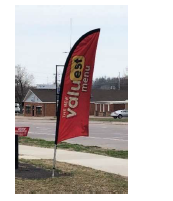 Flag Sign
 Pole Banner Sign
Sign, Business: A sign that directs attention to a business or profession, or to a commodity, service, or entertainment sold or offered upon the premises where such a sign is located.
Sign, Electronic: Signs whose alphabetic, pictographic or symbolic informational content can be changed or altered on a fixed display screen composed of electrically illuminated segments. For the purposes of this Ordinance, electronic signs within ground or wall signs are regulated as one (1) of the two (2) following types:
1. Electronic Display Screen: A sign, or portion of a sign, that displays an electronic image or video, which may or may not include text. This definition includes television screens, plasma screens, digital screens, flat screens, LED screens, video boards and holographic displays.
2. Electronic Message Sign: Any sign, or portion of a sign, that uses changing lights to form a sign message or messages in text form wherein the sequence of messages and the rate of change is electronically programmed and can be modified by electronic processes. Time and temperature signs are considered electronic message signs.
Electronic Display Screen Electronic Message Sign
Sign, Flashing: A sign with blinking or flashing lights, or other illuminating devices that change light intensity, brightness or color, traveling/chasing or blinking lights, or rotating beacons are prohibited. Electronic signs, as permitted by Section 10.5, are not considered flashing signs; however, the messages or images on an electronic sign may not imitate flashing signs.
Sign, Illuminated: Any sign that has characters, letters, figures, designs or outlines illuminated by electric lights or luminous tubes as a part of the sign.
Sign, Name Plate: Any sign that states the name or address, or both, of the business or occupant of the lot where the sign is placed.
Sign, Monument: Any freestanding sign with its sign face mounted on the ground or mounted on a base at least as wide as the sign and which has a total height not exceeding fourteen (14) feet.
Monument Sign
Sign, Off Premises: A commercial speech sign which directs the attention of the public to a business, commodity, service or entertainment conducted, sold or offered at any location other than upon the premises where such sign is located or to which it is affixed. Also called a billboard.
Sign, Portable: Any sign which is manifestly designed to be transported, including by trailer or on its own wheels, even though the wheels of such sign may be removed and the remaining chassis or support is converted to another sign or attached temporarily or permanently to the ground since this characteristic is based on the design of such a sign.
Portable Sign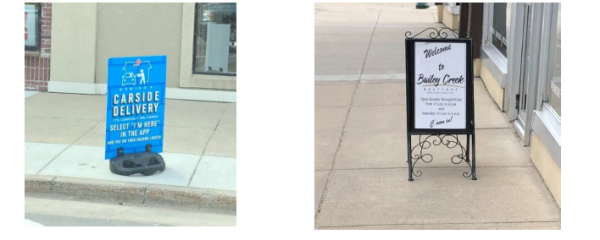
Sign, Projecting: Any sign which is perpendicular to and attached to a building or other structure, and extends beyond the surface of the building or structure to which it is attached by more than twelve (12) inches. A projecting sign does not include a wall sign.
Projecting Sign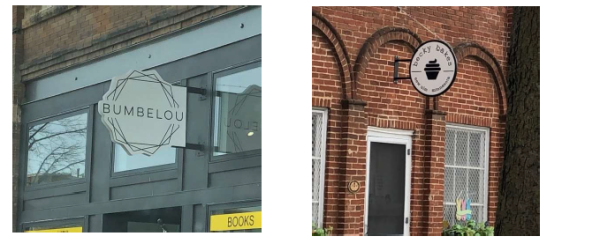
Sign, Pylon: Any freestanding sign which has its supportive structure(s) anchored in the ground and which has a sign face elevated above ground level by pole(s) or beam(s) and with the area below the sign face open.
Pylon Sign
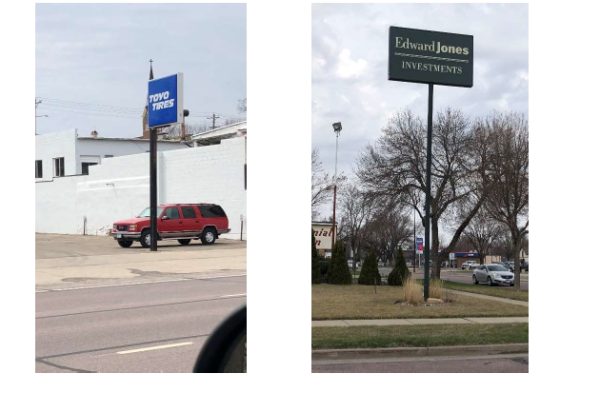 Sign, Roof: Any sign wholly erected, constructed or maintained upon or above the roof or parapet of any building, with the principal support attached to the roof structure.
Roof Sign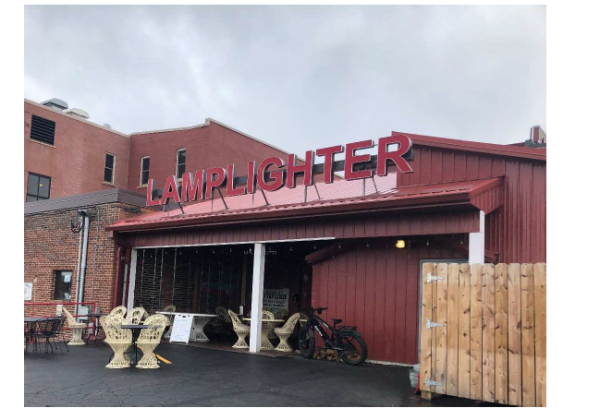
Sign, Rotating: A sign that revolves or rotates on its axis by mechanical means.
Sign, Sandwich Board: A temporary advertising device ordinarily in the shape of a “A”, or some variation thereof, located on the ground, not permanently attached and easily movable, and usually two sided. Also called an A-Frame Sign.
Sign Sandwich Board
 Sign Sales & Services: An establishment where the primary use is the retail sale and service of signs, banners, or similar items.
Sign, Surface Area: The entire area within a single, continuous perimeter enclosing the extreme limits of the actual sign surface. It does not include any structural elements outside the limits of such sign and not forming an integral part of the display. Only one side of the double-face or qualifying V-type sign structure shall be used in computing total surface area. (See Section 10.5 C)
Sign, Temporary: Any sign which is erected or displayed for a specified period of time, including, but not limited to, banners, search lights, portable signs, streamers, pennants, and inflatable devices.
Sign, Total Site: The maximum permitted combined area of all signs allowed on a specific lot.
Sign, Wall: Any building sign attached parallel to, but within twelve (12”) inches of a wall, painted on the wall surface, or erected and confined within the limits of an outside wall of any building or structure, which is supported by such wall or building, and which displays only one (1) sign surface.
Wall Sign
Sign, Window: Any building sign, picture, symbol, or combination thereof, designed to communicate information about an activity, business, commodity, event, sale, or service, that is placed inside a window/door or upon the windowpanes or glass and is visible from the exterior of the window.
Window Sign
 Sleeping Room: A room in a structure rented for sleeping with access to a bathroom, with or without access to a kitchen.
Slope: Means the degree of deviation of surface from the horizontal, usually expressed in percent or degrees.
Steep Slope: Land where agricultural activity, or development is either not recommended or described as poorly suited due to slope steepness and the site's soil characteristics, as mapped and described in available county soil surveys or other technical reports, unless appropriate design and construction techniques and farming practices are used in accordance with the provisions of this Ordinance. Where specific information is not available, steep slopes are lands having average slopes over eighteen percent (18%), as measured over horizontal distances of fifty (50) feet or more, that are not bluffs.
Stoop: A landing pad providing ingress and egress from an above grade door in the principal building. A stoop may be roofed, but cannot be enclosed.
Solar Energy: Radiant energy (direct, diffuse, and reflected) received from the sun.
Solar Energy System: An active solar energy system that collects or stores energy that transforms solar energy into another form of energy or transfers heat from a collector to another medium using mechanical, electrical, thermal or chemical means.
Solar Energy System, Building or Other Architecturally Integrated: An active solar energy system that is an integral part of a principal or accessory building, rather than a separate mechanical device, replacing or substituting for an architectural or structural component of the building. Building-integrated systems include, but are not limited to, photovoltaic or thermal solar systems that are contained within roofing materials, windows, skylights and awnings.
Solar Energy System, Community: A solar-electric array that provides retail electric power (or a financial proxy for retail power) to multiple community members or businesses residing or located off-site from the location of the solar energy system.
Solar Energy System, Ground Mounted: A freestanding solar panels mounted onto the ground by use of racks or poles or similar apparatus.
Solar Energy System, Roof or Building Mounted: A solar energy system that is mounted to the roof or building using brackets, stands or other apparatus.
Solar Farm: A commercial facility that converts sunlight in electricity, whether by photovoltaics (PV), concentrating solar thermal devices (CST) or other conversion technology, for the principal purpose of wholesale sales of generated electricity.
Solar Hot Water System: A system that includes a solar collector and heat exchanger that heats or preheats water for building heating systems or other hot water needs.
Special Event: An event which plans for or can reasonably expect to attract more than 100 persons at any one time such as cultural events, musical events, celebrations, festivals, fairs, carnivals, etc.
Speech, Commercial: Speech advertising a business, profession, commodity, service or entertainment.
Speech, Noncommercial: Dissemination of messages not classified as commercial speech which include, but are not limited to, messages concerning political, religious, social, ideological, public service and informational topics.
Site Landscaping: Required vegetative material consisting of trees and shrubs that are placed on a development site to soften built edges and provide transitions. [See Section 10.2]
Sports & Health Facility: A facility, for profit or nonprofit, where members or nonmembers pay a fee to use equipment or space for the purpose of physical exercise, including but not limited to swimming, court games, aerobic and muscular exercise programs. Such facility may include as an accessory use, personal services to patrons, including but not limited to therapeutic massage, tanning, saunas, whirlpools and locker rooms.
Start of Construction: The first land-disturbing activity associated with a development including land preparation such as clearing, grading, excavation and filling.
Story: That portion of a building included between the surface of any floor and the surface of the next floor above it or, if there is not a floor above it, the space between the floor and the ceiling next above it.
Street, Collector: Streets that form the link between arterial streets and local streets, and provide access to community services and businesses.
Street, Major Arterial: Streets that serves as a regional transportation corridor and are designated as federal or state highways that connect New Ulm with other cities.
Street, Minor Arterial: Streets that are primarily segments of the Brown and Nicollet County highway system that connect New Ulm with the surrounding region.
Structure: Anything constructed or erected on the ground or attached to the ground or on-site utilities, including, but not limited to, buildings, factories, sheds, detached garages, cabins, manufactured homes and other similar items.
Structural Alterations: Any change in the supporting members of a building, such as bearing walls, columns, beams or girders.
Street: A public right of way 30 feet or more in width.
Street, Cul-de-Sac: A minor street with only one (1) outlet and having an appropriate terminal for the safe and convenient reversal of traffic movement.
Street Frontage: In the case of a building lot abutting upon only one street, the frontage line is the line parallel to and common with the right-of-way. In the case of a corner lot, that part of the building lot having the narrowest frontage on any street shall be considered the frontage line. For the purpose of determining yard requirements on corner lots and double frontage lots, all sides of a lot adjacent to streets shall be considered frontage, and yards shall be provided as required in this Ordinance.
Subdivision: Any land, vacant or improved, which is divided or proposed to be divided into two (2) or more lots, parcels, sites, units, plots, tracts, or interests for the purpose of offer, sale, lease, or development whether immediate or future, either on the installment plan or upon any and all other plans, terms, and conditions. Subdivision includes the division or development of residential and non-residential zoned land, whether by deed, metes and bounds description, devise, intestacy, lease, map, plat, or other recorded instruments. Subdivision includes resubdivision.
Swimming Pool, Private Residential: Any outdoor structure intended for swimming or wading located on private residential property that exceeds both of the following:
- A depth capacity of more than 24 inches at any point.
- Total volume in excess of 5,000 gallons.
Taproom: A facility for the on-sale and consumption of brewery made products on or adjacent to premises owned by a brewery.
Tattoo, Tattooing: Any method of placing designs, letters, scrolls, figures, symbols or any other mark upon, under or in the skin with ink or any other substance resulting in the coloration of the skin by the aid of needles or any other instruments which puncture any portion of the skin to any degree.
Temporary Mobile Cell Site: Any mobile tower, pole, or structure located on a trailer, vehicle, or temporary platform intended primarily for the purpose of mounting an antenna or similar apparatus for personal wireless services, also commonly referred to as cellular on wheels (COW).
Tower: Any ground or roof-mounted pole, spire or structure, or combination thereof, taller than fifteen (15) feet, including supporting lines, cables, wires, braces and masts, intended primarily for the purpose of mounting an antenna, meteorological device, telecommunications or similar apparatus above grade.
Transportation Services: Vehicles that travel by public or private carrier and related cost to activities and program resources in the community, including consultation, medical and other services.
Trash Handling & Recycling Collection Area: Areas designated for the accumulation, storage and pick-up of refuse and recyclable material.
Tree Caliper: The American Association of Nurserymen standard for trunk measurement of nursery stock, as measured at six (6) inches above the ground for trees up to and including four (4) inch caliper size, and as measured at twelve (12) inches above the ground for larger sizes.
Tree Canopy, Existing: The crowns of all healthy self-supporting canopy trees with a diameter at breast height (DBH) of ten inches or greater and understory trees with a caliper size of four inches or greater at breast height.
Tree, Deciduous: A tree that generally loses all of its leaves for part of the year.
Tree, Evergreen: A tree that retains some or most of its leaves or needles throughout the year.
Tree, Understory: Ornamental tree that is, when mature, less than eight (8) feet in height.
Truck or Freight Terminal: A building or area in which freight brought by truck is assembled and/or stored for routing by truck or an area where buses and trucks are stored and where minor maintenance of these types of vehicles is performed.
Use: The purpose for which land or premises or a building thereon is designated, arranged or intended, or for which it is or may be occupied or maintained.
Utilities: Any person, firm, corporation, municipal department or board fully authorized to furnish, and furnishing under municipal regulation, to the public, electricity, gas, steam, communication services, transportation or water. For the purpose of this Ordinance, commercial wireless telecommunication service facilities are not considered a public utility use.
Variance: A modification or variation of the provisions of this Ordinance, as applied to a specific piece of property, except that modification in the allowable uses within a zoning district shall not be considered a variance.
Vegetation: Means the sum total of plant life in some area, or a plant community with distinguishable characteristics.
Vehicle, Large Commercial: A vehicle used for commercial purposes which is a semi-tractor and/or semi-trailer, dump truck, or any other commercial vehicle that does not qualify under the definition of a “Small Commercial Vehicle.”
Vehicle, Passenger: A vehicle capable of moving under its own power which is licensed and operable for use on public roadways, and shall include the following vehicles: Passenger automobiles, pick-up trucks and sport-utility vehicles of less than 9,000 pounds gross vehicle weight, pick-up trucks and sport-utility vehicles of between 9,000 pounds and 13,000 pounds with no visible commercial messages, commuter vans of a capacity up to 16 persons, and motorcycles or other lawfully permitted vehicles.
Vehicle and Equipment, Recreational: A recreational vehicle is any of the following:
- Any self-propelled vehicle and any vehicle propelled, drawn, towed or carried by a self-propelled vehicle, which is designed to be used for temporary living quarters.
- A non-motorized trailer intended and generally used for transporting recreational vehicles such as boats and snowmobiles.
- A van or truck with a slide-in camper which is not used primarily for day to day transportation needs.
- Snowmobiles, all terrain vehicles, any type of water craft and similar vehicles. Such vehicles which are placed on a trailer shall, together with the trailer, be considered a recreational vehicle.
- Hobby vehicles, defined as passenger automobiles with antique or collector license plates, and specialized off-road vehicles which are not primarily used for day to day transportation needs. Such vehicles which are placed on a utility trailer shall, together with the trailer, be considered a single recreational vehicle.
- A trailer designed for carrying property or material.
Vehicle, Small Commercial: A vehicle used primarily for commercial purposes, including pickup trucks and sport-utility vehicles larger than 9,000 pounds gross vehicle weight, but less than 13,000 pounds gross vehicle weight which display a commercial business message, and all other commercial vans or trucks, regardless of commercial message which are no greater than any of the following dimensions: 22 feet in length, 8 feet in height, and 8.5 feet in width.
Vehicle Fuel Station: A facility for the retail sale of unleaded or diesel gasoline. A vehicle fuel station may include a convenience store or minor auto repair and maintenance of vehicles, such as muffler repair, oil change and lubrication, or tire service and sales. Electric vehicle charging stations may be located at a vehicle fuel station.
Vehicle Sales or Rental: Establishments primarily engaged in the retail sale of new and used—in operating condition—automobiles, noncommercial trucks, motor homes, recreational vehicles or farm machinery; including incidental storage, maintenance, and servicing.
Vehicular Use Area Landscaping, Interior: Vegetative material, structures (walls or fences), berms, and associated ground cover located within the interior of a parking lot, or other vehicular use area for the purposes of providing visual relief and heat abatement. [See Section 10.2]
Vehicular Use Area Landscaping, Perimeter: Vegetative material, structures (walls or fences), berms, and associated ground cover located around the perimeter of a parking lot, or other vehicular use area when such areas are adjacent to a street right-of-way or land in a residential district or residentially developed lands, or property used for the purposes of screening the vehicular use area from off-site views. [See Section 10.2]
Visible: Capable of being seen by a person of normal visual acuity (whether legible or not) without visual aid.
Veterinary Services: An establishment engaged in the practice of veterinary medicine, dentistry or surgery, along with those providing animal related services such as kennels, grooming or breeding services.
Wall: A vertical element with a horizontal length-to-thickness ratio greater than three, used to enclose space.
Waste Disposal & Incineration: A use which focuses on the disposal by abandonment, dumping, burial, burning, or other means and for whatever purpose, of garbage, sewage, trash, refuse, junk, discarded machinery, vehicles or parts thereof, or nontoxic waste material of any kind.
Waste Hauler: A licensed firm who owns, operates, or leases vehicles for the purpose of contracting to collect or transport solid waste or recyclable materials or yard waste from a site for disposal at a different location for a fee.
Warehousing: Structures used for the storage or distribution of goods, manufactured products, supplies and equipment where there is no sale of items to retailer or the general public unless permitted as an accessory use to the warehouse.
Warehouse & Distribution Facility: An establishment engaged in the storage or movement of goods, such as manufactured products, supplies, equipment or food.
Wayside Stand: A temporary structure or vehicle used for the seasonal retail sale of agricultural goods; the stand being clearly a secondary use of the premises which does not change the character thereof.
Wetland: Land which is annually subject to periodic or continual inundation by water and commonly referred to as a bog, swamp or marsh or a surface water feature classified as a wetland in the United States Fish and Wildlife Service Circular No. 39 (1971 edition) as amended.
Wholesale: An establishment primarily engaged in selling and/or distributing merchandise to retailers, to industrial commercial, institutional or professional business users or other wholesaler, or acting as agents or brokers and buying merchandise for, or selling merchandise to, such individuals or companies. This is not considered a commercial use.
Wildlife Area: An outdoor recreation location established to protect those lands and waters that have a high potential for wildlife production, wildlife watching, wildlife-based tourism and other compatible recreational uses.
Wind Energy Conversion System (WECS): A wind-driven machine that converts wind energy into electrical power for the primary purpose of resale or off-site use.
Wholesale Sales: Establishments or places of business primarily engaged in selling merchandise to retailers; to industrial, commercial, institutional, or professional business users; or to other wholesalers. Wholesale establishment does not include contractor’s materials or office or retail sales of business supplies/office equipment.
Yard: [See Section 13.2 (C)(1)(a)]
Yard, Front: [See Section 13.2 (C)(1)(b)]
Yard, Average Front: [See Section 13.2 (C)(1)(c)]
Yard, Rear: [See Section 13.2 (C)(1)(d)]
Yard, Side: [See Section 13.2 (C)(1)(e)]
Yard, Street Side: [See Section 13.2 (C)(1)(f)]
Zoning Map: The map or maps incorporated into this Ordinance as a part hereof, designating the use district.
Amended by Ord. 2025-098 on 3/4/2025

