
Norcross City Zoning Code
ARTICLE II
SUPPLEMENTAL AND ACCESSORY USE STANDARDS
Sec. 202-1.- Applicability.
The following specific requirements apply to each of the following principal and accessory uses in all zoning districts where each principal or accessory use is otherwise permitted by right or as a special use unless otherwise stated in this article.
(Ord. No. 08-2019, § I, 6-3-2019)
Sec. 202-2. - Supplemental use standards.
(a)
Artisan and craft sales. Artisan and craft sales shall be permitted within the R100 residential district as an accessory use under the following regulations. It shall not be the intention of this regulation to prohibit the occasional sale of personal belongings on one's property.
(1)
Permit required.
a.
All artisan and craft sales shall require a permit, which shall be obtained from the Community Development Department by personal application. This permit will contain the name and address of the applicant, and the time frame for which the applicant wishes to sell merchandise and the permit number.
b.
No permit shall be issued for more than four times in any calendar year for a street address.
c.
The property owner and all sellers must obtain the appropriate business license from the General Government Administration Department.
d.
It shall be the responsibility of the property owner to obtain the permit and to post said permit in full view of the public at the place of the artisan and craft sale. It shall be a violation of this regulation to sell merchandise in an artisan or craft market without a proper permit.
e.
Sales are allowed from 8:00 a.m. to 8:00 p.m. on Saturdays only.
f.
Adequate off-street parking must be provided for all sites. No parking in street rights-of-way will be allowed.
g.
Amplified music is not allowed. Acoustic music will be allowed from noon until 6:00 p.m.
(2)
Exclusions. This section shall not regulate the private sale of major possessions such as homes and personal autos.
(b)
Bed and breakfast inns.
(1)
Bed and breakfast inns are permitted only within the national historic district boundaries.
(2)
The dwelling unit in which the bed and breakfast inn operates shall be the principal residence of the owner and lived in by the principal owner when the bed and breakfast inn is in operation.
(3)
The maximum number of guestrooms provided by the bed and breakfast inn shall be six. Unless further restricted by the county Fire Marshal, the maximum occupancy per guestroom shall be no more than three adults.
(4)
Accessory structures and outdoor activities.
a.
Accessory structures may be utilized for guest accommodation purposes as part of a bed and breakfast inn use. Such accessory structures do not have to be physically connected to the principal structure.
b.
Such accessory structures shall have or shall be constructed to have architectural compatibility with the principal structure as determined by the ARB.
c.
Accessory structures used as accommodations for the guests of bed and breakfast inns shall not exceed 50 percent of the gross floor area of the principal structure, and/or more than 50 percent of the total number of guestrooms, and they shall comply with the setback requirements for accessory structures.
(5)
Notwithstanding the limits on number of vehicles in the residential parking ordinance, off-street parking spaces must be provided and shall be a minimum of one per guestroom and a maximum number of non-enclosed parking spaces less than or equal to the number of guestrooms.
(6)
Exterior lighting shall be residential in nature and shall not be directed towards adjacent properties.
(7)
An owner's bed and breakfast inn business license will be required and will be nontransferable. The bed and breakfast inn guest fees will be subject to the city hotel/motel tax.
(c)
Building materials and outdoor storage yards.
(1)
Shall not be located within a required front yard;
(2)
Shall be set back at least 25 feet from any side or rear property lines and shall be screened by a solid fence at least eight feet high set back a similar distance from any side or rear property lines, appropriately landscaped and maintained; and
(3)
If an outdoor storage yard is established in connection with a permitted building, it shall meet the above requirements.
(4)
There will be no variances to the screening and distance requirements when abutting residential uses.
(d)
Chickens. The keeping of chickens for personal pleasure or utility on a lot which contains the dwelling of the property owner is permitted, subject to the following requirements:
(1)
The minimum lot size for the keeping of chickens shall be one-half of an acre;
(2)
The keeping of chickens shall be permitted only on the same lot as the dwelling of the owner;
(3)
Chickens must be kept securely in an enclosed yard or six-sided pen at all times;
(4)
Minimum pen area of chickens shall be ten square feet per chicken;
(5)
Chickens must be housed at least 20 feet from any property line and 50 feet from any residence other than the owner's residence;
(6)
Any structure housing chickens must be located in the rear yard;
(7)
The keeping of roosters is not permitted;
(8)
No more than six chickens shall be permitted on any lot;
(9)
No slaughter of chickens is permitted on the property;
(10)
All enclosed yards and pens permitted herein are "accessory structures" as set forth in section 202-2 and shall comply with that Code section in addition to the requirements set forth above;
(11)
It shall be the duty of the Chief of Police or his delegated representative, including the city Code Enforcement Officer, to administer and enforce the provisions of this subsection.
(e)
Commercial filming operations. Commercial filming operations shall be regulated in this Code, part II, chapter 8, business and business regulations, article V, commercial filming activity.
(f)
Community garden. Community gardens shall be subject to the following requirements:
(1)
The garden shall not be located within any required buffer.
(2)
Signage shall be limited to a single, non-illuminated sign of no more than four square feet.
(3)
Gardening equipment and machinery must be stored in an enclosed, secure building or shed or off-site.
(4)
Composting is permitted on the premises if stored in a manner that prevents odor, insect or rodent infestation and controls runoff into waterways and onto adjacent properties.
(5)
The garden must maintain an orderly appearance and may not be neglected or allowed to become overgrown or eroded.
(6)
If a community garden ceases operation and is no longer desired by the owners, it shall be stabilized with grass, trees and/or shrubbery in accordance with a plan submitted for approval by the Community Development Director.
(g)
Day care.
(1)
Shall comply with all state requirements.
(2)
Shall comply with all health department requirements.
(h)
Fences and walls. Fences and walls shall be permitted in any zoning district and are not subject to setback requirements, except as provided for in this section.
(1)
In a residential zoning district, the following provisions shall apply:
a.
No wall or fence shall exceed eight feet in height within a side yard or rear yard.
b.
No wall or fence that extends into the front yard shall exceed four feet in height, except that any vehicular gate or gatepost within the wall or fence shall not exceed six feet in height. However, no fence shall extend into or across the front yard of any residence in the national historic district or local historic district, except that parcels located on the corner of two streets may have a fence in the front yard adjacent to the secondary roadway upon authorization of the Community Development Department.
c.
No wall or fence constructed of woven wire or metal fabric (e.g. chain link, hog wire or barbed wire) shall extend into a front yard, except that woven wire or metal fabric fences may extend into a front yard when the property contains a minimum of three acres, and only where allowed under this UDO.
d.
Any wall or fence which extends into the front yard, where allowed, on property containing less than three acres shall be ornamental or decorative and may be constructed of brick, stone, wood, stucco, wrought iron or split rail; provided that no wall or fence shall be constructed of exposed concrete block, tires, junk or other discarded materials. Any front yard fence or hedge row, where allowed, shall be setback a minimum of three feet from the edge of the right of way.
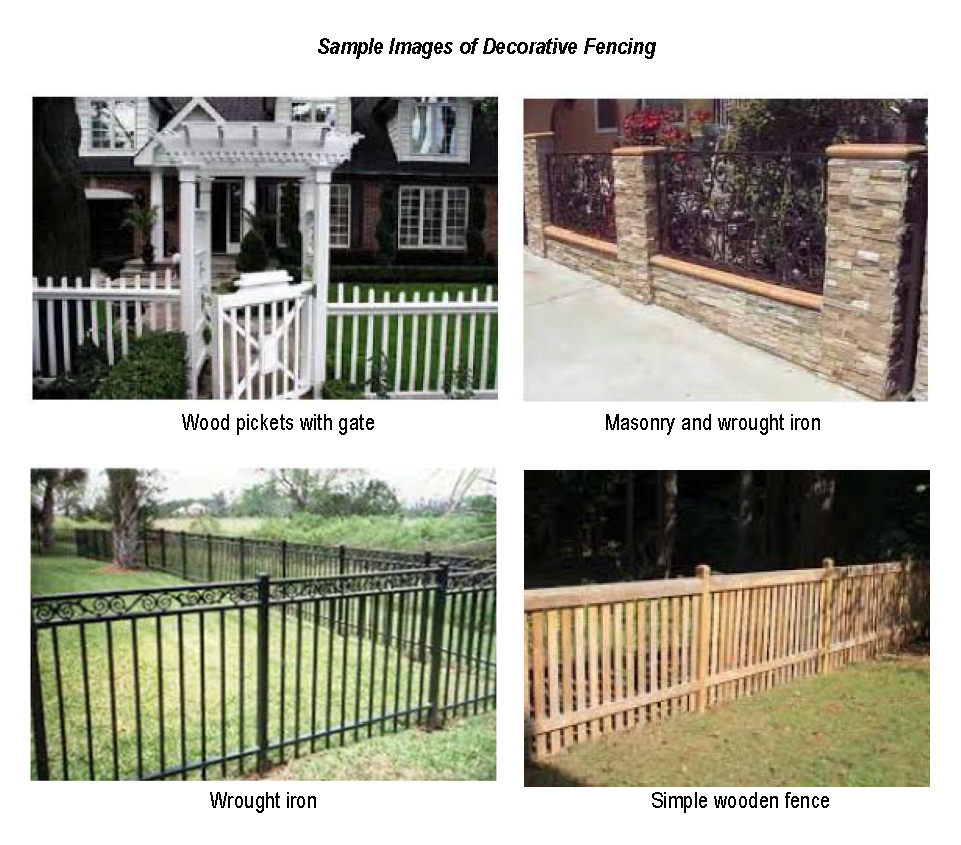
Any subdivision entrance wall or fence shall not exceed ten feet in height and shall be subject to the approval of the Community Development Director after the submission of a landscape plan and an architectural elevation.
(2)
In a nonresidential district, the following provisions shall apply:
a.
Any fence or wall to be located in the HX, historic mixed use district shall be subject to the approval of the Community Development Director.
b.
No fence or wall shall be allowed in any front yard.
c.
Chain link fencing or other similar elements are prohibited, except in the side and rear yards of the M-1 or M-2 districts and only when the fencing elements are not visible from the right-of-way and are screened according to site landscape standards provided in this UDO. Otherwise all fencing shall be decorative in nature as outlined in this UDO.
(3)
In all districts, the following provisions shall apply:
a.
A building permit is required for retaining or freestanding walls that are greater than four feet in height from the top of the footing. A building permit is also required for retaining walls less than four feet in height when the slope of backfill materials exceeds a one-foot rise in three feet length or when the wall will be required to support a surcharge load. For tiered walls, the wall height is measured from top of lowest wall footing to top of highest wall unless the tier is set back far enough to allow each tier to act independently.
b.
A building permit is required for the installation of decorative masonry piers that exceed four feet in height. Masonry piers must have brick, stone, or stucco finish.
(i)
Emission inspection stations.
(1)
The facility shall be in a permanent noncombustible structure.
(2)
The facility shall provide a minimum of four paved parking spaces. Drive-through facilities shall also provide a paved stacking lane for a minimum of four vehicles. Parking spaces and stacking lane shall be striped.
(j)
Event hall.
(1)
Activities at an event hall shall be limited to community or private events celebrating a particular event, anniversary or holiday, such as birthday parties, quinceañeras, weddings, showers, holiday parties, etc.
(2)
No event hall shall be located in a building of less than 2,500 square feet.
(3)
All events at an event hall must be community or private (invitation only) events. No events should be open to the general public except where a part of a community-based event.
(4)
All activities must be subject to a written lease and/or service agreement with the individual or group utilizing the venue.
(5)
The maximum number of guests shall be subject to fire-code limitations or by conditions imposed by council. During inclement weather, there shall be sufficient space to safely shelter guests. Adequate, permanent restroom facilities must be provided, which shall meet the minimum requirements of the unified development ordinance and other applicable city and state regulations.
(6)
Adequate off-street parking must be provided on-site.
(7)
In addition to those standards to be addressed in the applicant's request for a special use permit as provided in article VI of the unified development ordinance, an applicant seeking a special use permit to allow an event hall use on a property must address how additional noise, traffic, and irregular hours of operations (if any) may impact the uses surrounding the property. Further, the applicant must identify similar uses within a mile radius and address whether such a concentration of uses would result in a disproportional proliferation of that or similar uses in the surrounding area.
(k)
Home occupation. In order to protect and preserve the residential character of the city:
(1)
The home occupation must be clearly secondary to the use of the dwelling as a residence and must not change the residential character of the dwelling or lot in any visible manner.
(2)
The home occupation must not create any objectionable odor, noticeable vibration, or offensive noise that increases the level of ambient sound at the property lines.
(3)
The home occupation must not cause unsightly conditions or waste which is visible from off the property.
(4)
The home occupation must not cause interference with radio or television reception in the vicinity.
(5)
The home occupation employees in the residence are only those persons who reside in the residence.
(6)
The home occupation has no signs.
(7)
The home occupation occupies less than one-fourth of the floor area of the dwelling.
(8)
The home occupation has a maximum of one commercial vehicle, that is in compliance with the off-street parking ordinance, parked at the residence.
(9)
The home occupation has no storage outside the residence.
(10)
The home occupation does not create a volume of passenger or commercial traffic that is inconsistent with the normal level of traffic on the street on which the dwelling is located.
(11)
The following uses shall not be permitted as home occupations: massage therapists, psychics and fortunetellers, tattoo and/or body piercing businesses.
(l)
Hotels.
(1)
Guest rooms shall be accessed internally to the building with no direct room access to the outside.
(2)
The lobby shall be a minimum of 700 square feet in size.
(3)
Each hotel/motel site shall be a minimum of two acres.
(4)
Each hotel/motel must provide management on duty 24 hours a day.
(5)
Each guest room shall have a minimum of 300 square feet.
(6)
For buildings three stories or less or containing no more than 130 rooms, each motel/hotel building shall have a minimum roof pitch of four in 12.
(7)
Outside storage of commercial equipment is prohibited.
(8)
No business license shall be issued for any business operating from any guest room of the facility.
(9)
Shall provide a 75-foot natural buffer, enhanced with an additional 25-foot landscaped buffer (total 100 feet) adjacent to residentially zoned property.
(m)
Garage sales. No more than two garage sales per lot are permitted during any 12-month period and each garage sale is limited to a period not to exceed three consecutive days.
(n)
Gasoline pumps. Within the C1, neighborhood business district, gasoline service station pumps are permitted within the front yard setback, provided they are located:
(1)
Not closer than 15 feet to the highway right-of-way; and
(2)
Not less than the existing setback for any residential structure on abutting lots on either the frontage street or a side street.
(o)
Honey bees. The raising and keeping of honey bees for personal pleasure or utility on a lot which contains the dwelling of the property owner of the honey bee hive boxes provided that:
(1)
The lot is at least 10,000 square feet in area; and
(2)
The honey bee hive boxes are in the rear yard and no closer than five feet to any property line and provided that no nuisance is created as defined under other sections of this Code.
(3)
It shall be the duty of the chief of police or his delegated representative, including the city Code Enforcement Officer, to administer and enforce the provisions of this subsection.
(p)
Hookah and smoking related shops. Any shop that involves the onsite sale or use of smoking related products, including hookah, VAPE, cigarettes, and cigars shall adhere to the following requirements:
(1)
Indoor sprinkler systems required.
(2)
May not be located within 500 feet of a school, daycare, park, place of worship or playground.
(q)
Microbreweries or craft breweries.
(1)
Shall be subject to all regulations of chapter 4, article 2 of this Code concerning alcoholic beverages:
(2)
Shall be a maximum of 20,000 square feet.
(3)
No outdoor public address system shall be permitted.
(4)
Production space shall be in a wholly enclosed building.
(r)
Mini-warehouse.
(1)
Must be climate controlled.
(2)
Individual storage units must be accessed from an internal corridor.
(3)
Minimum 35 feet in height.
(s)
Mobile home, manufactured home or modular home. One mobile, manufactured, or modular home as a second and temporary accessory dwelling on a lot, providing the following conditions are met:
(1)
The mobile, manufactured, or modular home is an accessory use on a lot that meets all of the requirements of the R60, single-family residence district, provided further that the occupant of the mobile, manufactured, or modular home and the occupant of the principal dwelling and lot are related to one another, i.e., father, mother, son or daughter.
(2)
The mobile, manufactured, or modular home is not located within any required front or side yard.
(3)
The mobile, manufactured, or modular home is located on a lot that is not less than one acre in size.
(4)
It is the intent herein that when any of the required conditions no longer are met the special exception is rendered invalid and the mobile home must be removed.
(5)
It shall be unlawful for any person to place, store or maintain any trailer in the city except as outlined in this section.
(t)
Motorcycle repair and sales.
(1)
Shall have a minimum three-quarter-acre lot size.
(u)
Motor vehicle related uses.
(1)
No reductions in buffer requirements are allowed when adjacent to a residential use.
(2)
Shall have a minimum lot size of two acres for all automotive related uses including car wash, auto repair, auto sales and auto rental.
(3)
Indoor auto repair shall be permitted provided:
a.
The gross-square-foot area of the business in the building is less than 3,000 square feet.
b.
No auto repairs are conducted outside the building.
c.
No car sales or auto brokerage except in the CAR zoning district.
d.
No outdoor air compressors.
e.
No outdoor incidental uses such as carwashes.
f.
All work on vehicles to be completed inside the structure.
g.
The sides and rear of the business will be screened from view of surrounding properties with an opaque eight-foot fence.
h.
Customer and employee parking allowed in the front.
(4)
All vehicles in sales lots are always in operating condition.
(5)
Motor vehicles for sale shall be parked in marked, striped spaces only, and only in areas designated for the display of vehicles for sale.
(6)
Motor vehicles for sale or rent cannot be parked in areas reserved for customer or employee parking.
(v)
Reserved.
(w.1)
Multi-family dwellings. Multifamily dwellings, which may be duplexes, apartments, condominiums, or planned residential developments, subject to the following provisions:
(1)
All condominium developments shall comply with all state laws regarding condominium developments.
(2)
All planned residential developments shall provide for a mandatory homeowner's association, which shall hold title to all common areas in the development. A declaration of covenants for the development shall be provided to and approved by the city prior to said declaration of covenants being recorded in the public records. Following the approval by the city, the declaration of covenants shall be recorded in the public records of the county, and title to the common areas transferred to the homeowner's association prior to the approval of a final plat for the planned residential development and before any certificates of occupancy for the individual residential units are issued by the city.
(w.2)
General. All developments or redevelopments of property located within the CX and BH zoning districts proposing multi-family uses, whether as a standalone use or as a component of a mixed-use development, shall submit an application and request and obtain a special land use permit as provided herein:
(1)
Contents of multifamily special use application and letter of intent. Applicant's seeking a special land use permit as provided in this section shall submit an application detailing, in addition to such information as is required by section 103-11(c) of this UDO, the following:
a.
The total number of units and the division of bedroom counts proposed;
b.
The total parking spaces proposed;
c.
A traffic study performed by a licensed engineer;
d.
The division and proportion of uses as measured by gross floor area of each building;
e.
Total building height and the approximate height of existing buildings on adjoining parcels;
f.
A community engagement plan providing for at least one applicant-hosted community meeting held at least two weeks before the item is first considered by the city council at a policy work session; and
g.
Evidence of compliance with the standards provided is section 103-11(c) of this UDO.
(2)
No residential only multi-family development in the CX and BH zoning districts shall be permitted to exceed a gross density of 54 units per acre.
(3)
No mixed-use multi-family development in the CX and BH zoning districts shall be permitted to exceed a gross density of 61 units per acre.
(w.3)
Special use standards.
(1)
All applications for special land use permits under this section shall be required to show conformity with section 103-11(a)(2) of this UDO. Additionally, such applications shall be required to meet the requirements provided below based on the gross density of such developments.
(2)
For residential only multi-family developments or mixed-use multi-family developments with a gross density of 35 units per acre or less, the following use provisions and standards shall apply:
a.
Applicant should show that the development has adequate parking facilities in close proximity to the dwelling units such that there is minimal risk of parking overflow upon surrounding areas and public facilities;
b.
Applicant should show that the development will not further burden underperforming public utilities and streets;
c.
Applicant should demonstrate that the development will provide at least three of the following environmental efficiency features:
1.
Green roof components.
2.
Permeable pavement for at least ten percent of total permeable and impermeable pavement coverage.
3.
Native planting.
4.
Stormwater planters or cisterns.
5.
Roof-mounted solar panels.
6.
Electric vehicle charging stations of at least five percent of the total parking spaces.
7.
Energy-efficient windows.
8.
Rain gardens or bio-swales.
9.
Street trees on public rights-of-way.
(3)
For residential-only multi-family developments with a gross density exceeding 35 units per acre, the following use provisions and standards shall apply:
a.
Applicant should demonstrate that a substantial amount of parking for the development shall be provided through structured parking decks such that surface-level parking (not including structured parking) does not exceed 20 percent of the total land area of the development;
b.
Applicant must/should demonstrate that the development will provide at least five of the following environmental efficiency features:
1.
Green roof components.
2.
Permeable pavement for at least ten percent of total permeable and impermeable pavement coverage.
3.
Native planting.
4.
Stormwater planters or cisterns.
5.
Roof mounted solar panels.
6.
Electric vehicle charging stations of at least five percent of the total parking spaces.
7.
Energy efficient windows.
8.
Rain gardens or bio-swales.
9.
Street trees on public rights-of-way.
c.
Applicant should demonstrate that the development provides pedestrian connectivity to commercial/retail opportunities either within or beyond the development and that the development provides connectivity to other pedestrian and recreational opportunities;
d.
Applicant should provide elevations for each of the buildings proposed in the development which shall be subject to review and recommendation by the city's Architectural Review Board prior to the public hearing before the City Council; and
e.
Applicant should demonstrate that the development will not overly burden current public roads; applicant may make such a demonstration by showing performance standards of existing infrastructure in a traffic study and, where appropriate, detail proposed traffic mitigation strategies and infrastructure improvements.
(4)
For mixed-use multi-family developments with a gross density exceeding 35 units per acre, the following use provisions and standards shall apply:
a.
Applicant must demonstrate that the development is a mixed-use development as that term is defined in section 102-2 of the UDO;
b.
Applicant should demonstrate that a substantial amount of parking for the development shall be provided through structured parking decks such that surface-level parking (not including structured parking) does not exceed 20 percent of the total land area of the development;
c.
Applicant should demonstrate that the development will provide at least five of the following environmental efficiency features:
1.
Green roof components.
2.
Permeable pavement for at least ten percent of total permeable and impermeable pavement coverage.
3.
Native planting.
4.
Stormwater planters or cisterns.
5.
Roof-mounted solar panels.
6.
Electric vehicle charging stations of at least five percent of the total parking spaces.
7.
Energy-efficient windows.
8.
Rain gardens or bio-swales.
9.
Street trees on public rights-of-way.
d.
Applicant should demonstrate that the development provides pedestrian connectivity to commercial/retail opportunities either within or beyond the development and that the development provides connectivity to other pedestrian and recreational opportunities;
e.
Applicant should provide elevations for each of the buildings proposed in the development which shall be subject to review and recommendation by the city's Architectural Review Board prior to the public hearing before the City Council; and
f.
Applicant should demonstrate that the development will not overly burden current public roads; applicant may make such a demonstration by showing performance standards of existing infrastructure in a traffic study and, where appropriate, detail proposed traffic mitigation strategies and infrastructure improvements.
(x)
Places of public assembly.
(1)
Lot requirements:
a.
They are located on not less than five acres for places of worship in residential districts only; or
b.
One acre in commercial or mixed use districts, provided that the minimum parking requirements of this UDO can be met.
(2)
A 20-foot undisturbed buffer is provided where the property abuts residential property.
(3)
Schools are located on the same lot as a place of worship and are clearly secondary to the use.
(y)
Static electric transformer or gas regulator stations.
(1)
The structures are placed not less than 50 feet from any property line.
(2)
The structures are enclosed by a woven wire fence at least eight feet high.
(3)
The lot is suitably landscaped, including a buffer strip at least ten feet wide along the side and rear property lines but not extending into the required front yard, planted with evergreen trees and shrubs that grow at least eight feet tall and provide an effective visual screen.
(4)
No vehicles or equipment are stored on the premises.
(z)
Tattoo and/or body piercing establishments.
(1)
Road frontage requirement. The proposed establishment must have road frontage, in conformance with the requirements of this zoning district, on a major arterial street. Major arterial streets are shown on the official thoroughfare map of the city, on file with the office of Community Development.
(2)
Minimum distance requirement from other tattoo and/or body piercing establishment. No tattoo and/or body piercing establishments shall be located, established, maintained or operated on any lot that has a property line within 500 feet of the property line of any other lot on which any other tattoo and/or body piercing establishments are located, established, maintained or operated.
(3)
Minimum distance from protected uses. No tattoo and/or body piercing establishments shall be located, established, maintained or operated on any lot that has a property line within 500 feet of the property line of any lot on which any protected use is located, established, maintained or operated.
(4)
Minimum distance from residential property. No tattoo and/or body piercing establishments shall be located, established, maintained or operated on any lot that has a property line within 500 feet of the property line of any residential property.
(5)
Measurement. For purposes of this subsection, distances shall be measured in a straight line, without regard to intervening structures or objects, from the nearest point on the property line of the lot on which the tattoo and/or body piercing establishments are located to the nearest point on the property line of any residential property or any lot on which a protected use or other tattoo and/or body piercing establishment as the case may be, is established, maintained or operated.
(6)
Limited exception for subsequent protected uses or residential property. A tattoo and/or body piercing establishment lawfully operating under this Code shall not be deemed to be in violation of the location restrictions set forth solely herein because a protected use subsequently locates within the minimum required distance of the tattoo and/or body piercing establishments, or property within the minimum required distance of a tattoo and/or body piercing establishments subsequently becomes residential property. This subsection shall not apply to a tattoo and/or body piercing establishment at a time when an application for a business license for that establishment is submitted after the license has previously expired, has been revoked, or is at that time under suspension.
(aa)
Telecommunications antenna and towers.
(1)
Applicability.
a.
District height limitations. Except as set forth in subsection (c) of this section, the requirements set forth in this section shall govern the location of towers that exceed, and antennas that are installed at a height in excess of, the height limitations specified for each zoning district in which towers and antennas are permitted.
b.
Governmental exemption. The provisions of this section shall not apply to governmental facilities and structures. Private facilities and structures may be permitted on city owned property with the recommendation of the City Manager and approval of the Mayor and Council with no SUP required.
c.
Amateur radio; receive-only antennas. This section shall not govern any tower, or the installation of any antenna, that is under 75 feet in height and is owned and operated by a federally licensed amateur radio station operator or is used exclusively as a receiver-only antenna. Amateur radio towers in excess of 75 feet may be located in any zoning district and need only comply with subsection (5) to the extent required by subsection (5)a.2. and 3., and subsections b., site plan, c., factors considered in granting special use permits, e., setbacks and separation, and f., security fencing, only to the extent that an anti-climbing device will be required.
d.
Grandfathered towers and antennas. Any tower or antenna existing prior to January 1, 2008, shall not be required to meet the requirements of this section, other than the requirements of subsection (2)e., federal requirements and f., building codes; safety standards. Any such existing towers or antennas that fail to meet the requirements of this section shall be referred to in this section as grandfathered towers or grandfathered antennas. The provisions applicable to nonconforming uses set forth in this UDO shall apply to grandfathered towers and grandfathered antennas.
(2)
General guidelines and requirements.
a.
Purpose; goals. The purpose of this section is to establish guidelines for the siting of towers and antennas. The goals of this section are to:
1.
Encourage the location of towers in nonresidential areas and minimize the total number of towers throughout the community;
2.
Encourage strongly the joint use of new and existing tower sites;
3.
Encourage users of towers and antennas to locate them, to the extent possible, in areas where the adverse impact on the community is minimal;
4.
Encourage users of towers and antennas to configure them in a way that minimizes the adverse visual impact of the towers and antennas; and
5.
Enhance the ability of the providers of telecommunications services to provide such services to the community quickly, effectively, and efficiently.
b.
Principal or accessory use. Antennas and towers may be considered either principal or accessory uses. A different existing use or an existing structure on the same lot shall not preclude the installation of an antenna or tower on such lot. For purposes of determining whether the installation of a tower or antenna complies with district development regulations including, but not limited to, setback requirements, lot-coverage requirements, and other such requirements, the dimensions of the entire lot shall control, even though the antennas or towers may be located on leased parcels within such lots.
c.
Inventory of existing sites. Each applicant for an administrative approval or a special use permit shall provide to the Community Development Department an inventory of its existing towers, including specific information about the location, height, and design of each tower. The Community Development Department may share such information with other applicants applying for administrative approvals or special use permits under this section or other organizations seeking to locate antennas within the jurisdiction of the Mayor and Council.
d.
Aesthetics; lighting. The guidelines set forth in this subsection, towers, and the installation of all antennas, governed by this section; provided, however, that the Mayor and Council may waive these requirements if, in its sole discretion, it determines that the goals of this section are better served thereby.
1.
Towers shall either maintain a galvanized steel finish, or subject to any applicable standards of the FAA, be painted sky blue or gray, to reduce visual obtrusiveness.
2.
At a tower site, the design of the buildings and related structures shall, to the extent possible, use materials, colors, textures, screening, and landscaping that will blend the tower facilities to the natural setting and built environment.
3.
If an antenna is installed on a structure other than a tower, the antenna and supporting electrical and mechanical equipment must be of a neutral color that is identical to, or closely compatible with, the color of the supporting structure to make the antenna and related equipment as visually unobtrusive as possible.
4.
Towers shall not be artificially lighted, unless required by the FAA or other applicable authority. If lighting is required, the governing authority may review the available lighting alternatives and approve the design that would cause the least disturbance to the surrounding views.
e.
Federal requirements. All towers must meet or exceed current standards and regulations of the FAA, the FCC, and any other agency of the federal government with the authority to regulate towers and antennas. If such standards and regulations are changed, then the owners of the towers and antennas are governed by this chapter shall bring such towers and antennas into compliance with such revised standards and regulations.
f.
Building codes; safety standards. To ensure the structural integrity of towers, the owner of a tower shall ensure that it is maintained in compliance with standards contained in applicable local building codes and the applicable standards for towers that are published by the Electronic Industries Association, as amended from time to time.
(3)
Permitted uses. New towers shall be allowed only in M1, light industry district, and C2, general business district, CX community mixed-use and BH Buford Highway zoning districts by special use permit under this section, including the procedures set forth in subsection (5), special use permit, and as governed by this UDO.
(4)
Administrative approvals. The Community Development Department head may administratively approve the installation of an antenna on any existing tower or structure (such as a building, sign, light pole, water tower, or other freestanding nonresidential structure) whether or not the structure or tower is grandfathered so long as the additional structure adds no more than 20 feet to the height of the existing tower or structure. This administrative approval process may include any related equipment structures.
(5)
Special use permits.
a.
General. The following provisions shall govern the issuance of special use permits:
1.
Towers are permitted as of right in the M1 district. A special use permit is required for the installation and construction of a tower or antenna in the C2, CX, and BH zoning districts.
2.
In granting a special use permit, the Mayor and Council may impose zoning conditions to the extent the Mayor and Council concludes such conditions are necessary to buffer or otherwise minimize any adverse effect of the proposed tower on adjoining properties.
3.
Any information of an engineering nature that the applicant submits, whether civil, mechanical, or electrical, shall be certified by a licensed professional engineer.
b.
Site plan. Each applicant requesting a special use permit under this section shall submit a scaled site plan and a scaled elevation view and other supporting drawings, calculations, and other documentation, signed and sealed by appropriate professional engineers, showing the location and dimensions of all improvements, including information concerning topography, radio frequency coverage, tower height requirements, setbacks, drives, parking, fencing, landscaping, adjacent uses, and other information the city determines is necessary to assess compliance with this section.
c.
Factors considered in granting special use permits. The Mayor and Council shall consider the following factors in determining whether to issue a special use permit, although the Mayor and Council may waive or reduce the burden on the applicant of one or more of these criteria, if, in the sole discretion of the Mayor and Council, the goals of this section are better served thereby:
1.
Height of the proposed tower;
2.
Proximity of the tower to residential structures and residential district boundaries;
3.
Nature of uses on adjacent and nearby properties;
4.
Surrounding topography;
5.
Surrounding tree coverage and foliage;
6.
Design of the tower, with particular reference to design characteristics that have the effect of reducing or eliminating visual obtrusiveness; and
7.
Availability of suitable existing towers and other structures as discussed in subsection d., availability of suitable existing towers or other structures of this section.
d.
Availability of suitable existing towers or other structures. No new tower shall be permitted unless the applicant demonstrates to the reasonable satisfaction of the Mayor and Council that no existing tower or structure can accommodate the applicant's proposed antenna. Evidence submitted to demonstrate that no existing tower or structure can accommodate the applicant's proposed antenna may consist of any of the following:
1.
No existing towers or structures are located within the geographic area required to meet applicant's engineering requirements.
2.
Existing towers or structures are not of sufficient height to meet applicant's engineering requirements.
3.
Existing towers or structures do not have sufficient structural strength to support applicant's proposed antenna and related equipment.
4.
The applicant's proposed antenna would cause electromagnetic interference with the antenna on the existing towers or structures, or the antenna on the existing towers or structures would cause interference with the applicant's proposed antenna.
5.
The fees or costs required to share an existing tower or structure or to adapt an existing tower or structure for sharing are unreasonable. Costs exceeding new tower development are presumed unreasonable.
6.
Property owners or owners of existing towers or structures are unwilling to accommodate reasonably the applicant's needs.
7.
The applicant demonstrates that there are other limiting factors that render existing towers and structures unsuitable.
e.
Setbacks and separation. The following setbacks and separation requirements shall apply to all towers and antennas for which a special use permit is required; provided, however, that the Mayor and Council may, in its sole discretion, reduce the standard setbacks and separation requirements if the goals of this section would be better served thereby.
1.
Towers must be set back a distance equal to the height of the tower from any offsite residential structure.
2.
Towers, guys, and accessory facilities must satisfy the minimum district yard setback requirements.
3.
Towers over 90 feet in height shall not be located within 1,000 feet from any existing tower that is over 90 feet in height.
f.
Security fencing. Towers shall be enclosed by security fencing not less than six feet in height and shall be equipped with an appropriate anticlimbing device; provided, however, that the Mayor and Council may, in its sole discretion, waive such requirements, as it deems appropriate.
g.
Landscaping. The following guidelines shall govern the landscaping surrounding towers for which a special use permit is required; provided, however, that the Mayor and Council may, in its sole discretion, waive such requirements if the goals of this section would be better served thereby.
1.
Tower facilities shall be landscaped with a buffer of plant materials that effectively screens the view of the tower compound from adjacent residential property. The standard buffer shall consist of a landscaped strip at least four feet wide outside the perimeter of the compound.
2.
In locations where the visual impact of the tower would be minimal, the landscaping requirement may be reduced or waived altogether.
3.
Existing mature tree growth and natural land forms on the site shall be preserved to the maximum extent possible. In some cases, such as towers sited on large, wooded lots, natural growth around the property perimeter may be a sufficient buffer.
(6)
Removal of abandoned antennas and towers. Any antenna or tower that is not operated for a continuous period of 12 months shall be considered abandoned, and the owner of such antenna or tower shall remove same within 90 days of receipt of notice from the Mayor and Council notifying the owner of such abandonment. If there are two or more users of a single tower, then this provision shall not become effective until all users cease using the tower.
(bb)
Temporary building.
(1)
A temporary modular or mobile building or buildings for use in connection with a construction project of land subdivision development shall be permitted on the land of the project during the construction period.
(2)
Temporary modular or mobile buildings used in conjunction with a special event and authorized to be located on public property shall be permitted during the event for no more than three days.
(cc)
Temporary shelter.
(1)
No temporary shelter use shall be located, established, maintained or operated on any lot that has a property line within 1,000 feet of the property line of any other lot on which any other temporary transitional housing establishment is located, established, maintained or operated.
(2)
The applicant for such development is granted a special use permit by the governing authority only after receiving recommendation from the Community Development Department Director and the Planning and Zoning Board after a public hearing.
(3)
The shelter site should have ready access to a major street or state highway, serviced by public transportation; and proximity to local commercial districts.
(4)
The applicant for such a development shall provide to the Community Development Department a business plan outlining the mission of the institution and its proposed clientele, uses, services, a statement of financial stability, and a statement of other similar shelters the applicant has established.
(5)
All temporary shelters shall comply with chapter 42 of this Code, pertaining to temporary shelters.
(6)
Issuance of special use permits for temporary shelters shall be granted to the owner of the shelter at the time of application. Should the ownership of the shelter change, the special use permit shall be deemed expired and a new special use permit must be requested.
(dd)
Truck terminal.
(1)
Terminal shall have ready access to a designated truck route on the long-range roadway classification map of the city, which can be found in the latest adopted version of the city comprehensive plan.
(2)
Terminal shall not be within 500 feet of a residential use.
(ee)
Wholesaling and warehousing with offices and accessory retail sales. Office and accessory retail sales shall not exceed 20 percent of the gross floor area of the wholesale/warehouse.
(ff)
Designation of street numbers.
(1)
Each one- and two-family dwelling unit shall have posted and maintained in a conspicuous place on the property, visible from the street providing general public access, the address of such dwelling unit in figures at least three inches high on a contrasting background that will allow 24-hour visibility.
(2)
Each multifamily dwelling shall have posted and maintained in a conspicuous place on the building, visible from the parking lot or street providing general public access, the address or number of the building in figures at least six inches high on a contrasting background, and each individual apartment/unit within the building shall be marked on or about its main entrance with individual apartment/unit number and/or address in figures at least three inches high on a contrasting background that will allow 24-hour visibility. In addition to the above, where a multifamily building has more than one exterior entrance, each such entrance shall be marked, in figures at least three inches high on contrasting background, with the number and/or address of each and every individual apartment/unit to which access is provided through that common entrance.
(3)
Each business or other nonresidential building shall have posted and maintained in a conspicuous place on the property, visible from the street providing public access, the address of such building in figures at least four inches high on a contrasting background that will allow 24-hour visibility. If the numbers are not placed within 15 feet of the back of the street curbing or edge of the street surface, then such figures shall be at least six inches high. In cases where there is a loading deck in the rear of a warehouse building, the numbers must be displayed in the same manner as described above.
(4)
A quadrant designation will be posted as part of the address in figures at least two inches high on a contrasting background of a material that will allow 24-hour visibility and be placed with the number designation.
(gg)
Car washes. All newly constructed conveyor car washes shall install a recycled water system which captures and reuses water used in the wash or rinse cycles. A minimum of 50 percent of the water utilized shall be recycled. Car wash facilities, including hand car washes, shall utilize floor drains connected to the sanitary sewer system for collection and proper disposal of all wastewater.
(Ord. No. 08-2019, § I, 6-3-2019; Ord. No. 14-2019, 11-4-2019; Ord. No. 03-2020, § I, 4-6-2020; Ord. No. 12-2020, § I, 12-7-2020; Ord. No. 08-2022, § I, 8-1-2022; Ord. No. 06-2023, § I, 7-10-2023; Ord. No. 09-2025, § 1, 12-5-2025; Ord. No. 02-2026, § III, 2-2-2026)
Sec. 202-3. - Accessory uses or structures.
(a)
General. In general, unless otherwise permitted by this section:
(1)
Accessory uses or structures shall be permitted only in rear yards.
(2)
An accessory use or structure shall be set back not less than five feet from any lot line.
(3)
No accessory building shall be erected on a lot prior to the time of construction of the principal building to which it is an accessory.
(4)
In residential districts the total square footage of accessory structures shall not exceed one-half the size of the principal structure.
(5)
If an accessory building exceeds 500 square feet, it shall be sided in wood, stucco or brick. Metal or vinyl siding is not permitted.
(6)
Accessory structures over 32 square feet shall require a building permit.
(b)
Accessory dwelling unit (ADU). Allowed only in single-family residential zoning districts.
(1)
An ADU may be developed in or behind an existing or new main dwelling.
(2)
To keep true to its accessory size, an ADU may not exceed 40 percent of the floor area of the main dwelling.
(3)
An ADU may have up to two bedrooms.
(4)
The owner of the property is required to reside in either the main dwelling or the ADU, is required to be currently receiving a homestead on the property, or is required to demonstrate that an application has been submitted for the following taxable year.
(5)
If detached from the main dwelling, an ADU must be located in the rear yard and have a footprint no greater than 30 percent of the rear yard.
(6)
If the ADU is combined with a garage, the total floor area may be in addition to the square footage of the garage.
(7)
The ADU shall meet all rear and side yard setback requirements of the principal structure and when detached, be at least five feet away from the principal structure.
(8)
The ADU shall not be higher than the main dwelling.
(9)
One parking space for every 750 square feet of heated area.
(10)
Only one ADU per lot.
(c)
Donation and drop-off boxes.
(1)
Findings and intent.
a.
The purpose of this section is to establish minimum requirements and standards for registration and placement of donation drop-off boxes in order to promote and protect the public health, safety, convenience, order and general welfare of the citizens of the city.
b.
The Council finds that:
1.
There is a need to establish a registration system for donation drop-off boxes to protect the health, welfare and safety of all citizens, to protect property values for all property owners and to encourage proper upkeep and maintenance of such properties.
2.
The lack of adequate maintenance and security of donation drop-off boxes have an adverse effect on the property values and quality of life of neighboring properties and are detrimental to the health, welfare and safety of all citizens.
3.
Improperly maintained and secured donation drop-off boxes can become a hazard to the health and safety all citizens and the owners of neighboring properties.
4.
Difficulties often arise in locating the person responsible for the condition of donation drop-off boxes. This proposed system will require owners and agents to provide the city with official information for contacting the party responsible for bringing the donation drop-off boxes into compliance with applicable provisions of state and local laws and regulations.
(2)
Procedures. Donation drop-off boxes shall be permitted only in accordance with the following standards and procedures:
a.
Donation drop-off boxes shall not be allowed in any residential, industrial or agricultural zoning district.
b.
Donation drop-off boxes are permitted only on properties that contain a primary permitted use.
c.
Donation drop-off boxes are limited to two per property and shall be clearly marked with the names and telephone numbers of the sponsoring organization and/or charity receiving benefit. Only entities or organizations that have a tax status under Section 501(c)(3) of the Internal Revenue Code, as amended, are eligible. Proof of such tax status must accompany an application for a permit to include a letter of determination from the Internal Revenue Service (IRS) indicating valid 501(c)(3) tax status.
d.
Donation drop-off boxes are subject to the issuance of a donation drop-off box permit and which will only be given upon receipt of written authorization of the property owner or their local legal representative.
e.
Donation drop-off boxes shall meet ADA regulations and shall not obstruct pedestrian or vehicular circulation, nor be located in public rights-of-way, required building setbacks, landscape areas, drive aisles, parking spaces, fire lanes, loading zones, buffers, traffic sight lines or any other location that may cause hazardous conditions, constitute a threat to the public safety, or create a condition detrimental to surrounding land uses.
f.
Each donation drop-off box shall have a firmly closing lid and shall have a footprint of no more than five feet by five feet and be no greater than six feet in height.
g.
Donation drop-off boxes may be constructed of painted metal, rubber, wood, or plastic and shall be properly maintained in a safe and good condition.
h.
Donation drop-off boxes shall be clearly marked to identify the specific items and materials requested to be left for donation, the name of the operator or owners of the donation container, the entity responsible for maintenance of the drop-off box and removal of materials from the box and a telephone number where the owner, operator or agent of the owner or operator may be reached at any time. The box shall display a notice stating that no items or materials shall be left outside of the donation drop-off box as well as a notice that shall read "Not for refuse disposal. Liquids are prohibited. Do not use for garbage."
i.
Occupation of parking spaces by donation drop-off boxes shall not reduce the number of available parking spaces below the minimum number required for the site.
j.
All donated items must be collected and stored in the donation drop-off box. Donated items or materials shall not be left outside of donation drop-off boxes and the area around each box shall be maintained by the owner or operator, or the property owner free of litter.
k.
In addition to the above referenced requirements and procedures, donation drop- off boxes that accept used clothing (exclusively or in part) shall adhere to the following minimum regulations pertaining to:
1.
Minimum pickup shall be at least two times per week.
2.
The containers must be sealed and covered with swinging lids that automatically close. They must regularly be disinfected with an effective germicide.
(d)
Drive-thru and drive-in service.
(1)
Drive-through service windows shall provide adequate queue space for a minimum of five cars per lane.
(2)
Stacking lanes shall be delineated from traffic aisles, other stacking lanes and parking areas with striping, curbing, landscaping and the use of alternative paving materials or raised medians.
(3)
Stacking lanes shall be designed to prevent circulation congestion, both on site and on adjacent public streets. The circulation shall:
a.
Separate drive-through traffic from site circulation;
b.
Not impede or impair access into or out of parking spaces;
c.
Not impede or impair vehicle or pedestrian traffic movement; and
d.
Minimize conflicts between pedestrian and vehicular traffic with physical and visual separation between the two.
(4)
Stacking lanes shall not interfere with required loading and trash storage areas and loading or trash operations shall not impede or impair vehicle movement. If said separate stacking lane is curbed, an emergency by-pass or exit shall be provided.
(5)
No outdoor speakers shall be established within 200 feet of any residential zoning district.
(e)
Food vendor, mobile. Mobile food vendors may only be located on a lot with a principally permitted use on the same zoning lot, provided the following conditions can be met:
(1)
Mobile food vendors may not conduct sales when parked on a public street unless approved for a city sponsored or sanctioned event.
(2)
The mobile food vendors must be licensed by the Health Department and have a valid business license for food truck operations.
(3)
Reserved.
(4)
Temporary outdoor seating is only permitted upon review and approval of the Community Development Director.
(5)
Mobile food vendors shall not block any ingress/egress or vehicular circulation in a parking lot, loading/unloading area or building entrance.
(6)
Mobile food vendors shall not block any fire hydrant or fire lane.
(7)
Mobile food vendors operations shall be limited to the operating hours of the primary business on the lot.
(8)
Mobile food vendors operations shall be located a minimum of ten feet from a residential driveway.
(9)
No audio speakers or on-site/off-site freestanding signage shall be permitted other than what is displayed on the mobile food vendors.
(10)
Grease, liquid waste and garbage shall not be disposed of on-site.
(11)
Mobile food vendors shall be subject to the all other applicable city and county ordinances related to food operation.
(f)
Solar panels. Solar panels are permitted as an accessory use in all districts to promote clean, sustainable and renewable energy resources. The intent of these regulations is to establish general guidelines for the location of solar panels and solar collection systems to prevent off-site nuisances including unreasonable visual interference, light glare and heat that the incorrect placement of solar panels or solar collection systems may create such that they may have a negative effect on surrounding property values. No solar panel or solar collection system shall be constructed, erected, installed or located proper approval has been obtained pursuant to this section.
Residential or commercial solar panels not located on the principal building shall be considered an accessory structure and shall be located on site according to the provisions listed below:
(1)
Location. In order to provide location flexibility, and to install the solar equipment in the most efficient location, the accessory structure can be located in the side and front yard without the need of a board of appeals variance approval if the following requirements are met:
a.
The ARB shall review an application for any proposed solar equipment located in the front or side yard. At a minimum, the ARB application shall include the following information:
1.
Completed ARB certificate of appropriateness application.
2.
A site plan, drawn to scale, showing all existing site conditions and the proposed location of the solar equipment.
3.
A landscape plan, drawn to scale, that shows screening measures of the solar equipment. The landscape plan shall also include elevations, details, plant schedule and any other information determined by the Community Development Director.
b.
Prior to the installation of any solar equipment, the applicant shall obtain a building permit from the Community Development Department. The building permit application shall match all building related conditions from the ARB review.
(2)
Requirements and regulations.
a.
Solar panels or solar collection systems shall conform to or be evaluated for compliance with the following standards:
1.
The proposed system is no larger than necessary to provide 120 percent of the electrical energy requirements of the structure to which it is accessory to as determined by a contractor licensed to install solar and photovoltaic energy systems.
2.
If roof mounted, the solar or photovoltaic system shall:
a)
Be flush mounted on the roof unless good cause is shown by the applicant that the solar panel is not at an appropriate angle to obtain maximum sun exposure if mounted flush to the roof.
b)
Be in the most inconspicuous location on the roof so as not to be seen from the street, if possible, and still be able to function as designed.
c)
Not extend higher than the peak of a sloped roof or higher than five feet from the top of a flat roof.
3.
If freestanding, the solar or photovoltaic system shall:
a)
Not extend more than ten feet above the existing grade in residential districts. In all other districts, the maximum height of a solar or photovoltaic system will be determined on a case by case basis upon plan review.
b)
Not be in the front yard.
c)
Not be in any required side or rear yard setback areas for accessory uses.
d)
Not be positioned to reflect sunlight onto neighboring property, public streets or sidewalks, including on any neighboring structures.
e)
Be landscaped at the base and the back of the panel structure if structure is visible from neighboring property.
4.
All signs, both temporary and permanent, are prohibited on solar panel or solar collection systems, except as follows:
a)
Manufacturer's or installer's identification information on the system.
b)
Appropriate warning signs and placards.
5.
Solar panel or solar collection systems shall comply with all applicable sections of the city building code and applicable industry standards such as the American National Standards Institute (ANSI), Underwriters Laboratories (UL) or an equivalent third party.
6.
All electrical wires and connections on freestanding solar or photovoltaic collection system shall be located underground.
b.
Utility connection. Solar panels or solar collection systems proposed to be connected to the local utility power grid through net metering shall adhere to all applicable electrical codes and state statues.
c.
Maintenance. All solar panel or solar collection systems shall be maintained in good working order.
(3)
Plan review. A plan shall be submitted for review for freestanding solar panel or solar collection systems. The following items shall be the minimum requirements to be considered a complete application and shall include the following:
a.
Property lines and physical dimensions of the applicant's property.
b.
Location, dimensions and types of existing structures on the subject property and on properties directly contiguous to the subject property.
c.
Location of the proposed solar panel or solar collection system, and associated equipment.
d.
System specifications, including manufacturer, model, kilowatt size.
e.
Documentation shall be provided regarding the notification of the intent with the utility regarding the applicant's installation if the system will be connected to the power grid.
f.
Electrical components in sufficient detail to allow for a determination that the manner of installation conforms to the National Electrical Code (typically provided by the manufacturer).
g.
Compliance with all development standards as outlined in this section.
(g)
Temporary outdoor activities and sales. The Community Development Director, or his designee, is hereby authorized to inspect the temporary outdoor activity for compliance with the following provisions:
(1)
Businesses located in the HX district are exempt from this section.
(2)
Temporary outdoor activities shall be permitted only within the city's M-1, C-2, CX, NX, and BH zoning districts. The Community Development Department shall collect a fee for the issuance of such permit as established in the schedule of fees.
(3)
Peddling goods and merchandise not customarily sold on a day-to-day basis in the business which constitutes the principal use of the premises is prohibited.
(4)
Sales shall be conducted by employees of the principal use and goods shall be owned by the owner or tenant of the principal use, not a consignment operation or temporary arrangement with a transient merchant/vendor.
(5)
No display shall be erected or installed, nor shall any temporary outdoor activities take place, within 50 feet of a county or state right-of-way.
(6)
Temporary outdoor activities shall not be permitted on parcels of property which are less than two acres in size.
(7)
No temporary structure or covering shall be erected as a part of a temporary outdoor activity with the exception that temporary structures shall be permitted as a part of holiday activities.
(8)
Display tables may be used as a part of a temporary outdoor activity.
(9)
No operator, employee, or representative of the operator of a temporary outdoor activity shall solicit directly from the motoring public.
(10)
Temporary outdoor activities shall be permitted only on property where such activities shall not disrupt controlled vehicular ingress and egress or occupy required off-street parking spaces.
(11)
Occupation tax certificates for temporary outdoor activities shall be issued for a period of not more than ten days from the date of initiation of the temporary outdoor activity. All temporary outdoor activities shall require an occupation tax certificate, which is issued by the General Government Administration Department.
(12)
Written permission from the property owner shall be obtained and submitted by the applicant to the Community Development Department prior to the issuance of a temporary outdoor activity permit.
(13)
Temporary outdoor activities, other than holiday activities, shall be conducted on a paved surface and not on grassed or landscaped areas.
(14)
No evidence of the temporary outdoor activity, other than holiday activities, shall remain on a parcel of property for more than 12 consecutive hours of any calendar day.
(15)
Mattress and box spring sets, couches or sofas, refrigerators, washers/dryers, large appliances, office shelving and desks, dining room and kitchen tables and similar large furniture, and heavy construction equipment are specifically prohibited from outdoor display.
(16)
Christmas tree sales shall be permitted between November 1 and December 31 due to the seasonal nature of such sales.
(17)
Pumpkin sales shall be permitted from September 15 through October 31 due to the seasonal nature of such sales.
(18)
Carnivals shall be permitted as temporary outdoor activities so long as no structure or equipment is located within 500 feet of any residential property line.
(19)
Charitable or nonprofit events for which sale proceeds benefit charitable organizations are not regulated by this section.
(Ord. No. 08-2019, § I, 6-3-2019; Ord. No. 11-2021, § I, 10-4-2021; Ord. No. 09-2025, § 1, 12-5-2025; Ord. No. 02-2026, § III, 2-2-2026)

