
Norcross City Zoning Code
ARTICLE III
PARKING AND LOADING
Sec. 203-1.- Purpose.
The purpose of this article is to ensure and regulate the provision of parking and loading spaces and access to such facilities for motor vehicles, to provide the appropriate means for adjusting parking and loading requirements and to provide for suitable parking alternatives.
(Ord. No. 08-2019, § I, 6-3-2019)
Sec. 203-2. - General applicability.
For the purpose of complying with the regulations of this article, no part of a yard or the off-street parking or loading spaces that are required in connection with any building or use shall be included as part of the yard or off-street parking or loading spaces required for another building, except as specifically provided in this article.
(Ord. No. 08-2019, § I, 6-3-2019)
Sec. 203-3. - Spaces required.
(a)
New construction. Any new building or site improvement shall comply with the parking requirements of this article.
(b)
Maintenance and repair. An existing building or site may be repaired, maintained or brought up to code standards without providing additional parking or loading space, provided there is no increase in gross floor area or site area.
(c)
Additions and expansion.
(1)
When an existing building, use or site is increased in gross floor area by up to 25 percent cumulatively, parking and/or loading is required for the additional floor or site area only.
(2)
When an existing building, use or site is increased by more than 25 percent cumulatively, both the existing building, use or site and the additional floor area or site area must conform to these parking and loading requirements.
(d)
Change in use.
(1)
A change in use based on the parking table in section 203-9 or loading table in section 203-14 must comply with the parking and/or loading requirements of this article unless the use has the same or a lesser parking and/or loading requirement than the previous use.
(2)
Where the required number of parking and/or loading spaces for a new use according to section 203-9 or section 203-14 is less than the parking/loading spaces required for the existing use, no additional parking and/or loading spaces are required.
(3)
Where the required parking and/or loading spaces for a new use exceeds 125 percent of the required parking spaces of the existing use, additional parking is only required for the difference between the current parking space requirement and the parking spaces required by the new use.
(Ord. No. 08-2019, § I, 6-3-2019)
Sec. 203-4. - Plan and design standards.
The following are required plan and design standards for off-street parking for areas of five or more vehicles. Plans shall be submitted to the Community Development Director for review and approval.
(1)
Calculation of required spaces.
a.
When a lot is used for two or more uses, the parking requirements are the sum of the requirements for each use unless otherwise specified in this article.
b.
In determining the required number of spaces, fractional spaces are rounded up to the nearest whole number with one-half or more counted as one additional space.
c.
Unless otherwise identified, the parking requirement is based on the gross floor area (GFA) of a building devoted to the use(s) identified.
d.
When bench space is used for calculating parking spaces, 30 inches of seating width is equal to one seat.
(2)
Driveway visibility.
a.
Visibility from a driveway may not be blocked between a height of three feet and eight feet for a depth of ten feet from the street curb line.
b.
Off-street parking areas and their respective driveways shall be designed such that vehicles entering and exiting are moving in a forward motion only.
(3)
Required area for each parking space. Parking spaces shall have the following minimum dimensions:
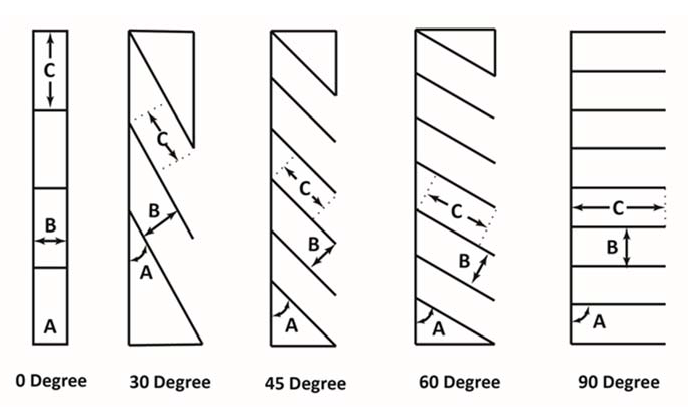
a.
Each space shall be clearly identified by surface markings at all times in a highly visible condition.
b.
The Community Development Director may grant an administrative variance to permit up to 40 percent of the parking spaces to be eight feet wide and 15 feet deep to accommodate compact cars where, in his/her opinion, the purpose of the parking ordinance can be achieved, and equal performance obtained by granting an administrative variance.
c.
Adequate interior driveways shall connect each parking space with the public right-of-way.
(4)
Interior driveways/aisle.
(5)
Surfacing, drainage and lighting. All areas intended to be used for off-street parking and driveways shall be properly drained and surfaced with material suitable to control drainage and dust problems.
a.
Surfacing and drainage.
1.
In commercial and multifamily districts, any off-street parking area for five or more vehicles shall be paved with asphalt or concrete material.
2.
In any residential district, the parking of any vehicle in the front yard or in front of the principal building line is prohibited except on a hard-surfaced or gravel driveway.
a)
Not more than 35 percent of this required front yard area shall be used for parking under any circumstance. Lots developed as of the effective date of this UDO with driveways and exterior parking areas that comprise more than 35 percent of the total lot area are entitled to exist as legal nonconforming lots.
b)
All areas intended to be used for off-street parking and driveways shall be properly surfaced with asphalt, concrete (pervious or impervious), or other impervious material, to facilitate adequate stormwater management.
c)
In any residential district, the parking of any vehicle is prohibited except on an improved asphalt, concrete (pervious or impervious), or other impervious material, to facilitate adequate stormwater management, or other hard-surfaced driveway or parking pad, or in a carport or enclosed garage with an improved surface.
b.
Lighting.
1.
If the off-street parking facilities are used at night, they shall be properly illuminated for the safety of pedestrians, vehicles and for security.
2.
The lighting shall be designed so as not to reflect into or cause unnecessary glare in any residential district and shall provide a minimum luminescence of one footcandle at pavement level.
3.
In commercial and multifamily districts, if the off-street parking facilities are used at night, they shall be properly illuminated for the safety of pedestrians, vehicles and for security. The lighting shall be designed so as not to reflect into or cause unnecessary glare in any residential district and shall provide a minimum luminescence of one footcandle at pavement level.
(6)
Interior design and perimeter landscaping. Parking lot landscaping, including any required interior islands, perimeter landscaping and median islands shall be designed and installed as identified in chapter 200, article V, buffers, landscaping and tree conservation.
(7)
Maintenance. All required surfaces and plantings must be permanently maintained in good condition and repaired/replaced when necessary to ensure continued compliance with these regulations.
(8)
Accessible spaces for automobiles and vans. Accessible spaces for automobiles and vans shall fully conform to the requirements of the 2010 ADA Standards for Accessible Design as adopted by the U.S. Department of Justice, Civil Rights Division.
(9)
Drive-in and drive through circulation. When products or services are to be provided to the public in their occupied vehicle, a vehicular circulation plan shall be submitted to the Community Development Director prior to issuing building permits. The plan shall be reviewed to determine that the circulation does not:
a.
Constitute a threat to public safety.
b.
Block access to and from required parking spaces.
(Ord. No. 08-2019, § I, 6-3-2019)
Sec. 203-5. - Prohibited use of off-street parking areas.
The following shall be prohibited in required off-street parking areas:
(1)
The display for sale of all types of vehicles except for private individuals selling one personal vehicle from a residence or a licensed dealership.
(2)
The display, storage or sales of any goods or merchandise.
(3)
Motor vehicle repair except for temporary repair to make the vehicle operable to move off site.
(Ord. No. 08-2019, § I, 6-3-2019)
Sec. 203-6. - Location of required off-street parking spaces on other property.
In commercial and mixed use districts, if the required automobile off-street parking spaces cannot reasonably be provided on the same lot on which the principal use is located, such spaces may be provided on other off-street property within 400 feet of the main entrance to the principal use and subject to the following requirements:
(1)
All required vehicle parking spaces, except required accessible spaces, may be located off-site, provided the remote parking spaces are located within 400 feet of the primary entrance of the use served and are located within the same or more intense zoning district as the principal use served.
(2)
Lease agreements must be for a term of not less than one year to serve the use or uses proposed to be satisfied by the off-site leased parking. Each year the use is renewed (as shown by the renewed application for a business license), the applicant for the business license must show a current lease agreement for not less than one year for the necessary off-site parking.
(3)
The distances referred to above are measured by the most direct route of travel on the ground and are measured in the following manner:
a.
From the front door of the principal structure on the applicant's property;
b.
In a straight line to the nearest public sidewalk, street, road or highway;
c.
Along a public sidewalk, walkway, street, road, or highway by the nearest route; and
d.
To the edge of the off-site parking area to be used by the applicant to meet parking requirements.
However, if a mixed-use project incorporates residential uses as part of the project, all residential off-street parking must be integral to the primary residential site. Other residential parking configurations may be considered and approved by the Mayor and Council.
(Ord. No. 08-2019, § I, 6-3-2019; Ord. No. 01-2023, § I, 1-3-2023)
Sec. 203-7. - Sharing of required off-street parking spaces.
One-half of the off-street parking spaces required by a use whose peak attendance will be at night or on weekends may be shared with a use that will be closed at night or on weekends.
(Ord. No. 08-2019, § I, 6-3-2019)
Sec. 203-8. - Not to exceed requirement.
In order to prevent excessive lot coverage, the artificial increase in air temperature, and an unnecessary increase in surface water runoff, no minimum off-street parking requirement in section 203-9, below, shall be exceeded by more than 25 percent unless good cause can be shown by the applicant and approved by the Community Development Director through the administrative variance process.
(Ord. No. 08-2019, § I, 6-3-2019)
Sec. 203-9. - Minimum number of spaces required.
The following are the minimum number of off-street parking spaces required. For uses not specifically listed, the off-street parking requirements shall be those of the most similar use as determined by the Community Development Director.
(Ord. No. 08-2019, § I, 6-3-2019; Ord. No. 02-2026, § IV, 2-2-2026)
Sec. 203-10. - Parking reductions.
A reduction in parking may be approved by the Community Development Director as an administrative variance under the following circumstances:
(1)
Proximity to public parking facilities. A 25 percent reduction in the number of required off-street parking spaces may be permitted for uses within 1,320 feet of a public parking facility.
(2)
Proximity to bus transit. A ten percent reduction in the number of required off-street parking spaces may be permitted for uses within 1,320 feet of an operating transit stop with service between the hours of 6:00 a.m. to 8:00 p.m. and where service intervals are no longer than 20 minutes during peak commute hours.
(3)
Private car sharing or vanpool ride sharing program. When an active on-site car share or vanpool ride share program is present, a five percent reduction in the number of required off-street parking spaces may be permitted.
(4)
Mixed-use parking calculations and allowed reductions. In cases where two or more different uses are on the same lot or within the same building, the minimum number of parking spaces shall be calculated as the sum of all required parking spaces in section 203-9, minimum number of spaces required, a 25 percent reduction in the number of required off-street parking spaces may be permitted.
(Ord. No. 08-2019, § I, 6-3-2019)
Sec. 203-11. - Business vehicle parking.
(a)
In commercial zoning districts, fleet delivery/service vehicles and fleet vehicles displaying advertising must be parked within the side or rear yard and appropriately screened from view of the right-of-way by approved landscaping and fencing materials and may not be parked within the front yard, except vehicles parked temporarily while making a delivery, providing a service, or purchasing goods or services.
(b)
In all residential districts, the parking of any business vehicle (other than an automobile, pick-up or panel truck used to provide daily transportation to and from work or a business vehicle parked temporarily while making a delivery or providing a service) and any vehicle with a carrying capacity of more than one and one-half tons is prohibited except when the following provisions apply:
(1)
Such vehicle may park within a fully enclosed structure that meets all other criteria of the zoning district and the city development regulations.
(2)
Such vehicle may park on the side or to the rear of the primary residential structure on the lot provided that the lot is five acres or larger, but in no case may be located closer than 100 feet from any property line.
(3)
Such vehicle is used for the primary purpose of transporting children to and from state licensed or accredited elementary, middle or high schools provided such vehicle is parked off any public thoroughfare, on an all-weather surface, and in the side or rear yard.
(Ord. No. 08-2019, § I, 6-3-2019; Ord. No. 12-2020, § I, 12-7-2020)
Sec. 203-12. - Residential parking management.
The following regulations govern the off-street parking, stopping and standing of vehicles and trailers within the city limits on residentially zoned property:
(1)
No more than four vehicles, including trailers, per dwelling unit shall be parked, stopped, standing or stored on any parcel of land. A parking waiver can be requested when the residents can prove that the number of cars does not exceed the number of licensed drivers in the home and the car is operable, or when the vehicle is vintage (25 years old or older). Parking waivers are subject to review and approved by the Community Development Director. There is no fee for this review.
a.
All vehicles and trailers of any kind found parked, stopped, standing or stored in residential areas that require licenses, emission stickers, tags, titles, tax payment receipts, or registration with state or federal agencies, must properly display all required certifications for operation in the state or they shall be cited as abatable nuisances under city ordinance and state law; and, if applicable, shall otherwise be cited for other registration or display compliance failures.
b.
Each residentially zoned parcel of land may have additional vehicles, including trailers, parked, stopped, standing or stored, so long as they are in a safely erected and maintained enclosed shelter, not visible from the public right-of-way or adjoining properties, where the entire floor area under the roof of the enclosed shelter is made of concrete, asphalt, gravel or other improved surface.
c.
Vehicles prohibited within residential zones include limousines, flatbed trucks, dump trucks, tow trucks, transport wreckers, tandem axle trucks, cab-on chassis trucks, tractor trailers, wheeled attachments or trailers, buses, earth moving machinery, semitrailers, and any other vehicle over 23 feet long, seven feet high, or seven feet wide.
(2)
Airplanes, helicopters, air balloons, gliders, ultra-light air vehicles, hang gliders, and/or every other device designed for air travel are prohibited from parking, standing, stopping or being stored outside of a storage building in any residentially zoned area at any time.
(3)
Ships, boats, pontoons, personal watercraft, jet skis, canoes, kayaks, paddle boats and any other devices designed for water travel, hereafter referred to as "watercraft," may only be located and/or stored in a residentially zoned area when:
a.
There are no more than two watercraft parked, stopped, or standing on each residential parcel of land; and located on an improved surface in a side or rear yard only; except that:
b.
All watercraft may be in a completely enclosed and safely erected and maintained enclosed shelter which meets the standards set forth in this section as well as section 202-3, accessory uses or structures.
c.
Watercraft alone do not count against the four vehicles and trailers allowed in this section.
(4)
Recreational vehicles (RVs), travel trailers, campers, and all other similar type vehicles, both driven and towable, may only be located and/or stored in a residentially zoned area when:
a.
There are no more than two such vehicles parked, stopped, or standing on each residential parcel of land; and the vehicle is located on an improved surface in a side or rear yard only; except that:
b.
All recreational vehicles, travel trailers, campers and all similar-type vehicles may be in a completely enclosed and safely erected and maintained enclosed shelter which meets the standards set forth in this section as well as section 202-3, accessory uses or structures.
(5)
Waivers. Residents subject to these parking management regulations may apply for a waiver under limited circumstances. Waivers will be reviewed and approved or denied by the Community Development Director. The following limited circumstances may request a waiver:
a.
Proof that each additional vehicle is needed for a licensed driver living at the residence. Each vehicle must be operable; or
b.
Each additional vehicle is vintage (25 years old or older).
(Ord. No. 08-2019, § I, 6-3-2019)
Sec. 203-13. - Plan and design standards for loading and unloading spaces.
The following are the plan and design standards for off-street loading and unloading spaces:
(1)
The loading and unloading area must be located on the same lot occupied by the use served and must be accessible from a public street or alley unless specifically approved by the Community Development Director.
(2)
The off-street loading and unloading space shall be so located that it causes a minimum of interference with the free movement of vehicles and pedestrians over a street, sidewalk or alley.
(3)
The loading and unloading area must be located to the side or rear of the building served. Loading and unloading areas shall not be located between the street and the associated building.
(4)
Loading and unloading areas are not permitted within 100 feet of a residential zoning district unless specifically approved by the Community Development Director.
(5)
Loading and unloading areas shall be paved with a durable concrete material.
(Ord. No. 08-2019, § I, 6-3-2019)
Sec. 203-14. - Minimum size and number of loading and unloading spaces required.
The minimum number and size of off-street loading and unloading spaces required are as follows:
(1)
For the purpose of this section, an off-street loading and unloading space shall have the minimum dimensions of 12 feet by 40 feet by 14 feet of overhead clearance.
(2)
The minimum required number of loading spaces are as follows for retail business, office, wholesale, industrial, governmental, and institutional uses, including public assembly places, hospitals and educational institutions:
(Ord. No. 08-2019, § I, 6-3-2019)
Sec. 203-15. - Bicycle parking.
(a)
Developments in all commercial, mixed-use and industrial districts shall provide bicycle parking spaces at a ratio of at least one bicycle parking space for every 20 automobile parking spaces.
(b)
No development shall have fewer than three bicycle parking spaces nor be required to exceed a maximum of 20 spaces.
(c)
Bicycle parking shall provide an inverted U steel frame or decorative rack approved by the Development Director. The rack shall be anchored to a concrete pad.
(d)
Each required bicycle parking space must be at least two feet by six feet. Where a bike can be locked on both sides of a bicycle rack without conflict, each side can be counted as a required space. Two feet wide by two feet and six inches long.
(e)
Bicycle racks must be securely anchored, be easily usable with both U-locks and cable locks, and support a bicycle at two points of contact to prevent damage to the bicycle wheels and frame.
(f)
Bicycle racks must be publicly accessible and be located no more than 100 feet from the building entrance the bicycle rack is intended to serve.
(g)
Bicycle parking must be provided in a well-lit area.
(h)
Spacing of the bicycle racks must provide clear and maneuverable access. Bicycle facilities may be placed within the public right-of-way, provided the encroachment is approved by the Director.
(Ord. No. 08-2019, § I, 6-3-2019)
Sec. 203-16. - Design of parking decks or structures.
The façade design of parking decks or structures shall be reviewed by either the Architectural Review Board or the Historic Preservation Commission and design shall be commensurate with all design requirements outlined in the architectural and site design standards.
(Ord. No. 01-2023, § I, 1-3-2023)

